Showing posts with label Cockpit Theatre. Show all posts

Saturday, 7 August 2021

Tête-à-Tête Opera Festival (2) – The Unravelling Fantasia of Miss H. (world premiere), 5 August 2021


Cockpit Theatre

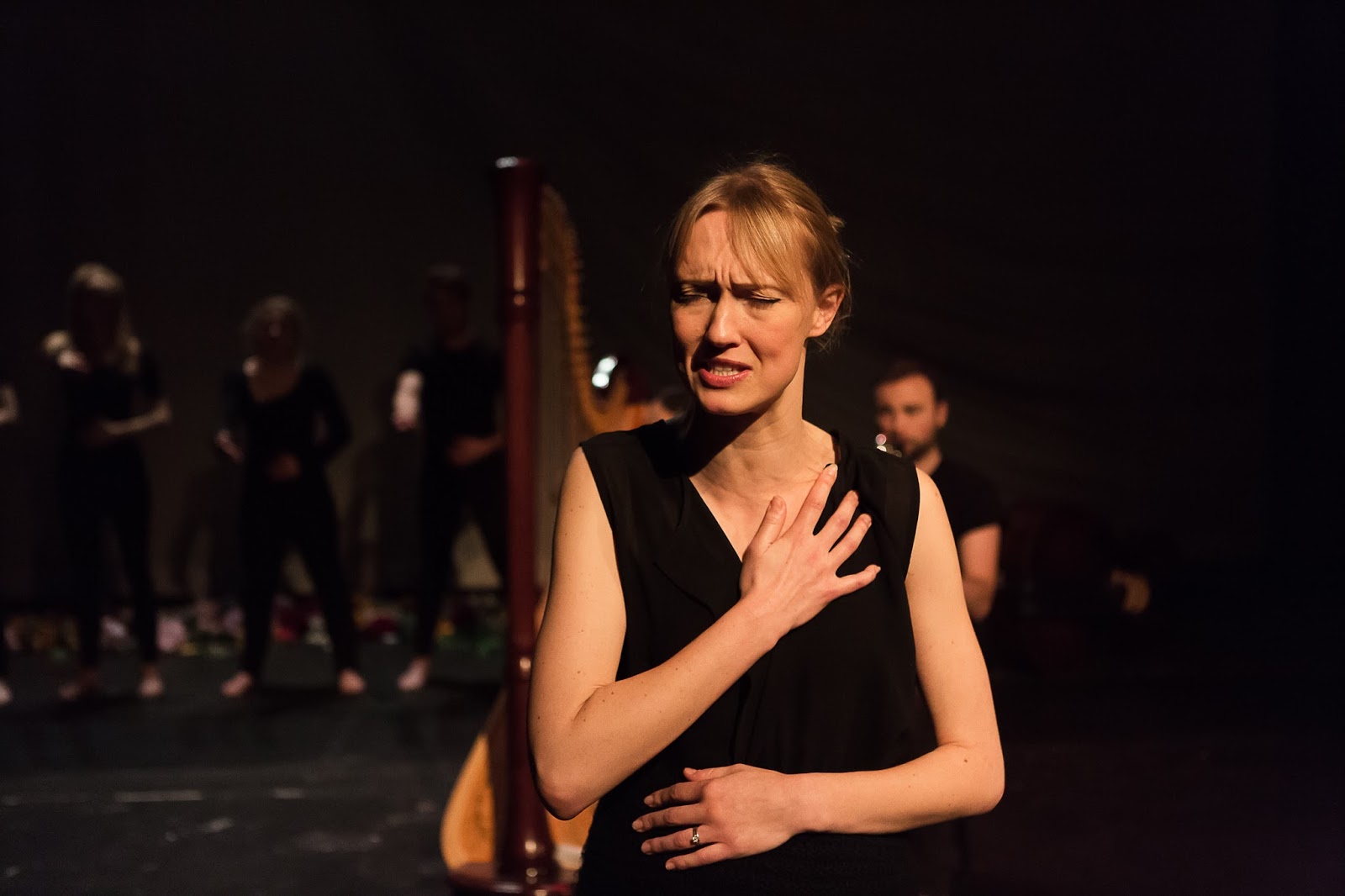
Mary Matthewson (Sarah Nicolls), Mary Frances Heaton (Red Gray)
Images: Claire Shovelton


Mary Frances Heaton (voice) – Red Gray
Mary Matthewson (inside out piano) – Sarah Nicolls
Overseer/Asylum Attendant – Katie Webster

Zoe Bouras (director)
Katie Webster (movement)
Kristina Jjelm (lighting)
Rosie Whiting (costumes)


A fascinating evening encountering The Unravelling Fantasia of Miss H.: perhaps more a resourceful theatre piece with music than opera, though it had something of music theatre to it too. As with other instalments in Tête-à-Tête’s 2021 Opera Festival, though, we should not get bogged down with what ‘is’ or ‘is not’ an opera. Sometimes it matters, for instance when that question proves an intrinsic part of the work and its challenge, but that was not the case here.

Mary Frances Heaton, Overseer (Katie Webster)


Stitched-up-Theatre here presents the tale of Mary Frances Heaton, words and music formulated together by Red Gray and Sarah Nicolls, who also played respectively the title role and a fellow inmate, a second Mary, Matthewson. Mary Frances Heaton was arrested in 1837 for a breach of the peace, having insisted on payment from a clergyman for one of her lessons. She was sentenced to life imprisonment at Wakefield’s Pauper Lunatic Asylum and never saw the light of day again. Using words from medical reports and her own words, sewn into patients’ clothes and samplers she embroidered—also part of the designs—Gray and Nicholls have told and reimagined her story in a way that can hardly fail to elicit sympathy and outrage at the injustice, Katie Webster’s vicious roles as Overseer and Asylum Attendant speaking more broadly of societal attitudes towards both women and those judged to be ‘lunatics’, electric shocks to the pelvis included. Vocal style ranges from popular song to art song to something more operatic, moments of transition often particularly telling in performance.


On the ‘inside out piano’, her own invention, Nicolls offers music and performance ranging from conventional salon music to ‘prepared’ contemporary. All the time, the arresting image of her instrument contributes its own visual aesthetic and, perhaps, if one wishes, Foucauldian social commentary. There is more minimalist music using asylum cutlery and crockery, enabling responsorial sympathy and solidarity between the two Marys. And there is dramatic physicality in the movement of sheets, both figurative and more realistic. As we take our seats, there is introductory piano music by the nineteenth-century English pianist and composer, Kate Loder: a welcome opportunity to hear music clearly influenced by Chopin and other early Romantics. Had I realised what it was, I should probably have listened more keenly. That doubtless tells its own story.


This is Mary Frances Heaton’s story, of course: a tribute to her spirit and an indictment to the society that crushed it. We might have seen and heard things differently, had it been that of Mary Matthewson or someone from the authorities. But that is part of the point; other untold stories can be told too. This one, absorbing and sympathetic, is very well worth telling, seeing, and hearing.

Monday, 7 June 2021

L'Egisto, HGO, 5 June 2021


The Cockpit

Egisto – Martins Smaukstelis
Climene – Astrid Joos
Lidio – Alex Pullinger
Clori – Caroline Taylor
Hipparco – John Holland-Avery
Amore – Helen Lacey
Semele, Bellezza, Hora Seconda – Charity Mapletoft
Venere, Dedra, Hora Quarta – Oliva Carrell
Dema – Emily Kyte
Volupia, Didone, Hora Terza – Helen Daniels James
La Notte – Laurence Gillians

Marcio de Silva (director, lighting)
Madeline de Barrié (assistant director)
Christian Hey (designs)

HGO Baroque Orchestra
Marcio da Silva (music director)


HGO (formerly Hampstead Garden Opera) led the way after the first lockdown with opera’s return to London, in the guise of an outdoor performance of Holst’s Sāvitri at Lauderdale House. Five miles or so away, at Marylebone’s Cockpit Theatre, it proved if not quite the earliest, then one of the earliest, to return to the fray this time round, with Francesco Cavalli’s (and Giovanni Faustini’s) L’Egisto of 1643.


The second of Cavalli’s collaborations with Faustini, L’Egisto proved influential and popular beyond Venice, travelling to Naples and many other nascent centres of opera across the Italian peninsula. It even travelled with Cavalli to Paris, to be performed in 1646 at the behest of Cardinal Mazarin, determined yet frustrated in his every attempt to establish Italian opera on a permanent basis in the French capital. (Mazarin would later commission Cavalli’s Ercole armante for Louis XIV’s marriage to Maria Theresa of Spain, though neither opera nor théâtre à machines was ready in time. It would be performed two years later, in 1662, Cavalli’s Xerse quickly substituted—and highly popular.) The renaissance in Cavalli’s fortunes, if not quite initiated by Raymond Leppard, then nonetheless incalculably in his debt, saw L’Egisto among the earlier Cavalli operas to return to the stage, Leppard realising the work for Santa Fe in 1974 and Scottish Opera eight years alter. Marcio da Silva, acting both as stage and music director, now gives a reading for our time, doubtless less lavish than Leppard’s, but our moment is hardly one given to lavish operatic presentation. Rightly or wrongly, it tends to favour ‘original instruments’ and a less ‘interventionist’ approach than what Jane Glover described, in her review of Leppard’s score, as ‘look[ing] upon the surviving material rather as a lump of modeller’s clay, which he [Leppard] moulds skilfully into shapes which he knows will please modern audiences. In so doing, he departs from original practice, often quite violently.’


There was certainly no such violence here, whether in the pit or on stage. Given in the round, the boundary was not in any case entirely distinct, though there was no dramatic mixing of function to match that combination of roles in our dual director’s case. The ebb and flow of the score and its realisation—or whatever we want to call it—by Marcio da Silva and Cédric Meyer very much complemented the scenic action, presented in some ways simply, yet far from neutrally. A small yet colourful band—harpsichord, organ, lute, baroque guitar, two violins, gamba, cello, two recorders, and sparingly employed percussion—did not suggest, at least not in this small, socially distanced theatre, that Cavalli’s music cried out for more. Rather, it furnished a crucial harmonic backdrop of imagination, against which the human voice could be heard and human gesture seen. If I cared less for the folk-like excursions now expected in early opera performances of a certain school, they were rare and clearly relished by the players, whose pleasure it would be churlish unduly to begrudge. With Sebastian Gillot, assistant music director, at the keyboard, much was possible and realised in aural tapestry, but also much was offered in support to the singers, the continuo ensemble flexible enough to be reinforced with a minimum of fuss where necessary.


A staging that relied on distance, on separation, and on mischief and anguish in their wake was doubtless developed with our current predicament in mind, yet fitted very well with a plot in which two couples, separated, must find, recognise, and learn to love one another again (though do they?) The passing of a single day, respecting the old dramatic unities, is symbolised by the passage of the sun above (this Egisto a descendant of Apollo, not the Aegisth we know from Elektra). Curtains of separation that could be seen through, or not, did much that was necessary. Singing to and past each other, touching or, more often, failing to do so, spoke to us clearly yet far from clinically. Touches of blood-red brought colour with dramatic impact predicated on an overall economy of means. Elements of cross-dressing reminded us of where Cavalli, much to Leppard’s sorrow, ended up: ‘plots … of such a ridiculous complexity that it is doubtful if anybody could ever have known, or cared, what was happening on the stage once the disguises had got under way’. But with Faustini, as Leppard remarked in the liner notes to his recording of L’Ormindo, Cavalli ‘responded to the best libretti with his best music’.


To make it so, of course, requires not only sensitive continuo realisation but also sensitive—and dramatic—vocal artistry. Here a number of singers excelled, showing considerable stage gifts too. Martins Smaukstelis was first among equals as Egisto, wounded, external heroism and inward anguish expressed by all manner of subtle gradations. Astrid Joos as Climene and Caroline Taylor as Clori offered complement and contrast in their soprano roles, expression lying very much within the precision of their performances. Helen Lacey’s Amore schemed and sulked by turn, vocally and visually. This was, however, very much an ensemble piece, with all involved, musical and directorial teams alike, contributing to the musico-dramatic whole. Recommended—even without the bonus of drinks brought to your seat. There are two, alternating casts; I saw the second.

Wednesday, 14 December 2016

The Winter’s Tale, The Hermes Experiment, 13 December 2016


Cockpit Theatre, Marylebone

 
Images: Cathy Pyle

Leontes – William McGeough
Hermione – Sadie Parsons
Polixenes, First Gentleman – Robert Willoughby
Paulina – Louisa Hollway
Mamillius, Camillo, Antigonus, Officer, Second Gentleman – Christopher Adams
Perdita/Soprano – Héloïse Werner
Florizel – Stephen Williams (clarinets)
Anne Denholm (harp)
Marianne Schofield (double bass)

Kim Ashton (composer) 
Nina Brazier (director)
Sophie Mosberger (designs)
Damian Robertson (lighting)
Hanna Grzeskiewicz and Héloïse Werner (co-producers)


Much of the most interesting art of our time seems to ask questions of us rather than to answer them. Sociologically, there are doubtless many reasons for that, many of them blindingly obvious if we pause to consider the world around us. (And who amongst us is not doing that at the moment?!) That is certainly my experience of most recent worthwhile opera (theatre, more broadly) staging. Our lot, whether we like it or no, is metatheatrical, and a good deal of other meta-things too. On the whole, I like it; I certainly value it.


In that spirit, this new ‘musical reimagining’ of The Winter’s Tale from The Hermes Experiment asked questions of itself and of us, not least concerning genre. I had been expecting an opera of some sort; that was certainly not what I got. We heard an hour’s worth of Shakespeare’s text, very well delivered, well acted too, with music. Rarely were words and music opposed, although sometimes they were. There were elements of song, but more often, boundaries between words, music, and gesture (I always seem to fall back upon Wagner at some point), between actors and musicians, between most components present or believed to be present, were questioned, blurred, negated, perhaps even, dare I suggest it, transcended.  

Polixenes (Robert Willoughby)


Adaptations have long been part of Shakespearean reception; there would be little reception to speak of without them. Garrick’s Florizel and Perdita is an obvious example here; (semi-)opera-lovers will immediately think of Purcell’s Fairy Queen. There was no pastoral, but so what? No one was claiming this to be a performance of the ‘original’; insofar as I thought of what this ‘was’, or perhaps better of where I might locate it, somewhere between a version with incidental music and a (mostly spoken) cantata-cum-music-theatre-piece might have come closer than many attempts. But I did not really spend my time trying to locate what I saw and heard. I took it, I hope, for what it was, and enjoyed it, my Shakespearean appetite whetted rather than sated. When contrasted with the bizarre Glyndebourne-Royal Opera House Macbeth opera, I know which I found more involving, by a country mile.


Kim Ashton’s name was given as composer, but not in the traditional top billing, for this seems to have been a genuinely collaborative effort. I was put in mind of Schoenberg’s futuristic vision of studios at musical work: ironic, given his emphatic self-understanding – ours too, surely – as Teutonic, Romantic ‘genius’. Here, however, there was nothing ironic, nor falsely modest. As Ashton himself explained in the programme, ‘My position as ‘composer’ of the piece is precarious: while my name appears at the top of the score (a compilation of instructions, including only sparse musical notes), the music is as much by The Hermes Experiment as it is by me, since most of what you will hear is being improvised live, according to musical shapes and behaviours agreed in advance.’ That would only work, at least in the sense that it did here, with excellent preparation, for which director, Nina Brazier should, I presume take a good deal of credit too, likewise everyone else involved.  

Hermione (Sadie Parsons) and Perdita (Héloïse Werner)

For instance, again to quote Ashton, ‘The “folk song”,’ which certainly had that air, ‘in the second half is a case in point – particularly since it is the first tonal piece I have ‘composed’ in about 15 years!’ (As Schoenberg admitted, there were still good tunes to be written in C major, although this was not, if I remember correctly, in C.) ‘When someone suggested that a folk song would suit one scene well, the soprano Héloïse [Werner] sketched out its opening melody; I then fleshed this out into a rough whole; finally Héloïse, Anne [Denholm] (who plays it later on the Harp) and I all tweaked it here and there until I no longer remember who was originally responsible for which note.’ The darkness of the bass clarinet and its interjections made their points, not necessarily translatable into words; so too, did the harmonic – and melodic – resonances of the double bass.


Similarly, actors came close to music – do they not always, in Shakespeare? – and in some cases, definitely crossed any such a boundary. The inability to handle Shakespeare’s verse – there are many ways, of course, but there are also failures – is the bane of many a contemporary Shakespeare performance. Not here, for all conveyed both its beauty and its meaning, Robert Willoughby perhaps my favourite in the former respect. William McGeough offered a subtle portrait of wounded masculinity as Leontes, Sadie Parsons an intriguing voice (Hermione) whom we wanted to believe, and whom we knew we were correct to believe, but who could yet sow some of that doubt experienced by Leontes. I could go on, but it was a company effort, symbolised perhaps, by Héloïse Werner’s wordless soprano – a voice from beyond in more than one sense, I think – becoming Perdita. Likewise, instrumentalists (the other members of the Hermes Experiment all outstanding) were called on not only to employ extended techniques but also, music-theatre-style, to participate in the ‘dramatic’ action.

Hermione 

There was, then, a particular, one-off sense of enchantment to the night’s proceedings. I shall not say ‘more, please’, since that would seem rather against the spirit of what was seen and heard; I was, though, delighted to have been there.