Showing posts with label BBC Symphony Orchestra. Show all posts

Sunday, 5 October 2025

BBC SO/Oramo - Mahler, 4 October 2025


Barbican Hall

Symphony no.9

BBC Symphony Orchestra
Sakari Oramo (conductor)


Mahler’s Ninth Symphony is not a young person’s work—a young person as conductor, that is, not as listener or indeed orchestral musician. There will be exceptions; there always are. It is not, though, a work to be rushed into; frankly, no Mahler symphony is, though that has not stopped many. That is not, of course, to say it need be an old person’s work; Mahler, after all, was in his later forties when he wrote it. Coincidentally or otherwise, Claudio Abbado was more or less – very slightly less, I think – the same age when he first conducted it. It benefits, at least, from a degree of maturity: musical, but also emotional and intellectual. Serious musician that he is, Sakari Oramo has wisely left it until last. There was no doubting, though, the preparation that had gone into this, his first time conducting the work. He had its measure and communicated it well to a packed Barbican audience, drawing out the best from the BBC Symphony Orchestra, of which he is now its longest serving conductor. I hope we shall hear it again from him before long, but this was an auspicious, well-considered, and well-timed debut, taking nothing for granted and thereby resulting in a fresh, convincing performance of a work whose confrontation with mortality and what might lie beyond can, given the present state of the world, rarely have spoken more personally or necessarily. 

The opening was tentative and uncertain in the right way: that is, such was its mood, not a characterisation of the playing. The vast Andante comodo, often accounted Mahler’s single finest sonata-form achievement, built slowly and, by contrast, certainly. Yet, almost before one knew it, there came the first great orchestral cri de cœur, with all its multivalence and complex ambiguities. The music continued to sing, as it must. Variegated string playing, articulation in particular, was detailed – Mahler’s instructions are nothing if not detailed – and yet without fuss. How malevolent the darker timbres and harmonies sounded. I was put in mind of an observation by Adorno concerning Parsifal, so rich in implication for late Mahler in particular, of ‘eine düstere Abblendung des Klangs’, a ‘lugubrious dimming of sound’ that yet left space, even necessity, for agonies, such as those of Parsifal in and after Wagner’s second act, to play out. This was especially the case for the wind – shades of Kundry as ‘rose of Hell’ – even to the extent of according to an edge, in context rather than by design, to the purity of Daniel Pailthorpe’s flute solos, and certainly to those harp phrases (Elizabeth Bass and Elin Samuel) on the threshold of the Second Viennese School. The greater trajectory was all there, but it was properly built from detail; a broad brush, if every appropriate, could hardly be less so. Form and, if one may call it this, musical narrative unfolded with an urgency that had everything to do with understanding and nothing to do with minutes on the clock. Urgency does not and never should equate to mere speed. If, just occasionally, I felt that climaxes might have opened up further, in retrospect that single-mindedness was amply justified; far better that than sentimentalism, and there is no single way here. More importantly, the music peaked neither too early nor too frequently. Grief-laden, yet anything but mawkish, it seemed to suggest, even to say: this is how the world is. And it is, is it not? When consolation came, it had been earned and came from within. A sense of return at the movement’s close was not a case of full circle, but of revisitation given what had passed in the meantime. 

Oramo and the orchestra offered a splendidly deliberate foundation, its strength and integrity almost Klemperer-like, on which the ambiguities of the scherzo could rest, and/or from which they could grow. Overused it may be, but it is difficult not to reach for the word sardonic. Puppets danced above the abyss, somehow suspended from something that would not let them fall, something or even someone that may not, perhaps cannot, be named. Bruckner night at Wozzeck’s tavern ceded, or at least shared the stage with, sounds of the Prater and, more distant, more insidious, strains of Götterdämmerung. A Ländler corroded and transformed: what did it mean? And again, who might say? Yet, that it had meaning, whether or no it could be put into words, could hardly be doubted: a Viennese dream that not only permitted but demanded interpretation. 

The Rondo-Burleske, ‘sehr trotzig’, raged with a malevolence that may have been intrinsic or may have reflected a world to which the music ‘itself’ reacted. There was, at times, especially earlier on, a smile too, though by the close it would be but a bitter memory. Again, there was an impression of marionettes playing out their drama, or it being played out for them, through them. Who pulls the strings? Driven equally by harmony and counterpoint, it offered a final Mahlerian tribute, beleaguered and yet in its way triumphant, to Bach. Marching bands would not, could not fall silent. Indeed, for a few heartrending moments, the world of the Third Symphony seemed if not to return, then to be fondly recalled, only to be banished by something closer to the spirit of the Sixth. 

The finale followed attacca, its opening as rich in compassion as in texture and in string sentiment expressed with – not dependent on – vibrato. There were still daemons to be exercised, but there was, it seemed, a God—and He might just aid us. Clear reminiscences of the first movement made clear the nature of the journey we had taken. Violin tone was transmuted from gold into silver, even for a moment into ice that chilled the bones. There would be no easy to path, yet we could trust that there was one. Stoically, Mahler summoned the reserves to keep going. For the lights might be going off – one could hear and almost see them, one by one – but there was no alternative. The Mahlerian subject somehow, somewhere remained, a voice of humanity, the hymn’s ‘still small voice of calm’, or even a peace that passed all understanding. Having passed through a weird twilight zone, metaphysical (Wagner, Schoenberg, and others) and even political (Nono, I fancied, might have divined the Gramscian ‘Now is the time of monsters’), and having refused to let go, humanity spoke—and sang. In a ghostly revisitation of Haydn’s Farewell Symphony, there was a flicker: maybe of hope, maybe even of peace, unquestionably of something. Music bore witness.

(The performance will be broadcast on BBC Radio 3 on Thursday 16 October at 7.30 p.m.; it will be available for thirty days thereafter on BBC Sounds.)


Tuesday, 5 August 2025

BBC SO/Lintu - Boulez and Mahler, 4 August 2025


Royal Albert Hall

Boulez: Rituel in memoriam Bruno Maderna
Mahler: Das klagende Lied

Carlos Gonzales Napoles (treble)
Malakai Bayoh (boy alto)
Natalya Romaniw (soprano)
Jennifer Johnston (mezzo-soprano)
Russell Thomas (tenor)
James Newby (baritone)

Constanza Chorus (chorus master: Joanna Tomlinson)
BBC Symphony Chorus (chorus master: Neil Ferris)
BBC Symphony Orchestra

Hannu Lintu (conductor)

For my generation, as well as for me personally, Pierre Boulez’s Mahler was probably the most influential of all. My Mahlerian coming of age coincided with his decisive return to the composer, as recorded by Deutsche Grammophon. I recall hearing music from the Sixth Symphony for the very first time, on Radio 3’s Building a Library and immediately rushed out to buy the CD. I would hear Boulez conduct the work live twice, with the LSO in 2000 and with the Staatskapelle Berlin in 2007 (during those extraordinary Festtage in which Boulez and Daniel Barenboim between them performed all of the completed symphonies and most of the orchestral songs). Alas, I never heard him conduct Das klagende Lied, though he recorded it twice. Nor, unless I am forgetting, did I hear him conduct his Rituel in memoriam Bruno Maderna, though I was privileged to hear him conduct much of his music. (Alas, no Répons either, though surely the Ensemble Intercontemporain in 2015 continued to bear some of his imprint.) If London tributes to Boulez in his centenary have not been so plentiful as one might have hoped – surely Répons would have been in order somewhere – then many of us will continue to hear his repertoire through a Boulezian lens, not least when given by an ensemble such as the BBC Symphony Orchestra.

Rituel emerged paradoxically – a mixture, perhaps itself paradoxical, of dialectic and mystery – out of something and nothing: not quite creatio ex nihilo, but not entirely unlike it either. The precedent of Berg’s op.6 Orchestral Pieces came strongly to my mind, but there are many others too. That quality of being neither one nor the other and of the music lying in that encounter extended to other apparent oppositions too: subjective and objective; involved and observed; regular and irregular (though never imprecise); tuned and untuned (though never, it seemed, unpitched). But above all, this was an immersive ritual, in which order and process, heard and felt, revealed.  Arabesques, flourishes, spirals, repeated experience of a figure so familiar from the composer’s future, all unfolded in eminently ‘natural’ fashion, Hannu Lintu knowing precisely when to conduct and when not. (In that, he reminded me of Peter Eötvös in a 2015 performance with the LSO.) It was a procession for the ears but also for the eyes, the spatial element readily appreciable in both ways. A mass of detail combined into something both complex and remarkably simple, or so it seemed. An array of different attacks on a single triangle was not only palpable, but connected with other musical parameters on that instrument, with others in its instrumental group, and beyond to other groups, mirroring, responding, combining. Reverberation, timbre, pitch, and so much more grew indissoluble: the very idea of serialism, one might say, as a musical and emotional necessity. Ultimately, it was the mesmerising, well-nigh Mahlerian quality that remained with us, long after the music had ceased; indeed, one doubted that it had ceased. 

For Das klagende Lied, the Proms programme heading (not Monika Hennemann’s informative programme note) told us we should hear the ‘original version, 1830’: a rarity indeed from thirty years before Mahler’s birth, contemporary with the Symphonie fantastique. This mysterious prenatal version, however, sounded pretty much the same as the more familiar ‘original’ written between 1878 and 1880 and could be experienced as such. Boulez gave the first British performance and made the first recording of the excised first movement, ‘Waldmärchen’. (His two recordings of the cantata as a whole are of the 1898 revision, as was his 1976 Proms performance.) One can go round in circles discussing versions, revisions, and editions, often to little avail. Suffice it to say I should always rather hear the full three movements; more to the point, Lintu and his musicians duly vindicated that choice. 

It was fanciful, no doubt, but in context perhaps not entirely absurd to hear the opening emerge similarly to that of Rituel, before taking a very different path. Mahler’s ‘voices’, as Julian Johnson has shown, are many. One of the many striking things about this work in particular is how many of them already seem to be here: not only stylistic traits, compositional method, even thematic material, but aspects of subjectivity such as we had already heard explored in Boulez’s work. ‘The great novel is sketched,’ as Boulez once wrote of this cantata, and we should ‘read its chapters progressively in the works to come’. From this orchestral introduction to ‘Waldmärchen’, Lintu seemed to have the music’s measure. If, occasionally, I found he drove a little hard, more often there was splendid flexibility, the BBC SO responding in further hallucinatory quality to his direction, Romantic vistas opening up before our ears. The Lied elements of this movement were also clear from the outset, or at least from when voices entered, as was Mahler’s Wagnerian inheritance. Uncanny choral singing – here from outstanding joint forces of the BBC Symphony Chorus and the amateur Constanza Chorus – already imparted a ghostly element, doubtless founded in German Romanticism but extending far beyond it; again in context, the versicle-response quality to Rituel endured. At least from where I was seated, the female solo voices made greater impact than tenor and bass, but that may have been as much a matter of acoustics as anything else. Natalya Romaniw switched from almost instrumental blend with Mahler’s woodwind to hochdramatisch declamation. Jennifer Johnston sounded splendidly Erda-like, harps a further Ring-echo. If there were inevitable echoes of Götterdämmerung in the choral writing, what struck in general was how little could have been written by anyone else, how intensely, convincingly personal this music was already. Harmonic coincidence with – at this stage, it could not be influence from – Parsifal, aptly enough on the words ‘Ihr Blumen’, pointed back to Tristan und Isolde, though again spoke clearly on its own merits. 

That sense of a page turning, of a new ‘chapter’, was readily apparent in the orchestral introduction to the second movement, ‘Der Spielmann’. One could almost see the illumination, even the script. Chorale snatches disconcertingly yet unmistakeably pointed to the Mahlerian future, the Rückert world of the Fifth and Sixth Symphonies. Courtly echoes of Wagner’s ‘Romantic operas’ Lohengrin and Tannhäuser cast their spell, off-stage bands suggesting the former’s festivities turned (still more) sour. Johnston’s perfectly judged match of emotional intensity and humanity helped the tale on its way, at the close of the movement turning to an inheritance from Waltraute. The two boy soloists sang very well so far as I could tell, though evident amplification (perhaps necessary, though a pity) made it difficult to discern more. Throughout, the orchestral narrative was both founded in and punctuated by Mahler’s fateful descending scales. That is the composer’s doing, of course, but it was also a matter of performance to have it felt in our bones. The riotous celebration of the final ‘Hochzeitstück’ was, quite rightly, never without its dark side. The ‘proud spirit’ of the ‘proud queen’ was always going to be broken. Mobile telephone (really!) notwithstanding, the hushed close rightly took its time and made its mark.


Friday, 25 July 2025

Hadelich/BBC SO/Oramo - Stravinsky, Mendelssohn, Davis, and Strauss, 24 July 2025


Royal Albert Hall

Stravinsky: Chant du rossignol
Mendelssohn: Violin Concerto in E minor, op.64
Anthony Davis: Tales (Tails) of the Signifying Monkey (European premiere)
Strauss: Till Eulenspiegels lustige Streiche, op.28

Augustin Hadelich (violin)
BBC Symphony Orchestra
Sakari Oramo (conductor)

Stravinsky seems unfashionable in London right now. Maybe it is my imagination, or maybe it is a consequence of increasingly non-existent public funding that what once stood at the very core of twentieth-century repertoire is now not considered ‘safe’ enough. I am sure, though, we used to encounter his music more frequently. Like the opera from which it is drawn, the Chant du rossignol seems always to have been curiously neglected. Goodness knows why; both are magical works and not obviously ‘difficult’. Boulez was, of course, a persistent and compelling advocate. It is perhaps especially fitting, then, that the BBC Symphony Orchestra should programme the work in his centenary year for the music festival at which Boulez was a longstanding, greatly valued guest, probably in no composer more often than Stravinsky. 

Sakari Oramo’s predecessor would surely have admired the éclat with which this performance opened and might well have heard more than a little of his own compositional history in what followed. Not that Oramo neglected Stravinsky’s ‘Russianness’ in a colourful, detailed, incisive, and magical performance that also boasted a good measure of Debussyan languor when called for, humour too (for instance in downward trombone slide). Echoes – more properly, pre-echoes – of Petrushka and The Rite of Spring were to be heard in harmony, metre, timbre, and much else. Narrative was clear and meaningful, in what duly sounded as a drama in (relative) miniature. Perhaps, though, it was the haunting stillness at the work’s heart that lingered longest in the memory. Solos – flute, violin, trumpet, and others – were all finely taken by BBC SO principals. I have little doubt Boulez would have loved the harp playing too. 

I cannot recall offhand whether Boulez ever conducted the Mendelssohn Violin Concerto, but I imagine he might have done. He certainly admired the composer’s orchestral music, contrasting it and that of Berlioz to Schumann’s, in that one would never retouch or rebalance, given the composers’ perfect scoring. The opening is tricky, though it should never sound so—and certainly did not here, in a beautifully ‘natural’-sounding performance of the first movement that flowed fast without ever sounding rushed. Conductor, orchestra, and the simply outstanding soloist Augustin Hadelich captured Mendelssohn’s world, emotional as well as stylistic, to a tee. A poignant second subject was never remotely sentimentalised. Indeed, all had just the right sort of Romantic ardour and humanism to it. There was a wonderfully fresh sense of discovery too; at times, one might almost have been hearing it for the first time—and doubtless some in the audience were. The movement’s concision once again astonished me: seemingly over before it had begun, and just as dramatic in its different way as the Stravinsky. Transitions between movements were equally well judged, the central Andante given with a rapt lyricism that was far from restricted to the violin. Unendliche Melodie, as Wagner might have been compelled to admit. Like the concerto as a whole, it was deeply moving without evidently trying to be. An elfin finale, as infectious as anything in the Midsummer Night’s Dream music, emerged bright as a button, Hadelich’s playing both splendidly old-world and very much of now. The encore – which I have had to look up – was his own arrangement, effortless in idiom and despatch, of Carlos Gadel’s ‘Por una cabeza’. 

It is probably better to pass over what Boulez might have made of the European premiere of Anthony Davis’s unabashedly tonal Tales (Tails) of the Signifying Monkey, drawn from his opera of the same year (1997) Amistad. Davis clearly has a fondness, as his admirably informative programme note made clear, for unsual metres: dances in 11/8, 13/8, and so on. Likewise for ostinato: perhaps one of Stravinsky’s deadlier legacies. He knows what he is doing in writing for the orchestra too, and deftly brings in sounds from the jazz world. I could not help thinking, though, that what we heard sounded considerably over-extended and might have worked better illustrating a television series. Applause was polite yet reticent; I think the audience had it right. The United States is truly a foreign country, nowhere more so than its musical culture. (Consider Boulez in New York.)

Till Eulenspiegel is a relatively rare example of a Strauss work Boulez conducted. There is an excellent live recording with the Chicago Symphony Orchestra, once released by the orchestra itself and which seems to be available on YouTube too. How different things might have been, had Wieland Wagner’s death not brought to an end the prospect of Boulez and him collaborating on Salome, Elektra, and Ariadne auf Naxos. An endearingly, acutely strange commercial recording of Also sprach Zarathustra suggests they would have been as different from hitherto received wisdom as the Wagner and Mahler that changed the way we hear and understand that music forever. Back to the present, Strauss’s tone poem received a finely judged performance from Oramo and the BBC SO that lacked nothing in requisite virtuosity, yet likewise did not take that virtuosity for musical substance. If I found it occasionally a little hard-driven, there was plenty of flexibility where called for. Episodes were discerningly characterised whilst taking their place in the grander narrative. Counterpoint was admirably, necessarily clear, characters and situations leaping off the page. The BBC may have been in anything but safe hands since Boulez’s time; Radio 3 is now reduced to screaming ‘Adventures in Classical’ from garish banners hung around the Royal Albert Hall. Its eponymous Symphony Orchestra continues to do very well indeed.


Monday, 21 April 2025

Komsi/BBC SO/Oramo - Howell, Weill, and Mahler, 16 April 2025


Barbican Hall

Dorothy Howell: Lamia
Kurt Weill: Der neue Orpheus, op.15
Mahler: Symphony no.4 in G major

Anu Komsi (soprano)
BBC Symphony Orchestra
Sakari Oramo (conductor, violin)

Placing little-known music with a Mahler symphony might be thought both a sensible and high-risk strategy. It will almost certainly result in the music gaining a wider audience. In the case of Dorothy Howell, though, it is difficult to imagine many wishing to extend that acquaintance. To be fair, she was young when she wrote Lamia, premiered (1919) and championed by no less than Henry Wood. Maybe there are better pieces from later on in her career. The muted reception accorded to a committed performance from the BBC Symphony Orchestra and Sakari Oramo said it all, alas. I cannot imagine anyone would have divined inspiration in Keats without being told so. An opening two-flute figure intrigued; like everything else, it led nowhere in particular. This was a tone poem that might just about have appealed as to those for whom Delius’s music is too goal-oriented and too radical in musical language. If introductions to introductions to introductions were your thing, you might still find it featureless, though there usually seems to be an English ‘enthusiast’ market for rhapsodic expanses of lateish-Romantic sound. 

Weill came, then, as a relief, in a rare opportunity to hear his 1925 cantata Der neue Orpheus. It continued a vaguely Grecian theme, yet is anything other than nostalgic, setting Yvan Goll’s ironic, surrealist – perhaps ironically surrealist – poem in a witty set of musical parodies taking us from Clementi to Wagner via Stravinsky, Mahler, and other milieux. And that is only one central section of its twenty-minute span. (Howell, apparently, was significantly shorter, yet felt longer.) Can one hear absence? Almost certainly, if only contextually. The absence of violins in the chamber orchestra was surely felt in that sense at least, in typically wind-led sound, adopted with immediate security and conviction of idiom by the BBC SO. The orchestral introduction, imbued with a keen sense of drama, might have been the opening to an opera. Vividly communicative, Ana Komsi’s account of the text relished its surrealism but also the humanity seemingly gained (shades already of the uneasy collaboration between Brecht and Weill?) by its alchemic conversion into vocal music. . ‘Everyone is Orpheus. Who does not know Orpheus?’ Such apparently lofty universalism was immediately deflated, even alienated, by banal detail of his vital statistics and personality. Increasing presence of Busoni in the orchestra was splendidly brought out by Oramo, reminding us not only of the identity of Weill’s teacher, but of the conductor’s recent outstanding account of his Piano Concerto, Pierrot- as well as Orpheus-like, Oramo took up his violin, as sounds of the circus took us closer to the world of Mahagonny and, especially notable, that of The Soldier’s Tale. 

If Goll and Weill’s Orpheus moved its audience in performance of a Mahler symphony, so did his interpreters. Not quite what I was expecting, this Mahler Fourth was arguably more dramatic in a stage sense and less Classical than most. It was not so much that movements in themselves and in relation to one another seemed to have been conceived separately as that conception apparently having been born more of contrast than line, even continuity. The first movement’s opening was more deliberate than usual, really holding back before launching into a spirited first subject. It had charm, style, precision, heart, and heavily inverted commas. Flexibility is written as well as called for interpretatively, but both varieties seemed emphasised here and throughout in a notably nightmarish reading, in which sardonic presentiments of the Fifth Symphony took precedence over those of neoclassicism. It was doubtless more context than anything else, but Weill at times seemed only to be just around the corner. And the music certainly breathed: not always regularly, but it breathed. 

Weird, childish, all things in good measure, the second movement got a move on without being hurried. If Oramo loved it a little too much from time to time, it was a fault in the right direction. And here a certain sort of neoclassicism did come to the fore; there were passages in which Schoenberg’s Serenade, op.23, was unquestionably a kindred spirit. It seemed to foretell both movements to come, the third unfolding ‘naturally’, almost in reaction, without trying to turn it into Bruckner. There remained in such contrast a highly modern subjectivity. Mahler’s inheritance from Beethoven was neither overlooked nor overplayed in a passionate yet far from overblown performance whose climax proved properly moving. So too did the advent of the finale, palpable as it must be in sincerity that is childlike yet never childish. Komsi’s singing contributed a further level of intercession as intermediary between us and the saints. This was rightly more Styrian than Sienese, in voice and orchestra alike. I am not sure I have ever felt more immediately involved, mediation notwithstanding, as if a definitive, magical link had been forged in the Great Chain of Being.


Saturday, 5 April 2025

Bevan/BBC SO/Wigglesworth - Berg and Debussy, 4 April 2025


Barbican Hall

Berg: Three Pieces from the Lyric Suite
Debussy, arr. John Adams: Le Livre de Baudelaire
Berg: Der Wein
Debussy: Nocturnes

Sophie Bevan (soprano)
BBC Symphony Chorus (chorus master: Neil Ferris)
BBC Symphony Orchestra
Ryan Wigglesworth (conductor)

Not the least of Pierre Boulez’s legacies, in London and across the world, is programming such as this. It may be difficult for us now to realise – given the disappointing size of the Barbican audience, less difficult than we might have hoped – but a concert of Berg and Debussy would not so long ago have seemed daring, even reckless. Boulez, one might say, created the ‘modern’ orchestral repertoire. There is some exaggeration in that. He did not do so alone, even in his generation: musicians such as Michael Gielen played crucial roles too. They had forerunners too, conductors such as Hans Rosbaud and Hermann Scherchen, as well as successors. Boulez’s time at the BBC was nonetheless pivotal for London musical life; his more general example was of incalculable significance. Hearing this concert just a few days after the Barbican and BBC’s Total Immersion event for Boulez’s centenary extended the celebration—and the homage. 

Boulez would surely have appreciated the clarity of the BBC SO strings in the three movements from Berg’s Lyric Suite, and indeed throughout, under Ryan Wigglesworth’s leadership. The ‘Andante amoroso’ started polished, directed, and cool, though not cold, its temperature rising without ever sounding Romantic. Whilst string orchestra versions of quartet music have a tendency to sound smoothed over, less radical, in their new, orchestral guise, the second movement here was an exception, especially in its scurrying, heard with impressive unanimity. One was drawn in to listen, in a manner not dissimilar to Webern or Nono. Wigglesworth and the orchestra fashioned a fine interplay between texture and harmony. The ‘Adagio appassionata’ dug more overtly deep, emanating from the world of Wozzeck and Lulu—as if a staging post between them, which in a way it is. The Zemlinsky quotation (‘Du bist mein Eigen’) was poignant, meaningful, and generative: far more than mere quotation. 

John Adams’s 1994 orchestration of Debussy’s Cinq poèmes de Baudelaire (minus the fifth, ‘La Mort des amants’) varied in its proximity to what the composer might have done. There is nothing wrong with that; it was always skilful and inventive on its own terms. The opening ‘Le Balcon’ did not sound especially Debussyan in that respect. Hearing it after Berg, its twists and turns sounded more Germanic than one might have expected. At any rate, Sophie Bevan communicated Baudelaire’s words with great clarity, shaping them, as Wigglesworth did the orchestra’s, unobtrusively yet to excellent effect. There was languor, but not too much, motion and overall shape well balanced. ‘Harmonie du soir’ was similarly evocative; it seemed at times to move closer to a Debussyan, as well as a Wagnerian (above all Tristan) orchestral and particularly string sound. Pelléas hovered in the wings vocally for the final two, the charged language another connection in ‘Le Jet d’eau’. The opening scoring of ‘Recueillement’ seemed again to come from a Wagnerian world, violas, cellos, and harps, paving the way for woodwind and voice to combine in flesh and desire for its transcendence.     

Baudelaire spanned the interval, twinned in the second half with Berg for Der Wein, which many will know from Boulez’s recording with Jessye Norman. Pelléas-malevolence persisted and mutated in the first poem, ‘Die Seele des Weines’, all the more so given Wigglesworth’s deliberate tempo. The opening, wandering bass line sounded as if Fafner had made his way onto the stage as Lulu’s new amant. (There is an idea for an opera—or perhaps not.) This was a rich vinous soul indeed, redolent of the French Wagnerism of a subsequent generation to the poet: the Revue wagnérienne, perhaps. Bevan once more span the line and worked the text with alchemy inherent in a fine vantage, matched note for note by the BBC SO. A riotous opening to the central ‘Der Wein der Liebenden’ subsided to suggest a world, as it is, very much post-Das Lied von der Erde, which persisted to a dark, yet ambiguous climax in ‘Der Wein des Einsamen’. 

Back to Debussy to close, for Nocturnes, colours variegated to permit, if not quite every shade between rare primaries, then a good few nevertheless. Enchantment and ambiguity characterised ‘Nuages’, its musical parameters kept in fruitful, shifting balance. Allemonde malevolence gave way, at least momentarily, to fluted rays of sun. Colour was well and truly switched on for ‘Fêtes’, over which a celebrated maître had left an unforgettable visual and musical BBC performance to haunt memories and even proceedings. Wigglesworth was not inflexible, by any means, but rather ensured that relative flexibility was always directed towards a goal. Even in the Barbican, whose acoustic can hardly be accused of accentuating the mysterious, ‘Sirènes’ offered a more distant form of seduction than Der Wein. It flowed beautifully, and not without a little menace, in a full-blooded account from orchestra and voices alike. This was not a Debussy painted in pastel shades; it sounded all the better for that.


Tuesday, 1 April 2025

Stefanovich/Dennis/BBC SO/Brabbins et al. - Boulez Total Immersion Day, 30 March 2025


Milton Court Concert Hall and Barbican Hall

Domaines for solo clarinet
Piano Sonata no.2
Dialogue de l’ombre double

Deux Études de musique concrète
Douze Notations
Incises
Cummings ist der Dichter
Pli selon Pli

Beñat Erro Díez, Lily Payne (clarinets)
Hannah Miller (recording engineer)
Tamara Stefanovich (piano)
Anna Dennis (soprano)
BBC Singers
BBC Symphony Orchestra
Martyn Brabbins (conductor)


Images: BBC/Mark Allan

Boulez at 100. It does not seem long since we were celebrating his 90th here at the Barbican, with another BBC Total Immersion Day, likewise culminating in Pli selon pli, from Yeree Suh, Thierry Fischer, and (neither for the first nor the last time) the BBC Symphony Orchestra. It even does not seem so very long since, as a student, I came down to London to hear Boulez himself conduct the work at the Festival Hall for his 75th. Strangely, it very much does seem like another world thinking back just five years earlier, to when I bought my first Boulez CD, having heard on Radio 3’s Building a Library the first movement of his now legendary Mahler Sixth with the Vienna Philharmonic and rushed out to spend a good few pennies I barely had, knowing this was something I must hear and have. It remains the recording closest to my heart (and mind) of the Mahler symphony closest to my heart (and mind). Given Boulez’s long association with the BBC, it was fitting and enlightening to begin the day with a cinema showing, first of a deftly assembled compendium of BBC material, presentationally fronted and fused with typical verve and light-worn learning by Tom Service, followed by a film from the late, greatly lamented Barrie Gavin. 

A quick break for lunch was followed by an equally fitting and enlightening panel, chaired by Jonathan Cross, discussing Boulez at the BBC, musicians (harpist Sioned Williams and Daniel Meyer) and former Controller Nicholas Kenyon sharing memories, experience, and acute critical ears for what made those years so extraordinary and some aspects of their legacy. Every path to what increasingly seems to have assumed, Répons and Le Marteau sans maître notwithstanding, the stature of Boulez the composer’s popular masterwork – in its final form, it is unmistakeably finished, or at least seems so – will be different. This was no exception, but there was, even before the event, a sense of heading in that direction: appropriately enough from all directions, temporal and other. In a nod to his work with young musicians – we saw and heard tantalising excerpts from his National Youth Orchestra Gurrelieder on both films – and a statement of belief in the future of his music and his vision, we moved to Milton Court for a concert involving Guildhall School musicians, two clarinet works sandwiching the Second Piano Sonata, pli selon pli. Tamara Stefanovich, who has very recently issued her recording of the work, heroically stepped in at the shortest of notice for an indisposed Guildhall student, to add to a not inconsiderable workload later in the day (and a demanding programme, Structures II included, the previous night in Cologne). 


We had heard Domaines but three weeks earlier in London, in a London Sinfonietta programme juxtaposing Boulez and Cage. Lily Payne’s performance had little to fear even from such an exalted comparison (Mark van de Wiel). Indeed, save for the different layout, music stands arranged in a line, aptly highlighting symmetry (Original-Miroir) rather than the circular (centrifugal) approach spatialised at the Queen Elizabeth Hall, thoughts did not turn at all to comparison. One concentrated, rather, on the here and now. Crystal clear in the Milton Court acoustic, it was as beautiful as it was meaningful, line spun, indeed created, with seemingly infinite variegation. 

As it triumphantly reinstated the role of performance and the performer in Boulez’s music, so  did Dialogue de l’ombre double from Beñat Erro Díez and his taped self (with Hannah Miller as recording engineer, and a little help from piano resonance too). Lights off signalled a distinctly later proliferation of sound in the shadow not only of the clarinet (and clarinettist) but of Répons too. It was a wondrously ‘achieved’ experience, both as work and performance, clarity of line, however complex, as strongly to the fore as in Domaines. Boulez’s ‘invisible theatre’ seemed born as much of Wagner as of Claudel, the magic of Bayreuth reborn in a strikingly different environment—ironically, perhaps, given his own lament that Wagner’s theatrical innovations had been so resolutely ignored by the actually existing theatrical ‘business’ of the opera houses whose destruction he (as Wagner) had once suggested. Here, perhaps, was the Boulez opera we never had, in darkness, light, and shadows.   

This was a welcome reminder from both clarinettists that, for young players, Boulez’s music is first and foremost music, not an object of controversy. It never really was for my generation either; we all knew, which doubtless separates us from those who truly had to fight (in that case either), though we surely must continue to fight for it to be heard, given the ever-more-deplorable cultural reaction around us. It makes little sense, in any case, for young musicians to declare ‘Boulez est mort’. They relish its challenges, which will remain in one form or another, just as those of Bach and Beethoven do, but their essence will change, as Boulez takes his place in his own fabled ‘Museum’ of musical history. The Royal Academy of Music’s performance of sur Incises a few nights earlier, on Boulez’s birthday itself, was by all accounts a splendid, enriching experience for all concerned. It stands now at the heart of the repertoire of Berlin’s Boulez Ensemble, founded by Daniel Barenboim. There is cultural reaction, yes, as there is political reaction, but there is also hope. 

As indeed there was in Stefanovich’s spectacular performance of the Sonata. I have a confession to make here. When I first heard the pianist perform it, I was too much in thrall to my won preconceptions of what it ‘should’ sound like. It was not even that I did not ‘like’ it; I did, very much, but part of me, brought up above all on Maurizio Pollini, unconsciously wondered whether I ‘should’, when it sounded so very different. Memories of that 2015 encounter remained with me, though, marinating in the ombre of conscious and unconscious alike, and I slowly realised it had begun to change my understanding of the work and its possibilities. What a joy, then, to celebrate the composer’s centenary not only with a new recording, but with so magnificent and, in the circumstances, unexpected a performance, which spoke of Boulez’s own advice to Stefanovich to think of reaching into a beehive. 

The first movement ignited and transformed those memories, revealing a far more ‘universal’, less specifically ‘French’ Boulez, its molten lava that of the composer’s fire-breathing youth, its logic all the more clearly post-Schoenbergian. In fidelity was born the most personal expression, Boulez’s claim that he would be the first composer without a biography almost touchingly forlorn. The tumult of a trill, the momentum of a repeated note, the terror of a silence: all these and more were not only to be heard but to be felt in a rich slow movement that celebrated parenthesis yet nonetheless ‘cohered’, not entirely unlike late Beethoven (as well as quite unlike it). The scherzo’s making music through intervallic and other parameters fused through astonishing willpower a marriage of Debussy and Webern we only take for granted now on Boulez’s account. It gazed into the abyss and something – reflection, shadows, something else? – stared back. The fourth movement unleashed a very particular character, again from within, exultant in its Artaud-inspired cruelty, Beethoven annihilated and yet in some sense reborn, like Boulez himself in its after-shock. 

Further discussion, led by Kate Molleson, Jonathan Cross joined by Gillian Moore, a longstanding, leading figure in Boulez’s later London appearances, offered a substantial, duly provocative apéritif for the evening concert. It also reminded us just how much London and the world’s appetite for such enrichment activities owed to Boulez’s own example. I myself learned more from his own pre-concert discussions than from a host of other concerts, even festivals. There would doubtless have been other paths and they can be interesting to speculate about. ‘Virtual’ history can have its own, well, virtues, in helping us refine understanding of what did happen. But Boulez, IRCAM, and more did, just as Beethoven, Wagner, and Mahler did. We were reminded, quite properly, of more awkward encounters and memories too. Was Boulez’s return to France at the expense of figures such as Xenakis? Perhaps. There is always danger in schematicism, although in practice that is more likely to come from the derrière than the avant garde (and despite the arrant nonsense one hears from some, even now, on Boulez and William Glock).


Heard partly in that light, the opening number in the Barbican concert reminded us of a path Boulez did not really take, though it was perhaps not entirely without issue in later encounters with tape and indeed live electronics. Two 1951-2 Études for tape suggested to Boulez above all the limitations of existing technology, as well as ‘Pierre Schaeffer’s “do-it-yourself” studio methods,’ to quote Caroline Potter’s informative programme note. There is always, at least for me, the oddity of hearing purely electronic music, without performers, in a concert setting. How will, even should, the audience react? Here in awkward silence, before Stefanovich returned for more piano music. It was a fascinating opportunity nonetheless to hear these serial manipulations of percussion sounds from the eve of Le Marteau sans maître. Whether intended whimsically or not – I doubt it, at least consciously – there was a winning air of that spirit, which certainly characterised some of Boulez’s difficult diplomacy with musicians and institutions, as we had heard in the first of the two talks.


Stefanovich renewed and extended our appreciation of Boulez the composer for piano. Dull souls will claim the earlier Boulez was the ‘real’ Boulez, or some such nonsense. They are perfectly entitled to their preferences; we all are. But if you cannot hear wonders in Incises and indeed sur Incises, to your taste or otherwise, just as you can in the Second Sonata, you are probably not hearing them in either. It was unmistakeably later, though far from late, Boulez—just as Dialogue de l’ombre double had been. The toccata-quality of the score was immediate, immanent even, in a scintillating journey suggestive also of earlier piano fantasias, Bach and beyond, and every bit as protean as the Sonata, just differently so. The twelve Notations that preceded it enabled us to hear another, similarly absorbing example of post-Romanticism, the bagatelle spirit of late Beethoven reborn and reheard via Bartók, Schoenberg, Messiaen, and others. The dialectic between mystery (IX) and mechanism (X) penetrated, both in work and performance, to the heart of the whole. 

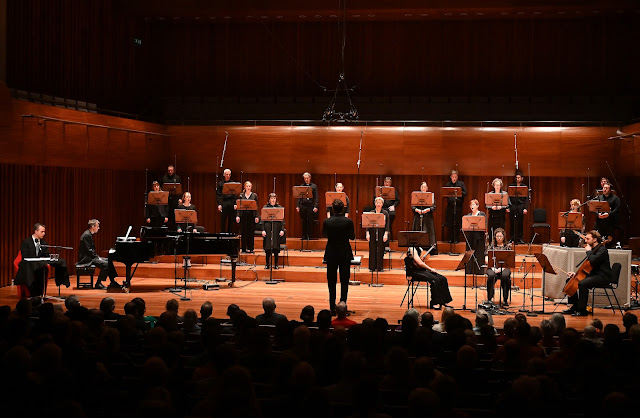
It would, given their long, incredibly productive association with Boulez, have been a great pity not to hear from the BBC Singers on such a day. That we can do so at all is, of course, no thanks to the corporation itself; for now, let us give thanks that we can, whilst remembering how strong the forces Boulez and so many others, aesthetic foes included, have had to fight against. Joining Martyn Brabbins and the BBC SO, their pinpoint precision was, in proper Boulezian style, never an end in itself, but rather the foundation of a exquisite, multi-directional (in that centrifugal, serialist and post-serialist sense) account of Cummings ist der Dichter. Warmth, as in Boulez’s own later performances of his music, was a hallmark, so was a hyper-expressivity that surely had its roots in Schoenberg as much as Webern, Debussy too.  Given in a single, endlessly variegated whole, this offered opera-less drama that emerged almost like a tapestry that spoke and sang: a fusion, if you like, of Boulez’s earlier dark surrealism and his late fascination with Szymanowski, seeds of which one could imagine one heard here.


And so, to Pli selon pli. Memories, whether of that earlier Second Sonata performance or of other readings of this ‘portrait of Mallarmé’, are necessarily part of our experience. ‘Must I once again sing the praises of amnesia?’ Boulez once asked, and the answer in context – out of which the rhetorical question has too often been shamelessly extracted – is of course yes. Memories will never be obliterated, but they can too readily become Mahlerian ‘tradition’ as Schlamperei, to invoke once more one of Boulez’s most illustrious composer-conductor predecessors. This performance, from Anna Dennis, the BBC SO, and Brabbins, seemed to me the equal of any I have heard, probably surpassing that of ten years ago, even approaching the fina lencounter I heard from Boulez himself, in 2011 conducting Barbara Hannigan. That is not really the point, though. The past cannot be obliterated, nor did one of the most penetrating of all conductors of works from the ‘Museum’ ever think or wish it to be. He simply wished us to turn attention to the present – even the ‘present’ of the Museum’ – as we could and did here.

The opening of ‘Don’ issued an invitation to enter that none could refuse, trademark éclat followed by the seduction (and seductive birth!) of a ‘nuit d’Idumée’. Beautifully voiced and connected, this was a performance led by a conductor who, in quiet, unflashy security not unlike that of Boulez, showed that he ‘got it’, that he could and would be our guide to the work’s unfolding. Nowadays particularly, we hear much other music folding in but this is infinitely more than synthesis; it is a personal ‘voice’ that yet extends far beyond mere ‘personality’. Mesmerising in Mozartian qualities that already announced a period of ‘modern classicism’ (Arnold Whittall) in Boulezian works, in its seduction it no more brooked dissent than Così fan tutte (or Szymanowski). We had entered a  Bergian labyrinth and never wished to leave.


The first of the three central ‘Improvisations’ brought Webern and Debussy more evidently to the fore, but intriguingly also the very idea of a composed improvisation, recreated before our ears. In a sense, that is simply ‘performance’, though one can too readily lose sight of that, especially in an age still haunted by the ‘authenticity’ Boulez abhorred. Dennis’s way with the words was all: their sound as much as alleged ‘meaning’. As humans, we naturally wish to interpret, but sometimes we need simply to enjoy too. The wide range of her line and performance in a magical second ‘Improvisation’ (‘Une dentelle s’abolit’) seemed both to incite and be incited by the orchestral tapestry woven and re-woven around her—and us. Was that an echo of Prélude à l’après-midi I heard in the third? Perhaps—and perhaps it pointed to another fold to incorporate. There is no single ‘right’ answer, nor ever could there be. That sonic recreation of textures before ears and minds alike was the thing—and what a thing. Webern’s influence so thoroughly assimilated one barely noticed, until one did, both in and across the orchestra. It also felt haunted by the vocal and instrumental laboratory of Bach’s cantatas, a world that also exerted great fascination for Boulez, though, in a further indictment of current compartmentalisation of musical life and history, seldom do we hear about it.
 

This, then, was a world of ever-shifting, ever-transforming folds of silk, transposed into music—and/or vice versa. Its culmination in ‘Tombeau’ was the culmination of an intense orchestral drama with voice: that invisible theatre once again, conceived before Boulez’s incursions into the operatic world, revised after them. Maybe it was the chance connection of the moment, yet Pelléas and Parsifal seemed more than usually present. There will always be ghosts at any musical feast, not least Boulez’s own. Not the least of this performance’s wonders was both to hear and to feel how his music is now taking on new directions in his absence. Boulez est mort; vive Boulez.


Tuesday, 17 December 2024

BBC SO/Oramo - Elgar, 13 December 2024


Barbican Hall

Elgar: The Dream of Gerontius, op.38

Sarah Connolly (mezzo-soprano)
David Butt Philip (tenor)
Roderick Williams (baritone)

BBC Symphony Chorus (chorus master: Neil Ferris)
BBC Symphony Orchestra
Sakari Oramo (conductor)


Images: Mark Allan

This was to have been something entirely different: Berlioz’s L’Enfance du Christ, conducted by Andrew Davis. The death of the BBC Symphony Orchestra’s former chief conductor led not only to a necessary change of conductor, in the guise of the orchestra’s current chief conductor, Sakari Oramo, but to a change of programme, Elgar’s Dream of Gerontius, a work with which Davis was more strongly associated, taking the place of Berlioz’s oratorio, as a memorial. Having been a little nonplussed by the change, I soon realised that it made greater sense as a memorial, not least on account of the tangible commitment from a chorus and orchestra – a considerable Barbican audience too – to remembering their erstwhile colleague. I had a few reservations concerning the performance itself, none especially grievous; I hope it will not seem unduly curmudgeonly to share them, alongside the many estimable qualities to what I heard. For whatever reason, they did not seem to be shared by most members of a highly enthusiastic audience. 

The principal problem was arguably the hall itself and its constricted acoustic. For once, the Royal Albert Hall might not have been too poor a venue; large-scale choral works, many of which Davis conducted there at the Proms, tend to fare better than most. Brass in particular tended to blare, something it was difficult to ignore in the Prelude. I was a little surprised that Oramo, who must by now be used to the difficulties, did not do much about them: a pity, given the fine Elgar sound from the rest of the orchestra, strings in particular. Oramo certainly showed flexibility in his reading here, though some tempo choices and changes I found  puzzling. 

David Butt Philip’s entry, ably supported by Oramo and the orchestra, announced a surprisingly Italianate way with the music: more Puccini than Wagner or Strauss, let alone Brahms. Indeed, Oramo increasingly brought things I had either not heard or had forgotten, but which seemed very much to grow out of the score, a nice line in dance rhythms included. This was certainly, at least in the first part, an operatic reading: not necessarily how Davis would have done it, but then a tribute should not be an imitation. The struggle was dramatic, it seemed, rather than overtly theological, Oramo skilled at guiding crucial transitions. Many, I know, have problems with the work on the latter ground; it even had to be given with a revised text for early performances at the Three Choirs Festival. One could surely say the same, though, of its avowed model: Parsifal. Perhaps this was a way, conscious or otherwise, ecumenically to broaden its appeal. At any rate, if I sometimes felt a little loss on Newman’s side, there was an undeniable keen sense of joint endeavour, audience included, that appeared to offer ample, even quasi-religious compensation to many. Never showing the slightest sense of strain that occasionally accompanied Butt Philip’s often thrilling and full-throated approach, Roderick Williams proved a wise and faithful guide for the journey both underway and to come. The BBC Symphony Chorus, of which Davis remained President until his death, offered performances throughout of warmth, heft, and blend that worked with, rather than against, the difficult acoustic. 


The second part, quite rightly, took us to a very different place, ushered in by string playing of which any orchestra or conductor would be proud. Sarah Connolly’s Angel’s finely spun, infinitely compassionate performance was a jewel: rooted in Newman’s words, yet equally communicating beyond them through Elgar’s music. Choral and orchestral demons were a colourful, malevolent band, ‘angelicals’ in turn beautifully contrasted. Where sometimes – only sometimes – I had found the first part meandering, Oramo here seemed ever clearer in his mission to bind the work together, motivically, harmonically, and yes, theologically. In that, Wagner returned, as did Parsifal more specifically in the passage of approach to God. Brahms did too, above all the German Requiem, most keenly in the choruses. Moreover, I could not help but find something a little Liszt in an endeavour that, perhaps despite Newman, retained a little of the Faustian. Music once again proved a superior, or at least different, agent of synthesis to words.


And yet, it is not really a matter of either/or, but rather of combination, of that shared endeavour to which I referred above. ‘Farewell, but not for ever brother dear, Be brave and patient on thy bed of sorrow’: for some a necessity, for some doubtless an obscenity. Heard here from Connolly, at a darker time than many of us have known, it offered, however briefly, a semblance of consolation.


Tuesday, 5 November 2024

Gerstein/BBC SO/Oramo - Bacewicz and Busoni, 1 November 2024


Barbican Hall

Grażyna Bacewicz: Symphony no.2
Ferruccio Busoni: Piano Concerto in C major, op.83

Kirill Gerstein (piano)
BBC Symphony Chorus
BBC Symphony Orchestra
Sakari Oramo (conductor)


Images: Copyright: BBC/Sarah-Louise Bennett

The centenary of Ferruccio Busoni’s death fell earlier this year, not that ninety-nine per cent of the musical world appears to have noticed. Where are the operas, even his masterpiece and summa, Doktor Faust this year, or any other? His Turandot will never rival Puccini’s for popularity, nor for various other attributes, least of all disturbingly alluring sadism. Yet, though I admire both, I think Busoni’s is ultimately the better piece. In the meantime, the BBC Symphony Chorus and Orchestra, Sakari Oramo, and Kirill Gerstein offered a rare opportunity to hear his genre- and much-else-defying Piano Concerto, which in its finale offers a male chorus setting of words from the Danish Romantic Adam Oelenschläger’s Aladdin, in Oelenschläger’s own German translation (long since superseded), which Busoni at one point considered turning into an opera. If that sounds more like Beethoven’s Ninth than any of his piano concertos – not, if truth be told, the work has much in common with either – then it points to an important truth: namely, that this superlative pianist and veteran of many a piano concerto, historical and contemporary, chose in his own to write, without sparing the pianist great technical challenges, a work that was more operatic symphony with piano than concerto in any traditional sense, adversarial or otherwise.

A composer such as Busoni needs a champion, and Gerstein probably has better claim than any other current performing musician to the title. During the 2022-23 season, he gave a series of three concerts at the Wigmore Hall, entitled ‘Busoni and his World’. I attended two and left enriched by both. He has also been performing the Piano Concerto, a live recording with Sakari Oramo and the Boston Symphony Orchestra having been warmly acclaimed. I have yet to hear it, but if it is anything like this performance with Oramo and the BBC Symphony Orchestra, it should be snapped up by anyone with the slightest interest or curiosity. I suspect it will be in broad outline, since swift overall timings of about seventy minutes are common to both. For the sake of comparison, John Ogdon takes about seventy-eight and Victoria Postnikova manages to stretch it to almost ninety. A signal achievement of this performance, though was that such thoughts never entered the mind. The work did not even seem long, but rather, like a Mahler symphony, the precise length that it needed to be, compelling from beginning to end. 


Indeed, from the outset, soloist, conductor, and for the most part orchestra approached it as if it were a repertory piece. The first movement flowed with notable fluency, with no question as to its depths. Whatever this is, it is not a ‘surface’ work. There was a Beethovenian strength to the string foundations, the Seventh Symphony in particular coming to mind. Gerstein, on his first entry, showed himself both secure in command and inviting—even if we did not yet quite know to what he and Busoni were inviting us. He made the massive piano chords sing in themselves, but equally in counterpoint with the orchestra, unleashing Faustian energy yet also relishing the more ‘feminine’ – in the old, gendered typology – passages in which Doktor Faust itself is at its least successful. If the creation of music from often simple elements required Beethovenian struggle, it rarely sounded like it, the effect closer to Mozart, to Liszt, and occasionally to Brahms. One sensed if not the birth of Busoni’s Junge Klassität, then a milestone in its evolution. 

That Classical-Romantic line ran through the following Pezzo giocoso too, its energy almost yet not quite delirious in piano and orchestra alike. Like its predecessor, it seemed effortlessly to capture the protean spirit of its composer, here pointing, tambourine and all, toward the warm, Mediterranean south. The longer Pezzo serioso struck, unsurprisingly, a more serious, even Teutonic note, pianistic shadows and rays of winter sun from the worlds of Beethoven and Brahms set against surprisingly Wagnerian trombones: a magical combination. Form was unerringly communicated as was a musical narrative perhaps closer to that of Liszt’s symphonic poems than to Strauss. Faustian tones became more pronounced, as if the good doctor himself were seated at the piano, performing his own concerto. The fourth movement tarantella sounded as a truly Italian vision, albeit an Italy different from anyone else’s. In its Lisztian figuration, we experienced a unique, even outrageous fever. And how could we not smile at the evocation of Rossini on entering the realm of commedia dell’arte? 

The transition to the final movement, as the male chorus stood, was a thing of wonder. Busoni instructed that it should be invisible, and the effect would doubtless be all the more magical if it were, if perhaps at the cost of intelligibility, though we had (welcome) surtitles in this case. A quietly ecstatic new and final chapter opened: ‘Lifet up your hearts to the Power Eternal. Feel Allah’s presence. Behold all his works.’ A splendidly warm and consoling choral sound led us into a realm in which it was difficult not to think, perhaps through a Goethian lens, of Die Zauberflöte—and of Mahler. The rapturous acclaim with which Gerstein and his fellow performers met was fully justified. I have no doubt it will prove to be one of my musical memories of 2024. 


Preceding it, we had heard Grażyna Bacewicz’s Second Symphony, a much shorter and more modest work, far from without its virtues, yet paling when placed beside the Busoni. The BBC SO and Oramo summoned just the right sort of mid-century sound in a committed performance of this 1951 work. Other composers came to mind, Prokofiev and Bartók in the first movement, Hindemith later on, but Bacewicz was never merely to be reduced to them, her personal contrasts of ‘voice’ and texture holding the attention throughout. The second movement evoked unease through traditional harmony and counterpoint. The third, a scherzo proved incisive and ambiguous. In the finale, not for the first time, the composer showed her ability not only to write a melody but to ensure that it was generated from the material in which it found itself. Bacewicz’s symphony could probably have found a more suitable home than this concert, but it was a good opportunity to make its acquaintance.


Tuesday, 16 August 2022

Prom 39: Hartwig/BBC SO/Oramo - Turnage, Vaughan Williams, and Elgar, 15 August 2022


Royal Albert Hall

Turnage: Time Flies (UK premiere)
Vaughan Williams: Tuba Concerto in F minor
Elgar: Symphony no.1 in A-flat major, op.55

Constantin Hartwig (tuba)
BBC Symphony Orchestra
Sakari Oramo (conductor)

Three very different English composers were to be heard here, in excellent performances from the BBC Symphony Orchestra and Sakari Oramo. Elgar’s First Symphony was for me unquestionably the highlight, but the varied conspectus will have offered something for many. It is especially welcome just now to be reminded that, notwithstanding unremitting hostility from our fathomlessly philistine government and media, there can still be something to celebrate in English artistic endeavours, past and present. Nadine Dorries does not yet hold all the cultural cards.  

Mark-Anthony Turnage’s Time Flies is a co-commission from the Tokyo Metropolitan Symphony Orchestra, the NDR Elbphilharmonie Orchestra, and the BBC SO. Its premiere, like so many, fell victim to Covid, as did the Tokyo Olympic Games at which it was due to take place. The piece’s three movements, ‘London Time’, ‘Hamburg Time’ and ‘Tokyo Time’, the last considerably more extended than its predecessors, last about twenty-five minutes in total. ‘London Time’ opened with an urban confidence, metallic and syncopated, perhaps more redolent of London a dozen years ago than now. Upbeat and playful, that opening material nonetheless fell downward through disorienting, corrosive chromaticism, until we reached one of Turnage’s trademark saxophone solos, prior to a final section in which various tendencies are combined. Hope for the future? Perhaps.

The opening trumpets of ‘Hamburg Time’ seemed to recall Copland’s Fanfare for the Common Man or, after a while, the Janáček of the Sinfonietta. Stravinsky too came to mind, especially as woodwind became more prominent. But these were ghosts; Turnage’s is the fundamental voice. A sense of wide-open space similarly dissolved in unease, reassertion of something perhaps not so very different from socialist or at least collectivist realism the hallmark of what follows. Jazz rhythms, sonorities, and attack of ‘Tokyo Times’ were refreshingly distinct from faded orientalist tropes. Turnage evokes them, of course, rather than simply recreating them, another sign of Stravinsky’s presence (perhaps Henze’s too). An enigmatic chorale at the centre—post-Messiaen, or is it post-Weill?— cautioned against easy answers.

Vaughan Williams’s Tuba Concerto was treated to a splendidly nimble reading from Constantin Hartwig and the orchestra. The first movement’s liveliness was justly ambiguous, culminating in a beautifully played cadenza imbued with a sense of longing the more impressive for not being milked. The central ‘Romanza’ offered a fine instance in miniature of Vaughan Williams’s ability to create something folklike that is entirely composed rather than found. Again, there was longing without cloying, let alone sentimentality. The tuba part sounded at times almost like a descant, albeit amidst or beneath orchestral textures, at any rate in intriguing counterpoint. The finale offered darker, even diabolical, play not so distant perhaps from Prokofiev, though certainly speaking with a different accent. Another cadenza, different in character, proved equally fine in execution. A sudden end underlined the composer’s achievement in concision, never outstaying his welcome. That, alas, is more than can be said for a dreary encore, apparently Paul McCartney’s Blackbird, which served mostly to underline Vaughan Williams’s skill in tuba-writing.

Oramo’s studied tempo for the opening of the Elgar avoided sentimentality without going down the more common road of swiftness. Articulation further underlined a premonition of shock, even shellshock. When the full orchestra entered, it sounded glorious, as much maestoso as Elgarian nobilmente, without a tinge of regret. Did it, though, lead to the Allegro material, or was it more a matter of sectional contrast? I missed something, a sense of connection, however intangible, characterising performances otherwise as different as Boult and Barenboim. That, however, was my only doubt concerning this fine performance; given the excellence of everything else, I am happy to allow the fault may have been mine. For Oramo captured even-handedly Elgar’s Wagnerian and Brahmsian tendencies; as did the BBC SO’s sound. And the return of the opening material unquestionably arose from preceding breakdown, mood-swings necessitating something both old and new. It was not only Brahms and Wagner, though: the most liminal qualities of this movement evoked, yet never merely recreated, both featherlight Mendelssohn and phantasmagorial Strauss, the latter especially at the point of disturbing recapitulatory collapse. If the frame of reference were not so wide as that of Barenboim’s extraordinary recent performances, we had likewise travelled a long way from the Boultian ascendancy.

The second movement similarly had a Mendelssohn-cum-Brahms underpinning to its steely (anti?)-militarism. As with Mahler, who increasingly came to mind, there were startling new vistas to witness, though the light, often the half-light, crucially was different in quality. For all the alleged serenity of the third movement, there were darker forces at work too. Harmonies summoned Hagen from his watch. At the close, there prevailed a rapt inwardness not so different from Schumann’s Innigkeit, albeit exquisitely and even tragically late. Disorientation, even brokenness, marked the onset of the finale, the question being ‘is this irreparable?’ It was no easy question to answer, a struggle of Brahmsian order indicated. If here, Elgar comes perilously close on occasion to imitation of Brahms, it is a fault in the right direction—and here a winning one. Ultimately, nobility in both work and performance won out, not despite but on account of the slings and arrows.


Tuesday, 25 January 2022

Total Immersion – Music for the End of Time, 23 January 2022


Barbican Hall, Milton Court Concert Hall

The Music of Terezín, dir. Simon Broughton

‘The Theresienstadt Orchestra’
Hans Krása: Overture for Small Orchestra
Pavel Haas: Study for String Orchestra
Erwin Schulhoff: Symphony no.5


BBC Symphony Orchestra
Alpesh Chauhan (conductor)

‘Songs in Time of Distress’
Viktor Ullmann: Two Hebrew Pieces for choir; Songs of Comfort for low voice and string trio
Gideon Klein: String Trio; Folk Songs for male chorus
Silvie Bodorova: Terezín Ghetto Requiem for baritone and strong quartet: ‘Lacrimosa’
Pavel Haas: String Quartet no.2: ‘Wild Night’
Dieter Gogg, arr. Iain Farrington: Als ob; Theresienstadt, der schönste Stadt der Welt
František Domažlický: Song without words for string quartet
Ullmann: Yiddish Songs for choir; Der Kaiser von Atlantis: ‘Komm Tod, du unser werter Gast’ (arr. Farrington)


Simon Wallfisch (baritone)
Guildhall School Musicians
BBC Singers
Nicholas Chalmers (conductor)

Ullmann: Der Kaiser von Atlantis, dir. Kenneth Richardson
Messiaen: Quatuor pour la fin du temps

Kaiser Overall – Thomas Johannes Mayer
Loudspeaker – Derrick Ballard
Soldier – Oliver Johnston
Harlekin – Robert Murray
Bubikopf – Soraya Mafi
Death – Henry Waddington
Drummer Girl – Hanna Hipp


BBC Symphony Orchestra
Josep Pons (conductor)
Guildhall School Musicians


Images: BBC/Mark Allan

Holocaust Memorial Day falls on 27 January, thus poignantly entwined—forever?—with the birthday of Mozart. Much could and doubtless should be said about that dialectical relationship, but let us leave that for another time, perhaps when I am once again able to travel to Salzburg and its Mozartwoche is once again able to take place. The BBC/Barbican annual Total Immersion day or weekend—this year a day—was, however, able to do so, offering much food for thought and contemplation. This year, we approached a commemoration that calls into question, many would say irrevocably denies, the possibility of historical ‘normalisation’, by way of music (mostly) from Nazi prison camps, above all the ghetto of Theresienstadt/Terezín. Simon Broughton’s 1993 documentary film offered an excellent introduction: informative, evocative, and, through its interviews with and performances from survivors, touching too. It is difficult to imagine the BBC making such a film now, but thank goodness it did then. 

Two of the three composers featured in the first of three concerts also featured in that film. Hans Krása and Pavel Haas were joined by Erwin Schulhoff, who met his end at another of the camps, Wülzburg in Bavaria. It was unclear why the concert was named ‘The Theresienstadt Orchestra’, since Schulhoff’s Fifth Symphony was not performed there, nor indeed anywhere else until 1965; but never mind. The BBC Symphony Orchestra under Alpesh Chauhan gave sharp, committed performances of all three works, though the spiritual sense of a memorial seemed strangely absent. Krása’s Overture for Small Orchestra, the ensemble essentially a matter of what was available to him, was light, at times sardonic, almost a Central European response to French neoclassicism, with an especially virtuosic piano part. It was nothing adventurous, yet well crafted and performed, with a nice twist for its sign-off. Where Krása had offered an ensemble of many soloists, Haas gave us massed strings in a more substantial piece whose fugal writing and more general counterpoint brought us closer to contemporary Hindemith than to Haas’s teacher, Janáček. Lively cross rhythms perhaps suggested otherwise. During its relatively short span, it packed in a considerable amount of material and invention. There was moving fragility and resolve to its ultimate contrapuntal restoration. 

Schulhoff’s symphony opened with great promise, its first movement ominous, full of foreboding, as if the walls of his incarceration-to-come were already closing in. The tread of a march in slow motion, deliberate in both senses, seemed as though it might go on forever—then suddenly stopped, which I assumed to be the point. A slow movement somewhere between Franz Schmidt and Prokofiev, with some of the former’s post-Bruckner tendencies, and some of the latter’s harmonies, nonetheless looked at times to a different, darker, and perhaps more cinematic world. If it perhaps went on a bit long, many of us are used to forgiving that failing in other music. A furious and frenetic scherzo, its repeated frustration apparently imbued with definite, even fatal meaning, seemed still more intent on bearing witness to its time, courting comparisons with a contemporary piece such as Martinů’s Double Concerto for Two String Orchestras, Piano, and Timpani. This was a tremendous performance, driven in a good way, and above all brutal, in what came across as a forceful if not overtly complex work. Alas, its finale hovered on the edge of incompetence (as composition, rather than performance). Its opening intrigued, suggesting grim nobility to a chorale that might ultimately triumph or, knowingly going through the post-Mahlerian motions, not. It never quite hung together, though, more damagingly extending for what seemed an unmerited eternity. I could not help but wonder whether it would be better given as a three-movement work, omitting the finale entirely. 


The second concert, for which we crossed over the road to Milton Court, was perhaps the most successful of all. The brainchild of baritone Simon Wallfisch, who not only briefly sang but devised the programme and read from letters and diaries more properly to remember those who lost their lives, it offered not only a touching memorial but also a valuable conspectus of artistic production, performed by the BBC Singers, young instrumentalists from the Guildhall, and Nicholas Chalmers. What might not seem the most intrinsically interesting of choral music was transformed by our knowledge of its educative role at Theresienstadt, where education was prohibited but keeping children busy was not, singing falling into that category. And what one could learn by singing, as one of the readings reminded us. Here the determination to bear Jewish witness was one of the many things experienced, for instance through by Two Hebrew Pieces and Yiddish Songs by Viktor Ullmann. Gideon Klein’s String Trio, concise and almost shocking in its mastery, received a fine, comprehending performance, every bit as involving in more ‘purely’ musical terms as it was in remembrance. Cabaret was present too. An arrangement of the closing chorale from Ullmann’s Kaiser von Atlantis looked forward to the evening. But this finely planned selection was so much more than the sum of its parts. It is to be hoped that Wallfisch has opportunity to give it elsewhere.

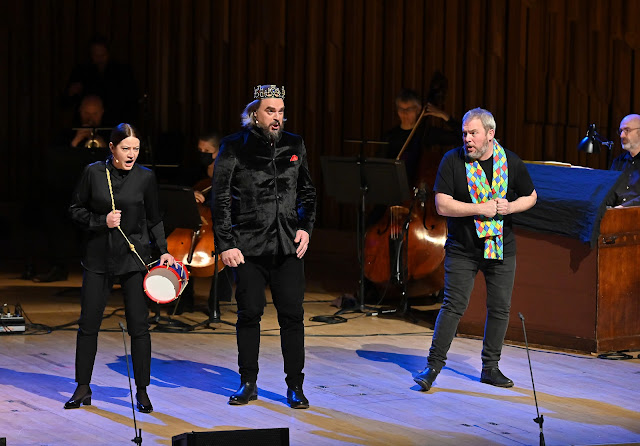
And so, to the evening, where we saw a resourceful concert staging of Ullmann’s celebrated opera. It was haunted not only by the opening pageant of characters walking on stage, Death laying down a suitcase (of course), others picking up props from it, but later by a shocking interpolation of sound from without the camp: a sound of actual war, and then of crowds hailing Hitler (for whom, read the Emperor). But it was the early parody of Mahler, the ‘Trinklied vom Jammer der Erde’, life both overflowing and fundamentally tragic, that hit home most strongly for me, fruitfully, fatally overshadowing what was to come. A fine cast, the BBC Symphony Orchestra, and Josep Pons, captured our attention and never let it wander. This is not Brecht-Weill; nor should it attempt to be. It breathed a sadder, more unmediated, yet undoubtedly sincere air: not a work one wishes to encounter often, but which one definitely should from time to time. Quite what Messiaen’s Quartet for the End of Time was doing in this company, I do not know. Musicians from the Guildhall gave an impressive performance, especially so during its passages—movements—of slow ecstasy. A prison camp, whilst no fun, was not, however, a concentration camp. Messiaen’s compositional mastery seemed to accentuate the divide further, giving an unfortunate impression of climax upon the day’s towering (acknowledged) musical masterpiece. Audience whooping at the close only made matters worse. It was a pity, but we had heard—and learned—much of very different value before.