Showing posts with label Erwin Schulhoff. Show all posts

Saturday, 29 April 2023

McFadden/Melnikov - Cage, Prokofiev, Berio, Berberian, Knussen, Schnittke, Schulhoff, and Crumb, 28 April 2023


Wigmore Hall

Cage: Aria
Prokofiev: Five Melodies, op.35
Berio: Sequenza II
Berberian: Stripsody
Knussen: Whitman Settings, op.25
Schnittke: Improvisation and Fugue
Schulhoff: Sonata Erotica
Crumb: Apparition: Elegiac Songs and Vocalises

Claron McFadden (soprano)
Alexander Melnikov (piano)

The Wigmore Hall has witnessed an extraordinary number of first-class song recitals over the years; a good few will even have taken place over the past year. This outstanding recital from Claron McFadden and Alexander Melnikov could hold its head high in comparison with any of them. Taking us from Cage to Crumb, via a fascinating route as coherent as it was replete with surprises, it was a model of programming as well as performance. If it were a pity that more listeners did not join the audience, those who did received a rare treat. I do not think I had previously heard any of the pieces previously in concert, with the exception of the Berio Sequenza and Prokofiev’s Five Melodies, albeit the latter in their more familiar, later version for violin and piano. We all love Schubert, but on this occasion he could readily wait until another evening. 

Cage’s 1958 Aria made for a splendid overture, one of a number of pieces closely associated with Cathy Berberian, in this case dedicated to her. It presented a riotous yet ordered – if only in the moment – collage of languages, techniques, styles, delivery, and so much more: from operatic coloratura to a sneeze, arias becoming Aria. My companion aptly likened it to a New York streetscape from a little while ago, in which one might see and hear various characters contributing to this greater whole in near simultaneity. Indeterminacy, after all, is not arbitrary.

It was fascinating to hear Prokofiev’s Five Melodies as vocalise (with piano) rather than for violin, to hear the voice – and McFadden’s voice in particular – as an instrument without words, let alone ‘expressing’ them. This may have been a quieter, even more classical radicalism than some of the avant-gardism on offer, but it was certainly not the least, nor the least durable. An almost post-impressionist delivery from both McFadden and Melnikov led us into and through much of the first song, magical melody and harmony (that utterly characteristic ‘side-slipping’ close!) enthralling us here and beyond. The second soared further, higher, also opening up a world of differences in vocal delivery, a striking shift from vowel to consonant a case in point. The third emerged as Prokofiev’s heir to Stravinsky’s Rossignol, already peering into the Cinderella-like future. Melnikov’s piano interjections in the fourth were perfectly judged, both to disrupt and yet also ultimately to confirm its general, yet never generalised, lilt. A beautifully haunting fifth song took us to a thrilling climax before subsiding. We had been on quite a journey, guided with expert judgement. 

Berio’s second Sequenza and Berberian’s own Stripsody made for a fine pair. The liminal zone in which the audience adjusted to the fact that the former had in fact already begun immediately called into question and enhanced much about our experience. A dizzying array of sounds and techniques were constructed as and into performance. If it is difficult not to experience either ‘theatrically’ – and why would one try? – they were certainly musical experiences too, form apparently created before our ears yet no less real for that. Literal breast-beating with which the latter piece began paved the way for material ranging from that world of Tarzan, necessarily a very different experience with a different artist from Berberian to Monteverdi and The Beatles, to squeaking and sirens. A ticket to ride indeed. 

Oliver Knussen’s Whitman Settings song-cycle for Lucy Shelton might have sounded a little conventional in such company, but its renewal of a relatively traditional genre seemed anything but, given such compelling, at times well-nigh overwhelming performances from McFadden and Melnikov. One heard and felt the construction of each song, harmonically in its serial processes as well as overall shape and form. Melnikov’s piano virtuosity took us to a realm some place after Ravel, in ‘The Dalliance of the Eagles’ even post-‘Scarbo’. McFadden’s way with the words had us experience, seemingly at first- rather than second-hand, how they gave birth to Knussen’s score, how the two had become inextricably interlinked. Vividly communicative in words and music, these were exemplary performances. ‘I am the Poem of Earth,’ McFadden sang in the closing ‘Voice of the Rain’, yet she and her partner seemed equally to be the poem of the skies, of the depths, of the elements. 

Melnikov had a solo spot to open the second half. Schnittke’s Improvisation and Fugue, a later yet not late Soviet work (1965), was stark, declamatory, again laying musical processes bare, whilst also permitting them at time to evaporate before our ears. Polystylism might theoretically lie in the future, yet aspects at least of jazz seemed at times but a stone’s throw away. Schulhoff’s Dadaist Sonata erotica made for a contrast in every way, a definitely German eroticism on show as music emerged from sex and, perhaps, vice versa. The joke did not outstay its welcome, at least not here.

Finally, at least so far as programmed works were concerned, we heard Crumb’s Apparition: Elegiac Songs and Vocalises, Melnikov’s prepared piano contributions as striking, not least in the opening and closing approaches to the world of the sitar, as McFadden’s evergreen variety and integration of techniques. From the more conventionally – this is highly relative – avant-gardism, albeit perhaps by now (1979) looking back with fondness, of the first Vocalise ‘Summer Sounds’ and ‘When Lilacs Last in the Dooryard Bloom’d’ to the differently haunting ‘Dark Mother’ and the outright high-dramatic warpath of ‘Approach Strong Deliveress!’ there was another world to be discovered here. The ‘Death Carol’, sung into the piano, bathing in the echoes of its predecessor, and ‘Come lovely and soothing death’, inviting, even seductive, like an expansive slow movement in context, led us to a reprise of the first song both surprising and inevitable. One might say much the same of the two encores, Oscar Peterson’s Hymn to Freedom and Debussy’s Beau Soir. It was indeed a fine evening.

Tuesday, 25 January 2022

Total Immersion – Music for the End of Time, 23 January 2022


Barbican Hall, Milton Court Concert Hall

The Music of Terezín, dir. Simon Broughton

‘The Theresienstadt Orchestra’
Hans Krása: Overture for Small Orchestra
Pavel Haas: Study for String Orchestra
Erwin Schulhoff: Symphony no.5


BBC Symphony Orchestra
Alpesh Chauhan (conductor)

‘Songs in Time of Distress’
Viktor Ullmann: Two Hebrew Pieces for choir; Songs of Comfort for low voice and string trio
Gideon Klein: String Trio; Folk Songs for male chorus
Silvie Bodorova: Terezín Ghetto Requiem for baritone and strong quartet: ‘Lacrimosa’
Pavel Haas: String Quartet no.2: ‘Wild Night’
Dieter Gogg, arr. Iain Farrington: Als ob; Theresienstadt, der schönste Stadt der Welt
František Domažlický: Song without words for string quartet
Ullmann: Yiddish Songs for choir; Der Kaiser von Atlantis: ‘Komm Tod, du unser werter Gast’ (arr. Farrington)


Simon Wallfisch (baritone)
Guildhall School Musicians
BBC Singers
Nicholas Chalmers (conductor)

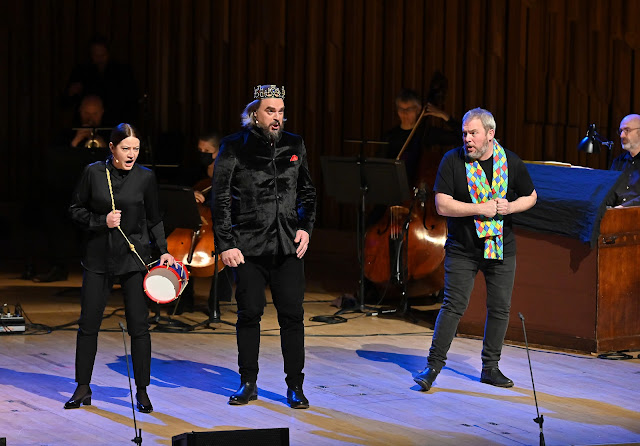
Ullmann: Der Kaiser von Atlantis, dir. Kenneth Richardson
Messiaen: Quatuor pour la fin du temps

Kaiser Overall – Thomas Johannes Mayer
Loudspeaker – Derrick Ballard
Soldier – Oliver Johnston
Harlekin – Robert Murray
Bubikopf – Soraya Mafi
Death – Henry Waddington
Drummer Girl – Hanna Hipp


BBC Symphony Orchestra
Josep Pons (conductor)
Guildhall School Musicians


Images: BBC/Mark Allan

Holocaust Memorial Day falls on 27 January, thus poignantly entwined—forever?—with the birthday of Mozart. Much could and doubtless should be said about that dialectical relationship, but let us leave that for another time, perhaps when I am once again able to travel to Salzburg and its Mozartwoche is once again able to take place. The BBC/Barbican annual Total Immersion day or weekend—this year a day—was, however, able to do so, offering much food for thought and contemplation. This year, we approached a commemoration that calls into question, many would say irrevocably denies, the possibility of historical ‘normalisation’, by way of music (mostly) from Nazi prison camps, above all the ghetto of Theresienstadt/Terezín. Simon Broughton’s 1993 documentary film offered an excellent introduction: informative, evocative, and, through its interviews with and performances from survivors, touching too. It is difficult to imagine the BBC making such a film now, but thank goodness it did then. 

Two of the three composers featured in the first of three concerts also featured in that film. Hans Krása and Pavel Haas were joined by Erwin Schulhoff, who met his end at another of the camps, Wülzburg in Bavaria. It was unclear why the concert was named ‘The Theresienstadt Orchestra’, since Schulhoff’s Fifth Symphony was not performed there, nor indeed anywhere else until 1965; but never mind. The BBC Symphony Orchestra under Alpesh Chauhan gave sharp, committed performances of all three works, though the spiritual sense of a memorial seemed strangely absent. Krása’s Overture for Small Orchestra, the ensemble essentially a matter of what was available to him, was light, at times sardonic, almost a Central European response to French neoclassicism, with an especially virtuosic piano part. It was nothing adventurous, yet well crafted and performed, with a nice twist for its sign-off. Where Krása had offered an ensemble of many soloists, Haas gave us massed strings in a more substantial piece whose fugal writing and more general counterpoint brought us closer to contemporary Hindemith than to Haas’s teacher, Janáček. Lively cross rhythms perhaps suggested otherwise. During its relatively short span, it packed in a considerable amount of material and invention. There was moving fragility and resolve to its ultimate contrapuntal restoration. 

Schulhoff’s symphony opened with great promise, its first movement ominous, full of foreboding, as if the walls of his incarceration-to-come were already closing in. The tread of a march in slow motion, deliberate in both senses, seemed as though it might go on forever—then suddenly stopped, which I assumed to be the point. A slow movement somewhere between Franz Schmidt and Prokofiev, with some of the former’s post-Bruckner tendencies, and some of the latter’s harmonies, nonetheless looked at times to a different, darker, and perhaps more cinematic world. If it perhaps went on a bit long, many of us are used to forgiving that failing in other music. A furious and frenetic scherzo, its repeated frustration apparently imbued with definite, even fatal meaning, seemed still more intent on bearing witness to its time, courting comparisons with a contemporary piece such as Martinů’s Double Concerto for Two String Orchestras, Piano, and Timpani. This was a tremendous performance, driven in a good way, and above all brutal, in what came across as a forceful if not overtly complex work. Alas, its finale hovered on the edge of incompetence (as composition, rather than performance). Its opening intrigued, suggesting grim nobility to a chorale that might ultimately triumph or, knowingly going through the post-Mahlerian motions, not. It never quite hung together, though, more damagingly extending for what seemed an unmerited eternity. I could not help but wonder whether it would be better given as a three-movement work, omitting the finale entirely. 


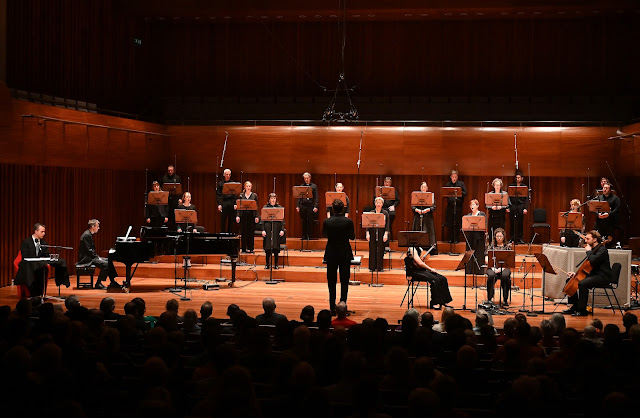
The second concert, for which we crossed over the road to Milton Court, was perhaps the most successful of all. The brainchild of baritone Simon Wallfisch, who not only briefly sang but devised the programme and read from letters and diaries more properly to remember those who lost their lives, it offered not only a touching memorial but also a valuable conspectus of artistic production, performed by the BBC Singers, young instrumentalists from the Guildhall, and Nicholas Chalmers. What might not seem the most intrinsically interesting of choral music was transformed by our knowledge of its educative role at Theresienstadt, where education was prohibited but keeping children busy was not, singing falling into that category. And what one could learn by singing, as one of the readings reminded us. Here the determination to bear Jewish witness was one of the many things experienced, for instance through by Two Hebrew Pieces and Yiddish Songs by Viktor Ullmann. Gideon Klein’s String Trio, concise and almost shocking in its mastery, received a fine, comprehending performance, every bit as involving in more ‘purely’ musical terms as it was in remembrance. Cabaret was present too. An arrangement of the closing chorale from Ullmann’s Kaiser von Atlantis looked forward to the evening. But this finely planned selection was so much more than the sum of its parts. It is to be hoped that Wallfisch has opportunity to give it elsewhere.

And so, to the evening, where we saw a resourceful concert staging of Ullmann’s celebrated opera. It was haunted not only by the opening pageant of characters walking on stage, Death laying down a suitcase (of course), others picking up props from it, but later by a shocking interpolation of sound from without the camp: a sound of actual war, and then of crowds hailing Hitler (for whom, read the Emperor). But it was the early parody of Mahler, the ‘Trinklied vom Jammer der Erde’, life both overflowing and fundamentally tragic, that hit home most strongly for me, fruitfully, fatally overshadowing what was to come. A fine cast, the BBC Symphony Orchestra, and Josep Pons, captured our attention and never let it wander. This is not Brecht-Weill; nor should it attempt to be. It breathed a sadder, more unmediated, yet undoubtedly sincere air: not a work one wishes to encounter often, but which one definitely should from time to time. Quite what Messiaen’s Quartet for the End of Time was doing in this company, I do not know. Musicians from the Guildhall gave an impressive performance, especially so during its passages—movements—of slow ecstasy. A prison camp, whilst no fun, was not, however, a concentration camp. Messiaen’s compositional mastery seemed to accentuate the divide further, giving an unfortunate impression of climax upon the day’s towering (acknowledged) musical masterpiece. Audience whooping at the close only made matters worse. It was a pity, but we had heard—and learned—much of very different value before.