Showing posts with label Evelin Novak. Show all posts

Friday, 15 April 2022

Berlin Festtage (4): Così fan tutte, Staatsoper Unter den Linden, 14 April 2022


Fiordiligi – Evelin Novak
Dorabella – Marina Viotti
Guglielmo – Gyula Orendt
Ferrando – Bogdan Volkov
Despina – Barbara Frittoli
Don Alfonso – Lucio Gallo

Vincent Huguet (director)
Aurélie Maestre (set designs)
Clémence Pernoud (costumes)
Irene Selka (lighting)
Louis Geisler (dramaturgy)  

Staatsopernchor Berlin (chorus master: Martin Wright)
Staatskapelle Berlin
Giuseppe Mentuccia (conductor)


Images: Matthias Baus
Don Alfonso (Lucio Gallo) and Guglielmo (Gyula Orendt)


From The Marriage of Figaro to Così fan tutte: the first to the last of Mozart’s Da Ponte operas; or, with Vincent Huguet, from the second to the first in his ‘trilogy’. The setting suggested this, I suppose, moving back from the 1980s to the late 1960s, though that in itself assumes a unity one might not otherwise discern (or guess). Guglielmo, apparently, becomes Count Almaviva—and, after that, Don Giovanni. In Così and Figaro, he is sung by the same artist, at least, Gyula Orendt, though Michael Volle is due to take over in Don Giovanni. Beyond that, though, I found little indication of what might well be an interesting standpoint to take onstage. One can read this in the programme, of course, as I did afterwards, though what if one has not bought one? Should there not be some stage indication of this situation? We learn other oddities of Huguet’s conception in the programme too, for instance that Don Alfonso and Despina are married. I am not sure what light that shed on anything, but it was in any case not apparent to me. 

I think I can see why someone might opt for a ‘flower power’ setting. Ultimately, one can set this opera anywhere or nowhere, with little in the way of loss, so long as one has some underlying, convincing idea to what one is doing. But the point—Mozart’s, still more than Da Ponte’s—seems to have been missed entirely, with something frankly weak and uninspiring put in its place. (I confess that I had to read the programme and watch a short video even to get that far, but perhaps I am just especially slow.) Apparently what happens is that Alfonso and Despina meet another couple of couples, ‘from, let’s say, Milano’ who are intending to marry, and decide to show them a few home truths by having them lighten up a bit. Fine, so far as it goes, but ‘you can have a lot of problems and it is never that bad’. Really? Is not the agonising truth of this work, in all its exquisite sadomasochism, that it really is ‘that bad’, actually worse, and that you—we—must somehow live in knowledge of that devastation? We have eaten the apple; we are fallen creatures; more to the point, we are going to keep on falling, keep on hurting, even killing, each other. It is an opera made for Schopenhauer, save that it is still clearer-eyed. Of the philosophical, let alone religious, truths at the work’s heart—this is surely a ‘Passion of passion’, to quote Michael Tanner on Tristan—there is little or nothing. ‘Always look on the bright side of life’ is a message of sorts, I suppose, though ultimately, however much (or little) one dresses it up with a smattering of Foucault, it does not really extend beyond the realm of the self-help book. 

That, however, seems largely beyond the point, given how difficult it is (at least it was for me) to deduce any of it from what we actually see. We simply have the time-change, a move for a while to what appears to be a yacht, the inevitable silly dancing and other tomfoolery, smoking of what appears to be marijuana, and some random extras engaging in what sometimes, but not that often, approaches soft porn. Two of them massage members of the cast for a while, again to no evident reason. Everyone is conventionally good-looking and everything is surprisingly heterosexual, any engagement between women remaining clearly for the benefit of the man watching or participating. I could not help but notice that a few more elderly men in the audience were audibly excited by female nudity; one even managed to wake from his intermittent snoozing to exclaim something whose meaning I mercifully could not quite discern. If this is sexual liberation, some serious repression would be in order, if only to prevent participants expiring from sheer boredom. That may be a point worth making, though it seemed to arise by accident rather than design.
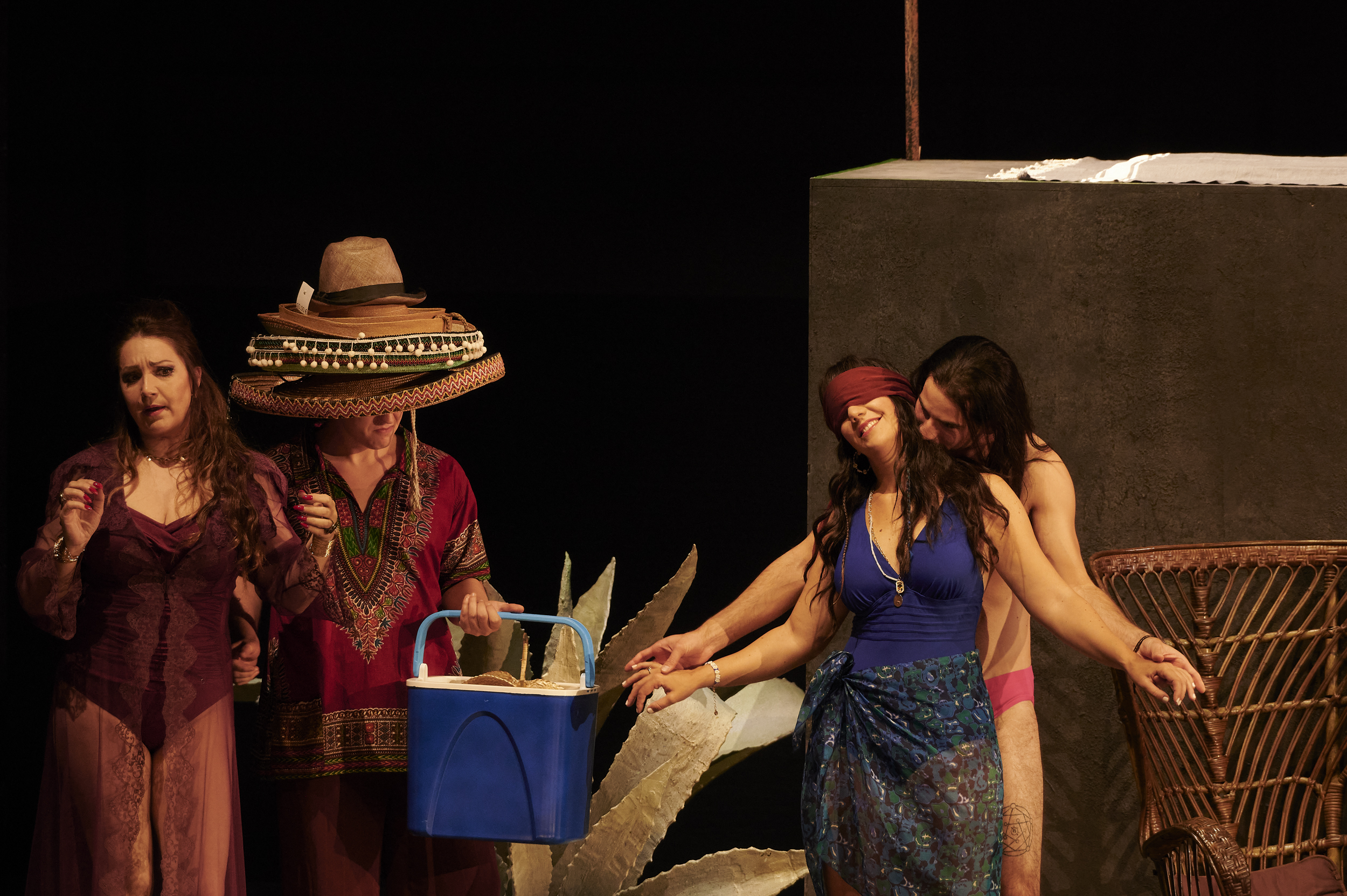

Despina (Barbara Frittoli), Dorabella (Marina Viotti), and extras
 

Daniel Barenboim should have conducted, but has had to take time off to recover from illness. In his place, at very short notice, was his assistant Giuseppe Mentuccia. It is difficult to tell much of Mentuccia’s own vision of the work from such a ‘jump in’, given that he would essentially have had to conduct Barenboim’s Così, perhaps with the odd inflection when he can. There were a few hints that he may have preferred swifter tempi at times, yet for the most part he fulfilled his duties very well indeed, the Staatskapelle Berlin sounding gorgeous and fully involved throughout. I look forward to hearing more of Mentuccia on his own terms. 

Orendt impressed once more, if anything still more so than as the Count. His dark, virile baritone was well complemented by Bogdan Volkov’s sweet-voiced tenor, ardent and imploring as required, as Ferrando. The latter’s duet with Evelin Novak’s Fiordiligi was a particular vocal (and orchestral) highlight for me. Fiordiiligi’s journey, traced in finest Egyptian vocal cotton, was throughout as involving as Huguet’s banalities permitted. I was less sure about Marina Viotti’s contrasting Dorabella, though concluded that to be more a matter of taste than anything else, her degree of forthrightness in, say, ‘E amore un ladroncello’, a valid interpretative choice (if not necessarily mine). Lucio Gallo made for an effortlessly stylish, verbally acute Don Alfonso. Barbara Frittoli shared the same virtues and offered a welcome change as voice of experience rather than irritating soubrette. She felt no need to resort to silly voices for Despina’s other ‘characters’, employing subtler transformations of tone and colour. 

The cast throughout worked very well together, though I could not help but wish they had been put to use in a more interesting, even challenging, production. Memories of Hans Neuenfels in my first Così continue to die hard, though there have been many alternative options since. Incidentally, on what does Huguet base his claim that the three Mozart-Da Ponte operas are ‘the most-performed operas worldwide’? They have not been in any statistics I have seen; indeed, not one of them falls into the top three, so far as I am aware. I should be astonished, though heartened, if Così came into the top ten. It is certainly among the least understood, though Don Giovanni must come close, and even Figaro’s more profound meaning seems to elude most.


Tuesday, 1 November 2016

Fidelio, Staatsoper Berlin, 28 October 2016


Images: Bernd Uhlig
Rocco (Matti Salminen) and Marzelline (Evelin Novak)

Schillertheater

Don Fernando – Roman Trekel
Don Pizarro – Falk Struckmann
Florestan – Andreas Schager
Leonore – Camilla Nylund
Rocco – Matti Salminen
Marzelline – Evelin Novak
Jaquino – Florian Hoffmann

 
Harry Kupfer (director)
Derek Gimpel (assistant director)
Hans Schavernoch (set designs)
Yan Tax (costumes)
Olaf Freese (lighting)
Berlin State Opera Chorus (chorus master: Martin Wright)
Staatskapelle Berlin
Daniel Barenboim (conductor)


What to do with Fidelio? It seems to be a question exercising everyone staging – and performing – it, which, in one, very obvious sense, is fair enough, even a necessity. On the other hand, the desire to ‘do’ something with it, whether musically, scenically, or both, will sometimes lead us down decidedly peculiar alleys. I have been sent down stranger, far less convincing ways than that of Harry Kupfer. Indeed a signal strength of his new production for the Berlin State Opera is that it seems to suggest – or at least can be understood to do so – that the desire to do things different musically, the jadedness that gave birth to the fashion-victim wing of ‘authenticity’ can be at least as injurious to Beethoven as Mahler’s ‘tradition’ as Schlamperei. Both the comfortable, too-smoothly-connected Beethoven of regular, all-too-regular performances at the Musikverein – seen at beginning and end, in a strangely convincing trompe l’œil backdrop – and a reductive, anti-metaphysical, post-Stravinskian inability to cope with him, his music, and his message, to connect anything, be it phrase or idea, with anything else, stand accused. Or at least they did for me. Kupfer is not always the most open of directors, but here, I think he offers the potential for different readings, according to one’s own needs as well as inclinations. Whether that has come at the expense of the directoral boldness we know from the Kupfer of old, whether there is a tiredness, as well as an accusation of tiredness, remains an awkward, nagging doubt.  


Kupfer, aided by Hans Schavernoch’s excellent designs, presents a Beethoven hemmed in by routine. His bust stands on the piano; that is what busts, especially of Beethoven, do. Performance directions, director’s notes, multilingual key words drive us up the walls. The day-to-day routine of an opera house or concert hall, even when well run, well thought through – having studied, for instance, at some of Kupfer’s notes for his Dresden Moses und Aron, I can attest that he thinks, certainly thought, things through – can militate against great artistry. No one, I am sure, would claim otherwise. Such, in a sense, is the world of the first scene of Fidelio, of Jacquino and Marzelline, or Rocco’s ‘gold’ aria. It would be an odd thing if the most memorable thing about a Fidelio were the ironing, but ironing is necessary, as are the non-heroic characters in general. Does it seep through too much, though? Are the prisoners as imprisoned by their Peters scores – which, mysteriously, they rarely if ever open, although I think Jacquino does his – as by something more objectively brutal? Is that an important question to ask, or is it gravely insulting to those who actually are physically imprisoned? Kupfer seems to invite us to ask such questions; I have thought a good deal about them since, and am still doing so.

Don Pizarro (Falk Struckmann), Leonore, and Florestan (Andreas Schager)
 

There are big moments, of course. They still shine through. Is the director perhaps telling us to simplify, to focus upon them? He might be, but I am not entirely sure. Perhaps that is as it should be. At any rate, the events in the dungeon retain a straightforward power of their own, as surely they must. Or must they? I know that many in the audience felt too much left to their own devices, and wonder whether some on stage did too. I am far from unsympathetic to them, yet at the same time, the contrast between the ambiguity of direction (and even, if non-direction it were, of non-direction) and the certainty of the musical performance was not, for me, entirely unproductive.

 
Florestan

For it was ultimately the contribution, unsurprisingly, of the Staatskapelle Berlin and Daniel Barenboim that made this Fidelio – well, Fidelio. That is not intended as any disrespect to the generally excellent singers, but Fidelio begins and ends with its symphonism – even when, perhaps even particularly when, it is aspirant symphonism. The oddity of opening with the second Leonore Overture aside – was even Barenboim joining in the game of ‘difference’? – not a foot was put wrong. That is not enough, of course: not nearly enough. More to the point, everything, even if there were multiple alternatives, felt right, felt necessary. Hearing the work from beginning to end, Barenboim built it intriguingly from Klemperian foundations to a blazing, almost incredibly Furtwänglerian final chorus. (The interplay between those two tendencies, living influences, has recently been a particular theme in his conducting of Beethoven symphonies.) The orchestra, as transparent as it was weighty, as dramatically incisive as it was metaphysically wise, stood quite beyond the realm of the quotidian. It played with greater ‘tradition’ than the unforgettable West-Eastern Divan under Barenboim, but this was a tradition, unlike that of some, that was constantly rethought, recreated. Much the same could, and should, be said of the magnificent choral singing. Barenboim’s Fidelio is not the same as it was, nor should it be. Is it better? Who cares? It is what it is now, and it is something special indeed.


Andreas Schager’s Florestan was also special. Too few singers who essay the role can actually sing it. Unsurprisingly, there was no such problem in Schager’s case: he is unquestionably the finest Heldentenor, as conventionally understood, of our time. (Jonas Kaufmann, a superlative exponent of the role, is something quite different again.) There was an appealing, rather straightforward sincerity to his portrayal, which is arguably just what it needs. And in a dialectical situation such as set up by Kupfer, straightforwardness will never ‘just’ be straightforwardness. Camilla Nylund’s Leonore was very similar. The near-impossible things Beethoven asks of her held no (vocal) fear. They were never despatched routinely, though; they mattered. The trajectory traced by Matti Salminen’s Rocco, from (relative) darkness to light, was very much that of the work; it moved immensely, the artistry undeniable, yet worn (in a different sense) lightly. Evelin Novak and Florian Hoffmann shone, in their own ways, as the ‘other’ couple, capable of excellent things indeed vocally, content in their non-heroic station dramatically. If Roman Trekel’s Don Fernando were a little dry, that should not be exaggerated. And if Falk Struckmann’s Don Pizarro could not quite create the malevolence the role seems to require, very few assumptions do. (In fact, do any?)


To return to where we began, then: what to do with Fidelio? The answer may seem obvious, but it is not trite, for Beethoven can never be trite. Whilst Guantánamo Bay remains open, whilst Palestine, Tibet, so many other parts of the world remain under brutal occupation, whilst, above all, Aleppo remains under siege, do we not know actually know very well what it is about? Are we not hiding, imprisoning ourselves and others, if we fail to acknowledge that, to let Beethoven’s music inspire us, and to let performances such as these do likewise? We need Beethoven most when he seems furthest from us. A Calixto Bieito will always be able to make us think differently, to reconsider a work such as this – or rather, this work, for there is not really any other work like it. Kupfer does, too, I think, if less clearly. However, a straightforward presentation, performed with burning conviction, may be all it needs. There is no harm, however, in pausing from time to time to question such apparent certainty. Does Fidelio mean Fidelio?