Showing posts with label Gyula Orendt. Show all posts

Friday, 9 May 2025

The Excursions of Mr Brouček, LSO/Rattle, 6 May 2025


Barbican Hall

Mr Brouček – Peter Hoare
Mazal/Blankytný – Aleš Briscein
Málinka/Etherea/Kunka – Lucy Crowe
Sacristan/Svatopluk/Lunobor/Domšík – Gyula Orendt
Würfl/Čaraskvouci/Councillor – Lukáš Zeman
Čišničeck/Child prodigy/Student – Doubravka Novotná
Kedruta – Hanna Hipp
Básník/Oblačný/Vacek- Arttu Kataja
Artist/Dohuslav/Vojta – Stephan Rügamer
Skladatel/Harfoboj/Miroslav – Linard Vrielink

Tenebrae (chorus director: Nigel Short)
London Symphony Orchestra
Simon Rattle (conductor)


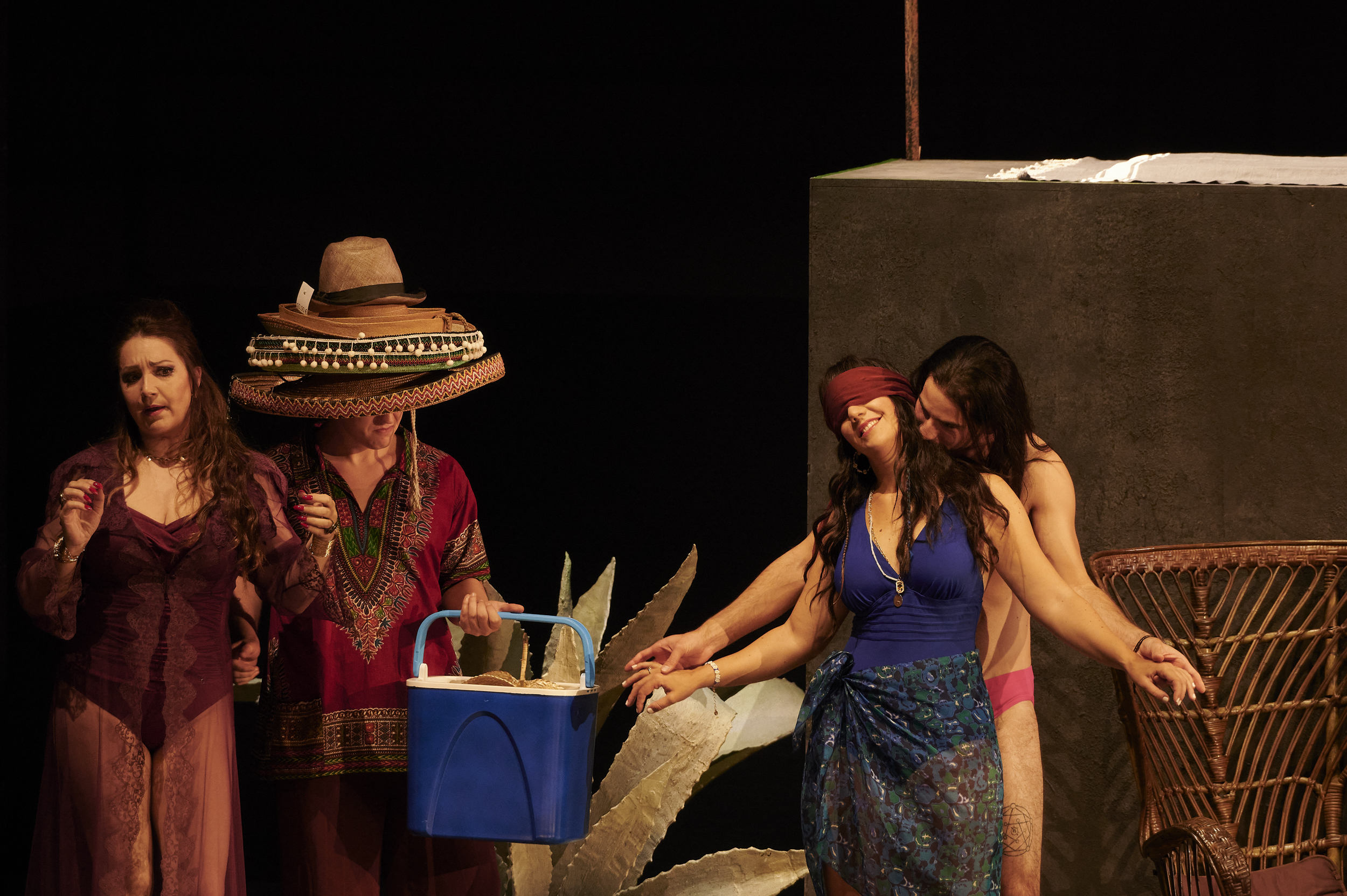
Images: Mark Allan


Simon Rattle’s survey of the Janáček operas has proved a tale of two cities: Berlin (first the Philharmonic and latterly the Staatsoper) and London (the LSO). The latter has been mostly in concert, although it shared Peter Sellars’s concert staging with the Berlin Philharmonic. Now, on the back of Robert Carsen’s Berlin staging, originally seen at the Janáček Festival Brno, the LSO’s series reaches The Excursions of Mr Brouček to the Moon and to the 15th Century. 

Of those I have attended, this unquestionably marked the highpoint: one of those performances it is difficult immediately to imagine being bettered. At the heart of that was the magnificent playing of the LSO. Janáček had not previously played a large part in its repertoire, though I remember an interesting, also highly criticised Glagolitic Mass from Colin Davis. It hardly could, one might say, for a symphony rather than an opera orchestra, which incidentally reminds us of a long-term consequence of Davis and Clive Gillinson’s tenures, nurtured by their successors: regular performances of opera in concert, supplemented by occasional appearances in festival pits. Intimacy of acquaintance with Janáček’s writing, its melodic, rhythmic, harmonic, and timbral qualities, inextricably bound to the Czech language, told—as, I think, it did with Rattle, who has long championed this music and who no longer has anything to prove. Precision, heft, the way the orchestra ‘spoke’: this and so much more made for an ideal partnership, rendered all the more impressive by a uniformly impressive cast and chorus (the ever versatile Tenebrae choir, trained and sometimes conducted here by Nigel Short). 


From the opening of the first part, dance rhythms and orchestral colours, xylophone immediately recalled from Jenůfa, created a dramatic stage before our ears, so much so that it is difficult to imagine anyone truly regretting the lack of staging. Time of day, temperature (literal and metaphorical), place, and much more were palpable, indeed unavoidable. As dawn approached at the end of the first part, one felt it emotionally, overwhelmingly so, as well as temporally. For a tenderness embedded in the composer’s deep humanity was always apparent, in a reading that saw no reason to exaggerate the bizarre, zany elements, as perhaps did David Pountney in a memorable 2022 staging for Grange Park Opera. There is room for all, but this went deeper, also underscoring the extraordinary, innovative brilliance of the composer as a contemporary of Strauss, Schoenberg, and yes, Puccini. There was absurdity, yes, but in that absurdity lay deepest sincerity, and the second part, darker and more soulful from the off, proved more moving still. Soundworlds related yet distinct offered both contrast and connection between the opera’s two parts. 

Peter Hoare, who had also sung the title at Grange Park, proved if anything a still more captivating Mr Brouček, alive to his provincial, bourgeois absurdity, not without affection, yet quite without what would have been deadly sentimentality. Like his fellow cast, this was a portrayal that sprang from the page, deeply rooted in words, music, and their alchemy, without being bound by them. Lucy Crowe gave as fine a performance as I have ever heard from her, alternating various roles as Málinka, Etherea, and Kunka, bringing something special to each of them, refulgent of tone, yet acerbic where called for, and hinting without didacticism at what might unite them. Much the same might be said in principle of all those taking on multiple roles, world-class casting offered by the likes of Gyula Orendt, Linard Vrielink, and Aleš Briscein. Truth be told, there was not a weak link in the cast; more to the point, the drama lay in connection, collaboration, and of course conflict. We were fortunate, I think, to see and hear a cast that had mostly performed together onstage in Berlin. 


Dare we hope, then, for all of Janáček’s operas to feature in subsequent instalments? However tempting, we should probably retain perspective and simply enjoy them one at a time. Sometimes I worry that, in ever-straitening times, opera with full forces, be it staged or unstaged, might come to seem an ‘unaffordable’ luxury. Smaller versions, cleverly adapted, whether will slightly reduced orchestrations or full-scale reductions, can form a crucial part of our operatic ecology, but that must never be at the expense of the ‘real thing’. One can hardly hope for a better reminder of such ‘reality’ than the magical surreality of these Excursions.


Friday, 26 January 2024

BPO/Petrenko - Schoenberg, 25 January 2024


Philharmonie

Chamber Symphony no.1 in E major, op.9
Die Jakobsleiter

Gabriel – Wolfgang Koch
One who is called – Daniel Behle
One who protests – Wolfgang Ablinger-Sperrhacke
One who struggles – Johannes Martin Kränzle
The chosen one – Gyula Orendt
The monk – Stephan Rügamer
The dying one – Nicola Beller Carbone
The soul – Liv Redpath, Jasmin Delfs

Berlin Radio Chorus (chorus director: Gijs Leenaars)
Berlin Philharmonic Orchestra
Kirill Petrenko (conductor)


Image: © Stephan Rabold

150 years on from the birth of Arnold Schoenberg, we could be forgiven for lamenting this world still does not know what to do with him and his music. The most important of twentieth-century composers, he languishes respected yet for the most part unperformed. The muted tones in which even this, his anniversary year, is being celebrated – if not now, then when? – are such that it could readily be missed altogether. There are exceptions, not least my friends and colleagues at Vienna’s Arnold Schönberg Center; I am referring essentially to the world of musical performance—and listening. And just perhaps here also in Berlin, second of Schoenberg’s three major cities. (Los Angeles, alas, has long seemed a lost cause.) Not so much in the city as a whole: we search in vain for contributions from its opera houses – surely things would have been different, were Daniel Barenboim still at the helm of the Staatsoper – and indeed from most of its orchestras, yet in the Philharmonie, home to the Berlin Philharmonic, we at least see in the foyer a little exhibition, mounted in conjunction with the ASC, and here we have now also heard the first of several contributions planned from the orchestra. 

If they continue even to approach the level of this instalment, all will not be lost. The First Chamber Symphony offered a splendid way to start. It was the first live Schoenberg I heard, travelling down as a schoolboy to London on the coach from Sheffield for my first Prom; I think it was actually the first piece on the programme, so the first notes I heard at the Proms, at the Royal Albert Hall, indeed in London, were Schoenberg’s. An attempt at comparison would be pointless: I cannot remember much other than that, even then, it impressed me greatly. But this is therefore a work with which I have lived for a while, and of which I have heard a number of fine performances since that CBSO Prom with Simon Rattle (and Maurizio Pollini), one next door at the Kammermusiksaal included (from members of this same orchestra as the Scharoun Ensemble and Pierre Boulez). Today’s Berlin Philharmonic and Kirill Petrenko have little to fear from even the most exalted comparisons, but it is better simply to consider their performance on its own terms. 

In some ways the most conservative – in the proper rather than the debased, contemporary sense – of revolutionaries and surely the most revolutionary of conservatives, Schoenberg stands Janus-faced, that historical position readily conveyed here in immanent, performing terms. For a work so sunny and life-affirming, it is haunted by ghosts, many of whom cheerfully partook of this particular feast. First up, in the opening bars, was Richard Strauss, already balanced by a heightened sense that this was as much chamber music, a gathering of soloists, as symphony (or indeed symphonic poem). Brahmsian developing variation, Wagnerian melos, passage of transition that owed much to both, and of course Lisztian formal inheritance were to the fore, but through the particular material and character of this piece; it never felt like anything other than itself, though there was to be heard something of a more traditional, darkly ‘German’ sound and warmth to the ensemble than might often have been the case from Petrenko’s two immediate predecessors, Claudio Abbado and Simon Rattle, albeit without sacrifice to clarity and balance. So assured was the latter that one might almost have forgotten what an astonishingly difficult feat it is to bring off (as Herbert von Karajan, Abbado’s predecessor, freely admitted). Illuminating detail – sepulchral, Alberich-like playing from violist Diyang Mei, a snatch of Pierrot-laughter from Kilian Herold’s clarinet – was present to an extent sometimes difficult to believe, but always within a sure and malleable sense of the whole. The development truly developed, showing Schoenberg as heir to Beethovenian struggle. The ‘lightness’ of the beginning of the ‘slow movement’ offered a surprising presentiment of the ‘air of another planet’ soon to be experienced in Schoenberg’s Second String Quartet, prior to well-nigh Mahlerian ‘deepening’. No performance of this complex piece can be perfect; it contains more than can ever be achieved in a single performance. This came closer than most.   

True revelation, though, came with Die Jakobsleiter. So seldom is this extraordinary work heard that I cannot have been the only audience member hearing it live for the first time. I had thought I knew this incomplete oratorio well enough, yet such were the strength and all-round excellence of this performance that I realised I had hardly known it at all. Indeed, not the least of my realisations was that one cannot really begin to know it other than through live performance. Recordings, however excellent, can barely suggest the spatial dimension – here the hall came into its own as much as the performers – nor, more important still, the overwhelming power and conviction inherent in the work and any performance worthy of it. One felt the work’s constructivism from the off, its opening cello hexachord so clearly, powerfully generative of what ensued: musical expression first, words from Wolfgang Koch’s Gabriel next. ‘Whether right or left, forward or backward, uphill or downhill’: one felt, harmonically, motivically, conceptually the multi-dimensional Schoenbergian Idea. Just as important, its colours, not only orchestral (though the inheritance of the Five Orchestral Pieces, op.16 was thrillingly apparent) but vocal too, not least from the souls of the Berlin Radio Chorus, individual and as a mass. Instrumental lines, as if generated by the Chamber Symphony and further developed here, contributed equally to the composer’s hyper-expressivity and the sense of its absolute necessity. It was relentlessly dialectical, relentlessly communicative, already pointing to elements of the world of Moses und Aron. A well-nigh flawless cast of vocal soloists had been assembled and exceeded expectations. Again, the variety of colours and expressive gestures within a single performance, be it that of the increasingly Wagnerian Daniel Behle, the dark, rich Gyula Orendt, Liv Redpath and Jasmin Delfs’s souls in vocalise, or anyone else had to be heard to be believed. Schoenberg’s vivid imagery – or is that too representational a characterisation? – was brought still more vividly to life that was both fleeting and aspirant to the eternal.

All the while, we moved, after Swedenborg, upwards, heralded by the sweetest of violin solos from above, instruments and voices surrounding us as if truly from the heavens. This was less the air of another planet than of another dimension, music and post-Wagnerian, post-Mahlerian redemption above, beyond, around us. This was a magic unlike anything I had yet heard. Part of our world, then, does know what to do with Schoenberg and his music. May it serve as an example to the rest.


Friday, 15 April 2022

Berlin Festtage (4): Così fan tutte, Staatsoper Unter den Linden, 14 April 2022


Fiordiligi – Evelin Novak
Dorabella – Marina Viotti
Guglielmo – Gyula Orendt
Ferrando – Bogdan Volkov
Despina – Barbara Frittoli
Don Alfonso – Lucio Gallo

Vincent Huguet (director)
Aurélie Maestre (set designs)
Clémence Pernoud (costumes)
Irene Selka (lighting)
Louis Geisler (dramaturgy)  

Staatsopernchor Berlin (chorus master: Martin Wright)
Staatskapelle Berlin
Giuseppe Mentuccia (conductor)


Images: Matthias Baus
Don Alfonso (Lucio Gallo) and Guglielmo (Gyula Orendt)


From The Marriage of Figaro to Così fan tutte: the first to the last of Mozart’s Da Ponte operas; or, with Vincent Huguet, from the second to the first in his ‘trilogy’. The setting suggested this, I suppose, moving back from the 1980s to the late 1960s, though that in itself assumes a unity one might not otherwise discern (or guess). Guglielmo, apparently, becomes Count Almaviva—and, after that, Don Giovanni. In Così and Figaro, he is sung by the same artist, at least, Gyula Orendt, though Michael Volle is due to take over in Don Giovanni. Beyond that, though, I found little indication of what might well be an interesting standpoint to take onstage. One can read this in the programme, of course, as I did afterwards, though what if one has not bought one? Should there not be some stage indication of this situation? We learn other oddities of Huguet’s conception in the programme too, for instance that Don Alfonso and Despina are married. I am not sure what light that shed on anything, but it was in any case not apparent to me. 

I think I can see why someone might opt for a ‘flower power’ setting. Ultimately, one can set this opera anywhere or nowhere, with little in the way of loss, so long as one has some underlying, convincing idea to what one is doing. But the point—Mozart’s, still more than Da Ponte’s—seems to have been missed entirely, with something frankly weak and uninspiring put in its place. (I confess that I had to read the programme and watch a short video even to get that far, but perhaps I am just especially slow.) Apparently what happens is that Alfonso and Despina meet another couple of couples, ‘from, let’s say, Milano’ who are intending to marry, and decide to show them a few home truths by having them lighten up a bit. Fine, so far as it goes, but ‘you can have a lot of problems and it is never that bad’. Really? Is not the agonising truth of this work, in all its exquisite sadomasochism, that it really is ‘that bad’, actually worse, and that you—we—must somehow live in knowledge of that devastation? We have eaten the apple; we are fallen creatures; more to the point, we are going to keep on falling, keep on hurting, even killing, each other. It is an opera made for Schopenhauer, save that it is still clearer-eyed. Of the philosophical, let alone religious, truths at the work’s heart—this is surely a ‘Passion of passion’, to quote Michael Tanner on Tristan—there is little or nothing. ‘Always look on the bright side of life’ is a message of sorts, I suppose, though ultimately, however much (or little) one dresses it up with a smattering of Foucault, it does not really extend beyond the realm of the self-help book. 

That, however, seems largely beyond the point, given how difficult it is (at least it was for me) to deduce any of it from what we actually see. We simply have the time-change, a move for a while to what appears to be a yacht, the inevitable silly dancing and other tomfoolery, smoking of what appears to be marijuana, and some random extras engaging in what sometimes, but not that often, approaches soft porn. Two of them massage members of the cast for a while, again to no evident reason. Everyone is conventionally good-looking and everything is surprisingly heterosexual, any engagement between women remaining clearly for the benefit of the man watching or participating. I could not help but notice that a few more elderly men in the audience were audibly excited by female nudity; one even managed to wake from his intermittent snoozing to exclaim something whose meaning I mercifully could not quite discern. If this is sexual liberation, some serious repression would be in order, if only to prevent participants expiring from sheer boredom. That may be a point worth making, though it seemed to arise by accident rather than design.


Despina (Barbara Frittoli), Dorabella (Marina Viotti), and extras
 

Daniel Barenboim should have conducted, but has had to take time off to recover from illness. In his place, at very short notice, was his assistant Giuseppe Mentuccia. It is difficult to tell much of Mentuccia’s own vision of the work from such a ‘jump in’, given that he would essentially have had to conduct Barenboim’s Così, perhaps with the odd inflection when he can. There were a few hints that he may have preferred swifter tempi at times, yet for the most part he fulfilled his duties very well indeed, the Staatskapelle Berlin sounding gorgeous and fully involved throughout. I look forward to hearing more of Mentuccia on his own terms. 

Orendt impressed once more, if anything still more so than as the Count. His dark, virile baritone was well complemented by Bogdan Volkov’s sweet-voiced tenor, ardent and imploring as required, as Ferrando. The latter’s duet with Evelin Novak’s Fiordiligi was a particular vocal (and orchestral) highlight for me. Fiordiiligi’s journey, traced in finest Egyptian vocal cotton, was throughout as involving as Huguet’s banalities permitted. I was less sure about Marina Viotti’s contrasting Dorabella, though concluded that to be more a matter of taste than anything else, her degree of forthrightness in, say, ‘E amore un ladroncello’, a valid interpretative choice (if not necessarily mine). Lucio Gallo made for an effortlessly stylish, verbally acute Don Alfonso. Barbara Frittoli shared the same virtues and offered a welcome change as voice of experience rather than irritating soubrette. She felt no need to resort to silly voices for Despina’s other ‘characters’, employing subtler transformations of tone and colour. 

The cast throughout worked very well together, though I could not help but wish they had been put to use in a more interesting, even challenging, production. Memories of Hans Neuenfels in my first Così continue to die hard, though there have been many alternative options since. Incidentally, on what does Huguet base his claim that the three Mozart-Da Ponte operas are ‘the most-performed operas worldwide’? They have not been in any statistics I have seen; indeed, not one of them falls into the top three, so far as I am aware. I should be astonished, though heartened, if Così came into the top ten. It is certainly among the least understood, though Don Giovanni must come close, and even Figaro’s more profound meaning seems to elude most.


Sunday, 10 April 2022

Berlin Festtage (3): Le nozze di Figaro, Staatsoper Unter den Linden, 9 April 2022


Count Almaviva – Gyula Orendt
Countess Almaviva – Elsa Dreisig
Susanna – Regula Mühlemann
Figaro – Peter Kellner
Cherubino – Marina Viotti
Marcellina – Waltraud Meier
Basilio – Stephan Rügamer
Don Curzio – Siegfried Jerusalem
Bartolo – Peter Rose
Antonio – David Oštrek
Barbarina – Liubov Medvedeva
Harpsichordist – Lorenzo Di Toro

Vincent Huguet (director)
Aurélie Maestre (set designs)
Clémence Pernoud (costumes)
Irene Selka (lighting)
Thomas Wilhelm (choreography)
Louis Geilser (dramaturgy)

Staatsopernchor Berlin (chorus master: Martin Wright)
Staatskapelle Berlin
Daniel Barenboim (conductor)


Countess Almaviva (Elsa Dreisig)
Image: Matthias Baus

Of the three Mozart-Da Ponte arias, The Marriage of Figaro used to seem relatively director-proof. Don Giovanni was the notorious directors’ graveyard, with Così fan tutte somewhere in between. Figaro is not the only one dramatically beholden to an ancien regime society of orders; Don Giovanni is too, though the element of mythology offers other possibilities. In Così, whilst there are important inflections in that respect, they are less crucial. That makes transferral to another setting more difficult than many seem to think, at least unless they are simply going to jettison much of Mozart and Da Ponte altogether. (Yes, ‘at least’ is doing more work than it should there.) It can work—very well in some cases, ranging from Janet Suzman’s pre-revolutionary Cuba to Claus Guth’s exceptional reimagining after Strindberg. It needs thought, though, and application. Alas, chez Vincent Huguet, who to the apparent bewilderment of the entire operatic world has been awarded new productions of all three operas, lack of reflection and sheer laziness seem to have been the order of the day.

One can find germs, relatively well-concealed, of a few basic ideas in Huguet’s programme note. Estimably, he wanted to treat the works as a trilogy, albeit in eccentric order: Così, Figaro, Don Giovanni. We shall see, I suppose; I have been known to recant before, and shall do so happily if necessary. However, beyond name-checking of a few very predictable Francophone names—Foucault, Houellebecq—even that note has little to say; moreover, its connection to the vacuous goings on witnessed onstage remained obscure. The first act seemed to take place at a health club. That permitted an extraordinary display, in which praise could not be high enough for Peter Kellner (Figaro) and Regula Mühlemann (Susanna), of their opening duet being sung whilst doing press-ups. To what end, who knows? That idea, if one may call it that, was soon dropped, after Figaro dressed and the gym surface appeared to become a kitchen counter, on which he prepared some food. To what end, who knows? Thereafter, we moved from there completely, the Countess being revealed as a faded 1980s recording artist, painted by Andy Warhol. The outlandish tastelessness—yes, a quality we all summon to mind when considering the Countess—of her quarters, enhanced by a personal harpsichordist, suddenly onstage (to what end…?) and then by a giant stuffed leopard (or was that perhaps the Count’s? a sense of place became at best unclear…) might have had some implications, I suppose. One might simply have said this was akin to the Trumps, and celebrated a Peter Sellars Trump Tower reunion. Needless to say, no one did, and we moved on to the next sequence of non sequiturs.

It is not worth cataloguing them all, even if I could remember them, but the weird appearance of people with animal heads in the fourth act, two of them taking Figaro’s shirt off, may have had some significance. It probably did not, though, other than giving those who wished an opportunity to see a shirtless Figaro. At the very close, the Count and Countess continued to fight—not necessarily a bad idea—and, out of nowhere, Cherubino ran towards his adversary, hit him, and ran off with the Countess. Thomas Wilhelm’s choreography seemed limited to a brief fitness display from a few unidentified people at the opening and the usual—in this tired ‘dramatic’ world—generic disco dancing at the end of Act III. Immediately prior to that, Huguet’s ‘response’ to Mozart’s exquisitely crafted ballet music was to have the Count and Countess sit on a sofa, the former tickle the latter with a large flower at tedious, apparently amusing, length, and then leap on top of her. It takes all sorts, I suppose, but sometimes I wish it would not. Perhaps we should have been better off if, according to Joseph II’s initial edict, it had been struck out after all; Mozart certainly would have been.

What made this waste of everyone’s time so heartbreaking was the thoroughgoing excellence of the musical performances. For them, and them alone, it is worth anyone’s time and money to attend, though I cannot have been the only person desperately wishing this had been a concert performance—or, dare I say it, a ‘traditional’ staging set when and where it ‘should’ have been. Daniel Barenboim has been conducting this work since the mid-1970s and shows no signs of tiring; rather, the wisdom of experience, of Mozart as composer and dramatist, and of so many others, informs every bar, whilst weighing feather-light. To hear Barenboim conduct Figaro is an experience of stature similar to hearing Colin Davis do so, though their paths are of course distinct. Not even the Vienna Philharmonic would sound indubitably superior to the Staatskapelle Berlin here; they and Barenboim know what to expect from one another and can therefore play with expectations in the moment (an unfortunate bassoon disappearance in the Overture notwithstanding). Golden strings, heavenly woodwind, the entire ensemble up (down?) to and including first-rate timpani: all responded to each other, as if a large chamber ensemble, as well as to Barenboim’s vision. 

In recitativo accompagnato, the strings ‘spoke’ with a vividness such as is called for in Gluck, or even Wagner, though of course a language that is subtly—or greatly—different. Those moments had me wish Barenboim would expand the circle of his Mozart’s operas to include Idomeneo; but that does not, sadly, seem to be on the cards, a postponed new production allotted instead to Simon Rattle. What strikes still more uncommonly in Barenboim’s case, though, is his strategic long-term thinking and hearing. As if this were a giant symphony, he knows the work’s structure and how to communicate it as form in ‘real time’. Conducting from memory liberates, so it seems. This, after all, is a conductor who leads Tristan without a score. In other circumstances, I would lament the ‘traditional’ fourth-act cuts, but it was probably the right decision on Planet Huguet. 

What a cast, too. Gyula Orendt’s Count Almaviva was dark, threatening, and seductive of tone. Leaving aside Huguet’s trashy vulgarity, Elsa Dreisig’s Countess poised and benevolent Countess was straightforwardly one of the finest I have heard. Her collaboration with Barenboim and the orchestra in ‘Porgi amor’, voice and instruments responding to each other’s shifts in colour offered a masterclass in outstanding Mozart performance. One would never have known Kellner, keenly matched by Mühlemann, was a last minute substitute for Riccardo Fassi; indeed, one might have thought the performance built around him. His was, by any standards, an heroic undertaking, again gloriously seductive and as agile as he showed himself in the opening fitness class. Marina Viotti’s Cherubino was finely, instrumentally coloured, though done no favours by Huguet’s confused and confusing direction of her scenes. (One had to know, really.) Waltraud Meier, yes Waltraud Meier, showed she can still act—and how—as Marcellina, also clearly relishing verbal meaning and implications in her recitatives. Siegfried Jerusalem (!) had little to do as Don Curzio, but did it with uncanny excellence. Peter Rose at times threatened to steal the show as an uncommonly distinguished Bartolo. Everything was there, then, not least a fine sense of company, save for an intelligent or even vaguely coherent staging.


Tuesday, 1 February 2022

Theodora, Royal Opera, 31 January 2022


Royal Opera House

Theodora – Julia Bullock
Irene – Joyce DiDonato
Didymus – Jakub Józef Orliński
Septimius – Ed Lyon
Valens – Gyula Orendt
Marcus – Thando Mjandana
Actors and dancers – Aquira Bailey, Browne, Ben Clifford, Sarah Northgraves, David Rawlins, Holly Weston, Kelly Vee

Royal Opera Chorus (chorus master: William Spaulding)
Orchestra of the Royal Opera House
Harry Bicket (conductor)

Katie Mitchell (director)
Chloe Lamford (set designs)
Sussie Juhlin-Wallén (costumes)
James Farncombe (lighting)
Sarita Piotrowski (movement)

ROH Theodora 2022, (c) Camilla Greenwell

Theodora received its first performances at Covent Garden in 1750. Now, at last, Handel’s oratorio came home, albeit staged—and in a staging Handel, Thomas Morrell, their singers and their audience might have had difficulty in understanding. That qualification is, of course, irrelevant as only a truism can be, for much of we might do would be largely incomprehensible to eighteenth-century London, let alone fourth-century Antioch. The question, as ever, is how performance—which emphatically includes the audience—might mediate between different societies, between different ideologies, between text, act, and critique. 

Katie Mitchell adopts, unsurprisingly, a feminist standpoint. She updates the action to a modern embassy, lorded over by Valens as Roman ambassador (rather than governor), where Christians work as an oppressed class. One of their number, Theodora, is pushed to the extent of attempting and, more controversially, succeeding in destruction of the embassy. That already points to a shift in standpoint, crucially apparent from the opening. We should normally wait until the third scene before seeing (hearing) Theodora or indeed the Christians more generally, the first two scenes being devoted to Valens, Didymus, Septimius, and the Chorus of Heathens. Here, we see Theodora and her people from the start, in the kitchen (traditionally, the female ‘domestic’ sphere, of course, ‘top chefs’ notwithstanding). When we view and hear the Romans, it is through their eyes and ears as much as our own. That continues to be the case when Theodora has been sent to the brothel (the other side of the main public room from the kitchen) as a sex slave and continues, moreover, to be the case for Didymus when they have exchanged clothes, when he takes his first, literally faltering steps in heels to learn what it might be to view the world as a woman, and to be treated by that world as a woman. He experiences female solidarity with fellow sex workers, as had Theodora. They teach him how he might survive, by pole-dancing.


Yet we also remain wise to what continues to divide them; there is far more to womanhood than clothes and a blonde wig. For where Mitchell’s achievement hits home most powerfully, often shockingly so, is in its unflinching portrayal of violence against women, Theodora humiliated, molested, ‘remade’ in an appearance acceptable to those in power, and awaiting rape. Septimius may speak of Theodora as a ‘prostitute’, but she is not that; there is no payment. She is entirely at the mercy of those who possess her—until, that is, she fights back. Mitchell’s determination to avoid, to demolish, the male gaze is meet and right. Indeed, in having Didymus stand as the object of our gaze, male and female, first in the baptismal rite conducted at the end of the first act, renewed and parodied in the second loss of his clothes (his masculinity too), she reminds us that even such fragile ‘equality’ as that will constantly be under attack. We recognise it as inversion, even if we pleasure in it. And should we not instead wish for and bring about liberation instead? 

Whereas the libretto has us move in our mind’s imagination from one camp to the other, the embassy setting enables exchange, sometimes by splitting the stage into different rooms, sometimes by having their worlds collide. This has evident dramatic consequences, but they can be arrestingly aesthetic too. In Irene’s ‘Defend her, Heav’n!’ for instance, the action taking place simultaneously in the brothel is seen in magnificently crafted slow motion (movement: Sarita Piotrowski) that interacts with vocal and orchestral music in astonishing fashion. Mitchell appreciates the difficulties attendant to staging in ‘modern’ fashion arias which, if even if they had been intended to be staged—we need not be too hung up on that, for Handel would have written them similarly, even identically—would not generally have been conceived as purveyors of dramatic action. Here, and on certain other occasions, she lets the world continue to move. How, after all, could she stop it? Yet there is a suspended quality to that action, a recognition that beholding it can be exquisite, can be spellbinding, and can be harnessed, dare I suggest, to good and evil.


Harry Bicket’s conducting of the Orchestra of the Royal Opera House—in a welcome break with much recent practice, the Royal Opera has not consigned Handel’s music to an imported band—impressed most when, as often it did, it appeared quite indivisible from the stage action. I had a sense—right or wrong, it barely matters—that he might have done it differently in a performance without Mitchell’s staging. At times, more often than not with the chorus, it took a little while to settle down; indeed, some of the faster choral writing, arguably too fast on this occasion, ran a little ragged. This, however, was by and large a thoughtful and compelling musical performance, with some utterly ravishing woodwind playing in particular. And what a joy not to have to endure Handel with toothpaste-squeezing strings!


What a joy, moreover, to be treated to such a cast of Handel singers, who of course contributed greatly to much of what I have said above. Julia Bullock’s patient strength and unshowy sincerity seemed to me just the ticket for Theodora. Charles Burney described her predecessor, Giulia Frasi, a few years earlier as having for Handel ‘a clear and sweet voice, free from defects, and a smooth and chaste style of singing; which, though cold and unimpassioned, pleased natural ears, and escaped the censure of critics.’ Doubtless that meant something different then from what it would now, but I sensed, however fancifully, a dialogue between our two Theodoras, in the broader spirit of what we saw and heard elsewhere too. If I felt the production a little less clear what to do with Irene—perhaps I was simply failing to understand—Joyce DiDonato’s performance of heartfelt clarity likewise challenged one to imagine it sung otherwise. Likewise Jakub Józef Orliński’s Didymus, as athletic and as melting as his stage presence. Movingly, intelligently compromised as a character between worlds, Ed Lyon’s Septimius was again an object lesson in vocal style, clarity, and tenderness. If Gyula Orendt’s task as Valens in this production was rather thankless, he emerged nonetheless with vocal and dramatic credit. Dramatic credit certainly went to the non-singing actors in the cast too, crucial to Mitchell’s vision—and to our increasingly discomfited gaze.


I have a ‘but’. (Does not one always?) I can see why Mitchell and her team resist Theodora’s martyrdom. In many ways, I sympathise, though surely we have all moved beyond Cathérine Clément’s notorious Opera, or the Undoing of Women (notorious not least for treating opera as if it were not a musical genre). Yet ultimately, to have the heroine survive and kill her oppressors points to a lack of interest I find more troubling than any inversion or deconstruction; it is a lack of interest shared by most opera directors and indeed by most beyond our theatres too. For Theodora is supposed to be a Christian in more than name. Didymus is supposed to convert in more than word. Who are these ‘Christians’? One could adopt a Nietzschean attitude towards their ‘slave morality’ if one did not want to take their faith, or Handel’s, at face value. One could make them another oppressed group: Muslims, say. There is surely, though, interest in that for which they are willing, even joyful, to die; to lose that completely seems an unnecessarily bitter pill. Religious belief and a broader theological framework seem neither here nor there, which surely is to sidestep why Theodora ‘should’ have died and to fail to recognise her on terms more radical still than anything attempted here and which ultimately resist victimhood more strongly too. That, of course, is not what Mitchell has chosen and she is perfectly entitled to have made the choice she has, but it is surely not incompatible with feminism (at least as this male voice understands it). We are nevertheless left with much to consider.


Sunday, 3 March 2019

Così fan tutte, Royal Opera, 25 February 2019


Royal Opera House

Dorabella (Serena Malfia)
Images: ROH 2019/Stephen Cummiskey

Ferrando – Paolo Fanale
Guglielmo – Gyula Orendt
Don Alfonso – Thomas Allen
Fiordiligi – Salome Jicia
Dorabella – Serena Malfi
Despina – Serena Gamberoni

Jan Philipp Gloger (director)
Julia Burbach (revival director)
Ben Baur (set designs)
Karin Jud (costumes)
Bernd Purkrabek (lighting)
Katharina John (dramaturgy)

Orchestra of the Royal Opera House
Royal Opera Chorus (chorus director: William Spaulding)
Stefano Montanari (conductor)

Ensemble

First the good news. With one partial exception, there was much splendid singing, and stage performance more generally, to enjoy from an entirely new cast for the first revival of Jan Philipp Gloger’s Così fan tutte (reviewed here first time around). Our pairs of male and female lovers were nicely differentiated, whilst blending with equal skill and pleasure – crucial in an opera with so much ensemble writing, endlessly varied, endlessly revised and renewed. (There is dramaturgical genius in that, of course, not that sceptics and outright decriers – believe it or not, there remain a few – bother to think about that before regaling us with their ‘thoughts’ on the work.) Salome Jicia and Serena Malfia made for a sparkling pairing of ladies from Ferrara, linear clarity matched by complementary contrast such as one might enjoy in a fine wind ensemble. Much the same, perhaps still more so, might be said of Paolo Fanale’s Ferrando and Gyula Orendt’s Guglielmo, the former’s arias as sweetly sung, tenderly phrased as anyone might reasonably ask. Serena Gamberoni’s keenly sung Despina was properly knowing without lapsing into the unduly arch. Thomas Allen’s Don Alfonso had its moments, but it was difficult to avoid the conclusion that this, a role he long made his own, is now a vocal challenge too far, whatever his continued enthusiasm on stage. Hand on heart, I cannot say that any of these performances surpassed those at Holland Park last year, but I doubt that anyone would have had serious grounds for disappointment either.
 
Dorabella and Guglielmo (Gyula Orendt)


There were, alas, grounds aplenty for disappointment in both the conducting and the production: concerning the former, rather more than mere disappointment. Described in the programme as ‘charismatic’, Stefano Montanari certainly made his presence felt Charisma, however, entails a gift, not a curse, be it divine or otherwise. It is difficult to think of anyone more deserving of the claim than Mozart. If only we had heard a little more of his work and a little less of Montanari’s extraordinary – extraordinarily ignorant, too – arrogance. Arrogating to himself the fortepiano continuo too, Montanari went on to show us that he has little ability at conducting but considerable ability at obscuring scores with his own, allegedly witty, yet in truth tediously predictable, sonic vandalism. To begin with, his ‘contributions’ remained within the realm of the unnecessary, if still highly irritating. The level of premature ejaculation soon, however, reached the level of medical emergency, at times entirely taking leave of Mozart’s bass line and harmony so as simply to present some ‘songs from the shows’. It was the sort of thing a bumptious first-year organ scholar might have done over late-night drinks, albeit more cleverly; here, the results were quite unforgivable. Occasionally hard-driven, Montanari’s conducting was more often merely flaccid: nothing to do with speed, everything to do with a lack of harmonic and formal understanding; it was as if the performance were led by the lovechild of René Jacobs and Marc Minkowski. For a performance of Così fan tutte drag so much is an achievement of sorts, not one I wish to hear repeated. To hear it in the house that was once Sir Colin Davis’s was little short of scandalous.

Dorabella and Ferrando (Paolo Fanale)


Some changes have been made to Gloger’s production since its first outing, presumably by revival director, Julia Burbach. In the first act in particular, they are to its benefit, tightening and clarifying, although the second act fizzles out much as it had done before (if slightly differently). It is, perhaps, indicative of the state of British opera audiences that anyone would see something remotely adventurous in the hamfisted attempt at metatheatricality on show – ‘show’ being the thing – here. Clichés abound, without apparent awareness that clichés they are, and therefore might be played with. The more promising moment remains the substitution of applauding members of the real cast, initially seated in an audience box, for the cast in eighteenth-century garb on stage. There is nothing wrong with the idea that the characters might learn from a performance of the work; it has much to commend it. There is everything wrong, however, with the confusion – somewhat mitigated now, yet only somewhat – with which that is allegedly accomplished. Identities, acts, characters are not ambiguous; they appear simply not to have been thought through, rather as if this were an early sketch for a production rather than the finished article.


As for Gloger’s preposterous claim, allegedly justifying such confusion, namely that to be ‘realisable in realistic terms’, the female characters must ‘know from the beginning of the second act that the “foreign men” are really their own boyfriends,’ it is difficult to think of a graver admission of incompetence. By all means play with such an idea, should it prove dramatically fruitful. The idea, however, that such banal realism has anything to do with the work, that ‘we decided to explain…’ signifies anything other than a catastrophic misunderstanding of the opera’s artificiality and its dramatic consequences, is both saddening and infuriating. Perhaps there is scope for further revisions; I certainly appreciate the attempt. I cannot, however, claim to be hopeful. Like Montanari's conducting, if less so, the production thinks itself far cleverer than it is. More seriously, neither seems remotely to appreciate not only the intelligence but the profundity of this most ravishing of operas.


Wednesday, 16 May 2018

Lessons in Love and Violence, Royal Opera, 15 May 2018


Royal Opera House

King – Stéphane Degout
Gaveston, Stranger – Gyula Orendt
Isabel – Barbara Hannigan
Mortimer – Peter Hoare
Boy, Young King – Samuel Boden
Girl – Ocean Barrington-Cook
Witness 1, Singer 1, Woman 1 – Jennifer France
Witness 2, Singer 2, Woman 2 – Krisztina Szabó
Witness 3, Madman – Andri Björn Róbertsson

Katie Mitchell (director)
Vicki Mortimer (designs)
James Farncombe (lighting)
Joseph Alford (movement, associate director)

Orchestra of the Royal Opera House
George Benjamin (conductor)

Girl (Ocean Barrington-Cook), Isabel (Barbara Hannigan), King (Stéphane Degout), Boy (Samuel Boden)
Images: © ROH 2018/Stephen Cummiskey

 
If Harrison Birtwistle remains acknowledged as England’s greatest musical dramatist since Purcell, then Lessons in Love and Violence may well come to be seen as the work with which George Benjamin mounted his challenge. There is no reason, of course, why such matters should be adversarial, and such is hardly Benjamin’s style, whatever the grisly subject matter of his third opera. He is more someone to knock on the door, enter and delight us with what he brings to the party, without any need to elbow anyone aside. Let us instead rejoice in the creation of another masterpiece, darker and perhaps deeper still than Written on Skin. (Not, of course, that we should forget Benjamin’s first opera either: the wonderful Into the Little Hill.)


As you will doubtless know by now, Benjamin has been reunited with Martin Crimp for this, Crimp’s third libretto, and Katie Mitchell, who directed the excellent first staging of Written on Skin, and who has also worked with Crimp on his other theatrical works, has rejoined the team too. This seems, almost a priori, to have given rise to a degree of ennui in certain quarters. (I have tried to avoid hearing what others have thought about the work, but have not been entirely successful.) One objection seems to have been ‘more of the same’, more or less. I can only presume that the same people would have regretted Mozart’s decision to ‘pursue a collaboration’ with Lorenzo da Ponte after Don Giovanni, perhaps even after Figaro. After all, one often hears the most ridiculous nonsense spoken of Così fan tutte. But there is no reason to be defensive here; I only mention the matter since, for better or worse, it is being spoken of already. Upon leaving the theatre, I hastily typed an ‘instant reaction’ tweet, even, for once, remembering to use the ‘hashtag’: ‘#ROHLessons is a towering masterpiece, its intellectual brilliance and sensual wonders matched, at the very least, by its emotionally overwhelming dramatic path. Drained and satisfied as if by Wozzeck or Katya Kabanova; or, the work that increasingly came to mind, Boris Godunov.’ I have no argument with that almost a day later, and shall try to explain why.


Are such comparisons less odious than ridiculous? Perhaps. Not entirely, though, since I think this is how we often approach new works, not least in so repertory-bound a genre as opera, perhaps especially with a house and company such as the Royal Opera (House). They are far from exact and the tragic trajectory is not the same; here, in the story of Edward II, it is nicely doubled at the end. Essentially we see (and hear) here Edward’s (never, I think named as such) inability to say no to his lover, Gaveston, resulting in the banishment of the clever, unscrupulous politician, Mortimer, who returns, having manipulated the people to his end, to restore himself in something equivalent to a queen’s coup, ridding the court and realm first of Gaveston and then of the king. But the young king, again not named as Edward III, having watched, with his sister, everything unfold, including that violence which is often yet not always subtly hinted at or stylised, turns upon the usurpers and truly becomes king himself.

Boy, Girl, Isabel

Tragedy or restoration? That rightly does not quite seem to be the question, just as that bald outline omits the mess of motivations that characterises this horrible, political world. Much is hinted at, there for one to join the dots, but much is portrayed too. The audience member is, rightly or wrongly, treated as an intelligent human being, a participant, not a consumer of Verdi or other tedious kitsch. It is certainly not so straightforward as portraying a situation in which no one is sympathetic. Rather, as in ‘real life’ – and what, alas, could be more real than our present, not so different high or low ‘political’ life? – motivations are complex, contradictory, and, between characters at least, irreconcilable. Such is surely not the least of the lessons of love and violence that unfold – whether one does not believe in love, as Mortimer, or in violence, as the younger young king does not, yet must. Mortimer, after all, schools him, too, perhaps better than he intended. Likewise, Isabel seems – perhaps is – wronged at the start; we can understand why she, a mother and a wife as well as a queen, acts as she does. Yet she is far from white to start with; in her aestheticism – her love of music and her chilling dissolution of a pearl in acid, a pearl that would have given houses to petitioning subjects – she actually seems a good, or rather deadly, match to her husband, as well as a potential rival to Gaveston. There is horror, too, in her children turning upon her, however deserved that turnaround might be.


But we must return to music, so beloved of these unpleasant people, yet puritanically or sadistically prohibited by the Young King. (Or so he claims: we never quite know the truth of many claims, for who is narrating? We almost seem to know better in the play within a play, that of David and Jonathan, in which Isabel almost literally begins to call the shots, and in the non-musical reprise of such ‘entertainment’ which is threatened, and yet which turns out to be ‘real’, a tortured Mortimer about to be shot dead by the Young King’s sister.) Yes, we must, that too lengthy parenthesis notwithstanding. For it is music that seems – apparently or otherwise – to structure the words and the drama, or perhaps to re-structure them. It is music that creates them, in many ways, regardless of empirical priority. It also creates, and is created by, the situation: its colour, its tensions, its possibilities. ‘It’, whatever it may be, is always, ultimately, about the music; for when the music stops, so does the opera. Perhaps that has always been Isabel’s fear: the fall of the curtain. Mitchell certainly seems to hint at that, but so do Benjamin and Crimp – and, of course, the outstanding cast and orchestra.

Madman (Andri Björn Róbertsson) restrained, Queen, Girl, Boy, Mortimer (Peter Hoare)


Benjamin’s ability to create a sound world has always been one of his hallmarks; in that sense I could not help but think of Janáček and Mussorgsky, both in general and in particular, as mentioned above. Yet, as with those composers, it is certainly not a matter of simply providing atmosphere, a setting, although that certainly is created. Just as Vicki Mortimer’s plush, power-dressing – dressing itself becomes, in true royal fashion, almost a ritual in itself – claustrophobic designs, both for sets and costumes, provide a framework, both to contain and to be broken by the action, so do timbres, often in combination, and harmonies, likewise. There is almost infinite variegation within. The old problem, almost yet not quite Schoenbergian, of reconciling musical antimonies between freedom and determinism, gains new clothes – aural and visual. And the inevitability of the action, at least viewed from the close, of what has happened, takes upon itself an almost Bergian thrust, not least through the characters of and connections between particular scenes. The orchestra follows Benjamin, whether as composer or conductor; or rather, it leads the action with all the confidence and, more to the point, understanding it might once have shown Bernard Haitink in Wagner. And, as with Wagner, still more so with the Debussy of Pelléas, so much action, so much of the truest, wordless action, occurs in the interludes, the transformations between scenes. It is perhaps in those, as in Pelléas, that the stature of Benjamin as a musical dramatist is most immediately manifest.


Or does it? Does the orchestra lead? Do not the singers? Yes, they do too. There is much leadership: too much in the plot, just enough in performance. For song, or at least singing, is crucial to this opera; it is certainly not to be defined as a ravishing, horrifying symphonic poem with voices, although it is perhaps partly that. Benjamin and his co-creators and co-performers refuse the either-or that many of us, seeking for a way in to account for our reactions, would seek to foist upon him. There is drama in melisma: what could be more traditionally operatic than that? There is drama in the entwining and the opposition of melisma? Again, what could take us back more closely to that first zenith of the genre, to Monteverdi? Perhaps the encounter between Isabel and Gaveston, in which she verbally bids him come closer to her, that she might also come closer to the King (who remains distant on stage), is most instructive of all here, for it expresses and creates a musico-dramatic situation more complex than, and still more deadly than, the duet of two baritones so full of sensual delight between the king himself and his lover. Both, and other duets and ensembles, are necessary of course, in the structuring of the drama, just as in the still sorely misunderstood Così. Post-Mozartian Harmoniemusik occasionally seemed to make that point, at least to me; likewise the haunting death rattle avant la lettre emanating from harps and cimbalom, as the Stranger took the King’s life in his cell. The King thought this stranger was Gaveston; so did we, even though he told us he was not, and Gaveston was dead. One could hardly fail to think of the careful, meaningful symmetries of Lulu.

Isabel and Mortimer


And, as with Mozart, although whether through design or through the sheer excellence of these artists on stage, one had the sense that the roles had been written with them in mind. They were, of course, for Mozart, but here, who knows? We are not so much concerned with process, as with each artist having inhabited his or her role. Stéphane Degout’s velvet tones cloaked the impetuous, arbitrary deeds of a weak tyrant, who was also a wronged and wronging man. One made no distinction between role and performance; he simply was the King. So too, and increasingly so, as her role came into focus, was Barbara Hannigan, as his consort. That she played so well in the initial background speaks just as well of her as the display of that extraordinary ability we all know and love – think, for instance, of her Ligeti – to encompass so many modes of vocal delivery within a single line that remains spun from the same silk. Gyula Orendt’s seductive, nasty, manipulative way with Gaveston mirrored and contested the politician’s path of Peter Hoare’s clever, calculating, just as (in)human Mortimer. Not the least of the evening’s performances was the coming of age through politico-emotional stunting of Samuel Boden’s Boy and Young King. Dressed like a boy, he acted unerringly like one too: almost a Prince William, whilst Diana was still around, or shortly after. Ably assisted by his sister, Ocean Barrington-Cook (a mute role), the crown was, again if only in retrospect, his for the taking – once he had learned his deathly lessons. Smaller roles were all very well taken, by Jennifer France, Krisztina Szabó, and Andri Björn Róbertsson: suggestive of a greater number of voices and faces than was actually present, drawn, as it were, as if from an imaginary chorus.

Isabel, King, Gaveston (Gyula Orendt)

For, as in Boris, we observed and felt the people’s grief, feared equally for what we knew to be their largely hopeless future. As the Third Witness had accused the Queen, in a shocking intrusion, orchestrated by Mortimer, into her chamber, the poor had no choice, unlike the decadent rich, to sleep three to a bed. The miracle here was that fury, both external and internal to the drama of princes and nobles, manifested itself through three single voices, an orchestra, and, not least, an endlessly inventive, supportive, and questioning production. Mitchell too did the work the necessary honour of treating it as a mature drama, as she had in Written in Skin; this was not something to be introduced, hesitantly, but to be directed with the critical modernity she would bring to any other work. This may be a quiet operatic manifesto; such, as discussed, is Benjamin’s way. It may even be a manifesto without intention to be a manifesto. Perhaps that makes it all the more convincing, all the more accomplished.