Bockenheimer Depot
Venus – Kateryna Kasper
Ascanio – Cecilia Hall
Silvia – Karolina Bengtsson
Aceste – Andrew Kim
Fauno – Anna Nekhames
Secretary – Aijan Ryskulova
Bodyguard – Stefan Biaesch
Silvia’s friends – Valentina Ziegler, Isabel Casás Rama
Christoph Fischer (set design)
Henriette Hübschmann (costumes)
Jonathan Pickers (lighting)
Deborah Einspieler (dramaturgy)
 |
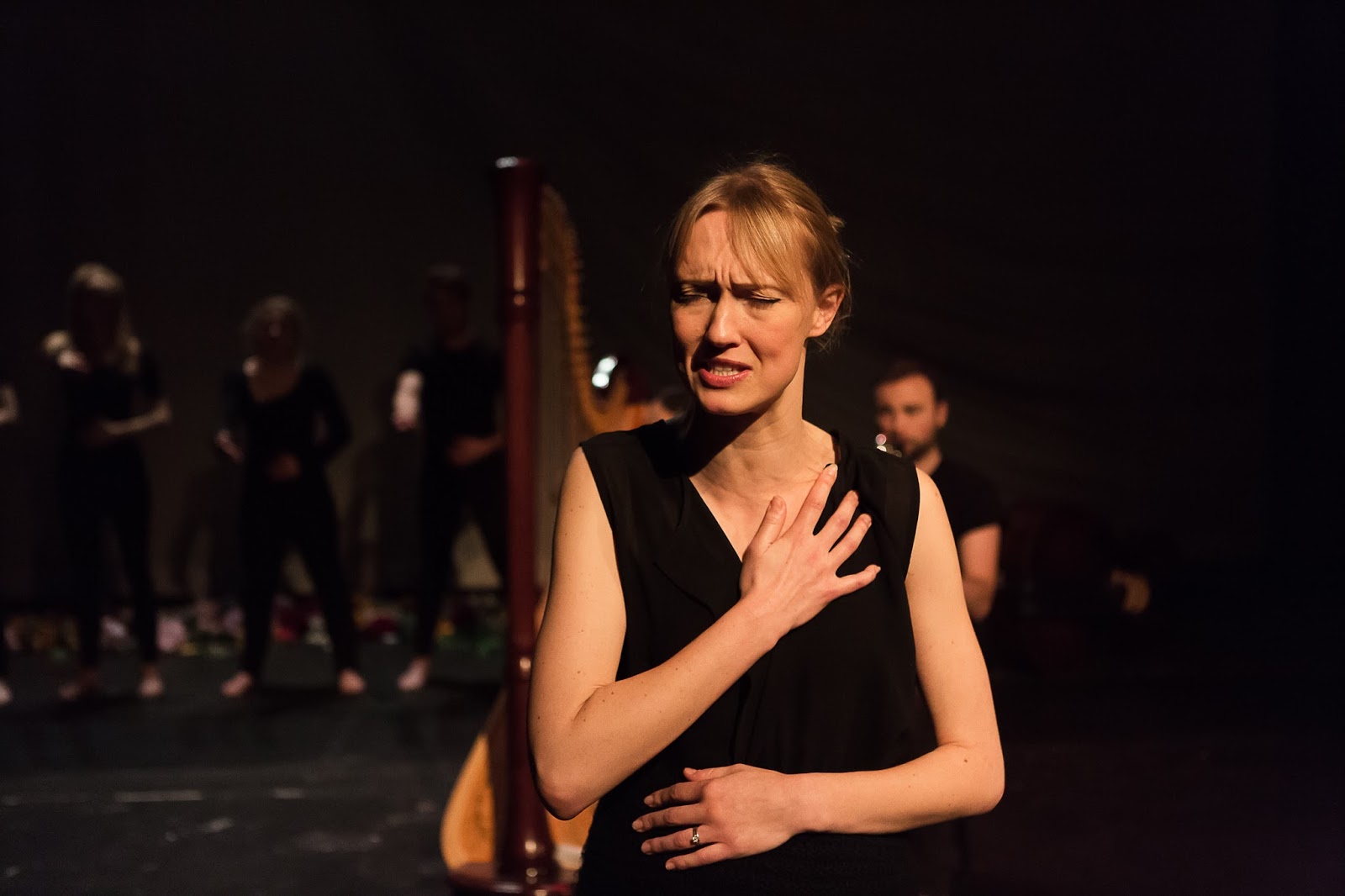
| Images: Monika Rittershaus Aceste (Andrew Kim), Silvia (Karolina Bengtsson), Venus (Kateryna Kasper), Ascanio (Cecelia Hall), Fauno (Anna Nekhames) |
It is not every day I get to hear a Mozart opera live for the first time. And yet, this year 2023, some time after my first year of opera-going, I have done so twice: Il re pastore at this year’s Salzburg Festival, albeit in concert performance, and now Oper Frankfurt’s new Ascanio in Alba, directed by Nina Brazier and conducted by Alden Gatt. Two to go, but another two ticked off the list—not that I ever wish to hear them only once.
Ascanio presents its own difficulties for modern performance and reception. They lie not in Mozart’s age – though all of fifteen years old, he already had considerable operatic experience in different operatic genres – as in the nature of the commission and thus, quite properly, his and his librettist Giuseppe Parini’s response to it. The second of his three operas for Milan, Ascanio was the second of two operas commissioned for – wait for it… the 1771 marriage of Archduke Ferdinand Charles, Governor of the Duchy of Milan and a younger son of the Habsburg monarch, Maria Theresa, to Maria Beatrice, daughter of Ercole III d’Este, Duke of Modena, and his estranged wife, Maria Teresa, Duchess of Massa and Princess of Carrara in her own right. Various treaties and agreements were made concerning inheritance, which I shall not detail now, but this was, even by ancien regime standards, a complicated dynastic match, not even originally intended for Ferdinand, but rather for one of his elder brothers, (Peter) Leopold, passing down the line of succession when the latter went instead to Florence in 1765, succeeding his father, Francis Stephen, as Grand Duke of Tuscany (but not as Holy Roman Emperor, the lot of the eldest son and King of the Romans, Joseph, also appointed co-regent to Maria Theresa in the Monarchy). I could go on, and will elsewhere, but the point, now further underlined, is that this was not a marriage concluded for love; it was, like other Habsburg marriages, and as we now should say, a business arrangement.
This festa teatrale therefore offered, its veil of allegory thin, Venus deputing her son (by the deceased Aeneas) Ascanio to rule the territory of Alba, literally civilising it by turning its pastures into a city, and informing him he would marry Silvia that day. Cupid has already had Ascanio appear in dream form to Silvia, causing her to fall in love with him. (There was a difference here too, since the actual marriage had been arranged when the participants were young children, and the pair did not know each other prior to their nuptials.) The situation, in any case, was a cause for celebration, yet offered little in the way of conventional drama. The most obvious ways in which that might have been achieved were out of the question: Venus’s (Maria Theresa’s) role as mistress of ceremonies who must unquestionably be obeyed could hardly be questioned. Nor was it possible to present some sort of intrigue in which the two ‘lovers’ might initially be thwarted, still less in which they might, however momentarily, have feelings for others. Instead, Venus instructs Ascanio – and never, it seems, does it occur to anyone to disobey her – not to reveal himself to her, leaving the poor girl to believe she is in love with another, whom she meets, until just before the marriage. Silvia will nonetheless do her duty and marry Ascanio, whom she finally discovers to be the one she loves. Cue rejoicing, as both parties have acted as they should, that is according to Venus’s instructions, and will be rewarded both in marriage and in rule.
A modern production might perhaps wish somewhat to deconstruct this and/or to historicise it. Brazier does the former, I think, in respectful, subtle fashion, though I admit to wondering whether she might have gone further. That may have been a matter of my slowness, though, and in some ways it is a relief not to report a sledgehammer attack on a serenata (as Mozart referred to it) whose slender nature might not withstand it. The contemporary setting is corporate, its blue and yellow colour-scheme suggestive either of the European Union (perhaps, in Frankfurt, specifically the euro?) or Ryan Air. I am not sure either was intended, but the insistence and thoroughness of Venus’s ‘corporate identity’ – in the Christoph Fischer’s totalising circular set design there can be no escape – imparted, regardless of intent, such thoughts to me. Otherwise, though, could not Venus/Maria Theresa/dynasticism/corporate power have been made a little more obviously monstrous? Or some other, modern slant on an arranged marriage been presented? A girlish and very pink Silvia, replete with equally girlish and pink girlfriends, was doubtless bringing money into the family/firm’s coffers, but that again had me ask whether an approach taking us back to the eighteenth century, presenting the real plot behind the plot, might have taken us further.
 |
| Silvia and her friends |
That is not to say we should all have enjoyed a recreation of a Habsburg wedding: a prospect whose denial might have had more than merely financial grounds. But I wondered – and I cannot put it stronger – whether admirable reluctance to mess with the work’s dramaturgy had left us with an updating that neither connected quite strongly enough to the work nor presented us with something whose contemporary relevance, for want of a better word, was as apparent as it might be. Perhaps, though, that is simply in the nature of the work’s challenges, and on reflection, in representing the difficulties faced by creators it has indeed provided food for thought. Might something have been attempted in which today’s Venus aped yesterday’s Maria Theresa, whilst the rest of the world suffered accordingly? Possibly. It is easy, though, to come up with germs of concepts behind one’s laptop on the train back from Frankfurt. The craft of theatre direction is far more than that, and detailed, thoughtful Personenregie, even with what even an ardent Mozartian might concede is not always the deepest of characterisation, was very much on show.
 |
| Ascanio and Venus (centre) and Statisterie |
For the situation did present Parini and
Mozart with a particular opportunity for the titular hero, if we may call him
that. In an ‘actual’ opera seria, we should be unlikely to find anyone facing
such a problem in the central role. This was not the stuff of a primo uomo,
though the musical style may well often be so, at least on the initial surface.
This boy, completely under his mother’s thumb and not necessarily through any fault
of his own, came vividly to life in Cecelia Hall’s performance. Initially
somewhat pallid, of character if not of tone, there was true development here,
and both Ascanio’s anguish and subsequent joy, in exhilarating duet with Karolina
Bengtsson’s Silvia, stepped out of the confines of occasion and even genre,
reminding us that Mozart already had not only experience of writing operas seria
and buffa, but also a good amount of affecting sacred music. Bengtsson’s
beautifully sung Silvia contrasted and complemented. Her graciousness in light
of Kateryna Kasper’s demands as Venus, despatched with imperial precision,
might even momentarily – that was all any child, let alone daughter-in-law
might hope for – have impressed Maria Theresa. The role of Aceste, priest
turned corporate fixer, was stylishly sung and acted by Andrew Kim, agile and
clean of line. So too was that of the shepherd Fauno, Anna Nekhames revelling
in its often absurd coloratura. All singers were making their role debuts. Choral
numbers were recorded, yet had reasonable presence, and there was neither
jarring nor disjuncture.
 |
| Fauno, Ascanio, Silvia, Aceste, with the orchestra and Alden Gatt in front |
That was largely due, of course, to Alden Gatt’s coordination as conductor. Gatt’s tempi were well-chosen, and his command, from one of the two harpsichords, of the small orchestra was unquestionable. If there were a few times when I wished for greater string warmth that may have reflected the acoustic more than the performance. Passages of astonishing psychological acuity – yes, even at this age and in this work – and of sonorous delight from Frankfurt woodwind and horns were in any case numerous enough to be savoured. Everything was in place, and considerably more than that. First nights, in any case, tend to be succeeded by performances that delve deeper, though Ascanio in Alba never had that chance first time around. Continuo playing, moreover, was excellent throughout, recitatives explaining and connecting just as they should.
Just in case you were wondering: those two Mozart operas remaining for me to experience in the flesh are Lucio Silla and Il sogno di Scipione. So, if any enterprising opera companies within my reach would care to help out, I should be greatly obliged. And if a still more enterprising organisation were able to preface Ascanio with the first of the two Milanese wedding operas, Johann Adolph Hasse’s Metastasian Il Ruggiero, designed by the same team of brothers, we should at last have chance to discover how justified posterity’s verdict of definitive Mozartian victory actually was. For now, the verdict of Maria Theresa’s favourite composer, Hasse, stands: ‘This boy will render us all forgotten.’