Saturday, 29 March 2025

Aimard - Ravel, 27 March 2025


Queen Elizabeth Hall

Jeux d’eau and Valses nobles et sentimentales (excerpts)
Le Tombeau de Couperin: ‘Prélude’, ‘Forlane’, ‘Toccata’
Miroirs: ‘Noctuelles’, ‘Alborada del gracioso’, ‘La Vallée des cloches’
Gaspard de la nuit

Pierre-Laurent Aimard (piano)
Mathieu Amalric (speaker)


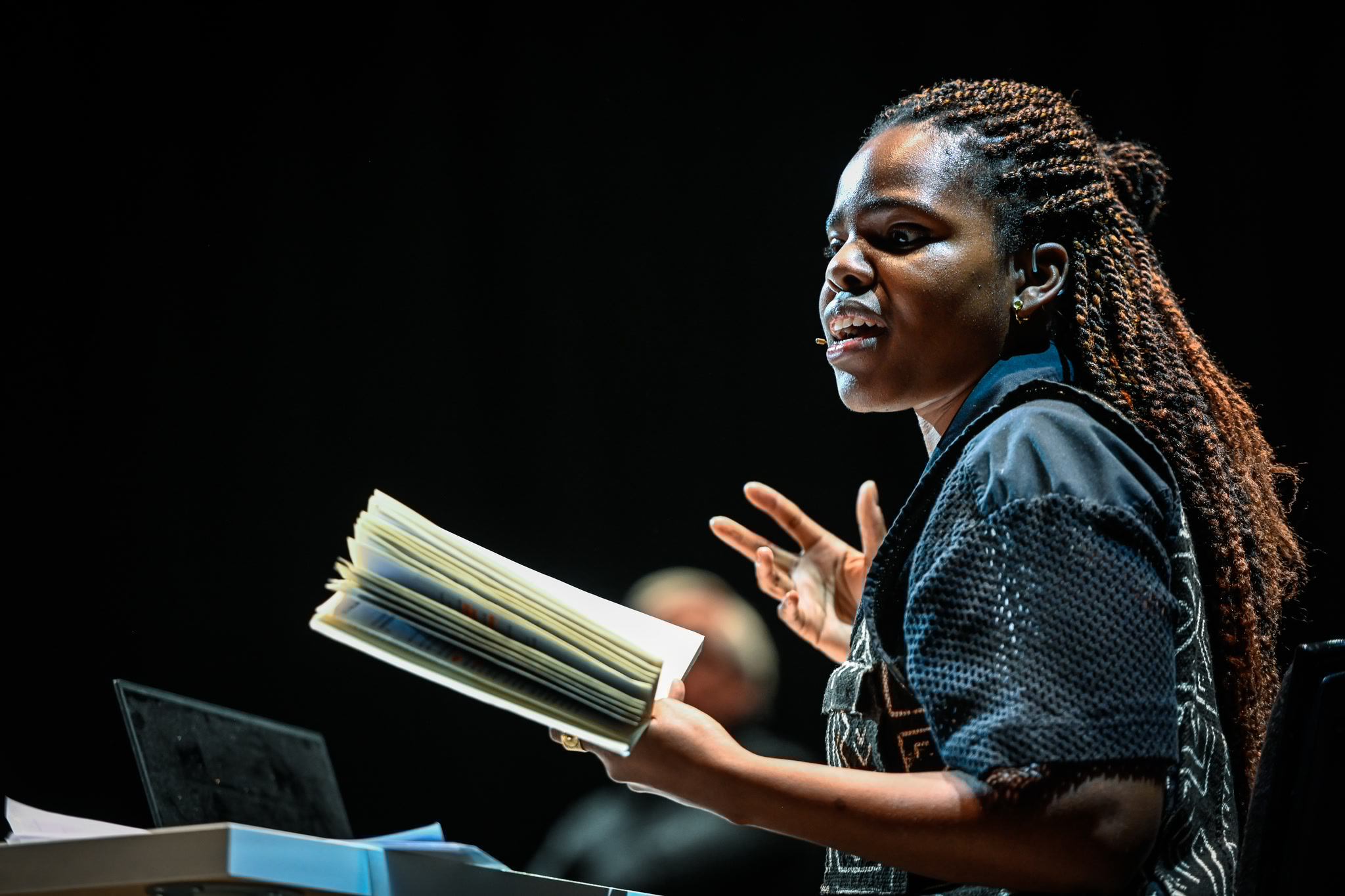
Presented more as show than recital, it was nevertheless the musical elements of this Queen Elizabeth Hall celebration of Ravel that shone through. The conceit did no harm; for one thing, it was a welcome opportunity to see Mathieu Amalric on a London stage. He took the part of a friend of Pierre-Laurent Aimard, calling to collect him to travel to a recital Aimard would be giving. Whilst Aimard did some last-minute practice – or rather played around with other music by Ravel – Amalric read from material with which his friend had helped inform him and also filmed him. The script could have done with more work, to be honest, but it did not get in the way; the warmth of their collaboration was evident. 

And so, when the lights went down, the music began. Aimard’s selection of sheet music from the floor – we have all been there – and (very superior) busking through a few bars of Jeux d’eau, followed by excerpts from Valses nobles et sentimentales offered a winning amuse gueule, though naturally one wished to hear more, whilst retaining a sense of eavesdropping on practice. Then the doorbell rang: enter Amalric. He suggested that Aimard play the ‘Epilogue’, which served to cast a nostalgic shadow even over music we had not heard, lilt and voicing delectable. 

Other readings followed, interspersed with music: Ravel writing to his mother in 1916 with a wounded reproach that he had not heard from her, another letter from the same year on ‘active duty’ opposing ‘patriotic’ efforts to prohibit performances of enemy music, such as that of Schoenberg and Bartók. The three movements from Le Tombeau de Couperin certainly gained something from enhanced awareness of their wartime context, as did the three from Miroirs from a 1905 letter to Maurice Delage, its talk of ‘smelting castles’ and the ‘wonderful symphony’ of their sounds nice preparation for the beauty in precision of ‘Noctuelles’ as composition and performance. Talk from another source of the cliché of Ravel’s Spain as more real than the real thing could momentarily be believed, in the Lisztian virtuosity of ‘Alborado del gracioso’, not least its exultant close. The more mysterious, even mystical realm of ‘La Vallée des cloches’ gave a sense of French music to come, Messiaen, even Boulez, heard at a different aural temperature, which paved the way for Gaspard de la nuit. 

This was the concert ‘proper’, a performance that reminded me, among other things, how infrequently we hear this masterpiece. Why? Perhaps pianists still shy away from its demands, or only have it in their repertoire for a while. One can hardly blame them. At any rate, it was a treat from beginning to end chez Aimard. The unmistakeable shimmering of ‘Ondine’ registered with a freshness that, just maybe, had some roots in the novelty of presentation as well as in the excellent pianism and musicianship. Aimard’s wondrous spinning of a musical line, unfailingly eloquent, revelled in the Bösendorfer and its sound world. The terrifying yet somehow seductive insistence of ‘Le Gibet’ was heard at proper ‘temperature’ too, as if the myriad repeated notes throughout the evening had been leading here. ‘Scarbo’, his laughter and shadows, could be seen as well as heard, a still more fitting culmination with roots in all that had gone before. Had I not seen Aimard’s two hands with my own eyes, I might have sworn he had four.


Wednesday, 26 March 2025

Kapelis/Berliner Barock Solisten - Bach, 25 March 2025


Barbican Hall

Piano Concerto no.3 in D major, BWV 1054
Piano Concerto no.4 in A major, BWV 1055
Piano Concerto no.1 in D minor, BWV 1052
Piano Concerto no.2 in E major, BWV 1053
Piano Concerto no.5 in F minor, BWV 1056
Piano Concerto no.7 in G minor, BWV 1058

Berliner Barock Solisten
Alexandros Kapelis (piano)

Six out of the seven Bach keyboard concertos: a tall order by any standards, and in practice probably better suited to recording than live performance, or at least spit between a couple of concerts, interspersed with other works (and/or maybe multiple soloists, even instruments). Indeed, it came as little surprise to read that Alexandros Kapelis and the Berliner Barock Solisten have indeed recorded these works, plus the missing BWV 1057. Still, it was not the first and will not be the last concert to present more of a CD than a concert programme, and I chose to go, curious to see what would come of the idea.

Putting aside, insofar as one can, the programming, how then did it turn out? Perhaps inevitably, my experience was mixed, the second half to my ears generally stronger than the first. (There is nothing unusual about that in a solo piano recital or many other concerts.) Perhaps the biggest problem for me was a general uniformity of approach, especially during the first half. If one is going to programme this way, one surely needs to consider what makes these works different from one another and communicate that—as well, doubtless, as what they hold in common. The D major Concerto, BWV 1054, set a pattern for much of what was to come, its first movement bright and bouncy, piano playing less distinct – perhaps in part a matter of acoustics – than that of the strings, although here and elsewhere Kapelis’s trills were very much to be enjoyed.
 

What I missed even in isolation, and despite gravely beautiful playing from the Berlin strings in the slow movement, was a sense either of chamber music or of the pianist leading, let alone of interplay or tension between the two. The small orchestra (4.3.2.2.1), led by Daniele Gaede, pretty much did its own thing and Kapelis played along. Might a conductor have helped? Perhaps. Not that the orchestra needed it, but perhaps a conductor would have helped connect the soloist with them. Moreover, it was the orchestra, more than the pianist, that tended to vary its approach, the second slow movement (BWV 1055) more austere, somewhat ‘period’ in tone. 

It was definitely Steinway rather than Bösendorfer playing and certainly seemed to be conceived for the piano. (Why would you play Bach on the piano only to try to make it sound like the harpsichord, in which endeavour you will certainly fail?) In the D minor Concerto, BWV 1052, there were some distinctly odd passages, violin imitation/derivation in the first movement sounding merely heavy, whilst the second often seemed listless, a relatively swift tempo notwithstanding. The third movement nonetheless sprang to life, mostly maintaining that impetus. There were even, much to the music’s benefit, a few signs of Kapelis actually leading proceedings. 

The outer movements of BWV 1053 in E major largely maintained that shift of gear. The first was impressively variegated and well-articulated. There was a sense both of air behind the sails—and of high-quality sails too. I suspect it was no coincidence that the orchestra sounded more committed too. There was a better approach to chamber music in the Siciliano, even if usually of piano listening to and following the strings rather than of true give-and-take. When it came to solo passages, though, Kapelis’s playing was oddly detached, as if embarrassed to sound ‘Romantic’. The two final concertos mostly followed that pattern, with noticeable springs in the step for outer movements, the finales admirably vigorous. The slow movement of BWV 1058 was notably more successful, offering greater continuity and some genuinely lovely playing, than its counterpart in BWV 1056: oddly choppy, both at the time and as an encore.

Still, there was a large audience at the Barbican, many of whom will surely have been hearing some or all of these works for the first time. If I had reservations about some aspects of the performances, there was also much to enjoy. Further acquaintance with Bach’s music is rarely, if ever, anything but time well spent.  

Sunday, 23 March 2025

JACK Quartet - Carter, Aguilar, Lachenmann, Boulez, Houben, Webern, Cage, Wulliman, and Cheung, 22 March 2025


Wigmore Hall

Carter: String Quartet no.5
Eduardo Aguilar: HYPER
Lachenmann: String Quartet no.3, ‘Grido’

Boulez: Livre pour quatuor: 1b
Eva-Maria Houben: Nothing More
Boulez: Livre pour quatuor: 3c
Webern: Six Bagatelles, op.9
Cage: String Quartet in Four Parts
Boulez: Livre pour quatuor: 1a
Austin Wulliman: Escape Rites
Anthony Cheung: Twice Removed
Boulez: Livre pour quatuor: 2

Christopher Otto, Austin Wulliman (violins)
John Pickford Richards (viola)
Jay Campbell (cello)

From a full day – three concerts – of twentieth- and twenty-first-century music for string quartet, I was able to attend the last two of the JACK Quartet’s Wigmore Hall appearances. Alas, I had to miss most of two pieces in the third, both from 2024, by Austin Wulliman and Anthony Cheung. It would be unfair to comment further, other than to say I should be keen to put that right, should the opportunity present itself. Otherwise, the JACK Quartet showed itself once again to be an outstanding ensemble of broad musical sympathies, encompassing works at what we might consider the modernist end of the spectrum, but also others, which have points of contact with the likes of Boulez and Lachenmann, as well as Cage, yet also have quite different concerns. 

Carter’s Fifth (and final) Quartet opened proceedings for me, as finely crafted in the JACK’s performance as this masterpiece is on the page. From the outset, one was left in no doubt that every note counted. Patterns, progressions, and contours in sound were communicated as readily as in an outstanding performance of a Haydn quartet. One felt as well as heard – as throughout the day – emotional breadth and depth, as well as energy, rhetorical eloquence, and intellect. Carter’s metric modulation provided the turning points, the moments of decision, in transitional material. His indications underlay not only tempi in the narrower sense, but in a fuller understanding of character: for instance, ‘Lento espressivo’, ‘Presto scorrevole’ (the latter word a favourite of Carter’s), or ‘Adagio sereno’. In high-lying violin harmonics, in a magical reinvention of viola pizzicato, in a conversation between two or three of the instruments (and players), or in the four coming together in time-honoured fusion of harmony, counterpoint, rhythm, and attack, this was the keenest, most captivating of quartet music. 

Eduardo Aguilar’s ten-minute HYPER (2021) followed, beginning almost inaudible on the first violin, yet fast becoming not only audible, but vividly present across the quartet, pitch gradually discernible in the gathering of a whirlwind. Then came another—in another direction. (I was going to say the opposite direction, but that would, I think, present a false binary.) Tempi shifted and transformed, not ‘like’ Carter, but holding a potential point in common. So did other parameters and other, less definable concerns: intriguingly including a sense of ease or effort, speaking perhaps to some, indefinable sense of subjectivity and/or objectivity. At the close, the players gave up their instruments, though continued to play with their bows, two walking into the audience and making music with and into the air. 

Lachenmann’s ‘Grido’ Quartet immediately showed the players once more fully inside the idiom: language, yes, but also a broader sensibility and strategy. There was at the opening something of a ‘story so far’ impression: both to Lachenmann’s previous quartet writing and even to the history of the genre more broadly. It invited and, if one accepted, compelled us to listen in a performance with a strong sense of discovery. Dynamic and other fluctuations – pitch, for instance, through what one might have thought vibrato, yet only rarely was – grabbed and led us on our journey as much as more overt musical gesture, in a neat-half-hour of enormous intensity of musical expression. This was, without question, a German heart and mind at work: ever-becoming, on multiple levels. At the close, one felt, as one might with Webern or Nono, that one was hearing differently, more clearly. 

In the second concert, movements from Boulez’s Livre pour quatuor framed a wider exploration, involving not only those works I was unable to hear but also Eva-Maria Houben, Webern, and Cage. Webern stood behind the other three: ironically, perhaps, for one the brevity of whose music is so celebrated (if never really the point). Here, his op.9 Six Bagatelles sounded, far from inappropriately, as much as backward glance to German Romanticism as Boulez’s ‘threshold’ for modernity. Each of his six movements said everything, and yet each said something different. This was not compression, but rather a paradoxical (or dialectical) superfluity in which not a note, not a sigh, not a Viennese dance inflection, was anything but necessary. Mahler sounded more present than ever. 

Houben’s Nothing More (2019) took what one might, in the broad rather than the US American sense, call a minimalist route from Webern (from Cage too, I think). There was nowhere to hide, not that anyone should have wished to. Precision was all in work and performance. Much playing was, if not at the limits of audibility, not so far away from them. This, one felt, not entirely unlike Lachenmann, was a way into listening ‘itself’. 

The glassy non-vibrato of Cage’s 1949-50 Quartet suggested, similarly, both a fiddling and a viol consort past, complemented by the music’s melodies and harmony. (It was a little surprising to find myself thinking of harmony in Cage, but that doubtless points to my preconceptions, not to his reality.) The apparent simplicity of its four movements is real enough, but again seems as much an invitation to listen and to listen differently, as a quality in itself. Its related chastity – rarely, if ever, does Cage (for me) sound erotic – sounded, like that of the Five Melodies I heard earlier this month, closer than one might expect to the folksiness of ‘populist’ Copland. In both cases, though, that probably conceals more than it reveals. The closing Quodlibet came as relief in every sense.   

Boulez’s more-or-less contemporary Livre pour quatuor (1948-9), long more or less unheard, seems to be regaining popularity again. It seemed to me a pity not to hear all of it, with or without the reconstructed completion of the fourth movement, but a fragmentary approach has always been part of its performance tradition—and some would say also speaks in some way to essence. Hearing parts of it interspersed with other music heightened its contrasting qualities and perhaps aided reflection on its particularities within Boulez’s œuvre too. At the outset, it may have been the relative austerity – classicism perhaps, though that raises at least as many questions as it answers – that spoke, especially if one had in mind from preceding works the explosive qualities of the Second Piano Sonata, or indeed the eroticism of Les Soleil des Eaux. And yet, even in movement 1b, a veiled sense of kinship with late Beethoven as allegedly annihilated in the Sonata came through in (smaller) fragmentary manifestation of its dialectical contrasts. 3c brought greater emotional, Webernesque intensity, aptly preceding the Bagatelles, whilst 1a at the beginning of the second half sounded more variegated, partly in reaction to the different, arguably more essential austerity of the Cage. The second movement, with which the concert closed, engaged itself – and us – in a process of seemingly infinite, centrifugal transformation, perhaps not only a quartet but a world in itself.


Friday, 21 March 2025

LSO/Hannigan - Khayam, Haydn, Vivier, Debussy, Sibelius, and Bartók, 20 March 2025


Barbican Hall


Golfam Khayam: Je ne suis pas une fable à conter (UK premiere)
Haydn: Symphony no.39 in G minor
Claude Vivier: Orion
Debussy: Syrinx
Sibelius: Luonnotar
Bartók: The Miraculous Mandarin: Suite

Gareth Davies (flute)
London Symphony Orchestra
Barbara Hannigan (soprano/conductor)

The second of Barbara Hannigan’s two March LSO concerts opened with a UK premiere: Golfam Khayam’s Je ne suis pas une fable à conter, which Hannigan commissioned and has already performed with the Iceland Symphony, Radio France Philharmonic, and Gothenburg Symphony orchestras. Khayam being unable to travel to after hearing hearing her speak on Iranian music, receiving a reply and offer a collaboration within two hours of sending her message. They settled on a poem by Ahmed Shamlou. There are, it seems, elements of improvisation, though without knowing the work it is impossible to know how much. Opening with cellos and double basses, joined by other, deep-pile LSO strings, the piece effects, especially after voice and flute entry, an ‘east-west’ encounter in vocal and instrumental arabesques, and in combination of tonal and modal (at least to my ears) writing. It seemed to suggest eventual passage from mourning to light, or perhaps better, to glimpse it almost Janáček-like, at the end of our current tunnel. Not that it sounded in any way like Janáček, but perhaps there something in that sensibility was held in common. Perhaps it was no coincidence that here the words turned from French to Farsi. 

Haydn’s Symphony no.39 received a fine reading, Hannigan revelling in its quirks and surprises—considerably more so, it seemed to me, than her slightly disappointing way with the so-called ‘London’ Symphony no.104 last week (an altogether more Classical concern). From the off, she and the LSO relished its Sturm und Drang energy, silence as much part of its activity as sound in the first movement. It developed and returned, almost in a flash, yet certainly not without our knowing that it had. Here and in the ensuing Andante, there was nothing generic to form and process, deeply rooted as they were in Haydn’s particularities. And what a joy it was to hear the LSO in such music, unburdened by ‘period’ affectation. In her programme note, Kate Hopkins described the minuet as stately. It might have done with being a little statelier here, or at least sterner. Still, in its more flowing though not rushed way, it ‘spoke’ clearly, just as its delectable trio sang. The finale, full of incident, might in some ways sound ‘theatrical’ but proved, quite rightly, above all symphonic. 

Claude Vivier’s Orion followed, essentially a theme and five variations. Throughout, it was characterised by a strong sense of liminality, doubtless born, as Tim Rutherford-Johnson’s helpful note pointed out, of Vivier’s preceding opera on death and the afterlife, Kopernikus, and its foretelling; ‘You will hear the music of Orion and the mystical seven sages.’ Distinct echoes of various music – the Stravinsky of the early ballets, Messiaen, Grisey (or was that the Wagner of the Rheingold Prelude) – sounded both too close not to be intentional, yet also too fully integrated to be the point. Above all, it seemed to refer only to itself and, in the two percussionist cries of ‘hé-o’ to the mystery of human subjectivity set against something implacably cosmic. 

The second half opened with a solo from above (at least in the Stalls), Gareth Davies in a beautifully free yet coherent performance of Debussy’s flute Syrinx. Hannigan again led for Sibelius’s Luonnotar. But of course she can sing Finnish whilst conducting… It made for a fascinating combination, the Sibelius possessed of a keen narrative thrust born of words and music alike, all the drama of the ballad rooted in febrile LSO strings. It emerged as a kindred spirit to Mahler’s Das klagende Lied, albeit in (relative) miniature. 

Bartók’s Miraculous Mandarin Suite rounded off an eclectic programme. For me, it is one of those cases in which I always regret the loss of material. Habits of early encounters with Boulez doubtless die hard. Nonetheless, on its own terms, there was much to ‘enjoy’, if that be the right word. Hannigan and the LSO seemed more focused on the harder edged elements to the score: a steely frame that seemed to invite comparisons with more or less contemporary Prokofiev (Le Pas d’acier and even the later Fiery Angel). Occasionally ear-splitting in the Barbican’s awkward acoustic, it danced its way to a final, ever wilder climax.


Thursday, 20 March 2025

Nash Inventions - Stravinsky, Holt, Grime, Davies, Carter, Casken, Matthews, and Anderson, 18 March 2025


Wigmore Hall

Stravinsky: Concertino
Simon Holt: Acrobats on a loose wire (world premiere)
Helen Grime: Long have I lain beside the water (world premiere)
Davies: String Quintet
Carter: Mosaic
John Casken: Mantle (world premiere)
Colin Matthews: C.A.N.O.N. (world premiere)
Julian Anderson: Van Gogh Blue

Claire Booth (soprano)
Nash Ensemble
Martyn Brabbins (conductor)

Founded in October 1964 by Amelia Freedman at the Royal Academy of Music, a shortish walk away from the Wigmore Hall, the Nash Ensemble is celebrating its sixtieth anniversary season, this the culminating concert in a day’s events of ‘Nash Inventions’ that was but one part, broadly speaking the ‘new music’ part, of that season. As Harrison Birtwistle noted, quoted in the programme, the Nash is and has been unusual in ‘dedication to the old and the new’. Here, no fewer than four world premieres were heard alongside other Nash commissions, plus Stravinsky’s Concertino. 

Stravinsky’s 1920 piece for string quartet received a performance making it sound as new as the day it was born, now of course more than a century ago. Incisive, even aggressive, the Nash’s account showed that rich tone was not inimical to such qualities, quite the contrary. Quite rightly, this singular work sounded unlike anything else, although certain approaches to The Soldier’s Tale made a welcome impression.

Simon Holt’s new work, Acrobats on a Loose Wire, for flute (in the balcony above and behind) and string trio draws inspiration from a painting by Jusepe de Ribera. Its clear trajectory, the flautist moving from piercing piccolo to alto flute and finally to (standard) C flute, seemingly unaware of the string trio on stage proved engaging and brimming with melody of a kind one might almost, borrowing from Wagner, call ‘unendlich(e)’. 

Soprano Claire Booth and conductor Martyn Brabbins joined flute, clarinet, string trio, and harp for the premiere of Helen Grime’s  Long have I lain beside the water in its chamber version. Originally, it was the final song in a cycle for orchestra and solo soprano, to words by Zoe Gilbert. ‘A lament’, to quote Gilbert, ‘by a murderous sister, a tale of jealousy and love,’ it opens with a single pitch passed from woodwind to soprano, other instruments joining around them (descending). Words and music seemed to form an indissoluble union, both as work and performance, whether melismatic or syllabic. In that, they gave a taste – rather more than that – of gripping drama in which every note counted: both song and scena, it seemed. Typically vivid of timbre, it made me keen to hear the larger work from which it comes. 

Next came Peter Maxwell Davies’s 2014 String Quintet. Whether it was quite the right time and place to hear it, I have my doubts. It made for a long evening with this broad span of four movements. Still, if there were few surprises here, there was unquestionably compositional craft. The first movement in particular, entitled ‘Chacony’, might initially have sounded conventional, and the music is naturally distant from the anger of the composer’s youth; its ambiguities nonetheless suggested something more elusive the closer one listened. An oblique ‘Reel’, a broad, sometimes anguished ‘Slow Air’, and the whirlwind of a vigorous closing ‘Stamash’ brought us to the interval. 

Elliott Carter’s 2004 Mosaic, taking a further decade’s step back, proved a fine counterpart in context to the Grime piece. Once again, every note counted in a bejewelled mosaic for flute, oboe, clarinet, harp, string trio, and double bass. It evinced all the vigour of a young composer and all the wisdom of the composer’s actual years in a setting so exquisite one might reach for the word ‘Mozartian’. There was certainly no gainsaying the vibrance of the performance. If every aspect of form were not immediately to be grasped, it was certainly, like a mosaic, to be perceived as a whole. 

Returning to 2024, John Caskeen’s Mantle for piano and wind quintet (flute, oboe, clarinet, bassoon, and horn) offered a different sort of ‘classical’, perhaps in some ways closer to Stravinsky’s brand (though hardly to the Concertino heard on this occasion). Again, one sensed, even if one could not necessarily grasp, the music mapped out before us in another vividly present performance. As with most of the music heard this evening – excepting the Davies Quintet – there was a suggestion of it having covered such ground as might have been expected from a considerably longer piece, its span if not short, then certainly not long. It pulsed with life and clear, sonata-like direction. 

Colin Matthews’s new commission, C.A.N.O.N. for soprano and piano trio, took its leave from a 2022 setting of Christopher Reid’s poem ‘O’ for what would have been Oliver Knussen’s 70th birthday. Its first part, ‘C’ for Claire, did not actually include Claire Booth: instead, we heard a wistful, even Romantic movement for piano trio. Instant contrast was offered with an ‘A’ vocal movement (as with the rest, words by Reid) for ‘Anonymals’, ‘the numberless nameless ones’, but also for ‘Amelia’. Both singer and composer truly used the words to shape music—and, so it seemed, vice versa. ‘N’ for ‘Nightingale’ and ‘Nash’ offered the bird’s voice, I think, first in the trio, then reflected in the vocal writing. ‘O’ was clearly very much the heart of the material; that I could tell before having read the composer’s note. And ‘Narwhals’, once again for ‘Nash’, felt from the outset as a finale, its music founded on yet never merely dictated by the words it ‘set’.

Again without prejudice to any music in particular, I felt the second half might have benefited from one fewer piece. Julian Anderson’s Van Gogh Blue, for which Brabbins returned to conduct an ensemble of flute, two clarinets, harp, viola, and cello, nonetheless made for a characterful and characteristic conclusion. Sparer though also more luxuriant, perhaps more ‘Gallic’ in sensibility, it formed a beautifully crafted homage to Van Gogh’s paintings in musical images of the colour blue from dawn to midnight. The brightness of the latter made for a fitting, somewhat disturbing evocation of Starry Night in light of the painter’s suicide: clarinets again above, a quarter-tone apart.


Friday, 14 March 2025

Degout/LSO/Hannigan - Roussel, Ravel, Britten, and Haydn, 13 March 2025


Barbican Hall


Images: Mark Allan


Roussel: Le Festin de l’araignée (symphonic fragments)
Ravel, arr. Anthony Girard: Histoires naturelles
Britten: Les Illuminations
Haydn: Symphony no.104, ‘London’

Stéphane Degout (baritone)
London Symphony Orchestra
Barbara Hannigan (soprano/conductor)

Barbara Hannigan is unquestionably a star in today’s musical firmament. Anyone who has heard (and seen) her Ligeti Mysteries of the Macabre, live or recorded, would neither doubt nor forget that. I have been an admirer, even a devotee since I first heard her, singing songs by Berg and Webern with the Scharoun Ensemble and none other than Pierre Boulez in 2008. Her more recent, yet by now established, forays into conducting, often in combination with song, have never failed to interest and to excite. And she clearly has a deep fondness for Haydn, regularly conducting symphonies from across his œuvre. What, then, is not to like, especially in combination with the LSO and another outstanding artist, Stéphane Degout? 

Very little, in fact, though I found myself somewhat disappointed by the Haydn symphony this time around, it seeming not yet really to have settled. Proceedings nonetheless got off to a fine start with the suite, once popular yet now somewhat out of fashion, from Roussel’s 1913 Diaghilev ballet Le Festin de l’araignée. The parade of animal victims for the spider in his web had a keen narrative thrust, full of character, and vividly but far from only pictorial. Hannigan and the LSO above all imparted a sense of how it ‘moved’, even without dancers. It may not have the magic of, say, Ravel and Debussy, but it charmed, without overstaying its welcome. However different it may be in most respects from more celebrated Ballet russes commissions, there was kinship to be sensed, both in work and performance. It was far-sighted, moreover, of Roussel wittily to write a part for mobile telephone to coincide with nightfall on the lonely garden. Who would have imagined? To quote Edward Bhesania’s programme note on the music itself, ‘Nothing has changed and yet everything has changed.’ 


A piece Ravel did not orchestrate will probably always be too tempting for composers to resist, even if others have had a shot before them. I wish I could say Anthony Girard’s orchestration of Histoire naturelles offered revelations, but it sounded more workaday than that. It was skilful enough and could hardly fail when it came closer to what Ravel himself might have done, but the somewhat heavy string writing (doubtless a sense of mock-gravity to depict the peacock, but was it quite the right sense?) at the opening of the first song, ‘Le Paon’) gave a distinctly odd impression, especially given Degout’s seemingly effortless way with words and music alike. Indeed, his performance offered a masterclass in French song, all the supposed difficulties (they are real enough) with the language melting away. Again, I could hear Girard’s intent in the percussive clatter of ‘Le Grillon’, but it did not seem quite right. I was more persuaded by the closing guinea-fowl song, whose orchestration seemed genuinely to have one see, even to feel, with her. So too of course did Degout’s vividly communicative vocalism: not a million miles from the theatre, yet subtly distinct. 

Hannigan both sang and conducted for Britten’s Les Illuminations, the Rimbaud text making it seem more at home with its predecessors than otherwise it might have done. Lucy Walker’s point, in her programme note, that ‘perhaps sheltered by the non-English language here, Britten seems to be letting his hair down and channelling some of Rimbaud’s … spirit,’ seemed to me very well captured by the performance, Hannigan clearly inspired rather than inhibited by the exigencies of her dual role. The LSO, never less than very good, seemed a few notches more incisive here, doubtless partly as a result. From the opening bars, richness of string sound seemed to take us to a different level. Hannigan as soloist proved just as communicative as Degout, as were other, instrumental soloists, first among equals leader Benjamin Gilmore in ‘Phrase et Antique’. Rhythms were tight or swung, as required. A well-nigh operatic ‘Marine’ proved key to necessary transformation of mood. ‘Being Beauteous’ captured its particular qualities, not least the sense of a young heart racing. Throughout, Britten and his interpreters permitted Rimbaud to speak: not unmediated, for that would be a nonsense, but heightened, or at least a little transformed. ‘Assez connu. Les arrêts de la vie. Ô Rumeurs et Visions! Départ dans l’affection et le bruit neufs!’ Indeed. 


The first movement of Haydn’s final London Symphony, no.104, augured well. It had grandeur in its introduction, nowadays too often missed, as if Hannigan recalled Boulez’s extraordinary recording with the Vienna Philharmonic. (Perhaps she did.) It had no tedious mannerisms and was very well balanced, inner string parts sounding as if in a quartet. Tempo – not only speed, but mood – was similarly well judged. A dignified account of the slow movement offered generally good command of line and detail, held nicely in balance, though there were a couple of occasions in which tempo seemed to slip rather than to be knowingly modified. The minuet, taken fast, had a fine swagger. Alas, an excessive, almost endless holding back at the beginning of the trio and in several cognate passages made a mess of that (at least for me). The finale seemed to me just too fast, lacking in that grandeur that older conductors, not only Boulez, brought to the work. Playing, though, was excellent, and Haydn’s invention could still be relished.


Tuesday, 11 March 2025

London Sinfonietta/Kemp - Boulez and Cage, 9 March 2025


Purcell Room

Cage: Six Melodies
Boulez: Improvisé—pour le Dr. K
Cage: Credo in US
Boulez: Dérive 1
Boulez: Domaines
Cage: Variations I

Francesca Amewudah-Rivers (actor)
Michael McCarthy (director)

Mark van de Wiel (clarinet)
Sarah Nicolls (prepared piano)
London Sinfonietta
Thomas Kemp (conductor)


Images: Monika S Jakubowska


This London Sinfonietta concert, ‘innovative’ in the best rather than the debased, trivial way, framed performances of works by Pierre Boulez and John Cage with engaging readings from their correspondence by Francesca Amewudah-Rivers and short filmed contributions. It made for an enthralling and enjoyable evening at the Southbank Centre’s Purcell Room, precisely because the level of performance was so high, ‘additions’, though they were far more than that, genuinely complementing rather than substituting for musical excellence. It was a delight, moreover, to see a sold-out venue, once again giving the lie to claims that no one is interested in hearing this music. Many of us have a deep thirst for it; the only reason we do not go more often is a lack of opportunities to do so. Many do not, just as many do not like all manner of things, whether Mozart, Beethoven, the Beatles, or anything else; there is no reason to be dishonest and substitute one’s own preferences and interests for the voice of the world-spirit. And there is every reason to welcome an all-too-rare opportunity to hear, rather than simply talk about, this music, especially in so illuminating a juxtaposition, which offered great musical contrasts as well as points of mutual historical fascination. 

The first reading came not from the correspondence as such, although it is included in the Cambridge University Press Nattiez-Samuels edition as its first item. It was instead taken from Boulez’s 1949 spoken introduction – both manuscript and a rough draft are part of the Paul Sacher Stiftung – to the performance he helped organise of Cage’s Sonatas and Interludes for prepared piano, given at Suzanne Tézanas’s Paris salon. A brief filmed excerpt was juxtaposed with a live excerpt from Boulez’s own Second Piano Sonata of the previous year. Different worlds indeed, though the excerpted correspondence that followed suggested genuine interest in mutual exploration too, Boulez’s apology for sometimes writing in French – ‘my [English] grammar is still too shaky’ (3/11/12 January 1950) – typical of a humility for which he is still too infrequently credited. 


Cage’s Six Melodies for violin and keyboard (piano) from this same year were given a delightful performance by Clio Gould and Elizabeth Burley, the rhythmic progression Boulez admired strongly yet far from didactically to the fore. Initially un-, even anti-‘violinistic’, the music seemed to grow both as music and as violin music, the third and fourth pieces in particular splendidly ‘fiddling’. It felt like a gateway to the meditative sensibility as well as to the chance operations that would increasingly characterise Cage’s music in the years to follow. Boulez’s 2005 revision of his 1969 tribute for the eightieth birthday of Aldred A. Kalmus of Universal Edition, Improvisé—pour le Dr. K, opened with typical piano éclat. A very strong initial sense of Schoenberg – and he is there somewhere – faded slightly when I realised: ‘of course: like the other Kalmus pieces, this was written for the Pierrot ensemble’. Flute trills and their generative tendency seemed prophetic of later explorations, not least … explosante-fixe …, though its progress was very different. It was over in a flash, as ever leaving one wishing for more. 

A clip from the film Works of Calder, also from 1950, followed, including Cage’s music: ‘the first time I have felt the music to be necessary to a film’ (Boulez, 30 December 1950). Although Cage’s Credo in US was written earlier (1942) it seemed here to pre-empt the composer’s growing interest in chance operations through its use of radio music. Rhythm and sounds of percussion were truly infectious, leading up, so it seemed, to those Sonatas and Interludes. Boulez’s Dérive 1 (1984) offered more contrast than complement, though was no less welcome for that; it seemed to take up the baton from his earlier piece, the SACHER reference’s generative quality seductively palpable. Febrile, ever-transforming, a feast of Messiaenic colour, it spoke of and through Debussy rather than Cage’s Satie, and in its woodwind arabesques, similarly proclaimed a Stravinskian inheritance thoroughly internalised and transformed. 


Mark van de Wiel’s performance of the solo version of Domaines (1961-8) proved a stunning tour de force. Whatever Boulez’s intention, the element of choice and mobility, the clarinettist selecting the order in which the pages, each on a different stand, are played, brings an inescapable element of what soon would be called music theatre to proceedings, the performer’s one-man show extended to two, counting his instrument. Apart from – though who could it be apart from? – van de Wiel’s equally outstanding virtuosity and musical understanding, one of Boulez’s triumphant reinstatements of the performer, what truly stood out was an almost Wagnerian unendliche Melodie. One felt vividly as well as merely heard the procedures at work in all parameters, attack included, in the longest of constructed lines.   

Is Cage’s layering of transparencies in Variations I (1958) – to be performed by any number of performers on any instruments and any number thereof – more radical? Perhaps. Less ’Western’? Perhaps. Less ‘musical’? Perhaps. Given the presentation, it is hardly unreasonable to have felt led to ask such questions. Again, though, it was the contrast brought by something no less triumphantly ‘itself’ that was truly the thing. It brought with it a breath of the fresh air many felt Cage had imparted to Darmstadt.


Saturday, 8 March 2025

Uchida - Beethoven, Schoenberg, Kurtág, and Schubert, 7 March 2025


Royal Festival Hall

Beethoven: Piano Sonata no.27 in E minor, op.90
Schoenberg: Three Piano Pieces, op.11
Kurtág: Márta ligaturája
Schubert: Piano Sonata no.21 in B-flat major, op.posth., D 960

Mitsuko Uchida (piano)

An evening with Mitsuko Uchida is rarely less than a privilege, and this was no exception. One audience member at the start seemed to take the idea a little too far, resolutely continuing to film her despite verbal and gestural requests to stop. An usher had to walk across the hall and point a sign forbidding use of telephones in the person’s face. Extraordinary! What with that and an onslaught of coughing that again occasioned requests in vain from the platform to desist, we certainly experienced the worst of live performance. Fortunately, there was enough of the best to compensate. 

The first item on the programme, Beethoven’s E minor Sonata, op.90, took a while properly to get going (a state of affairs perhaps not entirely unrelated to the case of the manic telephone user). Contrasts, especially dynamic contrasts, were immediately present. More broadly, the strange, wonderful world of Beethoven on the cusp of ‘lateness’ was with us. If some of the first movement in particular was a little brittle, that was not entirely inappropriate for this fractured world. Accentuated by very sparing use of the pedal, much of it entirely unpedalled, here was a Beethoven that was anything but comfortable or routine, even if I sometimes felt a slight lack of the continuity that underlies discontinuity. An almost Schubertian intimacy to the close, presaging the second half of the recital, came close to erasing any such reservations. The second movement seemed to breathe the air already of the late Bagatelles, in particular their lyricism, even when turned outward. Occasional technical faltering was of little import; the crucial things were engagement with and expression of Beethoven’s truculent humanism. 

Voice-leading in the first of Schoenberg’s Three Piano Pieces seemed in context to take its leave not only from Brahms but directly from Beethoven. So, indeed, did much else: contrasts now here become fully dialectical; melodic fragments wending their necessary yet sometimes difficult way; and harmony, yes harmony, too. Above all, there was here a not entirely dissimilar obstinacy—and nobility of spirit. Formal command was unquestionable, as founded on harmony as, say, the Beethoven of Daniel Barenboim (or Wilhelm Furtwängler). Much the same could be said of the second piece, over which the spirits of Wagner and Liszt hovered still more clearly. The third felt very much like the final movement of a ‘sonata’ of a dark variety that was yet possessed of magical chiaroscuro. 

The second half opened with Kurtág’s 2020 miniature Márta ligaturája, written for cimbalom, but here played directly from what seemed to be small manuscript pages (presumably copies), rendering the tribute to the composer’s beloved wife Marta all the more moving. Again, harmony and voice-leading seemed to pick up from where we had left off, only all the more distilled. If kinship with Schoenberg’s op.11 came across with particular strength, the emotional import came closer to his evocation of funeral bells for Mahler in the last of the Six Piano Pieces, op.19. Harmonies, not least pristine major chords, surprised and beguiled. 

Schubert’s final piano sonata followed less attacca than might have been the case, given the audience’s inability to keep quiet. The opening was nevertheless a thing of magic, possessed of seemingly intimate dynamic gradations, strength lying in intimacy and fragility, in persistence. This movement, indeed the sonata, as a whole reminded us what happiness can be built on pain, and vice versa. The last thing one needs here is a maudlin path, tempting though it may be. (I recall my own youthful attempts.) Instead, Schubert’s nobility of utterance was treasured, allowing it to speak ‘for itself’, however illusory that performative idea might be in practice. Ambivalence ran deep, especially in oscillation between major and minor. The recapitulation was, quite properly, a second development: one of a very different nature from those of Beethoven, one that seemingly never gave him a moment’s thought. The sound of Uchida’s chords in the coda would have been worth the price of admission alone 

Beautifully judged in tempo, as in all else, the slow movement neither dragged nor was rushed. It built; it sang; it said what needed to be said. The revelation of C-sharp major silenced any questions about how to understand it enharmonically and in relation to the tonality of the piece as a whole; Schubert, Uchida, and we knew.  A light-footed scherzo, if not quite lifting the clouds, suspended them for a moment. Its trio’s ambiguity, strange even by Schubert’s standards, duly registered, thus paving the way for the manifold, still deeper ambiguities of the finale, its decidedly non-Beethovenian subjectivity simply present, immanent. That said, there was here too a decidedly human, as well as humanist, obstinacy that seemed to bind together all the compositional voices on this programme: in this case, both aptly and surprisingly, in the returns of the rondo theme and the alternative, fleetingly Mahlerian vistas of the episodes.


Wednesday, 5 March 2025

Lortie - Chopin, 27 February 2025


Barbican Hall

Études, op.10
Trois Nouvelles Études, B130
Études, op.25

Louis Lortie (piano)  

I do not think I had previously heard all of Chopin’s piano studies given on a single evening. Fortunately, Louis Lortie’s recital was not one of those occasions on which one ends up thinking that might have made more sense as a CD than a concert programme; there is certainly much to be gained by hearing the works together, not only the two celebrated sets, but also the Trois Nouvelles Études written in 1839 as a contribution to Ignaz Moscheles and François-Joseph Fétis’s Méthode des méthodes de piano. It is not unusual in a piano recital to feel that the music following the interval flows more freely; if that was the case here, that is not to say that the first half was without interest, far from it. And whatever quibbles one might have – there will always be something – there is something heroic to the very attempt, let alone to its navigation with such success. 

Indeed, Lortie’s way with the op.10 Études was in some ways surprising. Often, the technical difficulties underlying the idea of a study came across more strongly than usual as essence as opposed to mere starting-point. In the opening C major piece, fingerwork and basic figuration very much were the music material. In the F major Étude, all was generated from tightly sprung rhythms. Voice-leading very much did its work in the E-flat major and minor studies. There was a keen sense of progression too, the C-sharp minor study vehement, torrential even, and notably proceeding from its two immediate predecessors. That is not to say there was not lyricism, as for instance in the E major study, given not without rubato yet enough simplicity; but even there, the technical ‘point’ of the piece shone through. Whether the balance tilted too much in that direction is doubtless in part a matter of taste, though for me sometimes it did. I certainly felt the loss of subjectivity in the ‘Revolutionary’ Study, an odd anti-climax whose detachment felt at odds with ‘problem’ and material alike. 

The three Nouvelles Études seemed to strike a better overall balance, as did the op.25 set. In the former, Scarlatti’s ‘ingenious jesting with art’ came to mind, Lortie uncommonly successful even among great pianists in transforming the ‘problem’ into music from the outset. The first in particular can readily sound more an ‘exercise’ than anything else, but here was deeply involving; as, in its necessarily lighter way, was the second. The A-flat major opening study of op.25 built and sang, its trajectory beautifully plotted. Slightly odd hesitations in the second piece of the op.10 set were nowhere to be heard in the long line of its counterpart here, whilst the richness of texture in the succeeding F major study proved duly engrossing. Technical demands were not banished, but there was a more consistent, conventional sense of these as miniature tone poems proceeding from a technical question: nowhere more so than in the G-sharp minor Étude. A delectable G-flat major Étude dug just deep enough. The concluding C minor piece of this set worked considerably better to my ears as a conclusion than its counterpart prior to the interval, very much a profound utterance of the soul. 

The first encore – alas, I missed the second – a generous G minor Ballade, was oddly dream-like: not necessarily how I think of it, but successfully reimagined on Lortie’s own terms. This was, then, anything but a run-of-the-mill Chopin recital. I was often thrilled and, even where slightly puzzled, found myself at least intrigued.

Friday, 21 February 2025

Götterdämmerung, Regents Opera, 16 February 2025


York Hall, Bethnal Green


Images: Steve Gregson
Siegfried (Peter Furlong), Hagen (Simon Wilding), Gunther (Andrew Mayor)


First Norn - Ingeborg Novrup Børch
Second Norn, Flosshilde – Mae Haydorn
Third Norn, Woglinde – Jillian Finnamore
Brünnhilde – Catharine Woodward
Siegfried – Peter Furlong
Gunther – Andrew Mayor
Hagen – Simon Wilding
Gutrune – Justine Viani
Waltraute – Catherine Backhouse
Alberich – Oliver Gibbs
Wellgunde – Elizabeth Findon
Vassals – Davide Basso, Max Catalano, Anthony Colasanto, Jacob Dyksterhouse, Tim Sawers, Alfred Mitchell, Ed Walters, Robin Whitehouse, Guy Wood-Gush

Director – Caroline Staunton
Assistant directors – Eleanor Strutt, Keiko Sumida
Designs – Isabella van Braeckel
Lighting – Patrick Malmström
Producer – CJ Heaver  

Members of London Gay Men’s Chorus
Members of Regents Opera Upper Voices Chorus
Regents Opera Ensemble
Ben Woodward (conductor)


The Norns (Ingeborg Novrup Børch, Mae Heydorn, Jillian Finnamore)


Wagner’s Ring is the drama of our time, yet it is surely the drama of every time. Seeing Opera North’s concert Rheingold only five days after the fateful 2016 referendum, the work seemed to take its leave from that. In our present malaise, Götterdämmerung inevitably seems closer than ever. Wagner, after all, pointed to the great virtue of myth being its alleged truth for all time, its content inexhaustible for any age. He is not saying quite the same thing there, although nor is he saying something entirely different. Tempting though it might be to proceed down that road, the particularity of this particular production and performance should be our primary concern. If my personal experience was less than ideal, in that I was unable to see Die Walküre and Siegfried, the final day of Wagner’s Ring spoke mostly for itself, with tantalising suggestions of what I might have missed—and dearly wish that I had not. 

Caroline Staunton’s production continues to tell the story with great intelligence and clarity, further framing refreshing rather than distracting. The sense of a collection of objects, a museum or gallery even, has developed since Rheingold’s contest of Valhalla and Nibelheim, to something less distant, incontestably ‘present’, as many of the best Götterdammerungen have always been. In any Ring, thoughts almost inevitably turn to that of Pierre Boulez and Patrice Chéreau: testament not only to its extraordinary quality, almost taking upon itself that mythical quality to which Wagner referred, but also to its historical fortune, falling in the right place at the right time, and with the right technology (television) spreading its word. This is unquestionably, as Chéreau remarked and showed, a post-religious society of increasingly desperate rituals, which knows no morality and finds it difficult, perhaps impossible, to ‘know’ at all. Here, the sense of objects curated, possessed, and, like the gold, fatefully valued – an ‘art market’ not so very different from what one might encounter, say, in the Tate Modern’s Turner Prize – entwines with Wagner’s epic, genealogical method, verbal and musical, of telling, retelling, adding standpoints and perspectives, never repeating. The world of the Norns seeks, perhaps, to protect objects gathered from earlier instalments. One can see and feel this when, as a gallery spectator, one ventures during the intervals to inspect the saucepan and tins, presumably Mime’s, from Siegfried, and other such objets. 


Hagen, Gunther, Brünnhilde, (Catharine Woodward) Gutrune (Justine Viani)


The following world of the Gibichungs glories, trivially yet palpably, in their extraction and abstraction, in the fetishist need to add to the collection, as Alberich needed to add to his hoard, Wagner’s furchtbare Not turned Lacanian. (We might reflect on that as we seek to add to the collection of Ring performances we have seen. Why are we doing this? Is it as mere collectors, perhaps closer to Nietzsche’s ‘Wagnerians’ or as something more active, as participants, as the revolutionary audience Wagner himself demanded?) I could not help but think of the denizens of Frank Castorf’s Götterdämmerung safeguarding their Picassos as Brünnhilde, purposely underwhelmingly, set Wall Street (slightly) ablaze. That consumerism appears to be what drives Gunther and Gutrune to wish to acquire Siegfried and Brünnhilde, though Hagen of course knows better and deeper. When all is returned to the Rhinemaidens, one can read this in all manner of ways; an ecological imperative is not necessarily to the scenic fore, though it hardly need be, since it will surely present itself to any thinking person in the midst of our climate emergency. 

Instead, we are prompted to think of the role art and its commodification, as well as more general sliding into the ‘mere’ craft, indeed ‘effect without cause’ Wagner diagnosed in the more meretricious would-be art of his own time. Paris, the capital of the nineteenth century, is transposed to the Ring in a Bethnal Green boxing ring. And the ring itself, like various of these objects more akin to Loge’s Rheingold toyland ‘Tand’ than the fearsome object we have been led to believe, gains whatever power it might have through the act of investing. It is less a matter of it working on account of belief, than on account of its valuation, or perhaps better a financialised, late-capitalist merging of the two; until, that is, the bottom falls out of the market, as it always will, rope of Fate or otherwise. 


Gunther, Brünnhilde

Conductor Ben Woodward and his small ensemble continued to work wonders. Of course there are times when one longs for a full orchestra, just as in a large theatre, there are times when one longs to be able to see the faces of those onstage. What surprised was how relatively few they were. Götterdämmerung surely presents the toughest challenge in this sense of the four dramas. Das Rheingold as Kammerspiel makes considerable sense, but the cosmic scale and grand opéra hauntings of this tale of Siegfried’s death and Brünnhilde’s redemption, heard through all that has passed before, seem to require something different. Maintaining tension over its vast span is difficult enough at Bayreuth or Covent Garden. Even the most exalted orchestras will slip here and there. This, however, was decidedly not the moment for Beckmesserish quibbles. Musical drama unfolded with care and intelligence, in tandem with the staging yet far from enslaved to it. Opportunities to hear it anew, sometimes even a little ‘inside out’, were gladly taken, forming part of an overall refreshment for the jaded, as well as a riveting introduction for those enabled to attend for the first time. The instrumentalists deserve nothing but praise for their contributions throughout, and choral forces brought welcome and, in this context, all the more telling contrast, permitting that larger-scale operatic world thrillingly to burst in. 


Hagen

None of this could, of course, have been achieved without the contributions from an excellent set of singing-actors. Different audience members will have had different favourites, and all contributed to a drama that was very much greater than the sum of its parts. Nonetheless, I was particularly struck by Simon Wilding’s Hagen and Catharine Woodward’s Brünnhilde (partly the roles, no doubt, though only partly). Wilding’s Hagen, dark and dangerous, simply owned the stage, a study in evil and its undeniable charm. The scene with his father proved especially moving, Oliver Gibbs not so much reprising as developing his outstanding Alberich for new, still darker times. Woodward’s Brünnhilde was similarly blessed of stage presence. Art in many respects conceals art: it was difficult not to feel that this simply ‘was’ the Valkyrie, and these simply ‘were’ the final phases of her journey. She could certainly sing too, offering an Immolation Scene of equal humanity and grandeur, in tandem with conductor and orchestra. It seemed, then, in many ways fitting that, at the end of the second-act trio, perhaps haunted here more by Verdi than Meyerbeer, Staunton should offer the twist of an unexpected passing union between Hagen and Brünnhilde. 

Gunther and Gutrune offer different challenges, of course. Vocal portrayal of weak characters is always a tough call, to which Andrew Mayor and Justine Viani rose very well indeed. The key, it seemed, lay in portrayal arising from the text, as was also the case with Peter Furlong’s tireless Siegfried, the character clearly, intriguingly traumatised. I suspect a clue to this would have been found in Siegfried; even without, it pointed to the difficulties our age and indeed Wagner’s (later Attic tragedy too, for that matter) have found in heroism. Catherine Backhouse gave a heartfelt reading of Waltraute’s pleading. Norns and Rhinemaidens emerged in fine ensemble, without sacrifice to individual voice. 

To conclude, then, may I once again suggest that any reader feeling able to do so might consider supporting this extraordinary venture, thrice denied Arts Council funding? The ecology of opera in this country is now as parlous as that of the world around us. Maybe, just maybe, Götterdämmerung can still be averted.


Wednesday, 19 February 2025

Mary, Queen of Scots, ENO, 15 February 2025


Coliseum


Images: Ellie Kurttz
Queen Mary (Heidi Stober)


Queen Mary – Heidi Stober
James Stewart, Earl of Moray – Alex Otterburn
Henry Stuart, Lord Darnley – Rupert Charlesworth
James Hepburn, Earl of Bothwell – John Findon
David Riccio – Barnaby Rea
Cardinal Beaton – Darren Jeffery
Lord Gordon – Alastair Miles
Earl of Ruthven – Ronald Samm
Earl of Morton – Jolyon Loy
Mary Seton – Jenny Stafford
Mary Beaton – Monica McGhee
Mary Livingston – Felicity Buckland
Mary Fleming – Siān Griffiths

Director, designs – Stewart Laing
Associate costume designs – Mady Berry
Lighting – D.M. Wood
Choreography – Alex McCabe  

Chorus of the English National Opera (chorus director: Matthew Quinn)  
Orchestra of the English National Opera
Joana Carneiro (conductor)

Written to the composer’s own libretto based on Amalia Elguera’s unpublished play Moray – direct collaboration having proved difficult – Thea Musgrave’s Mary, Queen of Scots has had, by contemporary operatic standards, rather a happy history since its 1977 Edinburgh premiere. It has reached various stages in the United Kingdom, United States and Germany. Last year, a new production was mounted in Leipzig. Now, in co-production with San Francisco Opera, it receives its premiere at ENO. It may have seemed a bold step for the company in its current, parlous condition, yet it was rewarded with both an artistic success and something approaching a full house. It was a delight to see the composer, approaching 97, in the audience and receiving justly warm and prolonged applause. 


Earl of Bothwell (Barnaby Rea), James Stewart (Alex Otterburn), Mary

People can create, perform, and appreciate successful art regardless of personal circumstances; there nevertheless seems something apt for a Scottish woman who received part of her education in France (studying with Nadia Boulanger) who thereafter spent much of her life, if not in exile then working in another English-speaking country (the USA), to have written an opera on this theme. If it does not fall into the category of experimental opera, seeking to reinvent or reimagine the genre, to expand its theatrical and/or musical boundaries; nor is it seeking to do so, without proving self-consciously archaising. Mary Queen of Scots is rather a highly competent, engaging work which, in its three acts, come across as the equal of many an accomplished work by the likes of Britten or even, in some moods, Henze. In musical dramaturgy, if hardly language, the opera takes its place more in a line from Verdi than Wagner. Musgrave is equally, palpably adept at many of the classic set pieces and expectations of the genre, evoking with similar sureness requirements and shifts in general atmosphere, music for dancing, and crowd scenes set against individual feeling. Turning inwards for an aria, in which certain instrumentation colours a character’s – and our – response, music and drama might be understood as traditionally operatic, without pushing any particular aesthetic as to what anything other than itself should be.

Likewise, a broadly tonal musical language sounds straightforwardly to be what it is, rather than self-consciously reinstating tonality—or anything else. I could sense a mind at work planning its musical structure in tandem with the drama, without bringing that modernistically to the fore. The ENO Orchestra and (a regrettably thinned down) Chorus under conductor Joana Carneiro were surely instrumental to realising this success. One would never have had the sense this was not a repertory work they had been playing for years—save, perhaps for the keen sense of discovery. We felt, even knew, we were in safe hands, though. 


The cast was, of course, similarly crucial to such achievement. Heidi Stober gave a touching, multi-faceted performance in the title role, in no evident sense bound by the expectations such a portrayal must necessarily greet. One felt in her plight the twin demands of life and fate ground tragically by politics low and high. Alex Otterburn’s quicksilver James Stewart proved nicely enigmatic. If there remained a nagging suspicion one should dislike the character more than one did, that stood testament to the artists’ gift for bringing alive both the character and his own necessities. Rupert Charlesworth had one properly despise Darnley in his amoral weakness. I struggled somewhat to gain the measure of the Earl of Bothwell, but that seemed to be more inherent in the drama, perhaps the staging too, than in John Findon’s well-sung performance. Darren Jeffery’s Cardinal Beaton and Barnaby Rea’s Riccio were clearly, vividly presented; not that the two have much in common beyond that. Smaller roles were all well taken, rebuking the idea that one can, let alone should, uproot a company such as ENO and dump it somewhere else; such depth comes from building on a living tradition, not that the Arts Council has idea or interest in such an idea. 


David Riccio (Barnaby Rea), Lord Darnley (Rupert Charlesworth), James Stewart

Stewart Laing’s production was at best a mixed bag, though that may in part have been a matter of limited resources. If it tried to do more with a broadly comparable black-box space than Ruth Knight had for Britten’s Gloriana in 2022, Knight’s caution emerged all the wiser. A marquee was built and taken down with considerable noise: a metaphor, no doubt, yet one that added little. Other than that, we had strangely inappropriate costumes, their lack of social differentiation was puzzling. Warm anoraks were the thing across the board, perhaps because the opera is set in Scotland, although, especially in crowd scenes, we appeared to be closer to the world of The Flying Dutchman. If the idea – and I think it may have been – was to evoke twentieth-century Protestant-Catholic sectarianism, then it might have been more rigorously applied, strange exceptions throwing the whole thing into disarray, unaided by other aspects of the staging. To be fair, though, one could certainly understand why Mary would only have returned to this Scotland with the greatest of reluctance; it was difficult to imagine how what we saw would have been worth a mass, a Lord’s Supper, or anything else. 


Cardinal Beaton (Darren Jeffery)

I could not understand why Alastair Miles’s dour yet honest Lord Gordon wore a dog collar; let alone why, if so, he should be dressed more as Presbyterian minister than Catholic priest. But then his part in the drama more generally seemed strange on any discernible historical terms, not least in his stabbing of James Stewart (as the Earl of Moray is referred to). Conflation of characters, however much it may pain historians, is far from an unusual dramatic device; if we go down this route, we shall be here all day. This nonetheless remained a perplexing choice. Bothwell’s rape of Mary nevertheless registered in duly horrifying fashion. I do not know the work itself well enough – indeed at all, other than from this performance – to be sure whether the nature of the act is originally so clear. I sensed there might be a suggestion of greater ambiguity, though that may be entirely wrong. In any case, there none here; it cast its dark, terrible shadow over all that remained to be shown.


Tuesday, 11 February 2025

Das Rheingold, Regents Opera, 9 February 2025


York Hall, Bethnal Green

Images: Matthew Coughlan (unless stated otherwise)
Rhinemaidens (Jillian Finnamore, Justine Viani), Alberich (Oliver Gibbs)


Wotan – Ralf Lukas
Donner – Andrew Mayor
Froh – Calvin Lee
Loge – James Schouten
Fricka – Ingeborg Børch
Freia – Charlotte Richardson
Erda, Flosshilde – Mae Heydorn
Alberich – Oliver Gibbs
Mime – Holden Madagame
Fasolt – Henry Grant Kerswell
Fafner – Craig Lemont Walters
Woglinde – Jillian Finnamore
Wellgunde – Justine Viani

Director – Caroline Staunton
Assistant directors – Eleanor Strutt, Keiko Sumida
Designs – Isabella van Braeckel
Lighting – Patrick Malmström
Producer – CJ Heaver

Regents Opera Orchestra
Ben Woodward (conductor)


Fricka (Ingeborg Børch), Wotan (Ralf Lukas)

 
In some ways the most radical of all Wagner’s dramas and, far from coincidentally, both the most brazenly socialist in its content and the most aesthetically distant from traditional ‘opera’, Das Rheingold will never cease to astonish. Should it not, them something has gone seriously awry. Experience nonetheless teaches one to be prepared for anything. What a joy, then, to be quite unprepared for the extraordinary success of the first instalment of Regents Opera’s Ring at York Hall, Bethnal Green.

 The space itself is part of the magic. (Doubtless the venue for earlier Regents Opera performances, the contemporaneous yet very different Freemasons’ Hall in Holborn, will also have been.) The Wimbledon or Wembley of British boxing, yet speaking far more clearly of its East End working-class roots, York Hall will doubtless have been new to many in the audience; it was to me, though I lived for some years further east, in Poplar. This is a Ring in the round, encircling what would be the (boxing) ring itself. I have never experienced a Ring so close to the stage, however small the theatre, and that both allows an intimacy one would never otherwise experience and necessitates a form of detailed acting that might otherwise only intermittently be noticed. Fortunately, Caroline Staunton’s production, as theatrically alert as any I have seen, offers Personenregie fully equal to the task—and singers fully equal to it too. 

Production and performance tell the story, but also allow you to (re-)tell it. What characters do, who they are, what this might represent and mean: these are not only accomplished through words, music, gesture, and staging, but captivatingly so. Isabella van Braeckel’s set and costume designs may stand for themselves; they tell us important things about the world in which this is taking place. They are also amenable to interpretation, without imposition (not that I am opposed to this, far from it) of any one conceptual strand upon the performance. Plinth-like objects suggest the world of the gods, notably ruling over the first scene too, with resonances of the Attic tragedy Wagner so revered but also something more recent, Speer-like, as well as the vain sacrifices to a belief that in Götterdämmerung will already all but have died. They can also suggest workbenches for and display for the products of Nibelheim, and adapt readily to the transformation in circumstances of the final scene. Objects are indeed to the fore throughout: crucial in Wagner, as has been wearily established in recent stagings (Dmitri Tcherniakov in Berlin and, far worse, Valentin Schwarz in Bayreuth) that have blithely disregarded the near-necessity of having something that on some level might represent the spear, the gold, Freia’s apples, and so on. How this is accomplished is entirely open. Here, a variety of resourceful solutions is found. Lighting, costume, gold paint, physical (in one case, highly phallic) objects, a disturbing, power-based contagion leaping from victim to victim, blocking, dance, and of course the text of the work in performance. All has been thoroughly thought through; yet equally important, all comes up fresh as new. This is, in short, a splendid theatre-piece: one that is in some sense about theatre and music, and what happens when they come together, without wearing metatheatricality on its sleeve (as in, say, Stefan Herheim’s wonderful Deutsche Oper Rheingold). 


Froh (Calvin Lee), Alberich, Loge (James Schouten), Wotan

It is not only that, of course. Wagner’s musicodramatic dialectic is such, like that of any opera composer worth his/her/their salt, that intensification of one element necessitates elements of the other. (As we see painted on Alberich’s back: GESAMT KUNST WERK). Any orchestral reduction will have consequences, yet this scaling down to twenty-two-piece orchestra (on the stage above) does a splendid job in situ of conveying more than one would ever have thought possible, very much of a piece with the intense, intimate theatricality of the staging. Ben Woodward’s conducting does likewise, as does the instrumentalists’ playing. If I say that I rarely noticed them in themselves, that is not to say they were somehow neutral or featureless, but rather that the finely judged ebb and flow seemed to spring from the same source as staging and vocal performances, so that one could hardly be distinguished from the others. Use of a synthesiser was, wisely, sparing, yet assisted, for instance, with deeds of staging rendered audible (to invert Wagner’s own formulation) such as the Tarnhelm’s mysterious magic, itself splendidly acted out by Oliver Gibbs as Alberich. 

If I say that portrayal was an excellent instance of the singer-actor’s art – I could of most I saw and heard – that is not, as I know we sometimes do, to use the term as a euphemism for vocal shortcomings, but again to point to a fine alchemy in which all was considerably more than the sum of its parts. Indeed, Gibbs’s growth – negative growth, if you will – as a character was achieved precisely through that alchemy. His great antagonist, Wotan, received a thoughtful, dignified, yet ruthless performance from Ralf Lukas, finely matched by Ingeborg Børch’s human yet steely Fricka as consort. A fine Loge will always steal the show; James Schouten accomplished that and more in as complete a performance as I can recall on any stage, from Bayreuth to Bethnal Green. His palpable commitment was truly infectious—and surely a first-class invitation to consider words, music, and their meaning in a production that was text-driven in the fullest sense. (So many fall into the trap of thinking ‘text’ refers only to words—and in Wagner of all composers.)


Mime (Holden Madagame)

Yet there was more than one showstealer, Holden Madagame’s quicksilver, traumatised Mime another case in point, stage and vocal energy combined in a veritable whirlwind. Henry Grant Kerswell’s faltering, latterly lovelorn Fafner stood in dark contrast with the cynical thuggery of his brother Fafner from Craig Lemont Walters. Estimable contributions also came from an uncommonly fine trio of Rhinemaidens, distinct characters who blended with similar finesse, Mae Heydorn doubling as Erda, and well-sung Donner, Freia, and Froh (Andrew Mayor, Charlotte Richardson, and Calvin Lee).


Image: Steve Gregson
Erda (Mae Heydorn)

I now regret more deeply than before my inability to attend Die Walküre and Siegfried. However, I shall be back next Sunday for Götterdämmerung and shall hope this Ring will receive another outing. It certainly comes with my highest recommendation, whether for dyed-in-the-wool Wagnerites, neophytes, or anyone in between. New to the work, my guest loved it, apparently now as eager as I for the end of the world to come. As for the Arts Council – sorry, the article-less ‘Arts Council England’ – and its determination to destroy what remains of English operatic life, the resounding success of this project offers a stinging rebuke to its threefold rejection of Regents Opera’s applications for funding. If you can, please consider giving, lest such opportunities wither, like the World-ash, forever. Any purchase or donation will be generously repaid in terms that Nadine Dorries and Nicholas Serota could never understand, but which will long outlive their ephemeral notoriety.