Showing posts with label Barbara Hannigan. Show all posts

Friday, 6 March 2026

Hannigan/LSO/Avni - Bowler, Ligeti, and Strauss, 5 March 2026


Barbican Hall

Laura Bowler: The White Book
Ligeti: Lontano
Strauss: Also sprach Zarathustra, op.30

Barbara Hannigan (conductor and soprano)
Matthew Fairclough (live electronics)
Bar Avni (conductor)
London Symphony Orchestra

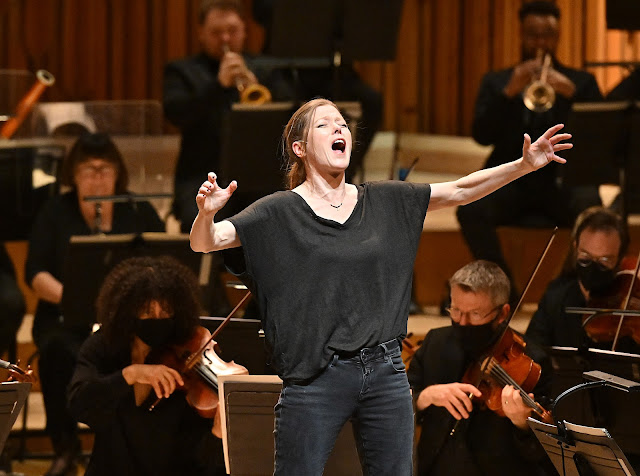
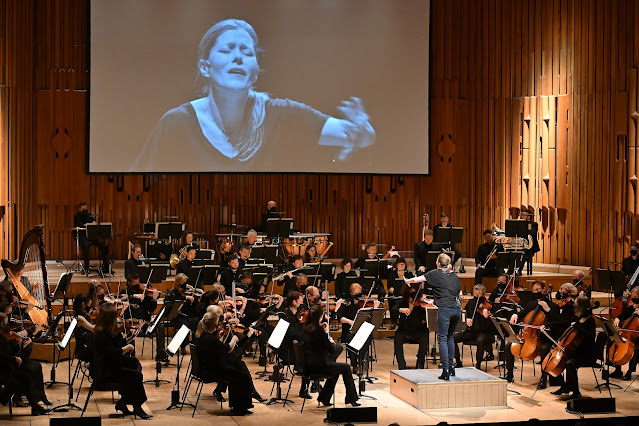
Barbara Hannigan’s LSO concerts – her concerts more generally too – always offer interesting, insightful programming as well as her extraordinary gifts as a performer. This was no exception, presenting the LSO’s new co-commission, The White Book, by Laura Bowler, with Ligeti’s Lontano and Strauss’s Also sprach Zarathustra. Clear that The White Book was not ‘a sing/conduct piece’, Hannigan elected to sing, whilst her protégée Bar Avni, Chief Conductor of the Bayer Philharmonic from 2021 to 2024 conducted. She then took to the podium alone for Ligeti and Strauss in the second half. 

Bowler’s response to Nobel laureate Han Kang’s Booker-shortlisted novel bears the hallmark of loss: in the latter case, of the writer’s elder sister, who died just hours after her premature birth; in the former, the recovery of the composer’s mother from leukaemia, only to die in an accident before it was possible to say goodbye. I do not know the novel, so can only proceed from what I heard, but the encounter made a strong impression and was warmly acclaimed by a large Barbican audience. There was theatre to Hannigan’s ascent onstage, appearing as part of the performance, clad in a ‘one-of-a-kind confection of white silk and wool linen designed by … Yuma Nakazato,’ from his Glacier Collection, for which Hannigan apparently ‘needed a video tutorial to be shown how it worked’.  The piece unfolded – perhaps better. ‘dropped’ – like the sleeves that ignited the orchestral introduction to the first of the five movements, ‘Wave’. Its icy precision and character, much of it founded on long, oscillating instrumental lines, was partly matched by and partly contrasted in a vocal part that required and received a cornucopia of vocal techniques that were yet combined in single, long lines of their own. Repetition, maintenance, and oscillation of pitch sounded as the musical key to all, until its sudden stop. 

‘Breath-cloud’ sounded and even looked as its name suggested. Related yet distinct orchestral technique and atmosphere led to a rocking incantation of the biting words ‘On cold mornings’ in lengthy melismata as clear as the LSO’s razor-sharp playing. Eventually, it tailed off, unaccompanied, into ‘the empty air’. There was something cyber- or Olympia-like – one might also think of her vocal Ligeti – to the abrupt transformations in Hannigan’s voice in the following ‘Sand’: partly so. It was as if vocal and verbal half-lives were fated to almost-eternal recurrence: perhaps in recognition of and response to trauma. There was some quasi-traditional word-painting on the word ‘slipping’, both in vocal line and orchestral penumbra, though never predictably so, the beginning of upward slipping a case in point. The suspended animation of a close when music, perhaps even life, slipped ‘stubbornly through fingers’ made its point with a chill. 

The fourth movement, ‘Silence’, was not silent but eerily still with, yes, some crucial silences. The vocal line took up a pattern of descent from its predecessor, albeit in distinct, scalar fashion rather than ambiguously slipping. The orchestra often took a similar route, sometimes coinciding precisely, both reinforcing one another. Ironically, a long crescendo of orchestra and electronic echoes led to (as yet) the work’s greatest climax; the rest played out in its shadow. ‘All whiteness’ offered, naturally, a climax to the work as a whole. Occasional sounds, even harmonies, brought Messiaen to my mind, but I think that was more a matter of me than the writing as such. At any rate, this ‘whiteness’ was properly comprised of the colours of the spectrum, like the sense of the sacred invoked in the glacier of the text, ‘unsullied by life’. Vain verbal and musical repetition on the words ‘shafts of’ attempted to surmount something – tragedy? – that could not be surmounted. Again, the rest played out in disquieting shadowlands of the movement’s climax. 

Lontano’s opening brought oscillating correspondences with that of The White Book, soon turning in different directions. There was a keen sense in such fluctuation of the outset of something akin to a journey, the excellence of the LSO’s performance commensurate to the extraordinary achievement of the work. It imparted the sense, illusory or otherwise, of changing the way one listened, so that nothing would ever sound quite the same again. Moreover, Ligeti’s writing sounded more strongly as a successor to the particular Klangfarbenmelodie of Schoenberg’s ‘Farben’ in a way I had not previously appreciated, captivating in its eternal transformation (as opposed to earlier eternal recurrence). It felt almost as if melody itself, perhaps harmony too, were being created or recreated before our ears, out of something both older and newer.

Also sprach Zarathustra similarly opened – no news here – with a single pitch, again heading in very different directions, although its organ music in particular (Richard Gowers) intriguingly suggested points of contact with the manipulations and oscillations of the earlier pieces. There was a fine sense of irony to Strauss’s response to Nietzsche: too often missed in performance, but not here. The LSO’s performance was once again outstanding, boasting uncommonly rich string playing (not least for the Barbican acoustic). There was throughout a welcome sense of space to the work’s unfolding, without that in any sense implying slow tempi. Processes were as clear as in Ligeti, especially earlier on. Did the performance lose its way somewhat later on? Perhaps, though it is a notoriously difficult work to grasp as a whole, whether as performer or listener. There was, at any rate, something fittingly phantasmagorical to the whole.  

Friday, 21 March 2025

LSO/Hannigan - Khayam, Haydn, Vivier, Debussy, Sibelius, and Bartók, 20 March 2025


Barbican Hall


Golfam Khayam: Je ne suis pas une fable à conter (UK premiere)
Haydn: Symphony no.39 in G minor
Claude Vivier: Orion
Debussy: Syrinx
Sibelius: Luonnotar
Bartók: The Miraculous Mandarin: Suite

Gareth Davies (flute)
London Symphony Orchestra
Barbara Hannigan (soprano/conductor)

The second of Barbara Hannigan’s two March LSO concerts opened with a UK premiere: Golfam Khayam’s Je ne suis pas une fable à conter, which Hannigan commissioned and has already performed with the Iceland Symphony, Radio France Philharmonic, and Gothenburg Symphony orchestras. Khayam being unable to travel to after hearing hearing her speak on Iranian music, receiving a reply and offer a collaboration within two hours of sending her message. They settled on a poem by Ahmed Shamlou. There are, it seems, elements of improvisation, though without knowing the work it is impossible to know how much. Opening with cellos and double basses, joined by other, deep-pile LSO strings, the piece effects, especially after voice and flute entry, an ‘east-west’ encounter in vocal and instrumental arabesques, and in combination of tonal and modal (at least to my ears) writing. It seemed to suggest eventual passage from mourning to light, or perhaps better, to glimpse it almost Janáček-like, at the end of our current tunnel. Not that it sounded in any way like Janáček, but perhaps there something in that sensibility was held in common. Perhaps it was no coincidence that here the words turned from French to Farsi. 

Haydn’s Symphony no.39 received a fine reading, Hannigan revelling in its quirks and surprises—considerably more so, it seemed to me, than her slightly disappointing way with the so-called ‘London’ Symphony no.104 last week (an altogether more Classical concern). From the off, she and the LSO relished its Sturm und Drang energy, silence as much part of its activity as sound in the first movement. It developed and returned, almost in a flash, yet certainly not without our knowing that it had. Here and in the ensuing Andante, there was nothing generic to form and process, deeply rooted as they were in Haydn’s particularities. And what a joy it was to hear the LSO in such music, unburdened by ‘period’ affectation. In her programme note, Kate Hopkins described the minuet as stately. It might have done with being a little statelier here, or at least sterner. Still, in its more flowing though not rushed way, it ‘spoke’ clearly, just as its delectable trio sang. The finale, full of incident, might in some ways sound ‘theatrical’ but proved, quite rightly, above all symphonic. 

Claude Vivier’s Orion followed, essentially a theme and five variations. Throughout, it was characterised by a strong sense of liminality, doubtless born, as Tim Rutherford-Johnson’s helpful note pointed out, of Vivier’s preceding opera on death and the afterlife, Kopernikus, and its foretelling; ‘You will hear the music of Orion and the mystical seven sages.’ Distinct echoes of various music – the Stravinsky of the early ballets, Messiaen, Grisey (or was that the Wagner of the Rheingold Prelude) – sounded both too close not to be intentional, yet also too fully integrated to be the point. Above all, it seemed to refer only to itself and, in the two percussionist cries of ‘hé-o’ to the mystery of human subjectivity set against something implacably cosmic. 

The second half opened with a solo from above (at least in the Stalls), Gareth Davies in a beautifully free yet coherent performance of Debussy’s flute Syrinx. Hannigan again led for Sibelius’s Luonnotar. But of course she can sing Finnish whilst conducting… It made for a fascinating combination, the Sibelius possessed of a keen narrative thrust born of words and music alike, all the drama of the ballad rooted in febrile LSO strings. It emerged as a kindred spirit to Mahler’s Das klagende Lied, albeit in (relative) miniature. 

Bartók’s Miraculous Mandarin Suite rounded off an eclectic programme. For me, it is one of those cases in which I always regret the loss of material. Habits of early encounters with Boulez doubtless die hard. Nonetheless, on its own terms, there was much to ‘enjoy’, if that be the right word. Hannigan and the LSO seemed more focused on the harder edged elements to the score: a steely frame that seemed to invite comparisons with more or less contemporary Prokofiev (Le Pas d’acier and even the later Fiery Angel). Occasionally ear-splitting in the Barbican’s awkward acoustic, it danced its way to a final, ever wilder climax.


Friday, 14 March 2025

Degout/LSO/Hannigan - Roussel, Ravel, Britten, and Haydn, 13 March 2025


Barbican Hall


Images: Mark Allan


Roussel: Le Festin de l’araignée (symphonic fragments)
Ravel, arr. Anthony Girard: Histoires naturelles
Britten: Les Illuminations
Haydn: Symphony no.104, ‘London’

Stéphane Degout (baritone)
London Symphony Orchestra
Barbara Hannigan (soprano/conductor)

Barbara Hannigan is unquestionably a star in today’s musical firmament. Anyone who has heard (and seen) her Ligeti Mysteries of the Macabre, live or recorded, would neither doubt nor forget that. I have been an admirer, even a devotee since I first heard her, singing songs by Berg and Webern with the Scharoun Ensemble and none other than Pierre Boulez in 2008. Her more recent, yet by now established, forays into conducting, often in combination with song, have never failed to interest and to excite. And she clearly has a deep fondness for Haydn, regularly conducting symphonies from across his œuvre. What, then, is not to like, especially in combination with the LSO and another outstanding artist, Stéphane Degout? 

Very little, in fact, though I found myself somewhat disappointed by the Haydn symphony this time around, it seeming not yet really to have settled. Proceedings nonetheless got off to a fine start with the suite, once popular yet now somewhat out of fashion, from Roussel’s 1913 Diaghilev ballet Le Festin de l’araignée. The parade of animal victims for the spider in his web had a keen narrative thrust, full of character, and vividly but far from only pictorial. Hannigan and the LSO above all imparted a sense of how it ‘moved’, even without dancers. It may not have the magic of, say, Ravel and Debussy, but it charmed, without overstaying its welcome. However different it may be in most respects from more celebrated Ballet russes commissions, there was kinship to be sensed, both in work and performance. It was far-sighted, moreover, of Roussel wittily to write a part for mobile telephone to coincide with nightfall on the lonely garden. Who would have imagined? To quote Edward Bhesania’s programme note on the music itself, ‘Nothing has changed and yet everything has changed.’ 


A piece Ravel did not orchestrate will probably always be too tempting for composers to resist, even if others have had a shot before them. I wish I could say Anthony Girard’s orchestration of Histoire naturelles offered revelations, but it sounded more workaday than that. It was skilful enough and could hardly fail when it came closer to what Ravel himself might have done, but the somewhat heavy string writing (doubtless a sense of mock-gravity to depict the peacock, but was it quite the right sense?) at the opening of the first song, ‘Le Paon’) gave a distinctly odd impression, especially given Degout’s seemingly effortless way with words and music alike. Indeed, his performance offered a masterclass in French song, all the supposed difficulties (they are real enough) with the language melting away. Again, I could hear Girard’s intent in the percussive clatter of ‘Le Grillon’, but it did not seem quite right. I was more persuaded by the closing guinea-fowl song, whose orchestration seemed genuinely to have one see, even to feel, with her. So too of course did Degout’s vividly communicative vocalism: not a million miles from the theatre, yet subtly distinct. 

Hannigan both sang and conducted for Britten’s Les Illuminations, the Rimbaud text making it seem more at home with its predecessors than otherwise it might have done. Lucy Walker’s point, in her programme note, that ‘perhaps sheltered by the non-English language here, Britten seems to be letting his hair down and channelling some of Rimbaud’s … spirit,’ seemed to me very well captured by the performance, Hannigan clearly inspired rather than inhibited by the exigencies of her dual role. The LSO, never less than very good, seemed a few notches more incisive here, doubtless partly as a result. From the opening bars, richness of string sound seemed to take us to a different level. Hannigan as soloist proved just as communicative as Degout, as were other, instrumental soloists, first among equals leader Benjamin Gilmore in ‘Phrase et Antique’. Rhythms were tight or swung, as required. A well-nigh operatic ‘Marine’ proved key to necessary transformation of mood. ‘Being Beauteous’ captured its particular qualities, not least the sense of a young heart racing. Throughout, Britten and his interpreters permitted Rimbaud to speak: not unmediated, for that would be a nonsense, but heightened, or at least a little transformed. ‘Assez connu. Les arrêts de la vie. Ô Rumeurs et Visions! Départ dans l’affection et le bruit neufs!’ Indeed. 


The first movement of Haydn’s final London Symphony, no.104, augured well. It had grandeur in its introduction, nowadays too often missed, as if Hannigan recalled Boulez’s extraordinary recording with the Vienna Philharmonic. (Perhaps she did.) It had no tedious mannerisms and was very well balanced, inner string parts sounding as if in a quartet. Tempo – not only speed, but mood – was similarly well judged. A dignified account of the slow movement offered generally good command of line and detail, held nicely in balance, though there were a couple of occasions in which tempo seemed to slip rather than to be knowingly modified. The minuet, taken fast, had a fine swagger. Alas, an excessive, almost endless holding back at the beginning of the trio and in several cognate passages made a mess of that (at least for me). The finale seemed to me just too fast, lacking in that grandeur that older conductors, not only Boulez, brought to the work. Playing, though, was excellent, and Haydn’s invention could still be relished.


Saturday, 26 February 2022

LSO/Hannigan - Strauss and Poulenc, 24 February 2022


Barbican Hall

Strauss: Metamorphosen
Poulenc: La Voix humaine

Barbara Hannigan, Denis Guégin, Clemens Malinowski (direction, video)
Julien Bourdin (sound engineer)

London Symphony Orchestra
Barbara Hannigan (soprano, conductor)


24 February 2022 was a black day for Europe, for humanity. The prospect of a concert opening with Strauss’s Metamorphosen seemed potentially a little much, directing us all too readily to where war once more threatened to take us. Perhaps it was as well that the LSO, unobtrusively conducted by Barbara Hannigan—she only began to direct at the first violin entry—offered a performance more Apollonian than Dionysian, Goethe more than requiem. In an extended companion piece to Capriccio and its opening sextet, to the Oboe Concerto too, an aristocratic collection of string soloists came together as if a collection of Masters in Munich’s Alte Pinakothek. In principle, I may have missed something darker, something engaging with Beethovenian ghosts of heroism, with destruction and devastation; but such quietly dignified, civilised music-making was probably the right thing at the right time. 

A darker performance might also have called into question the appropriateness of the pairing with Poulenc’s La Voix humaine. Here, to an unusual extent, Hannigan had taken to heart the word ‘humaine’. This was a glorious performance by the human voice, certainly, but equally so in terms of conducting and something approaching live filmed ballet, the two (or three) often fusing to form a greater ‘act’. Three live cameras proved in more than one sense a projection by ‘Elle’. Perhaps the orchestra itself was too, or Elle was imagining herself as conductor (or as Barbara Hannigan). Any initial scepticism concerning Hannigan’s conception of the work as a woman’s fantasy—perhaps this was simply what she might have said to someone from her past; perhaps there was no man at all—vanished, this viewer and listener entirely won over by the immediacy, commitment, and technical excellence of the performance, unsparing close-ups included. The film froze and Hannigan turned to the audience, continuing to act, when Elle told us of her attempts at suicide. Simple, yet startlingly effective.


The LSO, willing partners to Hannigan, Denis Guéguin, and Clemens Malinowski, proved precise, incisive, and affectionate without sentimentality. Where was the authorial voice, one asked? Was there more than one, or was there indeed one at all? Such questions emerged as both necessarily particular and more general, pertaining to what after all is, in some ways, little more (though no less) than recitativo accompagnato and to the heart of opera ‘itself’. The magic of Poulenc’s cadences and indeed of other harmonic progressions duly registered, lifting the everyday and its fantasies momentarily into that new realm we call the transcendental. Poulenc’s grand climax, almost paradoxically repeated yet convincingly so, on those final, tragic words, ‘Je t’aime’, reminded us, should we have needed reminding, that he, like his protagonist, knew how to put on a show. So too, likewise in the very best sense, did our performers this evening.

Thursday, 12 September 2019

Musikfest Berlin (6) – Hannigan/LSO/Rattle: Abrahamsen and Messiaen, 11 September 2019


Philharmonie

Hans Abrahamsen: let me tell you (2013)
Messiaen: Éclairs sur l’Au-Delà (1987-91)

Images: © Monika Karczmarczyk


Written for Barbara Hannigan and the Berlin Philharmonic, Hans Abrahamsen’s song-cycle, let me tell you, has garnered plentiful plaudits, including the 2016 Grawemeyer Prize. On a first hearing, it was not difficult to understand why, even if – a matter of taste, no more than that – its neoromanticism became for me at times a little wearing. For underlying a musical foreground whose somewhat saccharine language verges on the reactionary, structure and finely honed compositional craft are present and meaningful. The verbal text, drawn by the composer from a novella by Paul Griffiths whose vocabulary is restricted to the words spoken by Hamlet’s Ophelia, serves its purpose well as a springboard for song, though I cannot say that makes me eager to read the novella itself. There is, moreover, no doubting the work’s vocal qualities, ranging from intriguing reinvention of the Monteverdian genere concitato to a genuinely extraordinary relationship between soprano and instruments of similar or still higher range, in which colours echo, pierce, and fuse. Hannigan’s response was predictably outstanding, likewise the interplay between her voice and the LSO players, especially woodwind, tuned percussion, and violins, wisely guided by Simon Rattle. If I found a slight tentativeness to some of the playing in the very first song, that was soon forgotten – and may have been more a matter of adjustment to an acoustic very different from and far superior to the orchestra’s Barbican home. This was a performance, as it was a work, amounting to considerably more than the sum of its parts. And whilst I had my doubts during the performance, evidently not shared by an enthusiastic audience, on reflection I think the audience may well have been right.


It was Messiaen’s Éclairs sur l’Au-Delà that had been the real attraction for me, though, and a fine performance indeed it turned out to be. Even if I sometimes found myself missing the particular colours a French orchestra might have brought to this music – the Paris Opéra orchestra on Myung Whun Chung’s recording, for instance – there was again no doubting the all-round excellence of the LSO here. If the work has ever been treated to superior playing from massed flutes and percussion, I should be astonished; I doubt even that any performance will have matched those players here. Certainly the LSO wind brooked no dissent in the implacable, mystical opening ‘Apparition du Christ glorieux’. One could imagine the music transcribed for organ, yet never did the instruments imitate Messiaen’s beloved instrument; composer and performers alike were far too skilled for that. Rattle handled the twin imperatives of continuity and contrast in the ensuing ‘La constellation du Sagittaire’ with palpable understanding, paving the way surely for the surprises, even when one ‘knew’, of flute birdsong, superlatively despatched; mysterious violin harmonics; and Indian rhythms. If I found ‘L’Oiseau-Lyre et la Ville-Fiancée’ a little hard-driven – pretty much my sole cavil – it was rhythmically tight and vivid throughout, percussion of all varieties typically incisive. The apocalyptic cacophony of ‘Les élus marqués du sceau’ proved as mysterious, as inscrutable, as anything in Stockhausen.


Inscrutable in a very different way was the fifth movement, ‘Demeurer dans l’Amour’, the sweet ecstasy of its violins, Turangalîla and indeed Tristan reimagined, an object lesson in communication of sentiment without sentimentality. I was, moreover, fascinated to hear so clear an invitation from Messiaen, harmony notwithstanding, to listen intervallically: just as keen, just as meaningful as in the music of some forty years earlier. There was no doubting that this was the true heart, in more than one sense, of the work, balanced as it was by apocalyptic fervour on its other side, in ‘Les sept Anges aus sept trompettes’. Gareth Davies’s flute solo in ‘Et Dieu essuiera toute larme de leurs yeux’ was, to put it simply, perfectly judged.


Then came ‘Les étoiles et la Gloire’: the apocalypse once again, terrifying in that this might have been truly be the work of God or the Devil – and how could we know? Three sets of tubular bells (and three players), xylophone, glockenspiel, marimba, and so much else: a second heart, perhaps, to the work, even a heart of darkness. This listener emerged from it awestruck, as, in quite a different way, he did from the veritable dawn chorus of ‘Plusieus oiseaux des arbres de Vie’, woodwind onstage and beyond (au-delà?) There was no need for visibility in ‘Le chemin d I’Invisible’ when music rendered whoever He was so palpably present. The sense of completion, not just of this work, but (almost) of Messiaen’s musical life was keen in ‘Le Christ, lumière du Paradis’. Its kinship, from the opening chord, with the final movement of the early L’Ascension, ‘Prière du Christ montant vers son Père’, was clear, as was the reality that this was a different, if related, path to be taken. There was surely much theology as well as music in that thought – and prayer – alone. This was unquestionably – Messiaen tends no more to questioning than does Bach – a blessed, luminous, and in every sense sweet assurance.


Thursday, 21 March 2019

LSO/Hannigan - Ligeti, Haydn. Berg, and Gershwin, 17 March 2019


Barbican Hall

Ligeti: Concert Românesc
Haydn: Symphony no.86 in D major
Berg: Lulu Suite
Gershwin, arr. Barbara Hannigan and Bill Elliott: Girl Crazy: Suite

London Symphony Orchestra
Barbara Hannigan (soprano, conductor)


I first heard Barbara Hannigan in 2008. She was singing songs by Berg and Webern with Pierre Boulez and immediately made a great impression. Since then, she has been one of those artists I should make an extra effort to hear; not once have I been even slightly disappointed. Hannigan is, of course, most widely known as a singer, but she has been building a parallel, or rather complementary, career as a conductor in the meantime too. I heard her conduct the Britten Sinfonia in 2013, in works by Mozart, Stravinsky, and Haydn, for some of which she sang too – and once again proved enthusiastic. This concert, her LSO debut, offered a worthy successor in that line, now performing works by Ligeti, Haydn again, Berg, and Gershwin.


Ligeti’s Concert Românesc is one of those pieces we hear more than we probably ought: not in the sense that there is anything wrong with them, but rather that they seem to offer an early, unrepresentative piece by a composer who might otherwise be ignored. Webern’s Passacaglia or even Im Sommerwind would be obvious examples, even Schoenberg’s Verklärte Nacht. Hannigan is certainly not one to neglect Ligeti; one of her most celebrated performances, not least on YouTube, is of his Mysteries of the Macabre (also with the LSO). I could not help, however, but feel that this was a performance-in-progress – although it may simply have been a matter of nerves, of having come first in the programme. Even when it lacked ‘traditional’ incisiveness, as in the first section, there were gains, though, not least a sense of how close the music might sound to early Bartók, even to Strauss. Bartókian ‘night music’ of a later vintage certainly sang forth in the third section, even if the final ‘Presto’ came off somewhat hard-driven. In any case, there was much to relish from the solo work of LSO principals.


Haydn’s Symphony no.86 furthered Hanningan’s growing reputation in Haydn’s music: always a fine indicator of other strengths. The first movement’s introduction offered a grandeur and expectation that Colin Davis (thinking of the LSO) would surely have appreciated, with none of the irritations that, alas, often accompany Simon Rattle’s way with this composer. If its principal tempo were on the fast side, it was not unreasonably so. The music largely spoke here ‘for itself’, however much of an illusion that may be, the development especially well handled, the final coda a joy. Constructivism and lyricism were kept in a fruitful, generative relationship throughout in the second movement, founded, as it must be, in harmony and harmonic movement. This is music to rival Schoenberg in complexity – something most ‘period’ voices, alas, seem entirely to ignore. So too is the minuet – as soon as one listens, which Hannigan ensured that we did. Its trio relaxed harmonically and offered in tandem a winning sense of relative metrical freedom. Delightful, then, as was the finale, one of my very favourites: heard as if Leonard Bernstein had returned, albeit with greater dynamic variegation. It was as witty as it was thrilling, as convincing vertically as horizontally. More please!


Hannigan’s way with Berg’s Lulu-Suite was surprising. It took me a while to get used to, and there were unquestionably aspects of the music that went a little uncared for. That said, to hear it performed with such attention to the multifarious melodic strands – heard, I suspect, very much from a singer’s standpoint – was fascinating. So too was the relative lightness, almost Mendelssohnian, with which the first movement ‘Rondo’ was despatched. The big moments certainly told, but they were not everything. I am not sure I should always want to hear the music like this – indeed, I am sure that I should not – but to hear the classic Romantic/modernist dichotomy not so much evaded as avoided brought plenty of its own interest. Transparency is necessary no matter what the interpretative standpoint, of course; here, Hannigan and the LSO excelled. One might have taken dictation, vocal and verbal, from Hannigan’s sung contribution to the ‘Lied der Lulu’, which was ‘concert-acted’ too. Coloratura held no fear for her, but crucially, it was employed dramatically, just as in Mozart. If there were a few rough orchestral edges to the fourth movement, it is difficult to imagine them having bothered anyone but pedants. The final ‘Adagio’ emerged properly de profundis, as eloquent as if its lines were being sung. Hannigan’s melisma on ‘Engel’ truly told. Quite a performance, then, in so many ways.


The Gershwin suite with which the concert concluded proved equally fascinating – and perhaps still more thrilling. Conceived by Hannigan with the express purpose of accompanying the Lulu-Suite, its ingenious orchestration for identical forces was commissioned from Bill Elliott. As a Bergian, at times Mahlerian, soundworld unfolded, it did not jar. Quite the contrary: t drew one in, not only harmonically but also motivically, to the material of the three songs, ‘But not for me’, ‘Embraceable you’, and ‘I got rhythm’. Then, of course, there was Hannigan’s own star quality as a singer: different, perhaps, from the stars one often associates with this music, but in no sense less bright. It was sung as carefully as Berg had been, without ever sounding ‘careful’. The orchestra joined in with some vocal harmony too, but this was in every sense Hannigan’s show, ‘I got rhythm’ straightforwardly sensational.


Wednesday, 16 May 2018

Lessons in Love and Violence, Royal Opera, 15 May 2018


Royal Opera House

King – Stéphane Degout
Gaveston, Stranger – Gyula Orendt
Isabel – Barbara Hannigan
Mortimer – Peter Hoare
Boy, Young King – Samuel Boden
Girl – Ocean Barrington-Cook
Witness 1, Singer 1, Woman 1 – Jennifer France
Witness 2, Singer 2, Woman 2 – Krisztina Szabó
Witness 3, Madman – Andri Björn Róbertsson

Katie Mitchell (director)
Vicki Mortimer (designs)
James Farncombe (lighting)
Joseph Alford (movement, associate director)

Orchestra of the Royal Opera House
George Benjamin (conductor)

Girl (Ocean Barrington-Cook), Isabel (Barbara Hannigan), King (Stéphane Degout), Boy (Samuel Boden)
Images: © ROH 2018/Stephen Cummiskey

 
If Harrison Birtwistle remains acknowledged as England’s greatest musical dramatist since Purcell, then Lessons in Love and Violence may well come to be seen as the work with which George Benjamin mounted his challenge. There is no reason, of course, why such matters should be adversarial, and such is hardly Benjamin’s style, whatever the grisly subject matter of his third opera. He is more someone to knock on the door, enter and delight us with what he brings to the party, without any need to elbow anyone aside. Let us instead rejoice in the creation of another masterpiece, darker and perhaps deeper still than Written on Skin. (Not, of course, that we should forget Benjamin’s first opera either: the wonderful Into the Little Hill.)


As you will doubtless know by now, Benjamin has been reunited with Martin Crimp for this, Crimp’s third libretto, and Katie Mitchell, who directed the excellent first staging of Written on Skin, and who has also worked with Crimp on his other theatrical works, has rejoined the team too. This seems, almost a priori, to have given rise to a degree of ennui in certain quarters. (I have tried to avoid hearing what others have thought about the work, but have not been entirely successful.) One objection seems to have been ‘more of the same’, more or less. I can only presume that the same people would have regretted Mozart’s decision to ‘pursue a collaboration’ with Lorenzo da Ponte after Don Giovanni, perhaps even after Figaro. After all, one often hears the most ridiculous nonsense spoken of Così fan tutte. But there is no reason to be defensive here; I only mention the matter since, for better or worse, it is being spoken of already. Upon leaving the theatre, I hastily typed an ‘instant reaction’ tweet, even, for once, remembering to use the ‘hashtag’: ‘#ROHLessons is a towering masterpiece, its intellectual brilliance and sensual wonders matched, at the very least, by its emotionally overwhelming dramatic path. Drained and satisfied as if by Wozzeck or Katya Kabanova; or, the work that increasingly came to mind, Boris Godunov.’ I have no argument with that almost a day later, and shall try to explain why.


Are such comparisons less odious than ridiculous? Perhaps. Not entirely, though, since I think this is how we often approach new works, not least in so repertory-bound a genre as opera, perhaps especially with a house and company such as the Royal Opera (House). They are far from exact and the tragic trajectory is not the same; here, in the story of Edward II, it is nicely doubled at the end. Essentially we see (and hear) here Edward’s (never, I think named as such) inability to say no to his lover, Gaveston, resulting in the banishment of the clever, unscrupulous politician, Mortimer, who returns, having manipulated the people to his end, to restore himself in something equivalent to a queen’s coup, ridding the court and realm first of Gaveston and then of the king. But the young king, again not named as Edward III, having watched, with his sister, everything unfold, including that violence which is often yet not always subtly hinted at or stylised, turns upon the usurpers and truly becomes king himself.

Boy, Girl, Isabel

Tragedy or restoration? That rightly does not quite seem to be the question, just as that bald outline omits the mess of motivations that characterises this horrible, political world. Much is hinted at, there for one to join the dots, but much is portrayed too. The audience member is, rightly or wrongly, treated as an intelligent human being, a participant, not a consumer of Verdi or other tedious kitsch. It is certainly not so straightforward as portraying a situation in which no one is sympathetic. Rather, as in ‘real life’ – and what, alas, could be more real than our present, not so different high or low ‘political’ life? – motivations are complex, contradictory, and, between characters at least, irreconcilable. Such is surely not the least of the lessons of love and violence that unfold – whether one does not believe in love, as Mortimer, or in violence, as the younger young king does not, yet must. Mortimer, after all, schools him, too, perhaps better than he intended. Likewise, Isabel seems – perhaps is – wronged at the start; we can understand why she, a mother and a wife as well as a queen, acts as she does. Yet she is far from white to start with; in her aestheticism – her love of music and her chilling dissolution of a pearl in acid, a pearl that would have given houses to petitioning subjects – she actually seems a good, or rather deadly, match to her husband, as well as a potential rival to Gaveston. There is horror, too, in her children turning upon her, however deserved that turnaround might be.


But we must return to music, so beloved of these unpleasant people, yet puritanically or sadistically prohibited by the Young King. (Or so he claims: we never quite know the truth of many claims, for who is narrating? We almost seem to know better in the play within a play, that of David and Jonathan, in which Isabel almost literally begins to call the shots, and in the non-musical reprise of such ‘entertainment’ which is threatened, and yet which turns out to be ‘real’, a tortured Mortimer about to be shot dead by the Young King’s sister.) Yes, we must, that too lengthy parenthesis notwithstanding. For it is music that seems – apparently or otherwise – to structure the words and the drama, or perhaps to re-structure them. It is music that creates them, in many ways, regardless of empirical priority. It also creates, and is created by, the situation: its colour, its tensions, its possibilities. ‘It’, whatever it may be, is always, ultimately, about the music; for when the music stops, so does the opera. Perhaps that has always been Isabel’s fear: the fall of the curtain. Mitchell certainly seems to hint at that, but so do Benjamin and Crimp – and, of course, the outstanding cast and orchestra.

Madman (Andri Björn Róbertsson) restrained, Queen, Girl, Boy, Mortimer (Peter Hoare)


Benjamin’s ability to create a sound world has always been one of his hallmarks; in that sense I could not help but think of Janáček and Mussorgsky, both in general and in particular, as mentioned above. Yet, as with those composers, it is certainly not a matter of simply providing atmosphere, a setting, although that certainly is created. Just as Vicki Mortimer’s plush, power-dressing – dressing itself becomes, in true royal fashion, almost a ritual in itself – claustrophobic designs, both for sets and costumes, provide a framework, both to contain and to be broken by the action, so do timbres, often in combination, and harmonies, likewise. There is almost infinite variegation within. The old problem, almost yet not quite Schoenbergian, of reconciling musical antimonies between freedom and determinism, gains new clothes – aural and visual. And the inevitability of the action, at least viewed from the close, of what has happened, takes upon itself an almost Bergian thrust, not least through the characters of and connections between particular scenes. The orchestra follows Benjamin, whether as composer or conductor; or rather, it leads the action with all the confidence and, more to the point, understanding it might once have shown Bernard Haitink in Wagner. And, as with Wagner, still more so with the Debussy of Pelléas, so much action, so much of the truest, wordless action, occurs in the interludes, the transformations between scenes. It is perhaps in those, as in Pelléas, that the stature of Benjamin as a musical dramatist is most immediately manifest.


Or does it? Does the orchestra lead? Do not the singers? Yes, they do too. There is much leadership: too much in the plot, just enough in performance. For song, or at least singing, is crucial to this opera; it is certainly not to be defined as a ravishing, horrifying symphonic poem with voices, although it is perhaps partly that. Benjamin and his co-creators and co-performers refuse the either-or that many of us, seeking for a way in to account for our reactions, would seek to foist upon him. There is drama in melisma: what could be more traditionally operatic than that? There is drama in the entwining and the opposition of melisma? Again, what could take us back more closely to that first zenith of the genre, to Monteverdi? Perhaps the encounter between Isabel and Gaveston, in which she verbally bids him come closer to her, that she might also come closer to the King (who remains distant on stage), is most instructive of all here, for it expresses and creates a musico-dramatic situation more complex than, and still more deadly than, the duet of two baritones so full of sensual delight between the king himself and his lover. Both, and other duets and ensembles, are necessary of course, in the structuring of the drama, just as in the still sorely misunderstood Così. Post-Mozartian Harmoniemusik occasionally seemed to make that point, at least to me; likewise the haunting death rattle avant la lettre emanating from harps and cimbalom, as the Stranger took the King’s life in his cell. The King thought this stranger was Gaveston; so did we, even though he told us he was not, and Gaveston was dead. One could hardly fail to think of the careful, meaningful symmetries of Lulu.

Isabel and Mortimer


And, as with Mozart, although whether through design or through the sheer excellence of these artists on stage, one had the sense that the roles had been written with them in mind. They were, of course, for Mozart, but here, who knows? We are not so much concerned with process, as with each artist having inhabited his or her role. Stéphane Degout’s velvet tones cloaked the impetuous, arbitrary deeds of a weak tyrant, who was also a wronged and wronging man. One made no distinction between role and performance; he simply was the King. So too, and increasingly so, as her role came into focus, was Barbara Hannigan, as his consort. That she played so well in the initial background speaks just as well of her as the display of that extraordinary ability we all know and love – think, for instance, of her Ligeti – to encompass so many modes of vocal delivery within a single line that remains spun from the same silk. Gyula Orendt’s seductive, nasty, manipulative way with Gaveston mirrored and contested the politician’s path of Peter Hoare’s clever, calculating, just as (in)human Mortimer. Not the least of the evening’s performances was the coming of age through politico-emotional stunting of Samuel Boden’s Boy and Young King. Dressed like a boy, he acted unerringly like one too: almost a Prince William, whilst Diana was still around, or shortly after. Ably assisted by his sister, Ocean Barrington-Cook (a mute role), the crown was, again if only in retrospect, his for the taking – once he had learned his deathly lessons. Smaller roles were all very well taken, by Jennifer France, Krisztina Szabó, and Andri Björn Róbertsson: suggestive of a greater number of voices and faces than was actually present, drawn, as it were, as if from an imaginary chorus.

Isabel, King, Gaveston (Gyula Orendt)

For, as in Boris, we observed and felt the people’s grief, feared equally for what we knew to be their largely hopeless future. As the Third Witness had accused the Queen, in a shocking intrusion, orchestrated by Mortimer, into her chamber, the poor had no choice, unlike the decadent rich, to sleep three to a bed. The miracle here was that fury, both external and internal to the drama of princes and nobles, manifested itself through three single voices, an orchestra, and, not least, an endlessly inventive, supportive, and questioning production. Mitchell too did the work the necessary honour of treating it as a mature drama, as she had in Written in Skin; this was not something to be introduced, hesitantly, but to be directed with the critical modernity she would bring to any other work. This may be a quiet operatic manifesto; such, as discussed, is Benjamin’s way. It may even be a manifesto without intention to be a manifesto. Perhaps that makes it all the more convincing, all the more accomplished.

Sunday, 20 March 2016

George Benjamin Day: chamber works and Written on Skin, MCO/Benjamin, 19 March 2016


LSO St Luke’s and Barbican Hall

Purcell, arr. Benjamin – Fantasia 7 (1995)
Benjamin – Flight (1978-9)
Viola, Viola (1997)
Shadowlines (2001)
Bach, arr. Benjamin – Canon and Fugue from ‘The Art of Fugue’ (2007)

Members of the Mahler Chamber Orchestra
George King (piano)
George Benjamin (conductor)

Written on Skin (2009-12)

The Protector – Christopher Purves
Agnès – Barbara Hannigan
Angel 1/The Boy – Tim Mead
Angel 2/Marie – Victoria Simmonds
Angel 3/John – Robert Murray

Benjamin Davis (director of semi-staged performance)

Mahler Chamber Orchestra 
George Benjamin (conductor)


George Benjamin’s Written on Skin could hardly have had superior reception. Wherever it has gone, it has triumphed. Bizarrely, an American opera house intendant, smarting at the acclaim accorded an opera that did not offer his favoured brand of neo-tonal pandering (Jennifer Higdon?!), lamented that Benjamin’s brilliant score was not something one would ‘sit down and play [a recording of] … at dinner’. All I can say to that is that Mr Gockley must host strange dinner parties – ‘honoured guests, meet your hostess, the lovely Lulu’ – and his preferred way of experiencing opera, eccentric for anyone, would seem in itself to disqualify him from running an opera house.  That, however, was not remotely consonant with the success witnessed on either side of the Atlantic, indeed on either side of the Channel.


I was a little suspicious first time around. Are not masterpieces supposed to fail before an initially uncomprehending public, incite a riot, or at least receive an insufficient performance? No, of course not, although such mythologies can be fun, not least in enabling us to feel superior to our predecessors. Surely, though, there must have been something wrong when critical and audience unanimity is so striking. (Yes, there will always be the odd exception, but who cares?) Nevertheless, when I saw the work at the end of its Covent Garden run, I had no option but to join the adoring throng. Happily, this Mahler Chamber Orchestra performance, again under the baton of the composer, confirmed me in my judgement that Written on Skin is an unalloyed masterpiece, although in some ways I find its predecessor, Into the Little Hill, the more provocative work and certainly a masterpiece too. I see no point in simply repeating a description of what has already become a repertory work; what I wrote in 2013 may, however be read here for those unfamiliar or in need of a reminder. (I was surprised, myself, about how much I had forgotten!) However, I shall make some remarks about what struck me on this particular occasion, and of course upon the performances themselves.
 

It seems almost obligatory for a serious new opera to reflect in some way upon the nature of opera; or is it that it is almost obligatory for a serious opera audience to do so? You see, the questions begin already. (Or is it that I am unhealthily obsessed with the operas of Richard Strauss…?) Here, at any rate, what struck me, perhaps still more so in what was close to a concert performance – not meant as disrespect to Benjamin Davis’s able direction – was how much the opera’s status is entwined with that of the Boy’s book, ‘written on skin’. That illuminates – in more than one sense – our experience of the work’s progress as drama and the complexity, somehow nevertheless simple, of the relationship between mediæval setting and contemporary reception. Martin Crimp’s libretto, of course, points the way in that respect, introducing anachronisms as well as well-nigh ritually identifying narration. Said the critic.
 

Had this been Birtwistle, say, there would surely have been a parallel, indeed questioning, ritual in the music. Despite the toing and froing of the Angels, I do not really hear that here. Benjamin’s way is different; I have no wish to ascribe ‘influence’ here; but in its length – perfect for but a few masterpieces by the likes of Monteverdi, Mozart, Wagner, and a very few others – and in the assuredness of its narrative, I was put more in mind of Berg and Janáček. The division into three parts is perhaps a minor indication of that. The astounding musical climaxes of each part are perhaps more akin to the great operas of Janáček, although Wozzeck is surely not so very far away in some intangible, maybe even tangible, sense. The score presents other points of reference, always refracted, and did, I think, in performance too. Benjamin wrote the opera with the particular sound of the Mahler Chamber Orchestra in mind. Here it’s relatively small numbers, at least when it came to strings, were utterly belied by their sound, especially at those climaxes, but also in cushioning the voices and speaking, almost Wagner-like, as our Greek Chorus. Although famously a Messiaen pupil – sometimes one is tempted to ask: who was not? – it is not so often that I have heard Messiaen in Benjamin; here, in certain chords, even progressions, I fancied that I did (just, actually as I did in one of the works in the earlier concert, on which more below). Boulez, perhaps inevitably, came to mind too: again certain matters of kinship rather than influence, I think: the exquisite alchemy of melody, harmony, and timbre, for instance, with roots in earlier music surely renewing their musico-dramatic vows, poignantly reminding us that Boulez himself never wrote the opera he always planned, and which we always longed for. There is, I think, no parallel for the use to which Benjamin puts some of the most ear-catching instrumental solos: bass viol, glass harmonica, and so on. They may be used elsewhere, but there is nothing evidently Mozartian about, say, the latter. Nor need there be. This is confident writing in skin from a composer entirely bien dans sa peau.


There was nothing, needless to say, to beware of in Benjamin’s conducting of the score. His quiet authority seemed to speak almost unmediated, although that is of course ever an illusion of performance. Likewise, the playing of the MCO, reaching the end of a European tour with the conductor-composer, seemed almost beyond praise. Three of the original, Aix-en-Provence cast returned (Barbara Hannigan, Christopher Purves, and Victoria Simmonds). It might on some occasion be reassuring to find something adversely to criticise in a performance by Hannigan. Now was not, however, the occasion to do so. Her musico-dramatic portrayal of Agnès judged to perfection, almost as if emerging from the divided (at one point, Paul Griffiths’s note tells us, fifteen-part) MCO strings themselves, the character’s journey to selfhood, erotic fulfilment, and ultimately (necessary) tragedy. If it were Hannigan’s voice that ultimately continued to resonate once we had left the hall, the dangerous allure of Tim Mead’s counter-tenor came close. The complete identification of Purves with the role of Protector seemed, if anything, to bring still more dramatic daring than at Covent Garden. He could edge towards speech were he wished, without one ever suspecting that to be a musical failing. His eyes said it all; except his voice said more. Simmonds and Robert Murray brought subtlety and dramatic energy, as well as musical security, to their ‘lesser’ roles, still crucial – as, indeed, was every part of this outstanding performance.


Earlier in the day, a few minutes’ walk away at LSO St Luke’s, we had heard ‘Lunchtime with George’, a splendid survey of some of the composer’s chamber works from members of the MCO and, in the case of the piano piece, Shadowlines, George King. First was Benjamin’s arrangement of a Purcell Fantasia (Jaan Bossier (clarinet), Sonja Starke (violin), Maximilian Hornung (cello), Alphonse Cemin (celesta)). In one of his wonderfully engaging introductory conversations with Sara Mohr-Pietsch, Benjamin described Purcell’s early viol consort works as some of the greatest music ever written on this island. Indeed they are – and would that we heard them as often as their stature demands, or even a little more often. Already an old, verging upon archaic, genre when Purcell wrote them, they seem almost made to encourage such dialogue between past and present, and were indeed written, alongside arrangements by Oliver Knussen and Colin Matthews, as part of an Aldeburgh anniversary tribute to the English Orpheus. The second half in that concert was to be Messiaen’s Quartet for the End of Time; Benjamin switched Messiaen’s piano for celesta, imparting an unearthly feeling to the music which, in retrospect, might fancifully be heard as prefiguring that angelic glass harmonic in Written in Skin. Slow, steady progress of the first part and alternation with the quicker sections exchanged echt-Purcellian melancholy for something approaching high spirits, yet the suspicion of loss remained. Glassy, vibrato-less stringed instruments gained in vibrating allure, yet the journey was never one-way; this is thoughtful ‘authenticity’ rather than the fatwa of a period ayatollah. I thought at one point of Berio, although the sound and the sensibility are different. Music mediates, brings us together, perhaps especially when our way of listening – Pulcinella, anyone? – is called into question and enhanced.


Júlia Gállego was the solo flautist for one of Benjamin’s earliest-published pieces, Flight. Gállego worked with the composer seemingly as one, to convey, as well as melodic, Messiaenic profusion, a sense of harmonic ‘depth’, almost programmatically so, given the inspiration of ‘the sight of birds soaring and dipping over the peaks of the Swiss Alps’. Form was dynamically revealed; attack was endlessly varied. There was, ultimately, a splendid sense of numinous mystery: here, indeed, was a pupil of Messiaen.
 

Viola, Viola was written, at the invitation of Toru Takemitsu, for Yuri Bashmet and Nobuko Imai to perform at the 1997 opening of the Tokyo Opera City Concert Hall. If it managed to fill that hall, then it would scarcely have problems at St Luke’s. Nor did it under the violists’ worthy successors, Anna Puig Torné and Béatrice Muthelet. Confounding expectations seemed to me a theme, intentional or otherwise, of work and performance. Not only is this, as it were, an orchestral work for but two instrumentalists, but everything seems unpredictable, whilst making perfect sense after it has happened. (I have doubtless read too much Hegel to be thinking of him here, but such is the way of his dialectic, or indeed of theories of evolution.) Moments of éclat – Boulez on my mind here! – registered powerfully, unexpected yet anything but arbitrary. Harmonics, sometimes in tandem, sometimes not, could be understood at least in this sense to perform a similar role. Implied harmonies were again conveyed in masterly fashion, both as work and performance. (Apologies for any sexism there, but ‘mistressly’ really does not work!) Moments of Bartók seemed to echo, now strident, now tinged once again with Purcellian melancholy. Sometimes, if I closed my eyes, I could have sworn there were more than two players, whether ‘ancient’ consort or ‘modern’ quartet. A Mussorgskian bell, but no pealing? Maybe it was that I had recently heard Boris. Stravinskian games: almost certainly.
 

King’s performance of Shadowlines sounded to me equally authoritative. Benjamin’s compositional games, whatever he might have wished, perhaps came even more to the fore in the work’s canonical progress. We heard its six sections as a continuous whole, to be sure, but also very much with their own character. The first piece, marked ‘Cantabile’, proved the gentle curtain-raiser of the composer’s own description. I thought of a Boulez Notation, at least some of its harmonies. The hand-crossing of the second movement, ‘Wild’ with almost berceuse-like rocking beneath was captured as well as I imagine the work’s dedicatee, Pierre-Laurent Aimard, having done. Duetting in the ‘Scherzando’ movement – Benjamin suggested duetting bassoons – eventually broadened into a veritable chorus, putting me in mind, despite the modern piano, of the timbral possibilities of some nineteenth-century instruments. It was the fifth of the six movements that occupied the greatest time, and here it received a volcanic, perhaps again post-Messieanic performance, climax superbly judged. In the end, paradoxically or maybe dialectically, the composer’s stated wish that, as in the first movement of Webern’s Symphony, we lose perception of the canon was fulfilled partly in the mediated infidelity of our experience. Vertical and horizontal elements would dissolve and find themselves reinstated; or so I imagined. The epilogue truly sounded as such; I thought of Ravel’s Valses nobles et sentimentales.


Finally, Benjamin’s arrangement of the Canon in Hypodiapason and Contrapunctus VII from the Art of Fugue (Paco Varoch (flute), Stefán Jón Bernhardsson, Manuel Moya (horns), Jagdisch Mistry, Timothy Summers, Michiel Commandeur (violins), Delphine Tissot, Joel Hunter (violas), Martin Leo Schmidt (cello)). It was composed at Boulez’s request for a concert in which his own music would alternate with arrangements of Bach. (What a wonderful idea!) Benjamin’s piece takes the unique (I do not know whether it is empirically, but please humour me!) instrumentation of Mémoriale. In this, the only work requiring a conductor, Benjamin took the Canon fast, yet it never seemed remotely hurried; rather, it sounded juste. Counterpoint was ‘revealed’ in every sense, again presaging the evening’s opera. The fugue offered a change of pace and, so it seemed, of perspective, in an almost Birtwistle-like sense. (Again, I think that was just my own fancy, but so be it.) The composer’s desire to suggest an organ here was mesmerisingly fulfilled: here a sixteen-foot bourdon, there the strange alchemy – that word again – of a horn and viola duet, a miracle of ‘registration’. It made me think that it would be a very good thing, were Benjamin to write for the King of Instruments itself. Fastidious expressivity came close to Boulez; Bachian reinvention suggested the music of the spheres. This was a concert so engrossing that it too might have been written on skin.