Showing posts with label Annette Dasch. Show all posts

Wednesday, 1 June 2016

Lear, Opéra national de Paris, 29 May 2016


Palais Garnier

King Lear – Bo Skovhus
King of France – Gidon Saks
Duke of Albany – Andreas Scheibner
Duke of Cornwall – Michael Colvin
Earl of Kent – Kor-Jan Dusseljee
Earl of Gloucester – Lauri Vasar
Edgar – Andrew Watts
Edmund – Andreas Conrad
Goneril – Ricarda Merbeth
Regan – Erika Sunnegårdh
Cordelia – Annette Dasch
Fool – Ernst Alish
Servant – Nicolas Marie
Knight – Lucas Prisor

Calixto Bieito (director)
Rebecca Ringst (set designs)
Ingto Krügler (costumes)
Bettina Auer (dramaturgy)
Sarah Derendinger (video)
Franck Evin (lighting)
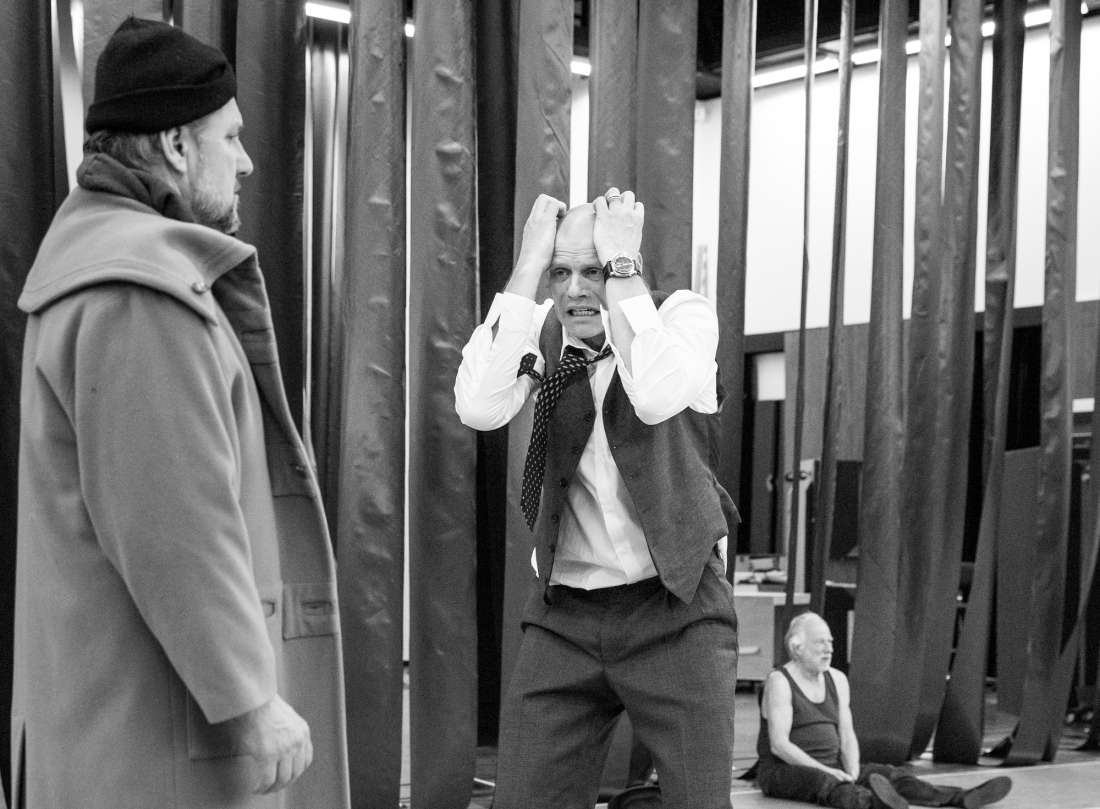
Chorus of the Opéra national de Paris (chorus master: Alessandro di Stefano)
Orchestra of the Opéra national de Paris
Fabio Luisi (conductor) 
 
Rehearsal photograph: © Élena Bauer / OnP


This year has seen musical Shakespeare commemorations aplenty, although I cannot help but wonder whether some miss the point. Although there are many wonderful musical settings of Shakespeare, his verse is often so musical in quality that it requires nothing additional. Successful Shakespeare operas are thus less surprisingly few than one might initially suspect. Britten’s A Midsummer Night’s Dream has its devotees, many of them fervent; I should rather stick with the play and Mendelssohn’s incidental music. Falstaff: well, it is difficult to care much one way or the other about The Merry Wives of Windsor, even if Nicolai’s version is (slightly) preferable. Lear, however, has at least one other excellent operatic version, very different in conception: Alexander Goehr’s Promised End. Aribert Reimann’s opera is more conventionally operatic, perhaps, than Goehr’s post-Brechtian response, although such a claim is highly relative and this is no work, thank God, for canary-fanciers. We are lucky to have both – and equally lucky never to have that threatened late Verdi opera. (I have never heard Aulis Sallinen’s 2000 opera.) At any rate, the Paris Opéra’s contribution, whether intended as such or no, is most welcome in principle, still more welcome in practice.


Claus H. Henneberg wrote a number of libretti, from Reimann’s 1971 Melusine to works by Peter Eötvös and Matthias Pintscher. (How I should love an opportunity to see the latter’s Thomas Chatterton!) This, first performed at the Munich Opera Festival in 1978, was written with Dietrich Fischer-Dieskau very much in mind for the title role, and that seems to have helped the initial dissemination of the work, both in the theatre and on its first recording. For a number of stagings followed, including San Francisco, Paris (making Calixto Bieito’s staging the Opéra national de Paris’s second), East Berlin (the Komische Oper), Vienna, Amsterdam, and eventually in 1989, London (ENO). Opera of this period has not generally been well served well by our opera houses, although many continental houses – and not just German ones, as this Paris production and its predecessor attest – tend to do better than their English counterparts; nor has it been in much Anglophone writing. In the meantime, however, you are recommended to seek out a performance and/or a recording where you can.
 

This Paris production and performance will do nicely in that respect. Reimann’s post-expressionist score – not unlike what you might expect from so fine a pianist in Lieder of the Second Viennese School – and Henneberg’s libretto do nothing especially ‘to’ the play, although it is of course not remotely set in its entirety. Given the musical language, violence comes much to the fore, without forsaking claims upon our human sympathies. Indeed, as one would expect, the latter become progressively engaged as the second of the two acts progresses. Dramatic parallelisms and distinctions, for instance between Lear (baritone) and Gloucester (bass-baritone), Cordelia and Edgar, are surely, if sometimes rather obviously, handled in words and music. The series with which the latter pair are associated come strongly into the foreground, much as they might have done with Berg, although there is far less of the ‘Romantic’ to this score. As with a good deal of serialist opera, one has a sense of the workings of the serial machinery and its implications, even if one could not quite put it into words, and would have to consult the score properly to analyse it. (When, after all, would one not? Surely the same is true of Mozart or Wagner.)


Although I felt that Fabio Luisi sometimes led the excellent Orchestra de l’Opéra national de Paris with a little too much restraint, and that something more full-blooded would have turned the dramatic screws with a more evident sense of theatre and ultimately of musico-dramatic generation, audibility of such procedures and our consequent ability to relate them, indeed to fuse them, with stage action were nevertheless most welcome. Not that screams from the orchestra – seemingly, insofar as I could tell, never having seen the score, executed with pinpoint precision – or stereo dialogue between percussionists in boxes either side of the pit had nothing of the visceral to them, far from it. The score can rarely, if ever, have been played with such clarity and, at times, both depth and brightness of string tone as by this fine orchestra, still woefully underrated by many who should know better. My mind was cast back to their magnificent Moses und Aron at the opening of this season.
 

The cast was excellent too. Bo Skovhus gave a highly distinguished, dramatically detailed performance of the title role. His initial pride and its disintegration into a complex web of emotions, inadequacies, and ultimately greater humanity were accomplished in what I presume would have been a more physical performance than that adopted by Fischer-Dieskau (or indeed, really possible to the role’s creator at the time). Skovhus was, I am sure, just as committed as his great predecessor would have been. The dryness I have sometimes observed more recently in his voice seemed as resolutely banished as Cordelia, without danger of its parallel return.
 

Lauri Vasar’s Gloucester was handsomely sung, in a portrayal of considerable emotional depth. Facial, vocal, and verbal expression seemed very much of a piece, as indeed they did in general on stage, testament surely to Bieito’s work as director as well as to individual artistry. Indeed, it is surely testament to both that it is difficult to disentangle the two, and I shall not really attempt to try. Bieito certainly does not seem out to shock, but rather to draw from characters, production, and performances the elements of musical drama. Modern dress is employed, if one cares about that sort of thing in itself, but the designs more broadly are stark, permitting one to allow oneself to imagine any manner of ‘setting’ or none: so more or less what all but the most hidebound reactionary would expect in Shakespearean tragedy. I am not sure that anyone would claim this as a ‘history play’, but perhaps someone silly will claim it as a ‘history opera’; frankly, who cares?
 

What Goneril and Regan have in common and what, increasingly, sets them apart is fascinatingly explored, Ricarda Merbeth’s Goneril the power-dressing big sister, initially less interested in the sexual, it would seem, but ultimately more successful – perhaps because her actions have not previously been so overtly erotic? – in its exploitation. The depravity of Regan’s actions, by contrast, from the initial sexual approach to her father (one almost wants to have her convicted of elder abuse) to her sleazy demise (a touch of necrophilia before expiring, perhaps, however understated?) tell their own story. Erika Sunnegårdh’s performance again melded the ‘musical’ and the ‘dramatic’ into a single, dynamic whole. If Annette Dasch’s Cordelia made less of a strong impression, that was more a function of the work; when she returned, hers was an undoubtedly sympathetic contrast, if ultimately never one that could emerge victorious. Andreas Schiebner’s Albany was intriguingly ambiguous: here, one felt, was a truly conflicted character, no doubt weak yet still a victim of circumstances. Andreas Conrad’s Edmund followed the seeming fate, even nature, of his own personal circumstances, with similarly powerful command of musico-dramatic theatre. His legitimate half-brother, Edgar, received a memorable performance, especially but not only in vocal terms, from Andrew Watts, switching as he must between tenor and countertenor. Here, again, was a desperately needed hint of sympathy, if also a reminder of hopelessness. There was no sense, however, of whether he might become king; our eyes and ears were focused upon tragedy.


Now I should like to see Bieito direct King Lear ‘itself’ or not quite ‘itself’. Shakespeare stands no more in need of Werktreue than any composer of opera, indeed if anything, less so. The Barbican has staged some of his Shakespeare; alas, I was unable to go, but hope that it will not prove the last opportunity in London. Otherwise, to Paris, to Barcelona, or to wherever else might oblige…


Wednesday, 10 July 2013

Dasch/Deutsch - Mahler, Zemlinsky, Schoenberg, and Korngold, 9 July 2013


Wigmore Hall

Mahler – Des Knaben Wunderhorn: selection
Zemlinsky – Altdeutsches Minnelied, op.2
Das bucklichte Männlein, op.22 no.6
Entbietung, op.7 no.2
Meeraugen, op.7 no.3
Schoenberg – Wie Georg von Frundsberg von sich selber sang, op.3 no.1
Warnung, op.3 no.3
Mädchenlied, op.6 no.3
Der Wanderer, op.6 no.8
Korngold – Schneeglöckchen, op.9 no.1
Die Sperlinge, op.5 no.7
Was Du mir bist?, op.22 no.1
Mit Dir zu schweigen, op.22 no.2
Welt ist stille eingeschlafen, op.22 no.3

Annette Dasch (soprano)
Helmut Deutsch (piano)
 

This was an excellent recital: committed performances from both artists, and a fascinating programme. Annette Dasch, whom I last heard as Elsa in Bayreuth’s Lohengrin last year, proved an equally captivating recitalist; Helmut Deutsch may need no introduction as a collaborative pianist, but his artistry should not be taken for granted either.

 
The first half was devoted to ten of Mahler’s Wunderhorn songs. Deutsch offered a wonderfully slow, teasing introduction to ‘Rheinlegendchen’, its lilt and indeed harmonies looking forward to Schoenberg’s Brettl-Lieder. Dasch set out her stall from the outset, making a great deal of the words, especially during the stanza in which we hear of the little gold ring being swallowed by a fish, to be served ‘at the King’s own table’. There followed a splendidly militaristic ‘Trost im Unglück’, prior to relaxation. Dasch presented two quite different ‘voices’ for the hussar and the girl; the latter’s ‘away with you; I have had my fill’ (‘Und geh’ du nur hin, Ich had mein Teil’) delivered through audibly clenched teeth. ‘Zu Straßburd auf der Schanz’ benefited from a highly atmospheric piano introduction, the Alphorn sounding through pedalled melancholy. Dissonances throughout the song, and again, noticeably in the later ‘Wo die schönen Trompeten blasen,’ sounded all the more biting in the sparseness of a piano ‘accompaniment’ than when heard in their more familiar orchestral guise. ‘Lied des Verfolgten im Turm’ offered another opportunity, well taken, for Dasch to distinguish between ‘characters’. The almost paradoxical phantasmagorical clarity of the piano part sounded verily Debussyan. A deeply felt ‘centre’ to the first half was afforded by both ‘Wo die schönen Trompeten blasen’ and the following ‘Urlicht’. The warmest of futile consolation was communicated in the former: ‘Willkommen, lieber Knabe mein, So long hast du gestanden.’ We knew that it would not last, long before its ghostly conclusion. ‘Urlicht’ offered a quite extraordinary sense of ‘revelation’, largely through that elusive ability to permit words and music to speak ‘for themselves’. Its ecstatic progress whetted the appetite for the rest of the Second Symphony, but instead it was to be followed by a sardonic, though occasionally shrill, account of ‘Wer hast dies Liedlein erdacht?’ The journey of ‘Ich ging mit Lust’ was lovingly and knowingly traced, that sense of knowingness certainly present also in the ensuing ‘Verlorne Müh’. Mahler’s inveterate sophistication showed through, as it should, even when the surface might seem ‘simple’. ‘Scheiden und Meiden’ rounded off the Wunderhorn selection, a properly ambivalent Mahlerian climax.

 
Zemlinsky’s songs made a welcome appearance at the beginning of the second half. His ‘Altdeutsches Minnelied’ proved more direct than Mahler’s songs, both in work and performance, though the piano part was certainly not without its subtle surprises. ‘Das bucklichte Männlein,’ a Wunderhorn song, comes harmonically from quite a different world, reflecting the chronological gap between the two songs: 1895-6 and 1934, respectively. The extraordinary latter song sounds as post-Schoenbergian as anything I have heard from Zemlinsky: a true discovery (at any rate for me). Dasch and Deutsch offered a superlatively animated performance, every note and every word being made to count. Dasch’s extraordinary vocal production for the final two lines, hushed and grotesque, truly chilled: ‘“Liebes Kindlien, ach, ich bitt, Bet’ für’s bucklicht Männlein mit!’” The hunchback – shades of Zemlinsky’s famed ugliness? – petitioned the child, as best he could, to pray for him too.  ‘Entbietung’ and ‘Meeraugen’ are both Richard Dehmel settings from 1898. Both took us back to a Tristan-esque world, in which Dasch allowed her gifts as a hochdramatisch soprano full rein, the impulsive eroticism of the former leading into an exquisite account of the latter, seemingly well along the way, at least at times, toward suspension of tonality.

 
Such talk inevitably has one think of Schoenberg, to whom we turned for the next group. Another Wunderhorn song was to be heard with ‘Wie Georg von Frundsberg von sich selber sang’. It offered another apparent return to relative straightforwardness, but the piano part, especially in Deutsch’s hands, soon showed otherwise, its Brahmsian ‘involved’ quality so utterly characteristic of the composer. Dasch’s performance again drew upon her operatic experience, whilst remaining true to the tradition of Lieder-singing. It would be an excellent thing to hear more Schoenberg from these artists, preferably on disc too. ‘Warnung’ is another Dehmel song. It proved properly disquieting, its musical violence mirroring, furthering  that of the text with its dog and ‘blood-red carnations’. ‘Mädchenlied’ proved as erotic as anything in Berg, its musical complexity both as work and performance drawing one similarly into a sinful labyrinth. ‘Der Wanderer’ showed itself to be the most overtly Tristan­-esque of the Schoenberg songs, recalling Zemlinsky’s ‘Meeraaugen’, and yet going further, in its approach toward the air of another planet.

 
Though I find Korngold’s operas difficult to take – wild horses would not drag me back to another performance of Das Wunder der Heliane – there is real craftsmanship to enjoy in his songs. ‘Schneeglöckchen’ opened the group with an apt change of performative register: late Romanticism, or whatever we want to call it, yet thankfully not overheated. Deutsch in particular offered a fine sense of harmonic understanding and surprise. ‘Die Sperlinge’, another Eichendorff song, appeared in context almost as if a scherzo, albeit with a duly radiant conclusion, a true impression of ‘opening out’. The latter quality was present also in the following ‘Was Du mir bist’, though by now there was perhaps a little overheating: more a matter of work than performance. Likewise, by the end of ‘Mit Dir zu schweigen’, there was something of a sense of too much Jugendstil; something a little more Bauhaus-like would have been a good antidote. That said, performances were excellent; the final ‘Welt ist stille eingeschlafen’ offered musical as well as verbal consummation. As an encore we heard the Shakespeare setting, ‘My mistress’ eyes’ (Sonnet 130), whose ambivalent harmonic progress put me in mind both of the earlier Abschiedslieder and even the late F-sharp major Symphony. (Both of these pieces, incidentally, may be found on an excellent CD from the late Edward Downes.)


Tuesday, 23 April 2013

La finta giardiniera - Die Pforten der Liebe, Staatsoper Berlin, 19 April 2013

Images: (c) Ruth Walz
Sandrina (Annette Dasch), Belfiore (Joel Prieto)
Schiller Theater, Berlin

Podestà – Stephan Rügamer
Sandrina – Annette Dasch
Belfiore – Joel Prieto
Arminda – Alex Penda
Ramiro – Stephanie Atanasov
Serpetta – Regula Mühlemann
Nardo – Aris Argiris
Countess – Elisabeth Trissenaar
Count – Markus Boysen

Hans Neuenfels (director)
Reinhard von der Thannen (designs)
Olaf Freese (lighting)
Henry Arnold (dramaturgy)

Staatskapelle Berlin
Christopher Moulds (conductor)


Hans Neuenfels’s production of La finta giardiniera, to which the subtitle – or should it be surtitle? – Die Pforten der Liebe (‘The Portals of Love’), has been added, received its premiere in November last year. The cliché of being destined ‘to divide opinion’ seems unavoidable here. I found it in many respects fascinating, causing me to reflect not only upon the work, but once again upon the concept of the musical artwork, especially in performance. That is not to say that I thought every aspect of Neuenfels’s reworking – it seems that designer Reinhard von der Thannen and dramaturge Henry Arnold (of Heimat 2 fame) deserve credit here too – convinced or was indeed ‘necessary’, but then one could say the same about most allegedly ‘traditional’ stagings. I am certainly not claiming that there is anything wrong with presenting the work ‘as it is’, or rather ‘as it has come down to us’, which is not really the same thing at all, but there should be room in theatre and in musical performance for re-examination, for disruption of what one might perhaps, in Benjamin-mode, call disruption of the work’s aura, not least when reception history plays a role, as it does here.

 
Arminda (Alex Penda) and actors
 
 
For there is something of a resurrection, or better, resuscitation, of the Singspiel-tendencies within the work and its history. It was, after all, as early as 1780, just five years after the Munich premiere, that the work was reimagined as Die verstellte Gärtnerin for Augsburg, a reworking with which Mozart may have been involved. The original Italian version of the first act having been lost for almost a century, La finta giardiniera as we understand it would not be revived until 1979, in Munich and Salzburg. I do not share Neuenfels’s poor opinion of the libretto, but nor do I think it an inviolate masterpiece, should indeed such a thing exist at all. (One can esteem Da Ponte’s libretti, without prescribing cruel and unusual punishments for those who might wish to make changes in particular performing circumstances.) There is, then, reordering. Recitativi secci are, without exception, cut. And we have introduced Neuenfels’s own German dialogue, centred upon an elderly Count and Countess: less a matter of flash-back to the action we recognise, though there seems to be an element of that, than of collage and sometimes of interaction. ‘German humour’ does not necessarily communicate itself well to foreigners, even if Emanuel Schikaneder suggests otherwise, and I cannot claim that all of it does in this particular case, though there are some splendid moments, not least that involving painful delivery of carrots from actors’ trousers, in preparation for their reduction in an electric blender (pictured above, with oranges). Eyebrows might also be raised by the return of Neuenfels’s wife, Elisabeth Trissenaar, as the elderly Countess; a Berlin friend tells me that she reappears with wearing regularity in his stagings. That said, I thought she performed her role splendidly, and there are plenty of conductors who cast spouses or lovers more often than might be strictly necessary.

 
More fundamentally, there remains an alertness to the darkness of ‘love’, whatever that might be, without turning to tragedy, a  sense of fantasy, by turns wide-eyed and surrealistic that seems to point in some sense towards The Magic Flute, and a sense in theory, if not, alas, always in practice, that Mozart’s music is the principal reason for our interest. Probing our conceptions of love seems to me a definite advance upon what is in some respects a stock buffa libretto. My thoughts turned to Neuenfels’s Così fan tutte, which I saw in Salzburg in 2000, and almost alone seem to have admired. There was kinship too with Stefan Herheim’s brilliant rethinking, again for Salzburg, of Die Entführung aus dem Serail, a work transformed into a new and yet ancient parable concerning love, sex, and gender. Herheim’s staging is more thoroughly thought through, partly, I suspect, because he has a superior ear for music, and also, perhaps a related point, because he never stoops to banality, but if, as I hope, the Neuenfels ‘work’ should prove be released on DVD, it ought to be seen. It would, moreover, be interesting to see whether the shock of the new would bear repetition. There is, in any case, more than a hint here of Berlin’s Komische Oper invading the Staatsoper, just as Harry Kupfer once made that same journey, a sense of welcome cross-fertilisation in the city’s operatic world.

 
The Staatskapelle Berlin was on excellent form throughout. Though not so often recognised as such, this is one of the world’s great Mozart orchestras, indeed one of the world’s great orchestras. There was fullness of tone without over-ripeness; woodwind contributions were simply delectable. If Christopher Moulds began the Overture with incessant haste, his reading soon calmed down, without that entailing a loss of inner life. The delights, and they are manifold, of Mozart’s scoring were present for all to hear, even if listeners, as many understandably did, were confused or even appalled by what they saw on stage. The cast was excellent too. Joel Prieto’s honeyed tone made light yet substantial work of Count Belfiore. The match with Annette Dasch’s somewhat more hochdramatisch soprano might on paper have seemed questionable, but in practice worked very well, Dasch’s Sandrina offering cleanness of tone and dramatic commitment in equal measure. Alex Penda’s Arminda impressed in very much the same fashion, seizing her role by the scruff of the neck, and turning it into something beyond the call of duty. Aris Argiris offered a different experience, as befits Nardo, warmer, more buffo, welcome in its reinstatement of tendencies of character and genre the staging sometimes overlooked, or at least played down. But all of those participating brought something, both individually and collectively, to the experience. In an opera of this nature, and a staging of this nature, one needs a true sense of company, a sense that was here most impressively achieved, whether in vocal, acting, or orchestral contribution.    


Friday, 2 November 2012

Two CD reviews: Schreker, Der Schmied von Gent, and Lohengrin

These reviews originally appeared (in slightly edited form) in the October and November 2012 issues of OPERA:


Franz Schreker, Der Schmied von Gent

Judith Kuhn: Arstate, Angel; Anna Erxleben: Mary; Christiane Knappe: Squire; Undine Dreißig: Smee’s Wife; André Riemer: Flipke; Edward Randall: Slimbroek; Viktor Sawaley: Second Noble, Henker Jakob Hessels; David Sitka: Angel; Matthias Winter: St Joseph; Oliver Zwarg: Smee; Martin Gäbler: First Noble, Duke of Alba; Thomas Mäthger: Third Noble; Kouta Räsänen: St Peter. Chorus and Children’s Chorus of the Chemnitz Opera/Robert-Schumann-Philharmonie/Frank Beermann (conductor). CPO 777 647-2, 2 CDs, 127:55. Recorded at the Chemnitz Opera House, 28-30 January and 1-2 February 2010.  
  
CPO heralds the first complete recording of Schreker’s 1929-32 three-act opera, Der Schmied von Gent. Smee, a Ghentish smith, falls upon hard times on account of his resistance to Spanish occupation, makes a pact with the Devil and is restored to prosperity. When his seven years are up, he manages the fruits of good works to evade his fate and is thereby, despite St Peter’s initial adamant refusal, admitted to Heaven.

The imposing opening bars, an audible curtain raiser poised somewhere between Neue Sachlichkeit and Hollywood, mark a call to attention. Closed, sometimes neo-Baroque, forms tend to be the rule: more Hindemith than Strauss. Many of the thirty-four scenes have their own generating formal principle, for example a haunting downward scale at the opening of the third act. Alto saxophone weaves its obbligato way on a number of occasions, suggestive of its time, if less strikingly so than, say, in Berg. One may, if one will, play guess the influence. There are, unsurprisingly, Meistersinger-ish echoes in counterpoint and folksiness. Hindemith’s Cardillac seems an obvious precursor. Busoni comes to mind – the sale of Smee’s soul inevitably suggesting Doktor Faust – but he often does in music of this period; much may be correspondence rather than influence.

The subtitle ‘grosse Zauberoper’ courts comparison with The Magic Flute and Die Frau ohne Schatten, kinship most obvious in scenes such as that when Smee meets the Holy Family. There is no gainsaying the compositional craft, whether in terms of orchestration, counterpart, or convincing harmonic progression.  That said, Schreker’s score expresses general situation better than character, for whatever the gentle melancholy of his second-act soliloquy, ‘Schöne Bäum’ draußen am Kai,’ Smee is no Hans Sachs. Yet if not necessarily operatic gold, nor is this corn.

Vocal performances tend to competence rather than inspiration, Oliver Zwarg’s Smee an intelligent, finely-sung cut above the generality. Frank Beermann conducts with formal clarity, though one could imagine a more propulsive account.

Janine Ortiz contributes a thorough, informative booklet note, though the translation is often Google-like. ‘If one considers the note reserves, then it is striking that they involve an eleven-note theme,’ means nothing unless one is in a position to read the original. The libretto would have benefited from better proof-reading: some words appear to be missing completely, for example during the second and twelfth scenes, whereas what I assume to be performance cuts go unacknowledged in the written text.

My appetite was certainly whetted to see the opera in the theatre. Herewith a glimmer of an artist-opera Konzept: portray Smee’s intial destitution in the light of the Great Depression, the Spanish occupying forces in SA uniforms, the diabolical pact as collaboration, and Heaven as a form of inner emigration.
 

_________________________________________________


Wagner, Lohengrin

Elsa: Annette Dasch; Four Pages: Christine Bischoff, Isabelle Voßkühler, Judith Löser, Bettina Pieck; Ortrud: Susanne Resmark; Lohengrin: Klaus Florian Vogt; Four Brabantian Nobles: Robert Franke, Holger Marks, Sascha Glintenkamp, Thomas Pfützner; Friedrich von Telramund: Gerd Grochowski; Herald: Markus Brück; King Henry the Fowler: Günther Groissböck. Berlin Radio Chorus (chorus master: Eberhard Friedrich), Berlin Radio Symphony Orchestra, Marek Janowski (conductor). Pentatone, 3 SACD, PTC 5186 403, 200:34. Live recording of a concert performance from the Berlin Philharmonie, 12 November 2011.

 
Lohengrin, the fourth instalment in Marek Janowski’s Wagner series, arrives in a finely detailed recording. A principal glory of this performance is the precision of its chorus: one really hears Wagner’s contrapuntal ingenuity here and in the orchestra, which sounds less monolithic than is often the case. Janowski highlights shifting instrumental timbres as well as harmony to signal presentiments, for instance during the second act’s first scene, of Alberich’s world and plight. Rhythmic exactitude, such as during the build up to first-act combat, also proves a victor. Details of high-lying violin figuration emerge more clearly than I can recall, fascinating from an analytical standpoint, though such hyper-clarity arguably militates against Wagner’s intention, as in those performances of Strauss’s Don Juan in which technical virtuosity tarnishes the wash of sound. The general sonority of the Berlin RSO veers oddly, without obvious reason, between old-German depth, if not quite to the extent one hears from Barenboim’s Staatskapelle, and a lighter, Mendelssohnian approach.

This set’s other principal attraction is the unearthly Lohengrin of Klaus Florian Vogt; the role might have been written for him, possessed of a Heldentenor’s tonal weight but the lyrical beauty of a Tamino. Vogt’s admirers – there are a few nay-sayers – will require this recording for that reason alone. Alas, much other singing pales by comparison, both with Vogt and with artists of the past. Annette Dasch’s Elsa and Gerd Grochowski’s Telramund are at best distinguished by Lieder-like attention to detail, but both can tend to dryness and fail to soar. Susanne Resmark’s Ortrud is often squally and imprecise of intonation and diction.

Oddly, however, the ‘live recording’ evinces little sense of the concert hall, let alone the theatre, drawing attention to the ideological intent of the series, born of Janowski’s dissatisfaction with contemporary Regietheater. A reactionary imperative to rescue Wagner from his and our troublesome politics is betrayed by remarks from the orchestra’s dramaturge, Steffen Georgi: ‘from today’s perspective, Wagner the theatre-reformist pales into near-insignificance ... a very minor revolutionary.’ I can only suggest that he, Janowski, and the speaker of the Bundestag, who offers a printed endorsement, take another look not only at Wagner’s writings, but at the dramas themselves. Whereas the printed libretto has Lohengrin herald Gottfried as ‘Führer’, Janowski opts for the evasive ‘Schützer’. There remains a dialectical irony, however, in that the case of a Wagner recording as CD rather than DVD helps one focus not only upon Wagner’s music but upon his words. Whatever the intention, my experience was thereby to hear as strong a warning as I had seen in Hans Neuenfels’s Bayreuth staging against the perils of popular attraction to charismatic leadership. Vogt, not coincidentally, starred in Bayreuth too. Politics will out.


Wednesday, 15 August 2012

Bayreuth Festival (3) - Lohengrin, 13 August 2012

Bayreuth Festspielhaus

King Henry the Fowler – Wilhelm Schwinghammer
Lohengrin – Klaus Florian Vogt
Elsa – Annette Dasch
Friedrich von Telramund – Thomas Johannes Mayer
Ortrud – Susan Maclean
King’s Herald – Samuel Youn
Brabantian Nobles – Stefan Heibach, Willem van der Heyden, Rainer Zaun, Christian Tschelebiew

Hans Neuenfels (director)
Reinhard von der Thannen (designs)
Franck Evin (lighting)
Björn Verloh (video)
Henry Arnold (dramaturgy)

Bayreuth Festival Chorus (chorus master: Eberhard Friedrich)
Bayreuth Festival Orchestra
Andris Nelsons (conductor)


I found much to admire last year in Hans Neuenfels’s production of Lohengrin, though equally voiced a few reservations. This time around, perhaps having overcome my initial surprise at the now-celebrated infestation of rats, I found little to quibble about at all. Indeed, the production seemed elevated almost to the level of a companionable yet still provocative classic. Direction appeared still tighter, and I did not feel there were many, if any, instances of working against Wagner’s score; indeed, subtle distinctions of movement, which I am not convinced were necessarily there last year, suggested commendable consonance. Where there was simply too much confusion in the previous evening’s Flying Dutchman, there could be little doubt that we were seeing what we were meant to see. At the heart of Neuenfels’s production, or at least my understanding of it, remains the experiment, into which Lohengrin first, unsuccessfully, tries to break, towards the end of the First Act Prelude. He eventually gains access, yet that initial failure is noteworthy: whoever is in control, it is not Lohengrin. Nor is it King Henry, who is dragged off-stage by the mysterious attendants – redolent perhaps of those enigmatic ‘authorities’ to whom Don Ottavio refers in Don Giovanni. Indeed, the king is clearly a flawed, even wounded, perhaps Amfortas-like character: an intriguing and utterly convincing conception. Interestingly, two instances of characters throwing off the shackles of supervision are Ortrud and Lohengrin, arguably when both are at the height of their powers during the second act. So no authority is absolute, perhaps, though whatever this is – Fate? The near-omnipotent surveillance of late capitalism? The illusion of the Gesamtkunstwerk? – manages to reassert itself, before bringing forth the fragile infant figure of Gottfried from within an egg. (Incidentally, I cannot now imagine why I found that problematical last year, so it is time to recant.)  One of the most telling aspects of the staging is the impatience, at moments shading from frustration into anger, that Lohengrin experiences with respect to Elsa. Neither of these characters is a saint.


Andris Nelsons’s conducting had progressed by leaps and bounds; it certainly proved more coherent than either Philippe Jordan’s account of Parsifal or, perhaps more surprisingly, Christian Thielemann’s sometimes brilliant yet sometimes flawed conducting of The Flying Dutchman. The orchestral sound was aptly golden, more redolent of Vienna than anywhere further north. Ebb and flow were splendidly judged throughout, with none of the mannerisms that intruded from time to time in 2011. At the risk of sounding like a stuck record, Eberhard Friedrich’s chorus was magnificent: absolutely crucial in this work, of course; the chorus members’ acting as part of the pliable, threatening mass was equally exemplary.


Klaus Florian Vogt would seem to have been born to play Lohengrin. The unheimlich quality of his voice meshes perfectly both with role and production. What a relief it is not to have to endure a strained or downright unpleasant tenor in this repertoire, even if I thought there were just a few occasions this year when he might have been guilty of coasting towards slight blandness. That said, there were many instances not only of unearthly beauty but of fine dynamic shading and phrasing. Moreover, Vogt looks the part, which one can hardly say of Johan Botha, the most recent Lohengrin at Covent Garden. Annette Dasch may not have been the most memorable of Elsas, but she offered an attentive, varied assumption, far more secure than Astrid Weber, whom I heard as a late replacement for Dasch last year. Thomas Johannes Mayer was an excellent Telramund, both forthright and sensitive. If Susan Maclean paled somewhat in comparison with Petra Lang’s Ortrud in 2011, Maclean’s tone lacking refulgence, she nevertheless did as much to compensate with stage presence as she could. (The final scene seemed overdone, though that may well have been a matter of direction: here, Ortrud seemed less drunk with power than merely drunk.) Samuel Youn was on better form as the Herald than he had been as the Dutchman the night before, though intonational problems reared their head again. The splendidly named Wilhelm Schwinghammer was an excellent King Henry; it is a fine achievement to sing strongly and yet convincingly play the role of a weak man, as opposed to acting weakly.


This production is now available on DVD, filmed last year. Though I have not actually seen the DVD, my experiences this year and in 2011 render me reasonably certain that I can, indeed should, offer a firm recommendation.