Showing posts with label Barenboim. Show all posts

Saturday, 9 November 2024

Dego/LSO/Rustioni - Liszt, Mendelssohn, and Schubert, 7 November 2024


Barbican Hall

Liszt: Les Préludes, S 97
Mendelssohn: Violin Concerto in E minor, op.64
Schubert: Symphony no.9 in C major, ‘Great’, D 644

Francesca Dego (violin)
London Symphony Orchestra
Daniele Rustioni (conductor)


Images: Mark Allan

This was a slightly curious concert: much to admire and very little, if anything, to which to object, the LSO on excellent form throughout. Yet the performance of Schubert’s ‘Great’ C major Symphony rarely ignited as it might have done, a case of being almost yet not quite there under Daniele Rustioni’s direction, and Mendelssohn’s Violin Concerto received an unusual, interesting, yet again not entirely convincing performance from Francesca Dego. 

Liszt’s symphonic poem Les Préludes came off best, in an outstanding performance from orchestra and conductor alike. From the opening bar, they conjured up a splendidly Lisztian sound – easier said than done with orchestra, as opposed to piano – and showed themselves adept at managing those all-important transitions and transformations. What can all too readily sound stiff, even from the most exalted names, here evinced first-rate continuity and flexibility; it was refreshingly free of brashness, let alone vulgarity, too. Lyrical, even operatic, it seemed to confirm Wagner’s unhistorical placing of Liszt’s symphonic poems as an intermediate stage between Beethoven’s symphonies and his own music dramas. Exemplary woodwind playing and blend, melting strings (with an especially spirited cello section, where called for), and big-hearted climaxes that lacked nothing in power combined to form a performance of power and sensitivity.


Rustioni’s way with the Mendelssohn was often as impressive. He began the first movement swiftly, yet never drove too hard, and lightly emphasised its darker undercurrents, as if to confound absurd preconceptions of this as ‘pleasant’ music. Dego’s sound was often on the smaller, silvery side, worlds away from, say, Anne-Sophie Mutter, yet always cut through, and line was secure and finely spun; any qualms were really a matter of taste. She had a nice line in telling rubato too. The cadenza in particular was captivating, likewise the closing accelerando. Her tone in the slow movement was often a little nervy, even wiry: again, clearly an interpretative choice, since it was not always like that, but a little odd. There was nothing routine to the performance, though, which showed commendable metrical flexibility. A quicksilver finale pulsed with life and good humour, with all the give and take of chamber music. It made me smile, and goodness knows we need something like that in the world right now.


The introduction to the first movement of the Schubert trod a middle path between old and new. (The labels make little intrinsic sense, but perhaps remain the easiest way to describe broad interpretative trends.) It was certainly alla breve, yet sounded less rushed than has became the case, nonetheless lacking the grandeur – and meaning – of ‘old’, whether Klemperer and Furtwängler, or Colin Davis and Daniel Barenboim (Barenboim’s 2015 VPO performance in Berlin by some way the best live performance I have heard). It was elegant and euphonious, and had a sense of heading somewhere, the movement ‘proper’ then being taken at a perfectly reasonable tempo. Likewise, it evinced vigour and rigour, still flying by, all the time retaining creditably cultivated orchestral sound. The Andante con moto was bracingly swift, yet retained flexibility and an admirably Viennese sound. Solo playing was comfortably the equal of any one would hear around the world, and the orchestra as a whole offered a winning match of transparency and warmth. The third and fourth movements, both played very well and far from lacking in energy, nonetheless seemed to outstay their welcome, repetition supplanting development: a pity, given the swagger of the scherzo and the initial excitement of the finale.


Wednesday, 6 November 2024

WEDO/Barenboim - Mendelssohn and Brahms, 4 November 2024


Royal Festival Hall

Mendelssohn: Symphony no.4 in A major, op.90
Brahms: Symphony no.4 in E minor, op.98

West-Eastern Divan Orchestra
Daniel Barenboim (conductor)


Images: Pete Woodhead


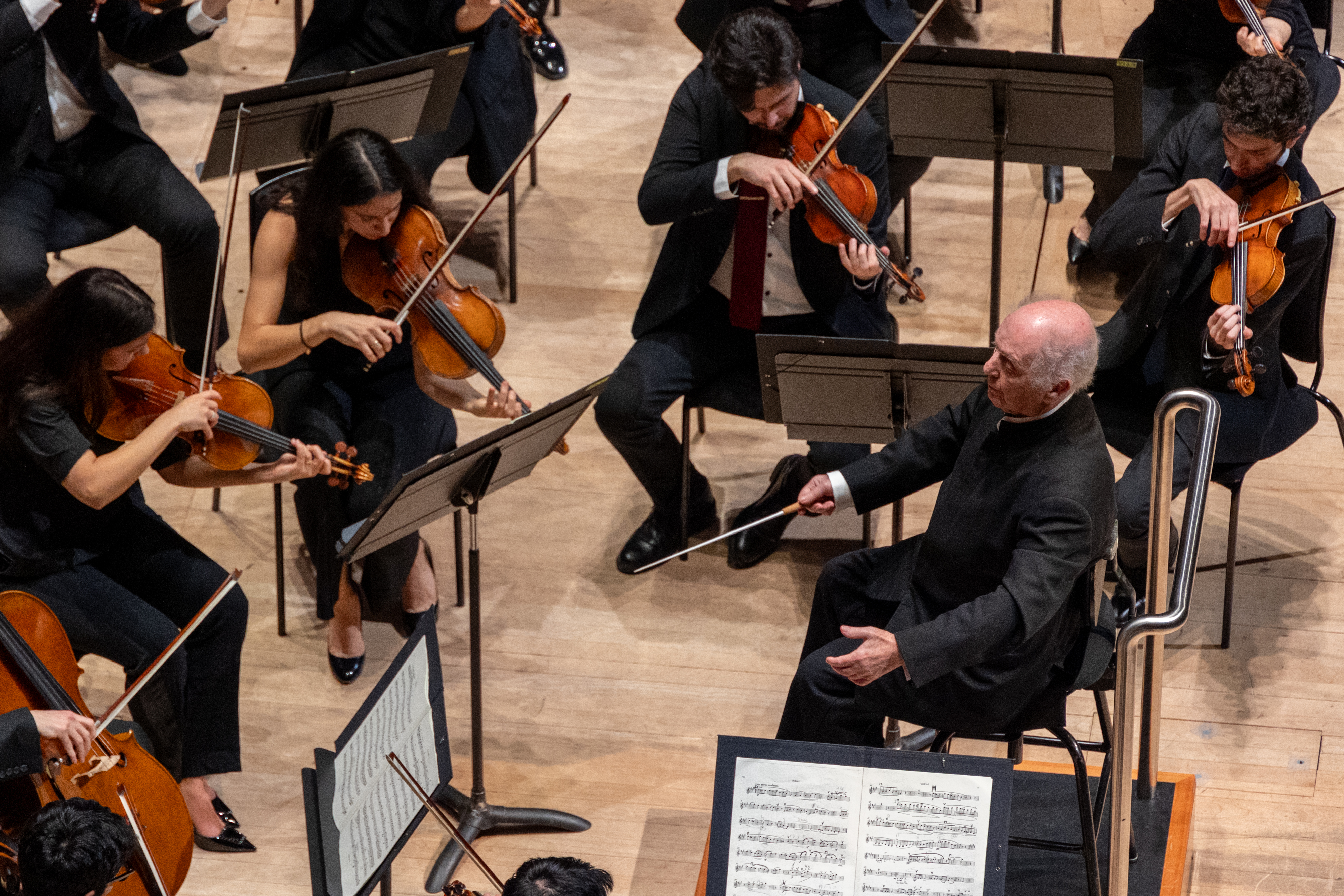
A performance from Daniel Barenboim and the West-Eastern Divan Orchestra has always been an experience hors concours. That has not changed; it is arguably all the more so than ever. The warmth of applause Barenboim received coming on stage was in itself striking, arguably beyond even that Bernard Haitink did during his later years; that with which Barenboim and the orchestra met on departing was something else again. The reasons for this are obvious and do not need rehearsing, but they are very much part of the context in which any listener from this planet, perhaps even from beyond, would experience this concert. 

Mendelssohn’s Italian Symphony was not a work I associated with Barenboim, but that was clearly a matter of my ignorance, since he conducted it, as he would Brahms’s Fourth Symphony, without a score. The manner in which it opened banished any such doubt for good: buoyant, transparent, directed, at an ideal tempo, and imbued with chiaroscuro. Ravishing woodwind solos characterised not only this first movement but the performance as a whole. Split violins brought the dialogue further to life—and what a luxury it was to hear this music with an orchestra ranging from sixteen firsts to eight double basses. That depth of strings truly told in the struggle of the development, more Beethovenian than one generally hears, and all the better for it. Indeed, it was not only Beethoven but the Beethoven of Furtwängler who increasingly came to mind: surely a matter not entirely dissociated from the state of the world around us and, above all, around these extraordinary young musicians and their wise guide and mentor. It was likewise perhaps my imagination, but I am not sure I have heard the second movement sound so mournful. It was neither slow nor lugubrious, but told of an underlying pain that could never be put into words (thinking of Mendelssohn’s own aesthetic claim). This processional, steeped in the deepest melancholy, maintained its line from beginning to end, detail and broad sweep in perfect equipoise. Moving to the major mode brought Schubertian bitter-sweetness. The close, alas, brought a less than welcome intervention from mobile telephone. 

Was the minuet too loving? I imagine some might have thought so. For me, as a one-off, it offered a fond backward glance to a world before, ever vanished, yet tantalisingly close, whether to Mozart or whatever one might choose politically. Again, woodwind were to die for. Horns and bassoons in the trio, beautifully hushed, seemed to recall the world of A Midsummer Night’s Dream, building to a stern climax with militaristic trumpets and drums. In that context, the finale offered a wake-up call in several senses. Fast, furious, unrelenting, it had never terrified me as it did here. String figuration again darted from the Dream music, the Scherzo in particular, yet turned to acid, disturbingly close to the world of, say, Mahler’s Fifth. Throughout, the sense of purpose evoked Beethoven and anticipated Brahms.


The first concert I heard Barenboim conduct was of Brahms, in this very hall: not the Fourth Symphony, but rather the Third and First. He still has much to tell us and much to surprise us with. If the candle occasionally flickers, as here in the great finale, which almost yet not quite fell apart; it continues ultimately to burn, perhaps all the more movingly for its infallibility. There is little doubt that the Divan musicians would follow him to the end of the earth and there is hope in that. The first movement, deeply sad without sentimentality, felt well-nigh overwhelming. It may have been on the slow side, but it pulsed with life both in its harmonic fundamentals and in the motivic working of inner parts: Schenker and Schoenberg united, as so often in the best of Barenboim’s (and anyone else’s) performances. It became more frightening, more vehement, its insistence frightening, sweeter passages arguably still more so. Its fragility remained deeply moving. The development opened as if showing us a musical (and political) wasteland, from which the world somehow, just about, picked itself up. Horn calls and massed string portamenti sent chills, properly ambiguous, down the spine. Battle between first and second violins towards the close told its own unmistakeable story.

The second movement, intriguingly, seemed to take up whether the inner movements of the Mendelssohn had left off, building rhythmically (those hemiolas!) and harmonically into a tragic statement of Beethovenian stature, whose virginal tenderness troubled still more than external defiance. Truth, here, was the essence. It was not beautiful; nor was it intended to be. Yet in the richness of Brahms’s inner parts, there lay hope, as there did in something later, warmer, aptly (given Barenboim’s history) Elgarian. He may not have seemed to be doing very much, yet detail remained within his hands, as witnessed by a subtle signal to the firsts to tone down, instantly obeyed. The scherzo-like third movement offered ebullient contrast, as if a thunderbolt from Zeus. In dialectical contrast, it became almost balletic, only adding to the sense of what humanly was at stake. The passacaglia was as implacable, as naked in its honesty: the final, complete tragic utterance, laden with all the cares of the world and yet still able to speak, to resist, to bear witness. At times, it almost stood still; at others, it pressed on. All was part of the same flow, all rooted in harmony, musically Sophoclean. 


The Scherzo from A Midsummer Night’s Dream, as at the Waldbühne this summer, made for a fitting, featherlight encore: charming, yet with depth rarely achieved and perhaps never surpassed. Encapsulating so much of what had gone before, it also offered something refreshingly new. Again, a sign of hope.


Saturday, 10 August 2024

Mutter/WEDO/Barenboim - Brahms and Schubert, 9 August 2024


Waldbühne

Brahms: Violin Concerto in D major, op.77
Schubert: Symphony no.9 in C major, ‘Great’, D 944

Anne-Sophie Mutter (violin)
West-Eastern Divan Orchestra
Daniel Barenboim (conductor)


Images: Jakob Tilmann

That it came close to a miracle that this concert took place at all will not be news to anyone. The West-Eastern Divan Orchestra continues to offer hope, light, and crucially listening. It has for me ever since I first heard the players in a London memorial concert for Edward Said, conducted (partly from the piano) 20 years ago, almost to the day, by co-founder Daniel Barenboim. As Barenboim and Said made clear, it was not straightforwardly a political project; an orchestra was never going to bring justice to the world or to part of it. It could, however, show a way to listen to one another in extremely difficult – some might have thought, impossible – circumstances. That it has now been doing for 25 years. I was unable to attend the anniversary concert here in Berlin in April, but it helped nonetheless to know that it was taking place—and I was able the previous September to hear them come together once again to play the three final symphonies of Mozart, conducted as (almost) always by Barenboim. It was not a concert I reviewed, but the ultra-Klemperian performance of the E-flat Symphony was the finest I have ever heard. It compelled one above all to listen. 

And so, it was a privilege once again to see, as well as to hear, these musicians assemble to perform Brahms and Schubert with long-term collaborator Anne-Sophie Mutter. Berlin’s Waldbühne is a strange venue. It was my first visit, earlier plans having been confounded. And it is certainly worth the visit for the ‘experience’, even if it rains for part of it, necessitating a sea of umbrellas and the rest. In the forest, as its name suggests, the vast ampitheatre offers no shelter for anyone but the performers; it offers little shelter either, save for the determinedly uninquisitive (never underestimate them!) from its Nazi origins and concept. Handel’s Hercules and Eberhard Wolfgang Möller’s Frankenburger Würfelspiel featured here in 1936, as well as the Olympic Games’s gymnastics competition. Still, boiling things down merely to alleged origins is as un-historical as it is un-musical. Barenboim has never been a musician to resort to such pseudo-archaeology, and nor should we be. History is, or should be, as much about dialogue, about listening, as music.


The major problem in saying much concerning the performances is the necessary amplification such a vast open-air theatre requires. I say that not to complain; if you do not wish to hear an amplified performance, do not attend one. I say it rather to explain why my remarks on the performances will be brief and somewhat generalised, and will take second place to the ‘event’ itself, reflecting the nature of the occasion and my experience of it. Insofar as I could tell, given the nature and consequences of amplification – that ‘insofar’ should be taken as read or heard for the rest – Mutter gave a fine performance: broad, unmannered, tonally centred throughout. From time to time, she led, but like those around her, she listened; her understanding with the players, as well as Barenboim, drawing on an even greater wealth of experience, was palpable. Barenboim ensured, often whilst doing apparently little – he has always known when not to conduct, as well as when to do so – that not only the proportion were there, but that they were thoroughly founded on harmony: another humanistic, as well as musical, lesson. The Divan’s strings, as so often of a greater size than one would hear with a ‘normal’ symphony orchestra, produced not only fine tone, but a true sense of how (relatively) massed musicians can come together to prove so much more than the sum of their parts—when they listen, and act on that listening. So too did the rest of the orchestra, the oboe and other wind solos in the slow movement exquisite, yet also somehow symbolic of how individual voices may continue to sound and matter when part of that greater whole. 

Barenboim has long been an outstanding interpreter of Schubert in general, and the ‘Great’ C major Symphony in particular. A performance I heard him give at the Philharmonie, with the Vienna Philharmonic, was without question the finest I had heard, drawing as much as his Beethoven on the Furtwänglerian sources of his musicianship. Here that lineage remained important, but it was joined – as indeed as has much of his symphonic Beethoven over the past fifteen years or so – by a reunion with another powerful influence on his career, albeit slightly later, the aforementioned Otto Klemperer. As with Klemperer, if there could be something implacable to the playing here, that did not preclude the more mercurial, let alone the more human; it was part and parcel of the same dialectical conception. And Furtwänger’s famed long-distance hearing or listening (Fernhören, he called it) was just as apparent, from beginning to end. Barenboim had no truck with currently fashionable, frankly idiotic ideas concerning the opening tempo; he trusted the score, listened to it, and aided his musicians to do likewise. Here, deep – well, not so deep, but one could fancy it was after nightfall – in the German forest, horns and other wind took on a magical quality of their all, spirits already presaging, like quicksilver strings, the perfectly chosen and played encore, the Scherzo from Mendelssohn’s Midsummer Night’s Dream music. The Andante con moto’s length felt truly ‘heavenly’, to reprise Schumann’s celebrated description of Schubert’s ‘lengths’: not a moment too long, but just long enough. Such Goldilocks proportions characterised the symphony as a whole and in its myriad interrelations, not least between trio and scherzo material, all with admirable, infectious Schwung. The meteor-like finale thrilled, erupted, and not least, recalling Brahms, satisfied just as it should. I may not have heard the music quite as in a concert hall, but I was drawn in to listen to it as such.


The orchestra has released the following statement, which I do not wish to edit or to paraphrase. As in a musical performance, the text, whilst not everything, has intrinsic value: 

As we witness and mourn tens of thousands of lives destroyed and communities shattered while political courage remains absent, we, the musicians of the West-Eastern Divan Orchestra, are horrified and deeply saddened by the extreme escalation of violence in the Middle East, which continues to intensify daily. The profound humanistic commitment of Maestro Daniel Barenboim and the late Palestinian intellectual Edward Said stands at the core of our orchestra. In and through our music we seek to model a life of mutual recognition between equals. We call on the local and the international communities and their leaders to stop procrastinating and put an end to the cycle of violence by effecting a permanent cease-fire, ensuring the safe return of all hostages and unlawfully held detainees. It is imperative to work toward a long-lasting peaceful resolution grounded in equality. 

It would not have done so without Barenboim or Said; indeed, it would not have come into existence without them. But nor would words from their founders have had the import they do without these musicians, and without the many others, musicians and otherwise, who have worked with them. Such a statement does not just ‘happen’; it requires work, reflection, listening, empathy: as do music and its performance, at least to be worthwhile. I see no reason to add to or further to comment on the orchestra’s words. The world, however, needs to listen: not at some point in the future, near or far, but now. And, like Barenboim, Said, and the Divan, it needs to act.


Saturday, 23 December 2023

Argerich/BPO/Barenboim - Beethoven and Brahms, 20 December 2023


Philharmonie

Beethoven: Piano Concerto no.2 in B-flat major, op.19
Brahms: Symphony no.3 in F major, op.90

Martha Argerich (piano)
Berlin Philharmonic Orchestra
Daniel Barenboim (conductor)


Images: Monika Rittershaus

Seventy-four years ago they met in Buenos Aires. They continue to play together, here in Beethoven’s Second Piano Concerto, and continue to delight audiences. For my final concert of the year, it was a treat to hear Martha Argerich and Daniel Barenboim, this time – and, I believe for the second time ever – with the Berlin Philharmonic. The warmth of applause at the beginning, let alone the close, offered testament to a special evening. 

Although I have heard Barenboim many times in Beethoven, as pianist, as conductor, and as both, I do not think I had heard him conduct the BPO in Beethoven. Even with him, it offers a different sound from the Staatskapelle Berlin, but needless to say, there was absolutely no rebarbative faddishness to it, whether in tonal quality or tempo. Instead, the opening tutti spoke in a heart-rending beauty of tone in direct line from Mozart, and owing as much in its fundamental harmonic rhythm to Klemperer as to Furtwängler (as has generally been the case in Barenboim’s Beethoven of the last decade or so). Every note mattered—and meant: as noble as the Fifth Symphony or Fidelio, though with requisite lightness of touch. Argerich responded in kind, though not without (quite rightly, as soloist) a certain wresting of initiative that yet always furthered collegial, chamber-music give-and-take. The piano part sang and scintillated, Barenboim and Argerich both bringing particular, complementary gifts to the performance. How a pivot chord from the piano told; how an orchestral sequence built harmonically; and how left-hand bass rumbling led us toward the tonic for the moment of return. The music continued to ‘grow’, not only to develop, throughout the recapitulation, Berlin strings truly digging in, preparing the way for Beethoven’s own cadenza, a missive from the Beethovenian future, lying gloriously beyond the language of the concerto ‘itself’.


The Adagio’s opening tutti, in contrast, complement, and development, was consoling as well as dramatic, a new frame for a new yet related painting. Argerich’s solo grew from within, its ethical subjectivity both singular and in accord with that of Barenboim’s wise narration. Together, their voice, Beethoven’s voice, had one believe – and so one should – that it was the voice of truth, its hushed tones and awe prefiguring the ‘late’ voice of the Ninth Symphony or even the Missa solemnis, piano elaboration nonetheless reminding us of the different nature of this music. Spun from finest Egyptian cotton, it was a sensuous delight as well as a musical necessity. This was the very model of a Beethoven slow movement. The finale was forthright as ever, from all concerning. After Elysian reverie, fun and goodness were to be had back on earth—and how. Like sparks of the divine, they were present in the detail as well as the broader contours, in articulation and acciaccaturas as in the tonal plan, in orchestral syncopation and in Haydnesque conversation. Civilisation matters, perhaps especially in our terrible historical moment, and the wonder of modulation is part of it, as triumphantly displayed here.


A surprise encore came in Schubert’s A major Rondo for piano four hands, D 951, Barenboim taking his seat next to Argerich, their page-turner none other than concertmaster Daishin Kashimoto. Here, in confidences whispered more softly than ever before, was a very different subjectivity, its fragility no less touching, an act of remembrance nonetheless in the here and now rather than an act that was ‘about’ remembrance. Episodes unfolded in their own time, and according to their own necessity. Indeed, time almost stood still, but not quite.


A larger orchestra assembled after the interval for Brahms’s Third Symphony, twelve first violins now fourteen, four double basses now seven, and so forth. Anyone expecting something sedate would have been immediately put to rights, the opening of the first movement not only febrile but angry, albeit quite without the trivial hysteria some, though never Barenboim, seem to think constitutes musical emotion and ‘excitement’. The second group retreated to the world of Schubert’s Rondo; here was music we over-heard, in a dialectical conception of the movement taking us between public and private. All the while, life was to be found in the inner parts, rather as if in a string quartet—or in Wagner. Sinews, honed again on Klemperer and Furtwängler, unleashed still greater anger in the development. This, for me at least, was music for and of Palestine, a musical land of beauty almost ‘occupied’, a heart of darkness terrifying in its truth. The grim determination of the recapitulation, and not only that, would not have been out of place in the composer’s Fourth Symphony. It was not without consolation, but need for that consolation had been immeasurably heightened.


Heard in a veiled dignity that enhanced riches both textual and textural, the Andante possessed a majestic intimacy suggestive somehow both of an expanded string quartet and, at times, of an imaginary ballet, Tchaikovsky closer than one might think. Once again, so much grew, motivically but also harmonically, from those glowing inner parts. Strange dissonances registered a pain both inner and inward. The third movement proved a sad serenade, whose eternally transforming song bore post-Beethovenian witness to the eternal – and eternally troubled – spirit of humanity. Did it meander? Perhaps a little, but not if that be taken to mean lack of clarity as to destination; rather, this was a musical stream, with twists and turns, yet undeniable, directed flow. The subdued opening of the finale only heightened the impact of subsequent bursting of the banks. Again, the Fourth was foreshadowed in darkness, even in tragedy, though that remained only one side of the coin. There was hard-won Beethovenian joy too, if briefly. Stubborn as well as graceful, this was a reading of thoroughgoing integrity, whether in those echt-Brahmsian half-lights, in ghostly reminiscences, or under a winter sun that just occasionally suggested spring might come. Above all, it was a struggle, a necessary one at that.

Saturday, 11 November 2023

West-Eastern Divan Ensemble/Barenboim M. - Hindemith, Carter, Hensel, and Beethoven, 9 November 2023


Pierre Boulez Saal

Hindemith: Trauermusik for viola and strings
Fanny Hensel: String Quartet in E-flat major
Carter: Au Quai for bassoon and viola; Duettone for violin and cello
Beethoven: Septet in E-flat major, op.20

Michael Barenboim (violin, viola)
Miriam Manaserhov (viola)
Assif Binness (cello)
David Santos Luque (double bass)
Daniel Gurfinkel (clarinet)
Mor Biron (bassoon)
Ben Goldscheider (horn)


Images: Peter Adamik

9 November is a date full, too full, of resonance for German history. From the proclamation of the Republic in 1918 to the fall of the Berlin Wall in 1989, it takes in also the Munich putsch of 1923 and the November pogroms of 1938. At the best of times, whenever they might be, it is impossible not to feel conflicted and at times close to overwhelmed by the imperatives of remembrance; and these, I hardly need add, are anything but the best of times. On the 85th anniversary of what English-speaking countries still refer to as Kristallnacht, although in Germany the term is now generally held to conceal the full horror of what happened that night, even the West-Eastern Divan Ensemble playing Beethoven might have struggled to impart much in the way of hope. Yet somehow, ultimately, these musicians did: not in the sense that they offered a solution to our world’s cruelty, carnage, and apparently irredeemable darkness, whether then or now, of course not. As Daniel Barenboim, co-founder with Edward Said of the orchestra from which this chamber ensemble draws its members, noted in a typically inspiring piece written for the programme, they ‘never intended … [it] to be a political project. It was always a humanistic one, a call against ignorance. It may have seemed like a utopian idea then and perhaps appears even more so today.’

But that they were still here at all, let alone playing, listening and responding was something—and increasingly so. ‘Here, in this building, this utopia,’ Barenboim continued, ‘is alive every day. Our young musicians, whether they come from Tel Aviv, Ramallah, Damascus, or Cairo, work and study under the same roof and learn to listen to each other, in music just as in daily life—something that is impossible in their home countries. It takes courage for them to be here.’ It does indeed, and their courage as well as their broader example offers an example to the audience too, although it is for us, not for them, to lead our struggle to listen rather than merely to hear.


A late addition to the programme was Hindemith’s Trauermusik: in Barenboim’s words, ‘our collective expression of grief, but also of hope’. And so it sounded; so it felt. Indeed, the sadness in the first of its four short movements seemed almost unbearable. Was it ‘there’, in the work, or was it what we brought to it? Impossible to answer, and not the most relevant of questions. Michael Barenboim, leading from solo viola, and a string quartet representing Hindemith’s orchestra inhabited the composer’s universe fully, dignity of craft, ensemble, counterpoint, and harmony, and what they might mean to the fore—and beyond that, the universal musical imperative to listen. Hindemith’s use of music from Mathis der Maler reinforced all the more the importance of witness against fascism, against murderous, antihuman ideology. Crisis tends to reinforce what is essential, if only we will take time to find out. Inner movements’ lyricism in particular grew out of that early material, a necessary, human development. The final chorale, ‘Für deinen Thron tret ich hiermit’, offered not triumph, but modest climax in human fragility. It was met with prolonged silence and, eventually, respectful applause. 

Fanny Hensel’s 1834 E-flat major Quartet was an interesting choice, its first movement, ‘Adagio ma non troppo’, opening again with nobility and dignity. Was the sadness with which it seemed to be imbued…? We have already answered that question, or rather observed that answer there can be none. At any rate, the proportion of time spent in the minor mode seemed fitting. Expansive, without dragging, the quartet, again led by Michael Barenboim, seemed very much to have its measure, subtleties telling without exaggeration. The following Allegretto comes closer to Mendelssohn, though it is perhaps both a little more conventional yet also quirkier. Beethoven too came to mind at times (as he often does in Mendelssohn’s own quartets too). There was scope for considerable virtuosity, well taken, within a collegial framework. An eloquent account of the ‘Romanze’, Barenboim first melodist among equals, again permitted reference to other composers, Mendelssohn and Mozart among them, without ever being reducible to them and their ‘influence’. The finale came as close as anything had yet done to good cheer. Sometimes smiling, sometimes sterner, even vehement, it offered plenty of light and shade in a finely directed performance.


Either side of the interval came two short works by Elliott Carter. Barenboim’s viola and Mor Biron’s bassoon were very much equals in Au Quai from 2002, Carter a still relatively young 93 at the time of writing. A game of post-Webern ping-pong led to almost Stravinskian melodic flowering, not that the music ever sounded ‘like’ either. Instead, it emerged as something akin to a reinvention, as it were, of a Bach Two-Part Invention, and was despatched as well as composed with a good deal of dry wit. For Duettone, Barenboim was joined by the similarly excellent cellist Assif Binness. It is perhaps too easy to romanticise, but this little gem from Carter’s 101st year truly sounded like the distillation of a lifetime’s work, not least with respect to his metrical discoveries and explorations. Within its modest frame – though think again of Webern – it seemed to come close to possessing the weight, contrasts, and journey of a symphony. Every combination of notes, and indeed of other parameters, was both fresh and deeply considered. Here, in two solo lines, was something suggesting comparison with one of Bach’s mirror fugues. 

It is difficult to characterise Beethoven’s Septet without resorting to ‘sunny’, and why try? After all, sun affects us in different ways at different times, and necessarily casts a shadow too. The ‘Adagio’ introduction to the first movement was strikingly expansive, rather as if it were taken ‘after’ Barenboim père, and frankly all the better for it. Neither faster nor slower than it ought to be, the movement as whole offered space for a lightness of touch and responsiveness lying at the heart of ethical and musical challenges alike. Line was present throughout in a performance replete with contrasts and sheer delights. The second movement, taken a little slower than is often the case, again benefited from greater space: heavenly length maybe, heavenly without question. Initially led by Daniel Gurfinkel’s quicksilver, liquid clarinet, it afforded all members of the ensemble opportunities to shine, to support, and as ever to listen and respond. Lilt properly verging on swing, conveyed via excellent textural balance born of such listening and response, characterised the minuet and trio. The ensuing theme and variations, in their transformational variety of instrumental combination similarly proposed a lightly worn moral as well as ‘purely’ musical lesson. Buoyant and in the best sense infectious, the scherzo, led by Ben Goldscheider’s miraculous horn playing, was both directed and collegial. Likewise a finale of stature and character which, like the performance as a whole, never forgot the sheer enjoyment to be had from such music, enjoyment that spilled into an encore performance of the Scherzo from Schubert’s Octet.


To return to Daniel Barenboim’s words in the programme, ‘We must, want, and will continue to believe that music can bring us closer together as fellow human beings.’ For all who continue to believe, there is no alternative.


Wednesday, 24 August 2022

Salzburg Festival (3) – VPO/Barenboim: Saint-Saëns and Wagner, 22 August 2022


Grosses Festspielhaus

Saint-Saëns: Samson et Dalila, op.47: Act II
Wagner: Parsifal: Act II

Elina Garanča (soprano)
Brandon Jovanovich (tenor)
Michael Volle (baritone)
Members of the Young Singers Project
Concert Association of the Vienna State Opera Chorus (chorus director: Jörn Hinnerk Andresen)
Vienna Philharmonic Orchestra
Daniel Barenboim (conductor)

This was, alas, very much a concert of two halves, disturbingly so. For reasons that I hope will be obvious, I shall concentrate on what was best; there is neither critical nor broader human need to hammer home the shortcomings.

Programming was unusual, yet revealing: an excellent case of using a cast to think what might conceptually as well as musically be possible. Consider what these two acts, premiered within five years of one another, have in common or in meaningful contrast, and the answer is quite a lot. Samson et Dalila is not, I think, a theological work; formal affinities to oratorio notwithstanding, it treats with religion, as do many nineteenth-century operas, as an engine of drama and colour. Parsifal most certainly is a theological work; we should probably not get too hung up on whether to call it an opera at all, but its dissociation from common operatic practice is undeniable, even extreme. Both acts, however, deal with seduction of a quasi-consecrated hero with a religious (and political) mission, by an exotic temptress with whom, at least in part, it is difficult not to feel some degree of sympathy. Indeed, as John Snelson remarks in his programme note, hearing these two acts divorced from their predecessors (however much we may still bear them in mind) enables us to observe the action more ‘from the perspective of the women’, even arguably intensifying ‘the hypnotic force they exert as they propel the dramas to contrasting climaxes’. Saint-Saëns’s ambiguous musical debt to Wagner was certainly in evidence here too, perhaps unsurprisingly given the conductor was Daniel Barenboim.

What was surprising was that Saint-Saëns fared so much better overall than Wagner. The initial orchestral sound we heard from the Vienna Philharmonic was, to my ears, perfect in balance, colour, and harmonic grounding, its darkness seemingly transposed from Siegfried’s forest. It was inviting, intensely so, with promise—not least of danger. On entry, Elina Garanča could likewise hardly have been improved upon: flawless in delivery, dignified and rich of tone, her (Dalila’s) made mind up, her lines despatched with duly operatic grandeur, even hauteur. The orchestra spoke and commented upon the action, much as in Wagner, though rightly also with reference to a long French history of orchestral recitative dating back at least to Rameau. There was certainly more than a little Berlioz to be heard; I soon found myself wishing for a Troyens from these forces, whilst knowing in my heart of hearts that it was already too late. Barenboim’s ear for motivic unity extended over sections of the score, but also across the entire act, imparting a unity necessary yet sadly all too rare in this repertoire. Michael Volle made for a commanding High Priest of Dagon, his typical sensitivity to words and music married to extraordinary dynamic and colouristic range. Brandon Jovanovich, our Siegmund-on-Seine, was as ardent a Samson as one could have imagined, playing nonetheless on a fine ambiguity between hero unmediated and a character compelled (or choosing) to play that role. The climactic duet between Samson and Dalila was, quite simply, a privilege to see (such acting too!) and hear, all the while knowing Dalila ultimately was in control.

The Parsifal Prelude was more deliberate, at its best evincing the spirit of a Klemperer, certainly oozing Tristan-esque malevolence. I listened for as long as I could in that vein and, to be fair, there was much in the orchestral cauldron still to admire, at least in the first scene or two. The first, orchestral intimation of Klingsor’s magic garden, for instance, appeared before our ears’ eyes with all the freshness of continually renewed experience. Whether that were the VPO’s or Barenboim’s, however, soon became a moot point. Samson et Dalila certainly does not play itself; the talk I heard from some about the conductor’s disengagement at this stage was just that, talk. It was, sadly, shown all the more to be so by much of what we heard of Parsifal, in which a disaffected orchestra at times seemed more or less to have given up, kept together (just about) only by the extraordinary commitment of three outstanding soloists. One made what one could of it; at least I did. Concentrating on the poem, I heard all the more in this context just how much of Wagner’s language is steeped in Lutheran theology. So many of the words could have stepped straight out of Bach; in a sense, they had. The luminosity of the orchestral grail, here with a distinctly Viennese tinge, beguiled as ever. Ultimately, though, this was difficult to listen to, as well as to watch.

Barenboim does not need critics, even those who are long-term admirers, to tell him what to do. I hope, though, that those close to him will counsel caution, for his recovery is clearly far from complete. If, for now, that entails fewer, shorter concerts, then for his sake I hope he will consider that path.


Sunday, 10 April 2022

Berlin Festtage (3): Le nozze di Figaro, Staatsoper Unter den Linden, 9 April 2022


Count Almaviva – Gyula Orendt
Countess Almaviva – Elsa Dreisig
Susanna – Regula Mühlemann
Figaro – Peter Kellner
Cherubino – Marina Viotti
Marcellina – Waltraud Meier
Basilio – Stephan Rügamer
Don Curzio – Siegfried Jerusalem
Bartolo – Peter Rose
Antonio – David Oštrek
Barbarina – Liubov Medvedeva
Harpsichordist – Lorenzo Di Toro

Vincent Huguet (director)
Aurélie Maestre (set designs)
Clémence Pernoud (costumes)
Irene Selka (lighting)
Thomas Wilhelm (choreography)
Louis Geilser (dramaturgy)

Staatsopernchor Berlin (chorus master: Martin Wright)
Staatskapelle Berlin
Daniel Barenboim (conductor)


Countess Almaviva (Elsa Dreisig)
Image: Matthias Baus

Of the three Mozart-Da Ponte arias, The Marriage of Figaro used to seem relatively director-proof. Don Giovanni was the notorious directors’ graveyard, with Così fan tutte somewhere in between. Figaro is not the only one dramatically beholden to an ancien regime society of orders; Don Giovanni is too, though the element of mythology offers other possibilities. In Così, whilst there are important inflections in that respect, they are less crucial. That makes transferral to another setting more difficult than many seem to think, at least unless they are simply going to jettison much of Mozart and Da Ponte altogether. (Yes, ‘at least’ is doing more work than it should there.) It can work—very well in some cases, ranging from Janet Suzman’s pre-revolutionary Cuba to Claus Guth’s exceptional reimagining after Strindberg. It needs thought, though, and application. Alas, chez Vincent Huguet, who to the apparent bewilderment of the entire operatic world has been awarded new productions of all three operas, lack of reflection and sheer laziness seem to have been the order of the day.

One can find germs, relatively well-concealed, of a few basic ideas in Huguet’s programme note. Estimably, he wanted to treat the works as a trilogy, albeit in eccentric order: Così, Figaro, Don Giovanni. We shall see, I suppose; I have been known to recant before, and shall do so happily if necessary. However, beyond name-checking of a few very predictable Francophone names—Foucault, Houellebecq—even that note has little to say; moreover, its connection to the vacuous goings on witnessed onstage remained obscure. The first act seemed to take place at a health club. That permitted an extraordinary display, in which praise could not be high enough for Peter Kellner (Figaro) and Regula Mühlemann (Susanna), of their opening duet being sung whilst doing press-ups. To what end, who knows? That idea, if one may call it that, was soon dropped, after Figaro dressed and the gym surface appeared to become a kitchen counter, on which he prepared some food. To what end, who knows? Thereafter, we moved from there completely, the Countess being revealed as a faded 1980s recording artist, painted by Andy Warhol. The outlandish tastelessness—yes, a quality we all summon to mind when considering the Countess—of her quarters, enhanced by a personal harpsichordist, suddenly onstage (to what end…?) and then by a giant stuffed leopard (or was that perhaps the Count’s? a sense of place became at best unclear…) might have had some implications, I suppose. One might simply have said this was akin to the Trumps, and celebrated a Peter Sellars Trump Tower reunion. Needless to say, no one did, and we moved on to the next sequence of non sequiturs.

It is not worth cataloguing them all, even if I could remember them, but the weird appearance of people with animal heads in the fourth act, two of them taking Figaro’s shirt off, may have had some significance. It probably did not, though, other than giving those who wished an opportunity to see a shirtless Figaro. At the very close, the Count and Countess continued to fight—not necessarily a bad idea—and, out of nowhere, Cherubino ran towards his adversary, hit him, and ran off with the Countess. Thomas Wilhelm’s choreography seemed limited to a brief fitness display from a few unidentified people at the opening and the usual—in this tired ‘dramatic’ world—generic disco dancing at the end of Act III. Immediately prior to that, Huguet’s ‘response’ to Mozart’s exquisitely crafted ballet music was to have the Count and Countess sit on a sofa, the former tickle the latter with a large flower at tedious, apparently amusing, length, and then leap on top of her. It takes all sorts, I suppose, but sometimes I wish it would not. Perhaps we should have been better off if, according to Joseph II’s initial edict, it had been struck out after all; Mozart certainly would have been.

What made this waste of everyone’s time so heartbreaking was the thoroughgoing excellence of the musical performances. For them, and them alone, it is worth anyone’s time and money to attend, though I cannot have been the only person desperately wishing this had been a concert performance—or, dare I say it, a ‘traditional’ staging set when and where it ‘should’ have been. Daniel Barenboim has been conducting this work since the mid-1970s and shows no signs of tiring; rather, the wisdom of experience, of Mozart as composer and dramatist, and of so many others, informs every bar, whilst weighing feather-light. To hear Barenboim conduct Figaro is an experience of stature similar to hearing Colin Davis do so, though their paths are of course distinct. Not even the Vienna Philharmonic would sound indubitably superior to the Staatskapelle Berlin here; they and Barenboim know what to expect from one another and can therefore play with expectations in the moment (an unfortunate bassoon disappearance in the Overture notwithstanding). Golden strings, heavenly woodwind, the entire ensemble up (down?) to and including first-rate timpani: all responded to each other, as if a large chamber ensemble, as well as to Barenboim’s vision. 

In recitativo accompagnato, the strings ‘spoke’ with a vividness such as is called for in Gluck, or even Wagner, though of course a language that is subtly—or greatly—different. Those moments had me wish Barenboim would expand the circle of his Mozart’s operas to include Idomeneo; but that does not, sadly, seem to be on the cards, a postponed new production allotted instead to Simon Rattle. What strikes still more uncommonly in Barenboim’s case, though, is his strategic long-term thinking and hearing. As if this were a giant symphony, he knows the work’s structure and how to communicate it as form in ‘real time’. Conducting from memory liberates, so it seems. This, after all, is a conductor who leads Tristan without a score. In other circumstances, I would lament the ‘traditional’ fourth-act cuts, but it was probably the right decision on Planet Huguet. 

What a cast, too. Gyula Orendt’s Count Almaviva was dark, threatening, and seductive of tone. Leaving aside Huguet’s trashy vulgarity, Elsa Dreisig’s Countess poised and benevolent Countess was straightforwardly one of the finest I have heard. Her collaboration with Barenboim and the orchestra in ‘Porgi amor’, voice and instruments responding to each other’s shifts in colour offered a masterclass in outstanding Mozart performance. One would never have known Kellner, keenly matched by Mühlemann, was a last minute substitute for Riccardo Fassi; indeed, one might have thought the performance built around him. His was, by any standards, an heroic undertaking, again gloriously seductive and as agile as he showed himself in the opening fitness class. Marina Viotti’s Cherubino was finely, instrumentally coloured, though done no favours by Huguet’s confused and confusing direction of her scenes. (One had to know, really.) Waltraud Meier, yes Waltraud Meier, showed she can still act—and how—as Marcellina, also clearly relishing verbal meaning and implications in her recitatives. Siegfried Jerusalem (!) had little to do as Don Curzio, but did it with uncanny excellence. Peter Rose at times threatened to steal the show as an uncommonly distinguished Bartolo. Everything was there, then, not least a fine sense of company, save for an intelligent or even vaguely coherent staging.


Friday, 8 April 2022

Berlin Festtage (1): VPO/Barenboim - Mozart, 6 April 2022


Philharmonie

Symphony no.25 in G minor, KV 183/173dB
Piano Concerto no.27 in B-flat major, KV 595
Symphony no.38 in D major, KV 504, ‘Prague’

Vienna Philharmonic Orchestra
Daniel Barenboim (piano/conductor)


The Staatsoper Unter den Linden’s annual Festtage have been cancelled two years running, but in 2022 it is third time lucky. Wagner, however, has another year off prior to the forthcoming new Ring, directed by Dmitri Tcherniakov. He is replaced with Mozart, in the guise of all three Da Ponte operas in new—or almost new—productions by Vincent Huguet, and three concerts. We began, as has recently become traditional, with a concert from Daniel Barenboim and the Vienna Philharmonic. 

Not to put too fine a point on it, this was the finest performance I have ever heard of the so-called ‘Little’ G minor Symphony, KV 183/173dB. The first movement exposition alone offered weight and lightness, space and urgency, string agitation and the finest woodwind balm, in a fiercely dialectical conception that bent time where necessary (the second group) yet pressed on regardless. Lest that sound unduly Beethovenian—Beethoven would surely have admired, but could never have emulated this—the inverted symmetries of the exposition close (heard twice, given Barenboim’s observance of the repeat) spoke of something else entirely. Here and elsewhere, that perfection of balance which many, Wagner included, have woefully misunderstood in the symphonic Mozart, might historically have been traced to Austrian or Salzburg antecedents, even Johann Christian Bach, but in reality belonged to no one other than Mozart himself. The extraordinary intensity of the development section, especially at its sparest, transformed all before it, preparing the way for, without intruding on, the ineffable, Catholic tragedy of the final return to G minor. Those who fail to understand Mozart theologically will always underestimate him. 

The second movement, warmly and richly lyrical, had its flow and emotional arc equally well judged, Barenboim’s great strength, as in Beethoven, Wagner, and much else, being his ability not only to balance different musical demands but to integrate them. Not for nothing is he an excellent conductor of Schoenberg. There was here enough of the Salzburg serenade to feel kinship, and enough distance from it equally to sense its difference. If the minuet burst forth with a defiance that again would surely have impressed Beethoven, it was in a voice very different not only from Beethoven’s but from the nature of his subjectivity. It might have been God Himself. A garden of delights, whether earthly or heavenly—why choose?—from Viennese woodwind in the trio reminded us of the fallacy of a secular/sacred dichotomy for the Enlightenment at large, and certainly for Mozart. The finale, aptly enough, proved both more defiant and more determined to leaven that defiance with a symmetrical imperative such as heard at the close of the first-movement exposition. Barenboim, conducting here as elsewhere from memory, knew the score in more senses than one. 

There was much to admire in Barenboim and the VPO’s account of Mozart’s final piano concerto too, although the finale tired a little in its second half. Its ‘lateness’ was not exactly exaggerated, but became, intentionally or otherwise, a little too pronounced (for me, though apparently not for the rest of an enthusiastic audience). The first movement, though, received a model performance, its opening tutti bright not maudlin, albeit with subtle harmonic hints at something darker beneath the surface. Transparent Vienna sound here and elsewhere astonished in sheer variegation. Barenboim’s playing was wisely collegial, drawing on what is now a lifetime’s experience. How easy—crucially—he made it sound, as indeed did the orchestra. He knew precisely when and how to draw a different colour from the instrument for a phrase echo or sequence. Perhaps there might have been a little more sparkle, but a hint of melancholy is far from inappropriate here. A dream-like cadenza spoke with the intimacy that was this performance’s hallmark. The Larghetto was warm, loving, though never too much; it expanded the emotional range, gloriously unhurried without ever being merely slow. And the finale began, at least, with all the lightness and energy of the young men Barenboim and Mozart remained. Barenboim showed us how he can still turn a phrase, meaningfully, preparing the next, seemingly effortless. This was still intimate music-making, with no grandstanding, capturing something close to the essence of an innocent rondo that yet knows. 

The Prague Symphony’s introduction was grand and spacious, always moving forward to an implicit goal. Its richness was felt, without needing to make of a point of it; it was that which led us imperceptibly into a first-movement exposition of equal richness and potentiality. It proved as ever-developmental as Beethoven, but again differently, that crucial Mozartian element of balance equally important. A rigorous development section showed Mozart having learned Bach’s contrapuntal lessons well. Beethoven again came to mind in the recapitulation: not because this was ‘like’ his music, but because one could hear where so much Beethoven came from. (It is not only Haydn; Barenboim and the VPO know that.) The exultancy of the final climax was both seen and heard. A similarly developmental Andante had more pronounced lightness and shade, heard—and played—as if in a single, infinitely divisible breath. The finale erupted and concluded: strong, detailed, and full of life, as if an orchestral reflection or elaboration of Don Giovanni, which of course—bear in mind the symphony’s nickname—is in part precisely what it is.


Saturday, 11 September 2021

Argerich/Staatskapelle Berlin/Barenboim - Schumann, 6 September 2021


Staatsoper Unter den Linden

Schumann: Symphony no.1 in B-flat major, op.38, ‘Spring’
Piano Concerto in A minor, op.54
Symphony no.2 in C major, op.61
 
Martha Argerich (piano)
Staatskapelle Berlin
Daniel Barenboim (conductor)

There are worse ways to celebrate one’s birthday than to hear Martha Argerich, the Staatskapelle Berlin, and Daniel Barenboim in an all-Schumann concert. In truth, there are few, if any, better. Tastes vary, of course; there is notoriously no account for them. Taste, a merely personal matter, aside, though, there are no musicians alive any reasonable listener would esteem in this music. What a treat, moreover, to have Barenboim defiantly—whether in the face of endemic ‘period’ talk or pandemic viral contagion—deploy a full-scale symphony orchestra, from sixteen first violins down to eight double basses, on the Staatsoper stage.

An echt-Romantic horn call, full of expectancy, repeated by full orchestra heralded the Spring Symphony. This introduction had such depth of tone and palpable drama, one knew it would be a special evening. Freshness, precision, and depth characterised playing throughout, the first movement development’s counterpoint clear, directed, and above all meaningful. The music fairly danced, even balletically, when called for. Festal, with inwardness where required, its balances were just right. The second movement flowed tenderly, Barenboim here and elsewhere often content to let the players play with little or no direction from him. Shifting moods were always, rightly, founded on harmonic change. The scherzo was on the grand scale, wanting nothing either in vigour nor in ravishing woodwind solo playing; likewise its trios. Magnificent! A finale full of picturesque incident, Mendelssohn and even Elgar coming to mind, revealed its not uncomplicated structure readily, Barenboim never losing sight of the wood for the trees. A Tristan-esque ripeness to the Staatskapelle horns recalled former nights in this very house. Splitting violins left and right truly paid dividends in antiphonal statement and response. The closing flourish alone was worth the price of admission.

Lyricism and grandeur, urgency and expanse: that was only the first few bars of the Piano Concerto. This was both chamber and orchestral music, with again extraordinarily fine woodwind solos. Argerich’s shading of a single phrase was eloquent, never fussy, never for its own sake. Even at the height of reverie, there was no question of line and direction. Voice-leading beguiled yet with clear purpose. The first-movement cadenza has its own trajectory, of course, verging on Brahms—and so it sounded here. Just to hear Argerich’s trills was (almost) enough. Eusebius responded in the slow movement, taken attacca, thereby heightening the impression of two sides to the same coin of personality. Its tricky mix of skittishness and Innigkeit suited Argerich to a tee. Strings, above all cellos, shone with equal brightness. It seemed over almost before it had begun, transition to the finale begun. It was ever inch a concerto finale, full of light and shade, for there was quite a journey still to go, ever more exhilarating, infections even (in a good sense!) Piano and woodwind ravished alike, counterpoint and harmony directed as one. If again the piano sometimes sounded close to Brahms, that is only because it should. What strength and delicacy there was in those fingers, so ably supported by Barenboim and his orchestra. As an encore—yes, an Argerich encore—we heard the first of Schumann’s Kinderszenen, ‘Von fremden Ländern und Menschen’. Limpid, warm, and directed, it sounded as if a microcosm of the Concerto.

If counterpoint were crucial before, it was at least doubly so in the Second Symphony, which opened in strikingly Bachian style: not the lamentable, enfeebled Bach of today’s ‘specialists’, but Schumann’s Bach, the world’s Bach. And so it continued, with well-nigh Beethovenian strength of purpose, urgency something born from within, not applied from without. (You know the sort of performance and conductors I have in mind.) To hear this string section in all its glory was everything. One heard afresh, moreover, quite what a complex, radical opening movement this is, imbued with post-Beethovenian humanism that by now is almost Barenboim’s own. Fast need not mean dehumanised, though all too often it does in a culture that prizes all things other than spirit. The scherzo thrilled at quite a tempo, virtuosic, but in a musical sense, Beethoven steel added to Mendelssohn-like effervescence. The first trio relaxed, not too much, but enough, Tender and colourful, it looked back to the First Symphony and the Piano Concerto. Its successor sang beautifully, string counterpoint propelling it on its way. The dash to the finish was duly exhilarating: a force of nature, one might say, save for the artistry involved. A gravely beautiful slow movement was richly sustained throughout, strings once again tugging at the heart strings. Bach’s example was felt throughout the counterpoint: calling his name in declaring it anew. If anything, the orchestra sounded still more miraculous in the finale. Weight and warmth, vigour and virtuosity: music poured forth like Wagnerian molten lava, form created in the moment, yet unerringly prepared. We need Barenboim to return to Bach—and, as Edward Said urged him, finally to conduct the St Matthew Passion.


Sunday, 30 August 2020

Musikfest Berlin (1) - Staatskapelle Berlin/Barenboim: Mozart, 29 August 2020


Philharmonie 


Images: © Monika Karczmarczyk / Berliner Festspiele
Images: © Monika Karczmarczyk / Berliner Festspiele 


Symphony no.39 in E-flat major, KV 543
Symphony no.40 in G minor, KV 550
Symphony no.41 in C major, KV 551

Staatskapelle Berlin
Daniel Barenboim (conductor)


Almost six months ago, I penned my last concert review, Daniel Barenboim and Pinchas Zukerman having completed, all of three days in time, their latest survey of the Beethoven violin sonatas. I had had every reason, or so I believed, to look forward to a good deal more Beethoven in Berlin before reluctant return to London. The nine symphonies from Barenboim and the Staatskapelle Berlin, together with Fidelio from the Berlin Philharmonic and Kirill Petrenko were all booked, as were several other concerts and theatre visits, two new Mozart opera productions (Idomeneo and Così fan tutte) included. None took place. Instead, I scrambled to make another booking: a flight ‘home’ before it was too late. Literally homeless and unable to find anywhere to live during lockdown, I spent three months in Yorkshire with my brother and his family, to reach London once again only in mid-June, to start to rebuild my life. Since then, one short dress rehearsal apart, that life has truly been a Land ohne Musik, an especially strange coincidence with reception of the chalice, more bitterly poisoned than ever, bearing the name ‘Head of the Department of Music’ for the next three years. (There are baptisms of fire, and there are baptisms of March 2020.)
 

I could scarcely believe, then, that not only had I been able to reach Berlin, to say goodbyes previously denied; not only was I about to hear music once more in the flesh; but also that it would be with Mozart and the man who was to have conducted that never-to-be-seen Così, as well as the never-to-be-heard Beethoven series: Daniel Barenboim. But so it was. All was not the same. Under necessary social distancing, the Philharmonie can only offer interval-less concerts of up to ninety minutes and, more importantly, at what looked to me barely more than one in five capacity. This was no orchestra for Mahler; it was a typical Barenboim Mozart orchestra, strings 12.10.8.6.4, spaced so as to fill the stage, whether masked, as the players came on to and left the platform, or not, when (of course!) they played. Barenboim too was masked until after taking his podium bow. But then, in the presence of the President of the Federal Republic of Germany, the attempt to create a ‘new orchestral normal’ could begin.
 

It was not normal, of course; how could it be? That E-flat chord with which the first of the evening’s three symphonies opened would, even at the best of times have been heard with all manner of resonances. Here, however, it was not only a matter of presaging The Magic Flute. ‘The music itself’, a few years ago the bane of many a musicologist’s life, was recreated before our very ears, and to hell with pedantic criticism. It is always an introduction rich in expectancy; here, a whole world of possibilities lay before us, with all the fabled warmth of this great orchestra, the Staatskapelle Berlin, and its music director, Barenboim. Unsurprisingly, I welled up, surrendering—as if I had any choice—but then found myself able to listen, almost as if the intentness and immediacy of the experience were to compensate for the deprivations of the last six months. Silences to shame Bruckner played their part, but as ever with Barenboim at his best, it was above all understanding and communication of harmony that led us to the exposition proper, in a performance both collegiately genial and generatively constructed. Every note mattered, was connected, played its part: like every player, perhaps even every audience member. All the drama of opera denied erupted. Cello scales sounded for the miracles they are, transmuted from figures into music by the most Mozartian of alchemy. The lack of a repeat—one ear on the legal clock?—made for an uncommonly Boulezian overview from Barenboim, but it worked with similar purpose and acuity. Not his least strength as a musician has been constant rethinking of his way with familiar works, constantly on offer here today. The recapitulation sounded as a second development, that lack of an exposition repeat perhaps necessitating this still more strongly: how everything had changed by the ‘return’ to the second group! The triumph of the coda, often overlooked among the miracles of this triptych, sent shivers down the spine. Yes, music had returned, and it was music at its most exalted.


In the slow movement, Barenboim negotiated the difficult balance between development and, well, balance so well that would never have known its difficulty. The minor-key episode was expertly prefigured—harmony again!—so that the strange description I read as a teenager in a borrowed LP liner note, ‘bizarre’, seemed more bizarre than ever. The personal inscrutability born of apparently different subjectivity, which so strongly differentiates Mozart and Beethoven, however close they may otherwise become, was a guiding spirit here. Mozart never judges. Dramatic flexibility of tempo suggested, not without reason, the world of Don Giovanni. There was all the time, also all the urgency, in the world, and how we needed them; how those dissonances ached and their resolutions healed. The minute, ebullient yet yielding, likewise was founded on the securest of harmonic understandings. Its counterpoint told with a directed clarity vouchsafed only to the finest of Mozartians. The trio proved a garden of similarly directed delights, straight out of Così, or rather vice versa. Champagne with especially present pinot noir was the hallmark of the finale, its extraordinary concision uncannily prophetic of Webern. Motivic integrity and dynamism played a crucial role, once more founded upon harmony. The final, Haydnesque phrase was thrown away not as if nothing, but as if almost nothing, thereby rendering it everything.


The G minor Symphony began with Furtwänglerian fury, yet perhaps greater precision than Barenboim’s hero might have elicited. Concision again proved Mozart’s order of the day, likewise a motivic intensity to rival Beethoven, albeit with a tragedy that could only be Mozart’s. Disorienting descent and battle royal in the development wound down in well-nigh Mendelssohnian exhaustion to ignite a recapitulation that was again very much a second development. The fear and fury of the Requiem to come rendered the tragedy of the ‘failure’ to turn away from the tonic minor in the second group and coda all the more vivid and felt. The second movement likewise flowed as a wordless theatrical scene, with both the variety and unity that implies, at least chez Mozart. A particular form of inevitability, recalling more strongly than I can recall the music of Bach, characterised the minuet. Its trio offered balm, the promise of a better world, the purity of the Staatskapelle’s horns enough once again to have tear ducts do their thing. The finale burst forth as resolution to the truest of tragedies: no histrionics, but musical fate. There was hope, of course, but a rock-steady, almost Klemperer-like overall command marshalled its inevitable demise. The disjuncture with which the development opened ‘spoke’ almost as if a Wagner arioso. Here at least, Mozart needed no words.


I do not think it was temporal requirements that led Barenboim to take a brisker, even brusquer approach with the first movement of the Jupiter than I can remember him doing so before. In some ways, it seemed closer to Haydn and Beethoven than to Mozart. I may not have liked the idea a priori, but it worked: again, testimony to his determination to rethink, not to rest on his laurels. It was defiant; perhaps therein lay the key, given our present ‘circumstances’. Beethovenian goal-direction was very much the guiding principle to this movement as a whole, which is not to say that other musical themes lacked charm. However, it unfolded with a solemnity very much of our time, with little sense of celebration, though once again with an increasingly important role played, so it seemed, by Mozart’s study of Bach. 


The second movement was imbued with a humanity to match any of Barenboim’s Beethoven. This mattered, whether in the harmonic depths or on the melodic surface, such opposition more than usually meaningless. Mozart here spoke with all the moral goodness that he would with the late Colin Davis, and all the complexity of Schoenberg. Barenboim’s rethinking of the minuet was striking too, opening intimacy preparing the way for a veritable panoply of Viennese Redoutensaal life. Public-private contrast and interconnection proved the foundation of the trio too, relationship between the diatonic and chromatic adding a further layer of meaning to both dances of this third movement. The finale burned with fiery urgency as much contrapuntal as harmonic, though it was certainly both. (Bach again!) Perhaps it lacked the sense of absolute triumph, of a musical QED, that sometimes it will boast, but surely that was again to be expected in times of plague. It certainly lacked nothing in freshness, nor in thrill. I could happily, repeats or no repeats, have heard it all again.