Showing posts with label Vincent Huguet. Show all posts

Saturday, 23 April 2022

Berlin Festtage (5) – Staatsoper Unter den Linden, Don Giovanni, 17 April 2022


Don Giovanni – Michael Volle
Donna Anna – Slávka Zámečníková
Don Ottavio – Bogdan Volkov
Commendatore – Peter Rose
Donna Elvira – Elsa Dreisig
Leporello – Riccardo Fassi
Masetto – David Oštrek
Zerlina – Serena Sáenz

Vincent Huguet (director)
Aurélie Maestre (set designs)
Clémence Pernoud (costumes)
Irene Selka (lighting)
Robert Pflanz (video)
Louis Geisler (dramaturgy)

Staatsopernchor Berlin (chorus master: Martin Wright)
Staatskapelle Berlin
Thomas Guggeis (conductor)

Don Giovanni (Michael Volle), Commendatore (Peter Rose), Leporello (Riccardo Fassi)
Images: Matthias Baus


Don Giovanni was the first opera Daniel Barenboim conducted: at the 1973 Edinburgh Festival. Nearly fifty years on, this new production was eagerly awaited, if more for Barenboim than for director Vincent Huguet, whose previous contributions towards this Berlin Da Ponte ‘trilogy’ (see here and here) have generally been considered disappointing at best. Alas, Barenboim, whose incendiary conducting of Peter Mussbach’s production here on Unter den Linden in 2007 remains one of my Mozart operatic highlights, had to withdraw, replaced by Staatskapellmeister Thomas Guggeis. 

Not that Guggeis fared poorly, far from it. In such circumstances, it is difficult to know quite how much is Conductor B and how much is Conductor B leading what is essentially Conductor A’s conception. Guggeis had been involved with rehearsals, and was in any case due to conduct a later performance. There was certainly no question of ‘period’ faddism. Possible flashpoints went unscathed, the Overture’s opening and the Stone Guest scene itself taken at a well-chosen tempo that enhanced rather than detracted from the depth and grandeur of Mozart’s abidingly theological conception. Guggeis always drew something approaching the best from the Staatskapelle Berlin, and generally ensured fire, drama, and where appropriate depth and heft. The all-too-familiar conflation of Prague and Vienna versions was used, but that was not his fault. Damage wrought to the second act was minimised by continuing flow. If, ultimately, there was not that Furtwänglerian Fernhören one would have expected with Barenboim, who is to say what we should have heard in something entirely of Guggeis’s conception. Here is a conductor who always impresses; this was no exception. 

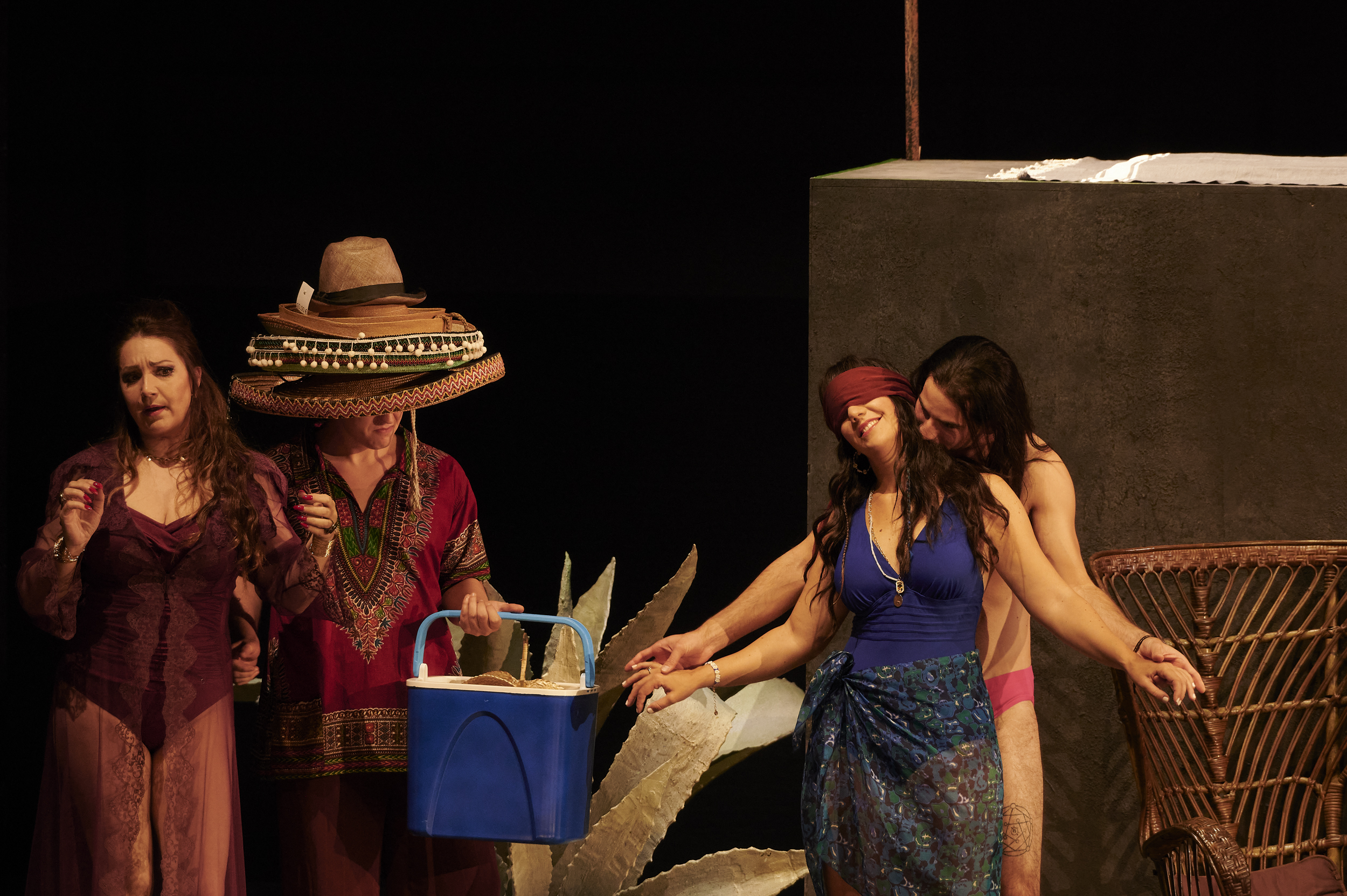
As for Huguet’s staging, it made some creditable efforts to connect with what we had seen before, but alternating as they did between vague and specific, without much in the way of rhyme or reason, it was difficult to know what to make of them. It seemed to be set in the present, the baritonal-heroic baton passed slightly awkwardly from Guglielmo to the Count to Don Giovanni. Leporello likewise seemed to be picking up from Figaro and Donna Elvira from the Countess. Whether they were intended to be the same people a generation on, or simply to be read with reference to what had gone before was never clear. On the one hand, there were clear references; on the other, much seemed not to make sense at all when one followed them through. Giovanni was a photographer, or was credited as such, though it seemed to be Leporello who took the photographs—of his master’s conquests, of course. Displayed on a tablet, projected onto a screen for the Catalogue Aria, the similarity of their subjects, without exception young, slim, and conventionally good-looking (see also Così) was markedly at odds with the variety of which Leporello sang. Whether this were a deliberate mismatch or mere carelessness was unclear; to be honest, it become difficult to care very much.


Why Elvira briefly became a politician/dignitary, handing Giovanni a prize for his retrospective during the first-act finale, I have no idea; at any rate, she took her wig off—or did she put it back on?—and that line of transformation abruptly closed. I wondered whether there was also a hint at Don Ottavio and Donna Anna reincarnating Ferrando and Dorabella, but perhaps not. A strange gap at the end of the first scene, entirely halting the action for a less-than-necessary scene change, did not do wonders for continuity; perhaps it was a metaphor. Don Giovanni's brief appearance in a coffin, which first I thought was a bath (!) might have seemed suggestive, but it was simply part of an unconvinving move, for no evident reason, to a chapel of rest. And why he, supposedly dead (straightforwardly murdered here) stood in the wings to watch the scena ultima was never clear either. Perhaps he too was trying to work out whether there had been any meaning to what had just unfolded. (In the programme, Huguet says that the hero died, merely adding to the confusion.) There was little, if anything, in the way of social differentiation, let alone of sin and punishment (that despite the Commendatore suddenly, arbitrarily, becoming a courtroom judge). One might have wondered why Mozart and Da Ponte bothered. 

Singing was mostly admirable, though it cannot be said that the production afforded singers much in the way of inspiration. Michael Volle is ever a consummate professional; and so he was here, fully in command of the title role and its demands. Riccardo Fassi’s agile Leporello provided vocal complement and contrast, differently dark in hue. Slávka Zámečníková and Bogdan Volkov perhaps lacked a little in dramatic stage presence, but that was as much a matter of the production as anything else. Guggeis might have drawn out the seria distinction of their parts more strongly, but again that would not necessarily have made much sense, given what unfolded (or did not) onstage. They sang well, at any rate, as did Elsa Dresig in a welcome return as a volatile Donna Elvira. If Peter Rose were on occasion slightly woolly as the Commendatore, David Oštrek and Serena Sáenz offered a winningly straightforward peasant couple, physical and vocal selves as one. If an air of missed opportunity proved impossible to dispel, responsibility lay squarely with the production.


Friday, 15 April 2022

Berlin Festtage (4): Così fan tutte, Staatsoper Unter den Linden, 14 April 2022


Fiordiligi – Evelin Novak
Dorabella – Marina Viotti
Guglielmo – Gyula Orendt
Ferrando – Bogdan Volkov
Despina – Barbara Frittoli
Don Alfonso – Lucio Gallo

Vincent Huguet (director)
Aurélie Maestre (set designs)
Clémence Pernoud (costumes)
Irene Selka (lighting)
Louis Geisler (dramaturgy)  

Staatsopernchor Berlin (chorus master: Martin Wright)
Staatskapelle Berlin
Giuseppe Mentuccia (conductor)


Images: Matthias Baus
Don Alfonso (Lucio Gallo) and Guglielmo (Gyula Orendt)


From The Marriage of Figaro to Così fan tutte: the first to the last of Mozart’s Da Ponte operas; or, with Vincent Huguet, from the second to the first in his ‘trilogy’. The setting suggested this, I suppose, moving back from the 1980s to the late 1960s, though that in itself assumes a unity one might not otherwise discern (or guess). Guglielmo, apparently, becomes Count Almaviva—and, after that, Don Giovanni. In Così and Figaro, he is sung by the same artist, at least, Gyula Orendt, though Michael Volle is due to take over in Don Giovanni. Beyond that, though, I found little indication of what might well be an interesting standpoint to take onstage. One can read this in the programme, of course, as I did afterwards, though what if one has not bought one? Should there not be some stage indication of this situation? We learn other oddities of Huguet’s conception in the programme too, for instance that Don Alfonso and Despina are married. I am not sure what light that shed on anything, but it was in any case not apparent to me. 

I think I can see why someone might opt for a ‘flower power’ setting. Ultimately, one can set this opera anywhere or nowhere, with little in the way of loss, so long as one has some underlying, convincing idea to what one is doing. But the point—Mozart’s, still more than Da Ponte’s—seems to have been missed entirely, with something frankly weak and uninspiring put in its place. (I confess that I had to read the programme and watch a short video even to get that far, but perhaps I am just especially slow.) Apparently what happens is that Alfonso and Despina meet another couple of couples, ‘from, let’s say, Milano’ who are intending to marry, and decide to show them a few home truths by having them lighten up a bit. Fine, so far as it goes, but ‘you can have a lot of problems and it is never that bad’. Really? Is not the agonising truth of this work, in all its exquisite sadomasochism, that it really is ‘that bad’, actually worse, and that you—we—must somehow live in knowledge of that devastation? We have eaten the apple; we are fallen creatures; more to the point, we are going to keep on falling, keep on hurting, even killing, each other. It is an opera made for Schopenhauer, save that it is still clearer-eyed. Of the philosophical, let alone religious, truths at the work’s heart—this is surely a ‘Passion of passion’, to quote Michael Tanner on Tristan—there is little or nothing. ‘Always look on the bright side of life’ is a message of sorts, I suppose, though ultimately, however much (or little) one dresses it up with a smattering of Foucault, it does not really extend beyond the realm of the self-help book. 

That, however, seems largely beyond the point, given how difficult it is (at least it was for me) to deduce any of it from what we actually see. We simply have the time-change, a move for a while to what appears to be a yacht, the inevitable silly dancing and other tomfoolery, smoking of what appears to be marijuana, and some random extras engaging in what sometimes, but not that often, approaches soft porn. Two of them massage members of the cast for a while, again to no evident reason. Everyone is conventionally good-looking and everything is surprisingly heterosexual, any engagement between women remaining clearly for the benefit of the man watching or participating. I could not help but notice that a few more elderly men in the audience were audibly excited by female nudity; one even managed to wake from his intermittent snoozing to exclaim something whose meaning I mercifully could not quite discern. If this is sexual liberation, some serious repression would be in order, if only to prevent participants expiring from sheer boredom. That may be a point worth making, though it seemed to arise by accident rather than design.


Despina (Barbara Frittoli), Dorabella (Marina Viotti), and extras
 

Daniel Barenboim should have conducted, but has had to take time off to recover from illness. In his place, at very short notice, was his assistant Giuseppe Mentuccia. It is difficult to tell much of Mentuccia’s own vision of the work from such a ‘jump in’, given that he would essentially have had to conduct Barenboim’s Così, perhaps with the odd inflection when he can. There were a few hints that he may have preferred swifter tempi at times, yet for the most part he fulfilled his duties very well indeed, the Staatskapelle Berlin sounding gorgeous and fully involved throughout. I look forward to hearing more of Mentuccia on his own terms. 

Orendt impressed once more, if anything still more so than as the Count. His dark, virile baritone was well complemented by Bogdan Volkov’s sweet-voiced tenor, ardent and imploring as required, as Ferrando. The latter’s duet with Evelin Novak’s Fiordiligi was a particular vocal (and orchestral) highlight for me. Fiordiiligi’s journey, traced in finest Egyptian vocal cotton, was throughout as involving as Huguet’s banalities permitted. I was less sure about Marina Viotti’s contrasting Dorabella, though concluded that to be more a matter of taste than anything else, her degree of forthrightness in, say, ‘E amore un ladroncello’, a valid interpretative choice (if not necessarily mine). Lucio Gallo made for an effortlessly stylish, verbally acute Don Alfonso. Barbara Frittoli shared the same virtues and offered a welcome change as voice of experience rather than irritating soubrette. She felt no need to resort to silly voices for Despina’s other ‘characters’, employing subtler transformations of tone and colour. 

The cast throughout worked very well together, though I could not help but wish they had been put to use in a more interesting, even challenging, production. Memories of Hans Neuenfels in my first Così continue to die hard, though there have been many alternative options since. Incidentally, on what does Huguet base his claim that the three Mozart-Da Ponte operas are ‘the most-performed operas worldwide’? They have not been in any statistics I have seen; indeed, not one of them falls into the top three, so far as I am aware. I should be astonished, though heartened, if Così came into the top ten. It is certainly among the least understood, though Don Giovanni must come close, and even Figaro’s more profound meaning seems to elude most.


Sunday, 10 April 2022

Berlin Festtage (3): Le nozze di Figaro, Staatsoper Unter den Linden, 9 April 2022


Count Almaviva – Gyula Orendt
Countess Almaviva – Elsa Dreisig
Susanna – Regula Mühlemann
Figaro – Peter Kellner
Cherubino – Marina Viotti
Marcellina – Waltraud Meier
Basilio – Stephan Rügamer
Don Curzio – Siegfried Jerusalem
Bartolo – Peter Rose
Antonio – David Oštrek
Barbarina – Liubov Medvedeva
Harpsichordist – Lorenzo Di Toro

Vincent Huguet (director)
Aurélie Maestre (set designs)
Clémence Pernoud (costumes)
Irene Selka (lighting)
Thomas Wilhelm (choreography)
Louis Geilser (dramaturgy)

Staatsopernchor Berlin (chorus master: Martin Wright)
Staatskapelle Berlin
Daniel Barenboim (conductor)


Countess Almaviva (Elsa Dreisig)
Image: Matthias Baus

Of the three Mozart-Da Ponte arias, The Marriage of Figaro used to seem relatively director-proof. Don Giovanni was the notorious directors’ graveyard, with Così fan tutte somewhere in between. Figaro is not the only one dramatically beholden to an ancien regime society of orders; Don Giovanni is too, though the element of mythology offers other possibilities. In Così, whilst there are important inflections in that respect, they are less crucial. That makes transferral to another setting more difficult than many seem to think, at least unless they are simply going to jettison much of Mozart and Da Ponte altogether. (Yes, ‘at least’ is doing more work than it should there.) It can work—very well in some cases, ranging from Janet Suzman’s pre-revolutionary Cuba to Claus Guth’s exceptional reimagining after Strindberg. It needs thought, though, and application. Alas, chez Vincent Huguet, who to the apparent bewilderment of the entire operatic world has been awarded new productions of all three operas, lack of reflection and sheer laziness seem to have been the order of the day.

One can find germs, relatively well-concealed, of a few basic ideas in Huguet’s programme note. Estimably, he wanted to treat the works as a trilogy, albeit in eccentric order: Così, Figaro, Don Giovanni. We shall see, I suppose; I have been known to recant before, and shall do so happily if necessary. However, beyond name-checking of a few very predictable Francophone names—Foucault, Houellebecq—even that note has little to say; moreover, its connection to the vacuous goings on witnessed onstage remained obscure. The first act seemed to take place at a health club. That permitted an extraordinary display, in which praise could not be high enough for Peter Kellner (Figaro) and Regula Mühlemann (Susanna), of their opening duet being sung whilst doing press-ups. To what end, who knows? That idea, if one may call it that, was soon dropped, after Figaro dressed and the gym surface appeared to become a kitchen counter, on which he prepared some food. To what end, who knows? Thereafter, we moved from there completely, the Countess being revealed as a faded 1980s recording artist, painted by Andy Warhol. The outlandish tastelessness—yes, a quality we all summon to mind when considering the Countess—of her quarters, enhanced by a personal harpsichordist, suddenly onstage (to what end…?) and then by a giant stuffed leopard (or was that perhaps the Count’s? a sense of place became at best unclear…) might have had some implications, I suppose. One might simply have said this was akin to the Trumps, and celebrated a Peter Sellars Trump Tower reunion. Needless to say, no one did, and we moved on to the next sequence of non sequiturs.

It is not worth cataloguing them all, even if I could remember them, but the weird appearance of people with animal heads in the fourth act, two of them taking Figaro’s shirt off, may have had some significance. It probably did not, though, other than giving those who wished an opportunity to see a shirtless Figaro. At the very close, the Count and Countess continued to fight—not necessarily a bad idea—and, out of nowhere, Cherubino ran towards his adversary, hit him, and ran off with the Countess. Thomas Wilhelm’s choreography seemed limited to a brief fitness display from a few unidentified people at the opening and the usual—in this tired ‘dramatic’ world—generic disco dancing at the end of Act III. Immediately prior to that, Huguet’s ‘response’ to Mozart’s exquisitely crafted ballet music was to have the Count and Countess sit on a sofa, the former tickle the latter with a large flower at tedious, apparently amusing, length, and then leap on top of her. It takes all sorts, I suppose, but sometimes I wish it would not. Perhaps we should have been better off if, according to Joseph II’s initial edict, it had been struck out after all; Mozart certainly would have been.

What made this waste of everyone’s time so heartbreaking was the thoroughgoing excellence of the musical performances. For them, and them alone, it is worth anyone’s time and money to attend, though I cannot have been the only person desperately wishing this had been a concert performance—or, dare I say it, a ‘traditional’ staging set when and where it ‘should’ have been. Daniel Barenboim has been conducting this work since the mid-1970s and shows no signs of tiring; rather, the wisdom of experience, of Mozart as composer and dramatist, and of so many others, informs every bar, whilst weighing feather-light. To hear Barenboim conduct Figaro is an experience of stature similar to hearing Colin Davis do so, though their paths are of course distinct. Not even the Vienna Philharmonic would sound indubitably superior to the Staatskapelle Berlin here; they and Barenboim know what to expect from one another and can therefore play with expectations in the moment (an unfortunate bassoon disappearance in the Overture notwithstanding). Golden strings, heavenly woodwind, the entire ensemble up (down?) to and including first-rate timpani: all responded to each other, as if a large chamber ensemble, as well as to Barenboim’s vision. 

In recitativo accompagnato, the strings ‘spoke’ with a vividness such as is called for in Gluck, or even Wagner, though of course a language that is subtly—or greatly—different. Those moments had me wish Barenboim would expand the circle of his Mozart’s operas to include Idomeneo; but that does not, sadly, seem to be on the cards, a postponed new production allotted instead to Simon Rattle. What strikes still more uncommonly in Barenboim’s case, though, is his strategic long-term thinking and hearing. As if this were a giant symphony, he knows the work’s structure and how to communicate it as form in ‘real time’. Conducting from memory liberates, so it seems. This, after all, is a conductor who leads Tristan without a score. In other circumstances, I would lament the ‘traditional’ fourth-act cuts, but it was probably the right decision on Planet Huguet. 

What a cast, too. Gyula Orendt’s Count Almaviva was dark, threatening, and seductive of tone. Leaving aside Huguet’s trashy vulgarity, Elsa Dreisig’s Countess poised and benevolent Countess was straightforwardly one of the finest I have heard. Her collaboration with Barenboim and the orchestra in ‘Porgi amor’, voice and instruments responding to each other’s shifts in colour offered a masterclass in outstanding Mozart performance. One would never have known Kellner, keenly matched by Mühlemann, was a last minute substitute for Riccardo Fassi; indeed, one might have thought the performance built around him. His was, by any standards, an heroic undertaking, again gloriously seductive and as agile as he showed himself in the opening fitness class. Marina Viotti’s Cherubino was finely, instrumentally coloured, though done no favours by Huguet’s confused and confusing direction of her scenes. (One had to know, really.) Waltraud Meier, yes Waltraud Meier, showed she can still act—and how—as Marcellina, also clearly relishing verbal meaning and implications in her recitatives. Siegfried Jerusalem (!) had little to do as Don Curzio, but did it with uncanny excellence. Peter Rose at times threatened to steal the show as an uncommonly distinguished Bartolo. Everything was there, then, not least a fine sense of company, save for an intelligent or even vaguely coherent staging.