Showing posts with label Southbank Centre. Show all posts

Friday, 24 April 2026

RPO/Petrenko - Messiaen, 23 April 2026


Royal Festival Hall

Turangalîla-Symphonie

Steven Osborne (piano)
Cécile Lartigau (ondes Martenot)
1927 Studios (animation)
Royal Philharmonic Orchestra
Vasily Petrenko (conductor)


Images: Andy Paradise

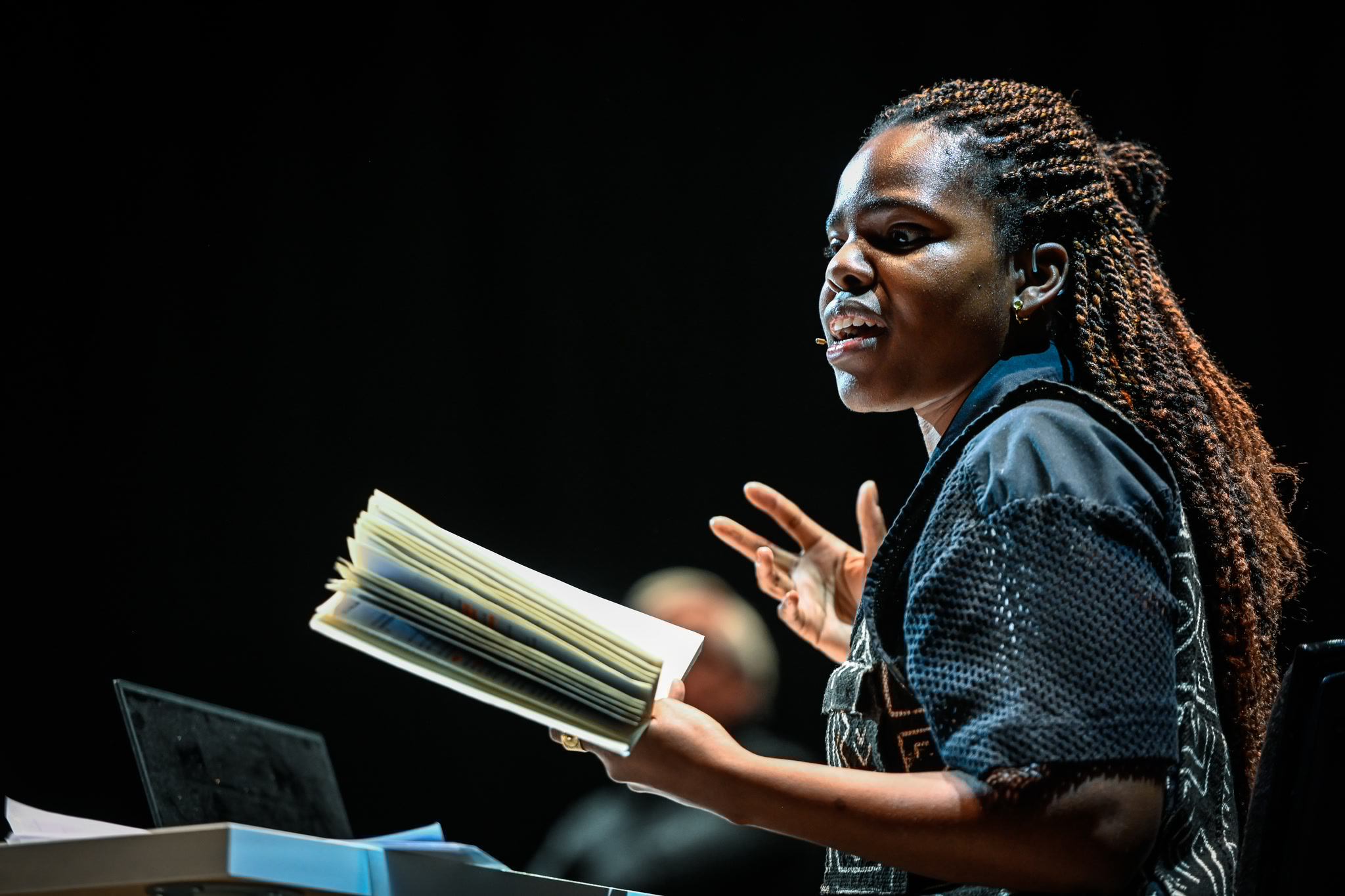
Messiaen was never one to do things by halves. We might think his Turangalîla-Symphonie offered enough in sensory overload without adding further to it; we might have good reason for doing so. Yet, for one night only, in the particular setting of the Southbank Centre’s Multitudes ‘multi-arts festival powered by orchestral music’, it gained – doing things by doubles rather than halves, one might say – a silent film and narrative from 1927 Studios. Their work may be familiar from a Magic Flute and Petrushka/L’Enfant et les sortilèges double-bill for Berlin’s Komische Oper during its Barrie Kosky years; it is inventive, witty, and absorbing. Here, a film engaging with some varieties of ‘love’ – ‘whatever that means’, as once upon a time a prince might have said – accompanied or, perhaps, was accompanied by a performance of Messiaen’s irresistible, outrageous exploration of still more of those varieties, from the human physical to that of the universe itself (in whatever sense you can imagine). 

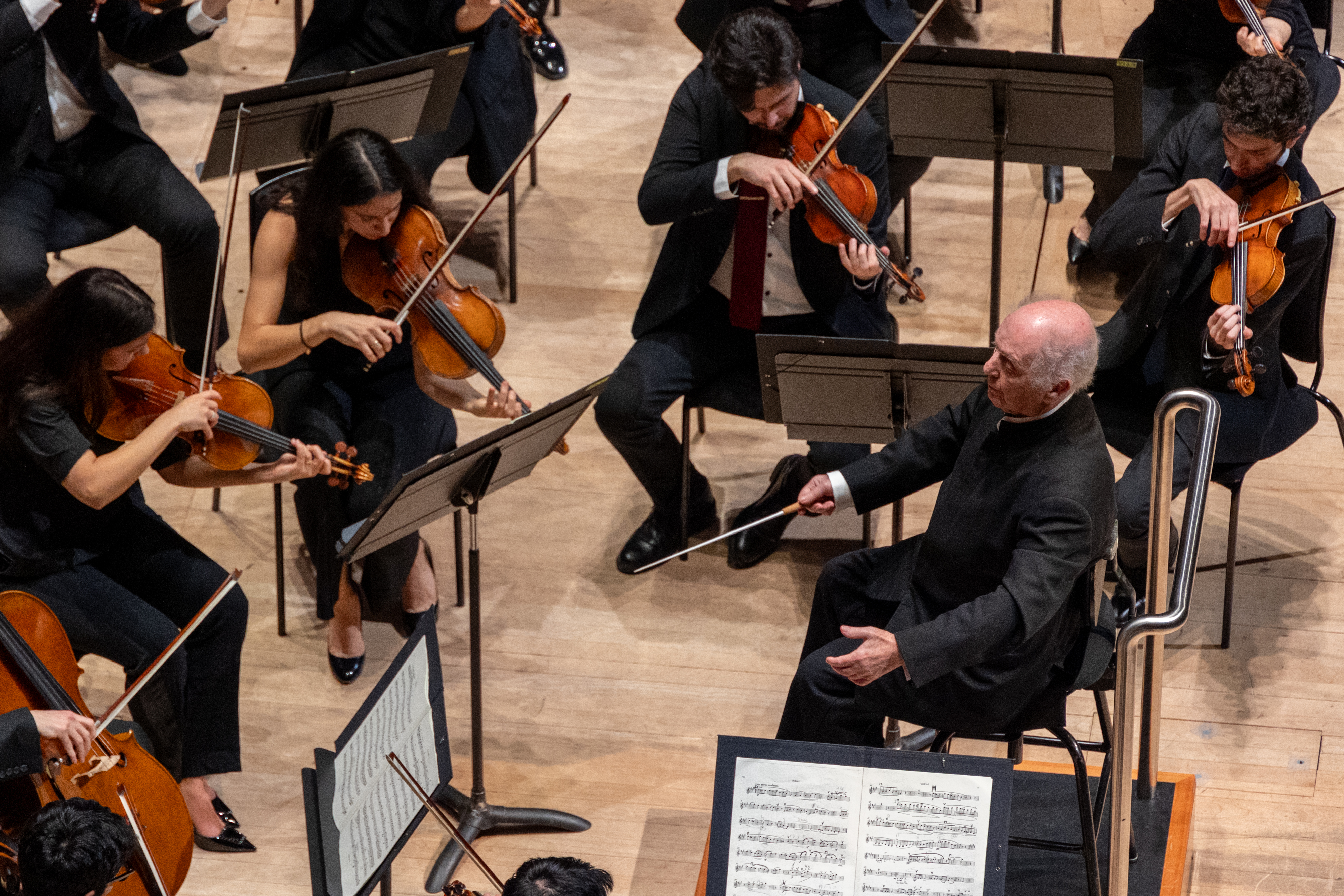
As the film, beautifully, intricately put together and acted, starring Jake Cecil as a dashing Tristan-ish knight and Esme Appleton as his tragic, Isolde-like bride, unfolded, so did its soundtrack ‘live’. Of course, that has problems from a purely musical perspective. I began to feel guilty about the lack of attention, or perhaps better the divided attention, I was according the performance ‘itself’. But would I feel that if it were an opera? (There is an LPO Wozzeck to come this weekend, though I shall not be attending.) Does it matter? The two did not merely mirror or follow one another, but for the most part they complemented. And when I decided to focus my visual gaze on the Royal Philharmonic Orchestra and Vasily Petrenko, I could still do so and hear what was a fine, tautly conceived and executed Festival Hall performance. 


Petrenko, moreover, gave a well-judged, engaging spoken introduction to the event, as well as making a knowing, winking cameo as the wedding’s music director on film. Messiaen in any case, was still very much there, in all his multicoloured, synaesthetic, infectious craziness. No one will have failed to feel the motor rhythms, the repetitions and variations of figures, the confrontations between different conceptions of time, nor have been seduced by the array and interaction of harmonic and timbral colour—whether from the RPO, Steven Osborne’s titanic, all-encompassing interpretation (this was no mere execution) of the piano part, or the soaring presence of Cécile Lartigau’s ondes mardenot. There were passages of extraordinary magic, the cool blue and hue lingering glances at sleeping bodies in the ‘Jardin du sommeil d’amour’ finding music and animation in perfect complement. The crazy flower-(power)-love of the preceding ‘Joie du sang des étoiles’ may never quite be the same again, though whenever is it? No artwork stands still in a world of performance; nor should it. This was a journey to the cosmic such as one could imagine Stockhausen dreaming, albeit with a little – just a little – more self-control. 


Messiaen doubled, then, or halved? Both are a little extreme as perspectives. Having seen and heard Turangalîla like that, I should probably rather do so on its own, ‘neat’, next time. (Or perhaps, I should rather have done that first, ‘progressing’ to the ‘augmented reality’ of this evening’s show.) No one, however, is claiming that I should do otherwise. This was, by its nature, a one-off, even if it finds itself repeated elsewhere—as I suspect it will be (and probably should). I loved the Stravinsky-Ravel double-bill nine years ago, whilst feeling circumspect about the Magic Flute than many. Nothing will be for everyone; more to the point, works will always survive and usually grow from such encounters. So, we should hope, will audiences. This was not simply an outreach exercise, but a fascinating experiment in its own right; if it has worked as the former too, we shall all be the better for it.


Sunday, 8 February 2026

Idrīsî Ensemble/Fournil: Troubadour songs, etc., 6 February 2026


Queen Elizabeth Hall


Grigor Natekatsi: Հավիկ մի պայծառ (Havik mi paydzar)
Mkhitar Ayrivanetsi: Սիրտ իմ սասանի (Sirt im sasani)
Comtessa de Dia/Bernart de Ventadorn, arr. Marti de Riquer: Ab joi et ab joven
Azalaïs de Porcairagues/Guiraut Riquier, arr. Thomas Fournil: Ar em al freg temps vengut
Troubadour motet: S’on me regarde
Trad. Epirus: Αλησμονώ και χαίρομαι (Alismonό kai chaíromai)
Anon./Guiraut de Borneth, arr. Fournil: En un vergier
Trad. Corsican: Stabat mater
Syriac chant: ܪ ܰܡܰܐܺܢܺ ̣ ܘ̣ ܰ ܬܰ (Taw nīmar)
Old Roman chant: Alleluia ‘Deute galliasometha’
Comtessa de Dia/Raimon de Miravai: Estat ai en greu cossirier
Anon.: Trois serors sor rive mer
Thomas Fournil/trad. Corsican: Dieus sal la terra
Sanʿa of Algiers: راسرم يرَ يَّوط (Tuwayyarī al-Masrār)
Comtessa de Dia: A chantar
Ponç d’Ortafà: Si ay perdut
Trad. Corsican: Kyrie

Idrīsî Ensemble
Thomas Fournil (director)


On yet another dismal, dark, and rainy night, scholar-performer Thomas Fournil and his Idrīsî Ensemble transformed the Queen Elizabeth Hall acoustically, scenically, and musically into a venue for a wide-ranging programme of mediaeval music. Focused on, yet far from limited to, some of the few surviving melodies that can confidently be attributed to trobairitz, that is female troubadours, it radiated outwards in various directions: to other troubadour songs; to related practices; to sacred music from twelfth- and thirteenth-century Occitania; to the music of other groups, marginalised in various ways; and across the Mediterranean world to take in Old Roman and Syriac chant, traditional music from Epirus; and, to begin with, a tenth-century Armenian poem by Gregor Narekatsim, set to a mediaeval melody transcribed by Robert At’ayan. 

Whether solo song or ensemble singing, accompanied or, very rarely, unaccompanied, a new – old, but also necessarily new – world was created before our eyes and ears. Musical building blocks, poetic themes, methods of music making all old and new, likewise often simultaneously, gave each of us, all coming from slightly or radically different musical and broader cultural backgrounds, points of reference, departure, and arrival. Women’s voices came to the foreground, even in repertoire traditionally and probably historically reserved for men. Something akin to a varied continuo group, however anachronistic the notion, helped lead, ground, and fantasised, but so did words, notions, and fantasies. Frankly erotic texts, musical as well as poetic, took in sacred and secular, but so did themes of nature, of belonging, of land, of identity in multiple, as we might now say intersectional, fashion. A previously unrecorded Old Roman (pre-Gregorian) Allleluia, a walk in a garden of delights, a heart’s trembling at Judas’s deeds, three sisters on a seashore, and more came to life through monody, microtones, something akin to close harmony, movement, and an instrumental ensemble including portative organ, vielles, kaval, ney, kanun, and kanjira. 

Much of this music and its performance is intrinsically political. How could it not be, with origins in struggles of gender, religion, ethnicity, and of course land? Minoritisation, persecution, and war from the time of writing have both much in common and much that is different from today. Having endured live-streamed genocide for more than two years now – never forgetting those who have lost lives, families, all hope in that genocide – the world is traumatised in a way that seems unusual even by historical standards. In many ways, it is, but we are also reminded of resources, witness, on which we can draw from those who learned (and failed to learn) lessons many centuries before us: the struggles of peoples to remain on their land and, indeed, to resist outright extermination. It was a clear, clear-sighted statement of solidarity in context. As one of the ensemble members said to overwhelming applause, introducing the old Occitan ‘Dieus sal la terra’, imagined by Fournil as mediaevalist, performer, and composers: ‘We stand with Palestine.’ 

That naturally made a great impression, yet so did much else. The third song of the Comtessa de Dia (Countess of Die), A chanter, in which a lover spurned and betrayed continues to believe in and praise herself, is the only trobairitz song to survive with music fully intact. ‘My rank and lineage,’ in Fournil’s translation, ‘should be of help to me, and my beauty and, still more, my true heart: this song, let it be my messenger.’ It was no mere tragedy or defiance, though; it was a statement and exploration of womanhood. A Corsican Stabat mater told a familiar story yet in both older and newer setting: for one thing, this was new, not old, verse ‘then’. Collaboration to reveal a single performing voice and yet many pointed to something essential about the evening. The harmonic, textural richness of a traditional Corsican Kyrie not only confounded but warmed and thrilled: paghjella of then and now, mediated by oral tradition. It was a varied, eventful journey that turned us into musical wayfarers and troubadours, trobairitz. If it could not, should not rid us of our particular standpoints, it suggested a little of what might lie beyond our cultural, even aural gazes: as Fournil pointed out in an excellent programme note, northern as well as gendered. 

Cavils? It was, I think, a pity that, although we were given texts and translations, the auditorium was too dark to read them, there being no alternative in the form of titles. For the second half, I spent part of the interval reading the texts to come so as to prepare a little; that certainly helped. But I was literally in the dark for the first, which matters in a form for which words, meaning, and multiple unfamiliar languages matter. At the first half’s close, the Stabat mater offered a welcome exception, but also reflection on what I had missed earlier. Whilst I can understand the reluctance to distract, even by spoken introduction, they certainly helped when we had them. In such ignorance, one can as listener fall all the more prey to facile exoticism. These are trade-offs, though, and it is always interesting to glean sense and sensuality by other mean. Otherwise, though, this was a wonderful introduction to a world that continues, as it vanishes, to beckon.


Friday, 14 November 2025

Philharmonia/Hrůša - Mahler, 13 November 2025


Royal Festival Hall

Symphony no.7

Philharmonia Orchestra
Jakub Hrúša  (conductor)


A little light relief here for Jakub Hrúša, in between Covent Garden performances of The Makropulos Case. That Mahler and Janáček should sound very different will hardly surprise, though the distance between Kalischt and Hukvaldy is not necessarily so great, even in compositional terms. There has long been something – have been some things, for let us not essentialise – special about the ears many Czech musicians bring to Mahler; one has only to think of Rafael Kubelík, let alone the Czech Philharmonic. Hrúša’s way with Mahler is different, indeed different from any I can recall hearing, yet full of interest and created with a collaborative determination that knows not only what it wants but how to get it. The Philharmonia must also, of course, be credited with that accomplishment. Most successful readings of the Seventh Symphony, at least in my experience, tend to rest on bringing coherence to what, rightly or wrongly, many find a tendency that pulls in the opposite direction. Highly contrasting examples would be Daniel Barenboim’s surprising – and surprisingly successful – treatment of the work in dark, post-Brahms fashion and Pierre Boulez’s more brazenly modernist, yet no less steely command of line, timbre on equal terms with rhythm and harmony. A reading that was merely incoherent would be little more than that. One that revelled in rather than attempted to solve its enigmas, perhaps with more than one might expect of Boulez’s musical hindsight, yet imbued with other varieties of its own, was what we heard here: crazier than Barenboim, arguably more so than Boulez too, and more theological to my mind’s ear than, say, the quite different house-of-horrors readings of Leonard Bernstein. 

The opening of the first movement already signalled something intriguingly different. Slow in tempo yet febrile, it drew one in, brass vibrato somewhat Slavic, and more generally dark in orchestral tone (definitely more Barenboim than Boulez—or Bernstein, for that matter). Here, it seemed was an extended fin-de-siècle orchestra experiencing twentieth-century hallucinations that, over the course of the symphony as a whole, would increasingly wrest control from a fast-vanishing past. Basic tempo firmly established, deviation, be it early flexibility or later abrupt change, registered in relation to that; much the same could be said for the whole symphony. The performance’s spirit compelled too: marionettes from the earlier ‘Rückert’ symphonies danced, yet abstracted, even automated, harbingers of a future that might not be desired, but could not be averted. The ‘world’ of a Mahler symphony – think of his celebrated exchange with Sibelius – has many mansions, historical, geographical, and otherwise. Unusually prominent at times, to my ears anyway, were premonitions not of the over-invoked Shostakovich, but of his more interesting compatriot, Prokofiev, lying in a future somewhere between The Fiery Angel and Cinderella. Wind tattoos functioned likewise, provoking if anything still greater unease. In more ‘traditional’ vein, vistas I might foolishly have imagined might no longer astonish me still did, the aural lens stretched a little or more than a little at times, testing yet never abandoning overall coherence, whether in rapt, near-suspended animation at the close of the development or something more furious in a recapitulation of depth and breadth. 

The first Nachtmusik’s opening horn calls have been delivered more flawlessly, but so what? The sense was there. (I mention this only because Beckmessers may otherwise assume I did not notice.) More to the point, they initiated a sardonic, Nietzschean serenade on the cusp of the nihilist and the diabolical, subjectively ambiguous and the more powerful for it. Lyrical cellos suggested a world all the more alienated as a result. Cowbells on- and offstage sounded a desiccated memory of their presence in the Sixth Symphony. Dances were swung, yet with knowledge of what was to come: a Weill future already, disturbingly present. The Second Symphony’s faithful were despatched to purgatory, or worse. Aufersteh’n? If you say so, but not only Klopstock was dead. The Scherzo seemed firmly rooted in that other place. It snarled in defiantly post-Nietzsche fashion, even as it (aptly) danced. Zarathustra’s realm, hell, purgatory, or somewhere else? Why choose? Except it did, the Devil’s lair increasingly apparent: no monolith, but all the more frightening for its variegation. Perhaps – shudder – this hell was our earth. There was to be heard a distinctly Schoenbergian rage, disciplined by remnants of Prokofiev’s motor-rhythms, particularly when one peered between the cracks. 

More strange bedfellows were encountered in the second Nachtmusik, Adagietto strings taking a walk on the wild side, joined by guitar, mandolin, and the rest, to pass the Eighth Symphony, even Pierrot, to the unmistakeable world of Schoenberg’s Serenade and contemporary Webern. An orchestra (in large part, or so it sounded) of soloists tended to parody, in a world that had nothing left to parody, that strong initial grounding of the symphony’s opening as crucial as ever. Music appeared to pose a theological conundrum Mahler’s St Anthony might have blanched at: one for the fish, perhaps. And so, to the finale, to ask further unanswered, unanswerable questions. It blared and blazed, sang and danced, tracing a path between old and new that transformed before our ears. It was not the last word, nor did it try to be; indeed, its modernity lay in its provisionality, exhausted and exhausting, yet exhilarating in a restored radicalism whose nods to Mozart and Wagner did anything but clarify. It ate itself as it laughed (or mocked). Nietzsche or nihilist? Again, why choose? Angels on acid or devils on ambrosia? Perhaps they were instead on horseback. The Wunderhorn St Martha may not be the cook after all.               


Sunday, 12 October 2025

Barenboim/Nouno - Boulez, Attahir, Manoury, Chaker, and Roustom, 12 October 2025


Purcell Room

Boulez: Anthèmes 1
Benjamin Attahir: Retour à Tipasa
Philippe Manoury: Partita II
Layale Chaker: Before bloom
Kareem Roustom: Pavane (pour les enfantes défuntes) (UK premiere)
Boulez: Anthèmes 2

Michael Barenboim (violin, viola)
Gilbert Nouno (live electronics)


Michael Barenboim’s Sunday afternoon Purcell Room concert, given with Gilbert Nouno, offered not only a welcome new standpoint to the Boulez centenary celebrations, but also the United Kingdom premiere of Kareem Roustom’s Pavane (pour les enfantes défuntes), for viola and live electronics, Barenboim’s own commission for ‘something for the children of Gaza’. Words, music, money, anything at all may seem hopelessly insufficient in the face of genocide, and of course they are. That does not mean, though, that we should not bear witness as we can. Schoenberg’s A Survivor from Warsaw does not efface, let alone undo, what was done, nor does it intend to. Extending his father’s humanitarianism and indeed as much in the tradition of Edward Said, co-founder of the West-Eastern Divan Orchestra, Michael Barenboim, the orchestra’s longstanding concertmaster, has consistently shown great courage in doing so in the face of implacable opposition from German media and the German state. Indeed, to have given the work’s world premiere in Berlin just under a year ago, in the rare friendly space of the city’s Pierre Boulez Saal, was itself an act of witness. 

An opening cry, far from histrionics, yet all the more powerful for it, spoke of something more fundamental—in more than one sense. Roustom’s piece takes its leave, of course, from Ravel’s Pavane pour une infante défunte, and specifically the absurdism of its title, an absurdism we have seen and heard, via Beckett and the debris of post-Holocaust art, inflicted on children in Gaza and beyond. Neither overtly representational nor overtly abstract, its hope in some sense to speak, perhaps to sing, despite and through trauma seemed woven into both piece and performance, as well as to our necessary reactions. That it ultimately approached Ravel and his piece themselves, without the slightest incongruence, itself seemed both absurd and necessary, electronics creating a strange piano echo of their own.   

In a carefully planned programme, this Pavane stood as a counterpart to the first-half Retour á Tipasa for violin and electronics, by Boulez pupil (at the Lucerne Festival Academy) Benjamin Attahir, also following on meaningfully from Layale Chaker’s Before a bloom for solo viola. Both works bridged, like Roustom’s, ‘East’ and ‘West’, not in a banal cross- or inter-culturalism, but as a natural form of expression. The opening éclat – that indispensable Boulezian quality – of Attahir’s work, a dazzling pizzicato figure, was immediately bathed, magnified, and transformed in dialogue with an electronic penumbra that offered more of a sense of aural landscape, though not only that, than Boulez would have been likely to consider. North African melodic and rhythmic inflections – to our ears, they may sound Scottish, but that is our problem – evoke or hail, again without mere representation, the Punic-Roman-Algerian port of Tipasa. Shifting relationships between solo instrument and electronics, as well as a clear, dramatic overall trajectory bore their own witness: not necessarily one to be put into words, but no less important for that. Likewise, in Chaker’s solo piece, whose pizzicato ‘accompaniment’ and solo arco line – it is more complicated than that, but perhaps not entirely – seemed to me strangely, expressively to echo the world of Bartók’s rhapsodies for violin and piano. Originally composed for cello, it showed no obvious sign of transcription, benefiting from rich, variegated viola playing and, again, unfailing sense of overall line. 

Philippe Manoury’s Partita II for violin and electronics came across as effortlessly – however much art conceals art – conceived for violin, electronics, and their joint capabilities: as ‘natural’ as Chopin writing for piano, or Mahler for orchestra. A magical realm of precision, consequence, and highly expressive potential and achievement radiated, Boulez-like, from the ‘solo’ instrument, although it is far from clear that  ‘influence’ or at least inspiration, may not have run as much in the opposite direction.  Both like and unlike a violin concerto, its nine stands’ worth of music was full of surprises that were anything but arbitrary, Barenboim’s virtuosity here as elsewhere so clearly in the service of the music one might readily overlook it—yet should not. 

Opening and closing the programme were Boulez’s own Anthèmes 1 and Anthèmes 2, the former for solo violin, the latter its expansion for violin and electronics. In both, Barenboim – and Boulez – made crystal clear from the outset the nature and contrasts of the musical material: the figure from his …explosante-fixe… ‘kit’, treated in almost sequential yet never predictable variation, and single notes of long duration. It was their story, told in illuminated style that recalled old ‘anthems’ on the acrostic Lamentations of Jeremiah, consecutive Hebrew letters beginning each verse. (Recall also Stravinsky’s Threni.) Performed with a keen, yet never remotely flashy sense of drama, the works’ structure became form before our eyes and ears. Serial-Bachian procedures redolent of the Musical Offering and Art of Fugue, especially in Anthèmes 2, evoked the instrument’s past and perhaps its future, proliferation pointing toward an apparent eternity. Musical rays shone outwards from the violin; at other times, the instrument sounded as if a single ray, albeit the brightest, from within a spectrum. This is not spectralist music, far from it, yet the distance may not prove so great as many of us may have thought. I was struck anew by surprisingly Messiaenesque harmony at its centre, by the singular use of electronics in ‘real time’, by the music’s multi-dimensionality. It felt as if the pages of Anthèmes 1 had been opened, their notes, numbers, metaphorical flowers turning to the sun—and then away from it, inspired, emboldened, given new life. There may or may not be hope, but there is still music.


Tuesday, 7 October 2025

London Sinfonietta/Benjamin - Boulez, 5 October 2025


Queen Elizabeth Hall

Mémoriale; …explosante-fixe…

Michael Cox (flute)
Royal Academy of Music Manson Ensemble
Sound Intermedia (sound projection)
London Sinfonietta
George Benjamin (conductor)

Pierre Boulez’s centenary celebrations are far from over. Here, the opening concert of the London Sinfonietta’s 2025-26 season presented the complex relationship between the 1985 Mémoriale, written in memory of flautist Laurence Beauregard, and …explosante-fixe…, initially a Stravinsky memorial, which both furnished material for Mémoriale and, in its final form, of 1993, written once technology permitted, in turn drew on the earlier (and later) work. 

First came the shorter Mémoriale (following an introduction to the composer in the Queen Elizabeth Hall foyer by Jonathan Cross and Gillian Moore). Knowing …explosante-fixe… better – also having heard it more recently, at this year’s Salzburg Festival – I immediately began to notice and reflect on the differences and points in common, perhaps most obviously that Mémoriale is very much a piece for solo flute and small ensemble, whereas the later work seems increasingly to derive its larger ensemble, not only electronics, from a flute at its physical and conceptual centre. It sounded akin to a flute concerto in miniature, Michael Cox here and later the expert soloist, euphonious, virtuosic, and much more. Boulezian proliferation was experienced as vividly as anyone might imagine, perhaps more so, surrounding, ornamenting, and in turn shaping an unmistakeable, almost Classical line at its centre, albeit very much haunted and inspired, like so much of Boulez’s music, by Debussy. 

There followed an enlightening discussion between Moore and, first Andrew Gerzso, with whom Boulez worked on the realisation of …explosante-fixe…, among other works, followed by George Benjamin, who would conduct the work this evening, armed with players of the London Sinfonietta and their side-by-side Royal Academy Manson Ensemble colleagues to illustrate with musical examples. Gerzso clearly explained Boulez’s dissatisfaction with earlier attempts to integrate acoustic and electronic music, needing ‘score-following’ technology such as he first heard in Philippe Manoury’s Jupiter, so as to avoid the players’ enslavement to the tape. Boulez’s longterm interest in music as commentary upon itself, multiphonics, the airiness of ‘Aeolian’ sounds, the importance of Paul Klee, and much more were rendered vividly comprehensible. Benjamin in turn attended to the work’s musical content and form, Boulez’s melismatic writing but one of many telling links between the two commentaries (as, one might say, in his composition too). 

For …explosante-fixe…, Cox was joined by co-soloists Karen Jones and Sofia Patterson Guttierez. Whether it was the particularity of performance, that particularity integral to Boulez’s use of electronics, the contextualisation afforded by prior discussion, or something else, much sounded strangely, if hardly surprisingly, post-Stravinskian, flute lines included. The Rite of Spring can rarely have seemed so present, so haunting. Benjamin imparted an urgency to the opening perhaps greater than I have previously heard, instigating a frenetic, delirious outpouring of sound. He soon relaxed, though, in a notably fluid reading, enabling éclat to transform itself into sensuality, both of course hallmarks of Boulez’s music. In composer, conductor, and players’ bending of time, rubato and performance seemed reborn before our ears. I was struck anew by the nerviness of some of the string writing and its proliferating consequences, but equally later by exquisite, frankly erotic longing. All manner of other detail emerged as if for the first time: perhaps, in some cases, it was. Electronics assumed their rightful role as another section, here almost in place of percussion though that need not be so, of the organism we know as the orchestra. In its three-movement form, the ‘modern classicism’ (Arnold Whittall) of this phase in Boulez’s career courted comparison with Mozart: a sinfonia concertante reimagined. The clarity Benjamin brought to the score would surely have impressed the composer himself. It was difficult also not to feel that melancholic, even elegiac quality to the close, as all returned to E-flat (Es/S for Stravinsky), might have moved him as it did us.


Saturday, 29 March 2025

Aimard - Ravel, 27 March 2025


Queen Elizabeth Hall

Jeux d’eau and Valses nobles et sentimentales (excerpts)
Le Tombeau de Couperin: ‘Prélude’, ‘Forlane’, ‘Toccata’
Miroirs: ‘Noctuelles’, ‘Alborada del gracioso’, ‘La Vallée des cloches’
Gaspard de la nuit

Pierre-Laurent Aimard (piano)
Mathieu Amalric (speaker)


Presented more as show than recital, it was nevertheless the musical elements of this Queen Elizabeth Hall celebration of Ravel that shone through. The conceit did no harm; for one thing, it was a welcome opportunity to see Mathieu Amalric on a London stage. He took the part of a friend of Pierre-Laurent Aimard, calling to collect him to travel to a recital Aimard would be giving. Whilst Aimard did some last-minute practice – or rather played around with other music by Ravel – Amalric read from material with which his friend had helped inform him and also filmed him. The script could have done with more work, to be honest, but it did not get in the way; the warmth of their collaboration was evident. 

And so, when the lights went down, the music began. Aimard’s selection of sheet music from the floor – we have all been there – and (very superior) busking through a few bars of Jeux d’eau, followed by excerpts from Valses nobles et sentimentales offered a winning amuse gueule, though naturally one wished to hear more, whilst retaining a sense of eavesdropping on practice. Then the doorbell rang: enter Amalric. He suggested that Aimard play the ‘Epilogue’, which served to cast a nostalgic shadow even over music we had not heard, lilt and voicing delectable. 

Other readings followed, interspersed with music: Ravel writing to his mother in 1916 with a wounded reproach that he had not heard from her, another letter from the same year on ‘active duty’ opposing ‘patriotic’ efforts to prohibit performances of enemy music, such as that of Schoenberg and Bartók. The three movements from Le Tombeau de Couperin certainly gained something from enhanced awareness of their wartime context, as did the three from Miroirs from a 1905 letter to Maurice Delage, its talk of ‘smelting castles’ and the ‘wonderful symphony’ of their sounds nice preparation for the beauty in precision of ‘Noctuelles’ as composition and performance. Talk from another source of the cliché of Ravel’s Spain as more real than the real thing could momentarily be believed, in the Lisztian virtuosity of ‘Alborado del gracioso’, not least its exultant close. The more mysterious, even mystical realm of ‘La Vallée des cloches’ gave a sense of French music to come, Messiaen, even Boulez, heard at a different aural temperature, which paved the way for Gaspard de la nuit. 

This was the concert ‘proper’, a performance that reminded me, among other things, how infrequently we hear this masterpiece. Why? Perhaps pianists still shy away from its demands, or only have it in their repertoire for a while. One can hardly blame them. At any rate, it was a treat from beginning to end chez Aimard. The unmistakeable shimmering of ‘Ondine’ registered with a freshness that, just maybe, had some roots in the novelty of presentation as well as in the excellent pianism and musicianship. Aimard’s wondrous spinning of a musical line, unfailingly eloquent, revelled in the Bösendorfer and its sound world. The terrifying yet somehow seductive insistence of ‘Le Gibet’ was heard at proper ‘temperature’ too, as if the myriad repeated notes throughout the evening had been leading here. ‘Scarbo’, his laughter and shadows, could be seen as well as heard, a still more fitting culmination with roots in all that had gone before. Had I not seen Aimard’s two hands with my own eyes, I might have sworn he had four.


Tuesday, 11 March 2025

London Sinfonietta/Kemp - Boulez and Cage, 9 March 2025


Purcell Room

Cage: Six Melodies
Boulez: Improvisé—pour le Dr. K
Cage: Credo in US
Boulez: Dérive 1
Boulez: Domaines
Cage: Variations I

Francesca Amewudah-Rivers (actor)
Michael McCarthy (director)

Mark van de Wiel (clarinet)
Sarah Nicolls (prepared piano)
London Sinfonietta
Thomas Kemp (conductor)


Images: Monika S Jakubowska


This London Sinfonietta concert, ‘innovative’ in the best rather than the debased, trivial way, framed performances of works by Pierre Boulez and John Cage with engaging readings from their correspondence by Francesca Amewudah-Rivers and short filmed contributions. It made for an enthralling and enjoyable evening at the Southbank Centre’s Purcell Room, precisely because the level of performance was so high, ‘additions’, though they were far more than that, genuinely complementing rather than substituting for musical excellence. It was a delight, moreover, to see a sold-out venue, once again giving the lie to claims that no one is interested in hearing this music. Many of us have a deep thirst for it; the only reason we do not go more often is a lack of opportunities to do so. Many do not, just as many do not like all manner of things, whether Mozart, Beethoven, the Beatles, or anything else; there is no reason to be dishonest and substitute one’s own preferences and interests for the voice of the world-spirit. And there is every reason to welcome an all-too-rare opportunity to hear, rather than simply talk about, this music, especially in so illuminating a juxtaposition, which offered great musical contrasts as well as points of mutual historical fascination. 

The first reading came not from the correspondence as such, although it is included in the Cambridge University Press Nattiez-Samuels edition as its first item. It was instead taken from Boulez’s 1949 spoken introduction – both manuscript and a rough draft are part of the Paul Sacher Stiftung – to the performance he helped organise of Cage’s Sonatas and Interludes for prepared piano, given at Suzanne Tézanas’s Paris salon. A brief filmed excerpt was juxtaposed with a live excerpt from Boulez’s own Second Piano Sonata of the previous year. Different worlds indeed, though the excerpted correspondence that followed suggested genuine interest in mutual exploration too, Boulez’s apology for sometimes writing in French – ‘my [English] grammar is still too shaky’ (3/11/12 January 1950) – typical of a humility for which he is still too infrequently credited. 


Cage’s Six Melodies for violin and keyboard (piano) from this same year were given a delightful performance by Clio Gould and Elizabeth Burley, the rhythmic progression Boulez admired strongly yet far from didactically to the fore. Initially un-, even anti-‘violinistic’, the music seemed to grow both as music and as violin music, the third and fourth pieces in particular splendidly ‘fiddling’. It felt like a gateway to the meditative sensibility as well as to the chance operations that would increasingly characterise Cage’s music in the years to follow. Boulez’s 2005 revision of his 1969 tribute for the eightieth birthday of Aldred A. Kalmus of Universal Edition, Improvisé—pour le Dr. K, opened with typical piano éclat. A very strong initial sense of Schoenberg – and he is there somewhere – faded slightly when I realised: ‘of course: like the other Kalmus pieces, this was written for the Pierrot ensemble’. Flute trills and their generative tendency seemed prophetic of later explorations, not least … explosante-fixe …, though its progress was very different. It was over in a flash, as ever leaving one wishing for more. 

A clip from the film Works of Calder, also from 1950, followed, including Cage’s music: ‘the first time I have felt the music to be necessary to a film’ (Boulez, 30 December 1950). Although Cage’s Credo in US was written earlier (1942) it seemed here to pre-empt the composer’s growing interest in chance operations through its use of radio music. Rhythm and sounds of percussion were truly infectious, leading up, so it seemed, to those Sonatas and Interludes. Boulez’s Dérive 1 (1984) offered more contrast than complement, though was no less welcome for that; it seemed to take up the baton from his earlier piece, the SACHER reference’s generative quality seductively palpable. Febrile, ever-transforming, a feast of Messiaenic colour, it spoke of and through Debussy rather than Cage’s Satie, and in its woodwind arabesques, similarly proclaimed a Stravinskian inheritance thoroughly internalised and transformed. 


Mark van de Wiel’s performance of the solo version of Domaines (1961-8) proved a stunning tour de force. Whatever Boulez’s intention, the element of choice and mobility, the clarinettist selecting the order in which the pages, each on a different stand, are played, brings an inescapable element of what soon would be called music theatre to proceedings, the performer’s one-man show extended to two, counting his instrument. Apart from – though who could it be apart from? – van de Wiel’s equally outstanding virtuosity and musical understanding, one of Boulez’s triumphant reinstatements of the performer, what truly stood out was an almost Wagnerian unendliche Melodie. One felt vividly as well as merely heard the procedures at work in all parameters, attack included, in the longest of constructed lines.   

Is Cage’s layering of transparencies in Variations I (1958) – to be performed by any number of performers on any instruments and any number thereof – more radical? Perhaps. Less ’Western’? Perhaps. Less ‘musical’? Perhaps. Given the presentation, it is hardly unreasonable to have felt led to ask such questions. Again, though, it was the contrast brought by something no less triumphantly ‘itself’ that was truly the thing. It brought with it a breath of the fresh air many felt Cage had imparted to Darmstadt.


Saturday, 8 March 2025

Uchida - Beethoven, Schoenberg, Kurtág, and Schubert, 7 March 2025


Royal Festival Hall

Beethoven: Piano Sonata no.27 in E minor, op.90
Schoenberg: Three Piano Pieces, op.11
Kurtág: Márta ligaturája
Schubert: Piano Sonata no.21 in B-flat major, op.posth., D 960

Mitsuko Uchida (piano)

An evening with Mitsuko Uchida is rarely less than a privilege, and this was no exception. One audience member at the start seemed to take the idea a little too far, resolutely continuing to film her despite verbal and gestural requests to stop. An usher had to walk across the hall and point a sign forbidding use of telephones in the person’s face. Extraordinary! What with that and an onslaught of coughing that again occasioned requests in vain from the platform to desist, we certainly experienced the worst of live performance. Fortunately, there was enough of the best to compensate. 

The first item on the programme, Beethoven’s E minor Sonata, op.90, took a while properly to get going (a state of affairs perhaps not entirely unrelated to the case of the manic telephone user). Contrasts, especially dynamic contrasts, were immediately present. More broadly, the strange, wonderful world of Beethoven on the cusp of ‘lateness’ was with us. If some of the first movement in particular was a little brittle, that was not entirely inappropriate for this fractured world. Accentuated by very sparing use of the pedal, much of it entirely unpedalled, here was a Beethoven that was anything but comfortable or routine, even if I sometimes felt a slight lack of the continuity that underlies discontinuity. An almost Schubertian intimacy to the close, presaging the second half of the recital, came close to erasing any such reservations. The second movement seemed to breathe the air already of the late Bagatelles, in particular their lyricism, even when turned outward. Occasional technical faltering was of little import; the crucial things were engagement with and expression of Beethoven’s truculent humanism. 

Voice-leading in the first of Schoenberg’s Three Piano Pieces seemed in context to take its leave not only from Brahms but directly from Beethoven. So, indeed, did much else: contrasts now here become fully dialectical; melodic fragments wending their necessary yet sometimes difficult way; and harmony, yes harmony, too. Above all, there was here a not entirely dissimilar obstinacy—and nobility of spirit. Formal command was unquestionable, as founded on harmony as, say, the Beethoven of Daniel Barenboim (or Wilhelm Furtwängler). Much the same could be said of the second piece, over which the spirits of Wagner and Liszt hovered still more clearly. The third felt very much like the final movement of a ‘sonata’ of a dark variety that was yet possessed of magical chiaroscuro. 

The second half opened with Kurtág’s 2020 miniature Márta ligaturája, written for cimbalom, but here played directly from what seemed to be small manuscript pages (presumably copies), rendering the tribute to the composer’s beloved wife Marta all the more moving. Again, harmony and voice-leading seemed to pick up from where we had left off, only all the more distilled. If kinship with Schoenberg’s op.11 came across with particular strength, the emotional import came closer to his evocation of funeral bells for Mahler in the last of the Six Piano Pieces, op.19. Harmonies, not least pristine major chords, surprised and beguiled. 

Schubert’s final piano sonata followed less attacca than might have been the case, given the audience’s inability to keep quiet. The opening was nevertheless a thing of magic, possessed of seemingly intimate dynamic gradations, strength lying in intimacy and fragility, in persistence. This movement, indeed the sonata, as a whole reminded us what happiness can be built on pain, and vice versa. The last thing one needs here is a maudlin path, tempting though it may be. (I recall my own youthful attempts.) Instead, Schubert’s nobility of utterance was treasured, allowing it to speak ‘for itself’, however illusory that performative idea might be in practice. Ambivalence ran deep, especially in oscillation between major and minor. The recapitulation was, quite properly, a second development: one of a very different nature from those of Beethoven, one that seemingly never gave him a moment’s thought. The sound of Uchida’s chords in the coda would have been worth the price of admission alone 

Beautifully judged in tempo, as in all else, the slow movement neither dragged nor was rushed. It built; it sang; it said what needed to be said. The revelation of C-sharp major silenced any questions about how to understand it enharmonically and in relation to the tonality of the piece as a whole; Schubert, Uchida, and we knew.  A light-footed scherzo, if not quite lifting the clouds, suspended them for a moment. Its trio’s ambiguity, strange even by Schubert’s standards, duly registered, thus paving the way for the manifold, still deeper ambiguities of the finale, its decidedly non-Beethovenian subjectivity simply present, immanent. That said, there was here too a decidedly human, as well as humanist, obstinacy that seemed to bind together all the compositional voices on this programme: in this case, both aptly and surprisingly, in the returns of the rondo theme and the alternative, fleetingly Mahlerian vistas of the episodes.


Wednesday, 5 February 2025

Aimard/Philharmonia/Honeck - Weber, Beethoven, and Dvořák, 2 February 2025


Royal Festival Hall

Weber: Overture: Der Freischütz
Beethoven: Piano Concerto no.3 in C minor, op.37
Dvořák: Symphony no.9 in E minor, ‘From the New World’, op.95

Pierre-Laurent Aimard (piano)
Philharmonia Orchestra
Manfred Honeck (conductor)

Manfred Honeck’s unfussy musicianship has long offered an antidote to crass media veneration of mediocre ‘star’ performers. Much the same might be said of Pierre-Laurent Aimard, who, although certainly celebrated, could not stand further removed from the likes of… [I had better stop there]. The Philharmonia, on better form than I have heard it for some time, clearly relished the opportunity to perform with both in this Sunday afternoon concert at the Royal Festival Hall, which also went to show there is life yet in the ‘classic’ overture-concerto-symphony programme, whose popularity may have been attained with good reason. 

Weber’s Freischütz Overture announced a reassuringly large orchestra, sounding very much as ‘of old’. Taken in gorgeously relaxed fashion, the introduction unfolded rather than being harried. Not that it lacked the tension and release of incipient drama, whether in dark, threatening intimations of the Wolf’s Glen or elsewhere, later glorying in the gentlest of lyricism and well-nigh Brucknerian power of silence. 

A smaller Philharmonia, strings thinned by several desks, reassembled for Beethoven’s Third Piano Concerto, Aimard at the keyboard. As Donald Tovey observed, the opening movement’s difficulty lies first in the ‘sheer symphonic exposition’ offered by the orchestra; ‘it rouses no expectation of the entry of a solo instrument, and … leaves nothing essential for the pianoforte to add when its time comes.’ Save to the most strenuous musical minds, doubtless counter-productively strenuous, Beethoven saves the day, although a fuller learning of Mozartian lessons, such as we see in very different ways in the Fourth and Fifth Concertos, would have avoided the problem in the first place. Why mention this? Because, perhaps through estimable fidelity to the work in all respects, Honeck and Aimard brought that difficulty to the fore, before settling down to a fine performance. Honeck’s ‘first exposition’ was motivically coherent and imparted a strong sense of goal-orientation; but it was only after the piano’s second attempt, as it were, announcing a true partnership between soloist, conductor, and orchestra, that all fell quite into place, the basic tempo slightly broadening in a reading of mutual responsiveness. Aimard’s way with the piano was, as one might have expected, not to be pigeonholed. Neither old-fashioned, nor ‘period’, doubtless modernist in its way, though without shouting about it, it gave a sense of having considered the music anew, without stinting on spontaneity of the moment. The first movement close provided a case in point, suspense and climax working so well because fully prepared from all. 

That disinclination to be categorised was certainly to be heard, if so inclined, in the slow movement too. Shaped rather than moulded, it was always heading somewhere, yet with plenty of space to enjoy what arose during the journey. Possessed of an ultimately long line, yet with much variegation within, it spoke of a Beethoven once again – is he not always? – in transition, in a noble, deeply felt utterance from piano and orchestra alike. Taken attacca, the finale sounded as a necessary response. Occasional slight gear changes might have been better avoided or integrated, but the crucial thing was a feeling of life, of drama. No ‘designer Beethoven’ here. Fortunately, this was not a performance in keeping with a bizarre programme note attributed to Andrew Mellor, reading at best as if the work of ‘artificial intelligence’ (sic): ‘That realisation [of deafness] had a cataclysmic effect on Beethoven as a person and shot entirely new sentiments and concepts into his music, starting with this piece. … Beethoven got wise to that new reality in this piece.’ It is difficult to know where to start with that, so let us instead end by saying performers and audience, let alone Beethoven, deserved far better. In all other respects, they received just that—other programme notes, by Joanna Wyld and Douglas Shadle, included. 

Dvořák’s ‘New World’ Symphony came up similarly fresh, even if I left not quite convinced that elements were strongly integrated enough to avoid accusations – more justly levelled at work than performance – of the episodic. As might be expected, I felt that above all in the finale, though I should not wish to exaggerate. Otherwise, there was much to enjoy from the large orchestral forces reassembled. The first movement’s introduction proved tender and wistful, speaking of both darkness and light; in essence, it told, as surely it must, of many things. Indeed, that movement as a whole proved full of drama, flexible without meandering, musicians at the top of their game both in solo and tutti work. Antiphonal violins had one ask why anyone would ever have considered placing them together. 

Warm, dignified, excellent playing from all, not only but certainly including Henry Clay’s cor anglais, characterised the slow movement: much implied, no overstatement. Horns, as in the Weber, were simply to die for. String playing would have gladdened any of the great conductors from the past who had led this work, whether with the Philharmonia or other orchestras. The scherzo was urgent, perhaps at times a touch hard-driven, yet certainly giving a proper sense of release and relaxing without meandering. Transition to the trio was intriguingly disorienting, suggesting a more ‘modern’ Dvořák than many of us might be used to, material almost dream-like prior to sharpening of focus. The finale was likewise urgent, though not breathless. Tender strings, characterful woodwind, and implacable brass more or less suspended those nagging formal doubts.


Tuesday, 4 February 2025

MCO/Uchida - Mozart and Janáček, 1 February 2025


Royal Festival Hall, London, 1.2.2025 (MB)

Mozart: Piano Concerto no.18 in B-flat major, KV 456
Janáček: Mládi for wind sextet
Mozart: Piano Concerto no.21 in C major, KV 467

Mitsuko Uchida (piano, director)
Mahler Chamber Orchestra

Mitsuko Uchida’s series of Mozart piano concertos with the Mahler Chamber Orchestra reaches nos 18 and 21, on this occasion sandwiching an outstanding performance from MCO soloists of Janáček’s Mládi. If KV 456 took a little time to settle – its first movement a little too ‘neutral’ in character – then its later movements and the whole of KV 467 witnessed pianist and orchestra alike on excellent form. 

B-flat major is a funny key. My ears ‘tuned’ by orchestral tuning, I could not help but notice its flatter character. Even beyond that, though, that first movement sounded somewhat subdued. The MCO strings offered more extroverted playing in some tutti passages; there were gains too in the intimacy and the need properly to listen. It was only later on, though, that I really felt the music’s inherent drama, though tempo and balance could not be faulted. A barrage of coughing notwithstanding, the opening of the slow movement suggested the subtle tragedy of a great seria aria, and that sense only increased with its passage. There have doubtless been more overtly Romantic readings, but the MCO’s relative understatement did not undersell; nor did Uchida’s dignified response, voice-leading and harmony already pointing toward Mozart’s later years. Orchestral Furies vied with Orphic pleas, leading to a mesmerising close in which time stood still and once again moved—for it could do no other. In the best sense, that drama hung over a finale that truly smiled – rarest of delights – though sterner moments were equally moving. A slip from Uchida went for little; if anything it enhanced the sense of deeply human music-making. 

It is difficult not to regret a relative lack of concert music from Janáček, though certainly not at the cost of his operas. In any case, Mládi showed us how intimately connected are both ‘sides’ to his output, the music breathing the air of the late operas, instruments assuming the roles of dramatic characters, as if in anticipation of the music theatre of composers such as Birtwistle. As characteristic as it was compelling, a kaleidoscope of emotions was unleashed in the first movement, only to be added to or deepened in its successors. The second emerged as if the composer’s counterpart to that in the preceding piano concerto, its multiplicity of inflections and incitements, moods both shifting and abruptly changing, highly dramatic throughout. As bubbly as they were mysterious, the third and fourth were not only dramatically consequent but blessed by tremendous, unfailingly eloquent wind playing. 

The C major Piano Concerto, KV 467, had the second half to itself. From the off, the orchestra – still on the small side – sounded more energised than at the start of the earlier concerto, as did Uchida’s direction. A larger wind section made its presence felt, as did the commitment of the MCO strings—and of course Mozart’s (natural) trumpets and drums. Phrasing, mood, detail: all came into grater focus. Mozart’s oscillation between major and minor structured an emotionally engaging tonal drama, replete, where called for, with imperious C major ‘public’ grandeur. I assume the cadenza, conceived on a grander scale and inflected with greater modernity than those for the B-flat concerto, was Uchida’s own; at any rate, I did not recognise it. 

In the slow movement, the strings again were at least equal partners, whether in their celebrated pizzicato passages or bowed music with meaningfully varied vibrato. A black and white pearl, one might say, of a movement. The tempo, if a little faster than once might have been the case, felt right. Mozart’s music sang and bewitched, in a performance that seemed to conceive his writing in a single breath. At times, I found the finale just a little hard-driven, at others, it scampered delightfully. Uchida’s collegial music-making – rarely did I think of her as a ‘soloist’ – nonetheless proved throughout a treat.


Wednesday, 6 November 2024

WEDO/Barenboim - Mendelssohn and Brahms, 4 November 2024


Royal Festival Hall

Mendelssohn: Symphony no.4 in A major, op.90
Brahms: Symphony no.4 in E minor, op.98

West-Eastern Divan Orchestra
Daniel Barenboim (conductor)


Images: Pete Woodhead


A performance from Daniel Barenboim and the West-Eastern Divan Orchestra has always been an experience hors concours. That has not changed; it is arguably all the more so than ever. The warmth of applause Barenboim received coming on stage was in itself striking, arguably beyond even that Bernard Haitink did during his later years; that with which Barenboim and the orchestra met on departing was something else again. The reasons for this are obvious and do not need rehearsing, but they are very much part of the context in which any listener from this planet, perhaps even from beyond, would experience this concert. 

Mendelssohn’s Italian Symphony was not a work I associated with Barenboim, but that was clearly a matter of my ignorance, since he conducted it, as he would Brahms’s Fourth Symphony, without a score. The manner in which it opened banished any such doubt for good: buoyant, transparent, directed, at an ideal tempo, and imbued with chiaroscuro. Ravishing woodwind solos characterised not only this first movement but the performance as a whole. Split violins brought the dialogue further to life—and what a luxury it was to hear this music with an orchestra ranging from sixteen firsts to eight double basses. That depth of strings truly told in the struggle of the development, more Beethovenian than one generally hears, and all the better for it. Indeed, it was not only Beethoven but the Beethoven of Furtwängler who increasingly came to mind: surely a matter not entirely dissociated from the state of the world around us and, above all, around these extraordinary young musicians and their wise guide and mentor. It was likewise perhaps my imagination, but I am not sure I have heard the second movement sound so mournful. It was neither slow nor lugubrious, but told of an underlying pain that could never be put into words (thinking of Mendelssohn’s own aesthetic claim). This processional, steeped in the deepest melancholy, maintained its line from beginning to end, detail and broad sweep in perfect equipoise. Moving to the major mode brought Schubertian bitter-sweetness. The close, alas, brought a less than welcome intervention from mobile telephone. 

Was the minuet too loving? I imagine some might have thought so. For me, as a one-off, it offered a fond backward glance to a world before, ever vanished, yet tantalisingly close, whether to Mozart or whatever one might choose politically. Again, woodwind were to die for. Horns and bassoons in the trio, beautifully hushed, seemed to recall the world of A Midsummer Night’s Dream, building to a stern climax with militaristic trumpets and drums. In that context, the finale offered a wake-up call in several senses. Fast, furious, unrelenting, it had never terrified me as it did here. String figuration again darted from the Dream music, the Scherzo in particular, yet turned to acid, disturbingly close to the world of, say, Mahler’s Fifth. Throughout, the sense of purpose evoked Beethoven and anticipated Brahms.


The first concert I heard Barenboim conduct was of Brahms, in this very hall: not the Fourth Symphony, but rather the Third and First. He still has much to tell us and much to surprise us with. If the candle occasionally flickers, as here in the great finale, which almost yet not quite fell apart; it continues ultimately to burn, perhaps all the more movingly for its infallibility. There is little doubt that the Divan musicians would follow him to the end of the earth and there is hope in that. The first movement, deeply sad without sentimentality, felt well-nigh overwhelming. It may have been on the slow side, but it pulsed with life both in its harmonic fundamentals and in the motivic working of inner parts: Schenker and Schoenberg united, as so often in the best of Barenboim’s (and anyone else’s) performances. It became more frightening, more vehement, its insistence frightening, sweeter passages arguably still more so. Its fragility remained deeply moving. The development opened as if showing us a musical (and political) wasteland, from which the world somehow, just about, picked itself up. Horn calls and massed string portamenti sent chills, properly ambiguous, down the spine. Battle between first and second violins towards the close told its own unmistakeable story.

The second movement, intriguingly, seemed to take up whether the inner movements of the Mendelssohn had left off, building rhythmically (those hemiolas!) and harmonically into a tragic statement of Beethovenian stature, whose virginal tenderness troubled still more than external defiance. Truth, here, was the essence. It was not beautiful; nor was it intended to be. Yet in the richness of Brahms’s inner parts, there lay hope, as there did in something later, warmer, aptly (given Barenboim’s history) Elgarian. He may not have seemed to be doing very much, yet detail remained within his hands, as witnessed by a subtle signal to the firsts to tone down, instantly obeyed. The scherzo-like third movement offered ebullient contrast, as if a thunderbolt from Zeus. In dialectical contrast, it became almost balletic, only adding to the sense of what humanly was at stake. The passacaglia was as implacable, as naked in its honesty: the final, complete tragic utterance, laden with all the cares of the world and yet still able to speak, to resist, to bear witness. At times, it almost stood still; at others, it pressed on. All was part of the same flow, all rooted in harmony, musically Sophoclean. 


The Scherzo from A Midsummer Night’s Dream, as at the Waldbühne this summer, made for a fitting, featherlight encore: charming, yet with depth rarely achieved and perhaps never surpassed. Encapsulating so much of what had gone before, it also offered something refreshingly new. Again, a sign of hope.


Saturday, 28 September 2024

Levit - Bach, Brahms, and Beethoven, 27 September 2024


Royal Festival Hall

Bach: Chromatic Fantasia and Fugue in D minor, BWV 903
Brahms: Four Ballades, op.10
Beethoven-Liszt: Symphony no.7 in A major, op.92, S 464/7

Igor Levit (piano)


The Royal Festival Hall can seem too large for a solo piano recital. It needs a pianist to fill it, which, as anyone acquainted with the monstrous Royal Albert Hall will testify, is more a matter of drawing one in to listen than of external projection. Fortunately, Igor Levit showed himself fully able to do so, in a fascinating programme, given without an interval, of Bach, Brahms and Beethoven, the latter arranged by Liszt.
 

A highly declamatory opening to Bach’s Chromatic Fantasia and Fugue presented it unabashedly as ‘Steinway music’. Equally noteworthy, though, was the sense of its chromaticism, of all twelve notes of the chromatic scale coming into play. Not for nothing did Schoenberg call Bach the first twelve-note composer. This was not simply a matter of Bach, but of Levit too, inviting us to immerse ourselves in melodies, harmonies, in the workings of Bach’s modulatory tonal plan, both in a properly improvisatory fantasia and in a fugue whose subject emerged tenderly, wandering, to build and ultimately find resolution. Featherlight, almost Mendelssohnian playing combined with grander rhetorical delivery, as composer and pianist patiently and capriciously combined the learned and the mercurial. 

Twilight, experienced in certain Bach passages, characterised much, though not all, of the Four Ballades, op.10, of Brahms, one of its greatest kindred spirits. The first, in D minor, proved gravely beautiful, Ossianic in spirit, with tantalising hints already (1854) of the Schoenbergian future. Its rhetoric became surprisingly (yet faithfully) Lisztian before withdrawing into the shadows. In its D major sibling, it was Chopin’s turn to be revealed, not as an eccentric visiting stranger, but summoned from Brahms’s own material. It was an intimate, at times almost diffident portrait that led to more ardent, Schumannesque Romanticism. The B minor Intermezzo sounded in context as if its predecessor had been turned inside out, in a strange, Gothic transformation, only to turn itself inside out subsequently. All three seemed in some way to prepare the way for the fourth, in B major, a more mature Brahmsian butterfly emerging from its chrysalis. There was a deeper sadness here, which one might compare to Chopin, but which was in reality very much Brahms’s own. If there was a reluctance to fly freely in the sun, that was perhaps as much composer’s as the pianist’s. It was a markedly interior vision, which some may have felt a little too introverted, but I found it compelling. 

Liszt’s Beethoven symphony transcriptions are fascinating tributes, which take a peculiar combination of talents and insights to bring alive. The piano can of course only imitate the orchestra, but in some cases that can be a good thing. After all, one thing an orchestra cannot do is imitate an orchestra; it can only be one, at least before the later twentieth century. Here we heard the Seventh Symphony, which Levit gave (rightly, I think) as a symphony on the piano, not a sonata manqué. The chords announcing the first movement’s introduction necessarily sound different; Levit relished that difference with ear-catching detached playing, recapturing an element of surprise. And yet, thereafter, there was an increasingly Lisztian (and sustained) sound and style to chords and octaves, propelling us toward the exposition, whose provenance became unusually clear. The movement developed and returned as it should, yet heard anew. If anything, the coda sounded all the more of Weber’s ‘madhouse’. 

Even on the piano, the opening chord of the second movement sounded grey as the North Sea. It was given relatively swiftly, the marking Allegretto taken at Beethoven’s (disputed) word, without sounding rushed. Indeed, one felt as well as observed the processional element at work in all its multifarious glory—and dignity. Line was maintained throughout, and we were treated at times to just a little – a Goldilocks amount of – Lisztian grandiloquence. The ghostly quality to the fugato was spot on, making me keen to hear Levit in the third movement (and the rest) of the Fifth. Remarkable in its pianistic success, the scherzo’s performance was founded on great virtuosity that was nonetheless a mere beginning, a necessary given. Its Tiggerish quality and propulsion almost had one regret that Beethoven did not offer yet another reprise. The Trio relaxed, as of old, the Austrian pilgrims’ hymn truly felt as well as heard. 

It took my ears a little while to adjust for the finale: probably the most difficult movement to bring off, whether from orchestra or piano. I have heard some horribly merciless renditions, incomprehensibly praised, which have sacrificed the humanity without which Beethoven is traduced. Levit showed that one can have a thrilling ride, imbued with Lisztian spirit, which will ultimately grow into Beethoven’s too. His choice of encore was perfect, both in itself and for highlighting the contrast between Beethoven arranged for the piano and the composer’s own piano writing. The Adagio cantabile from the ‘Pathétique’ Sonata wedded lyrical impulse to Haydnesque roots in a performance at least as moving as anything heard previously.


Tuesday, 27 June 2023

Pollini - Schumann and Chopin, 23 June 2023


Royal Festival Hall

Schumann: Arabesque in C major, op.18; Fantasie in C major, op.17
Chopin: Mazurka in C minor, op.56 no.3; Barcarolle in F-sharp major, op,60; Scherzo no.1 in B minor, op.20

Maurizio Pollini (piano)


‘Who is the world’s greatest pianist?’ is a silly question, although human beings have long been prone to ask and indeed to answer silly questions. So long as it remains at the level of the parlour game, it probably does no great harm, though it is unlikely ever to illuminate either. For more than half a century though, Maurizio Pollini has stood as one of the world’s greatest: not merely, or even principally, from the standpoint of technique, awe-inspiring as that long was, but as a musician of penetrating intelligence and insights, committed equally to classical and new repertory. Whether in Beethoven or Boulez, Chopin or Stockhausen, Pollini at his best might occasionally be equalled, yet, allowing for vagaries of taste and opinion, never surpassed. 

More recently, that fabled technique, out of which were born and formed performances of white-hot intensity, has proved more fallible. It has sometimes taken Pollini a little time to ‘get going’ in a recital, though the second half and encores have at least tended to show him still at his best. This Festival Hall appearance, postponed from earlier in the year, offered uncomfortable listening – and viewing – yet ultimately proved a triumph of the human spirit, one that involved audience warmth, involvement, and encouragement too. There were flashes and sometimes more than that of the younger musician alongside the memory lapses. As we progressed towards the end of the recital, aided now by sheet music and a page turner, Pollini showed something far more valuable than the sort of interchangeable, note-perfect feat of virtuoso execution one might hear from some. For those of us who have grown up with him, it was an evening of very mixed emotions, but it was ultimately a chance to remember the journey we have taken with him, how much we have learned from it, and how much we shall continue to do so.

Schumann’s Arabeske suggested Bach led in new clothes into the age of Romanticism. The whiteness of C major sounded pristine, rare, and yet far from vulnerable, possessed of a strength belying so much. Florestan and Eusebius presented themselves and did varied battle throughout the work’s episodes and return. The epilogue in particular was truly touching: light yet decisive in piercing of the heart. The Fantasie opened with a sense of its greater scale and ambition, reference seemingly made as much to the venerable history of the keyboard fantasia as to Schumann’s more obvious points of closer reference. There were passages of high Romantic vehemence when poise returned, though ultimately a performance of the whole was not to be. That setbacks had neither pianist nor audience give up, though, was something in which to take solace and always to remember. 

A plain-spoken Chopin Mazurka in C minor opened the second half, sadness seeping through as it must. Repeated rhythms and chromatic inflections took on greater, metaphysical meaning in context. In the Barcarolle, the waters rose once again, the gondola took flight, and surveyed familiar yet ever-strange landscapes, perhaps for the last time. One never knows—and for that reason should always make the most of what one has. The B minor Scherzo presented tumultuous flashes of old: in part muscle memory, doubtless, for there will always be something of that in any performance. But it was not only that; anger, tenderness, and more came to the surface via a cantilena that was unquestionably the real thing.

Monday, 22 May 2023

London Sinfonietta/Piero, Paterson, et al. - Vivaldi and Grisey, 21 May 2023


Queen Elizabeth Hall

Vivaldi: The Four Seasons, op.8
Grisey: Vortex temporum

Michael Morpurgo (narrator)
Clio Gould, Oliver Wilson (violins)
Oliver Wilson (viola)
Clare O’Connell (cello)
Jonas Nordberg (archlute)
David Gordon (harpsichord)
Katherine Tinker (chamber organ)
Karen Jones (flutes)

Mark van de Wiel (clarinets)
Paul Silverthorne (viola)
Tim Gill (cello)
Daniel Piero (violin, director)
Andrew Zolinsky (piano)
Geoffrey Paterson (conductor)
 

All music unfolds in time. Here, two musical works, separated by the greater part of three centuries, in turn explored time’s unfolding. It has become such a cliché to moan about the ubiquity of Vivaldi’s Four Seasons that perhaps now it is time, as it were, to welcome it back to the fold. (In any case, apart from telephonic descents into hell punctuated by reminders of the value of our call and eagerness of Corporation X to answer us, we can readily avoid it. I have for years.) It is certainly time to do so if treated to so engaging a performance as this from Daniel Pioro and friends. Comparisons between Baroque music – a well-nigh meaningless term, but anyway – and jazz are overdone, yet here there really was something akin to that spirit of listening and responsiveness on show, Pioro often at most first among equals, sometimes even ready to cede that position, as well as stepping up – and around the stage, as if it visit his colleagues – to the solo spot when the moment seized him. Introduced and punctuated by similarly engaging readings on the four seasons by Michael Morpurgo, this was no ordinary Vivaldi, which is surely the best plan for rescue of these concertos. 

‘Spring’ showed us many things, reminded us of a good few more. The greater prominence assumed by the continuo players, both on account of chamber scale but also their conception both of work and role, marked it from the start, as did Pioro’s camaraderie with his fellow string players. Duetting, trios, jamming: it was all there in the first movement, yet also beyond. If he were more a conventional soloist in the slow movement, such is the material. The third took a folk-like route, Pioro as head fiddler in foot-stomping mood, rock-solid continuo providing rhythmic underpinning. 

Bird-calls of ‘Summer’ came not only from the violin, but also from organist Katherine Tinker’s moonlighting, also prefiguring the world of Grisey. Stormy rumblings and other aspects of the natural world eventually erupted, leaving us with something old and new, known and unknown: perhaps a metaphor for Vivaldi’s cycle as a whole, as well as its modern reception. Jonas Nordberg’s animating presence on archlute for the first movement of ‘Autumn’ again dissolved expectations of genre, writing, and performance. What was Vivaldi here, and what was extemporisation? Why should one care? After the vivid contrasts of the two succeeding movements, ‘Winter’ concluded in vivid pictorial and extra-pictorial fashion. It was still full of surprises, not least an unexpected pedal, above which various solo lines prepared for the final fireworks. 

For Gérard Grisey’s Vortex temporum, Pioro joined the ranks of the London Sinfonietta, conducted by Geoffrey Paterson. If any player were first among equals here, it was pianist Andrew Zolinsky. There from the opening éclat, along with flautist Karen Jones and clarinettist Mark van de Wiel, those instruments’ pulsating sound serving, among other things, to introduce the strings, the piano would close the first movement with a fearsome, ferocious solo. In between, one experienced much of that strange hyper-clarity of sound that seems to come with the best of spectralism. (Like others with serialism, I prefer results to aesthetic.) Out of that, sound itself seemed to re-emerge, transformed and even recreated in the second movement, as we passed from ‘normal’, human time to the ‘expanded’ time of whales. A hypnotic quality to the piano’s descending figure, varied in repetition – dare one say ‘development’? – as enveloped by ensemble penumbra, did indeed suggest Grisey’s titular vortex. 

There and in the third movement, strings elevated us to the world of birdsong and its ‘compressed’ time. They seemed indeed to breathe as naturally as us humans, perhaps more so. Balances, roles, techniques were reinvented before our ears; proliferation remained, unlike that of, say, Boulez, centripetal rather than centrifugal. A universe was not being created, but rather turning in on itself, ‘compressed’. Piero and others had solo moments, but this was even more an ensemble piece, a collaborative effort, than Vivaldi. Or was it? Perhaps it was simply a different way to do something similar, to make music, as indeed we should find in Boulez too. Not only to make music, of course, but to make it interestingly, both as work and performance—and, one hopes, in listening too.