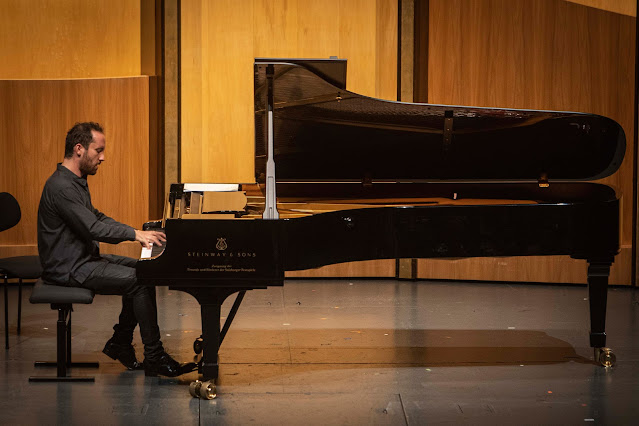
Bach:Chromatic Fantasia and Fugue in D minor, BWV 903 Brahms: Four Ballades, op.10 Beethoven-Liszt: Symphony no.7 in A major, op.92, S 464/7
Igor Levit (piano)
The Royal Festival Hall can seem too large for a solo piano recital. It needs a
pianist to fill it, which, as anyone acquainted with the monstrous Royal Albert
Hall will testify, is more a matter of drawing one in to listen than of
external projection. Fortunately, Igor Levit showed himself fully able to do
so, in a fascinating programme, given without an interval, of Bach, Brahms and
Beethoven, the latter arranged by Liszt.
A highly declamatory opening to Bach’s Chromatic
Fantasia and Fugue presented it unabashedly as ‘Steinway music’. Equally
noteworthy, though, was the sense of its chromaticism, of all twelve notes of
the chromatic scale coming into play. Not for nothing did Schoenberg call Bach
the first twelve-note composer. This was not simply a matter of Bach, but of
Levit too, inviting us to immerse ourselves in melodies, harmonies, in the
workings of Bach’s modulatory tonal plan, both in a properly improvisatory
fantasia and in a fugue whose subject emerged tenderly, wandering, to build and
ultimately find resolution. Featherlight, almost Mendelssohnian playing
combined with grander rhetorical delivery, as composer and pianist patiently
and capriciously combined the learned and the mercurial.
Twilight, experienced in certain Bach
passages, characterised much, though not all, of the Four Ballades,
op.10, of Brahms, one of its greatest kindred spirits. The first, in D minor, proved
gravely beautiful, Ossianic in spirit, with tantalising hints already (1854) of
the Schoenbergian future. Its rhetoric became surprisingly (yet faithfully)
Lisztian before withdrawing into the shadows. In its D major sibling, it was
Chopin’s turn to be revealed, not as an eccentric visiting stranger, but summoned
from Brahms’s own material. It was an intimate, at times almost diffident
portrait that led to more ardent, Schumannesque Romanticism. The B minor
Intermezzo sounded in context as if its predecessor had been turned inside out,
in a strange, Gothic transformation, only to turn itself inside out
subsequently. All three seemed in some way to prepare the way for the fourth,
in B major, a more mature Brahmsian butterfly emerging from its chrysalis.
There was a deeper sadness here, which one might compare to Chopin, but which
was in reality very much Brahms’s own. If there was a reluctance to fly freely
in the sun, that was perhaps as much composer’s as the pianist’s. It was a
markedly interior vision, which some may have felt a little too introverted,
but I found it compelling.
Liszt’s Beethoven symphony transcriptions
are fascinating tributes, which take a peculiar combination of talents and
insights to bring alive. The piano can of course only imitate the orchestra,
but in some cases that can be a good thing. After all, one thing an orchestra
cannot do is imitate an orchestra; it can only be one, at least before the
later twentieth century. Here we heard the Seventh Symphony, which Levit gave (rightly,
I think) as a symphony on the piano, not a sonata manqué. The chords announcing
the first movement’s introduction necessarily sound different; Levit relished that
difference with ear-catching detached playing, recapturing an element of
surprise. And yet, thereafter, there was an increasingly Lisztian (and
sustained) sound and style to chords and octaves, propelling us toward the
exposition, whose provenance became unusually clear. The movement developed and
returned as it should, yet heard anew. If anything, the coda sounded all the
more of Weber’s ‘madhouse’.
Even on the piano, the opening chord of the
second movement sounded grey as the North Sea. It was given relatively swiftly,
the marking Allegretto taken at Beethoven’s (disputed) word, without
sounding rushed. Indeed, one felt as well as observed the processional element at
work in all its multifarious glory—and dignity. Line was maintained throughout,
and we were treated at times to just a little – a Goldilocks amount of –
Lisztian grandiloquence. The ghostly quality to the fugato was spot on, making
me keen to hear Levit in the third movement (and the rest) of the Fifth. Remarkable
in its pianistic success, the scherzo’s performance was founded on great
virtuosity that was nonetheless a mere beginning, a necessary given. Its Tiggerish
quality and propulsion almost had one regret that Beethoven did not offer yet
another reprise. The Trio relaxed, as of old, the Austrian pilgrims’ hymn truly
felt as well as heard.
It took my ears a little while to adjust for
the finale: probably the most difficult movement to bring off, whether from
orchestra or piano. I have heard some horribly merciless renditions,
incomprehensibly praised, which have sacrificed the humanity without which
Beethoven is traduced. Levit showed that one can have a thrilling ride, imbued
with Lisztian spirit, which will ultimately grow into Beethoven’s too. His
choice of encore was perfect, both in itself and for highlighting the contrast
between Beethoven arranged for the piano and the composer’s own piano writing.
The Adagio cantabile from the ‘Pathétique’ Sonata wedded lyrical impulse
to Haydnesque roots in a performance at least as moving as anything heard
previously.
Mozart:Le nozze di Figaro, KV 492, Overture Mozart: Piano Concerto no.9 in E-flat major, KV 271 Schubert: Symphony no.9 in C major, ‘Great’, D 944
Igor Levit (piano)
Vienna Philharmonic Orchestra
Joana Mallwitz (conductor)
Images: Wolfang Lienbacher
Joana Mallwitz’s account of the Overture to
The Marriage of Figaro revealed the Vienna Philharmonic as of old.
(Conductors foolish enough to try to change its sound will quickly be rebuffed.
If you do not like it, work with another orchestra.) Warm sound, fine turning
of phrases, and a swift tempo that yet permitted time for the music to breathe
offered a proper curtain-raiser. Indeed – a good sign, this – when the Overture
had come to an end, I expected and wanted the opera to continue.
Alas not on this occasion, but instead we
were treated to a performance of ‘one of the greatest wonders of the world’
(Alfred Brendel): the E-flat Piano Concerto, KV 271, with Igor Levit as
soloist. This was the only work on the programme for which Mallwitz used a
score, though her head was certainly not in it. It was interesting to note the
change in her – and the VPO’s – approach: although using the same body of
strings, there was even in the opening tutti more of a sense of chamber music
writ large than in the Overture, whilst retaining warmth and variegation. That impression
was confirmed upon Levit’s entry, when he took the existing musical line and
ran with it, until handing it back or sharing, in what was very much a shared
endeavour. Replete with imaginative touches that never went against the grain,
this was a first movement full of life. With Levit’s pearly tone and the
heavenly sound of Vienna strings and woodwind, it is difficult to imagine
anyone feeling shortchanged, though just occasionally I wondered whether
something deeper was missing.
The answer came in the slow movement: not
that something had been missing, but rather that something had been kept in
reserve. Its dark C minor opening, direct from the world of opera seria,
prepared the way for a profound experience in which a finely spun Mozart line,
wherever it might lie, was revealed to be possessed of infinite sentiment. It
was not precious, but rather seemed to speak of something, to borrow from
Mendelssohn, too precise for words: a grief-stricken lament from the deepest of
all composers, or so it seemed here. Its radical interiority could be heard
particularly in Levit’s solo passages, even in the voicing of a trill. After
that, a finale both lighter and faster than one usually hears again had
Mendelssohn’s presence hover before us. The orchestra responded to Levit’s
opening challenge in helter-skelter fashion as if a nightmare had ended, and we
were back to the day, albeit a day that could not quite banish memory of what
had preceded it. The subdominant minuet emerged pristine in surprising
simplicity: again at a fastish tempo, but in proportion to the music
surrounding it. A surprising – and surprisingly apt – solo encore came in the
quizzical guise of Shostakovich’s ‘Waltz-Scherzo’ from the Ballet Suite no.1.
The second half was given over to Schubert’s
‘Great’ C major Symphony. Here there was much to admire – how could there not
be with the Vienna Philharmonic onstage? – even if the whole felt lacking in
the import and inevitability of the finest performances. Mallwitz presents the
work, especially its first two movements, more as companion pieces to the early
symphonies than harbingers of Romanticism. There is no Schubert performing
tradition here, of course, so one is at liberty to do what one wants so long as
it works; but does it? The first movement proceeded fluently without much in
the way of tempo modifications (save for actual transition of tempo). Voicing
of inner parts was a particular strength. The coda, however, felt less like a
culmination and more a signoff.
If the second movement were also on the fast
side, it was proportionally so. Such tempo relationships are crucial; Mallwitz has
clearly given them due thought. Detail was present and correct. Alternation of
string and wind choirs made its point, without veering too strongly towards
Bruckner. There was drama too in climax, silence, and aftershock, difficult not
to think of in quasi-military terms, given the unfailing march-like quality to
the VPO’s build-up. The scherzo I found engrossing; it offered weight and
movement without galumphing, charm as well as style. Its trio proceeded a
little too much bar-to-bar, its regularity too obvious. When it came to the
finale, it certainly sounded like one—and a finale to what had gone before too.
It was very well put together, with clear understanding and communication of
harmonic rhythm, indeed rhythm more generally. I could not help but ask,
though: what, if anything, might it all mean? Not that such 'meaning' could or should be put into words, but even so.
Schubert:Allegretto in C minor, D 915 Schumann:Arabeske in C major, op.18 Mozart: Sonata in D major, KV 448/375a Debussy:En blanc et noir Rachmaninov: Suite no.1 in G minor, op.5, ‘Fantaisie-tableaux’
Igor Levit, Alexei Volodin (pianos)
Two-piano repertoire seems, for reasons I
do not fully understand, to appeal more to pianists than to general audiences.
The Wigmore Hall was nonetheless full and greatly appreciative for this coronation-day
recital from Igor Levit and Alexei Volodin. First, though, we heard two solo
items: Schubert from Levit and Schumann from Volodin.
It was Schubert, in the guise of the C
minor Allegretto, who to my ears came off best. A wonderfully ‘sung’
opening phrase somehow managed to sound as if it were responded to by a piano ‘accompaniment’,
and so forth, counterpoint proving the means through which the two ‘instruments’
were united. It was a startlingly rhetorical performance whose argument
remained coherent, indeed gripping, throughout. And there was an undeniably
Schubertian harmonic core to this well-nigh visionary opening. Volodin’s
Schumann, the C major Arabeske, began in similarly promising, albeit
more conventional fashion. It sounded immediately as one would expect, moments
of robbed time and all. Points of detail illuminated rather than distracted. It
was, moreover, good to hear the episodes played with due heart on sleeve. My
reservations came, however, when they became more wilful, disrupting the
overall line. Perhaps, though, that is more a matter of taste than anything
else.
Mozart’s Sonata for two pianos in D major
followed. There was much to admire in it, not least a responsorial opening to
the first movement that seemed to take off where Levit’s own responsorial
Schubert had left us. Tricky balances between contrast and complement were well
navigated. Ultimately, though, I found it somewhat unyielding, especially from
Volodin, the very opening of the development section a welcome exception. The slow
movement was taken with welcome seriousness and attentiveness, though here and
in the finale a little more smiling would not have gone amiss. Subtle
ornamentation nonetheless proved a welcome addition. There was on occasion a
sense of fun to the finale, mostly from Levit, but warmth and affection were in
relatively short supply when compared with, say, the hallowed likes of Daniel
Barenboim and Martha Argerich.
The duo captured well the abstraction of Debussy’s
En blanc et noir, without neglecting the first movement’s more obviously
‘poetic’ passages, thereby thrown into greater relief. A due sense of mystery rose
in all movements seemingly directly from the keys—and of course the fingers
upon them. The dark malevolence of the second movement and a fine sense of
aerial suspension in a nonetheless keenly directed closing Scherzando came
close to the heart of Debussy’s enigmas, making this unusual work sound more
characteristic than is often the case.
Crowning the proceedings was the first of Rachmaninov’s two
suites for two pianos. The opening Barcarolle conveyed from the outset an
impression of settled idiom, such that occasional languor could register
meaningfully within its bounds. Chopin and Liszt both lay behind the writing, yet
one could never reduce what one heard to mere ‘influence’. The two pianists
offered an intriguing sense of a more modernist sense of proliferation than that
with which we might always associate the composer. Richly Romantic, without
indulgence, the second movement was similarly well judged in shape and
direction, permitting a sense of the fantastic it is difficult not to stereotype
as ‘Russian’ to take flight and form. ‘Les Larmes’ built powerfully and
subsided with equal care, founded on a deep-seated sadness that resists
verbalisation. The closing ‘Pâques’ showed Rachmaninov in Mussorgskian vein, bells
from Boris Godunov sublimated (perhaps not entirely without irony) into celebration
of Easter.
Die schöne Müllerin, Schubert’s first song-cycle, is two centuries
old this year. As Frankie Perry points out in her illuminating programme note
to this Wigmore Hall recital, it has ‘inevitably been heard and understood
differently’ over that period; it was first performed in public in its entirety
as late as 1856. Now, of course, it stands as a pillar of the song repertoire,
if sometimes suffering a little by comparison with the later Winterreise.
It need not, should not; it is a different work with different challenges and
rewards. One might expect Igor Levit, whose re-examinations of, say, Beethoven
piano sonatas, always founded in the text yet always offering something fresh,
to have something interesting, powerful, and in some sense new to say about
these songs. That he did, in just that vein. Likewise his established Lied-partner,
tenor Simon Bode. Again, there was no sign of novelty for its own sake, but of
considered, intelligent, highly dramatic performances that took wing in the heat
and light of the moment.
Youthful impetuosity marked the piano
introduction to the opening ‘Das Wandern’, a call to journey, Levit’s articulation
startling whilst sounding right. Bode followed suit, likewise startling with such
vivid communication of the words, a hallmark of his performance throughout. A
surprising hush to the final stanza’s beginning, broadening to climax, was but
one instance of illuminating detail that helped unlock the puzzle of what is
perhaps the cycle’s principal challenge: how does one honour the strophic
nature of its songs, as opposed either to attempted concealment or, perish the
thought, veering into monotony? ‘Wohin?’ naturally went deeper, more obviously
metaphysical in conception; yet, as with the rest of the cycle, nothing was
laboured. This was not straining (and failing) to be Winterreise. Here,
again, repetitions were never mere repetitions; the nixies beneath the brook’s
surface will never quite sing the same way twice.
Levit’s piano-playing, in its way as
developmental as if this were a sonata, yet certainly not ‘abstract’, propelled
music, verse, and yes, drama. Music seemed to give rise to words, as much as vice
versa. In ‘Am Feierabend’, for instance, this might almost have been
Schubert transcribed by Liszt: not that it did not sound like Schubert, nor
that it was unduly romanticised; but rather, the introduction was so
communicative that one felt little need for the voice. Until, that is, it
entered, and one felt every need for it. In that song’s second stanza, Bode
varied his tone with such quicksilver intelligence—colour, vibrato, and much
else—that song and story sounded as if invented before our ears.
There were certainly character and line to
the whole. When we reached the central (so it seemed) ‘Pause’, brought to our
consciousness with a deep sadness that again was never laboured, lightened by keen
chiaroscuro in piano and voice, one felt all had led here—and it had. By the
same token, all that had led there could never be determined in advance; there
was no one size to fit all, just as every imploring ‘Dein its mein Herz’ in the
butterflies of ‘Ungeduld’, whilst ever familiar, was never identical. That
said, the closing line of the following ‘Morgengruss’, putting into words the care
and sorrow that already are love’s hallmark, made its point: all had changed.
For the sublimated, post-Mozartian pain one
felt in the lines, vocal and instrumental, and harmonic progressions of ‘Tränenregen’
became very much our world: our journey, not simply a journey observed. When it
went further, toward expressionist effect, if not expressionist means, in ‘Der
Jäger’ and ‘Eifersucht und Stolz’, this had been prepared, fatally, though without
stepping onto an inappropriate, proto-Winterreise stage. Was that, in
the latter song, perhaps a hint of Sprechgesang? Perhaps, yet if so,
just a hint; Schubert’s lyricism remained its guiding force. Anger spent, the
desolation of ‘Die liebe Farbe’ was similarly consequent, the frightening eloquence
of the piano’s left hand a dramatic masterclass in itself, only for fury to
return at the close of the cleverly responding song in (metaphorical) mirror
image, ‘Die böse Farbe’, green’s colour and all it signified transformed from
love into hate.
No wonder Bode’s wan tone and ultimately triumphant
yet embittered irony in ‘Trockne Blumen’ so shocked; no wonder the final two
songs so haunted, the resolution or completion of the brook’s lullaby hypnotically
horrifying simply, or so it seemed, by being itself. Levit seemed already to be
in the world of the late piano music, yet continued to play with all the
delicacy of Mozart. Bode continued to resist any temptation to drag us into a
world beyond Schubert, the lyricism of ‘Des Baches Wiegenlied’ all the more
haunting for it. Both musicians proved outstanding guides not only to the
journey, but to its landscape, physical and metaphysical. Heartbreaking.
Brahms, arr. Busoni: Chorale Preludes, BV B 50 Fred Hersch: Variations on a Folk Song Wagner, arr. Kocsis: Tristan und Isolde: Prelude to Act I Liszt: Piano Sonata in B minor, S.178
Igor Levit (piano)
A typically thoughtful programme,
brilliantly performed, from Igor Levit: the second half reprising that of his
Salzburg recital in August, the first quite different, yet forming an equally
coherent whole. First we heard the six of Brahms’s eleven late organ chorale
preludes Busoni arranged for piano in 1902. The first, ‘Herzlich tut mich
erfreuen’, rightly announced itself paradoxically, or better dialectically,
both emphatically as piano music and yet also as ‘letting the music speak for
itself’, in that most necessary of clichés. Musical processes behind and
beneath the melody revealed two—sorry, three—great minds at work. Brahms’s
arpeggiated half-lights emerged, as if from his own piano music; they were
never imposed. That attentiveness to material—a sort of dual authenticity, though
not in the debased sense the later twentieth century made all too current—marked
out ‘Schmücke dich, o liebe Seele’ as more yielding, yet similarly
straightforward, and the ineffably lovely ‘Es ist ein Ros entsprungen’ as
differently inward, Levit relishing Busoni’s modest interventions. The two preludes
on ‘Herzlich tut mich verlangen’ were properly contrasted, the first speaking
with a richness of tone apt for a more overtly Romantic outpouring (from both
Brahms and Busoni), the second acting with ‘Es ist ein Ros entsprungen’ both to
encase that passion, and coming closest to the Passions of Bach. It was deeply
moving in its modesty, patience, and depth. Levit took his time, rather
beautifully, with the heartbreaking ‘O Welt, ich muß dich lassen’. His dignified
performance spoke with a distilled wisdom, like Brahms’s, that seemed to say
all that need, perhaps all that could, be said.
Fred Hersch’s 2021 Variations on a Folk
Song followed. An initial statement of a time-honoured theme, here ‘Oh
Shenandoah’, provided a connection rather than kinship with Brahms, but enough
to have one think. Twenty variations followed. Harmonic recolouring came first
to the fore, followed in what I think may have been the third variation by a
change of mood to something less ruminative, more extrovert. A wide variety of
treatments ensued, one (mostly) for the left hand standing out in dark,
muscular fashion, as an heir to Romantic tradition, another insistent and ardent,
perhaps a little after Liszt (to come). Others were more inward or floating. This
was evidently music Levit had internalised, just as it this clearly represented
a tribute from one pianist to another pianist—and vice versa. The
principal language may have been forged in the jazz world, but it was generous
in its frame of reference—and that generosity extended to spirit too.
Zoltán Kocsis’s transcription of the
Prelude to Act I of Tristan was strenuous, big-boned, virtuosic, the
emphasis placed very much on struggle, on becoming. Always directed to a goal
that was never reached, its oppressive lack of resolution (in more than one
sense) led us directly into a performance of Liszt’s B minor Sonata perhaps
still more fiery, still more coherent than that I had admired a month earlier
in Salzburg. It was similarly bold and questing, and of course more
unremittingly virtuosic, virtuosity and rhetoric always means to an end rather
than ends in themselves. Post-Beethovenian goal-direction was equally apparent,
through rather than despite flexibility. Bringing us to the recapitulation, for
instance, Levit triumphantly banished the false dawn of the preceding fugato to
the fiery furnace. Form was a living, breathing, even diabolical thing. Liszt
here was, quite rightly, both highly integrated and far-flung, Liszt’s essence grasped
and communicated.
Detail mattered too: the return of those strange descending scales told us
beyond any doubt that, were a single note in them to be changed, so too would the
rest of the work. Never, not for one moment, could one doubt our guide knew
where he was leading us. For Levit’s command of line, which one might well
consider ‘Wagnerian’ in terms of unendliche Melodie, was not the least tool
in communicating a pianistic sorcery on Liszt’s part that under the right hands
is anything but rhapsodic. As for hands, had I not witnessed the performance
with my own eyes as well as ears, I might have sworn there were four at work. This
is a masterpiece of musical thought, of course, but it is equally piano
music, and sounded as such, reminding me of Donald Tovey’s observation that
Liszt’s piano music was that of someone who could not fail to make a beautiful
sound when touching the keys. Beauty takes many guises, of course, but Liszt
never, ever writes against the instrument. Nor, so it seems, does Levit ever
play against it. A beatific close seemed, at least in retrospect, to
necessitate the lovely yet plain-spoken encore, (as in Salzburg) Schumann’s ‘Der
Dichter spricht’.
Bartók:Out of Doors, Sz 81 Schumann: Waldszenen, op.82 Wagner, arr. Zoltán Kocsis:Tristan und Isolde: Prelude to Act I Liszt: Piano Sonata in B minor, S.178
Igor Levit (piano)
Image: SF / Marco Borrelli
For this Salzburg Festival recital, Igor
Levit offered a programme of piano music—and, in one case, orchestral music
transcribed for the piano—rich in connections explicit and implicit, and
beautifully balanced too. Programming is in many ways an art in itself, yet not
of course quite in itself: the music needs to be performed at least as compellingly
as it has been assembled. There was little problem in that respect here, given
performances that never took the works in question for granted, always looked—and
listened—afresh.
Bartók’s Out of Doors suite was a
welcome choice to open. The drums and pipes of the opening piece gave neither pianist
nor audience time to adjust. Poundingly percussive from the word go, it was
always much more than that, though: melody and harmony, as ever in Bartók, at least
as crucial as the initially startling melodic element. Levit understood and
conveyed this, not only here but in the following pieces of very different,
highly contrasted character. This suggested what a treat we might have in store
from the Sonata and the Piano Concertos; let us hope they are only just around
the corner. The ‘Barcarolla’ emerged as a mysterious heir to Chopin et al.,
those others certainly including Liszt, especially the Liszt of those lugubrious
late Venetian works. I thought I heard a kinship to Prokofiev too: less
expected, perhaps, but making a great deal of chronological sense. (Kinship
need not mean influence in either direction.) Levit’s variety of articulation
in service of the musical idea was just the thing to tease out its secrets.
Delicately insistent, the ‘Musettes’ presented yet another winding,
post-Romantic way, sharply contrasted by the night music of the fourth piece.
Bells? Birds? Breezes? Beasts? Who knows? It was certainly Bartók, at any rate,
the beating heart of the work as a whole. Independence of hands, the very
foundation of Lisztian technique—well, one of the foundations, anyway—was crucial
here in delineation and communication. The final piece was every inch the
finale, early echoes of the opening taking us along a very different, dancing
path. Fiendishly difficult and infectious, this was the piece with the most
transcendental virtuosity, in Levit’s hands a veritable whirlwind.
Schumann’s Waldszenen is another set
of pieces one might expect to hear more often than one does. Here, it breathed
a post-Bachian air, not only in its counterpoint, but in melody, harmony, figuration,
and much else. The introductory piece gently placed us in medias res:
storytelling magic with an inwardness (Innigkeit) all Schumann’s own.
The hunters of the second brought a degree of stormy release, ever precise,
though, just as in Bach. Deceptively, captivatingly ‘einfach’ or simple, ‘Einsame
Blümen’ offered as keen a note of fantasy as anything else: a note struck, in
various ways, throughout the set, not least in a questing ‘Freundliche
Landschaft’. In between, the dignified pathos, both directed and a little
wayward, of ‘Verrufene Stelle’ hinted at a fugal mind deconstructed. A friendly
wayside inn (‘Herberge’) and dignified ‘Vogel als Prophet’, the latter’s
animation almost yet never quite suspended, took us into the sky before coming
properly back down to earth in a rhythmically generative ‘Jagdlied’ that, in
context, suggested memories of Bartók. Schumann’s epilogues are always things
of wonder; here was a fond ‘Abschied’ indeed, its reluctance to close as touching
as it was understandable.
Nietzsche famously declared he would not
touch the score of Tristanund Isoldewithout wearing gloves.
There was no doubting the dangers of its opening Prelude here, in a 1978 transcription
by Zoltán Kocsis. More flexible than one would expect from an orchestra, it
became a forerunner of late Liszt, ever struggling, ever becoming, endless in
melody—until, that is, one realised that it was actually taking its cue from
earlier Liszt, in the guise of the Sonata into which its close dissolved. We
shall never finally disentangle the mutual influence and affinities of the two
composers; here was a good reason perhaps not even to try, musical threads all
the more dangerously intoxicating with ‘dies süsse Wortlein: und’: Wagner
und Liszt.
In that vein, the beginning of the
exposition proper sounded like another chapter in the same story, beginning
with Wagner, moving to those shockingly ‘new’ (even now) Liszt scales of the
introduction, and new bursting forth in other, neue Bahnen,to
quote Schumann on a young composer (Brahms) who certainly did not appreciate
this work, allegedly falling asleep (!) when Liszt played it to him. That almost
novelistic sense of pages, even chapters being turned was, I think, a
particular characteristic of Levit’s performance, Liszt’s supreme Faustian
bargain turned almost literally into a nineteenth-century page-turner. The
composer’s formal concision can hardly be gainsaid here, but a complementary
expansiveness was revealed as the other side to a coin of seemingly endless
transition. There was time for grandiloquence as well as for silence; there was
space for rhapsodic freedom and constructivism. (To misquote Dolly
Parton, it takes a lot of organisation to sound that free.) With Liszt,
especially here, several balls will often be in the air at any one time. The odd
one may be dropped, but that is part and parcel of his generosity of character.
With the structural outline firmly in place—there was no question as to the
moment of recapitulation—there was no harm in occasionally pausing to ask a question,
or even to admire the view. A divine comedy, a thoroughly Lisztian enterprise,
was created before our ears. One had the sense, moreover, that it was a
one-off, that a different tale would have been told on another occasion.
With quiet dignity, the poet spoke (‘Der
Dichter spricht’) for a Schumann encore. On a more modest yet not necessarily
less eloquent level, Romantic rhetoric held us once again in its sway.
Liszt (ed. Busoni): Fantasy on Themes from Mozart’s ‘Figaro’ , S 697 Mozart: Piano Sonata in B-flat major, KV 570 Mozart: Piano Sonata in C minor, KV 457 Liszt: Réminiscences de Don Juan de Mozart, S 418
Igor Levit (piano)
Igor Levit’s contribution to
this year’s Festtage offered us
Mozart, both ‘as himself’ and through a Lisztian lens. First was Liszt’s rarely
heard Fantasy on Themes from Mozart’s
‘Figaro’, properly the Fantasy on
Themes from Mozart’s ‘Figaro’ and ‘Don Giovanni’, albeit in Busoni’s
performing version, considerably truncated, it loses the Don Giovanni material entirely. Its skittish opening, particularly
as performed here, put me slightly in mind—doubtless arbitrarily—of Henze’s ‘Three
miniatures for piano’, Cherubino.
(Someone, perhaps Levit, should perform them together some time.) Soon,
however, a grander contagion spread, from composer and pianist alike, to the
entire keyboard, exhibiting a clarity that can come only from transcendental
virtuosity. In such music, essentially a slightly more permanent snapshot of
Liszt improvising, one can fancy one hears the seeds of other, original Liszt
pieces. Perhaps one does, but it is more likely simply to be the stock pianistic
material on which Liszt drew. It was fascinating also to hear the junctures at
which Liszt seems to prepare the way for music from Don Giovanni, only to swerve—or rather, via Busoni, to be swerved—in
a different direction. Levit had the piano sing in all registers; a piano can
do so, of course, be imitating the human voice, whereas our Western voices at
least are more limited in range. Around that, all manner of pianistic adornment
was spun. Levit’s command of Lisztian rhetoric, again as if improvising, though
unquestionably faithful, proved second to none. He was not afraid, either, of a
little vulgarity: something positively demanded by Liszt and yet to which some
pianists find it difficult, even impossible, to accede.
Mozart’s late B-flat major
Sonata, KV 570, offers a very different kind of difficulty. Its spareness
offers nowhere to hide, even by Mozart’s usual standards. I remained unsure
about Levit’s way with the opening Allegro,
very fast indeed, but it was clear and directed, with a proper sense of the
development opening up a new harmonic world. The other two movements, to my
ears, worked better, the Adagio
sustained by a fine sense of line and scrupulous, yet never pedantic,
articulation. The minor-mode section benefited from an understated yet clearly
felt pathos. Here, Mozart’s cruel, achingly honest spareness was beautifully,
meaningfully realised. So too was it in the finale, whose fast tempo did not
preclude space to savour the composer’s clever imitation of solo and orchestral
tutti. (B-flat major seems to have
been one of his favoured keys for doing this, as witnessed by the ‘concerto’
finale to KV 333/315c.) Disorienting
chromaticism was taken in the pianist’s stride.
Levit thrived on the mood-swings
of the C minor Sonata, KV 457, both as a whole and of its first movement in
particular. The crucial thing, here admirably accomplished, was to have them
cohere into a whole. If its dialectics looked forward to Beethoven, so they
should; this was a motivically determined performance in the best sense. The
concision of Mozart’s development section astounded, as it must. Levit had the
tragic measure of his turn to the tonic minor in the recapitulation, as well as
its ghostly coda. A spacious ‘Adagio’ followed, confirming Levit as one of the
least ideological of musicians. His tempi, whether one agrees or not, are
clearly born of his own understanding and vision for the music, not some absurd
conception of ‘correctness’. Scrupulous with Mozart’s markings, he ensured this
great aria was sung by a great piano-singer, blessed by no mean accompanist. The
richness of Mozart’s modulations was fully savoured and conveyed. Even a telephone
intervention was treated with good humour and incorporated into the
particularity of good performance. Perhaps that incited the tragic intensity of
the finale; more likely, it would have been there anyway. At any rate, this
extraordinary conclusion to an extraordinary work, was unleashed rightly, with
a C minor daemon to rival that of Beethoven.
Levit relished, unsurprisingly,
the Stone Guest opening to Réminiscences
de Don Juan, putting it, crucially, to pianistic, dramatic, and more
broadly musical work. If Daniel Barenboim were in the audience, I should like
to think he would have approved (likewise his hero, Furtwängler). Liszt’s work
emerged as the masterpiece it is (with due regard to the Figaro Fantasy). Transitions, as finely judged as they sounded
spontaneous, were of the greatest importance here. So too was Levit’s mastery
in having the piano once again sing—and, in ‘Là ci darem la mano’, seductively
at that. All manner of technical strengths and achievements were present and
correct, but one barely noticed them in themselves, which is just as it should
be, Lisztian virtuosity being ultimately a musical tool to vanquish mere virtuosity.
Common ground between Mozart’s and Liszt’s major-minor dialectics was
heightened to properly diabolical effect. The quiet dignity and resolve of
Busoni’s transcription of Bach’s Chorale Prelude, Nun komm’ der Heiden Heiland, made for a perfect encore.
Unveiling of the Beethoven monument, Bonn, in 1845. Liszt ensured that the project succeeded, contributing money, advocacy, performances, and his own music.
In
his Third Symphony, Beethoven threw down the gauntlet: to himself, to
contemporaries and to successors in the 19th and even 20th centuries. The scale
and public quality of its utterance seem, like the composer’s visage in
glowering, ineffably human portraits, to speak of and with something new:
Beethoven’s heroic voice.
In the sonata-form first movement,
generative simplicity and development of unprecedented length and complexity
prove two sides of the same coin. Its opening E flat major triad, heard first
vertically then horizontally, gives the appearance of organic necessity in
informing all that is to come; so too does its subsequent – consequent? – turning
away: E flat–D–C sharp. This music is in a dramatic, persistent state of
becoming as opposed to being, not least a coda functioning as fully fledged
second development. The monumental ceremonial of the Marcia funebre, the
funeral games of the Scherzo and the thrills and spills of the Finale’s set of
ultimately fugal variations present not only Beethoven’s titular ‘memory of a
great man’ but also a present and future for heroism that lies in common
humanity. Dedication to one man, Napoleon, even had his memory not been
tarnished, could never have been enough. As Wagner would argue in a
programmatic explanation to accompany a performance he conducted, ‘the term
“heroic” must be taken in the widest sense, and not simply as relating to a
military hero’; ‘understand “hero” to mean, above all, the whole, complete man’.
Liszt stood equal to Wagner in
formulation and development of the 19th century’s Beethoven. Having met the
composer in 1823 – alleged occasion of the mythical ‘Weiheküss’ (consecration
kiss) – Liszt proceeded to act as champion in multiple ways: pianist, arranger,
conductor, benefactor (to Bonn’s Beethoven Monument), custodian (to Beethoven’s
Broadwood piano) etc. As recitalist – he invented the term – Liszt brought
Beethoven’s piano sonatas to a rank of public utterance close to that of the
symphonies; he likewise brought the symphonies to audiences that would rarely,
if ever, hear an orchestra. Liszt transcribed the Marcia funebre of the
‘Eroica’ as early as 1837, alongside the Fifth, Sixth and Seventh Symphonies.
The remaining three movements of the Third were added in 1863, after which he
revised the slow movement. That first transcription afforded a model from which
to work – literally, for Liszt wrote his modifications into an old copy – with
certain difficulties now benefiting from more graceful solutions. In 1865, the Symphony
was published as part of a complete set of nine, dedicated to Hans von Bülow.
Large hands are a prerequisite, with
stretches of a tenth commonplace. If amateur pianists can happily make their
way through the piano duet versions of orchestral music popular throughout the 19th
century and even much of Liszt’s transcription of the First Symphony, the Third
is another matter – the Ninth still more so. What is readily accomplished by
orchestra is not always by piano, and vice versa. Liszt’s solutions, however
difficult, are comprehending and ingenious. He notes instrumentation, and lines
impossible to incorporate are included on a separate stave. Ossia passages for the more adventurous
(and dexterous) cross hands to include further material, or to do so at the
correct octave. Suggestions for pedalling are well thought out and imaginative,
always deserving of consideration. To ask whether the purpose is interpretative
or to further acquaintance with Beethoven’s score is to miss the point; Liszt
rarely trades in the either/or.
The notes are on one fundamental
level Beethoven’s. How much do they become Liszt’s and/or the pianist’s? Such
questions would in a sense always be present: how much did they become Wagner’s
or Furtwängler’s? We cast our imaginative net as wide or as narrow as we wish.
Yet there is something more here, thanks not only to Liszt’s presence as
intermediary – how ‘faithful’ will or should the pianist be to him? – but also
to demands of transcendental piano virtuosity. What Romantics such as Liszt and
Wagner would have called Beethoven’s ‘poetic idea’ is both treasured and
transformed. The heroism of transcription and performance for solo piano offers
a study in fidelity, infidelity and the complexity of their dialectical
relationship.
Breadth and Introspection
A
pallbearer at Beethoven’s funeral, Schubert long fell too readily under his
shadow, especially in the realm of instrumental music. If Schubert’s stature as
songwriter – further inspiration to Liszt the arranger – no longer eclipses his
instrumental achievements, it can remain tempting to consider them in relation
to divergence from an alleged Beethovenian model. That said, when hearing
Schubert immediately after Beethoven, some degree of comparison seems
inevitable; it does little harm so long as it does not over-determine our
response. For, in John Daverio’s words, ‘whereas Beethoven, especially in the
symphonic works of his “heroic” phase, drives headlong from the present into
the future, thus emulating the teleological thrust of drama, Schubert treats
the present as a pretext for summoning up or mulling over the past, tending as
he does toward epic breadth and lyric introspection’. That bardic impulse may
be heard in Schubert’s Drei Klavierstücke.
These three pieces, composed in Beethoven’s wake, in 1827–8, may have been
intended to contribute toward a third set of (four) impromptus, although a
different paper type for the third may indicate otherwise (or simply earlier
composition). They went unpublished until 1868, collected and edited
(anonymously) by Brahms.
An E flat minor winter wind blows
through much of the First, though oscillation with the tonic major renders its
chill more uncertain, if hardly consoling. For consolation, we await the warm,
almost hallucinatory lyricism – recognizable from Winterreise – of the central Andante section; in remote B major, it
is not itself without moments of tragic vehemence. Schubert’s original
conception of a five-part rondo, ABACA, became a ternary ABA form, the ‘C’
episode crossed out entirely in the manuscript. His motive remains a matter for
speculation; René Rusch has recently pointed to differences in Schubert’s use
of modal mixture (borrowing chords from E flat major) in the first two pieces.
Some pianists follow Schubert’s deletion; others are unwilling to resist the
lure of extra material and follow Brahms’s editorial reinstatement. Who knows
what Schubert would have decided in performance or preparation for publication.
Schubert, in any case, employed
that five-part form next, the second piece’s tender barcarolle, taking up where
its predecessor had left off, in E flat major. Enharmonic means, similar yet
different, take us on a journey through dark episodes of pathos that in
themselves contain passages of modal transfiguration. The urgency of the final
piece’s flights of syncopation once more offers strong, seemingly necessary
contrast with the hymn-like central section, a semitone higher, yet a flatter
key (D flat major to surrounding C major). Decidedly un-Beethovenian
ambiguities persist.
‘In real time’
The
quizzical opening of Prokofiev’s Seventh Piano Sonata might suggest a similar
path. Its first movement’s marking, ‘Allegro inquieto’, indicates tempo in the
fullest sense: concerned as closely with character and mood as speed. Needless
to say, though, Prokofiev’s way proves very much his own, albeit with points of
connection to all three composers heard previously.
Much depends, of course, on
performance. As with Schubert’s Klavierstücke,
Sviatoslav Richter – different from himself in alternative performances – will
present something different from Maurizio Pollini; Igor Levit something
different from both. Richter never performed Liszt’s Beethoven, publicly
disavowing most transcriptions, Liszt’s response to ‘Erlkönig’ a rare
exception.Given the depth of
Richter’s ‘at home’ repertoire, he may well have explored more; at any rate, he
certainly performed much Beethoven, Liszt, Schubert and Prokofiev, and loved to
play symphonic and operatic music on the piano for himself. Prokofiev, who
entrusted Richter with this work’s premiere, was more open-minded concerning
transcription, whether of his own music or that of others, ranging from
Buxtehude to Schubert. He was also a superlative pianist who knew, like Liszt,
godfather to Russian schools of composers and pianists alike, how to compose
ferociously demanding music that was always written ‘for’, not ‘against’, the
instrument.
Moreover, whatever his enfant terrible reputation, principally
a matter of contrast with reactionary conservatory professors, Prokofiev’s
musical grounding was rooted in Classical tradition. Beethoven, whose music he
had often as a child heard his mother play, always loomed large, whether in
performance or composition; sonata forms and genres were ever present in
Prokofiev’s music, modernist or more nostalgic. The distinction was always
problematic, as we discover in the Seventh and its fellow ‘War’ sonatas – not a
Russian term – of 1939–42. To many Western ears, the Seventh, as recorded by
Pollini, seems most modernistic, at least in the wandering tonality of the
first movement and the brutal insistence of the Finale; however, that begs more
questions than it answers. It is more meaningful to follow Boris Berman’s
argument that the Sixth anticipates war and the Eighth recalls it, while the
Seventh ‘projects the anguish and the struggle […] experienced in real time’. For
Richter, it plunged an audience ‘into the anxiously threatening atmosphere of a
world that has lost its balance’.
Chaos and uncertainty reign. We see
murderous forces unleashed. But this does not mean that what we lived by
therefore ceases to exist. We continue to feel and to love. Now the full range
of human emotions bursts forth. Together with our fellow men and women, we
raise a voice of protest and share the common grief. We sweep everything before
us, borne along by the will for victory. In the tremendous struggle that this
involves, we find the strength to affirm the irrepressible life force.
Marina
Frolova-Walker has similarly discerned a ‘Beethovenian narrative of victory won
through struggle’: socialist realism, perhaps, though not of a dogmatic
variety, and coming more naturally to Prokofiev than some would like.
Beethovenian realism might be
better: in its inner voices, the second half of the opening theme bears
apparent reference to what we have come to know as Beethoven’s motif of fate.
This is no transcription, yet ambition to attain orchestral stature or
suggestion remains, as in the marking ‘quasi Timp.’. Grotesquerie of yore is
intermittently present, yet in a context of militaristic discipline is no
longer a laughing matter. If the first movement offers a Beethovenian contrast
between thematic groups, almost conventionally ‘masculine’ and ‘feminine’, its
progress, both mocking and honouring hallowed sonata form, stands as close to
theatre or cinema. The principal theme of the Andante caloroso may be heard as
a reminiscence as false as it is fond, both in register and chordal accompaniment,
of kindred movements in Beethoven. Ternary form stands familiar from many of
its kind – and from two of Schubert’s Klavierstücke.
The closing Precipitato offers synthesis in combat between jaunty 7/8
machine-irregularity and the Classical frame of a rondo finale. Hammered, even
frenetic insistence, seemingly inherited from Prokofiev’s piano concertos, on
the tonic of B flat speaks solely of the here and now. The Sonata hurtles to a
close, exhilarating and only in retrospect exhausted: ‘in real time’, because
it can do no other.
(This essay was originally published to accompany a recital by Igor Levit at the 2021 Salzburg Festival.)
Piano Sonata no.5 in C minor, op.10 no.1 Piano Sonata no.19 in G minor, op.49 no.1 Piano Sonata no.20 in G major, op.49 no.2 Piano Sonata no.22 in F major, op.54 Piano Sonata no.23 in F minor, op.57, ‘Appassionata’
Igor Levit (piano)
Sturm und Drang or full-blown Romanticism? Why choose? The point was twin fury and tenderness, their dialectical connection crucial. This Igor Levit performance of Beethoven’s early C minor Sonata, op.10 no.1, thereby offered an object, concise lesson in first-movement sonata form contrasts: their necessity and meaning. The shock with which the development section began and the new paths along which it led were very much part of that, roots unquestionably in Haydn, yet never reducible. It was all over before we knew it, Beethoven the radical—already. The poise with which the Adagio molto unfolded, plenty of space for detail truly to register, was finely judged. Here was a dignity that was moral above all: ‘“The moral law within and the starry skies above us!”—Kant!’ as he would note more than two decades hence, in an 1820 conversation book. Clarity, complexity, and the particular character of this slow movement were unerringly recreated before our ears. The finale’s extremity of Beethovenian drive, at times almost tipping over into Schumann, made for a thrilling ride, which, had we known, might well have come from closer to 1820. ‘Lateness’ can be early, as suggested by a rhetorical, formally comprehending performance that yet proved enigmatic to a degree.
The two little op.49 sonatas were treated with all the seriousness and affection they deserved. The G minor Sonata’s first movement as lovely as any Bagatelle, its melancholy and invention equally relished. Its second movement suggested a yarn well spun, full of incident. Taken without a break, the G major Sonata thereby sounded all the more as a companion piece. Its first movement had Mozartian poise and dignity, imbued with difference enough to make it quite clear that this was Beethoven. Touching naïveté characterised the second, its simplicity distinguishing it from Beethoven’s reworking in the Septet. Nothing was condescended to; everything was enjoyed for what it is. Delightful!
By contrast, simplicity such as we heard at the opening of the op.52 Sonata was unquestionably ‘secondary’, mediated: from Kant, then, to Hegel. Such subtlety pervaded Levit’s performance just as much as the work itself, even prior to the first furious dialectical outburst. Once more, ‘late Beethoven’ seemed already to be among us. There was no shying away from difficulty; rather it was celebrated and confronted. Strangeness was relished, even heightened, through fidelity, both here and in the second movement, its moto perpetuo a means rather than an end, that end unrepentantly modernist, even Schoenbergian.
Ghostliness of a different, yet perhaps related, kind haunted the opening of the Appassionata, whose first movement received a duly questing account, transcendental and Faustian by turn and sometimes simultaneously. It was difficult not to think of Liszt and Busoni, of what they might have made of this ever extraordinary work. Levit afforded space for surprises, yet equally urgency to remind us of Lenin’s celebrated devotion. Yet where Lenin could therefore not listen often to music, we were enabled, even impelled, to do so all the more. Here was an interior subjectivity that spilled over into exteriority, yet retained primacy throughout. Such was also the case in the second movement, albeit with different material and all that flowed from that difference. Much bubbled under and even on the surface, however much one ‘knew’. The shock of transition to the finale was undimmed by familiarity, a path to a defiant humanism that characterises both composer and interpreter. Such white intensity proved as exhilarating a work-out for the mind as for the fingers. One hardly dared breathe, even before the coda’s shock and awe.
The seventh of Busoni’s Elegien made for a perfect encore. You cannot top the Appassionata, but you can certainly do something else. Levit showed how Busoni’s flickering half-lights can, if anything, prove still more expressive from piano than orchestra. However different the means, there remained something subtly Faustian to the bargain. I look forward to hearing him play the Piano Concerto.
Piano Sonata no.24 in F-sharp major, op.78 Piano Sonata no.4 in E-flat major, op.7 Piano Sonata no.9 in E-flat major, op.14 no.1 Piano Sonata no.10 in G major, op.14. no.2 Piano Sonata no.26 in E-flat major, op.81a, ‘Les Adieux’
Igor Levit (piano)
Whatever equal temperament, ‘common sense’, or anything else might say, any pianist will tell you that, leaving aside absolute pitch, an all-black F-sharp major chord will feel and sound quite different from one made up of white notes or a mixture. It certainly did here, the rarity in every sense of the tonality immediately apparent, drawing one in both to Beethoven’s short introduction to the op.78 Sonata and thereafter to the first-movement exposition proper, which unquestionably grew from those magical, pregnant four bars. Intimacies were whispered and sung, sforzandi registered without exaggeration, all part of a greater whole envisaged and communicated by Igor Levit. Surprises in the development sprang from deepest Romanticism, be it that of Beethoven or his interpreter. All was equally fresh in the recapitulation. In the second of this extraordinary sonata’s two movements, humour both skittish and vehement was brought to life by the transcendental technique of a Liszt or a Prokofiev (so it sounded; it was, of course, actually that of a Levit). A one-off surprise at the close amused the pianist still more than it did us: a winning sign of humanity, in the unlikely case of anyone requiring it.
The E-flat major Sonata, op.7, hails from a different world: key, period, mood, and so on. There was no question, however, that its first movement also was Beethoven—and mature Beethoven, in a reading that felt no special need to dwell on his antecedents. At times, indeed, the music sounded bracingly, brazenly modern, without that ever precluding charm or tenderness. Once again, this was a protean whole, rhythm generative yet ever founded upon harmony. Levit maintained the slow movement’s essential simplicity of utterance at a daringly slow tempo. Beethoven was rendered strange once again, through fidelity and understanding, in a performance implacable and fantastical, intimate and forbidding. In the third movement, Beethoven and Levit in indissoluble partnership unleashed a dynamo of motivic and harmonic development, just as inextricably interlinked. The white heat of its trio was such as if to encircle Brünnhilde—and perhaps even to repel Siegfried. Like the first movement, the finale sounded remarkably mature, with little sense of (post)Mozartian throwback. Gruff and boisterous, it also reached for the stars: patently Beethovenian stars, in Beethoven’s tonal universe, discovered as if for the first time. Once again, Levit trusted Beethoven and Beethoven more than repaid that trust.
The opening of the E major Sonata, op.14 no.1, was necessarily made to sound as if it were the easiest thing in the world—until one listened, when the truest artistry was revealed. Voicing as directed as it was exquisitely of the moment was married to telling variety of articulation (never for its own sake). I found myself especially taken by the understatement of the development, not least since it had me realise what a vulgar mess I had once made of it. The second movement was a tale of Mendelssohnian melancholy disrupted and restored. In not entirely dissimilar fashion, the finale’s opening lightness had the vehemence of its central episode emerge all the more meaningful and necessary.
The op.14 no.2 Sonata made for a lovely companion piece in practice as well as in theory, the freshness of its first-movement Romantic lyricism beautifully judged. Tiggerish in its amiability, it led with all the inevitability of a grander work to its central Andante. It is all too easy to end up doing things to this movement, but not here in a reading whose seemingly infinite charm was born again of honesty (Beethoven and Levit), not subterfuge. Taken attacca, the scherzo finale thereby heightened its predecessor’s closing joke. It proved a performance full of contrast and incident, which yet remained unerringly part of a greater whole.
A deeply poignant introduction both prepared the way for and was dispelled by the Emperor Beethoven of Les Adieux’s exposition. It is not so simple, of course; when is it? Interplay between such tendencies proved the very motor of the music; it was, though, quite a starting-point. The second movement, ‘L’Absence’, revealed another side to the Romantic moon: mysterious, yet familiar; quietly insistent, yet richly exploratory. The finale was in many respects similar, uniting tendencies from both preceding movements, yet keenly attuned to its own function and specificity. Exultant, even ecstatic, Beethoven the sublime poured forth like proverbial molten lava, yet with none of the lazy clichés my insufficient words might suggest.
As an encore, Levit offered August Rosenbrunnen by his friend, Malakoff Kowalski. There was here a sense of the improvisatory that was anything but arbitrary. Unquestionably piano music, this was clearly writing, as well as performance, born of deep love for the instrument. If there were a certain post-Debussyan quality to some of the harmonies, their function seemed to me quite different. This was a song of dark passions and liberation, though whether in or from those passions remained an intriguingly open question.
Muffat: Apparatus musico-organisticus: Passacaglia in G minor
Rzewski:
Dreams
II
Kerll:
Passacaglia in D minor
Busoni:
Fantasia
contrappuntistica
I have heard a good number of
ambitious musical performances, ambitions fully realised, from Igor Levit,
ranging from his Wigmore Hall Beethoven sonata cycle to a landmark modern performance of Henze’s Tristan in Salzburg. None of
those, however, would outstrip the ambition, again fully realised, of this, his
Pierre Boulez Saal debut recital, culminating in Busoni’s Fantasia contrappuntistica, a work which, he owns, is a ‘borderline
piece’, which ‘takes me to the limits of my abilities – mentally,
intellectually, physically’. Those limits, if limits they were, were thrilling
to explore.
Two seventeenth-century passacaglias,
from Georg Muffat and Johann Caspar Kerll, rarely if ever heard on the modern
or indeed any other form of piano, proved not the least of the recital’s
achievements. Georg Muffat’s G minor piece, from his 1690 Apparatus musico-organisticus, revealed kinship with music from contemporary
clavecinistes, early keyboard
composers (Frescobaldi came to mind more than once), and later composers from
Bach to Brahms, and perhaps even beyond to Busoni. Delicate, responsive,
variegated in a developmental sense, Levit’s performance had one feel as well
as observe the composer’s balance between detail and longer line: not so
different, after all, from Beethoven. Harmony was relished; harmonic motion was
meaningfully conveyed. So too were the surprises Muffat sprang for us: no
underlining, ‘just’ musical understanding and communication. It had all the
inevitability of Hegel’s owl of Minerva taking flight, yet none of that old
bird’s baggage. Levit’s performance of Kerll’s piece had all the virtues of his
Muffat and likewise all of its particularity. Voice-leading, quite without
narcissism, was nonetheless to die for. Its directed freedom created form
before our ears. We travelled from intimacy to exultancy, the latter never
failing to nurture continuation of the former from within.
In between came Frederic
Rzewski’s 2014 Dreams II, written for
Levit (and previously heard by me at
the Wigmore Hall in 2015). Its four movements did, whether as work or
performance, what they said in their titles – ‘Bells’, ‘Fireflies’, ‘Ruins’, ‘Wake
up’ – without conforming to mere expectation, without questioning as well as
fulfilling. Indeed, questioning seemed to be very much part and parcel of their
fulfilment. The first movement seemed to relate both to Debussy and to Webern,
but that was never the point, not even the starting point, in a performance of calibrated
drama. Increasingly seductive warmth proved anything but antithetical to
crystalline clarity. Febrile and flickering, the second movement burned with
mercurial heat. The pianist’s riveting virtuosity once again spoke from
apparently Debussyan roots, yet who speaks or thinks of roots in relation to
fireflies? Rzewski’s ‘Ruins’ seemed known – ruins tend to – yet the more one
listened, the more one realised one had not known them at all. Again, ruins
tend to be like that. Their (re)discovery was a wayward process that built on
the previous two movements, yet was very much its own thing. The final movement
was shaped, dramatised as keenly as Beethoven – or Muffat. Somehow, it seemed
already to be hinting at Busoni, not least in its dynamic form and its
toccata-like qualities. In its improvisatory reminiscence-cum-creation of
whimsical childhood memories it spoke too of dreams, of their magic, of their
power.
Like Doktor Faust, Busoni’s fantasia has the quality of a summa, even a summa theologica. Levit’s ‘Preludio corale’ seemed already to
encompass the entirety of his instrument in considerably more than mere
compass. Questing, like Faust, like Busoni, to bring order out of chaos, the
process was never complete, yet no less real like that. Good German (convert)
that he was, Busoni believed in werden
rather than sein. Beethoven and Liszt
flashed by, the pianist-composer’s battle with Bach but one of the dramas, the theologies
at stake here. With lightly-worn – insofar as possible! – virtuosity and veiled
clarity, Levit proved a sure guide, though whether to the inferno or to
paradise was rightly never clear. Busoni’s Sonatina
seconda from two years later (1912) hung in the air, suspended, yet somehow
also flayed alive. The fugal path was soon upon us, the first of Busoni’s four
a further, developmental prelude in miniature (not-so-very miniature)
Transition was, it seemed, everything; so too was that journey to the limits of
which the pianist had spoken in the programme. Alternative paths to a twentieth
century that never quite was, Schoenberg be damned, opened up before us in the
Intermezzo and Variations. This, it seemed, was veritable necromancy, but
whose? What was the cadenza, and what was the following fugue? The answer was,
on one level, perfectly clear; yet it seemed to miss the point entirely.
Transition, again, was all. Neo-Lisztian peroration pointed more to the
impossibility of completion than Bach could ever have done. If a ‘point’ there
were, perhaps it was that. Or perhaps it was the melting encore, the
Bach-Busoni Chorale Prelude, ‘Nun komm’ der Heiden Heiland’. Mephistopheles does
not always have the last word.
Many of
Liszt’s works have complex, protracted geneses. Rather than chisel away in
furious, even obsessive, self-criticism like Brahms, working his way toward a
final, perfected version – there are exceptions – Liszt tended to move on,
sometimes furnishing several, competing versions of an ‘original’ work. In
addition, there are, of course, arrangements, transcriptions, paraphrases, and
much in between, often again in more than one version. Not all of Liszt’s works
– nor Busoni’s, following closely in the footsteps of his great
pianist-composer predecessor – are works in progress. Even when not, though, we
can sense a restless tendency, something moreover of an improvisatory,
experimental beginning, with or without closure.
A Father’s Grief
The
origins and ‘poetic idea’ of Liszt’s Weinen,
Klagen, Sorgen, Zagen Variations are autobiographical. Liszt’s daughter
Blandine had died on 11 September 1862; at the end of that month, his
son-in-law Émile Ollivier travelled from Saint-Tropez to Rome to inform Liszt
of her last days. In response, Liszt penned a series of 48 variations on the
ground bass from the opening movement of Bach’s 1714 cantata Weinen, Klagen, Sorgen, Zagen BWV 12,
also familiar from Bach’s own recycling in the ‘Crucifixus’ of the Mass in B
minor. A chromatically descending line furnishes Liszt, as it had Bach, with
plenty of scope for what Schoenberg would christen ‘developing variation’.
However,
Liszt, following and extending Beethoven’s example as composer of variations,
begins in a different key, D flat major. Typically crashing chords make their
way to the tonic, F minor, long a key of mourning for Liszt, through the
offices of an anguish that borders upon mental collapse. Sovereign command of
his instrument enables Liszt to coax, to compel, even to coerce the piano to
join him, Bach and the listener in the weeping, lamenting, sorrowing and
fearing that combine in mourning. First introspective, relatively strict in its
contrapuntal homage to Bach, then broadening out until it brings the very idea
of variation under Mephistophelian attack, the work’s progress might be
understood to mirror that of Liszt confronting the death of a second child – his
son, Daniel, had died less than three years earlier. Several years of a process
yet to be concluded are condensed into a grand sweep that is musico-dramatic in
an almost Wagnerian sense.
Arioso
tendencies certainly inform the spirit and progress of the 48 variations,
negating the letter and yet ultimately reinstating the spirit of Bach’s
passacaglia. Telescoping Bach’s plan in his cantata as a whole, Liszt reaches
the Lutheran chorale in F major, ‘Was Gott tut, das ist wohlgetan’ (What God
does, that is well done). Or is it? Such affirmation attempts to proffer
retrospective meaning on the search, the struggle, the soul bearing of the work
as a whole. The Abbé Liszt nods assent as he must, even in grief. He adds the
words of the hymn above: plain and unanswerable. Chromatic daemons nonetheless
work to undermine it before the close; if their success is not unambiguous, the
major mode of the ending is scarcely affirmative, the insistence upon the final
tonic chord weary in alleged triumph.
Tears at the Heart of Things
Mourning
as unending process is again the subject of the next piece, written in 1872,
later published as part of the third book (of 1883) of the Années de pèlerinage: ‘En Priamus. Sunt hic etiam sua praemia
laudi, sunt lacrimae rerum et mentem
mortalia tangunt’. Even for a poem, Virgil’s Aeneid, hardly lacking in scholarly, artistic, all manner of
attention, these words have been considered exhaustively. Having come upon a
Carthaginian temple dedicated to Juno, its walls decorated with scenes from the
Trojan War that had turned his and his men’s lives upside down as refugees,
Aeneas exclaims to (the memory of) his father, Priam: ‘there are tears at the
heart of things’ (according to Seamus Heaney’s translation). A 19th-century
artist as pluralistic in national and cosmopolitan identity and thus as
homeless as any – in a state of permanent pèlerinage
– Liszt knew this well. His subtitle renders the general claim particular:
‘en mode hongrois’ (in the Hungarian style).
This is
no divertissement, though ‘gypsy’ or ‘Magyar’ – for Liszt, the two were more
readily interchangeable than for his more ethnomusicologically minded
successors, such as Bartók.As in the
1849 ‘Funérailles’ from his Harmonies
poétiques et réligieuses, an angry elegy for the Hungarian Revolution
crushed that year by the Habsburgs, Liszt, like Aeneas, remembers his comrades.
This piece shares the growling low register of that earlier work, the obsession
with unstable, even brutal augmented seconds; it shares its rhythmic and
harmonic defiance too, its refusal to be cowed. Themes, intervals,
progressions, gestures which one might hear as anticipatory modernist in the
throes of, say, the Piano Sonata in B minor are now found in isolated, even
distilled form, the essence of an almost responsorial music. For this is a work
of Liszt’s old age, a gateway to a world of further elegies and threnodies, of
embittered near atonality: seraphic in transcendence, yet also, far more
clearly than the Weinen, Klagen, Sorgen,
Zagen Variations, dejected in temporal contemplation. Liszt’s utterances remain
Janus-faced, similarly refined glances to the world of his first book of
pilgrimages, reminding us of a Romantic world that he and his people – real or
imaginary – cannot, will not, relinquish.
Day of Judgement
Another
day ‘full of tears’ is the Day of Judgement: certainly, according to the
Lacrimosa of the Requiem Mass. No setting is more celebrated than Mozart’s, not
only on account of the manuscript breaking off, with almost unbearable Romantic
poignancy, just eight bars in, the life of our misunderstood, suffering
(allegedly) genius cruelly cut short, yet still more so on account of its
musical quality. Franz Xaver Süssmayr’s completion has never seriously been
challenged, the ‘scraps of paper’ given him by Mozart’s widow, Constanze,
having clearly offered expert guidance. The D minor pathos, perfectly judged
harmonically and rhythmically – rocking metre and rests of equal importance
here – could hardly have failed to appeal to Liszt. He chose this and the
Confutatis to transcribe for piano, his work here respectful, restrained, in no
sense a paraphrase such as the Evocation
à la Chapelle Sixtine – based on Mozart’s Ave verum corpus and Allegri’s Miserere
– penned on the same 1860s visit to Rome. It is not difficult to imagine him warming
to the legend that this movement was sung at Mozart’s death bed; hearing or
playing this 19th-century homage, it is not difficult for us to warm to that
legend too.
Liszt and Busoni
More
neglected still as a composer than Liszt, Busoni would have understood only too
well Liszt’s pessimism concerning performance of his later works. Liszt had
gone even so far as to forbid, at least strongly to counsel against,
performance, fearing it would harm his pupils’ careers and elicit further
hostile criticism. At any rate, Liszt proved a crucial forerunner, example and
inspiration to Busoni throughout his life and career – as, of course, did Bach.
Busoni suffered personally and vicariously for his Lisztian advocacy, a
clueless London critic for The Times
lamenting of a February 1913 visit to the Bechstein (now Wigmore) Hall, which
included the Weinen, Klagen, Sorgen,
Zagen Variations:
There are
many people who regret that a great pianist whom they otherwise want to hear
should spend the afternoon playing Liszt, and the regret is intelligible
enough. But if a whole programme of Liszt is to the played at all, probably everyone
would agree that there is no pianist so able to hold the attention through it
and give pleasure at the same time.
In
grudging concession, the anonymous critic owned that:
[Many] must
have realized in listening merely to the Variations on Bach’s theme […] that
the most advanced technique discovered, one may say, by Liszt and pushed to the
point to which Signor Busoni has brought it, is capable of making the
pianoforte express new ideas and a new kind of beauty (with the corollary that
there may be new kinds of vulgarity).
Performance as Transcription
Onwards
and upwards, then, to Busoni’s ultimate reckoning with Bach, via Liszt’s example
as transcriber, composer, tireless advocate: the Fantasia contrappuntistica, its D minor tonality provided by Bach,
though it follows nicely here from Liszt’s Mozart transcription. The Fantasia grew out of Busoni’s work on a
critical edition of Die Kunst der Fuge.
His friend, Bernard Ziehn, composer and music theorist, persuaded him that the
trick to completing Bach’s final, quadruple fugue was to understand that the
missing subject was in fact the principal theme to the work as a whole,
offering obvious cyclical unity. Busoni set to work, initially on a ‘Grosse
Fuge’ – ‘it will be like something between C. Franck and the “Hammerklavier”
Sonata, but with an individual nuance’ – which was almost immediately expanded
into the work we know today. In homage to Bach, the master of the organ chorale
prelude, the work opens with variations on ‘Allein Gott in der Höh sei Her’ –
essentially an expansion and revision of the third of Busoni’s pianoelegies.
Three
fugues arise from its ashes, by way of a lovely three-part invention,
‘intimamente e indugiando’. Drawing upon scholarship and imagination,
transcription and composition, something both old and new is created, tracing
Bach’s lines to what Busoni considered to be their provisional – there could
surely never be an ultimate – conclusion. And so, an intermezzo, haunted, like
much of the rest of the score by the monogram, ‘B–A–C–H’, has its own material
transmuted into a series of three variations, cadenza and a further transition
– in a strong sense, the work is entirely transition – into the fourth fugue.
It triumphantly, yet not without chromatic dissent, reinstates D minor, furious
in the enormity of its necessarily unsuccessful attempt to ‘complete’ Bach.
Reimagination of the opening chorale – comparison and contrast with Liszt are
equally valid – and a concluding, climactic stretta
prepare a close as climactic and, in retrospect, if not in the moment, as
open-ended as we might hope.
It is on
the grandest scale, if not of the Piano Concerto’s duration (roughly 70
minutes), then aspiring to it and conceived as a magnum opus of similar vein. An extraordinary Berlin concert of
1912 offered both, with the Fantasia
in an orchestration by Frederick Stock and the exquisite orchestral miniature –
at least by comparison – Berceuse
élégiaque in between. We might also think of the composer’s – ironically,
perhaps necessarily – incomplete opera as summa:
Doktor Faust. Ideas, expressed
conceptually and emotionally, of transcription and variation remain public andprivate. Let us grant Busoni the final
say:
Every
notation is itself the transcription of an abstract idea. The instant the pen
seizes it, the idea loses its original form. The very intention to write down
the idea compels a choice of measure and key. [...] Again the performance of a
work is also a transcription. Whatever liberties it may take it can never
annihilate the original. [...] So the arrangement is not good, because it varies
the original; and the variation is
good, although it “arranges” the original.
(This essay was originally published as a programme note for a 2019 Salzburg Festival recital by Igor Levit.)