Showing posts with label Bartók. Show all posts

Wednesday, 21 January 2026

Kopatchinskaja/Shaham/LSO/Rattle: Bartók and Falla, 18 January 2026


Barbican Hall

Bartók: Violin Concerto no.2, BB 117; Five Hungarian Folksongs, BB 97
Falla: The Three-Cornered Hat

Patricia Kopatchinskaja (violin)
Rinat Shaham (mezzo-soprano)
London Symphony Orchestra
Simon Rattle (conductor)


Images: Mark Allan

A busy few days for Simon Rattle and the LSO: first two concert performances of The Makropulos Case, then this concert with Patricia Kopatchinskaja and Rinat Shaham. Both performances proved, moreover, of the highest quality. Bartók’s Second Violin Concerto is a substantial work by any standards; it seemed all the more so in this case. Whether it was actually a spacious performance, I do not know, but it felt like it in a positive sense, on a grand scale—that is, not a euphemism for dragging. Kopatchinskaja’s opening statement was relaxed, almost louche, but certainly not lacking in precision, any more than her highly energetic response. At times, she seemed almost shamanic, but from within, not without, the music. It was a highly personal account, though never without warrant, either in the score or in the more general ‘idea’ of the piece. Rattle has often seemed to me at his very best as an ‘accompanist’. This was no exception: he led the LSO not only in kindred precision, but kindred direction, colour, and atmosphere, always underpinned by harmonic understanding and communication. Kopatchinskaja proved every bit as responsive to the orchestra as vice versa. Her cadenza was spellbinding, an object lesson in line, commitment, and understanding. And throughout, performances sang—and showed, moreover, that they had something to sing, and that there were different ways in which to do so. 

Another such way was on offer at the beginning of the slow movement: fragile yet with undeniable inner strength, a testament of intimacy that could yet turn outwards. The LSO and Rattle wove a gorgeous tapestry of orchestral sound, which, in collaboration with the soloist, often turned towards chamber music. Take, for instance, Bartók’s extraordinary writing for violin, double basses, and timpani; or magical passages of well-nigh suspended animation for harp, celesta, and woodwind. As the path became ever more surprising, even when one ‘knew’, it remained ever secure and coherent, both here and in a finale that combined improvisatory freshness with deep knowledge and understanding. Various balances and relationship were key to this, whether between solo and orchestra, or harmony and rhythm. It was a fantastical, exhilarating performance that achieved that status through command of detail and its integration into a keen sense of musical narrative. The piece felt ultimately like a Mahlerian symphonic ‘world’: in idea, rather than expression, but as an utterance of that stature. Kurtág’s ‘Ruhelos’ from his Kafka-Fragmente said all that might be said as an encore, Webern to Bartók’s Mahler. 


Bartók’s Five Hungarian Folksongs made for an arresting opening to the second half, all the more so in such committed, comprehending performances as we heard when Rinat Shaham joined Rattle and the orchestra. My first and last question was: why on earth do we not hear these songs more often? My fist and last answer were alas identical: the language, of course. It is a great, if understandable pity. I cannot vouch for Shaham’s Hungarian, but I can certainly vouch for her communication, which often seemed so vivid as to transcend mere linguistic understanding. ‘In Prison’, the first song, offered a sense of direct witness from the soloist, to another beautifully woven orchestral accompaniment. From the house of the dead, one might say. As Shaham’s delivery became ever more declamatory, her witness chilled all the more. Every song was sharply characterised by all concerned, the LSO warm and precise in the ‘old Lament’, Shaham colourful, even whimsical, yet with something undoubtedly serious to the core of ‘Yellow Pony, Harness Jingling’. A poignant ‘Complaint’ preceded ‘Virág’s Lamps Are Burning Brightly’, delivered with palpable relish: a fine, spirited finale.

Seated at the back of the orchestra, Shaham crafted two excellent cante jondo interventions, one in the Introduction, one in the second act’s ‘Dance of the Miller’, to Manuel de Falla’s ballet The Three Cornered-Hat. That Introduction and indeed the whole of the first act seemed to need no theatre; theatricality lay in the score and the images its performance evoked. The world of puppetry never seemed far away: whether that of the composer’s puppet-opera El retablo de maese Pedro or, increasingly, Stravinsky’s Petrushka. Diaghilev kinship was certainly strong, though Falla’s score never quite sounded ‘like’ anyone or anything else—which certainly included the Spain of Frenchmen such as Ravel and Debussy. Fast and furious, this account shone a welcome midday sun on a dark and wintry London evening. In the second act, Rattle imparted a fine sense of inevitability, the Miller’s dance seemingly necessitating his arrest, which in turn necessitated his escape. The Beethoven parody was clearly, wittily handled and properly integrated into the narrative whole. The ‘Final Dance’ emerged as if a mini-ballet in itself, eliciting rapturous applause from a capacity Barbican audience.


Friday, 21 March 2025

LSO/Hannigan - Khayam, Haydn, Vivier, Debussy, Sibelius, and Bartók, 20 March 2025


Barbican Hall


Golfam Khayam: Je ne suis pas une fable à conter (UK premiere)
Haydn: Symphony no.39 in G minor
Claude Vivier: Orion
Debussy: Syrinx
Sibelius: Luonnotar
Bartók: The Miraculous Mandarin: Suite

Gareth Davies (flute)
London Symphony Orchestra
Barbara Hannigan (soprano/conductor)

The second of Barbara Hannigan’s two March LSO concerts opened with a UK premiere: Golfam Khayam’s Je ne suis pas une fable à conter, which Hannigan commissioned and has already performed with the Iceland Symphony, Radio France Philharmonic, and Gothenburg Symphony orchestras. Khayam being unable to travel to after hearing hearing her speak on Iranian music, receiving a reply and offer a collaboration within two hours of sending her message. They settled on a poem by Ahmed Shamlou. There are, it seems, elements of improvisation, though without knowing the work it is impossible to know how much. Opening with cellos and double basses, joined by other, deep-pile LSO strings, the piece effects, especially after voice and flute entry, an ‘east-west’ encounter in vocal and instrumental arabesques, and in combination of tonal and modal (at least to my ears) writing. It seemed to suggest eventual passage from mourning to light, or perhaps better, to glimpse it almost Janáček-like, at the end of our current tunnel. Not that it sounded in any way like Janáček, but perhaps there something in that sensibility was held in common. Perhaps it was no coincidence that here the words turned from French to Farsi. 

Haydn’s Symphony no.39 received a fine reading, Hannigan revelling in its quirks and surprises—considerably more so, it seemed to me, than her slightly disappointing way with the so-called ‘London’ Symphony no.104 last week (an altogether more Classical concern). From the off, she and the LSO relished its Sturm und Drang energy, silence as much part of its activity as sound in the first movement. It developed and returned, almost in a flash, yet certainly not without our knowing that it had. Here and in the ensuing Andante, there was nothing generic to form and process, deeply rooted as they were in Haydn’s particularities. And what a joy it was to hear the LSO in such music, unburdened by ‘period’ affectation. In her programme note, Kate Hopkins described the minuet as stately. It might have done with being a little statelier here, or at least sterner. Still, in its more flowing though not rushed way, it ‘spoke’ clearly, just as its delectable trio sang. The finale, full of incident, might in some ways sound ‘theatrical’ but proved, quite rightly, above all symphonic. 

Claude Vivier’s Orion followed, essentially a theme and five variations. Throughout, it was characterised by a strong sense of liminality, doubtless born, as Tim Rutherford-Johnson’s helpful note pointed out, of Vivier’s preceding opera on death and the afterlife, Kopernikus, and its foretelling; ‘You will hear the music of Orion and the mystical seven sages.’ Distinct echoes of various music – the Stravinsky of the early ballets, Messiaen, Grisey (or was that the Wagner of the Rheingold Prelude) – sounded both too close not to be intentional, yet also too fully integrated to be the point. Above all, it seemed to refer only to itself and, in the two percussionist cries of ‘hé-o’ to the mystery of human subjectivity set against something implacably cosmic. 

The second half opened with a solo from above (at least in the Stalls), Gareth Davies in a beautifully free yet coherent performance of Debussy’s flute Syrinx. Hannigan again led for Sibelius’s Luonnotar. But of course she can sing Finnish whilst conducting… It made for a fascinating combination, the Sibelius possessed of a keen narrative thrust born of words and music alike, all the drama of the ballad rooted in febrile LSO strings. It emerged as a kindred spirit to Mahler’s Das klagende Lied, albeit in (relative) miniature. 

Bartók’s Miraculous Mandarin Suite rounded off an eclectic programme. For me, it is one of those cases in which I always regret the loss of material. Habits of early encounters with Boulez doubtless die hard. Nonetheless, on its own terms, there was much to ‘enjoy’, if that be the right word. Hannigan and the LSO seemed more focused on the harder edged elements to the score: a steely frame that seemed to invite comparisons with more or less contemporary Prokofiev (Le Pas d’acier and even the later Fiery Angel). Occasionally ear-splitting in the Barbican’s awkward acoustic, it danced its way to a final, ever wilder climax.


Wednesday, 11 October 2023

Quatuor Ébène: Haydn, Bartók, and Schubert, 10 October 2023


Kammermusiksaal

Haydn: String Quartet in G minor, Hob. III:33, op.20 no.3
Bartók: String Quartet no.3, Sz 85
Schubert: String Quartet no.15 in G major, D 887

Pierre Colombet, Gabriel Le Magadure (violins)
Marie Chilemme (viola)
Yuya Okamoto (cello)

This was an outstanding concert: three masterpieces of the string quartet repertoire in performances that were not only of the highest quality but also, especially in Schubert’s case, constantly (in a good way) surprising. The Quatuor Ébène, here with Yuya Okamato substituting for regular cellist Raphaël Merlin, is of course one of the world’s leading chamber ensembles; I doubt anyone would question that. But there was absolutely no resting on laurels.

If a Death on the Maiden I heard from this quartet fourteen years ago had announced a Schubert raging against the dying of the light, this G major Quartet took such tendencies further. Not only was this anything but a comfortable, Biedermeier Schubert, it was perhaps the most brazenly modernistic incarnation of the composer I have heard: certainly so when it comes to quartet-playing. There were times when I might have thought this music from a century later, especially coming as it did after Bartók’s Third Quartet, although then I remembered late Beethoven—and appreciated just how much vehement strength of purpose was shared between the two composers. Not that lyricism, whether in the first movement or elsewhere, was absent, but it was never merely lyrical, never a chance for repose. This is not how I should always like to hear Schubert, but that is not the point. Its compelling instability, within an overarching command of form and structure, had it make sense, almost like never before. A disconcerting combination of nervous energy and E minor melancholy characterised the second movement. Ferocious, grandly rhetorical outbursts to rival anything in Winterreise, made their point both in themselves but also, crucially, in relation to the music surrounding them. The scherzo was similarly febrile and full of startling dynamic contrasts. Even its Trio afforded little in the way of relaxation. Deeply ambiguous, heard as if through the haze of an uncomfortable summer night, its dreams seemed to tend towards a delirium carried through into a finale whose tipsy mood swings might charm yet could never console.

That 2009 Wigmore Hall concert had featured the same Bartók quartet. My memory is far too faded to attempt a comparison; suffice it to say that I was mightily impressed on both occasions. The first of its four parts vividly set out a number of dialectical contrasts and connections. Bartók does that, of course, but he needs his players to do so too. This they did in a performance as intent on making every note count as if it had been Webern, though the sheer profusion of melody on offer put me in mind of Mozart and Schoenberg too. The transition to the second part, as to each of the four parts, was splendidly handled: not only convincing but thrilling. Cello pizzicato having incited an infernal dance, themes could be turned upside down, inside out: always themselves, yet always new, a veritable homage to Bach. The ‘Ricapitulazione della prima parte’ again combined the desolate and the welcoming, the ensuing Coda having its mysteries unlocked through recognition that gesture and motivic transformation were dependent on one another, even two sides to the same coin.

First on the programme was Haydn’s G minor Quartet, op.20 no.3. Just as much as in the Bartók that followed, the players ensured that every note and its connections to what had gone and what would follow truly mattered. The freshness announced in the first movement, with a continuous development at least to rival that to be heard in the two later works spoke – and sang – in a Sturm und Drang manner that served as a meeting-point for what, with the broadest brush, we might think of as ‘Baroque’ and ‘Classical’ tendencies. There was no attempt to smooth the dissonances of the Menuetto; rather they registered fully within a euphonious balance that permitted the richness of Haydn’s inner parts to have their say. The slow movement was similarly rich, as it were, in its plain-spokenness, again characterised by something close to Schoenbergian developing variation. A tonal surprise to take one’s breath away such as one might expect from Schubert was as perfectly prepared as it was executed. The finale benefited from a different yet equal variety of intensity, suited to its character and function, replete with unexpected turns that, once heard, could never have been otherwise. The Quatuor Ébène brought all these to life in a vivid theatre of the imagination.


Thursday, 25 August 2022

Salzburg Festival (4) - Levit: Bartók, Schumann, Wagner, and Liszt, 24 August 2022


Grosses Festspielhaus

Bartók: Out of Doors, Sz 81
Schumann: Waldszenen, op.82
Wagner, arr. Zoltán Kocsis: Tristan und Isolde: Prelude to Act I
Liszt: Piano Sonata in B minor, S.178

Igor Levit (piano)


Image: SF / Marco Borrelli

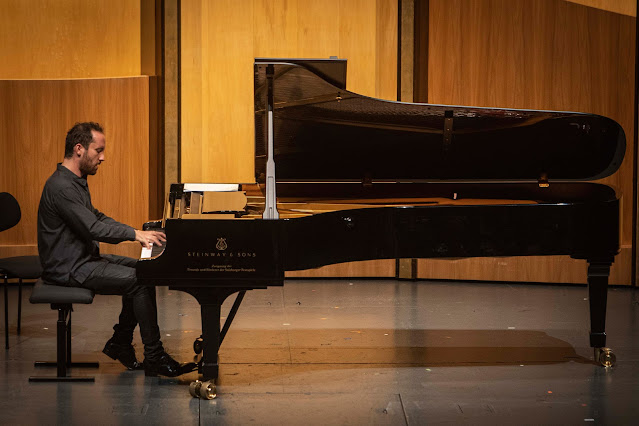
For this Salzburg Festival recital, Igor Levit offered a programme of piano music—and, in one case, orchestral music transcribed for the piano—rich in connections explicit and implicit, and beautifully balanced too. Programming is in many ways an art in itself, yet not of course quite in itself: the music needs to be performed at least as compellingly as it has been assembled. There was little problem in that respect here, given performances that never took the works in question for granted, always looked—and listened—afresh.

Bartók’s Out of Doors suite was a welcome choice to open. The drums and pipes of the opening piece gave neither pianist nor audience time to adjust. Poundingly percussive from the word go, it was always much more than that, though: melody and harmony, as ever in Bartók, at least as crucial as the initially startling melodic element. Levit understood and conveyed this, not only here but in the following pieces of very different, highly contrasted character. This suggested what a treat we might have in store from the Sonata and the Piano Concertos; let us hope they are only just around the corner. The ‘Barcarolla’ emerged as a mysterious heir to Chopin et al., those others certainly including Liszt, especially the Liszt of those lugubrious late Venetian works. I thought I heard a kinship to Prokofiev too: less expected, perhaps, but making a great deal of chronological sense. (Kinship need not mean influence in either direction.) Levit’s variety of articulation in service of the musical idea was just the thing to tease out its secrets. Delicately insistent, the ‘Musettes’ presented yet another winding, post-Romantic way, sharply contrasted by the night music of the fourth piece. Bells? Birds? Breezes? Beasts? Who knows? It was certainly Bartók, at any rate, the beating heart of the work as a whole. Independence of hands, the very foundation of Lisztian technique—well, one of the foundations, anyway—was crucial here in delineation and communication. The final piece was every inch the finale, early echoes of the opening taking us along a very different, dancing path. Fiendishly difficult and infectious, this was the piece with the most transcendental virtuosity, in Levit’s hands a veritable whirlwind.

Schumann’s Waldszenen is another set of pieces one might expect to hear more often than one does. Here, it breathed a post-Bachian air, not only in its counterpoint, but in melody, harmony, figuration, and much else. The introductory piece gently placed us in medias res: storytelling magic with an inwardness (Innigkeit) all Schumann’s own. The hunters of the second brought a degree of stormy release, ever precise, though, just as in Bach. Deceptively, captivatingly ‘einfach’ or simple, ‘Einsame Blümen’ offered as keen a note of fantasy as anything else: a note struck, in various ways, throughout the set, not least in a questing ‘Freundliche Landschaft’. In between, the dignified pathos, both directed and a little wayward, of ‘Verrufene Stelle’ hinted at a fugal mind deconstructed. A friendly wayside inn (‘Herberge’) and dignified ‘Vogel als Prophet’, the latter’s animation almost yet never quite suspended, took us into the sky before coming properly back down to earth in a rhythmically generative ‘Jagdlied’ that, in context, suggested memories of Bartók. Schumann’s epilogues are always things of wonder; here was a fond ‘Abschied’ indeed, its reluctance to close as touching as it was understandable.

Nietzsche famously declared he would not touch the score of Tristan und Isoldewithout wearing gloves. There was no doubting the dangers of its opening Prelude here, in a 1978 transcription by Zoltán Kocsis. More flexible than one would expect from an orchestra, it became a forerunner of late Liszt, ever struggling, ever becoming, endless in melody—until, that is, one realised that it was actually taking its cue from earlier Liszt, in the guise of the Sonata into which its close dissolved. We shall never finally disentangle the mutual influence and affinities of the two composers; here was a good reason perhaps not even to try, musical threads all the more dangerously intoxicating with ‘dies süsse Wortlein: und’: Wagner und Liszt.  

In that vein, the beginning of the exposition proper sounded like another chapter in the same story, beginning with Wagner, moving to those shockingly ‘new’ (even now) Liszt scales of the introduction, and new bursting forth in other, neue Bahnen, to quote Schumann on a young composer (Brahms) who certainly did not appreciate this work, allegedly falling asleep (!) when Liszt played it to him. That almost novelistic sense of pages, even chapters being turned was, I think, a particular characteristic of Levit’s performance, Liszt’s supreme Faustian bargain turned almost literally into a nineteenth-century page-turner. The composer’s formal concision can hardly be gainsaid here, but a complementary expansiveness was revealed as the other side to a coin of seemingly endless transition. There was time for grandiloquence as well as for silence; there was space for rhapsodic freedom and constructivism. (To misquote Dolly Parton, it takes a lot of organisation to sound that free.) With Liszt, especially here, several balls will often be in the air at any one time. The odd one may be dropped, but that is part and parcel of his generosity of character. With the structural outline firmly in place—there was no question as to the moment of recapitulation—there was no harm in occasionally pausing to ask a question, or even to admire the view. A divine comedy, a thoroughly Lisztian enterprise, was created before our ears. One had the sense, moreover, that it was a one-off, that a different tale would have been told on another occasion.

 With quiet dignity, the poet spoke (‘Der Dichter spricht’) for a Schumann encore. On a more modest yet not necessarily less eloquent level, Romantic rhetoric held us once again in its sway.


Sunday, 12 June 2022

Dido and Aeneas and Bluebeard's Castle, Oper Frankfurt, 5 June 2022


Frankfurt Opera House

Dido – Cecelia Hall
Aeneas – Sebastian Geyer
Belinda – Kateryna Kasper
Second Woman – Karolina Bengtsson
Sorceress – Dmitry Egorov
First Witch – Elizabeth Reiter
Second Witch – Karolina Makuła
Spirit, Sailor – Carlos Andrés Cárdenas

Bluebeard – Nicholas Brownlee
Judith – Claudia Mahnke
Prologue (on tape) – Benedek Salgo

Barrie Kosky (director)
Alan Barnes (revival director)
Katrin Lea Tag (designs)
Joachim Klein (lighting)
Zsolt Horpácsy (dramaturgy)

Frankfurt Opera Chorus (chorus director: Tilman Michael)
Frankfurt Opern- und Museumsorchester
Benjamin Reiners (conductor)


First Witch (Elizabeth Reiter), Sorceress (Dmitry Egorov), Second Witch (Karolina Makula)
Images: Barbara Aumüller


The operatic double-bill presents problems and opportunities—like any staged event, one might say, though there are of course specific cases for each genre, even vis-à-vis spoken theatre. First, at least in most instances, comes the question of what to programme together, that is assuming one has rejected the obvious solution of leaving a shortish one-act opera on its own. Practices change: we now rarely programme Salome or Elektra with another work, although once this was far from uncommon. Bluebeard’s Castle is more often heard in concert, which permits a broader range of companion pieces; in the theatre, it has also attracted ballets and even concert works, Katie Mitchell’s recent Munich staging having been presented with Bartók’s own Concerto for Orchestra. Another companion, at Salzburg, Covent Garden and the Met, has been Erwartung: the timings work well, as do the complementary dramatic trajectories. In New York, Jessye Norman played both Judith and The Woman, quite a feat. Dido and Aeneas has likewise had various operatic partners, as well as none; ENO’s After Dido, again directed by Mitchell, presenting the opera within a larger theatre piece. Only last month, I saw an HGO performance paired with John Blow’s Venus and Adonis. In our enclosed musical world, ‘early music’ all too often siphoned off as a thing-in-itself, rarely to be performed with modernist works, or even on the same instruments, one interesting dramatic solution can rarely if ever have been attempted before: Bluebeard and Dido, both treatments of a proud woman’s fate. Step forward Oper Frankfurt and Barrie Kosky, in their 2010 production (taken to the 2013 Edinburgh Festival), now revived in Frankfurt for the fourth time. 

A further major question lies in how far to connect the stagings and performances. Calixto Bieito’s pairing of Bluebeard with Puccini’s Gianni Schicchi for Kosky’s home territory of the Komische Oper Berlin presented what we might think of as a strong yet subtle combination of the two, leading connection not only through scenery but action and ideas, without forcing it. Kosky seems more content to let us do the work: no bad thing necessarily, and it may (more or less) simply reflect the differences between the works. The closest I could come to a guiding thread was use of space, physical and metaphysical. When Dido opens, we see a crowded bench, somewhat cramped, with what may be a theatre audience, or at any rate a representation of the cast and (postmodern?) society featured. There is stereotypical Kosky action, whose silliness will irritate or not according to persuasion, albeit in more of an alienating, even Brechtian way than twelve years later one might expect from him. There is, of course, cross-dressing—but in a fun slant on such gender bending, it is unclear whether the female singers who play witches (as well as countertenor Dmitry Egorov as the Sorceress) are male or female; at least it was to me. I only discovered when they sang. And in that sense, there is some impression given that liberation from a claustrophobia that stands somewhat at odds, presumably on purpose, with our post-Virgilian idea of Carthage is through music, through dance, through human (and theatrical) activity. The loneliness felt in the case of Dido and Aeneas alone on the vast expanse of the bench comes as contrast, yet within an overall sense of constriction. It is perhaps a reinvention of the classical AMOR/ROMA dilemma, not without metatheatrical elements born of, yet far from enslaved by, the old English court masque. 


Bluebeard (Nicholas Brownlee) and Judith (Claudia Mahnke)

With Bluebeard, by contrast, where one would expect to see visual, if opulent constraint, within the castle, the stage is wide-open, though its tilting revolve, leading nowhere, provides necessary boundaries. The important thing here, I think, is that nothing is overladen with attempts, necessarily unsuccessful, to conjure visually the riches of what we hear. There is good reason this opera is often given in concert. Like Bieito, Kosky understands Bluebeard as a game of sado-masochism. It is played out with restraint, though certainly not without action, simply making every action, more symbolist than realist, count. And it is open, like the stage, permitting to make what one will. Doubles of different ages come and go, participate and do not; but it is clear where the drama truly lies. 


Benjamin Reiners registered the orchestral action most strongly in Bartók, seemingly afraid to trust Purcell at what we can still with good reason consider his word, notwithstanding the complexities of textual issues three centuries on. Leading the excellent Frankfurt Opern- und Museumsorchester, Reiners traced the ebb and flow of Bartók’s score with dramatic wisdom, absorbing the fascination of detail within longer-term hearing (and playing), not unlike what we saw played out above. If lacking the razor precision and strength of tonal association of the finest accounts, there was no reasonable room for complaint here, especially with Nicholas Brownless and Claudia Mahnke on stage. Their commanding, utterly involved performances seemingly took us to the limits, straining at something beyond, again just like Bartók’s (and Béla Balázs’s) drama. Within those limits, all manner of variegation made its point just as strongly. Bluebeard’s deep, damaged vulnerability came as powerfully to the fore as Judith’s complex death wish, caught within the dictates of fate. 

When it came to Purcell, Reiners (and, to a certain extent, the orchestra) seemed more uncertain, aping what we have come to know, rightly or wrongly, as ‘period style’ without making the case for it. The results often sounded arbitrary, more fashionable than grounded, resorting to peculiar distractions so as not to sound too archaeological and thereby emerging as neither fish nor fowl, not even an alchemical combination of both. I do not think I have ever, in any variety performance, heard the second section of the overture taken at anything like such a speed. One may quibble with the suggestion by the Victorian editor (and composer) George McFarren of ‘Allegro moderato’, though it seems sensible enough to me; a modern Presto merely sounded bizarre. Other sections came across as listless, lacking necessary underpinning of harmonic rhythm. Peculiar Luftpausen were frequently inserted into vocal lines, solo and choral; whether this were a feature of the production or simply the performance, I am not entirely sure, though I had a distinct impression, so well staged were they, that it may have been the former. At any rate, they served little musical—nor, for that matter, dramatic—purpose, though some will doubtless have felt differently. Likewise addition of recorder, oboe, and percussion. (The same people who scream blue murder at a great name from the past ‘taking liberties’ with early music seem strangely content with far more musically arbitrary practice such as this, so long as vibrato is minimised and/or ‘period instruments’ are employed.)


Dido (Cecilia Hall) and Aeneas (Sebastian Geyer)

A good deal, though, was redeemed by the singing. Cecilia Hall and Sebastian Geyer made for a captivating, ill-fated pair, who used Kosky’s staging (and Alan Barnes’s evidently attentive revival direction) as a fine springboard for their own thoughtful interpretations of mood, action, and overall trajectory. Kateryna Kasper’s Belinda, Karolina Bengtsson’s Second Woman, and Egorov’s aforementioned Sorceress, all impressed in detailed performances highly invested in music, words, and gesture. The chorus responded similarly well to demands both of score and production. Much, then, to enjoy—and on which to ponder.


Tuesday, 1 March 2022

’20 Sonatas’ – Stefanovich: Bach, Soler, Scarlatti, CPE Bach, Ives, Bartók, Eisler, Hindemith, Scriabin, Roslavets, Janáček, and Ustvolskaya, 27 February 2022


Queen Elizabeth Hall

Bach: Sonata in A minor, BWV 965, after Reincken
Soler: Sonata in C minor, R.100
Busoni: Sonatina seconda
Scarlatti: Sonata in C minor, Kk.158; Sonata in G major, Kk.13
CPE Bach: Sonata in G minor, Wq.65/17
Ives: Three-Page Sonata

Scarlatti: Sonata in C major, Kk.406
Bartók: Sonata, Sz.80
Scarlatti: Sonata in G minor, Kk.450
Eisler: Sonata no.1, op.1
Soler: Sonata in D-flat major, R.110
Hindemith: Sonata no.3 in B-flat major

Soler: Sonata in G minor
Scriabin: Sonata no.9 in F major, op.68, ‘Black Mass’
Scarlatti: Sonata in G minor, Kk.8
Roslavets: Sonata no.2
Scarlatti: Sonata in B minor, Kk.87
Janáček: Sonata in E-flat minor, 1.X.1905, ‘From the Street’
Ustvolskaya: Sonata no.6

Tamara Stefanovich (piano)

Twenty piano sonatas over three fifty-minute-long recitals; avoiding the ‘core’ Classical and Romantic (broadly speaking) repertoire, from Haydn to Liszt; asking why composers might time and time again have returned to this genre, if indeed it can be considered the same genre at all. What would you choose? Why? There are no answers, of course, or rather no definitive answers, only an almost infinite host of opportunities. Such is the embarrassment of riches, usually a blessing but just occasionally a curse, of the piano/keyboard repertoire more generally. Tamara Stefanovich’s selection proved typically imaginative, committed, and both spiritually and intellectually nourishing, as well as an outstanding feat of musicianship and pianism.

The first selection began with Bach. (Does not everything?) Here we heard him in the sonata ‘after’ Johann Adam Reincken’s Hortus Musicus trio sonatas: some distance, perhaps, from what we generally think a sonata to be, but perhaps that was part of the point. No one would deny the glories of Haydn, Mozart, Beethoven, Schubert, et al., but they can sometimes obscure other paths, especially earlier ones. Stefanovich left us in no doubt that this was a performance for the piano. (If you want to give a harpsichord performance, surely you should do that on the harpsichord.) Voicing gave the sense of a small orchestra at her disposal, a flute answering an oboe, a cello a viola. ‘Ornamentation’ was shown to be melody. There was declamatory joy, a strong sense of harmonic motion, and throughout a vivid, directed performance, culminating in a splendidly ‘present’ Gigue. Antonio Soler offered a very different voice, with both greater pathos and lightness. Stefanovich’s performance drew one in to listen. Busoni’s Sonatina seconda grew out of its close. Restless, diabolical, or better Faustian, it took us to the edge of atonality in a performance of virtuosity entirely at the service of the music, recalling what we know of Busoni's own pianism. Long-range coherence and incident of the moment were two sides of the same coin. 

Domenico Scarlatti made the first of several appearances, with a finely contrasted pair of sonatas (as we often hear his music). The first notes of the C minor Sonata, Kk.158, sounded truly disorienting, emerging as they did from Busoni. Where were we? In a liminal zone, so it seemed, in which eighteenth-century tonality reassembled itself. Both performances seemed thought out from first principles, from individual materials. What joy there was to be had in hearing the second’s repeated notes (more difficult on the piano than they sound). A sonata by CPE Bach, in G minor, followed. Its opening benefited from the grandest, most magnificent opening to a work of his I can recall, rhetoric harnessed as if to the rise of a velvet curtain. The first movement’s fantasia-like swings of mood and material were disciplined, just about, into a whole, yet never too much. This justly lived on the edge. The central Adagio sarabande, still duly involved, nonetheless offered some sense of relief, its arioso quality finely captured. The sheer strangeness (Sturm und Drang, one might call it, I suppose) of the third movement was again relished, never tamed. From one avant-gardist to another, we moved to Charles Ives’s Three-Page Sonata. Strikingly Schoenbergian language—close, not identical, and only for a moment or two—unleashed a parade of restless, radical, and wry freedom, whose chimes were almost the least surprising feature. The vehemence of disciplined chaos to its close made it almost impossible, had I not seen it for myself, to credit that there were only two hands at work here. 

The second recital was announced by Scarlatti: full of incident and pictorial character and contrast. ‘Percussive’ is a word we often hear used to describe Bartók’s piano-writing. One can understand why, but in reality it begs still more questions. (No bad thing.) For here, in his strangely neglected Piano Sonata, there were such profusion of melody, such variegation in the entirely unfussy weighting of each chord, propelled by rhythm and harmony alike, it seemed more than usually inadequate. A relentless first movement paved the way for a second of equal (at least) emotional intensity. The finale was every inch a finale in its substantive release. Rightly, for the first and only time within a recital, the pianist paused for applause. Returning to Scarlatti, it was fascinating to hear his repetitions and other, lighter obstinacies through the shadow cast by Bartók. 

Hanns Eisler’s opus one brought us fascinatingly close in its first movement to the language of the serial Schoenberg, yet held its distance too: more skittish, Scarlatti an excellent preface. Structure on paper became living form in liquid performance. Prokofiev seemed close at times too, perhaps particularly in the second of the three movements, its line unerringly traced and projected. The care and abandon with which not un-Schoenbergian idiosyncrasies were integrated in the finale typified the performance as a whole. Following an unexpectedly fragrant ornamental flowering from Soler, its harmonies taking a while to get used to after Eisler, we moved to Hindemith’s Third Piano Sonata. In its first movement, siciliano rhythms immediately standing out, they sounded as if formed by their surrounding harmonies. A scampering scherzo and two deliberate yet purposeful movements to follow led us to a sense of hard-won victory. 

Soler opened the third and final instalment: courtly yet capricious, ornamentation speaking of a freedom of which we stand in greater need than ever. Scriabin’s ‘Black Mass’ Sonata suggested dissolution as another, more dangerous form of emancipation, even through the burning fire of Bakunin-like anarchism (very different from Ives’s). There was wayward alchemy, though, and direction to be appreciated looking backwards from where we had come, even if we were uncertain at the time where we were heading. Command of detail was crucial to that greater sweep, just as it was in the dignified pathos of the Scarlatti sonata that followed. The post-Romantic constructivism of Ukrainian Nikolai Roslavets took a different path from Eisler (or Schoenberg) yet could nonetheless be felt as something of an antidote to Scriabin. There were moments of languor, yes, but motivic construction and transformation won out. Once more, the strangeness in context of Scarlatti’s harmonies was to be relished as a pendant.

Janáček’s Sonata, 1.X.1905 could hardly fail to have particular resonance given the state of the world around us. It went beyond that, though, in a moving performance of proud dignity and deeply communicative humanism, fusing the subtle and the direct. Its second movement was more songful, yet no less impassioned, through rather than despite its fragile nerve endings. For the final work of the day, Stefanovich donned black gloves to tackle the immediate yet reflective violence of Galina Ustvolskaya’s 1988 Sonata no.6. More unremitting than Bartók, blacker than anything we had yet heard or wished to hear, it duly bludgeoned, yet spoke of and with an integrity that refused to offer easy answers. Was there, perhaps, a glimmer of hope in there somewhere? It was probably something more equivocal than that. And then it was gone.


Saturday, 15 January 2022

Bavouzet/Shishkin: Debussy, Liszt, Bartók, and Ravel, 13 January 2022


Wigmore Hall

Debussy, arr. Ravel and Kocsis: Nocturnes
Liszt: Concerto pathétique, S 258
Bartók, arr. Kocsis: Two Pictures, op.10
Ravel: La Valse

Jean-Efflam Bavouzet, Dmitry Shishkin (pianos).

A difficult choice, this: Jean-Efflam Bavouzet and Dmitry Shishkin in a fascinating programme of two-piano music at the Wigmore Hall, or Lise Davidsen and Leif Ove Andsnes in Grieg, Strauss, and Wagner at the Barbican. It is difficult to imagine those attending the latter having been disappointed; at any rate, having tossed a coin in favour of the former, I was not. 

First, we heard Debussy’s Nocturnes. I honestly would never have guessed the opening of ‘Nuages’ had not been written for two pianos, rather than transcribed by Ravel, had I not known: testament, surely, both to arrangement and performance. (I am not sure we need worry in this context about differences of meaning between ‘transcription’ and ‘arrangement’.) We heard a wonderful freedom within metre. Darkness of ambiguity seemed, if anything, enhanced by the sound of two Yamahas rather than orchestra. Dynamics, tempo, balance, shaping: all convinced and had one think they could not have been improved on. ‘Fêtes’ sounded more different from the original, more ‘transcribed’, but that was surely the nature of the material, rendered into piano monochrome. It was a sharp, lively performance, occasionally percussive, having me think at times of Bartók. ‘Sirènes’, which Ravel also transcribed but which he admitted to having found especially difficult, was here given in a transcription by Zoltán Kocsis. I did not realise this until afterwards, but I admit to having first found the arrangement sound closest to Ravel himself (so much for my ears!) and thereafter the most enigmatic of all, which is doubtless as it should have been. In performance, there was languor enough, though it always sounded directed. 

The genesis of what we heard from Debussy, Ravel, and Kocsis was not entirely straightforward. Essentially, Ravel transcribed ‘Sirènes’ first, to accompany the first two movements, as already transcribed by Raoul Bardac. Then, eight years later, Ravel added his own versions of ‘Nuages’ and ‘Fêtes’, whilst Kocsis’s ‘Sirènes’ dates from seven decades later. However, Liszt’s Concerto pathétique is arguably more complicated (not atypical, for a composer who tended to move on quickly, creating multiple versions, rather than chiselling away at a single work). At any rate, having passed through two solo piano workings of this material, the latter far closer to the two piano version than the first, Liszt rightly settled on two pianos as offering the superior medium for the concerto contrasts of this material. Such was clear from the grand, even grandiloquent, virtuosic opening dialogue; but it was also readily apparent in melting towards more tender sounds. The sheer weight of sound impressed at times, though even then it was never monolithic. Bavouzet and Shishkin imparted a strong sense that Liszt’s music might readily have been orchestrated, but also kept one happy that it had not. It sang too, as only Liszt can. If the roulades sometimes stand on the edge of absurdity when heard for two pianos, they were despatched with conviction, glitter, and crucially, heart. Sometimes, it was difficult to credit that there were only two pianists at work. From a pianistic standpoint, this was little short of stupendous, Liszt’s rhetoric harnessed and sublimated. 

Bartók himself arranged his Two Pictures, op.10, for solo piano. Kocsis extended the idea to two pianos. It was quite a revelation to hear: imaginative and faithful, above all pianistic. ‘In Full Flower’, the first picture, sounded, just as much as in orchestral guise, as though it were well on the way to Bluebeard’s Castle, in a performance of sad nobility. Both muscular and tender, often both, it did Bartók and Kocsis proud. ‘Village Dance’ was thrillingly responsive—and responsorial. This performance captured to a tee so many facets, melodic, harmonic, metrical, and more, of Bartók’s style and meaning. Lisztian and other inheritances were refracted, remoulded, even bent to new ends. ‘New wine demands new bottles,’ as Liszt once put it.

La Valse rumbles in a different yet no less ‘authentic’ way in its two-piano version. It was fascinating to hear that opening in the aural light of Bartók. Bavouzet and Shishkin conveyed with relish Ravel’s inflections of Viennese lilt, not necessarily as one would expect with an orchestra, but on their pianos’ own terms. Perhaps there was greater extremity here; there were certainly different sounds and implications. And what a feast, again, of pianism. As an encore, we heard Ravel’s early Sites auriculaires in two short movements. A slinky ‘Habanera’ prefaced a barnstorming ‘Entre cloches,’ its spatial qualities splendidly realised.


Wednesday, 9 June 2021

Waterloo Festival (3) – Doric String Quartet: Schubert, Bartók, and Mozart, 8 June 2021

St John's, Waterloo

Schubert: Quartettsatz, D 703
Bartók: String Quartet no.3, Sz. 85
Mozart: String Quartet no.23 in F major, KV 590

Alex Redington, Ying Xue (violins)
Hélène Clément (viola)
John Myerscough (cello)


Images: Matthew Johnson


With such a programme, one might have been back at the Wigmore Hall. Indeed, many are already. It is a hallmark of Anthony Friend’s achievement in his Spotlight Chamber Concerts that all combinations of artists and programme I have heard might readily have taken place in London’s—many would say the world’s—finest chamber music venue. This evening was the turn of the Doric String Quartet, in Schubert, Bartók, and Mozart.


Schubert’s Quartettsatz is a popular recital-opener the world over. However many times one has heard it, it seems always to retain its allure and fascination. This was an unusual performance, unlike any I can recall, a frozen opening thawing somewhat, yet never to the extent of sounding what we might call ‘traditional’, let alone ‘Viennese’. If the tonal palette were somewhat restricted, there were great contrasts nonetheless to be heard within its selected constraints. There was much pent-up fury, so it seemed: a performance, perhaps, for our times. If I cannot imagine always wanting to hear Schubert like this, it was certainly preferable to lazy Gemütlichkeit.


Was that relative astringency in some sense preparation for Bartók? Not really, for it was quite rightly a very different world we entered with his Third Quartet: a different kind of ice, a different kind of febrility. Process stood more closely to the fore: doubtless a reflection of the work itself, but also of the performance. The palette here was broader, both in tone and dynamic contrasts. The players showed a keen collective—and individual—ear for detail and its place in the greater whole. If sometimes one felt on the brink of chaos, there was no doubt this was an organised chaos, drama lying in the shards of light, the cracks between notes, as much as in Bartók’s well-nigh Mozartian profusion of melody and, crucially, its relationship to harmony. Syncopation and other rhythmic devices propelled that drama, but never alone.


I often missed that relationship between melody and harmony and the consequent harmonic motion that creates dynamic form in the performance of Mozart’s late F major Quartet, KV 590. Clearly the Doric players hear Mozart differently from me, their favoured light, silvery, broadly ‘period’ tone—post-Harnoncourt, one might call it—very different from my ideal (or default). That, however, is no bad thing; one should always be prepared to examine and re-examine one’s preconceptions and prejudices. Their approach is in any case far from dogmatic: there was strikingly warmer playing from all concerned too. It was more what I heard sometimes as a strange lack of direction that puzzled. That said, there was much to admire in each movement: the first a model of conversational playing; the second swift yet intriguingly chaste, enigmatic, even introverted. The third offered splendid emotional intensification in its trio, whilst the fourth was full of incident in its almost helter-skelter progress. I never heard it smile, though. The lack, moreover, of an identifiable—to me—pulse had the music sound increasingly listless. For me, this was quixotic Mozart, but it drew me in to listen, above all in the intensity of passages taken sotto voce. It also had me think.

Sunday, 27 October 2019

Aimard/BPO/Roth - Haydn, Bartók, and Varèse, 26 October 2019


Philharmonie

Haydn: Symphony no.59 in A major, ‘Fire’
Bartók: Piano Concerto no.3, Sz 119
Bartók: Dance Suite, Sz 77
Varèse: Arcana (revised version, 1960)

Varèse: Poème électronique; Ionisation; Density 21.5; Octandre; Intégrales; Hyperprism; Ionisation; Octandre; Offrandes

Pierre-Laurent Aimard (piano)
Sarah Aristidou (soprano)
Berlin Philharmonic Orchestra
Scholars of the Karajan Academy
François-Xavier Roth (conductor)


Two Berlin Philharmonic concerts in a single evening: such is the cultural desert we know as Berlin. For the first, we heard Haydn, Bartók, and Varèse from the full Berlin Philharmonic, Pierre-Laurent Aimard, and François-Xavier Roth; for the second, Roth and members of the orchestra were joined by scholars of the orchestra’s Karajan Academy, a few guest instrumentalists, and soprano, Sarah Aristidou for late-night Varèse that went beyond a mere ‘bonus’. Both concerts proved enlivening and edifying: complementary, yes, yet eminently satisfying in their own right.


Haydn’s Symphony no.59 received, sadly yet far from surprisingly, its Berlin Philharmonic debut. (That is not intended in any sense as a criticism of this orchestra; I imagine it would be the same for many others.) Is there a composer so fundamental to the canon – other, perhaps, than Schoenberg or Webern? – so scandalously neglected? The orchestra and Roth certainly made up for lost time, in a performance as fizzing as it was thoughtful, as charming as it was enthralling. A vigorous opening movement, full of life, released nervous energy rather than – in the manner of so many current Haydn performances – trying to impose it upon the music. Line and disjuncture were revealed to be too sides of the same coin; Beethoven certainly did not come from nowhere. It was full of surprises, even for those who might have ‘known’, so long as one listened – which listening was certainly invited. Harpsichord continuo, so discrete one could barely hear it, was employed, for those who care about such matters. The second movement sounded elegant, yet strange: nothing taken for granted, whether by Haydn, Roth, or the players. Balance or dialectic between counterpoint and harmony? That was the question key to both work and performance. Haydn’s ingenuity is and sounded extraordinary, without exaggeration. Likewise in the minuet, whose structure many, foolishly, might consider merely conventional – that is, again, until they listen. A sotto voce move to the trio again took us by surprise, drawing us in further to savour Haydn’s tonal delights. The finale was everything a finale should be, not least in its brazen particularity. Berlin horns in particular thrilled, but really, this was a showstopper for all concerned. How could one not adore such music, when taken on such a journey, with such twists and turns, and in such expert hands?


Bartók’s Third Piano Concerto has long been a problem work for me. Although it was the first I heard, thrilled by a performance I heard as a schoolboy at Sheffield City Hall – I cannot recall by whom – I have, almost ever since, responded far more readily to the First and Second. I might have known that Pierre-Laurent Aimard and Roth would be the musicians to change that. With this performance, it suddenly made sense to me and I could no longer understand what my difficulties might have been. Exceptional keenness at the opening, from orchestra and soloist alike, promised much and was fulfilled. Again, nothing was taken for granted; again, we were invited, in eminently collegial fashion, to listen, rather than bludgeoned into doing so. (That is partly the nature of the music, of course. There would have been nothing wrong with, say, Beethoven or Mahler compelling us to do so in different fashion.) What struck me, in this first movement and throughout, was the revelation of listening to (this) Bartók in the light of Haydn. Indeed, listening to the relationship once more of harmony to counterpoint, in a not entirely dissimilar way, was invaluable to finding that key to the door that was not Bluebeard’s. Aimard’s phrasing and voicing were second to none: never prominent for their own sake, always in the service of musical expression. This was, moreover, a true partnership between conductor, soloist, and orchestral musicians, all listening to and responding to one another; audience too, it seemed.


There was an almost neoclassical chasteness to the opening of the second movement, Aimard’s responses to the orchestra almost akin to those of the piano in the slow movement of Beethoven’s Fourth Piano Concerto, less taming the Furies, if we recall Tovey’s evocative characterisation, than beginning to thaw the intriguingly Stravinskian ice. The night music was both contrasted and rooted in what had gone before, again recalling Haydn’s moves; fantastical and not without the occasional hint of Ravel, it sounded newly strange and yet ultimately familiar. The finale erupted with perfect yet never predictable logic, as if to say, yes, the old Bartók is still here; that is, before it took another, related path, once again bringing Haydn’s surprises to mind. Bartók as Classicist? No. Bartók as fresh renewal of the Classical? Quite probably.


Following the interval, Bartók’s Dance Suite – first played by the orchestra under Furtwängler, most recently under Boulez – was immediately characterised by a similar freshness, rhythms sharply etched yet, crucially, never considered separately from other parameters. This was dance music, one might say, rather than musical dance. Flexibility, where apt, was as noteworthy as drive. The Berlin Philharmonic sounded at its most magnificent when truly unleashed, but this was a multi-faceted performance, of fantasy, charm, balletic moves, and ebullience.


Varèse’s Arcana was given its German premiere by the Berlin Philharmonic in 1932, conducted by Nicolas Slonimsky. Its 1960 revision was last heard here as recently as 2016, under Andris Nelsons. Roth proved a worthy successor, setting up a clear, anticipatory opposition and complement between the stark and the fantastical. The Stravinsky of the Rite, but even of the Firebird, was far from dead, but much the same might have been said of Romanticism. It is easy to think of Varèse in such terms in the abstract; it is not always so easy to hear him as such. Here, in a beautifully upholstered performance, a delightful, structured starscape emerged, twin riots as well as rites of spring heard – even, perhaps, seen – in simultaneity. Or was it more summer? Roth’s tracing of the work’s logic and illogic was, at any rate, vividly communicated.


We returned to the hall a little later for Varèse’s Poème électronique. There remains something a little strange to a concert hall, a space for performance, as home for a work without performers (at least in the conventional sense). Percussionists and conductor filled the gap, in a way, entering the hall ready for the following Ionisation, Roth pressing the button on the laptop onstage for the beginning of the electronic poem first ‘performed’ at Expo 58’s Philips Pavilion, designed by Le Corbusier and Xenakis. Now we sounded closer to Stockhausen, though these sounds, this music, could never be mistaken for his. The spatial element was undeniable, of course, but only as part of something more. This was, it seemed, in a very different way both from Arcana and Sirius’s most celebrated son, music of the stars. Memories, the illusion of a heavenly, electronic ‘ensemble’ and much else combined – both just as musical instruments and performers might, and quite differently from anything they might have accomplished.


Ionisation emerged from its shadows – or rays. It was fascinating, disconcerting, even amusing to hear the siren sound as if it were still part of this piece’s fading predecessor, though that fading had, in fact, already ceased. One made connections: perhaps above all of ritual. The hieratic quality heard here, as later with Intégrales in particular, was, however, quite different, revealing a very different musical conception and narrative. Was this a controlled riot, or a riot out of control? As with Varèse’s successor, Boulez –Roth seemed especially sensitive to that affinity – it was difficult, perhaps impossible to tell. Then, before we knew it, Density 21.5, for solo flute, was heard from on high. Initially seductive, Debussyan, in a way that seemed to extend beyond mere sentimental identification with the instrument, it announced the importance of timbre and then revised that initial assessment, suggesting that it had, in fact, been little more than sentimental. For soon, we sensed what the two works had in common too: a fascinating, telling juxtaposition.


Octandre’s instrumental timbres engendered not only different expectations but the musical material itself. It is, in reality, a game of chicken-and-egg, not least since the distinction is arguably false, but such was the impression in context here. The music’s aggression was palpable and powerful, tension at times close to overwhelming. I am not sure that I have heard a double bass sound stranger, and yet I am equally unsure that I could say why.


The starkness of hieratic ritual in Intégrales seemed to foreshadow Birtwistle, albeit initially without explicit, perhaps even implicit, violence. Not that that could be said at the close, growth and transformation powerfully conveyed in an exceptional, disconcerting performance. One might have thought Hyperprism would sound dissimilar; but no, as in the case of, say, two Haydn symphonies written for similar forces, the musical invention was revealed to be very different. Instruments in themselves, we learned, do not create the material: as important a lesson in listening as in composition. Aristidou duly complemented and contrasted with the players for the closing Offrandes, the first song oracular, the second losing its mooring in the ‘old’, whatever that may have been. It was, like its predecessors, a detailed and compelling performance. It asked what might have been, had Varèse taken a different path, and also confirmed the rightness of that he did take: not unlike, then, the rest of this evening’s music-making.


Tuesday, 10 September 2019

Boulez Ensemble/Barenboim: Beethoven, Bartók, and Boulez, 9 September 2019


Pierre Boulez Saal

Beethoven: Sonata for horn and piano in F major, op.17
Bartók: Sonata for two pianos and percussion, Sz 100
Boulez: sur Incises

Radek Baborák (French horn)
Karim Said, Denis Kozhukhin, Michael Wendeberg (piano)
Aline Khouri, Susanne Kabalan, Stephen Fitzpatrick (harp)
Lev Loftus, Dominic Oelze, Pedro Torrejón Gonzáles (percussion)
Daniel Barenboim (piano, conductor)


Two-and-a-half years after the opening of Berlin’s Pierre Boulez Saal, in a programme climaxing in Pierre Boulez’s sur Incises, the hall’s resident Boulez Ensemble, drawn from members of the Staatskapelle Berlin and West-Eastern Divan Orchestra, returned, neither for the first time, nor, I suspect, for the last, to a work that seems almost to define not only the performing space, not only its memories, but just as much its potentialities. In that, it takes its leave from Boulez’s own method of proliferation, his own pattern of works-in-progress, his own incomparable, endlessly proliferating legacy for all musicians and music-lovers, and indeed for all those interested in reimagination of performing spaces in the line of Boulez’s cherished concept of the salle modulable.


First, however, came two other Bs: Beethoven and Bartok; and a third, that other presiding musical presence of the Boulez Saal: Barenboim. What a joy it was not only to hear Beethoven’s Horn Sonata, op.17, but to hear it in such an enlightened performance, from Radek Baborák and Daniel Barenboim. A horn call as forthright as it was perfectly judged of tone seemed the perfect way to open a new season: rooted not only in the Austro-German musical past, but in Beethoven, a prelude to next year’s anniversary. (And if people do not like that prospect, they should, quite frankly, stop their childish posturing and grow up.) Barenboim’s melting, post-Mozartian response reminded us why he stands as one of the very few great Beethovenians alive (indeed the only one, as conductor). A few first movement exposition smudges, of interest only to carpers, were banished upon the repeat. What mattered was Beethoven’s spirit, revealed in a performance of perfect balance and tempo, the latter flexible, yet never drawing attention to itself in the subtlety of that flexibility. It was, above all, a performance grounded in harmonic understanding, without which all else will be in vain (and more than often is, in contemporary Beethoven performance). The recapitulation brought a fine sense of return, and some magically soft playing, Baborák’s phrasing, here and elsewhere, to die for. A gravely beautiful, properly vocal Poco adagio quasi andante led to a finale that proved, again, quite perfectly judged in its post-Mozartian spirit. Darker passages told, albeit without exaggeration, in an account both poignant and ebullient.


It was a welcome occasion indeed to hear Bartók’s Sonata for two pianos and percussion: not only as precursor to sur Incises, but also in relation to Peter Eötvös’s Sonata per sei, heard the previous day at the Berlin Philharmonie’s Kammermusiksaal. The first movement’s opening, imbued with suspense, erupted in well-nigh Boulezian éclat; and again, although quite rightly, differently. This was to be a performance that surprised, even when one ‘knew’: that is to say, it was to be a performance in the emphatic sense, pianists, Michael Wendeberg and Denis Kozhukhin, and percussionists, Dominic Oelze and Lev Loftus, alike revelling in the potentialities of live thinking and communication. Bartók’s music was made strange in the best sense, these fine musicians riding a defiantly untamed tiger and (more than) living to tell the tale. How inevitably. The score unfolded, grew, developed, taking in predecessors such as Beethoven and Bach in a sense extending far beyond the relative banality of ‘influence’. Its spatial element, prophetic for Boulez among others, felt especially immediate in this space. Inevitability – not in the sense of dullness, but a ‘rightness’ that, in retrospect, could not have been other – characterised the slow movement too, percussion processional joined by Wendeberg, then by Kozhukhin, in playing of almost Mozartian perfection (not only the pianists!) Form dramatically revealed itself; so too did the wildest, most compelling of night music. As in the Beethoven sonata, the final movement proved in every sense a finale, almost as fascinating to watch – for instance, how the percussionists, sometimes unexpectedly, shared their load – as to hear. Counterpoint lived and thrilled in a performance that was not remotely safe, and was all the better for that, culminating in a splendidly witty and beguiling close.


sur Incises has many roots: most obviously in the solo piano piece, Incises (written originally for the Umberto Micheli Piano Competition, with which Maurizio Pollini had a strong association). Boulez’s first intention, as he explained in a 1998 interview, was to ‘transform this piece into a longer one for Pollini and a group of instrumentalists, a kind of piano concerto although without reference to the traditional form.’ Other ghosts reared their head, though, such as Bartók’s Sonata and Stravinsky’s Les Noces. In this context, unsuprisingly, Bartók offered a strong point of departure – opening similarly, yet differently, de profundis – yet, as with so much of Boulez’s music, it was his conception of serialism as open-ended, ever-expanding, that dazzled. The spatial element is, of course, crucial. Here, again, it was greatly assisted by the hall and its acoustic, enabling us not only to hear but truly to feel the interplay between the ensemble as a whole (a giant reinvention of the piano, one might say), solo lines, and differently constituted groups within: three groups, considered vertically, each of percussion, harp, and piano, and, horizontally, the three percussionists, the three harpists, and the three pianists. Here, in the line of Boulez’s – and Barenboim’s – beloved Parsifal, not only did space become time, both became music. The way a trill passed across all three piano keyboards, Wendeberg and Kozhukhin joined by the equally excellent Karim Said, would offer but one case in point. Magic squares sensual, musical, conceptual, above all thrilling played themselves out and reinvented themselves before our eyes and ears (the ‘thinking ear’, as the hall’s motto has it). Whatever the antecendents, it was vividly clear that Boulez’s own proliferating method of generation actually had little in common with either Beethoven or Bartók; likewise his, and Barenboim’s, control of liminal suspense and propulsive release. The work, like the two that had preceded it, passed as if in no time, whetting the appetite for more, much more, in the weeks, months, years to come. This hall and the events within, then, continue as a work-in-progress, very much in Boulez’s sense.


Monday, 19 August 2019

Salzburg Festival (4) – Ottensamer/Camerata Salzburg/Viotti: Bartók, Weber, Koncz, and Kodály, 17 August 2019


Grosser Saal, Mozarteum

Bartók: Music for Strings, Percussion, and Celesta, Sz 106
Weber: Clarinet Concerto no.1 in F minor, op.73
Stephan Koncz: Hungarian Fantasy on Themes by Carl Maria von Weber, for clarinet and orchestra
Kodály: Dances of Galánta

Andreas Ottensamer (clarinet)
Camerata Salzburg
Lorenzo Viotti (conductor)


A deeply frustrating concert, this: a fine orchestra and fine soloist, let down by odd programming and, more seriously, a conductor who only intermittently impressed. Mine, it is fair to see, was very much a minority view, the audience rising to give Lorenzo Viotti a standing ovation.


Bartók’s Music for Strings, Percussion, and Celesta opened with great promise, its first movement involving and intriguing. Musically, it was the highpoint of the concert, though the Weber First Clarinet Concerto, a considerably lesser work, could hardly be faulted in performance terms. Veiled yet clear from the outset, the Camerata Salzburg strings grew in muted – and then non-muted – intensity. Viotti guided them with skill and evident commitment, Bartók’s structure readily becoming form. There was a welcome physicality to the second movement, not only concerning rhythmic impact but of bows on strings: once again, the orchestra was on superlative fault. Corners, however, were more of a difficulty, Viotti communicating little of how the movement’s sections were connected, a problem that only increased throughout this admittedly difficult work. Eerie ‘night music’ passages registered vividly in the third movement, which, to be fair, also generated a good deal of harmonic and dramatic suspense, so long as one listened only a section at a time. There was a welcome sense of the dance to the finale, or at least to its opening. Overall line, however, eluded me.


Joined by Andreas Ottensamer for the Weber concerto, the orchestra and Viotti gave what was overall their most satisfying performance. Some might have found Viotti’s moulding of the first movement’s Romantic drama a little much, but it was a perfectly justifiable aesthetic stance to take, evoking responses from Ottensamer both surpassingly virtuosic and intensely dramatic. Phrasing and articulation here and in the remaining two movements were splendidly judged, the slow movement characterised by deeply-felt lyricism, tone variegated without affection, the finale winningly propelled with an Italianate verve that may not have been especially profound, but which was very much in keeping with music that neither asks for nor requires profundity. For Weber music that does, we turns generally to the final three operas, a flash from which – Der Freischütz – opened Stephan Koncz’s Hungarian Fantasy on Themes by Carl Maria von Weber. As a vehicle for Ottensamer’s virtuosity, it did its trick. Musically, it seemed to me quite without interest, mostly written in a language that would hardly have been avant-garde two hundred years earlier. Not everything need be Helmut Lachenmann, but it is difficult to imagine Weber writing straightforwardly in the style of Monteverdi, minus the content. It went on for too long simply to be a throwaway encore.


As for Kodály’s Dances of Galánta, they have their fans; I remain uncertain quite why. At any rate, they seem dangerous to programme alongside a Bartók masterpiece. Camerata Salzburg’s playing was again beyond reproach, impeccable in balance and blend, heft and subtlety. Viotti responded well to the needs of characterisation. I am not sure his habit of pulling them around did them any favours either, nor his placing emphasis so strongly on the ‘Romantic’ side. They are what they are, though, and the audience clearly enjoyed them, as it did the encore: a swashbuckling account of Brahms’s Hungarian Dance no.1 in G minor.