Showing posts with label Katharina Wagner. Show all posts

Saturday, 10 August 2019

Bayreuth Festival (1) - Tristan und Isolde, 9 August 2019


Festspielhaus


Tristan – Stephen Gould
Isolde – Petra Lang
Kurwenal – Greer Grimsley
Melot – Raimund Nolte
Brangäne – Christa Mayer
Shepherd, Sailor – Tansel Akzeybek
Steersman – Kay Stiefermann

Katharina Wagner (director)
Frank Philipp Schlößmann, Matthias Lippert (set designs)
Thomas Kaiser (costumes)
Daniel Weber (dramaturgy)
Reinhard Traub (lighting)

Bayreuth Festival Chorus (chorus master: Eberhard Friedrich)
Bayreuth Festival Orchestra
Christian Thielemann (conductor)


A frustrating evening, this, as Tristan performances tend to be. Wagner, notoriously, wrote to Mathilde Wesendonck: ‘I fear the opera will be banned – unless the whole thing is parodied in a bad performance –: only mediocre performances can save me! Perfectly good ones will be bound to drive people mad, – I cannot imagine it otherwise.’ I used to sympathise with that melodramatic claim, the work having affected me so deeply, so frighteningly, even in performances that fell somewhat short, especially vocally. Now, however, following a series of disappointments, to which only one recent staging has proved (mostly) an exception, I think I might prefer to be driven mad, in this particular sense, once again.


Oddly, given my early experiences of the work and of Tristan’s role in particular, this had most to be said in its favour in vocal terms. I shall pass over those first Tristans I heard, other than to say that they had me wonder whether I should ever hear someone capable of singing the notes, let alone singing them well, someone capable of making it through the first act, let alone all three. There has never been a golden age of the Heldentenor; the beast has always been rare, even at times apparently extinct. We do not fare badly at the moment, though. Stephen Gould can certainly sing the role – and sing it he did, without audibly tiring. Tristan’s third-act agonies were underplayed in what was overall a relative sensible portrayal, but better that than the agonies of quite a different, unintentional kind to which many of us have frequently been subjected. Petra Lang’s Isolde, if often overacted – this may have been Katharina Wagner’s doing – offered impressive response throughout to music, words, and what is here their ever-mysterious union. Her voice is deeper than one generally hears, with more of the tone, at times clarinet-like, and character of a mezzo-soprano (her original Fach). That, it seems to me, is all to the good. She certainly had one listen to the performance in the here and now, not to some all-too-readily (mis)remembered ‘great recording’ of the past, from which anything actually existing would doubtless fall short. Though a mezzo, Christa Meyer sometimes sounded more soprano-like than Lang. Again, no harm was done by this, slightly disconcerting though the initial impression may have been. Her performance and Greer Grimsley’s as Kurwenal were both marked by similar virtues, and less by strange melodramatic gesture. Georg Zeppenfeld’s Marke could hardly be bettered. It is a gift of a role – to those with the necessary instrument and intelligence. Those Zeppenfeld has in spades; here he left us in no doubt of that. Tansel Akzeyebek shone both as the Young Sailor and Shepherd: sweetly pleasing of tone, his singing recalled to us, at least to me, fine performances as Froh in Frank Castorf’s Ring.


What, then, of Katharina Wagner’s production, which I previously saw three years ago, in 2016? (I shall not re-read what I wrote until after posting.) It has some ideas to it: some of them odd, even perverse, ones, but good can come of it. How they cohere into anything not considerably less than the sum of its parts remains, I am sad to say, beyond me. Incessant insistence on activity, often for nothing more than its own sake, or so it seems, detracts from them – and is surely out of place in this of all operas, whose dramatic stuff is metaphysical or it is nothing. (A partial exception would be the previously trailed production by Dmitri Tcherniakov for the Staatsoper Unter den Linden: unique, in my experience, for attempting and, in large part, succeeding in its presentation of something different.) Whatever is going on here – truth be told, I am not entirely sure – it is certainly not metaphysical. Fair enough: let us try something materialist instead. Materialism, after all, is a strong current not only in nineteenth-century history but in our own time too. But whose materialism is it anyway? Feuerbach’s? The natural sciences’? That of Friedrich Albert Lange’s once-influential History of Materialism and Critique of its Present Importance? Unclear, I am afraid. It veers all over the place, less eclectic than in need of an editor.


Madness – recall Wagner’s caution to Mathilde Wesendonck – comes to the fore in the first act and never quite leaves us. It is a construction, of course; surely we are all to that extent Foucauldians now. Set designs often make that clear: a cruel, constantly changing labyrinth in the first act, brutal, Marke-directed surveillance in the second. Perhaps Isolde’s outsize, ‘operatic’ gestures are a reaction to that. Perhaps – but frankly, they seem more a decision to do something, pretty much anything. Dramatic confusion over what the couple may be doing rather than drinking the love potion can doubtless be justified: I have come up with a few tentative explanations myself. However, none of them feels justified, anything more than a post hoc justification of a directorial decision to have people faff around for a while, be it with knives, with portentously spilling the potion, or with shredding Isolde’s veil into tiny pieces, like children playing with napkins at the dinner table.


Likewise, the emphasis on darkness and light – night and day, in Wagner’s terms – augurs well for the second act. Tristan and Isolde attempt to hide from the searchlights, to little or no avail. But why, then, does Tristan start fixing fairy lights to the makeshift tent Brangäne has offered them as a shield? It may, I suppose, be to undercut the metaphysics, or even the physics, but again it comes across as activity for its own sake. There is masochism here too: intriguingly at first. Tristan clearly derives ecstatic pleasure from cutting himself on the sharp ends of a cage of incarceration. That, in some sense at least, is and must be different from death and a death-wish. An attempt to examine the relationship between the two, though, goes sadly missed, as does any attempt to explore the implications of Melot, at Marke’s instruction, stabbing Tristan, rather than having Tristan, here blindfolded, fall on Melot’s sword (here, I think, a flick knife such as Isolde has played around with for much of the preceding drama).


Then, suddenly, in the third act, we find ourselves back to ‘normal’: to a dark, gauze-obscured staging, replete with shapes, symbols, imaginary doubles, and so on a little too close to comfort to other productions for comfort. Quite why some of Tristan’s hallucinatory Isoldes appear, beckoning to him, to have morphed into Isolde/Iseult of the White Hands I do not know. Again, I could speculate: an alternative, marital path, for instance? Once more, perhaps; once more, however, it comes across less as mysterious than arbitrary. One of them falls from her triangle as the ship arrives: it is a reaction of sorts, I suppose. After the action, Marke, like a brutal Wotan, albeit one married to his Brünnhilde-Isolde, drags her off, unpityingly. Undercutting his noble compassion in the name of an attack on patriarchy could be a fascinating idea, if prepared, pursued, and examined. In this case, it is more the final thing that happens – in a drama that is really not about things happening at all.


There is something of the materialist, perhaps more thorough-going, but also infuriatingly arbitrary in application, to Christian Thielemann’s conducting too. There is no doubting Thielemann’s command of his craft. He can have the Bayreuth Festival Orchestra do anything he wants – well, almost anything, for there were a few rough edges when it seemed he stretched things a little too far even for them. It was a fascinating display, but ultimately a display is what it felt like: a conscious display of virtuosity, even narcissism. The opening Prelude’s phrases were made to swell as if a strange mixture of ‘period’ parody and a highly talented child having delightedly learned how to operate the organ swell pedal. There were times when everything came together: the aftermath of the potion-taking (or –spilling!) Here a veritable Adornian phantasmagoria worked wonders such as can rarely have been heard before, though even that had something, as phantasmagoria would suggest, of the astounding conjurer’s trick to it rather than the workings of Schopenhauer’s Will. At other times, Katharina Wagner’s insistence on activity for its own sake seemed strangely mirrored, if rarely at the same time, by Thielemann’s play with ‘his’ orchestra. The end of the second act came close to the interminable: because he could.


Oddly, the score as a whole came across as more number-oriented, more in the line of Hans von Bülow’s quip concerning Wagner’s bel canto opera, than I have heard: at least from someone who knows what he is doing, rather than from incapable of doing otherwise. There were highly sophisticated connecting passages in between, but connecting passages was ultimately what they were: testament, it seemed, to a conception of unendliche Melodie as solely horizontal, rather than vertical too. Surely the Tristan-chord itself should give the game away in that respect. The moment of the ship’s arrival – surely one of the most exhilarating in all Western art music, on a par with the advent of the finale in Beethoven’s Fifth Symphony – went likewise for almost nothing, though all was present and correct. Of Wagner’s all-determining bass line, we heard surprisingly little: either toned down, or simply an object of beauty. Thielemann’s way could not have stood further from Furtwångler or Barenboim (Tcherniakov’s conductor); but nor did his conception of the score have anything in common with a more Schoenbergian way, such as Esa-Pekka Salonen’s. For many years, Thielemann’s Strauss has seemed to me considerably more convincing than his Wagner. (His earlier Wagner was quite different – and, to my mind, preferable.) This, however, went far beyond what he might have done with Strauss, whose forms he tends to project with extraordinary, sometimes superlative, understanding. This was more akin to a parody of Strauss by his detractors. Or, perhaps, even to the Wagner of those Nietzsche damned as ‘Wagnerians’. It might conceivably have formed the basis of a critique, just as the production might. Neither, alas, seemed willing or able to do so.


Tuesday, 23 August 2016

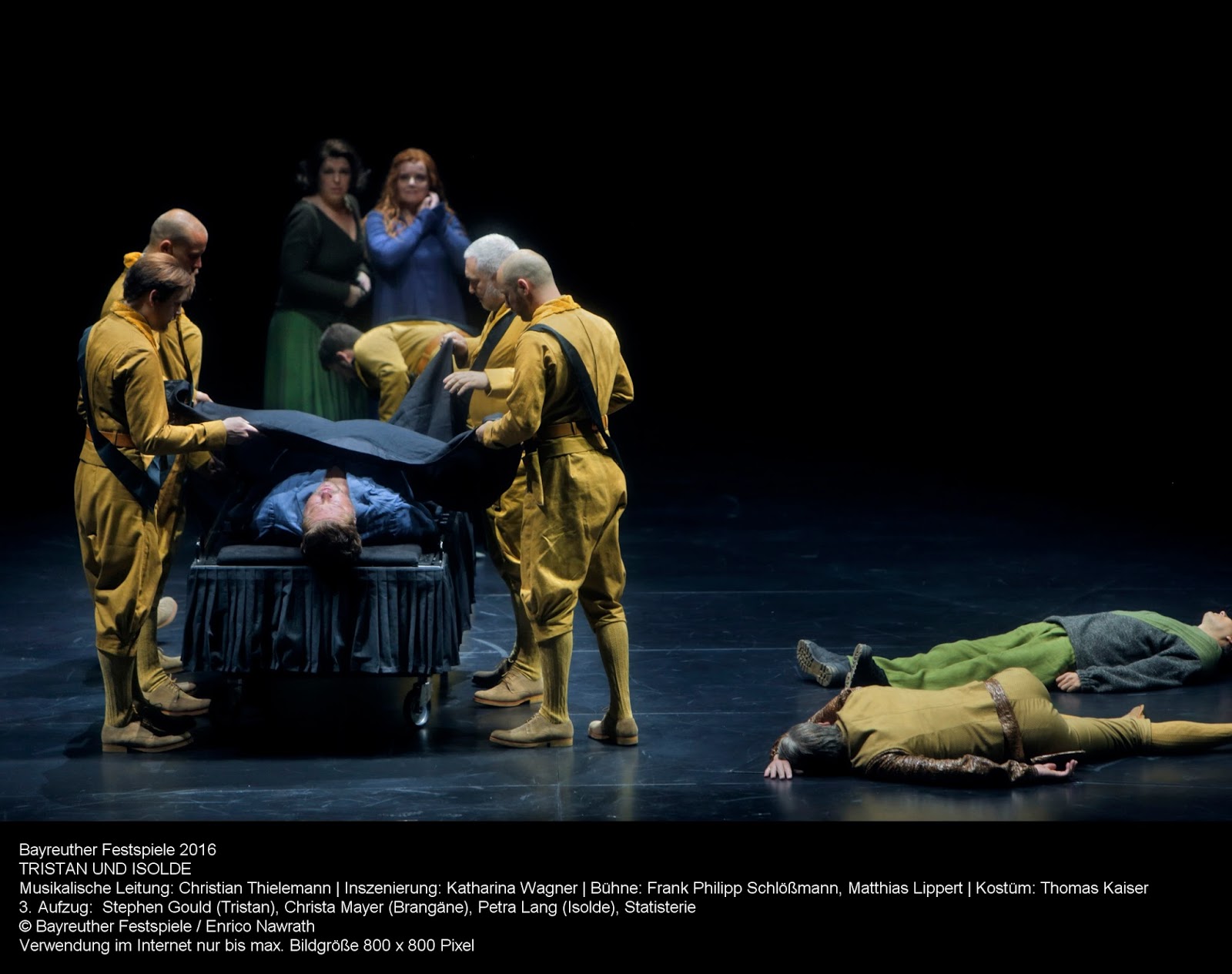
Bayreuth Festival (3) - Tristan und Isolde, 22 August 2016


Bayreuth Festspielhaus

Tristan – Stephen Gould
Isolde – Petra Lang
Kurwenal – Iain Paterson
King Marke - Georg Zeppenfeld
Melot – Raimund Nolte
Brangäne – Christa Mayer
Shepherd – Tansel Akzeybek
Steersman – Kay Stiefermann

Katharina Wagner (director)
Frank Philipp Schlößmann, Matthias Lippert (set designs)
Thomas Kaiser (costumes)
Daniel Weber (dramaturgy)
Reinhard Traub (lighting)

Bayreuth Festival Chorus (chorus master: Eberhard Friedrich)
Bayreuth Festival Orchestra
Christian Thielemann (conductor)


Let me summarise the case for Katharina Wagner’s defence; in this production, that is, rather than more generally. It is certainly better than her Meistersinger, although its problems are not dissimilar in quality. Nothing is downright embarrassing: remember those shoes being thrown all over the place for several minutes, because, well, because Hans Sachs is a cobbler (who nevertheless does not wear shoes himself), or a child-from-the-Stolzing-future requiring a lavatory break during the Quintet? This time, at least, it seems that the characters are doing what they are supposed (by the director) to be doing; there has clearly been progress made in terms of the director’s craft.


There are, moreover, several visually striking aspects to the mise-en-scène, for which designers Frank Philipp Schlößmann and Matthias Lippert certainly deserve credit. In some cases, although not all, they point to engagement with and a welcome critical standpoint with respect to the drama. The first act’s setting in a labyrinth, full of dead ends and other pitfalls, persistently – yet not entirely successfully – preventing the lovers from meeting presents a striking metaphor. That for the second act, in which Tristan and Isolde are constantly under King Marke’s surveillance, cruel, harsh spotlighting directed from above, initially makes its point well, taking on board Wagner’s Day/Night antithesis, and extending it, even questioning it. This is clearly a cruel world indeed; it may be understood politically, psychologically, or in both ways. The darkness of the third act is again visually attractive, and the images in which Isolde appears – I wondered to begin with whether something was being done with the white hands of legend, but then thought not – are again striking, even if their framing stands perhaps a little too close for comfort to Herbert Wernicke’s Covent Garden triangles. Tristan’s interaction with these empty ragdolls of his imagination is sensitively accomplished, although somewhat repetitive after a while. And the revisionist view of King Marke – yes, of course it is at odds with the surface of the text, but is it so very wrong to question, from time to time, its ideological basis and assumptions – is in itself welcome. His dragging Isolde off at the close, transfiguration clearly an idle, Romantic delusion, duly chills.


For the fundamental problem, however, is not so dissimilar to that of the hapless Meistersinger. Whilst there are striking images and ideas – in some instances at least, one presumes, dramaturge, Daniel Weber should at least share the credit for the latter – very little, at least until that striking conclusion, is really done with them; or, in some cases, too much of little import is done with them. I am all for an audience having to do some thinking for itself; a production that fails to accomplish that is unworthy of the name. Nevertheless, it seems to me, that there is a world of difference between, say, Frank Castorf’s Ring (at least so far, in revised fashion, as seen in 2016) and a staging (which may well, of course, undergo significant revision of its own in the future) in which the first act is made up more or less entirely of people running around, platforms being raised and lowered, and, on a couple of occasions, Tristan and Isolde are all over each other. Similarly for the stylised torture-medical (?) paraphernalia of the second act. Melot’s murder of Tristan, entirely without agency on the part of the latter, might have been suggestive; as it was, however, it came across as merely ‘different’ for the sake of it. If it were not for the striking designs – less happily striking in the hideous yellow costumes of Marke and his men – it would not be so very different from the most conventional, ‘traditional’ production. Although the screams of one audience member as I left the theatre – ‘They’ve changed the ending! You can’t change the ending! You can’t change the ending!’ – left me feeling more sympathetic with Katharina Wagner’s production than I might otherwise have done, having upset a person seemingly possessed of no critical abilities whatsoever is not in itself enough.


There is not really very much being said, then, whilst, at the same time, Wagner’s insistence – and I have yet to see it properly contradicted, on stage, in practice – that this is a metaphysical drama, majestically unconcerned with the ephemera of external representation, goes sadly unacknowledged. For, when condensing the action of Tristan und Isolde into a few words for Mathilde Wesendonck, the composer, in full Schopenhauerian flow, did not even mention Marke’s forgiveness (which is perhaps not so very important, then, to undercut). The action, he suggested, as much by omission as by commission, was not really of this phenomenal world at all; even Tristan’s agonies went unmentioned upon the way to ‘redemption: death, dying, destruction, never more to waken!’ (Erlösung: Tod, Sterben, Untergehen, Nichtmehrerwachen!) Now that need not be taken on trust, although this drama seems curiously, almost uniquely, resistant to attempts to question it on stage; the dots, however, need to be joined up a good deal more convincingly than they are here. Ultimately, what we see becomes tedious – and not in a self-critical, ‘let us consider tedium’ manner.


Fortunately, we were on much, much surer ground musically, permitting metaphysics a not insignificant re-entry to the proceedings. Hearing Christian Thielemann, in the finest Wagner I have heard from him for quite some time, made me realise that I had, in fact, been bending over backwards to excuse the shortcomings of Marek Janowski’s handling of the Ring scores (so far). De facto music director Thielemann has, of course, a huge advantage over Janowski: he has been dealing with the peculiarities of the Bayreuth acoustic – and pit! – for many years; indeed, he conducted Die Meistersinger here on my first visit, in 2000. And so, that fabled Bayreuth sound, more or less entirely absent, whether by design or otherwise, from Janowski’s performances, was once again a real presence amongst us. Perhaps I should say a variety of that fabled sound, for Thielemann tends perhaps to a slightly glossier, even more Straussian, sound than, say, that other fabled Bayreuth Straussian Tristan-master, Karl Böhm.


Beneath the surface, though – and what a glorious surface it was, all the more so for Thielemann’s not un-Barenboim-like willingness to let Debussy-tilting woodwind have their say too – there was undoubted rigour. Not only did the orchestra twist and turn, growl and gloat, speak and dissent as his fabled Oper und Drama successor to the chorus of Attic tragedy; it constituted, at least as much as merely representing, the Handlung of Wagner’s designation for the work. It was, I think, a reading of avowedly tonal understanding, such as would have pleased Wagnerian colleagues as distant ideologically from one another as JPE Harper-Scott and Roger Scruton. Schenker would have been proud. In the agonies of the third act, I might prefer something more Schoenbergian, more prepared at least to consider the air of another planet and the way it might criticise the (admittedly) iron-clad tonal structure of the work as a whole. (I think, for instance, of a performance Esa-Pekka Salonen gave with the Philharmonia in 2010.) Not every performance, not even one by Furtwängler, can present all of the potentialities of a Wagner score, though; no one would have been disappointed, or indeed anything other than thrilled, by the work of Thielemann and his orchestra, now back on superlative form.


It is unusual indeed not to find oneself making excuses for a Tristan cast, but there was no need to do so on this occasion. Bayreuth should be in the business of engaging casts to challenge, at the very least, those to be found anywhere else in the world; here it succeeded in doing so. ‘Untiring’ is often, in the Heldentenor world, a part-euphemism for ‘unpleasant, wildly out of tune, but he kept going’; not so in Stephen Gould’s case. Gould was able to put that ability to pace himself to thoroughly musical use, shaping his phrases with care, with dramatic meaning, in most cases equally careful with his words. The clarity of Petra Lang’s diction came and went, but hers was a powerfully dramatic reading, in which the somewhat unusual – for the role – colouring of her voice was relished. Her first-act sarcasm towards Brangäne, flouncingly acted as much as sung, was very different from that of, say, Birgit Nilsson, but made its point. I was less keen on the broken phrasing of the opening of her (non-)Verklärung, but it seemed to be part of a genuine effort to point to words as well as music.


Christa Mayer was as fine a Brangäne as I can recall hearing, wide of dynamic range and colour, unfailing sympathetic (perhaps especially when Isolde did not wish to hear). Iain Paterson seemed more at home with Kurwenal than the Rheingold Wotan, not that there was anything to complain about in his portrayal of the latter. This was a trustworthy, kind, unfailingly human servant and (failed) friend. Georg Zeppenfeld’s Marke proved as distinguished, at least, as his Hunding the previous night, exhibiting many similar musico-dramatic virtues. Zeppenfeld’s delivery of the second-act monologue was in no sense hampered by the director’s unsympathetic view of his character. Quite the contrary; potential difficulty was transformed into meaningful dramatic counterpoint. Tansel Akzeybek, whose Froh I had previously found uncommonly sweetly sung, offered similar pleasures in the twin roles of the Young Sailor and the Shepherd; I hope to hear more from him. Music, then, redeemed the work, or rather the production. Nietzsche’s opus metaphysicum was, more or less, reinstated as such.


Wednesday, 5 November 2008

God in the nineteenth century: Wagner (Parsifal)

A sermon delivered at Evensong, at Trinity College, Cambridge on Sunday 26 October: https://www.trin.cam.ac.uk/show.php?dowid=627. The series, God in the nineteenth century, will culminate with Terry Eagleton on Nietzsche on Sunday 23 November. Other sermons may be found at: https://www.trin.cam.ac.uk/index.php?pageid=459.

Friday, 8 August 2008

Bayreuth Festival: Die Meistersinger von Nürnberg, 7 August 2008

Festspielhaus, Bayreuth

Hans Sachs – Franz Hawlata
Veit Pogner – Artur Korn
Kunz Vogelgesang – Charles Reid
Konrad Nachtigall – Rainer Zaun
Sixtus Beckmesser – Michael Volle
Fritz Kothner – Markus Eiche
Balthasar Zorn – Edward Randall
Ulrich Eisslinger – Hans-Jürgen Lazar
Augustin Moser – Stefan Heibach
Hermann Ortel – Martin Snell
Hans Schwarz – Andreas Macco
Hans Foltz – Diógenes Randes
Walther von Stolzing – Klaus Florian Vogt
David – Norbert Ernst
Eva – Michaela Kaune
Magdalene – Carola Guber
Nightwatchman – Friedemann Röhlig

Katharina Wagner (director)
Tilo Steffens (designs)
Michaela Barth, Tilo Steffens (costumes)
Robert Sollich (dramaturgy)

Orchestra and Chorus of the Bayreuth Festival (chorus master: Eberhard Friedrich)
Sebastian Weigle (conductor)

This was a production that was not so much compromised by its Konzept as by its execution. Let us begin by clutching at straws. What might represent the case for the defence? Setting the work in terms of a 1970s-ish art student, rebelling against a fusty old academy – even if it boasted academic gowns with a fluorescent green stripe garish enough to be worthy of the newest of campuses – is not necessarily a bad idea. That said, I cannot really think of any good reason, other than novelty, for jettisoning the musical world for that of the visual and increasingly all-too-drearily conceptual arts. Stressing the presence of past masters – Bach, Beethoven, Goethe, Schiller, Kleist, Wagner himself – both on stage and in terms of their output is, I think, rather a good idea, which I suspect may have come from dramaturge Robert Sollich rather than Miss Wagner herself. His ideas seemed far superior to her contribution, as was made clear from an interesting essay in the programme book. The motif of the iconic yellow Reclam volumes was quite arresting, even if the use to which said volumes were put was often baffling. I have pretty much reached the end of my attempted and already somewhat qualified defence.

For what was so truly staggering about this production was the ineptitude with which it was presented. There was no sense of any community whatsoever, despite the fact that the city of Nuremberg is one of the most important ‘characters’ in Wagner’s drama. So we did not see the chorus singing the chorales, and there was no sense of who might be singing this music, or why. The chorus did appear, though, at the very end, to appear as a talent show studio audience. As for poor Walther, several hours of daubing paint upon anything and everything wears thin pretty quickly and hardly presents a convincing radical artist. Paint poured out of – how we laughed! – tins of Campbell soup. The Trial Song became a jigsaw puzzle that would not have challenged a three year old. Hans Sachs clearly wanted to relive some youthful radicalism since he did not wear a tie and for some reason walked around barefoot: strange behaviour for a cobbler. Indeed, that whole part of his existence was ignored, so that instead of working on Beckmesser’s shoes he hammered away on a typewriter. Bizarrely, the riot was signalled by multiple pairs of trainers falling from the skies and old masters appearing in their underwear.

The opening of the third act was actually a little better, almost bearable, and there was one relatively amusing joke, when Beckmesser tried to ape his younger rival, acting in appropriately middle-aged youth attire. That, however, ran quite out of control when Katharina Wagner – and presumably the rest of the production team – completely misunderstood what should have been going on by having him not only continue in such vein to the Festwiese scene, but emerge as the more ‘challenging’ conceptual artist, as opposed to Walther who sold out and accepted a large cheque from gameshow host Kothner. Once again clutching at the one remaining straw, I can accept that some of Beckmesser’s music, like that of other Wagnerian villains, is more ‘advanced’ than some of Walther’s, but this made no sense at all. No attention whatsoever seemed to be paid to the text, which was not challenged but merely disregarded.

But there had been worse, much worse. After the more or less bearable opening to the third act, we were subjected to a bizarre interpolation for Daily Mail family values during the Quintet. Did no one tell the director that baptism is a metaphor here? Walther, Eva, and Pogner posed for a portrait with future children, as did David and Magdalene with theirs. This, needless to say, had to be undercut by having one of the Stolzing children crossing his legs, desperate for the lavatory. It was, however, with the move towards the Festwiese scene that the production reached its nadir. The past masters returned with their – barely recognisable – masks. They instead of anyone else marched and danced, stripped to their underwear, and then paraded around with prosthetic phalluses, which they rubbed against newly appeared masked women and each other. This went on for quite some time until they bade farewell one by one, leaving Beethoven straining to hear and then finally Wagner himself. Someone then appeared with a brush to sweep up the debris.

What of the music? Sebastian Weigle alternated between merciless, arbitrary pulling around of the score – the Prelude to Act I was all too much of a harbinger – and listless inconsequentiality. Whenever the orchestra sounded good, it appeared to be in spite of him. Franz Hawlata appeared to be having an off day, losing his voice somewhat during the third act, although he was rather good in the second. It is difficult to evaluate Michael Volle’s Beckmesser, so hamstrung was he by the production, especially once sporting his ‘hilarious’ ‘Beck in town’ T-shirt, but he seemed to follow suit, over-dignifying Wagner’s Malvolio figure, whilst singing well in purely vocal terms. Artur Korn audibly struggled as Pogner. Michaela Kaune just about passed muster as Eva, but only just, whilst Carola Guber must be the most undistinguished Magdalene I have heard. (It was not simply a matter of the sheer frightfulness of their costumes.) I was grateful for Norbert Ernst’s keenly sung David but the only star was Klaus Florian Vogt as Walther. This may be the finest Heldentenor­­-singing I have heard in the flesh. He was youthful, ardent, always audible, and truly looked the part too, if one managed to ignore his absurd costume. He does not have the classic Heldentenor bark; this is a far more beautiful voice, redolent of a lyric tenor, yet with the necessary volume. I cannot wait to hear him again. The chorus was good but not a patch on the previous night for Parsifal; who can blame it?

Tuesday, 8 April 2008

Der fliegende Holländer, 8 April 2008, Vienna State Opera

Vienna State Opera

Daland – Ain Auger
Senta – Eva Johansson
Erik – Klaus Florian Vogt
Mary – Daniela Denschlag
Steuermann – Gergely Németi
Der Holländer – Terje Stensvold

Orchestra, Chorus, and Additional Chorus of the Vienna State Opera
Thomas Long (chorus-master)
Donald Runnicles (conductor)

Christine Mielitz (director)
Stefan Mayer (designs)

At last, some real musical drama at the Vienna State Opera! After my experiences with a musically-flawed Tristan and a superannuated production of Ariadne auf Naxos, I had begun to wonder whether the house had become more of a tourist trap than a living opera house. This Flying Dutchman was not flawless but should certainly be accounted an artistic success.

I had praised the orchestra in Tristan; its contribution had certainly been superior to any other aspect of the performance. Here, however, I was reminded of the difference when it clearly wants to play. Second-rate (or worse) conductors are simply not tolerated by these players; whatever one thinks of such practice, that is how it is. Donald Runnicles, thankfully, could not be taken for a second-rater. Wagner’s score, quite a miracle when one considers how it followed immediately upon Rienzi, was taken by the scruff of its neck, by a musician who appeared to commit everything to two-and-a-quarter hours of unbroken musical drama. The deplorable practice of splitting up the work once again into three separate acts was, thankfully, not followed. (Covent Garden had done so on the last occasion it mounted the Dutchman, but that had been almost the least of its problems, given the presence of the lamentable Simone Young in the pit. I also had the misfortune to re-encounter her in Berlin, although Harry Kupfer’s superb production almost salvaged that occasion.) Although I might quibble at certain choices, for instance the very slow speed Runnicles adopted for Senta’s Ballad (and – at least he was consistent – its presentiment in the Overture), these were evidently choices thought through, as opposed to some of the thoughtlessness and ineptitude in Ariadne, especially its Prologue. The tricky balance between individual numbers – all there, despite the through-composed nature of the score – and the tonal architecture was in safe and exciting hands. As for the orchestra itself, every section played as if its lives depended upon it. The Vienna strings can never sound truly anonymous, but I now appreciated just how much had been missing on previous evenings. The depth of tone and supremely judged vibrato were something at which to wonder, had one not been so gripped by the unfolding of the score. Sitting immediately above the horns did not make for an ideal orchestral blend, but there was ample compensation in full appreciation of their consummate contribution, as was the case with the rest of the brass, which added immeasurably to both salty tang and supernatural terror.

The cast was not musically perfect, but it was dramatically engaged. Klaus Florian Vogt perhaps came closest to combining both virtues. Not only did he make something of Erik’s role, he convinced me to sympathise, which I think must be a first. Considering that Erik’s music is often in itself relatively banal – dramatically contrasting with the more highly-charged and forward-looking music of Senta and the Dutchman – this was quite an achievement for the sweetly-toned, often plangent tenor. There were hints of something more heroic to the voice, but wisely they were not over-emphasised, however tempting this might have been in purely musical terms. Gergely Németi was an unusually ingratiating Daland, which gave an interesting slant upon the character. His attention to words and to musical line was noteworthy, although the musical portrayal was perhaps too beautiful, ultimately lacking the overt venality that the character demands. Both Eva Johansson and Terje Stensvold were very convincing dramatically, although they could equally both be a little too free and loose with intonation. Stensvold did not always project as strongly as he might, although this was far more prevalent earlier on.

The choral singing was superb: perhaps a little rough around the edges, but better dramatically truthful than clinical. It was also clear that the chorus had been directed, not fussily but with enough skill to make its members credible and indeed interesting on stage. Indeed, this was a hallmark of the production in general. It did not draw attention unduly to itself, but gave a relatively straightforward – which is not to say unimaginative – account of the drama. The wraith-like denizens of the Dutchman’s ship convinced in supernatural terms, when one might have feared a dated science-fiction treatment. It appeared that due notice had been taken of the music, which sadly cannot be taken for granted. The final redemption – prophetically in immolation – of Senta and the Dutchman was fittingly climactic but not sensational, which is just how it should be