Showing posts with label Christa Mayer. Show all posts

Wednesday, 5 April 2023

Der Rosenkavalier, Semperoper Dresden, 3 April 2023


Die Feldmarschallin, Fürstin Werdenberg – Camilla Nylund
Der Baron Ochs auf Lerchenau – Peter Rose
Octavian – Sophie Koch
Herr von Faninal – Markus Eiche
Sophie – Nikola Hillebrand
Jungfer Marianne Leitmetzerin – Daniela Köhler
Valzacchi – Aaron Pegram
Annina – Christa Mayer
Police Officer – Tilmann Rönnebeck
The Marschallin’s Major-domo – Florian Hoffmann
Faninal’s Major-domo – Jürgen Müller
House Servant – Holger Steinert
A Notary – Matthias Henneberg
A Landlord – Kevin Conners
A Singer – Pavol Breslik
A Milliner – Katerina von Benningsen
A Vendor of Pets – Andreas Sauerzapf
Leopold – Yevgen Bondarenko
Lackeys – Jun Seok Bang, Norbert Klasse, Ingolf Stollberg-da Silva, Matthias Beutlich
Waiters – Markus Hansel, Max Hebeis, Andreas Heinze, Thomas Müller
Three noble orphans – Ofeliya Pogosyan, Mariya Taniguchi, Justyna Olów
Lerchenauschen – Alexander Födisch, Wooram Lim, Thomas Müller, Mirko Tuma, Werner Harke, Holger Steinert
Hairdresser – Mario Kretschmer
Mohammed – Ricardo Garcia Heine

Uwe Eric Laufenberg (director)
Christoph Schubiger (designs)
Jessica Karge (costumes)
Torsten Schäfer, Jan Seeger (lighting)
Hella Bartnig (dramaturgy)  

Children’s Choir of the Semperoper Dresden
Dresden State Opera Chorus (chorus director: André Kellinghaus)
Sächsische Staatskapelle Dresden
Cornelius Meister (conductor)

Images: © Semperoper Dresden/Klaus Gigga

One more step back towards operatic ‘normality’, at least in Germany for me: a performance of Der Rosenkavalier with its large cast, no sign of (anti-)social distancing, and as yet no sign of a Covid-themed staging. (We know they are coming: the masks, the ventilators, the Tristan love-duet via Microsoft Teams, the Downing Street ‘Abba parties’; let us enjoy their absence while we can.) My reunion with characters one fancies one knows so well they might be personal acquaintances took place in Dresden, at the Semperoper, in a production by Uwe Eric Laufenberg I saw previously in 2014. It does not seem so long, as the Marschallin would understand all too well. 

First seen in 2000, it is, like most of us after the last few years, somewhat looking its age. In 2014, I thought it had belied its years. Whether that says more about me or the production, I do not know: perhaps a bit of both. Updating a century-and-a-half or so does no harm, though it perhaps makes no particular point either other than visualising the distances and anachronisms in which Strauss and Hofmmansthal deal. There are puzzling details, for instance: why does Octavian wear a black tie with evening tails? And there are, I think, a few changes, with some overlap. The peculiar treatment of Mohammed is no more, though he remains unusually evident, only not to appear at all at the close, Ochs’s ‘children’ taking his place. None of that is of particular importance, though, and issues not only of the male gaze – complicated, of course, in a world of cross-dressing – but also of publicity remain strong. The Marschallin’s relation to the latter world is, appropriately, more old-fashioned, her levée remaining much as it ‘should’, whereas chez Faninal, with its touch of Hollywood new money, the Presentation of the Rose is a choreographed photoshoot. Paparazzi or their equivalent even scale the building to gain an ‘exclusive’ picture of Octavian and Sophie ‘in private’. The Italians straddle both worlds. 

A notable change this time was the conductor. Christian Thielemann was due to have conducted the performance once more, but withdrew, replaced with Cornelius Meister. If the performance were less razor-sharp than last time, I suspect that was more down to rehearsal time and the vagaries of standing in than anything else. The first act seemed at times to drag, but the second two were well proportioned and full of incident. Moreover, the first-act Prelude can rarely, if ever, have made its intentions, here frankly post-Tannhäuser, more immediately apparent. If you did not feel the earth move, you must not have been listening. Indeed, Meister’s somewhat Wagnerian way with much of the score, gently yet tellingly contradicting lazy assumptions of a volte face after Elektra, brought ready human warmth and motivic integrity in equal measure. The Staatskapelle Dresden, effortlessly at home in this music since its premiere, brought a multitude of colours born of, yet never bogged down in, tradition.


Camilla Nylund’s warmth as the Marschallin, especially in the first act, sounded similarly inspired, or at least in sympathy. She became steelier in the third act, often thrillingly so, in triumphant, only part-tragic, reassertion of her authority. She, after all, may and probably should be understood to direct her own opera—and certainly did so here. Sophie Koch, also Octavian in 2014, seemed a little more out of sorts. In many ways, it was a very good performance, yet it was one that left one thinking this may be a role she, like Octavian with his recent past, should now leave behind, her voice having changed considerably in the meantime. Nikola Hillebrand made for a highly impressive Sophie: not only less unsympathetic than often, but more multi-dimensional, on the cusp in so many ways. Peter Rose, another 2014 veteran, gave another highly accomplished performance as Ochs. He knows the role inside out and can play with it, the language in particular assimilated as if he were speaking it spontaneously, yet he takes nothing for granted. His boredom with the Italian singer, here in an utterly outstanding cameo by none other than Pavol Breslik, was as much a joy to watch as last time. Casting was throughout from depth, everyone contributing something. Christa Mayer’s Annina was a class act indeed, having one wish for more. Markus Eiche’s Faninal was similarly, if differently, well observed. Yes, something approaching normality was back, though not without regard to the special quality of the operatic moment.


Wednesday, 3 August 2022

Bayreuth Festival (2): Die Walküre, 1 August 2022


Festspielhaus


Siegmund – Klaus Florian Vogt
Hunding – Georg Zeppenfeld
Wotan – Tomasz Konieczny, Michael Kupfer-Radecky
Sieglinde – Lise Davidsen
Brünnhilde – Iréne Theorin
Fricka, Schwertleite – Christa Mayer
Gerhilde – Kelly God
Ortlinde – Brit-Tone Müllertz
Waltraute – Stéphanie Müther
Helmwige – Daniela Köhler
Siegrune – Stephanie Houtzeel
Grimgerde – Marie Henriette Reinhold
Rossweiße – Katie Stevenson
Grane – Igor Schwab

Valentin Schwarz (director)
Andrea Cozzi (designs)
Andy Besuch (costumes)
Konrad Kuhn (dramaturgy)
Reinhard Traub (lighting)

Bayreuth Festival Orchestra
Cornelius Meister (conductor)

The boos are getting louder: not, I think, for the musicians, but for the production of Valentin Schwarz, who has yet to appear for a curtain-call. That need be no bad thing artistically, though the practice itself is fascistic; should a bourgeois audience feel satisfied with what it has consumed, it will be a disturbing outcome for art. Here, though, the open mind I am endeavouring to keep concerning Schwarz’s production is struggling a little. As a distinguished Wagner scholar said to me when I met him afterwards, ‘It is getting worse.’ On the basis of what I saw in Die Walküre, I had little choice but to agree.

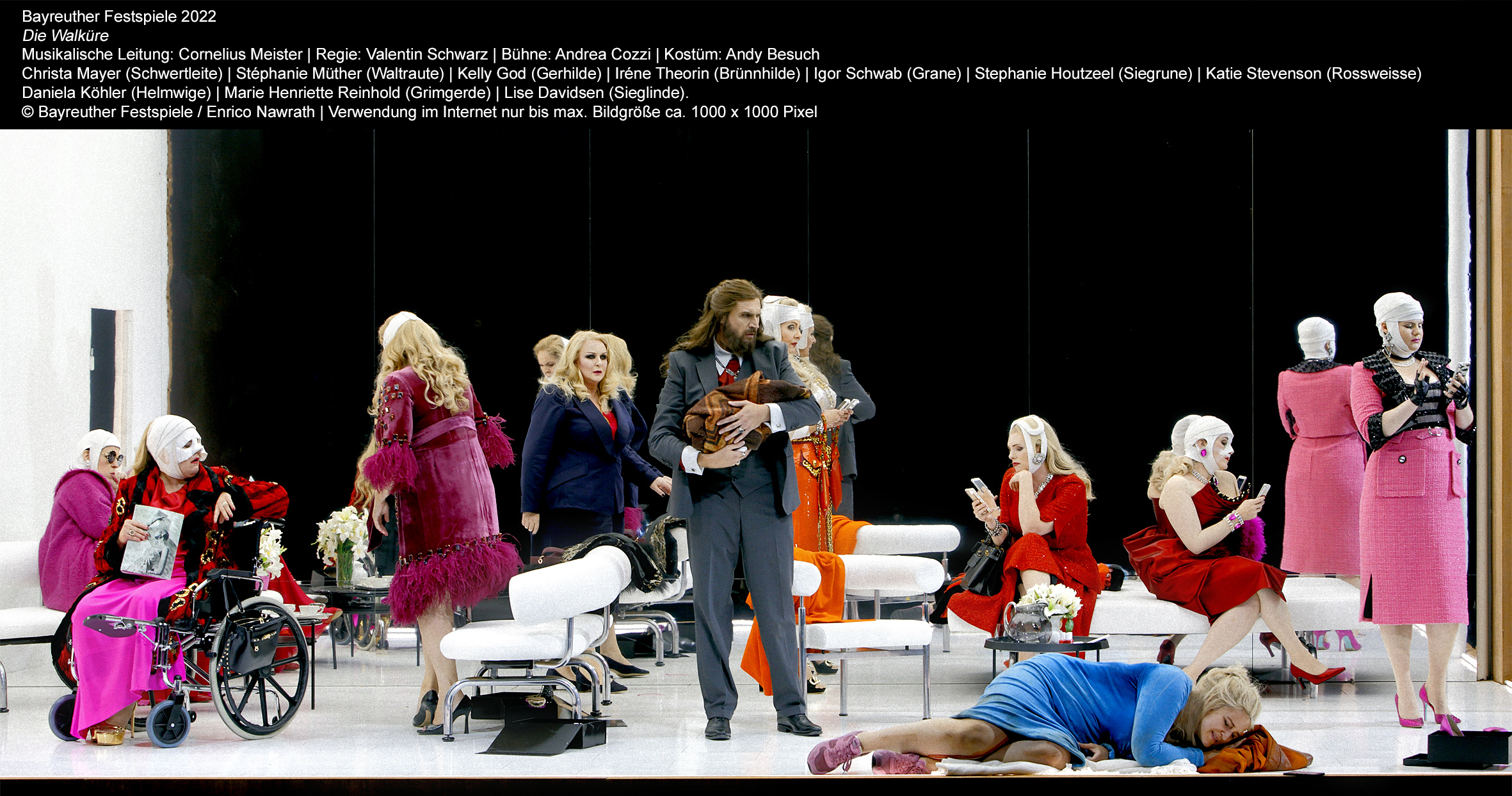
Short of the framing of the action as a saga of twins, which here seems more assumed to continue from Das Rheingold than illustrated, there is little at all to point to other than strange departures from Wagner’s drama, which taken separately or together fail to amount to anything very much. Siegmund and Sieglinde are, I think, taken back by their self-discovery to their childhood, joined by ‘symbolic’ star-children. (Either that, or they fantasise about the children they will have, but I think it is the former.) There is nothing wrong with that; it makes sense. But for it to have taken place in Wotan’s godly quarters seems peculiar—imagine Fricka’s thoughts on that—as well as quite at odds with what they have just sung, without obvious reason.

 It is later implied that Sieglinde, heavily pregnant throughout the first two acts, is carrying Wotan’s baby. At least I think that is why he ‘comforts’ her, whilst Siegmund and Hunding seek one another, pulling down her tights and apparently attempting to deliver the child. If not, it is a straightforward case of sexual assault, although I suppose it must have been anyway earlier. My guess would be that this is intended to enhance the parallelism between Wotan and Alberich, that both will be found to have produced children, Siegfried and Hagen, through rape. But where that leaves Siegmund, goodness knows: St Joseph with a twist, it would seem. Where, though, does that leave Hunding? He must surely have noticed. It is difficult not to conclude that Wagner’s plot would have been better left as it was.

In between, Freia’s funeral, or at least her lying in rest, had taken place. There were some germs of decent, if ultimately rather incidental ideas, here. Assuming we are still to take her as goddess of love, her death would have obvious implications (although its timing is arguably strange, given that Siegmund and Sieglinde have just met). In a Mafia-film-style mise-en-scène, a few people come to pay their respects, whilst Wotan and Fricka have their decisive confrontation. (Brünnhilde spends some of that scene in what appears to be a greenhouse. I don’t know either.) Hunding petitions the gods in person, an interesting touch. That Fricka returns at the end of the third act, after Wotan has put Brünnhilde to sleep (and made, you guessed it, his incestuous urges all too clear), suggests that she is confident in her triumph. She even wheels on a drinks trolley and offers Wotan a celebratory glass. He declines, though, so in the absence of a spear—just nothing at all, throughout—Fricka clinks together the glasses to make the requisite noise.


I am afraid I have no idea at all what happens in the Ride of the Valkyries. It veered all over the place—at least the BBC light entertainment place—from Dr Who to The Benny Hill Show to Casualty, with an apparently accidental turn for Diana Dors’s gender-reversal ‘The Worm that Turned’ series for The Two Ronnies. Sometimes the Valkyries were in charge, sometimes Wotan’s guards. There was a great deal of mobile telephone use. Perhaps it is time to call for a moratorium on those devices onstage, unless the director has a clear idea what they are for. As things stand, they seem to have become the new suitcases.

Lack of objects when called for and introduction of obscure alternatives does little to help. I have already mentioned the lack of a spear or any substitute.   Just as the role of Das Rheingold’s dark-haired boy is more unclear than ambiguous, so is that of the strange pyramid-in-a-box, earlier seen and quasi-worshipped upon the gods’ entry into Valhalla as if a grail-refugee from a production of Parsifal. It now reappears as a repository for a pistol. Sometimes a pistol is a Notung equivalent, sometimes not; sometimes there are several. None of it makes any sense, really, and try as I might to try to piece together some sort of explanation, I am really on the verge of giving up.

As for Grane’s reincarnation as Brünnhilde’s male, suited personal assistant, it makes even less sense when there have been a few apparently arbitrary visual references to actual horses elsewhere. Finally, there is a strong impression that the strongest acting is brought by the singers themselves to their roles. Personenregie is intermittent at best and sometimes disappears altogether in longer exchanges between characters. I suppose some of these things, minus the lack of Personenregie, might add up to something in retrospect, but I do not feel especially hopeful.

Musically, things are better, often much better. Cornelius Meister continues to impress greatly with his command of structure and detail, conveying and expressing a Wagner melos from the pit that drives and, in many respects, is the action. The sound he drew from the Bayreuth Festival Orchestra—and, I assume, to an extent, the sound its players wished to conjure too—was in some ways distant from that we might recall from old Bayreuth recordings, closer to those of other opera orchestras. Choices seem well justified to me, though, and there is no point merely trying to imitate Karl Böhm—or anyone else, for that matter. There is considerable emotional and conceptual range as the cauldron of Wagner’s Greek Chorus bubbles: quite a difference, alas, from what we see onstage.

Not, however, from what we hear onstage. Lise Davidsen’s Sieglinde was at least the equal of any I have heard. No one seems to have a bad word to say about this extraordinary soprano, and so far there seems no reason for anyone to do so. Her final peroration here, ‘O hehrstes Wunder!...’ was as vocally magnificent, riding the orchestral wave almost like no other, as it was clearly heartfelt, the culmination of a dramatic journey that now must end. Klaus Florian Vogt’s tenor will always divide opinion. Much of that is simply down to taste. Whether one liked his performance or not—and there is no getting away from the fact that its sound is very different from the baritonal Siegmunds we have come to expect—his was certainly a committed and, I think, highly likeable performance. Georg Zeppenfeld’s Hunding offered a masterclass in the role, everything present and correct, both considered and alert to the moment.

Tomasz Konieczny and Michael Kupfer-Radecky shared the role of Wotan, the former having become unable to continue during the second interval. Both gave strong performances, deeply rooted in Wagner’s text; if the ear took a little while to adjust to new sound and delivery, that was a tiny price to pay for so crucial, short-notice a substitution. Christa Mayer’s Fricka was once again first-class, fuller-throated than often one hears, and all the better for it. Iréne Theorin impressed as head Valkyrie, youthfully impetuous and headstrong, yet clearly transformed by what she had witnessed. The rest of her team was cast from depth, including a return for Mayer as Schwertleite. Had this been a concert performance, I suspect it would have moved more than it did in the theatre. This Ring, however, will continue in Wagner’s own theatre.


Monday, 1 August 2022

Bayreuth Festival (1): Das Rheingold, 31 July 2022


Festspielhaus


Wotan – Egils Silins
Donner – Raimund Nolte
Froh – Attilio Glaser
Loge – Daniel Kirch
Fricka – Christa Mayer
Freia – Elisabeth Teige
Erda – Okka von der Damerau
Alberich – Olafur Sigurdarson
Mime – Arnold Bezuyen
Fasolt – Jens-Erik Aasbø
Fafner – Wilhelm Schwinghammer
Woglinde – Lea-ann Dunbar
Wellgunde – Stephanie Houtzeel
Flosshilde – Katie Stevenson

Valentin Schwarz (director)
Andrea Cozzi (designs)
Andy Besuch (costumes)
Konrad Kuhn (dramaturgy)
Reinhard Traub (lighting)
Luis August Krawen (video)

Bayreuth Festival Orchestra
Cornelius Meister (conductor)


In der Erde Tiefe
tagen die Nibelungen:
Nibelheim ist ihr Land.
Schwarzalben sind sie;
Schwarz Alberich hütet’ als Herrscher sie einst!

So begins the Wanderer’s answer to the first of Mime’s three riddles, in which notoriously the dwarf asks his unwelcome visitor questions he hopes will catch him out—they do not—thereby wasting the opportunity to ask the chief of the gods what he, Mime, actually needs to know. Mime has asked which Geschlecht may be found in the earth’s depths. Wotan/the Wanderer tells him: the Nibelungs, that is Mime’s own kin. In response to the third riddle, when Mime asks him which Geschlecht lives in the cloud-hidden heights, the Wanderer, disguised chief of the gods, tells his interlocutor that it is those very gods, continuing, ‘Lichtalben sind sie; Licht-Alberich, Wotan, waltet der Schar.’

If I understand correctly—I should stress that I am writing this immediately after Das Rheingold, with much yet to be revealed—those points in that exchange point to something crucial in understanding Valentin Schwarz’s new Bayreuth production of Wagner’s Ring. That dialectical opposition between Wotan and Alberich, ‘white’ and ‘black’ Alberich—which is certainly the meat of the Rheingold drama, and in many ways underpins all that is to come—is taken a little more literally, rendering them twins. The Rheingold prologue is perhaps as close as we shall come to a musical presentation of the ‘spontaneous generation’ Wagner’s contemporary Karl Marx hymned in his long unpublished, Feuerbachian Paris Manuscripts: Generatio æquivoca is the only practical refutation’ of the theological ‘theory of creation,’ The ‘abstraction’ of the old way of thinking of oneself as apart from Nature overcome, ‘for you too are Nature and man’.  (Wagner would have read Arthur Schopenhauer’s description ‘spontaneity of the world of Nature’ in Parerga and Paralipomena when working on the score, but the roots of this idea unquestionably extend back to the Young Hegelian inheritance he and Marx—‘black’ and ‘white’ Marx?—found in Ludwig Feuerbach and other writers of the 1840s.)

Luis August Krawen’s opening video projection makes it very clear that we were in the waters (‘in the river Rhine’, as Anna Russell would have reminded us, ‘in it!’) so as to fit any number of creation or non-creation myths. What proceeds differently here is the vision of twin umbilical chords, leading us to twin babies—who, as the saga develops, we associate with Wotan and Alberich. At any rate, there are birth, kinship, and rivalry: a reminder that Mime’s ‘Geschlecht’, often translated as ‘race’, has here more to do with genealogy, with family, house, and lineage. Schwarz not only takes Wagner’s three lineages—dwarves, giants, and gods—as the basis of the drama to come, but takes Wagner further than himself by rendering at least two of them estranged branches of the same clan: Cain and Abel, Esau and Isaac, Wotan and Alberich…

Inheritance, therefore, is fundamental. In an underlining of the family saga element (which, at one level, surely no one could deny) Schwarz has Alberich steal and turn a child from the swimming pool over which the Rhinemaidens (glorified au pairs?) watch over a group of children. Notably, that child is black-haired, as opposed to the blond of the others. One can go down the route of trying to work out precisely what the ‘dark’ child symbolises: the gold, what it is turned into, inheritance? I am not sure that is really the way to go, though. There is a struggle between Black and White Alberich both for that boy and, intermittently, for a blonde girl, which perhaps represents—if at times, a little confusingly—the overall power struggle. Alberich is certainly an outsider and remains so, presumably at some stage cast out. Wotan’s crew is the ‘legitimate’ branch, with a ghastly family (shades of Murdoch, or even Dynasty?) in competition over the spoils and succession. I worry somewhat that the ‘racial’ element of Geschlecht may come to be seen as the point, rather than a metaphor, but perhaps the claim—it certainly has been claimed, if far from convincingly—is that race is the point here. As with much else, we shall see.


There are intriguing elements, for instance the ongoing element of the children ‘leaders’ educating and abusing other children, struggle and oppression already echoing down the ages. Wotan’s ecstasy in his own apparent victory at the close is compelling: high, it would seem, on his own ideology, or at least his own misdeeds. There are others I have yet to understand: why does Erda put in several appearances before her scheduled arrival, just to watch, and why does she walk off with the blonde girl in her care at the end? Is this in some sense a presentiment of Brünnhilde, as the boy might be of Hagen? Again, we shall see. It would be odd to understand everything, or even have much of a developed idea about at this stage. This, after all, is only the
Vorabend, the preliminary evening. Something more strongly political might not be a bad thing, but one might argue much attention, from Patrice Chéreau onwards, has been devoted to that already; perhaps it is time for a shift of emphasis. Again, we shall see.

Conducting anything at all at Bayreuth is a difficult task indeed, even when familiar with the set-up, let alone when not—likewise even when it is a single evening’s work, rather than that of four. Cornelius Meister, who was due to conduct Tristan but now substitutes for Pietari Inkinen, made a better job of Das Rheingold than I have previously heard here (Sinopoli, Petrenko, Janowski). Balance was excellent; so too was pacing. If there were a few orchestral fluffs—a couple of brass wrong entries, for instance—nothing was too grievous. The orchestra itself likewise sounded on good form. In both cases, more will surely come, but this was an impressive start.


So too was it for the cast. Olafur Sigurdarson garnered the greatest cheers from the audience as Alberich, probably rightly so. His was certainly an outstanding performance, seemingly instinctively alert to the dramatic reality and implications of Wagner’s particularly dialectical blend of verse, music, and gesture. A blond Egils Silins—that dark/light antagonism again—offered a proper battle as his principal antagonist. Christa Mayer’s Fricka was thoughtful, considered, and personal in tone and delivery. Much the same, albeit far from the same, might be said of Okka von der Damerau’s Erda. Arnold Bezuyen and Daniel Kirch made much of their tenor roles, verbally and physically, as Mime and Loge respectively. Elisabeth Teige’s Freia offered proper beauty of tone, well echoed by that forlorn violin solo of ‘love’ in the orchestra. Jens-Erik Aasbø and Wilhelm Schwinghammer contrasted actions and motivations well in the giants’ roles. It was an impressive trio of Rhinemaidens we heard too, their ensemble warning in the final scene fatally apparent. As for what is to come, we shall see (and hear).


Saturday, 10 August 2019

Bayreuth Festival (1) - Tristan und Isolde, 9 August 2019


Festspielhaus


Tristan – Stephen Gould
Isolde – Petra Lang
Kurwenal – Greer Grimsley
Melot – Raimund Nolte
Brangäne – Christa Mayer
Shepherd, Sailor – Tansel Akzeybek
Steersman – Kay Stiefermann

Katharina Wagner (director)
Frank Philipp Schlößmann, Matthias Lippert (set designs)
Thomas Kaiser (costumes)
Daniel Weber (dramaturgy)
Reinhard Traub (lighting)

Bayreuth Festival Chorus (chorus master: Eberhard Friedrich)
Bayreuth Festival Orchestra
Christian Thielemann (conductor)


A frustrating evening, this, as Tristan performances tend to be. Wagner, notoriously, wrote to Mathilde Wesendonck: ‘I fear the opera will be banned – unless the whole thing is parodied in a bad performance –: only mediocre performances can save me! Perfectly good ones will be bound to drive people mad, – I cannot imagine it otherwise.’ I used to sympathise with that melodramatic claim, the work having affected me so deeply, so frighteningly, even in performances that fell somewhat short, especially vocally. Now, however, following a series of disappointments, to which only one recent staging has proved (mostly) an exception, I think I might prefer to be driven mad, in this particular sense, once again.


Oddly, given my early experiences of the work and of Tristan’s role in particular, this had most to be said in its favour in vocal terms. I shall pass over those first Tristans I heard, other than to say that they had me wonder whether I should ever hear someone capable of singing the notes, let alone singing them well, someone capable of making it through the first act, let alone all three. There has never been a golden age of the Heldentenor; the beast has always been rare, even at times apparently extinct. We do not fare badly at the moment, though. Stephen Gould can certainly sing the role – and sing it he did, without audibly tiring. Tristan’s third-act agonies were underplayed in what was overall a relative sensible portrayal, but better that than the agonies of quite a different, unintentional kind to which many of us have frequently been subjected. Petra Lang’s Isolde, if often overacted – this may have been Katharina Wagner’s doing – offered impressive response throughout to music, words, and what is here their ever-mysterious union. Her voice is deeper than one generally hears, with more of the tone, at times clarinet-like, and character of a mezzo-soprano (her original Fach). That, it seems to me, is all to the good. She certainly had one listen to the performance in the here and now, not to some all-too-readily (mis)remembered ‘great recording’ of the past, from which anything actually existing would doubtless fall short. Though a mezzo, Christa Meyer sometimes sounded more soprano-like than Lang. Again, no harm was done by this, slightly disconcerting though the initial impression may have been. Her performance and Greer Grimsley’s as Kurwenal were both marked by similar virtues, and less by strange melodramatic gesture. Georg Zeppenfeld’s Marke could hardly be bettered. It is a gift of a role – to those with the necessary instrument and intelligence. Those Zeppenfeld has in spades; here he left us in no doubt of that. Tansel Akzeyebek shone both as the Young Sailor and Shepherd: sweetly pleasing of tone, his singing recalled to us, at least to me, fine performances as Froh in Frank Castorf’s Ring.


What, then, of Katharina Wagner’s production, which I previously saw three years ago, in 2016? (I shall not re-read what I wrote until after posting.) It has some ideas to it: some of them odd, even perverse, ones, but good can come of it. How they cohere into anything not considerably less than the sum of its parts remains, I am sad to say, beyond me. Incessant insistence on activity, often for nothing more than its own sake, or so it seems, detracts from them – and is surely out of place in this of all operas, whose dramatic stuff is metaphysical or it is nothing. (A partial exception would be the previously trailed production by Dmitri Tcherniakov for the Staatsoper Unter den Linden: unique, in my experience, for attempting and, in large part, succeeding in its presentation of something different.) Whatever is going on here – truth be told, I am not entirely sure – it is certainly not metaphysical. Fair enough: let us try something materialist instead. Materialism, after all, is a strong current not only in nineteenth-century history but in our own time too. But whose materialism is it anyway? Feuerbach’s? The natural sciences’? That of Friedrich Albert Lange’s once-influential History of Materialism and Critique of its Present Importance? Unclear, I am afraid. It veers all over the place, less eclectic than in need of an editor.


Madness – recall Wagner’s caution to Mathilde Wesendonck – comes to the fore in the first act and never quite leaves us. It is a construction, of course; surely we are all to that extent Foucauldians now. Set designs often make that clear: a cruel, constantly changing labyrinth in the first act, brutal, Marke-directed surveillance in the second. Perhaps Isolde’s outsize, ‘operatic’ gestures are a reaction to that. Perhaps – but frankly, they seem more a decision to do something, pretty much anything. Dramatic confusion over what the couple may be doing rather than drinking the love potion can doubtless be justified: I have come up with a few tentative explanations myself. However, none of them feels justified, anything more than a post hoc justification of a directorial decision to have people faff around for a while, be it with knives, with portentously spilling the potion, or with shredding Isolde’s veil into tiny pieces, like children playing with napkins at the dinner table.


Likewise, the emphasis on darkness and light – night and day, in Wagner’s terms – augurs well for the second act. Tristan and Isolde attempt to hide from the searchlights, to little or no avail. But why, then, does Tristan start fixing fairy lights to the makeshift tent Brangäne has offered them as a shield? It may, I suppose, be to undercut the metaphysics, or even the physics, but again it comes across as activity for its own sake. There is masochism here too: intriguingly at first. Tristan clearly derives ecstatic pleasure from cutting himself on the sharp ends of a cage of incarceration. That, in some sense at least, is and must be different from death and a death-wish. An attempt to examine the relationship between the two, though, goes sadly missed, as does any attempt to explore the implications of Melot, at Marke’s instruction, stabbing Tristan, rather than having Tristan, here blindfolded, fall on Melot’s sword (here, I think, a flick knife such as Isolde has played around with for much of the preceding drama).


Then, suddenly, in the third act, we find ourselves back to ‘normal’: to a dark, gauze-obscured staging, replete with shapes, symbols, imaginary doubles, and so on a little too close to comfort to other productions for comfort. Quite why some of Tristan’s hallucinatory Isoldes appear, beckoning to him, to have morphed into Isolde/Iseult of the White Hands I do not know. Again, I could speculate: an alternative, marital path, for instance? Once more, perhaps; once more, however, it comes across less as mysterious than arbitrary. One of them falls from her triangle as the ship arrives: it is a reaction of sorts, I suppose. After the action, Marke, like a brutal Wotan, albeit one married to his Brünnhilde-Isolde, drags her off, unpityingly. Undercutting his noble compassion in the name of an attack on patriarchy could be a fascinating idea, if prepared, pursued, and examined. In this case, it is more the final thing that happens – in a drama that is really not about things happening at all.


There is something of the materialist, perhaps more thorough-going, but also infuriatingly arbitrary in application, to Christian Thielemann’s conducting too. There is no doubting Thielemann’s command of his craft. He can have the Bayreuth Festival Orchestra do anything he wants – well, almost anything, for there were a few rough edges when it seemed he stretched things a little too far even for them. It was a fascinating display, but ultimately a display is what it felt like: a conscious display of virtuosity, even narcissism. The opening Prelude’s phrases were made to swell as if a strange mixture of ‘period’ parody and a highly talented child having delightedly learned how to operate the organ swell pedal. There were times when everything came together: the aftermath of the potion-taking (or –spilling!) Here a veritable Adornian phantasmagoria worked wonders such as can rarely have been heard before, though even that had something, as phantasmagoria would suggest, of the astounding conjurer’s trick to it rather than the workings of Schopenhauer’s Will. At other times, Katharina Wagner’s insistence on activity for its own sake seemed strangely mirrored, if rarely at the same time, by Thielemann’s play with ‘his’ orchestra. The end of the second act came close to the interminable: because he could.


Oddly, the score as a whole came across as more number-oriented, more in the line of Hans von Bülow’s quip concerning Wagner’s bel canto opera, than I have heard: at least from someone who knows what he is doing, rather than from incapable of doing otherwise. There were highly sophisticated connecting passages in between, but connecting passages was ultimately what they were: testament, it seemed, to a conception of unendliche Melodie as solely horizontal, rather than vertical too. Surely the Tristan-chord itself should give the game away in that respect. The moment of the ship’s arrival – surely one of the most exhilarating in all Western art music, on a par with the advent of the finale in Beethoven’s Fifth Symphony – went likewise for almost nothing, though all was present and correct. Of Wagner’s all-determining bass line, we heard surprisingly little: either toned down, or simply an object of beauty. Thielemann’s way could not have stood further from Furtwångler or Barenboim (Tcherniakov’s conductor); but nor did his conception of the score have anything in common with a more Schoenbergian way, such as Esa-Pekka Salonen’s. For many years, Thielemann’s Strauss has seemed to me considerably more convincing than his Wagner. (His earlier Wagner was quite different – and, to my mind, preferable.) This, however, went far beyond what he might have done with Strauss, whose forms he tends to project with extraordinary, sometimes superlative, understanding. This was more akin to a parody of Strauss by his detractors. Or, perhaps, even to the Wagner of those Nietzsche damned as ‘Wagnerians’. It might conceivably have formed the basis of a critique, just as the production might. Neither, alas, seemed willing or able to do so.


Tuesday, 23 August 2016

Bayreuth Festival (3) - Tristan und Isolde, 22 August 2016


Bayreuth Festspielhaus

Tristan – Stephen Gould
Isolde – Petra Lang
Kurwenal – Iain Paterson
King Marke - Georg Zeppenfeld
Melot – Raimund Nolte
Brangäne – Christa Mayer
Shepherd – Tansel Akzeybek
Steersman – Kay Stiefermann

Katharina Wagner (director)
Frank Philipp Schlößmann, Matthias Lippert (set designs)
Thomas Kaiser (costumes)
Daniel Weber (dramaturgy)
Reinhard Traub (lighting)

Bayreuth Festival Chorus (chorus master: Eberhard Friedrich)
Bayreuth Festival Orchestra
Christian Thielemann (conductor)


Let me summarise the case for Katharina Wagner’s defence; in this production, that is, rather than more generally. It is certainly better than her Meistersinger, although its problems are not dissimilar in quality. Nothing is downright embarrassing: remember those shoes being thrown all over the place for several minutes, because, well, because Hans Sachs is a cobbler (who nevertheless does not wear shoes himself), or a child-from-the-Stolzing-future requiring a lavatory break during the Quintet? This time, at least, it seems that the characters are doing what they are supposed (by the director) to be doing; there has clearly been progress made in terms of the director’s craft.


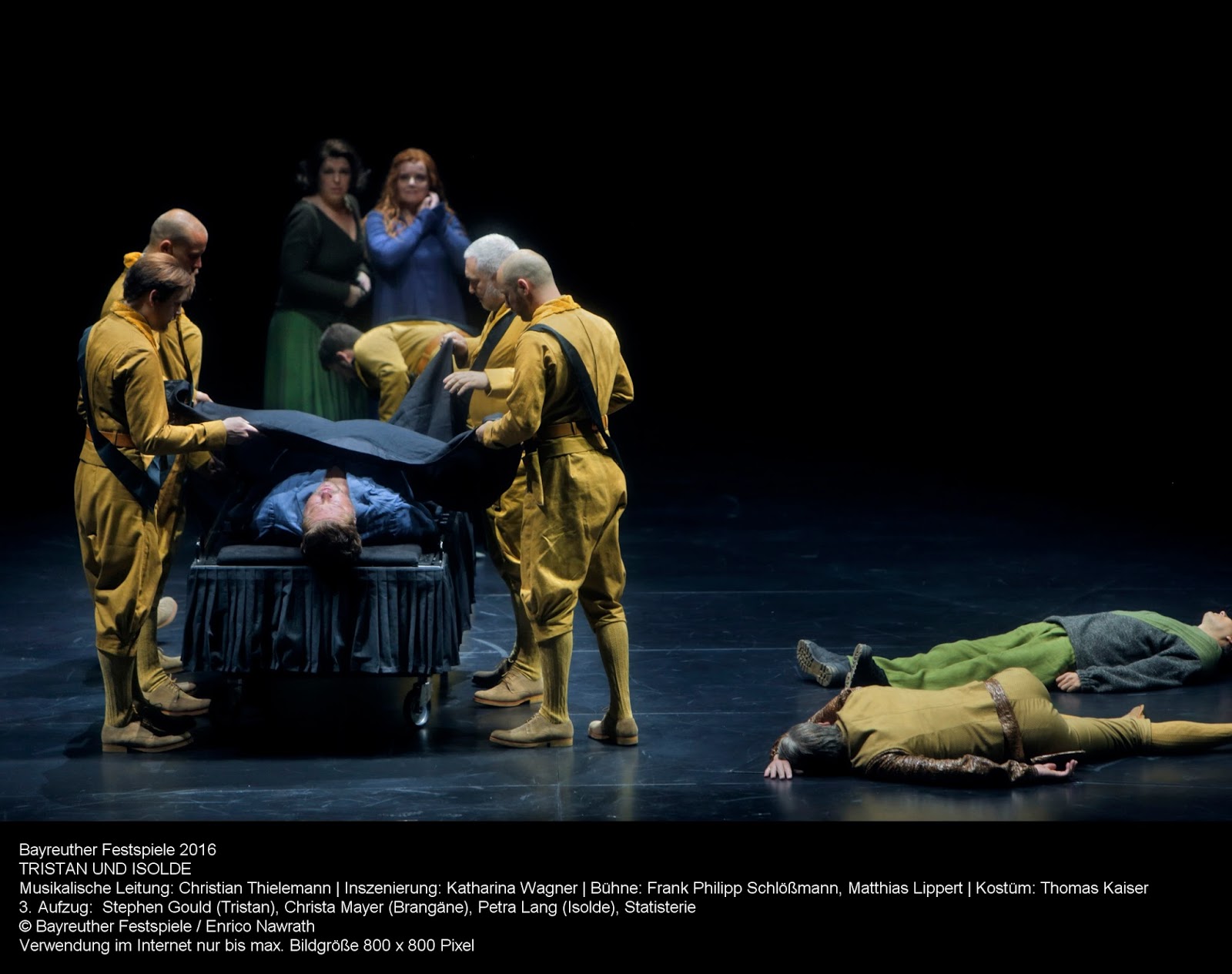
There are, moreover, several visually striking aspects to the mise-en-scène, for which designers Frank Philipp Schlößmann and Matthias Lippert certainly deserve credit. In some cases, although not all, they point to engagement with and a welcome critical standpoint with respect to the drama. The first act’s setting in a labyrinth, full of dead ends and other pitfalls, persistently – yet not entirely successfully – preventing the lovers from meeting presents a striking metaphor. That for the second act, in which Tristan and Isolde are constantly under King Marke’s surveillance, cruel, harsh spotlighting directed from above, initially makes its point well, taking on board Wagner’s Day/Night antithesis, and extending it, even questioning it. This is clearly a cruel world indeed; it may be understood politically, psychologically, or in both ways. The darkness of the third act is again visually attractive, and the images in which Isolde appears – I wondered to begin with whether something was being done with the white hands of legend, but then thought not – are again striking, even if their framing stands perhaps a little too close for comfort to Herbert Wernicke’s Covent Garden triangles. Tristan’s interaction with these empty ragdolls of his imagination is sensitively accomplished, although somewhat repetitive after a while. And the revisionist view of King Marke – yes, of course it is at odds with the surface of the text, but is it so very wrong to question, from time to time, its ideological basis and assumptions – is in itself welcome. His dragging Isolde off at the close, transfiguration clearly an idle, Romantic delusion, duly chills.


For the fundamental problem, however, is not so dissimilar to that of the hapless Meistersinger. Whilst there are striking images and ideas – in some instances at least, one presumes, dramaturge, Daniel Weber should at least share the credit for the latter – very little, at least until that striking conclusion, is really done with them; or, in some cases, too much of little import is done with them. I am all for an audience having to do some thinking for itself; a production that fails to accomplish that is unworthy of the name. Nevertheless, it seems to me, that there is a world of difference between, say, Frank Castorf’s Ring (at least so far, in revised fashion, as seen in 2016) and a staging (which may well, of course, undergo significant revision of its own in the future) in which the first act is made up more or less entirely of people running around, platforms being raised and lowered, and, on a couple of occasions, Tristan and Isolde are all over each other. Similarly for the stylised torture-medical (?) paraphernalia of the second act. Melot’s murder of Tristan, entirely without agency on the part of the latter, might have been suggestive; as it was, however, it came across as merely ‘different’ for the sake of it. If it were not for the striking designs – less happily striking in the hideous yellow costumes of Marke and his men – it would not be so very different from the most conventional, ‘traditional’ production. Although the screams of one audience member as I left the theatre – ‘They’ve changed the ending! You can’t change the ending! You can’t change the ending!’ – left me feeling more sympathetic with Katharina Wagner’s production than I might otherwise have done, having upset a person seemingly possessed of no critical abilities whatsoever is not in itself enough.


There is not really very much being said, then, whilst, at the same time, Wagner’s insistence – and I have yet to see it properly contradicted, on stage, in practice – that this is a metaphysical drama, majestically unconcerned with the ephemera of external representation, goes sadly unacknowledged. For, when condensing the action of Tristan und Isolde into a few words for Mathilde Wesendonck, the composer, in full Schopenhauerian flow, did not even mention Marke’s forgiveness (which is perhaps not so very important, then, to undercut). The action, he suggested, as much by omission as by commission, was not really of this phenomenal world at all; even Tristan’s agonies went unmentioned upon the way to ‘redemption: death, dying, destruction, never more to waken!’ (Erlösung: Tod, Sterben, Untergehen, Nichtmehrerwachen!) Now that need not be taken on trust, although this drama seems curiously, almost uniquely, resistant to attempts to question it on stage; the dots, however, need to be joined up a good deal more convincingly than they are here. Ultimately, what we see becomes tedious – and not in a self-critical, ‘let us consider tedium’ manner.


Fortunately, we were on much, much surer ground musically, permitting metaphysics a not insignificant re-entry to the proceedings. Hearing Christian Thielemann, in the finest Wagner I have heard from him for quite some time, made me realise that I had, in fact, been bending over backwards to excuse the shortcomings of Marek Janowski’s handling of the Ring scores (so far). De facto music director Thielemann has, of course, a huge advantage over Janowski: he has been dealing with the peculiarities of the Bayreuth acoustic – and pit! – for many years; indeed, he conducted Die Meistersinger here on my first visit, in 2000. And so, that fabled Bayreuth sound, more or less entirely absent, whether by design or otherwise, from Janowski’s performances, was once again a real presence amongst us. Perhaps I should say a variety of that fabled sound, for Thielemann tends perhaps to a slightly glossier, even more Straussian, sound than, say, that other fabled Bayreuth Straussian Tristan-master, Karl Böhm.


Beneath the surface, though – and what a glorious surface it was, all the more so for Thielemann’s not un-Barenboim-like willingness to let Debussy-tilting woodwind have their say too – there was undoubted rigour. Not only did the orchestra twist and turn, growl and gloat, speak and dissent as his fabled Oper und Drama successor to the chorus of Attic tragedy; it constituted, at least as much as merely representing, the Handlung of Wagner’s designation for the work. It was, I think, a reading of avowedly tonal understanding, such as would have pleased Wagnerian colleagues as distant ideologically from one another as JPE Harper-Scott and Roger Scruton. Schenker would have been proud. In the agonies of the third act, I might prefer something more Schoenbergian, more prepared at least to consider the air of another planet and the way it might criticise the (admittedly) iron-clad tonal structure of the work as a whole. (I think, for instance, of a performance Esa-Pekka Salonen gave with the Philharmonia in 2010.) Not every performance, not even one by Furtwängler, can present all of the potentialities of a Wagner score, though; no one would have been disappointed, or indeed anything other than thrilled, by the work of Thielemann and his orchestra, now back on superlative form.


It is unusual indeed not to find oneself making excuses for a Tristan cast, but there was no need to do so on this occasion. Bayreuth should be in the business of engaging casts to challenge, at the very least, those to be found anywhere else in the world; here it succeeded in doing so. ‘Untiring’ is often, in the Heldentenor world, a part-euphemism for ‘unpleasant, wildly out of tune, but he kept going’; not so in Stephen Gould’s case. Gould was able to put that ability to pace himself to thoroughly musical use, shaping his phrases with care, with dramatic meaning, in most cases equally careful with his words. The clarity of Petra Lang’s diction came and went, but hers was a powerfully dramatic reading, in which the somewhat unusual – for the role – colouring of her voice was relished. Her first-act sarcasm towards Brangäne, flouncingly acted as much as sung, was very different from that of, say, Birgit Nilsson, but made its point. I was less keen on the broken phrasing of the opening of her (non-)Verklärung, but it seemed to be part of a genuine effort to point to words as well as music.


Christa Mayer was as fine a Brangäne as I can recall hearing, wide of dynamic range and colour, unfailing sympathetic (perhaps especially when Isolde did not wish to hear). Iain Paterson seemed more at home with Kurwenal than the Rheingold Wotan, not that there was anything to complain about in his portrayal of the latter. This was a trustworthy, kind, unfailingly human servant and (failed) friend. Georg Zeppenfeld’s Marke proved as distinguished, at least, as his Hunding the previous night, exhibiting many similar musico-dramatic virtues. Zeppenfeld’s delivery of the second-act monologue was in no sense hampered by the director’s unsympathetic view of his character. Quite the contrary; potential difficulty was transformed into meaningful dramatic counterpoint. Tansel Akzeybek, whose Froh I had previously found uncommonly sweetly sung, offered similar pleasures in the twin roles of the Young Sailor and the Shepherd; I hope to hear more from him. Music, then, redeemed the work, or rather the production. Nietzsche’s opus metaphysicum was, more or less, reinstated as such.