Showing posts with label Markus Brück. Show all posts

Sunday, 5 May 2024

Intermezzo, Deutsche Oper, 1 May 2024


Images: Monika Rittershaus
Robert Storch (Philipp Jekal), Christine (Maria Bengtsoon), Franzl (Elliott Woodruff)


Robert Storch – Philipp Jekal
Christine – Maria Bengtsson
Franzl – Elliott Woodruff
Anna – Anna Schoeck
Baron Lummer – Thomas Blondelle
Kapellmeister Stroh – Clemens Bieber
Notary – Markus Brück
Notary’s wife – Nadine Secunde
Commercial Counsellor – Joel Allison
Judicial Counsellor – Simon Pauly
Chamber Singer – Tobias Kehrer
Resi – Lilit Davtyan

Director – Tobias Kratzer
Designs – Rainer Sellmaier
Lighting – Stefan Woinke
Video – Jonas Dahl, Janic Bebi
Dramaturgy – Jörg Königsdorf

Orchestra of the Deutsche Oper
Donald Runnicles (conductor)

Christine, Robert, taxi driver

The second panel of Tobias Kratzer’s Strauss triptych for the Deutsche Oper, following last year’s Arabella, proves a worthy successor. A relative rarity for reasons no one seems able to discern, Intermezzo once again vindicates itself and its composer-librettist, who had learned his lessons well from his longtime collaborator Hugo von Hofmannsthal. Taking an intelligent, but not the most predictable, line from young love – it need not always be Der Rosenkavalier – through Intermezzo’s bourgeois marital comedy, next season heading toward the symbolic yet pronatalist transformations of Der Frau ohne Schatten, Kratzer’s partnership with the house and its outgoing music director Donald Runnicles turns out to have fewer clouds than, yet rest on similarly firm foundations as, that of the barely disguised Richard and Pauline seen and heard onstage as Robert and Christine Storch. Salome or Elektra might be a fitting way to undercut all that at the end, but such, at least for now, does not appear to be the intention. (In any case, the Deutsche Oper already has a splendid production of the former from Claus Guth on its books.)

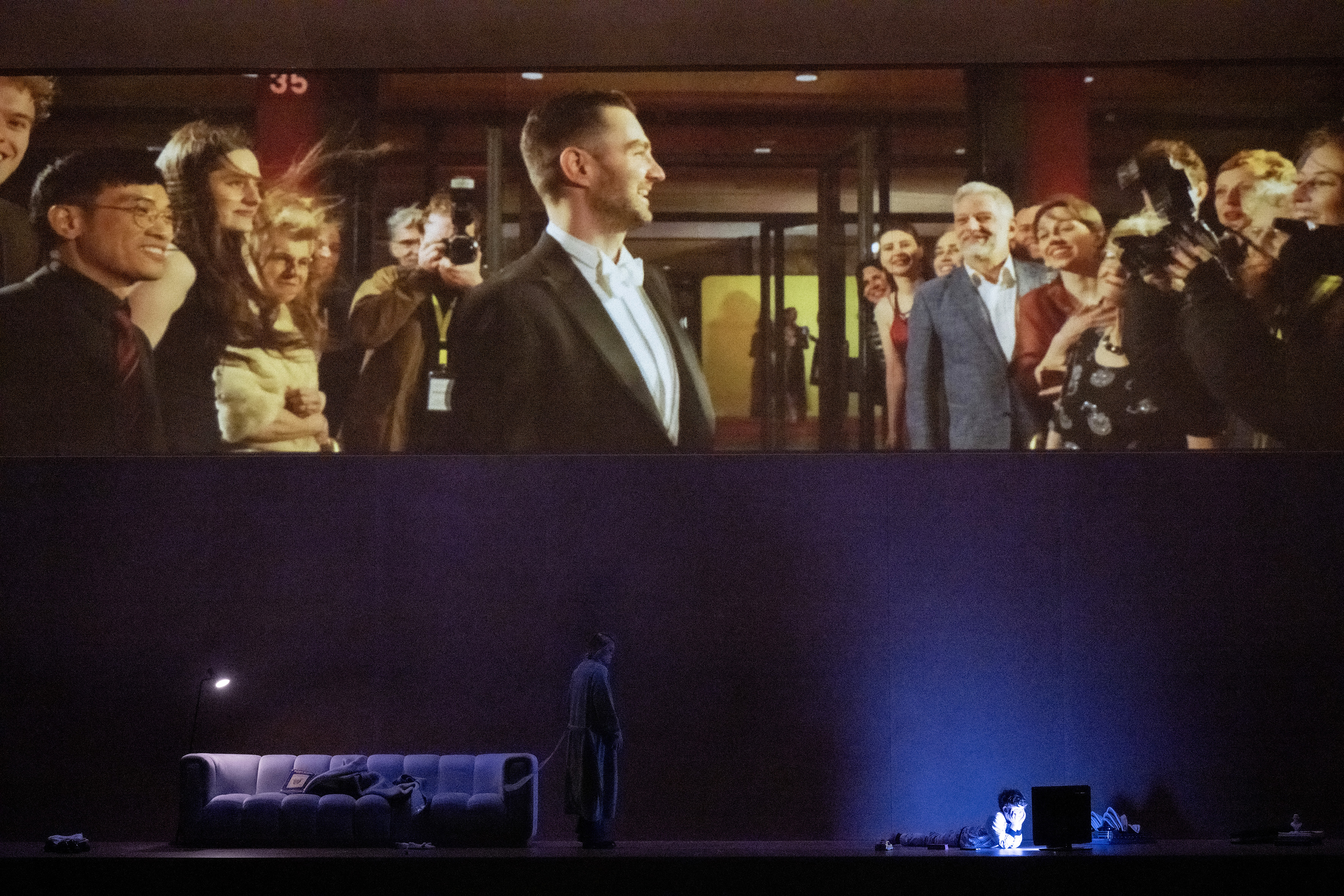
A Zeitoper, if it is to be updated, needs careful handling in finding equivalents, at least if an abiding aesthetic of realism is to be retained as it is here. (It is not beyond the bounds of possibility to try something different, far from it, but it would be a tricky assignment.) Kratzer proves almost unerring in finding realistic contemporary settings for Strauss’s succession of bourgeois scenes. The Prater becomes an aeroplane (Straussair, with ostrich emblem play-on-words) journey home. The scene in Franzl’s bedroom has him watch online his father’s red-carpet, autograph-signing arrival at the Deutsche Oper (a little much, one might have thought, for either an opera composer or conductor, but perhaps that is the point). Such glamour contrasts poignantly with Pauline’s loneliness and her announcement of a broken marriage to the little boy. The game of skat takes place in a typical green room/Kantine. We see much of the orchestra and Donald Runnicles on film during the interludes, heightening the wonders of metatheatricality—and, quite simply, an excellent chance to see the players at close quarters. 


Baron Lummer (Thomas Blondelle), Christine, others


Earlier on, Robert leaves domestic ‘bliss’ in a taxi absurdly overfull with baggage, driver waiting patiently, cigarette in hand. Subsequent text messaging between the two of them proved a rare instance of adept operatic reference to that world. Ironically, for an opera claimed by some to be ‘embarrassing’ – perhaps accusers should look instead in the mirror – the scene turns out, unlike most such attempts, to be anything but; it strikes a fine balance between irritation and genuine, communicative emotion. The ski-slope collision between Christine and the Baron is transferred to behind the motoring wheel. I could not help but find the transfer of the ensuing scene at the Grundlsee Inn to a hotel bedroom – there can be no doubt what is meant by the ‘dancing’ on which Robert has given up – something of a miscalculation: it made much of what happened later between the characters, especially in their dialogue, very difficult to understand, if not quite incomprehensible. Even that, though, was handled on its own terms with a strong sense of theatrical realism, Personenregie crucially alert throughout. 


Notary (Markus Brück), Christine

Kratzer, moreover, responds to Strauss’s loving (without being too self-loving) self-quotation and allusion with twofold references of his own. Elektra and Der Rosenkavalier on film are further doubled by Christine’s choices from her costume wardrobe, that dressing up being in turn pressed upon the Baron (initially dressed as Kratzer). So much opera is about disguise and the assumption of roles in one way or another. Here we receive a welcome invitation to reflect on that, almost as our own minds will, though with guidance for those who need or wish it. No one, surely, could miss either the craziness or the sincerity of Christine’s metamorphosis into axe-wielding Elektra when she strikes her blows for womankind against the hapless Notary in his office. The ‘natural’ order of things is restored and perhaps lightly mocked by having Christine, conducted by Richard, sing her part of their closing love duet to an assembled audience in front of acted orchestra. I hesitate, no decline, to defend the sexism, though frankly what would one expect in a work so much, so avowedly, of its time? Straussian irony, though, will always be present for those with ears to hear; that certainly includes Kratzer, Runnicles, and a strong cast. For those who do not, there are many other ways to spend three hours of their time. 


Robert, Stroh (Clemens Bieber)

The orchestra for which Strauss calls is small, verging indeed on a chamber orchestra at times. We certainly heard pinpoint precisio, and ‘ensemble’ sonorities that would more readily be classed modernist if penned by Schoenberg or Webern. What nonetheless struck most keenly and certainly most warmly were the swell and glow of the Deutsche Oper orchestra and not only in the interludes: miniature tone poems in their own right, a splendid formal innovation for which Strauss never seems to gain credit. That the orchestra and Runnicles are old Strauss hands, not least in tandem, should not have us take their idiomatic and dramatically meaningful musicianship for granted. It may have been gorgeous, but it was never for ‘mere’ gorgeousness’s sake, the composer’s strong aestheticist tendences notwithstanding. 


Christine, Baron Lummer

At least as much as any Strauss opera and more so than many, an Intermezzo performance will stand and fall not only by the orchestra but also by its soprano heroine. Veterans of great Strauss performances of the past will surely not be disappointed, at least not reasonably so, by Maria Bengtsson’s Christine. It is here, of course, that whatever Strauss’s everyday sexism – misogyny if you will, though it seems a little strong – is routed by his lifelong love for the soprano voice (and Pauline). Bengtsson made the role her own and also very much a creature of our own times, ultimately likeable through that earlier cited genuineness of emotion. How we felt with her at her darkest hour, however silly some of her other behaviour may have been. Kratzer’s direction of Elliott Woodruff as Franzl and indeed the boy-actor’s own performance helped here too. Philipp Jekal’s Robert was finely sung and acted, treading difficult lines of his own without in any sense trying to upstage his partner-in-crime. Thomas Blondelle’s Baron Lummer initially seemed a bit old for the role, but the revelation of him as directorial emanation brought him more clearly into his own; at any rate, this was a similarly good performance. Strong appearances in smaller roles from artists such as Clemens Bieber, Anna Schoeck, and Markus Brück likewise attested to thoughtful casting and direction. Assuming that performances of Intermezzo will, alas, continue to be rarities even in German-speaking lands, catch this if and when you can.


Final scene


Friday, 10 March 2017

Edward II, Deutsche Oper, 9 March 2017


Deutsche Oper, Berlin

Images: Monika Rittershaus
Edward II (Michael Nagy) and Piers de Gaveston (Ladislav Elgr)

Edward II – Michael Nagy
Isabella – Agneta Eichenholz
Piers de Gaveston – Ladislav Elgr
Roger Mortimer – Andrew Harris
Walter Langton, Bishop of Coventry – Burkhard Ulrich
Lightborn – James Kryshak
Angel – Jarrett Ott
Soldiers, Councillors, Guards, Tourguides, etc. – Markus Brück, Gideon Poppe
Spencer Jr – Gieorgij Puchalski
Prince Edward – Ben Kleiner

Christof Loy (director)
Annette Kurz (set designs)
Klaus Bruns (costumes)
Stefan Bolliger (lighting)
Yvonne Gebauer, Dorothea Hartmann (dramaturgy)

Chorus of the Deutsche Oper, Berlin (chorus master: Raymond Hughes)
Orchestra of the Deutsche Oper, Berlin
Thomas Søndergård (conductor)
Walter Langton, Bishop of Coventry (Burkhard Ulrich) and the crowd


Andrea Lorenzo Scartazzini’s new music theatre piece – ‘Musiktheater in zehn Szenen,’ although I am unsure in what sense it is not an opera as conventionally understood – seems to have generated quite some controversy. I have avoided reading the offending article or indeed anything else until seeing this, but I hear that one journalist has been accused of homophobia in the insults she has hurled at the work. Let us leave that on one side – I can hardly do otherwise, not having read any of the commentary – and attend to Edward II on its own terms, or what I take them to be.


Foreground: Spencer Jr (Gieorgij Puchalski), Roger Mortimer (Andrew Harris), Gaveston, Edward 
 

It turns out to be one of those difficult things to write about: perfectly serviceable as an opera, competently constructed, doing pretty much everything one would expect it to and almost nothing one would not expect. The work’s ten scenes do not overstay their welcome; the pacing seems just about right. There is a very traditional operatic and more broadly dramatic contrast between the public and private: think of Schiller, or the Petrarchan AMOR/ROMA dilemma, although here, not unreasonably, one never has any doubt that King Edward will choose love and ‘sodomite’ – a word endlessly repeated – lifestyle over matters of state. A vicious crowd, stirred up by hypocritical clergyman, bays for sodomite blood. The Queen moves – perhaps a little quickly, but such is opera – from sympathetic, lonely figure to vicious, vengeful, murderess. There is, moreover, a genuine sense of ‘this could be any family’, the young Prince Edward torn between his two self-obsessed parents. Scartazzini’s score follows the action, in what sounds on a first hearing (with all the caveats that must imply) like a generic not-quite-contemporary modernism. It screams when one would expect it to, likewise creates a hushed atmosphere when one would expect; it has structural impetus of its own within scenes.


And yet, there is little that adds up to anything more than that, or at least it did not for me. We can leave aside the playing fast and loose with history and with sources: that is what dramatists do. However, the framing devices of librettist, Thomas Jonigk, come across as forced, and indeed almost haplessly agitprop. Attempts, for instance in comments by the Angel, to present knowingly anachronistic references to other pertinent historical events and figures, are a bit embarrassing, likewise the historical tour’s visitation of Edward’s cell at the close. The comparison between wronged Jews and sodomites is not pursued in any depth, and merely seems glib. It is, moreover, only really at the close – and perhaps this is deliberate, but if so, it again needs better framing – that Edward as a character comes into focus; everyone else, despite extremely strong performances, remains something of a caricature. Derek Jarman, let alone Christopher Marlowe, did this, or something akin to this, so much better. Scartazzini never seems to lead the action, to have the orchestra partake in it, engender it, rather than predictably mirror the events on stage. His vocal lines, such as they are, hold little or no interest of their own; I could not help but wonder whether he would have been better off writing a symphonic poem or equivalent on the subject.

Edward and Gaveston
 

The sad conclusion I ended up drawing was that this opera’s creators seem to have thought it enough to write a gay opera. Perhaps it is; we are not exactly blessed with a huge number of examples, at least overtly, proudly so. (Subtexts, however close to the surface, are another matter.) Overall, though, it feels too much like box-ticking, too little like something that might have arisen from genuine artistic necessity. Imagine what might have been done in an opera that placed queer experience at its complex heart, doing something akin to what Nono did for women’s revolutionary experience in Al gran sole carico d’amore. There will, I hope, be other opportunities – and, to be fair, there is an abundance of mediocre, or worse, operas dealing with heterosexual themes.
Isabella (Agneta Eichenholz) and Prince Edward (Ben Kleiner)


That said, the Deutsche Oper deserves only praise for the commitment it has shown, both in staging the new work and, still more, doing so in performances of such quality. Its orchestra and chorus, the latterly brilliantly trained by Raymond Hughes, played under Thomas Søndergård with a confidence that suggested this might have been a repertory work. Balance, weight, incisiveness, tenderness: all those qualities and more were present in the pit; on stage, one could hardly have asked for more from the chorus, director Christof Loy’s blocking of the partly differentiated mass a joy in itself to behold. Indeed, Loy’s work in general – I speak as someone who has been far from a constant fan of his productions – deserves great credit, essentially presenting the opera as a somewhat abstracted version of classic grand opera, with slightly alienated invasions from without. The ‘family values’ crowd was an obvious ploy, replete with placards from any reactionary demonstration one might care to look at, but it made its (agitprop) point well enough.

Angel (Jarrett Ott), Edward, and Spencer Jr
 

Michael Nagy drew one in more than one had any right to expect in a visually torn, vocally secure performance of the title role. As the Angel only the King could see, Jarrett Ott offered all the strength and comfort Edward might ever have asked: a rock in a vicious world indeed. Ladislav Elgr, seen for about ninety per cent of his time on stage merely in well-fitted white vest and briefs, exhibited as the favourite, Gaveston, a near-ideal marriage of fun, born of social desperation no doubt, and magnetism. Agneta Eichenholz made the most of that abrupt transition from wronged woman to monster in a powerful assumption of the role of Isabella. The darkness of her relationship to Andrew Harris’s unreconstructedly masculine Mortimer could only really be hinted at, given the confines of the work, but hinted at it certainly was. There was a good deal of camp humour to be had from the recurring double act – from thirteenth-century soldiers guardedly admitting their sodomite tendencies to modern tour-guides – of Philip Jekal and Gideon Poppe. The Mime-like nastiness, with an undoubtedly chilling Nazi allusion of just following orders, of Edward’s murderer-with-abortionist’s-bag, Lightborn, was splendidly portrayed by James Kryshak. Ben Kleiner’s treble could hardly be faulted as the young prince; he knew how to deport himself on stage too. And last but not least, Gieorgij Puchalski’s performance in the non-speaking role as Spencer Junior, the new favourite risen from the ashes of the old, showed just what the suggestiveness and sheer physicality of a dancer in a vocal work can achieve.


If the above tends too much towards a list, that is part of my point. These were all, without exception, fine performances indeed; they did all they could with a work that could have been much worse, but ought to have been much better.


Wednesday, 17 February 2010

Die Meistersinger von Nürnberg, Deutsche Oper, 14 February 2010

Deutsche Oper, Berlin

Hans Sachs – James Johnson
Veit Pogner – Kristinn Sigmundsson
Kunz Vogelgsang – Thomas Blondelle
Konrad Nachtigall – Simon Pauly
Sixtus Beckmesser – Markus Brück
Fritz Kothner – Stephen Bronk
Balthasar Zorn – Jörg Schörner
Ulrich Eißlinger – Peter Maus
Augustin Moser – Burkhard Ulrich
Hermann Ortel – Klaus Lang
Hans Schwarz – Jörn Schümann
Hans Foltz – Hyung-Wook Lee
Walther von Stolzing – Klaus Florian Vogt
David – Paul Kaufmann
Eva – Michaela Kaune
Magdalena – Ulrike Helzel
Night-watchman – Krzysztof Szumanski

Götz Friedrich (director)
Peter Sykora (stage designs)
Kirsten Dephoff and Peter Sykora (costumes)
Gerlinde Pelkowski (revival director)

Chorus and Supplementary Chorus of the Deutsche Oper, Berlin (chorus master: William Spaulding)
Movement Chorus, Actors, Acrobats (choreography: Charlotte Butler and Carsten Meyer)
Orchestra of the Deutsche Oper, Berlin
Donald Runnicles (conductor)

And so, my brief sojourn in Charlottenburg drew to a close with a performance of the greatest of all comedies. From the host of idiocies one hears repeated about Wagner, the claims of a lack of humour must be amongst most preposterous. Whilst I missed out on the new Rienzi, an intriguing-sounding Flying Dutchman, and of course the Ring, at least I could be reminded of just what a magnificent work of art The Mastersingers of Nuremberg is: most welcome, since I still shudder when considering the sheer directorial ineptitude of my most recent stage encounter with the work, when Katharina Wagner presented it at Bayreuth.

Götz Friedrich was a far wiser director and his 1993 production holds up pretty well almost seventeen years on. It will doubtless be well known to many readers from the DVD recording, but this was my first acquaintance. Nuremberg is recognisably Nuremberg, but the costumes suggest the nineteenth century: the time of composition, I suppose. A vision of old Nuremberg and, more, briefly of the devastation of its twentieth successor, may be glimpsed during the opening prelude, thus framing the production’s terms of reference. We can never quite forget – especially when a Star of David is seen on stage with the Mastersingers’ guild: same symbol, different meaning, but the possibility of consequences? (By the way, obsessive purveyors of anti-Semitic interpretations of Wagner may care to ask themselves why the composer chose to mention King David. It would hardly have been beyond him to have chosen a different symbol.) This set me thinking that, in some respects at least, a city such as Nuremberg might well have been recognisably the same city, at least during the earlier nineteenth century. The guilds were breaking down, but not broken. They had their defenders, from Hegel to Wagner. And they presented their own solutions to the ‘social question’, represented their own version of community to an increasingly disenchanted world of liberal ‘free competition’. Not the least of the consequences of the 1848-9 revolutions was the boost given to ‘free trade’ and onslaught on impediments thereto: such sops to the bourgeoisie kept them on side with the restored order, far preferable to the red threat, from Wagner and his ilk, they had glimpsed during the uprisings.

Lest this sound one-sided – and I should emphasise that the thoughts are largely mine, sparked by the production, but not necessarily to be ‘found’ therein – the humour of Friedrich’s staging should certainly be mentioned. To take one example, I have never before found the reappearance of the Nightwatchman amusing. Here, the haplessness of his arrival once the riot is over was just that. The Malvolio-like quality of Beckmesser was emphasised throughout; there may or may not be uncomfortable questions to ask here, but the brilliance of Wagner’s humour is too often overlooked. Other nice touches include Walther threatening physical violence when impertinently asked whether he is frei und ehrlich geboren. Would not any self-respecting Junker do the same? Schopenhauer, however, barely registers.

Prior commitments meant that Donald Runnicles, who has recently become Music Director of the Deutsche Oper, was unable to lead a new production during this Wagner festival. We found him in the pit, however, for Meistersinger. He encourages a good, indeed an excellent, sound from the orchestra – which, during my three performances, I found on as good form as I can recall, perhaps better. The Viennese glint on which I have remarked in earlier reviews remained very much a characteristic of the strings. Warm and full of sound, this was an orchestra fully worthy of expressing the sentiments of heil’ge deutsche Kunst. On the negative side, to be mentioned though not exaggerated, Runnicles could sometimes drive the music too hard, veering occasionally towards the metronomic, the very antithesis of Wagner’s ever-varying melos. Moreover, there were too many disjunctions between stage and pit. Perhaps there was limited rehearsal time, but the excellent chorus was too often left adrift. It is worth here, however, commending chorus master William Spaulding for his work with the chorus, which once but no longer seemed a poor relation to its counterpart at the Linden opera.

Fortunes were somewhat mixed on stage. James Johnson was a likeable Hans Sachs, who grew in character as the performance progressed. He could sometimes, however, be overwhelmed by the orchestra and lacked the degree of personality – think Sir John Tomlinson! – that makes a true Sachs. The real fly in the ointment, however, was Michaela Kaune’s Eva. Her voice lacks beauty, even steadiness, and simply sounds ‘wrong’, too mezzo-like, for the role. The radiant lyricism that should flow so freely from this evocation of the Goethian Ewig-Weibliche was nowhere to be heard. I had wondered whether a different production from Bayreuth (!) might set her off to better advantage – sadly not. Indeed, I found myself wishing that she would swap roles with Ulrike Helzel, an artist new to me but a quite outstanding Magdalena. Here was beauty of tone, and a character in whom one could believe as an object of David’s love. Davids tend to be winning – what a gift of a role it is! – but Paul Kaufmann’s refusal to be an exception should nevertheless be cited approvingly. Kristinn Sigmundsson’s Pogner sounded tired – he had sung King Henry the night before – and Stephen Bronk’s Kothner simply sounded old. However, Markus Brück’s Beckmesser was a joy. If Sir Thomas Allen remains my gold standard in this role, this was an excellent assumption of the part, fully alive to the Shakespearean humour I mentioned above, unwilling to descend into even the slightest suspicion of caricature.

And then – there was Klaus Florian Vogt. Regular readers will know of my esteem for his near-miraculous voice. I almost tire of praising him, but not quite. Once again, he displayed his instrument’s strange, yet wonderful mixture of lyric tenor quality with the power of the heroic tenor: an ideal combination. The Prize Song was so beautiful as to bring one to tears, almost as if Fritz Wunderlich had turned Heldentenor. How could anyone resist? Vogt can act, too, as I had to admit even at Bayreuth…