Showing posts with label Tobias Kratzer. Show all posts

Monday, 5 August 2024

Bayreuth Festival (3) - Tannhäuser, 4 August 2024


Festspielhaus

Images: Bayreuther Festspiele / Enrico Nawrath


Hermann, Landgrave of Thuringia – Günther Groissböck
Tannhäuser – Klaus Florian Vogt
Wolfram von Eschenbach – Markus Eiche
Walther von der Vogelweide – Siyabonga Maqungo
Biterolf – Olafur Sigurdarson
Heinrich der Schreiber – Martin Koch
Reinmar von Zweter – Jens-Erik Aasbø
Elisabeth – Elisabeth Teige
Venus, Page – Irene Roberts
Young Shepherd – Flurina Stöckl
Le Gateau Chocolat – Le Gateau Chocolat
Oskar – Manni Laudenbach
Pages – Simone Lerch, Laura Margaret Smith, Annette Gutjahr

Director – Tobias Kratzer
Set designs – Rainer Sellaier
Lighting – Reinhard Traub
Video – Manuel Braun
Dramaturgy – Konrad Kuhn

Bayreuth Festival Chorus (chorus director: Eberhard Friedrich)
Bayreuth Festival Orchestra
Nathalie Stutzmann (conductor)

Adieu or au revoir, I asked myself when leaving the Festspielhaus, but also from time to time during this performance of Tannhäuser. It will not, I hope, be adieu to the Bayreuth Festival. My years of attendance pale in comparison to those of many, but regular visits have become part of my musical, intellectual, and indeed social life, and I should be sorry to see that come to an end. But would it be to Tobias Kratzer’s production, and to the characters it has not only portrayed and explored but created, with lives, personalities, and possibilities of their own. The closest parallel that presented itself to me, perhaps ironically, was that of Frank Castorf’s Ring, which I also saw here three times, and to which by the end I had become quite attached. Even now, I sometimes wonder fancifully whatever became of Nadine Weissmann’s Erda, following Wotan’s brutal dismissal of her at (Al-)Exanderplatz. Somehow, ridiculous though this may sound, I should like to know that, a bit like Dallas’s Sue Ellen, she battled through. For Kratzer’s similarly classic – less controversially so – staging, time will tell. 2024 was scheduled to be its final outing, but there are plausible rumours that Le Gateau Chocolat and the gang will take the stage one more time two summers from now, when Bayreuth is due to give all works from The Flying Dutchman on, adding Rienzi for the first time in the Festspielhaus, for the Festival’s sesquicentenary.


Le Gateau Chocolat

As intelligent as it is entertaining (not necessarily a word one instantly associates with this opera), Kratzer’s metatheatrical, Ariadne-like Tannhäuser thus became all the more moving for me on this occasion, though I think that may also be attributed to a slight shift in tone. At its heart – it has a big heart – lies the opposition, faithful to Wagner’s own binaries and attempts to bridge them, between the world of the Wartburg and that of the Venusberg: the former as presented at Bayreuth, the latter a defiantly alternative, joyous troupe made up of Tannhäuser, his lover Venus, and two fellow artists, the fabulous Le Gateau Chocolat (as herself) and the enchanting Oskar (as in Günter Grass’s Oskar Matzerath, played by Manni Laudenbach with tin drum). They too make art; they too can be uncompromising; but differently, as in life, and in that they are quite unapologetic. The Overture – for better or worse, this is the Dresden Tannhäuser – shows through a mixture of film and staging our players on the road, running out of food and fuel, having to make an emergency stop at a service station to replenish supplies, only to be (almost) caught by a policeman. Venus, to the horror of the others, puts her foot down in a hit-and-run incident, occasioning Tannhäuser’s jump from the van and departure from the band. ‘Unapologetic’ has its limits. A lovely touch this year, was early on to have Oskar, lump in his throat, drink a shot in memory of Stephen Gould, the production’s first Tannhäuser.

Found by a passing cyclist (the Shepherd), Tannhäuser proceeds to rejoin his former singers on the Festspielhügel, the Festival audience making its way around their discussions, in order to be present at the performance. As the first act is drawing to a close, Venus, Le Gateau Chocolat, and Oskar make their way to the Green Hill to win Tannhäuser back. Much of the actual audience – all who wish – then make their way down to the pond at the foot of the actually existing hill, for the cabaret show they have devised, beautifully compered by Le Gateau Chocolat, who draws proceedings (her own rendition of ‘Dich teure Halle’ included) to a close with a call for Bayreuth to come out of the closet and display of the Progress Pride Plag, a poignant and necessary call for queer liberation in the age of JD Vance and JK Rowling.
 

For the second act, we move inside the Festspielhaus/traditional Wartburg, video taking us backstage, both for preparations (with fine, detailed work both by the live film crew and members of the chorus) and for events for which the house is anything but prepared. In explicit homage to the Young German Wagner, members of the troupe invade the temple of bourgeois art, reminding us who Wagner really was and what he stood for with the banner unfurled from the storied balcony at the front of the house: quoting the composer’s torrential revolutionary catechism, Die Revolution, of 1849: ‘Frei im Wollen/Frei im Thun/Frei im Geniessen/R[ichard] W[agner]’. Freedom in desire, deed, and pleasure offers an obvious, glaring contrast with the professed values of the Minnesänger, as of course Wagner proceeds to show in the song contest, here crashed by our alternative artists, Venus pushing herself forward as an ersatz Page (a phrase behind in the first instance). Eventually, a security guard alerts Katharina Wagner, who calls the police to arrest Tannhäuser, notably leaving a dejected, broken troupe behind as the curtain falls. 


No one is a winner here, then, and certainly not Elisabeth, whom we meet again in a desolate landscape, the van burned out, tasting soup Oskar has made. What has happened in the meantime can largely be left to our own imagination, but it is clear that the troupe has broken up and Elisabeth has similarly lost almost everything. If, moreover, she has not lost her final gift (or curse), she will do so shortly to Wolfram, though only because he agrees to dress as Tannhäuser, clown wig and all. It was clearly not a good idea; it does not seem to have brought them any joy; but in the absence of anything better in art or life, they felt a compulsion to do so in the back of the van. Only Le Gateau Chocolat, we learn, has made it, advertising watches from a giant billboard above. When Tannhäuser returns, he tears to pieces his own score in despair, pages littering the stage until tales of the Papal miracle reach us. Life having in crisis supplanted art – this is not a Nietzschean aestheticism, nor was Wagner’s – we see on film at the close an alternative path, which may or may not offer consolation: Tannhäuser and Elisabeth, riding off in the van into the sunset. Perhaps another day, in another world. 

None of this would amount to much without committed performances from all concerned. All principal roles other than Venus were played by the same artists I heard last year. Ekaterina Gubanova will return for the final two performances, but here she was replaced with Irene Roberts, who uncannily resembled her (tribute not least to those working in costumes and make-up). Her performance was alive, arresting, and unsentimental: very much what was required. Klaus Florian Vogt’s Tannhäuser was beautifully sung, tirelessly acted: another intelligent portrayal. Some do not like his voice or think it appropriate; it is for them, as his gang might (perhaps more colourfully) tell us, to deal with it. Elisabeth Teige gave another excellent performance as her namesake, showing strength and subtlety in her tragedy. Markus Eiche’s often tenor-like Wolfram offered a fine study not only in verbal response but also in wounded pride. Günther Groissböck was on considerably better form as the Landgrave than as the previous night’s King Marke. Other noteworthy performances out included Siyabonga Maqungo’s sweet-toned Walther von der Vogelweide and Olafur Sigurdarson’s charismatic Biterolf.


Eberhard Friedrich drew out variegated performances from the Bayreuth Festival Chorus, words and meaning as intelligible as those of any soloist. And whilst I was unconvinced by some gear changes in Nathalie Stutzmann’s conducting – at the end of the first act in particular – and there remained a good few peculiar orchestral balances, possibly born of a desire to highlight Wagner’s debt to grand opéra, considerable progress had been made from last year. Ensemble was not perfect, but it was a good deal sight stronger than it had been in the first of the three productions I saw and heard this year. The sum of what, I think, we may in the best sense call this ‘show’ proved greater and deeper than its estimable parts. Here is to hopes for 2026.


Sunday, 5 May 2024

Intermezzo, Deutsche Oper, 1 May 2024


Images: Monika Rittershaus
Robert Storch (Philipp Jekal), Christine (Maria Bengtsoon), Franzl (Elliott Woodruff)


Robert Storch – Philipp Jekal
Christine – Maria Bengtsson
Franzl – Elliott Woodruff
Anna – Anna Schoeck
Baron Lummer – Thomas Blondelle
Kapellmeister Stroh – Clemens Bieber
Notary – Markus Brück
Notary’s wife – Nadine Secunde
Commercial Counsellor – Joel Allison
Judicial Counsellor – Simon Pauly
Chamber Singer – Tobias Kehrer
Resi – Lilit Davtyan

Director – Tobias Kratzer
Designs – Rainer Sellmaier
Lighting – Stefan Woinke
Video – Jonas Dahl, Janic Bebi
Dramaturgy – Jörg Königsdorf

Orchestra of the Deutsche Oper
Donald Runnicles (conductor)

Christine, Robert, taxi driver

The second panel of Tobias Kratzer’s Strauss triptych for the Deutsche Oper, following last year’s Arabella, proves a worthy successor. A relative rarity for reasons no one seems able to discern, Intermezzo once again vindicates itself and its composer-librettist, who had learned his lessons well from his longtime collaborator Hugo von Hofmannsthal. Taking an intelligent, but not the most predictable, line from young love – it need not always be Der Rosenkavalier – through Intermezzo’s bourgeois marital comedy, next season heading toward the symbolic yet pronatalist transformations of Der Frau ohne Schatten, Kratzer’s partnership with the house and its outgoing music director Donald Runnicles turns out to have fewer clouds than, yet rest on similarly firm foundations as, that of the barely disguised Richard and Pauline seen and heard onstage as Robert and Christine Storch. Salome or Elektra might be a fitting way to undercut all that at the end, but such, at least for now, does not appear to be the intention. (In any case, the Deutsche Oper already has a splendid production of the former from Claus Guth on its books.)

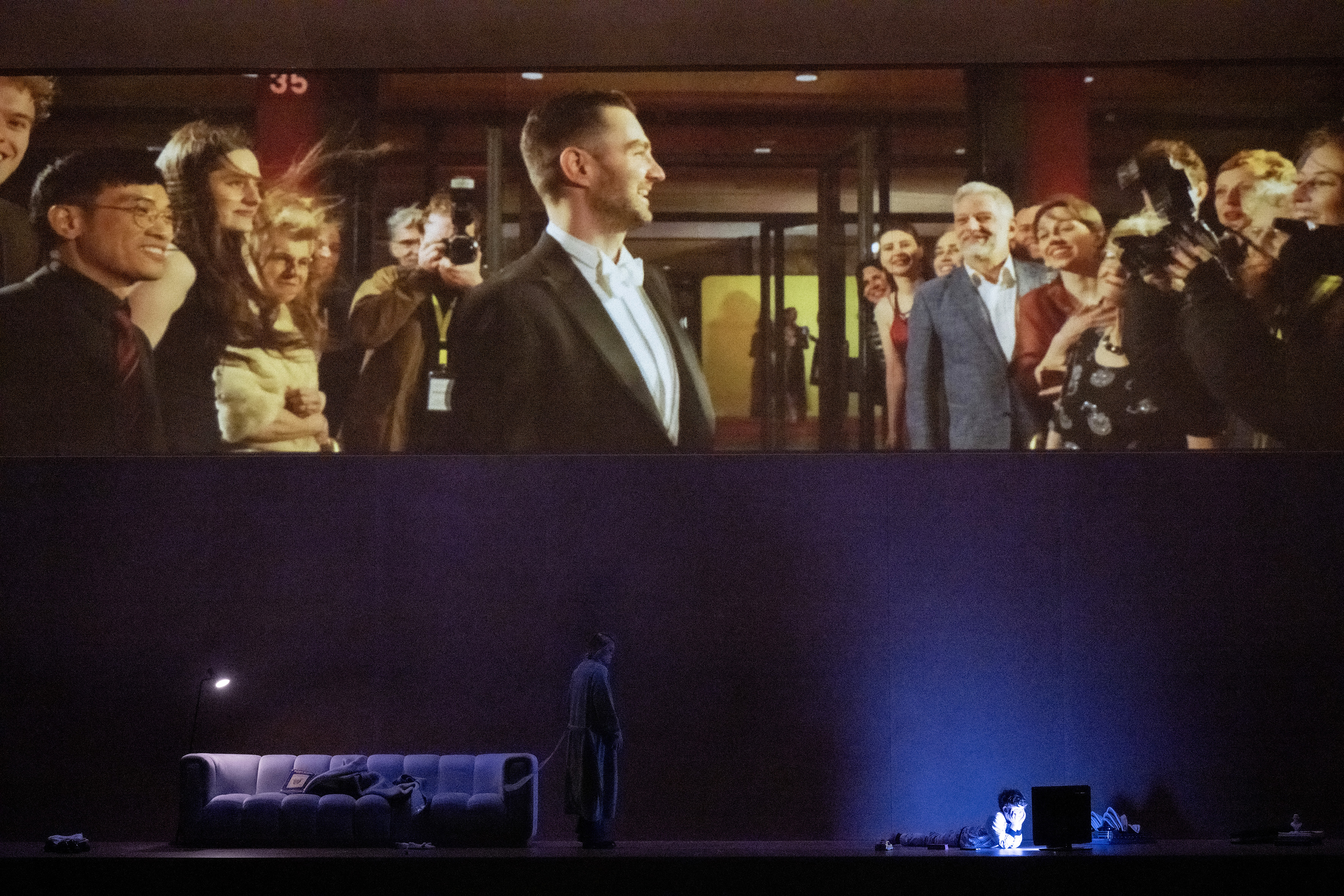
A Zeitoper, if it is to be updated, needs careful handling in finding equivalents, at least if an abiding aesthetic of realism is to be retained as it is here. (It is not beyond the bounds of possibility to try something different, far from it, but it would be a tricky assignment.) Kratzer proves almost unerring in finding realistic contemporary settings for Strauss’s succession of bourgeois scenes. The Prater becomes an aeroplane (Straussair, with ostrich emblem play-on-words) journey home. The scene in Franzl’s bedroom has him watch online his father’s red-carpet, autograph-signing arrival at the Deutsche Oper (a little much, one might have thought, for either an opera composer or conductor, but perhaps that is the point). Such glamour contrasts poignantly with Pauline’s loneliness and her announcement of a broken marriage to the little boy. The game of skat takes place in a typical green room/Kantine. We see much of the orchestra and Donald Runnicles on film during the interludes, heightening the wonders of metatheatricality—and, quite simply, an excellent chance to see the players at close quarters. 


Baron Lummer (Thomas Blondelle), Christine, others


Earlier on, Robert leaves domestic ‘bliss’ in a taxi absurdly overfull with baggage, driver waiting patiently, cigarette in hand. Subsequent text messaging between the two of them proved a rare instance of adept operatic reference to that world. Ironically, for an opera claimed by some to be ‘embarrassing’ – perhaps accusers should look instead in the mirror – the scene turns out, unlike most such attempts, to be anything but; it strikes a fine balance between irritation and genuine, communicative emotion. The ski-slope collision between Christine and the Baron is transferred to behind the motoring wheel. I could not help but find the transfer of the ensuing scene at the Grundlsee Inn to a hotel bedroom – there can be no doubt what is meant by the ‘dancing’ on which Robert has given up – something of a miscalculation: it made much of what happened later between the characters, especially in their dialogue, very difficult to understand, if not quite incomprehensible. Even that, though, was handled on its own terms with a strong sense of theatrical realism, Personenregie crucially alert throughout. 


Notary (Markus Brück), Christine

Kratzer, moreover, responds to Strauss’s loving (without being too self-loving) self-quotation and allusion with twofold references of his own. Elektra and Der Rosenkavalier on film are further doubled by Christine’s choices from her costume wardrobe, that dressing up being in turn pressed upon the Baron (initially dressed as Kratzer). So much opera is about disguise and the assumption of roles in one way or another. Here we receive a welcome invitation to reflect on that, almost as our own minds will, though with guidance for those who need or wish it. No one, surely, could miss either the craziness or the sincerity of Christine’s metamorphosis into axe-wielding Elektra when she strikes her blows for womankind against the hapless Notary in his office. The ‘natural’ order of things is restored and perhaps lightly mocked by having Christine, conducted by Richard, sing her part of their closing love duet to an assembled audience in front of acted orchestra. I hesitate, no decline, to defend the sexism, though frankly what would one expect in a work so much, so avowedly, of its time? Straussian irony, though, will always be present for those with ears to hear; that certainly includes Kratzer, Runnicles, and a strong cast. For those who do not, there are many other ways to spend three hours of their time. 


Robert, Stroh (Clemens Bieber)

The orchestra for which Strauss calls is small, verging indeed on a chamber orchestra at times. We certainly heard pinpoint precisio, and ‘ensemble’ sonorities that would more readily be classed modernist if penned by Schoenberg or Webern. What nonetheless struck most keenly and certainly most warmly were the swell and glow of the Deutsche Oper orchestra and not only in the interludes: miniature tone poems in their own right, a splendid formal innovation for which Strauss never seems to gain credit. That the orchestra and Runnicles are old Strauss hands, not least in tandem, should not have us take their idiomatic and dramatically meaningful musicianship for granted. It may have been gorgeous, but it was never for ‘mere’ gorgeousness’s sake, the composer’s strong aestheticist tendences notwithstanding. 


Christine, Baron Lummer

At least as much as any Strauss opera and more so than many, an Intermezzo performance will stand and fall not only by the orchestra but also by its soprano heroine. Veterans of great Strauss performances of the past will surely not be disappointed, at least not reasonably so, by Maria Bengtsson’s Christine. It is here, of course, that whatever Strauss’s everyday sexism – misogyny if you will, though it seems a little strong – is routed by his lifelong love for the soprano voice (and Pauline). Bengtsson made the role her own and also very much a creature of our own times, ultimately likeable through that earlier cited genuineness of emotion. How we felt with her at her darkest hour, however silly some of her other behaviour may have been. Kratzer’s direction of Elliott Woodruff as Franzl and indeed the boy-actor’s own performance helped here too. Philipp Jekal’s Robert was finely sung and acted, treading difficult lines of his own without in any sense trying to upstage his partner-in-crime. Thomas Blondelle’s Baron Lummer initially seemed a bit old for the role, but the revelation of him as directorial emanation brought him more clearly into his own; at any rate, this was a similarly good performance. Strong appearances in smaller roles from artists such as Clemens Bieber, Anna Schoeck, and Markus Brück likewise attested to thoughtful casting and direction. Assuming that performances of Intermezzo will, alas, continue to be rarities even in German-speaking lands, catch this if and when you can.


Final scene


Sunday, 17 September 2023

Das Floß der Medusa, Komische Oper, 16 September 2023


Hangar 1, Tempelhof Airport


Images: Jaro Suffner


La Mort – Gloria Rehm
Jean-Charles – Günter Papendell
Charon – Idunnu Münch
Four Dead – Takshiro Namiki, Taiki Miyashita, Yauci Yanes Ortega, Matthias Spenke, Fermin Basterra
Thirteen Dying – Polly Ott, Agnes Dasch, Sarah Papodopoulo, Viola Weimker, Claudia Buhrmann, Orine Nosaki, Wiebke Kretzschmar, Martin Fehr, Christoph Eder, Hartmut Schröder, Martin Netter, Thomas Heiß, Werner Matusch
Fourteen Surviving – Angela Postweiler, Uta Krause, Veronika Burger, Claudia van Hasselt, Julia Hebecker, Ulrike Jahn, Hans-Dierer Gilleßen, Michael Schaffrath, Matthias Eger, Laurin Oppermann, Philipp Schreyer, Simon Berg, Enrico Wenzel, Frank Schwemmer

Tobias Kratzer (director)
Rainer Sellmaier (designs)
Marguerite Donlon (choreography)
Julia Jordà Stoppelhaar (dramaturgy)
Lighting – Olaf Freese
Sound design – Holger Schwark

Choir Soloists of the Komische Oper (director: David Cavelius)
Movement Choir and Children’s Extras of the Komische Oper
Vocalconsort Berlin
Staats- und Domchor Berlin (director: Kai-Uew Jirka)
Orchestra of the Komische Oper, Berlin
Titus Engel (conductor)

Henze’s Raft of the Medusa may lay claim to the most celebrated non-premiere in musical history. In his autobiography, Bohemian Fifths (one of the most beautifully readable and enjoyable of composer autobiographies), Henze tells of how a media campaign against him had been stepped up during rehearsals, its authors ‘a ghost writer … also active as a composer … and a Hamburg-based journalist of ill-repute,’ somehow pillorying the oratorio about to be given its first performance without having seen or heard a note of it. It was neither the first nor the last time that his enemies claimed that the desire of ‘someone who was not hard up but who had a roof over his head and contracts with an appreciative Establishment … to become a spokesman for minorities, for the underprivileged and for opponents of the system’ must be bogus. Luigi Nono and Peter Weiss wrote letters on Henze’s behalf; Theodor Adorno nearly did, then (according to Henze) backed out on learning of such communist involvement. At any rate, a shot across the bows, at least in retrospect, had been fired when, in an interview with two journalists, eight days beforehand, they asked the composer what he would do in the case of ‘unpleasant scenes’. Maybe they knew; maybe they did not. 


At any rate, something already eerily amiss backstage, the chaos initiated when someone unfurled a (small) red flag on stage, and Henze quite reasonably declined a functionary’s demand that he personally take it down – ‘I was there to conduct, not to keep the place clean’ – led first of all to withdrawal of the RIAS Chamber Choir, who had joined from West Berlin to add to the numbers. They absurdly chanted ‘in unison: “Get rid of the flag! Get rid of the flag!”,’ notwithstanding the fact that the very same flag flew from the Hamburg and Schöneberg Town Halls at that time. Riot police intervened, ‘ready for action with their clubs and shields’. The orchestra had already left. ‘There was total confusion, brute force was used, and a number of arrests were made. Ernst Schnabel,’ writer of the oratorio’s text, ‘may have been a former controller of North German Radio, but that did not stop him from being thrown through a plate-glass door by a representative of the forces of law and order and from being briefly locked up in a cell for opposing the state’s authorities.’ Someone, as Henze discovered only later, had attached a poster to his desk, with the word ‘Revolutionary’, followed by a question mark. 

It was a traumatic event for Henze, however fun or glamorous it may sound to us with distance. He, rather than the disruptors, found himself the target of a boycott from German musical institutions as a result. It has long seemed to me it would make a splendid metatheatrical setting for a staging of the work (be it noted, if only in parenthesis, that it was never intended to be staged). Yet, on reflection, and in light of what was in many ways, doubtless near-necessarily yet also wisely, quite a straightforward staging by Tobias Kratzer, perhaps that is the last thing The Raft of the Medusa actually needs: a further overshadowing by trumped-up debates and, let us not forget, state violence. Perhaps, actually, what it needs is the ability to speak, however clichéd the expression, ‘for itself’, in order to move and indeed to engage a new generation of listeners, many of us, me included, being afforded the opportunity to hear it live for the first time. There is probably, truth be told, room for both, though what do I know? I am no director. What I can say is that this Komische Oper premiere was, both intrinsically and judging by the audience reaction, a great success, indeed handsome recompense for that West German sabotage at the end of the fateful year of 1968.


We were not, however at the Komische Oper’s usual base. We were in Hangar 1 of Tempelhof Airport, a spectacular (and history-ridden) venue in what was and, in many ways still is, the West. Whilst long-awaited renovation and expansion work, to last several years, proceeds at the house on Behrenstraße, the company intends to deepen contacts with all parts of the city. This certainly made for an excellent start. The action took place, as it were, in the round—or rather the square, and a very large square at that, the audience surrounding a giant pool representing the sea in which the great tragedy of the French frigate Méduse took place, immortalised for so many of us in Théodore Géricault’s painting of two or three years later (an arresting tableau vivant on our arrival). Like the jungle, the forest, indeed any ‘natural’ setting, the sea in itself lies beyond human good and evil, but it all too often provides a setting for the latter to unfold. And so, after a little initial splashing around, already brought into relief by Charon’s dinghy narration, the tragedy unfolded, honouring where apt the intentions of its original creators, yet not bound by them where it no longer made sense. The chorus descended from all around us, indeed within us, ensuring our identification and involvement from the very outset. Death, La Mort, called from the side, and stepped in, luring many away. The dwindling band of survivors fought, reconciled, sank, swam, hallucinated, met again with reality, all clearly narrated and explained, always in danger—not only from La Mort, but from the heartless, stratified, capitalist society that had sent them to her and abandoned them. 

A shipwreck necessarily evokes further thoughts and images to us concerning our world’s (that of contemporary fascist regimes in Italy, Greece, and Britain in particular) inhuman rejection of refugees whose torment its economic and political systems have engendered. That is neither to be avoided nor regretted. Kratzer, rightly, I think, does not push that, for whilst it is part of the same struggle against the ruling class, it is not simply to be identified with it. This is also a more general struggle, indeed the general struggle of class society. Charon’s line remains with us: ‘Die Überlebenden aber kehrten in die Welt zurück: belehrt von Wirklichkeit, fiebernd, sie umzustürzen.’ The survivors returned to the world, instructed by reality, fevered, to overthrown it. They have not done so yet, of course, yet they were some of many to have planted the revolutionary seed reaction, its lies and distractions can never quite extinguish. And, at that point, the opening of the hangar doors, revealing a vehicle to take away the survivors, welcoming them (like Death, of course) though we know not to what, offered a glimpse of hope, whilst the idea that it was anything but continued to gnaw at us.


Charon (Idunnu Münch)

My sole reservation, and I should not wish to make much of this, is that such a setting perhaps tended to emphasise the ‘dramatic’ and particularly the scenic over the ‘musical’—not, of course, that the two (or three, or however many there are) should be dissociated in the first place. Singers were miked, which in the setting made good sense, I think; this was not an oratorio hall, nor was it pretending to be. Just occasionally, though, I wondered whether Henze’s orchestra, the excellent Komische Oper forces conducted with great wisdom and knowledge by Titus Engel, might have had a bit of a raw deal. Opera (even when it is not strictly so) is beset with such compromises, of course; indeed, it glories in them. Another performance would bring something different to the table and there are certainly no grounds for complaint. What I think I might have benefited from was a further opportunity to hear the performance once I had become more closely accustomed to its general outlines. 

For there was no doubting the command of detail, be it melodic, rhythmic, harmonic, or timbral to be heard here, nor its inextricable combination both with the myriad of vocal lines and with the staged action. In Henze’s own words: ‘The polyphonic style of writing that I had acquired in such disparate works as Novae de infinito laudes, Der junge Lord and Die Bassariden now acquired a very real power and a realistic dimension: these were the voices of people thrown together, voices that rose to a scream or died away to a murmur and to silence.’ Crucially, moreover, Henze thought here – and wanted his performers to think – of instrumental lines as vocal lines too, ‘as the music of wordless Greek choruses’. If there is a whole world – this is most definitely a Mahlerian imagination at work – to be discovered in these particulars, there is a score and there are recordings for that. Moreover, the timpani call ‘Ho, Ho, Ho Chi-Minh’ prevails, equivocally no doubt, yet ultimately it does and must. (So it did in those ‘events’ of December 1968, when socialist students, protesting against the culture industry, showed explicit solidarity in the hall with Henze and vice versa, so one part of the ‘message’, if you like, did reach performance after all.) Schnabel’s use of German and Italian, the latter deepening the reach of Dante’s Inferno, also helped point to a world that one day might just shed itself of national boundaries—or perhaps not, given we hear it only from the dead. 


The choral model in Bach’s Passions is obvious enough and was acknowledged by Henze. At least as important, however, is how he and Schnabel, as well as their performers, travelled beyond that into more naturalistic realms, ‘including whimpering and screaming – even the wailing of Arab women is audible here’ (Henze). That plurality, very much part of his artistic and political vision, could at times only be hinted at, but out of those hints could, and did, grow something larger and stronger. We should not forget, though, that that, just as in Bach, could encompass something dark too. The monstrous description of those (as yet) still alive, the ‘Vielzuvielen’, (the far too many), becomes imprinted by repetition: not quite ritualistic, for Schnabel’s writing and Henze’s setting are more skilfully varied than that, but not entirely un-ritualistic either. This is, after all, an oratorio. They are individual human beings, all with a right to live, yet their number is a crucial key to Death’s victory, such as it is. All of this was finely balanced in a musicodramatic dialectic that was heard as well as seen, felt as well as thought. 

Whilst it would be invidious and, in many cases, simply not possible to single out particular vocal contributions, something should nonetheless be said of the central trio. Gloria Rehm welcomed the sailors in sweet obscenity to their destruction, their choral (and solo vocal) lines acknowledging her welcome, finding it all too easy to intertwine with it, to forge a new ensemble. Idunnu Münch’s Charon kept us (just about) sane, framing our understanding and response, a clear voice of goodness in the sense that we knew her truth to be ‘the truth’. (At least, the alternative did not bear thinking about it.) She mastered a very different kind of writing, taking us back not only in her name to the earliest of opera, negotiating passage between the living and the dead, and imparting a different kind of hope, in a documentary truth that permitted of aesthetic expression. (We may remember here that, as well as heading North German radio, Schnabel was a key figure in the making and development of German radio documentaries.)


La Mort (Gloria Rehm), Jean-Charles (Günter Papendell)

Jean-Charles is, to quote Kratzer in a programme interview, ‘the primus inter pares any of us could be, almost an Everyman in the Hofmannsthal sense. In this particular setting, it is that that enables – and did in Günter Papendell’s towering performance – identification, reading ourselves in, and thus exploration of some more particular qualities too. It is a tricky balance, yet Papendell brought it off, rising from the crowd and giving voice, without being a mere mouthpiece. There are musical as well as ‘dramatic’ means to this, of course, and he very much had the measure of Henze’s Pierrot-plus (that is, at times more experimental) writing here. Thoughts of Fischer-Dieskau, quite simply, never surfaced—alas, like so many others, lost in those treacherous waters, made all the more treacherous by man’s inhumanity to man. Yet each of those individual singers and actors, as well as the massed choral forces, brought a crucial individual presence to the performance without distracting: not the least of Krazter and his team’s achievement here. 

‘Ernst Schnabel and I,’ Henze wrote, ‘identified with the figures in Géricault’s painting, not only in order to be able to deal artistically with the subject matter of the piece and in order to give credible expression to our shared experience and fellow suffering but because we felt a sense of inner solidarity with these people and their struggle.’ Surely part of the task of such a performance is to enable the audience to do so too; in this, it seemed triumphantly to succeed. In Henze’s 1990 revision, there is even to be heard a final glimmer of hope (or might we, irrespective of intention, divine it in our administered society as reimposition of order?) An orchestral hymn is heard above, perhaps structuring, the ongoing drumbeat. It – the idea rather than the means – put me slightly in mind of Wagner’s revision of The Flying Dutchman in light of Tristan’s equivocal thoughts of redemption. Is that a good thing or not? The very question is doubtless silly, yet it reminds us that we soldier on, sometimes taking a step back, sometimes a step sideways, sometimes no step at all; and just occasionally, sharing a communal and, yes, political experience such as this, those doors flung open, Fidelio-like, we take a hesitant step forward. Or we imagine we do. 

The greater number of the Komische Oper’s activities this season will take place in the Schillertheater, known to many of us as temporary home to the Staatsoper during its lengthy renovations, but there will also be performances at the Konzerthaus, at Neukölln’s Kindl-Areal (formerly the Berliner Kindl brewer, now a centre for contemporary art), in a tent at the Rotes Rathaus, and at pop-up locations across the city. For the meantime, do what you can to get a ticket for this, and take that hesitant step forward into the freie Luft.


Thursday, 17 August 2023

Bayreuth Festival (3) - Tannhäuser, 16 August 2023

Festspielhaus

Hermann, Landgrave of Thuringia - Günter Groissböck

Tannhäuser - Klaus Florian Vogt

Wolfram von Eschenbach - Markus Eiche

Walther von der Vogelweide - Siyabonga Maqungo

Biterolf - Olafur Sigurdarson

Heinrich der Schreiber - Jorge Rodriguez-Norton

Reinmar von Zweter - Jens-Erik Aasbø

Elisabeth - Elisabeth Teige

Venus - Ekaterina Gubanova

Young Shepherd - Julia Grüter

Le Gateau Chocolat - Le Gateau Chocolat

Oskar - Manni Laudenbach

Pages - Cornelia Heil, Ekaterina Gubanova, Laura Margaret Smith, Karolin Zeinert


Tobias Kratzer (director)

Rainer Sellmaier (designs)

Manuel Braun (video)

Reinhard Traub (lighting)

Konrad Kuhn (dramaturgy)


Bayreuth Festival Chorus (chorus director: Eberhard Friedrich)

Bayreuth Festival Orchestra

Nathalie Stutzmann (conductor)


For my third and final Bayreuth performance this year, I revisited an old friend, Tobias Kratzer’s Tannhäuser. New when we met in 2019, it has weathered the pandemic storm and since assumed something close to classic status. Not that, like any of us during that or indeed any other four-year period, it has remained the same. Artists have come and gone, though some have remained: Markus Eiche’s Wolfram, Jorge Rodriguez-Nortonäs Heinrich der Schreiber, and from Kratzer’s new, Ariadne-like troupe, Manni Laudenbach’s Oskar and Le Gateau Chocolat. Memory can play tricks, so this may be a matter of my imagination, but I think Le Gateau Chocolat’s first-interval show had acquired a greater edge as storm clouds have gathered across the world in the battle to preserve, let alone extend, LGBTQ+ rights. (Let us Westerners never forget that, for much of the world, such rights remain a pipe dream.) Calling on Bayreuth to ‘come out of the closet’, explicitly telling the audience it had seen a queer show, and unfurling the rainbow flag (as would soon be done onstage, in the house, at the end of the second act) seemed, in the light of much that has happened, a more political act than ever, as necessary as the Festival’s ongoing exploration of past Jewish contributors.


To take a step back, we first meet he troupe - Tannhäuser, Venus, Le Gateau Chocolat, and Oskar - during the Overture, on Manuel Braun's wonderful video and briefly onstage. Anarchic, hurried, and chronically lacking in cash, they meet tragedy as Venus pushes down on the van’s accelerator to escape the latest, Burger King non-payment predicament and seemingly kills the policeman who had caught them. That affords the occasion for Tannhäuser deciding to leave the band and return to the Bayreuth Festival, pilgrims and all, where Tannhäuser is being played, yet stands in need of an injection of Wagner the Young German revolutionary, who stands behind them at least as much as he does behind his ‘official’ life beyond the grave. 


Venus & Co. will not take no for an answer, though, and pursue Tannhäuser, two worlds colliding above all in the Wartburg/Festspielhaus. Venus makes her way onstage as one of the pages, the discipline of an opera performance clearly not to her liking. Her invasion, joined by Le Gateau Chocolat and Oskar, occasions Tannhäuser’s crisis of artistic, sexual, and revolutionary confidence. The third act plays out much as one might have expected, albeit with a touching friendship between Elisabeth and Oskar, and a properly disturbing twist in which Elisabeth cedes to Wolfram but only so long as he is dressed as Tannhäuser. When he attempts to shed Tannhäuser’s clown wig, she adamantly replaces it. The action, though, has been prepared so as to heighten the emotional and intellectual weight of its drama. What may have seemed like an entertaining new story has proved a friend of long standing after all, a friend with whom our own journeys have shared much.


Klaus Florian Vogt, a newcomer to the title role here, did a typically committed, highly well-acted job. His voice remains controversial: put simply, people tend to like it (in a particular role) or not. Leaving that aside, and considering what he does with it, no one would have had reasonable, or even unreasonable, grounds to accord him anything but praise. And when one recalls the not-so-distant days when opera houses struggled to cast any Wagner tenor role, one realises that not everything has changed for the worst. Vogt’s Elisabeth, Elisabeth Teige, proved an unusually powerful presence in the role, her part, seemingly vocal and instrumental in quality, in second-act ensembles something close to awe-inspiring. Her compassion, moreover, was matched by her womanliness: this Elisabeth is avowedly no cipher. 


From the rest of a fine cast, Markus Eiche’s Wolfram and Siyabonga Maqungo’s Walther were impressively attendant to the demands of words, music, and stage, as was Günter Groissböck’s Landgrave, luxury casting indeed. Ekaterina Gubanova enthusiastically grasped the challenges and possibilities of Kratzer’s expanded conception of Venus, and added several more for good measure. Julia Grüter shone, strikingly so, as the Young Shepherd. And of course, Le Gateau Chocolat and Laudenbach shone in their roles, as did Eberhard Friedrich’s outstanding Bayreuth Festival Chorus (again!)


There is often a ‘but’, and here it comes. Nathalie Stutzmann’s conducting proved something of a work-in-progress. Balances were often eccentric, sometimes revealing interesting aspects of the score and (especially) its grand opéra origins, as well as affinities with Berlioz, but that eccentricity often proving puzzling rather than enlightening. There was little in the way of greater, ‘music drama’ line, which is fine up to a point if one wishes to highlight where the work, musically, has come from, but some greater sense of overall structure is surely desirable, whichever version of the work one uses. Here, for better or worse, it is Dresden. Perhaps most concerningly, there were occasions, especially during the second act, when ensemble veered dangerously close to collapse. There were, I think, good ideas here, maybe their execution will improve with greater experience in an admittedly difficult house. In any case, there was so much else to enjoy that no one seemed to notice, or care, which perhaps is as it should be. We tend to our communities, or should, as a whole, not as an aggregate of individuals.

Sunday, 2 April 2023

Arabella, Deutsche Oper, 1 April 2023


Count Waldner – Albert Pesendorfer
Adelaide – Doris Soffel
Arabella – Gabriela Scherer
Zdenka – Elena Tsallagova
Mandryka – Russell Braun
Matteo – Robert Watson
Count Elemer – Thomas Blondelle
Count Dominik – Kyle Miller
Count Lamoral – Tyler Zimmerman
Fiakermilli – Hye-Young Moon
Fortune Teller – Alexandra Hutton
Welko – Jörg Schörner
Djura – Michael Jamak
Jankel – Robert Hebenstreit
Room Waiter – Hainer Boßmayer

Tobias Kratzer (director)
Rainer Sellmaier (designs)
Clara Luise Hartel (costumes)
Jeroen Verbruggen (choreography)
Manuel Braun, Jonas Dahl (video)
Philine Tiezel (evening director)
Stefan Woinke (lighting)
Bettina Bartz, Jörg Königsdorf (dramaturgy)
Silke Broel, Lea Hopp, Janic Bebi (live camera)

Opera-ballet and actors of the Deutsche Oper Berlin
Chorus of the Deutsche Oper Berlin (chorus director: Jeremy Bines)
Orchestra of the Deutsche Oper Berlin
Dirk Kaftan (conductor)


Images: Arabella von Richard Strauss, Regie: Tobias Kratzer, Premiere am 18. März 2023 Deutsche Oper Berlin, Copyright: Thomas Aurin.

Arabella hovers on the edge of the repertoire in non-German-speaking countries, a little more popular in Germany and Austria than elsewhere. It has appeared once in London during my opera-going career, early on, in a production by Peter Mussbach, conducted by Christoph von Dohnányi, and starring Karita Mattila. Sitting in the amphitheatre of the Royal Opera, it was difficult to know what to make of it, given that much (most?) of the action was on the higher level of a split-level set, too high to be seen: by any standards, a failing of basic stage direction. I have also seen it twice in Munich, experiences I was happy to have had, yet neither of which won me over. Perhaps we are too ready to assign the label ‘problematic’ to dramatic works, yet the premature death of Hugo von Hofmmansthal certainly presented its problems to this, and to Richard Strauss. Although revisions had been made to the first act of Hofmannsthal’s libretto in light of Strauss’s criticism, as was their custom, Strauss set the remainder as it stood: a creditable mark of respect, though not perhaps the best decision on artistic grounds. I came, then, to the Deutsche Oper’s new production, first in a Tobias Kratzer Strauss trilogy (subsequent seasons will see Intermezzo and Die Frau ohne Schatten), not necessarily expecting to be convinced, yet actually finding myself rather more so than I had expected. 

Kratzer’s production was not without its flaws, yet offered definite virtues too; I shall come shortly to both. It undoubtedly benefited from strong, committed performance, as did we, not least from late substitutes (explicitly identified as such on the cast list) conductor Dirk Kaftan and, in the title role, soprano Gabriela Scherer. How much of the musical interpretation was Kaftan’s and how much that of his predecessor Donald Runnicles, I do not know. In such circumstances, it often tends to be a bit of both. It surely owed a good deal of its success to Kaftan, though, in what, dim memories of Dohnányi notwithstanding, I found the most successful performance I had heard. I greatly enjoyed the greater warmth, especially from the strings; what can often come across as an icy score, too eager to place itself, more with Hofmannsthal than Strauss, close to operetta, here sounded positively Wagnerian—enabling us far better to sympathise with characters who, if we are honest, are not all the most sympathetic. That is, we did not necessarily align ourselves with them or I did not, but I gained greater insight into them as characters, in a particular situation. Arabella herself, as well as the opera that takes her name, could take her place more readily in a line of Strauss, and even Wagner, heroines. And the action, its ebb and flow as well as its pacing and, crucially, its meaning, took flight before our ears as well as our eyes. 

Scherer proved ready both to dig deeper verbally than many a star soprano (though certainly not Mattila!) in what has often been seen as a ‘vehicle’, and also, especially in the first act, to offer a more rounded portrayal that did not present Arabella as an empty or implausible angel (whatever Mandryka might claim). Elena Tsallagova’s animated Zdenka/Zdenko was a joy from beginning to end. She did not put a foot, or note, wrong, engaging us in her plight and its vocal beauties in equal measure. If I say that Albert Pesendorfer and Doris Soffel as their parents proved excellent character singers, that is not to praise their acting ahead of their vocal artistry, but rather to say that it was impossible to dissociate one from the other. Russell Braun’s Mandryka and Robert Watson’s Matteo offered similarly rounded performances, engaging equally with the not always allied demands of Strauss and Hofmannsthal. Arabella’s trio of Viennese suitors met with detailed characterisation and differentiation from Thomas Blondelle, Kyle Miller, and Tyler Zimmerman. And if liking the Fiakermilli remains sadly beyond me, Hye-Young Moon’s performance was razor-sharp. 

Kratzer’s production begins and, for the first act proceeds, relatively traditionally—at least in terms of being set where it ‘should’ be, though surely winning against tradition as Schlamperei in sheer keenness of observation. Much of both libretto and score seem emphatically to request this, and it is actually rather a nice surprise to see the faded grandeur of an 1860s Vienna hotel; not only that, it serves splendidly as backdrop for the financially driven nastiness playing out in front of it. All is heightened by live video work, picking up detail and enhancing the sense of much action – too much? – that might yet spiral out of control. The second act drags us out of what might seem to some nostalgia, though it is surely always more than that. For some the ball can seem a little long, though surely no one would feel it played out over a century-and-a-half. That, however, is what happens here, one shift taking us forward to the time of composition, Nazis rushing on stage to beat up a cabaret (indeed Cabaret) monkey, further ‘progress’ leading us to more sexually and otherwise liberated times: to the disco era, and finally what seems to be contemporary, frankly pansexual clubbing, leaving us in the here and now for the third act, albeit with filmed footage of where we began. The idea, I think, is to explore different attitudes towards sex and, perhaps still more so, gender.


If that sounds earnest, even contrived, perhaps it is; I think it might have been done less clunkily, though one might argue there is a little of Virginia Woolf’s Orlando to the conceit. However, the denouement, which may sound banal, nonetheless seems to me not only to work but to affect more readily than it might sound. Born, it seems, not only of the inclusiveness (ideally speaking, anyway) of a partying atmosphere – Adelaide, leading Dominic by a leash, ballet couplings to suit many a taste, and so on – an accepting world, perhaps opposed to or at least expanding upon the more traditional heteronormativity of Arabella and Mandryka, seems to be born before our eyes and even our ears. It may seem a stretch to portray Zdenka as trans; it may also seem a little unsubtle to have her (and, nicely, a converted Matteo) display the transgender flag at the close. Yet in this context, and also given the actual lived experience, as we now should say, of the character, it is arguably less so than narrow, operatic experience might initially suggest. In some ways, after all, operatic treatment of gender, including yet far from restricted to trouser roles, stands light years ahead of broader society. Why not celebrate that? And recognition and transformation are longstanding themes in opera, as well as of particular importance to both Hofmannsthal and Strauss. If Arabella does not seem the likeliest Strauss opera to bear a ‘message’, there is no harm in it doing so now and again, especially at a time when such a message stands so sorely needed. If Adelaide can adapt, and enjoy herself in doing so, why cannot we all?


Thursday, 15 August 2019

Bayreuth Festival (4) - Tannhäuser, 13 August 2019


Festspielhaus


Hermann, Landgrave of Thuringia – Stephen Milling
Tannhäuser – Stephen Gould
Wolfram von Eschenbach – Markus Eiche
Walther von der Vogelweide – Daniel Behle
Biterolf – Kay Stiefermann
Heinrich der Schreiber – Jorge Rodriguez-Norton
Reinmar von Zweter – Wilhelm Schwinghammer
Elisabeth – Lise Davidsen
Venus – Elena Zhidkova
Young Shepherd – Katharina Konradi
Four Pages – Cornelia Ragg, Lucila Graham, Annette Gutjahr, Elena Zhidkova
Le Gateau Chocolat – Le Gateau Chocolat
Oskar – Manni Laudenbach

Tobias Kratzer (director)
Rainer Sellmaier (designs)
Reinhard Traub (lighting)
Manuel Braun (video)
Konrad Kuhn (dramaturgy)

Bayreuth Festival Chorus (chorus master: Eberhard Friedrich)
Bayreuth Festival Orchestra
Christian Thielemann (conductor)


Eight years after I last saw Tannhäuser at Bayreuth, in Sebastian Baumgarten’s truly bizarre production, came the highlight, for me at least, of this year’s Festival: Tobias Kratzer’s new staging, conducted not by Valery Gergiev, as expected, but in a last-minuted substitution, Christian Thielemann. Not only was this unquestionably the best staging I have seen of the work in years; not only was it the best Wagner I have heard from Thielemann since the very first time I heard him (Meistersinger, 2000); it convinced me in a way no other performance and production have that there are genuine dramatic, as well as stylistic, reasons for giving Tannhäuser in its (almost) original, Dresden version.*


As the Overture plays, we see the Wartburg on film. We then see a troupe in a van – action switches between film and stage, or combines the two with outstanding skill and insight – making its way there. Or is it, perhaps, making its way from there, to the Bayreuth Festspielhaus? It could be either; after all, we are not all [cue: Anglican clerical voice] ‘in a very real sense,’ on our way between the two? Tannhäuser as clown (Stephen Gould), Venus (Elena Zhidkova), the voluptuous Le Gateau Chocolat (as herself), and the diminutive Oskar (Manni Laudenbach, surely a reference to Günter Grass’s The Tin Drum) are clearly used to a few scrapes on the road, not least when Venus splits her time between driving and entertaining her grotto guest. A pitstop at Burger King goes horribly wrong, a policeman spying Gateau Chocolat and Oskar drawing petrol from another vehicle and coming to confront the troupe after Venus has offered its update Young German motto, ‘Frei im Wollen/Frei im Thun/Frei im Geniessen/R[ichard] W[agner]’ as payment. (Or, as Don Giovanni might have put it, ‘Viva la libertà!’) In a move that clearly shocks the others, Venus puts her foot down and kills the policeman. Thus is the scene set for the nearby guest house. Oskar faces a surprise with the kitschy gnomes outside, and more seriously, Tannhäuser decides to make a break with the gang and make his own way to the Festspielhaus and, presumably, also in life.


The pilgrims, the Bayreuth audience itself, are of course on their way to a performance: his performance; at least it should be, if he deigns to turn up on time. If the fellow Minnesänger, studying their vocal scores – Tannhäuser always has his upon him – and taking the occasional sip of a local brew, are more relaxed about Tannhäuser’s return to the fold, Elisabeth, in a brief appearance, shows her true feelings, slapping his face in the wake of jeopardising the entire performance. This is the first, but far from the last, occasion on which we realise that Elisabeth is here a flesh-and-blood human being, no mere virginal saint. And then, we in the audience make a reverse progression down the hill to an interval show from Gateau Chocolat and Oskar, inflatable unicorn, fabulous new bathing costume, and all.


On returning to the house, we see a splendid Wartburg recreation set. It is the Festspielhaus after all, then, not the Wartburg ‘itself’. Elisabeth alternates between fury and arousal, as one – perhaps not Wagner – might expect. Such roleplaying, metatheatrical to a determined, in many respects deeply moving, end, divests the work of many of those problems with dramatic motivation it has often been held, not least by Carl Dahlhaus, to present. Mythology, history, performance, reception, psychological realism, and more can happily coexist, come into conflict. Is that not the very stuff of drama? And is not love, ‘whatever that means’, as the Prince of Wales once had it, always a ‘show’ too? Such is very much what Tannhäuser ‘itself’ is about, is it not?


Having narrowly missed Tannhäuser outside the Festspielhaus at the end of the first act, the troupe-as-was invades the house (on film) during the Arrival of the Guests, emblazoning the balcony with a flag declaring its Wagnerian motto. Venus deals with one of the pages so that she can take her place in the hall, whilst Gateau Chocolat and Oskar wander around the house, taking in a few images of previous conductors (Thielemann, ironically given the substitution, one of them, and much to Gateau Chocolat’s taste, and James Levine – well, the less said the better). Knowing neither her lines nor her moves, Venus must be kept in line – good luck with that – by one of the other pages. Nevertheless, she just about maintains her cover for a while, until all hell breaks loose. Shades of Ariadne auf Naxos, as two operatic worlds collide? Inevitably, but this remains its own tale. Venus sheds a layer, puts on her own show, to the shock of respectable singers and patrons. She dances, to what is supposedly Tannhäuser’s own music, to win him back, but reminds us that he never really has his own musical style; rather, he assimilates to wherever he is. Does that make him an artist, or…? You decide. He still has his score. Meanwhile, the security guard on film has alerted Katharina Wagner, who calls the police. They pause for a while before the unfurled motto, before doing what they must, and closing down the show(s).


The world-weariness, even despair, of the opening to the third act is evoked powerfully onstage – as well as in the pit – by a wasteland, in which the van has crashed and/or taken root, only Oskar remaining. (We later learn that Gateau Chocolat has gone solo, making it to the big time, her image gracing an advertisement for eponymous watches. That’s show business, we suppose.) Elisabeth still needs Tannhäuser; indeed she needs him more than ever, so much so that she has poor Wolfram dress in Tannhäuser’s clown costume. Then, and only then, can she welcome him into the van; then, and only then, and even then after a good deal of self-persuasion, can Wolfram take her. Shades of Siegfried/Gunther/Brünnhilde? Again, the suggestion is made, or at least can be, but the drama plays out on its own terms. And of course, then and only then can Elisabeth die. It is too late for Tannhäuser himself; he finally tears apart his cherished vocal score. Tannhäuser is free of Tannhäuser. And so, at the close, in a staff-sprouting miracle for our own time, Tannhäuser and Elisabeth are united at last, resurrected, as is the van, in which they drive off into the sunset. Fantasy? The after-life? An actual happy ending? That, ‘in a very real sense’, is up to us.


The cast responded with excellence and enthusiasm to Kratzer’s vision. Stephen Gould seemed much more at home with the conflicts and opportunities presented by Tannhäuser than he had in Tristan (equally well sung, yet quite without agony). Lise Davidsen’s Elisabeth was as poignantly human as I have ever seen or heard the character – and equally possessed of vocal power, wisely dispensed. Elena Zhidkova grasped the nettle of this particular Venus with everything she had, and made the role her own, ably assisted by her fabulous assistants. If I say that I found Markus Eiche’s Walther every bit as moving as Christian Gerhaher’s, many readers will appreciate the distinction of his performance, if anything perhaps slightly more attuned to verbal subtlety. All Minnesänger roles were sung with great distinction; if I mention in particular Daniel Behle, it is only because Wagner gives him more to do. Stephen Milling’s Landgrave and even Katharina Konradi’s Shepherd offered similarly impressive performances.


So too did the ever-excellent Bayreuth Festival Chorus, once more as distinguished in stage as in vocal terms; Eberhard Friedrich’s stewardship of these singers has not been the least joy of recent years in Bayreuth. So too, last but not least, did Thielemann’s conducting and the simply outstanding playing of the orchestra. Here, stepping in at what seems to have been very short notice, Thielemann showed none of the affectation that had sometimes detracted from his Tristan and Lohengrin. Structure became dynamic form in the moment; ‘beauty’ took care of itself, rather than being imposed upon it. And crucially, both he and Kratzer, who had previously directed a different version*, demonstrated their belief in the coherence and singular interest of the ‘Dresden’ Tannhäuser. Not once – well, save for the lost Bacchanale – did I miss what was ‘not there’. When I heard the musical drama turn otherwise from what is imprinted on my memory, it was unarguably right at that moment and in this context for it to do so. Thielemann, it seems to me, not unlike Simon Rattle, fares best when presented with a challenge. To this challenge, to these challenges, the assembled company rose with excellence. A happy ending, then, indeed, for an ultimately happy troupe.


* For detail on the versions – not quite what many think they are – and other thoughts on the work, please see my Royal Opera House programme note, ‘Owing the World a Tannhäuser. (Click here.)