Showing posts with label Maria Bengtsson. Show all posts

Sunday, 5 May 2024

Intermezzo, Deutsche Oper, 1 May 2024


Images: Monika Rittershaus
Robert Storch (Philipp Jekal), Christine (Maria Bengtsoon), Franzl (Elliott Woodruff)


Robert Storch – Philipp Jekal
Christine – Maria Bengtsson
Franzl – Elliott Woodruff
Anna – Anna Schoeck
Baron Lummer – Thomas Blondelle
Kapellmeister Stroh – Clemens Bieber
Notary – Markus Brück
Notary’s wife – Nadine Secunde
Commercial Counsellor – Joel Allison
Judicial Counsellor – Simon Pauly
Chamber Singer – Tobias Kehrer
Resi – Lilit Davtyan

Director – Tobias Kratzer
Designs – Rainer Sellmaier
Lighting – Stefan Woinke
Video – Jonas Dahl, Janic Bebi
Dramaturgy – Jörg Königsdorf

Orchestra of the Deutsche Oper
Donald Runnicles (conductor)

Christine, Robert, taxi driver

The second panel of Tobias Kratzer’s Strauss triptych for the Deutsche Oper, following last year’s Arabella, proves a worthy successor. A relative rarity for reasons no one seems able to discern, Intermezzo once again vindicates itself and its composer-librettist, who had learned his lessons well from his longtime collaborator Hugo von Hofmannsthal. Taking an intelligent, but not the most predictable, line from young love – it need not always be Der Rosenkavalier – through Intermezzo’s bourgeois marital comedy, next season heading toward the symbolic yet pronatalist transformations of Der Frau ohne Schatten, Kratzer’s partnership with the house and its outgoing music director Donald Runnicles turns out to have fewer clouds than, yet rest on similarly firm foundations as, that of the barely disguised Richard and Pauline seen and heard onstage as Robert and Christine Storch. Salome or Elektra might be a fitting way to undercut all that at the end, but such, at least for now, does not appear to be the intention. (In any case, the Deutsche Oper already has a splendid production of the former from Claus Guth on its books.)

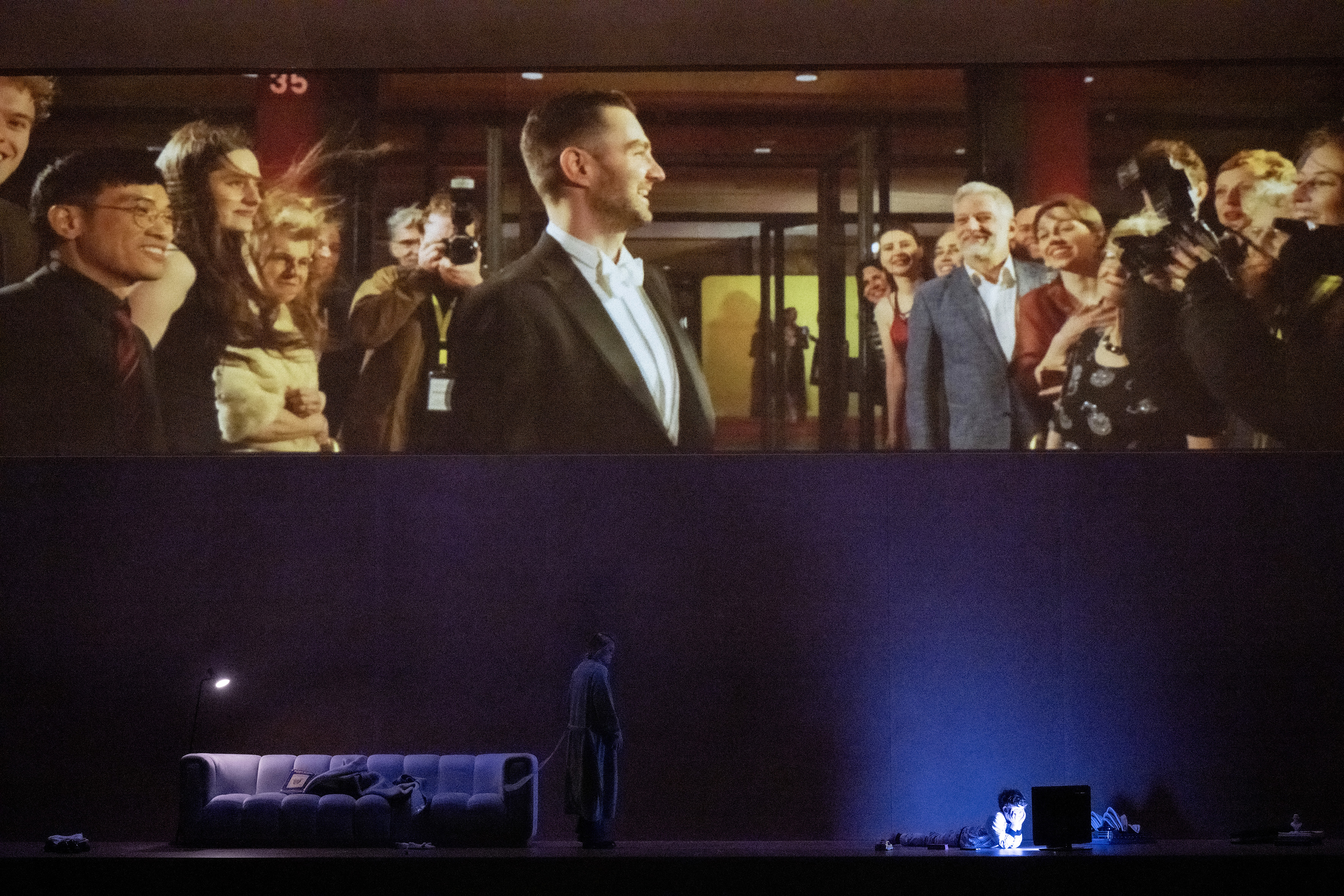
A Zeitoper, if it is to be updated, needs careful handling in finding equivalents, at least if an abiding aesthetic of realism is to be retained as it is here. (It is not beyond the bounds of possibility to try something different, far from it, but it would be a tricky assignment.) Kratzer proves almost unerring in finding realistic contemporary settings for Strauss’s succession of bourgeois scenes. The Prater becomes an aeroplane (Straussair, with ostrich emblem play-on-words) journey home. The scene in Franzl’s bedroom has him watch online his father’s red-carpet, autograph-signing arrival at the Deutsche Oper (a little much, one might have thought, for either an opera composer or conductor, but perhaps that is the point). Such glamour contrasts poignantly with Pauline’s loneliness and her announcement of a broken marriage to the little boy. The game of skat takes place in a typical green room/Kantine. We see much of the orchestra and Donald Runnicles on film during the interludes, heightening the wonders of metatheatricality—and, quite simply, an excellent chance to see the players at close quarters. 


Baron Lummer (Thomas Blondelle), Christine, others


Earlier on, Robert leaves domestic ‘bliss’ in a taxi absurdly overfull with baggage, driver waiting patiently, cigarette in hand. Subsequent text messaging between the two of them proved a rare instance of adept operatic reference to that world. Ironically, for an opera claimed by some to be ‘embarrassing’ – perhaps accusers should look instead in the mirror – the scene turns out, unlike most such attempts, to be anything but; it strikes a fine balance between irritation and genuine, communicative emotion. The ski-slope collision between Christine and the Baron is transferred to behind the motoring wheel. I could not help but find the transfer of the ensuing scene at the Grundlsee Inn to a hotel bedroom – there can be no doubt what is meant by the ‘dancing’ on which Robert has given up – something of a miscalculation: it made much of what happened later between the characters, especially in their dialogue, very difficult to understand, if not quite incomprehensible. Even that, though, was handled on its own terms with a strong sense of theatrical realism, Personenregie crucially alert throughout. 


Notary (Markus Brück), Christine

Kratzer, moreover, responds to Strauss’s loving (without being too self-loving) self-quotation and allusion with twofold references of his own. Elektra and Der Rosenkavalier on film are further doubled by Christine’s choices from her costume wardrobe, that dressing up being in turn pressed upon the Baron (initially dressed as Kratzer). So much opera is about disguise and the assumption of roles in one way or another. Here we receive a welcome invitation to reflect on that, almost as our own minds will, though with guidance for those who need or wish it. No one, surely, could miss either the craziness or the sincerity of Christine’s metamorphosis into axe-wielding Elektra when she strikes her blows for womankind against the hapless Notary in his office. The ‘natural’ order of things is restored and perhaps lightly mocked by having Christine, conducted by Richard, sing her part of their closing love duet to an assembled audience in front of acted orchestra. I hesitate, no decline, to defend the sexism, though frankly what would one expect in a work so much, so avowedly, of its time? Straussian irony, though, will always be present for those with ears to hear; that certainly includes Kratzer, Runnicles, and a strong cast. For those who do not, there are many other ways to spend three hours of their time. 


Robert, Stroh (Clemens Bieber)

The orchestra for which Strauss calls is small, verging indeed on a chamber orchestra at times. We certainly heard pinpoint precisio, and ‘ensemble’ sonorities that would more readily be classed modernist if penned by Schoenberg or Webern. What nonetheless struck most keenly and certainly most warmly were the swell and glow of the Deutsche Oper orchestra and not only in the interludes: miniature tone poems in their own right, a splendid formal innovation for which Strauss never seems to gain credit. That the orchestra and Runnicles are old Strauss hands, not least in tandem, should not have us take their idiomatic and dramatically meaningful musicianship for granted. It may have been gorgeous, but it was never for ‘mere’ gorgeousness’s sake, the composer’s strong aestheticist tendences notwithstanding. 


Christine, Baron Lummer

At least as much as any Strauss opera and more so than many, an Intermezzo performance will stand and fall not only by the orchestra but also by its soprano heroine. Veterans of great Strauss performances of the past will surely not be disappointed, at least not reasonably so, by Maria Bengtsson’s Christine. It is here, of course, that whatever Strauss’s everyday sexism – misogyny if you will, though it seems a little strong – is routed by his lifelong love for the soprano voice (and Pauline). Bengtsson made the role her own and also very much a creature of our own times, ultimately likeable through that earlier cited genuineness of emotion. How we felt with her at her darkest hour, however silly some of her other behaviour may have been. Kratzer’s direction of Elliott Woodruff as Franzl and indeed the boy-actor’s own performance helped here too. Philipp Jekal’s Robert was finely sung and acted, treading difficult lines of his own without in any sense trying to upstage his partner-in-crime. Thomas Blondelle’s Baron Lummer initially seemed a bit old for the role, but the revelation of him as directorial emanation brought him more clearly into his own; at any rate, this was a similarly good performance. Strong appearances in smaller roles from artists such as Clemens Bieber, Anna Schoeck, and Markus Brück likewise attested to thoughtful casting and direction. Assuming that performances of Intermezzo will, alas, continue to be rarities even in German-speaking lands, catch this if and when you can.


Final scene


Friday, 18 March 2022

Peter Grimes, Royal Opera, 17 March 2022

Royal Opera House


Images: ROH 2022 (c) Yasuko Kageyama
The Boy (Cruz Fitz), Peter Grimes (Allan Clayton)


Hobson – Stephen Richardson
Swallow – John Tomlinson
Peter Grimes – Allan Clayton
Ned Keene – Jacque Imbrailo
Rev. Horace Adams – James Gilchrist
Bob Boles – John Graham-Hall
Auntie – Catherine Wyn-Rogers
First Niece – Jennifer France
Second Niece – Alexandra Lowe
Mrs Sedley – Rosie Aldridge
Ellen Orford – Maria Bengtsson
Bryn Terfel – Captain Balstrode
The Boy – Cruz Fitz
Aerialist – Jamie Higgins

Deborah Warner (director)
Michael Levine (set designs)
Luis F. Carvalho (costumes)
Peter Mumford (lighting)
Kim Brandstrup (choreography)

Royal Opera Chorus (chorus master: William Spaulding)
Orchestra of the Royal Opera House
Mark Elder (conductor)

London has proved fortunate with recent productions of Peter Grimes (and doubtless with older ones too). David Alden’s 2014 production for ENO and Willy Decker’s for the Royal Opera (in its 2011 revival) both had considerable virtues and received performances. This new staging from Deborah Warner and the performances that brought it to life were nevertheless in a class of their own, showing the Royal Opera at the top of its game.


All three productions will have displeased the Campaign for Real Barnacles, and thank goodness for that. Warner takes us into the dark underbelly of a contemporary, down-at-heel seaside town, with neither room nor appetite for prettified nostalgia for an early nineteenth century that never was (and certainly never was in George Crabbe). I thought of a poorer version of Margate, somewhere perhaps in Essex—and lo and behold, had that confirmed in Warner’s programme reference to ‘some of the extremely poor and socially deprived towns of the Essex coast, namely Jaywick Sands’, testament not to any great acuity on my part but to Michael Levine’s sets, Luis F. Carvalho’s costumes, and to the entire ensemble of Warner’s production, sharply, meaningfully choreographed by Kim Brandstrup. There is poverty here, also reckless abandon; there are drugs, alcohol, and sleaze; there is a ‘community’ that rounds on an outsider and in the violence of that rounding discovers a nativist identity and ‘morality’ that chills and kills. It takes back control, polices its borders, and deals with outsiders in a terrifying march of intimidation, fire, and nihilism. This Borough is UKIP, even BNP, country, in which shirtless neo-Nazis mix with dealers such as Ned Keene, one of the more sympathetic townsmen if ultimately untrustworthy on account of his habit; and bigoted, ‘respectable’ rentiers such as Mrs Sedley. It is not, however, an amorphous mass: not everyone is like that, and everyone has his or her own story. Warner takes immense care, as do all of those participating, every member of the chorus clearly directed individually and coming to life both in that individuality and as part of a deadly, group identity. Not only do Grimes and his apprentices—one hauntingly portrayed as a just out-of-touch aerialist vision—have no chance; nor does Ellen Orford, herself a victim of Grimes’s physical violence. ‘The more vicious the society, the more vicious the individual.’


There is no sign that Grimes is homosexual, or Muslim, or Polish for that matter; but this is undoubtedly the rough justice that would be meted out to him if he were. It is a similar social tragedy to that one sees in parts of Brandenburg or Saxony, doubtless across the world. But it has a particularly English flavour. They do like to be beside the seaside, and they do not like others, with no place to be there, to attempt to join them. Britten’s fraught relationship to England and Englishness, his (partly) thwarted internationalism, and the parochialism of some of his devotees are set in implied counterpoint, but with the work rather than its critics ultimately setting the terms of examination. It is slightly odd—maybe more than that—that, in the contemporary setting, Grimes’s apprentice should be so young a boy, but even that serves to remind us of another aspect of the ‘Britten problem’, which this contemporary Borough would doubtless address with savage, summary justice. 

There could not, I think, have been a better choice to conduct this production than Mark Elder, who led the Orchestra of the Royal Opera House, on as fine form as I can recall, as if a man possessed. He clearly believes in every note of the score and, more to the point, revealed all manner of potentialities I had barely imagined were there. Musical processes are clear and generative, indicative of a serious attempt to address the problems of form that so often bedevil Britten’s music in work and performance. An account of titanic clashes and contrasts spanned, on the one hand, screaming echoes of Shostakovich’s Lady Macbeth and, beyond it, the Mahler of the Fifth Symphony; and, on the other, passages of translucent beauty that seemed to have all the time in the world, yet are fated to be cut short. Elder’s conducting was urgent, even when spacious, whipping up a sequence of storms of fatal consequence that not only framed, but incited, the action on stage. We were reminded that, here, the sea was a thing of danger as well as livelihood, a theatre of cruelty and redress far more than a picturesque landscape.

Another man possessed was Allan Clayton’s Peter. If I say it was the most beautifully sung account of the role I have heard that would unduly delimit its range, though in many respects it certainly was beautiful—and more youthfully vulnerable than the typical craggy old man. This, crucially, was a performance that dug deep psychologically, that suggested profound consideration of dilemmas and traumas faced by the character, and frankly admitted that not all could or should be answered. I could not help but think of Boris Godunov in Clayton’s final scene; the voice is different, as are music, drama, and almost everything else, yet psychological descent and devastation presented tragic parallels across the divide.


Ellen Orford (Maria Bengtsson), The Boy

Maria Bengtsson gave us a profoundly human, refreshingly unhackneyed Ellen Orford, a force for good whose goodness went so cruelly punished. Her ‘Embroidery Aria’ could not have been more touchingly sung, its difficult intervals navigated with ease and in perfect harmony with the orchestra. Jacques Imbrailo’s Ned Keene offered a fascinating study in ambiguity, perhaps beyond mere good and evil. Powerfully and, again, beautifully sung, so much more lay in the acting: a drug-addled hedonist who exerted a mysterious yet undeniable attraction, not an outside as such, yet never quite to be assimilated. Bryn Terfel’s Balstrode may well be the finest opera performance I have seen from him, fully in command of the role and its possibilities, throughout exuding deep humanity and a wisdom that again set him apart without excluding him. Catherine Wyn-Rogers gave us a world-weary yet lively Auntie of experience, Rosie Aldridge a properly vicious Mrs Sedley, more insidious than John Graham-Hall's nicely buffoonish Bob Boles. There were no disappointments in a strong supporting cast, which seemed to grow out of that minutely observed direction of the chorus: a community of individual and mass imperatives. Choral singing was likewise outstanding, the Royal Opera Chorus on better form than I have heard for a long time, fully engaged in portrayal of Britten, Warner, and Elder’s visions (as well, doubtless, as their own).


This enthusiasm comes from a place of ambivalence toward the work itself. I am not yet persuaded that swathes of the second act in particular are not a little dull, nor that the influence of Wozzeck at the beginning of the third is not a little too close for comfort, ‘Arias’ still seem to stand out awkwardly from the rest, and so on. If you are going to be influenced, though, you will struggle to find a better source of influence than Wozzeck, and not every opera can attain the perfection of Figaro or Tristan. This was an outstanding night of theatre, strongly to be recommended to everyone: to the Britten devotees who will not give two hoots about my reservations; to fellow Britten-agnostics, who may also find previous reactions challenged; and even to those more hostile, whose road to conversion may have its point of departure. Not to be missed.


Thursday, 23 March 2017

Don Giovanni, Semperoper Dresden, 20 March 2017


Image: David Baltzer

Semperoper 

Don Giovanni – Christoph Pohl
Commendatore – Michael Eder
Donna Anna – Maria Bengtsson
Don Ottavio – Edgaras Montvidas
Donna Elvira – Danielle de Niese
Leporello – Evan Hughes
Masetto – Martin-Jan Nijhof
Zerlina – Anke Vondung
 

Andreas Kriegenburg (director)
Harald Thor (set designs)
Tanja Hofmann (costumes)
Stefan Bolliger (lighting)
Anne Gerber (dramaturgy)

Sachsischer Staatsopernchor Dresden (chorus master: Cornelius Volke)
Sächsische Staatskapelle Dresden
Omer Meir Wellber (conductor)


Busoni, great composer that he was, revered Mozart as greatly as any composer – well, any composer other than Bach, of course. Although Busoni came to Mozart through the nineteenth-century, broadly speaking ‘Romantic’ tradition(s), and although he lauded, in the preface to his own edition, Liszt’s Réminiscences de don Juan for possessing ‘an almost symbolic significance as the highest point of pianism’ (quoted by Charles Rosen), he seems not necessarily to have appreciated the darker side to Mozart as strongly as some of those who came after – above all, Wilhelm Furtwängler, whose recorded performances remain as astounding, as symphonic, as daemonic, as ever. It is a truism, perhaps a cliché, that we all make our own Mozart. Up to a point, that is of course the case, yet that does not make every viewpoint, every experiment, equally worthwhile. Our age, by and large, has not done very well, albeit with noble exceptions. Whereas Dresden did Busoni himself fine service indeed, the previous evening, in his Doktor Faust, this (musically) misconceived Don Giovanni did not, alas, mark anything like its finest hour – mostly on account of the conductor.


It has become one of the many clichés to be read in reviews of Don Giovanni performances to call it a director’s graveyard. (Bizarrely, the same seems to have become true of recent stagings of Le nozze di Figaro, a work until recently seemingly imperishable. Così fan tutte rarely does well, either.) Perhaps, but there are certainly exceptions. Most recent of those for me was Stephan Kimmig’s brilliant production for Munich, which I saw last summer. Insofar as one could tell, the fault here did not lie with Andreas Kriegenburg’s production either. It starts promisingly, in a swish fashion or modelling agency, a world of expensive, ruthless vacuity enthroned. (What could be more contemptible than mere ‘fashion’? There are lessons, largely unheeded, for performance there too.) '2064 donne', we read on a wall poster. Such is clearly an environment in which Don Giovanni, aided by Leporello, can have his pick of the depressingly interchangeable ‘girls’. Harald Thor’s set designs and Tanja Hofmann’s costumes work well, adding to what one can discern of the concept. The problem is that it all becomes rather lost. I suspect that tighter revival direction – I do not necessarily mean this as a criticism of the person to whom this was entrusted: there may not have been enough time, enough resources, and so on – would have made everything much clearer. As it is, for an alarming amount of the time, the singers seem to have to make their own drama from the designs, and that is more or less it. They generally did pretty well at that, but there is a limit to what can be expected of them, and, modern(ish) look aside, it all comes a little too close to a repertory night in Vienna.
 

That said, there was much to enjoy in a number of the vocal performances. Christoph Pohl’s Giovanni was a serious assumption, whose depth crept up upon us. Equal attention was paid to words and line, as with Evan Hughes’s quicksilver Leporello. The occasional intonational slip aside, Maria Bengtsson’s Donna Anna proved very well focused. A pleasingly ‘big’ sound could be made, although likewise the voice could offer laudable intimacy. Coloratura offered few problems to her; nor did it to Danielle de Niese as Donna Elvira. Likeable artist though she may be, however, an intrinsic thinness to her voice shone through in ‘In quali eccessi, o Numi … Mi tradì’. Might she have been better off as Zerlina? I wondered whether Anke Vondung, who sometimes lacked sparkle in that role, in an admittedly dependable performance, might have better suited to the mezzo part. Martin-Jan Nijhof’s Masetto was likewise dependable enough; perhaps with stronger direction, more might have been made of both peasant characters. Edgaras Montvidas, however, offered a beautifully sung, thoughtfully assertive Don Ottavio. One longed to hear more from him, if not from Michael Eder’s weak Commendatore (strange, given how strongly cast that role tends to be). With the Staatskapelle Dresden on fine form, strings and woodwind equally beguiling, the stage should have been set for a very good evening. And yet…
 

For all the chatter, most of it uninformed, we hear concerning so-called Regietheater, an opera worth its salt – many, indeed a bewildering proportion of those in the benighted repertory, are not – will fail if it is not also a piece of Dirigententheater. What Omer Weir Welber did to Don Giovanni genuinely shocked me, although it angered and, worst of all, bored me still more. I say this not because I am hostile a priori to performances that play with the work concept. Far from it, even in Mozart: one of the most enlightening performances I have seen of a ‘version’ of Don Giovanni was heavily cut and reversed the genders of all but the (anti-)hero himself. To mess about, glibly, crassly with the score to no apparent end other than to massage the ego of the conductor is, however, something upon which it is difficult to look with anything other than horror. The Overture should have alerted me, but conductors sometimes do strange things there, taking it as ‘their’ moment. Regrettable though the new alla breve orthodoxy for the opening may be – there are good reasons to follow the practice, but mere fashion is not one of them – one can live with it. A Rossini-like breakneck speed to what followed was more disturbing. The sudden appearance, and disappearance after a few bars, of a harpsichord bewildered. Not half as much, though, as did the turn at the end towards what has long been known, somewhat problematically, as its ‘concert ending’, which may – or may not – have been written for Vienna. One can only wish that it had not, for it remains unconvincing in the extreme, whatever view one takes of where the ‘alternative conclusion’ should start. (If one wants a concert ending, one is better off with the serviceable, if uninspired, solution offered in most recordings – and concert performances.)
 

There was worse to come, though, much worse. Exhibitionistic continuo playing is another curse of our age, it seems, but I have never heard anything quite on this level, before. Quite why we had harpsichord and what sounded like (I presume it was a trick of the acoustic, but who knows?) some sort of amplified early-ish, but not that early piano, I have no idea. There did not seem to be any obvious, or even elusive, point being made, and the lion’s share was reserved for the latter. Not being able to see the pit, it took me a while to realise that it was Welber playing whatever that strange-sounding instrument may have been. Whereas some more interventionist accounts seem to offer a commentary on the action – one can argue about whether that is what a continuo player ought to be doing, but that is another matter – this seemed to be simply a case of ‘look at me’, or rather ‘listen to me’. One tires quickly of formulaic figures, but they would have been preferable to the lounge pianist meandering we heard here, replete with all manner of very strange harmonies, endless sequences of Scotch snaps, keyboard crashes and clashes, changes of metre, and so on and so on. (It was the sort of thing that certain undergraduates find hilarious after a few bottles of wine, whilst everyone else looks on, baffled and not a little irritated.) One recitative, at least, seemed to end in entirely the wrong key, rendering its non-transition to the ensuing aria both painful and inexplicable. A mismatch of tuning between the instrument and orchestra did not help, either.
 

That, however, was almost as nothing, compared with Welber’s tampering – again, to no discernible end – with the orchestral score. This was not some Mahlerian retouching, nor indeed was it something more artistically adventurous. It sounded utterly arbitrary, and involved the apparent deletion – to begin with, I thought it must be a matter of strange balance, but then realised better, or worse – of certain lines, leaving either nothing, or an opportunity for one of the continuo instruments to play instead. The orchestral introduction to one second-act aria – I cannot remember which: perhaps a blessing... – was removed entirely, the music played instead by the harpsichord. In another number, during the first act, the other continuo instrument loudly banged out the orchestral line an octave higher, doing its best to obliterate the orchestra. Another orchestral ending was close to drowned out by crashing, clashing keyboard chords. Unmotivated tempo variations – sometimes quite at odds with what was being sung onstage – only compounded the mess. When Welber settled down, he seemed perfectly capable of delivering a reasonable enough performance; the problem was that he rarely did.
 

The unholy conflation we generally endure of Prague and Vienna versions is perfectly understandable as a sop to singers, and their fans, although it remains dramatically quite unjustifiable. One might make a case, if one were so minded, for Vienna, if only out of difference, but frankly, it would be misguided at best. Nevertheless, that was pretty much what we heard here – with the important proviso, rarely heard, that there is much we simply do not know about Mozart’s Vienna performances, and we should almost certainly do better to speak about them in the plural. It was mildly interesting to hear the duet for Zerlina and Leporello: the first time, I think, that I have done so in the theatre. It is unworthy of Mozart, though, especially unworthy of the Mozart of Don Giovanni; it might perhaps be rescued by imaginative staging – the libretto surely cries out for something truly sado-masochistic – but such was not the case here. Given the ‘liberties’ taken elsewhere, it was difficult not to feel sorry for Montvidas, losing Ottavio’s second-act aria. In context, though, anything that would hasten the end was no bad thing. Except, of course, the end did not come. The increasingly fashionable practice – it should be stressed that we do not know that Mozart did this, and/or how often he did so, in Vienna, and people should stop claiming that we do – of omitting the scena ultima was practised here, and so the work, such as it remained, simply stopped rather than closed. The proto-Brechtian alienation effect of the ‘moral’ was thus entirely lost, as in Claus Guth’s over-praised production (Salzburg, La Scala, Berlin), in which the uncomprehending director arrogantly accused Mozart of having bowed to convention. Let me put it this way: if you want to do what Mahler did, you really need to be of Mahler’s stature.
 

I shall close with words from Julian Rushton’s review, in Eighteenth-Century Music, of Ian Woodfield’s book on the Vienna Don Giovanni:


Some versions of Don Giovanni acted in the composer’s and librettist’s lifetimes were outside their control (most obviously the singspiel versions), and knowledge of these richly informs reception history. Probably undertaken with no intention to slight the original, they document what seemed theatrically presentable in an irrecoverable time and place; this does not afford them status as a template for later interpretations. The modern theatre is not the eighteenth-century theatre; layers of meaning have accumulated that require access to a text we can ascribe to definite, even if multiple, authorship. … Woodfield … points to the irony of performances today going ‘authentic’ just as ‘the academy’ is beginning to take a more flexible view of such texts. We are indebted to him for presenting the ingredients that make up the early forms of Don Giovanni but we should not regard it as intrinsically wrong to adopt a version of nearly identifiable authorship rather than remixing the Don Giovanni soup for every modern production; we can safely leave that to the stage director.


That seems about right – or does it? Is it a little too prescriptive? In theory, perhaps; in practice, when one suffers – well, you know the rest… At any rate, let us not disdain a thoughtfulness, a respect for Mozart and Da Ponte, that goes beyond a juvenile ‘look at or ‘listen to’ me. Two great Mozart conductors, duly honoured in the Semperoper foyers, would surely have nodded wise assent. Colin Davis and Karl Böhm, however, knew very well that it was ‘not all about them’.


Monday, 6 April 2009

Armide, Komische Oper Berlin, 5 April 2009


(sung in German, as Armida)

Komische Oper, Berlin

Armide – Maria Bengtsson
Hidraot – Peteris Eglitis
Renaud – Peter Lodahl
Artémidore – Christoph Schröter
Ubaldo – Günter Papendell
Danish Knight – Thomas Ebenstein
Phénice – Olivia Vermeulen
Sidonie – Karolina Andersson
Aronte – Hans-Peter Scheidegger
Hatred – Maria Gortsevskaya
A Naiad – Karolina Andersson
First Genius – Anna Borchers
Second Genius – Nicola Proksch
A Demon in the form of Mélisse – Anna Borchers
A Pleasure – Olivia Vermeulen

Calixto Bieito (director)
Rebecca Ringst (designs)
Ingo Krügler (costumes)
Franck Evin (lighting)
Bettina Auer (dramaturge)

Members of the Chorus of the Komische Oper, Berlin (chorus master: Robert Heimann)
Orchestra of the Komische Oper, Berlin
Konrad Junghänel (conductor)

Gluck regarded Armide as ‘perhaps the best of my works’. Posterity seems less to have disagreed than disregarded, for revivals have been sporadic at best. For some reason, or perhaps none, the mid-1840s might have been its most favoured era. Meyerbeer conducted the work in Berlin (at the Staatsoper) in 1843, the same year that Wagner conducted it in Dresden, with Wilhelmine Schröder-Devrient in the title role. Berlioz would conduct the third act the following year, in a typically extravagant performance involving nine hundred performers. (Whatever must that have sounded like?!) Toscanini clearly believed in Armide too, leading performances in Milan and New York. Riccardo Muti, often – rather misleadingly in my view – seen as Toscanini’s heir, included the work in his Gluck cycle at La Scala. I am not sure that Covent Garden, which has rarely if ever expressed much enthusiasm for the great operatic reformer, has staged Armide since 1928, when Frida Leider sang the title role, although there was a production, directed – ‘controversially’ according to the New Grove dictionary – by Wolf-Siegfried Wagner (son of Wieland), at Spitalfields in 1983. Suffice it to say that the Komische Oper’s enterprise and advocacy are much to be applauded in mounting Armide. Anticipation was further heightened by the example of last year’s triumphant Iphigénie en Tauride and by the choice of Calixto Bieito as director.

However, I should probably have known better. Whilst I admired Bieito’s Don Giovanni for the English National Opera, he really does seem to have become a one-trick pony. In a conversation amongst members of the production team reported in the programme, Bieito said that Armide appealed to him ‘because it is a piece about love. And above all a piece about a woman.’ The only possible response, given what we saw on stage, would be: ‘you could have fooled me’. Everything seems to be about sex, or perhaps there is nothing in the world other than sex. Sometimes, looking at our world, one might think that Bieito has a point. But it seems that, in order to make it, he simply has to become more and more sensationalist. I do not think that I could do more than begin to list the various forms and combinations of what was depicted on stage; nor can I summon up any inclination. It is not prudishness but simply weariness that prevents me. Should gerontophiliac sado-masochism be your thing, you will find it here. Ditto asphyxiation by telephone cord. Straight, gay, transvestite, solitary, couples, groups, master-slave dog relationships, even fun with a snake: roll up, roll up. Poor Renaud’s mild leather fetish seems to render him so very conventional. Perhaps that is the point; if so, it would not have been difficult to come up with a clearer way to make it. The production is blessed with a ready and willing band of nude actors – ‘Die Nackten’ – to carry out whatever the director required of them. And they certainly do, most impressively. Apparently this is all Armide’s fantasy. Or perhaps it is really someone else’s. In any case, it so dominates everything else that it is often difficult to listen to the music, let alone to discern a plot. A great deal of unmusical stage noise shows equally scant regard for Gluck’s score.

What a pity this was, for the musical performance was a fine one. Performance in German rather than the original French changes the nature of what one hears, of course, but this did not trouble me unduly. The orchestra was on excellent form, directed with verve – and only the occasional irritating ‘authenticism’ – by Konrad Junghänel. The ballet music fairly danced – unlike the stage business – whilst the harmonic direction and the myriad of Gluck’s post-Rameau or pre-Berlioz orchestral colours registered with great dramatic force. None of the singers was weak and many were very good indeed. Thomas Ebenstein sang the apparently minor role of the Danish Knight with a noble sureness of purpose that belied anything he was called on to do by his director. Maria Gortsevskaya personified Hatred, as she must, without the slightest hint of vocal grotesquerie. Peter Lodahl presented an impressively subtle Renaud, insofar as he was permitted, reminding me of his fine performance in Iphigénie last season. Had he not been more or less submerged in the ongoing ‘activities’, I suspect that his winning stage presence would have registered more strongly.

And when she was allowed to take centre stage, Maria Bengtsson truly shone as Gluck’s almost psychodramatic heroine. This is her story, even if it is not her fantasy. For when the madness finally subsided at the very end, one could more or less concentrate upon Gluck’s astonishing music. Bengtsson and Junghänel almost made one think of an eighteenth-century Erwartung. If only we had been able to do so earlier on. This ending recognised Armide, if only by default, as perhaps Gluck’s truest tragedy, the work having no deus ex machina as resolution. However, Armide also looks back perhaps more than any of his later works to the tragédies lyriques of Rameau and even Lully, written as it is in five acts, with an intended – loaded word, I know – cornucopia of effects and divertissements, reflecting the provenance of the libretto (seventeenth-century, Philippe Quinault, as set by Lully ninety years previously) rather than of any conscious reversion on the composer’s part. Now there are effects and then there are effects. I have never entertained any great desire to witness exhumation of eighteenth-century stagecraft; yet, my resistance relentlessly ground down by Bieito’s adolescent ‘provocations’, rarely have I come so close. If, however, this production, with its excellent musical performances, brings to greater attention a work that still languishes almost unknown, a greater benefit will nevertheless have been accrued.