Showing posts with label Pablo Heras-Casado. Show all posts

Wednesday, 16 August 2023

Bayreuth Festival (2) - Parsifal, 15 August 2023


Festspielhaus

Amfortas - Derek Welton

Titurel - Tobias Kehrer

Gurnemanz - Georg Zeppenfeld

Parsifal - Andreas Schager

Klingsor - Jordan Shanahan

Kundry - Ekaterina Gubanova

Knights of the Grail - Siyabonga Maqungo, Jens-Erik Aasbø

Squires - Betsy Horne, Margaret Plummer, Jorge Rodriguez-Norton, Garrie Davislim

Flowermaidens - Evelin Novak, Camille Schnoor, Margaret Plummer, Julia Grüter, Betsy Horne, Marie Henriette Reinhold

Alto solo - Marie Henriette Reinhold


Jay Scheib (director)

Mimi Lien (designs)

Meentje Nielsen (costumes)

Rainer Casper (lighting)

Joshua Higgason (AR and video)

Marlene Schleicher (dramaturgy)


Bayreuth Festival Chorus (chorus director: Eberhard Friedrich)

Bayreuth Festival Orchestra

Pablo Heras-Casado (conductor)


To move from Dmitri Tcherniakov’s gripping Flying Dutchman to Jay Scheib’s new and much-trumpeted, Artificial Reality-enhanced Parsifal veered towards regression from the sublime to the ridiculous. I should state that I was not one of those with the spectacles necessary to see the ‘enhanced’ version, my short-sightedness being (just) too severe. But since most in the Festspielhaus audience did not have the glasses, it does not seem unreasonable to write about what I could see, whilst noticing access issues that surely require resolution.


I wish I could tell you what Scheib’s production is about. It certainly does not seem to be founded in knowledge of, or even interest in, Wagner and Parsifal. ‘When I think of the word “Bühnenweihfestspiel,’ Scheib tells us in the programme, ‘I think first of all about a celebration. We are opening a festival! Let’s get the party started!’ Leaving aside what is presumably an unintentional hommage to the former Labour MP Keith Vaz, it is difficult to know where to start. Perhaps with advice to look up the ‘weih’ part of the word in a dictionary, and thereafter to consider what ‘consecretion’ might entail. Or even just to acquaint oneself with the plot, let alone with Wagner’s writings. Good things can, of course, proceed from misunderstandings or misappropriations; the problem is that very little at all proceeds from this or from anything else.


What do we have, then? It looks somewhat like a computer game, I think, though I am hardlly the best person to know. That, I suspect, is the ‘aesthetic’, but I may be wrong. What action there is unfolds against some of the most hideous designs I have had the misfortune to see, accompanied by apparently equally meaningless activity and lack of activity. Strange outfits sported by some of the knights in the first act suggest a directorial attempt to tell us he too has done some drugs in his time. I was unsure for a while whether the peculiar shapes on them were intended to evoke bacteria - wounds of their own? - but Gurnemanz’s sudden acquisition of them on a garish, presumably sacerdotal cloak and equally sudden dispensing of them suggested not. The poor souls looked like refugees from a discontinued children’s television programme. Earlier, indeed in the first-act Prelude, Gurnemanz has sex with a woman, tastelessly magnified on live camera. Who she is I have no idea, but she returns to stand and then walk around in the third act, before embracing him at the close. 


Amfortas’s blood, not unreasonably, appears for a while to be a preoccupation, the wound rather monstrously magnified on camera during Gurnemanz’s first-act narration. Parsifal smashes the grail at the end, though with what import again I have no idea. Certain people walk around or wear slightly different clothes. There are two Kundrys, I think, one of whom silent, sometimes mirrors the action of the other and sometimes walks around in a circle. Others, above all Parsifal and Kundry in their great confrontation in the second act, seem entirely abandoned and have to fend for themselves. And the Barbie-meets-Benny Hill aesthetic of that act, sadly lacking the intellectual heft of either, is not an experience I should wish even on Mr Vaz. That Klingsor wears heels seems a peculiar, carelessly offensive translation of self-castration. To be brutally honest, though, it is difficult to care. So boring, I am sad to say, was this hapless production that it almost had me long for the prior nadir of Uwe Eric Laufenberg’s staging (2016-19), though at least it had none of Laufenberg’s Islamophobia. Illumination such as that offered by Stefan Herheim (2008-12) will always remain a rare experience, but surely a director should be able to do, or at least try to do, better than this.


Sadly, this made it difficult, at least for me, to care much about or even to attend to the musical performances. Pablo Heras-Casado’s conducting was generally fluent enough on the micro-level, but imparted little sense of a greater whole. String tone was sometimes strangely thin, though to his credit, Heras-Casado seemed largely to have the measure of the particular challenges presented by conducting in Bayreuth’s covered pit. The audience, though, was wildly enthusiastic. So too was it for most of the singers (with none of the incomprehensible booing heard the previous night). For me, insofar as I could tell beyond the production, they were more impressive than moving. Andreas Schager was his usual indefatigable self in the title role. We are lucky to have him and his seemingly boundless enthusiasm, although his voice is no longer so fresh as it was. Ekaterina Gubanova similarly gave much as Kundry; her attention to the equally exacting demands of words and music was noteworthy throughout. So too was Georg Zeppenfeld’s as Gurnemanz, though Heras-Casado’s lack of greater structural command did not assist the narrations. Derek Welton’s Amfortas was finely sung throughout, as were the choral contributions. A concert performance would, frankly, have enabled greater appreciation both of these performances and of Wagner’s drama.


Saturday, 15 July 2017

Festival d'Aix-en-Provence (3) - Carmen, 13 July 2017


Images: Festival d'Aix-en-Provence 2017 © Patrick Berger / artcompress
Carmen (Stéphanie d'Oustrac), Don José (Michael Fabiano), Micaëla (Elsa Dreisig)


Grand Théâtre de Provence

Carmen – Stéphanie d’Oustrac
Don José – Michael Fabiano
Micaëla – Elsa Dreisig
Escamillo – Michael Todd Simpson
Frasquita – Gabrille Philiponet
Mercédès – Virginie Verrez
Zuniga – Christine Helmer
Moralès – Pierre Doyen
Le Dancaïre – Guillaume Andrieux
Le Remendadao – Mathias Vidal
Administrator – Pierre Grammont

Dmitri Tcherniakov (director, designs)
Elena Zaitseva (costumes)
Gleb Filshtinsky (lighting)

Maîtrise des Bouches-du-Rhône (chours master: Samuel Coquard)
Chœur Aedes (chorus master: Mathieu Romano)
Orchestre de Paris
Pablo Heras-Casado (conductor)

Carmen and Don José 

At last: a Carmen that takes a step back (from the work) and several steps forward (in every other dramaturgical respect). If one wants Carmen straight, as it were, Calixto Bieito’s Franco-era production will do very nicely indeed. As for borderline racists lusting after picture-postcard ‘Spain’ – it makes a change from lamenting the lack of blacking up in Othello – who cares? They certainly did, I am delighted to report. I do not know what the reaction was on the first night, but here various audience members, keen to show that the French wing of ‘Against Modern Opera Productions’ is pulling its weight, contributed greatly to the cabaret. Some booed during the performance; some shouted things out. Perhaps my favourite was one man who helpfully informed the cast that they were delivering ‘the wrong dialogue’. Bless him, or rather do not. An American family – the parents anyway: the children seemed fine – could be heard during the interval lamenting the ‘Eurotrash’ they had seen: surely a title la Carmencita herself would happily ‘reclaim’, although she might have to return with those visitors to the era of big-hair Dallas and Dynasty to do so. I should also not forget a woman seated not so far from me. At the end, she was visibly excited when Pablo Heras-Casado came onstage to take his bow. It was her moment, she knew, and she took it, starting to boo vigorously. Her husband then explained to her, a little too late, that Heras-Casado was the conductor, not the director. Who cares, though? When you want to make animal noises in a theatre and generally behave like an uneducated fascist, go for it. At least they all have a new hate figure to supplant Gerard Mortier; and what is petit bourgeois life without hate figures?


Dmitri Tcherniakov does far more, though, than épater les bourgeois – although I shall not deny the theatre in that itself. We all know the ‘monster opera Carmen’, as he calls it; and if we do not, we can do so at the click of a mouse. What is far too often lost – not, to be fair in Bieito, but in most productions, which are simply ghastly – is the drama. We do not actually know the opera at all, most of us; we know some tacky visualisations, often more fitted to a set of plates to be bought from a Sunday colour supplement. (Do they still exist? Do we care?) We play at knowing it, keeping our distance from anything that might challenge us. We, then, are the protagonists – albeit in a drama that is true to no one’s ‘intentions’, least of all to Bizet’s or Merimée’s. That is emphatically so here: we are confronted with what we – all of us – have done to Carmen and to ourselves, and by what we continue to do so.


And so, Tcherniakov presents us with a man of today, an Everyman even: Don José. Carmen is decentred; she will, like the rest of the cast, be brought in as and when required. The man, whoever, he is, clearly wealthy – a beautiful suit and shoes – is in a bad way. He needs therapy, and his wife is determined to have him undergo it. Should we not suspect her actions too, though? On what basis does she derive any authority in this treatment, or game, or drama, or whatever we want to call it, think of it? As this ‘thing’, let us call it an opera, progresses, we are certainly given reason, often quite subtle, to doubt her, to doubt everything and everyone: above all, we are given reason to doubt ourselves. (Will we be brave enough, even able, to do so, though? Tcherniakov helps; the performers help; but therapy requires preparation, consent, participation.) When the mysterious – or is he merely mundane? – Administrator explains what will happen to our (anti-)hero, he laughs, refuses to take it seriously. Michael Fabiano’s laugh is itself a thing of artistic horror, almost to put alongside that of Klytämnestra (in another twisted therapeutic context). But play the game of Carmen he must; or rather he decides to. Scepticism is palpable; we have surely all felt sceptical at some time towards dramas and productions that reveal things we should rather leave unrevealed. But once the game is afoot, wallet and telephone handed in for safe keeping, he must continue. Indeed, he refuses the advised option of calling it quits at half time. His progress has been such that he is about to be discharged. He wants to carry on to the end, and so he does.

Soldiers, Micaëla, and Don José 


Who are the expensive – opera is expensive – cast of characters and extras brought in for the game? His wife returns, in need of a role. She becomes Micaëla. But like him, we are sometimes a little unsure what is for real, and what is not. Are the troops who storm the stage at the end of the first act, to impose order, actually from ‘outside’? It is cleverly suggested – or I lazily assumed – that they might be; but no, we discover, in the Administrator’s next visitation and explanation (true, or not?) that they were part of the game. That is what opera is; is it not? Guns fire ‘smiley’ faces of approval; we are the customers, after all. No, of course we are not; we are the participants, but we, or at least some of us, like to think we are customers. No more in Carmen than in the Ring should that be the case. As Pierre Boulez once remarked, ‘opera houses are … like cafés where … you can hear waiters calling out their orders: “One Carmen! And one Walküre! And one Rigoletto!”’ His playful suggestion, or rather hinted suggestion, a few years earlier was that an elegant solution would be to blow them into the air. Indeed. There are more ways, more interesting ways, of accomplishing that, of course, than with actual explosives. We might as well just read out the stage directions if we want to play at opera – which is precisely what happens here.

Carmen – or the woman playing Carmen – becomes deeply concerned about where things are heading. She wants out, but the Administrator says no. What are her feelings for the man she is paid (presumably) to help? Interestingly, even ironically, relieved of simply being Carmen, the ‘icon’, she becomes a more interesting, more complex, or at least less readily stereotyped, character. Her interaction with Fate thus acquires new meaning – and new questioning. Tragedy, however, reinstates itself. At the end, the man is broken more than ever before. Don José has killed him; Carmen has killed him; his wife has killed him; therapy has killed him. Others – neither ‘Carmen’ nor his wife, though – have been busily celebrating the end of the game, the end of the opera. Life and art are not like that, not at all. Do you want ‘picturesque’ scenery and a ‘heart-warming’ justification of your own existence, followed, perhaps, by a ‘nice meal’: go elsewhere. You – we – actually need this.

Mercédès (Virgine Verrez), Carmen, Frasquita (Gabrielle Philiponet), Don José

Fabiano gave a tireless, often terrifying performance in the central role. If there were occasions when his style was a little on the Italianate side, then who cares, especially on this particularly occasion? So much of what we were seeing and hearing in any case concerned the playing of roles. (I keep telling myself I should include myself in all of that – and I should, but do not want to seem still more solipsistic here. But what gives any of us the right to expectations, and should we not at least question them vigorously?) In any case, identification with something that was both Don José and yet was not became clearer and deeper as he and we penetrated role and game deeper too. I do not think I have seen a more tormented, possessed man on stage, certainly not for a long time. This was his drama – and by his, I mean at least as much Fabiano’s as the anonymous man’s or as Don José’s. And he can certainly sing too, with dark, repressed menace, just as much as with splendidly ‘operatic’, climactic passion. Liberated as discussed above, Stéphanie d’Oustrac, gave a splendidly thoughtful portrayal – or whatever we wish in this context to call it. Expectations subverted, she could present a woman who did not always know what to do for the best, and yet tried to do so, a woman with agency of her own, agency that was yet hemmed in by powerful forces from without. Sung with an elegance to offset and yet also to complement Fabiano’s passion, this was a performance to make one think just as much as his – provided one permitted oneself to do so.

Carmen, Escamillo (Michael Todd Simpson), assembled company, and Don José

Elsa Dreisig’s Micäela became more manipulative, less predictable: something to be heard as well as merely observed. Treating opera as drama creates opportunities for all, both on and off stage. (Both Joseph Kerman and Tcherniakov could have told us that; so could both Bizet and Boulez.) Michael Todd Simpson’s Escamillo – playing Micaëla’s extra-marital lover, or was he actually so? – was vocally disappointing, somewhat dry of tone; yet, as with so much else here, there were other ways of approaching what we saw and heard. Amongst the ‘smaller’ roles, everything was well taken; special mention, I think, should go to the voices of Gabrielle Philiponet and Virginie Perez. Choral singing was excellent throughout, as was the incisive, often colourful – yet not unduly touristic – playing of the Orchestre de Paris. Heras-Casado seemed to me to make a great effort as collaborator, not simply as ‘conductor’. (We all play roles, but that does not mean we should not reconsider them.) There was, throughout, a keen sense of engagement with Tcherniakov: not necessarily simply mirroring, for that is certainly not what orchestra or conductor should be doing. Taken as a whole, the musical performances engaged with, enabled, and criticised the production; as it did them; as all did the work. Ladies, gentlemen, however we wish to define and perform ourselves: welcome, whether you like it or not, to musical drama. It comes alive when you least expect it. It may sometimes not even work. Life is like that, but it is not life; it is both less and more, better and worse, than that.

Wednesday, 26 April 2017

Le nozze di Figaro, Staatsoper Berlin, 25 April 2017


Schillertheater

Count Almaviva – Ildebrando d’Arcangelo
Countess Almaviva – Dorothea Röschmann
Susanna – Anna Prohaska
Figaro – Lauri Vasar
Cherubino – Marianne Crebassa
Marcellina – Katharina Kammerloher
Basilio – Florian Hoffmann
Don Curzio – Peter Maus
Bartolo – Otto Katzameier
Antonio – Olaf Bär
Barbarina – Sónia Grané)

Jürgen Flimm (director)
Gudrun Hartmann (assistant director)
Magdalena Gut (set designs)
Ursula Kudrna (costumes)
Olaf Freese (lighting)


Staatsopernchor Berlin (chorus master: Frank Flade)
Staatskapelle Berlin (conductor)
Pablo Heras-Casado (conductor)

Countess (Dorothea Röschmann) and Count
(Ildebrando d'Arcangelo)
Images: Hermann und Clärchen Baus


Figaro is by far the best work ever devised for the stage; it combines everything that moves the human heart and mind: forlorn hope, pleasantry, satire, profound significance, also much ado about bagatelles and vain amours.’ Thus is Jürgen Flimm quoted – oddly, in English, but not in the German version – on the website of the Berlin State Opera. Leaving aside the silly if pardonably hyperbole – how on earth does one say it is ‘by far’ better than Così fan tutte or Don Giovanni, let alone Hamlet, Tristan, or Agamemnon? – the only printable response I can summon to that would be: ‘you have a funny way of showing it.’ Flimm’s Bayreuth Ring was noteworthy for – well, nothing at all, save for irritating displays of dramatic hyperactivity. His Fidelio for Covent Garden likewise seemed to be about nothing at all: imagine that, for Fidelio, or indeed for the Ring! This, however, is significantly worse. All the ludicrous hyperactivity is there, in order to present a Marriage of Figaro that reduced Mozart and Da Ponte to the level of a silly, vulgar farce: a farce, moreover, that does not work even on its own terms. It used to be the case, not so long ago, that, even if they fell some way short of revelatory, productions of this opera would at least cohere dramatically; now that hope seems at least as forlorn as it would be, perhaps more so than, in a production of Don Giovanni. David McVicar’s Covent Garden ‘prettiness’ looks almost distinguished by comparison; here we languish at the level of Michael Grandage (Glyndebourne) and perhaps even the dread Jean-Louis Martinoty (Vienna).


‘Updating’ is generally an unhelpful time. In many ways, the least interesting thing – although the thing dull people will often become most exercised about – is when and where something is (re-)set. As Schoenberg remarked in a different context: ‘A Chinese poet speaks Chinese, but what is it that he says?’ ‘Updating’ is, perhaps, the mot juste here, however, for as with McVicar, Grandage, and quite a few others, it seems done for the sake of it. The intricacies of Da Ponte’s libretto pose some difficulties for such a change of scenario; yet, by the same token, the droit de seigneur was at best highly exaggerated, at least in theory, for the eighteenth century, even in Andalusia, let alone Beaumarchais’s France. A pre-revolutionary situation elsewhere can work very well, as in Janet Suzman’s Cuban setting for the Royal Academy’s superlative 2015 performances; Martin Lloyd-Evans at the Guildhall (yes, another conservatory, which is where London audiences will find much of their best opera) took more of a risk, which mostly paid off, in looking to the world of modern American politics and its sexual harassment. (I wonder how prescient that would seem now, in the Age of Trump.) Flimm, however, simply moves everything to the 1920s, presenting the characters as holiday-makers (as does Grandage), and then proceeds not to deconstruct the characters and the action, but seriously to misunderstand them and to have them drown in a sludge of silliness.


Pointlessness – can you think of a worse reproach for a staging of Figaro than that? – reigns supreme, and certainly not in a Beckettian way. Even the incessant use of a strip in front of the pit for stage action seems to serve no purpose whatsoever. Mindless seekers after novelty would doubtless praise it as imaginative; perhaps they would also hail breaking the fourth wall as a pioneering development. And yes, we do have that at some points too, not least in some irritating business at the beginning of the third act, when poor Count Almaviva must do both, wandering around behind and in front of the pit, waiting for the continuo player to begin and eventually having to prod him into action. The guffawing was of almost post-interval Glyndebourne proportions. Nowhere indeed is this staging more catastrophically flawed than in its treatment of the Count. I can see that it would be interesting to deconstruct his masculinity. Here, however, he is portrayed – with awe-inspiring professionalism by Ildebrando d’Arcangelo – as a gibbering idiot, who cannot even hold a rifle. He is more a sitcom cross between Frank Spencer of Some Mothers do ’ave ’em and Manuel from Fawlty Towers – would that the dramaturgy had a fraction of that series’ skill and wit – than anything words, music, or just a little thought might suggest. And nothing is done with that bizarre ‘reinterpretation’: the audience simply laughs at him dropping things and injuring himself. He is a coward with trembling hands: yes, we get it. Is that all you have to say about him?
 

In what approaches a parody of reactionaries’ charges against ‘updating’ and ‘modern opera productions’, Barbarina appears all over the place for no apparent reason. In what struck me as a deeply, or shallowly, misogynistic portrayal, she again provokes hysterical mirth from some patrons as she is forced to play the part – presumably because she is not of noble birth – of a ‘common tart’. Quite why Antonio, who also appears far too often, is wearing a black tail coat, when everyone else is in ‘summer wear’ is unclear. Nor is there any evident justification for him and his daughter running around ‘hilariously’ with wheelbarrows full of plants, which they proceed to tip over the stage, whilst the second act proceeds. Having earlier simply walked out of a door and then pushed it across the stage, as opposed to jumping out of a window, Cherubino is nonsensically discovered at the end of that act, ‘bonking’ – as would seem to be the appropriate post-seaside postcard language for the production – yes, you have guessed it, Barbarina, in the wardrobe (whose function is repeatedly confused with a trunk of luggage). The intricate business of the second act is not only coarsened but rendered incoherent, almost to the level of Martinoty in Vienna.


At the end, there is not even a hint of revolution, or revolt, of Figaro as sans-culotte (unless that were, highly obliquely, to be from bizarre penchant for rolling up his trousers throughout the evening, even during his betrothal ceremony). There is no sense that anything has actually taken place. They all just collect their luggage and head home. If that is your idea of this folle journée, then either you or I have completely misunderstood.


Figaro (Lauri Vasar) and Susanna (Anna Prohaska)
 

There seems little point in going on further about what one sees; it is not worth the effort. Matters were not helped by Pablo Heras-Casado’s conducting. It improved as the night went on, yet remained markedly at odds with the rich, noble Klang of the Staatskapelle Berlin, let alone the rich, noble score of Mozart. The Overture was perhaps more harried than I have heard it, and much of the first act suffered from strange, seemingly arbitrary tempo decisions, then pursued quite without flexibility. Too often, the score could not breathe; there was, I suppose, at least a parallel with much of what was, alas, going on onstage.


Redemption came, when permitted, from the cast. I mentioned D’Arcangelo’s professionalism; that goes for them all, without exception. They clearly did what had been asked of them and did it far better than anyone would have any right to expect; moreover, they did it without sacrifice to their vocal and indeed more broadly considered dramatic performances. Insofar as one could dissociate them from the ridiculous stage business – and it is quite a testament to the artistry on show that one generally could – they were, without exception, distinguished indeed. D’Arcangelo’s dark, virile tone told the truth concerning his character. Dorothea Röschmann’s Countess offered Mozart on the very grandest scale, even beyond Jessye Norman. The climax of ‘Dove sono’ was well-nigh Wagnerian, although alas, the audience ruined the end of the aria by applauding for several bars before it had finished. Anna Prohaska’s rich-toned yet quicksilver Susanna, clearly a victim of unwelcome harassment (something very much to think about), did everything one could ask of the character and more. Her Figaro, Lauri Vasar, proved just as adept in this role as he had earlier this month as Amfortas. Both servants’ way with words, music, and dramatic sincerity offered an object lesson. Marianne Crebassa’s Cherubino suffered at least as much as anyone (with the exception of Barbarina, for whose cavatina Sónia Grané showed us, seemingly effortlessly, what it all should have been about) from Flimm’s production, but lacked nothing otherwise. The strange portrayal of Marcellina as glamorous siren – if an attempt to avoid or to address misogyny, it seemed quite unmotivated in practice – did not prevent Katharina Kammerloher from offering much to savour, not least in her fourth act aria (mercifully present). Florian Hoffmann may not have had much to do as Basilio, but subtle pointing of his words nevertheless made an impression. If only they, and the rest of the company, had had something just a little better to work with…


Wednesday, 3 February 2016

Salzburg Mozartwoche (3) - VPO/Heras-Casado: Mendelssohn, 30 January 2016


Grosses Festspielhaus

Das Märchen von der schönen Melusine: op.32: Overture
42nd Psalm: ‘Wie der Hirsch schreit’, op.42
Symphony no.3 in A minor, ‘Scottish’, op.56

Dorothea Röschmann (soprano),
Werner Güra, Dániel Aŕva (tenors),
Matthias Winckhler, Marcell Attila Krovokay (basses)
Arnold Schoenberg Chor (chorus master: Erwin Ortner)
Vienna Philharmonic Orchestra
Pablo Heras-Casado (conductor)
 
 
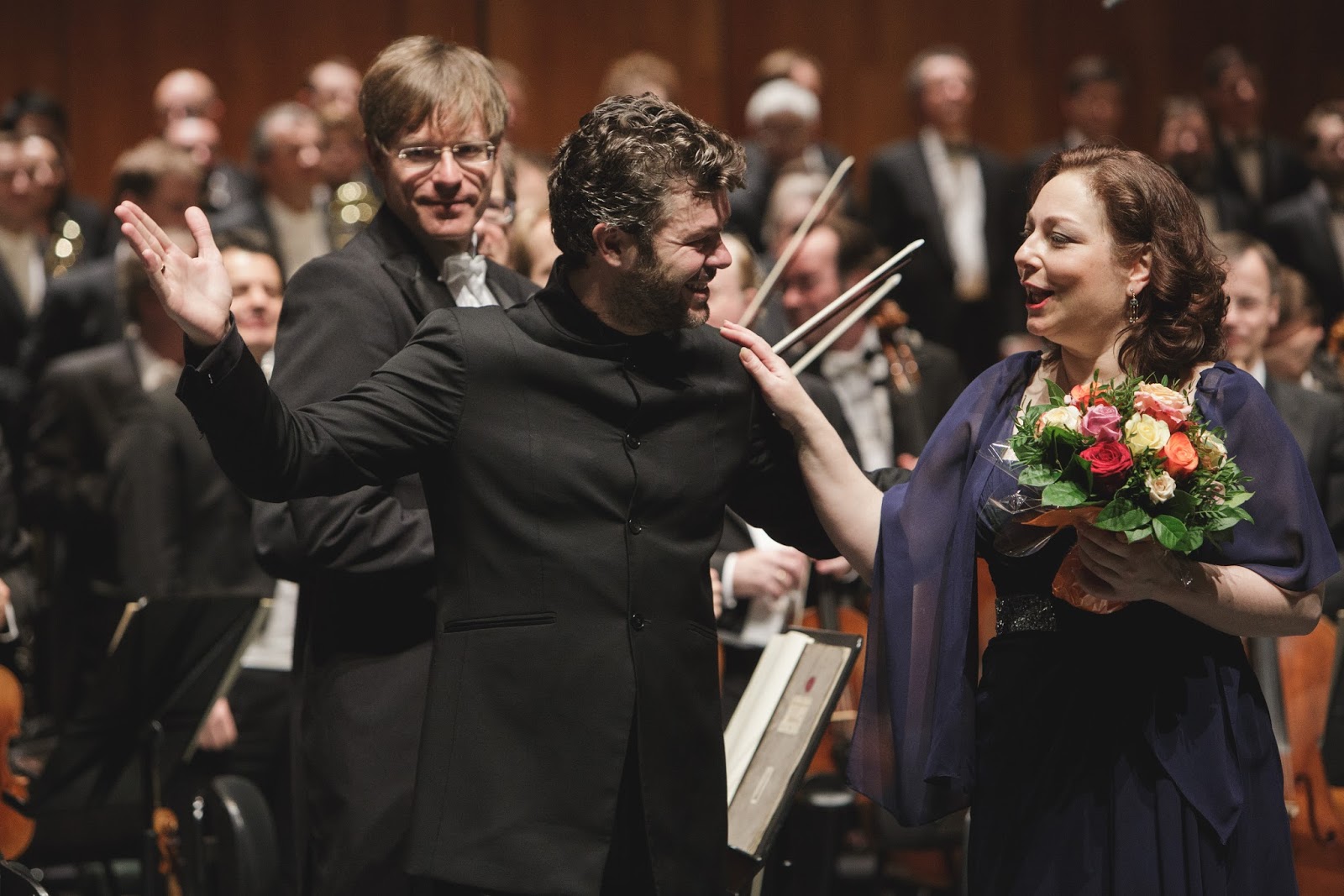
Conductor and soprano receive applause
Image: Salzburg Mozartwoche
 

Nikolaus Harnoncourt was to have conducted this concert. The recently-retired conductor has many admirers, indeed clearly inspires great affection and loyalty, but, although it would not have done me any harm to have heard him once ‘in the flesh’, I, being not so close to him æsthetically, was probably less distraught than many to be deprived of that particular opportunity. I looked forward, however, to hearing another conductor for the first time ‘live’, and was not disappointed. Pablo Heras-Casado, who has recently been recording Mendelssohn on period instruments – you see, I am not quite so narrow-minded as I might sometimes like to pretend – here performed the composer’s music with a very different beast, the Vienna Philharmonic, also of course an orchestra with long-standing affection for Harnoncourt.


The Overture to Die schöne Melusine opened with delightfully bubbly woodwind, responded to by featherlight – yet grounded! – strings. Then came full orchestral vehemence, with a quite wondrous precision, not always the VPO’s stock in trade, and so on, quicksilver changes of mood beautifully handled. This was the most alert playing from an orchestra which, especially recently, has not been without its slapdash moments. That, I think, must indicate that what can be a somewhat recalcitrant beast likes Heras-Casado, who certainly seemed to have the measure of this score.
 

Whether I should have liked Harnoncourt’s way with Mendelssohn’s setting of the forty-second Psalm, who knows? I certainly like – very much – his having programmed it. We almost never hear Mendelssohn’s shorter choral works; indeed, although Elijah has the reputation of being a warhorse, I have only heard it once in the concert hall, under Kurt Masur. This was a performance in general as beautifully crafted as the work itself. (If you do not know it, please give it a try! Likewise the extraordinary Die erste Walpurgisnacht and a very fine Kyrie setting, both on a highly recommendable disc from Michel Corboz. For Harnoncourt fans amongst you, I feel bound to remark that he also recorded the former, although I have not heard that recording.) The opening chorus was often amiable – have I used up my store of Mendelssohn clichés yet? – without that being a term of mild abuse; its sterner moments told too. It sounded midway between Mozart and Brahms, which is probably just about where Mendelssohn tends to stand. The oboe solo was utterly ravishing, putting me in mind of a Bach obbligato. Dorothea Röschmann, who had the only real vocal solos in the work, proved imploring yet, as one would suspect, possessed of a thrillingly ‘big’ voice. Her aria with female chorus brought similarities not only with the inevitable Midsummer Night’s Dream but also the Second Symphony. After that, the male-voice opening to the chorus, ‘Was betrübst du dich, meine Seele’, offered imposing contrast, without sounding merely grandiose. Röschmann’s recitative, ‘Mein Gott, betrübt ist meine Seele an mir’, sounded veritably Elsa-like; following that, there was fine work from her and the male quartet (two from the Arnold Schönberg Chor). The choir provided an echt-Romantic choral sound, perfectly blended, in the final number, the orchestra producing playing of quite amazing clarity. It may have been the only time I have heard this work in the concert hall, but I doubt I should have had many, if any, opportunities to hear it performed better.


The Scottish Symphony – I do not think we are supposed to call it his ‘Scotch’ any more! – receives many more performances, of course, but perhaps not so many as one might expect. At least in my experience, its Italian brother seems to crop up far more often. The opening to the first movement was grave yet sweet of tone; indeed, the whole introduction sounded full of potentiality, not unlike Haydn in that respect. Heras-Casado imparted a fine sense of momentum; he clearly knew, and knew how to communicate, its contours. The Allegro un poco agitato soon developed a fine head of steam, as it were. As earlier, there was a fine sense of intimacy too; indeed, that was really one of the hallmarks of this performance, which seemed conceived very much in chamber-music style. There was certainly little that was Wagnerian about Heras-Casado’s Mendelssohn; not that there is anything wrong with such an approach, which I remember well from Sir Colin Davis conducting this symphony, but there is rarely one ‘correct’ way. And, although Heras-Casado could drive quite hard, the second group yielded in lovely – yes, I must have used up my store by now – fashion, the development of its material seeming here of particular interest (subtleties brought out without underlining). There was brilliantly virtuosic playing to be heard in the scherzo; essentially, it sounded as a Mendelssohn scherzo should (whatever I might have said about there not being one way). Clarity of counterpoint was admirable; so, crucially, was its direction. The opening to the Adagio was infused with sweet Viennese longing, which, under Heras-Casado’s wise leadership, did not neglect the particular twists that mark this music as Mendelssohn’s, close though it rightly might have sounded at times to Schumann. The sterner, majestic passages were given their full due too, and, again, there was a fine sense of how the movement cohered as a whole. There followed as spirited and, in general, precise an account as one might hope for of the finale, tension maintained throughout. My only real cavil was a slightly hesitant moment or two at the turn to the minor, but after that, the music grew to a splendid final peroration.