Showing posts with label Lauri Vasar. Show all posts

Sunday, 22 October 2023

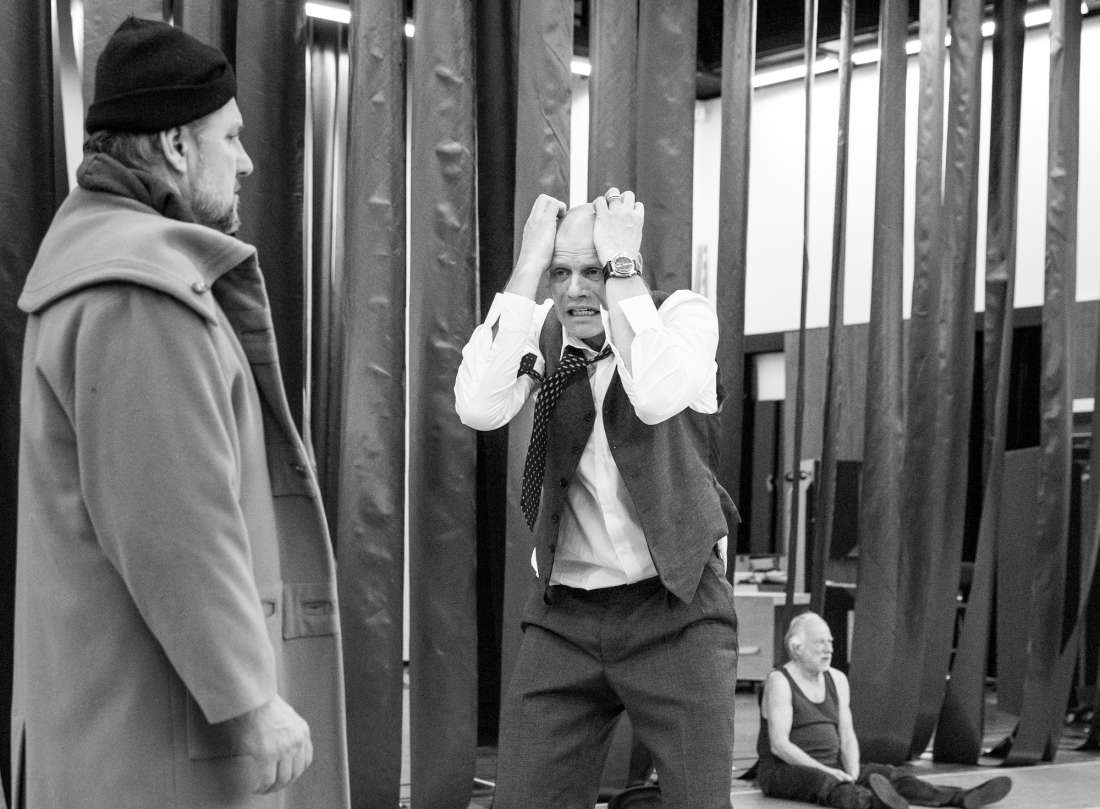
Elektra, Staatsoper Unter den Linden, 20 October 2023


Images unless otherwise stated: (c) Jakob Tillmann


Klytämnestra – Waltraud Meier
Elektra – Ricarda Merbeth
Chrysothemis – Vida Miknevičiūtė
Orest – Lauri Vasar
Aegisth – Stephan Rügamer
First Maid – Bonita Hyman
Second Maid, Train-bearer – Natalia Skrycka
Third Maid – Katharina Kammerloher
Fourth Maid – Anna Samuil
Fifth Maid – Roberta Alexander
Overseer, Confidante – Cheryl Studer
Young Servant – Siyabonga Maqungo
Old Servant – Olaf Bär
Orest’s Tutor – David Wakeham

Patrice Chéreau (director)
Vincent Huguet (assistant director)
Richard Peduzzi (set designs)
Caroline de Vivaise (costumes)
Dominique Bruguière (lighting)

Staatsopernchor Berlin (chorus director: Dani Juris)
Staatskapelle Berlin
Markus Poschner (conductor)  

For many of us, she has always been there. Not only ‘there’, somewhere, but there—at the top. It is difficult not to romanticise a little, though it is certainly not her style. She spoke briefly and with customary professionalism: she had had a wonderful career, done what she wanted to, and now it was time to say goodbye. ‘Tschüss.’ And with that, Waltraud Meier – the reason all of us, however avid Straussians we might be, were there – bade farewell to the stage. I saw her last Kundry and her last Isolde. I even heard her Marcellina last year, reuinted with Siegfried Jerusalem as Don Curzio (!) We had just heard and, crucially, seen her final Klytämnestra. 

Like the queen she portrayed with intelligence, dignity, a fresh eye and ear, and as keen a collaborative instinct as ever, this queen of the stage bewitched us once last time—and let us go. The audience, however, did not seem inclined to let her go, however many times the curtain fell. Bouquets continued to fly on to the stage, or sometimes, not quite reaching their target, into the pit. The ensemble – whatever fans might have felt, this was never a solo show – continued to come forward to receive applause. Then, once again, she briefly stepped forward, this time without microphone, to pay tribute to that constant presence in her career and in the musical lives we (felt we) had spent together: Daniel Barenboim. He had been in her thoughts all evening—and in her heart. Letting go is a difficult thing. Like her career, difficult decisions such as ruling Brünnhilde was not the right role for her included, this was supremely well judged and directed, as joyful as it was poignant. She never played the Marschallin, though she had offers; for some of us, at this moment she did. Life, music, theatre, go on. ‘Tschüss.’


The Klytämnestra we saw and heard was not the same as that of 2016 in this same Patrice Chéreau production, nor that (in my case at the cinema) from its incarnation slightly earlier that year in New York, still less that of Salzburg (Nikolaus Lehnhoff’s staging) in 2010. Chéreau’s production remains impressive in its provision of a frame – literally, in the case of Richard Peduzzi’s set – for human interactions. Fate can take care of itself. It may or may not be something more than the sum total of individual characters and their decisions, but here they are given due weight. And that includes the decisions of those playing their roles. Perhaps inevitably, in this performance the relationship between Elektra and Klytämnestra seemed still more central, more crucial than ever. Yet there was absolutely no grandstanding, indeed little even in the way of grandeur to it. The Staatskapelle Berlin may have prepared the way for a grand entrance, or better provided one, for the woman who emerged was a distressed, even disoriented mother, finding her way according to the text (Strauss and Hofmannsthal) and acting according to the precept that she needed her daughter – it was definitely her daughter, not just some other character – more than the other way around. There was a degree of pride: all that said, she remained a queen. But this was a queen in private, insofar as her attendants would ever permit a private sphere to exist, not in public: a woman compelled to transfer her political wiles to the domestic sphere. Sometimes she came as close to speech than to song: not because she could not sing, but rather because she realised she could speak. She held the stage through artistry, not image; through what she did on this occasion, not through what she had done in the past.


(c) Monika Rittershaus (2016)

Ricarda Merbeth’s Elektra offered an interesting complement, almost a child who retreated into the womb, or rather who would were it still available. That it was not was a large part of the problem—at least in this scene. Elsewhere, hers was a performance that lacked nothing in power yet likewise never forsook the realm of humanity. Vida Miknevičiūtė’s Chrysothemis brought further characteristics of both, as well as her own, into sharp relief: a portrayal as vividly sung as it was conceived. Lauri Vasar’s dark-toned Orest, brutalised, dangerous, and yet with more than a hint of his own fragility and neurosis, was similarly excellent. Throughout a cast that included singers such as Cheryl Studer, Roberta Alexander, and Olaf Bär, each seemed to bring out something new and interesting in another.


If Markus Poschner’s direction of the Staatskapelle Berlin tended often to be fleshing out, even making sense of, a world created by characters on stage rather than creating it – worlds away from, say, Daniele Gatti’s Salzburg cataclysm – that seemed in context at one with this general approach: almost a Kammerspiel. It was certainly not that the orchestra failed to speak, but not only did it owe as much to Mendelssohn as to Wagner, it reacted as much as it delineated. The stars, one our inevitable lodestar, may have been on stage but this proved the most collaborative of dramas. That, surely, was the proper and ultimate tribute. Tschüss.


Thursday, 13 April 2023

Berlin Festtage (5) - Götterdämmerung, 10 April 2023


Staatsoper Unter den Linden

Siegfried – Andreas Schager
Alberich – Jochen Schmeckenbecher
Hagen – Mika Kares
Brünnhilde – Anja Kampe
Gunther – Lauri Vasar
Gutrune – Mandy Fredrich
Waltraute – Violeta Urmana
Three Norns – Noa Beinart, Kristina Stanek, Anna Samuil
Woglinde – Evelin Novak
Wellgunde – Natalia Skrycka
Flosshilde – Anna Lapkovskaja
Erda (silent) – Anna Kissjudit

Dmitri Tcherniakov (director, designs)
Elena Zaytseva (costumes)
Gleb Filshtinsky (lighting)
Alexey Polubpoyarinov (video)
Tatiana Werestchagina, Christoph Lang (dramaturgy)

Staatsopernchor Berlin (chorus director: Martin Wright)
Staatskapelle Berlin
Thomas Guggeis (conductor)


Images: Monika Rittershaus
Brünnhilde (Anja Kampe)

‘Alles was ist, endet.’ Erda’s words from Das Rheingold apply both to the rule of the gods and to Wagner’s depiction of that rule, its decline, and its fall. The Ring does strange things to one’s sense of time, time in any case a strange thing to experience. By the time one reaches Götterdämmerung, let alone its end, one both feels one has been through a good deal, to put it mildly, and yet also that it has only just begun. Partly, of course, that is or can be the work’s message too. Wagner counselled Liszt to mark well his poem, containing the beginning and end of a world, not, as sometimes has been said, the world. Those ‘watchers’, men and women (on which Wagner is very clear) ‘moved to the very depth of their being’, who, at least according to his stage directions, should observe Brünnhilde’s final acts and who implicitly remain with us to create a new world, would otherwise have no role. Nor, on one level, would performing and staging the work. Here we were again, though: the end of another Ring, one which had challenged and taught us much, moving us too, even if not always living up dramaturgically to the moments of its highest promise. 

For, if much of Siegfried, especially its first two acts, had left me enthused and eager to find out what might happen next, Götterdämmerung sometimes suggested Dmitri Tcherniakov had lost his way, failing to follow up – or at least electing not to do so – on themes and threads which instead were left hanging. Wagner’s more uncomprehending critics might claim he did so too; we have no need to discuss them further here. The research centre in which the work – all of it, probably – takes place opened up questions of agency and control in which Tcherniakov seemed, at least in part, to have lost interest. If the Norns, whom we had seen throughout, filing away information, seemingly keeping matters in order, are now locked out of proceedings, what does that mean? I could speculate, perhaps fruitfully, yet the production largely seems to abdicate any responsibility it might have to tell, to explain, to suggest.


Hagen (Mika Kares), Staatsopernchor Berlin

The Tarnhelm’s failure again to work, Siegfried looking and dressing like Siegfried, not Gunther, on Brünnhilde’s mountain, could have many potential explanations and implications, yet where were they here? If the world has been disenchanted – fair enough, returning to Adorno and Horkheimer, or indeed many others – where, and I am sorry to bang on about this, does that leave the objects of Wagner’s work (musical as well as verbal and scenic)? It is not always clear to me that that problem has been adequately considered, though I think it could be in a revised production building on what has gone before. Where steps had been taken in Siegfried to suggest Wagner lay beyond any of the characters in setting up the experimental basis for the production, here if anything we went backwards—and it did not, Dallas- or Die tote Stadt-style, seem all to have been a dream.


Hagen, Gunther (Lauri Vasar), Gutrune (Mandy Fredrich), chorus

There are lovely and other telling touches. The return of Erda and ultimately the Wanderer (his cloth cap still somewhere between Chéreau’s Brechtian ‘watchers’ and Wagner’s own carefully curated portraiture) to pay tribute to the dead Siegfried is genuinely moving. Has this particular experiment concluded? In that respect we can, I think justly, draw our own conclusions, however inadequate. Siegfried’s earlier Don Draper-like sprawling on the sofa and a plethora of cigarettes tell their own story of toxic – literally so – masculinity. So too does the basketball court on which Siegfried meets his death. That Gutrune may be drugged too is interesting: perhaps an addict rather than a formal object of experimentation, but is that not in any case part of a broader societal experiment of death and disaster? (Her other treatment is decidedly unsympathetic to the point of misogyny: a pity.) 

And what to make of the ending? I am tempted to say very little. To the text of Wagner’s rejected ‘Schopenhauer ending’ – he rejected it for sure dramatic reason – Brünnhilde approaches Erda, ultimately rejecting a paper bird such as Siegfried had rejected from the Woodbird. She pulls down the curtain, after it has become stuck. Making her own way with a clichéd bag in hand? Doubtless, yet could we, should we not expect more? It did not strike me as a deliberate drama of the underwhelming, a world failing to end, as in Frank Castorf’s Bayreuth Ring, rather a need to do something, almost anything. But perhaps, even probably, I am failing to understand. Tcherniakov’s Parsifal and, more controversially, his Tristan were tauter, more thought through. Is the lack the message? We begin to pursue ourselves, or our thoughts, in circles.


More understandably, Thomas Guggeis’s musical interpretation seemed to have tired somewhat. It was still an excellent show, a fine achievement for one at this stage of his career, which would put many others to shame; yet, a few orchestral fluffs (near-inevitable) aside, there were a few more cases where, not unlike the staging, the conductor did not always seem sure where next to turn. There was tremendous playing from the Staatskapelle Berlin led, at its best, by a keen sense of where the score was heading, but there were hesitations too. That, I have little doubt, will change with greater experience. 

Andreas Schager’s Siegfried created the drama before him: tireless, cocksure, yet with a crucial degree of stunted development (Tcherniakov’s toy horse Grane another nice touch). He and Anja Kampe as Brünnhilde once again held the stage at least as well as anyone this century. Mika Kares added Hagen to Fasolt and Hunding, excelling once again in words, music, and gesture. Lauri Vasar (Gunther) and Mandy Fredrich (Gutrune) were not given the most promising hands in Tcherniakov’s conception, teetering on the edge of the merely silly, yet worked to gain our sympathy—and ultimately succeeded, a true sign of excellent artistry. The Norns and Rhinemaidens made fine contributions, though Violeta Urmana’s Waltraute did not make so consistently strong an impression as one might have expected.


Hagen, Alberich (Jochen Schmeckenbecher)

It was, moreover, a joy to welcome back, however briefly, Jochen Schmeckenbecher’s thoughtful, detailed portrayal of Alberich. As so often, one’s thoughts returned to him, dead, alive, or somewhere in between. ‘Schläfst du, Hagen, mein Sohn?’ That near-liturgical question, so alluring to Boulez at work with Chéreau on the Centenary Ring, retains its irrational enticement. In lieu of a more conventional conclusion, that might do.


Wednesday, 26 April 2017

Le nozze di Figaro, Staatsoper Berlin, 25 April 2017


Schillertheater

Count Almaviva – Ildebrando d’Arcangelo
Countess Almaviva – Dorothea Röschmann
Susanna – Anna Prohaska
Figaro – Lauri Vasar
Cherubino – Marianne Crebassa
Marcellina – Katharina Kammerloher
Basilio – Florian Hoffmann
Don Curzio – Peter Maus
Bartolo – Otto Katzameier
Antonio – Olaf Bär
Barbarina – Sónia Grané)

Jürgen Flimm (director)
Gudrun Hartmann (assistant director)
Magdalena Gut (set designs)
Ursula Kudrna (costumes)
Olaf Freese (lighting)


Staatsopernchor Berlin (chorus master: Frank Flade)
Staatskapelle Berlin (conductor)
Pablo Heras-Casado (conductor)

Countess (Dorothea Röschmann) and Count
(Ildebrando d'Arcangelo)
Images: Hermann und Clärchen Baus


‘Figaro is by far the best work ever devised for the stage; it combines everything that moves the human heart and mind: forlorn hope, pleasantry, satire, profound significance, also much ado about bagatelles and vain amours.’ Thus is Jürgen Flimm quoted – oddly, in English, but not in the German version – on the website of the Berlin State Opera. Leaving aside the silly if pardonably hyperbole – how on earth does one say it is ‘by far’ better than Così fan tutte or Don Giovanni, let alone Hamlet, Tristan, or Agamemnon? – the only printable response I can summon to that would be: ‘you have a funny way of showing it.’ Flimm’s Bayreuth Ring was noteworthy for – well, nothing at all, save for irritating displays of dramatic hyperactivity. His Fidelio for Covent Garden likewise seemed to be about nothing at all: imagine that, for Fidelio, or indeed for the Ring! This, however, is significantly worse. All the ludicrous hyperactivity is there, in order to present a Marriage of Figaro that reduced Mozart and Da Ponte to the level of a silly, vulgar farce: a farce, moreover, that does not work even on its own terms. It used to be the case, not so long ago, that, even if they fell some way short of revelatory, productions of this opera would at least cohere dramatically; now that hope seems at least as forlorn as it would be, perhaps more so than, in a production of Don Giovanni. David McVicar’s Covent Garden ‘prettiness’ looks almost distinguished by comparison; here we languish at the level of Michael Grandage (Glyndebourne) and perhaps even the dread Jean-Louis Martinoty (Vienna).


‘Updating’ is generally an unhelpful time. In many ways, the least interesting thing – although the thing dull people will often become most exercised about – is when and where something is (re-)set. As Schoenberg remarked in a different context: ‘A Chinese poet speaks Chinese, but what is it that he says?’ ‘Updating’ is, perhaps, the mot juste here, however, for as with McVicar, Grandage, and quite a few others, it seems done for the sake of it. The intricacies of Da Ponte’s libretto pose some difficulties for such a change of scenario; yet, by the same token, the droit de seigneur was at best highly exaggerated, at least in theory, for the eighteenth century, even in Andalusia, let alone Beaumarchais’s France. A pre-revolutionary situation elsewhere can work very well, as in Janet Suzman’s Cuban setting for the Royal Academy’s superlative 2015 performances; Martin Lloyd-Evans at the Guildhall (yes, another conservatory, which is where London audiences will find much of their best opera) took more of a risk, which mostly paid off, in looking to the world of modern American politics and its sexual harassment. (I wonder how prescient that would seem now, in the Age of Trump.) Flimm, however, simply moves everything to the 1920s, presenting the characters as holiday-makers (as does Grandage), and then proceeds not to deconstruct the characters and the action, but seriously to misunderstand them and to have them drown in a sludge of silliness.


Pointlessness – can you think of a worse reproach for a staging of Figaro than that? – reigns supreme, and certainly not in a Beckettian way. Even the incessant use of a strip in front of the pit for stage action seems to serve no purpose whatsoever. Mindless seekers after novelty would doubtless praise it as imaginative; perhaps they would also hail breaking the fourth wall as a pioneering development. And yes, we do have that at some points too, not least in some irritating business at the beginning of the third act, when poor Count Almaviva must do both, wandering around behind and in front of the pit, waiting for the continuo player to begin and eventually having to prod him into action. The guffawing was of almost post-interval Glyndebourne proportions. Nowhere indeed is this staging more catastrophically flawed than in its treatment of the Count. I can see that it would be interesting to deconstruct his masculinity. Here, however, he is portrayed – with awe-inspiring professionalism by Ildebrando d’Arcangelo – as a gibbering idiot, who cannot even hold a rifle. He is more a sitcom cross between Frank Spencer of Some Mothers do ’ave ’em and Manuel from Fawlty Towers – would that the dramaturgy had a fraction of that series’ skill and wit – than anything words, music, or just a little thought might suggest. And nothing is done with that bizarre ‘reinterpretation’: the audience simply laughs at him dropping things and injuring himself. He is a coward with trembling hands: yes, we get it. Is that all you have to say about him?
 

In what approaches a parody of reactionaries’ charges against ‘updating’ and ‘modern opera productions’, Barbarina appears all over the place for no apparent reason. In what struck me as a deeply, or shallowly, misogynistic portrayal, she again provokes hysterical mirth from some patrons as she is forced to play the part – presumably because she is not of noble birth – of a ‘common tart’. Quite why Antonio, who also appears far too often, is wearing a black tail coat, when everyone else is in ‘summer wear’ is unclear. Nor is there any evident justification for him and his daughter running around ‘hilariously’ with wheelbarrows full of plants, which they proceed to tip over the stage, whilst the second act proceeds. Having earlier simply walked out of a door and then pushed it across the stage, as opposed to jumping out of a window, Cherubino is nonsensically discovered at the end of that act, ‘bonking’ – as would seem to be the appropriate post-seaside postcard language for the production – yes, you have guessed it, Barbarina, in the wardrobe (whose function is repeatedly confused with a trunk of luggage). The intricate business of the second act is not only coarsened but rendered incoherent, almost to the level of Martinoty in Vienna.


At the end, there is not even a hint of revolution, or revolt, of Figaro as sans-culotte (unless that were, highly obliquely, to be from bizarre penchant for rolling up his trousers throughout the evening, even during his betrothal ceremony). There is no sense that anything has actually taken place. They all just collect their luggage and head home. If that is your idea of this folle journée, then either you or I have completely misunderstood.


Figaro (Lauri Vasar) and Susanna (Anna Prohaska)
 

There seems little point in going on further about what one sees; it is not worth the effort. Matters were not helped by Pablo Heras-Casado’s conducting. It improved as the night went on, yet remained markedly at odds with the rich, noble Klang of the Staatskapelle Berlin, let alone the rich, noble score of Mozart. The Overture was perhaps more harried than I have heard it, and much of the first act suffered from strange, seemingly arbitrary tempo decisions, then pursued quite without flexibility. Too often, the score could not breathe; there was, I suppose, at least a parallel with much of what was, alas, going on onstage.


Redemption came, when permitted, from the cast. I mentioned D’Arcangelo’s professionalism; that goes for them all, without exception. They clearly did what had been asked of them and did it far better than anyone would have any right to expect; moreover, they did it without sacrifice to their vocal and indeed more broadly considered dramatic performances. Insofar as one could dissociate them from the ridiculous stage business – and it is quite a testament to the artistry on show that one generally could – they were, without exception, distinguished indeed. D’Arcangelo’s dark, virile tone told the truth concerning his character. Dorothea Röschmann’s Countess offered Mozart on the very grandest scale, even beyond Jessye Norman. The climax of ‘Dove sono’ was well-nigh Wagnerian, although alas, the audience ruined the end of the aria by applauding for several bars before it had finished. Anna Prohaska’s rich-toned yet quicksilver Susanna, clearly a victim of unwelcome harassment (something very much to think about), did everything one could ask of the character and more. Her Figaro, Lauri Vasar, proved just as adept in this role as he had earlier this month as Amfortas. Both servants’ way with words, music, and dramatic sincerity offered an object lesson. Marianne Crebassa’s Cherubino suffered at least as much as anyone (with the exception of Barbarina, for whose cavatina Sónia Grané showed us, seemingly effortlessly, what it all should have been about) from Flimm’s production, but lacked nothing otherwise. The strange portrayal of Marcellina as glamorous siren – if an attempt to avoid or to address misogyny, it seemed quite unmotivated in practice – did not prevent Katharina Kammerloher from offering much to savour, not least in her fourth act aria (mercifully present). Florian Hoffmann may not have had much to do as Basilio, but subtle pointing of his words nevertheless made an impression. If only they, and the rest of the company, had had something just a little better to work with…


Monday, 10 April 2017

Berlin Festtage (2) - Parsifal, Staatsoper Berlin, 8 April 2017


Klingsor (Tómas Tómasson) and the Flowermaidens
Images: Ruth Walz

Schiller Theater

Amfortas – Lauri Vasar
Gurnemanz – René Pape
Parsifal – Andreas Schager
Klingsor – Tómas Tómasson
Kundry – Anna Larsson
Titurel – Matthias Hölle
Squires – Sónia Grané, Natalia Skrycka, Florian Hoffmann, Michael Porter
First Knight of the Grail – Michael Smallwood
Second Knight of the Grail – Dominic Barberi
Flowermaidens – Katerina Tretyakova, Adriane Queiroz, Anja Schlosser, Sónia Gráne, Narine Yeghiyan, Natalia Skrycka
Voice from Above – Natalia Skrycka
 
Dmitri Tcherniakov (director, set designs)
Elena Zaytseva (costumes)
Gleb Filshtinsky (lighting)
Jens Schroth (dramaturgy)

Staatsopernchor Berlin (chorus master: Martin Wright)
Staatskapelle Berlin
Daniel Barenboim (conductor)

 
With this, my third visit to Dmitri Tcherniakov’s Parsifal, I have now seen the production as many times as I did that of Stefan Herheim at Bayreuth. I shall spare you the ritual Herheim encomium on this occasion; anyone interested may seek out either my earlier reviews (here, here, and here), or the chapter I have devoted to the staging in my book, After Wagner. Suffice it to say that, developing as it has each year, again like Herheim’s staging, Tcherniakov’s production is now thoroughly established as one of the most thought-provoking, deeply troubling stagings since Herheim’s breathed its last in 2012. (Again, should anyone be interested, I shall have an article in the July issue of The Wagner Journal, looking at both stagings and their relationship to psychoanalysis.) It is just what musical drama should be, and just what clueless reactionaries loathe – because, like all great drama, it points the finger at them. If you want somehow to feel better about yourself, then Parsifal and Wagner are certainly not for you, any more than Sophocles, Shakespeare, or Mozart are. If, however, you want to begin to understand why you should not feel so good about yourself, here you are.

 
For at the heart of Tcherniakov’s staging, it seems to me, perhaps increasingly so, is the Freudian, indeed Nietzschean insight (not just theirs, by any means) that human existence is founded upon a lie. The first chapter of Beyond Good and Evil opens with the challenge: ‘The will to truth, which misdirects us toward many adventures, that fabled truthfulness, before which all philosophers hitherto have paid obeisance … why not rather untruth? … Who is Oedipus here? Who the Sphinx?’ From such perspectivism (back) to (the birth or death of) tragedy is, in a way, a splendidly anti-Nietzschean journey, especially when it involves the Wagner drama Nietzsche affected above all to hate. Here, nevertheless, it is – and it is perhaps not idle to note here the Russian –Mussorgskian (Khovanschina) and Dostoevskian – ‘look’ to Tcherniakov’s designs and direction for a Monsalvat community of what we might well call Old Believers. (But do they, fundamentally, believe? Why should we take them at their word?) Nihilism needs to be fought against, but how, and how could such battle succeed? Is the only conclusion itself nihilistic? No wonder the world of Dostoevsky seems hinted at – although it is rightly left to us to do much of that thinking; Nietzsche’s perspectivism is incorporated rather than denied (aufgehoben, if you will).


Titurel increasingly seems to me one of the most important keys to the work; he certainly is to the staging. Sung here by Matthias Hölle, there is little doubt that he is continuing to run the show. Indeed, as part of the ritual, whatever that ritual may be, he puts himself in his coffin, to emerge again once ‘it’ is over. Amfortas, whilst he can hardly be ignored in any production, seems perhaps still more central to the first and third acts than often he is. The identification with and perversion of traditional images of Christ – tradition is a dangerous, if necessary thing – comes across more strongly than ever on this occasion. He is presented as an object for us to behold, to admire, whether we like it or no; draining of blood for the ritual from his own side harrows, yet we cannot look away. There is, indeed, perhaps greater emphasis on the history of this strange community than in previous years. The slide show in which Gurnemanz educates his charges with images past – recollections, actual or false, of Wagner’s own Siena Cathedral taking pride of place – makes its point especially clearly. Whatever it is that is going on, whatever it is that is taking its inspiration and its justification from this alleged history, is losing its power to convince. Lies do that, although that does not stop us telling them, believing them.

 
The shock of the second act naturally registered most strongly of all when new in 2015. What we see when the curtain rises seems entirely new, although we come to realise that its actual framework remains from the first act; it has, however, almost literally been whitewashed. Presentation of Klingsor as an almost stereotypical tabloid image of a paedophile – one can almost see the chasing headline ‘MONSTER!’ – replete with repellent comb-over, surrounding himself with Flowermaidens as little girls in flowery dresses (some of them with dolls, performing the same role in miniature) continues to provide a discomfiting way in to the exploration of Parsifal’s sexuality that lies at the very heart of this act. Klingsor’s overt wandering of hands when he sits himself next to Kundry and her revulsion remind us there is nothing voluntary about this alliance, and, more generally, that abuse breeds abuse. So when Kundry makes Parsifal remember (or invent?) his past, the abusive lineage is extended further. (‘Who is Oedipus here? Who the Sphinx?’) The dumb show of recollection in which his mother walks in on his first tentative steps with a girl instils greater trauma than previously: upon Parsifal, visibly shaking for much of what follows (brilliantly acted by Andreas Schager), but also seemingly upon Kundry, whose production from her sinister bag of tricks of a white shirt, bloodied from a wound like that of Amfortas (perhaps it actually is from his wound?) provides a more overt connection with the business of the outer acts than we have previously seen. Parsifal was not the only one to be shaken by what he experienced; I was too. No wonder he drives the spear through Kingsor at the close of that act. The trauma of male adolescent sexuality is perhaps less often treated with in opera than one might expect. Tcherniakov makes a huge step in redressing that imbalance.

Parsifal (Andreas Schager) and the Flowermaidens
 
Memory plays tricks – as we see on stage. It is therefore perhaps unwise to attempt extended comparisons between different incarnations of staging and performance. Certainly Daniel Barenboim’s conducting and the playing of the Staatskapelle Berlin would have little to fear from such comparisons. Suffice it to say that this great orchestra’s immersion in Wagner’s music continues to reward. Here, it was the darkness of sound at the darkest of Wagner’s moments that perhaps made the greatest impression upon me, the prelude to the third act a case in point, still more so the continued development of its material throughout the act. Lower strings told one so much of what one needed to know, even if one were somehow managing to ignore, or to misunderstand, what was going on onstage. Barenboim’s ideal combination of structural command and dynamic impetus underlay everything we heard. Revealing encounters between stage action and pit action (Wagner’s fabled orchestral Greek Chorus) were many; that between the rotational cycles (see Warren Darcy’s chapter, ‘“Die Zeit ist da”: Rotational Form and Hexatonic Magic in Act 2, Scene 1, in William Kinderman and Katherine Syer (ed.), A Companion to Wagner’s ‘Parsifal’) and Klingsor’s creepy, childish self-rotation centre-stage is but one instance. The stage listens to the pit, and vice versa.

 
So too, of course, is that the case when it comes to our cast of singers and outstanding chorus (and extras too). Schager’s portrayal of the title role once again offered a near-ideal sound; he is unquestionably the Heldentenor of our age. His acting skills, as previously mentioned, are almost as crucial, especially his ability to evoke all manner of visual adolescent awkwardness. Anna Larsson’s Kundry offered something intriguingly new when we saw her too caught in the headlights of her own (well, ultimately Klingsor’s) trap in the final quarter of an hour or so of the second act. Otherwise, she sometimes seemed a little less settled, less compelling in the role than her predecessors, although her vocal tone often proved a considerable pleasure in itself. Lauri Vasar’s Amfortas was another new assumption. I found it quite spellbinding: as rich and/or as agonised of tone as need be, in perfect, often complex, relation to what we saw onstage. His way with words was equally impressive. When speaking of richness of tone, one can hardly fail to think of René Pape, whose reprisal of Gurnemanz continued to offer the excellence this production demands (and almost always receives). His almost slow-motion stabbing of Kundry gives the lie to claims that his musico-dramatic gifts are only, or even mostly, vocal. Tómas Tómasson has made this Klingsor his own – and continues to do so: of the outstanding performances to be seen and heard here, his is far from the least. Smaller parts were all well taken, often outstandingly so. This is a Parsifal that will not let go.


Wednesday, 1 June 2016

Lear, Opéra national de Paris, 29 May 2016


Palais Garnier

King Lear – Bo Skovhus
King of France – Gidon Saks
Duke of Albany – Andreas Scheibner
Duke of Cornwall – Michael Colvin
Earl of Kent – Kor-Jan Dusseljee
Earl of Gloucester – Lauri Vasar
Edgar – Andrew Watts
Edmund – Andreas Conrad
Goneril – Ricarda Merbeth
Regan – Erika Sunnegårdh
Cordelia – Annette Dasch
Fool – Ernst Alish
Servant – Nicolas Marie
Knight – Lucas Prisor

Calixto Bieito (director)
Rebecca Ringst (set designs)
Ingto Krügler (costumes)
Bettina Auer (dramaturgy)
Sarah Derendinger (video)
Franck Evin (lighting)

Chorus of the Opéra national de Paris (chorus master: Alessandro di Stefano)
Orchestra of the Opéra national de Paris
Fabio Luisi (conductor) 
 
Rehearsal photograph: © Élena Bauer / OnP


This year has seen musical Shakespeare commemorations aplenty, although I cannot help but wonder whether some miss the point. Although there are many wonderful musical settings of Shakespeare, his verse is often so musical in quality that it requires nothing additional. Successful Shakespeare operas are thus less surprisingly few than one might initially suspect. Britten’s A Midsummer Night’s Dream has its devotees, many of them fervent; I should rather stick with the play and Mendelssohn’s incidental music. Falstaff: well, it is difficult to care much one way or the other about The Merry Wives of Windsor, even if Nicolai’s version is (slightly) preferable. Lear, however, has at least one other excellent operatic version, very different in conception: Alexander Goehr’s Promised End. Aribert Reimann’s opera is more conventionally operatic, perhaps, than Goehr’s post-Brechtian response, although such a claim is highly relative and this is no work, thank God, for canary-fanciers. We are lucky to have both – and equally lucky never to have that threatened late Verdi opera. (I have never heard Aulis Sallinen’s 2000 opera.) At any rate, the Paris Opéra’s contribution, whether intended as such or no, is most welcome in principle, still more welcome in practice.


Claus H. Henneberg wrote a number of libretti, from Reimann’s 1971 Melusine to works by Peter Eötvös and Matthias Pintscher. (How I should love an opportunity to see the latter’s Thomas Chatterton!) This, first performed at the Munich Opera Festival in 1978, was written with Dietrich Fischer-Dieskau very much in mind for the title role, and that seems to have helped the initial dissemination of the work, both in the theatre and on its first recording. For a number of stagings followed, including San Francisco, Paris (making Calixto Bieito’s staging the Opéra national de Paris’s second), East Berlin (the Komische Oper), Vienna, Amsterdam, and eventually in 1989, London (ENO). Opera of this period has not generally been well served well by our opera houses, although many continental houses – and not just German ones, as this Paris production and its predecessor attest – tend to do better than their English counterparts; nor has it been in much Anglophone writing. In the meantime, however, you are recommended to seek out a performance and/or a recording where you can.
 

This Paris production and performance will do nicely in that respect. Reimann’s post-expressionist score – not unlike what you might expect from so fine a pianist in Lieder of the Second Viennese School – and Henneberg’s libretto do nothing especially ‘to’ the play, although it is of course not remotely set in its entirety. Given the musical language, violence comes much to the fore, without forsaking claims upon our human sympathies. Indeed, as one would expect, the latter become progressively engaged as the second of the two acts progresses. Dramatic parallelisms and distinctions, for instance between Lear (baritone) and Gloucester (bass-baritone), Cordelia and Edgar, are surely, if sometimes rather obviously, handled in words and music. The series with which the latter pair are associated come strongly into the foreground, much as they might have done with Berg, although there is far less of the ‘Romantic’ to this score. As with a good deal of serialist opera, one has a sense of the workings of the serial machinery and its implications, even if one could not quite put it into words, and would have to consult the score properly to analyse it. (When, after all, would one not? Surely the same is true of Mozart or Wagner.)


Although I felt that Fabio Luisi sometimes led the excellent Orchestra de l’Opéra national de Paris with a little too much restraint, and that something more full-blooded would have turned the dramatic screws with a more evident sense of theatre and ultimately of musico-dramatic generation, audibility of such procedures and our consequent ability to relate them, indeed to fuse them, with stage action were nevertheless most welcome. Not that screams from the orchestra – seemingly, insofar as I could tell, never having seen the score, executed with pinpoint precision – or stereo dialogue between percussionists in boxes either side of the pit had nothing of the visceral to them, far from it. The score can rarely, if ever, have been played with such clarity and, at times, both depth and brightness of string tone as by this fine orchestra, still woefully underrated by many who should know better. My mind was cast back to their magnificent Moses und Aron at the opening of this season.
 

The cast was excellent too. Bo Skovhus gave a highly distinguished, dramatically detailed performance of the title role. His initial pride and its disintegration into a complex web of emotions, inadequacies, and ultimately greater humanity were accomplished in what I presume would have been a more physical performance than that adopted by Fischer-Dieskau (or indeed, really possible to the role’s creator at the time). Skovhus was, I am sure, just as committed as his great predecessor would have been. The dryness I have sometimes observed more recently in his voice seemed as resolutely banished as Cordelia, without danger of its parallel return.
 

Lauri Vasar’s Gloucester was handsomely sung, in a portrayal of considerable emotional depth. Facial, vocal, and verbal expression seemed very much of a piece, as indeed they did in general on stage, testament surely to Bieito’s work as director as well as to individual artistry. Indeed, it is surely testament to both that it is difficult to disentangle the two, and I shall not really attempt to try. Bieito certainly does not seem out to shock, but rather to draw from characters, production, and performances the elements of musical drama. Modern dress is employed, if one cares about that sort of thing in itself, but the designs more broadly are stark, permitting one to allow oneself to imagine any manner of ‘setting’ or none: so more or less what all but the most hidebound reactionary would expect in Shakespearean tragedy. I am not sure that anyone would claim this as a ‘history play’, but perhaps someone silly will claim it as a ‘history opera’; frankly, who cares?
 

What Goneril and Regan have in common and what, increasingly, sets them apart is fascinatingly explored, Ricarda Merbeth’s Goneril the power-dressing big sister, initially less interested in the sexual, it would seem, but ultimately more successful – perhaps because her actions have not previously been so overtly erotic? – in its exploitation. The depravity of Regan’s actions, by contrast, from the initial sexual approach to her father (one almost wants to have her convicted of elder abuse) to her sleazy demise (a touch of necrophilia before expiring, perhaps, however understated?) tell their own story. Erika Sunnegårdh’s performance again melded the ‘musical’ and the ‘dramatic’ into a single, dynamic whole. If Annette Dasch’s Cordelia made less of a strong impression, that was more a function of the work; when she returned, hers was an undoubtedly sympathetic contrast, if ultimately never one that could emerge victorious. Andreas Schiebner’s Albany was intriguingly ambiguous: here, one felt, was a truly conflicted character, no doubt weak yet still a victim of circumstances. Andreas Conrad’s Edmund followed the seeming fate, even nature, of his own personal circumstances, with similarly powerful command of musico-dramatic theatre. His legitimate half-brother, Edgar, received a memorable performance, especially but not only in vocal terms, from Andrew Watts, switching as he must between tenor and countertenor. Here, again, was a desperately needed hint of sympathy, if also a reminder of hopelessness. There was no sense, however, of whether he might become king; our eyes and ears were focused upon tragedy.


Now I should like to see Bieito direct King Lear ‘itself’ or not quite ‘itself’. Shakespeare stands no more in need of Werktreue than any composer of opera, indeed if anything, less so. The Barbican has staged some of his Shakespeare; alas, I was unable to go, but hope that it will not prove the last opportunity in London. Otherwise, to Paris, to Barcelona, or to wherever else might oblige…


Thursday, 26 January 2012

Philharmonia/Salonen - Beethoven and Dallapiccola, Il prigioniero, 26 January 2012

Royal Festival Hall

Beethoven – Symphony no.5 in C minor, op.67
Dallapiccola – Il prigioniero

The Prisoner – Lauri Vasar
The Mother – Paoletta Marrocu
Gaoler/Grand Inquisitor – Peter Hoare
First Priest – Brian Galliford
Second Priest, Fra Redemptor – Francisco Javier Borda

David Edwards (stage director)
David Holmes (lighting)

Philharmonia Voices (chorus master: Aidan Oliver)
Philharmonia Orchestra
Esa-Pekka Salonen (conductor)

Luigi Dallapiccola


There are Beethoven cycles and there are Beethoven cycles. Arguably eclipsed in recent years by Mahler, le grand sourd (Ravel) has never gone away, but he has been at least as unlucky in the quality as well as the quantity of the attention devoted to him. Many conductors – less so, it would seem, pianists and quartets – simply do not know what to do with Beethoven’s music. Daniel Barenboim does, and will bring the West-Eastern Divan Orchestra to the Proms this summer: it almost makes it worth enduring London’s Olympic Hell to hear that. A few years ago, Bernard Haitink conducted a memorable cycle – at least those concerts I heard were memorable – with the London Symphony Orchestra, though the results on disc perhaps shine less brightly. (Sometimes one has to be there.) Others I shall pass over in silence, except to suggest avoiding like the plague one recent, heavily-promoted CD set. Esa-Pekka Salonen, however, is offering something quite different, potentially more interesting: Beethoven’s symphonies in intelligent, provocative couplings. I do not know whether anyone before has presented the Fifth Symphony with Dallapiccola’s one-act masterpiece, Il prigioniero; someone certainly should have done and will, I hope, do so again. The archetypal Romantic journey of hope from darkness to light receives its tragic twentieth-century response.

And yet, despite a truly shattering performance of Dallapiccola’s opera, there was a problem. Salonen, at least on the basis of this performance, would seem to have no feeling for Beethoven. Even the change of orchestral clothes from evening tails to open-necked black shirts, doubtless intended for dramatic reasons, served only to underline the apparent, tragic remoteness of Beethoven to our concerns. We were not treated to the indignities of the perverse, alla Rattle or Norrington. Nevertheless, the Fifth Symphony was rendered dull; stripped of meaning, it emerged not in intriguing modernistic abstraction, but rather as if it were ballet. Beethoven as Delibes? It just about approaches the status of a point of view, I suppose, but it is not one I wish to hear voiced again. Perhaps surprisingly, the first movement exposition did not come off too badly, rhythmically and motivically insistent. Salonen’s reading showed musicianship at least, and Beethoven’s concision came through clearly. (There was some splendid kettledrum playing too, from Andrew Smith.) But of course, that was not enough. We had to wait until the coda for anything approaching vehemence, first from the cellos and then from the other strings, though even here, the final bars were on the light side. The slow movement emerged as an accomplished set of variations, which certainly did not dawdle and yet which nevertheless suffered at times from rhythmic slackness. There was no sense of striving: at best, this was an intermezzo. The scherzo was impressive enough in its own way, but one cannot start here; alas, the trio simply sounded too fast. Perhaps worst of all, the transition to the finale, one of the greatest passages in all music, entirely lacked mystery, even sounding dull. It pains me to say that the finale less evoked the opening of the portals of Heaven than the opening of a swish private health club. Enough: to hear the Philharmonia in this symphony, turn to Thielemann, to Boulez, or best of all, to Klemperer.

If our world, with a few heroic exceptions, simply does not know what to do with symphonic Beethoven, it desperately needs to hear from Dallapiccola, just as much as his own world of fascism and apparent liberation did. Were there any justice, Il prigioniero would long have been a staple of every opera house. There is no such justice, of course, whether in the operatic or the wider world; instead, we discover that L’enfer, c’est les autres opéras, more often than not the latest rerun of La traviata. However, a performance such as this can still offer us that hope so utterly denied in the story enacted (though not, perhaps, in the musical form?)

The bite and conviction absent from Salonen’s Beethoven could scarcely have registered more powerfully; the Philharmonia sounded reinvigorated, the prologue’s opening chords screaming less as twelve-note Puccini than in startlingly Stravinskian fashion. They were matched, moreover, even surpassed, by the anguished Mother of Paoletta Marrocu. Her delivery was unabashedly emotional, and all the better for it, those terrible final cries of ‘Figlio’ (son) haunting us, angering us, inciting us. Lauri Vasar’s Prisoner was equally fine. The occasional sob in his voice early on could readily be forgiven, for this proved not only a scrupulous but a searing portrayal, all-engrossing with a truly hallucinatory power when it came to the poor soul’s own hallucinations. For that, of course, Salonen and the Philharmonia must also be credited. A wealth of orchestral detail was revealed, not with cold, clinical clarity, but with dramatic direction founded upon evident understanding and communication of Dallapiccola’s motivic and serial working. This was most certainly a post-Bergian labyrinth – at times, I even fancied that I heard foreshadowing of Boulez in the woodwind – but for a purpose. We, like the Prisoner, were tempted by the possibility of escape, only to have it all the more cruelly denied by the sweetness of orchestral phantasmagoria. (Zsolt-Tihámer’s first violin solos were especially noteworthy in that respect.)

The Gaoler and Inquisitor of Peter Hoare and the First Priest of Brian Galliford were more ‘character’ portrayals than anything else, but in context that mattered not at all. Any verdict upon the former’s use of head voice would be largely a matter of taste: there was certainly an apt sense of wheedling casuistry. The invitation ‘Fratello …. andiamo…’ sickened as it must. Francisco Javier Borda’s Second Priest impressed vocally as well as dramatically. No one, though, not even the orchestra, could overshadow the stunning contribution of the Philharmonia Voices. Absolute vocal security combined with surprising weight for a choir of under fifty, to assault both conscience and consciousness. Quasi-liturgical repetition of responsorial words our modern predicament would deny straightforwardly terrified, the precedent for a work such as Nono’s Intolleranza 1960 starkly apparent. In such a context, the Prisoner’s standing seemed ambiguously to evoke celebrant and crucifixion; however, Fate – such as we ought to have heard in the Fifth Symphony – was to be the sole victor. Hope was indeed the final torture: ‘La speranza … l’ultima tortura’. We all knew the answer to that final, faltering, ironic question: ‘La libertà?’ In a world of prisons such as Guantánamo and Gaza, we know it all too well.

Tuesday, 19 January 2010

Henze, Phaedra, Ensemble Modern/Boder, 17 January 2010

Barbican Hall

Phaedra – Maria Riccarda Wesseling
Aphrodite – Marlis Petersen
Minotaur – Lauri Vasar
Artemis – Axel Köhler
Hippolytus – John Mark Ainsley

Ensemble Modern
Michael Boder (conductor)

This concert performance of Henze’s latest – he seems now to have stopped speaking of his ‘last’ – opera, Phaedra, marked the end of the Barbican’s Henze weekend and also the beginning of its Present Voices 2010 series, which will also include performances of Peter Eötvös’s Angels in America and Michel van der Aa’s After Life. Many, though not quite all, of the same performers gave the first performances at Berlin’s Staatsoper Unter den Linden; certainly they seemed very much at home here with Henze’s style and musical demands.

In two short acts, the work re-tells the celebrated tale first of stepmother Phaedra’s love for Hippolytus and the latter’s consequent death, and then of Hippolytus’s after-life as Virbius, culminating in his resurrection as King of the Forest. The autobiographical consonance seems almost too good to be true: Henze fell seriously ill, having completed most of the first act, falling into a coma, or something very close thereto, before rising from his bed one day to start work upon the second act. But such would seem to have been the case – and, one way or another, much of Henze’s output has always been autobiographical in its concerns. We may stand far away from Der langwierige Weg in die Wohnung der Natascha Ungeheuer, a warning of the perils of bourgeois leftism and perhaps the high water-mark of the composer’s revolutionary activism, but in this sense, at least, the works have more in common than one might expect.

Christian Lehnert’s libretto seems at times a little too full of its symbolism and general cleverness, though I wonder whether that might be different with a scenic element to the performance . Henze’s score is full of beguiling sounds, using his chamber ensemble in a way that betokens both imagination and experience. Yet I am not sure that it totally evaded the charge of note-spinning, rather akin to certain middle-period Strauss. (I have often thought there to be parallels between the two composers, though Henze would doubtless angrily disavow such a comparison, having once disparaged his predecessor as resembling something akin to a court composer to the last Kaiser.) There was magic, though, in the final scene, in which Hippolytus rises as King of the Forest: not so very far from the transformation of Daphne. And earlier on, I thought I heard a Gurrelieder tribute, when mention was made of a dove, or was it simply my ears tricking me? Some of the rest of the time, however, I wondered whether I was in the world of an updated French Baroque cantata, even though, to be fair, hints and sometimes more than hints of Ulisse-like paganism ensured that it was not all prettiness. The bruitage of the second act (that for both acts was provided by Francesco Antonioni) was in some senses a contrasting relief – and rather an impressive one, by turns realistic and abstract, and with clear dramatic purpose.

Michael Boder clearly knows the score inside out and performed it with persuasive confidence – and delicacy. Likewise the excellent Ensemble Modern, whom we really should hear more of in this country. Phaedra the title may be, but the central character is really Hippolytus (in which case, why the title?). John Mark Ainsley employed his light tenor to advantage, affording a sensitive portrayal, though without much suggestion as to why Phaedra might ever have felt so strongly attracted towards him. Maria Riccarda Wesseling likewise presented an intelligent depiction of Phaedra – I assume one is not supposed to warm to her – though her facial expressions could be distracting. Marlis Petersen offered no such drawbacks in a beautiful, if icy portrayal of Aphrodite. Those more drawn than I to the countertenor voice might still have had problems with Axel Köhler’s squally Artemis. Is that also not partly the composer’s fault, for is this really an appropriate vocal type for such a role today? It can work as something other-worldly, as, for instance, in Goehr’s The Death of Moses, but here it seemed an all-too-easy ‘Baroque’ reference. In any case, it was a relief when for a minute or so, Köhler fell into a perfectly decent ‘character’ tenor. At least as impressive as anyone else was Lauri Vasar, pleasing of tone and intelligent of expression; I certainly wished that his part, that of the Minotaur, had been introduced earlier.