Showing posts with label Georg Zeppenfeld. Show all posts

Friday, 2 August 2024

Bayreuth Festival (1) - Der fliegende Holländer, 1 August 2024


Festspielhaus

Images copyright: Bayreuther Festspiele / Enrico Nawrath


Daland – Georg Zeppenfeld
Senta – Elisabeth Teige
Erik – Eric Cutler
Mary – Nadine Weissmann
Steersman – Matthew Newlin
The Dutchman – Michael Volle

Director, set designs – Dmitri Tcherniakov
Costumes – Elena Zaytseva
Lighting – Gleb Filshtinsky
Dramaturgy – Tatiana Werestchagina
  
Bayreuth Festival Chorus (chorus director: Eberhard Friedrich)
Bayreuth Festival Orchestra
Oksana Lyniv (conductor)


The Dutchman sets sail every seven years, though more often at the Bayreuth Fetival. Like all of Wagner’s operas and dramas staged there, The Flying Dutchman will run for several years, then take a few years off prior to a new staging. I first saw Dmitri Tcherniakov’s production here last year and welcomed it with enthusiasm: a return to form for a director who had seemed in danger of falling into a therapeutic rut. Despite a few, largely unvoiced misgivings over Oksana Lyniv’s conducting, I put them to one side, knowing what a challenge it can be to conduct in the covered pit and trying to remain open to approaches that would not necessarily be mine. This year, Tcherniakov’s staging continued to impress, though I could not help but feel a little had been lost in tightness of presentation (or lack of Werkstatt development in the meantime). The major problem, though, was Lyniv’s direction of the score, loudly acclaimed by the audience, yet which for me fell seriously short, resulting in the strange, unwelcome achievement of making Wagner’s score sound incoherent, arbitrary, and for long stretches – which, sadly, seemed even longer – simply dull, mostly excellent vocal performances notwithstanding. 


Back to Tcherniakov first, though. Here ‘H’ – presumably ‘Holländer’, someone to whom even hardline Line of Duty fans seem not to have given due consideration – returns to his home town, as usual with Tcherniakov, brilliantly evoked scenically through his own set designs. The horrific deeds he recalls from his childhood are played out during the Overture, a small town closing ranks against his mother, perhaps a prostitute or at least in receipt of financial aid from Daland, leading to her death by hanging from a window. This is something, understandably, of which he can never let go; traumatised, he is clearly bent on vengeance against Daland and family (which now includes Mary as his wife), and more broadly against the entire community. Whether his feelings for Senta are ‘real’, whatever that might mean, or not, seems beside the point. He clearly has his own trajectory and she has hers, determined (as in so many stagings, as in Wagner) to escape a world of stifling conformity—and, in a sense, does so. 

Yet at what cost? When the inevitable conflagration occurs, perhaps hinted at earlier by Mary’s placing of candles at the impeccably bourgeois dinner table that proves only a source of misery and misunderstanding, the Dutchman, having shot others, is himself shot by Mary (as you will have gathered by now, a considerably extended part) to whom a now clearly traumatised Senta turns for comfort. The surplus wealth our ever-venal Daland has achieved in the meantime has gone up literally in flames, leaving the women once again both to suffer the consequences and to attempt to pick up the pieces. Dreams can readily turn into nightmares—although someone seated near me appeared, unaccountably as well as distractingly, to find the whole thing a comedy, merrily chortling throughout. 


Michael Volle gave another fine performance as the Dutchman. Every word counted, at least as much as, arguably still more so than, every note. Though this was undoubtedly an opera performance, it drew on his deep experience of Lieder and other concert singing. Moreover, he dealt extremely well with what I assume was a serious injury, appearing with a crutch, though wielding it so well in the course of his portrayal that I initially thought it must be a new feature of the production. Only when he retained it for curtain calls, was I reasonably sure this was not the case (though I shall happily be corrected.) Elisabeth Teige’s vocal strength, accuracy, and dramatic commitment were second to none throughout. Hers was a haunted, haunting portrayal that drew on a wide-ranging palette of vocal colour whilst remaining absolutely centred throughout. Nadine Weissmann as Mary once again impressed as a fine singing actor, whilst Georg Zeppenfeld showed for the nth time that he can apparently do no wrong in any role, including one that requires unattractive traits of personal weakness. This was mostly the same cast as in 2023, the exceptions being Eric Cutler’s Erik and Matthew Newlin’s Steersman. Cutler truly made Erik into a character of his own; what a luxury it was to hear a Heldentenor hold his imploring own in this role. Newlin likewise impressed greatly in his smaller role, clearly relishing the Festspielhaus acoustic and what he could accomplish, verbally and musically, within it. 


Lyniv’s conducting had its moments. It retained a sense of urgency to begin with, from last year, though all too often that dissipated into a strangely meandering tour through the music. A tendency, already pronounced in 2023, to overemphasise the number-opera aspects to the score, as if ashamed of the seeds of something more ‘progressive’, had now become an apparent determination to make it sound as if it were little more than Das Liebesverbot. Yes, of course one can hear varied roots in the score; of course, highlighting them on occasion can be revealing. Perhaps unsurprisingly, Erik benefited most from such emphasis, though it is worth recalling that the opera does not fall so neatly into ‘backward-looking’ Erik and Daland, and ‘forward-looking’ Dutchman and Senta. Indeed, the way in which Cutler brought that to the fore through gesture as well as voice was not the least of his achievements. 

Yet so heterogeneous an approach required some sense of direction, whereas what we heard, especially in the second act, promised less redemption than interminable day-to-day tedium. I can only wish I believed that to have been evidence of a musicodramaturgical point of view. The third act fared better, not least since problems with the chorus, or rather with coordination between it and the orchestra, which Lyniv failed for too long to address, had now been fully resolved. Even here, though, an apparent determination to rob the orchestra of its depth and, more seriously still, Wagner of harmonic meaning suggested more an abdication of musical dramaturgy than an alternative. I can only assume the production’s use of Wagner’s post-Tristan ‘redemptive’ revisions to the score was intended to evoke irony; to an extent it did, more at the close than in the revised Overture. Yet it made little sense given such an approach to the score, other than to suggest it was a bit of a mess. My sentiments, however, seemed to place me in a minority; I do not think I have heard a more enthusiastic reaction to any performance at Bayreuth.


Wednesday, 16 August 2023

Bayreuth Festival (2) - Parsifal, 15 August 2023


Festspielhaus

Amfortas - Derek Welton

Titurel - Tobias Kehrer

Gurnemanz - Georg Zeppenfeld

Parsifal - Andreas Schager

Klingsor - Jordan Shanahan

Kundry - Ekaterina Gubanova

Knights of the Grail - Siyabonga Maqungo, Jens-Erik Aasbø

Squires - Betsy Horne, Margaret Plummer, Jorge Rodriguez-Norton, Garrie Davislim

Flowermaidens - Evelin Novak, Camille Schnoor, Margaret Plummer, Julia Grüter, Betsy Horne, Marie Henriette Reinhold

Alto solo - Marie Henriette Reinhold


Jay Scheib (director)

Mimi Lien (designs)

Meentje Nielsen (costumes)

Rainer Casper (lighting)

Joshua Higgason (AR and video)

Marlene Schleicher (dramaturgy)


Bayreuth Festival Chorus (chorus director: Eberhard Friedrich)

Bayreuth Festival Orchestra

Pablo Heras-Casado (conductor)


To move from Dmitri Tcherniakov’s gripping Flying Dutchman to Jay Scheib’s new and much-trumpeted, Artificial Reality-enhanced Parsifal veered towards regression from the sublime to the ridiculous. I should state that I was not one of those with the spectacles necessary to see the ‘enhanced’ version, my short-sightedness being (just) too severe. But since most in the Festspielhaus audience did not have the glasses, it does not seem unreasonable to write about what I could see, whilst noticing access issues that surely require resolution.


I wish I could tell you what Scheib’s production is about. It certainly does not seem to be founded in knowledge of, or even interest in, Wagner and Parsifal. ‘When I think of the word “Bühnenweihfestspiel,’ Scheib tells us in the programme, ‘I think first of all about a celebration. We are opening a festival! Let’s get the party started!’ Leaving aside what is presumably an unintentional hommage to the former Labour MP Keith Vaz, it is difficult to know where to start. Perhaps with advice to look up the ‘weih’ part of the word in a dictionary, and thereafter to consider what ‘consecretion’ might entail. Or even just to acquaint oneself with the plot, let alone with Wagner’s writings. Good things can, of course, proceed from misunderstandings or misappropriations; the problem is that very little at all proceeds from this or from anything else.


What do we have, then? It looks somewhat like a computer game, I think, though I am hardlly the best person to know. That, I suspect, is the ‘aesthetic’, but I may be wrong. What action there is unfolds against some of the most hideous designs I have had the misfortune to see, accompanied by apparently equally meaningless activity and lack of activity. Strange outfits sported by some of the knights in the first act suggest a directorial attempt to tell us he too has done some drugs in his time. I was unsure for a while whether the peculiar shapes on them were intended to evoke bacteria - wounds of their own? - but Gurnemanz’s sudden acquisition of them on a garish, presumably sacerdotal cloak and equally sudden dispensing of them suggested not. The poor souls looked like refugees from a discontinued children’s television programme. Earlier, indeed in the first-act Prelude, Gurnemanz has sex with a woman, tastelessly magnified on live camera. Who she is I have no idea, but she returns to stand and then walk around in the third act, before embracing him at the close. 


Amfortas’s blood, not unreasonably, appears for a while to be a preoccupation, the wound rather monstrously magnified on camera during Gurnemanz’s first-act narration. Parsifal smashes the grail at the end, though with what import again I have no idea. Certain people walk around or wear slightly different clothes. There are two Kundrys, I think, one of whom silent, sometimes mirrors the action of the other and sometimes walks around in a circle. Others, above all Parsifal and Kundry in their great confrontation in the second act, seem entirely abandoned and have to fend for themselves. And the Barbie-meets-Benny Hill aesthetic of that act, sadly lacking the intellectual heft of either, is not an experience I should wish even on Mr Vaz. That Klingsor wears heels seems a peculiar, carelessly offensive translation of self-castration. To be brutally honest, though, it is difficult to care. So boring, I am sad to say, was this hapless production that it almost had me long for the prior nadir of Uwe Eric Laufenberg’s staging (2016-19), though at least it had none of Laufenberg’s Islamophobia. Illumination such as that offered by Stefan Herheim (2008-12) will always remain a rare experience, but surely a director should be able to do, or at least try to do, better than this.


Sadly, this made it difficult, at least for me, to care much about or even to attend to the musical performances. Pablo Heras-Casado’s conducting was generally fluent enough on the micro-level, but imparted little sense of a greater whole. String tone was sometimes strangely thin, though to his credit, Heras-Casado seemed largely to have the measure of the particular challenges presented by conducting in Bayreuth’s covered pit. The audience, though, was wildly enthusiastic. So too was it for most of the singers (with none of the incomprehensible booing heard the previous night). For me, insofar as I could tell beyond the production, they were more impressive than moving. Andreas Schager was his usual indefatigable self in the title role. We are lucky to have him and his seemingly boundless enthusiasm, although his voice is no longer so fresh as it was. Ekaterina Gubanova similarly gave much as Kundry; her attention to the equally exacting demands of words and music was noteworthy throughout. So too was Georg Zeppenfeld’s as Gurnemanz, though Heras-Casado’s lack of greater structural command did not assist the narrations. Derek Welton’s Amfortas was finely sung throughout, as were the choral contributions. A concert performance would, frankly, have enabled greater appreciation both of these performances and of Wagner’s drama.


Bayreuth Festival (1) - Der fliegende Holländer, 14 August 2023


Festspielhaus


Daland – Georg Zeppenfeld

Senta – Elisabeth Teige

Erik – Tomislav Mužek

Mary – Nadine Weissmann 

Steersman – Tansel Akzeybek

Dutchman – Michael Volle


Dmitri Tcherniakov (director, designs)

Elena Zaytseva (costumes)

Gleb Filshtinsky (lighting)

Tatiana Werestchagina (dramaturgy)


Bayreuth Festival Orchestra

Bayreuth Festival Orchestra (chorus master: Eberhard Friedrich)

Oksana Lyniv (conductor)


It had been six, not seven, years since I last saw The Flying Dutchman, but it was time. So it was for ‘H’: Holländer, rather than a friend from Line of Duty, though there was certainly something of the allied Nordic Noir genre to Dmitri Tcherniakov’s staging, first seen in 2021. The Dutchman revisits his home town following an horrific crime, resulting in a woman, perhaps a prostitute, left hanging from a window, seen (or dreamed) during the Overture. He plays his cards close to his chest, but is bent ultimately on justice, revenge, or both, insofar as they may be separated. Is that what he achieves? He seems to think so, maniacal in a burning triumph to match Götterdämmerung, windows of Tcherniakov’s own small-town, Norwegian set, its church a focal yet distant point of alternative judgement; or, for Nietzscheans, alternative death, ablaze. Until, that is, Mary, the ‘normal’ yet apparently decent animating future of community singing (rather than spinning), desperate to escape from that world, shockingly shoots him dead at the close, the ironic strains of Wagner’s 1859 ‘redemptive’ ending telling their own tale from the pit. 


Mary, it seems in this retelling, is Senta’s mother or stepmother. She is certainly resented earlier by Senta, who in crazed fashion – is she high, a not uncommon reaction to smalltown life? – supplants her in front of the choir, waving her arms around to little apparent musical effect. The Dutchman’s picture, however, still causes a stir. To have Nadine Weissmann, Frank Castorf’s unforgettable Erda, in this newly important, and sympathetic role, added intriguing, intertextual possibilities to this mind, although that is perhaps for the most part a private matter. Weissmann’s performance was as musically endearing as it was dramatically powerful, its silences and quiet looks as potent as the final shot.


This is, among other things, a tale of storytelling. The Steersman, Daland, the Dutchman, Senta, most likely everyone has a story to tell. The past, especially as understood by the present, is like that. For the woman hanged was the Dutchman’s mother, and it would seem, Daland’s lover. (I think it was a little more than a transactional arrangement, though I am not entirely sure. Perhaps they were not either.) The town bar is a dangerous, masculine place of storytelling; the Dutchman has money, and thus can buy men and time. The choir is most probably the bar’s feminine equivalent. At any rate stories are told and heard, decisions are made, and steps are taken towards the final tragedy.


For Senta, it has been a tale cleverly poised between Nordics Noir and Beige (the latter literally in Elena Zaytseva’s costumes for her and the womenfolk). And it is emblematic of the success of the whole, almost whatever one may think of parts of it, that this is seen and heard at all levels. When Tansel Akzeybek’s Steersman sang his song, eliciting derisory laughter, the number of different tones and expressions used, without sacrifice to the whole, transformed it into a mini-cantata or indeed an encapsulation or anticipation, of the whole drama. The tragedy of having to live in the circumstances given and which cannot be altered is not of course, uncommon. It seems, however, unusually apparent and immediate on this occasion. That thought may be politicised; it may be internalised; it may even be transmuted into geography. What is this Norway, we might ask, for Wagner, for Tcherniakov, for the performers, for us? To say it is, the imagination is too easy, although there is surely an element of that. We all create it before our eyes and ears, although certainly not with free will. Always the grey, the beige, the community, and likewise our dreams, fantasies, and plans to escape beckon, thwart and are thwarted, impart life and death. 


Michael Volle’s complete portrayal, as visceral as it was detailed, as rooted in Schubert ballads and even Bach as it was echt-Wagnerian, was a rare prize, fundamental to our experience, as was Georg Zeppenfeld’s luxury casting as Daland. I say ‘luxury’, but in fact a signal virtue of this performance and this production was to have one realise quite how important and complex the role should be. Elisabeth Teige’s Senta was fully the equal of the portrayals of her illustrious peers. A fittingly Nordic heroine, as steely as Nilsson when required, yet probably more variegated in response to very particular stage requirements, she understandably received thunderous applause. Erik is a difficult role; one cannot (usually) be unduly heroic or assertive. Tomislav Mužek nevertheless impressed in another excellent performance.


Eberhard Friedrich’s Bayreuth Festival Chorus was likewise on first-rate form, as it must be. A rooted community that can yet be swayed, it offered an almost Bach Passion-like combination of participation and observation. That goes for Tcherniakov as well as Wagner. Much the same may be said of what Wagner would soon designate his Greek chorus, the orchestra. If Oksana Lyniv drove hard times, not least during the Overture, and sometimes seemed more inclined to look back toward the number-opera past than forward to the music-drama future, hers was always a musically and dramatically motivated reading, strongly in sympathy with the production. The orchestra itself was incisive, decisive and full of telling colour, such as Wagner had learned in Paris. My ears may still tend, say, towards Wolfgang Sawallisch in 1959, but this was – and is – a Dutchman for here and now. After all, the past, constantly retold and reinvented, is always with us, terrifyingly so as the house from which that terrible deed was done burns. 

Wednesday, 3 August 2022

Bayreuth Festival (2): Die Walküre, 1 August 2022


Festspielhaus


Siegmund – Klaus Florian Vogt
Hunding – Georg Zeppenfeld
Wotan – Tomasz Konieczny, Michael Kupfer-Radecky
Sieglinde – Lise Davidsen
Brünnhilde – Iréne Theorin
Fricka, Schwertleite – Christa Mayer
Gerhilde – Kelly God
Ortlinde – Brit-Tone Müllertz
Waltraute – Stéphanie Müther
Helmwige – Daniela Köhler
Siegrune – Stephanie Houtzeel
Grimgerde – Marie Henriette Reinhold
Rossweiße – Katie Stevenson
Grane – Igor Schwab

Valentin Schwarz (director)
Andrea Cozzi (designs)
Andy Besuch (costumes)
Konrad Kuhn (dramaturgy)
Reinhard Traub (lighting)

Bayreuth Festival Orchestra
Cornelius Meister (conductor)

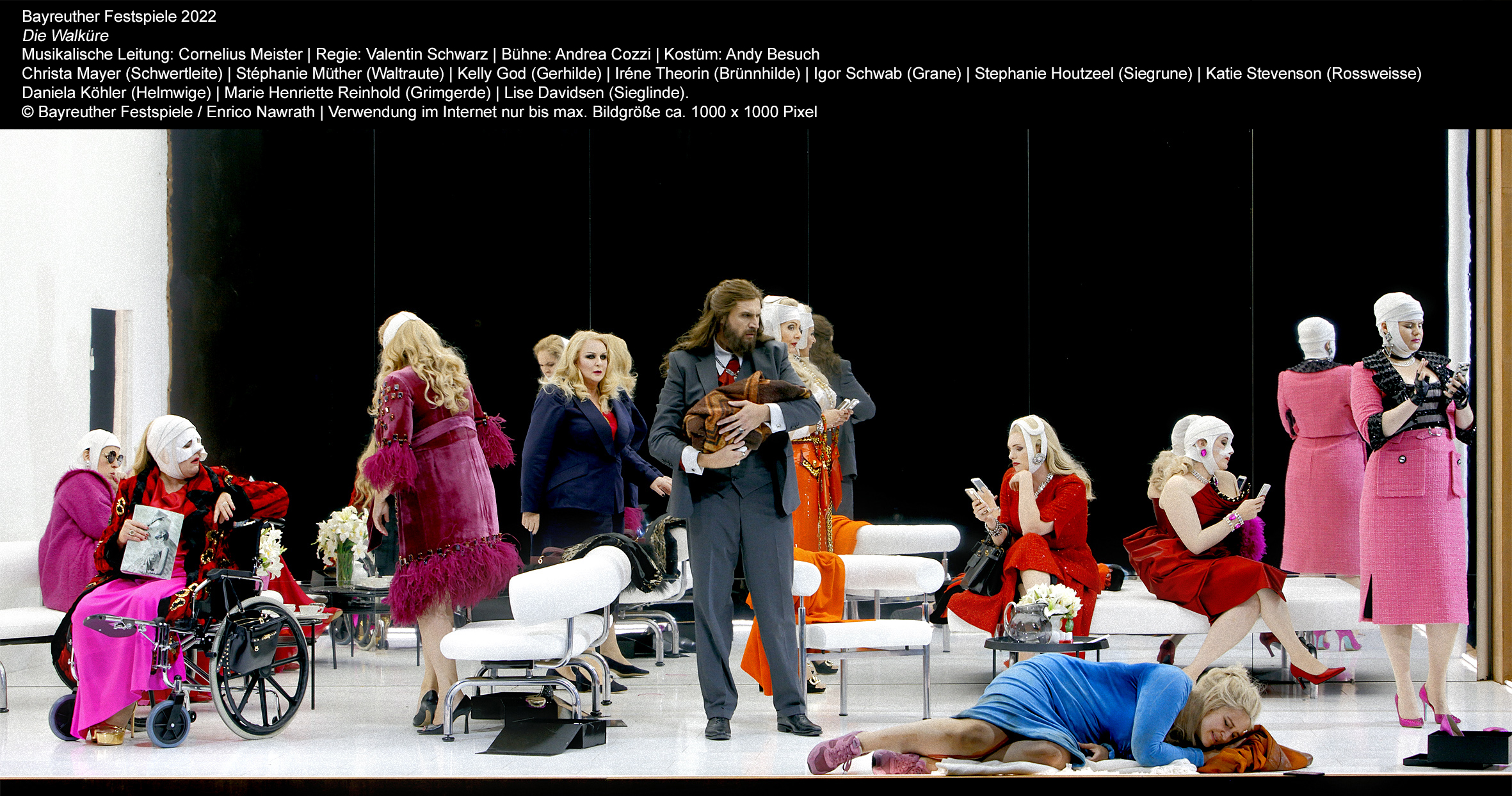
The boos are getting louder: not, I think, for the musicians, but for the production of Valentin Schwarz, who has yet to appear for a curtain-call. That need be no bad thing artistically, though the practice itself is fascistic; should a bourgeois audience feel satisfied with what it has consumed, it will be a disturbing outcome for art. Here, though, the open mind I am endeavouring to keep concerning Schwarz’s production is struggling a little. As a distinguished Wagner scholar said to me when I met him afterwards, ‘It is getting worse.’ On the basis of what I saw in Die Walküre, I had little choice but to agree.

Short of the framing of the action as a saga of twins, which here seems more assumed to continue from Das Rheingold than illustrated, there is little at all to point to other than strange departures from Wagner’s drama, which taken separately or together fail to amount to anything very much. Siegmund and Sieglinde are, I think, taken back by their self-discovery to their childhood, joined by ‘symbolic’ star-children. (Either that, or they fantasise about the children they will have, but I think it is the former.) There is nothing wrong with that; it makes sense. But for it to have taken place in Wotan’s godly quarters seems peculiar—imagine Fricka’s thoughts on that—as well as quite at odds with what they have just sung, without obvious reason.

 It is later implied that Sieglinde, heavily pregnant throughout the first two acts, is carrying Wotan’s baby. At least I think that is why he ‘comforts’ her, whilst Siegmund and Hunding seek one another, pulling down her tights and apparently attempting to deliver the child. If not, it is a straightforward case of sexual assault, although I suppose it must have been anyway earlier. My guess would be that this is intended to enhance the parallelism between Wotan and Alberich, that both will be found to have produced children, Siegfried and Hagen, through rape. But where that leaves Siegmund, goodness knows: St Joseph with a twist, it would seem. Where, though, does that leave Hunding? He must surely have noticed. It is difficult not to conclude that Wagner’s plot would have been better left as it was.

In between, Freia’s funeral, or at least her lying in rest, had taken place. There were some germs of decent, if ultimately rather incidental ideas, here. Assuming we are still to take her as goddess of love, her death would have obvious implications (although its timing is arguably strange, given that Siegmund and Sieglinde have just met). In a Mafia-film-style mise-en-scène, a few people come to pay their respects, whilst Wotan and Fricka have their decisive confrontation. (Brünnhilde spends some of that scene in what appears to be a greenhouse. I don’t know either.) Hunding petitions the gods in person, an interesting touch. That Fricka returns at the end of the third act, after Wotan has put Brünnhilde to sleep (and made, you guessed it, his incestuous urges all too clear), suggests that she is confident in her triumph. She even wheels on a drinks trolley and offers Wotan a celebratory glass. He declines, though, so in the absence of a spear—just nothing at all, throughout—Fricka clinks together the glasses to make the requisite noise.


I am afraid I have no idea at all what happens in the Ride of the Valkyries. It veered all over the place—at least the BBC light entertainment place—from Dr Who to The Benny Hill Show to Casualty, with an apparently accidental turn for Diana Dors’s gender-reversal ‘The Worm that Turned’ series for The Two Ronnies. Sometimes the Valkyries were in charge, sometimes Wotan’s guards. There was a great deal of mobile telephone use. Perhaps it is time to call for a moratorium on those devices onstage, unless the director has a clear idea what they are for. As things stand, they seem to have become the new suitcases.

Lack of objects when called for and introduction of obscure alternatives does little to help. I have already mentioned the lack of a spear or any substitute.   Just as the role of Das Rheingold’s dark-haired boy is more unclear than ambiguous, so is that of the strange pyramid-in-a-box, earlier seen and quasi-worshipped upon the gods’ entry into Valhalla as if a grail-refugee from a production of Parsifal. It now reappears as a repository for a pistol. Sometimes a pistol is a Notung equivalent, sometimes not; sometimes there are several. None of it makes any sense, really, and try as I might to try to piece together some sort of explanation, I am really on the verge of giving up.

As for Grane’s reincarnation as Brünnhilde’s male, suited personal assistant, it makes even less sense when there have been a few apparently arbitrary visual references to actual horses elsewhere. Finally, there is a strong impression that the strongest acting is brought by the singers themselves to their roles. Personenregie is intermittent at best and sometimes disappears altogether in longer exchanges between characters. I suppose some of these things, minus the lack of Personenregie, might add up to something in retrospect, but I do not feel especially hopeful.

Musically, things are better, often much better. Cornelius Meister continues to impress greatly with his command of structure and detail, conveying and expressing a Wagner melos from the pit that drives and, in many respects, is the action. The sound he drew from the Bayreuth Festival Orchestra—and, I assume, to an extent, the sound its players wished to conjure too—was in some ways distant from that we might recall from old Bayreuth recordings, closer to those of other opera orchestras. Choices seem well justified to me, though, and there is no point merely trying to imitate Karl Böhm—or anyone else, for that matter. There is considerable emotional and conceptual range as the cauldron of Wagner’s Greek Chorus bubbles: quite a difference, alas, from what we see onstage.

Not, however, from what we hear onstage. Lise Davidsen’s Sieglinde was at least the equal of any I have heard. No one seems to have a bad word to say about this extraordinary soprano, and so far there seems no reason for anyone to do so. Her final peroration here, ‘O hehrstes Wunder!...’ was as vocally magnificent, riding the orchestral wave almost like no other, as it was clearly heartfelt, the culmination of a dramatic journey that now must end. Klaus Florian Vogt’s tenor will always divide opinion. Much of that is simply down to taste. Whether one liked his performance or not—and there is no getting away from the fact that its sound is very different from the baritonal Siegmunds we have come to expect—his was certainly a committed and, I think, highly likeable performance. Georg Zeppenfeld’s Hunding offered a masterclass in the role, everything present and correct, both considered and alert to the moment.

Tomasz Konieczny and Michael Kupfer-Radecky shared the role of Wotan, the former having become unable to continue during the second interval. Both gave strong performances, deeply rooted in Wagner’s text; if the ear took a little while to adjust to new sound and delivery, that was a tiny price to pay for so crucial, short-notice a substitution. Christa Mayer’s Fricka was once again first-class, fuller-throated than often one hears, and all the better for it. Iréne Theorin impressed as head Valkyrie, youthfully impetuous and headstrong, yet clearly transformed by what she had witnessed. The rest of her team was cast from depth, including a return for Mayer as Schwertleite. Had this been a concert performance, I suspect it would have moved more than it did in the theatre. This Ring, however, will continue in Wagner’s own theatre.


Thursday, 15 August 2019

Bayreuth Festival (3) - Lohengrin, 11 August 2019


Festspielhaus


Henry the Fowler – Georg Zeppenfeld
Lohengrin – Piotr Beczala
Elsa – Camilla Nylund
Friedrich von Telramund – Tomasz Konieczny
Ortrud – Elena Pankratova
King’s Herald – Egils Silins
Brabantian Nobles – Michael Gniffke, Tansel Akzeyebek, Marek Reichert, Timo Riihonen

Yuval Sharon (director)
Neo Rauch, Rosa Loy (designs)
Reinhard Traub (lighting)

Bayreuth Festival Chorus (chorus master: Eberhard Friedrich)
Bayreuth Festival Orchestra
Christian Thielemann (conductor)


The origins of this production of Lohengrin, first seen at last year’s Bayreuth Festival, are interesting and unusual. Alvis Hermanis, an avowed ‘conservative, and proud of it’ – for which, as usual nowadays, we should read something considerably more extreme – had been due to direct the new production. Hermanis withdrew in 2016, to little sadness from the rest of the world, yet nevertheless bequeathing the Festival a serious headache. By that time, work on the designs by the New Leipzig School artists, Neo Rauch and Rosa Loy, was already far advanced. Yuval Sharon, as incoming director, was presented with a greater challenge than simply directing a new production of Lohengrin (and, incidentally or otherwise, being the first American director to work at Bayreuth). He had to formulate and put into practice his own production, using designs intended for another production.


Watching the dress rehearsal last year – I did not see a public performance, and thus did not write about it – I saw a productive tension, an immanent critique, which fascinated me: broadly, and thus misleadingly, politics pitted against fairy-tale, not unlike the work itself. It was doubtless in some respects still a work-in-progress: every production, every performance is. It made me think, though, and I was greatly looking forward to seeing it again this year, to seeing how it had progressed, hoping that the cracks, the fissures, the contradictions would have provocatively deepened. Alas, that did not seem to have been the case; if anything, the production seemed to have reconciled itself to the designs. Perhaps it is too much to ask of a staging that the two can continue to struggle like that, especially when performers have their own imperatives. I genuinely do not know and it may have been entirely my own fault, but I must confess that, to my great sadness, I missed a good deal of what I saw and gleaned last year.


At first, this was not apparent. Indeed, the first act engenders considerable expectancy (at least on my part!) It comes across, or at least did to me, in painterly fashion: a Romantic fairy-tale world, slightly frozen – so blue, so very blue! – from which things can and must progress. It is, then, waiting for Lohengrin; as are we all. When he comes, he ignites the world. He brings electricity, literally as well as figuratively. Is this the beginning of the route from an early-modern Brabant to socialism, a short-circuit, as it were? If so, only fitfully – and that, this time, does not necessarily seem to be a deliberate undercutting. Instead, the critique seems to halt, even to vanish, in the second act, not helped at all by Christian Thielemann’s sometimes interminable scenic-route reveries. At times, other than marshalling of the forces onstage, little else comes across. There is more in the third act, though even that seems considerably less bold. Lohengrin tying Elsa up comes across more as pretty choreography than a deadly game of sado-masochism. And the hints at green politics, culminating in a bizarre, if intriguing green Gottfried, do not come across nearly as strongly as they might. Ortrud’s rightful oppositional status – what if she is right, seems to be the question – is likewise considerably less clear. It is a pity, since I remain convinced that there is potentially much to be admired here. Perhaps 2020 will sharpen things up.


Thielemann’s conducting proved variable. Like the production, he was stronger in the first and third acts, although, as in his Tristan the night before, there was no doubting his extraordinary ability to have the superlative Bayreuth Festival Orchestra do whatever he asks of it. Speed, or otherwise, was not in itself the problem: indeed, speed is only a part, often a relatively unimportant part, of what we really mean by ‘tempo’. The listlessness and at times the self-regard we heard in the second act most certainly was. A little study of Wagner’s essay, Über das Dirigieren, might help. There were magical moments, magical passages, yet sometimes – only sometimes – they came at the expense of musico-dramatic momentum.


There was much to admire from the cast. A few vowels aside, Piotr Beczala’s Lohengrin approached the ideal. ‘Italianate’ might be a lazy way to describe his phrasing, but I hope it will be understood for what it is, in the very best sense. Not that it came at the expense of words, far from it. Beczala’s golden tone could be relished in and for itself, but that would have been to miss an acutely, astutely dramatic portrayal, one I should dearly love to hear again. Camilla Nylund’s Elsa had the occasional rocky moment in the first act, but hers was likewise an intelligent, committed, and beautifully sung performance. Tomasz Konieczny and Elena Pankratova offered similarly intelligent, highly musical portrayals of Telramund and Ortrud, although the latter’s diction occasionally left one having to fill in verbal gaps for oneself. Georg Zeppenfeld never, in my experience, disappoints; that is no reason to take singing such as that for King Henry for granted. Egils Silins’s Herald likewise compelled attention and admiration. So too, last but not least, did the outstanding performances of the Bayreuth Festival Chorus, vocal heft, stage versatility, and verbal comprehensibility all second to none.


Still a work-in-progress then? Doubtless. However, whatever work may remain to be done here – there is always work still to be done – we may give thanks that this was not an Alvis Hermanis production. Catastrophes such as his Vienna Parsifal and, perhaps still more, his Salzburg Liebe der Danae warn of what might have been.


Monday, 11 June 2018

Lohengrin, Royal Opera, 7 June 2018


Royal Opera House

Images: Clive Barda

King Henry the Fowler – Georg Zeppenfeld
Lohengrin – Klaus Florian Vogt
Elsa – Jennifer Davis
Friedrich von Telramund – Thomas Johannes Mayer
Ortrud – Christine Goerke
King’s Herald – Kostas Smoriginas
Brabantian Nobles – Konu Kim, Thomas Atkins, Gyula Nagy, Simon Shibambu
Pages – Katy Batho, Deborah Peake-Jones, Dervla Ramsay, Louise Armit
Gottfried – Michael Curtis
                                        
David Alden (director)
Paul Steinberg (set designs)
Gideon Davey (costumes)
Adam Silverman (lighting)
Tal Rosner (video)
Maxine Braham (movement)

Royal Opera Chorus and Extra Chorus (chorus director: William Spaulding)
Orchestra of the Royal Opera House
Andris Nelsons (conductor)

Elsa (Jennifer Davis) at her wedding

Since returning to London in January, I have been heartened by much of what I have seen – and indeed heard – from the Royal Opera. If Barrie Kosky’s Carmen proved something of a flop, there has been much to ponder and indeed to inspire from Krzysztof Warlikowski’s From the House of the Dead, superlatively conducted by Mark Wigglesworth, and most recently, George Benjamin’s new operatic masterpiece, Lessons in Love and Violence. David Alden is perhaps not the most obvious directorial choice for Wagner, though his ENO Tristan – the first I saw – certainly had its merits. He pretty much had the field to himself, though, given that Covent Garden’s previous staging was the lamentable fancy-dress pageant served up by Elijah Moshinsky, its final reheating coming as late as 2009. On the face of it, Alden’s move to the 1930s must have come to a shock to the more reactionary elements always present in a Wagner audience. That it does not seem to have done so suggests either a welcome opening of minds or something – at least, according to one reading, like Lohengrin – rather less substantial than one might have initially presumed.


I wish it had been the former but Alden’s production ultimately proved conventional, all too conventional: more a potential shell for something more interesting than a remotely finished – even ready – production in itself. Designs and some stage direction, notably that of the chorus, are suggestive, but where is the dramatic grit? To offer a Lohengrin come as redeemer to a society broken by war is of course to follow Wagner precisely; to shift the actual war to something closer to our modern concerns is no bad thing at all. He unifies a people in disarray through his charismatic authority, yet ultimately cannot fulfil his duty and rejects his people.

Lohengrin (Klaus Florian Vogt) and Telramund (Thomas Johannes Mayer)

Ortrud (Christine Goerke) and Telramund
Nazi parallels, or rather premonitions – like Marx, Wagner is often at his very strongest in pointing to where the twentieth and twenty-first centuries would go wrong – are obvious, yet none the worse for that. Even that level of critique will, after all, stand as a rebuke to those who follow that disingenuous old Nazi, Curt von Westernhagen, railing against the fresh theatrical wind of the 1970s: ‘Directors who deem themselves progressive when they transform the Ring back into a drama with a “message” have no idea how regressive this approach is in relation to the genesis of the work itself.’ Westernhagen’s scholarly methods are now as discredited as his ideology. Disciples remain, though, and few things get them so hot under the collar as Nazis on stage. Clue: they like it, really.


That said, simply to update is never enough. Indeed, it is to adopt the Westernhagen fraternity’s strange delusion that a production more or less is its designs (here, handsome indeed, for which great credit should be accorded to Paul Steinberg in particular). In many ways, when and where something is set, or is not, is the least interesting thing of all; at best, it is a starting-point. Save for that arresting, almost cinematic (Riefenstahl at a push) direction of crowd movement, its dramatic import obvious yet undeniably powerful, there is not much to get one’s teeth into. If the setting remains largely undeveloped, too much also seems awkwardly reminiscent of other productions. Had you never seen a German Lohengrin, you might remain, often literally, in the dark; Wagner and indeed many in his audiences surely deserve greater credit than that.

Henry the Fowler (Georg Zeppenfeld)

A King Henry whose hunched body language was a little too close to comfort to that of Hans Neuenfels’s Bayreuth production is one thing, but a falling of banners for war that aped the close of the second act of Stefan Herheim’s Parsifal is another again. If some point had been made about Wagner, the Nazis, and Bayreuth, it might have worked, I suppose; here, it seemed gratuitous and frankly derivative. What the point of describing the pages as ‘four women at the wedding’ may have been I do not know: if you like that sort of thing, then that will doubtless be the sort of thing you like. A sudden design apparition from Neuschwanstein seems merely a change of scene. Again, one can see why such an image might have a point in a fascist, even Nazi, setting, but it needs at some level to be made, not merely assumed. Dramatic motivation, then, largely eluded me. Such irritations pointed to a greater problem: a conceptual weakness at the heart. I suspect it can be remedied: if a shell, it is a fine shell. It will not, however, remedy itself.


Perhaps the same once had been true of Moshinsky. At any rate, this evening shared something else important with that final outing of 2009: musical excellence. Andris Nelsons, who conducted Neuenfels’s production at Bayreuth, was not at his strongest here, especially in the first act. Indeed, there both Nelsons and Alden seemed intent, consciously or otherwise, to underline what can often seem to be its rather static nature rather than to enliven the drama. However, Nelsons drew increasingly lovely playing from the orchestra, lower strings and woodwind in particular, and made often quite extreme second-act rubato – not to be confused with tempo variation – work, rather than seem merely mannered. His command of the architecture in the second and third acts impressed. Still more so did the outstanding singing from the chorus and extra chorus. William Spaulding’s work here is clearly reaping rewards, just as it did at Berlin’s Deutsche Oper.


Klaus Florian Vogt’s Lohengrin is a known quantity: known also, of course, to Nelsons from Bayreuth. I am less enthusiastic than once I was: the purity is less consistently apparent, the blandness more so. (Or maybe I am just tired of it.) However, it remains impressive on its own terms; one’s response to his singing will perhaps be more than usually personal. Replacing the originally advertised Kristine Opolais, Jennifer Davis impressed greatly as Elsa. This was by any standards a high-profile debut. Vocal and dramatic sincerity were matched by a security one had little right to expect. Thomas Johannes Mayer, also of recent Bayreuth fame, more than hinted at a properly complex Telramund, even if his artistry received little help from the staging. Christine Goerke’s Ortrud climaxed in properly blood curdling cries at the close, although again I had the impression a deeper production would have brought out something – well, deeper. Georg Zeppenfeld did what he could with the Neuenfels King-redux; that again was impressive indeed. Only Kostas Smoriginas, as his Herald, disappointed: often uncertain of verbal and musical line alike.
 
Ortrud waiting

The audience, part of one’s experience whether we like it or not – unless one happens to be Ludwig II, and even then… – proved something of a trial. Someone’s telephone vibrated throughout the first minute or so of the first-act Prelude, the culprit eventually shouting ‘Yes! I’m going to turn it off’. A friend heard someone else announce upon Lohengrin’s arrival: ‘I prefer it when he wears golden armour.’ Coughing, electronic terrorism, and inanity aside, they seemed to like the production: rarely a good sign. Given what they will boo… Still, there is, I am sure, room for something more to take shape within its framework; perhaps they will do so then. Moreover, there is, I assure you, a genuinely exciting prospect for the new Lohengrin at Bayreuth this year. At least on this occasion, my lips must remain better sealed than Elsa’s. The world, however, is likely to see a worthy successor to Neuenfels from Yuval Sharon, in a production that penetrates more deeply to the work’s essence and grapples with its implications.