Showing posts with label Siobhan Stagg. Show all posts

Friday, 23 May 2025

Die dunkle Seite des Mondes, Hamburg State Opera, 18 May 2025

Images: Bernd Uhlig
Dr Kieron (Thomas Lehman), Creature of Light (Andrew Dickinson)


Dr Kieron – Thomas Lehman
Meister Astaroth – Bo Skovhus
Miriel – Siobhan Stagg
Creature of Light – Andrew Dickinson
Anima – Kangmin Justin Kim
The Bright Girl – Narea Son
Cornelius – Aaron Godfrey-Mayes
Dr Pulski – William Desbiens
Dr Raubenstock – Karl Huml
Dr Spinberg – Jürgen Sacher

Directors – Dead Centre (Ben Kidd and Bush Moukarzel)
Designs – Jeremy Herbert
Costumes – Janina Brinkmann
Lighting – James Farncombe
Video – Sophie Lux
Choreography – Sasha Milavic Davies
Dramaturgy – Angela Beuerle, Michael Sangkuhl
Live camera – Benjamin Hassmann  

Chorus of the Hamburg State Opera (director: Christian Günther)
Hamburg State Philharmonic Orchestra
Kent Nagano (conductor)

I really wanted to like this opera, Unsuk Chin’s second, following her widely and justly acclaimed Alice in Wonderland (2004-7). After all, I travelled from London to Hamburg expressly to attend its opening night. In some ways, I liked and admired it; or rather I liked and admired much of the music and stage performances, above all Thomas Leaman’s commanding account of the central role. It pains me to say that, nonetheless, as a dramatic and even theatrical experience what we saw and heard in Die dunkle Seite des Mondes (The Dark Side of the Moon) fell considerably short of the considerable hopes invested in it. My sense, moreover, was that mine was not, sadly, an eccentric reaction. 

A Faustian tale is no bad start; opera in particular and drama more broadly continue to flourish in development and variation of time-honoured subjects, to which something more timely will necessarily be brought. The (anti-hero), Dr Kieron, is a scientist, Dr Kieron, an unbearable, impossible colleague, who dismisses and needs the work of others, but who harbours the secret of his haunting by visions, which lead him to the realm of a ‘soul healer’, Meister Astaroth. Inspiration came originally from Chin’s interest in the relationship between the physicist Wolfgang Pauli and the psychologist Carl Friedrich Jung. 


Meister Astaroth (Bo Skovhus)

Chin’s score announces a darker soundworld, aptly enough, than that of her previous opera and indeed many other of her works, yet it is possessed, at least in its stronger sections, of many of the inventive qualities, especially rhythmic and timbral, that have justly lent her great esteem. There is exuberance and a true sense of potential in the orchestral lines, vividly brought to theatrical life, so far as I could discern, by the Hamburg State Philharmonic Orchestra under Kent Nagano, the house chorus a welcome addition in its several appearances. The beginnings of both acts, more than just the beginning in the first, offered the most compelling music and also, doubtless far from coincidentally, registered strongest in dramatic terms. Broadly, Kieron’s world convinces more than Astaroth’s, which may or may not be the point. Dramaturgically and theatrically, it seems conceived – in my case, it was certainly received – in a traditional way. A story is told on stage through words and music. There are no obvious metatheatrical questions posed; nor is there an evident desire to play with narrative, let alone a sense of the postdramatic. There is nothing wrong with that; many fine operas still take on such a form and probably always will. Traditional operatic virtues, then, probably need to register more strongly.   

The libretto, however, and more generally the plot come across as hopelessly contrived: not artificial in an arch or detached aesthetic sense, but mostly unfortunate. This, I am afraid, is also Chin’s work, written in collaboration with Kerstin Schüssler-Bach. It piles up words, fails to establish characters – most glaringly, in the case of the women, mere projections in a sense that surely extends beyond feminist critique – and often seems bizarrely unsuited to opera. I should actually go a step further and say that the problem was less its wordiness, although that certainly did not help, than that wordiness simply not having been very good. It would have come across unfortunately, had there been no music at all. Put another way, literariness needs to be good – very good – and if you are not a Hofmannsthal, remains better avoided. When something merely aspires to literariness, if indeed that is what is going on here. I honestly cannot imagine anyone caring about the characters—and it was not clear what else there was to care about. At times, an anti-war message seemed to surfacebut then it disappeared; or perhaps I had imagined it. It is surely not coincidental that the music’s invention registered most strongly when there were no words to get in the way. Then there is the length. On the face of it, it was refreshing to be presented with something that dared to be different, not to be confined to the consensus of how long an opera ‘need’ be. Like any artwork, it should probably be as long as it needs to be, but no longer. Offering something roughly the length of a Mozart-Da Ponte opera (done whole) shows ambition, if only it were realised. 

There was a good deal to suggest, however, that this had been developed as a whole, extending considerably beyond the composer’s work on her libretto. At its best, Dead Centre’s production seemed to ‘listen’ to the score and not only to the words. Without merely mirroring, movement, lighting, and much else seemed to spring from the same source, for instance in the set’s swaying to convey the drunkenness of the bar. If anything, though, it seemed too often to remain tied to the words and drama. If it would be too much to hope that a different staging might have redeemed them, something a little more interventionist might nonetheless have added something, perhaps fleshing out the characters rather than simply presenting them, such as they were. Even something that accentuated the c.1930 setting, present when one reflected yet not registering as something that mattered, might have contributed something. Live camera did, in a straightforward way, homing in on particular characters – for instance, during bar ‘crowd’ scenes – and register their facial reactions. 


Thomas Lehman’s assumption of the principal role, Dr Kieron, was thus in some ways all the more impressive: a fiercely intelligent act of apparent conviction, which created a character almost in spite of what he was presented with.  Bo Skovhus, as Meister Astaroth, similarly impressed with great stage presence throughout. Kieron’s former lover and morphine addict, Mirel, was woefully under-characterised in the work, but Siobhan Stagg did what she could, her coloratura duly sparkling—and suggestive of what might have been. Kangmin Justin Kim’s Anima was quite a star turn, splendidly feminine of tone and gesture, so much so that it was only when I checked the cast list I realised this had been a countertenor. Aaron Godfrey-Mayes made for a sympathetic Cornelius, assistant to Kieron. All seemed well sung; there was nothing evident for which to reproach the musicians, whether on stage or in the pit. 

A puzzling and, in many ways, frustrating evening, then, but one I was nonetheless pleased to have experienced. Not only because one learns from when things go wrong, though surely there is much to be learned here; but because I remain convinced there is something waiting to be released here. Where that leaves the opera, I am not sure. It is difficult to imagine the music, or rather some of it, retained and a new libretto fashioned. Perhaps there is some radical surgery that could be performed. Perhaps the best of it could be reworked into a shorter opera or another work entirely. Perhaps different performances and stagings would make a difference. Or perhaps I am entirely wrong: first night reports are notoriously littered with wrongheaded criticism. No one would be more delighted than I to find my criticisms misplaced, to owe the creators an apology, and to welcome a new work to the repertory. We shall see.


Tuesday, 2 April 2024

St Matthew Passion, Deutsche Oper, 29 March 2024


Evangelist – Kieran Carrel
Jesus – Padraic Rowan
Bass – Joel Allison
Tenor, False Witness – Kangyoon Shine Lee
Petrus, High Priest, Pontifex II – Youngkwang Oh
Pilatus, Judas, Pontifex I – Artur Garbas
Soprano, First Maid – Siobhan Stagg
Alto, False Witness, Second Maid – Annika Schlicht
Girl – Zoé Höchse
Friend – Selina Nüsse

Director – Benedikt von Peter
Revival directors – Eva-Maria Abelein, Matteo Marziano Graziano
Set designs – Natascha von Steiger
Costumes – Lene Schwind
Video – Bert Zander
Lighting – Roland Edrich
Dramaturgy – Dorothea Hartmann

Children’s and Youth Choirs of the Deutsche Oper (director: Christian Lindhorst)
Youth Choir of the Staatsoper Unter den Linden
Children’s Choir of the Aalto-Theatre, Essen (director: Patrik Jaskolka)
Chorus of the Deutsche Oper (director: Jeremy Bines)
Orchestra of the Deutsche Oper
Alessandro De Marchi (conductor)


Images: Marcus Lieberenz

Had someone told me I should be attending performances of the two Bach Passions on consecutive evenings, Maundy Thursday and Good Friday, in Leipzig and Berlin, my first reaction might have been of scepticism, followed by reflection that this could not fail to be a Holy Week to remember. And indeed, it has not failed, neither in that nor in any other respect. However, had I then been told that I should find a staged performance in an opera house considerably more involving, not only thought-provoking, than a concert in the Thomaskirche, my reaction might have turned to something a little stronger than scepticism. Yet so it came to pass. I had little idea what to expect, though memories of Deborah Warner’s Messiah for the English National Opera (remember them?) continue to cast a baleful shadow. There might have been common ground, in that the Deutsche Oper’s production claimed to share a concern for ‘community’. Yet whereas, in London, that had been an unfortunate buzzword, here community involvement, not only from five choirs, amateur and professional, but also from a Berlin (and beyond) public that seemed to go beyond the typical, nonetheless broad opera audience, as well as both intelligently considering what community the work might construct and questioning what that might mean in an increasingly secular society. 

Benedikt von Peter’s staging, a co-production with Theater Basel, was first seen in Berlin last year. Here, in one of its first revival performances, it attracted a large audience both in the traditional auditorium and in additional seating onstage. Or perhaps that should be congregation, as we were addressed in the titles; we were given the music for two chorales to sing too: ‘Was mein Gott will,’ and ‘O Haupt von Blut und Wunden’. The production is in many ways, especially during the first part, quite straightforward. That works to its advantage once critical possibilities are voiced; they are grounded in something that has arisen, it seems, rather than having arisen from initial antagonism. Its spatial-conceptual framework would seem to have developed collaboratively from discussions between the director and conductor Alessandro De Marchi, doubtless dramaturge Dorothea Hartmann too. The two orchestras are on stage, either side of the space in which the production plays out. The conductor is at the front of the stalls, and the choirs are positioned around the auditorium in the shape of the Cross, an arrangement, we are told, modelled on an expansion of the separation of forces between altar and ‘swallow’s nest’ gallery. It certainly helps break boundaries between performers and audience, rendering us all in some sense congregants—whilst maintaining the possibility of different levels of engagement according to belief or inclination.


Members of the Children’s Choir of the Deutsche Oper carry the Cross onstage in the monumental opening chorus. I have heard it both more and less monumental. This was not, thank God, a dogmatic performance, De Marchi showing himself commendably pragmatic: all too much a rarity, alas, in today’s ‘authenticke’ world. If its tempo was fast, at least to my ears, it was not absurdly so; nor was there whining rigidity. Klemperer’s approach would, after all, neither have suited the occasion and forces, nor doubtless the conductor’s inclination, any more than something more objectionable. Once past a little discrepancy between orchestras – eminently forgivable in the circumstances – one felt drawn in to the greatest of all (music) dramas: visually, aurally, aesthetically, and yes observantly. Children act out the Passion, with overtones of Oberammergau, as it is musically enacted by the adults, the Evangelist in particular assuming the role of their instructor. Thus we see ‘disciples’ leave a little boy alone, tied and blindfolded—as indeed we hear that. But I have missed a stage: before that first chorus, a little girl has read to us from the Book of Isaiah. She appears to be simply reading a lesson, but becomes an increasingly critical voice, shouting to the deserting disciples, albeit to no avail. At the close of the first part, she frees Jesus: out of humanity, not necessarily faith. Indeed, elements of faith continue to trouble her, unable to reconcile her ethics with the economy of salvation. Having been freed, Jesus runs off to join the others, those who had captured him, rather than be comforted by his liberator: a difficult, hurtful act, rich in symbolism. After all, he must; he has no choice in any of this. She returns to the Bible, to read, learn, and think though not necessarily in the way her instructors intend.


In the second part, the girl (Zoé Höchse) returns, ever more ‘troublesome’ to the forces of organised religion. She cannot accept what is happening and is eventually banished by the Evangelist. (There is, I think, more than a dash of Greta Thunberg to her.) So too is her friend, and so too are some of the other children, convinced by the rebels’ arguments and understandably unwilling simply to do as they are told. Disturbingly, having remained separate following his trial, Christus briefly takes part in these expulsions too, but we can find ample Scriptural warrant for that, should we wish. By contrast, some of the ‘remaining’ children are elevated to sung as well as visual participation: a couple of them highly impressive as well as touching. As not only tragedy becomes clear but also its truer theological, sacrificial meaning – that of the Cross in whose form the entire drama unfolds – the children who cannot accept it invade the stage with their own, unresolved questions as placards. Epic theatre meets Christian ritual, and ultimately it us for us to decide (or not). Questioning a Bach Passion may seem odd, indeed unwelcome, to many, and surely it would be in a church. In an opera house, though, things are different. It might well not have worked, but it did. 

That was due in no small part, of course, to Da Marchi and his musical forces. The Orchestra of the Deutsche Oper played with great style and sensitivity: not trying to be something they were not, but engaging in a recreation of Bach for today, without ever suggesting they might prefer to be playing Wagner. Indeed, in their obbligato roles, one sensed a moment of musical liberation: how wonderful, it seemed, that for once they could not only play this repertoire, but engage in music theatre of their own. Likewise the massed choral forces, used sparingly together, but voicing drama and reflection from around us, evoking a great basilica as much as Stockhausen. All involved in their direction deserve credit, pastorally as well as musically, this mirroring work and production in practice. One can question some of the musical choices, but that will always be the case in such music; one can still learn from the choices made. I might not choose to use lutes for the continuo, but I greatly appreciated their contribution.


Kieran Carrel proved an excellent Evangelist. It is at the best of times a considerable task, emotionally as well as vocally; with additional ‘dramatic’ duties, it became all the more so. Carrel’s understanding and communication of that understanding seemed to gain depth from those challenges, fully engaging with circumstances and their conceptual framework. The same might be said of Padraic Rowan’s Christus, darkly beautiful: strangely, properly remote yet also approachable. The other vocal soloists also all impressed. Battling a cold, Joel Allison nonetheless offered moving accounts of the bass arias; there were only a few occasions when one could tell. Tenor Kangyoon Shine Lee proved at least his match in the tenor arias, finely sculpted line and tone at the service of the text. Siobhan Stagg, Annika Schlicht complemented each other well as soprano and mezzo, offering performances both considered and, so it seemed, dramatically spontaneous. Youngkwang Oh and Artur Garbas impressed similarly in their parts. There really was no weak link, but rather in a true sense a musical community that both constructed and was constructed by Bach’s great Passion and its particular enactment.


Sunday, 9 July 2023

Le nozze di Figaro, Royal Opera, 8 July 2023


Royal Opera House

Figaro – Mattia Olivieri
Susanna – Siobhan Stagg
Bartolo – Maurizio Muraro
Marcellina – Dorothea Röschmann
Cherubino – Anna Stéphany
Count Almaviva – Stéphane Degout
Don Basilio – Krystian Adam
Countess Almaviva – Hrachuhí Bassénz
Antonio – Jeremy White
Don Curzio – Peter Bronder
Barbarina – Sarah Dufresne
Two Bridesmaids – Helen Withers, Miranda Westcott

David McVicar (director)
Tanya McCallin (designs)
Paule Constable (lighting)
Leah Hausman (movement)

Royal Opera Chorus (chorus director: William Spaulding)
Orchestra of the Royal Opera House
Joana Mallwitz (conductor)


Images: Clive Barda
Cherubino (Anna Stéphany), Figaro (Mattia Olivieri), Susanna (Siobhan Stagg)


Figaro is the opera that a critic sees most often, and it is right that it should be.’ An opera critic I greatly admire wrote those words concerning a relatively early outing for this production in 2008. Michael Tanner proceeded to commend Charles Mackerras’s conducting of that revival of David McVicar’s staging, first seen in the Mozart Year of 2006, comparing it favourably even to that of his fellow knight of the realm, (Sir) Colin Davis. He even found that what had previously irritated him in McVicar’s staging, bar the intrusive ‘action’ that drowned out the Overture, did no longer, seemingly preferring Leah Hausman’s revival direction to the original. Seeing and hearing the same thing, I was notably cooler, in some ways downright hostile, though we certainly agreed on the distinction of the cast. I am not sure I should have expected still to be seeing the same production fifteen years later, but here we are. And though I am not certain, I think I may have seen Figaro more often than any other opera. Surely only Don Giovanni or perhaps The Magic Flute would rival its frequency, though I am well aware how often Covent Garden presents La traviata for those less impervious to its charms than I.


Marcellina (Dorothea Röschmann


I cannot claim to like McVicar’s staging any more than I did, and with the best will in the world, it looks tired and – partly a function of its mysterious updating to the nineteenth century – heavy, for all its playing-to-the-gallery silliness and strangely inconsequential Upstairs, Downstairs busyness from an additional troupe of actors. There could doubtless be a host of reasons to shift the action to what seems from the costumes to be at least the 1830s, but none comes through here, other than a liking for its fashions. That a class-based society, as that increasingly was, needs to be distinguished from one still largely founded on social orders seems not to have occurred to the director. If we want 1780s-themed anachronism, we can turn to Der Rosenkavalier. There seems, though, to be no message here, no justification for its move from where it ‘should’ be. A large part audience, though, seems enamoured of both the designs and the additional activity; there is little accounting for taste, it seems, let alone for judgement. 

That Mozart’s music is phenomenally difficult to conduct, or more generally to perform, ought to go without saying, though it seems to bear repeating. I never cared for Mackerras’s Mozart, though many did, and I admired him greatly in a good deal of other repertoire. Having heard Sir Colin in this music spoils one forever, though it also offers the instructive that one does not need to ‘do’ much. (See also Bernard Haitink.) There was doubtless a great amount of accumulated wisdom behind that ability to do little, as there was on the numerous occasions I saw Daniel Barenboim cease conducting his orchestras altogether, trusting in them and they in him. Joana Mallwitz did not get in the way and set largely sensible tempi: that already distinguishes her from far too many conductors, some of them ‘period’-inclined, some not. There was little of the former to her performance, at least overtly; her performance had, in the best sense, something of the Kapellmeisterin to it. That is to say, it was not about her; she was supportive, reasonable, and largely drew good playing from the orchestra. If there were a few disjunctures between pit and stage, that often happens, especially on an opening night, and she dealt with them with minimum fuss. Why the fortepiano rather than the harpsichord  it is certainly not historically 'correct'  I do not know, but the affectation is now commonplace.


I cannot get used to the ‘Moberly-Raeburn’ reordering of the third act, which places the sextet before ‘Dove sono’, nor do I find arguments for it remotely convincing, but I think it has generally been adopted in this production; it was unlikely, at any rate, to have been solely Mallwitz’s idea. (If I remember correctly, Davis and Mackerras used it too.) Likewise the ‘traditional’ excision of two arias in the fourth act, said to ‘hold up the action’, but in reality (and good performance) doing nothing of the kind.

The production has had its fair share, perhaps more than that, of excellent casts. Those who have attended a few times over the years will have our favourites. Comparison would be odious and, more to the point, unrevealing. It speaks well of the Royal Opera that it granted role debuts to two fine singers as Figaro and Susanna: Mattia Olivieri and Siobhan Stagg. I am reluctant to speak of the advantages of having ‘native’ Italian speakers in the cast; the last thing this international art form needs is any form of nativism. But Olivieri’s ‘natural’, readily communicative way with the language seemed to act as an energising presence to all around him, as well as to enable him to present a myriad of different ways of singing: from parlando to ardent lyricism. He has a splendid stage presence too, balancing the necessarily cocksure with hints, and sometimes more than that, of something more wounded and vulnerable. That he looks good in livery certainly does no harm either. Stagg sounded just ‘right’ in her role, at least for me. ‘Soubrette’ can sound dismissive; I certainly do not intend it that way, when I say that it formed the basis of her approach, tonally and otherwise, permitting growth in stature as she revealed more of the character to her. It is, we should always remind ourselves, a lengthy and difficult role; Stagg navigated its challenge with winning ease. 


Susanna

Stéphane Degout is more of a known quantity on London stages. He offered a duly commanding Count Almaviva, complemented and put properly to shame by Hrachuhí Bassénz’s Countess, whose ‘Dove sono’, audience disturbance notwithstanding, brought tears to the eyes. So did their final moment, beseeching and granting forgiveness. Anna Stéphany’s was a classic Cherubino: very much what would one expect, and certainly none the worse for that. It does not seem so long ago that I saw Dorothea Röschmann on this stage as Pamina for McVicar (and Davis). Now she is Marcellina, and what a wonderful job she made of it, a more fully drawn portrait than I can recall: a woman in her prime, no mere has-been, with feelings of her own that demand to be heard. Krystian Adam’s sharply observed Don Basilio marked him out as one to watch, as did Sarah Dufresne’s Barbarina. 


Figaro

Opera is, of course, theatre, and that, for better or worse, entails theatre audiences. Sadly, last night’s offered behaviour that seriously detracted from the ability to appreciate, even to hear, what was going on. The uproarious laughter – do they really find these things quite so funny? – was one thing, at least until the unforgivable (ironically) disturbance following ‘Contessa perdono’. Anyone listening to Mozart, or indeed simply to Degout’s Count, would have known there is nothing remotely amusing to this infinitely touching moment. But if one could, by and large, deal with that, what of applause within numbers, ‘Dove sono’ included, widespread use of mobile telephones, and the stench of goodness knows what foodstuff somewhere in the Balcony? There is no real ‘etiquette’ to this, merely an imperative to show consideration for others; or at least there should be. A great pity.

And with that, with the opera I may have seen more often than any other, it is time to say au revoir to London stages and halls. I shall be spending the next academic year on research leave in Berlin and hope to be writing regularly of the musical riches on offer there. There is nothing about poor audience behaviour that is exclusive to London or the United Kingdom; I have experienced as bad in Berlin, Paris, Vienna, and elsewhere. But without, I hope, being unduly pious, perhaps we might all try a little harder to refrain from impinging upon the appreciation of others in the audience. Anyone can fall victim to a fit of coughing, but (almost) no one need chatter, look at telephones, and the rest. Theatres and concert halls are places of precious experience not to be readily be recreated elsewhere. Without undue gatekeeping, let us try to keep them that way. They and we, in all our fallen humanity, are worth it.


Tuesday, 11 January 2022

LSO/Rattle - Anderson, Mahler, Rott, Webern, and Dvořák, 9 January 2022


Barbican Hall

Julian Anderson: Suite from Exiles
Mahler: ‘Blumine’ movement for Symphony no.1 in D major
Hans Rott: Symphony in E major: Scherzo
Webern: Six Orchestral Pieces, op.6
Dvořák: Symphony no.7 in D minor, op.70

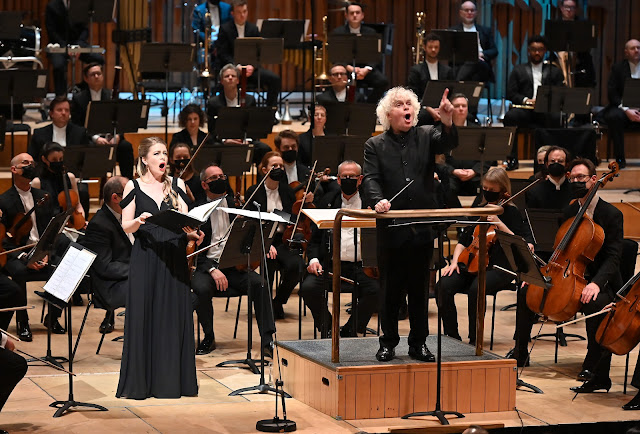
Siobhan Stagg (soprano)
London Symphony Chorus (chorus director: Simon Halsey)
London Symphony Orchestra
Simon Rattle (conductor)


Images: Mark Allan


Two or three weeks ago, it did not seem especially likely this concert would happen. It did—and very well it went too. To hear as large an orchestra as that fielded by the LSO here under Simon Rattle remains unusual during our current troubles. We now perhaps ascribe greater worth to every artistic and social occasion, all too well aware of general precarity. I certainly relished the sheer richness of orchestral sound, the unquestionable commitment from all on stage and (London Symphony Chorus) up in the balcony, and something close to a full house for an appreciative audience.

It seems that Julian Anderson’s Exiles has, one way or another, been a victim of the dread virus. Two of its five movements were given by the LSO and Rattle in September; here they were joined by ‘La République des Lettres’ for soprano and a cappella chorus, then impossible to perform. When the final two will come is unclear, yet on the basis of this ‘Suite’ and its reception, they will be eagerly awaited by many. The new movement—to the world, that is; all were new to me—pays tribute to the American diplomat Varian Fry who assisted many under threat from Nazism into exile. Here, several of them are named, from Bohislav Martinů via Darius and Madeleine Milhaud and Betsy Jolas to the Hungarian animal photographer Ylla (Camilla Koffler). That was the work of half the chorus, initially syllabic, though not in a ‘difficult’, Nono- or Lachenmann-like way. The other sang from Psalm 46: ‘God is our hope and strength: a very present help in trouble…’. Dialogue between soprano Siobhan Stagg and choir added to the responsorial sense. If the writing were largely homophonic, there was a splendid, again psalm-like freedom to its metre, Rattle finely shaping an heroic performance from all.

First we had heard ‘le 3 mai’, Anderson’s setting of an e-mail from the Moroccan-French composer Ahmed Essyad to other composers from 3 May 2020, telling of his coronavirus isolation and nonetheless greeting them: ‘internal’ exile. The soprano I head first, followed by orchestral sounds that to me evoked a sense of electronic communication—latterly both bane and saviour of our lives. Anderson’s orchestration here and later proved typically ‘French’ in sonority, bells perhaps evoking an inheritance from Messiaen as well as Debussy and Ravel. The darker turn taken upon ‘Je vous embrasse tous,’ leading to climax at the end of the same line of the text, ‘sans covid’, repeated, would doubtless have moved irrespective of the words set; however, we heard it with them, and could hardly fail to think ‘if only’. The sign off ‘Ahmed’ returned us to the exile of electronic communication. 

‘Tsyion’, heard last, sets for chorus words from Psalm 137, the Jews in Babylonian exile, by those famous waters, and from Horatiu Rădalescu on that archetypal exile Ulysses, whilst the soprano sang other words above, from Rădalescu on ‘Exile’ itself. Stagg’s exultant melismata again provoked memories of Messiaen, but Anderson’s music throughout offered a compelling harmonic language and, more broadly, combination of that with melody, rhythm, and timbre never to be reduced to mere ‘influence’ or parallels. Solo horn at one point seemed to encapsulate the wistfulness of exile; there was more to it than that, though. Anderson’s fantastical imagination suggested to me opportunity and, at the close, through a mass of solo violins, a secularised chorus of birds. There is hope out there, as Essyad realised in contemplating a mountain he could not yet visit.

Next up was the discarded ‘Blumine’ movement from Mahler’s First Symphony. There could be no doubting the composer via sentiment or language, nor the specific identity of the Mahler of that symphony, though in many ways it sounded, quite rightly, earlier still: late Romantic rather than modernist, even ‘late early Romantic, Mendelssohn as well as Wagner apparent, Mahler taking his leave from the world of Das klagende Lied. Rattle had Mahler’s song sung with simplicity, never audibly moulded as has seemed the case with much of his more recent Mahler. There was darkness, but only moments of darkness in a fine, unexaggerated performance. And what it was to hear both the excellent solo trumpet and a full LSO at the movement’s climax. This was truly affecting music-making, all the way to a magical final harp chord.


The scherzo from the E major symphony of Mahler’s friend Hans Rott received here an outstanding, spacious, altogether generous performance, whetting the appetite for what one must hope will one day be a performance of the whole work. One need not be starry-eyed about it, as some are, to recognise its music, anticipations of Mahler and all (any ass can see that…) as intrinsically worthy of listening. The LSO’s sound hovered, like Rott’s music, somewhere between Bruckner and Mahler, with a little Berlioz at times too, not least in its trippiness. A sort of deranged jollity with disquieting echoes fascinates; and if sureness of direction is not altogether Rott’s thing, his music’s sheer originality offered something quite compelling both as work and performance. 

With Webern’s op.6 Orchestral Pieces we are in different territory: one of the supreme masterpieces of twentieth-century orchestral music. Rattle and the LSO offered them as the repertoire pieces they demand to be: without apology and through intimate knowledge and understanding. Free choice might not lead one naturally to the 1928 revision, but its smaller forces doubtless enabled the work to be performed at all. Heard after that first half of Anderson, Mahler, and Rott, the first movement’s lyricism emerged all the lovelier and more longing. Rattle ensured here and throughout a balance that invited comparison with conductors such as Abbado and Boulez. In this narrative, crucially, every note counted for a multitude in so much other music. The second movement’s response sounded as inevitable as I can recall, in a vision less haunted than propelled by anger, fear, violence, and yes, wonder. Longing was intensified in the third piece, here sounding intriguingly close to Berg. The German Sehnsucht came to mind. Ominous tread and progress through the funeral march fourth encapsulated a Mahlerian world in itself. Music lay between the notes as well as in them, in a requiem of defiant hope whose roaring climax duly shattered. Heard in aftershock, the fifth seemed to say, stealing from the future of Webern’s teacher Schoenberg’s Piano Concerto, that life must go on. It witnessed yet sparkled. And what expressive depth we heard in the closing ‘Langsam’ movement, each chord speaking as if it were a page or two at least of Mahler.


It is doubtless too easy to speak of performing Dvořák via Webern, but it was difficult, at least at times, not to hear it that way. An aural lens of motivic concision and well-nigh Schubertian melodic profusion did no harm at all to its opening ‘Allegro maestoso’. I was fascinated to hear the LSO strings sound more ‘old German’, akin to Daniel Barenboim’s Staatskapelle Berlin, than I ever heard the Berlin Philharmonic under Rattle. It worked, in any case, as the LSO really dug into Dvořák’s score. A purposeful yet flexible account of this first movement was far from deaf to the beauties and meaning of detail, yet integrated them rather than having them stand out. Here, again, music lay between as well as in the notes. The slow movement was taken slowly, surely more than the ‘poco’ of the composer’s ‘Adagio’ marking; a somewhat Tchaikovskian performance nevertheless worked well on its own terms. Rattle loved it doubtless, but not, I think, too much. There were rhetorical underlinings, yet they worked to shape a musical drama. The scherzo flowed via, rather than despite, its engineered tensions, metrical and more. Its trio was, I felt, moulded a little too much. Likewise the finale: impassioned, yes, but not always clear where it was going. That said, Rattle’s conception of something akin to an enigmatic tone poem in its own right had much to be said for it. His remains a questing musical imagination, as seen in programming and heard in performance.


Friday, 31 January 2020

A Midsummer Night's Dream, Deutsche Oper, 29 January 2020


Images: A MIDSUMMER NIGHT'S DREAM von Benjamin Britten, Regie: Ted Huffman, Premiere am 26.1.2020, Deutsche Oper Berlin, copyright: Bettina Stöß

Oberon – James Hall
Tytania – Siobhan Stagg
Puck – Jami Reid-Quarrell
Theseus – Padraic Rowan
Hippolyta – Davia Bouley
Lysander – Gideon Poppe
Demetrius – Samuel Dale Johnson
Hermia – Karis Tucker
Helena – Jeanine De Bique
Bottom – James Platt
Quince – Timothy Newton
Flute – Michael Kim
Snug – Patrick Guetti
Snout – Matthew Peña
Starveling – Matthew Cossack
Cobweb – Markus Kinch
Peaseblossom – Lora Violetta Haberstock
Mustardseed – Selina Isi
Moth – Chiara Annabelle Feldmann

Ted Huffman (director)
Marsha Ginsberg (set designs)
Annemarie Woods (costumes)
DM Wood (lighting)
Sam Pinkleton (choreography)
Ran Arthur Braun (Puck’s choreography)
Sebastian Hanusa (dramaturgy)
Neil Barry Moss (Spielleitung)

Children’s Choir of the Deutsche Oper, Berlin (chorus director: Christian Lindhorst)
Orchestra of the Deutsche Oper, Berlin
Donald Runnicles (conductor)


For my final review – unless, which seems unlikely, I manage to write up this evening’s concert before midnight – written as a European citizen, it is perhaps fitting to be writing of an English opera, performed by a German company, conducted by a Scotsman. Given the circumstances, I hope I shall be forgiven if it does not find me at my most inspired, should such a condition even exist. Hand on heart, Britten’s A Midsummer Night’s Dream is not an opera I can bring myself to care for greatly, although – perhaps there is a lesson, or at least an irony, here too – the Berlin audience reacted enthusiastically.


Shakespeare is a dramatist whom composers, at least opera composers, confront at their peril. However clichéd it may be to say this, there is so much music in his verse that setting it can seem superfluous. This is not a rule; there are no such rules. However, I cannot see, or rather hear, what is gained in this case, other than an undeniable creepiness to score and elements of the dramaturgy, which therefore does not seem an unreasonable place for a performance to take as its point of departure. In that, as in everything else, Donald Runnicles’s leadership of the excellent Deutsche Oper Orchestra and Children’s Choir and a fine group of soloists proved just the ticket. Rarely if ever have I heard those recurring slithering glissandi and the weird balances of instrumentation and of instrumentation-vis-à-vis-harmony sound quite so ambiguous, even callous in their indifference to the affairs of mere mortals. This was fairyland music properly unsentimentalised. Moreover, Runnicles communicated the constructivist aspects of Britten’s writing more powerfully than any conductor I can recall. Unsurprisingly, the closer it sounded to The Turn of the Screw, the more interesting the score became. There is only so much anyone can do about the general thinness of writing and a tendency, constructivism notwithstanding, towards diffuse formlessness; insofar as anyone can, Runnicles certainly did. Colour, however, came first and foremost. Those silvery slivers of orchestral moonlight cast, in a fine dramatic paradox, as much shadow as anything else.


The children’s choir had evidently been very well prepared by Christian Lindhorst. Indeed, I had to remind myself afterwards that most of its members would have been singing in a foreign language. A mixed cast included many Anglophone singers, but those who were not, at least in terms of mother tongue, could again hardly be distinguished from those who were. (Singing and musical performance more generally are, of course, international businesses in which British artists have been enabled to flourish by membership of the European Union; goodness knows what will happen next year.) It seems invidious to single out particular performances when all impressed and contributed to a whole that was unquestionably greater than the sum of its parts. I shall limit myself to noting vocal portrayals that, for whatever reason, particularly caught my ear. From James Hall came a warm yet, in the best way, piercing Oberon, channelling Alfred Deller’s memory through something more than imitation; he was well matched by Siobhan Stagg’s spirited, knowing (at least until she was not!) Tytania. Gideon Poppe and Samuel Dale Johnson offered an excellent rutting pair of impetuous youths, well matched and contrasting with their lovers, Karis Tucker and Jeanine De Bique. James Platt’s bluffly comic Bottom led a characterful troupe of rustics.


Ted Huffman’s production gave the impression of good ideas that might fruitfully have been taken further, while shining a clear path through the basic narrative. No one would have stood in any doubt as to who was who, nor as to what was taking place: more, after all, than can often be said in opera staging. I presume the mid-twentieth-century setting – 1940s? – was intended to suggest the period of writing or at least Britten’s life in some respect. It was not, however, immediately clear why we should not then have been closer to 1960. Military uniforms and a suggestion – or was that just me? – of a battlefield as all slept in the forest may have alluded to wartime; if so, without something more, I was rather at a loss as to why and with what consequences. In a programme interview, Huffman referred to Oberon and Tytania fighting over the Indian boy as being akin to the status of Britten and Peter Pears as a childless couple. Once more, if so, nothing more was made of it – and I should hardly have thought of that without reading. Lines delivered in somewhat exaggerated fashion by Jami Reid-Quarrell, Puck was likewise intended, I learned, to represent an outsider. Fair enough, although surely that comes with the territory. There was, however, no doubting Reid-Quarrell’s agility, nor the skill of Ran Arthur Braun’s choreography for him. Quite why Theseus, in a fine vocal and stage display by Padraic Rowan, was drunk, I am afraid I have no idea, but the use of giant puppets for Pyramus and Thisby was charming.


What did I miss? Christopher Alden’s superlative ENO production, far and away the best I have seen, went for the pederastic jugular. Would that more would grasp that thorny nettle with such dramatic verve – be it in this or any other Britten opera. Perhaps, though, I was missing the point. With that, I should probably sign off. See you on the other side, lost in a far darker wood than this, with blue passports, yet nothing in the way of fairyland magic and no ‘break of day’ for at least a couple of decades. If we are lucky.

Tuesday, 20 August 2019

Salzburg Festival (5) - Soloists/Mozarteum/Pichon: Mozart, Paisiello, Salieri, and Martín y Soler, 18 August 2019


Grosser Saal

La folle giornata
Mozart: Lo sposo deluso, KV 430/424a: Overture, Quartet, ‘Ah che ridere!’, and Aria, ‘Dove mai trovar quel ciglio?’
Paisiello: Il barbiere di Sivilgia: Cavatina, ‘Saper bramate’
Mozart: Recitative and aria, ‘Bella mia fiamma, addio’ – ‘Resta, oh cara’, KV 528; Insertion aria, ‘Chi sà, chi sà, qual sia,’ for Vincente Martín y Soler’s Il burbero di buon cuore, KV 582; L’oca del Cairo: Aria, ‘Ogni momento dicon le donne’; Canzonetta, ‘Ridente la calma,’ KV 152/210a; Nocturne (trio), ‘Se lontan, ben mio, tu sei,’ KV 438

La scuola degli amanti
Mozart: Der Schauspieldirektor, KV 486: Overture; Aria, ‘Männer suchen stets zu naschen’, KV 433/416c; Aria, ‘Io ti lascio, oh cara, addio’, KV Anh.245/621a; Der Schauspieldirektor: Arietta: ‘Da schlägt die Abschiedsstunde’
Salieri: La scuola de’ gelosi: Sextet, ‘Son le donne sopraffine’
Mozart: Lo sposo deluso: ‘Che accidenti! Che tragedia!’; Canzonetta, ‘Più non si trovano,’ KV 549

Il dissoluto punito
Mozart: Thamos, König in Ägypten: Entr’acte: Maestoso-Allegro
Vicente Martín y Soler: Una cosa rara: Sextet, ‘O quanto un sì bel giubilo’
Mozart: Recitative and aria, ‘Così dunque tradisci’ – ‘Aspri rimorsi atroci’, KV 432/421a; Aria, ‘Vado ma dove? oh Dei!’, KV 583; Aria, ‘Per pietà, non ricercate’; L’oca del Cairo: Sextet, ‘Corpo di Satanasso!’; Thamos, König in Ägypten: Chorus, ‘Ne pulvis et cinis superbe te geras’, and final music to the fifth act of the play

Claire de Sévigné, Siobhan Stagg (sopranos)
Lea Desandre (mezzo-soprano)
Mauro Peter (tenor)
Huw Montague Rendall (baritone)
Robert Gleadow (bass)
Choir of Soloists from the Young Artists’ Project
Salzburg Mozarteum Orchestra
Raphaël Pichon (conductor)

Image: Salzburger Festspiele / Marco Borrelli

Now this is just what the Salzburg Festival should be doing in its longstanding Mozart-Matinee series: one of the most delightful and thought-provoking I have yet to attend. Divided into three ‘scenes’, each accorded as title the subtitle of one of the Da Ponte operas, this concert, from an excellent cast of young singers, the Mozarteum Orchestra, and Raphaël Pichon, offered suggestions as to inspirations, sources, context, and sometimes just affinities between music for a number of principal characters in each opera from other works by Mozart and contemporaries. So, for ‘La folle giornate’, we welcomed to the stage the Count, Countess, Figaro, Susanna, Cherubino, and Dr Bartolo; for ‘La scuola degli amanti’, the full Così sextet; and for ‘Il dissoluto punito’, its entire cast too. Arrangements, where necessary, were credited to Pierre-Henri Dutron and Vincent Manac’h. One may sometimes have quibbled about the programme attribution of certain parts to certain others, but that was part of the fun and enlightenment. We all approach these greatest of operas in different ways, with different ears, with different memories, at different times. One of the great losses of recent years in the Festival has been that of a core Mozart ensemble of singers, often singing the major operas for several years in succession. This concert not only hinted at that time-honoured practice, but also brought many thoughts to mind of Mozart’s own work with particular singers on particular operas.


A decent-sized orchestra for a small hall (strings 8.7.6.4.3) played with verve, vigour, and great sensitivity, all on show in a warm account of the Overture to the operatic fragment, Lo sposo deluso, its second, Andante section winningly prayerful – reminding us that Mozart, like any good man (or woman) of the Enlightenment, made little or no distinction between sacred and secular. (Such, in broadest outline, will be the starting point for my next book.) I may have preferred more string vibrato there, but such was Pichon’s style, and my ears soon adjusted. Moaning that this was not Colin Davis would rather have missed the point on this very particular occasion. Pichon handled very well the transition to the quartet, ‘Ah che ridere!’ from our reassigned Count, Countess, Figaro, and Cherubino, all of whom excelled in concert-ish-performance acting too: the knowing glance, the perfection of timing, and so on. Mozart’s prophetic progression to full vocal ensemble: well, we know very well where that was heading. Huw Montague Rendall’s following aria marked him out as perhaps first among equals for me, though I had no complaints from any of the singers. It was, in any case, an absorbingly full, characterful performance, quite as vivid as any on stage. Mauro Peter’s aria from the ‘other’ Barber of Seville, Giovanni Paisiello’s, was beautifully sung, capturing the sense that this was far more straightforwardly Italian a serenade than anything Mozart would have written – and more seductive than anything Rossini would. Paisiello’s lovely writing for pizzicato strings (as well as mandolin) and clarinet was relished by players and conductor alike. Siobhan Stagg’s concert aria suffered a little from unduly ascetic violins, especially during the recitative, but my goodness, she knew how to use recitative – as, of course, did Mozart, in accompagnato of extraordinary musico-dramatic riches. As for his chromaticism in the aria itself, we were but a stone’s throw already from Wagner and Schoenberg. Lea Desandre’s coloratura was sometimes a little shaky in the insertion aria Mozart wrote for Vicente Martín y Soler’s Il burbero di buon cuore, but her tone was nicely suggestive of Cherubino. A vigorous contribution from Robert Gleadow, a palpably sincere – if a little too ‘white’ for my taste – early canzonetta from Claire de Sévigné, and a refreshing choice for ‘finale’, the delectable Metastasian ‘Se lontan, ben mio, tu sei’, rounded off a first scene that, like Figaro itself, had one straining for more.


On then, after the interval, to ‘La scuola degli amanti’ and ‘Il dissoluto punito’. If Pichon, here as elsewhere, never quite managed to hear, or at least to communicate, the Schauspieldirektor Overture in a single breath, it had pleasing weight and vigour. Gleadow, who, it was revealed was suffering from excruciating back pain, offered a lovely Don Alfonso-ish aria, to which Montague Rendall responded with a poignancy that threatened almost to eclipse his own Guglielmo and touch the (allegedly) more sensitive Ferrando. If I thought the ‘Fiordiligi’ Schauspieldirektor number closer to Pamina, that opera was not on offer here – and the final coloratura made its own point. Salieri’s sextet from his strikingly similar (in plot) 1778 La scuola de’ gelosi, to a libretto by Caterino Mazzolà (librettist for Mozart’s La clemenza di Tito, after Metastasio), was, like the Paisiello number, more straightforwardly Italian, less contrapuntal – but then, it would be, and not only because it was written for Venice. Mozart, upon a return to Lo sposo deluso, followed on seamlessly, almost immediately demonstrating who was the greater composer and dramatist, but then, he would. A Metastasian closing number, again written for quartet and three basset horns, offered prayerful continuity with the first scene as well as a degree of contrast in the same respect. What could be more apt?


We stepped back slightly in time for the final scene, to the second of the three Da Ponte operas, or rather to music in its orbit. For ‘Il dissoluto punito’, we opened and indeed closed with some of the astonishing incidental music for Thamos, King of Egypt. Here was the full-bloodedly Romantic Mozart we knew from the piano concertos as well as from Don Giovanni, the Mozart ETA Hoffmann had no doubt was of his party. On hearing the sextet from Martín y Soler’s Una cosa rara, we might well by now have replied, like Leporello on hearing a snatch of ‘Non più andrai’, ‘Questa poi la conosco pur troppo’, so often have we heard its quotation in Don Giovanni. But why? What a lovely opportunity, not least in so compelling a rendition, to hear the original, genuinely admired, it would seem, by Mozart. Its move to the minor was perhaps especially interesting – and quite differently accomplished from any instance I could immediately recall in Mozart. Gleadow’s aria, once again, spoke wonderfully on its own terms; no one would surely have known the conditions under which he was having to sing. Desandre’s, which followed, displayed here absolute control of her instrument and clarity of line, was well as a wonderful way with Italian. Peter (or ‘Don Ottavio’) offered typical sincerity in his preceding a splendid clarion call (Montague Rendall) and full ensemble from the unfinished L’oca del Cairo. I do not think I have ever heard the music leap from the page with such joy. That, in a sense, was the ‘finale’; but, in an inversion of the practice of Don Giovanni, we returned to the tragic, minor mode, Montague Rendall leading his colleagues, an additional quartet of vocalists included, in a magnificent, Gluck-haunted ‘Ne pulvis et cinis superbe te geras’. If this were not sacred music in the fullest sense, I do not know what would be.