Showing posts with label Webern. Show all posts

Tuesday, 19 August 2025

Salzburg Festival (2) - One Morning Turns Into An Eternity, 18 August 2025


Felsenreitschule

Schoenberg: Erwartung, op.17
Webern: Five Orchestral Pieces, op.10
Mahler: Das Lied von der Erde: ‘Der Abschied’

Director – Peter Sellars
Costumes – Camille Assaf
Set designs – George Tsypin
Lighting – James F. Ingalls
Dramaturgy – Antonio Cuenca Ruiz

Aušrinė Stundytė (soprano)
Fleur Barron (contralto)
Vienna Philharmonic Orchestra
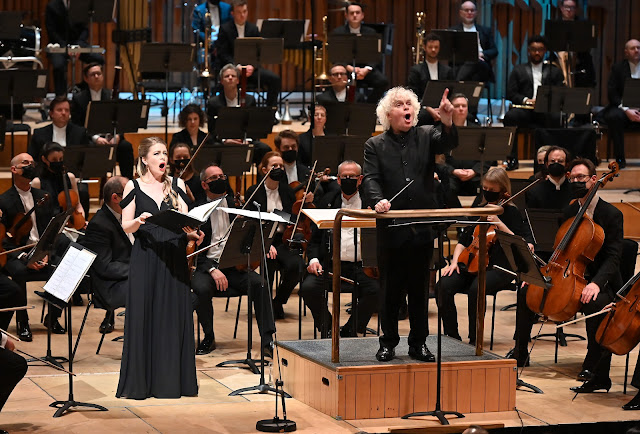
Esa-Pekka Salonen (conductor)


Image: Ruth Walz
Aušrinė Stundytė

'At a time when violence seems ubiquitous and the future uncertain, Peter Sellars argues that the extremes and intensity of Erwartung are not expressionist exaggerations, but instead reflect the actual experience of existential wounds. Rather than viewing the work as a portrait of a disorientated woman, the director approaches Schoenberg’s masterpiece as a lyrical poem expressing doubt, heartbreak, and hope in the face of despair.' 

My heart sank on reading these words on the Salzburg Festival website a couple of days ago. Not that I in any sense mind a production transforming, questioning, or pretty much anyth-ing a work, so long as it works, but rather that my experience of Peter Sellars’s brand of interventionism has, at least for the best part of two decades, not been entirely positive. The celebrated Harlem Don Giovanni still packs a punch; the other instalments of that 1980s Da Ponte trilogy retain their devotees. Last year’s Salzburg Gambler did no harm, if only because it worked well enough even if one missed – which I largely did – the concept. There is no need to rehearse other experiences; one should give something new a chance, or simply stay away.

Perhaps unwisely, I read Sellars’s programme synopsis immediately prior to the performance. It was of the variety, as for The Gambler last summer, in which the director outlines his vision of the work rather than the work ‘itself’: no bad thing, one might say, if one is trying to establish what the former might be (or have been). Again, I cannot say it inspired ‘hope in the face of [not quite] despair’ and it certainly coloured my initial impressions. To cut a long story short, Sellars has decided to present Erwartung as presenting a woman in search of her probably unfaithful lover, whose child she is bearing and who ‘she has reason to believe … has died under torture’, both of them being ‘part of a resistance movement’. There is much more of it, but actually I discovered – at least to me – that it did not really matter. I am not sure how much of it one would glean without reading the synopsis: the broad setting, probably, given an introduction in which two men with tablets show the woman and forest ‘trees’ that have something of surveillance towers – or is it the other way around? – to them. Beyond that, though, what one actually sees can pretty much be the basis for a more faithful – for me, more interesting – or indeed any other reading of the work. If that sort of realism helps the director, perhaps helps inspire the Woman’s movements, and so on, that need not worry us unduly. 

Whether such ‘working’ would be better left unsaid is a question one might ask, but one is not obliged to take it on board, and for the most part it does not get in the way. The stagecraft is well wrought, to my mind more in sympathy with the work. How much was Sellars and how much Aušrinė Stundytė I do not – need not – know. A boulder on which she rests for a while connected with other stagings, actual or in our minds’ eyes, including that of the recently departed Robert Wilson for Jessye Norman here in Salzburg, that bench a permanent fixture in the foyer. Lighting, shadows, and the Felsenreitschule backdrop suggest and create: for instance, crucifix shadows that might threaten or console, according to taste or situation. 


Image: Monika Rittershaus
Peter Sellars

Once past initial slight irritation, then, I found myself able to concentrate on the performance—and excellent it was too. Stundytė fully inhabited the role: Schoenberg’s and, I imagine, Sellars’s too. A true stage animal, she is – and was – a singing actress in the very best sense: not a euphemism for someone who convinces on stage but cannot sing, but rather one who uses her outstanding lyrical art to truly dramatic ends. Without undue pedantry, every move, every gesture contributed to a greater whole, whilst crucially – for this piece, perhaps, above all – giving the impression of spontaneity, of conception in the moment. Not that there was any shortage of vocal shading, of telling phrasing, of much else in more ‘purely’ musical categories, but the distinction was false and indeed never occurred. 

Guided, inspired by, and in dialogue with Esa-Pekka Salonen and the Vienna Philharmonic, as musically all-encompassing a performance of Erwartung as I can recall emerged. Every orchestral flash and flicker, every transformation of timbre and harmony, every imperceptible – in some cases, well-nigh unanalysable – connection between snatches of melody to create musicodramatic form before our ears: these and much more reminded us why this is and always will be a work that presents far more than we can ever grasp in a single experience, why it will always remain one of Schoenberg’s and indeed the Western tradition’s most radical, most extraordinary works. Rarely have I felt so strongly, immediately, and unquestionably the truth of Schoenberg’s 1929 explanation: ‘the aim is to represent in slow motion everything that occurs during a single second of maximum spiritual excitement, stretching it out to half an hour.’ And yet, still it was too much to handle. The ‘resistance movement’ scenario: well, who cared, or even noticed? 


Image: Ruth Walz
Fleur Barron

And so the musical drama continued, distinct yet related, through the Webern op.10 Zwischenspiel, moments and connections of inscrutable, undeniable magic, now all too brief, yet more evidently sufficient, even (relatively) comprehensible. These were exquisite jewels, on the face of it, yet jewels that – crucially for Webern in particular – were in truth developed and developing organisms, not objects. One naturally heard what Schoenberg, Webern, and Mahler, as we moved to ‘Der Abschied’ from Das Lied von der Erde held in common, as well as what distinguished them. How much of that was conscious in Salonen’s performance, again, I do not and cannot know. There was certainly no sense of imposing anything on the music (however loaded such categories may be in an art that remains one of performance, never mere execution). There is a great deal of art in concealing art, yet Salonen and the orchestra, throughout on exquisite, burningly committed form, gave one the (flattering) impression one was discovering for oneself rather than being unduly led.  Equally apparent were Schoenbergian motivic snatches, burned in Webernian purgatory, and deftly turned into deceptive Mahlerian chinoiserie, and a broadening of time, the ‘single second’ of the ‘morning’ cited in Marie Pappenheim’s libretto transformed into a window on Mahler’s ‘eternity’. 

I had skipped over Sellars’s Mahler synopsis more quickly, so much so that it left little mark on my experience. In some senses, it seemed closer to the text; at least, it was saying farewell (to a friend) rather than doing something else completely. It remained specific, realistic, and (for better or worse) couched in what seems to me a rather dated sense of therapeutic self-realisation. But we all come to things from different standpoints and experiences; it doubtless helped him – presumably others, too – and it did not get in the way for me. There were again magical images, such as that of silhouetted flautist Karlheinz Schütz far above, birdsong beckoning Fleur Barron – and/or her friend – to the beyond. Barron’s own performance was, as you would expect, less agitated, yet an eminently worthy complement. Imbued with vocal and quasi-instrumental wisdom, it lived and breathed and brought to its culmination a related, liminal world of words, music, image, and gesture that, whatever the words in the programme, never confused sentiment and sentimentality.


Sunday, 23 March 2025

JACK Quartet - Carter, Aguilar, Lachenmann, Boulez, Houben, Webern, Cage, Wulliman, and Cheung, 22 March 2025


Wigmore Hall

Carter: String Quartet no.5
Eduardo Aguilar: HYPER
Lachenmann: String Quartet no.3, ‘Grido’

Boulez: Livre pour quatuor: 1b
Eva-Maria Houben: Nothing More
Boulez: Livre pour quatuor: 3c
Webern: Six Bagatelles, op.9
Cage: String Quartet in Four Parts
Boulez: Livre pour quatuor: 1a
Austin Wulliman: Escape Rites
Anthony Cheung: Twice Removed
Boulez: Livre pour quatuor: 2

Christopher Otto, Austin Wulliman (violins)
John Pickford Richards (viola)
Jay Campbell (cello)

From a full day – three concerts – of twentieth- and twenty-first-century music for string quartet, I was able to attend the last two of the JACK Quartet’s Wigmore Hall appearances. Alas, I had to miss most of two pieces in the third, both from 2024, by Austin Wulliman and Anthony Cheung. It would be unfair to comment further, other than to say I should be keen to put that right, should the opportunity present itself. Otherwise, the JACK Quartet showed itself once again to be an outstanding ensemble of broad musical sympathies, encompassing works at what we might consider the modernist end of the spectrum, but also others, which have points of contact with the likes of Boulez and Lachenmann, as well as Cage, yet also have quite different concerns. 

Carter’s Fifth (and final) Quartet opened proceedings for me, as finely crafted in the JACK’s performance as this masterpiece is on the page. From the outset, one was left in no doubt that every note counted. Patterns, progressions, and contours in sound were communicated as readily as in an outstanding performance of a Haydn quartet. One felt as well as heard – as throughout the day – emotional breadth and depth, as well as energy, rhetorical eloquence, and intellect. Carter’s metric modulation provided the turning points, the moments of decision, in transitional material. His indications underlay not only tempi in the narrower sense, but in a fuller understanding of character: for instance, ‘Lento espressivo’, ‘Presto scorrevole’ (the latter word a favourite of Carter’s), or ‘Adagio sereno’. In high-lying violin harmonics, in a magical reinvention of viola pizzicato, in a conversation between two or three of the instruments (and players), or in the four coming together in time-honoured fusion of harmony, counterpoint, rhythm, and attack, this was the keenest, most captivating of quartet music. 

Eduardo Aguilar’s ten-minute HYPER (2021) followed, beginning almost inaudible on the first violin, yet fast becoming not only audible, but vividly present across the quartet, pitch gradually discernible in the gathering of a whirlwind. Then came another—in another direction. (I was going to say the opposite direction, but that would, I think, present a false binary.) Tempi shifted and transformed, not ‘like’ Carter, but holding a potential point in common. So did other parameters and other, less definable concerns: intriguingly including a sense of ease or effort, speaking perhaps to some, indefinable sense of subjectivity and/or objectivity. At the close, the players gave up their instruments, though continued to play with their bows, two walking into the audience and making music with and into the air. 

Lachenmann’s ‘Grido’ Quartet immediately showed the players once more fully inside the idiom: language, yes, but also a broader sensibility and strategy. There was at the opening something of a ‘story so far’ impression: both to Lachenmann’s previous quartet writing and even to the history of the genre more broadly. It invited and, if one accepted, compelled us to listen in a performance with a strong sense of discovery. Dynamic and other fluctuations – pitch, for instance, through what one might have thought vibrato, yet only rarely was – grabbed and led us on our journey as much as more overt musical gesture, in a neat-half-hour of enormous intensity of musical expression. This was, without question, a German heart and mind at work: ever-becoming, on multiple levels. At the close, one felt, as one might with Webern or Nono, that one was hearing differently, more clearly. 

In the second concert, movements from Boulez’s Livre pour quatuor framed a wider exploration, involving not only those works I was unable to hear but also Eva-Maria Houben, Webern, and Cage. Webern stood behind the other three: ironically, perhaps, for one the brevity of whose music is so celebrated (if never really the point). Here, his op.9 Six Bagatelles sounded, far from inappropriately, as much as backward glance to German Romanticism as Boulez’s ‘threshold’ for modernity. Each of his six movements said everything, and yet each said something different. This was not compression, but rather a paradoxical (or dialectical) superfluity in which not a note, not a sigh, not a Viennese dance inflection, was anything but necessary. Mahler sounded more present than ever. 

Houben’s Nothing More (2019) took what one might, in the broad rather than the US American sense, call a minimalist route from Webern (from Cage too, I think). There was nowhere to hide, not that anyone should have wished to. Precision was all in work and performance. Much playing was, if not at the limits of audibility, not so far away from them. This, one felt, not entirely unlike Lachenmann, was a way into listening ‘itself’. 

The glassy non-vibrato of Cage’s 1949-50 Quartet suggested, similarly, both a fiddling and a viol consort past, complemented by the music’s melodies and harmony. (It was a little surprising to find myself thinking of harmony in Cage, but that doubtless points to my preconceptions, not to his reality.) The apparent simplicity of its four movements is real enough, but again seems as much an invitation to listen and to listen differently, as a quality in itself. Its related chastity – rarely, if ever, does Cage (for me) sound erotic – sounded, like that of the Five Melodies I heard earlier this month, closer than one might expect to the folksiness of ‘populist’ Copland. In both cases, though, that probably conceals more than it reveals. The closing Quodlibet came as relief in every sense.   

Boulez’s more-or-less contemporary Livre pour quatuor (1948-9), long more or less unheard, seems to be regaining popularity again. It seemed to me a pity not to hear all of it, with or without the reconstructed completion of the fourth movement, but a fragmentary approach has always been part of its performance tradition—and some would say also speaks in some way to essence. Hearing parts of it interspersed with other music heightened its contrasting qualities and perhaps aided reflection on its particularities within Boulez’s œuvre too. At the outset, it may have been the relative austerity – classicism perhaps, though that raises at least as many questions as it answers – that spoke, especially if one had in mind from preceding works the explosive qualities of the Second Piano Sonata, or indeed the eroticism of Les Soleil des Eaux. And yet, even in movement 1b, a veiled sense of kinship with late Beethoven as allegedly annihilated in the Sonata came through in (smaller) fragmentary manifestation of its dialectical contrasts. 3c brought greater emotional, Webernesque intensity, aptly preceding the Bagatelles, whilst 1a at the beginning of the second half sounded more variegated, partly in reaction to the different, arguably more essential austerity of the Cage. The second movement, with which the concert closed, engaged itself – and us – in a process of seemingly infinite, centrifugal transformation, perhaps not only a quartet but a world in itself.


Tuesday, 22 October 2024

Burkhard/London Sinfonietta/Berman - Schoenberg, Lutyens, and Webern, 20 October 2024


Queen Elizabeth Hall

Schoenberg: Serenade, op.24
Lutyens: Six Tempi, for 10 instruments
Schoenberg: Ode to Napoleon Buonaparte, op.41
Schoenberg: Six Little Piano Pieces, op.19
Webern: Symphony, op.21
Schoenberg: Chamber Symphony no.1, op.9

Andrew Zolinsky (piano)
Richard Burkhard (baritone, speaker)
London Sinfonietta
Jonathan Berman (conductor)


Concert images: Monika S Jakubowska


Much nonsense is spoken about all composers, all artists, all celebrated historical and contemporary figures. There can be few, save perhaps for Wagner, who at least bears a share of responsibility for the nonsense spoken about him, about whom more and greater nonsense is spoken than Schoenberg. A Queen Elizabeth Hall concert devoted to his music, with further contributions from Webern and Elisabeth Lutyens, sold out, once again disproving the claim that no one wishes to hear this music. Even if that were true, it demands nonetheless be performed. Whether readings from Schoenberg and others, and changes in lighting – a tricolore for the Ode to Napoleon – added up to anything much may have been a matter of taste. In the greater sum of things, they did no harm either, and perhaps offered a way in for some. So too will have an excellent pre-concert discussion from conductor Jonathan Berman and musicologists Jonathan Cross and Julie Brown. 


The problem is not that there is no audience for Schoenberg’s music, but rather that certain interests in the musical world wish us not to, as with modernist music of subsequent generations. There is more than a hint of the trendy vicar to (largely US American) neotonal evangelists insisting on the ‘popularity’ and ‘relevance’ of something that at best has long since had its day and probably never had one, whilst the Second Viennese School and what was once called the ‘postwar avant garde’ continue to nourish performers, audiences, and indeed composers alike. If, like many other cities, London has done culpably little to celebrate the 150th birthday of the most important composer of the twentieth century, this London Sinfonietta concert helped make amends. Its dedicatee, the late Alexander Goehr, would surely both have applauded this contribution and rightly deplored the establishment’s ongoing hostility. 

More important, these performances will surely have made fresh converts from a pleasingly mixed audience—save, alas, for those who more or less obliterated stretches of Webern’s Symphony with their coughs, shuffles, and worse. It was not entirely clear which was the chicken and which the egg in a surprisingly tentative performance, at least in terms of expression. We certainly heard pitches and timbres, various symmetries and their implications readily apparent. Yet the whole in combination fell somewhat flat, beautiful moments never quite combining to make the symphony the work is claimed to be—and is. For perhaps the first time in my life, I began to think a Webern piece too long. The music, however, sang more as time went on, Webern’s second movement a considerable improvement on the first. 

Lutyens’s 1957 Six Tempi for ten instruments had fared much better, as did all else that we heard. The influence of Schoenberg and Webern was certainly apparent in this, Lutyens’s breakthrough work, though nothing was to be reduced to mere precedent in utterances and performances of great integrity. The six movements’ varied quality, whether in approach to melody, emotional quality, and other aspects of character shone through. Scintillating piano writing, a strong sense of representation or embodiment, one movement that even suggested serial miniature Bruckner (one might say Webern does that too in the first movement of his Symphony), and much more combined to leave me keen to explore further. More please, London Sinfonietta.

The rest was Schoenberg, beginning with the Serenade, op.24, which received an outstanding performance from the opening viola line onwards. In its combination of precision and lilt, it indeed proved prophetic of much that was to come. ‘Serenade’ covers a multitude of sins, and a particular virtue of Berman’s knowing, idiomatic performance was its understanding of roots in more popular music, again without in any sense indulging in reductionism. One could hear, perhaps even see, the days of Schrammelmusik; I could not help but think, particularly in this first movement, of a 1900 Reichenau photograph of Schoenberg, Fritz Kreisler, and two others (Louis Savart, Carl Redlich, and Eduard Gärtner). So much was toe-tapping, here and beyond. Much was haunted, not only by the past, but also by the future. Even without knowing the first Chamber Symphony was coming, one felt that it was present in method, sonority, and harmony: both as complement and as contrast. 


Image: Arnold Schönberg Center

For Schoenbergian dialectical method, or better that multiplicity of dialectical methods, was the progenitor of dance and delight: doubtless no surprise to those who knew, but the most welcome of introductions on the cusp of dodecaphony for those who might not have done. A rich, flexible performance took us through Wozzeck-like dances, fantastic arabesque flights in multiple directions, nostalgia, resolution (in one sense, anyway), density, and lightness of being, in a flow as inevitable as it was endless imaginative. Command of detail from the Sinfonietta proved key to liberation of the Schoenbergian imagination; so too did seemingly effortless command of idiom and formal articulation. Here was a Viennese serenade and no mistake, yet it never fell prey to lesser composers’ confusion of sentiment and sentimentality. 

Richard Burkhard, baritone for the Serenade, shone equally as reciter in the Ode to Napoleon Buonaparte, which took its leave from Roosevelt’s ‘Day of Infamy’ speech in the wake of the Japanese attack on Pearl Harbor, as well of course from Byron—and Hitler. Present-day comparisons will surely have come to many minds; but here, rightly, this emerged in melodramatic expansion of the piano quintet. ‘Expression’ of all kinds was intense, but it was founded in the notes, not least in Schoenberg’s inheritance from the chamber music of Beethoven and Brahms. We heard and felt the ghosts of earlier forms, not only genres, combining to form something both old and new: truly visionary and ultimately defiant. 

In a very different way, so we did in Andrew Zolinsky’s account of the op.19 Six Little Piano Pieces, Brahms the starting point and never vanquished, Wagner the purveyor of unendliche Melodie, Schoenberg the architect of an ever-transforming constellation in the musical skies. Zolinsky certainly had his own ideas, the third taken slower than one generally hears and gaining in weight of utterance. As with other performances of the evening, they were rooted in the score and in its potentialities, in letter and in spirit: in both style and idea. 


The First Chamber Symphony was long the Sinfonietta’s calling card. Let us hope that it might become so again, given so intriguing and satisfying a performance as we heard here. Berman approached it symphonically, in the sense of a Brahms symphony’s motivic working that requires a great deal of flexibility in elucidation, so as to sound the most natural thing in the world—which it both is and is not. Unshowy warmth and security in line and direction brought Brahms masters of old to mind and, not for the first time, had one regret more of them did not show such devotion to Schoenberg. Musical line horizontal and vertical flowed beautifully, without a hint of the problems of balance that bedevil so many performances. If the Sinfonietta’s long history with the work was part of the key to that, so too surely was something new brought to the party—and it was a party of Haydnesque joy, tonality (not neotonality) in context both relativised and rejuvenated. Happy belated birthday, Arnold Schoenberg.


Tuesday, 11 January 2022

LSO/Rattle - Anderson, Mahler, Rott, Webern, and Dvořák, 9 January 2022


Barbican Hall

Julian Anderson: Suite from Exiles
Mahler: ‘Blumine’ movement for Symphony no.1 in D major
Hans Rott: Symphony in E major: Scherzo
Webern: Six Orchestral Pieces, op.6
Dvořák: Symphony no.7 in D minor, op.70

Siobhan Stagg (soprano)
London Symphony Chorus (chorus director: Simon Halsey)
London Symphony Orchestra
Simon Rattle (conductor)


Images: Mark Allan


Two or three weeks ago, it did not seem especially likely this concert would happen. It did—and very well it went too. To hear as large an orchestra as that fielded by the LSO here under Simon Rattle remains unusual during our current troubles. We now perhaps ascribe greater worth to every artistic and social occasion, all too well aware of general precarity. I certainly relished the sheer richness of orchestral sound, the unquestionable commitment from all on stage and (London Symphony Chorus) up in the balcony, and something close to a full house for an appreciative audience.

It seems that Julian Anderson’s Exiles has, one way or another, been a victim of the dread virus. Two of its five movements were given by the LSO and Rattle in September; here they were joined by ‘La République des Lettres’ for soprano and a cappella chorus, then impossible to perform. When the final two will come is unclear, yet on the basis of this ‘Suite’ and its reception, they will be eagerly awaited by many. The new movement—to the world, that is; all were new to me—pays tribute to the American diplomat Varian Fry who assisted many under threat from Nazism into exile. Here, several of them are named, from Bohislav Martinů via Darius and Madeleine Milhaud and Betsy Jolas to the Hungarian animal photographer Ylla (Camilla Koffler). That was the work of half the chorus, initially syllabic, though not in a ‘difficult’, Nono- or Lachenmann-like way. The other sang from Psalm 46: ‘God is our hope and strength: a very present help in trouble…’. Dialogue between soprano Siobhan Stagg and choir added to the responsorial sense. If the writing were largely homophonic, there was a splendid, again psalm-like freedom to its metre, Rattle finely shaping an heroic performance from all.

First we had heard ‘le 3 mai’, Anderson’s setting of an e-mail from the Moroccan-French composer Ahmed Essyad to other composers from 3 May 2020, telling of his coronavirus isolation and nonetheless greeting them: ‘internal’ exile. The soprano I head first, followed by orchestral sounds that to me evoked a sense of electronic communication—latterly both bane and saviour of our lives. Anderson’s orchestration here and later proved typically ‘French’ in sonority, bells perhaps evoking an inheritance from Messiaen as well as Debussy and Ravel. The darker turn taken upon ‘Je vous embrasse tous,’ leading to climax at the end of the same line of the text, ‘sans covid’, repeated, would doubtless have moved irrespective of the words set; however, we heard it with them, and could hardly fail to think ‘if only’. The sign off ‘Ahmed’ returned us to the exile of electronic communication. 

‘Tsyion’, heard last, sets for chorus words from Psalm 137, the Jews in Babylonian exile, by those famous waters, and from Horatiu Rădalescu on that archetypal exile Ulysses, whilst the soprano sang other words above, from Rădalescu on ‘Exile’ itself. Stagg’s exultant melismata again provoked memories of Messiaen, but Anderson’s music throughout offered a compelling harmonic language and, more broadly, combination of that with melody, rhythm, and timbre never to be reduced to mere ‘influence’ or parallels. Solo horn at one point seemed to encapsulate the wistfulness of exile; there was more to it than that, though. Anderson’s fantastical imagination suggested to me opportunity and, at the close, through a mass of solo violins, a secularised chorus of birds. There is hope out there, as Essyad realised in contemplating a mountain he could not yet visit.

Next up was the discarded ‘Blumine’ movement from Mahler’s First Symphony. There could be no doubting the composer via sentiment or language, nor the specific identity of the Mahler of that symphony, though in many ways it sounded, quite rightly, earlier still: late Romantic rather than modernist, even ‘late early Romantic, Mendelssohn as well as Wagner apparent, Mahler taking his leave from the world of Das klagende Lied. Rattle had Mahler’s song sung with simplicity, never audibly moulded as has seemed the case with much of his more recent Mahler. There was darkness, but only moments of darkness in a fine, unexaggerated performance. And what it was to hear both the excellent solo trumpet and a full LSO at the movement’s climax. This was truly affecting music-making, all the way to a magical final harp chord.


The scherzo from the E major symphony of Mahler’s friend Hans Rott received here an outstanding, spacious, altogether generous performance, whetting the appetite for what one must hope will one day be a performance of the whole work. One need not be starry-eyed about it, as some are, to recognise its music, anticipations of Mahler and all (any ass can see that…) as intrinsically worthy of listening. The LSO’s sound hovered, like Rott’s music, somewhere between Bruckner and Mahler, with a little Berlioz at times too, not least in its trippiness. A sort of deranged jollity with disquieting echoes fascinates; and if sureness of direction is not altogether Rott’s thing, his music’s sheer originality offered something quite compelling both as work and performance. 

With Webern’s op.6 Orchestral Pieces we are in different territory: one of the supreme masterpieces of twentieth-century orchestral music. Rattle and the LSO offered them as the repertoire pieces they demand to be: without apology and through intimate knowledge and understanding. Free choice might not lead one naturally to the 1928 revision, but its smaller forces doubtless enabled the work to be performed at all. Heard after that first half of Anderson, Mahler, and Rott, the first movement’s lyricism emerged all the lovelier and more longing. Rattle ensured here and throughout a balance that invited comparison with conductors such as Abbado and Boulez. In this narrative, crucially, every note counted for a multitude in so much other music. The second movement’s response sounded as inevitable as I can recall, in a vision less haunted than propelled by anger, fear, violence, and yes, wonder. Longing was intensified in the third piece, here sounding intriguingly close to Berg. The German Sehnsucht came to mind. Ominous tread and progress through the funeral march fourth encapsulated a Mahlerian world in itself. Music lay between the notes as well as in them, in a requiem of defiant hope whose roaring climax duly shattered. Heard in aftershock, the fifth seemed to say, stealing from the future of Webern’s teacher Schoenberg’s Piano Concerto, that life must go on. It witnessed yet sparkled. And what expressive depth we heard in the closing ‘Langsam’ movement, each chord speaking as if it were a page or two at least of Mahler.


It is doubtless too easy to speak of performing Dvořák via Webern, but it was difficult, at least at times, not to hear it that way. An aural lens of motivic concision and well-nigh Schubertian melodic profusion did no harm at all to its opening ‘Allegro maestoso’. I was fascinated to hear the LSO strings sound more ‘old German’, akin to Daniel Barenboim’s Staatskapelle Berlin, than I ever heard the Berlin Philharmonic under Rattle. It worked, in any case, as the LSO really dug into Dvořák’s score. A purposeful yet flexible account of this first movement was far from deaf to the beauties and meaning of detail, yet integrated them rather than having them stand out. Here, again, music lay between as well as in the notes. The slow movement was taken slowly, surely more than the ‘poco’ of the composer’s ‘Adagio’ marking; a somewhat Tchaikovskian performance nevertheless worked well on its own terms. Rattle loved it doubtless, but not, I think, too much. There were rhetorical underlinings, yet they worked to shape a musical drama. The scherzo flowed via, rather than despite, its engineered tensions, metrical and more. Its trio was, I felt, moulded a little too much. Likewise the finale: impassioned, yes, but not always clear where it was going. That said, Rattle’s conception of something akin to an enigmatic tone poem in its own right had much to be said for it. His remains a questing musical imagination, as seen in programming and heard in performance.


Friday, 23 July 2021

Monserrat/Mad Song/Ballance - Mahler, Müller-Hermann, and Schoenberg, 22 July 2021


St John the Baptist Church, High Barnet, London

Johanna Müller-Hermann, arr. Joshua Ballance: Fünf Lieder, opp.11 and 32
Mahler, arr. Ballance: Lieder eines fahrenden Gesellen
Schoenberg, arr. Webern: Chamber Symphony no.1, op.9

Anita Monserrat (soprano)
Hannah Gillingham (flute)
James Gilbert (clarinet)
Seleni Stewart (violin)
Benedict Swindells (cello)
Gus Tredwell (piano)
Joshua Ballance (conductor)


To the (other) end of the Northern Line, to High Barnet (Chipping Barnet, if you prefer), for a wonderful concert in the inaugural season of the High Barnet Chamber Music Festival, conceived during lockdown by conductor and scholar Joshua Ballance. Here was a judicious mixture of known and—to me, at any rate—unknown, the known in new, chamber guise, arranged by Ballance and Webern (whose music features in Ballance’s doctoral study).


First, the unknown: two songs from Johanna Müller-Hermann’s op.11 (c.1914) and three from her op.32 (between 1932 and 1936). It was a fascinating opportunity to hear music from this Zemlinsky pupil. If the music sounded broadly how one might a priori have expected it to sound, that is not intended to convey shortcoming. The first two song, both Goethe settings, ‘Nähe des Geliebten’ and ‘An die Entfernte’, initially had me thinking in (necessary?) clichés to orient myself: post-Brahms, post-Zemlinsky, but never to be reduced to mere influence. If vocal lines, especially phrase endings, had a certain Classical quality to them, that is not necessarily a bad thing and they were not entirely without surprises, suggesting perhaps a kinship with early Schoenberg songs (or those of Berg and Webern, for that matter). Harmonies were definitely of the time, whatever that may mean. These are well-crafted songs, worth anyone’s attention, in equally well-crafted arrangements: the first inviting, the second imploring and speaking not only of, but with, sad resignation.


As Müller-Hermann’s song-writing developed, so too did the arrangements in which we heard them. Ballance’s work both as arranger and conductor in the Hofmannthal song, ‘Vorfrühling’, hinted cunningly and seductively at Second Viennese School possibilities, whilst remaining true to Müller-Hermann’s more conservative style. This song seemed to look both to a typical expressionist landscape and the more stifling eroticism of the contemporary drawing room. In ‘Du schlank und rein’, Stefan George offered a verbal framework for kaleidoscopic harmony and timbre, above which the excellent soprano Anita Monserrat floated a finely spun yet variegated vocal line. Equally attentive to words and music, Monserrat suggested darker currents, as did Balance, in ‘In Traum und Gesang’ (Rudolf Alexander Schröder), Brahmsian in part, yet again far from reducible to any such model.


We know Mahler’s Lieder eines fahrenden Gesellen in piano and orchestral guise. Why not an ensemble somewhere in between? Why not indeed, especially in such fine performances as those offered by Ballance and his Pierrot ensemble Mad Song. Such instrumentation could hardly avoid to suggest the Second Viennese future, but there are tendencies enough, even in early Mahler, that this sounded the most natural step in the world. The combination of naïveté and alienation was spot on, allied to fine command of line and tempo. By the time we reached the second song, ‘Ging heut’ Morgen über’s Feld’, the enormity of hearing Mahler at long last again in the flesh hit home. There was little question, whether from Monserrat or Mad Song, that this was the real thing: exultant, and perhaps somewhere with a glimmer of that hope we have learned to call by its mediaeval name, ‘respair’. The final question, might happiness now begin, and negative response, no it can never bloom for me, hit home all the more strongly in such heart-stopping guise. ‘Ich hab’ ein glühend Messer’ received hochdramatisch treatment, very much on a knife-edge, and pivoting in truly Mahlerian fashion to hallucinogenic new vistas, through not against form. The closing ‘Die zwei blauen Augen von meinem Schatz’ seemed very much to speak to our recent (and current) trauma, uncertain rebuilding, and further illusion and hope. A mirage? Perhaps, yet what else do we have? Haunting was the mot juste.


Webern’s arrangement (1922-3) of Schoenberg’s First Chamber Symphony completed the programme. Unsurprisingly, Webern seems especially concerned to play up Schoenberg’s constructivism of fourths at the opening—or is it that one wants to hear that, knowing who it is? That was how it sounded, at any rate, balanced by Schoenberg’s well-nigh profusion of melody. Ballance’s reading, especially during the exposition, spoke of a musical understanding that had nothing to prove other than the immanent qualities of this extraordinary music. Later on, he seemed especially keen to characterise the character of individual ‘movements’ within Schoenberg’s overall single-movement form, though there was certainly affinity between them too. Variation of tempo at micro- and macro-levels was in general finely judged. If there were occasional corners whose turning seemed slightly abrupt, that is largely testament to what difficult music this is to bring off convincingly. That achievement was never in doubt, and it was intriguing to hear the ‘slow movement’ taken with more Brucknerian breadth. Not everything need, nor should, be taken frenetically here. Playing was committed throughout, Benedict Swindells’s cello perhaps first among equals. How welcome it was to welcome back both Schoenberg and Mahler, and to welcome a team of fine musicians from whom we shall doubtless hear more.

Friday, 11 June 2021

‘Salonen: The Finale’: Uchida/Philharmonia - Bach, Salonen, and Beethoven, 10 June 2021

Royal Festival Hall

Bach (attrib.), arr. Klemperer: Bist du bei mir, BWV 528
Bach, arr. Webern: A Musical Offering, BWV 1079: Fuga (2. Ricercata) a 6 voci
Bach, arr. Berio: The Art of Fugue BWV 1080: Contrapunctus XIX
Bach: Partita no.3 in E major for solo violin: Prelude
Salonen: Fog (world premiere of orchestral version)
Beethoven: Piano Concerto no.3 in C minor, op.37

Mitsuko Uchida (piano)
Benjamin Marquise Gilmore (violin)
Philharmonia Orchestra
Esa-Pekka Salonen (conductor)


Images: Luca Migliore


It should have been a bitter-sweet moment: the Philharmonia returning to live performance, yet also its farewell to Principal Conductor and Artistic Advisor of thirteen years, Esa-Pekka Salonen. It doubtless was in some ways, but there was a feeling of hope here too. Hope may be the cruellest of gifts: it dies last, as Donald Tusk was wont to remind us. In one of the many outstanding performances I heard from the orchestra and Salonen during his tenure, Dallapiccola’s Il prigioniero, the Beethovenian message of Fidelio was, after all, decisively turned on its head for the twentieth (and twenty-first) century: ‘La speranza … l’ultima tortura’.


And yet, Beethoven, notwithstanding banishment during the clash of anniversary year and pandemic, is still with us. So is the partnership of Salonen and Philharmonia, as he becomes the orchestra’s Conductor Laureate. And so too is that orchestra’s great history, which, to quote Salonen (responding to a spoken and filmed tribute from the orchestra), seems to learn its ‘tradition … through osmosis … like a biological process, certainly beyond words’. That too was how he had connected with his illustrious predecessors: Strauss, Furtwängler, Karajan, and of course ‘Dr Klemperer’. But that in itself could never have been enough, for ‘communal experience has been missing.’ For many of us, as for Salonen, the Internet ‘doesn’t quite work’ in this way. ‘It has to be this moment. You, and us, and the distinction between you and us disappearing.’ It was the return of that experience, ultimately, that gave us hope, not torture.


We opened with Bach, whom Salonen likened to Shakespeare, every generation having taken its own look at this music, interpreting and even mutilating it. First came Klemperer’s orchestral transcription—or should it be arrangement? We could spill endless ink over that alone—of Bist du bei mir, thought at the time to be Bach’s, now known to have been composed by Gottfried Heinrich Stölzel for his opera Diomedes and merely collected by Bach for Anna Magdalena’s celebrated Notebook. Salonen had heard it once on the radio and had been determined to get his hands on the score: a difficult task since it was owned by a private collector. We make, find, and invent our own Bach—constantly. This string version, made for the Los Angeles Philharmonic, flowed with grace, beauty, and enormous clarity. There was nobility too, not least in, dare I suggest, the almost Elgarian sound of the Philharmonia’s cellos. Somehow it seemed all the more fitting that this was not Bach, but something he cherished and enabled us to cherish. There is hope in that.


The celebrated Webern transcription—I am tempted to say re-composition—from the Musical Offering followed without a break. As Salonen had said earlier, notes sounded like stars in the sky: connected, yet separate. How they are connected is the thing—or rather, one of the things. The closer one listens, the more one discerns. Players must join the dots: and they did, music ricocheting across the stage, connecting itself, the players, and us. Again, the flow was measured and increasingly flexible, gathering pace and falling back—as in Salonen’s recording with the LA Philharmonic. It is a flexibility we may call ‘Romantic’, yet which is in truth as much Bach’s, Webern’s, Salonen’s, or music’s.


Berio’s version of the unfinished fugue from the Art of Fugue sounded darker, at least for much of its progress. It sounded both ‘earlier’ and ‘later’ too, less radically interventionist, so much so that the sound of a saxophone came as quite a shock. (Klemperer substituted saxophone for trumpet in an early, pre-Philharmonia recording of the Second Brandenburg Concerto.) There was a feeling of that starry sky opening up to reveal the very music of the spheres, Bach’s music growing—being grown—with all the patience in the world and beyond. And then it began to turn, to take off, to suggest the air of more than one other planet. As Bach was left behind, music became something else entirely: dependent and independent of ‘tradition’, whatever that may be.


The Prelude to Bach’s E major Partita was heard from above (the Royal Box): given to the stage as much as to the audience by concert-master Benjamin Marquise Gilmore. Once more, we heard something of the essence of Bach: flexible and regular, balanced and directed, simple and complex, sung and instrumental—in work and performance. Salonen’s Fog responded. Initially composed for ensemble for Frank O. Gehry’s (title derived from initials) ninetieth birthday, and now expanded for orchestra, it recalls the first music ever heard in Disney Hall. It was a moment Salonen had wanted to ‘embellish upon’. And how—in a fantastical recreation, slightly sinister and unquestionably magical, poised between mechanism and the spontaneously woven. Were those ghosts in the machine, or machines in the ghosts? The general answer seemed to be: why choose? Bach rarely did. There was overt process to be heard—post-Ligetian as much as post-minimalist?—that felt somehow oppressed, indeed as if by the fog of the title. Surely all those many years of experience as conductor as well as composer—in this case, from Salonen’s celebrated 1983 debut with the Philharmonia in Mahler’s Third Symphony—made their way, lightly and without fuss, into this performance. Descriptions of events may sound incongruous: a piano cadenza came seemingly out of nowhere, yet also out of somewhere, inciting a wash of well-nigh post-impressionist sound; unexpected orchestral riffs with hand drum beats; solo violin and flute duetting. And yet, they did not feel so. All the time, the clouds rained Bach, more or less explicitly. Like Bach’s music, work, performance, and our listening seemed to grow both in simplicity and complexity, and in connexion.


Beethoven’s Third Piano Concerto had been the first piece Salonen and Mitsuko Uchida played together. It made for a fitting finale here. The first Classical music we heard—all the more Classically Mozartian given forces necessitated by social distancing—sounded, if you will forgive the cliché, newly minted. That fabled, almost Boulezian clarity was once again present, likewise the Philharmonia’s cultivation of orchestral tradition. There was plenty of hushed mystery as well as wide-eyed awe. Post-Mozartian sadness turned to post-Mozartian vehemence: the tragedy of modernity, that we want Mozartian perfection yet cannot reach it. (We even begin to wonder whether Mozart did.) It was all the more tragic for being softly spoken. And then Uchida’s entry: defiant yet soon sad too. This was to be chamber music writ large, in an unhurried, flexible performance of great wisdom from all concerned. It was music-making to give no option other than to listen, to remind us why we were there. At its heart, of course, stood the Beethovenian humanity we have so longed for, and been denied, these past fifteen months. There was Klemperian orchestral granite too, as well as many of the virtues the elderly Klemperer admired in the young(ish) Boulez. Uchida’s shaping of phrases assumed the mantle of inevitability, though only in retrospect; for looking—listening—forward, all was to play for. That, literally, was hope, in an almost Newtonian tonal cosmos that may no longer be ours, but which can still immediately speak to us. I fancied at one point that the cadenza might metamorphose into the Emperor; but no, not every beautifully voiced E-flat chord leads there. Beethoven’s C minor daemon possessed the coda: this was the real thing, no doubt.


In the slow movement, we heard the rapt voice of experience—and once more of hope. The sincerity of orchestral response to that piano opening took on an almost religious—versicle and response—quality. New vistas were opened up by solo woodwind. The music flowed like a great river, yet was most revelatory in its whispered confidences, no matter from whom. It was rounded off beautifully, preparing for the next chapter, yet offering a lingering look back too. Sometimes, Orpheus gets to keep Euridice. Returning to C minor for the finale, we heard a Klemperian doggedness that knew not all dances are light, and that persistence is not the least quality in bringing forth joy. It was persistence in the return of the rondo theme, in fascinating, dialectical combination with the onward tread, hop, and skip of the Philharmonia bass, that drove this movement. It was quite unlike any other performance I have heard: perhaps not for every day, perhaps not to be repeated, but is that not what performance is truly about?


As an encore, ‘what Esa-Pekka wanted’, Uchida treated us to the second of Schoenberg’s Six Little Piano Pieces, op.19. Here, persistence again paid off, the resistance of that repeated major third (G-B) compelling music ‘itself’ both to ravish and dissolve—and yet remain. There is hope in that too; there must be.


Thursday, 10 September 2020

Musikfest Berlin (6) - RSB/Jurowski: Bach, Berg, Webern, and Schnittke, 5 September 2020


Philharmonie

Bach-Webern: Musical Offering, BWV 1079: ‘Ricercar a sei voci’
Berg: Three Fragments from ‘Wozzeck’
Webern: Variations for Orchestra, op.30
Schnittke: Concerto grosso no.1, for two violins, harpsichord, prepared piano, and chamber orchestra

Anne Schwanewilms (soprano)
Erez Ofer, Nadine Contini (violins)
Helen Collyer (piano and harpsichord)
Children’s Choir of the Staatsoper Unter den Linden (director: Ralf Sochaczewsky)
Berlin Radio Symphony Orchestra
Vladimir Jurowski (conductor)


Only connect. Vladimir Jurowski has a longstanding talent for programming that does so—and ensures active participation from the listener in doing so too. Some connections in this programme were obvious, some less so, only revealed in performance and listening (at least for me). Whatever small reservations I may have had about some of Jurowski’s interpretative choices, they were outweighed by the illumination of his programming as a whole.


First up was Webern’s extraordinary orchestration, if we may call it that, of the six-part Ricercar from Bach’s Musical Offering. Clarity, both in itself and with respect to transition of lines between instruments, was a hallmark of this performance. There were times, especially earlier on, when I wished for a greater sense of flow, but Jurowski’s formalistic determination to have one hear processes, here and beyond, had its own rewards. There were many purely orchestral joys, in any case, from the sound of the RSB’s four double basses in pizzicato to any number of solos and transitions. There were also presentiments of much that was to come, the inner dialogue of string principals prefiguring Schnittke’s first Concerto grosso. The glorious full sound at climaxes, truly golden at the close, was moreover never a mere wash of sound, an idea utterly foreign to Webern; it was, like this concert as a whole, the sum of many parts.


Process was strongly to the fore in Berg’s Three Fragments from ‘Wozzeck’, for which orchestra and conductor were joined by Anne Schwanewilms and a thirteen-strong children’s choir—unlucky for some, Wozzeck’s child included—from the Staatsoper Unter den Linden. Jurowski’s deliberate way with this music worked well as an introduction to the labyrinth. In the first piece, Berg emerged in more Brahmsian fashion than I think I have ever heard (save, perhaps, in the songs). It became increasingly difficult not to see an imaginary stage in one’s head, even before the military parade and Schwanewilms’s full-blooded delivery of her part. If not note-perfect—is it ever?—it was vivid in its communication, which is surely the more important achievement. The second movement proved touching as ever, even to the point of the unbearable. Hearing this music after Bach, seven variations and a fugue, was revelatory; it offered a pathway to subsequent Webern too. Schwanewilms’s voice, an instrumental thread like that of the strings, offered musical as well as verbal argument. Workings were again clearly exposed in the final movement, generating musical drama in the absence of staging. That extraordinary build-up to Berg’s D minor climax could hardly fail, in our plague-ridding world, to have profound emotional force; it shattered, as it should, as it must. The orchestra, necessarily smaller than one would often hear, tended towards wind and somewhat away from strings, but that had its own fascination. To hear, finally, the world of children, innocent yet cruel, ready to pass on cruel gossip and doubtless other viruses too, chilled to the bone. Back to school, with that most terrifying of musical stops.


Webern’s Variations for Orchestra, op.30 followed, tension high from the opening double bass line, initiating such a variety of responses, through to the gestural mirrored intervals of the close. Again, process was paramount. This is not really how I hear the music in my head, or even in the score, but again, Jurowski’s way had its own justification, its analytical strength undeniable, vertical and horizontal unmistakeably apparent. That is not to say that it was cold, far from it, but rather that it was less flexible than Webern’s Romantic heritage—and practice—would suggest. There is no one way, and this remained Romanticism sublimated rather than banished. Different characters were imparted strongly to different variations: more than ever an heir to the op.27 set for piano. And those harmonies! I wanted to hear it again immediately, for what astounding music this is. Webern remains, as Stravinsky put it, ‘a perpetual Pentecost for all who believe in music’. Now, perhaps, we need that more than ever.


The equally extraordinary, postwar sound of the prepared piano ushered in the Prelude of Schnittke’s Concerto grosso no.1. Its sinister childishness had one recall the close of Wozzeck, yet here, quite rightly, meaning was more enigmatic. Initial, non vibrato string response underlined a sense of the sinister, eventually relieved yet never replaced by violin vibrato: from a cruelly reimagined past to the here and now? Tension gradually screwed up over a chillingly clear pedal. The following Toccata offered fiddling writ large—and writ wrong: quite memerising. And yet, before we knew it, we were once again in a sinister nursery world. Integration of those tendencies, or at least its attempt, unleashed a veritable house of horrors. Machines collapsed, though had they ever been intact? Schnittke’s ‘Recitativo’ properly spoke, ever uneasy, its growing intensity continuing into the Cadenza, which then spun off the rails in other directions, many of them. What could have been a better introduction to the idea of polystylism, whether in work or performance, than the hyper-Romantic surprise of the Rondo? There was nothing remotely amusing about Brahms’s appearance—just as it should be. Incongruity was the name of the game. The closing ‘Postludio’, return of prepared piano and all, seemed both to mean something and nothing. This was a commanding performance, intrinsically the finest of all four, although connection was the key throughout.


Sunday, 17 November 2019

Tetzlaff/Lonquich - Brahms, Enescu, Webern, and Franck, 16 November 2019


Pierre Boulez Saal

Brahms: Violin Sonata no.2 in A major, op.100
Enescu: Violin Sonata no.2 in F minor, op.6
Webern: Four Pieces for violin and piano, op.7
Franck: Violin Sonata in A major, FWV 8

Christian Teztlaff (violin)
Alexander Lonquich (piano)


What could be more satisfying than a comprehending performance of a Brahms masterwork? Nothing—and this was certainly that. Intimate yet not withdrawn, the opening of the first movement to the A major Violin Sonata—and much else besides—always had much bubbling beneath the surface, sometimes bubbling over, even erupting. Shifting balance between violin (Christian Tetzlaff) and piano (Alexander Lonquich) were managed almost as if this were the work of one player rather than two: a true partnership. Apparently simplicity soon revealed complexity, balance between melody and harmony, horizontal and vertical finely judged, likewise ever shifting. Formal concision and expression were two sides of the same coin. An ‘Andante tranquillo’ whose lyricism again encompassed harmony as much as melody proved the perfect foil for a Vivace section whose shadow games spoke not only of playful melancholy but also the melancholy of play. This second movement’s through-composition was truly felt and expressed, no mere structural ‘feature’. Metrical dislocation in the finale, as elsewhere, told without the slightest exaggeration. Once again, line, tempo, and mood were perfectly judged for music as intense, in its own way, as anything in Schoenberg and as deeply indebted to Beethoven, as revealed here, as anything Brahms wrote. Such things need not be shouted from the rooftops, especially with Brahms.


George Enescu’s 1899 Second—again of three—Violin Sonata was next on the programme, in a similarly absorbing performance. Its first movement, ‘Assez mouvementé’, began to speak from another shadow world with similar command of line, both aspects related to what we had heard in Brahms yet also distinct. Lonquich wore formidable technical demands lightly and without sentimentality, with an elegance one might consider Gallic. Such demands revealed rather than concealed underlying harmonic rhythm. Tetzlaff likewise made light of what he was asked to do, simplicity of utterance, not contrivance, the order of the day. The lyrical trade of the second movement offered something similarly distinctive. ‘Brahms with a French accent’ would sell it quite short, yet as a starting point in this particular recital, it may yet have served a purpose. Here, as elsewhere, contours were expertly, meaningfully shaped. The finale proved as rigorous as it was passionate, the idiom of Enescu’s strange ‘Romanticism’—I think one may just about call it that—judged to a tee. Equally fine in judgement was Teztlaff’s witty sign-off, too consequential merely to be nonchalant, yet momentarily, partially suggestive of that.


If I have heard a superior concert-hall Webern Four Pieces then I must have forgotten—which seems unlikely. Without apparent effort, art concealing art, Teztlaff imparted such meaning to his opening perfect fourth (double-stopped), that by the time Lonquich’s piano chord responded, one might almost have reached the end of a conventional first thematic group. The nine bars of the first piece present an entire drama of their own and were presented as such. Webern’s second piece emerged as a scherzo on acid, each note again the equivalent to a hundred in so much other music. The third announced itself as a drama of pitch and proceeded to be a drama of much else too, almost a Mahlerian world in itself. As in Beethoven, as in Brahms, a Webern finale’s victory needs to be won—and how it was here. All composer and performers asked was that we listen; it is difficult to imagine why, in circumstances so propitious, anyone would have declined.


For the final work on the programme we returned to A major, to César Franck’s Violin Sonata. What struck me most clearly from this sympathetic, refined, often ardent performance was, without disregard to certain affinities, the very different nature of Franck’s formal concerns here. The danger—I am not sure any performance can entirely avoid it—is that the music begins to speak with a certain sameness. Whatever the truth of my suspicion, Teztlaff and Lonquich made a valiant attempt, not through overt effort to be ‘different’, but by attending to different character between movements, by greater yet far from unrelieved intensification in the second and third, and finally by presenting a finale that balanced developmental and cyclical demands. It certainly did not stand still. Nor did the subtle, well-nigh Goethian tragedy—major mode conclusion notwithstanding—of the encore, the final movement from Brahms’s G major Violin Sonata. My only regret was that we had not heard the entire work; next time, perhaps.

Sunday, 25 November 2018

Hagen Quartet - Schubert, Webern, and Haydn, 22 November 2018


Wigmore Hall

Schubert: String Quartet no.9 in G minor, D 173
Webern: Five Movements, op.5; Six Bagatelles, op.9
Haydn: String Quartet in B-flat major, op.55 no.3

Lukas Hagen and Rainer Schmidt (violins)
Veronika Hagen (viola)
Clemens Hagen (cello)


It is rarely anything but a joy to hear the Hagen Quartet, especially when it comes to the central Austro-German repertoire. This Wigmore Hall concert of works by Schubert, Webern, and Haydn proved no exception.


Schubert’s G minor Quartet, D 173, opened the programme. Its first movement proceeded with a ‘rightness’ very much setting the tone for the rest of the concert. Well judged, without a hint of complacency, it offered formal dynamism with due flexibility – and a sense of G minor as a key, as a key with tradition, in the line of Mozart. Lyricism and turbulence were equal partners, Schubert’s often underestimated – even by him – skill with counterpoint their midwife. The Andantino smiled through tears, fragile without sentimentality, the Hagens’ playing as cultivated as the Vienna Philharmonic under Karl Böhm. Hushed passages drew one in, above all harmonically, with a simplicity that wanted to be Mozart’s yet, with the pathos of distance, could not quite reach him. Such, after all, is Schubert. The minuet proved very much an heir to its counterpart in the ‘Little’ G minor Symphony, distance and affinity again equally remarkable, as too they were in the post-Mozartian trio. Similarly posed between precursors and the Romantic future, the finale’s aesthetic drama unfolded before our ears as if for the first time.


The two following works received some of the finest Webern playing I have been privileged to hear. In the Five Movements, op.9, the first movement alone conveyed a full sense of the most concentrated sonata form: not merely structure, but form, experienced in time, in performance. Crucially, it danced too, old Vienna still with us; so too did it sing, unmistakeably in Schubert’s line. Dramatically necessary after that, the second, slow movement seemed more immediately of Schoenberg’s school. Every note – and so much more than every mere note – told. An instrumental scena, Webern’s Erwartung: that was how the central movement, marked ‘Sehr bewegt’, came into our consciousness. Likewise its successor: how every interval spoke to us, possessed of a meaning seemingly beyond the ability of words to communicate. Such listening seemed in retrospect to have prepared us for the final movement, albeit here at least as much vertically as horizontally: Webern’s music might as well have been serial all along. And how much music there is here to play and to listen.  


Those op.5 Movements seemed on the verge of expansive when compared with the concision of the op.9 Six Bagatelles. There was no mistaking, though, the common voice, the composer unquestionably the same, although the material was entirely different and sounded as such. The first sounded very much as a first movement in the line of Schubert or indeed Haydn, whilst the second brought a world transformed as its bracing wind blew. Terror or passion in the third? Why choose? Webern did not, nor did the Hagen Quartet. A similar refusal to indulge in the either/or characterised the fourth piece, a song of torment, consolation, and so much else. Connections between every note sounded all the more intense, all the more necessary as we reached the fifth and sixth bagatelles, both movements with character of their own, the latter every inch a finale in both style and dramatic necessity.


With Haydn’s B-flat major Quartet, op.55 no.3, we immediately heard the composer in full maturity. Times on the clock may have been different, but everything counted just as it had in Webern. Who needs a stage when all the musical world is a stage of the mind and senses already? Who needs a vocal quartet, when the instruments can sing and converse like this? Such interplay between ‘characters’, already marked in the first movement, seemed momentarily exchanged for something more ecclesiastical, even sacred, at the beginning of the second. Haydn, though, is never to be pigeon-holed, musical drama between those two tendencies, broadly defined, being revealed as its musical secret, equipoise almost Mozartian – without ever quite sounding ‘like’ the work of the younger composer, and rightly so. The minuet took nothing for granted, emerging all the more strongly for it. There were perhaps greater swing and vigour than I might have expected: again, the Hagens’ performance was one truly to draw one in. The trio followed on and contrasted, just as one might have hoped, if again never quite as one expected. With Haydn and with a great performance of Haydn, one must listen, truly listen. That holds, if anything, still more so for his finales; at any rate, it certainly did so here. Beethoven, Bartók, and many others, Schubert and Webern amongst them, would surely have doffed their hats at such riotous invention. I certainly did.

Saturday, 11 August 2018

Prom 36: Philharmonia/Salonen - Webern, Mahler, and Wagner, 9 August 2018


Royal Albert Hall

Webern: Five Orchestral Pieces, op.10
Mahler: Symphony no.10: ‘Adagio’
Wagner: Die Walküre, Act I

Siegmund – Robert Dean Smith
Sieglinde – Anja Kampe
Hunding – Franz-Josef Selig

Philharmonia Orchestra
Esa-Pekka Salonen (conductor)


One of the joys of writing regularly – sometimes, just sometimes, I think too regularly – about performance has been the transformation, both conscious and unconscious, of my scholarship. My most recent published book, After Wagner, would have been and was originally intended to be quite a different endeavour, had the example of Stefan Herheim’s production of Parsifal and many other performances and productions not intruded and helped shape it otherwise. Not only did a concluding chapter on staging and performance turn into a fully fledged third part (of three chapters); perhaps more importantly, I began to read back such concerns into more ‘work-based’ writing too. Indeed, the idea for the first chapter, on Parsifal ‘itself’, initially intended as a self-standing article, arose from my reflections on another production of that work: in many ways, a very bad production, however wonderfully performed, yet one that still had me think about the role of history and historical thinking in Parsifal.


And so it was with this Prom concert too. Hearing Esa-Pekka Salonen and the Philharmonia in Webern’s Five Orchestral Pieces, the opening Adagio to Mahler’s unfinished Tenth Symphony, and the first act of Die Walküre had me scribble in my programme booklet, lest I forget, not only that I should add a specific reference to Webern and Wagner’s unendliche Melodie (‘endless melody’) in what I am currently writing. I should also explain more clearly, I realised, in the section I had drafted that afternoon, how the legacy of that idea for so much twentieth-century music, Mahler’s included, was predicated on a qualitatively different understanding of ‘melody’ from that which previously had held sway – and still, in certain quarters, does:

The term has often been misunderstood; it has little to do, even in Tristan, with the long phrases of Italian bel canto opera, but rather refers to the need for each and every note to be expressive, significant within the whole. Therein surely lies one of Wagner’s most important legacies to Schoenberg, his pupils Alban Berg and (especially) Anton Webern, and beyond, to Boulez, Stockhausen, et al. It is as much a way of understanding the greatest music of the past – usually, yet not necessarily Austro-German – and of placing works, here the Ring, within that lineage as it is of offering prescriptions for the ‘music of the future’ (a term Wagner endowed with often unacknowledged irony).

Whether that thought will make it into the final cut remains to be seen – my co-editor may be cursing yet another round of Wagnerian expansion on my part – but it can remain here, at least, with thanks to the performers and indeed to the Proms.


For, as Carl Dahlhaus pointed out, when Wagner coined the term, he did so with respect to Beethoven, divining in the Eroica Symphony the unfolding and development of a single coherent melody – perhaps not so very different from what Schoenberg, defying interpreters ever since to make final sense of his term, called the Idea of a musical work – an idea of an Idea that was unquestionably familiar and congenial to Webern, if not necessarily to be identified with his. ‘According to Wagner,’ Dahlhaus continued, ‘music is “melodic” when every note is eloquent and expressive; and in contrast to a “narrow melody,” in which the melodic element is continually interrupted in order to make room for vacuous formulae … avoidance of cadences is not the nature of the principle, but one of its consequences.’ Such was what we heard in Salonen’s – and the Philharmonia’s – Webern and Mahler, at least insofar as audience bronchial activism and telephone calls permitted. Salonen’s principal revelation here, at least for me, was Webern’s build-up of harmonic tension, owing much to Wagner, and in Webern’s case at least to Brahms too, on the (relatively!) micro- and macro-levels. Not that that was at the expense of other parameters (as Webern’s fruitfully unfaithful successors would soon term them), nor at the expense of ‘character’, but rather underlying them. 


Hearing op.10 and the Adagio together, the one emerging from the other, was a masterstroke: a familiar enough idea in itself now, largely thanks to fellow composer-conductors such as Michael Gielen and Pierre Boulez, but not always endowed with such immanent meaning. We heard what was different too, of course, the particular quality of Webern’s iridescent sweetness, his dancing: so much more echt-Viennese, for better or worse, than the ever-alienated Mahler, who perhaps speaks in more familiar tones yet to us and our condition. (Assuming, that is, we are not all Austro-German nationalists!) Yet the overwhelming quality of the climaxes, musically prepared, never appliqué, had much in common – provided, that is, one listened. How keenly, moreover, one listened to the intervals and their import at the close of the Mahler, having been led to do so by Webern – and how keenly would one therefore be led to do so in the first act of Die Walküre, following the interval.


Wagner’s storm cleared the Mahlerian air – just as was happening outside the Albert Hall in ‘real’ life too. Robert Dean Smith as Siegmund sounded in better voice than I have heard him for quite some time. Certainly his opening phrase was such as one could have taken dictation from it, verbal and musical: an implied caesura both from the expressionism of the first half and from the inhuman dialectics of Das Rheingold, whose precedent was implied to many of us. Anja Kampe’s Sieglinde answered with almost instrumental colour – a modern chalumeau, perhaps – which yet did not preclude the keenest verbal response to Wagner’s text too. As so often in Wagner, as in Mahler and Webern, emphasis upon one element and excellence therein heighten rather than detract from other elements. It was clear, very soon, that this woman was damaged (are not all the characters here?) but also that she was emphatically a human being and a woman. Philharmonia chamber music – as with Liszt, most of Wagner’s chamber music is to be found in his orchestral writing – both beguiled and underlined dramatic tension: Hunding was already present in absentia. The sadness of cellos en masse commented on and extended the message of that unforgettable cello solo at the beginning of the scene. Wind anticipated the springtime (Lenz) with which Sieglinde would later identify Siegmund.


Enter Hunding. Franz-Josef Selig, in one of the greatest performances I have heard from him – which is saying quite something! – endowed Wagner’s Stabreim with all the significance it needs, and which yet it does not always receive. Selig realised and communicated how those consonants interact with the vocal line and indeed with the orchestra. So too, clearly, did Salonen. Unendliche Melodie! The febrile, almost Erwartung-like orchestral cauldron Salonen stirred drew attention to how anti-melodic, in the bel canto sense, these vocal lines can sometimes be – even in this, one of the most lyrical of the Ring acts. Occasionally, Dean Smith sounded a bit tired here, but he recovered – and really made the most of his role as saga narrator, as did Selig. One could almost see the ghostly horses of past, invisible dramas; one certainly heard them. Gurrelieder seemed but a stone’s throw away. Whilst Sieglinde was silent, one could not help but notice that she was. Hunding’s venom – not a quality I have usually associated with the often kindly Selig – was such as to draw still greater attention to the lack of a female voice. Timpani upon his departure, likewise brass response, further darkened the scene.


One of the few doubts I entertained about the entire performance was the excessive – to me, at any rate – holding of Dean Smith’s second ‘Wälse’. Still, if that is all I have to say on the negative side, there should be much rejoicing in Valhalla. Kampe’s return incited that turn to the vernal at which she had previously hinted, Philharmonia woodwind especially responsive – and generative. How she spun her line, verbally and musically: she might almost have been taking lessons from Wagner in Opera and Drama on the poetic-musical period. Perhaps, indeed, she had. It certainly was not long before her delivery sent shivers down this particular spine. That identification of Siegmund, as yet with ‘Lenz’ took place in more of a hothouse setting than often one hears, testament doubtless not only to Salonen’s long experience with Tristan, but also to the re-examined standpoint from which he is now addressing the Ring. Release when she named him Siegmund was as much musical as – well, whatever else you want to call it. Preparation had proved just as assured as in Mahler and Webern, and had doubtless, quite rightly, been coloured by Wagner’s posthumous history in their work. This, then, proved to be a performance both magnificent and fruitful. Salonen would seem to have come to the Ring in earnest at just the right, or at least a right, time – for him, for me, and, I hope, for you too. We shall see, or rather hear, over the next few years as his Ring gathers pace both in concert and in the opera house.