Showing posts with label Julian Anderson. Show all posts

Thursday, 20 March 2025

Nash Inventions - Stravinsky, Holt, Grime, Davies, Carter, Casken, Matthews, and Anderson, 18 March 2025


Wigmore Hall

Stravinsky: Concertino
Simon Holt: Acrobats on a loose wire (world premiere)
Helen Grime: Long have I lain beside the water (world premiere)
Davies: String Quintet
Carter: Mosaic
John Casken: Mantle (world premiere)
Colin Matthews: C.A.N.O.N. (world premiere)
Julian Anderson: Van Gogh Blue

Claire Booth (soprano)
Nash Ensemble
Martyn Brabbins (conductor)

Founded in October 1964 by Amelia Freedman at the Royal Academy of Music, a shortish walk away from the Wigmore Hall, the Nash Ensemble is celebrating its sixtieth anniversary season, this the culminating concert in a day’s events of ‘Nash Inventions’ that was but one part, broadly speaking the ‘new music’ part, of that season. As Harrison Birtwistle noted, quoted in the programme, the Nash is and has been unusual in ‘dedication to the old and the new’. Here, no fewer than four world premieres were heard alongside other Nash commissions, plus Stravinsky’s Concertino. 

Stravinsky’s 1920 piece for string quartet received a performance making it sound as new as the day it was born, now of course more than a century ago. Incisive, even aggressive, the Nash’s account showed that rich tone was not inimical to such qualities, quite the contrary. Quite rightly, this singular work sounded unlike anything else, although certain approaches to The Soldier’s Tale made a welcome impression.

Simon Holt’s new work, Acrobats on a Loose Wire, for flute (in the balcony above and behind) and string trio draws inspiration from a painting by Jusepe de Ribera. Its clear trajectory, the flautist moving from piercing piccolo to alto flute and finally to (standard) C flute, seemingly unaware of the string trio on stage proved engaging and brimming with melody of a kind one might almost, borrowing from Wagner, call ‘unendlich(e)’. 

Soprano Claire Booth and conductor Martyn Brabbins joined flute, clarinet, string trio, and harp for the premiere of Helen Grime’s  Long have I lain beside the water in its chamber version. Originally, it was the final song in a cycle for orchestra and solo soprano, to words by Zoe Gilbert. ‘A lament’, to quote Gilbert, ‘by a murderous sister, a tale of jealousy and love,’ it opens with a single pitch passed from woodwind to soprano, other instruments joining around them (descending). Words and music seemed to form an indissoluble union, both as work and performance, whether melismatic or syllabic. In that, they gave a taste – rather more than that – of gripping drama in which every note counted: both song and scena, it seemed. Typically vivid of timbre, it made me keen to hear the larger work from which it comes. 

Next came Peter Maxwell Davies’s 2014 String Quintet. Whether it was quite the right time and place to hear it, I have my doubts. It made for a long evening with this broad span of four movements. Still, if there were few surprises here, there was unquestionably compositional craft. The first movement in particular, entitled ‘Chacony’, might initially have sounded conventional, and the music is naturally distant from the anger of the composer’s youth; its ambiguities nonetheless suggested something more elusive the closer one listened. An oblique ‘Reel’, a broad, sometimes anguished ‘Slow Air’, and the whirlwind of a vigorous closing ‘Stamash’ brought us to the interval. 

Elliott Carter’s 2004 Mosaic, taking a further decade’s step back, proved a fine counterpart in context to the Grime piece. Once again, every note counted in a bejewelled mosaic for flute, oboe, clarinet, harp, string trio, and double bass. It evinced all the vigour of a young composer and all the wisdom of the composer’s actual years in a setting so exquisite one might reach for the word ‘Mozartian’. There was certainly no gainsaying the vibrance of the performance. If every aspect of form were not immediately to be grasped, it was certainly, like a mosaic, to be perceived as a whole. 

Returning to 2024, John Caskeen’s Mantle for piano and wind quintet (flute, oboe, clarinet, bassoon, and horn) offered a different sort of ‘classical’, perhaps in some ways closer to Stravinsky’s brand (though hardly to the Concertino heard on this occasion). Again, one sensed, even if one could not necessarily grasp, the music mapped out before us in another vividly present performance. As with most of the music heard this evening – excepting the Davies Quintet – there was a suggestion of it having covered such ground as might have been expected from a considerably longer piece, its span if not short, then certainly not long. It pulsed with life and clear, sonata-like direction. 

Colin Matthews’s new commission, C.A.N.O.N. for soprano and piano trio, took its leave from a 2022 setting of Christopher Reid’s poem ‘O’ for what would have been Oliver Knussen’s 70th birthday. Its first part, ‘C’ for Claire, did not actually include Claire Booth: instead, we heard a wistful, even Romantic movement for piano trio. Instant contrast was offered with an ‘A’ vocal movement (as with the rest, words by Reid) for ‘Anonymals’, ‘the numberless nameless ones’, but also for ‘Amelia’. Both singer and composer truly used the words to shape music—and, so it seemed, vice versa. ‘N’ for ‘Nightingale’ and ‘Nash’ offered the bird’s voice, I think, first in the trio, then reflected in the vocal writing. ‘O’ was clearly very much the heart of the material; that I could tell before having read the composer’s note. And ‘Narwhals’, once again for ‘Nash’, felt from the outset as a finale, its music founded on yet never merely dictated by the words it ‘set’.

Again without prejudice to any music in particular, I felt the second half might have benefited from one fewer piece. Julian Anderson’s Van Gogh Blue, for which Brabbins returned to conduct an ensemble of flute, two clarinets, harp, viola, and cello, nonetheless made for a characterful and characteristic conclusion. Sparer though also more luxuriant, perhaps more ‘Gallic’ in sensibility, it formed a beautifully crafted homage to Van Gogh’s paintings in musical images of the colour blue from dawn to midnight. The brightness of the latter made for a fitting, somewhat disturbing evocation of Starry Night in light of the painter’s suicide: clarinets again above, a quarter-tone apart.


Wednesday, 27 November 2024

Rossi/Kubota/BCMG/Paterson: Saunders, Anderson, Eötvös, Illean, and Birtwistle, 26 November 2024


Wigmore Hall

Rebecca Saunders: Stirrings
Julian Anderson: Mitternachtslied
Peter Eötvös: Secret Kiss (English version, world premiere)
Lisa Illean: Cantor
Harrison Birtwistle: The Woman and the Hare; …when falling asleep (London premiere)

Alice Rossi (soprano)
Meg Kubota (reciter)
Birmingham Contemporary Music Group
Geoffrey Paterson (conductor)

London visits from the Birmingham Contemporary Music Group are rarer than we might hope, though doubtless many would object, quite reasonably, that visits to the capital need not be its priority. At any rate, a city seemingly ever more starved of new music was here blessed by fine Wigmore Hall performances of six works from the last twenty-five years. 

‘The strokes now faint now clear as if carried by the wind but not a breath and the cries now faint now clear,’ is one of two quotations from Samuel Beckett Rebecca Saunders selected to accompany her 2011 ensemble piece, Stirrings: in this case from Beckett’s late Stirrings Still. Although the only vocal work on the programme, it seemed to set up much of what was to come, its title and perhaps not only that coming to life in the opening double bass solo and what it provoked. Nine players, most onstage, some behind us, took us on a captivating journey of extraordinary sounds that were never mere sounds, always music, ever evolving, as if this were a geological process. As before in Saunders’s work, I could have sworn I was hearing electronics, but I was not: simply nine musicians and their instruments who seemed  before our eyes and ears to have, in Gurnemanz’s vision – and Wagner’s – time become space. A sense of musical landscape already hinted at the music of Birtwistle to come, as did that of inherent musical drama. It is probably better to leave Beckett the last words, again as selected by Saunders, this time from Company: ‘Light infinitely faint it is true since now no more than a mere murmur.... In dark and silence to close as if to light the eyes and hear a sound. Some object moving from its place to its last place. Some soft thing softly stirring soon to stir no more. To darkness visible to close the eyes and hear if only that. Some soft thing stirring soon to stir no more.... By the voice a faint light is shed. Dark lightens while it sounds. Deepens when it ebbs. Lightens with flow back to faint full. Is whole again when it ceases.’

A recent (2023) setting by Julian Anderson of Zarathustra’s roundelay followed. Undaunted by Mahlerian precedent, composer and performers (here the Pierrot ensemble, joined by soprano Alice Rossi and conductor Geoffrey Paterson) made something new yet old, in that sense at least like Saunders and Birtwistle. It is tribute to their success that not once did I think of Mahler, save for the occasional resonance, perhaps via Schoenberg. Stravinskian inheritance seemed at least as strongly in play, not least in rhythm. It opened de profundis – how could it not? – yet soon moved on, even before Rossi’s entrance. If the pace was slow – again, how could it not be? – it seemed over too soon, like midnight or a Nietzschean aphorism. Much caught the ear. vocal and instrumental melismata seemingly inciting one another, building to a midnight climax both dark and refulgent, touching and perhaps ironic in the brevity of its evocation of eternity. 

To complete the first half, we heard the premiere of the English version of the late Peter Eötvös’s Secret Kiss (2018). Another arresting opening, this time from percussion, set the scene for a typical yet typically individual melodrama, words selected by Mari Mezel from Alessandro Baricco’s novel Silk. Five players, on flutes, clarinets, percussion, violin, and cello, were joined by reciter Meg Kubota and Paterson, seemingly bringing a silken world into existence before our ears. It was an instrumental as much as a verbal drama we heard, processes recognisably rooted in central European tradition – Webern, Bartók, et al. – yet reinvented in magically pictorial terms that were entirely Eötvös’s own, Bluebeard notwithstanding. My sole reservation related to what sounded like overmiking. I wondered whether it were simply a feature, if an odd one, of the piece, yet its persistence in the two Birtwistle pieces suggested otherwise. Maybe it was nonetheless an artistic decision; if so, at least to my ears, it proved a pity, detracting not insignificantly here and later from the ultimate coherence of otherwise spellbinding performances. 

Lisa Illean’s Cantor (2017) opened the second half, verse by Willa Cather separated by entirely different, yet no less exquisite, instrumental movements for somewhat augmented ensemble, more string-focused than anything heard previously (or afterwards). Whether it were simply Schoenberg on my mind, I am not sure, but I sensed his presence at a distance in noticeably un-Schoenbergian, postspectralist (?) music: a pattern from Pierrot here, a floating vocal line there. As with all pieces on the programme, rates of change, be they melodic, harmonic, or timbral, seemed just right in work and performance alike. 

The Woman and the Hare (1999) brought singer, reciter, ensemble, and conductor together in exploration of a post-Gawain landscape both alluring and threatening, unmistakeably English in its melancholy and in its vocal and instrumental reinvention of Morgan Le Fay. The two voices contrasted and complemented, embellished and elucidated, music not necessarily ‘autonomous’, yet unquestionably ‘itself’. Stravinsky was an abiding, yet intangible presence, as sure as in Punch and Judy, all the way down to Birtwistle’s musical bedrock. And like Stravinsky’s Pierrot, it was above all an instrumental masterpiece—and yet… 

To hear …when falling asleep immediately after (twice, the second time as an encore) was instructive and, it seemed, inevitable. The 2019 commission sounded less a homage to the earlier work, despite the return to responsorial combination of singer and reciter, than its distillation in a new yet related world. Rilke in English translation (Jochen Voigt) and words drawn from Swinburne’s elegy for Baudelaire here sounded more strongly in opposition, until they were not. Instrumentalists played on as as ever-changing voice of continuity, in this world and the evening’s music as a whole.


Thursday, 24 March 2022

Alexander Goehr 90th Birthday Concert – Goehr, Richards, and Anderson, Nash Ensemble et al., 22 March 2022


Wigmore Hall

Goehr-Stravinsky:
….around Stravinsky, op.72, for violin, oboe, cor anglais, clarinet, and bassoon
Emma-Ruth Richards: de Stâmparare, for solo oboe
Goehr: Largo siciliano, op.91, for piano, horn, and violin
Goehr: The Arrival of the Queen of Sheba, op.102, for voice, clarinet, and piano (world premiere)
Julian Anderson: Ring Dance, for two violins
Goehr: Combat of Joseph della Reina and the Devil, for two sopranos, mezzo-soprano, tenor, piano, and viola (world premiere)

Héloïse Werner, Emilia Bertolini (sopranos)
Clare Presland (mezzo-soprano)
Joshua Ellicott (tenor)
Nash Ensemble
Alasdair Beatson (piano/director)

Alexander Goehr will be 90 in August; here the Nash Ensemble, longstanding Goehr champions, got in a little early with a celebratory concert including no fewer than two Goehr premieres and three other of his works. Compared to his two ‘Manchester School’ colleagues, Harrison Birtwistle and Peter Maxwell Davies—John Ogdon and Elgar Howarth being very different cases—Goehr has latterly, perhaps always, had a raw deal in terms of public and institutional approbation. It is never too late to start setting things right, though; and if it is long past time for our opera houses and orchestras to rise once again to the challenge, this Nash Inventions concert will surely have confirmed the faithful in their habit and made a number of new converts. 

The Nash Ensemble premiered ….around Stravinsky twenty years ago in 2002. It is difficult to imagine a more sparkling, witty, and involving performance than that given here. With Stravinsky’s Pastorale at its heart, Goehr ‘remembers and refers to the piece “around” which it is performed’. And so, first we heard rich-toned solo violin (Benjamin Nabarro), in the movement ‘Dushkin’, which had at least a little, I fancied, of Stravinsky’s singular way with the instrument, albeit more rooted in German tradition (Schoenberg and Bach). Stravinsky himself, as automated music box, roaring towards (first version) and out of (second, as heard here) the Twenties, yielded to solo violin once more, this time an ‘Introduzione’, as eloquent as its predecessor, in character both related and different. Its proportions, not simply temporal, but also vertical and horizontal, sounded just right to me, beautifully handled both as work and performance. For a concluding Rondo, oboe, cor anglais, clarinet, and bassoon returned. One might initially have thought this Stravinsky, or at least Stravinsky-adjacent, but distance increased as it went on its merry way: not only a neat but an expressive and enjoyable conceit. 

Emma-Ruth Richards’s de Stâmparare received a fine performance from oboist Gareth Hulse. Based on a Romanian folk song, Hora Spoitorilor, it sang, cried, and in the tradition of the doina, seemed to invoke help or solace from beyond. Microtones woven around its (broadly) tonal core, it remained both direct and ambiguous, phrasing lightly deconstructive or developmental. 

Written in 2012, Goehr’s Largo siciliano stands precisely midway, temporally, between ….around Stravinsky and today. It refers, strikingly and surprisingly, to Messiaen’s Mode de valeurs et d’intensités, with what I think of ultimately as a respectful lack of respect. Throughout its sequence of variations for piano, horn, and violin, fascinating shadows and echoes of very different music emerge: melodic lines, rhythms, and harmonies all transformed. There is some splendidly gestural music, not entirely foreign to Messiaen, but darker, Brahmsian tendencies and related variegation are more typical. Indeed, the greater connection that struck me to Messiaen was less harmonic, than pertaining to a way of listening to harmony. (Or perhaps that was just me. At any rate, the analysis lectures I heard Goehr give at Cambridge, in which he argued the importance of mixture chords, as opposed to endless ‘growth’ of harmony in the guise of ‘new’ chords, seemed much to the point.) With counterpoint and harmony in fine balance, developing variation propelled us along a path whose transformational treatment of variations put me in mind of Liszt or the Beethoven of the Diabelli Variations. These were but reference points, though; I do not think there was anything so straightforward as ‘influence’. This may not have been serial music, which had long since become too predictable for the composer, but there seemed to me an idea, maybe even an Idea, at work not entirely dissimilar. Through the voices of three highly independent instruments, a whole world of potentialities opened up—and closed. 

Goehr’s The Arrival of the Queen of Sheba visits the Queen’s own visit to St Anthony in a Flaubert parody from Ulysses. Immediately, its combination of fantasy and the sardonic captivates, indeed even from its purely instrumental introduction. Full of incident and with a keen sense of musical narrative, it is overflowing with Schoenbergian lyricism that satisfies as much as it beguiles. A typically animated and detailed performance from Héloïse Werner, stepping in at very short notice for an indisposed Claire Booth, extended our understanding not only of Goehr but of Molly Bloom, leading us to the calculated disruption of the wake-up call: ‘You are a poor old stick in the mud. Go and see life. See the wide world.’ 

Julian Anderson’s early Ring Dance (1987) for two violins followed. Its grating—in a positive sense—Hardanger fiddling truly dug into the instruments of Nabarro and Michael Gurevich; or rather, they did, in its service. Work and performance served up an arc clearly felt, experienced, as well as observed, its notes worked for and achieved. Whilst it could hardly be considered spectral music, perhaps some of its processes fulfilled a similar function, not unlike Goehr’s transformations for serialism. It is, at any rate, a work newly released by the composer for public performance, and which he considers ‘to some extent … a prototype for everything I’ve composed since’. 

The second of two premieres was of Goehr’s setting, somewhat in the manner of Janáček’s Diary of One who Disappeared, of a Kabbalistic ‘Jewish Faust’ story, presented some time ago to the composer by Gerschom Scholem and latterly translated by Goehr from German intro English. The ‘combat’—a nod to Goehr’s beloved Monteverdi, in the guise of Il combattimento di Tancredi e Clorinda—of a rabbi with the Devil, the rabbi and his disciples setting out to climb the mountain where the Devil and his consort Lilith live, summoning Elijah, angels, and archangels along the way to help, only to be told that help his impossible, and having succeeded, failing through trickery and temptation at the last is told with dry wit yet expressive generosity (so long as one actually listens). A sweet-toned Joshua Ellicott, as the Teacher, was echoed and elaborated at the first by solo viola (Lars Anders Tomter), and latterly the full ensemble in varied, differentiated fashion, modes of not un-Brechtian Verfremdung lightly worn yet richly and amusingly expressive. The Schoenberg of Moses und Aron and smaller choral works stands in the background of the writing for the three disciples when heard together, yet each (Werner, Emilia Bertolini, and Clare Presland) was given plenty of scope for individual, shiftingly cast portrayal. 

These passages of narration, in which roles merged and separated, fascinated as much as the dialectical, rabbinical wisdom at the musical as well as philosophical heart of the work; indeed, the former seemed to emerge from the latter. Each of ten episodes had its own integrity, yet contributed to ascent as a whole. Viola harmonics, as the Angel Sandalphon vanished, echoing collaboration between the two high angels Metatron (loud) and Katrie (pianissimo), and a sense of time occasionally suspended, yet often pressing on furiously contributed to a work of well-judged proportions, leading ironically in the light of where the evening had begun in violin terms, with victory for the Devil, depravity for the rabbi, and intriguing survival for one of the disciple-narrators. ‘Only I remain to tell the tale.’ Make of that what you will—and that seemed to be the invitation. 

Now, please, for a revival of Goehr’s Brechtian masterpiece, Arden Must Die. ENO, are you listening? In time for the fiftieth anniversary of its 1974 British premiere at Sadlers Wells?


Tuesday, 11 January 2022

LSO/Rattle - Anderson, Mahler, Rott, Webern, and Dvořák, 9 January 2022


Barbican Hall

Julian Anderson: Suite from Exiles
Mahler: ‘Blumine’ movement for Symphony no.1 in D major
Hans Rott: Symphony in E major: Scherzo
Webern: Six Orchestral Pieces, op.6
Dvořák: Symphony no.7 in D minor, op.70

Siobhan Stagg (soprano)
London Symphony Chorus (chorus director: Simon Halsey)
London Symphony Orchestra
Simon Rattle (conductor)


Images: Mark Allan


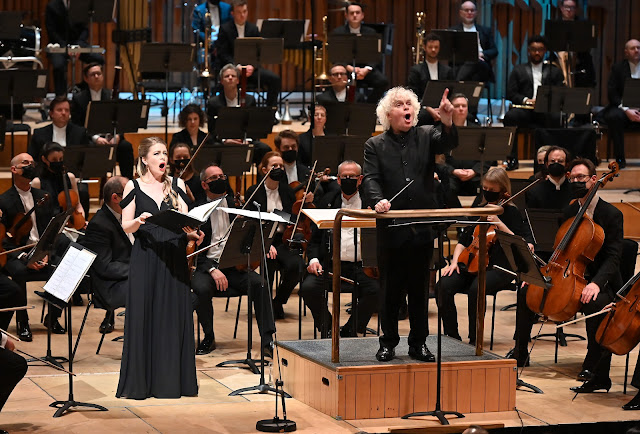
Two or three weeks ago, it did not seem especially likely this concert would happen. It did—and very well it went too. To hear as large an orchestra as that fielded by the LSO here under Simon Rattle remains unusual during our current troubles. We now perhaps ascribe greater worth to every artistic and social occasion, all too well aware of general precarity. I certainly relished the sheer richness of orchestral sound, the unquestionable commitment from all on stage and (London Symphony Chorus) up in the balcony, and something close to a full house for an appreciative audience.

It seems that Julian Anderson’s Exiles has, one way or another, been a victim of the dread virus. Two of its five movements were given by the LSO and Rattle in September; here they were joined by ‘La République des Lettres’ for soprano and a cappella chorus, then impossible to perform. When the final two will come is unclear, yet on the basis of this ‘Suite’ and its reception, they will be eagerly awaited by many. The new movement—to the world, that is; all were new to me—pays tribute to the American diplomat Varian Fry who assisted many under threat from Nazism into exile. Here, several of them are named, from Bohislav Martinů via Darius and Madeleine Milhaud and Betsy Jolas to the Hungarian animal photographer Ylla (Camilla Koffler). That was the work of half the chorus, initially syllabic, though not in a ‘difficult’, Nono- or Lachenmann-like way. The other sang from Psalm 46: ‘God is our hope and strength: a very present help in trouble…’. Dialogue between soprano Siobhan Stagg and choir added to the responsorial sense. If the writing were largely homophonic, there was a splendid, again psalm-like freedom to its metre, Rattle finely shaping an heroic performance from all.

First we had heard ‘le 3 mai’, Anderson’s setting of an e-mail from the Moroccan-French composer Ahmed Essyad to other composers from 3 May 2020, telling of his coronavirus isolation and nonetheless greeting them: ‘internal’ exile. The soprano I head first, followed by orchestral sounds that to me evoked a sense of electronic communication—latterly both bane and saviour of our lives. Anderson’s orchestration here and later proved typically ‘French’ in sonority, bells perhaps evoking an inheritance from Messiaen as well as Debussy and Ravel. The darker turn taken upon ‘Je vous embrasse tous,’ leading to climax at the end of the same line of the text, ‘sans covid’, repeated, would doubtless have moved irrespective of the words set; however, we heard it with them, and could hardly fail to think ‘if only’. The sign off ‘Ahmed’ returned us to the exile of electronic communication. 

‘Tsyion’, heard last, sets for chorus words from Psalm 137, the Jews in Babylonian exile, by those famous waters, and from Horatiu Rădalescu on that archetypal exile Ulysses, whilst the soprano sang other words above, from Rădalescu on ‘Exile’ itself. Stagg’s exultant melismata again provoked memories of Messiaen, but Anderson’s music throughout offered a compelling harmonic language and, more broadly, combination of that with melody, rhythm, and timbre never to be reduced to mere ‘influence’ or parallels. Solo horn at one point seemed to encapsulate the wistfulness of exile; there was more to it than that, though. Anderson’s fantastical imagination suggested to me opportunity and, at the close, through a mass of solo violins, a secularised chorus of birds. There is hope out there, as Essyad realised in contemplating a mountain he could not yet visit.

Next up was the discarded ‘Blumine’ movement from Mahler’s First Symphony. There could be no doubting the composer via sentiment or language, nor the specific identity of the Mahler of that symphony, though in many ways it sounded, quite rightly, earlier still: late Romantic rather than modernist, even ‘late early Romantic, Mendelssohn as well as Wagner apparent, Mahler taking his leave from the world of Das klagende Lied. Rattle had Mahler’s song sung with simplicity, never audibly moulded as has seemed the case with much of his more recent Mahler. There was darkness, but only moments of darkness in a fine, unexaggerated performance. And what it was to hear both the excellent solo trumpet and a full LSO at the movement’s climax. This was truly affecting music-making, all the way to a magical final harp chord.


The scherzo from the E major symphony of Mahler’s friend Hans Rott received here an outstanding, spacious, altogether generous performance, whetting the appetite for what one must hope will one day be a performance of the whole work. One need not be starry-eyed about it, as some are, to recognise its music, anticipations of Mahler and all (any ass can see that…) as intrinsically worthy of listening. The LSO’s sound hovered, like Rott’s music, somewhere between Bruckner and Mahler, with a little Berlioz at times too, not least in its trippiness. A sort of deranged jollity with disquieting echoes fascinates; and if sureness of direction is not altogether Rott’s thing, his music’s sheer originality offered something quite compelling both as work and performance. 

With Webern’s op.6 Orchestral Pieces we are in different territory: one of the supreme masterpieces of twentieth-century orchestral music. Rattle and the LSO offered them as the repertoire pieces they demand to be: without apology and through intimate knowledge and understanding. Free choice might not lead one naturally to the 1928 revision, but its smaller forces doubtless enabled the work to be performed at all. Heard after that first half of Anderson, Mahler, and Rott, the first movement’s lyricism emerged all the lovelier and more longing. Rattle ensured here and throughout a balance that invited comparison with conductors such as Abbado and Boulez. In this narrative, crucially, every note counted for a multitude in so much other music. The second movement’s response sounded as inevitable as I can recall, in a vision less haunted than propelled by anger, fear, violence, and yes, wonder. Longing was intensified in the third piece, here sounding intriguingly close to Berg. The German Sehnsucht came to mind. Ominous tread and progress through the funeral march fourth encapsulated a Mahlerian world in itself. Music lay between the notes as well as in them, in a requiem of defiant hope whose roaring climax duly shattered. Heard in aftershock, the fifth seemed to say, stealing from the future of Webern’s teacher Schoenberg’s Piano Concerto, that life must go on. It witnessed yet sparkled. And what expressive depth we heard in the closing ‘Langsam’ movement, each chord speaking as if it were a page or two at least of Mahler.


It is doubtless too easy to speak of performing Dvořák via Webern, but it was difficult, at least at times, not to hear it that way. An aural lens of motivic concision and well-nigh Schubertian melodic profusion did no harm at all to its opening ‘Allegro maestoso’. I was fascinated to hear the LSO strings sound more ‘old German’, akin to Daniel Barenboim’s Staatskapelle Berlin, than I ever heard the Berlin Philharmonic under Rattle. It worked, in any case, as the LSO really dug into Dvořák’s score. A purposeful yet flexible account of this first movement was far from deaf to the beauties and meaning of detail, yet integrated them rather than having them stand out. Here, again, music lay between as well as in the notes. The slow movement was taken slowly, surely more than the ‘poco’ of the composer’s ‘Adagio’ marking; a somewhat Tchaikovskian performance nevertheless worked well on its own terms. Rattle loved it doubtless, but not, I think, too much. There were rhetorical underlinings, yet they worked to shape a musical drama. The scherzo flowed via, rather than despite, its engineered tensions, metrical and more. Its trio was, I felt, moulded a little too much. Likewise the finale: impassioned, yes, but not always clear where it was going. That said, Rattle’s conception of something akin to an enigmatic tone poem in its own right had much to be said for it. His remains a questing musical imagination, as seen in programming and heard in performance.


Friday, 27 October 2017

Aimard - Anderson, Benjamin, Ligeti, Kurtág, Stroppa, Carter, and Messiaen, 26 October 2017


Pierre Boulez Saal

Julian Anderson: Sensation (2015-16): ‘Toucher’
George Benjamin: Shadowlines: ‘Tempestoso’ and ‘Very freely’ (2001)
Ligeti: Études: ‘Der Zauberlehrling’ and ‘Entrelacs’ (1994, 1993)
Kurtág: Játékok: ‘Passio sine nomine’ (2015)
Marco Stroppa: Miniatura estrose (1991-2001): ‘Passacaglia canonical in contrappunto policromatico’
Carter: Caténaires (2006)
Messiaen: Catalogue d’oiseaux: ‘La Rousserolle effarvatte’ (1958)

Pierre-Laurent Aimard (piano)


If it would be an exaggeration to describe this as a recital of music that ‘belonged’ to Pierre-Laurent Aimard – music, surely, belongs to us all – then it would be a pardonable exaggeration, whose purpose and meaning were clear. Here were pieces, mostly drawn from larger works or collections, with which Aimard has a particular connection, and with which he could – and did – speak not only with great authority but with eminently thoughtful musicality. Nothing was taken for granted; indeed, the music spoke both with the freshness of the new and the understanding of a grounded repertoire.


I wish I could feel the enthusiasm so many friends, colleagues, fellow musicians and music-lovers clearly feel for the music of Julian Anderson. That includes, clearly, Aimard, who gave the premiere of Sensation at Aldeburgh last year, and here extracted from it, in what he believed to be its German premiere, the second movement, ‘Toucher’. I have never actively disliked any of Anderson’s music, but rarely have I discerned much beneath an often attractive surface. Perhaps that is the point; I am not so sure. At any rate, this piece, conceived, in Anderson’s words, ‘with particular emphasis on the French tradition of the jeu perlé – playing of great lightness, speed and clarity – of which Pierre-Laurent Aimard … is such a brilliant exponent,’ made for an impressive pianistic opening. It sounded as if conceived more or less in a single, dare I say melodic, line, with certain additions or elucidations, often chordal, around it. The chords certainly sounded very ‘French’, Messiaen in particular coming to mind in some of the harmonies.
 

George Benjamin’s Shadowlines, from which we heard here the fourth and fifth movements, followed: another work of which Aimard had given the first performance. This emerged very much as a re-examination, more to my taste, even perhaps to my understanding, of canonical procedures, thereby offering our ears and minds as much vertically as horizontally. It seemed, in performance as well as in the work ‘itself’, that not only had polyphony been reinstated, but so too had its typical dialectic between freedom and organisation. Or perhaps that is just someone speaking who has been spending too much time with Schoenberg recently. At any rate, the piano writing (and playing) had an intriguing sense of the Germanic too it as well: far from exclusive, or even predominant, but unmistakeable, at least to these ears. Aimard clearly relished its complexities; so too did I.
 

Aimard’s collaboration with Ligeti verges upon the ‘legendary’: (not, of course, in the sense that it did not happen!) Aimard gave the premieres of many of the composer’s later piano works, these two Études included. What immediately struck me, both in no.10, ‘The Sorcerer’s Apprentice’, and no.12, ‘Entrelacs’, was the ‘finish’ to what we heard, again both as work and as performance. This, one felt, was a mastery, compositional and performative, worthy of, say, Ravel. If the first offered something of a connection to the Anderson piece, its emphasis perhaps in a broad sense ‘melodic’, the metrical transformations and layering of ‘Entrelacs’ seemed both to speak of kinship with and difference from Elliott Carter (still to come). The energy was impossible to resist – and why on earth would one try?
 

I suspect that, by now, you can guess who gave the 2015 first performance of Kurtág’s ‘Passio sine nomine’, from his compendious Játékok. He seemed to do it proud again here in Berlin. I was especially struck by a certain obstinacy, an almost religious truculence – although was that a thought elicited by the title? – a Credio quia absurdum, both to the material and to the performance. All that Bach the Kurtágs have played sounded with something I am tempted to call immanence.
 

Aimard gave the premiere of Marco Stroppa’s Miniature estrose in 1995; a second premiere, of the completed version, was given by Florian Hölscher in 2000. Here, Aimard’s performance of the ‘Passacaglia canonical in contrappunto policocromatico’ seemed very much to make use of the Pierre Boulez Saal – there, of course, is another composer to whom Aimard could hardly have stood closer! – as an instrument in itself. (How very different it must have sounded in that premiere at the Opéra Bastille!) The almost whispered intimacies and indeed the entire dynamic range sounded very much a product of the hall as well as of the keyboard. So too did their interaction with other parameters, and with other, more malleable aspects of the music. The sheer beauty of work and performance shone through.
 

Ever youthful, the work of Carter ended the first ‘half’; here we heard the composer at 102. In Caténaires, we heard once again consummate mastery. I thought of Ligeti’s ‘Sorcerer’s Apprentice’, and perceived – if sometimes only just – a penumbra of polyphonic possibilities surrounding what is, for Carter, as Aimard explained, an unusually un-polyphonic work. The composer indeed spoke of having ‘become obsessed with the idea of a fast one-line piece with no chords’. Was it perverse for me to have heard it that way? Perhaps, but nevertheless I did. Truly, though, its energy sounded as music for the age of computers, even of the Internet.
 

Aimard did not, of course, give the first performance of Messiaen’s Catalogue d’oiseaux; Yvonne Loriod did, in one of Boulez’s Domaine musical concerts. His association with all concerned, however, is strong and deep, and so it sounded here. Aimard’s recording of the complete work will be released next year. This performance of the vast ‘La Rousserolle effarvatte’ (‘The Reed Warbler’), at about half an hour, offered quite the calling card. More than that, it seemed, whether this were the illusion of performance and programming or something more, to unite and indeed to develop many of the tendencies we had heard earlier, whilst remaining of course very much itself. No one else could have written this music! The opening, as much for the different sonorities heard simultaneously as for their pitches, sounded as if performed with three hands. Admittedly, I could not see the keyboard, but I am reasonably sure that it was not. Through the violent eruptions, the silences (what silences!), the different colours (whether one actually ‘sees’ them or no), the luscious harmonies, the obstinate rhythms, the undeniable religious mysticism, and of course the birdsong, both a singularity of voice and a multiplicity of voices seemed to assert themselves – and to express a joy in being, in music-making that penetrated to the essence of Messiaen’s art. Everything sounded refracted through, not just related to but derived from, everything else. Perhaps ‘total serialism’ had not passed after all; it had simply, or not so simply, reinvented itself.


Sunday, 4 May 2014

Julian Anderson: Thebans (world premiere), English National Opera, 3 May 2014


Coliseum

Oedipus – Roland Wood
Creon – Peter Hoare
Tiresias – Matthew Best
Jocasta – Susan Bickley
Stranger from Corinth, Haemon – Anthony Gregory
Shepherd – Paul Sheehan
Messenger, Theseus – Christopher Ainslie
Antigone – Julia Sporsén
Polynices – Jonathan McGovern
Eteocles – Matt Casey

Pierre Audi (director)
Tom Pye (set designs)
Christof Hetzer (costumes)
Jean Kalman (lighting)
Lysander Ashton (video designs)

Chorus of the English National Opera (chorus master: Dominic Peckham)
Orchestra of the English National Opera
Edward Gardner (conductor)


There can be no doubting the ambition to this, Julian Anderson’s first opera, with a libretto ‘by Frank McGuinness after Sophocles’. Its three acts adapt not just one play from Sophocles’s Theban trilogy, but all three. Starting in the past – as the opening curtain informs us – the first act entitled ‘The Fall of Oedipus’, we move to the future, ‘Antigone’, before concluding with the present, ‘The Death of Oedipus’. Initially, I found myself sceptical about the reordering, wondering what lay behind it other than a desire to be different; however, when the third act came, I felt the sense – prior to reading these words from Anderson, in an eloquent programme note – that the act was ‘all about endings … the mysterious, timeless atmosphere of this sacred wood’ at Colonus lending ‘a special and quite different mood … which would be impossible to place anywhere but at the end’. There did indeed seem to be a finality arising from subject matter and treatment, perhaps even from Sophocles having written it last.


McGuinness’s libretto is in many respects highly skilful; it packs a great deal in, without necessarily seeming to do so, not least in sometimes lengthy passages of narrative. There is what we might consider to be real poetry in it, though sometimes there are clichéd phrases – ‘done and dusted’, for instance – which seem in context slightly to jar rather than carrying knowing weight. Perhaps, though, I simply misunderstood, and the task of writing words intended to be sung, whilst at the same time not knowing what the music will be, is not an easy one.  I was not entirely convinced by the suddenness of the ending, whether in terms of words or music. Antigone was seemingly cut off in mid flow, shortly after the strangely anti-climactic death of her father: that anti-climax more a product, I think, of the music’s tailing off than the libretto. It was, however, clearly intended as such, Anderson claiming that there ‘are no clear answers’ in Sophocles, McGuinness, or his own contribution. Perhaps, again, more would become apparent upon a second hearing. At any rate, the Lear-like quality to this scene came across with considerable power, not only in terms of Antigone’s faithful love, but also the haunting by death. I can imagine it being objected that this is as much drama 'about' drama as the thing itself, but in practice, the telescoping, the selection of particular points in time, and the enabling of those points to encompass more of the action, works well. In any case, the Theban plays are so much part of our collective consciousness, that we do not always have to start from the very beginning.
 

Anderson’s own contribution proved, for me at least, more variable. His writing is, it hardly need be said, highly accomplished, the composer’s virtuosic command of the orchestra never in doubt. The first act in particular meanders. Perhaps one might claim that to be the point; but whilst timings in the programme put it at the length of the second and third acts combined, it seemed, if anything, longer still. Although those latter acts are tauter, even there I found it difficult to discern an individual voice. It is certainly not a ‘difficult’ work; a great deal of the musical language is tonal in quality, not necessarily a problem, but is it perhaps a problem that much of it sounds as if it might have been written by a Stravinsky imitator not so very much less than a century ago? At any rate, the contrast, however unfair, with the blazing originality of Œdipus Rex, is not a little glaring. Maybe composers feel that the time for problematisation of opera is over; if so, on this evidence, it is not entirely clear that they are right to do so.
 

That said, there are interesting touches and, indeed, rather more than that. Microtonal sliding, for instance, disrupts or at least questions the otherwise stultifying metrical regularity – clearly a deliberate choice – in Creon’s Act II police state, as well as responding to the narrative we hear introduced from outside. Tiresias’s otherworldly strangeness registers not only in his gender-bending scenic portrayal, but also in the alterity of his tuning. Indeed, in some respects, his prophetic truth and its musical portrayal seem to haunt the third act all the more, when he is not even present on stage; I have no reason to think that such a comparison were intended, but I was put in mind of the overpowering presence of Wotan in Götterdämmerung. At any rate, Anderson’s portrayal of ‘everything – including Oedipus himself – gradually becoming part of nature and leaving civilisation altogether’ is impressively achieved. I had the sense that if the findings of the second and third acts had been read back into a revised version of the first, a tauter, more integrated, structure might well have emerged.
 

Edward Gardner seemed, insofar as it is possible to tell with a work one does not know, to conduct a splendidly authoritative performance, rhythms razor-sharp, layerings of colour ever-discernible. The ENO Orchestra deserves the strongest of plaudits in that respect too. Similarly the chorus, which plays an important role throughout, whether seen, as in the first two acts, or unseen, as in the third, its ambiguous offstage identity – does, for instance, Oedipus imagine the gods, or are they all-too-divine? – a clear dramatic advantage. Dominic Peckham’s choral training clearly paid off as well as Pierre Audi’s onstage blocking; there was a true sense of identity and credibility, both corporate and, especially in the first act, individual.
 

Audi’s staging does its job very well. There is a proper sense of place to each of the three acts, even if the jackbooted totalitarianism of Creon’s state arguably errs on the side of predictability. (Perhaps, though, that is the fault of the work as much as the staging.) Lighting from Jean Kalman sets off the relatively simple yet powerful work of the design team (Tom Pye’s sets and Christof Hetzer’s costumes) to excellent effect. Composer and librettist could hardly have asked for more for a premiere.
 

The cast acquitted itself with honour too. Despite having fallen victim to a throat infection, Roland Wood offered a tirelessly committed performance as Oedipus, his acquisition of wisdom genuinely affecting. Peter Hoare’s Creon was properly nasty, an excellent foil for the humanity of Julia Sporsén’s Antigone. (Here I could not help but think of Wagner’s analysis of the myth in Oper und Drama, Creon’s state falling victim to the anarchistic love-curse of this progenitor of Brünnhilde.) Susan Bickley’s Jocasta was as well sung and acted as expected, leaving one wishing that she had more to do. Christopher Ainslie, having previously appeared as the Messenger, truly came into his own as the third act Theseus, the purity of his counter-tenor voice as startling in its liminality as his bronzed appearance, the latter a clever stroke indeed from the production team. Matthew Best startled in quite very different way as a deep-voiced transsexual Tiresias: insistent, impatient, and defiantly ‘different’.
 

ENO, then, should be congratulated upon its efforts. With the best will in the world, it would be difficult to speak of this opera in the same breath as works by Benjamin or Birtwistle. By the same token, when one recalls in horror the latest offerings from Judith Weir and Mark-Anthony Turnage – whatever happened to the composer of the visceral Greek? – the contrast is equally apparent. A new work requires excellence in staging and performance; that it certainly received.  
 

Sunday, 8 August 2010

Prom 29: NYO/Bychkov - Dukas, Anderson, and Berlioz, 7 August 2010

Royal Albert Hall

Dukas – L’apprenti sorcier
Julian Anderson – Fantasias
Berlioz – Symphonie fantastique, op.14

National Youth Orchestra of Great Britain
Semyon Bychkov (conductor)

I have never heard a mediocre, let alone poor, performance from the National Youth Orchestra; this Prom would be no exception. Under Semyon Bychkov, of whom we have recently, welcomely, been hearing rather more in this country, these young musicians played their hearts out, in a programme of three orchestral showpieces, which, in two cases out of three, where shown to be much more than showpieces. First was The Sorcerer’s Apprentice. From the opening bars, it was imbued with a magic that made it sound as if minted anew. Ravel came to mind – but then, it should really be the other way around. Sharpness of attack and, on occasion, proto-impressionist haze worked together to provide a sharply characterised account. What a joy it was to hear such a large orchestra too, one that worked with the Royal Albert Hall, rather than performing as usual and leaving the listener to pretend that he were hearing with other ears. Seven trombones, here and elsewhere, did the trick wonderfully, likewise the depth and gloss – not an ugly word, whatever Karajan-deniers might tell you – of strings.

Next came the London premiere of Julian Anderson’s Fantasias (2007-9), written for the Cleveland Orchestra. I cannot imagine that even that mighty orchestra would have given a better account than the NYO did. Whether it was worth the effort is another matter. If one wanted a piece of modern, albeit relatively conservative, orchestration to study, one could do worse, but again and again I kept asking what lay behind the orchestration; if one wanted ‘orchestra without music’, someone else, already mentioned, did it rather better. The first of five ‘fantasias’ opens arrestingly, for brass alone, and the NYO brass is spectacular indeed. Anderson describes it as ‘very polyphonic’: a somewhat odd qualifier, ‘very’, but never mind. The debt to Stravinsky is obvious from the word go, but the Russian master’s economy of means seems to elude Anderson. Doubtless taxing and enjoyable to play, this is somewhat prolix. Wonder of wonders, though, and this would be maintained throughout the evening: no applause between movements. The second fantasia seems most concerned with orchestral colour. String pizzicato playing was beyond reproach, likewise general orchestral keenness of response. However, the outstanding nature of the percussion playing only served to highlight the watered-down proximity to writing in Boulez’s Notation II: superficially similar, but without the distinction of material and transformation. The NYO’s depth of string tone served the third piece well; so did the superlative flute-playing of Joshua Batty, whom I admired in the NYO’s Debussy a little while ago. Messiaenesque writing hinted both at chorale and birdsong. I later read that this ‘nocturne … was partly suggested by the image of a rainforest and its acoustic’. That seemed merely to consist in a cultural imperialism that took a few sounds and ‘ethnic’ rhythms as emblematic of a culture that in no way seemed truly to inform the music. Occidentalism, perhaps? There was a glittering climax in performance to the third part of this fantasia, again wonderfully performed, before subsiding into more birdsong and vaguely ‘jungle’-like noises, but to what end? The fourth fantasia, scherzo-like, brings more of the same, only sped up. (Be grateful for small mercies!) Mid-period Stravinskian syncopation was dealt with very well by the performers. Co-leader, Rosemary Hinton performed her solo exquisitely. The final fantasia once again brought water-down reminiscences of that Boulez Notation, along with faint reminders of Janáček, without the individuality. It outstayed its welcome, like much of the rest, but gave the NYO players ample opportunity to display their virtuosity.

With the Symphonie fantastique we returned, of course, to compositional mastery. For once, moreover we had an orchestra a little closer to the size Berlioz desired: not quite there, of course, but closer than most – and it told. (Note a typical hypocrisy – inconsistency, if we are to be charitable – on the part of the authenticke brigade here.) The opening of the first movement, like that of the Dukas, brought sonorous magic – this despite the insistent presence of someone apparently in advanced stages of consumption, who seemed to infect others with terrifying rapidity. The main tempo of the first movement proper, once past the introduction, sounded on the fast side, but Bychkov proved eminently flexible, imparting that all-important nervous energy to Berlioz’s vision. This Berlioz was perhaps more excitable than the more Classical conception of Sir Colin Davis, but this standpoint is perfectly valid in its Romanticism. An especially beautiful oboe solo (Julian Scott) should be noted. Le bal went with a swing – and an equally ravishing flute solo, again from Joshua Batty. A mediocre performance of the Scène aux champs will inevitably lead one’s mind to wander: no such problem here, for I was gripped from beginning to end. Bychkov showed a fine command of line, melodic and harmonic, whilst his players excelled themselves. A suave melody from the cello section was worthy of especial mention, likewise a splendid clarinet solo from Oliver Pashley. Indeed, all the woodwind players were truly excellent. The climax was finely shaped, not overdone, the movement as a whole leisurely, but always moving. Character and discipline vitally informed the march to the scaffold, the NYO brass simply magnificent: quality and quantity, just as Berlioz wished. A mobile telephone disrupted the early bars of the finale, but this proved a welcome opportunity for the brass to obliterate this most unwelcome ‘interactivity’ – as our modish commentators would have it. There was some splendidly characterised woodwind playing: grotesque in the best way, as was the added heft of the string section, which also served to underline the oft-overlooked symphonic stature of Berlioz’s achievement. Off-stage bells and their echo were duly credible, indeed atmospheric , whilst the final brass Dies irae proved truly resplendent, surrounded by diabolical orchestral madness. The rollicking conclusion provided a fitting climax to a fine concert.