Showing posts with label Thomas Blondelle. Show all posts

Wednesday, 8 July 2026

Pelléas et Mélisande, Staatsoper Unter den Linden, 3 July 2026


Images: Tatjana Dachsel (from an earlier revival, with a different cast)


Golaud – Simon Keenlyside
Mélisande – Magdalena Kožená
Pelléas – Thomas Blondelle
Geneviève – Anne Sofie von Otter
Arkel – Stephen Milling
Yniold – Henrik Brandstetter
Doctor, Shepherd – David Oštrek

Director – Ruth Berghaus
Revival director – Katharina Lang
Designs – Hartmut Meyer

Staatsopernchor Berlin (chorus director: Dani Juris)
Staatskapelle Berlin
François-Xavier Roth (conductor)


When, all too briefly, I lived in Berlin Mitte, I would regularly take a short walk, often mid-afternoon, to the Dorotheenstädtischer Friedhof. Taking their place in the firmament of great Berliners buried there, from Fichte and Hegel onwards, are Ruth Berghaus and Paul Dessau, director and composer in a properly Brechtian line. (From the house next to the cemetery, Brecht looked down at the graves of his predecessors, later joining them, and being joined by Helene Weigel.) It is little exaggeration to say that Berghaus saved the Berliner Ensemble from the mortmain of Brecht’s heirs, only to be replaced with their connivance and that of the ruling Socialist Unity Party. Berghaus’s most celebrated or at least most concentrated work in opera followed that period, when she worked with Michael Gielen in the 1980s at the Frankfurt Opera. Sadly, almost nothing of her opera work survives on film, but three or four productions remain in the repertoire: this Berlin Pelléas et Mélisande, her delightful Barber of Seville (also Berlin), Tristan und Isolde (Hamburg), and possibly Elektra (Mannheim).

The Pelléas was seen first in 1991, conducted by none other than Gielen; subsequent conductors have included Daniel Barenboim, Simon Rattle, and now François-Xavier Roth. This was its forty-third appearance performance at the Staatsoper: perhaps less than one might expect for so enduring a staging – compare that with over 350 for the Barber – but then the subtlety, depth, and absolute refusal to play to the gallery of Debussy’s opera have never appealed to sections of the operatic masses. (I once heard someone dismiss it as ‘boring’.) So much the worse for them. If they would not have been converted by this, then I suspect it would ever elude them; after all, we all have blind (deaf?) spots. The only sense in which Berghaus’s staging seems a little dated is perhaps in aspects of Hartmut Meyer’s designs: on reflection, not so much ‘dated’ as not quite of our time. Had I looked at them innocently, I might have guessed early twenty-first century rather than 1991. But they still function with great power as part of a musicodramatic whole, as if Roth and his cast had been involved from the outset: an astonishing achievement, when you think about it.


Like her fellow directors Harry Kupfer (now also in the Dorotheenstädtischer Friedhof), Götz Friedrich (across the city in Zehlendorf), and Joachim Herz (in Leipzig, as one might expect), Berghaus was a student of that great adoptive Berliner Walter Felsenstein (miles away at Kloser, on the Baltic island of Hiddensee). They may have departed from Felsenstein in post-Brechtian interpretation, but they all built upon his equal concern for musical and dramatic elements (insofar as they may be separated at all). It is perhaps no coincidence that their stagings, where they survive, have often proved especially enduring. Or perhaps it is, for the sell-by-date of a staging stands in a complex relationship to its initial qualities. Nothing, ultimately, is forever—and some wonderful things can prove ultimately ephemeral.


Not this, in any case—and there must surely be something in the production, as well as in the intelligence and craft of those reviving it, that enables such integrated results even now. One certainly notices the stark colours, quasi-abstract yet never cold, from the outset, and one soon becomes emotionally and intellectually involved in the Allemonde they create. The lighting, for whom I can find no one directly credited, is at least as important and, if anything, still more powerful. The shadows it creates are terrifying, and all will attest to the dramatic role, literal and metaphorical, of shadow worlds in this opera. The near-stratospherically vertiginuous staircase, representing Mélisande’s tower far more directly than any more realistic attempt I have seen, provides sceno-dramatic focus for so much and offers terror of its own. Much is invested in every walk up and down, every place and occasion to take a seat, and the rest. Likewise Yniold’s ball: a childish toy, an object of motion, and something to follow Mélisande’s ring into the menacing well. Her deliberate, not careless, tossing of that ring early on into those depths offers a rare, momentary instance of lightness, even humour, albeit set within the ever-ominous, increasingly terrifying workings of Fate. 

Costumes and their apparent meaning, or at least amenability to be read, play intriguing balancing acts: a hint, perhaps of the Brechtian commedia dell’arte we know from Berliner Ensemble and Barber alike, but turned both early-French and symbolist. At times, Pelléas and Golaud appear almost interchangeable; at others, characters and situations win through and make their similar costumes irrelevant. The role of letters, their reading, and their consequences, becomes more concrete when they appear in large form, passed from character to character, and at times pinned on the wall (again, perhaps a Brechtian inheritance, but one transformed by another great artist at work). There is a strong feminist element too: Golaud’s rape of Mélisande horrifying, her pregnancy almost intolerably vivid (without male-gaze exploitation); and at least as disturbing as anything else, Arkel’s pursuit and lying with her, founded in the text but extended with well-nigh perfect directorial judgement.


The Staatskapelle Berlin has long experience of Debussy under Barenboim in particular. Roth’s reading brought similar structural virtues and alertness to colour, the later inevitably of a somewhat different nature, founded in his work with period instruments on this work. Wisely, there was no attempt merely to replicate that; we can all do without ever hearing ‘period style on modern instruments’ ever again. But that does not mean music-making, like theatre, cannot, or should not, be in a more intelligent sense ‘historically informed’. Timbre here played as important a structural role as anything else, pointing the way forward to Boulez, as malevolent harmonies, their progression, dramatic implication, and structural role led back to multiple Wagner dramas. Throughout the playing of the Staatskapelle was at least as outstanding as one could hope to hear anywhere.


Simon Keenlyside made the transition from Pelléas to Golaud a while ago, and continues to excel in this music and its drama (or should it be the other way around?) His triangle with Thomas Blondelle and Magdalena Kožená was as credible, revealing, and terrifying as any I can recall. Blondelle may have been indisposed, yet his Pelléas was fresh, alert, vivid and, listening between the lines, doomed. Kožená’s typically intelligent artistry, founded in profound communicative gifts, not least in French, proved almost horrifyingly moving. Anne Sofie von Otter’s Geneviève presided with similar intelligence—and perhaps the occasional hint of her youth and its travails. Stephen Milling’s Arkel was subtly yet powerfully sketched: a fascinating, compelling move from Hunding. No wonder Henrik Brandstetter’s Yniold received such warm and vigorous applause; so excellent was this performance from a soloist of the Tölzer Knabenchor, I confess I thought he must have been an adult singer successfully aping a treble. Even the small roles of Doctor and Shepherd were memorably assumed by David Oštrek.


This, then, was a highly moving and thought-provoking night in the theatre: in itself and for the questions it posed about stagings and their aesthetics, lineage, and longevity. I must try to see that Hamburg Tristan before it is too late.

Sunday, 12 May 2024

Das Rheingold, Deutsche Oper, 11 May 2024

Images: Bernd Uhlig (from 2021 premiere)


Wotan – Iain Paterson
Donner – Thomas Lehman
Froh – Attilio Glaser
Loge – Thomas Blondelle
Fricka – Annika Schlicht
Freia – Flurina Stucki
Erda – Lindsay Ammann
Alberich – Jordan Shanahan
Mime – Ya-Chung Huang
Fasolt – Albert Pesendorfer
Fafner – Tobias Kehrer
Woglinde – Lee-ann Dunbar
Wellgunde – Arianna Manganello
Floßhilde – Karis Tucker

Director – Stefan Herheim
Revival director – Constanze Wediknecht
Set designs – Stefan Herheim, Silke Bauer
Costumes – Uta Heiseke
Lighting – Ulrich Niepel
Video – Torge Møller
Dramaturgy – Alexander Meier-Dörzenbach, Jörg Königsdorf

Orchestra of the Deutsche Oper
Nicholas Carter (conductor)


We begin in the rehearsal room, piano onstage, vast grey slab wall and fire exit behind, lights above. Below, the orchestra tunes, actually tunes. The magic of theatre, of music theatre, of opera, and of all concerned to bring it to our eyes and ears brings the two together: not necessarily so we cannot tell the difference between ‘drama’ and ‘reality’, but so that we are made aware of the ever-shifting boundaries between them, how one brings the other into being, as is also the case for Wagner’s related yet different trinity of drama, music, and gesture in Opera and Drama. That ‘book of all books on music’ (Richard Strauss) is, in a sense, the fount of all we see and hear; onstage, it is represented by the piano: the instrument around which so many rehearsals have taken place and at which Wagner sat to compose; from which for many, though not all composers, the miracles of the modern orchestra first come into being. A suitcase-laden procession of refugees, the perennial image of our times – from the vicious, racist ‘swarm’ of Cameron and Farage’s ‘breaking point’, to Merkel’s inspirational ‘Wir schaffen das’ and the welcoming crowds I saw at Munich Hauptbahnhof – crosses the stage and initiates the action, one of them, Wotan or better the human being who will play that role, plays the celebrated E-flat with which the Ring begins. This is no ‘crisis’; it is a reality and, in that reality, an opportunity. These people are the very stuff of the drama, of our drama, and of theirs. Decisions made and roles played will be matters of life and death. How differently this plays now that Merkel’s Willkommenskultur has itself been assigned to history, how all the more necessary then it is to find a new path. 


Herheim and his revival successors do this, moreover, not through dwelling on origins, but through the brazenly theatrical (and musical) magic of opera. Reality never quite disappears, but the insight of Schiller, Marx, and many others, Wagner included, that, left to his own devices, given the freedom and the education to do so, man will create is not only the starting point, but a point, if you will, of (Nietzschean, even Schopenhauerian) eternal recurrence that yet, through (Hegelian) history, is never merely that. The animating philosophical conflict of the Ring has begun. Likewise, animating joy in and through theatre, of the rehearsal piano rather than the piano composer, of Wagner’s creative life has been reignited, through Rhinemaidens’ magic tricks, Loge’s devilish flashes of fire, ever-resourceful use and reuse of stage staples such as billowing sheets, and the whole Wagnerian phantasmagoria of sight, sound, and sensation. Froh’s final rainbow is surely, at some level, a successor to Götz Friedrich’s rainbow tunnel in the previous Deutsche Oper production. History and, more specifically, reception both form and liberate us in our response. 

The first scene emerges, in typical, theatrical twin bind and opportunity, both seamlessly and with seams openly to show from what has gone before. The Deutsche Oper’s actors – ‘extras’ if you prefer, but the term seems more than unduly limiting – form the Rhine from themselves: what else do refugees have? They have their packed belongings, of course; still more will come from them in due course, the gods’ costumes included. Inciting, reflecting, and been incited by the Rhinemaidens’ play, their beautifully, sexily choreographed movement suggests a Venusberg-am-Rhein, with all the occasional awkwardness of an orgy’s need for perpetual reignition. Alberich, or the person who becomes him, models himself on that saddest of theatrical figures, the clown. That is how the others see him, of course; most poignantly of all, it is how he sees himself when they hand him back his mirror. He has, as Wagner shows us, been so sorely provoked, with so little prospect of reward in a cruel non-golden age of aesthetic hedonism, that renunciation of ‘love’ – as someone once said, ‘whatever that means’ – is an obvious next step. The ring he creates seems immediately to do his bidding—until, and ay, there’s the Ring’s rub, it does not. And we see it, as well as its consequences, throughout. 


From those sheets come the Rhine, the mountains of the gods’ realm, even the tree at the end from which, I assume, the next instalment will spring. A premonition of Volsung twins strongly suggests so: a sparing use of video and thereby all the more powerful. The whole Bayreuth project was built on technology, as was the world from which it sprang. So too were they built on choices of what to use and when, not on idiotic euphoria and fear about film supplanting theatre or ‘artificial intelligence’ supplanting actual, human intelligence. The hoard, perhaps the best I have seen, comes from those suitcases: a true bric-a-brac show, including musical instruments (echoing, almost literally, Alberich’s possession and instrumental use of a trumpet in the first scene) and religious artefacts, cross and menorah included. 

They cover Freia clumsily, brutally, yet also completely inside the piano from which she and Fricka, in posed nineteenth-century tableau vivant-style have risen, and through which portal she and the giants (her love for Fasolt is movingly real, as it should be) have passed to and from Riesenheim. Donner and Froh are splendidly caught too, stars of rock (Freddie Mercury) and disco (wig carefully prepared with hairspray, soon lost) respectively. Loge is a true Mephisto to two Fausts, Wotan and Alberich, with a little – in this he is not alone – though never too much of previous Herheim creations, the Parsifal Klingsor and the Lohengrin Herald reincarnated in something dazzlingly new. Alberich’s Nibelungs are, for once, a true host of night, terrifying to behold, images of death and the undead, marching to his lead. (Again, I recalled, a brief yet telling image from the second act of that Bayreuth Parsifal.) Indeed, throughout, the ways in which movement proceeds both in time to the music and not, yet never heedless to it, are not the least indication that we are in the hands of a musical stage director. Attempts at musical direction, both from the piano and conducting from the score, of the would-be leaders of our stage world, tell – and play – their own stories too. 


Art and its tricks, then and now, are not reality; they spring from it, yet we see, far more clearly how they are put together, whilst wondering all the more at them. They are more than reality; again, they form and react to it, at least potentially liberating us from it. And they cross history, through an artwork’s reception, always a joy for and from Herheim. Wotan’s winged helmet for once says much, not least in the boredom with which he discards it. So does Mime as Wagner in trademark velvet beret, a cunning tribute-cum-insult, in which the inventor of the Tarnhelm who cannot ever quite become an artist embodies the brilliance and insecurity of his creator. Yet ultimately, that craftsman also brings the drama, brings us, the score from which first he, then others reads, sings, learns, and is bound by. In a duly ambiguous representation of Werktreue, it becomes Valhalla, the sacerdotal fortress and resting place of heroes. Meanwhile, the sword, emblem of Wotan’s ‘great idea’, is placed through the piano lid, ready for a truer, more courageous hero to extract it. 


If Herheim surpassed my expectations, so too did the performances. Nicholas Carter’s musical direction proved, quite simply, a revelation. Carter has recently led performances of the Ring in Bern; returning to the Deutsche Oper, he offered an ideal balance between thorough musical grounding and theatrical spontaneity. This was a performance in which everything both fell near-miraculously into place and yet also involved itself in the dramatic here and now, as much, as it must, contributing to the drama as reflecting it. Balances were, without exception, well judged, as were tempi. What particularly struck me was the keenness of ear – and ability to project it – in recognition of Wagner’s different kinds of writing. Rarely, if ever, have I heard so clearly the roots in Gluckian accompagnato of Fricka’s contributions to her first exchange with Wotan, also of course tribute to the astute, rich-toned artistry of Annika Schlicht. My sole, extremely minor musical disappointment lay with the anvils. All else fairly sprung off the page as if in a musical Kammerspiel, mediated in the mind’s eye by the magical mechanics of the piano. 


A Kammerspiel would be nothing without its actors, and here both individual performances and ensemble as a whole were second to none. There may be (some) starrier assumptions elsewhere, but none more alert to the joy, as well as to the necessity, of musicotheatrical creation. As Schlicht’s consort, Iain Paterson offered a thoughtful performance, typical of the cast as a whole in its alertness to verbal and musical texts alike, as well as to their alchemic reaction as part of a new-yet-rooted performance text. Any Loge worth his salt will steal the show, 'durch Raub', yet Blondelle’s owned it too: tricksy, fiery, manipulative, and corrosive, in words and line as in gesture. Albert Pesendorfer and Tobias Kehrer shone as the giants, their performances as finely differentiated as those of Ya-Chung Huang’s intelligent Mime and Jordan Shanahan’s masterclass in the role of Alberich: sympathetic up to a point, yet as brutal in his forming by events as he had initially been hapless. This clown had grown up to lead troops, not a troupe, his curse echoing in the ears until the close. An excellent trio of Rhinemaidens underlined that too, their cries piercing any attempts there might have been to rejoice. So too did the coup de théâtre of Erda’s appearance and finely sung warning (Lindsay Ammann), emerging from the prompter’s box so as, well, to prompt, ‘sensibly’ clad like a stock librarian of yore. To whom, after all, should one turn for wisdom regarding texts?


Sunday, 5 May 2024

Intermezzo, Deutsche Oper, 1 May 2024


Images: Monika Rittershaus
Robert Storch (Philipp Jekal), Christine (Maria Bengtsoon), Franzl (Elliott Woodruff)


Robert Storch – Philipp Jekal
Christine – Maria Bengtsson
Franzl – Elliott Woodruff
Anna – Anna Schoeck
Baron Lummer – Thomas Blondelle
Kapellmeister Stroh – Clemens Bieber
Notary – Markus Brück
Notary’s wife – Nadine Secunde
Commercial Counsellor – Joel Allison
Judicial Counsellor – Simon Pauly
Chamber Singer – Tobias Kehrer
Resi – Lilit Davtyan

Director – Tobias Kratzer
Designs – Rainer Sellmaier
Lighting – Stefan Woinke
Video – Jonas Dahl, Janic Bebi
Dramaturgy – Jörg Königsdorf

Orchestra of the Deutsche Oper
Donald Runnicles (conductor)

Christine, Robert, taxi driver

The second panel of Tobias Kratzer’s Strauss triptych for the Deutsche Oper, following last year’s Arabella, proves a worthy successor. A relative rarity for reasons no one seems able to discern, Intermezzo once again vindicates itself and its composer-librettist, who had learned his lessons well from his longtime collaborator Hugo von Hofmannsthal. Taking an intelligent, but not the most predictable, line from young love – it need not always be Der Rosenkavalier – through Intermezzo’s bourgeois marital comedy, next season heading toward the symbolic yet pronatalist transformations of Der Frau ohne Schatten, Kratzer’s partnership with the house and its outgoing music director Donald Runnicles turns out to have fewer clouds than, yet rest on similarly firm foundations as, that of the barely disguised Richard and Pauline seen and heard onstage as Robert and Christine Storch. Salome or Elektra might be a fitting way to undercut all that at the end, but such, at least for now, does not appear to be the intention. (In any case, the Deutsche Oper already has a splendid production of the former from Claus Guth on its books.)

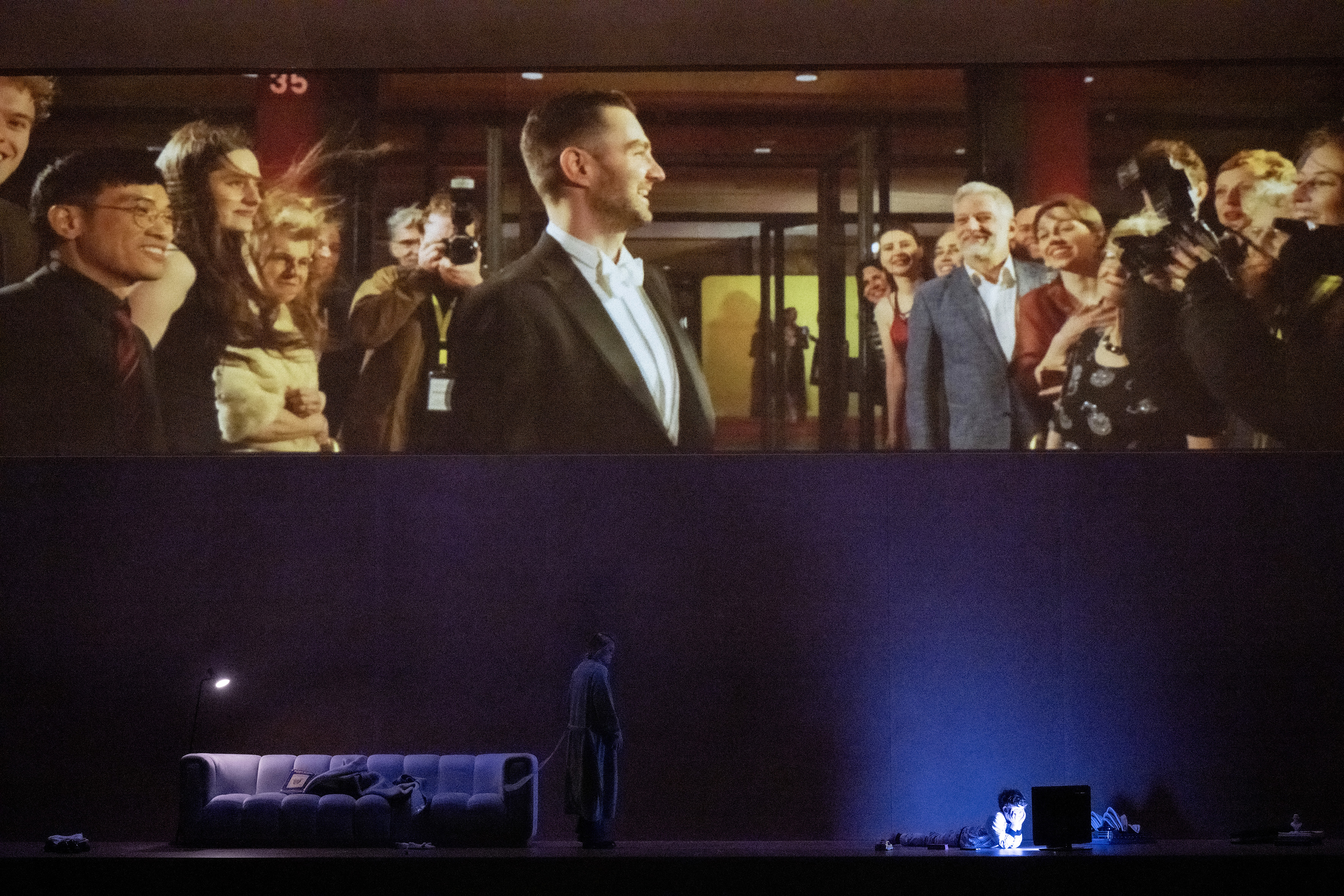
A Zeitoper, if it is to be updated, needs careful handling in finding equivalents, at least if an abiding aesthetic of realism is to be retained as it is here. (It is not beyond the bounds of possibility to try something different, far from it, but it would be a tricky assignment.) Kratzer proves almost unerring in finding realistic contemporary settings for Strauss’s succession of bourgeois scenes. The Prater becomes an aeroplane (Straussair, with ostrich emblem play-on-words) journey home. The scene in Franzl’s bedroom has him watch online his father’s red-carpet, autograph-signing arrival at the Deutsche Oper (a little much, one might have thought, for either an opera composer or conductor, but perhaps that is the point). Such glamour contrasts poignantly with Pauline’s loneliness and her announcement of a broken marriage to the little boy. The game of skat takes place in a typical green room/Kantine. We see much of the orchestra and Donald Runnicles on film during the interludes, heightening the wonders of metatheatricality—and, quite simply, an excellent chance to see the players at close quarters. 


Baron Lummer (Thomas Blondelle), Christine, others


Earlier on, Robert leaves domestic ‘bliss’ in a taxi absurdly overfull with baggage, driver waiting patiently, cigarette in hand. Subsequent text messaging between the two of them proved a rare instance of adept operatic reference to that world. Ironically, for an opera claimed by some to be ‘embarrassing’ – perhaps accusers should look instead in the mirror – the scene turns out, unlike most such attempts, to be anything but; it strikes a fine balance between irritation and genuine, communicative emotion. The ski-slope collision between Christine and the Baron is transferred to behind the motoring wheel. I could not help but find the transfer of the ensuing scene at the Grundlsee Inn to a hotel bedroom – there can be no doubt what is meant by the ‘dancing’ on which Robert has given up – something of a miscalculation: it made much of what happened later between the characters, especially in their dialogue, very difficult to understand, if not quite incomprehensible. Even that, though, was handled on its own terms with a strong sense of theatrical realism, Personenregie crucially alert throughout. 


Notary (Markus Brück), Christine

Kratzer, moreover, responds to Strauss’s loving (without being too self-loving) self-quotation and allusion with twofold references of his own. Elektra and Der Rosenkavalier on film are further doubled by Christine’s choices from her costume wardrobe, that dressing up being in turn pressed upon the Baron (initially dressed as Kratzer). So much opera is about disguise and the assumption of roles in one way or another. Here we receive a welcome invitation to reflect on that, almost as our own minds will, though with guidance for those who need or wish it. No one, surely, could miss either the craziness or the sincerity of Christine’s metamorphosis into axe-wielding Elektra when she strikes her blows for womankind against the hapless Notary in his office. The ‘natural’ order of things is restored and perhaps lightly mocked by having Christine, conducted by Richard, sing her part of their closing love duet to an assembled audience in front of acted orchestra. I hesitate, no decline, to defend the sexism, though frankly what would one expect in a work so much, so avowedly, of its time? Straussian irony, though, will always be present for those with ears to hear; that certainly includes Kratzer, Runnicles, and a strong cast. For those who do not, there are many other ways to spend three hours of their time. 


Robert, Stroh (Clemens Bieber)

The orchestra for which Strauss calls is small, verging indeed on a chamber orchestra at times. We certainly heard pinpoint precisio, and ‘ensemble’ sonorities that would more readily be classed modernist if penned by Schoenberg or Webern. What nonetheless struck most keenly and certainly most warmly were the swell and glow of the Deutsche Oper orchestra and not only in the interludes: miniature tone poems in their own right, a splendid formal innovation for which Strauss never seems to gain credit. That the orchestra and Runnicles are old Strauss hands, not least in tandem, should not have us take their idiomatic and dramatically meaningful musicianship for granted. It may have been gorgeous, but it was never for ‘mere’ gorgeousness’s sake, the composer’s strong aestheticist tendences notwithstanding. 


Christine, Baron Lummer

At least as much as any Strauss opera and more so than many, an Intermezzo performance will stand and fall not only by the orchestra but also by its soprano heroine. Veterans of great Strauss performances of the past will surely not be disappointed, at least not reasonably so, by Maria Bengtsson’s Christine. It is here, of course, that whatever Strauss’s everyday sexism – misogyny if you will, though it seems a little strong – is routed by his lifelong love for the soprano voice (and Pauline). Bengtsson made the role her own and also very much a creature of our own times, ultimately likeable through that earlier cited genuineness of emotion. How we felt with her at her darkest hour, however silly some of her other behaviour may have been. Kratzer’s direction of Elliott Woodruff as Franzl and indeed the boy-actor’s own performance helped here too. Philipp Jekal’s Robert was finely sung and acted, treading difficult lines of his own without in any sense trying to upstage his partner-in-crime. Thomas Blondelle’s Baron Lummer initially seemed a bit old for the role, but the revelation of him as directorial emanation brought him more clearly into his own; at any rate, this was a similarly good performance. Strong appearances in smaller roles from artists such as Clemens Bieber, Anna Schoeck, and Markus Brück likewise attested to thoughtful casting and direction. Assuming that performances of Intermezzo will, alas, continue to be rarities even in German-speaking lands, catch this if and when you can.


Final scene


Sunday, 2 April 2023

Arabella, Deutsche Oper, 1 April 2023


Count Waldner – Albert Pesendorfer
Adelaide – Doris Soffel
Arabella – Gabriela Scherer
Zdenka – Elena Tsallagova
Mandryka – Russell Braun
Matteo – Robert Watson
Count Elemer – Thomas Blondelle
Count Dominik – Kyle Miller
Count Lamoral – Tyler Zimmerman
Fiakermilli – Hye-Young Moon
Fortune Teller – Alexandra Hutton
Welko – Jörg Schörner
Djura – Michael Jamak
Jankel – Robert Hebenstreit
Room Waiter – Hainer Boßmayer

Tobias Kratzer (director)
Rainer Sellmaier (designs)
Clara Luise Hartel (costumes)
Jeroen Verbruggen (choreography)
Manuel Braun, Jonas Dahl (video)
Philine Tiezel (evening director)
Stefan Woinke (lighting)
Bettina Bartz, Jörg Königsdorf (dramaturgy)
Silke Broel, Lea Hopp, Janic Bebi (live camera)

Opera-ballet and actors of the Deutsche Oper Berlin
Chorus of the Deutsche Oper Berlin (chorus director: Jeremy Bines)
Orchestra of the Deutsche Oper Berlin
Dirk Kaftan (conductor)


Images: Arabella von Richard Strauss, Regie: Tobias Kratzer, Premiere am 18. März 2023 Deutsche Oper Berlin, Copyright: Thomas Aurin.

Arabella hovers on the edge of the repertoire in non-German-speaking countries, a little more popular in Germany and Austria than elsewhere. It has appeared once in London during my opera-going career, early on, in a production by Peter Mussbach, conducted by Christoph von Dohnányi, and starring Karita Mattila. Sitting in the amphitheatre of the Royal Opera, it was difficult to know what to make of it, given that much (most?) of the action was on the higher level of a split-level set, too high to be seen: by any standards, a failing of basic stage direction. I have also seen it twice in Munich, experiences I was happy to have had, yet neither of which won me over. Perhaps we are too ready to assign the label ‘problematic’ to dramatic works, yet the premature death of Hugo von Hofmmansthal certainly presented its problems to this, and to Richard Strauss. Although revisions had been made to the first act of Hofmannsthal’s libretto in light of Strauss’s criticism, as was their custom, Strauss set the remainder as it stood: a creditable mark of respect, though not perhaps the best decision on artistic grounds. I came, then, to the Deutsche Oper’s new production, first in a Tobias Kratzer Strauss trilogy (subsequent seasons will see Intermezzo and Die Frau ohne Schatten), not necessarily expecting to be convinced, yet actually finding myself rather more so than I had expected. 

Kratzer’s production was not without its flaws, yet offered definite virtues too; I shall come shortly to both. It undoubtedly benefited from strong, committed performance, as did we, not least from late substitutes (explicitly identified as such on the cast list) conductor Dirk Kaftan and, in the title role, soprano Gabriela Scherer. How much of the musical interpretation was Kaftan’s and how much that of his predecessor Donald Runnicles, I do not know. In such circumstances, it often tends to be a bit of both. It surely owed a good deal of its success to Kaftan, though, in what, dim memories of Dohnányi notwithstanding, I found the most successful performance I had heard. I greatly enjoyed the greater warmth, especially from the strings; what can often come across as an icy score, too eager to place itself, more with Hofmannsthal than Strauss, close to operetta, here sounded positively Wagnerian—enabling us far better to sympathise with characters who, if we are honest, are not all the most sympathetic. That is, we did not necessarily align ourselves with them or I did not, but I gained greater insight into them as characters, in a particular situation. Arabella herself, as well as the opera that takes her name, could take her place more readily in a line of Strauss, and even Wagner, heroines. And the action, its ebb and flow as well as its pacing and, crucially, its meaning, took flight before our ears as well as our eyes. 

Scherer proved ready both to dig deeper verbally than many a star soprano (though certainly not Mattila!) in what has often been seen as a ‘vehicle’, and also, especially in the first act, to offer a more rounded portrayal that did not present Arabella as an empty or implausible angel (whatever Mandryka might claim). Elena Tsallagova’s animated Zdenka/Zdenko was a joy from beginning to end. She did not put a foot, or note, wrong, engaging us in her plight and its vocal beauties in equal measure. If I say that Albert Pesendorfer and Doris Soffel as their parents proved excellent character singers, that is not to praise their acting ahead of their vocal artistry, but rather to say that it was impossible to dissociate one from the other. Russell Braun’s Mandryka and Robert Watson’s Matteo offered similarly rounded performances, engaging equally with the not always allied demands of Strauss and Hofmannsthal. Arabella’s trio of Viennese suitors met with detailed characterisation and differentiation from Thomas Blondelle, Kyle Miller, and Tyler Zimmerman. And if liking the Fiakermilli remains sadly beyond me, Hye-Young Moon’s performance was razor-sharp. 

Kratzer’s production begins and, for the first act proceeds, relatively traditionally—at least in terms of being set where it ‘should’ be, though surely winning against tradition as Schlamperei in sheer keenness of observation. Much of both libretto and score seem emphatically to request this, and it is actually rather a nice surprise to see the faded grandeur of an 1860s Vienna hotel; not only that, it serves splendidly as backdrop for the financially driven nastiness playing out in front of it. All is heightened by live video work, picking up detail and enhancing the sense of much action – too much? – that might yet spiral out of control. The second act drags us out of what might seem to some nostalgia, though it is surely always more than that. For some the ball can seem a little long, though surely no one would feel it played out over a century-and-a-half. That, however, is what happens here, one shift taking us forward to the time of composition, Nazis rushing on stage to beat up a cabaret (indeed Cabaret) monkey, further ‘progress’ leading us to more sexually and otherwise liberated times: to the disco era, and finally what seems to be contemporary, frankly pansexual clubbing, leaving us in the here and now for the third act, albeit with filmed footage of where we began. The idea, I think, is to explore different attitudes towards sex and, perhaps still more so, gender.


If that sounds earnest, even contrived, perhaps it is; I think it might have been done less clunkily, though one might argue there is a little of Virginia Woolf’s Orlando to the conceit. However, the denouement, which may sound banal, nonetheless seems to me not only to work but to affect more readily than it might sound. Born, it seems, not only of the inclusiveness (ideally speaking, anyway) of a partying atmosphere – Adelaide, leading Dominic by a leash, ballet couplings to suit many a taste, and so on – an accepting world, perhaps opposed to or at least expanding upon the more traditional heteronormativity of Arabella and Mandryka, seems to be born before our eyes and even our ears. It may seem a stretch to portray Zdenka as trans; it may also seem a little unsubtle to have her (and, nicely, a converted Matteo) display the transgender flag at the close. Yet in this context, and also given the actual lived experience, as we now should say, of the character, it is arguably less so than narrow, operatic experience might initially suggest. In some ways, after all, operatic treatment of gender, including yet far from restricted to trouser roles, stands light years ahead of broader society. Why not celebrate that? And recognition and transformation are longstanding themes in opera, as well as of particular importance to both Hofmannsthal and Strauss. If Arabella does not seem the likeliest Strauss opera to bear a ‘message’, there is no harm in it doing so now and again, especially at a time when such a message stands so sorely needed. If Adelaide can adapt, and enjoy herself in doing so, why cannot we all?


Tuesday, 12 April 2016

Deutsche Oper Strauss-Wochen (4) - Die Liebe der Danae. 9 April 2016


Die Liebe der Danae © 2011, Barbara Aumüller


Deutsche Oper, Berlin

Jupiter – Mark Delavan
Merkur – Thomas Blondelle
Pollux – Andrew Dickinson
Danae – Manuela Uhl
Xanthe – Adriana Ferfezka
Midas – Raymond Very
First King – Paul Kaufmann
Second King – Clemens Bieber
Third King – Thomas Lehman
Fourth King – Alexei Botnarciuc
Semele – Nicole Haslett
Europa – Martina Weischenbach
Alkmene – Rebecca Jo Loeb
Leda – Katharina Peetz

Kirsten Harms (director)
Bernd Damovsky (set designs)
Dorothea Katzer (costumes)
Manfred Voss (lighting)
Silke Sense (Spielleitung)
Andreas K.W. Meyer (dramaturgy)

Chorus of the Deutsche Oper , Berlin (chorus master: William Spaulding)
Orchestra of the Deutsche Oper, Berlin 
Sebastian Weigle (conductor)


Strauss’s penultimate opera has been unlucky, more a victim of circumstances than of its intrinsic qualities, although Joseph Gregor’s libretto admittedly falls somewhat short of Hofmannsthal. Its 1944 would-have-been premiere at the Salzburg Festival fell victim to ‘total war’ and closure of theatres, so the only time Strauss himself heard it was at the Generalprobe. Thereafter, despite a successful posthumous premiere in Salzburg, it has never secured itself in the repertory; so much the worse, as so often, for the repertory. A committed performance such as this will have done it no harm whatsoever, although, as with the only other performance I have attended (Salzburg again, 2002), I am not convinced that the production (then Günter Kramer, now Kirsten Harms) made the best of its opportunities. Perhaps Salzburg’s third attempt, this year, will do better.


In the meantime, there could be no doubting the work’s musical qualities. That extraordinary evocation of sadness – not tragedy, ‘just’ deep sadness – in the third-act Interlude is not the only candidate from this score for Strauss at his greatest. ‘Jupiter’s resignation’, as Strauss called it, is not the only time one cannot help but draw parallels with Wotan; indeed, such parallels suggest themselves in the libretto perhaps all too readily. At any rate, in the very capable hands of Sebastian Weigle – quite the best thing I have heard him do – Strauss’s musico-dramatic empathy spoke as eloquently as one could hope for. Throughout, Weigle’s pacing convinced, as did his balancing of the Deutsche Oper orchestra, which once again proved itself worthy of the most exalted comparisons in the music of a composer long so close to its heart.


At the risk of becoming unduly repetitive, I should like again to draw attention to the skill with which each conductor in this mini-festival (arguably not so mini- a festival!) and the orchestra have commanded and communicated Strauss’s phantasmagorical wizardry, not just with respect to orchestration, not just with respect to shifting of timbres, but perhaps most important of all, in the marriage of timbral to harmonic shifts. (I promise that I shall try to restrain, even to eliminate, my use of the word ‘phantasmagorical’ for a month or so, once these Strauss reviews are done and dusted.) This is undoubtedly an old man’s score; it sounded all the more loved for recognition of that, in a reading that was unhurried without ever losing its impetus. The aristocratic refinement of Capriccio is not Strauss’s way here. (It is certainly not Gregor’s!) However,t the Strauss of Die Frau ohne Schatten is here at times, albeit perhaps softened (I am not sure that is quite the right word), and what a joy it is to hear that Strauss one last time. Indeed, more than once I was put in mind of Strauss’s reworking of Idomeneo, the Wagnerian and Mozartian tendencies in his work performing their endlessly fascinating interaction, even battle.
 

Manuela Uhl proved a moving exponent of the title role, especially as the opera progressed. To make a distinction between the ‘vocal’ and ‘dramatic’ is always, or should always be, to err; here, there was no doubt of that, for the sympathy with the character as engaged by Uhl was part and parcel not only of beautiful tone but its alliance with her stage action. Raymond Very was equally impressive as Midas. Apparently he was ailing, but one would rarely have known it, so secure were his technique and his similar ability to engender sympathy. Mark Delavan’s Jupiter was occasionally a little bluff, but that is arguably in keeping with the character, or at least a perfectly respectable interpretation thereof. His sadness, as well as the orchestra’s, in the third act reminded us that the Wotan parallel would have been even stronger when the role was created by no less than Hans Hotter (at the rehearsal, that is, not the public premiere). Thomas Blondelle was quite the stage animal, and quite the vocally winged messenger, as Merkur. I had no complaint with any of the singers; the Deutsche Oper can cast from depth, and regularly does. Its chorus remains one of the finest jewels in its crown; this performance was no exception.
 

Harms’s production does no especial harm. It is ‘stylish’ enough, in a generalised fashion, but does not seem to me to offer any particular insights. Apart from a predictable updating – or should that be demythologising? – this is a somewhat conventional staging, but in a work unfamiliar to many, that might not always be a bad thing. I am not sure why Pollux’s auctioned-off piano is suspended in the sky during the third act. Is it to come crashing down, with catastrophic or even Zerbinetta-like, consequences (a troupe perhaps concealed within it)? No; it simply remains there, arresting in visual terms, yet seemingly contributing little beyond that, except perhaps a vague reminder of what has gone before. Transformation into gold relies upon suggestion, and is probably all the better for that. Personenregie is generally impressive, although that will presumably long since have been delegated from the original director. In this case, however, Strauss’s score was definitely the thing. How it glowed!


Thursday, 7 April 2016

Deutsche Oper Strauss-Wochen (1) – Salome, 6 April 2016


Images: Monika Rittershaus
(The Salome pictured is Catherine Naglestad)
 
Deutsche Oper, Berlin

Herodes – Thomas Blondelle
Herodias – Jeanne-Michèle Charbonnet
Salome – Allison Oakes
Jochanaan – Michael Volle
Narraboth – Attilio Glaser
Page – Annika Schlicht
First Jew – James Kryshak
Second Jew, Slave – Gideon Poppe
Third Jew – Andrew Dickinson
Fourth Jew – Clemens Bieber
Fifth Jew – Andrew Harris
First Nazarene – Dong-Hwan Lee
Second Nazarene – Thomas Lehman
First Soldier – Alexei Botnarciuc
Second Soldier – Tobias Kehrer
Cappadocian – Michael Adams
Salome as child – Alix Heyblom, Elisabeth Johanssen, Laura Meyer, Leonie Schöning, Maria Schulz, Katharina von Stackelberg
Dancers/Dummies – Uri Burger, Floris Dahlgrün, Alexander Fend, Nikos Fragkou, Oren Lazovski

Claus Guth (director)
William Robertson (revival director)
Muriel Gerstner (designs)
Olaf Freese (lighting)
Sommer Ulrickson (choreography)
Yvonne Gebauer, Curt A Roester (dramaturgy)

Statisterie and Male Dancers from the Deutsche Oper
Orchestra of the Deutsche Oper
Alain Altonoglu (conductor)
 

Five consecutive nights of Richard Strauss: how could anyone resist? Plenty of opera-goers would have little hesitation, and not just those for whom Donizetti and Verdi are the height of musical sophistication. Strauss, as I have discussed in one of the chapters of my book, After Wagner, remains an object of distrust for many. Their problems often seem to be moral, or at least to be couched in moral terms; perhaps Strauss has turned out to be the Nietzschean Anti-Christ after all. (Had Strauss called his Alpine Symphony, as was his early intention, The Antichrist, it and we might have been saved a great deal of spectacularly uninformed sniping.) We shall see; perhaps more to the point, we shall also hear. Will this prove too much of a good, a bad, or even an evil thing? I doubt it, but perhaps I am already a lost cause. At any rate, the Deutsche Oper’s Strauss festival offers an extraordinary opportunity, for which I nobly put myself forward as moral-æsthetic guinea pig.


Schoenberg accused – at least he had good reason to feel personally affronted – that Strauss’s was the art of a Marzipanmeister: ‘Problems arise for him and are solved by him in the same way: he misunderstands them. But it cannot be disputed that he has dealt with them: he has hidden them under a coating of sugar icing ... This is not the way of thinking of a man whom God has given a mission.’ One can well imagine Strauss’s materialist response to that. Stravinsky was, if anything, more hostile still: ‘I would like to admit all Strauss’s operas to whichever purgatory punishes triumphant vulgarity. Their musical substance is cheap and poor; it cannot interest a musician today. That now so ascendant Ariadne … makes me want to scream.’ Well, scream away, Igor – although perhaps not this week, in which Ariadne auf Naxos, which surely stole from your neo-Classical future, will not appear. However, Salome, Elektra, Die ägyptische Helena, Die Liebe der Danae, and Der Rosenkavalier will.


Artists include: Thomas Lehman, Tobias Kehrer, Noel Bouley, Jörg Schörner
 

Claus Guth’s Salome, first seen here in January, sets the bar high for what is to follow. It offered a splendid follow-up, perhaps less profound (but is not the work itself?) but even more chilling than Dmitri Tcherniakov’s outstanding Parsifal for the Staatsoper. Childhood horrors loom large, obscuring, perhaps even obliterating, the boundaries between ‘then’ and ‘now’; memory and above all trauma are like that. Can we ever recover? Do we even really want to? And what are our coping strategies? Do some of us, perhaps as self-proclaimed æstheticists or, worse, protectors of the artwork (c.f. the Donald Trump-like ‘Against Modern Opera Productions’, or its provisional wing, ‘Gegen Regietheater in der Oper’), try to take refuge in the very thing that should be challenging us, waking us up, and leading us to confrontation, even catharsis?
 

If opera is, to you, ‘about’ pretty frocks, then you might be out of luck here; but salvation of sorts it at hand, for there are some handsome suits and sportcoats instead; indeed, clothes rails are full of them. Indeed, dressing up – attempting, like AMOP to avoid the questions, or to misunderstand, to smother them, as Schoenberg accused Strauss of doing – is thrust to the forefront of Guth’s staging, once the lights have been switched on, Olaf Freese’s lighting very much at the heart of the drama and its (would-be) turning-points. However, we must first travel the road to the superior (deceptively so?) gentleman’s outfitter – wonderful designs by Muriel Gerstner! – in which  stylish ‘solutions’ will be no problem, though likewise no solution.


Jochanaan (Michael Volle) and Salome
 

For the first scene has been dark, grim, at times in a weirdly twilit state of suspended animation; it has been far from clear who the actors in this drama even are, or might be held to be. Salome tours the set – her mind, or something more? – in agitation but, at times, in the pleasure that might, uncomfortably for all of us, especially as audience-voyeurs, accompany such agitation. The table at which she has sat – will sit? still sits? should sit? wishes to sit? – with her parents is at the centre. Does she wish to relive or to pre-empt what will happen there later? It is unclear, as our recollections often are. Shop dummies haunt her. Or are they ‘real’ people, acting as dummies? Who is operating them? How can they be stopped? Should they be stopped? We only really begin to make sense of this – we cannot, just as the opera says we should not, see Jochanaan for quite some time – once the lights have been switched on; or do we just delude ourselves that we make sense of it? For much of what happened there happens again, albeit in a shrine to fashionable consumption, Herodias making the most of the readily available alcohol. Might you not too, in such circumstances?


The child versions Salome has seen of herself earlier come into play most starkly for the Dance of the Seven Veils. There are six of them, seven including her, and they are the playthings, the instantiations of trauma. There is no need for titillating nudity (although not in the sense that our ‘conservative’ friends would understand); whatever has happened and is continuing to happen is genuinely shocking. Should Werktreue fanatics complain that they have been denied the opportunity to play Herod? Over to them. Salome tears the head off Jochanaan herself. But he had somehow become a dummy in the meantime. Was he always? What was it she really wanted from him. An answer is perhaps suggested by the similarities, physical as well as dramatic, between our prophet and the Tetrarch, productively rather than negligently at odds with the differences in soundworld. (Strauss simply could not ‘do’ religion, which, given his materialist credo, does him a certain degree of credit. Or does it?)
 

The return to darkness is most traumatic of all. Like many a victim, we feel, indeed we are, disoriented. Yet we have the additional guilt of that aforementioned voyeurism. Is Strauss’s sensationalism being given especially disconcerting musico-dramatic form? Julius Korngold wrote of the composer: ‘The Germans want a priest, someone who will champion an art with deep intentions. Strauss is driven by the ego sensibility of the modern artist, who wants above all to serve himself and his sensations.’ Is he right? If so, is that a problem? Herod orders Salome dead, but nothing happens; or does it. Her child form begins again; or does she? Have we returned to childhood, or never left it? We do not seem to have ‘moved on’.


Such a reaction certainly seemed to be suggested by those dreadful closing chords. For whilst I had sometimes been a little unsure about aspects of Alain Altinoglu’s conducting, I was not here. The deadness, the modern(ist) materialism, at least as shocking as that of the conclusion to Elektra, registered as powerfully and yet as dully (in a positive sense) as I have heard. It was at such moments of modernist crisis, quite in keeping with the staging, that not only Altinoglu’s fastidiousness but also his ear for marriage between timbre and harmony registered with great musico-dramatic import. I have heard performances of Salome which have danced more freely, and to start with I found that more of a problem. As time went on, I began to suspect that I was relying too much upon my own memories, false or otherwise; a performance today of Salome, in this particular production, need not, perhaps even should not, sound like the Salome of Böhm or Karajan. There was certainly no gainsaying the quality of the performance from the Orchestra of the Deutsche Oper, whose colours phantasmagorically shifted as the harmonies ground – and ground us down. (Or should that have been vice versa?)


Herodias (Jeanne-Michèle Charbonnet) and Salome
 
Catherine Naglestad had been due to sing the title role. Her replacement, Allison Oakes, proved an outstanding replacement. I had not come across her previously, but certainly hope that I shall do so again. Hers was a tireless, unceasingly rewarding performance, vocally and ‘dramatically’, insofar as the two may be distinguished. Her lyricism called into question her trauma and yet justified it; in this case, there is no doubt as to the necessity of the vice versa. Herodes is a larger role than I tend to remember. (What was that about faulty remembrance?) Thomas Blondelle offered a detailed, disturbing portrayal: far better sung than one often hears, yet just as heedful of dramatic requirements. Jeanne-Michèle Charbonnet was a splendid grande dame Herodias; elements of caricature are surely justified, indeed written in. She was a monster and proud of it. Michael Volle's Jochanaan, suave, brutal, thoughtful, by turns and sometimes simultaneously, was just the thing for this production. Attilio Glaser’s sweetly sung, sincere, hopelessly lovelorn Narraboth left one wanting more. But more, of course, was not his fate on this night.


Above all, though, this felt like a strong company achievement; those singing smaller roles, those engaging as dancers and as ‘extras’, as much part of the dreadful events as the rest of us, whether on stage or in the audience. With trepidation, I should like to see this again, to try once again to make sense of what I might see, hear, and remember.