Showing posts with label West-Eastern Divan Orchestra. Show all posts

Wednesday, 6 November 2024

WEDO/Barenboim - Mendelssohn and Brahms, 4 November 2024


Royal Festival Hall

Mendelssohn: Symphony no.4 in A major, op.90
Brahms: Symphony no.4 in E minor, op.98

West-Eastern Divan Orchestra
Daniel Barenboim (conductor)


Images: Pete Woodhead


A performance from Daniel Barenboim and the West-Eastern Divan Orchestra has always been an experience hors concours. That has not changed; it is arguably all the more so than ever. The warmth of applause Barenboim received coming on stage was in itself striking, arguably beyond even that Bernard Haitink did during his later years; that with which Barenboim and the orchestra met on departing was something else again. The reasons for this are obvious and do not need rehearsing, but they are very much part of the context in which any listener from this planet, perhaps even from beyond, would experience this concert. 

Mendelssohn’s Italian Symphony was not a work I associated with Barenboim, but that was clearly a matter of my ignorance, since he conducted it, as he would Brahms’s Fourth Symphony, without a score. The manner in which it opened banished any such doubt for good: buoyant, transparent, directed, at an ideal tempo, and imbued with chiaroscuro. Ravishing woodwind solos characterised not only this first movement but the performance as a whole. Split violins brought the dialogue further to life—and what a luxury it was to hear this music with an orchestra ranging from sixteen firsts to eight double basses. That depth of strings truly told in the struggle of the development, more Beethovenian than one generally hears, and all the better for it. Indeed, it was not only Beethoven but the Beethoven of Furtwängler who increasingly came to mind: surely a matter not entirely dissociated from the state of the world around us and, above all, around these extraordinary young musicians and their wise guide and mentor. It was likewise perhaps my imagination, but I am not sure I have heard the second movement sound so mournful. It was neither slow nor lugubrious, but told of an underlying pain that could never be put into words (thinking of Mendelssohn’s own aesthetic claim). This processional, steeped in the deepest melancholy, maintained its line from beginning to end, detail and broad sweep in perfect equipoise. Moving to the major mode brought Schubertian bitter-sweetness. The close, alas, brought a less than welcome intervention from mobile telephone. 

Was the minuet too loving? I imagine some might have thought so. For me, as a one-off, it offered a fond backward glance to a world before, ever vanished, yet tantalisingly close, whether to Mozart or whatever one might choose politically. Again, woodwind were to die for. Horns and bassoons in the trio, beautifully hushed, seemed to recall the world of A Midsummer Night’s Dream, building to a stern climax with militaristic trumpets and drums. In that context, the finale offered a wake-up call in several senses. Fast, furious, unrelenting, it had never terrified me as it did here. String figuration again darted from the Dream music, the Scherzo in particular, yet turned to acid, disturbingly close to the world of, say, Mahler’s Fifth. Throughout, the sense of purpose evoked Beethoven and anticipated Brahms.
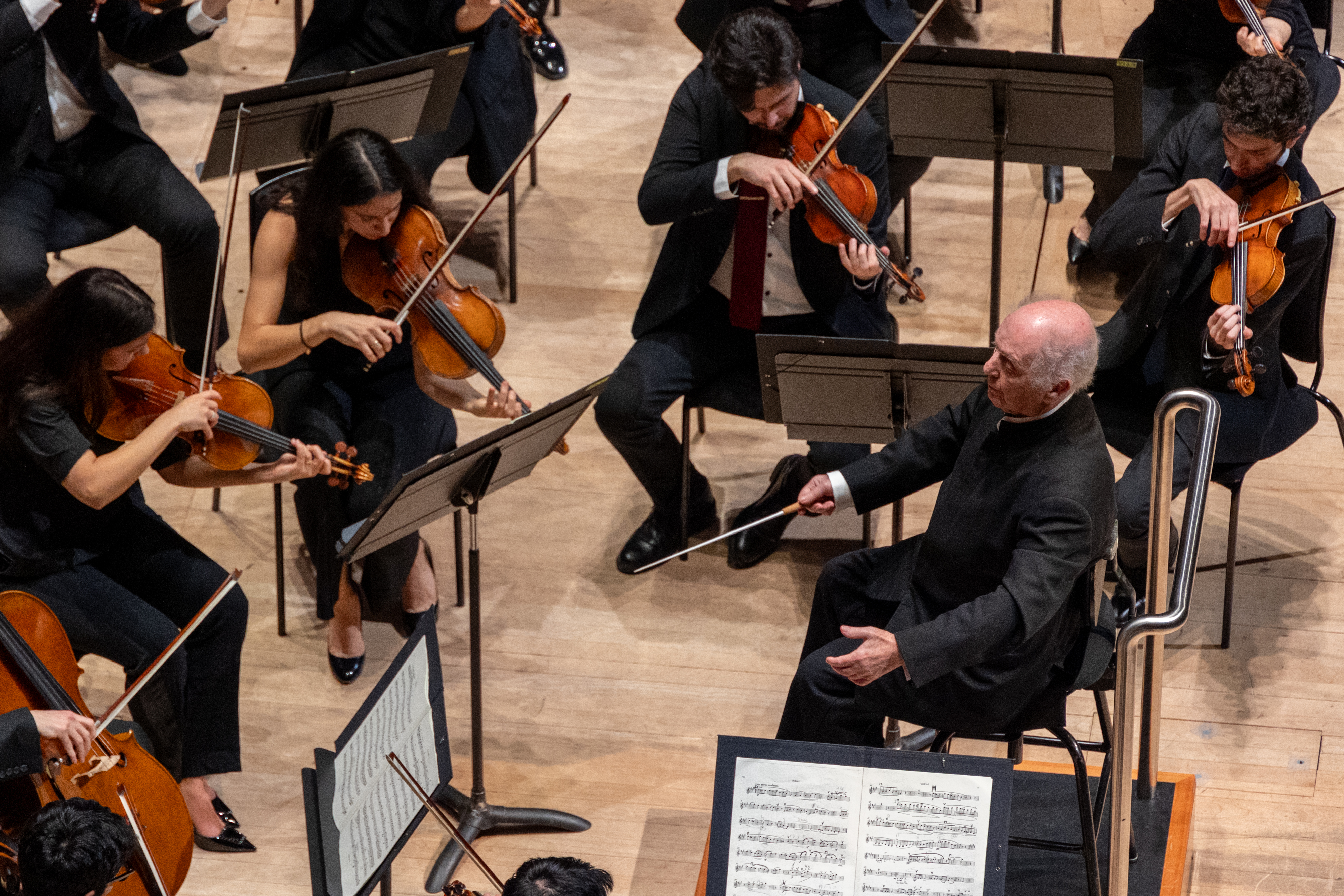


The first concert I heard Barenboim conduct was of Brahms, in this very hall: not the Fourth Symphony, but rather the Third and First. He still has much to tell us and much to surprise us with. If the candle occasionally flickers, as here in the great finale, which almost yet not quite fell apart; it continues ultimately to burn, perhaps all the more movingly for its infallibility. There is little doubt that the Divan musicians would follow him to the end of the earth and there is hope in that. The first movement, deeply sad without sentimentality, felt well-nigh overwhelming. It may have been on the slow side, but it pulsed with life both in its harmonic fundamentals and in the motivic working of inner parts: Schenker and Schoenberg united, as so often in the best of Barenboim’s (and anyone else’s) performances. It became more frightening, more vehement, its insistence frightening, sweeter passages arguably still more so. Its fragility remained deeply moving. The development opened as if showing us a musical (and political) wasteland, from which the world somehow, just about, picked itself up. Horn calls and massed string portamenti sent chills, properly ambiguous, down the spine. Battle between first and second violins towards the close told its own unmistakeable story.

The second movement, intriguingly, seemed to take up whether the inner movements of the Mendelssohn had left off, building rhythmically (those hemiolas!) and harmonically into a tragic statement of Beethovenian stature, whose virginal tenderness troubled still more than external defiance. Truth, here, was the essence. It was not beautiful; nor was it intended to be. Yet in the richness of Brahms’s inner parts, there lay hope, as there did in something later, warmer, aptly (given Barenboim’s history) Elgarian. He may not have seemed to be doing very much, yet detail remained within his hands, as witnessed by a subtle signal to the firsts to tone down, instantly obeyed. The scherzo-like third movement offered ebullient contrast, as if a thunderbolt from Zeus. In dialectical contrast, it became almost balletic, only adding to the sense of what humanly was at stake. The passacaglia was as implacable, as naked in its honesty: the final, complete tragic utterance, laden with all the cares of the world and yet still able to speak, to resist, to bear witness. At times, it almost stood still; at others, it pressed on. All was part of the same flow, all rooted in harmony, musically Sophoclean. 


The Scherzo from A Midsummer Night’s Dream, as at the Waldbühne this summer, made for a fitting, featherlight encore: charming, yet with depth rarely achieved and perhaps never surpassed. Encapsulating so much of what had gone before, it also offered something refreshingly new. Again, a sign of hope.


Saturday, 10 August 2024

Mutter/WEDO/Barenboim - Brahms and Schubert, 9 August 2024


Waldbühne

Brahms: Violin Concerto in D major, op.77
Schubert: Symphony no.9 in C major, ‘Great’, D 944

Anne-Sophie Mutter (violin)
West-Eastern Divan Orchestra
Daniel Barenboim (conductor)


Images: Jakob Tilmann

That it came close to a miracle that this concert took place at all will not be news to anyone. The West-Eastern Divan Orchestra continues to offer hope, light, and crucially listening. It has for me ever since I first heard the players in a London memorial concert for Edward Said, conducted (partly from the piano) 20 years ago, almost to the day, by co-founder Daniel Barenboim. As Barenboim and Said made clear, it was not straightforwardly a political project; an orchestra was never going to bring justice to the world or to part of it. It could, however, show a way to listen to one another in extremely difficult – some might have thought, impossible – circumstances. That it has now been doing for 25 years. I was unable to attend the anniversary concert here in Berlin in April, but it helped nonetheless to know that it was taking place—and I was able the previous September to hear them come together once again to play the three final symphonies of Mozart, conducted as (almost) always by Barenboim. It was not a concert I reviewed, but the ultra-Klemperian performance of the E-flat Symphony was the finest I have ever heard. It compelled one above all to listen. 

And so, it was a privilege once again to see, as well as to hear, these musicians assemble to perform Brahms and Schubert with long-term collaborator Anne-Sophie Mutter. Berlin’s Waldbühne is a strange venue. It was my first visit, earlier plans having been confounded. And it is certainly worth the visit for the ‘experience’, even if it rains for part of it, necessitating a sea of umbrellas and the rest. In the forest, as its name suggests, the vast ampitheatre offers no shelter for anyone but the performers; it offers little shelter either, save for the determinedly uninquisitive (never underestimate them!) from its Nazi origins and concept. Handel’s Hercules and Eberhard Wolfgang Möller’s Frankenburger Würfelspiel featured here in 1936, as well as the Olympic Games’s gymnastics competition. Still, boiling things down merely to alleged origins is as un-historical as it is un-musical. Barenboim has never been a musician to resort to such pseudo-archaeology, and nor should we be. History is, or should be, as much about dialogue, about listening, as music.


The major problem in saying much concerning the performances is the necessary amplification such a vast open-air theatre requires. I say that not to complain; if you do not wish to hear an amplified performance, do not attend one. I say it rather to explain why my remarks on the performances will be brief and somewhat generalised, and will take second place to the ‘event’ itself, reflecting the nature of the occasion and my experience of it. Insofar as I could tell, given the nature and consequences of amplification – that ‘insofar’ should be taken as read or heard for the rest – Mutter gave a fine performance: broad, unmannered, tonally centred throughout. From time to time, she led, but like those around her, she listened; her understanding with the players, as well as Barenboim, drawing on an even greater wealth of experience, was palpable. Barenboim ensured, often whilst doing apparently little – he has always known when not to conduct, as well as when to do so – that not only the proportion were there, but that they were thoroughly founded on harmony: another humanistic, as well as musical, lesson. The Divan’s strings, as so often of a greater size than one would hear with a ‘normal’ symphony orchestra, produced not only fine tone, but a true sense of how (relatively) massed musicians can come together to prove so much more than the sum of their parts—when they listen, and act on that listening. So too did the rest of the orchestra, the oboe and other wind solos in the slow movement exquisite, yet also somehow symbolic of how individual voices may continue to sound and matter when part of that greater whole. 

Barenboim has long been an outstanding interpreter of Schubert in general, and the ‘Great’ C major Symphony in particular. A performance I heard him give at the Philharmonie, with the Vienna Philharmonic, was without question the finest I had heard, drawing as much as his Beethoven on the Furtwänglerian sources of his musicianship. Here that lineage remained important, but it was joined – as indeed as has much of his symphonic Beethoven over the past fifteen years or so – by a reunion with another powerful influence on his career, albeit slightly later, the aforementioned Otto Klemperer. As with Klemperer, if there could be something implacable to the playing here, that did not preclude the more mercurial, let alone the more human; it was part and parcel of the same dialectical conception. And Furtwänger’s famed long-distance hearing or listening (Fernhören, he called it) was just as apparent, from beginning to end. Barenboim had no truck with currently fashionable, frankly idiotic ideas concerning the opening tempo; he trusted the score, listened to it, and aided his musicians to do likewise. Here, deep – well, not so deep, but one could fancy it was after nightfall – in the German forest, horns and other wind took on a magical quality of their all, spirits already presaging, like quicksilver strings, the perfectly chosen and played encore, the Scherzo from Mendelssohn’s Midsummer Night’s Dream music. The Andante con moto’s length felt truly ‘heavenly’, to reprise Schumann’s celebrated description of Schubert’s ‘lengths’: not a moment too long, but just long enough. Such Goldilocks proportions characterised the symphony as a whole and in its myriad interrelations, not least between trio and scherzo material, all with admirable, infectious Schwung. The meteor-like finale thrilled, erupted, and not least, recalling Brahms, satisfied just as it should. I may not have heard the music quite as in a concert hall, but I was drawn in to listen to it as such.


The orchestra has released the following statement, which I do not wish to edit or to paraphrase. As in a musical performance, the text, whilst not everything, has intrinsic value: 

As we witness and mourn tens of thousands of lives destroyed and communities shattered while political courage remains absent, we, the musicians of the West-Eastern Divan Orchestra, are horrified and deeply saddened by the extreme escalation of violence in the Middle East, which continues to intensify daily. The profound humanistic commitment of Maestro Daniel Barenboim and the late Palestinian intellectual Edward Said stands at the core of our orchestra. In and through our music we seek to model a life of mutual recognition between equals. We call on the local and the international communities and their leaders to stop procrastinating and put an end to the cycle of violence by effecting a permanent cease-fire, ensuring the safe return of all hostages and unlawfully held detainees. It is imperative to work toward a long-lasting peaceful resolution grounded in equality. 

It would not have done so without Barenboim or Said; indeed, it would not have come into existence without them. But nor would words from their founders have had the import they do without these musicians, and without the many others, musicians and otherwise, who have worked with them. Such a statement does not just ‘happen’; it requires work, reflection, listening, empathy: as do music and its performance, at least to be worthwhile. I see no reason to add to or further to comment on the orchestra’s words. The world, however, needs to listen: not at some point in the future, near or far, but now. And, like Barenboim, Said, and the Divan, it needs to act.


Saturday, 11 November 2023

West-Eastern Divan Ensemble/Barenboim M. - Hindemith, Carter, Hensel, and Beethoven, 9 November 2023


Pierre Boulez Saal

Hindemith: Trauermusik for viola and strings
Fanny Hensel: String Quartet in E-flat major
Carter: Au Quai for bassoon and viola; Duettone for violin and cello
Beethoven: Septet in E-flat major, op.20

Michael Barenboim (violin, viola)
Miriam Manaserhov (viola)
Assif Binness (cello)
David Santos Luque (double bass)
Daniel Gurfinkel (clarinet)
Mor Biron (bassoon)
Ben Goldscheider (horn)


Images: Peter Adamik

9 November is a date full, too full, of resonance for German history. From the proclamation of the Republic in 1918 to the fall of the Berlin Wall in 1989, it takes in also the Munich putsch of 1923 and the November pogroms of 1938. At the best of times, whenever they might be, it is impossible not to feel conflicted and at times close to overwhelmed by the imperatives of remembrance; and these, I hardly need add, are anything but the best of times. On the 85th anniversary of what English-speaking countries still refer to as Kristallnacht, although in Germany the term is now generally held to conceal the full horror of what happened that night, even the West-Eastern Divan Ensemble playing Beethoven might have struggled to impart much in the way of hope. Yet somehow, ultimately, these musicians did: not in the sense that they offered a solution to our world’s cruelty, carnage, and apparently irredeemable darkness, whether then or now, of course not. As Daniel Barenboim, co-founder with Edward Said of the orchestra from which this chamber ensemble draws its members, noted in a typically inspiring piece written for the programme, they ‘never intended … [it] to be a political project. It was always a humanistic one, a call against ignorance. It may have seemed like a utopian idea then and perhaps appears even more so today.’

But that they were still here at all, let alone playing, listening and responding was something—and increasingly so. ‘Here, in this building, this utopia,’ Barenboim continued, ‘is alive every day. Our young musicians, whether they come from Tel Aviv, Ramallah, Damascus, or Cairo, work and study under the same roof and learn to listen to each other, in music just as in daily life—something that is impossible in their home countries. It takes courage for them to be here.’ It does indeed, and their courage as well as their broader example offers an example to the audience too, although it is for us, not for them, to lead our struggle to listen rather than merely to hear.


A late addition to the programme was Hindemith’s Trauermusik: in Barenboim’s words, ‘our collective expression of grief, but also of hope’. And so it sounded; so it felt. Indeed, the sadness in the first of its four short movements seemed almost unbearable. Was it ‘there’, in the work, or was it what we brought to it? Impossible to answer, and not the most relevant of questions. Michael Barenboim, leading from solo viola, and a string quartet representing Hindemith’s orchestra inhabited the composer’s universe fully, dignity of craft, ensemble, counterpoint, and harmony, and what they might mean to the fore—and beyond that, the universal musical imperative to listen. Hindemith’s use of music from Mathis der Maler reinforced all the more the importance of witness against fascism, against murderous, antihuman ideology. Crisis tends to reinforce what is essential, if only we will take time to find out. Inner movements’ lyricism in particular grew out of that early material, a necessary, human development. The final chorale, ‘Für deinen Thron tret ich hiermit’, offered not triumph, but modest climax in human fragility. It was met with prolonged silence and, eventually, respectful applause. 

Fanny Hensel’s 1834 E-flat major Quartet was an interesting choice, its first movement, ‘Adagio ma non troppo’, opening again with nobility and dignity. Was the sadness with which it seemed to be imbued…? We have already answered that question, or rather observed that answer there can be none. At any rate, the proportion of time spent in the minor mode seemed fitting. Expansive, without dragging, the quartet, again led by Michael Barenboim, seemed very much to have its measure, subtleties telling without exaggeration. The following Allegretto comes closer to Mendelssohn, though it is perhaps both a little more conventional yet also quirkier. Beethoven too came to mind at times (as he often does in Mendelssohn’s own quartets too). There was scope for considerable virtuosity, well taken, within a collegial framework. An eloquent account of the ‘Romanze’, Barenboim first melodist among equals, again permitted reference to other composers, Mendelssohn and Mozart among them, without ever being reducible to them and their ‘influence’. The finale came as close as anything had yet done to good cheer. Sometimes smiling, sometimes sterner, even vehement, it offered plenty of light and shade in a finely directed performance.


Either side of the interval came two short works by Elliott Carter. Barenboim’s viola and Mor Biron’s bassoon were very much equals in Au Quai from 2002, Carter a still relatively young 93 at the time of writing. A game of post-Webern ping-pong led to almost Stravinskian melodic flowering, not that the music ever sounded ‘like’ either. Instead, it emerged as something akin to a reinvention, as it were, of a Bach Two-Part Invention, and was despatched as well as composed with a good deal of dry wit. For Duettone, Barenboim was joined by the similarly excellent cellist Assif Binness. It is perhaps too easy to romanticise, but this little gem from Carter’s 101st year truly sounded like the distillation of a lifetime’s work, not least with respect to his metrical discoveries and explorations. Within its modest frame – though think again of Webern – it seemed to come close to possessing the weight, contrasts, and journey of a symphony. Every combination of notes, and indeed of other parameters, was both fresh and deeply considered. Here, in two solo lines, was something suggesting comparison with one of Bach’s mirror fugues. 

It is difficult to characterise Beethoven’s Septet without resorting to ‘sunny’, and why try? After all, sun affects us in different ways at different times, and necessarily casts a shadow too. The ‘Adagio’ introduction to the first movement was strikingly expansive, rather as if it were taken ‘after’ Barenboim père, and frankly all the better for it. Neither faster nor slower than it ought to be, the movement as whole offered space for a lightness of touch and responsiveness lying at the heart of ethical and musical challenges alike. Line was present throughout in a performance replete with contrasts and sheer delights. The second movement, taken a little slower than is often the case, again benefited from greater space: heavenly length maybe, heavenly without question. Initially led by Daniel Gurfinkel’s quicksilver, liquid clarinet, it afforded all members of the ensemble opportunities to shine, to support, and as ever to listen and respond. Lilt properly verging on swing, conveyed via excellent textural balance born of such listening and response, characterised the minuet and trio. The ensuing theme and variations, in their transformational variety of instrumental combination similarly proposed a lightly worn moral as well as ‘purely’ musical lesson. Buoyant and in the best sense infectious, the scherzo, led by Ben Goldscheider’s miraculous horn playing, was both directed and collegial. Likewise a finale of stature and character which, like the performance as a whole, never forgot the sheer enjoyment to be had from such music, enjoyment that spilled into an encore performance of the Scherzo from Schubert’s Octet.


To return to Daniel Barenboim’s words in the programme, ‘We must, want, and will continue to believe that music can bring us closer together as fellow human beings.’ For all who continue to believe, there is no alternative.


Thursday, 21 November 2019

‘A New Divan’: WEDO/Barenboim and friends – Schumann, Wolf, Mendelssohn, Palomar, and Brahms, 20 November 2019


Pierre Boulez Saal

Schumann: Myrthen, op.25: ‘Talismane’, ‘Lied der Suleika’
Wolf: Erschaffung und Beleben, Phänomen
Mendelssohn: Suleika, op.34 no.4
Wolf: Hochgeglückt in deiner Liebe
Guillem Palomar: Im Ocean der Sterne (world premiere)
Brahms: String Sextet in B-flat major, op.18

Dorothea Röschmann (soprano)
Waltraud Meier (mezzo-soprano)
Michael Volle (baritone)
Members of the West-Eastern Divan Orchestra
Daniel Barenboim (piano)

Ben Goldscheider (horn)
Michael Barenboim, Mohamed Biber (violins)
Miriam Manasherov, Sindy Mohamed (violas)
Astrig Siranossian, Assif Binness (cellos)


Two hundred years since Goethe published his West-Eastern Divan and twenty years since Daniel Barenboim and Edward Said, among others, founded the orchestra that bears its name, we heard in this concert a celebration that, rightly, looked forward as well as back, the culmination of three days of events at the Barenboim-Said Akademie and Pierre Boulez Saal. It did not disappoint; indeed, it inspired hopes for the future of these projects, an anthological ‘New Divan’ from twenty-four poets included, that they should be anything but a creative culmination. To quote from Homero Aridjis’s poem for that collection, itself quoted in Mena Mark Hanna’s valuable welcome note in the programme booklet: ‘And life is re-created every day.’  


First, rightly, we looked to the past and present: to Goethe and his scandalously uncredited (by him, that is) co-author, Marianne von Willemer; also to Barenboim, a prince among Lieder-pianists, with three regular musical collaborators: Waltraud Meier, Michael Volle, and Dorothea Röschmann. Meier and Barenboim opened with two Schumann songs, one a setting of Goethe, the other of Willemer, both part of the Myrthen collection written as a wedding gift for Clara Wieck. Meier was declamatory yet variegated in ‘Talismane’, the ‘Lied der Suleika’ a confiding complement, just as communicative. Barenboim’s structural understanding proved just as enlightening as in any work for solo piano, likewise in all songs to come. Volle’s pair of songs were declamatory in different ways, his way with words—their sound, their meaning, their possibilities—a veritable master-class. The metaphysical intimacy of Wolf’s Phänomen was just the foil for the celebratory Erschaffen und Beleben. A different compositional as well as performative voice announced itself in Mendelssohn’s Suleika from Röschmann (Willemer again, of course). Line and sentiment were beautifully judged, neither performer remotely condescending to Mendelssohn, who rightly emerged as a full-blooded Romantic. A supremely vivid Wolf Hochbeglückt in deiner Liebe provided, in the best senses, a breathless conclusion to this section, Barenboim’s Lisztian exploits a reminder that his days as pianist may just be beginning.


We moved then to the evening’s premiere, Guillem Palomar’s Divan-setting, Im Ocean der Sterne. This was the first time I had heard music by Palomar, who studies at the Akademie with Jörg Widmann; I am sure it will not be the last. This was not only a strikingly accomplished song-cum-scena—why choose?—but an involving, affecting, and, much in the spirit of the evening as a whole, enquiring one too. Solo voice first—and in Volle, what a voice!—for the opening stanza: ‘Wo hast du das genommen? Wie konnt’ es zu dir kommen? Wie aus dem Lebensplunder erwarbst du diesen Zuner? Der Funken letzte Gluten von frischen zu ermuten?’ If one wanted a nutshell example of the difference between Goethe’s humanism and that of Schiller, familiar to musicians from, yes, that ode, one could do worse than start here. The music works up to the first line: first ‘wo, wo…’, and so on, and then up to the whole stanza, working with letter sounds as well as words, neither obscurely nor even enigmatically, but with a meaningful sense of joy in exploration. On ‘ermuten’ the instruments enter: first cello and horn, then piano. Performances from Ben Goldscheider, Astrig Siranossian, and Barenboim—mostly playing as a chamber musician, but just occasionally signalling an entry as primus inter pares—were not only excellent and tonally alluring, but spoke of understanding and the fondest of advocacy. Palomar’s setting showed as keen an ear for harmony as melody and word-setting, a surprising, post-Schoenbergian sense of tonality suspended rather than necessarily vanquished painting, even floating in an ocean of stars: captivating and enveloping in its instrumental as well as verbal drama. This was music, aptly enough, that seemed both to speak from a German tradition, not necessarily reducible to that, yet to look outward from that. Voice, piano, horn, and cello might not be the most usual of combinations, yet it sounded—however great the illusion—as the most ‘natural’ thing in the world. The closing horizon of illusory seas (‘Der Streif erlogner Meere’) edged us forward, so it seemed, even if we did not know to what. As Nietzsche put it: ‘We philosophers and “free spirits” feel, when we hear the news that “the old god is dead,” as if a new dawn shone upon us; … At long last the horizon appears free to us again, even if it should not be bright; at long last our ships may venture out again, venture out to face any danger; all the daring of the lover of knowledge is permitted again; the sea, our sea, lies open again; perhaps there has never yet been such an “open sea”.’


Following the interval, we were offered the opportunity to sail once again in that sea, with a repeat performance: a lovely idea, which certainly furthered our acquaintance. Soloists all then took their seats in the audience, evincing the collegiality at the heart of this enterprise, for the final work on the programme. Something old, something new: what could fit that bill better than Brahms, in this case his B-flat major String Sextet, op.18? Six members of the West-Eastern Divan Orchestra demonstrated why chamber music should stand at the heart of any larger ensemble’s life and work. The Sextet’s movements proved varied yet coherent as a whole, the first flowing in Schubertian fashion, themes connected and characterised, structure ably yet undemonstratively delineated. The Hauptstimme, if one may call it that with hindsight, was especially noteworthy for its threading through different instrumental voices, Schoenberg meeting Schubert—which, after all, is not a bad approximation at all for Brahms. The recapitulation was a case in point: very much a second development, yet with no need to prove itself as such.


In the second movement, we heard a richer tone, something more defiant, fiercely compelling. Here were six Romantic voices coming together in the service of a greater whole, ethical implications abundantly clear for those who cared to consider them. Arresting sharing of lines alla Webern both harked back to the first movement and ventured forth to the unknown—in whichever way one cared to conceive of that. A good humoured scherzo wore neither its simplicity nor its complexity too light or heavy, even in the trio, which emerged as an heir to the simultaneous dances of Don Giovanni. For the grace of the finale, ‘Poco allegretto e grazioso’ after all, seemed to nod as much to Mozart as to Schubert, yet with an equally unmistakeable sense that those days were past. There were sterner, more passionate moments too, of course, all unfolding as it ‘should’ in a musical cosmos that encapsulated and unified the many strands not only of the evening’s concert but of the Divan project as a whole. Long may its voyage continue.


Thursday, 24 October 2019

Mutter/Ma/WEDO/Barenboim - Beethoven and Bruckner, 23 October 2019


Philharmonie

Images: (c) Monika Rittershaus

Beethoven: Concerto for piano, violin, cello, and orchestra in C major, op.56
Bruckner: Symphony no.9

Anne-Sophie Mutter (violin)
Yo-Yo Ma (cello)
West-Eastern-Divan Orchestra
Daniel Barenboim (piano, conductor)


Twenty years of the West-Eastern Divan Orchestra: can it really be so? Indeed it can, and what an inspiration – musical, political, humanist – it continues to be. ‘Not in our wildest dreams,’ Daniel Barenboim writes in the programme, ‘could we have imagined that 20 years later this orchestra would be travelling the world as a musical ambassador for cultural understanding.’ Yo-Yo Ma was with the orchestra from the start; Anne-Sophie Mutter first joined only this year. After a wonderful performance of the Beethoven Triple Concerto, all three musicians performing as soloists, Barenboim as conductor too, the latter announced that his colleagues, to their evident delight, would now be honorary members of the orchestra. It was, then, a special evening in several ways – yet, as ever, none more so than the musical, without which the project, born in Weimar in 1999, would long since have been forgotten. For there was nothing remotely of the routine to either of these performances, separately and together an event fitting to these anniversary celebrations, which will now look forward to the future of the ensemble and its ideals, in a series commemorating the 200th anniversary of Goethe’s original West-Eastern Divan, from which the orchestra and more broadly its mission take their name.


I am not sure that I have heard the orchestral cello opening to the Beethoven sound quite so full of expectation, still less so when the rest of the orchestra joined, sending shivers down the spine. What depth there was to the sound of the string section, what keenness to the wind. When our piano trio entered, the relationship between soloists, however starry, and orchestra sounded collegial. Sometimes the latter would amplify, shadow in an almost Boulezian sense, the former; on other occasions, the give and take of Classical chamber music found itself writ large. Throughout this first movement and beyond, the performance was variegated and dynamic, founded, as ever with Barenboim, on harmony, be it that of the piano bass, its orchestral counterpart, or both. If he necessarily stood (and sat) at the centre, there was no grandstanding, no pretence at superiority; as there should, indeed must, be in Palestine, there was room for all. Ma’s quicksilver response and careful listening to that of his fellow musicians was perhaps the most readily visible, yet without such an attitude from all concerned, all would have come to naught. A welcome note of old-school glamour from Mutter brought thoughts and memories, however distorted by sentiment, of the age of Jacques Thibaud. All had roles to play, none more important than listening.


The slow movement’s opening cello solo, as eloquent as it was elegant, was cushioned perfectly by the orchestra. How many years’ experience by now Barenboim must have as ‘accompanist’, whether at the piano, as conductor – or here, as both. Ma’s honest lyricism – rapt might suggest here something more self-regarding – was duly responded to by all concerned, whether soloists or orchestral musicians, wondrous Harmoniemusik proving just the trick. A finely traced transition took us to a finale imbued anew with a sense of tonal discovery, however much one may have ‘known’. The release of pent-up energy was echt-Beethoven; so too was its humour. Delicacy and drive were combined in a performance whose Beethovenian nobility was felt just as keenly as the intelligence of its structural command. Whatever some cultured despisers may tell you, this is not second-rate Beethoven. Only a second-rate performance could have one think so, and this was certainly not that.


A string section pretty much doubled in size, alongside augmented forces all round, returned for Bruckner’s Ninth Symphony, its opening heir to another, (still) more elemental Beethoven, that of the Ninth Symphony. And so, the first movement opened, again expectant, febrile. However, what struck me here and throughout was Barenboim’s tendency towards highlighting the modernist, the fragmentary: not at the expense of underlying coherence, but rather in dialectical relationship to it. This might almost have been Pierre Boulez conducting; perhaps ironically, there was a stronger sense of incipient Mahler – a composer to whom Boulez stood closer than the more selective Barenboim has – to the second thematic group than I can recall hearing previously, the chorale from the first movement of Mahler’s Sixth Symphony, rooted and yet rootless, seemingly already in the making. That said, a Furtwänglerian combination of flexibility and direction endured, indeed intensified, in the great flow of this movement and its successors. If Barenboim’s Beethoven has often seemed to owe much to a compelling synthesis of Furtwängler and Klemperer, here Furtwängler and Boulez seemed to be the thing. Fascinating – and, crucially again, compelling. Harmony below, its dissolution above; brass of the Wagnerian apocalypse; as full an orchestral sound as you could imagine; that and much more took us to a coda of unutterable defiance. ‘Dem lieben Gott’? Yes and no.   


The scherzo proved more overtly diabolical, in properly disconcerting fashion. Rhythm, melody too (delectably turned woodwind melodic fragments in particular), emerged from harmony, threatening to separate, yet quite properly, never managing to do so. This music may retain strong roots in Schubert, yet it sounded at times uncommonly distant, without rejection. Relaxation, such as it was, in the trio, was deeply ambiguous. Dissolution and disintegration of at least one type, often more, was always a present danger. It should be no surprise to hear Wagner in Barenboim’s Bruckner, but rarely, if ever, can the third movement have sounded quite so soaked in Parsifal, and so fatally determined to escape its narcotic orbit. How? The question is part theological, part ontological, above all musical. Such, in many ways, was the drama of this movement and indication of the futility of any attempt to ‘complete’ the symphony; for this was a supremely questing, questioning performance, plagued by doubt, yet equally certain that it must find a way. Taken to extremes, not least of tempo, it refuted any case for ‘moderation’, cohering, yet never too readily. Final repose somehow seemed both absolute and temporary. There are lessons beyond the ‘merely’ musical in that too.


Saturday, 17 August 2019

Salzburg Festival (3) – Mutter/WEDO/Barenboim: Previn, Sibelius, and Beethoven, 16 August 2019


Grosses Festspielhaus

André Previn: Violin Concerto, ‘Anne-Sophie’: third movement, ‘(from a train in Germany)’
Sibelius: Violin Concerto in D minor, op.47
Beethoven: Symphony no.7 in A major, op.92

Anne-Sophie Mutter (violin)
West-Eastern Divan Orchestra
Daniel Barenboim (conductor)


Image: Salzburger Festspiele / Marco Borrelli


For the third and final of the West-Eastern Divan Orchestra’s Salzburg appearances this year, the players and Daniel Barenboim were joined by Anne-Sophie Mutter, for one-and-a-third violin concertos. The third-fraction was the final movement of André Previn’s work, written for Mutter and named after her, the movement in question a set of variations on the song, ‘Wenn ich ein Vöglein wär’. She is clearly fond of the work, although it is difficult to imagine we shall hear much of it from anyone else; at any rate, performance of a single movement afforded a touching tribute, without outstaying its welcome. Korngold, Prokofiev, Walton, even occasionally Berg haunted its pages: rather as one might have expected. It is not so much reactionary music, as simply what it is, never pretending to be anything else. Mutter here, as later, was on outstanding form, her tone centred, and focused, the music knowingly playing to her strengths, supported not only by a gorgeous orchestral sound, but by players and a conductor who knew where things were heading and how to get there. The soloist’s final sustained note, fading into nothing, made for a loving farewell to a mentor, sometime husband, and collaborator.


Sibelius, I am afraid, is a composer whose music I have never really been able to get on with. My loss, doubtless. I put the symphonies to one side some time ago, deciding that there was little point in persistently trying and getting nowhere: better to wait until they came knocking at the door again. Although I have found many of the shorter pieces, whether songs or orchestral works, attractive, I have likewise avoided the Violin Concerto for some time, initially nonplussed by it. If I cannot imagine it ever being my favourite work in the genre – though who knows? – I am delighted to report the extent to which I was won over, my reservations confounded and quite forgotten. Sometimes it pays to wait not just for the right time, but for the right performers. For me, at least, Mutter, the Divan Orchestra, and Barenboim proved very much that. Mutter’s tone for the opening was different: less glamorous, with tighter vibrato, her line nevertheless built swiftly and surely with evident passion and belief. It was a long line, yet variegated. Barenboim attended to harmonic rhythm with all the understanding one would expect. This first movement emerged as not un-Wagnerian at times: not just the sound, but, in Barenboim’s hands, dramatic timing too. The depth and vigour of the Divan strings did no harm whatsoever either. Mutter’s cadenza was as nourishing as it was thrilling, the vehemence of the movement’s close quite stirring from all concerned. There was more than a little Wagner to the slow movement’s opening clarinet and oboe duo, Mutter responding with a rich, yet never thick, solo of her own. It was unashamedly ‘Romantic’, yet with an awareness that the term meant something quite different from what it might have done twenty-five or fifty years earlier. The movement spoke ‘for itself’, not unduly or even noticeable moulded, Barenboim attentive in the best way. Virtuosity at the service of the score characterised the finale. I doubt one would hear its opening solo played with greater clarity or understanding today, the orchestra responding in (darker) kind. And so on and so forth, our musicians excellent guides. This prior sceptic found himself entirely won over.


With Beethoven we were firmly on Barenboim’s home territory – and his orchestra’s. The Seventh Symphony’s first movement introduction can rarely, if ever, have sounded replete with potentiality, with hope. (How we need that right now!) Haydn radicalised: is that not what Beethoven is, in many ways? From the outset, harmony was the symphony’s guiding force. (Why, apparently, do so many conductors fail to realise or at least to communicate this? As if Beethoven had no harmonic understanding…!) Every new phrase, every new section of a sequence, was developmental, generative, the transition to the exposition proper almost responsorial. Barenboim’s great friend and colleague, Pierre Boulez, would surely have nodded smiling assent. And the moment of arrival was, paradoxically, or better, dialectically, both decisive and almost imperceptible. Above all, though, there was meaning; this was music that mattered: I had shed a couple of tears before the advent of the second group. All the virtues of the introduction were carried forward, developed, transformed, Barenboim’s leading of his musicians an object lesson in symphonic form. Not only did we face the tonal universe in an almost Newtonian sense; we explored it, as humans do, as humans all will. To have those musicians playing as if their lives depending on it, a strong, decisive, generative bass line (ten cellos, eight double basses) reminded us what Beethoven can be, should be, must be, yet sadly, tragically, in these diminished times of ours, so rarely is. What struck me once the movement, coda and all, was over was how it had passed in the twinkling of an eye: as concise, so it seemed, as its opposite number in the Fifth Symphony.


Taken attacca, the nobility of the second movement, voiced with surpassing musical excellence and understanding, pursued the humanistic tale. A requiem for our hopes? No, although perhaps a moment to consider, to reconsider, to begin to achieve them. This, once again, was awe-inspiring Beethoven, such as only Barenboim can summon up today. Harmony and counterpoint alike offered an absolutely necessary coming together: political in every sense. This is our music; let us never forget that. Fresh, determined, the scherzo never hinted at outstaying its welcome, as it can in lesser performances, its trio offering new, yet related vistas and hopes. Mahler would have understood the marriage, the interdependence, of physical and metaphysical. And how this music, so often grimly driven, danced with delight! Much the same might be said of the finale, albeit with very different material and, ultimately, purpose. It was a whirlwind in the best sense: all-enveloping, directed, yet embracing us. ‘Seid umschlungen, Millionen…’ Content and form, style and idea were indissoluble: dialectically sparring and, yes, mutually embracing. The apotheosis, then, of human, necessary revolution.


Friday, 16 August 2019

Salzburg Festival (2) – Argerich/Barenboim/Members of the WEDO - Prokofiev and Schumann, 15 August 2019


Haus für Mozart

Prokofiev: Overture on Hebrew Themes, op.34
Schumann: Piano Quintet in E-flat major, op.44
Schumann: Violin Sonata no.1 in A minor, op.105
Schumann: Andante and Variations for two pianos, two cellos, and horn in B-flat major, WoO 10

Martha Argerich, Daniel Barenboim (pianos)
Michael Barenboim, Mohammed Hiber (violins)
Miriam Manasherov (viola)
Astrig Siranossian, Adi Tal (cellos)
Jussef Eisa (clarinet)
Ben Goldscheider (horn)


Schumann chamber music, with a Prokofiev overture: in this case a chamber overture, that ‘on Hebrew themes’, op.34. Martha Argerich and members of the West-Eastern Divan Orchestra treated us to a faithful, captivating performance, through the piece’s various twists and turns. Clarinettist, Jussef Eisa offered a sinuous Klezmer solo, set nicely against rhythmically insistent playing from the rest of the small band, all of whose solo passages made their mark keenly when required. It is a work I have long held dear, having played the piano part a few times for a sixth-form ensemble. Had I heard Argerich then, I may well have given up in despair – which may or may not have been a good thing.


Schumann’s Piano Quintet likewise brought out the best in its players, the first movement opening forthright, yet soon melting as it should in Argerich’s hands. It would be more or less impossible for her presence not to be first among equals here, but this was true chamber music playing from all concerned, with no sense of being overwhelmed. A cello and viola duet could be just as wonderfully ‘accompanied’ by her – and was. A proper sense of structure becoming dynamic form was felt, the exposition ‘repeat’ no mere repeat, the development duly exploratory. There was sadness, too, in the recapitulation, Schubert’s example perhaps especially apparent both there and in a searching, enigmatic account of the second movement. There were visions of other worlds, yes, but it was not necessarily vouchsafed to us what they were. Argerich on piano proved the securest of foundations for a propulsive scherzo, exultant, whilst nonetheless bearing memorial traces of what had preceded it. Instrumental poetry, ever the key to Schumann, characterised in different ways the two trios. The finale’s character can be difficult to judge, or at least to convey: not so here, its corners navigated with skill and conviction, motivic working and poetic mood as one. Brahms may at times have been but a stone’s throw away, but this remained unmistakeably Schumann. Affinity is not, after all, identity.


Having served ably as first violin in both of these works, Michael Barenboim took the stage with Argerich after the interval for the first of Schumann’s violin sonatas. They proved well matched, not unlike the first movement’s Romantic turbulence and Innigkeit. Barenboim’s tone was beautifully centred, with well-judged vibrato and occasional portamento; Argerich was, well, Martha Argerich, the nagging motivic insistence of her part never too much, though how it mattered. The central Allegretto benefited from rapt yet never precious lyricism and an elfin fantasy that again foretold the world of Brahms. Quicksilver changes of mood in the finale, never quite to be likened to one another, were effected by both musicians with ineffable musicality. Instrumental balance was, quite simply, never an issue. (If only I might say the same for student performances I should rather forget…)


The 1843 Andante and Variations for two pianos, two cellos, and horn in B-flat major, WoO 10, is an engaging rarity. In performances that seemed already to look forward to a welcome brace of encores, Argerich and Barenboim senior imparted different yet kindred ‘voices’ to their instruments, without one necessarily being able to say how, let alone why. Much the same might be said of cellists, Astrig Siranossian and Adi Tal. Together with horn player, Ben Goldscheider, the unusual ensemble offered mercurial yet responsive performances; the players drew us in, led us on paths both familiar and surprising. A quotation from Frauenliebe und –leben – aptly, perhaps, for the two female cellists – drew me up sharp. What are we to make of it? Whatever we wish, I suppose. It must surely have made Clara Schumann smile when the work was first played, likewise her piano partner, Felix Mendelssohn.

Salzburg Festival (1) - Argerich/WEDO/Barenboim: Schubert, Tchaikovsky, and Lutosławski, 14 August 2019


Grosses Festspielhaus

Schubert: Symphony no.8 in B minor, D 759, ‘Unfinished’
Tchaikovsky: Piano Concerto no.1 in B-flat minor, op.23
Lutosławski: Concerto for Orchestra

Martha Argerich (piano)
West-Eastern Divan Orchestra
Daniel Barenboim (conductor)

Image: Salzburger Festspiele / Marco Borrelli


Most likely our greatest living Schubert conductor, Daniel Barenboim lent credence to the claim in this West-Eastern Divan Orchestra performance of the Unfinished, the best I can recall since Bernard Haitink and the LSO ten years ago – and with the benefit of a far superior hall and acoustic to the Barbican, let alone the Royal Albert Hall, where Barenboim and his musicians had given the same programme a couple of nights earlier. Opening truly de profundis – an orchestra with a string section of this size truly helps here – and febrile, generative, it was clear from the outset that this would be special. This, it seemed, was music that had always been – waiting, Schopenhauer-like, to be voiced. Teeming with melody, ever grounded in harmony, it was music that both could not wait, yet must, until the abyss: the onset of the development section. Dark, rich strings and brings, offset by forest woodwind took us by the hand, grabbed us by the scruff of the neck: they did what was necessary, as did Schubert. Battle royal ensued, the intensity such as to have thoughts of Furtwängler well-nigh inescapable. Intimations of Wagner were doubtless not unrelated. In the recapitulation, all had been changed – forever. That is what happens when music, when music-making, matters. We had seen death, but this was no place to be maudlin, for we had looked it, ‘whatever ‘it’ may be, in the face. The coda’s grave beauty told us all we needed to know. Balance and progression were felt, experienced in the second movement. Its debts to Haydn were rendered lovingly clear: rusticity, yes, but also method, a method that helped render Schubert’s farsighted Romanticism all the more remarkable and poignant, not least in woodwind solos and string responses. It was perhaps, though, the transitions that told us most, not least those that might have seemed ‘mere’ silence on the page. Fernhören, then, as Furtwängler would have put it, but also Fernspielen.


Martha Argerich joined the orchestra for Tchaikovsky’s First Piano Concerto. These players, Barenboim too, have a lengthy and distinguished track record in Tchaikovsky’s music, which showed in the assured swagger of the opening, to which those piano chords were the only possible response. The depth of tone on which Argerich could draw, and did, was as remarkable as ever, likewise the variety of meaningful articulation. Her soulful skittishness rubbed off on the woodwind, and vice versa, so much of what we heard chamber music writ large. Lest all we heard seem a little too Mendelssohnian, there were Schumannesque reverie, muscle too, and backbone: this was a piano tigress of surpassing versatility, with double octaves that would have had Liszt himself sit up. I am no friend of applause between movements, but could readily have forgiven it here. There was none; instead, a good few audience members elected to chatter during the pizzicato opening to the second movement. Insofar as I could tell, it sounded lovely. A fine balance was struck, at any rate, between subsequent simplicity and complexity (not least but certainly not only metrical). There was little doubt where the finale was heading, urgent without a hint of the hard-driven, like the final flow of a mighty river and the human life gathered on its banks. For this was a performance full of delightful incident, first to be savoured, then fondly recalled. As an encore, Barenboim and Argerich treated us to a few minutes of decidedly superior domesticity: the Schubert A major Rondo, D 951, its lengths above all heavenly, Barenboim’s closing trill to die for.


A Concerto for Orchestra makes excellent sense as repertoire for a youth orchestra. The young players certainly seemed to relish the challenges of Lutosławski’s, in this splendidly vivid performance. Foreboding was in the air of the opening: foreboding that perhaps already had a sense of something beyond, a possible destination, Barenboim hearing and communicating form and possibilities, horizontal and vertical, as vividly as he had that of the Schubert symphony. Bartók’s spirit was present, of course; how could it not be? Prokofiev’s too, probably. These, however, were welcome guests at the feast, unease always present enough to prevent any folkloric elements from cloying. Scurrying and slide-slipping, the second movement again brought Prokofiev to mind. Fantasy and obstinacy were held in excellent balance, such as could only have resulted from playing of considerable excellence. Barenboim captured to a tee the decidedly post-war mood of the finale’s passacaglia section: Zimmermann as much as Shostakovich, though that is not in any straightforward sense to ascribe ‘influence’. Likewise the toccata, whose fantastical qualities – colour, rhythm, harmony – again brought Prokofiev to the fore, perhaps above all in a cacophonous passage that might almost have come from The Fiery Angel, or Le Pas d’acier. It was Bartók who emerged most clearly in the closing chorale section, yet with space and clarity that enabled us to hear difference as well as similarity. If the finale still sounded a little drawn out to me, that is doubtless my problem; I cannot recall a performance that made greater sense of it.