Showing posts with label Schumann. Show all posts

Wednesday, 13 May 2026

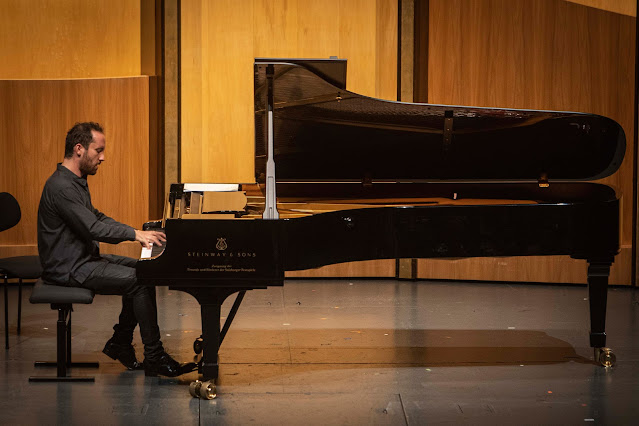
Lugansky - Schumann and Chopin, 12 May 2026


Wigmore Hall

Schumann: Kinderszenen, op.15; Humoreske in B-flat major, op.20
Chopin: Preludes, op.28

Nikolai Lugansky (piano)

The first movement from Kinderszenen announced, if a little stiffly, an absorbing recital of Schumann and Chopin from Nikolai Lugansky. We can all, to be fair, take a little time to get going. Thereafter, I had few, if any, reservations concerning playing that combined musical integrity and superlative playing to great effect. Indeed, recalling my previous most recent visit to the same hall, Lugansky’s performance was, if not necessarily superior to, certainly less wilful than Pavel Kolesnikov’s markedly different conception and execution last month. The relationship between pieces penetrated to the heart of opposing forces in Schumann’s music. Dazzling fingerwork in ‘Hasche-Mann’ seemed to enable, even to necessitate, yielding in ‘Bittendes Kind’, which in turn led to greater freedom in ‘Glückes genug’. ‘Träumerei’ dreamed, yet carried on, finely shaped without sounding unduly moulded, instigating an infectious response in ‘Am Kamin, that yet at the outset seemed possessed of an almost Mozartian sadness beneath the surface, albeit soon dispelled. For contrasting characteristics were certainly present within pieces too, as in ‘Ritter vom Steckenpfered’, indeed there almost disturbingly so. Changes of mood and complexity led us seemingly inexorably to ‘Der Dichter spricht’, blessed by touching nobility and considerable poetic depth. 

Humoreske furthered that kaleidoscope of moods, unfurled both within and between movements. The ambiguity of the first, for instance, suggested very much a knife-edge, which could go either way. Ultimately, it was Schumann’s poetic idea, once more, that held things together—an idea, of course, brought into being in performance by Lugansky. That Schumann was a Romantic and Romanticism was above all a literary movement that came to influence and shape other art forms may seem obvious points to make, but they can readily be forgotten; certainly not here, as a parade of characters and narrators made their presence felt. Voicing of lines unlocked many a door, to exultation as well as quandary. The work’s undeniable formal complexity was shown, ultimately, to rest above all upon questions – perhaps answers too – of feeling. 

Chopin’s Preludes followed, again very much a cumulative sequence, the C major opening succinct, laconic, Webern-like in essence if hardly language, a brief-curtain raiser to a further parade of characters, emotions, and more. Lugansky’s A minor Prelude captured beautifully both tension and ultimately marriage between hands: a technical problem (and opportunity) brought to étude-like musical life. Bright, gymnastic, liberated by the keyboard, its G major successor in turn necessitated both sadness and inner strength in its E minor counterpart. We heard and felt Schumannesque flickering in volatility, engrossing tumult, Bachian homage in harmony and counterpoint, and jet-black malevolence (as in the E-flat minor and F minor preludes). There was also plenty of time and space for reflection, the D-flat Prelude – ironically, given its ‘Raindrop’ nickname – clearing the skies magically, only for them to darken again in its ominous middle section, the close nicely ambiguous as to which had won out. If, in the end, blistering, tragic vehemence won out (G minor as well as the final D minor) then memories of much else, as in the Schumann works, persisted. There was no either/or. 

Nor, indeed, was there in three finely contrasted encores, at least taken as a whole. The A-flat ‘Duetto’ Song Without Words brought Mendelssohn closer still to Schumann, Chopin’s Fantaisie-Impromptu no less magical, yet more overtly thrilling. I am not sure I have ever heard the latter better played. Likewise Rachmaninov’s C minor Prelude, op.23 no.7, sounding as the composer’s piano music always should: music for the Steinway.


Friday, 17 April 2026

Kolesnikov - Schumann, Feldman, and Schubert, 16 April 2026


Wigmore Hall

Schumann: Kinderszenen, op.15
Feldman: Palais de Mari
Schubert: Piano Sonata no.18 in G major, D 894

Pavel Kolesnikov (piano)  

Pavel Kolesnikov is an uncommonly, very particularly interesting pianist and musician. His performances are never ‘standard’ or run-of-the-mill, yet I have no recollection either of finding them perverse or self-regarding. They seem always to take their leave from programming, often remarkable in itself, but as much to the point suggesting a work (sometimes a single piece of movement) might have been performed very differently in a different programme. This recital, with Schumann and Schubert sandwiching Morton Feldman’s final piano work, Palais de Mari, might appear relatively conventional on paper—though how many opportunities do we have to hear that or any Feldman piano music? Schumann and Feldman in particular seemed to inform one another in performances pointing to unsuspected kinship. Yet, whether it were that way around, or more that Kolesnikov’s conception of the three works had prompted the programming in the first place – presumably, some measure of both – artistry and commitment were such, one almost wondered no one had thought of doing this before, whilst the nature of this programming and performing alchemy retained an element of mystery in precisely how and why they complemented one another so well.

Schumann’s Kinderszenen received a captivating performance: rapt, poetic, its contrasts seemingly emanating from the work ‘itself’ rather than imposed upon it from without. Each movement possessed, was even possessed by, its own character, also taking its place in the necessary sequence. Like that of all the best Schumann pianists, Kolesnikov’s voicing was exquisite, yet never for its own sake, telling rather of the wayward, flickering, brilliant subjectivity at work in the score. He built it to a veritable black pearl of a ‘Träumerei’, taken very slowly (presaging Feldman), maintaining line without so much as a stretch mark. It was a case of suspended animation: a canto sospeso even, and indeed he invited us to listen with all the concentration we must lavish on a work by Nono. (It would be wonderful, I suspect, to hear him in such music.) Kinship with Chopin was particularly evident; it was, though, kinship rather than identity, earlier common roots, for instance in Bach, apparent, though again without didactic underlining. This was a truly Romantic, even Jean Paul-like performance to savour.

But then, before the poet spoke, another intervened, perhaps a painter. Feldman’s Palais de Mari takes its leave from an image he saw at the Louvre of a ruined Babylonian palace. Kolesnikov drew us in to a work that is never quite static, though it certainly takes its time. Does one often not, when something strikes one in a museum or gallery? Here, it sounded as if Schumann’s neo-Bachian inner voices attempted with every chord to progress, to develop, yet each time could not: a different, yet mysteriously related form of suspension. A certain similarity, perhaps superficial but perhaps not, to the last of Schoenberg’s op.19 Piano Pieces emerged, albeit on a canvas that owed more to Rothko than to Schoenberg’s very different, highly personal form of expressionism. Minimalist? Yes, in a proper sense, though it does not seem to me to have anything in common with most of the music that has taken that name. I was transfixed, as most of the audience also seemed to be. After which, der Dichter sprach: again, in highly measured, almost prophetic terms. It could hardly have been better judged.
 

Highly effective use, unless my ears had deceived me, of the una corda pedal, especially in the Feldman, effected a bridge into the similarly pedalled opening of Schubert’s G major Sonata, D 894. When the full complement of strings was finally heard in the first movement, the suggestion was of an act of Creation: ‘and there was Light’. I also thought of Edgar Reitz’s use of colour in his Heimat series; for me, at least, there was a sense of that haunting by memory, a reminiscence perhaps of Die schöne Müllerin, a staging post even to Winterreise. As so often with Schubert, Dylan Thomas’s ‘Rage, rage against the dying of the light’ seemed to haunt pages and performances. It felt slow, though not Richter-like glacial. That might have been an obvious choice post-Feldman, but here there was a sense of self-collection in the wake of the first half, furthered in the final three movements. Kolesnikov’s dynamic range was considerable and always considered; his exquisite tone never hardened, though it certainly impressed, at times in almost Lisztian fashion. Often the performance dealt in opposites, but it mediated too, as does Schubert. This music had lilt too; it danced. Line, lyricism, and proportion were all impeccably judged, again appat emerging from the material itself. Above all, though there was sadness, this was never lachrymose; there was resolve, even strength, to be heard and personally felt.

‘L’Egyptienne’ from Rameau’s G major/minor suite in the Nouvelles Suites de Pièces de Clavecin made for a refreshing, bracing, indeed vigorous encore: as much a reaction as a complement, fashioned in a highly particular burst of enthusiasm one imagined might well have been very different in other circumstances.

Friday, 9 January 2026

Gerstein - Liszt and Brahms, 7 January 2026

 Wigmore Hall


Liszt: Three Petrarch Sonnets, S 158; Années de pèlerinage, Deuxième année: Italie: ‘Après une lecture du Dante’, S 161/7
Brahms: Scherzo in E-flat minor, op.4; Piano Sonata no.3 in F major, op.5

Kirill Gerstein (piano)  

Kirill Gerstein’s visits to the Wigmore Hall are fast becoming – for many, have fast become – highlights of its season. His captivating Busoni series was certainly that. Ringing in a New Year, more or less, with Brahms and Liszt was no less impressive, technically or poetically. Indeed, as with all the best performances of such music, to distinguish between technique and poetry would have been complete to miss the point. 

The first half was Liszt’s: the three Petrarch Sonnets and the ‘Dante’ Sonata. A splendid opening flourish signalled the pianist’s arrival, response coming in held-back, almost laid-back fashion: quasi-improvisatory, as if we were invited to an exclusive salon concert in which the composer-pianist were to treat us to his paraphrases. Fresh yet considered, it sang beautifully, as did the others. They emerged as kindred spirits, yet with very much their own characters and souls. The second was similarly bold and convincing in its rhetoric, with a ravishing core, its climaxes still more exultant. Synthesising and extending qualities from both, the third could be heard almost as another face of the same mountain. Romantic freedom, eloquence, and rapture, but also rigour held the audience in the performer’s – and composer’s – hand. Perhaps the penultimate note was hit a touch too hard for the closing sigh, but really that only showed the performer to be human. 

At the beginning of 2026, most of us have long abandoned all hope, yet still we entered the Dante-Liszt Inferno. Here, the opening was, if anything, still more declamatory: as befits the subject, one might say. Detail, structure, and expressive content were inextricably related in the immediacy of the moment, the narrative as vivid as in any symphonic poem, only here with the added white heat of pianistic virtuosity. Underlying pulse was rock-solid, permitting great freedom in its variation. The story was not only told but felt—and what a story it is. 

Brahms’s E-flat minor Scherzo, op.4, is not his most characteristic work, though it was interesting to hear something akin to his more mature voice coming through, just as it might have done when the composer introduced it to Liszt in 1853, two years after its composition. Gerstein’s performance took its leave, as does Brahms, from Beethoven in propulsion and Schumann in occasional parenthesis, Brahms as ‘Brahms’ emerging from within in muscular energy that yet preserved space for poetic rumination. Here, undoubtedly, was a Classicist in Romantic clothing—though never formulaically so. 

The Third Piano Sonata, itself dating from 1853, underlined Brahms’s difference from Liszt, also coming as a kindred spirit to the Scherzo. If the mature voice were still only intermittent, Gerstein certainly brought it out when he could, in a performance of the first movement that at times seemed already to look forward to the First Piano Concerto. Its contours were traced with fidelity and illumination, as were those of the following Andante espressivo. Its shadow seemed to fall further into the future, although there was plenty of Schumannesque Innigkeit to savour too. The Scherzo, like its solitary predecessor, was both pianistic and straining towards the orchestral, sprung rhythms key to that combination. The Intermezzo united tendencies from both second and third movements, settling with greater simplicity than the second in a darkly compelling reading. Equally compelling was the finale, its relative complexity never eclipsing clarity of trajectory. Gerstein proved a sure guide in what can often prove highly treacherous terrain. That it ended with just a touch of well-judged, Lisztian grandiloquence was both meet and right. Schumann’s Blumenstück tied together various threads as a substantial encore, beautifully voiced, with Chopin’s A-flat major Waltz, op.42, a delightful, generous response.


Thursday, 19 June 2025

Horton - Schumann, Stockhausen, and Chopin, 17 June 2025


Wigmore Hall

Schumann: Piano Sonata no.1 in F-sharp minor, op.11
Stockhausen: Klavierstück VII
Chopin: Nocturne in C-sharp minor, op.27 no.1; Nocturne in D-flat major, op.27 no.2; Mazurka in A minor, op.59 no.1; Mazurka in A-flat major, op.59 no.2; Mazurka in F-sharp minor, op.59 no.3; Piano Sonata no.3 in B minor, op.58

Tim Horton (piano) 

Dedicated to the memory of Alfred Brendel, whose death had been announced earlier that day, this latest instalment in Tim Horton’s Wigmore Hall Chopin series offered a programme which Brendel might not have given but of which he would surely have approved. It opened with Schumann’s early F-sharp minor sonata, described in Jim Samson’s excellent programme note as ‘immensely challenging’. Indeed, seems the appropriate response: certainly for the pianist but also, I think, for the listener—or at least this one. Know and love much of Schumann’s piano music as I do, this work I struggle with. Often one needs to wait for such music to knock on the door, which it has yet to do for me. Horton, though, gave a commanding account, properly ‘orchestral’, though unquestionably written for the instrument to hand. The strange ‘Introduzione’ to the first movement, turbulent yet controlled, was given with a sort of tragic dignity that already spoke of affinity with Chopin, as did more ruminative passages later on. Schumann’s unusual conception of sonata form here was given its due: communicated rather than ‘explained’. The ‘Aria’ came initially as Eusebian relief, soon complicated to an almost Brahmsian degree: all over far too quickly, leaving one longing for more. Infectious energy characterised the scherzo, duly balanced by its trio, prior to quasi-Beethovenian struggle in a finale whose range of colour could not help but impress. the ascent to final climax finely prepared and achieved. 

I suspect I may have been in a minority in the audience in finding Stockhausen’s Klavierstück VII less challenging; yet perhaps not, given Horton’s vividly communicative, comprehending performance. It captured both what (as with almost any piece) is ‘of its time’ and what has enabled it to endure as key work in the piano literature. Attack, duration, all parameters were inextricably connected in a ravishing poetic vision of piano resonance and overtones. One could not help but listen in a different, moment-oriented way; one likewise could not help but be rewarded for doing so. 

The second half was given over to Chopin. The pair of op.27 Nocturnes complemented each other beautifully, independence of hands explored in different ways in both. Both were finely shaped, evidently conceived in single, long, ever-varying breaths. Telling rubato made its point without distracting. Both sounded as miniature tone poems: surely what they are. The three op.59 Mazurkas worked equally well as a set and as individual pieces, a fine lilt to the first ushering them on their way. What rhythmic and harmonic subtleties there are here, and what subtle yet unmistakeable pride, which latter quality also helped usher in the Third Piano Sonata. The first movement’s originality may be less startling than that of its counterpart in the Second Sonata, but it was nonetheless palpable in a performance that unfolded with all the time in the world: certainly not slow, yet equally neither hurried nor harried. Will-o’-the-wisp fluttering of the scherzo, turned on its head in the trio, prepared us more in contrast than kinship for the darkness that born in harmony and harmonic rhythm for the slow movement. The fantasia-like quality Horton brought to the finale both surprised and crowned, in a sense presaging similar qualities in the encore, the F-sharp major Nocturne, op.15 no.2, whose tonality also connected us to the close of the Schumann sonata. I look forward to the continuation of this fascinating series.


Friday, 17 May 2024

Kozhukhin - Widmann, Schubert, Ligeti, and Liszt, 16 May 2024


Pierre Boulez Saal

Widmann: Idyll and Abgrund (Six Schubert Reminiscences for piano)
Schubert: Piano Sonata in G major, D 894
Ligeti: Études, no.13: ‘L’Escalier du diable’
Liszt: Piano Sonata in B minor, S 178

Denis Kozhukhin (piano)

With this intelligently programmed and performed recital, Denis Kozhukhin reminded us what an interesting musician he is. Both halves presented a major piano sonata – two of the most celebrated and, in different ways, difficult in the repertoire – preceded by a more recent work either, in the first case, paying explicit reference to the earlier composer or, in the latter, holding something diabolically transcendental in common. 

Jörg Widmann’s 2009 Idyll and Abgrund, subtitled Six Schubert Reminiscences for piano, opened the programme. If its first ‘reminiscence’ certainly had melodic roots in Schubert, its harmonic world initially seemed closer to late Liszt, before heading in another direction altogether, heavy dissonant interventions in the treble sounding oddly like Schnittke. That composer also came to mind in the mode of expression of the second, though Schubert and indeed Brahms, as well as a more general (typically for the composer) relationship to German musical Romanticism were present. There were here and throughout so many ghosts that I cannot remember them all, and am not sure it would be helpful to list them even if I could. A charming waltz began, only to be partially obscured, yet soon returned to go a little haywire, pianist’s whistle and all. Kozhukhin offered a fine lilt, always idiomatic without sentimentality. There were starker passages. And surely that was Schubert’s final piano sonata I heard in the last movement, just before the close. But so what? Reference, allusion, or kinship were apparent, ‘meaning’ more allusive—and doubtless rightly so. 

Schubert’s own G major Sonata, D 894, followed. The first movement, Molto moderato e cantabile, was taken at no Richter tempo; how – why – would one imitate the inimitable? But it certainly took its lead from Schubert’s marking, as indeed did all four movements, in character as well as mere speed. A sense of sleepwalking, as in Thomas May’s programme note quotation from Alfred Brendel, was apparent, Schubert striding ‘across harmonic abysses as though by compulsion, and we cannot help remembering that sleepwalkers never lose their step’. Kozhukhin’s command of line certainly suggested this. One might, at any one moment, have been forgiven for thinking Schubert was not really in the business of development, but he was, through a stasis that was only apparent yet no less ‘felt’ for that. And he proved just as adept as summoning ghosts, albeit without any compulsion to name them. Form grew out of what we heard rather than being imposed upon it; that said, there was no doubting the moment of tonal return, nor the transformed nature of material thereafter. What a pity, then, that someone’s telephone went off at the first movement’s close, visibly disconcerting pianist and audience alike. The Andante received a similarly ‘interior’ reading, passages turning outwards where called for and not without violence. It made sense, again as if from deep sleep. This music can certainly be understood dialectically, yet it was less clear than with Beethoven that that would be the point. It came from a damaged world, a damaged psyche, Adorno’s Minima moralia coming to my mind, but showed great strength from within. The minuet asked and responded, the difference between question and response meaning all—both to pianist and composer. Its trio offered a vision of something beyond, perhaps heavenly, whilst unable or unwilling to let go of remaining, unbridgeable distance, as if a Bach musette found itself in the world of Mahler’s Fourth Symphony, neither party knowing quite what to do. The final movement brought us back to earth, perhaps, whilst remembering what had just passed (and in truth, we had never really left). This was the wayward progress of music that wishes to approach Mozart, yet actually ends up further away. Might Kozhukhin have confronted the abyss more starkly? Perhaps, but his long, unbroken line told its own story. 

The thirteenth and longest of Ligeti’s Etudes, ‘L’Escalier du diable’, offered a strong pictorial sense of its titular inspiration without being bound by it, nor indeed by anything else other than a precision the composer would surely have admired. The craziness of its technical demands and their fulfilment were all part of the challenge—and the fun. Dynamic levels were as rock-solid as rhythm, a big, post-Romantic sound as present where required as interior unwinding. It was probably just my imagination, but I could have sworn a chord emerged, perfectly in keeping, as if from the world of Messiaen. In any case, the final resonance was surely one to rival Stockhausen. 

It made for an ideal curtain raiser to the Liszt B minor Sonata, which began with an almost modest precision that was actually more a case of knowing where the music must lead. That precision remained, as did tautness of conception, again with fine command of line to recall Schubert. There was no haze here, though, in a performance that was bright even when dark, and ever immediate. If there were sleepwalking here, it was of a more nightmarish quality. Kozhukhin did not shy away from rhetoric as such, the first statement of the second subject, for instance, highly declamatory, but form and, even on occasion, a certain formalism were more to the fore. Perhaps the performance, then, sprang from Ligeti in that sense too. Again, it was certainly not that Kozkuhkin could not spin a compelling, even spell-binding cantabile line; he could and did. Integration nonetheless always seemed his ultimate concern. Clarity of texture and purpose was admirable, even if I occasionally missed a little Romantic mystery. (Was that just me trying to have it all? Probably.) There were surprises, though, in the sense that new points of departure, the fugato a case in point, truly sounded as such, even when one ‘knew’. The true recapitulation sounded, again, with all the inevitability one could wish for. It was, perhaps, a more modernistic story than often, but that is inherent to Liszt. And on the very few occasions when the music threatened to escape even the most iron self-control, that is surely part of Liszt and Lisztian performance too. This sonata will never sound ‘perfect’; it is not Mozart and is not trying to be. It was something different from that and all the better for it. 

A moan: must audience members really tell each other loudly what an encore is when a musician begins to play it, or just as bad, give a stage-sigh of satisfaction? Well done: you have recognised Schumann’s Träumerei, one of the most celebrated and likely encores in the piano literature. Fortunately, Kozhukhin gave an honest account, beautifully voiced. To be fair, no one made such noises for the first encore, perhaps because – like me – they did not know what it was. Hymnal and, if I remember correctly, slightly modal, it had melodic and harmonic characteristics I might have guessed to be Russian. I wondered whether it might have ‘meant’ something beyond its notes; at any rate, Kozhukhin clearly believed in and winningly communicated those notes.

Wednesday, 30 August 2023

Salzburg Festival (3) - Bernheim/Tysman: Schumann, Duparc, and Chausson, 19 August 2023


Haus für Mozart

Schumann: Dichterliebe, op.48
Duparc: L’Invitation au voyage, Phidylé, La vie antérieure
Chausson: Poème de l’amour et de la mer, op.19

Benjamin Bernheim (tenor)
Sarah Tysman (piano)

Image: SF/Marco Borrelli

When singers known primarily for opera venture into the song-recital world, results may, unsurprisingly, vary. Here, in an ambitious programme from Benjamin Bernheim, accompanied by Sarah Tysman, there was considerable variation within the programme too. Whilst it would be tempting to ascribe this primarily to the differences, far from only linguistic, between French and German song, a rapt first encore of Strauss’s Morgen suggested matters were not quite so simple. So too, for what it is worth, did the excellence of Bernheim’s German.

Nonetheless, Schumann’s Dichterliebe proved only intermittently successful, far from helped by penny-plain accompaniment (very much accompaniment rather than partnership). There were lovely moments; a slow yet sustainable ‘Im wünderschönen Monat Mai’ promised much for what was to come, likewise and ardent ‘Wenn ich in deine Augen seh’’. Words were always clear, as was their meaning. An animated ‘Aus alten Märchen’ imparted a sense of what might have been, in more than one sense. But deeper meaning, the sheer, unbearable sweetness of suffering, and so much more proved elusive. If it were not so straightforward as exchange of detail for the broader brush, it was difficult not to feel stage familiarity might have impeded a deeper performance.

Both artists sounded transformed in Duparc and Chausson: more animated and, as it were, more ‘inside’ the music. The three Duparc songs had everything: shape, range, style, and a keen sense of metaphysics beneath the surface. Readily, absorbingly communicative in both vocal and piano parts, their subtle ecstasy left one in no doubt this was the real thing.

Chausson’s Poème de l’amour et de la mer benefited, quite properly, from a more wandering approach that was yet fundamentally grounded, like Chausson’s Wagnerian harmony, in something that had not taken leave of its moorings. The deceptive ease of Bernheim’s singing was striking in its clarity and, again, its communication. Tysman rose similarly well to the ‘symphonic’ challenges of performing Chausson on the piano. This is almost at times a symphonic poem with voice as much as a song-cycle; where necessary, it sounded like it. The Romantic dolour of ‘La Mort de l’amour’ became ever more deathly through its passage, at times semi-hallucinatory, at others clarity itself spelling death. French, moreover, throughout sounded as if it were the easiest language in the world to sing: a signal achievement for any singer, Francophone or not.


Tuesday, 27 June 2023

Pollini - Schumann and Chopin, 23 June 2023


Royal Festival Hall

Schumann: Arabesque in C major, op.18; Fantasie in C major, op.17
Chopin: Mazurka in C minor, op.56 no.3; Barcarolle in F-sharp major, op,60; Scherzo no.1 in B minor, op.20

Maurizio Pollini (piano)


‘Who is the world’s greatest pianist?’ is a silly question, although human beings have long been prone to ask and indeed to answer silly questions. So long as it remains at the level of the parlour game, it probably does no great harm, though it is unlikely ever to illuminate either. For more than half a century though, Maurizio Pollini has stood as one of the world’s greatest: not merely, or even principally, from the standpoint of technique, awe-inspiring as that long was, but as a musician of penetrating intelligence and insights, committed equally to classical and new repertory. Whether in Beethoven or Boulez, Chopin or Stockhausen, Pollini at his best might occasionally be equalled, yet, allowing for vagaries of taste and opinion, never surpassed. 

More recently, that fabled technique, out of which were born and formed performances of white-hot intensity, has proved more fallible. It has sometimes taken Pollini a little time to ‘get going’ in a recital, though the second half and encores have at least tended to show him still at his best. This Festival Hall appearance, postponed from earlier in the year, offered uncomfortable listening – and viewing – yet ultimately proved a triumph of the human spirit, one that involved audience warmth, involvement, and encouragement too. There were flashes and sometimes more than that of the younger musician alongside the memory lapses. As we progressed towards the end of the recital, aided now by sheet music and a page turner, Pollini showed something far more valuable than the sort of interchangeable, note-perfect feat of virtuoso execution one might hear from some. For those of us who have grown up with him, it was an evening of very mixed emotions, but it was ultimately a chance to remember the journey we have taken with him, how much we have learned from it, and how much we shall continue to do so.

Schumann’s Arabeske suggested Bach led in new clothes into the age of Romanticism. The whiteness of C major sounded pristine, rare, and yet far from vulnerable, possessed of a strength belying so much. Florestan and Eusebius presented themselves and did varied battle throughout the work’s episodes and return. The epilogue in particular was truly touching: light yet decisive in piercing of the heart. The Fantasie opened with a sense of its greater scale and ambition, reference seemingly made as much to the venerable history of the keyboard fantasia as to Schumann’s more obvious points of closer reference. There were passages of high Romantic vehemence when poise returned, though ultimately a performance of the whole was not to be. That setbacks had neither pianist nor audience give up, though, was something in which to take solace and always to remember. 

A plain-spoken Chopin Mazurka in C minor opened the second half, sadness seeping through as it must. Repeated rhythms and chromatic inflections took on greater, metaphysical meaning in context. In the Barcarolle, the waters rose once again, the gondola took flight, and surveyed familiar yet ever-strange landscapes, perhaps for the last time. One never knows—and for that reason should always make the most of what one has. The B minor Scherzo presented tumultuous flashes of old: in part muscle memory, doubtless, for there will always be something of that in any performance. But it was not only that; anger, tenderness, and more came to the surface via a cantilena that was unquestionably the real thing.

Sunday, 7 May 2023

Levit/Volodin - Schubert, Schumann, Mozart, Debussy, and Rachmaninov, 6 May 2023


Wigmore Hall

Schubert: Allegretto in C minor, D 915
Schumann: Arabeske in C major, op.18
Mozart: Sonata in D major, KV 448/375a
Debussy: En blanc et noir
Rachmaninov: Suite no.1 in G minor, op.5, ‘Fantaisie-tableaux’

Igor Levit, Alexei Volodin (pianos)

Two-piano repertoire seems, for reasons I do not fully understand, to appeal more to pianists than to general audiences. The Wigmore Hall was nonetheless full and greatly appreciative for this coronation-day recital from Igor Levit and Alexei Volodin. First, though, we heard two solo items: Schubert from Levit and Schumann from Volodin. 

It was Schubert, in the guise of the C minor Allegretto, who to my ears came off best. A wonderfully ‘sung’ opening phrase somehow managed to sound as if it were responded to by a piano ‘accompaniment’, and so forth, counterpoint proving the means through which the two ‘instruments’ were united. It was a startlingly rhetorical performance whose argument remained coherent, indeed gripping, throughout. And there was an undeniably Schubertian harmonic core to this well-nigh visionary opening. Volodin’s Schumann, the C major Arabeske, began in similarly promising, albeit more conventional fashion. It sounded immediately as one would expect, moments of robbed time and all. Points of detail illuminated rather than distracted. It was, moreover, good to hear the episodes played with due heart on sleeve. My reservations came, however, when they became more wilful, disrupting the overall line. Perhaps, though, that is more a matter of taste than anything else. 

Mozart’s Sonata for two pianos in D major followed. There was much to admire in it, not least a responsorial opening to the first movement that seemed to take off where Levit’s own responsorial Schubert had left us. Tricky balances between contrast and complement were well navigated. Ultimately, though, I found it somewhat unyielding, especially from Volodin, the very opening of the development section a welcome exception. The slow movement was taken with welcome seriousness and attentiveness, though here and in the finale a little more smiling would not have gone amiss. Subtle ornamentation nonetheless proved a welcome addition. There was on occasion a sense of fun to the finale, mostly from Levit, but warmth and affection were in relatively short supply when compared with, say, the hallowed likes of Daniel Barenboim and Martha Argerich. 

The duo captured well the abstraction of Debussy’s En blanc et noir, without neglecting the first movement’s more obviously ‘poetic’ passages, thereby thrown into greater relief. A due sense of mystery rose in all movements seemingly directly from the keys—and of course the fingers upon them. The dark malevolence of the second movement and a fine sense of aerial suspension in a nonetheless keenly directed closing Scherzando came close to the heart of Debussy’s enigmas, making this unusual work sound more characteristic than is often the case.

Crowning the  proceedings was the first of Rachmaninov’s two suites for two pianos. The opening Barcarolle conveyed from the outset an impression of settled idiom, such that occasional languor could register meaningfully within its bounds. Chopin and Liszt both lay behind the writing, yet one could never reduce what one heard to mere ‘influence’. The two pianists offered an intriguing sense of a more modernist sense of proliferation than that with which we might always associate the composer. Richly Romantic, without indulgence, the second movement was similarly well judged in shape and direction, permitting a sense of the fantastic it is difficult not to stereotype as ‘Russian’ to take flight and form. ‘Les Larmes’ built powerfully and subsided with equal care, founded on a deep-seated sadness that resists verbalisation. The closing ‘Pâques’ showed Rachmaninov in Mussorgskian vein, bells from Boris Godunov sublimated (perhaps not entirely without irony) into celebration of Easter.

Friday, 21 April 2023

Schumann Quartet/Vinnitskaya - Schumann and Reimann, 20 April 2023


Wigmore Hall

Schumann: String Quartet in A minor, op.41 no.1
Reimann: Adagio (Zum Gedenken an Robert Schumann)
Schumann: Piano Quintet in E-flat major op.44

Erik Schumann, Ken Schumann (violins)
Veit Benedikt Hertenstein (viola)
Mark Schumann (cello)
Anna Vinnitskaya (piano)

I welcomed in February an excellent concert of Schumann and Brahms from the Schumann Quartet and Pablo Barrágan. This latest instalment of The Schumann Show – there will be a third in July – had still more Schumann: two of the composer’s works, plus another derived from his material and dedicated to him. It made for a fine successor, as did pianist Anna Vinnitskaya, joining the players for the Piano Quintet. 

The first of two works from 1842 was the A minor String Quartet. The first movement introduction invited us in, showing at the same time just how well Schumann knew his Bach, refracted by a Beethovenian lens. More important, its inwardness and pregnancy with possibility were very much to the fore, the surprise of Schumann’s move to the major mode for the Allegro registering subtly as part of his general tonal and developmental scheme; there was no need to hammer it home. Fiery and intimate by turn, and sometimes together, this performance certainly had the movement’s measure. Vigour characterised the second and four movements, though neither, rightly, was without vulnerability. Whirlwinds of different character, the former counterbalanced by a charming, sinuous trio, the latter full of post-Mendelssohnian life, they framed an Adagio rich both in secrets and in their divulgence. There was something almost operatic to it: Onegin on the Rhine, perhaps, though its heart still very much beat after Beethoven (not least his example in the Ninth Symphony). 

Aribert Reimann, a composer sadly overlooked in this country and probably best known here for work as a pianist with Dietrich Fischer-Dieskau, descends from one of the doctors who treated Schumann at his Endenich asylum. In 2006, 150 years after Schumann’s death, Reimann published the medical records he had inherited and composed an Adagio in memory of Schumann based on two chorale harmonisations Schumann had made at that time: ‘Wenn mein Stündlein vorhanden ist’ and ‘Stärk uns, Mittler, dein sind wir’. The Schumanns played the first, alongside Ken Schumann’s valuable spoken introduction to the piece, followed by a fine performance of Reimann’s typically post-Expressionist response. Prolongation, incision, elaboration, and other procedures enabled him – and us – to encircle those sad yet noble last musical words, as did Reimann’s own musical assailants and/or angels. Why, after all, choose?

Vinnitskaya and the Quartet gave us a warm and equally distinguished performance of the Piano Quintet, balance between instruments always finely judged, to the extent one would never have known it might be a problem. In the second group, viola and cello, shadowed and responded to by two violins, reminded us that Schumann’s own instrument is perhaps not even first among equals here, but simply an honoured equal. It was a dynamic reading that yet always found space for the musical drama to unfold. A tumultuous first-movement development and return took nothing for granted, taking us to quite a different place from where we had begun. Ghostly urgency in the second movement, contrasted with hallucinatory episodic visits to the Schubertian major-mode, duly unsettled. So too did Veit Benedikt Hertenstein’s dark viola solo. Full-blooded, almost Brahmsian eruption made its point with power and elegance.  Vinnitskaya’s dexterity, never in doubt, was certainly on show in the scherzo: another whirlwind to succeed those two in the String Quartet. Trios of very different character were equally relished; this was almost, not quite, an embarrassment of musical riches. An enthralling performance of the finale was given in, again, different yet consequent character. That first-movement combination of urgency and space was present also here. The Furiant from Dvořák’s second Piano Quintet made for a lovely encore—and indeed had me wish to hear the whole thing. Another time, I hope.


Tuesday, 14 February 2023

Gerhaher/Huber - Holliger, Wolf, Schumann, and Schoeck, 12 February 2023


Wigmore Hall

Holliger: Elis
Wolf: Abendbilder
Holliger: Lunea
Schumann: Vier Husarenlieder, op.117
Schoeck: Elegie, op.36: ‘An den Wind’, ‘Herbstgefühl’, ‘Verlorenes Glück’, ‘Das Mondlicht’, ‘Herbstentschluss’, ‘Welke Rose’
Schumann: Sechs Gedichte von N. Lenau und Requiem, op.90

Christian Gerhaher (baritone)
Gerold Huber (piano)


Any recital from Christian Gerhaher is likely to be special; offering a range of quite unusual repertoire, Heinz Holliger’s Lunea written for and dedicated to Gerhaher, this was no exception. It opened, though, with a rare solo spot for Gerhaher’s long-term collaborator, pianist Gerold Huber, and early (1961, revised 1966) Holliger. Gerhaher reading the three Georg Trakl texts on which Elis’s three short piano pieces, ‘Verkündigung des Todes’, ‘Todesangst und Gnade’, and ‘Himmelfahrt’, are based, even providing his own English translation for the programme sheet. Strikingly post-Schoenbergian harmony characterised the first, though its musical gestures worked differently. The soundworld of the second sounded later, more post-Webern, if you will, indeed surely marked by Holliger’s contemporary study with Boulez, albeit with a Germanic accent. ‘Himmelfahrt’, as its name might suggest, seemed in some sense both to reconcile and to go beyond. These aphoristic nocturnes emerged pregnant with emotion, gesture, and – who knows – perhaps ‘meaning’ too. 

Hugo Wolf’s Abendbilder (again early, 1877) followed, without a break. In context, the piano prelude to the first of the three sons sounded Romantically consoling, yet not unrelated: an excellent starting point for our Wolfram von Eschenbach, sorry Gerhaher, to sing, the sincerity as well as beauty of his delivery striking from the outset, likewise command of detail without pedantry. All three Nikolaus Lenau ‘pictures’ rightly formed part of a greater whole, whilst happily going on their own, sometimes pastoral, ways. It was difficult not to marvel at the different shades and colours of Gerhaher’s voice, poetically deployed, an sinking wanness as the sun set (‘Bald versinkt die Sonne’, an example in point. Shades of Schumann and Liszt in language and performance contextualised without overwhelming.

We remained with Lenau for Holliger’s Lunea, written from 2009-10, though only premiered at Zurich’s Opera House in 2013 (also venue five years later for the premiere of Holliger’s opera of the same name, featuring Gerhaher, reworking these settings ‘like chorales in a Bach Passion’). Notably more gestural than what we had previously heard, it yet remains – and, in performance, remained – within the noble Lied tradition. Twenty-two Lenau sentences and a short poem, ‘Einklang’, in memory of Johann Baptist Mayrhofer form a striking cycle that must surely have won the composer new admirers here in London. Gerhaher’s acuity of verbal and musical response seemed ideally suited. That range of colour was now married to a greater range of general delivery, sometimes unabashed song, sometimes recitation, often somewhere in between; extended piano techniques such as bowing the strings acted similarly. Searching melismata unsettled, lit up, even amused, as instances of wordpainting (‘Ein Tropfen im Stein’) worked something like their traditional magic of recognition. Wonderfully nomadic harmony illuminated Lenau’s Wüstenwanderer, prior to that neo-Schubertian postlude of ‘Einklang’.  

I struggle to find Schumann’s Lenau Husarenlieder among his more compelling work, but they received stylish, commanding performances, with a fine degree, where required, of Schwung. Rhythms were well-pointed, and Gerhaher, rightly, I think, permitted a word-driven approach. A selection of six songs from Othmar Schoeck’s Elegie, four to texts by Lenau, Gerhaher imparted a strong sense, even in the others’ absence, of its character as a whole, yet equally individual character to individual songs. Musical process was clear, courtesy above all of the piano, in ‘Das Mondlicht’. The performance as a whole was subtly surprising: no shocks, yet deeply satisfying provided one offered musical attention.

The final Schumann set showed the composer, at least some of the time, the recapturing the infinitely touching spirit of his youth. Gerhaher and Huber offered plenty of variety in the opening, strophic blacksmith’s song, but it was the ensuing ‘Meine Rose’ that played on the heartstrings. Was that perhaps a sense of Schumann influenced by Wagner, or simply memories of Gerhaher’s Wolfram? At any rate, it brought tears to my eyes. So too did the sense of youthful anticipation in ‘Die Sennin’, whilst ‘Einsamkeit’ and ‘Der schwere Abend’ both turned from disquieting ambiguity to ultimate sadness. The final ardour of the strange ‘Requiem’, offered us flame that flickered both in defiance and reconciliation, perhaps like the Lied tradition’s persistence unto Holliger (and beyond?) ‘Zweifeldner Wunsch’ from Schoeck’s Elegie made for a fitting encore, concluding and continuing a line of subtle questioning.

Thursday, 9 February 2023

Schumann Qt/Barrágan - Brahms and Schumann, 7 February 2023


Wigmore Hall

Brahms: String Quartet no.3 in B-flat major, op.67
Schumann: String Quartet no.2 in F major, op.41 no.2
Brahms: Clarinet Quintet in B minor, op.115

Erik Schumann, Ken Schumann (violins)
Veit Benedikt Hertenstein (viola)
Mark Schumann (cello))
Pablo Barrágan (clarinet)

Brahms and Schumann fit, for many reasons, like a glove. Participation of the Schumann Quartet (named after its three Schumann brothers, not the composer) does no harm either; nor indeed, on the evidence of this concert, does a guest appearance from clarinettist Pablo Barrágan. This was an evening of fine musicmaking throughout, evidently appreciated by the Wigmore Hall audience. 

First up was the third and last of Brahms’s surviving string quartets. (He is said to have destroyed his first dozen, even twenty, attempts, so fierce was his self-criticism, those first efforts having been made at Schumann’s urging.) With the Schumanns, the first movement and much of what was to follow wore their Beethovenian inheritance brightly. Even Brahms’s trademark metrical complexity seemed to spring to an unusual extent from Beethoven’s syncopation. There was something of late Beethoven’s fragmentation too, from at least the second group onwards, though there was never any denying Brahms’s own voice in the work’s undergrowth. None of it, of course, is remotely easy listening, and the development too us to greater extremes, no attempt made, quite rightly, to smooth the edges. The recapitulation seemed, in duly Beethovenian fashion, at least as much a second development as a return.

I was struck, in the second movement, by the relish with which the players communicated Brahms’s melodic profusion: first led by Erik Schumann’s first violin, proceeding to involve all. Still more important was the creation of an emotional world, poised between tragedy and something more affirmative, that engendered. Ghosts of the past made their presence felt: not only Beethoven, but Schumann, Bach, Schubert too. It was luminous, yet unquestionably grounded. A more turbulent third movement followed, seemingly darker and lighter, sometimes by turn, sometimes at once. Veit Benedkt Hertenstein’s viola emerged, properly, as first among equals, soon rivalled by Mark Schumann’s cello. Restless until the end, it prepared a fine contrast with the post-Classicism in work and performance of the finale, charm no more precluding depth than it would in Haydn. Serenity and joy were hard won, and all the more appreciated for that. Here was fulfilment, predicated on prior intense longing.

The first movement of Schumann’s F major Quartet, op.41 no.2, heard him in notably post-Classical style too. The Schumanns’ unhurried approach sounded just right to me: Allegro vivace does not mean the music should be harried, quite the contrary. The theme of the second movement was more inward, exuding all the charm of a ‘characteristic’ piano piece. Variations offered individuality and cumulative unity. By contrast, the scherzo and trio’s intensity and frankly involved character presented a later, almost Tchaikovskian Romanticism. The finale was delightfully puppy-like in character: a Haydn tribute, so it seemed, though with a Romantic heart. 

For the second part, we returned to Brahms, to the Clarinet Quintet. Poised and searching, the first movement presented the clarinet now as first among equals, though Barrágan would generously cede as required. Fuller texture combined with still greater sense of chiaroscuro that attended a keen sense of form—and, with that, an equally keen sense of the Mozartian perfection of late Brahms. The Adagio’s sweet melancholy and resurgent passion, h painful in their memories, contributed further to an idea of ‘lateness’ that was anything but maudlin. Romantic questing captivated in the Andantino, relative lightness of tone yielding ambiguously to darker impulses. Stoicism was the order of the day at the onset of the final theme and variations, which unfolded with all the complexity of a human being’s warring passions. The path taken seemed inevitable at the close, though everything had been to play for during its course. This fully involving performance was followed by an encore arrangement, again for clarinet quintet, of Schumann’s Abendlied: once more poised and with subtly convincing depth.

Sunday, 18 December 2022

Goerne/Ólafsson - Schubert, Schumann, and Brahms, 9 December 2022


Royal Festival Hall

Schubert: Der Wanderer, D 489; Wehmut, D 772; Der Jüngling und der Tod, D 545; Fahrt zum Hades, D 526; Schatzgräbers Begehr, D 761; Grenzen der Menschheit, D 716
Schumann: Meine Rose, op.90 no.2; Kommen und Scheiden, op.90 no.3; Die Sennin, op.90 no.4; Einsamkeit, op.90 no.5; Der schwere Abend, op.90 no.6
Schubert: Des Fischers Liebesglück, D 933; Der Winterabend, D 938; Drei Gesänge des Harfners, D 478
Brahms: Vier ernste Gesänge, op.121

Matthias Goerne (baritone)
Vikingur Ólafsson (piano)


Image: Arnaud Mbaki

A marvellous song recital from two great musicians made clear that there is much more to musical life—and life in general—in December than Advent, narrowly considered, although perhaps ultimately there was a light here to be discerned, shining in the greater darkness of mood and content. Whilst it would have been quite a treat to hear either Matthias Goerne or Vikingur Ólafsson, to hear both, in so productive a partnership, was special indeed. I hope it will not be the first of several such occasions. 

There was little light, at least in the sense of hope, in the opening set of six Schubert songs, though there was plenty of chiaroscuro, etched, painted, chiselled—for Ólafsson’s piano playing, one might say all three, at least—to their performance. The opening of Der Wanderer had one in no doubt that this was no conventional ‘accompanist’; the song began, as if the opening of a sonata: with just such purpose, shaded exquisitely and meaningfully, though far from in abstract. This was, in short, tone poetry—and how it elevated still further Schubert’s art. Goerne, in turn, sang of descending from the mountains, the valley dimming, the sea roaring, and that is just what he seemed to do, a descent as dramatic as if it had been staged, accomplished by voice alone. He spoke, or sang, it seemed with the wisdom of ages: a primaeval scene, from which, in the third stanza, an unmistakeable Viennese lilt could yet emerge. 

That attention to text, not only from Goerne but from Ólafsson too, marked every aspect of this recital: not in a pedantic way, but illuminating, alert to what words can accomplish, what music can, and what both can together (as well as to what both musicians can do together). Der Jüngling und der Tod opens with the sinking of the sun, heard and, crucially, felt from voice and piano alike, the latter’s chords almost Lisztian (as also in the preceding Wehmut), yet propelled by Schubert’s easy, almost profligate way with melody. The sweet beauty of death, or Death, could chillingly be felt at its close. Piano line in Fahrt zum Hades was just as crucial to the song’s course as the vocal line, almost as if this were a vocal sonata. And the piano’s response to Mayrhofer’s dread words ‘dein alter Fluss’ said as much as Goerne’s, finely judged rubato and all. Piano figuration and tone again worked together with voice in Schatzgräbers Begehr, the Lisztian chordal future (‘Il penseroso’, perhaps) returning in Grenzen der Menschheit: a special partnership with Goerne’s declamatory reading of Goethe. 

We turned then to Schumann, to five Lenau songs (nos 2-6) from the Sechs Gedichte und Requiem, op.90. ‘Meine Rose’ set the new scene perfectly from the piano: externally fragile, albeit with inner strength and vitality. Vocal delicacy and security contributed likewise in equal measure. Rankings are inane, yet it was difficult not to be reminded, however fleetingly, why sometimes one feels impelled to elevate Schumann even over Schubert as a song-composer. At any rate, here was a different, later, arguably more complete Romanticism. The magic of the postlude is common to both, of course, though there is something particular to Schumann’s artistry here, as we heard in the closing bars of ‘Kommen und Scheiden’. The expectancy of ‘Die Sennin’, the portrait of loneliness as total condition in ‘Einsamkeit’, and the heaviness, physical and metaphysical, in the air of ‘Der schwere Abend’ were all caught to near-perfection. 

Returning to Schubert, Des Fischers Liebesglück bore renewed witness to the partnership, visible and audible, onstage. These were two performances infinitely responsive to one another, with all the resulting subtleties that engenders, but also the unmistakeable directness of purpose. A robbed moment in time, a dynamic inflection spoke volumes—because it was acted on, part of a whole for both musicians and indeed for the audience too. Piano melodies, in whichever voice, in Der Winterabend had the magic of a Schubert impromptu: infinitely touching, and pregnant of so much poetic promise. The three Harper’s Songs from Wilhelm Meister proved in turn ardent, sorrowful and angry, and something close to chamber music with words, line in both parts supremely well judged. 

And line, if anything, proved still more the guiding thread to Brahms’s Four Serious Songs, here sounding as if Schubert and Bach had joined together to prepare a path new, yet old: which, in a way, is very much what they had. (Not to forget Schumann either.) The compelling flow of the first song, ‘Dann es gehet dem Menschen wie dem Vieh’ seemed to recall the world of Ein deutsches Requiem, albeit here the more finely distilled. Its form was grasped and communicated perfectly, third stanza prepared by its two predecessors and incorporating their insights and experience into a true return. ‘Ich wandte mich’ was delivered as if by the Preacher himself, Goerne in his element. The bell-like quality to Ólafsson’s final chord said just as much. ‘O Tod, wie bitter bist du’ was as dark as the verses themselves; yet, in typical Brahmsian fashion, captured to a tee by Goerne and Ólafsson alike, it revealed a myriad of colours as soon as one truly listened. ‘Rousing’ is perhaps not quite the right word for ‘Wenn ich mit Menschen und mit Engelszungen redete’, but it was perhaps not so far off. It made for a fine conclusion in so many ways, seeming to have the full measure of this extraordinary song both in itself and as the last of four. This was distinguished music-making indeed.

Wednesday, 28 September 2022

Levit - Brahms, Hersch, Wagner, and Liszt, 25 September 2022


Wigmore Hall

Brahms, arr. Busoni: Chorale Preludes, BV B 50
Fred Hersch: Variations on a Folk Song
Wagner, arr. Kocsis: Tristan und Isolde: Prelude to Act I
Liszt: Piano Sonata in B minor, S.178

Igor Levit (piano)


A typically thoughtful programme, brilliantly performed, from Igor Levit: the second half reprising that of his Salzburg recital in August, the first quite different, yet forming an equally coherent whole. First we heard the six of Brahms’s eleven late organ chorale preludes Busoni arranged for piano in 1902. The first, ‘Herzlich tut mich erfreuen’, rightly announced itself paradoxically, or better dialectically, both emphatically as piano music and yet also as ‘letting the music speak for itself’, in that most necessary of clichés. Musical processes behind and beneath the melody revealed two—sorry, three—great minds at work. Brahms’s arpeggiated half-lights emerged, as if from his own piano music; they were never imposed. That attentiveness to material—a sort of dual authenticity, though not in the debased sense the later twentieth century made all too current—marked out ‘Schmücke dich, o liebe Seele’ as more yielding, yet similarly straightforward, and the ineffably lovely ‘Es ist ein Ros entsprungen’ as differently inward, Levit relishing Busoni’s modest interventions. The two preludes on ‘Herzlich tut mich verlangen’ were properly contrasted, the first speaking with a richness of tone apt for a more overtly Romantic outpouring (from both Brahms and Busoni), the second acting with ‘Es ist ein Ros entsprungen’ both to encase that passion, and coming closest to the Passions of Bach. It was deeply moving in its modesty, patience, and depth. Levit took his time, rather beautifully, with the heartbreaking ‘O Welt, ich muß dich lassen’. His dignified performance spoke with a distilled wisdom, like Brahms’s, that seemed to say all that need, perhaps all that could, be said. 

Fred Hersch’s 2021 Variations on a Folk Song followed. An initial statement of a time-honoured theme, here ‘Oh Shenandoah’, provided a connection rather than kinship with Brahms, but enough to have one think. Twenty variations followed. Harmonic recolouring came first to the fore, followed in what I think may have been the third variation by a change of mood to something less ruminative, more extrovert. A wide variety of treatments ensued, one (mostly) for the left hand standing out in dark, muscular fashion, as an heir to Romantic tradition, another insistent and ardent, perhaps a little after Liszt (to come). Others were more inward or floating. This was evidently music Levit had internalised, just as it this clearly represented a tribute from one pianist to another pianist—and vice versa. The principal language may have been forged in the jazz world, but it was generous in its frame of reference—and that generosity extended to spirit too.

Zoltán Kocsis’s transcription of the Prelude to Act I of Tristan was strenuous, big-boned, virtuosic, the emphasis placed very much on struggle, on becoming. Always directed to a goal that was never reached, its oppressive lack of resolution (in more than one sense) led us directly into a performance of Liszt’s B minor Sonata perhaps still more fiery, still more coherent than that I had admired a month earlier in Salzburg. It was similarly bold and questing, and of course more unremittingly virtuosic, virtuosity and rhetoric always means to an end rather than ends in themselves. Post-Beethovenian goal-direction was equally apparent, through rather than despite flexibility. Bringing us to the recapitulation, for instance, Levit triumphantly banished the false dawn of the preceding fugato to the fiery furnace. Form was a living, breathing, even diabolical thing. Liszt here was, quite rightly, both highly integrated and far-flung, Liszt’s essence grasped and communicated.

Detail mattered too: the return of those strange descending scales told us beyond any doubt that, were a single note in them to be changed, so too would the rest of the work. Never, not for one moment, could one doubt our guide knew where he was leading us. For Levit’s command of line, which one might well consider ‘Wagnerian’ in terms of unendliche Melodie, was not the least tool in communicating a pianistic sorcery on Liszt’s part that under the right hands is anything but rhapsodic. As for hands, had I not witnessed the performance with my own eyes as well as ears, I might have sworn there were four at work. This is a masterpiece of musical thought, of course, but it is equally piano music, and sounded as such, reminding me of Donald Tovey’s observation that Liszt’s piano music was that of someone who could not fail to make a beautiful sound when touching the keys. Beauty takes many guises, of course, but Liszt never, ever writes against the instrument. Nor, so it seems, does Levit ever play against it. A beatific close seemed, at least in retrospect, to necessitate the lovely yet plain-spoken encore, (as in Salzburg) Schumann’s ‘Der Dichter spricht’.


Thursday, 25 August 2022

Salzburg Festival (4) - Levit: Bartók, Schumann, Wagner, and Liszt, 24 August 2022


Grosses Festspielhaus

Bartók: Out of Doors, Sz 81
Schumann: Waldszenen, op.82
Wagner, arr. Zoltán Kocsis: Tristan und Isolde: Prelude to Act I
Liszt: Piano Sonata in B minor, S.178

Igor Levit (piano)


Image: SF / Marco Borrelli

For this Salzburg Festival recital, Igor Levit offered a programme of piano music—and, in one case, orchestral music transcribed for the piano—rich in connections explicit and implicit, and beautifully balanced too. Programming is in many ways an art in itself, yet not of course quite in itself: the music needs to be performed at least as compellingly as it has been assembled. There was little problem in that respect here, given performances that never took the works in question for granted, always looked—and listened—afresh.

Bartók’s Out of Doors suite was a welcome choice to open. The drums and pipes of the opening piece gave neither pianist nor audience time to adjust. Poundingly percussive from the word go, it was always much more than that, though: melody and harmony, as ever in Bartók, at least as crucial as the initially startling melodic element. Levit understood and conveyed this, not only here but in the following pieces of very different, highly contrasted character. This suggested what a treat we might have in store from the Sonata and the Piano Concertos; let us hope they are only just around the corner. The ‘Barcarolla’ emerged as a mysterious heir to Chopin et al., those others certainly including Liszt, especially the Liszt of those lugubrious late Venetian works. I thought I heard a kinship to Prokofiev too: less expected, perhaps, but making a great deal of chronological sense. (Kinship need not mean influence in either direction.) Levit’s variety of articulation in service of the musical idea was just the thing to tease out its secrets. Delicately insistent, the ‘Musettes’ presented yet another winding, post-Romantic way, sharply contrasted by the night music of the fourth piece. Bells? Birds? Breezes? Beasts? Who knows? It was certainly Bartók, at any rate, the beating heart of the work as a whole. Independence of hands, the very foundation of Lisztian technique—well, one of the foundations, anyway—was crucial here in delineation and communication. The final piece was every inch the finale, early echoes of the opening taking us along a very different, dancing path. Fiendishly difficult and infectious, this was the piece with the most transcendental virtuosity, in Levit’s hands a veritable whirlwind.

Schumann’s Waldszenen is another set of pieces one might expect to hear more often than one does. Here, it breathed a post-Bachian air, not only in its counterpoint, but in melody, harmony, figuration, and much else. The introductory piece gently placed us in medias res: storytelling magic with an inwardness (Innigkeit) all Schumann’s own. The hunters of the second brought a degree of stormy release, ever precise, though, just as in Bach. Deceptively, captivatingly ‘einfach’ or simple, ‘Einsame Blümen’ offered as keen a note of fantasy as anything else: a note struck, in various ways, throughout the set, not least in a questing ‘Freundliche Landschaft’. In between, the dignified pathos, both directed and a little wayward, of ‘Verrufene Stelle’ hinted at a fugal mind deconstructed. A friendly wayside inn (‘Herberge’) and dignified ‘Vogel als Prophet’, the latter’s animation almost yet never quite suspended, took us into the sky before coming properly back down to earth in a rhythmically generative ‘Jagdlied’ that, in context, suggested memories of Bartók. Schumann’s epilogues are always things of wonder; here was a fond ‘Abschied’ indeed, its reluctance to close as touching as it was understandable.

Nietzsche famously declared he would not touch the score of Tristan und Isoldewithout wearing gloves. There was no doubting the dangers of its opening Prelude here, in a 1978 transcription by Zoltán Kocsis. More flexible than one would expect from an orchestra, it became a forerunner of late Liszt, ever struggling, ever becoming, endless in melody—until, that is, one realised that it was actually taking its cue from earlier Liszt, in the guise of the Sonata into which its close dissolved. We shall never finally disentangle the mutual influence and affinities of the two composers; here was a good reason perhaps not even to try, musical threads all the more dangerously intoxicating with ‘dies süsse Wortlein: und’: Wagner und Liszt.  

In that vein, the beginning of the exposition proper sounded like another chapter in the same story, beginning with Wagner, moving to those shockingly ‘new’ (even now) Liszt scales of the introduction, and new bursting forth in other, neue Bahnen, to quote Schumann on a young composer (Brahms) who certainly did not appreciate this work, allegedly falling asleep (!) when Liszt played it to him. That almost novelistic sense of pages, even chapters being turned was, I think, a particular characteristic of Levit’s performance, Liszt’s supreme Faustian bargain turned almost literally into a nineteenth-century page-turner. The composer’s formal concision can hardly be gainsaid here, but a complementary expansiveness was revealed as the other side to a coin of seemingly endless transition. There was time for grandiloquence as well as for silence; there was space for rhapsodic freedom and constructivism. (To misquote Dolly Parton, it takes a lot of organisation to sound that free.) With Liszt, especially here, several balls will often be in the air at any one time. The odd one may be dropped, but that is part and parcel of his generosity of character. With the structural outline firmly in place—there was no question as to the moment of recapitulation—there was no harm in occasionally pausing to ask a question, or even to admire the view. A divine comedy, a thoroughly Lisztian enterprise, was created before our ears. One had the sense, moreover, that it was a one-off, that a different tale would have been told on another occasion.

 With quiet dignity, the poet spoke (‘Der Dichter spricht’) for a Schumann encore. On a more modest yet not necessarily less eloquent level, Romantic rhetoric held us once again in its sway.


Tuesday, 31 May 2022

Andsnes/Hamelin - Adams, Schumann, Debussy, and Stravinsky, 30 May 2022


Wigmore Hall

John Adams: Hallelujah Junction
Schumann, arr. Debussy: Six Studies in Canonic Form, op.56
Debussy: En blanc et noir
Stravinsky: The Rite of Spring

Leif Ove Andsnes, Marc-André Hamelin (pianos)


Two-piano recitals look, feel, and are very different from piano-duet recitals. Sometimes we have a mixture, but even then, performances look and sound very different, for obvious logistical reasons. Leif Ove Andsnes and Marc-André Hamelin offered four (five, if one counts the encore) works for two pianos, ultimately taking us to the very limits—sometimes, it seemed, beyond—of what is possible, even with two instruments and four hands, in The Rite of Spring. Stravinsky’s arrangement is actually for piano duet, but Andsnes and Hamelin reinstate some of the lines necessarily missing, at times giving a full orchestra a run for its money. A deservedly well attended, well appreciated concert heated up an otherwise dismal, late May evening. Maybe the gods were exacting revenge for a strange spring rite of unwitting lèse-majesté at Stonehenge.

 First, though, was neither Neolithic Wiltshire nor the Théâtre des Champs-Elysées, but Hallelujah Junction, a truck stop on the border between California and Nevada. I am afraid John Adams’s piece does nothing for me. I could find nothing to signal compositional achievement beyond that of a generic, mid-1990s Channel 4 soundtrack, mixed with all-too-obvious ‘Americana’. As for the sentimental pseudo-Romantic harmonies of the central section, I presumed they were ‘ironic’, though perhaps not. The performance, though, was masterly, rhythmic tests passed with flying colours, not least in the final section in which the two pianists finally came into sync with one another, only to fall out again, ‘like a great malfunctioning mechanical player piano’, to quote Edward Bhesania’s evocative note. That I found diverting enough; the rest was evidently admired by most in the audience and enjoyed by both players.

 Adams over, I could breathe a sigh of relief and had no reservations whatsoever. Debussy’s 1891 arrangement for two pianos of Schumann’s Studies in Canonic form for pedal piano rarely disappoints, but here sheer ‘naturalness’ of musical response was second to none. Bach rightly emerged as the guiding spirit of the first, which paradoxically had one hear all that is not Bach all the more acutely. A melting performance, utterly pianistic, would surely have delighted Schumann and Debussy equally; Bach too, no doubt. From this ‘prelude’, greater pathos followed in the second study, its harmonic riches revealed with wisdom and ese. A winningly impetuous third study, harking back to the wide-eyed Romanticism of Schumann’s ‘Year of Song’ five years previously, filled one’s stomach with the loveliest of butterflies. Limpid, heartfelt, and noble in response, the fourth showed, in the building and subsiding of its more darkly involved central section, the truest virtues of such antiphonal performance. The fifth was resolute in a nicely post-Schubertian way, whilst the concluding study proved both developmental and summative: once more, a fine tribute to Bach.

Debussy’s own En blanc et noir opened as if paying brief homage to Schumann, then pressed on beyond. Its first movement offered clarity, direction, pianistic abandon and control, in as finely complementary duo playing as one could imagine—and then some. Tragedy penetrated necessary abstraction in the second movement, dedicated ‘ au Lieutenant Jacques Charlot tué à l’ennemi en 1915, le 3 mars’. Angels (la vielle France) and demons (war, Ein’ feste Burg) did battle, albeit with due ambiguity. This is music, not a tract, and so it sounded here. Anger, though, was barely suppressed, and why should it be? The scherzando, dedicated to Stravinsky, proved more elusive still, all the more so for resting on a rock-solid rhythmic base, above and sometimes beneath which passes all manner of musical entanglements.

 Debussy and Stravinsky gave a celebrated private performance of The Rite in the composer’s duet version. What it would have been to have heard that, though it is difficult to imagine it surpassing what we heard from Hamelin and Andsnes. Whenever one hears a good performance of the piano version, it is striking just how readily the opening bassoon lines, apparently so tied to their timbre, transfer. Who knows what wizardry is involved therein, but it was close to definitively unleashed on this occasion. More flexible at times than is possible (perhaps desirable) for orchestra, the performance lacked nothing in rhythmic solidity where it counted, its primitivism shockingly immanent. So too was clarity that enabled one to hear me manner of things I had never imagined were there, or so I fancied. Passages sounded closer to Petrushka than usual, surely in part on account of the medium. Others emerged hieratic enough to give Boulez a run for his money. Virtuosity took us to its limits and extended them. Yet for all the pounding, there was much delicacy too, and above all melody, which must lie at the heart (yes, the heart) of any Rite. What emerged more strongly than in any performance I can recall was the sheer tragic impulse of the second part, rooted harmonically, the radicalism of Stravinsky’s cellular organisation likewise becoming all the clearer as it progressed. Hamelin and Andsnes made the Rite strange again whilst remaining true to it: surely the ultimate goal of any performance worth our time.

 As an encore, we heard a tango composer by Hamelin himself, perfectly conceived for and realised on two pianos. Catchy and playful, it engaged in Ravel’s trick of having one ask what might lie beneath the beguiling, glittering surface, before immediately turning the joke on us by pointing out the silliness of the question.


Friday, 1 April 2022

Damrau/Kaufmann/Deutsch - Schumann and Brahms, 29 March 2022


Barbican Hall

Schumann: ‘Widmung’, op.25 no.1; ‘Jemand’, op.25 no.4; ‘Geständnis’, op.74 no.7; ‘Resignation’, op.83 no.1; ‘Liebeslied’, op.51 no.5; ‘Stille Tränen’, op.35 no.10
Brahms: ‘Verzagen’, op.72 no.4; ‘Waldeseinsamkeit’, op.85 no.6; ‘Nachtigall’, op.97 no.1; ‘Ach, wende diesen Blick’, op.57 no.4; ‘Es träumte mir’, op.57 no.3; ‘Meerfahrt’, op.96 no.4; ‘Anklänge’, op.7 no.3
Schumann: ‘In der Nacht’, op.74 no.4; ‘Tragödie’, op.64 no.3; ‘An den Abendstern’, op.103 no.4
Brahms: ‘Vergebliches Ständchen’, op.84 no.4; ‘Serenade’, op.70 no.3; ‘Therese’, op.86 no.1; ‘O komme, holde Sommernacht’, op.58 no.4; ‘Geheimnis’, op.71 no.3; ‘Wir wandelten’, op.86 no.2
Schumann: ‘Er und sie’, op.78 no.2; ‘Mein schooner Stern’, op.101 no.4; ‘Lied der Suleika’, op.25 no.9; ‘Ihre Stimme’, op.96 no.3; ‘Liebster, deine Worte’, op.101 no.2; ‘Lehn’ deine Wang an meine Wang’, op.142 no.2; ‘Verratene Liebe’, op.40 no.5
Brahms: ‘Weg der Liebe’, op.20 no.2; ‘An die Tauben’, op.63 no.4; ‘Die Liebende schreibt’, op.47 no.5; ‘Sehnsucht’, op.14 no.8; ‘Meine Liebe ist grün’, op.63 no.5; ‘Versunken’, op.86 no.5; ‘Von ewiger Liebe’, op.43 no.1; ‘Boten der Liebe’, op.61 no.4

Jonas Kaufmann (tenor)
Diana Damrau (soprano)
Helmut Deutsch (piano)


Images: Mark Allan/Barbican

Here was a rich—and richly varied—programme of songs and duets by Schumann and Brahms, which gained almost as much strength from intelligent programming, dividing the performances into two halves, and three single-composer groups within each half, as through the musical contributions of Diana Damrau, Jonas Kaufmann, and Helmut Deutsch. Broadly speaking, the second half was lighter than the first, though each traced its own dramatic path, drawing on the strengths of both singers as actors as well as singers. That is something frowned upon by the more severe of Lieder purists—do they really think opera and song should be separated by a chasm?—but which lent the evening its own particular, enchanting character.

The opening few Schumann songs set the scene for what was to come, Kaufmann immediately ardent and imploring in ‘Widmung’, Damrau’s ‘Jemund’ a finely judged response, characterful without tweeness, Kaufmann’s ‘Geständnis’ in turn following on, and so on. There was much, yet never too much, stage interaction, and Deutsch subtly had Schumann’s harmonies tell tales similar yet never identical to those told with words. I loved the unexaggerated, heartfelt dilemma Damrau outlined in ‘Liebeslied’, bringing us to Kaufmann’s conclusion to this group, a ‘Stille Tränen’, in which the world’s heart skipped a beat or two. Almost an aria, yet never leaving the realm of song, the performance benefited from Deutsch’s grand, almost Lisztian manner. Nothing was taken for granted, each song and its position within the whole thought out.

Turning to Brahms, the tumult of ‘Verzagen’, vividly portrayed by Damrau and Deutsch, set the scene for keen storytelling (a haunted Kaufmann ‘In Waldeseinsamkeit’), ardent nostalgia with a refreshing bite (Damrau’s ‘Nachtigall’) and much more. True, there was strain on Kaufmann’s voice at times, such as would not once have been the case. If that lessened the impact of his performances to some, it is a pity, but surely the way he built a song such as ‘Meerfahrt’ was ample compensation; likewise, the particular qualities of a voice that seems to have headed into falsetto, yet which is revealed to be simply part of a spectrum of many colours, leading down to that celebrated, baritonal base. There was a special magic when the two voices finally came together in Schumann’s ‘In der Nacht’, itself helping prepare for the exchanges of ‘Tragödie’: first Kaufmann’s vulnerable masculinity, then Damrau’s killing our hopes and expectations, and then both together in the final of its three songs, laced with a generous helping of Romantic irony. ‘An den Abendstern’ functioned as beautiful pendant and harbinger of new paths.


Our artists set a different initial tone for the second half: lighter, yet with fine distinctions of colour, in a humorous account of ‘Vergebliches Ständchen’. If the following Kaufmann ‘Serenade’ were darker, one nonetheless heard that in new light. There was altogether a post-Mozartian sensibility to many of these songs, doubtless drawing on long stage as well as hall experience and all the stronger for that. The romantic—and Romantic—intertwining of lines in Schumann’s ‘Er und sie’, followed by Kaufmann’s incorrigibly seductive ‘Mein schooner Stern’ and Damrau’s lightly worn longing in the Goethe setting ‘Lied der Suleika’—what verse!—led us to the end of that set and beyond, to the first of the next.

There, in Brahms’s ‘Weg der Liebe’, we heard the truest of duets, a fine sense of fulfilment as voices came together once more, with a hint or two, never overwhelming, of that operatic experience too. Damrau’s soaring, exultant ‘Meine Liebe ist grün’, set against typically Brahmsian shadows in the piano, set up expectations for the next-but-one ‘Von ewiger Liebe’. Kaufmann there took the audience in the palm of his hand, his singing as beautiful as anything from fifteen years ago, Damrau every inch his equal, both voices and piano contributing to a deeply cumulative experience. ‘Die Boten der Liebe’ made for a splendid foil, like a buffa duet in previously mentioned post-Mozart spirit. Schumann’s ‘Unterm Fenster’ came as well-chosen encore.


Wednesday, 2 March 2022

Pollini: Chopin and Schumann, 1 March 2022


Royal Festival Hall

Schumann: Arabesque, op.18; Fantaisie in C major, op.17
Chopin: Sonata no.2 in B-flat minor, op.35; Berceuse in D-flat major, op.57; Polonaise in A-flat major, op.53

Maurizio Pollini (piano)

No one who heard this concert will forget it. Not because it was billed as Maurizio Pollini’s eightieth birthday concert (a stretch, given his birthday had fallen two months earlier), although the warmth of audience affection, give or take a telephone call or two, was palpable from the outset. It was, rather, on account of the Chopin Second Sonata. The advertised Mazurka, op.56 no.3, did not open the second half; the Sonata did. Its first movement was vehement, immediate, perhaps the result of greater physical effort than once would have been the case, yet if anything all the more moving for it. How it sang too, not so much tugging at the heartstrings as wrenching them. Sentiment, not sentimentality. The exposition’s struggle was greater the second time around. Already, we knew. A grimly inexorable scherzo gave way to relative relief in the trio, though we knew it would not last. While it did, though, we were bade to listen anew: something needed now more than ever. 

The Funeral March was, quite simply, overwhelming. Chopin and Pollini spoke as one, with outstanding clarity, directly to humanity. Sometimes there is a case for words; Pollini has been known to use them from the platform himself, less often than his well-nigh exact contemporary, Daniel Barenboim, yet with similar moral authority. Here, there was no such case. The voice of the human spirit in the central nocturne, a veritable epiphany, rose as if a single survivor from surrounding carnage. It was far from untroubled, and all the greater for it. Nor did time stand still; rather it held us in its sweet embrace, having us believe the moment were on the scale of Mahler’s Sixth Symphony, or even that of Götterdämmerung, whose Siegfried had been buried only the night before at Madrid’s Teatro Real, draped in a Ukrainian flag. The ferocious, inhuman finale, quite without pity, terrified as the chill wind whose name and nature we dare not contemplate. In both movements, we knew. Applause was like none other I can recall in the middle of a recital. We knew.

The recital began with Schumann. His C major Arabeske had Bach as fons et origo, immanent, yet subtly inflected, aiding and propelling Schumann’s narrative. The dignity, moral and aesthetic, on which Pollini’s authority is founded was present from the outset. Again, sentiment, not sentimentality, the pathos of the minor-key episodes deeply moving. Half-lights of transition tended already towards Brahms. 

The Fantaisie opened, still more so, in the midst of things. If a whirlwind could be ardent and confessional, it would have been this. Again, emotional and intellectual integrity stood out. Starkness of opposition and alchemy of transition emerged not through sleight of hand, but through understanding that much lies between the notes. Formal challenges, especially yet not only in the first movement, were communicated and lived with relish, not smoothed over. This was a performance of possibilities, not of banal ‘solution’. Already, music spoke and sang as if it had words yet stood beyond them. There was an unmistakeably humanist, even heroic determination to the late Beethovenian line of a second movement that knew it could no longer be Beethoven. It was our lot as well as Schumann’s. It was, moreover, an almost Elgarian nobilmente we heard prior to temporary subsiding of the waves. If every single note were not there, so what? So much lies between and beyond them anyway. The third movement looked back at what had passed; this was the vindication of a seer (or better, a listener). Its emotional arc, founded on perfect harmonic understanding, offered a lesson in humanism as richly satisfying as those of Brahms or Schoenberg. 

An impossibly consoling Berceuse followed Chopin’s Sonata. Rock solid of rhythm, it was yet infinitely pliable. Through the truest of rubato, Chopin’s waters glistened, invited, even seduced. From an A-flat Polonaise of (fatally?) wounded swagger, there emerged a struggle worthy of Beethoven or Liszt, the foe mechanised and monstrous, heroism lying in further nocturnal depths. We knew, as we did in the cruelly if necessarily demanded encore: the G minor Ballade, its clarity of line equal to that of its moral purpose. Carrara marble of Pollini’s youth aurally gleamed once more, yet the depth of suffering was new, of our time alone. Strange realms were visited as if for the first time. In whispered confidence, in aching sorrow, in the proudest of defiance, we knew.