Tuesday, 8 January 2013

Kirchschlager/Henschel/Drake - Wolf, 6 January 2013

Wigmore Hall
 
Königlich Gebet
Der Sänger
Auf einer Wanderung
Erstes Liebeslied eines Mädchens
Das verlassene Mägdlein
Lebe wohl
Im Frühling
Prometheus
Grenzen der Menschheit
Philine
Spottlied aus Wilhelm Meister
Harfenspieler I-III
Mignon I-III
Kennst du das Land

Anglelika Kirchschlager (mezzo-soprano)
Dietrich Henschel (baritone)
Julius Drake (piano)

 
Twelfth Night at the Wigmore Hall brought Hugo Wolf from Angelika Kirchschlager, Dietrich Henschel, and Julius Drake. Whilst there was much to enjoy, most of that came courtesy of Kirchschlager, Drake proving variable in his command of Wolf’s admittedly difficult piano writing, Henschel having one wish for variability in order to leaven an often unpleasant tone.

 
Mörike settings opened the programme. In Auf eine Wanderung, Kirchschlager and Drake offered heightened, Schubertian expectancy, presenting the song as a child of Die Post. Ghosts of Tristan were to be heard during the interlude between the two stanzas, harmony quite properly the agent of transformation. Kirchschlager’s communicative artistry told, both through the excellence of her diction and, just as important, her use of those words. (It is no good simply being heard, if one does not know what to do with the words, what their implications might be, as many of us found to our cost with Bryn Terfel’s deeply disappointing recent Wotan at Covent Garden.) In Lebe wohl, harmony and vocal line sounded anticipatory of Strauss, whereas Mahler and the Second Viennese School hovered on the horizon in Das verlassene Mägdlein. If only Drake had been more in command of the piano part here and elsewhere, this could have been very special indeed; as it was, it seemed, rightly or wrongly, as if more practice would have been in order. Nevertheless, Kirchschlager offered a soaring account of Im Frühling, albeit an account without the lack of verbal attention that often accompanies that adjective. Moreover, she showed how she could scale her tone down to the greatest intimacy. Erstes Liebeslied eines Mädchen took us both back and forward to youthful excitement. The delirious nature of Wolf’s post-Wagnerian writing was compromised a little by Drake’s less than complete technical control; nevertheless, the essential mood of the song still registered.

 
Goethe settings made up the rest of the programme. Drake proved a little too orchestral in Königlich Gebet, which sounded oddly akin to an orchestral reduction. However, he proved admirably detailed in his response to Der Sänger. Henschel’s dryness became increasingly difficult to bear, though, especially when, as in Grenzen der Menschheit, it was compounded by seeming inability to maintain a vocal line, let alone to shape it. The song, alas, might have been better off entitled Grenzen der Sänger; indeed, Sprechstimme would have come as a relief. In Prometheus, the piano was furious, Lisztian in spirit, yet often surprisingly inexact. The voice had not improved; if anything, it had deteriorated, hectoring beyond anything even Fischer-Dieskau’s wildest detractors might ever have alleged.

 
Henschel returned after the interval to introduce a second half made up of songs from Wilhelm Meisters Lehrjahre. The second Harfenspieler suffered from Drake’s inability to make Wolf’s syncopations sound as such, rather than as simply odd metrical uncertainty, though matters improved as the song progressed. Henschel offered more of the same, so it was a great relief when Kirchschlager returned for Philine, coquettish, seemingly anticipatory of Schoenberg’s cabaret songs. Henschel’s Spottlied presented a voice that had seemingly disintegrated; there was little to hear beyond barking. Despite occasional intonational issues, the return of Kirchschlager for the Mignon songs was again most welcome, the first in particular a hochdramatisch reading, the third suffused with sadness, its onward tread maintained as if to prevent any slide into the merely lachrymose. Kennst du das Land, the fourth of the set, was almost, yet rightly, not quite, operatic; once again, Strauss beckoned. The encore, Schubert’s duet version of Nur wer die Sehnsucht kennt seemed, to me at least, to cross the operatic line, but with Henschel in attendance, that hardly mattered.

Saturday, 5 January 2013

Sampson/Wadsworth - 'Echoes of Venice', 3 January 2013


Wigmore Hall
 
Monteverdi – Si dolce è’l tormento
Barbara Strozzi – Rissolvetevi pensieri (from op.6)
Alessandro Piccinini – Toccata X
Ciaccona in partite variate
Strozzi – L’amante segreto (from op.2)
Giovanni Kapsberger – Libro quarto d’intavolatura di chitarrone: Passacaglia
Strozzi – Che si può fare
Francesca Caccini – Lasciatemi morire
Benedetto Ferrari – Voglio di vita uscir
Piccinini – Toccata VI
Partita variate sopra quest’aria francese detta l’Alemana
Corrente terza
Strozzi – L’Eraclita amoroso (from op.6)

Carolyn Sampson (soprano)
Matthew Wadsworth (theorbo)
 
 
In a fit of excessive New Year enthusiasm, I initially typed the year for this recital as 3013. It transpires that an additional millennium has not yet passed, though nevertheless a degree of time travel somehow seemed comforting on a dark early January night, that time travel taking us back to seventeenth-century Venice. Monteverdi one might have expected, yet he appeared but once, at the very beginning – and what a change it was to hear in a recital focused upon any period or none, the music of not just one but two female composers.

 
Monteverdi’s Si dolce e’l tormento was as notable for its theorbo ‘accompaniment’, Matthew Wadsworth offering considerable variation in attack, dynamic contrast, and mood, as for Carolyn Sampson’s intelligent ornamentation, admirably suited to the text. Barbara Strozzi provided the greater part of what remained of the first half. Sampson and Wadsworth showing her to be far more than an ‘interesting historical figure’. Despite the strophic form of the Monteverdi item, Strozzi’s Rissolvetevi, pensieri sounded in a sense simpler, perhaps more of a song in the modern sense, melody very much to the fore. At the same time, here and elsewhere, one felt that the opera stage was not so very distant; both ‘song’ and ‘aria’, then, seemed apposite frames of reference. L’amante segreto sounded almost as an operatic scena. Its plaintiveness was established from the outset by Sampson; even if one did not have, or did not understand, the words, one would readily have guessed their meaning. Her voice sounded ‘pure’ without the bloodlessness that afflicts a good number of ‘early music’ sopranos. This sounded very much as the post-Cavalli music that it is, certain aspects of melody and harmony recalling Strozzi’s teacher. Che si può fare was likewise beautifully sung. If, for my taste, a little more vibrato would not have gone amiss, there was nothing aggressive about its denial and there was no denying the cleanness of Sampson’s tone and the sincerity of her delivery.

 
In between the Strozzi items came solo pieces for Wadsworth. A little of such music goes a long way for me, I am afraid; I suspect it is infinitely more rewarding for the player than the listener, especially when the latter finds himself in a relatively large hall. (A seventeenth-century octagon room, such as that at Salzburg’s Schloss Hellbrunn, might well offer a different experience.) In the two pieces by Alessandro Piccinini, Wadsworth was an admirable guide, happy to leaven his tone with vibrato. The constant need to retune is a bit of a bore, but the fault lies with the instrument, not the performer. A passacaglia by Giovanni Kapsberger was cleverly programmed so that its ground bass ran straight into Strozzi’s Che si può fare, the solo item functioning as a prelude.  

 
Francesca Caccini, daughter of Giulio, opened the second half. Her ‘Lasciatemi qui solo’ was again song-like, seemingly in the tradition of her father’s music. Sampson’s Italian sometimes sounded a little careful, though meaning was always conveyed in an intimate performance, her deathly closing whisper, ‘Gia sono esangu’e smorto,’ a case in point. Benedetto Ferrari’s ‘Voglio di vita uscir’, despite its title, offered a lively contrast, something of a relief given the general tenor of the programme. Monteverdi sounded closer than elsewhere, both Zefiro torna and the notorious closing duet of L’incoronazione di Poppea – Ferrari a prime candidate as composer – coming to mind. Three more pieces by Piccinini followed. Again they were clearly well performed, yet to my doubtless untutored ears they proved rather tedious; perhaps some people feel the same about nineteenth-century piano music, but I think I shall stick with Chopin and Liszt. Strozzi’s L’Eraclito amoroso seemed to breathe the world of a small opera stage, though equally one could imagine it properly in more intimate surroundings, performed by the composer herself.  

 
If it would be difficult to claim any of this repertoire, even Monteverdi’s contribution, as ‘great’ music, much of it affords ample interest, especially when performed as well as here. It was a pity, then, that the programme note, arguably more important for listeners in a concert of unfamiliar repertoire than in, say, a performance of Winterreise, was often confusing and/or poorly written. Rick Jones’s opening sentences read as follows:

In 1612, Venice ended 45-year old Monteverdi’s year of unemployment since walking out on Mantua. He’d become famous through his operas Orfeo and the lost Arianna [certainly not lost in 1612!], and defended his ideas in the press, so that most employers were afraid to take him on. The merchant city state in the north was up for it though and never regretted it.
 
Alas, matters did not improve thereafter. It was a rare lapse, though, in terms of the Wigmore Hall’s typically high standards and did not detract unduly from the music, which for the most part spoke very well for itself.

 
As an encore, we were offered the English folksong, ‘I will give my love an apple’. Wadsworth explained that it was a somewhat oblique contribution to Britten year, given that Britten once set the song. At any rate, this was a loving and lovely performance.

Tuesday, 1 January 2013

Happy New Year!

I have always found myself reaching for Beethoven on New Year's Day. Though I am not entirely sure why, and it has certainly been a matter of instinct rather than reflection, I suspect it must have something to do with the combination of struggle and the indomitable nature of the human spirit: always appropriate, yet perhaps especially so for the beginning of a new year. And this setting of the Mass is surely in that respect, as in many others, the ne plus ultra. Very best wishes to all my readers for 2013! (Anyone interested in reading my thoughts on this performance at the time should click here. Suffice it to say that it was one of the greatest experiences of my life.)


Saturday, 29 December 2012

2012 concerts by composer


Having set myself the challenge, and a number of more pressing demands notwithstanding, I decided to count composer appearances in 2012 concerts too. (For operas, click here.) Even leaving aside what I suspect will prove to have been questionable arithmetic, this is a more approximate business. I have simply counted a composer once if he, or very occasionally she,  appeared in a programme, whether for its entirety or for a more Webern-like moment. Encores have not been counted. Nor have operas in concert performance, since they are included in the other list.
 

1.       Beethoven (15)

2.      Mozart (14)

3.      Schubert (11)

4.      Mahler (10)

5.      Schumann (9)

6.      Liszt (8)

7.      Debussy, Brahms (7)

8.      Strauss, Haydn (5)

9.    Berlioz, Boulez, Purcell, Wolf, Bruckner (4)

10.    Berg, Knussen, Elgar, Szymanowski, Mendelssohn, Chopin (3)

11.    Rihm, Zemlinsky, Wagner, Tchaikovsky, Tippett, Birtwistle, Ligeti, Bartók, Goehr, Prokofiev (2)

12.    Weber, Schreker, Pfitzner, Rameau, Schoenberg, Nono, James Clarke, Hans Abrahamsen, Rebecca Saunders, Andrea Gabrieli, Sciarrino, Monteverdi, Larry Goves, Christian Wolff, Gesualdo, Morgan Hayes, Evan Johnson, Michael Finnissy, Bach, Ravel, Handel, Britten, Duparc, Joseph Horovitz, Poulenc, Messager, Cole Porter, Vernon Duke, Ben Moore, Webern, Walton, Holst, Messiaen, George Benjamin, Carter, Scriabin, Nancarrow, Hugh Wood, Clara Schumann, Turnage, Peter Maxwell Davies, Colin Matthews, Jonathan Harvey, William Lawes, Fauré, Honegger, Dowland, Dvořák, Scarlatti, André Previn (1)

 
Beethoven’s pole position owes not a little to the superlative symphony cycle at the Proms from Daniel Barenboim and the West-Eastern Divan Orchestra. Boulez’s inclusion owes literally everything to the same series of concerts. I was delighted to see Liszt appear more highly than I had expected. The final set of composers presents something of a rag-bag, some composers included only because they were part of a programme that otherwise interested me. (I shall exercise a little self-restraint and forego naming them.) The composer I was genuinely shocked to discover there was the greatest of all, Johann Sebastian Bach. Poor Schoenberg, entirely absent from the list of operas, also scrapes but a single performance, likewise Webern. Moreover, I have only just realised that, greatly to my surprise, Stravinsky is entirely absent. I shall hope, then, for a 2013 with less 'authenticity' and more dodecaphony...


2012 operas by composer

I have attempted - and probably failed - to count the operas, including two Met broadcasts and concert performances, I have seen in 2012. The breakdown by composer is below. What if anything it indicates, I am not entirely sure, though it will doubtless indicate something regarding my own interests and something regarding what opera houses make available. Sadly no Schoenberg, for instance...

Wagner 9
Mozart 8
Bizet 2
Strauss 2
Puccini 2
Berlioz 2
Humperdinck 2
Meyerbeer 1
Hindemith 1
Monteverdi 1
Haydn 1
Adès 1
Knussen 1
Davies (Peter Maxwell) 1
Ullmann (Viktor) 1
Martinů 1
Stockhausen 1
Zimmermann (Bernd Alois) 1
Tchaikovsky 1
Gluck 1
Janáček 1
Glanert (Detlev) 1
Weber 1
Rihm 1
Berg 1
Auber 1
Weir (Judith) 1
Dvořák 1
Offenbach 1
Weill 1
Harvey (Jonathan) 1
Dallapiccola 1
I am not sure that I can (yet) summon up the energy, or indeed the time, to do something similar for concerts. In any case things become more complicated there, with respect to mixed programmes etc. We shall see...

Monday, 24 December 2012

Performances of the Year, 2012


First, I should like to wish my readers a very Merry Christmas and Happy New Year. I am deeply touched and genuinely surprised by how many of you there are, and greatly value your comments, discussion, and support. 2012 has brought a good number of fine performances, many more than I can practically list here. (They may all of course be found by consulting the archive on the right.) Last year I experimented with division into categories, a principal motivation for doing so having been that I felt opera tended otherwise to lose out, it being easier to attain a consistently high level of performance in, say, a string quartet recital than in an artwork involving a conductor, an orchestra, a host of singers, various contributors to staging, etc. This year, however, I felt that there was no need to do so, since operatic performances urged inclusion without any favourable weighting; indeed, rather to my surprise, there is more opera than anything else. The final number and thus selection are ultimately arbitrary, but as in 2010, I thought that twelve, an average of one per month, was selective enough. Here, then, in no order other than the chronological are my dozen performances of 2012:
 

1.       Two performances from Maurizio Pollini really ought to have been included, but in order to keep myself to twelve overall, I limited myself to this Royal Festival Hall performance of Chopin and Liszt. Pollini’s Chopin is rightly the stuff of legend; his Liszt should be so. Were I to be told that anyone had ever heard a more coruscating performance of the B minor sonata, even from Sviatoslav Richter, I should not believe it.

2.      Mahler has had a tough few years. Over-exposure and relegation of his œuvre to the status of orchestral showpieces has meant that few performances have measured up, many of us having therefore been led to abstain completely. Daniele Gatti’s blistering performance of the Fifth Symphony, along with music from Parsifal, was quite the finest live performance I have ever heard of the work. I am not sure that I have heard the Philharmonia on better form either.

3.      Sir Colin Davis, the London Symphony Orchestra, and the London Symphony Chorus in the Berlioz Requiem. Somehow this managed to exceed stratospheric expectations. This St Paul’s Cathedral performance was a more than worthy successor to the previous year’s Proms Missa Solemnis from the same forces. If pushed to opt for just one performance, I might opt for this.

4.      On the other hand, Daniel Barenboim’s Proms Beethoven and Boulez cycle with the West-Eastern Divan Orchestra was, as a whole, every bit as memorable. I could happily have chosen every one of the five concerts, but ‘tough choices’, as a war criminal once said... In a sense, then, to select the Ninth is merely indicative – and perhaps misleading, given that no Boulez was performed in this grand finale.  But it is The Ninth, even more than the Fifth is The Fifth, despite the fact that Barenboim’s Fifth was the only live performance I have heard worthy of the work. The liberating experience of hearing symphonic Beethoven treated with the seriousness of meaning it demands was matched by the still-extraordinary testimony of Barenboim’s young orchestra.

5.     Bayreuth brought a disappointing new Flying Dutchman, the final outing of Stefan Herheim’s legendary Parsifal, and Hans Neuenfels’s now classic Lohengrin, considerably stronger than last year, not least vocally and orchestrally. Indeed, Andris Nelsons’s conducting was perhaps ultimately the reason to choose this production, given the bitterly disappointing results of Gatti’s replacement by Philippe Jordan for Wagner’s Bühnenweihfestspiel.

6.      Bernd Alois Zimmermann’s Die Soldaten was done proud by the Salzburg Festival. The general tenor of Alexander Pereira’s programming had raised fears of a new populism, Carmen and La bohème appearing in the same year (the latter infinitely preferable to a mindless production, perversely conducted, of Bizet’s work). One could forgive almost anything, however, for this performance from an outstanding cast headed by Laura Aikin, with Ingo Metzmacher on the best form I have heard him at the helm of an equally superlative Vienna Philharmonic Orchestra. When that orchestra puts its obstreperous collective mind to doing so, it can excel just as much in ‘difficult’ modernist repertoire as in Mozart.

7.      The heroic Birmingham Opera Company offered the simply astounding achievement – which might even have led me to edge out Sir Colin’s Grande messe des morts – by staging world premiere performances of Stockhausen’s Mittwoch. This is just the thing every prestigious company in the world should have been fighting to present, yet sadly, as we know all too well, endless pandering revivals of Verdi and worse tend to be their priority. Every person taking part in Graham Vick’s production deserved a medal for an achievement far more meaningful, far more daring, than anything to be seen at London’s Olympic Park.

8.      Bernard Haitink could, like Pollini and Barenboim, readily have offered more than one performance in the present list. A truly gorgeous Proms performance of Haydn’s final symphony and Strauss’s Alpine Symphony just pips others to the post, as much for the golden tone of the Vienna Philhamonic and the repertoire as anything else.

9.      Sometimes I feel as though I am the only advocate for Haydn’s operas. How wrong I was. A performance such as that presented by Royal Academy Opera of La vera costanza was worth many thousands of words. Trevor Pinnock’s fresh, lively conducting and an excellent young cast combined to make for a wonderful evening in the theatre.

10.   Alice Coote and the Britten Sinfonia offered a splendid traversal of repertoire from Purcell to Tippett at the Wigmore Hall. If Coote’s bravura Handel was worth the price of admission alone, so was the Britten Sinfonia’s treatment of the composer’s work as music rather than pseudo-archaeology. Ditto Purcell.

11.    Much to my surprise, a second Mahler performance makes the list, this time from the Tonkünstler-Orchester Nieder Österreich and Andrés Oroczo-Estrada. In a case not entirely unlike that of Barenboim’s Furtwänglerian restoration of meaning to Beethoven, if perhaps without the degree of defiance necessary in that particular instance, ‘designer Mahler’ gave way to a Second Symphony authentic in the only sense that matters.  Should one find oneself wondering anew at Mahler’s ambition, imagination, and moral purpose, a performance will have been successful. I wondered anew for quite some time and much look forward to hearing orchestra and conductor again.

12.   Finally, again from Vienna, the Theater an der Wien’s new staging of Hindemith’s Mathis der Maler. Bertrand de Billy and the Vienna Symphony Orchestra excelled themselves; so did an excellent Slovak chorus and a fine cast headed unforgettably by Wolfgang Koch in the title role. The contrast with the tired repertoire and productions being regurgitated at the State Opera was telling; still more so was the conviction on offer from all concerned, not least director Keith Warner, whose staging proved both visually arresting and intellectually provocative.  

Saturday, 22 December 2012

Robert le diable, Royal Opera, 21 December 2012


Royal Opera House, Covent Garden

Robert – Bryan Hymel
Bertram – John Relyea
Raimbaut – Jean-François Borras
Alice – Marina Poplavskaya
Isabelle – Sofia Fomina
Alberti – Nicolas Courjal
Master of Ceremonies/First Chevalier – David Butt Philip
Herald/Second Chevalier – Pablo Bemsch
Prince of Granada/Third Chevalier – Ashley Riches
Priest/Fourth Chevalier – Jihoon Kim
Isabelle’s Lady-in-waiting – Dušica Bijelic

Laurent Pelly (director, costumes)
Chantal Thomas (set designs)
Jean-Jacques Delmotte (costumes)
Duane Schuler (lighting)
Claudio Cavallari (video)
Lionel Hoche (choreography)

Royal Opera Chorus (chorus master: Renato Balsadonna)
Orchestra of the Royal Opera House
Daniel Oren (conductor)

 
Having been out of London for almost the entire run of Meyerbeer’s Robert le diable, the only possibility was for me to catch the final performance. For once, I was very glad to have cast a fulsome number of pennies the way of the Royal Opera House. This was by any standards an important yet neglected work, by a crucially important yet all-but-ignored composer: just the sort of thing of which we should be seeing more on the Covent Garden stage. Frankly anything would be better than yet another outing for La triviata. (The cancellation of Oberon last season in favour of extending still further the number of performances of that most nauseating of operas still rankles almost beyond words.) I was vaguely aware of the criticism Robert received whilst I was away, and was unsurprised to discover how uninformed most of it was. A typical example, from a journalist I recently had the misfortune to hear mindlessly yet tirelessly haranguing the Artistic Director of the Salzburg Festival for having programmed Gawain rather than a Britten opera (as a ‘contemporary’ work!), may be read here. (Given the critical acuity with which that writer approached the most recent staging of Gawain at Covent Garden, one can understand why he might have wished to spare himself such undue challenge once again. One can certainly only continue to marvel that anyone is willing to pay him for writing such drivel.) People are perfectly at liberty not to like this work, indeed to criticise it as harshly as they feel necessary, but one would hope for a little more intelligence in the act.

 
No one – one hopes, even at that lowly critical level – would deny Robert its historical importance, staged one hundred times at the Paris Opéra within three years of its 1831 premiere and by 1835 seen at seventy-seven houses in ten countries. Meyerbeer’s influence on Wagner, to name but the most important example, runs deeper than most suspect; it was certainly not difficult, especially as the score progressed, to hear presentiments of The Flying Dutchman, Tannhäuser, and Lohengrin, as well as the more obvious Rienzi (‘Meyerbeer’s greatest opera’, in Hans von Bülow’s truthful quip.) Echoes of Der Freischütz are increasingly evident too, and not just in the more overtly ‘demonic’ third act, Weber himself of course heavily influenced by French and Italian music. Originality might not always be Meyerbeer’s strongest suit – what seemed either to be a quotation or direct plagiarism from Beethoven’s Symphony in the final act made me smile, though if one is going to steal, doing so from Beethoven shows good taste – yet claims of incompetence seemed to me wildly clear of the mark. Even in cut form – would it really have hurt to have retained an extra half-hour’s worth of music? – there are at the very least competent pacing and structure. (Contrast that with many works that bafflingly continue to hold the stage!)  And that despite the undeniable dramaturgical weakness of Raimbaut’s disappearance from the plot, a consequence of the move from originally-planned opéra-comique, in which his relationship with Alice loomed considerably larger, to grand opéra.

 
However, what struck me most of all was how untrue all the claims about alleged ‘unmemorability’ were. If tunes were your thing, you could hear a good few, and there was much more to nourish too, not least a good deal of attractive woodwind writing. The cello line highlighting the self-serving nature of Bertram’s apparent gallantry towards Alice in their third act duet struck me as a revealing dramatic touch, and that is but one example. Yes, there are examples of music that tend towards inconsequentiality or straightforward inappropriateness, but for me at least, they were surprisingly few. If the treatment of religion in the fifth act reduces it to little more than vaguely exotic ‘colour’, than Meyerbeer and Scribe are not alone in that failing; we suffer far worse from Gounod much more regularly. The theme of damnation, moreover, seems to me more interestingly handled than in many treatments; with Robert, one feels a true conflict in his choice between Heaven and Hell, their causes pleaded by Bertram and Alice respectively. There is no need to exaggerate; this is no Damnation de Faust; nor does Meyerbeer approach the compositional interest of Berlioz, let alone Wagner. Yet he pens a far more interesting, if uneven, score than anything by Verdi or Donizetti, whom houses inflict upon us with mind-numbing frequency. I doubt, however, that anything could redeem the third-act ballet: one of the most preposterous things I have ever seen, a cloister bacchanale for nuns risen from their tombs. Even if it had been handled more convincingly than here, Lionel Hoche’s embarrassing choreography, replete with strange noises, presumably intended as ‘erotic’, very much hailing from the school of Andrew George (as witnessed most recently in the dreadful McVicar Troyens.) If only we had had Calixto Bieito, perhaps the scene might have stood a chance. Perhaps, I repeat.

 
Where the Royal Opera performance truly fell down was in both the stage direction and the conducting: a very real problem for a work so little known and so easy to consign once again to the dustbin of history. Laurent Pelly’s production would doubtless have apologists praising its ‘whimsy’, most likely irritatingly prefaced by the offensive stereotype ‘Gallic’. It hovers uncertainly between sending up the work – not, I think, a course that would work, but it should at least be pursued with consistency – and attempting to take it a little more seriously. The multi-coloured, cartoon-like designs (Chantal Thomas) of the first two acts give way to something a little more plausible, though nowhere near the grand opéra spectacle one probably needs here. Either that, it seems, or a thorough-going deconstruction. Most insulting however was the unbridled kitsch of cardboard cut-out jaws of Hell and angelic heavenly clouds in the final act; if a director cannot manage better than that, then he ought to leave the work to someone who can.

 
Daniel Oren’s conducting served Meyerbeer equally badly. Entirely lacking in direction, let alone fire, this was listlessness to a degree so advanced that one almost suspected deliberate sabotage. (Alas the result was not interesting enough to justify the charge.) The Orchestra of the Royal Opera House often sounded, reasonably enough, uninspired, though there were many passages in which the musicians rose above the confines of such deathly conducting. What I suspect this music really needs is either the theatrical fire and brimstone of a Riccardo Muti or an approach that would bring to the fore its German roots and implications; in that case, the likes of Christian Thielemann or even Daniel Barenboim would perfectly fit the bill. (Thielemann is about to conduct Rienzi, so it is perhaps not an entirely absurd suggestion.) A third-rate Kapellmeister is unlikely to attract many converts.

 
The singing was often very good indeed, though, imparting more of a sense of the work’s potentialities than one might have expected. Bryan Hymel was not the strongest of links, alas, but his Robert at least benefited from stamina. Unfortunately, a combination of painful French and still more a lack of French style, singing his lines as if they were Puccini, severely compromised the title role. Otherwise, Marina Poplavskaya turned in by far the strongest performance I have heard from her. Intonational difficulties seemed to have been banished. Her coloratura put Hymel to shame. And she did her best, pretty successfully on the whole, to present Alice as a convincing character rather than the cardboard cut-out to which the production attempted to reduce her (and everyone else). Sofia Fomina, a singer entirely new to me, offered a ravishing performance as Isabelle, the Sicilian princess. Tone and line were impeccable throughout. John Relyea was at least equally impressive as Bertram, devilish darkness very much his thing. His French was a distinct improvement upon most of the cast too. (Do language coaches not instruct their charges that there is a great deal more to the admittedly difficult task of singing in French than just about mustering school-boy pronunciation?) Choral singing was as excellent as one has come to expect from Renato Balsadonna’s Royal Opera Chorus.

 
Where, then does Meyerbeer stand? Lower than he ought to, I think. Even Wagner, for all the ungrateful abuse he hurled Meyerbeer’s way, would sometimes acknowledge his stronger points. This is not a great work, but nor does it deserve the abuse heaped upon it by people of rather lesser standing than Wagner. I certainly cannot begin to understand how they can endure, even praise, nineteenth-century operas twenty times more trivial and yet react in the way they have to Robert le diable. Is this a mere case of me faire avocat du diable? If so, not to a great extent; I was genuinely interested by what I heard. Whatever Meyerbeer deserves, and I think he deserves considerably more than we grant him, he deserves neither Oren nor Pelly. Nor, I am sad to report, does he deserve a truly horrendous audience, spluttering, chattering, dropping things, laughing uproariously at nothing whatsoever. Who are these people, why do they bother attending at all, and whither might we return them?


Thursday, 20 December 2012

Caussé/Dalberto - Weber, Brahms, and Berlioz-Liszt, 19 December 2012


Wigmore Hall

Weber – Andante e Rondo ungarese, J.79, op.35
Brahms – Viola Sonata in E-flat major, op.120 no.2
Berlioz-Liszt – Harold en Italie, S 472

Gérard Caussé (viola)
Michel Dalberto (piano).


Weber’s Andante e Rondo ungarese seems nowadays more often to be performed in its later bassoon version, but was originally written for viola and orchestra. I am afraid I had the same problem I have with most of Weber’s music written before the great trilogy of three ‘late’ operas: bewilderment that such trivial, anonymous music could have been written by the same man who composed Der Freischütz. In this case, the problem was compounded by use of what I assume must have been a piano reduction of the orchestral score; at any rate, no credit was given, either to Weber or to someone else. It put me in mind of accompanying for Associated Board exams – somehow, as a teenage schoolboy, I used to think that £10 was an acceptable rate, rehearsals included, but it certainly taught me to listen to other musicians – and especially so in some thumping chords it is difficult to imagine anyone who actually played the piano having written as such. There was, however, some gorgeous lyrical tone to savour from Gérard Caussé. It was amiable enough, I suppose, but an odd choice and, in whatever guise, ultimately banal, form seemingly little more than a matter of adding section to section. Did this really hail from the composer of Euryanthe? It sounded closer to Donizetti.

 
With Brahms, inevitably, one could think and feel: now for some real music. The op.120 sonatas – sorry, clarinettists – have always seemed to me still more suited to the viola, its rich, dark tone as suited to the composer as the dark mahogany of a Hamburg panelled room. Caussé proved warm and clean of tone, well-nigh ideal. The first movement’s tempo was well chosen, also flexible without drawing attention to itself. After a slightly anonymous start, the piano grew in stature too, also benefiting from a richly Romantic tone to Michel Dalberto’s Bechstein (an excellent, fitting choice of instrument). Brahms’s rippling, cumulative complexity found a convincing dialectical relationship with his melodic (viola and piano) genius. The music sounded closer to the violin sonatas with these forces, and rightly so. Metrical dislocations told in the second movement: more the piano’s doing than the viola’s, again without exaggeration. Perhaps structure might have been a little more malleable or protean, a little less sectional; the transition back to Tempo I seemed tacked on rather than a necessity. Nevertheless, there was some fine ghostly as well as ardent playing in the reprise. The players grasped the singular mood of the finale, poised between melancholy and passion, dramatising the conflict between them.

 
This was, I think, the first time I had heard Liszt’s transcription of Harold en Italie. It is a marvellous work; I cannot imagine why it is not heard more often. But then Liszt is the transcriber, arranger, and paraphraser to vanquish all others, with the possible exception of his heir Busoni. I barely missed Berlioz’s orchestra at all: quite a claim, the more I think about it. In this performance, Dalberto’s piano opening was fluent, full of anticipation, quite unlike the piano reduction of the Weber piece. There were touches, if only from time to time, of Lisztian bravura too. Caussé made an amusingly melodramatic entrance on stage, ready for his viola entry, quite in keeping, I thought, with Berlioz’s Romantic sensibility and once again lavished his beautiful tone upon the music. Intriguingly, the music begins to sound more virtuosic in this transcription. Might Paganini have accepted it after all? Probably not, but I could not help but wonder. Nervous rhythmic eccentricity came across strongly too. Dalberto’s repeated piano notes towards the end were worth hearing for their own sake. The ‘Marche des pèlerins’ was on the swift side, but perhaps that was as much a matter of dealing with the piano’s relative lack of sustaining power as anything else. Both transcription and performance imbued the movement with high Romanticism, quite different from the more Classically-inclined Berlioz one hears from, say, Sir Colin Davis. The third movement was spirited and again surprisingly virtuosic (from both). It was fascinating as ever to hear how much of Liszt’s own personality shines through, even when he is as faithful to the original as here. The same could be said of the final orgy, though on occasion Dalberto’s rendition of the piano part suffered from a certain hardening of tone. I was not entirely convinced by Caussé’s exit from stage, followed by a return for the end: too much of a good thing. However, it did mean that one concentrated, once past the surprise, upon Liszt’s piano writing. Dalberto’s rendition was not flawless but impressed nevertheless. The delightful choice of first encore – alas, I missed the second, not having realised that there would be one – was Schubert’s Ständchen, in what seemed to be Liszt’s piano transcription, with the vocal part transferred to the viola from the second stanza onwards. It sounded quite magical, performed with delightful Romantic sweep.

Wednesday, 19 December 2012

Mathis der Maler, Theater an der Wien, 16 December 2012


All images: Wener Kmetitsch
 
 
Theater an der Wien, Vienna
 
Mathis – Wolfgang Koch
Albrecht of Brandenburg – Kurt Streit
Riedinger – Franz Grundheber
Ursula – Manuela Uhl
Hans Schwalb – Raymond Very
Regina – Katerina Tretyakova
Lorenz von Pommersfelden – Martin Snell
Wolfgang Capito – Charles Reid
Sylvester von Schaumberg – Oliver Ringelhahn
Truchseß von Waldburg – Ben Connor
Countess Helfenstein – Magdalena Anna Hofmann
Countess Helfenstein’s Piper – Andrew Owens
Count Helfenstein – Florian Emberger
Peasants – Florian Emberger, Adam Blažo, Ladislav Hallon, Ladislav Podkamenský, Matús Tráviniček

Keith Warner (director)
Johan Engels (set designs)
Emma Ryott (costumes)
Mark Jonathan (lighting)

Slovak Philharmonic Choir (chorus mistress: Blanka Juhaňaková)
Vienna Symphony Orchestra
Bertrand de Billy (conductor)
 
Slovak Philarmonic Choir, Countess Helfenstein (Magdalena Anna Hofmann)
 
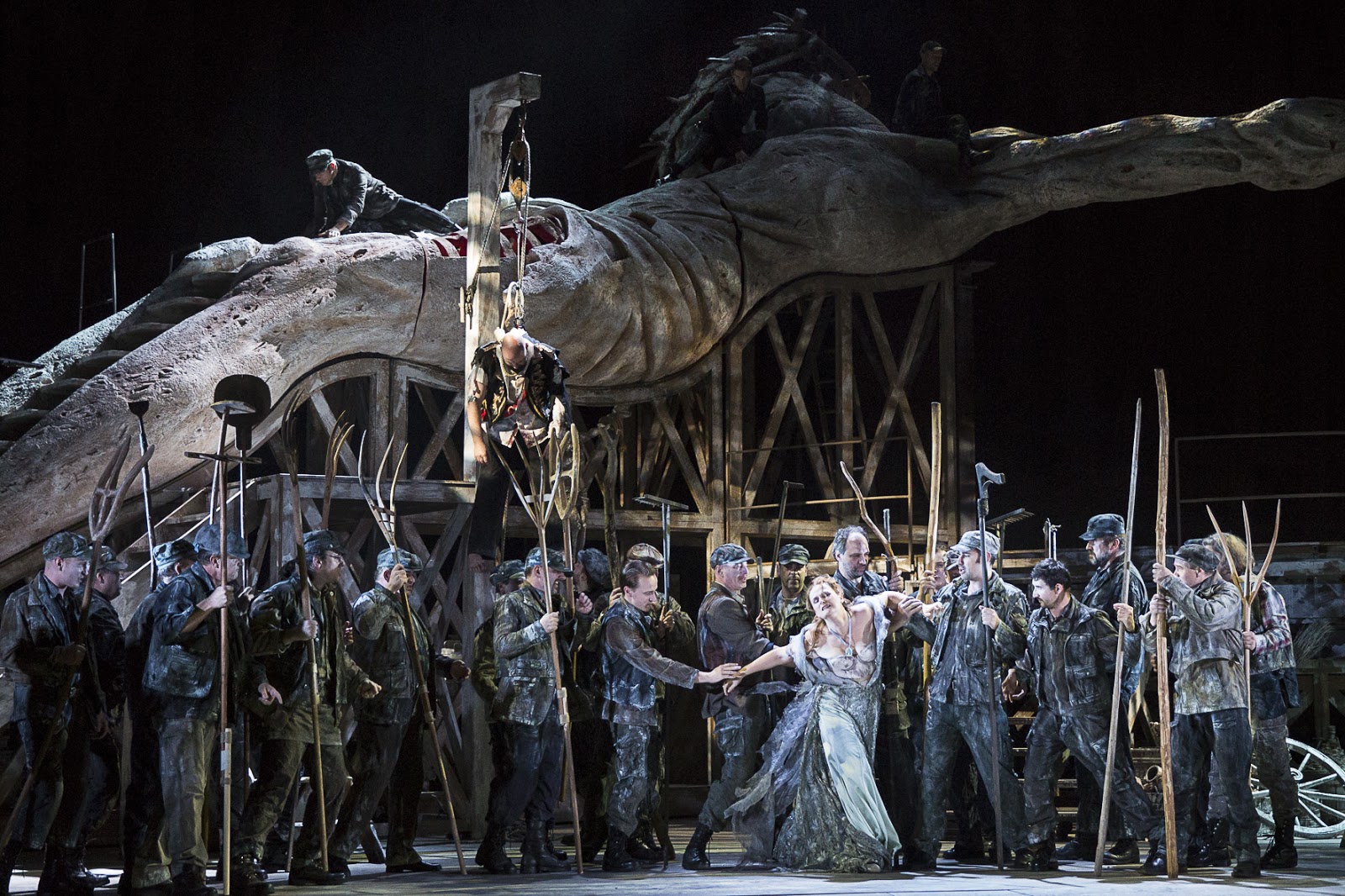
How pleasurable to be ending – well, almost, for a visit to Robert le diable at Covent Garden still beckons – my operatic year on such a high note! The Theater an der Wien is now generally acknowledged to offer substantially more interesting fare than the Vienna State Opera, the latter’s great orchestra notwithstanding. Indeed, during a sojourn of just over a fortnight in Vienna, the Staatsoper could summon up nothing that was not of the Italian nineteenth century; the only prospect I could even begin to face was La bohème, until I realised that remained in a production by the ultra-vulgarist, Berlusconi-supporting Franco Zeffirelli. Not for the first time I was led to fond remembrance of Boulez’s great clarion call from a 1967 interview with Der Spiegel: ‘To a theatre in which mostly repertoire pieces are performed one can only with the greatest difficulty bring a modern opera – it is unthinkable. The most expensive solution would be to blow the opera houses into the air. But do you not think that that might also be the most elegant solution?’ The Theater an der Wien has avoided the deep, one is almost tempted to say insurmountable, problems arising from a repertoire system by adopting instead the stagione principle: no pointless, barely rehearsed revivals – if indeed ‘revival’ can remotely be considered the mot juste for Zeffirelli et al. – of moribund works and productions, but bespoke productions, such as this new staging of Hindemith’s Mathis der Maler: hardly, I admit, a ‘modern opera’, but a great, unaccountably neglected, work from a century that still receives bizarrely short shrift from so many houses. The results, at least on this occasion, spoke for themselves. (Exemplary programmes are produced too.)

 
Albrecht of Brandenburg (Kurt Streit)
Hindemith remains a deeply unfashionable composer. To a certain extent that is not undeserved. His absurd claims about ‘tonality’ as a natural force, ‘like gravity’, do not help; history has undoubtedly proved Schoenberg right. The concept of Gebrauchsmusik, even if more sophisticated than one might expect, likewise remains problematical at best, many would say untenable. Moreover, some of the accusations hurled at Hindemith’s music are not unfair in particular cases: there is a good amount of grey, even turgid stuff to throw out as bathwater, before we arrive at fine babies such as Mathis, surely the composer’s most singular masterpiece. Its message of an artist, Matthias Grünewald, painter of the Isenheim Altarpiece, disillusioned by attempts to involve himself in politics during the sixteenth-century Peasants’ War, who ultimately has his artistic gift restored to him, has particular resonance, even within the context of ‘artist operas’, given Hindemith’s own plight during the Third Reich. It is far more than that, of course; there is (religious) fanaticism; there are love and renunciation; there is artistic patronage in all its complexity; there are artistic inspiration and the lack thereof;  there is the fascinating, compromised yet wise figure of Albrecht of Brandenburg. In a sense, as one of my Twitter followers remarked the other day, it is everything Pfitzner’s Palestrina ought to have been, yet is not. (The latter work retains a cult, which seems to be not entirely dissociated from the composer’s repellent nationalist politics.)

 
Bertrand de Billy gave a more impressive performance than I have previously heard from him. Whereas his Mozart has tended towards the anonymous, this was a powerful reading which, courtesy of tirelessly committed playing from the Vienna Symphony Orchestra, penetrated to the core of Hindemith’s musical imagination. What can readily sound like Busoni without the sense of fantasy – in a sense, though only in one sense, it is a bit like that – here resounded with dignity, counterpoint and form defiantly present, reasserting their presence against musical philistinism whether of the 1930s or of today, and allied more closely than some of Hindemith’s previous operatic work, to dramatic requirements. Choral singing, from the Slovak Philharmonic Choir, was of the highest standard throughout: weighty yet never in the slightest diffuse, and capable of impressive dynamic contrast and shading.

 
The cast was strong too, in some cases very strong indeed. Wolfgang Koch proved an heroic Mathis. If occasionally his voice tired towards the end, that fitted perfectly well with the drama. Otherwise, his multi-faceted portrayal – kindly, thoughtful, tortured – was as impressive for its verbal acuity as for its command of musical line. It is, quite simply, a privilege to hear so committed a performance as his. Kurt Streit was an unfailingly intelligent Albrecht. It could not be said that his vocal performance was always the most beautiful to listen to, but dramatic concerns were of greater importance. Franz Grundheber seems incapable of growing old; his Riedinger, the wealthy Protestant on whose money Albrecht is dependent, was just as well observed as any other performance I have heard from him. Manuela Uhl, as his daughter Ursula, and Katerina Tretyakova as Regina, daughter of the peasant leader, Hans Schwalb (a performance of evident conviction from Raymond Very), both offered at times ravishing vocal performances matched by fine stage presence and sense. All of the ‘smaller’ roles were well taken, right down to the individual peasants who made the shocking rape scene (Countess Helfenstein its victim, harrowingly portrayed by Magdalena Anna Hofmann) truly come to life.

 
Mathis (Wolfgang Koch) and demons
Keith Warner’s production furthered that too, of course. That particular scene, in which the production arguably goes further than the libretto, acquired its power as much through the striking attention afforded every member of the peasant mob as through the idea itself. As a turning point in which Mathis is impelled back towards art, it is crucial – and certainly proved so here. Class hatred – the term may be anachronistic for the sixteenth century, but so, by definition, is a subsequent artistic treatment – and mass psychosis did their work, just as they did when Hindemith was writing. Much the same could be said of the book-burning we witness. At the centre of the production lies an extraordinary giant statue of Christ crucified, prefiguring the altarpiece to come, taking form during the mistily staged Prelude, piercing our consciousness during the action just as its agonising nail does Christ’s foot, and subsequently coming apart, inducing and encompassing both Mathis’s fateful dream and the artwork itself. The sixth-scene dream, in which, confronted not only by figures from his – and the opera’s past – and a chorus of demons, but also by Saints Anthony and Paul, the latter in Albrecht’s guise, is staged with a fine eye both to the torment and to the potential consolation afforded by artistic creation, even during, perhaps especially during, times of political torment. The insanity of the dream-world, flailing demons and all – a splendidly writhing contribution from the Statisterie des Theater an der Wien – gains focus and eventually direction from the Pauline intervention. (Surely this is St Paul’s sole operatic appearance to date? I should gladly be corrected.) Mathis is thereby enable to do his work and prepare for death: a sobering and, in the best sense, ‘authentic’ vision.

 
All considered, then, this was a triumph for the Theater an der Wien, for the estimable artists engaged, and not least for Hindemith himself. Cameras were present in the theatre; let us hope a DVD may be in the offing.  Any chance, perhaps, of Busoni’s Doktor Faust?