Showing posts with label Raymond Very. Show all posts

Tuesday, 12 April 2016

Deutsche Oper Strauss-Wochen (4) - Die Liebe der Danae. 9 April 2016


Die Liebe der Danae © 2011, Barbara Aumüller


Deutsche Oper, Berlin

Jupiter – Mark Delavan
Merkur – Thomas Blondelle
Pollux – Andrew Dickinson
Danae – Manuela Uhl
Xanthe – Adriana Ferfezka
Midas – Raymond Very
First King – Paul Kaufmann
Second King – Clemens Bieber
Third King – Thomas Lehman
Fourth King – Alexei Botnarciuc
Semele – Nicole Haslett
Europa – Martina Weischenbach
Alkmene – Rebecca Jo Loeb
Leda – Katharina Peetz

Kirsten Harms (director)
Bernd Damovsky (set designs)
Dorothea Katzer (costumes)
Manfred Voss (lighting)
Silke Sense (Spielleitung)
Andreas K.W. Meyer (dramaturgy)

Chorus of the Deutsche Oper , Berlin (chorus master: William Spaulding)
Orchestra of the Deutsche Oper, Berlin 
Sebastian Weigle (conductor)


Strauss’s penultimate opera has been unlucky, more a victim of circumstances than of its intrinsic qualities, although Joseph Gregor’s libretto admittedly falls somewhat short of Hofmannsthal. Its 1944 would-have-been premiere at the Salzburg Festival fell victim to ‘total war’ and closure of theatres, so the only time Strauss himself heard it was at the Generalprobe. Thereafter, despite a successful posthumous premiere in Salzburg, it has never secured itself in the repertory; so much the worse, as so often, for the repertory. A committed performance such as this will have done it no harm whatsoever, although, as with the only other performance I have attended (Salzburg again, 2002), I am not convinced that the production (then Günter Kramer, now Kirsten Harms) made the best of its opportunities. Perhaps Salzburg’s third attempt, this year, will do better.


In the meantime, there could be no doubting the work’s musical qualities. That extraordinary evocation of sadness – not tragedy, ‘just’ deep sadness – in the third-act Interlude is not the only candidate from this score for Strauss at his greatest. ‘Jupiter’s resignation’, as Strauss called it, is not the only time one cannot help but draw parallels with Wotan; indeed, such parallels suggest themselves in the libretto perhaps all too readily. At any rate, in the very capable hands of Sebastian Weigle – quite the best thing I have heard him do – Strauss’s musico-dramatic empathy spoke as eloquently as one could hope for. Throughout, Weigle’s pacing convinced, as did his balancing of the Deutsche Oper orchestra, which once again proved itself worthy of the most exalted comparisons in the music of a composer long so close to its heart.


At the risk of becoming unduly repetitive, I should like again to draw attention to the skill with which each conductor in this mini-festival (arguably not so mini- a festival!) and the orchestra have commanded and communicated Strauss’s phantasmagorical wizardry, not just with respect to orchestration, not just with respect to shifting of timbres, but perhaps most important of all, in the marriage of timbral to harmonic shifts. (I promise that I shall try to restrain, even to eliminate, my use of the word ‘phantasmagorical’ for a month or so, once these Strauss reviews are done and dusted.) This is undoubtedly an old man’s score; it sounded all the more loved for recognition of that, in a reading that was unhurried without ever losing its impetus. The aristocratic refinement of Capriccio is not Strauss’s way here. (It is certainly not Gregor’s!) However,t the Strauss of Die Frau ohne Schatten is here at times, albeit perhaps softened (I am not sure that is quite the right word), and what a joy it is to hear that Strauss one last time. Indeed, more than once I was put in mind of Strauss’s reworking of Idomeneo, the Wagnerian and Mozartian tendencies in his work performing their endlessly fascinating interaction, even battle.
 

Manuela Uhl proved a moving exponent of the title role, especially as the opera progressed. To make a distinction between the ‘vocal’ and ‘dramatic’ is always, or should always be, to err; here, there was no doubt of that, for the sympathy with the character as engaged by Uhl was part and parcel not only of beautiful tone but its alliance with her stage action. Raymond Very was equally impressive as Midas. Apparently he was ailing, but one would rarely have known it, so secure were his technique and his similar ability to engender sympathy. Mark Delavan’s Jupiter was occasionally a little bluff, but that is arguably in keeping with the character, or at least a perfectly respectable interpretation thereof. His sadness, as well as the orchestra’s, in the third act reminded us that the Wotan parallel would have been even stronger when the role was created by no less than Hans Hotter (at the rehearsal, that is, not the public premiere). Thomas Blondelle was quite the stage animal, and quite the vocally winged messenger, as Merkur. I had no complaint with any of the singers; the Deutsche Oper can cast from depth, and regularly does. Its chorus remains one of the finest jewels in its crown; this performance was no exception.
 

Harms’s production does no especial harm. It is ‘stylish’ enough, in a generalised fashion, but does not seem to me to offer any particular insights. Apart from a predictable updating – or should that be demythologising? – this is a somewhat conventional staging, but in a work unfamiliar to many, that might not always be a bad thing. I am not sure why Pollux’s auctioned-off piano is suspended in the sky during the third act. Is it to come crashing down, with catastrophic or even Zerbinetta-like, consequences (a troupe perhaps concealed within it)? No; it simply remains there, arresting in visual terms, yet seemingly contributing little beyond that, except perhaps a vague reminder of what has gone before. Transformation into gold relies upon suggestion, and is probably all the better for that. Personenregie is generally impressive, although that will presumably long since have been delegated from the original director. In this case, however, Strauss’s score was definitely the thing. How it glowed!


Wednesday, 19 December 2012

Mathis der Maler, Theater an der Wien, 16 December 2012


All images: Wener Kmetitsch
 
 
Theater an der Wien, Vienna
 
Mathis – Wolfgang Koch
Albrecht of Brandenburg – Kurt Streit
Riedinger – Franz Grundheber
Ursula – Manuela Uhl
Hans Schwalb – Raymond Very
Regina – Katerina Tretyakova
Lorenz von Pommersfelden – Martin Snell
Wolfgang Capito – Charles Reid
Sylvester von Schaumberg – Oliver Ringelhahn
Truchseß von Waldburg – Ben Connor
Countess Helfenstein – Magdalena Anna Hofmann
Countess Helfenstein’s Piper – Andrew Owens
Count Helfenstein – Florian Emberger
Peasants – Florian Emberger, Adam Blažo, Ladislav Hallon, Ladislav Podkamenský, Matús Tráviniček

Keith Warner (director)
Johan Engels (set designs)
Emma Ryott (costumes)
Mark Jonathan (lighting)

Slovak Philharmonic Choir (chorus mistress: Blanka Juhaňaková)
Vienna Symphony Orchestra
Bertrand de Billy (conductor)
 
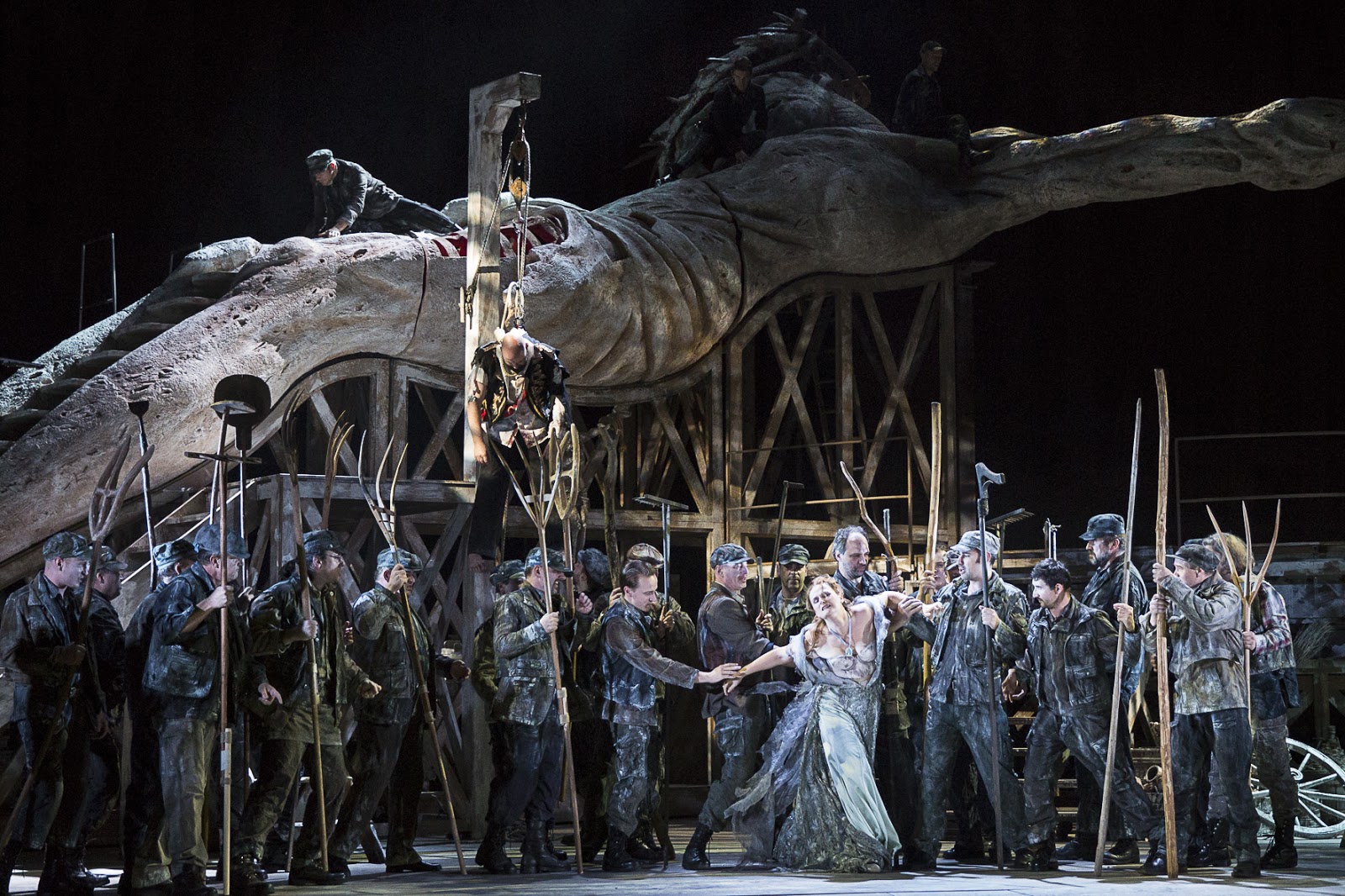
Slovak Philarmonic Choir, Countess Helfenstein (Magdalena Anna Hofmann)
 
How pleasurable to be ending – well, almost, for a visit to Robert le diable at Covent Garden still beckons – my operatic year on such a high note! The Theater an der Wien is now generally acknowledged to offer substantially more interesting fare than the Vienna State Opera, the latter’s great orchestra notwithstanding. Indeed, during a sojourn of just over a fortnight in Vienna, the Staatsoper could summon up nothing that was not of the Italian nineteenth century; the only prospect I could even begin to face was La bohème, until I realised that remained in a production by the ultra-vulgarist, Berlusconi-supporting Franco Zeffirelli. Not for the first time I was led to fond remembrance of Boulez’s great clarion call from a 1967 interview with Der Spiegel: ‘To a theatre in which mostly repertoire pieces are performed one can only with the greatest difficulty bring a modern opera – it is unthinkable. The most expensive solution would be to blow the opera houses into the air. But do you not think that that might also be the most elegant solution?’ The Theater an der Wien has avoided the deep, one is almost tempted to say insurmountable, problems arising from a repertoire system by adopting instead the stagione principle: no pointless, barely rehearsed revivals – if indeed ‘revival’ can remotely be considered the mot juste for Zeffirelli et al. – of moribund works and productions, but bespoke productions, such as this new staging of Hindemith’s Mathis der Maler: hardly, I admit, a ‘modern opera’, but a great, unaccountably neglected, work from a century that still receives bizarrely short shrift from so many houses. The results, at least on this occasion, spoke for themselves. (Exemplary programmes are produced too.)

 
Albrecht of Brandenburg (Kurt Streit)
Hindemith remains a deeply unfashionable composer. To a certain extent that is not undeserved. His absurd claims about ‘tonality’ as a natural force, ‘like gravity’, do not help; history has undoubtedly proved Schoenberg right. The concept of Gebrauchsmusik, even if more sophisticated than one might expect, likewise remains problematical at best, many would say untenable. Moreover, some of the accusations hurled at Hindemith’s music are not unfair in particular cases: there is a good amount of grey, even turgid stuff to throw out as bathwater, before we arrive at fine babies such as Mathis, surely the composer’s most singular masterpiece. Its message of an artist, Matthias Grünewald, painter of the Isenheim Altarpiece, disillusioned by attempts to involve himself in politics during the sixteenth-century Peasants’ War, who ultimately has his artistic gift restored to him, has particular resonance, even within the context of ‘artist operas’, given Hindemith’s own plight during the Third Reich. It is far more than that, of course; there is (religious) fanaticism; there are love and renunciation; there is artistic patronage in all its complexity; there are artistic inspiration and the lack thereof;  there is the fascinating, compromised yet wise figure of Albrecht of Brandenburg. In a sense, as one of my Twitter followers remarked the other day, it is everything Pfitzner’s Palestrina ought to have been, yet is not. (The latter work retains a cult, which seems to be not entirely dissociated from the composer’s repellent nationalist politics.)

 
Bertrand de Billy gave a more impressive performance than I have previously heard from him. Whereas his Mozart has tended towards the anonymous, this was a powerful reading which, courtesy of tirelessly committed playing from the Vienna Symphony Orchestra, penetrated to the core of Hindemith’s musical imagination. What can readily sound like Busoni without the sense of fantasy – in a sense, though only in one sense, it is a bit like that – here resounded with dignity, counterpoint and form defiantly present, reasserting their presence against musical philistinism whether of the 1930s or of today, and allied more closely than some of Hindemith’s previous operatic work, to dramatic requirements. Choral singing, from the Slovak Philharmonic Choir, was of the highest standard throughout: weighty yet never in the slightest diffuse, and capable of impressive dynamic contrast and shading.

 
The cast was strong too, in some cases very strong indeed. Wolfgang Koch proved an heroic Mathis. If occasionally his voice tired towards the end, that fitted perfectly well with the drama. Otherwise, his multi-faceted portrayal – kindly, thoughtful, tortured – was as impressive for its verbal acuity as for its command of musical line. It is, quite simply, a privilege to hear so committed a performance as his. Kurt Streit was an unfailingly intelligent Albrecht. It could not be said that his vocal performance was always the most beautiful to listen to, but dramatic concerns were of greater importance. Franz Grundheber seems incapable of growing old; his Riedinger, the wealthy Protestant on whose money Albrecht is dependent, was just as well observed as any other performance I have heard from him. Manuela Uhl, as his daughter Ursula, and Katerina Tretyakova as Regina, daughter of the peasant leader, Hans Schwalb (a performance of evident conviction from Raymond Very), both offered at times ravishing vocal performances matched by fine stage presence and sense. All of the ‘smaller’ roles were well taken, right down to the individual peasants who made the shocking rape scene (Countess Helfenstein its victim, harrowingly portrayed by Magdalena Anna Hofmann) truly come to life.

 
Mathis (Wolfgang Koch) and demons
Keith Warner’s production furthered that too, of course. That particular scene, in which the production arguably goes further than the libretto, acquired its power as much through the striking attention afforded every member of the peasant mob as through the idea itself. As a turning point in which Mathis is impelled back towards art, it is crucial – and certainly proved so here. Class hatred – the term may be anachronistic for the sixteenth century, but so, by definition, is a subsequent artistic treatment – and mass psychosis did their work, just as they did when Hindemith was writing. Much the same could be said of the book-burning we witness. At the centre of the production lies an extraordinary giant statue of Christ crucified, prefiguring the altarpiece to come, taking form during the mistily staged Prelude, piercing our consciousness during the action just as its agonising nail does Christ’s foot, and subsequently coming apart, inducing and encompassing both Mathis’s fateful dream and the artwork itself. The sixth-scene dream, in which, confronted not only by figures from his – and the opera’s past – and a chorus of demons, but also by Saints Anthony and Paul, the latter in Albrecht’s guise, is staged with a fine eye both to the torment and to the potential consolation afforded by artistic creation, even during, perhaps especially during, times of political torment. The insanity of the dream-world, flailing demons and all – a splendidly writhing contribution from the Statisterie des Theater an der Wien – gains focus and eventually direction from the Pauline intervention. (Surely this is St Paul’s sole operatic appearance to date? I should gladly be corrected.) Mathis is thereby enable to do his work and prepare for death: a sobering and, in the best sense, ‘authentic’ vision.

 
All considered, then, this was a triumph for the Theater an der Wien, for the estimable artists engaged, and not least for Hindemith himself. Cameras were present in the theatre; let us hope a DVD may be in the offing.  Any chance, perhaps, of Busoni’s Doktor Faust?


Sunday, 4 September 2011

Salzburg Festival (7) - The Makropulos Case, 25 August 2011

Grosses Festspielhaus


Images © Walter Mair/Salzburg Festival

Emilia Marty – Angela Denoke Dr Kolenatý – Jochen Schmeckenbecher
Vítek – Peter Hoare
Krista – Jurgita Adamonytė
Albert Gregor – Raymond Very
Jaroslav Prus – Johan Reuter
Janek – Aleš Briscein
Hauk-Šendorf – Ryland Davies
Chambermaid – Linda Ormiston
Conscientious Objector performing Community Service – Peter Lobert

Jin Ling – Sasha Rau
Mary Long – Silvia Fenz
Anita Stadler – Anita Stadler

Christoph Marthaler (director)
Anna Viebrock (designs)
Olaf Winter (lighting)
Joachim Rathke (associate director)
Malte Ubenauf (dramaturgy)

Vienna Philharmonic Orchestra
Concert Association of the Vienna State Opera Chorus
Esa-Pekka Salonen (conductor)


My feelings about The Makropulos Case, or perhaps more accurately, my feelings during and after a performance of the work, remain somewhat in flux. Janáček does not pull the heartstrings so consistently as in some of his other works, but of course the coldness of E.M. is part of his point – and, by all accounts, she is treated far more sympathetically than in Karel Čapek’s play. Even more so than, say, Jenůfa or Katya Kabanova, the vocal writing is conversational, the composer’s restraint admirable, even awe-inspiring: there is no more playing to the gallery here than in Pelléas – well, little more. The orchestra, then, plays its role as Wagnerian Greek Chorus. And yet, occasionally, I find that I am missing something: the question is whether that something missing is deliberately absent, whether, again, it is the dramatic point. And more so than those earlier Janáček masterpieces, rather like From the House of the Dead, I find myself reflecting afterwards, and for quite some time afterwards, on what is at stake in the drama. It is, then, an opera that makes one think, but perhaps only truly moves at the end, in the final peroration, both vocal and orchestral, when one finds that very same cyclical affirmation of life in death the composer voices in The Cunning Little Vixen, and arguably as in the earlier cited tragedies too.


Christoph Marthaler’s fine production of Katya Kabanova originated in Salzburg, before making its way to Paris, where I saw it earlier this year. I half expected to see The Makropulos Case similarly transposed to a joyless post-war East European setting, but in many respects, the setting (splendidly designed by Anna Viebrock) is rather ‘traditional’: there is certainly nothing for ‘traditionalists’ to complain about. Unless, that is, one includes the new material with which Marthaler introduces the work: a spoken reflective conversation, not without humour. Themes that will be explored during the work, most obviously the shortness of one’s allotted years, and what alternatives there might be, are adumbrated, without overstaying their welcome. (At least I thought so, though some in the audience seemed restless.) It would seem that there is some degree of reinstatement from Čapek’s play, but I shall leave delineation of that to those better informed. (I wish that I were…) There is even humour, as there is in the opera, concerning the ways of opera singers. Otherwise, one sees a court room, as one would expect, and pretty much in ‘period’, though the voguish practice of employing the same set for each act does lead to confusion: a court room is a bit of an odd place for Marty to succumb to Prus. (Doubtless we are not supposed to understand it that way, but it is a bit odd.) Other touches to either side of the principal room work better. A railway waiting room nicely suggests transience. Whilst I can imagine that some would be irritated by the depiction of a care home – replete with Zivildienstleistender (conscientious objector performing community service: no, I am not making this up) – on the other side of the stage, it aptly suggests the alternative to EM’s immortality. And therefore, as I said, really does make one think: given society’s present treatment of the elderly and infirm, it is by no means clear that one would not give elixir a try. If Christopher Alden’s ENO production probably made more of an immediate (stylish) impression on me when I saw it the first time, it began to irritate the second time around; it is probably fair to say that Marthaler’s production has made me think more, especially after the event. One would hardly expect Marthaler to play the work for laughs, and we can be grateful that he does not.


Angela Denoke performs estimably in the title role. It would be possible to castigate infelicities of tuning, for this, as one might have expected, was a performance very much in the ‘singing actress’ mould. However, such faults seemed to matter little, given the burning heat of her performance. Indeed, one could understand them, even if they were not intended this way, as contributing to the drama between aspiration to perfection and the frailty of flesh. Denoke held the vast stage of the Grosse Festspielhaus as her own, and rightly so. She was in every respect preferable to ENO’s Amanda Roocroft, though Cheryl Barker, on the first London run, was perhaps equally fine. I am rather surprised, however, to report that the other parts were more consistently cast in London (despite, of course, the gross handicap of singing in translation). Peter Hoare, for instance, was a much stronger Gregor than Salzburg’s dry-sounding Raymond Very; curiously, Hoare here movingly sang the role of Vítek. Aleš Briscein and Johan Reuter also just about stood out, though I have heard both singers to greater effect elsewhere. For there was a touch of anonymity to the general company, a surprising sense of routine, not to be exaggerated, but equally not the most memorable of Salzburg performances.

Esa-Pekka Salonen’s conducting of the Vienna Philharmonic proved somewhat disappointing. Though there were times when the orchestra sounded predictably gorgeous – and, unlike some, I really do not mind that in Janáček – one also had to reckon with a few too many loose threads, whether in terms of smudged and even missed entries, or a general lack of rhythmic bite, such as Sir Charles Mackerras and Sir Richard Armstrong both brought to the score in London. The VPO certainly can play this music; it did so memorably for Mackerras, amongst others. Here, however, it sometimes sounded as if Janáček were new and slightly unwelcome territory. Salonen seemed unwilling or unable to control the orchestra as he might have done, indeed perhaps to be still less in sympathy with Janáček’s music, the score somehow meandering aggressively, at least until the final act. Lack of tautness and indeed of formal perception went hand in hand with a tendency to play with loud indifference. Perhaps that is unduly harsh, but I expected great, or at least very good, things, and did not hear them. To my surprise, then, it proved to be Marthaler’s night rather than Salonen’s, though it was at least as much Denoke’s.

Sunday, 18 July 2010

Prom 2: Die Meistersinger von Nürnberg, Welsh National Opera, 17 July 2010

(concert staging)

Hans Sachs – Bryn Terfel
Walther von Stoltzing – Raymond Very
Eva – Amanda Roocroft
Sixtus Beckmesser – Christopher Purves
David – Andrew Tortise
Magdalene – Anna Burford
Nightwatchman – David Soar
Veit Pogner – Brindley Sherratt
Fritz Kothner – Simon Thorpe
Konrad Nachtigall – David Stout
Hans Schwartz – Paul Hodges
Balthasar Zorn – Rhys Meirion
Ulrich Eisslinger – Andrew Rees
Augustin Moser – Stephen Rooke
Hans Foltz – Arwel Huw Morgan
Kunz Vogelgesang – Geraint Dodd
Hermann Ortel – Owen Webb

Chorus and Orchestra of Welsh National Opera (chorus-master: Stephen Harris)
Lothar Koenigs (conductor)

Most reports of Richard Jones’s new production of Die Meistersinger von Nürnberg have been laudatory, though there has been a significant minority report decrying a perceived conservative turn. Not having seen it, I am in no position to assess Jones’s contribution, but this visit to the Proms from the Welsh National Opera granted an opportunity to appraise its musical values. There were many virtues to be heard here, but there were also significant drawbacks one might more readily have overlooked in the theatre.

Bryn Terfel was clearly the main attraction for many. It was depressing to note the BBC presented him as such in its television coverage. ‘Bryn Terfel sings Wagner’s Meistersinger’. Nice to see the composer gain a mention, I suppose, though it also makes one wonder what other Meistersinger it might have been, if not his. At any rate, Terfel’s legion of fans will not have been disappointed. This is a role better suited to him than that of Wotan, let alone that of the Wanderer, from which he notoriously cried off for the Royal Opera. His other recent London Wagner appearance, as the Dutchman, ought to have suited him better but was marred by alternate whispering and barking. This was not necessarily a Sachs for the ages, nor was it a profoundly philosophical reading: it was difficult to imagine the folio in which he was absorbed at the opening of the third act being, as has often been suggested, a harbinger of Schopenhauer’s World as Will and Representation. There were, moreover, cases in which important lines and phrases were somewhat casually thrown away. Nevertheless, the cast gained from Terfel’s undeniable star quality: there was a palpable upping of game as soon as he set foot upon the stage. And he generally took great care with his words, all of them audible, most of them invested with meaning. His acting at the end of the Wahn monologue was odd, though, seemingly dissociated from what he was singing, more the ardent, romantic hero.

At least as impressive, to my mind more so, was Andrew Tortise’s David. Deliciously camp, though never excessively so, it was difficult to imagine this apprentice having much interest in Magdalene. But from the outset, one could not be impressed by his careful distinction between the various tones of master-singing, without ever sounding unduly contrived. Wagner helps, of course, but it is no mean feat to bring this off so intelligently and so musically. There were manifold nice touches such as the word-painting, visual too, on the ‘brummt’ (buzz/hum) of ‘Nach dem Wort mit dem Mund auch nicht brummt,’ and withdrawal of vibrato for the ‘eitel Brot und Wasser’ (pure bread and water) melody. In the third act, his intervention to Sachs, ‘Am Jordan Sankt Johannes stand,’ was genuinely funny in its recollection of Beckmesser’s serenade: a trick that can only be pulled off with secure musical and theatrical grounding, sporting just enough crudity to draw the listener into the joke, but without undue disruptive effect. Tortise has an appealing lyric tenor voice that can yet withstand competition with Wagner’s orchestra, and can clearly act too – even in a ‘concert staging’. I hope to hear – and to see – more from him.

Christopher Purves was a fine Beckmesser, credible as the serenading lutenist too (though sadly, he tired a little towards the end of his song). Real anger was imparted during the confrontation with Sachs in his shop – and crucially without sounding a mere caricature. His was a portrayal that clearly itched to be on stage; I wish I could have seen him in the theatre. I have heard more imposing Pogners than that of Brindley Sherratt, but this was intelligently sung. Simon Thorpe’s dry Kothner veered alarmingly in terms of pitch, however. I liked Anna Burford’s colourful Magdalene; as so often, I wished that there were more to hear in this role. Likewise as so often, I found myself wishing that she could trade places with her Eva. Amanda Roocroft’s intonation was not quite so variable as when I heard her as Tatiana at Covent Garden, but in conjunction with intrusive, thick vibrato, this was not a part to savour. Her diction left a great deal to be desired too, and her over-acted style on stage, which may possibly have worked from a distance in the theatre, here simply made her look like a woman too mature for the part. Raymond Very’s Walther was equally disappointing: more accurate, doubtless, but thin, even elderly, of tone and in no sense credible as a charismatic hero. For rendition of the Prize Song merely to sound dull is an achievement I do not wish to hear repeated.

Lothar Koenigs’s conducting had its moments, but could often sound rushed or arbitrarily slow. Koenigs began well, with a first-act Prelude clearly born of experience in the theatre. Woodwind chatter and contrapuntal clarity registered nicely, as did magnificent kettledrum playing from Patrick King – not for the last time, for this was a genuine highlight of the performance throughout. The first act sounded as though it was going to end most impressively, the conductor screwing up the tension well as the bickering began, but unfortunately it degenerated into a rush. (Acting was of a high standard throughout the scene though, perhaps, as I suggested, testament to Terfel’s arrival on stage.) The Preludes in many ways constituted the better part of the conductor’s vision, that to the Second Act duly playful, and the great introduction to the Third gravely and meaningfully slow, cellos digging deep here for a tone that was sadly not always present during the performance. For it must be said that, whilst the orchestral playing was generally committed, the body of strings was simply too small for a true Wagnerian sound unerringly to emerge. One cannot always expect the Staatskapelle Dresden – though who can forget its golden sound under Karajan? – but greater heft is not an entirely unreasonable expectation. What might have passed muster in a small house was not always sufficient for the Royal Albert Hall. Moreover, Koenigs could meander, as during the baptismal scene, when one might have fancied Wagner’s orchestral chorus a mere agent of accompaniment. True choral singing was, however, mightily impressive, especially during the Festwiese scene, for which garlands should be presented to chorus and chorus-master, Stephen Harris.

This was an enjoyable Meistersinger, then, even when shorn of most visual aspects of its production. I did not, however, have the impression that it was born of a production that had penetrated into the darkness, the Wahn, at the very heart of this extraordinary work. This is a rare comedy, in that it should move as does any tragedy. I am tempted indeed to compare it to the greatest of Mozart and Shakespeare. For that, however, I must cast my mind back to the unforgettable performances from Bernard Haitink at Covent Garden – or, of course, listen on record to Furtwängler, Kubelík, and a select few others.