Showing posts with label Kurt Streit. Show all posts

Wednesday, 11 March 2015

Aufstieg and Fall der Stadt Mahagonny, Royal Opera, 10 March 2015


Images: ROH/Clive Barda
 
(sung in English)
 
Royal Opera House

Leocadia Begbick – Anne Sofie von Otter
Fatty – Peter Hoare
Trinity Moses – Sir Willard W. White
Jenny – Christine Rice
Six Girls – Anna Burford, Lauren Fagan, Anush Hovhannisyan, Stephanie Marshall, Meeta Ravel, Harriet Williams
Jimmy McIntyre – Kurt Streit
Jack O’Brien – Jeffrey Lloyd-Roberts
Bank-Account Bill – Darren Jeffery
Alaska Wolf Joe – Neal Davies
Bar Pianist – Robert Clark
Toby Higgins – Hubert Francis
Voice – Paterson Joseph

John Fulljames (director)
Es Devlin (set designs)
Christina Cunningham (costumes)
Bruno Poet (lighting)
Finn Ross (video)
Arthur Pita (choreography)

Royal Opera Chorus (chorus master: Renata Balsadonna)
Orchestra of the Royal Opera House
Mark Wigglesworth (conductor)

 
At long last, Rise and Fall of the City of Mahagonny has come to the Royal Opera House. Kurt Weill’s teacher, Busoni, remains scandalously ignored, but a season which includes house firsts both of this opera and Szymanowsi’s King Roger, cannot be all bad. The unresolved tension, much of it fruitful, some of it perhaps less so, between Brecht and Weill, came through loud and clear in this estimable performance, given in a new translation by Jeremy Sams (which was certainly preferable to his ‘versions’ of Mozart, even if not entirely free of the translator’s habit of drawing attention to himself rather than to the work). Is it an opera? Yes, of course. As David Drew pointed out long ago, in a 1963 Musical Times article,  one of the most pernicious ideas about Mahagonny has been ‘one that menaces even the most generous-hearted listener – the idea that Weill intended the work as an attack on the body of the operatic convention by means of parody or an injected virus (jazz, cabaret etc.). This idea is wholly false.’ As Drew continued, Weill had far too much knowledge of and respect for the operatic repertoire, above all Mozart, but others too (not least, and ominously for his collaboration with Brecht, Wagner), but he was also genuinely excited by the new paths opened up by composers such as Janáček and Stravinsky. (He was also a great defender of Wozzeck.) The problem, for me, is that sometimes, though not always, the musical material does not present the composer at his strongest; in general, and despite the songs and tunes we know and love, I find him the more compelling the closer he comes to his time with Busoni. The Second Symphony and Violin Concerto are surely his masterpieces. Mahagonny’s music, however, remains on an entirely different level from Weill’s disappointing music for the United States. (Whatever his apologists may claim, that is surely where, in aesthetic terms at least, he ‘sold out’.)


Trinity Moses (Willard White), Leocadia Begbick (Anne Sofie von Otter), Fatty (Peter Hoare)


The greater problem still, though, lies in the collaboration with Brecht, whose strengths are quite different, and whose adamant refusal to sentimentalise may sometimes be undone by Weill. (Not that Weill is sentimental as such, but his æsthetic is undoubtedly different, less didactic, unquestionably less concerned with alienation, more concerned perhaps with ‘opera’). It is no mean achievement of John Fulljames’s production of this difficult, perhaps impossible, work, that Brecht’s stature as, after Beckett, perhaps the greatest of twentieth-century playwrights comes across with increasing immediacy. There is no attempt to make us ‘sympathise’, although Weill sometimes does not help in that respect. The conceit, as with that of the work itself, is admirably simple, though certainly not simplistic.  Mahagonny and Mahagonny grow from a splendidly designed lorry. The accoutrements of capital, of ‘entertainment’, of neo-liberal barbarism sprout necessarily: garishly, of course, but retaining focus. Voice-overs and video projections do excellent work, Brecht’s placards reimagined for our computer-screen-obsessed age. Perhaps the acting does not always convince as strongly as it might as acting, but that is part of the trade-off between Brecht and Weill: an immanent criticism as much as, perhaps more than, a shortcoming. Choreography is sharp and to the point, for instance during the ‘Mandalay Song’, as the men of Mahagonny – and what an indictment for us this is of male behaviour, the Widow Begbick notwithstanding! – await their turn with the prostitutes. I wondered whether the Christ-like imagery at the end was exaggerated, but to be fair, it is no more so than it is in the work. Besides, we are at liberty to interpret God’s coming to Mahagonny as we will.


For, in general, the action is non-specific enough for us to be able to relate it to when and where seems most appropriate. (It would surely be bizarre, if in our age of bankster-crime run truly riot, we did not think of our own characters such as HSBC's The Revd Prebendary Baron Green of Hurstpierpoint, surely an invention who would have been too much, too far-fetched, too agitprop, even for Brecht.) Price variations do their evil work, and Fulljames, whilst not entirely ignoring the ‘American’ element, does not overplay it. Weill was certainly alert to the danger of the work seeming as if it were too much ‘about’ America, writing to his publisher: ‘The use of American names for Mahagonny runs the risk of establishing a wholly false idea of Americanism, Wildwest, of such like. I am very glad that, together with Brecht, I have now found a very convenient solution … and I ask you to include the following notice in the piano score and libretto,’ although, oddly, it would only appear in the full score, not in the piano score: ‘“In view of the fact that those amusements of man which can be had for money are always and everywhere exactly the same, and because the Amusement-Town of Mahagonny is thus international in the widest sense, the names of the leading characters can be changed into customary forms at any given time. The following names are therefore recommended for German performances: Willy (for Fatty), Johann Ackermann (for Jim), Jakob Schmidt (for Jack O’Brien) [etc.]”.’ In an English-language version, we necessarily tilt more towards Americana – the exhibitionist piano-playing of Robert Clark is an especial joy! –  but not too much. Moreover, whilst those of us with Lotte Lenya in our mind’s ear, may miss her and the rest of the Wilhelm Bruckner-Rüggeberg crew, we know that this is not a work to be confined to nostalgic conceptions of Weimar culture.

 
Jenny (Christine Rice)


Mark Wigglesworth is surely one of our most underrated conductors, although let us hope his forthcoming tenure at ENO will change that; he conducted a punchy, intelligently varied account. If I found the ‘Alabama Song’ a little on the slow side, it was slow rather than sentimentalised. Weill’s Neue Sachlichkeit generally won through, and where more typical ‘operatic’ impulses threatened Brecht’s conception, that suggested its own humane rewards. Choral singing was well-drilled and not without ‘expressive’ quality: never too much, though. The chorales did their formal, almost Stravinskian (think not least of The Soldier’s Tale) work, reacting both with ‘tradition’ and with Brecht. There was certainly a characterful, properly parodic sense of what Drew, in that Musical Times article, called ‘the fairground banalities of the trial scene,’ likewise of the horrifying ‘stormtrooper tunes of the boxing scene’. Where, though, was the Crane Song? Everything is permitted, of course, its omission certainly so, but it seemed a pity. We should at any rate be grateful that the once-popular ‘Paris version’, a travesty, with no warrant from Weill, in which songs from the Songspiel were interspersed with a few instrumental pieces from the opera, is no longer favoured.


The tension between Brecht and Weill was perhaps most clear in the vocal performances. How to approach these roles as opera singers, in so large a theatre? For the most part, the cast coped well enough; if their performances fell somewhat uneasily between (at least) two stools, then perhaps that is unavoidable in a presentation of the work so conceived. Willard White balanced gravity and sleaze as Trinity Moses. Kurt Streit as Jimmy had his lyrical moments – but also, alas, his moments of would-be lyricism. Christine Rice’s Jenny veered uneasily between home-spun Oklahoma and operatic vibrato, but her transformations were not so blatant as those of Anne Sofie von Otter’s Widow Begbick. Stylistically, she was all over the place, but I assume that in some sense was the point.  In any case, the whole, as the cliché has it, was more than the sum of its parts.

 
At the time of its first performance, Adorno’s was one of the few critical voices raised in favour of the work: ‘Apart from the diametrically opposed operas of the Schoenberg school, I know of no work better or more strongly in keeping with the idea of the avant-garde than Mahagonny … Despite and on account of the primitive façade, it must be counted among the most difficult works of today.’ That difficulty may have lessened, as indeed has that of Wozzeck or Von heute auf morgen – now when shall we see that in London? – but it remains, the chill with which Brecht and Weill react against each other perhaps no less than ever.


Wednesday, 19 December 2012

Mathis der Maler, Theater an der Wien, 16 December 2012


All images: Wener Kmetitsch
 
 
Theater an der Wien, Vienna
 
Mathis – Wolfgang Koch
Albrecht of Brandenburg – Kurt Streit
Riedinger – Franz Grundheber
Ursula – Manuela Uhl
Hans Schwalb – Raymond Very
Regina – Katerina Tretyakova
Lorenz von Pommersfelden – Martin Snell
Wolfgang Capito – Charles Reid
Sylvester von Schaumberg – Oliver Ringelhahn
Truchseß von Waldburg – Ben Connor
Countess Helfenstein – Magdalena Anna Hofmann
Countess Helfenstein’s Piper – Andrew Owens
Count Helfenstein – Florian Emberger
Peasants – Florian Emberger, Adam Blažo, Ladislav Hallon, Ladislav Podkamenský, Matús Tráviniček

Keith Warner (director)
Johan Engels (set designs)
Emma Ryott (costumes)
Mark Jonathan (lighting)

Slovak Philharmonic Choir (chorus mistress: Blanka Juhaňaková)
Vienna Symphony Orchestra
Bertrand de Billy (conductor)
 
Slovak Philarmonic Choir, Countess Helfenstein (Magdalena Anna Hofmann)
 
How pleasurable to be ending – well, almost, for a visit to Robert le diable at Covent Garden still beckons – my operatic year on such a high note! The Theater an der Wien is now generally acknowledged to offer substantially more interesting fare than the Vienna State Opera, the latter’s great orchestra notwithstanding. Indeed, during a sojourn of just over a fortnight in Vienna, the Staatsoper could summon up nothing that was not of the Italian nineteenth century; the only prospect I could even begin to face was La bohème, until I realised that remained in a production by the ultra-vulgarist, Berlusconi-supporting Franco Zeffirelli. Not for the first time I was led to fond remembrance of Boulez’s great clarion call from a 1967 interview with Der Spiegel: ‘To a theatre in which mostly repertoire pieces are performed one can only with the greatest difficulty bring a modern opera – it is unthinkable. The most expensive solution would be to blow the opera houses into the air. But do you not think that that might also be the most elegant solution?’ The Theater an der Wien has avoided the deep, one is almost tempted to say insurmountable, problems arising from a repertoire system by adopting instead the stagione principle: no pointless, barely rehearsed revivals – if indeed ‘revival’ can remotely be considered the mot juste for Zeffirelli et al. – of moribund works and productions, but bespoke productions, such as this new staging of Hindemith’s Mathis der Maler: hardly, I admit, a ‘modern opera’, but a great, unaccountably neglected, work from a century that still receives bizarrely short shrift from so many houses. The results, at least on this occasion, spoke for themselves. (Exemplary programmes are produced too.)

 
Albrecht of Brandenburg (Kurt Streit)
Hindemith remains a deeply unfashionable composer. To a certain extent that is not undeserved. His absurd claims about ‘tonality’ as a natural force, ‘like gravity’, do not help; history has undoubtedly proved Schoenberg right. The concept of Gebrauchsmusik, even if more sophisticated than one might expect, likewise remains problematical at best, many would say untenable. Moreover, some of the accusations hurled at Hindemith’s music are not unfair in particular cases: there is a good amount of grey, even turgid stuff to throw out as bathwater, before we arrive at fine babies such as Mathis, surely the composer’s most singular masterpiece. Its message of an artist, Matthias Grünewald, painter of the Isenheim Altarpiece, disillusioned by attempts to involve himself in politics during the sixteenth-century Peasants’ War, who ultimately has his artistic gift restored to him, has particular resonance, even within the context of ‘artist operas’, given Hindemith’s own plight during the Third Reich. It is far more than that, of course; there is (religious) fanaticism; there are love and renunciation; there is artistic patronage in all its complexity; there are artistic inspiration and the lack thereof;  there is the fascinating, compromised yet wise figure of Albrecht of Brandenburg. In a sense, as one of my Twitter followers remarked the other day, it is everything Pfitzner’s Palestrina ought to have been, yet is not. (The latter work retains a cult, which seems to be not entirely dissociated from the composer’s repellent nationalist politics.)

 
Bertrand de Billy gave a more impressive performance than I have previously heard from him. Whereas his Mozart has tended towards the anonymous, this was a powerful reading which, courtesy of tirelessly committed playing from the Vienna Symphony Orchestra, penetrated to the core of Hindemith’s musical imagination. What can readily sound like Busoni without the sense of fantasy – in a sense, though only in one sense, it is a bit like that – here resounded with dignity, counterpoint and form defiantly present, reasserting their presence against musical philistinism whether of the 1930s or of today, and allied more closely than some of Hindemith’s previous operatic work, to dramatic requirements. Choral singing, from the Slovak Philharmonic Choir, was of the highest standard throughout: weighty yet never in the slightest diffuse, and capable of impressive dynamic contrast and shading.

 
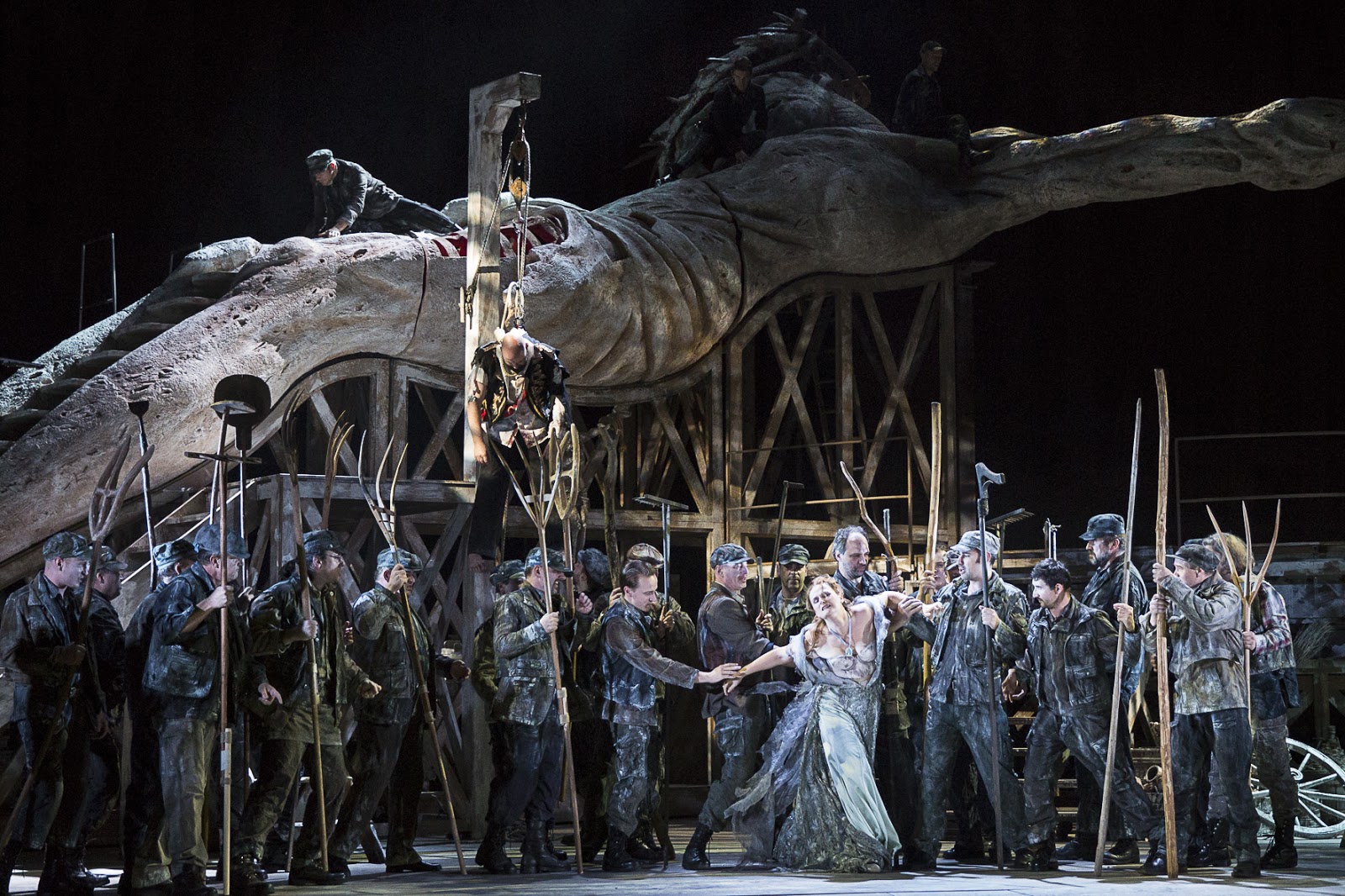
The cast was strong too, in some cases very strong indeed. Wolfgang Koch proved an heroic Mathis. If occasionally his voice tired towards the end, that fitted perfectly well with the drama. Otherwise, his multi-faceted portrayal – kindly, thoughtful, tortured – was as impressive for its verbal acuity as for its command of musical line. It is, quite simply, a privilege to hear so committed a performance as his. Kurt Streit was an unfailingly intelligent Albrecht. It could not be said that his vocal performance was always the most beautiful to listen to, but dramatic concerns were of greater importance. Franz Grundheber seems incapable of growing old; his Riedinger, the wealthy Protestant on whose money Albrecht is dependent, was just as well observed as any other performance I have heard from him. Manuela Uhl, as his daughter Ursula, and Katerina Tretyakova as Regina, daughter of the peasant leader, Hans Schwalb (a performance of evident conviction from Raymond Very), both offered at times ravishing vocal performances matched by fine stage presence and sense. All of the ‘smaller’ roles were well taken, right down to the individual peasants who made the shocking rape scene (Countess Helfenstein its victim, harrowingly portrayed by Magdalena Anna Hofmann) truly come to life.

 
Mathis (Wolfgang Koch) and demons
Keith Warner’s production furthered that too, of course. That particular scene, in which the production arguably goes further than the libretto, acquired its power as much through the striking attention afforded every member of the peasant mob as through the idea itself. As a turning point in which Mathis is impelled back towards art, it is crucial – and certainly proved so here. Class hatred – the term may be anachronistic for the sixteenth century, but so, by definition, is a subsequent artistic treatment – and mass psychosis did their work, just as they did when Hindemith was writing. Much the same could be said of the book-burning we witness. At the centre of the production lies an extraordinary giant statue of Christ crucified, prefiguring the altarpiece to come, taking form during the mistily staged Prelude, piercing our consciousness during the action just as its agonising nail does Christ’s foot, and subsequently coming apart, inducing and encompassing both Mathis’s fateful dream and the artwork itself. The sixth-scene dream, in which, confronted not only by figures from his – and the opera’s past – and a chorus of demons, but also by Saints Anthony and Paul, the latter in Albrecht’s guise, is staged with a fine eye both to the torment and to the potential consolation afforded by artistic creation, even during, perhaps especially during, times of political torment. The insanity of the dream-world, flailing demons and all – a splendidly writhing contribution from the Statisterie des Theater an der Wien – gains focus and eventually direction from the Pauline intervention. (Surely this is St Paul’s sole operatic appearance to date? I should gladly be corrected.) Mathis is thereby enable to do his work and prepare for death: a sobering and, in the best sense, ‘authentic’ vision.

 
All considered, then, this was a triumph for the Theater an der Wien, for the estimable artists engaged, and not least for Hindemith himself. Cameras were present in the theatre; let us hope a DVD may be in the offing.  Any chance, perhaps, of Busoni’s Doktor Faust?


Sunday, 30 October 2011

Lulu, Opéra national de Paris, 28 October 2011

Opéra Bastille

Lulu – Laura Aikin
Countess Geschwitz – Jennifer Larmore
Dresser, Schoolboy, Groom – Andrea Hill
Painter, Negro – Marlin Miller
Dr Schön, Jack the Ripper – Wolfgang Schöne
Alwa – Kurt Streit
Schigolch – Franz Grundheber
Animal Tamer, Athlete – Scott Wilde
Prince, Manservant, Marquis – Robert Wörle
Theatre Director, Banker – Victor von Halem
Fifteen-year old girl – Julie Mathevet
Girl’s Mother – Marie-Thérèse Keller
Artist – Marianne Crebassa
Journalist – Damien Pass
Professor of Medicine, Professor, Police Officer – Johannes Koegel-Dorfs
Servant – Ugo Rabec

Willy Decker (director)
Wolfgang Gussmann (designs)
Hans Toelstede (lighting)

Orchestra of the Opéra National de Paris
Michael Schønwandt (conductor)


Lulu in Paris: one immediately thinks of the first performance of the full work, as realised by Friedrich Cerha. What it must have been to be present at the Palais Garnier when an opera hitherto known only through its first two acts (and the Lulu-Suite) finally saw the light of day, conducted by Pierre Boulez and directed by Patrice Chéreau. Bafflingly, Chéreau’s production seems never to have been revived, being supplanted in 1998 by Willy Decker’s staging for the Paris Opéra, now at the Bastille, here revived for the first time.


There is no initial curtain, so one is immediately confronted with Wolfgang Gussmann’s set, in which a stage of sorts is viewed by something akin to an amphitheatre above. Sometimes, there are people watching the events onstage, sometimes not; they are nearly always men. A red stepladder forms the initial circus-like – remember the Prologue with the Animal Tamer – setting for Lulu to be observed and manhandled. Ladders prove important throughout, not least in permitting some degree of movement between the ‘audience’ and ‘stage’: the final scene with Jack the Ripper has several. The focal point for the scene with the Painter is a sofa in the form of red lips, stylishly evoking, like much else, a vague sense of design-led era and also reminding us that this is often as much the blackest of comedies as it is tragedy. (Contrast with Wozzeck is instructive.) Gussmann’s designs – costumes and hairstyles in particular – look strikingly similar to those for Decker’s well-travelled staging of Die tote Stadt, which I saw in Salzburg, as strong a case as is ever likely to be made for a rather overblown, more than a little ridiculous work. But this Lulu of course came first – and the style is certainly appropriate. Serried mannequins in the final scene of the first act are a splendid touch of artificiality as well as an opportunity for an existentially bored Lulu to select her latest performing outfit.

One only has to recall Christof Loy’s dreadful ‘minimalism’ for the Royal Opera – in which no one and nothing were distinguished from anybody and anywhere else, Berg’s carefully-crafted parallelism coming to naught – to appreciate this lively, colourful setting in which the drama could be understood and experienced in all its bewitching variety. It does not especially matter where the different scenes are set, but there needs to be a sense of difference – which there is here. Loy achieved what one might have thought impossible, to render Lulu boring – with considerable help from a conductor, Antonio Pappano, utterly at sea with Berg’s music – but Decker draws one in, paints a picture but allows one to imagine and to think as well. Mention of the picture reminds us that, unlike at Covent Garden, there is one, into which – a very nice touch this – Lulu blends at the end. Likewise, there is, crucially, a sofa on which Lulu can chillingly remind Alwa of his father’s death. (The absence of any such props, or substitutes, simply made nonsense of the work in Loy’s hands.) And the phalanx of men all drawing their knifes upon Lulu at the end makes still more explicit what has been apparent all along.

Michael Schønwandt led a very good account of the score: perhaps not quite revelatory– we can listen to Boulez for that – but unfailing alert to the longer line as well as to the ever-shifting balances between the myriad orchestral voices. If I regretted somewhat the lack of film for the palindrome turning-point – why is it that directors, often so eager to use film in quite unnecessary places, seem reluctant to do so where it is actually stipulated? – the black curtain had the beneficial consequence of allowing one only to listen. It is testament to Schønwandt’s formal control that Berg’s design was searingly audible, with all the dramatic implications that follow. Another interesting point made was the closeness of the music for Lulu’s appearance in that act, before the scene with Alwa, to that of Gurrelieder, for which Berg of course provided the vocal score and an introductory thematic guide. Schønwandt and the excellent orchestra conjured up a golden yet darkly Teutonic sound quite in keeping with such references. Indeed, the orchestra was on splendid form throughout, strings silken and woodwind quite delectable.

Laura Aikin’s performance in the title role was in most respects excellent. Except for a couple of lines in the Paris scene, in which I could hear nothing at all, as if she were miming, she had the necessary stamina. If I were to quibble, I might say that her German, both sung and especially spoken, was a little too American-accented, but I should not wish to exaggerate. There was also the issue of presenting a relatively mature Lulu: the eternal childlike aspect of the character was often downplayed. (I am sure that it could be made to work, and indeed could truly intrigue, but it would require more appropriate direction.) In the first scene of the second act, Lulu seemed a little too comfortable as Hausfrau of the Schön residence. Wolfgang Schöne’s Dr Schön – what’s in a name? – was better acted than sung: the vocal performance had its moments, but dryness of tone inevitably led one to invidious comparisons with earlier performers such as Fischer-Dieskau. Kurt Streit was an impressive Alwa, thoughtful yet also honeyed of tone, the composer’s self-portrayal tugging the heartstrings as it should. Jennifer Larmore seems to have made the role of Geschwitz her own for the moment: hers once again was a moving portrayal, melding words and music together with beauty and meaning. As for Franz Grundheber’s superlative rasping and grasping Schigolch, I can only repeat what I said about his performance of the role in Salzburg last year: it was in the Norman Bailey class. Scott Wilde made a strong impression, both virile and humorous, as Animal Tamer and Athlete. Marlin Miller offered a finely observed Painter, not least in terms of uncommonly sweet-toned vocalism. What a delight it was also to welcome back the veteran Victor von Halem as Theatre Director and Banker, quite in his element as both.

Whatever misgivings I may have voiced about certain aspects of this performance, the ultimate truth lay in the work emerging once again as a towering masterpiece. Contrast that with Loy and Pappano at Covent Garden, who contrived to make Lulu neither look nor sound recognisable, or even comprehensible, let alone great: had that been the only Lulu of one’s life, one would most likely have wondered what all the fuss was about. Lulu in Paris continued to enchant, to disturb, to make one think.