Showing posts with label 1927. Show all posts

Friday, 24 April 2026

RPO/Petrenko - Messiaen, 23 April 2026


Royal Festival Hall

Turangalîla-Symphonie

Steven Osborne (piano)
Cécile Lartigau (ondes Martenot)
1927 Studios (animation)
Royal Philharmonic Orchestra
Vasily Petrenko (conductor)


Images: Andy Paradise

Messiaen was never one to do things by halves. We might think his Turangalîla-Symphonie offered enough in sensory overload without adding further to it; we might have good reason for doing so. Yet, for one night only, in the particular setting of the Southbank Centre’s Multitudes ‘multi-arts festival powered by orchestral music’, it gained – doing things by doubles rather than halves, one might say – a silent film and narrative from 1927 Studios. Their work may be familiar from a Magic Flute and Petrushka/L’Enfant et les sortilèges double-bill for Berlin’s Komische Oper during its Barrie Kosky years; it is inventive, witty, and absorbing. Here, a film engaging with some varieties of ‘love’ – ‘whatever that means’, as once upon a time a prince might have said – accompanied or, perhaps, was accompanied by a performance of Messiaen’s irresistible, outrageous exploration of still more of those varieties, from the human physical to that of the universe itself (in whatever sense you can imagine). 

As the film, beautifully, intricately put together and acted, starring Jake Cecil as a dashing Tristan-ish knight and Esme Appleton as his tragic, Isolde-like bride, unfolded, so did its soundtrack ‘live’. Of course, that has problems from a purely musical perspective. I began to feel guilty about the lack of attention, or perhaps better the divided attention, I was according the performance ‘itself’. But would I feel that if it were an opera? (There is an LPO Wozzeck to come this weekend, though I shall not be attending.) Does it matter? The two did not merely mirror or follow one another, but for the most part they complemented. And when I decided to focus my visual gaze on the Royal Philharmonic Orchestra and Vasily Petrenko, I could still do so and hear what was a fine, tautly conceived and executed Festival Hall performance. 


Petrenko, moreover, gave a well-judged, engaging spoken introduction to the event, as well as making a knowing, winking cameo as the wedding’s music director on film. Messiaen in any case, was still very much there, in all his multicoloured, synaesthetic, infectious craziness. No one will have failed to feel the motor rhythms, the repetitions and variations of figures, the confrontations between different conceptions of time, nor have been seduced by the array and interaction of harmonic and timbral colour—whether from the RPO, Steven Osborne’s titanic, all-encompassing interpretation (this was no mere execution) of the piano part, or the soaring presence of Cécile Lartigau’s ondes mardenot. There were passages of extraordinary magic, the cool blue and hue lingering glances at sleeping bodies in the ‘Jardin du sommeil d’amour’ finding music and animation in perfect complement. The crazy flower-(power)-love of the preceding ‘Joie du sang des étoiles’ may never quite be the same again, though whenever is it? No artwork stands still in a world of performance; nor should it. This was a journey to the cosmic such as one could imagine Stockhausen dreaming, albeit with a little – just a little – more self-control. 


Messiaen doubled, then, or halved? Both are a little extreme as perspectives. Having seen and heard Turangalîla like that, I should probably rather do so on its own, ‘neat’, next time. (Or perhaps, I should rather have done that first, ‘progressing’ to the ‘augmented reality’ of this evening’s show.) No one, however, is claiming that I should do otherwise. This was, by its nature, a one-off, even if it finds itself repeated elsewhere—as I suspect it will be (and probably should). I loved the Stravinsky-Ravel double-bill nine years ago, whilst feeling circumspect about the Magic Flute than many. Nothing will be for everyone; more to the point, works will always survive and usually grow from such encounters. So, we should hope, will audiences. This was not simply an outreach exercise, but a fascinating experiment in its own right; if it has worked as the former too, we shall all be the better for it.


Saturday, 4 March 2017

Petrushka and L’Enfant et les sortilèges, Komische Oper, 2 March 2017


Komische Oper, Berlin

Images: Iko Freese | drama-berlin.de


Petrushka – Tiago Alexandre Neta Fonseca
Ptitschka – Pauliina Räsänen
Patap – Slava Volkov
 

L’Enfant – Nadja Mchantaf
Le Feu, La Princesse, Le Rossignol –Talya Lieberman
Maman, La Tasse Chinoise, La Libellule – Exgi Kutlu
Une Pastourelle, La Chauve-Souris – Elizabeth Holmes
La Chatte, L’Ecureuil – Maria Fiselier
L’Horloge comtoise, Le Chat – Denis Milo
La Bergère, La Chouette – Mirka Wagner
Le Fauteuil, L’Arbre – Carsten Sabrowski
Le Petit Vielliard, La Théière, La Rainette – Ivan Turšić
Un Pâtre – Katarzyna Włodarczyk
 

Suzanne Andrade and Esme Appleton (directors)
Paul Barritt (animations)
1927, Pia Leong (set designs)
1927, Katrin Kath (costumes)
Diego Leetz (lighting)
Ulrich Lenz (dramaturgy)

Vocalconsort Berlin (chorus master: Andrew Crooks)
Children’s Choir (chorus mistress: Dagmar Fiebach) and Orchestra of the Komische Oper
Markus Poschner (conductor)


1927’s Magic Flute has been well-nigh universally lauded, both at the Komische Oper and subsequently on tour. I say ‘well-nigh’, since I felt more ambivalent, applauding some aspects of the reworking, whilst lamenting a lack of seriousness at its heart: for me a perennial problem with many stagings of that work. Maybe I was not in a very good mood, or maybe the combination of æsthetic and work was just not for me; maybe I missed the point. Or perhaps I was right: who knows? I am not terribly easy to please when it comes to Mozart. At any rate, I am delighted to welcome its successor, a double-bill of Petrushka and L’Enfant et les sortilèges.


Petrushka is 1927’s first completely non-verbal work, and, of the three I have seen, I think it comes off best of all. (A counter-argument might be that I know less of ballet than I do of opera, but I should like to think that I know a little about Stravinsky, at least.) Here we see it via the offices, once again, of Paul Barritt’s animation – and with three humanised puppets: Petrushka as ‘awkward clown’, alongside a ‘sensitive acrobat’, Ptitschka, and an ‘unrefined but good-natured muscle-man,’ Patap. The animations are a period-influenced, but not period-restricted, delight: from a little later than the writing of the work, as the company’s name, ‘1927’, might suggest. Russian constructivism and the world of silent films more generally loom large. Colours, aptly, are gloriously bright (even if the curmudgeon in me might have wished for the original score rather than the more ‘practical’ 1947 revision), yet monochrome plays its part too. We tumble headlong – not unlike Petrushka himself, a little later – into the world of the fairground. ‘Roll up, roll up,’ the Russian speech-bubble (thank goodness for the Komische Oper’s multi-lingual titles) beckons us; it really felt to me as though we were making an individual and collective decision to attend the show within a show.  


That show is beautifully presented, not only showing but dramatising a keen sense of the thin line between comedy and tragedy. Puppet shows have always done that brilliantly, or at least the best ones have, so why should not a multi-media reimagining of the format, a work about puppetry? Petrushka is the latter anyway, of course, and here the figure of the puppeteer looms large – not visually, although his (I think we can presume ‘his’) actions certainly do. The heartlessness with which Petrushka is toyed with – which yet endears him to Ptitschka, and indeed also elicits sympathy from Patap, following his necessary moments of self-display – moves us, as does the excellence of the onstage performers, seemingly effortlessly moving between the worlds of stage and film. The sad clown, for Barritt close to Buster Keaton, and dressed as such, is not for nothing one of our culture’s perennially recurring figures. He lacks the grace of Ptitschka, the physique of Patap, but he is human, he feels sadness even when, particularly when, he amuses us. The manipulator of his emotions – the puppeteer, that is – does not entirely succeed in manipulating ours.
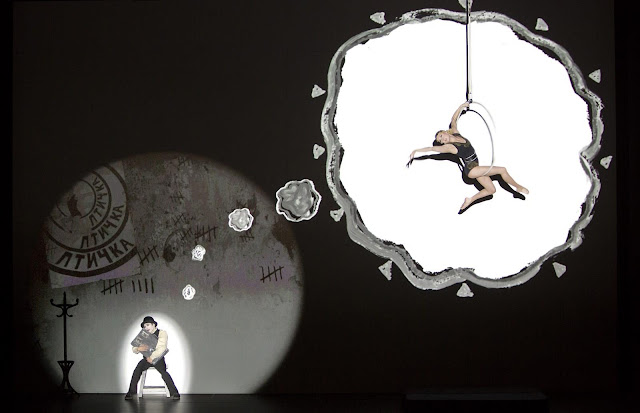
 

As for the other manipulator, the composer who so notoriously declared music’s inability to express anything other than itself, his score in performance exuded colourful rigour, its opening nicely, intriguingly deliberate, as if the forces were limbering up yet undoubtedly in control. Like what we saw, what we heard sounded audibly ‘Russian’ in origin and spirit, but with some degree of distance from time to time as well: not unlike Stravinsky, one might say. A few minor frayed edges aside – one can readily forget what a difficult piece this is – the orchestra under Markus Poschner did it proud, reminding us that recreation is not simply a matter of a new production; it happens, or should happen, every time we play and hear Petrushka.


In a programme interview, Suzanne Andrade likens the figure of the puppeteer in Petrushka to that of the Mother in L’Enfant et les sortilèges. It makes for a good connecting motif: meaningful rather than merely neat. It also helps make the ‘moral’ of Colette’s story – I think Ravel remains more circumspect; does he not always? – both more explicit and open to question. (Perhaps it criticises itself anyway; I am genuinely not sure. If so, that tendency is stronger here.) Andrade says that she and her collaborators had originally intended the boy (sung by a woman, let us never forget) to be like ‘one of those upper-class boys from Great Britain … they are naughty and learn nothing from the experience, because the societal status quo is such that they need not learn anything.’ If those overgrown schoolboys (and their aspirant hangers-on) have ‘had enough of experts’, we, not least those of us recently pushed into exile, have had more than enough of their running amok with our lives and futures; it is therefore something of a relief to experience contrition and forgiveness, before asking ourselves: ‘but whose, and on what authority?’ Who is the Mother, whether personally or more broadly, and what does she intend to be the outcome of those trials through which she means to get her own way?


The visual inspiration here comes from comics and films involving naughty little boys. Andrade names Dennis the Menace and the American film series, Our Gang (which began in the 1920s). Again, the transitions between animation and staging are deftly, wittily presented. (They also help with doubling or tripling of parts: one need not always see the singer in costume.) If I did not feel that as much was added to my thoughts about the work as in Petrushka, beyond that intellectual and dramaturgical question of overarching agency, perhaps I am showing myself a little more resistant, as I suggested, in opera than ballet (if, indeed we consider Stravinsky’s work primarily as such). Perhaps I also missed the nostalgia evident in Ravel’s sophisticated conception of childhood: no child could or would ever think of its ‘hood’ like that. One might counter that the score is there to do that anyway.


The Komische Oper’s welcome change of language policy – are you listening, ENO? – meant that we did not have to hear Ravel in German. If not everything was delivered with the most assured sense of what we have come to accept as French style, it rarely, or never is, even with Francophone singers. Moreover, one could hear every word – which is not always the case with such singers. Nadja Mchantaf made for a splendidly tomboyish boy – if that makes any sense. As hapless and as clumsy as Petrushka, he will at least have another chance. (Those privileged boys always do.) Orchestra and conductor seemed – or perhaps this was just my imagination, given the context – to play the score as if informed by some Stravinskian elements, rhythm perhaps playing a more prominent role than harmony at times, although such hierarchies will always be a matter of degree. In keeping with what we saw, there was much in bright, primary colours, and an evident delight in the mastery of that ‘Swiss watchmaker’, as Stravinsky called him. The rest of the cast proved very much more than the sum of its parts. If I do not relist the singers, it is not out of disrespect, but at least in part to emphasise, as so often in this house, the nature of the achievement of the company in an emphatic sense.


Wednesday, 16 April 2014

Die Zauberflöte, Komische Oper, Berlin, 13 April 2014


Komische Oper, Berlin

Pamina – Adela Zaharia
Tamino – Adrian Strooper
Queen of the Night – Olga Pudova
Sarastro, Speaker – Alexey Antonov
Papageno – Tom Erik Lie
Papagena – Julia Giebel
Monostatos – Peter Renz
Three Ladies – Mirka Wagner, Theresa Kronthaler, Caren von Oijen
Two Armoured Men – Christoph Späth, Bogdan Talos
Three Boys – Jakob Göpfert, Laurenz Ströbl, Samuel Baur

Suzanne Andrade and Barrie Kosky (directors)
Paul Barritt (animation)
Esther Bialas (designs)
Diego Leetz (lighting)

Chorus of the Komische Oper, Berlin (chorus master: David Cavelius)
Orchestra of the Komische Oper, Berlin
Kristiina Poska (conductor)


It seems more difficult to produce a satisfying Magic Flute than one might expect, if not nearly so difficult as the case of Don Giovanni. Barrie Kosky and ‘1927’ (Suzanne Andrade and Paul Barritt) come closer than many with this intriguing ‘silent film’ treatment. Doubtless predictably, I think it sells short the seriousness at the heart of this extraordinary work, but crucially, unlike many stagings falling into that category, it retains a space for one to think, to imagine and indeed to think of more serious things oneself. It was a pity that a sizeable section of the audience, seemingly intent on taking every opportunity to applaud through the music, did not avail itself of that space, but anyway… In Kosky’s words, ‘This concentration on images makes it possible for each spectator of the show to experience very much his own way,’ and to a large extent, that worked in practice.

In a reworking both radical and not, the dialogue – at least as dialogue – is dispensed with. Certain passages, old and new, conversational and explicatory, appear as part of 1927’s film. Whilst there are losses, and one clearly would not want to experience the work like this all the time, it is striking how much remains. And whilst Schikaneder deserves more credit than is often his due – how often one hears his magical, enabling text belittled! – it is of course for Mozart that we come to this work. What we see centres upon the 1920s, but is not confined to that era: associations, some freer than others, are made through what Andrade in a programme interview describes as ‘a journey through the most diverse fantasy worlds’. Meanwhile, what do we hear? Music from Mozart’s Fantasias for solo piano – to add to the post-modernism, on fortepiano. And yet, this somehow emerges as postmodernism that works. It might sound absurd to have Papageno dream (instead of his wine) of a pink cocktail, and through his experience to see pink elephants, but the free association benefits from the conviction of the ‘original’. It is certainly refreshing to experience the fruits of imagination as opposed to the mere silliness we often endure.

Musically, the situation was more mixed. Bonnie Wagner’s fortepiano playing – not in general, my usual readers will know, a favourite instrument of mine – was excellent: strong yet yielding, hinting at a larger whole yet imparting particular character to each ‘excerpt’. Kristiina Poska’s conducting was more problematical, despite generally fine playing from the orchestra. Most of the first act, from the Overture onwards, was rushed. Various tempi can work, of course, but the very difficult trick is to make them work; here, too often, one felt Mozart’s score harried. Matters settled down in much of the second act, however, and it was a relief to hear a performance of Pamina’s aria that, whilst certainly not of the Colin Davis variety, allowed Mozart’s pathos to shine through. Indeed, Adela Zaharia, a member of the Komische Oper’s Opera Studio, was definitely one of the stars of the show: hers was a genuinely touching performance. Her Tamino, Adrian Strooper, had his moments, offering a generally winning earnestness, but sometimes forced his voice. Tom Erik Lie was a characterful Papageno, hints of sadness informing even his most ebullient moments. Olga Pudova’s Queen of the Night did pretty much everything asked of her – often with considerable sparkle. The Sarastro of Alexey Antonov and Monostatos of Peter Renz were disappointing, however: the latter often shouting rather than singing, the former woolly of tone and too often insecure of pitch. The Three Ladies – Mirka Wagner, Theresa Kronthaler, and Caren van Oijen – were an excellent bunch, however, both individually and as a group. So were the Three Boys from Tölz: Jakob Göpfert, Laurenz Ströbl, and Samuel Baur. I am not sure I have heard better. Above all what impressed here was not only a strong sense of company but also of commitment to the staging, to the drama as a whole. That is worth a good deal – and the Komische Oper is strongly to be commended for it.