Showing posts with label Chloé Briot. Show all posts

Monday, 2 July 2018

Pelléas et Mélisande, Glyndebourne, 30 June 2018


Glyndebourne Opera House
  
Mélisande (Christiana Gansch), Pelléas (John Chest), Golaud (Christopher Purves)
Images: Richard Hubert Smith

Golaud – Christopher Purves
Mélisande – Christina Gansch
Geneviève – Karen Cargill
Arkel – Brindley Sherratt/Richard Wiegold
Pelléas – John Chest
Yniold – Chloé Briot
Doctor – Michael Mofidian
Shepherd – Michael Wallace

Stefan Herheim (director, lighting)
Philipp Fürhofer (designs)
Tony Simpson (lighting)
Alexander Meier-Dörzenbach (dramaturgy)

Glyndebourne Chorus (chorus master: Nicholas Jenkins)
London Philharmonic Orchestra
Robin Ticciati (conductor)

Mélisande and Golaud

What might have been? Such was a thought that came to my mind more than once during this, the premiere of Glyndebourne’s new Pelléas et Mélisande. What might have been if Stefan Herheim had not changed his Konzept so late in the day? (I had actually forgotten about that until reminded during the interval, yet had already begun to wonder whether the production had been, especially for him, unusually rushed.) What might have been, had this magnificent statement of intent – one of the greatest opera directors alive – from Sebastian F. Schwarz’s intendancy not been followed by manœuvring to ensure that something more ‘English’ would thereafter prove the order of the day? What might have been, had this Pelléas been conducted by someone with a little more feeling for and understanding of Debussy’s score – it would not have been difficult – than Robin Ticciati? What, ultimately, might have been, were operatic culture in this country not so philistine and class-ridden? The good news – our lives are at present as full of good news as those we see in Pelléas – is that leaving the European Union will only serve to make everything far, far worse. C’est au tour de pauvres petites.

Mélisande and Pelléas

I was thinking, though – which is considerably better than not. Even if I could not help but wonder what Pelléas set on a spaceship would have been like – on the face of it, it sounds a brilliant idea – Glyndebourne’s Organ Room, from time to time a salle modulable yet never escapable, turned the action and responsibility squarely upon us, the audience. (If only the worst-behaved had noticed. Some laughed at the end. Laughed! It was not difficult to think of them as Faragistes.) It is specific, yes, but not exclusivist. Indeed, with its heavy wood-panelling in Philipp Fürhofer’s outstanding set design, it might almost be the Victorianised combination room of an Oxford or Cambridge college or even something from the Hanseatic world of Buddenbrooks. Ancestry and tradition weigh down on it, though, as seen on the severe wall portraits. It is about us, then, but also about how we have become who we are.
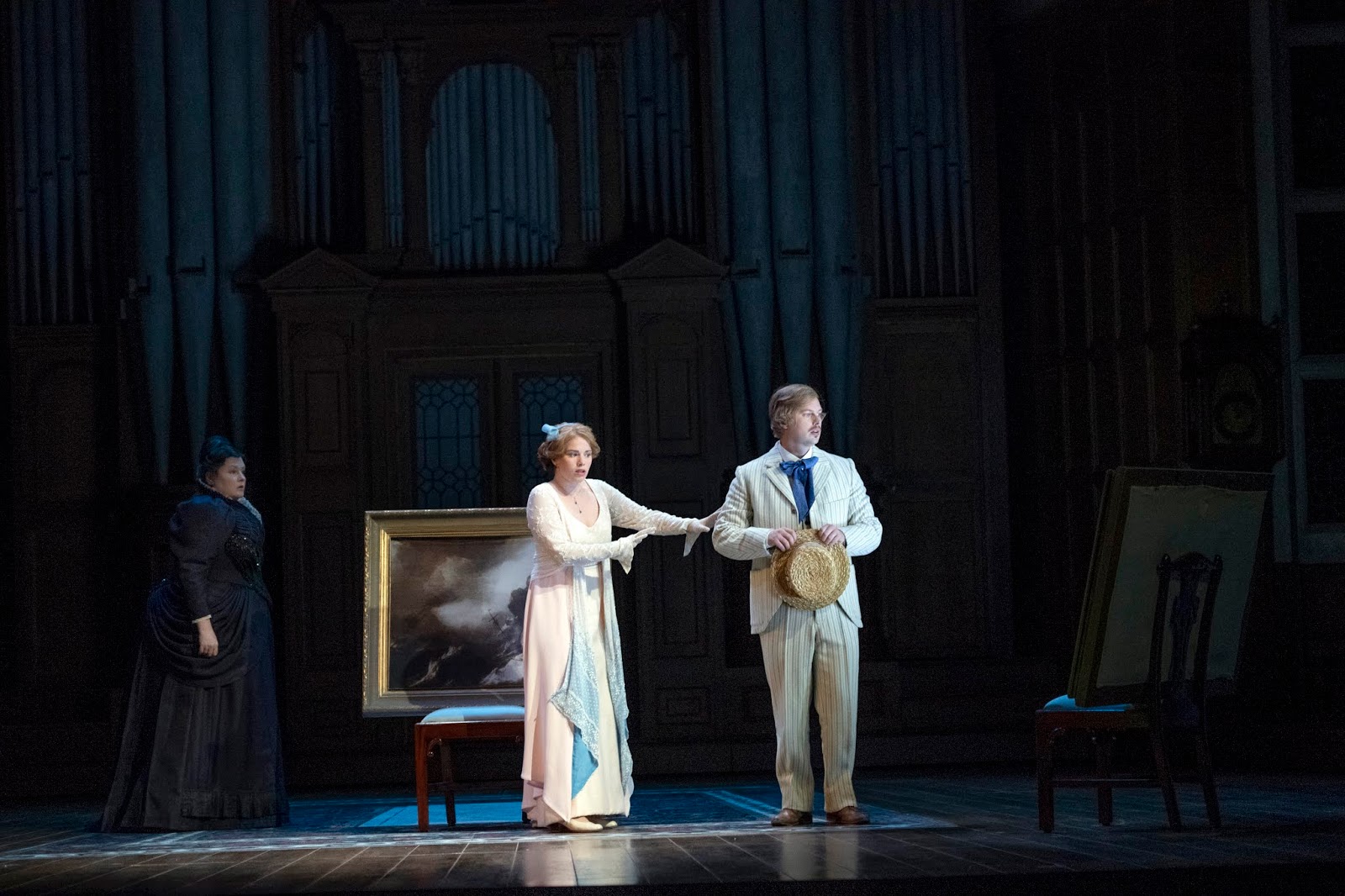

Geneviève (Karen Cargill), Mélisande, and Pelléas

‘Us’ in this sense means taking on aestheticism, asking ourselves as well as selfish fellow audience members what we think we are doing and why. These are people engaged in fruitless, fatal pursuits – but in this case they are also aesthetic pursuits. They try to paint new pictures and cannot. Why not? On account of tradition, or account of an aestheticism that has them retreat from lives, even try to turn their lives into art? It need not be either/or; it almost certainly is not. We see through their attempts at art, though: literally, for the paintings, if they exist at all, are beyond the fourth wall. Is not Mélisande, after all, a blank canvas? Men certainly tend to wish her so – as with Lulu. It is just a hobby, though, is it not? Something for rich people to do to while away their time, perhaps like building an opera house so that ‘your’ – the possessive is important – wife might sing in it. Pelléas might seem different; he is, here, an artist, a younger Debussyan dandy rather than the elderly huntsman trying to be something he is not and certainly was not. (Are Golaud and Pelléas to be identified with the composer? Perhaps, perhaps not. If you do not want ambiguity, this is not the opera for you.) But is he? Is he really? Or does he just wear summer clothes in a darkened room? Perhaps his aestheticised life is still more dishonest; perhaps ours are too. Perhaps, peut-être. ‘Je pars peut-être demain.’


We do that to children too, especially those of us who claim to be shocked by the very suggestion. Germaine Greer has fallen off the rails spectacularly in recent years, but her insight that we are all paedophiles still holds; indeed it holds more strongly than ever, if less so for those of us unburdened by ‘family’. And so, when Yniold – yes, I too had been mumbling that I should have preferred to hear a treble – is unmasked as a woman all along, with locks aspiring to those of Mélisande, we are obliged to ask ourselves questions. The violence we see, feel aestheticised and sublimated all around us suddenly becomes, as the interval comes, something we can no longer ignore. Those blows that never quite led anywhere come to seem something more than ‘boring’.


By the same token, however, should they perhaps not have become something a little sooner? When does representing boredom become merely boring? I am not sure that Herheim, usually a master at treading of multiple lines, does not trip, even fall, in this case. An object lesson in that respect was Christiane Pohle’s revelatory post-Beckett staging for the Bavarian State Opera. Meaninglessness was the thing there, not ennui as such; the production was all the better for it. I cannot help but wonder whether the negative reaction it received was laced with misogyny – and/or perhaps a journalistic lack of understanding of ‘modern’ theatre. It was, at any rate, difficult not to ask such a question in a work that focuses on abusive behaviour and yet here, at least, attempts to avoid addressing that behaviour.

Golaud and Mélisande

Later on, when it becomes more explicit, when we see that Pelléas and Mélisande literally stage their own death – is it actually a real death at all, or just an act – everything falls into place. Mélisande has already – in fact she did so straight away – ease(le)d out Geneviève. The family, closing ranks, would clearly avenge itself, so perhaps playing at Tristan and Isolde is all that it is left. It has not been an easy road; nor, surely, should it have been. However, just a little relief from the claustrophobia might actually render it more powerful. As things stand, there remains more than a little suspicion that earlier tedium is a handy, even suggestive excuse, yet perhaps nevertheless an excuse in part. Bloodied clowns certainly make their point; this sick Liebestod from the Theatre of the Absurd has still not left my imagination. Yniold, now herself, visits the Organ Room as a guest, an opera-goer. It makes the point, yes, but might it not be better left unmade?


Tradition is, after all, sometimes necessary, or at least helpful – as the Roman Catholic Church would rightly tell us. It often provides an important counterweight to literalism, to fundamentalism. Collective wisdom enables development; each one of us need not re-invent the wheel. (Aesthetes breathe a collective sigh of relief.) As Pierre Boulez pointed out in challenging – though not, as some have claimed, denying – tradition, ‘a strong personality will inevitably transform it [tradition].’ That still leaves the problem, of course, of what to do about personalities that are not ‘strong’ or do not wish to be. ‘Ne me touchez-pas! Ne me-touchez-pas!’ Is the conclusion here bleak or weak? Is it too easy to say that it is what we want it to be? Doubtless. Is it what we will make of it? By definition it more or less has to be, but is that simply to evade the question? And is that wrong? Debussy, after all, is the unsurpassed master of musical ambiguity.


Tradition, or at least learning, would certainly have benefited the conducting, at best featureless, at worst frankly jejune, we heard from Ticciati. Debussy’s genius shone through, although more the debt to Wagner than what distinguished him from the old Klingsor. That, however, was surely the doing of the London Philharmonic, drawing when it could on its vast reserves of operatic and symphonic experience. Alas, such uninspired musical direction  bleeding titbits of Wagner for people who dislike Wagner  did not help the singers either. Christopher Purves was presented as an older Golaud and sang as such: nothing wrong with it. His anger was wonderfully sublimated until it was not. It would have gained greater musical context, though, as would the rest of the cast’s, had there been – well, greater musico-dramatic context. Christina Gansch and John Chest likewise offered good vocal performances as the doomed lovers, but something seemed to be missing. (Should something be missing? Perhaps. Again, however, it is a fine line.) Richard Wiegold was an undoubted hero of the evening, singing from a box whilst an indisposed Brindley Sherratt acted out the role of Arkel below. Karen Cargill offered rich-toned benevolence – I think – as Geneviève; as so often in this role, one wished there were more to hear.  There was much to admire from Chloé Briot, Michael Mofidian, and Michael Wallace, although it was difficult not to think that all concerned might have benefited from greater certainty and clarity elsewhere.


Was it worth it, then, to have annoyed the right people, bluff English purveyors of ‘common sense’? Of course. They will not like Pelléas anyway; if they think they do, it is because they have not remotely understood it and think of it as vaguely ‘beautiful’. Is it enough to have annoyed them? Of course not. Does this represent Herheim’s best work? No. Does the production stand in need of revision? Very much so. Does it also need a conductor with a little more idea what might be going on and what might be at stake? Still more so. And yet, I have been thinking about it ever since, and show no sign of stopping. In the meantime, hasten to see Barrie Kosky’s Berlin production and, should it ever be revived, Pohle’s Munich staging. There are always, as we æsthetes/æstheticists will tell you, great recordings too. Desormière or Karajan? Boulez or Abbado? Why choose? With Boulez, you can even see Peter Stein before he lost it. ‘What,’ you might ask, ‘is “it”,’? Such is surely part of what Herheim’s production is about – perhaps, peut-être, still more so than he intended.


Wednesday, 19 July 2017

Festival d'Aix-en-Provence (4) - Philippe Boesmans, Pinocchio, 14 July 2017


Images: Festival d'Aix-en-Provence 2017 © Patrick Berger / artcompress
Father: Vincent Le Texier

Grand Théâtre de Provence


Director of the Troupe, First Crook, Second Murderer, Circus Director – Stéphane Degout
Father, Third Murderer, Schoolmaster – Vincent Le Texier
Puppet – Chloé Briot
Second Crook, Cabaret Director, Judge, First Murderer, Donkey Salesman – Yann Beuron
Cabaret Singer, Bad Pupil – Julie Boulianne
Fairy – Marie-Eve Munger
Troupe Musicians – Fabrizio Cassol (saxophone, improvisation coordination), Philippe
Thuriot (accordion), Tcha Limberger (violin tzigane)
 

Joël Pommerat (director)
Éric Soyer (set designs, lighting)
Isabelle Deffin (costumes)
Renaud Rubiano (video)

Klangforum Wien
Emilio Pomarico (conductor)


As the third of my four Aix operas this year, I saw the Festival’s new commission: Pinocchio, with music by Philippe Boesmans, to a libretto by Joël Pommerat, after his own play (itself, of course, in some sense ‘after’ Carlo Collodi). I wish I could be more enthusiastic about what I heard, but I was very much left with a feeling of something that had fallen between (at least) two stools. Is this a ‘children’s opera’, whatever that might be? There were certainly some children in the audience, although not that many: perhaps hardly surprisingly, for a performance that started at 8 p.m. and finished at 10.40. (There were, though, two performances out of the six that started earlier, at 5 p.m., on Sundays.) I could not help but think that if it were ‘for’ children, it might usefully have been about half the length. Indeed, pacing seems a bit odd more generally: lingering somewhat earlier on, perhaps with room for a cut or two.


Is it, then, a work about childhood, or some other form of work ‘for’ adults, using a children’s story as its basis? Again, I am not sure. For Boesman’s musical language and the use to which he put it seem determined to accommodate: somewhat at odds, I think, with what struck me as a rather more interesting libretto and indeed staging by Pommerat. Perhaps we should leave arguments concerning whether children need assistance into the world of opera by tonality until another day; for me, that is actually part of the problem, making post-tonal music – more than a hundred years on! – something to grow into, even to fear. So-called popular culture, more usually mass culture (quite a different, exploitative thing) has a great deal to answer for – in every respect, as any good, or even bad, Adornian would tell you. I was a little surprised, in any case, not only by the frankly tonal language employed throughout, but also by the almost childish – or should that be childlike? – simplicity of the score. A few motifs of reminiscence will certainly help anyone gain his or her bearings; a few references to other operas might appeal to people who like that sort of thing; a few more ‘with it’ moments may or may not grant a degree of ‘street’ relevance. (I suspect you can guess what I think.) However, whereas Pommerat’s libretto and the (literal) darkness of his production seem very keen lightly to explore the darker side of the fable, to open up philosophical questions concerning existence, a lack of justice in the world and so on, the score almost sounds as if it were intended for a children’s television programme. Nothing wrong with that, you might say, and perhaps not, but there seems neither to be genuine, productive conflict between different impulses and possibilities, nor the true collaboration of which the Festival’s outgoing director, Bernard Foccroulle, speaks in the programme: more a bit of a mismatch.


Director of the Troupe: Stéphane Degout


In performative terms, it all looked and sounded tremendous. No one could accuse the Festival of having done anything other than wholeheartedly supported the project. The Puppet, as he is always called, looked anything but cuddly, instead almost horror-movie fodder. Chloé Briot’s spirted performance stood much more in a line of offering fruitful dramatic conflict. Stéphane Degout proved a towering presence onstage, not least in the largely spoken narrative role of the Director of the Troupe. It seemed a bit of a waste of his talents, though, to have him devote so much of his time to speaking, and when singing, to lavish such vocal beauty and verbal acuity on so musically facile a part. Vincent Le Texier's seemingly wise, certainly compassionate Father impressed too. Marie-Eve Munger stood out in the high-lying part of the Fairy, whose lack of straightforwardness (on Pommerat’s part) certainly intrigued. Klangforum Wien under Emilio Pomarico offered truly luxurious orchestral support; I cannot imagine they have often, if ever, played anything quite like this. Again, though, it did seem to me somewhat to squander the talents of one of the finest new music ensembles in the world. Last month, Répons in Vienna; this month, well, this.


Fairy (Marie-Eve Munger)


It is certainly not that I am against ambiguity concerning audience, or broader appeal; far from it. This, however, gives the impression – or at least did so to me – that, perhaps like Pinocchio himself, it does not know quite what it wants to be. Or perhaps the problem lies with me, and I do not know what I want things to be. At any rate, whilst I was happy enough to have seen the opera, I cannot imagine wanting to do so again; for me, at least, the Festival’s offerings of The Rake’s Progress and Carmen proved infinitely more dramatically satisfying. Now, one Cavalli opera, Erismena, to go…


Sunday, 15 February 2015

Hannigan/Uchida/Philharmonia/Salonen - Dutilleux and Ravel, 12 February 2015


Royal Festival Hall

Dutilleux – Correspondances
Ravel – Piano Concerto in G major
Ravel – L’Enfant et les Sortilèges 

Barbara Hannigan (soprano, Princess)
Dame Mitsuko Uchida (piano)

Child – Chloé Briot
Mother, Chinese Cup, Dragonfly – Elodie Méchain
Louis XV Armchair, Shepherd, White Cat, Squirrel – Andrea Hill
Shepherdess, Bat, Owl – Omo Bello
Fire, Nightingale – Sabine Devieilhe
Grandfather Clock – Jean-Sébastien Bou
Teapot, Arithmetic, Frog – François Piolino
Armchair, Tree – Nicola Courjal

Irina Brown (director)
Quinny Sacks (movement)
Ruth Sutcliffe (designs)
Kevin Treacy (lighting)
Louis Price (video)

Philharmonia Voices (director: Aidan Oliver)
Philharmonia Orchestra
Esa-Pekka Salonen (conductor)


Henri Dutilleux’s music has its devotees. I am yet to join their ranks, but had no reason to think this was not an admirable performance of his song-cycle, Correspondances. Following its brief, opening Rilke (in translation) setting, ‘Gong’, ‘Danse cosmique’ offered Barbara Hannigan greater dramatic possibilities, well taken. The Philharmonia under Esa-Pekka Salonen provided vivid, often pictorial playing. Singer and orchestra proved tender indeed during the treatment of ‘solitude’ in the oddly-chosen extract from a letter from Aleksandr Solzhenitzyn to Mstislav Rostropovich and Galina Vishnevskaya. Hannigan’s closing repetitions of ‘toujours’ faded away nicely, as did the orchestra. ‘Gong II’ provided something a little more labyrinthine, even perhaps Bergian, although Pli selon pli this certainly is not. The closing ‘De Vincent á Théo’ brought beguiling sonorities and, in Hannigan’s performance, a stunning vocal climax.


Mitsuko Uchida joined the orchestra for Ravel’s G major Concerto. There were a few occasions when I wondered whether the Philharmonia had had enough rehearsal here, lapses in ensemble uncharacteristic for both orchestra and conductor. Otherwise, Salonen proved general cool but not cold, even though a little more freedom at times might not have gone amiss. Uchida’s playing was a model of clarity, energy, an of course grace. It is all too easy to make Mozartian comparisons here, but they did not seem especially relevant; this was Ravel, and sounded like it. Uchida’s second-movement cantilena was beautifully judged, a product of harmonic understanding as much as her melodic voicing itself. Woodwind solos were exquisitely voiced, with just the right degree of general orchestral languor. The scampering energy of the finale was occasionally hampered by a couple more lapses in ensemble, but the ‘sense’ of the music was there, especially in Salonen’s building of tension. Uchida’s choice of encore was inspired: the second of Schoenberg’s Six Little Piano Pieces, op.19, that repeated major third, G-B, making its point of continuity.


L’Enfant et les sortilèges followed the interval. Salonen’s tendency, especially at the start, was towards fleetness of tempo; there was certainly no hint of sentimentality. Indeed, a keen sense of forward motion was maintained throughout the performance. The action took place on a ‘stage’ surrounding the stage proper, a resourceful semi-staging giving all that we really needed, not least thanks to imaginative animation (for instance, the confusion of the clock) and atmospheric lighting. There was great character and chemistry to be experienced between the singers, François Piolino often stealing the show, whether by himself or in his interactions with others. Chloé Briot presented a convincingly boyish Child, never forgetting – nor did the performers as a whole – that this is not really a children’s opera at all, but an opera about that most adult of preoccupations, childhood. Hannigan, when she reappeared, now as the Princess, was very much a woman in a man’s creation of a supposed child’s world. Scenes were very sharply defined as almost self-contained units; Salonen seemed, at least to my ears, to perceive Ravel’s opera almost as a cinematic dream-sequence. Certain figures recalled the sound-world of the piano concerto, but there was no mistaking the heady atmosphere of the night.


Friday, 28 November 2014

Pelléas et Mélisande, Philharmonia/Salonen, 27 November 2014


Royal Festival Hall

Mélisande – Sandrine Piau
Pelléas – Stéphane Degout
Golaud – Laurent Naouri
Geneviève – Dame Felicity Palmer
Physician – David Wilson-Johnson
Arkel – Jérôme Varnier
Yniold – Chloé Briot
Shepherd – Greg Skidmore
Narrator – Sara Kestelman
 
David Edwards (director)
Philharmonia Voices
Philharmonia Orchestra
Esa-Pekka Salonen (conductor)
 

This was an extraordinary performance of an extraordinary work, one which has rarely been given its due in London and which, bafflingly, our opera houses still shy away from staging. I have only seen Pelléas et Mélisande ‘live’ once before, in a performance at Covent Garden superlatively conducted by Sir Simon Rattle. The best that one could say about the accompanying staging was that the excellence of the performances still shone through. Here, we had a minimal staging from David Edwards, excellently lit (so important in Debussy, both physically and metaphysically!), which let the opera speak for itself, but which, having the characters seated in the Choir watching, walking down slowly to the stage, offered something of a frame to the action. The narration, though well delivered, seemed entirely superfluous and would have been better off cut.


That really is my one and only cavil. Esa-Pekka Salonen led the Philharmonia in a performance as fine as anything I have heard from him and/or the orchestra. Like Debussy’s score itself, it drew one in to listen, rejecting ‘operatic’ gesture for symbolist drama. (Is that, perhaps why we find it so difficult to stage the work, finding ourselves so remote from æsthetic tenets from which it is far from readily sundered?) Debussy’s words from his 1902 ‘Pourquoi j’ai écrit Pelléas,’ might almost have been written as a review of what we heard:  ‘The drama of Pelléas, which, in spite of its dream-like atmosphere, contains far more humanity than so-called “real-life documents”, seemed to suit my intentions admirably. In it there is an evocative language whose sensitivity could be extended into music and into the décor orchestral.’ And so, not only was the performance, aurally still more than visually, ‘lit from behind’, as Debussy so memorably claimed of Parsifal, but it seemed to emerge from Materlinck, or perhaps even from words and a simple yet deep story that somehow had always been there.


That emergence was the musical story offered by Salonen and the orchestra. There is of course no one ‘right way’ to perform Pelléas. But the refusal to play to the gallery, in conjunction with a refusal to highlight any one particular strand or influence and a near-incredible sensitivity to the subtlest of changes, or indeed continuities, in pitch, timbre, and any other parameter you might care to mention made for an absorbing experience. Line was maintained without realising: it was simply ‘there’. The drenching of the score in Tristan and, perhaps still more, Parsifal had, as with Puccini or Elgar (in some senses, at least, closer spirits than one might suspect), no need to be hammered home. Pierre Boulez was accused in 1969 of having ‘Wagnerised’ Debussy at Covent Garden. (What I should have given to hear that!) He quite rightly responded that there was no need, since Debussy’s music was already ‘Wagnerised’. Although no one now would doubt that, it is interesting to reflect that many, especially from a French nationalistic standpoint, did so at the time. It is also a decidedly individual variety of Wagnerism, so close to Wagner and yet so utterly distant from Beethoven. Here, in 2014, the melos, the post-Amfortas pain, the motivic cohesion and propulsion, the turns of orchestral phrase: all reminded us where we had come from, without insisting that we were still there. Climaxes, as in Wagner, though not as in his lesser successors, were sparing and carefully marshalled – but how they registered when they came!


Such was, of course, very much the due also of the soloists. No climax registered more overwhelmingly than in the fourth act, thanks both to the orchestra and to the towering portrayal of Pelléas by Stéphane Degout, every inch the equal (at least!) of Simon Keenlyside in 2007. This Pelléas found himself, Tristan-like, in death; his was a frank yet still subtle sexual awakening perhaps, given its pace, more powerful still. Degout’s way with the French text was second to none; its alchemic union with Debussy’s music was not the least of the wonders we heard. ‘Musical’ and ‘dramatic’ values were utterly as one, a hallmark of the performance as a whole. Sandrine Piau’s pure-voiced Mélisande had her own tale to tell, or perhaps not to tell; one was more enchanted than infuriated, but the circularity that incites, and not always positively, was tangible throughout. There was no need for Piau to raise her voice, no need to play the vulgar game of so much actually-existing ‘opera’. Indeed, her ‘early music’ experience was put to spellbinding use, for, whether it be actual influence or no, there is also affinity in Debussy’s work with the earliest of opera. The ghosts – or prophecy – of the stile rappresentativo made their presence felt, without being forced upon us.


So, naturally, did the ghost of Mussorgsky. One heard it in the bells of the fifth act, but also in the alluring, yet slightly distancing delivery of so many vocal lines. Laurent Naouri’s Golaud was not always vocally ‘beautiful’, but why should he have been? There was something far more valuable here, dramatic truth: again, not in the sense of vulgar display, but in the emergence of a tortured soul from Maeterlinck, the vocal line, and the décor orchestral. The modern cliché of ‘feeling his pain’ was in a better sense entirely justified. Jérome Varnier hinted at a more interesting Arkel than one often feels, managing adroitly the difficult balancing act between young voice and old role. His psychological insights led nowhere, it seemed, and yet one knew at some level their truth. I sensed grave responsibility, even if its nature and grounding remained unspoken. Felicity Palmer’s Geneviève showed that artist’s typically acute response to text as words and music, whilst Chloé Briot offered a perky and, in the best sense, disconcerting Yniold.
 

Riddles were posed, then, yet never answered. The ambiguity that lies at the heart of so much of Debussy’s music, whatever ‘artistic’ label we seek to pin upon it, won out. For this was a musical triumph through and through, reminding us of what opera might be, yet sadly, so rarely is. Fauré was reported by Princess Edmond de Polignac as having remarked after the premiere, ‘If that be music, then I have never understood what music was.’ Quite.