Showing posts with label Glyndebourne. Show all posts

Wednesday, 22 July 2026

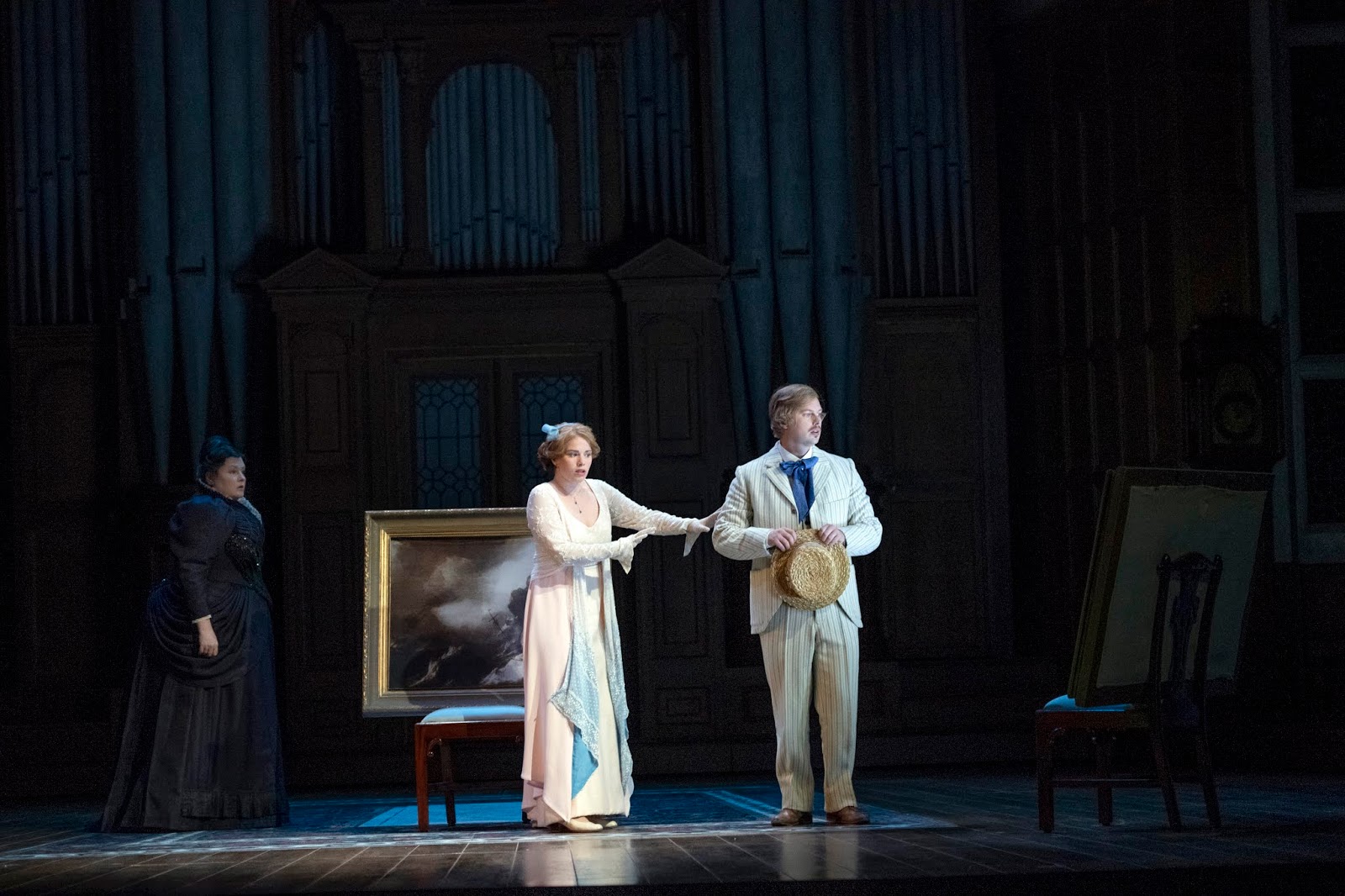
Ariadne auf Naxos, Glyndebourne, 19 June 2026


Images: © Glyndebourne Productions Ltd. Photo: Tristram Kenton


Music Master – Michael Kraus
Major Domo – William Relton
Lackey – Oliver Williams
Officer – Owen Lucas
Composer – Samantha Hankey
Tenor, Bacchus – David Butt Philip
Wigmaker – Hector Bloggs
Zerbinetta – Alina Wunderlin
Prima Donna, Ariadne – Rachel Willis-Sørensen
Dancing Master – Ru Charlesworth
Naiad – Anna Denisova
Dryad – Ekaterina Chayka-Rubinstein
Echo – Eirin Rognerud
Harlequin – Mikhail Timoshenko
Scaramuccio – Caspar Singh
Truffaldino – Lian James Karai
Brighella – Liam Bonthrone

Director – Laurent Pelly
Set designs – Massimo Troncanetti
Lighting – Marco Giusti

London Philharmonic Orchestra
Robin Ticciati (conductor)


Strauss and Hofmannsthal’s Ariadne auf Naxos should in many ways be the ideal Glyndebourne opera. It is indeed pretty much the ideal opera for any opera house, given its metatheatrical treatment not only of the genre itself, but of almost any aesthetic standpoint anyone in the audience might care to adopt (including none at all). All are fondly mocked and cherished; all can see and hear themselves. The question of art as ‘entertainment’ in a ‘country-house opera’ setting in which the picnic can take almost as long as the performance, itself increasingly prey to what the late Michael Tanner christened the ‘Glyndebourne guffaw’, is especially keen here. So too, for many of us, is the necessity for it to be more than merely entertainment, for the authors’ twin, arguably conflicting ideas and strategies of transformation (Verwandlung) to come into play. It is an opera, then, to be treated with good humour and seriousness, affection and critical distance, these and the opera’s other binaries all informing one another and reminding us why we might have fallen in love with the genre in the first place—even to the extent of catching trains, buses, and more in the madness of decamping to rural Sussex with hampers and the like for an afternoon in the uncharacteristically burning sun. Thinking and writing about opera are part of that joy and madness too, not least since one is almost inevitably setting oneself up to be lampooned in this context (that is, in the unlikely event anyone should really care what one has to say). Without hedging or situating further, I am somewhat saddened to say that it was only in the realm of vocal artistry and individual dramatic performances that this new production shone, staging and conducting leaving much to be desired, even to the extent of coming across in unduly provisional form. 


Let us start with the good news then. Our artists – and artistes – acquitted themselves with excellence ‘as themselves’ in the Prologue and, where relevant and appropriate, as something more in the Opera. Rachel Willis-Sørensen resisted any temptation there may have been to present the Prima Donna as a mere caricature; this was a singer who knew her worth, certainly, but without seeming silly or monstrous. Her seriousness – that word again – in preparing for Ariadne was genuine, as was her achievement in a splendid ‘Es gibt ein Reich…’ and beyond. One might say much the same of David Butt Philip’s Tenor/Bacchus, whose keen attention to words as well as music ensured uncommon depth, not least in furthering our appreciation of where (and whom) he was coming from, in Circe’s guise. Given the enormous technical and other demands placed on Zerbinetta, it is striking how few fail. It is really one of those roles one does not consider attempting unless one can. Alina Wunderlin proved no exception, whether as immensely likeable artist or purveyor of pinpoint coloratura thrills that yet did not mask a necessary sadness behind them. Samantha Hankey’s Composer was a sincere, similarly likeable portrayal, offering an unmistakeably human trouser role in various of its complexities and possibilities. There was much to admire elsewhere, too, the cast assembled in depth with vivid cameos from a world-weary Michael Kraus as Music Master, and Ru Charlesworth as his overtly camp, yet similarly professional opposite number in the world of dance. A haughty Major Domo (William Relton), a fine trio of Rhinemaidens or Naiad, Dryad, and Echo, and a spirited desert island troupe offered other highlights.


Insofar as Laurent Pelly’s production offered a framework, or at least setting, for those performances it functioned well enough. Too often, though, the lack of an evident directoral hand was felt: conceptually, but even in imparting much beyond the sense of bringing the cast together. Was this in some sense the Composer’s dream, suggested by his/her return to view proceedings? If so, that seems a workable, even promising idea, but little was done with it, beyond presenting a Prologue set that combined Rococo and modern, and an Opera wilderness around which characters walked, more or less directed. If Pelly did not get in the way of the work’s dramatic themes, nor did he seem interested in bringing them out either. There is much one could do here to suggest more than the sum of its parts, yet any attempt to do so passed me by. Likewise when it came to Robin Ticciati’s painting-by-numbers conducting, notwithstanding the strengths of the London Philharmonic in itself. We lumbered from section to section, with little to suggest connection between them. A strangely motoric opening intrigued, as if Stravinsky – who openly despised this opera, or claimed to – had been set the task of reinterpreting it, perhaps in the light of Pulcinella. That was soon binned, though, another, arbitrary idea come to replace it for a minute or two, and so on. Again, it gave an impression of what the work might be, but little more than that. A sense of magic beyond the vocal remained stubbornly elusive.


Tuesday, 10 June 2025

Saul, Glyndebourne Festival Opera, 8 June 2025


© Glyndebourne Productions Ltd. Photography by ASH


Saul – Christopher Purves
David – Iestyn Davies
Merab – Sarah Brady
Michal – Soraya Mafi
Jonathan – Linard Vrielink
Abner, High Priest, Doeg, Amalekite – Liam Bonthrone
Witch of Endor – Ru Charlesworth
Dancers – Lucy Alderman, Robin Gladwin, Lukas Hunt, Dominic Rocca, Nathan Ryles, Daisy West

Director – Barrie Kosky
Revival director – Donna Stirrup
Designs – Katrin Lea Tag
Choreography – Otto Pichler
Revival choreography – Merry Holden
Lighting – Joachim Klein

The Glyndebourne Chorus (chorus director: Aidan Oliver)
Orchestra of the Age of Enlightenment
Jonathan Cohen (conductor)


Saul (Christopher Purves)

I found myself listening at home to Saul a few months ago (Charles Mackerras’s outstanding Leeds Festival recording with Donald McIntyre, James Bowman, Margaret Price, et al.). It made for often uncomfortable listening, the ever-problematical identification of Handel’s Protestant England with the ‘children of Israel’ all the more when daily we see the Philistines’ successors mercilessly slain in the name of a latter-day ‘Eretz Israel’, itself the product of the imperialism on which the new, fiscal-military state of Great Britain had been founded. Culminating in news from the Amalekite – David’s ‘Impious wretch, of race accursed!’ – that Saul has been slain and Israelite exortation to ‘Gird on thy sword, thou man of might’, it seemed both a work both for now and absolutely not. At least it was not Joshua or Judas Maccabeus, I thought; and indeed its central dramatic concerns are not necessarily those, however glaring they may stand out now. The work’s political dimension is important, but is one of several and arguably not the most important. In any case, it extends beyond war and empire to broader questions of kingship—not least given the precedent of the Whig establishment’s treasonous support for the Dutch invasion that had removed ‘the Lord’s anointed’ within living memory, and without which George II would stand nowhere near the throne. 


Barrie Kosky’s Glyndebourne production of Saul was first seen in 2015: what may now seem a very different world, prior to Britain’s fateful referendum, Trump’s election, Covid, the invasion of Ukraine, and of course genocide in Gaza. None of those things came out of nowhere, of course, but the world was different. He was – and is – perfectly entitled to explore other aspects of the drama, and it is neither his nor revival director Donna Stirrup’s fault that events have overtaken us. Kosky offers a typically pugnacious, persuasive defence of staging such works at all and of his particular aesthetic in the programme. ‘But when you put Handel’s oratorios on stage you know that there will be a flood of opera reviewers who’ll say these pieces were not written for the stage, so why are we staging them? Get real! Opera is not about rules and regulations. Handel’s oratorios are sometimes more dramatic than his operas. We know that because we can hear it. Their musical landscapes are often more radical than those of the operas.’ I agree with every word. Why, then, beyond the inevitable unease concerning aspects of the drama, did I have my doubts—as someone who has long thought it cried out for the stage? 

There are problems intrinsic to the work, of course, as there always have been, lying beyond the cul-de-sac of alleged intention. The chorus’s role is one: how to deal with it onstage? Kosky certainly makes the most (as, for instance, in his Komische Oper Hercules) of his opportunities in this respect. An opening festal tableau, gestures arrestingly frozen, draws one in, Kosky’s detailed direction of each member of a crowd that also combines with excellence en masse dovetailing with Katrin Lee Tag’s painterly vision.An eighteenth-century audience, so it seems, participates, mirroring the dual function of the chorus itself, roots in Greek tragedy apparent and brimming with dramatic potential. 


David (Iestyn Davies)

The problem for me comes with elements of the conception of the protagonists. Not all of it: much shows great insight. A brazenly opportunist David is the trump card: charisma born of body and battle, seemingly willing to do anything – or anyone – to further his clear yet unstated lust for power. Why bother to spell it out, when the crowd will for him? ‘Saul, who hast thy thousands slain, welcome to thy friends again! David his ten thousands slew, ten thousand praises are his due!’ There is, moreover, a creditable effort to make more of Saul’s daughters and their roles, though that also leads us to more difficult territory. In that programme interview, Kosky states his dislike of realism, but that seems to refer to aesthetics rather than to psychology. (I actually would not have minded more on the former side and less dance, however finely accomplished; but that is a matter of taste, no more.) It is a particular form of psychological realism that, though I can see the temptation, also leads the drama to become less interesting and arguably less coherent. If one portrays calculation in such realistic way, there is nothing ‘mad’ about Saul’s reaction. Michal and still more Jonathan must simply be in love with David, which is obviously part of what is going on but surely not the only or overriding dramaturgical concern. And the decision to present Saul for much of the time as if already in Bedlam – perhaps even as if a flashback – is ultimately reductive, again crowding out other concerns. 

Set against that, the darker turn following the interval makes an undeniably strong impression. There is a splendid star-turn (literally) from the revolving solo organist onstage. When Saul visits the Witch of Endor, Kosky offers a nice sense of Tiresias in Beckettland, to the weird, disconcerting extent that Saul feeds from one of the Witch’s breasts. The doomed monarch also voices Samuel’s words himself: possessed or merely delusional? If Kosky and Tag’s Beckettland looks surprisingly (or unsurprisingly) close to that seen for their Castor et Pollux (ENO and elsewhere) and Don Giovanni (Vienna), most production teams have recognisable correspondences over time. Richard Jones & Co. anyone? The important question is what one does with them. 


Jonathan Cohen’s conducting I found more difficult to get on with: not only aggressively ‘period’, but of a variety that too often skated over Handel’s strengths as a musical dramatist. There was little grandeur, if often much rasping noise. The Orchestra of the Age of Enlightenment strings might surely have been permitted fuller tone at times. Excellent woodwind fared better: characterful and dramatically telling. Handel’s writing for bassoon – not only in the Witch of Endor scene – is worth an essay alone from someone. It certainly sounded so here. Greater variety of tempo was achieved as time went on, if there were still cases, especially in choral numbers, when breakneck speed disrupted ensemble. 


Merab (Sarah Brady), Michal (Soraya Malfi), and Jonathan (Linard Vrielink)

Christopher Purves’s Saul was superbly acted, if sometimes a little close to Sprechgesang (leaving aside purely spoken interjections further to enhance the impression of insanity). There was often, though, a thinness of tone to his delivery that complemented Cohen’s way with the orchestra, but which on ‘purely’ musical terms left me at least missing something more bass-like. Iestyn Davies’s David was outstanding in every respect: word, tone, and gesture a model of characterisation.  Sarah Brady and Soraya Mafi offered a haughty Merab and an attractive, calculating Michal, in fine dramatic contrast both with one another and with the honeyed, imploring sincerity of Linard Vrielink’s Jonathan. Kosky’s amalgamation of Abner, High Priest, and Doeg, into a single Fool-like character elicited sinister ambiguity from Liam Bonthrone, who also took on the ‘cursed’ role of the Amalekite, mysteriously hooded in the auditorium. Ru Charlesworth offered a darkly vivid portrayal for Kosky and Handel’s strange conception of the Witch of Endor. The Glyndebourne Chorus likewise responded to a varied set of challenges – Handel’s, Kosky’s, and Cohen’s – with fine musical and dramatic dedication. 

My reservations, then, were relatively minor. Audience enthusiasm suggested they were little shared. This was a highly enjoyable occasion, though might it have offered more dramatically? To my dismay, I could not help but wonder whether a concert performance, albeit differently conducted, might have come closer in that respect.


Wednesday, 25 May 2022

The Wreckers, Glyndebourne, 21 May 2022


Tallan – Jeffrey Lloyd-Roberts
Jacquet – Marta Fontanals-Simmons
Harvey – Donovan Singletary
Pasko – Philip Horst
Avis – Lauren Fagan
Laurent – James Rutherford
Thurza – Karis Tucker
Marc – Rodrigo Porras Garulo
Dancers – Rosie Bell, Lucy Bruns, Tash Cru, Sirena Tocco

Melly Still (director)
Ama Inés Jabares-Pita (designs)
Mike Ashcroft (choreography)
Malcolm Rippeth (lighting)
Akhila Krishnan (video)

The Glyndebourne Chorus (chorus director: Aidan Oliver)
London Philharmonic Orchestra
Robin Ticciati (conductor)


© Glyndebourne Productions Ltd. Photo: Richard Hubert Smith


I so much wanted to like this. Ethel Smyth was an interesting, admirable woman. What little of her other music I have heard I have always found at least to be of interest. Her opera The Wreckers is, moreover, an ambitious work, a great statement of intent, matched in many ways by Glyndebourne’s ambition and intent in staging it and by the commitment of those involved on stage and in the pit. None of that, alas, can disguise a signal dramatic failure, whose tedium was surely increased by the frankly bizarre decision to reinstate cuts made for its 1906 premiere. Sometimes cuts can actually make a work seem longer. (Think of Tristan; or rather do not, for the comparison is anything but forgiving.)

Henry Brewster's French libretto is a serious problem: not so much the language as such, though it is no literary masterpiece, as a broken-backed plot, which on paper looks interesting, even suggestive of a Cornish precursor to Peter Grimes. A multitude of incident and apparent conflict notwithstanding, though, it fails to convince. This is partly, I think, on account of so many trees of incident obscuring the dramatic wood. Here lies neither direction nor directness. One loses track—maybe just I did—of who is who, receives little musical help, and finds it difficult to care. Presentation of a host of unpleasant people in the service of a still more unpleasant occupation fails not only to engage, or even to ring true.  There is a message somewhere, but it struggles to emerge.

Smyth’s music is more immediately impressive: at its most structurally convincing when it comes to the choral writing, of which there is much. Even there, beyond being loud and accomplished, it remains anonymous, returning one to the questions of where the drama lies and why one should care. The rest, however, goes beyond mere eclecticism to a banquet of the derivative, all courses served more or less at once, resolving into a strange, indigestible purée of notes. Tchaikovsky, Brahms, Grieg, Wagner, Mendelssohn, Elgar, Bizet, Massenet; and so it goes on, and on, and on… Lack of a definable voice is one thing; so too is a lack of originality; this score, however, seems never to know where to turn, quite to lack harmonic and often even melodic direction. The third of three acts is probably the most interesting, perhaps not coincidentally the least backward-looking of the three. Maybe this was apprentice work, from which Smyth in other circumstances would have emerged more fully equipped; maybe a revision beyond cuts and greater theatrical experience would have produced something more convincing.


© Glyndebourne Productions Ltd. Photo: Richard Hubert Smith


Perhaps some would have held Robin Ticciati’s conducting responsible; it is difficult to say confronted by an entirely unfamiliar work. My sense, though, was of committed musical direction that was determined to mould the score into something more cohesive, failing through not fault of its own. The LPO sounded possessed with belief, rather like the community of which we heard the words tell, yet never felt for ourselves. So too did the Glyndebourne Chorus, outstanding in every respect. I cannot imagine a better case being made for what is probably the oratorio-heart of Smyth’s writing. Heft, precision, and clarity were impeccable, as were these singers’ acting skills. The vocal cast was largely impressive too, Lauren Fagen and Karis Tucker shining throughout, but especially towards the close, in the two principal female roles, Rodrigo Porras Garulo ardent as Marc, a romantic hero in whom one would have liked to believe.


© Glyndebourne Productions Ltd. Photo: Richard Hubert Smith


The conservatism of Melly Still’s production cannot have helped. I wonder what a director such as Katie Mitchell might have made of material that surely needed to be brought more out of itself, framed, interrogated, were it to have any hope of succeeding. As it is, the staging, half-heartedly ‘modern dress’—as people might have said half a century ago—shows little sign even of drawing basic distinctions between different standpoints. For something in one way so straightforward, it is paradoxically obscure and confusing. Female dancers in Edwardian dress, presumably in some sense signifying the composer, come and go; whatever it is their presence is supposed to contribute passed me by entirely. In a way, this mirrors the work, albeit with less octane and conviction: throw everything in, a shopping trolley included, and see what emerges. It is barely an æsthetic, though, let alone an enlightening one. The only respect in which Still really scores—this should certainly be acknowledged—is in detailed direction of the individuals who came together to make the chorus. 

So there you have it. Musical performances made as powerful a case as is likely to be made for the opera. The greater part of the first-night audience loved what it heard, roaring approval in no uncertain terms. A few more sober souls were simply relieved that it was over. I do not begrudge The Wreckers being afforded this opportunity; how else might we reach any sort of informed judgement? By the same token, I cannot imagine ever wanting to hear it again.


Monday, 20 May 2019

La Damnation de Faust, Glyndebourne, 18 May 2019


Glyndebourne Opera House


Images: Richard Hubert Smith

Faust – Allan Clayton

Méphistophélès – Christopher Purves
Brander – Ashley Riches
Marguerite – Julie Boulianne

Richard Jones (director)
Sarah Fahie (assistant director, choreography)
Hyemi Shin (set design)
Nicky Gillibrand (costumes)
Andreas Fuchs (lighting)

Dancers
Glyndebourne Chorus (chorus master: Aidan Oliver)
Glyndebourne Youth Opera
Trinity Boys Choir
London Philharmonic Orchestra
Robin Ticciati (conductor)


There may be a case for staging Berlioz’s ‘dramatic legend’, The Damnation of Faust; it was certainly not made on this occasion. To be fair, here are arguments either way, not least with respect to Berlioz’s own wishes and practice, and there probably always be. This new Glyndebourne production, however, found itself stuck uncertainly, awkwardly, and most of all tediously, between various poles and possibilities. It seemed to lack belief in the work, or at least the wisdom of staging it as it stands, yet at the same time makes changes so half-hearted, arbitrary, and silly that one wishes it had not. Some of Richard Jones’s recent productions – for instance, anon-committal Bohème and a weirdly unfinished Katya Kabanova, both for Covent Garden have suggested running out of steam; this did nothing to dispel the impression.


Much might have been salvaged in the event of a stronger musical performance. Alas, the festival’s music director, Robin Ticciati failed to provide it. I have yet to hear a performance from him that was not at least disappointing. Here, Ticciati offered a masterclass in the perverse art of rendering Berlioz bland and tedious to the point of non-recognition; only the following evening, listening to Colin Davis’s classic Philips LSO recording, did I feel reassured that, yes, I did know the work after all. Such lack of orchestral colour and warmth – the LPO strings sadly wasted through well-nigh absurdist lack of vibrato –married to inability to marry harmony and pulse, on the rare occasion that the latter were discerned, seemed to indicate not so much an æsthetic as mere incompetence. Notes, bars, phrased, paragraphs, even numbers drifted interminably, until suddenly an abrupt, stiff minor – very minor – eruption would occur: quite arbitrary, yet doubtless considered ‘exciting’ by some. Many paths might be taken to ignite the flame of Berlioz’s Romanticism, from Davis to Boulez, from Munch to Markevitch; a prolonged damp squib leading nowhere at all was what we heard here. When it could be heard, the LPO woodwind sounded gorgeous, not least in solo work. Too much, however, was relegated to the status of a dull backing-track to events on stage, such as they were.

 
Singing was better, if often unidiomatic. French is a notoriously difficult language in which to sing, especially for non-Francophone singers, but this was not straightforwardly a matter of nationality. Many of Julie Boulianne’s words were indecipherable, for instance, and she only really came into her own after the interval. Both Christopher Purves and Allan Clayton enunciated far more clearly. If the latter were not ideally cast, straining at the top, there was little doubting his commitment. A few tricky French corners aside, Purves seemed most at home, a sorely needed energising presence. The chorus had a few rocky moments, its female voices in particular; many of the performance’s stronger musical virtues were nevertheless to be found there.


What of Jones’s production? It certainly acknowledged the difficulty in staging the work at all, incorporating additional texts, ‘derived from Goethe’s Faust’, by Agathé Mélinand. Derivation, however, was sometimes oblique – not only because they were, oddly, delivered in French. (Surely English translation would have made more sense in this context.) As with much else, I was left feeling that less or (considerably) more would have been better. Having seen Frank Castorf’s Faust (i.e. Goethe) at the Berlin Volksbühne and heard of his work with Gounod’s version, I could not help but find this both non-committal and unfinished. A half-hearted rearrangement, trying to undercut Marguerite’s assumption by following it with ballet music (the ‘Menuet des feux follets’) in which Faust and his devils rejoiced and bared prosthetic genitalia seemed more to proclaim, ‘let us show our feminist credentials’, than actually to do so. Otherwise, a strange domestication, speaking more by default than of conviction, ruled. Presumably the idea was to show an everyday life that might have been Faust’s and Marguerite’s, but never could have been. By all means question, even negate Faust’s – and Berlioz’s – Romantic questing, but it really needs doing with greater verve and belief. This was often as tired as Ticciati’s conducting.


It is difficult to imagine any Berlioz staging of this memorial year matching, let along surpassing, Dmitri Tcherniakov’s magnificiently uncompromising Paris reassessment of The Trojans. If one does, all the better. However, given the uncomprehending hostility with which that met from many, the world seems likely to continue to receive more of what it most likely deserves.


Monday, 2 July 2018

Pelléas et Mélisande, Glyndebourne, 30 June 2018


Glyndebourne Opera House
  
Mélisande (Christiana Gansch), Pelléas (John Chest), Golaud (Christopher Purves)
Images: Richard Hubert Smith

Golaud – Christopher Purves
Mélisande – Christina Gansch
Geneviève – Karen Cargill
Arkel – Brindley Sherratt/Richard Wiegold
Pelléas – John Chest
Yniold – Chloé Briot
Doctor – Michael Mofidian
Shepherd – Michael Wallace

Stefan Herheim (director, lighting)
Philipp Fürhofer (designs)
Tony Simpson (lighting)
Alexander Meier-Dörzenbach (dramaturgy)

Glyndebourne Chorus (chorus master: Nicholas Jenkins)
London Philharmonic Orchestra
Robin Ticciati (conductor)

Mélisande and Golaud

What might have been? Such was a thought that came to my mind more than once during this, the premiere of Glyndebourne’s new Pelléas et Mélisande. What might have been if Stefan Herheim had not changed his Konzept so late in the day? (I had actually forgotten about that until reminded during the interval, yet had already begun to wonder whether the production had been, especially for him, unusually rushed.) What might have been, had this magnificent statement of intent – one of the greatest opera directors alive – from Sebastian F. Schwarz’s intendancy not been followed by manœuvring to ensure that something more ‘English’ would thereafter prove the order of the day? What might have been, had this Pelléas been conducted by someone with a little more feeling for and understanding of Debussy’s score – it would not have been difficult – than Robin Ticciati? What, ultimately, might have been, were operatic culture in this country not so philistine and class-ridden? The good news – our lives are at present as full of good news as those we see in Pelléas – is that leaving the European Union will only serve to make everything far, far worse. C’est au tour de pauvres petites.

Mélisande and Pelléas

I was thinking, though – which is considerably better than not. Even if I could not help but wonder what Pelléas set on a spaceship would have been like – on the face of it, it sounds a brilliant idea – Glyndebourne’s Organ Room, from time to time a salle modulable yet never escapable, turned the action and responsibility squarely upon us, the audience. (If only the worst-behaved had noticed. Some laughed at the end. Laughed! It was not difficult to think of them as Faragistes.) It is specific, yes, but not exclusivist. Indeed, with its heavy wood-panelling in Philipp Fürhofer’s outstanding set design, it might almost be the Victorianised combination room of an Oxford or Cambridge college or even something from the Hanseatic world of Buddenbrooks. Ancestry and tradition weigh down on it, though, as seen on the severe wall portraits. It is about us, then, but also about how we have become who we are.


Geneviève (Karen Cargill), Mélisande, and Pelléas

‘Us’ in this sense means taking on aestheticism, asking ourselves as well as selfish fellow audience members what we think we are doing and why. These are people engaged in fruitless, fatal pursuits – but in this case they are also aesthetic pursuits. They try to paint new pictures and cannot. Why not? On account of tradition, or account of an aestheticism that has them retreat from lives, even try to turn their lives into art? It need not be either/or; it almost certainly is not. We see through their attempts at art, though: literally, for the paintings, if they exist at all, are beyond the fourth wall. Is not Mélisande, after all, a blank canvas? Men certainly tend to wish her so – as with Lulu. It is just a hobby, though, is it not? Something for rich people to do to while away their time, perhaps like building an opera house so that ‘your’ – the possessive is important – wife might sing in it. Pelléas might seem different; he is, here, an artist, a younger Debussyan dandy rather than the elderly huntsman trying to be something he is not and certainly was not. (Are Golaud and Pelléas to be identified with the composer? Perhaps, perhaps not. If you do not want ambiguity, this is not the opera for you.) But is he? Is he really? Or does he just wear summer clothes in a darkened room? Perhaps his aestheticised life is still more dishonest; perhaps ours are too. Perhaps, peut-être. ‘Je pars peut-être demain.’


We do that to children too, especially those of us who claim to be shocked by the very suggestion. Germaine Greer has fallen off the rails spectacularly in recent years, but her insight that we are all paedophiles still holds; indeed it holds more strongly than ever, if less so for those of us unburdened by ‘family’. And so, when Yniold – yes, I too had been mumbling that I should have preferred to hear a treble – is unmasked as a woman all along, with locks aspiring to those of Mélisande, we are obliged to ask ourselves questions. The violence we see, feel aestheticised and sublimated all around us suddenly becomes, as the interval comes, something we can no longer ignore. Those blows that never quite led anywhere come to seem something more than ‘boring’.


By the same token, however, should they perhaps not have become something a little sooner? When does representing boredom become merely boring? I am not sure that Herheim, usually a master at treading of multiple lines, does not trip, even fall, in this case. An object lesson in that respect was Christiane Pohle’s revelatory post-Beckett staging for the Bavarian State Opera. Meaninglessness was the thing there, not ennui as such; the production was all the better for it. I cannot help but wonder whether the negative reaction it received was laced with misogyny – and/or perhaps a journalistic lack of understanding of ‘modern’ theatre. It was, at any rate, difficult not to ask such a question in a work that focuses on abusive behaviour and yet here, at least, attempts to avoid addressing that behaviour.

Golaud and Mélisande

Later on, when it becomes more explicit, when we see that Pelléas and Mélisande literally stage their own death – is it actually a real death at all, or just an act – everything falls into place. Mélisande has already – in fact she did so straight away – ease(le)d out Geneviève. The family, closing ranks, would clearly avenge itself, so perhaps playing at Tristan and Isolde is all that it is left. It has not been an easy road; nor, surely, should it have been. However, just a little relief from the claustrophobia might actually render it more powerful. As things stand, there remains more than a little suspicion that earlier tedium is a handy, even suggestive excuse, yet perhaps nevertheless an excuse in part. Bloodied clowns certainly make their point; this sick Liebestod from the Theatre of the Absurd has still not left my imagination. Yniold, now herself, visits the Organ Room as a guest, an opera-goer. It makes the point, yes, but might it not be better left unmade?


Tradition is, after all, sometimes necessary, or at least helpful – as the Roman Catholic Church would rightly tell us. It often provides an important counterweight to literalism, to fundamentalism. Collective wisdom enables development; each one of us need not re-invent the wheel. (Aesthetes breathe a collective sigh of relief.) As Pierre Boulez pointed out in challenging – though not, as some have claimed, denying – tradition, ‘a strong personality will inevitably transform it [tradition].’ That still leaves the problem, of course, of what to do about personalities that are not ‘strong’ or do not wish to be. ‘Ne me touchez-pas! Ne me-touchez-pas!’ Is the conclusion here bleak or weak? Is it too easy to say that it is what we want it to be? Doubtless. Is it what we will make of it? By definition it more or less has to be, but is that simply to evade the question? And is that wrong? Debussy, after all, is the unsurpassed master of musical ambiguity.


Tradition, or at least learning, would certainly have benefited the conducting, at best featureless, at worst frankly jejune, we heard from Ticciati. Debussy’s genius shone through, although more the debt to Wagner than what distinguished him from the old Klingsor. That, however, was surely the doing of the London Philharmonic, drawing when it could on its vast reserves of operatic and symphonic experience. Alas, such uninspired musical direction  bleeding titbits of Wagner for people who dislike Wagner  did not help the singers either. Christopher Purves was presented as an older Golaud and sang as such: nothing wrong with it. His anger was wonderfully sublimated until it was not. It would have gained greater musical context, though, as would the rest of the cast’s, had there been – well, greater musico-dramatic context. Christina Gansch and John Chest likewise offered good vocal performances as the doomed lovers, but something seemed to be missing. (Should something be missing? Perhaps. Again, however, it is a fine line.) Richard Wiegold was an undoubted hero of the evening, singing from a box whilst an indisposed Brindley Sherratt acted out the role of Arkel below. Karen Cargill offered rich-toned benevolence – I think – as Geneviève; as so often in this role, one wished there were more to hear.  There was much to admire from Chloé Briot, Michael Mofidian, and Michael Wallace, although it was difficult not to think that all concerned might have benefited from greater certainty and clarity elsewhere.


Was it worth it, then, to have annoyed the right people, bluff English purveyors of ‘common sense’? Of course. They will not like Pelléas anyway; if they think they do, it is because they have not remotely understood it and think of it as vaguely ‘beautiful’. Is it enough to have annoyed them? Of course not. Does this represent Herheim’s best work? No. Does the production stand in need of revision? Very much so. Does it also need a conductor with a little more idea what might be going on and what might be at stake? Still more so. And yet, I have been thinking about it ever since, and show no sign of stopping. In the meantime, hasten to see Barrie Kosky’s Berlin production and, should it ever be revived, Pohle’s Munich staging. There are always, as we æsthetes/æstheticists will tell you, great recordings too. Desormière or Karajan? Boulez or Abbado? Why choose? With Boulez, you can even see Peter Stein before he lost it. ‘What,’ you might ask, ‘is “it”,’? Such is surely part of what Herheim’s production is about – perhaps, peut-être, still more so than he intended.


Sunday, 20 May 2018

Madama Butterfly, Glyndebourne, 19 May 2018


Glyndebourne Opera House

Pinkerton – Joshua Guerrero
Goro – Carlo Bosi
Suzuki – Elizabeth DeShong
Sharpless – Michael Sumuel
Cio-Cio-San – Olga Busuioc
Cousin – Jennifer Witton
Cio-Cio-San’s Mother – Eirlys Myfanwy Davies
Yakuside – Adam Marsden
Aunt – Shuna Scott Sendall
Imperial Commissioner – Michael Mofidian
Official Registrar – Jake Muffett
Bonze – Oleg Budurtaskiy
Prince Yamadori – Simon Mechlinski
Sorrow –Rupert Wade
Kate Pinkerto – Ida Ränzlöv

Annilese Miskimmon (director)
Nicky Shaw (set designs)
Mark Jonathan (lighting)
Kally Lloyd Jones (movement)
Ian William Galloway (video)

Glyndebourne Chorus (chorus master: Nicholas Jenkins)
London Philharmonic Orchestra
Omer Weir Wellber (conductor)


‘Picture it,’ as senior Golden Girl, Sophia Petrillo used to say. ‘England, 19 May 2018…’ An audience found itself enthralled by the marriage of an impressive woman to a privileged man, impeccable and dashing in his military uniform, from another nationality and ‘race’. They wished her well in this fairytale, investing their hopes, personal and communal, in the success of their union, even as some of their number risked spoiling the party by exploring a little of the history of this meeting of cultures. All the while, the mediating moneymakers – well, they made money. Would it last? Were some of them/us already gearing up to be thrilled by its potential difficulties, failures, even tragedy? From Windsor Castle, then, to the Sussex Downs did not seem too lengthy a journey – I saw signs at Clapham Junction for the latter, as I found my platform for the latter – especially for a festival opening for which the not-quite-so-great-and-good-as-would-have-resulted-in-an-invitation-to-the-reception were naturally out in force.


Annilese Miskimmon’s production of Madama Butterfly, Glyndebourne’s first, has been seen previously on the 2016 tour, but this was its first appearance at the Festival proper, and my first encounter with it. It would be considered reasonably straightforward for most composers, bar the ‘updating’ – must we continue to use that dated word and idea? – to the 1950s, yet for Puccini, who perhaps suffers more than any other opera composer from a surfeit of reactionary stagings, probably marks quite an important step. It is not Calixto Bieito, nor would one expect it to be. What we see, however, portrays the drama, both a clash of cultures and expectations on anything but a level playing-field and a very personal tragedy, with unfailing intelligence and emotional commitment. I liked it – and the stage performances – very much, and responded pretty much how I ‘should’, whilst being provoked to think rather more than I often have been.


What comes across very strongly from the outset is that, whatever the exalted setting – be it a royal castle or an opera stage – and the undeniable personhood of the sacrificial victim, there is something distressingly typical about the story and the social structures that give rise to it. Cio-Cio-San is placed explicitly in a line of geishas, ‘married’ off to their respective ‘husbands’, educated onsite at the marriage bureau by the slide show, ‘How to be an American wife’, a ready source of income for the grubbily venal Goro. (He returns at the close of the first act to count his money.) A neon-lit HOTEL stands next door, for ease of consummation; or rather, the bureau stands next door to it, for ease of commerce. The overweening arrogance of Pinkerton is his personally and culturally: not just the cigarettes he smokes, but his – in context – shocking act of forcing a horrified Cio-Cio-San to toss her bouquet behind her. She does not understand, nor do the girls behind her, who dart away from it. It is cultural misunderstanding, yes, but from a man and a culture – a gender too – which, holding all the cards, have neither need nor wish to understand. Perhaps he does, a little; he too, after all, is ultimately ordinary, nothing special. (Unlike his ‘bride’, he remains that way, resolutely untransfigured, untransfigurable.) There are a few little signs of such, and, in the duet with which the first act closes, he shows her a degree of kindness, or at least of toxic masculine, Yankee concern. He is, however, a colonial tourist and overlord – and will remain so. So says the score too, of course, as Puccini subjects the Star-Spangled Banner to further exploration than one might innocently expect. In Madam Butterfly, we are all robbed of whatever innocence we may fondly delude ourselves we possessed in the first place.


The second act, tellingly, shows us an American house, set in a Japanese – or, rather stylised, orientalised ‘Japanese’ – landscape. There is no doubting Butterfly’s – sorry, Mme Pinkerton’s – belief and pride in her new situation, whatever the parlous financial situation of which Suzuki informs her. She smokes American cigarettes too now, or claims to; she proudly offers one to Sharpless, and discreetly chokes on hers. Prince Yamadori was surrounded by Americans as well as ‘natives’, when he paid her a visit: he is the compromising member of a colonial elite one would expect. Much is done with light, much is done with designs, costumes included; she is dressed as an American woman too. Until the end, that is, when to die in honour, she dresses, tragically and yet not without her hallmark pride, as the Japanese woman she has, perhaps, always known herself to be. And her son, little Sorrow, plays with a model of an American gunboat, as he waits for his father – and as his mother kills herself. Throughout, the tragedy is intensely personal and intensely imperialist.


In the title role, Olga Busuioc impressed greatly, especially during the second and third acts, when she seemed more at ease in the role. (This was, after all, an opening night.) As Alexandra Wilson writes in her programme note – and this goes for so much Puccini in general: think what we actually see and hear first-hand in La bohème! – ‘one of the particular strokes of brilliance about the opera is the way in which Puccini manages to trace the development of … [her] personality so vividly and perceptively across the span of a comparatively short opera.’ That needs performative brilliance too, which one certainly received later on, the dynamic scale of her vocal contribution not the least of her dramatic tools. Elizabeth DeShong made for a kindly yet – again – proud Suzuki. If I am rehearsing colonialist stereotypes, what else is one to do in such an opera? Perhaps the best we can hope for is to do so with a degree of critical awareness, unless, that is, we are puritanically to consign this and so many other works to the dustbin of history – and then remain with what?


Joshua Guerrero portrayed Pinkerton to a tee: his easy, false charm, his arrogance, and yet, a hint of the ambiguous, albeit quotidian devil to him too. (The pantomime booing he received was, as ever, deeply regrettable. Can we not put a stop to that, right now, please?) Carlo Bosi made us loathe the shallow evil of the aforementioned Foro, whilst Michael Sumuel did an excellent job as the duly compassionate – up to a point: repeat, up to a point – Sharpless. Indeed, every member of the cast impressed, and contributed to a greater whole; I noted, especially, Michael Mofidian’s Imperial Commissioner, Oleg Budartaskiy’s Bonze, and, as much in stage beaing as in voice – for, as one always rediscovers, she has so little to sing – Ida Ränzlöv’s Kate Pinkerton.


The London Philharmonic clearly relished playing Puccini’s score. (Which orchestra would not?) String sheen and more general tonal allure were not purchased at the expense of incisive drama: quite the contrary. I could not help but wish that it had been given its head a little more often by Omer Meir Wellber, but perhaps that was his point. If he did not always communicate the quasi-symphonic form of the musical work as strongly as he might have done, with a consequent lack of dramatic impetus at times. For the most part Wellber showed himself a good accompanist, more often than not alert to the ebb and flow, often a little reticent and sometimes even sluggish. In Puccini, just as in Wagner and Strauss, the relationship between orchestra and singers is not, or should not be, a zero-sum game: attention paid to the one should heighten our attention to the other. More of that will probably come, though, as the run progresses. This remained, by any standards, an impressive opening night for the 2018 Glyndebourne Festival. For those, moreover, who cared to think, it may have had a good deal still to tell us about our own hopes and fears, about our own prejudices and our struggles, however vain, to surmount them. As Carl Dahlhaus once observed, ‘it is precisely in order to radicalise conflicts — so that “resolutions” are ruled out — that dramas are written; if not, they would be treatises.’

Monday, 13 June 2016

The Cunning Little Vixen, Glyndebourne, 12 June 2016


Glyndebourne Opera House

Badger, Priest – Alexander Vassiliev
Forester – Christopher Purves
Cricket – Tate Nicol
Grasshopper – Kitty Casey
Mosquito, Schoolmaster – Colin Judson
Frog – Krishan Shah
Young Vixen Sharp Ears – May Abercombie
Forester’s Wife, Owl – Sarah Pring
Vixen Sharp Ears – Elena Tsallagova
Dog – Marta Fontanals-Simmons
Pepík – Eliza Safjan
Frantík – Rhiannon Llewellyn
Cockerel – Hannah Sandison
Hen – Natalia Tanasii
Pásek, Innkeeper – Michael Wallace
Fox – Alžběta Poláčková
Jay – Shuna Scott Sendall
Woodpecker – Angharad Lyddon
Harašta – Alexandre Duhamel
Innkeeper’s Wife – Natalia Brzezińska
Dancers, Fox Cubs

Melly Still (director)
Tom Pye (set designs)
Dinah Collin (costumes)
Mike Ashcroft (choreography)
Paule Constable (lighting)

Glyndebourne Chorus (chorus master: Jeremy Bines)
London Philharmonic Orchestra
Jakub Hrůša (conductor)

 
Images: Richard Hubert Smith

Four years ago, almost to the day (13th to 12th), I saw Melly Still’s production of The Cunning Little Vixen during its first Glyndebourne run. I found myself surprised how much more warmly I responded to it this time. Speaking to various Glyndebourne people beforehand – you will, I trust, be pleased to learn that I unsubtly went on the offensive for easy box-office prospects, such as Gluck and Nono, to Sebastian Schwarz, the company’s new General Director – I was told that revisions had been made. However, I cannot honestly tell you whether my change of heart were owed to them, to a newfound sunnier disposition (maybe not), or to being able to see the entire stage rather than half of it. I shall leave comparisons on one side, now, then, and respond to what I heard and saw, which I enjoyed very much. (In fact, although I offer a link, I have not actually re-read my earlier review, and you may wish to follow suit.)


Still’s production nicely blurs boundaries between opera and ballet. There is, of course, a good deal of ballet music ‘proper’ in the opera, as well as mime, but there is not always so much of a dividing line anyway, and the visual æsthetic seen here, the animals more stylised, less realistic, than often, strengthens the almost-hybrid impression. Paule Constable’s lighting plays just as important a role as Dinah Collin’s costumes, if a rather different one: it helps to delineate the scenes, in conjunction with Tom Pye’s resourceful sets, themselves visually arresting even before humans and animals litter them (sometimes in more than one sense). Whilst I do not find that the production unduly sentimentalises, and its moments of absurdist humour welcome, I missed a stronger sense of the darkness that also lies at the heart of this tale of lifecycles and the collision of human and animal worlds. Perhaps, though, it is that quasi-balletic æsthetic that most characterises the production as a whole and grants its unity; perhaps it is also that to which I find myself better able to respond, if not entirely without reservation, than I did in 2012.
 

Jakub Hrůša’s conducting of the London Philharmonic seemed to me to quite close in character and sonority to that of Jiří Bělohlávek in London’s recent concert Jenůfa. Even for a non-Czech speaker such as I, there is no mistaking not only the conductor’s apparently instinctive ease with every musical idiom, but also the give and take between vocal and orchestral lines, not just texturally but also generatively. Having heard quite a bit of my earliest Janáček from Charles Mackerras, whose way with the composer’s music I continue to admire greatly, I often find myself intrigued that what I had taken (perhaps naïvely) to be somehow typically ‘Czech’ is not always the way with Czech conductors, not that they hold any monopoly on Janáčekian wisdom. (The composer, just like Elgar, is far too important to be confined by national considerations.) That almost Viennese sweetness, which in that Jenůfa performance, I hesitantly dubbed Bohemian rather than Moravian, was often to be heard again in the LPO’s playing, without that shading into any smoothing over of lines. So maybe I should be still warier of such easy – too easy? – typologies, and simply enjoy the often golden fruits of what I have heard. That is very much what I have done in practice, anyway. Angularity was certainly not absent; nor, on occasion, was weight of sound that looked forward to From the House of the Dead. But, like the operatic-balletic action on stage, aural impressions were often fleeting, or at least constantly self-transformative. Mackerras, in 2010 at Covent Garden, perhaps granted a still stronger sense of the life-arc of the whole, but a drawback on that occasion was translation into English. This was, in any case, an estimable performance, pretty much irreproachable with respect to orchestral playing.


As with that 2010 performance, indeed as with any performance I can recall having attended, there was an unusually strong sense of the cast acting as a whole greater than the sum of its parts. Somehow, this opera seems to inspire an especially strong sense of ensemble in those taking part; or perhaps it is partly a matter that it would not be worth putting it on if it did not. Elena Tsallagova, who also took the title role in a Paris performance I saw in 2008, has seen neither her vocal nor her stage athleticism dim with greater experience. Quite the contrary: this was a tour de force of effervescence, and thus very much a visual representation of the character herself as well as her deeds. Alžběta Poláčková’s Fox proved an excellent complement, embodying many of the same characteristics in principle, the character’s pride and affection palpable throughout. Christopher Purves made for a characterful and soulful Forester, master of and yet also mastered by the natural world into which he found himself persistently, almost Narnia-like, drawn. Sarah Pring, as his wife, played with, yet never merely relied upon, ‘peasant’ or at least ‘folk’ stereotype; I should never have guessed, without consulting the cast list, that she had doubled up as an equally convincing Owl. Likewise for the other doublings. Alexandre Duhamel revealed a rich yet agile baritone as Harašta. Colin Judson’s turn as the Schoolmaster offered one of many ‘character’ highlights. I could go on, but should essentially be repeating the cast list. As so often, it was the Glyndebourne Chorus, as ever excellently trained (by Jeremy Bines), which bound much of the musical drama together, almost as well as the orchestra. No one hearing this performance would have doubted either the stature or the sheer wonder of this most singular of operas.