Showing posts with label Dan Ettinger. Show all posts

Sunday, 19 June 2022

Madama Butterfly, Royal Opera, 14 June 2022


Royal Opera House

Pinkerton – Freddie De Tommaso
Goro – Alexander Kravets
Suzuki – Patricia Bardon
Sharpless – Lucas Meachem
Cio-Cio-San – Lianna Haroutounian
Imperial Commissioner – Dawid Kimberg
Original Registrar – Nigel Cliffe
Cio-Cio-San’s Mother – Eryl Royle
Uncle Yaukusidé – Andrew O’Connor
Cousin – Amy Catt
Aunt – Kiera Lyness
Bonze – Jeremy White
Dolore – Leo Stokkland-Baker
Prince Yamadori – Alan Pingarrón
Kate Pinkerton – Rachel Lloyd

Moshe Leiser and Patrice Caurier (directors)
Daniel Dooner (revival director)
Christian Fenouillat (set designs)
Agostino Cavalca (costumes)
Christophe Forey (lighting)

Royal Opera Chorus (chorus director: William Spaulding)
Orchestra of the Royal Opera House
Dan Ettinger (conductor)


Images: © Yasuko Kageyama

‘In the 21st century, staging Madama Butterfly poses questions for any opera house. The opera’s essence is a violent collision between two cultures. But how to represent another culture on stage with truth and sensitivity? In reviving Moshe Leiser and Patrice Caurier’s classic production, we have involved Japanese practitioners and academic to work towards a Butterfly both true to the spirit of the original and more authentic in its representation of Japan.’

Not perfect, far from it; one could readily pick holes in that section of the programme’s ‘welcome’ statement from Oliver Mears and Antonio Pappano. For instance, t is at least debatable, to my mind rather more than that, that the work’s ‘essence’ is something else entirely. Moreover, if the Royal Opera were honest about it—this would be true of pretty much every opera company on the planet—staging such a work and production did not really ‘pose questions’ until very recently indeed in the twenty-first century. It is good, though, to see the opera world showing some such development, and we should be gracious about that: we all, after all, have a long, long way to go in working towards a more racially (and otherwise) just society.

I do not recall having seen the production before, so cannot comment on how noticeable the changes are. I suspect some of them would have passed me by, had I not been advised what to look for, though that doubtless says more about my (ignorant) standpoint than anything else. Costumes, we read, have undergone modification to make them more of the period in which the production is set, not least in terms of their signification of social status. Make-up has also been modified, in order to appear less caricatured, more ‘natural’ or at least appropriate. This I can see from looking at pictures from previous outings. Otherwise, Leiser and Caurier’s production seems to me ‘classic’ only in the sense of standing firmly in the middle of the road: a degree of abstraction, more as style than concept, remaining essentially realist; no Zeffirelli horror, but nothing to scare the Daily Mail horses either. Christophe Forey’s lighting guides the action, subtly and more starkly. And revival director Daniel Dooner does a good job guiding his forces on stage, although the heroine’s demise proved unfortunate.
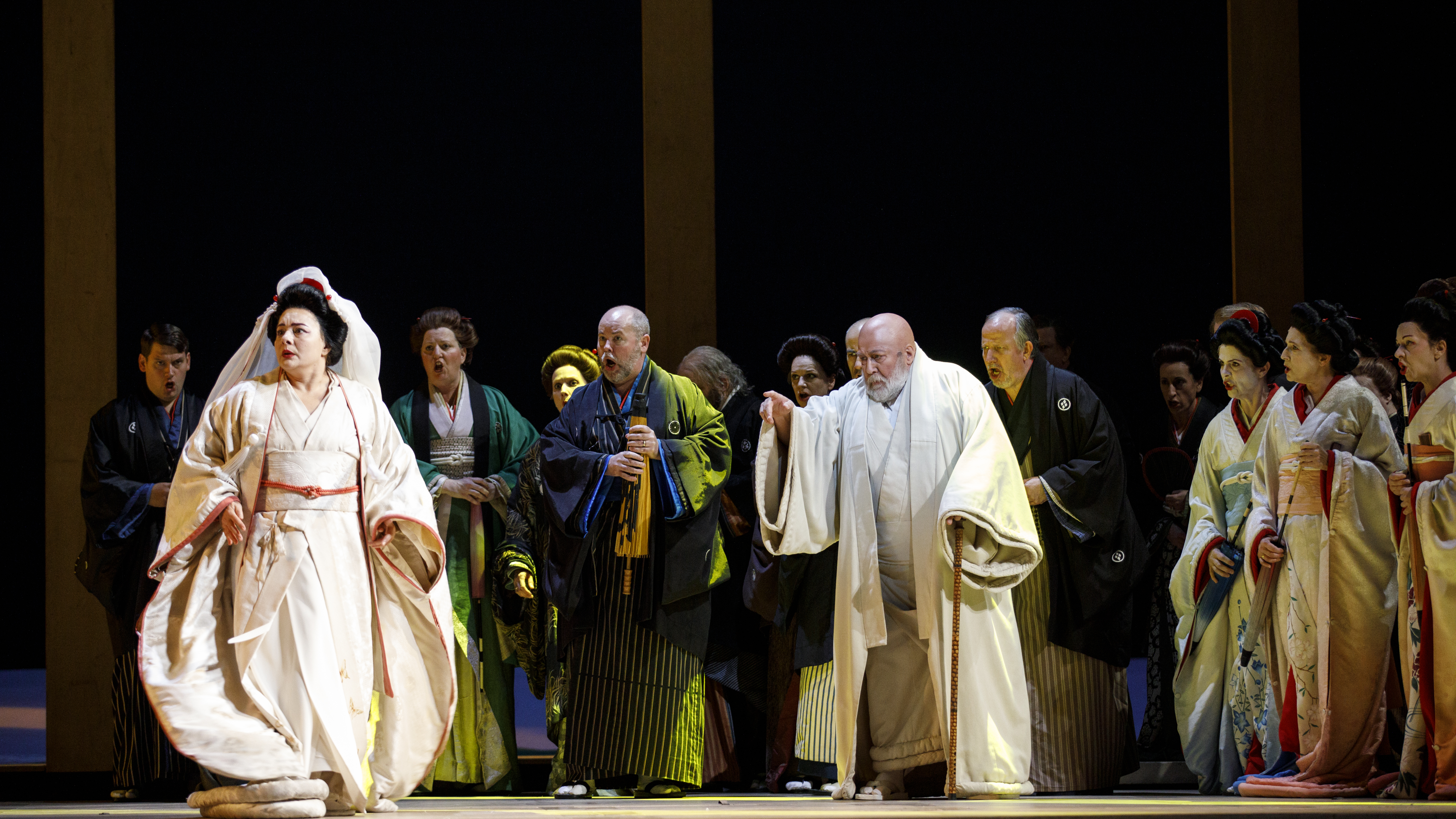


That final rolling around on stage was an extreme conclusion to a performance from Lianna Haroutounian that was throughout more strong than subtle. I am not sure it was especially in keeping with the avowed intentions of this revision, but it did no especial harm. Ultimately, though, it was difficult to take her seriously enough in the role. Freddie De Tommaso’s Pinkerton also tended towards the broad-brush, albeit with greater attention to detail: a perfectly decent, if not especially illuminating, performance. I presume a pronounced lachrymose tendency in the third act to have been an interpretative decision, just in case one did not loath the character enough; the self-pity did the trick, in any case. Patricia Bardon’s Suzuki was constant and compassionate, very much what one expected—and wanted—to hear. For me, Lucas Meachem’s Sharpless was the pick of the bunch, his thoughtful, variegated performance unquestionably founded in the text. The Royal Opera Chorus was not on its best form, comparisons with Covent Garden’s recent Lohengrin again unfortunate.

 Not nearly so unfortunate, though, as the conducting. In the programme, we also read Mears and Pappano write, ‘We are thrilled to welcome back Dan Ettinger to conduct.’ They could hardly say they had been pained to do so, but leaving out Ettinger altogether would have been preferable. It is difficult to imagine anyone having been thrilled with the results, at any rate. Ettinger’s sole advantage, relatively speaking, was that he was not Daniel Oren: another, frankly atrocious conductor Covent Garden engages with bewildering frequency. This was bad, but perhaps not quite so bad. Quite what it is with some such figures I do not know; maybe it is the demands of artist management companies. Whatever it is, houses should stand firm. For Ettinger’s perverse achievement in ridding most of Puccini’s score, especially an interminable first act, of any interest, let alone drama, was not something any house should welcome. The rest was loud, crude, weirdly devoid of harmonic rhythm, and often simply of harmonic, let alone structural, interest. 

If work and production are to be further re-evaluated, then having someone capable of leading such re-evaluation from the pit would help; enlisting someone capable of holding one’s attention would be a bare minimum. Better still, consider a staging that engages more deeply with the racial and sexual violence, as well as the devastating imperialism, that lie at this opera's heart (or lack thereof).


Sunday, 6 December 2015

Tosca, Vienna State Opera, 2 December 2015


Vienna State Opera


Images: Wiener Staatsoper / Michael Pöhn
Floria Tosca – Martina Serafin
Mario Cavaradossi – Roberto Alagna
Baron Scarpia – Michael Volle
Cesare Angelotti – Ryan Speedo Green
Sacristan – Alfred Šramek
Spoletta – Benedikt Kobel
Sciarrone – Hans Peter Kammerer
Gaoler – Il Hong
Shepherd Boy – Bernhard Sengstschmid

Margarethe Wallmann (director)
Nicola Benois (revival director)

Vienna State Opera Chorus (chorus master: Martin Schebesta)
Orchestra of the Vienna State Opera
Dan Ettinger (conductor) 


Tosca is pretty much indestructible, although that does not necessarily prevent opera houses from doing their worst to prove me wrong. Where are the Bieitos, the Konwitschnys, the Herheims, the Katy Mitchells, indeed anyone who might think Puccini and indeed his audiences merit something other than condescension? The Berlin State Opera recently signalled the prospect of something a little more interesting with a new production, conducted by Daniel Barenboim (his first Puccini!), directed by Alvis Hermanis, a director with a mixed record, at best, but at least not renowned for pandering to ‘subscription’ tastes. Whether the staging succeeded, I do not know; given Hermanis’s recent pronouncements, I am unlikely ever to find out. Alas, Dominique Meyer decided, rather than to present a new production at the Vienna State Opera, to reproduce the disintegrating sets and costumes of its existing – I am tempted to say, ‘prehistoric’ – production.

 
That, alas, is precisely what it looks like. Indeed, before I was informed by a friend of Meyer’s strange decision, my thought had been that the sets and costumes reminded me of the horrible if understandable restoration of Dresden’s Frauenkirche. (How much more powerful it was when a pile of rubble: an encounter, from my first visit to that city, I will never forget!) Indeed, what the action, if one can call it that, looked and felt like was really rather curious: some people attempting, without much support, less to ape the manners of the 1950s than to have rediscovered an abandoned set from that period, trying to do something, anything, but not too much, within its confines. Margarethe Wallmann’s production, to our eyes, seems strange, not in an intriguing way, but because the years have hollowed it out of what one presumes once to have been its content. Doubtless a revival director does what she can, and can hardly be held responsible, but a piece of theatre this is not.

 
The answer one often hears to such complaints is that great artists can breathe new life into anything. Perhaps, although I think even Herbert von Karajan and Renata Tebaldi, who featured in its 1957 premiere, might have had difficulty here in 2015. This, at any rate, was not a vintage night in performing terms. Dan Ettinger’s conducting was at best plodding, although there were occasional hints form the orchestra – some gorgeous cello playing in particular – that these were players who might, under a conductor such as Daniele Gatti, produce something world-beating. For the most part, Ettinger seemed content to ‘accompany’: a very odd idea for one of the most symphonic of opera composers. When he did try something, it seemed to be merely to repeat a phrase slower and louder than the last time. This score usually flies by; here, one might have thought it a misfire on the composer’s part.


There was better news from the singers – at least until the end (on which more shortly). Martina Serafin is not possessed of the most refulgent of voices, but she did a good deal with what she had, and for the most part proved attentive towards words as well as music. ‘Vissi d’arte’ was, alas, plagued by poor intonation. Roberto Alagna suffered similarly when he first came on stage, but his performance improved dramatically – in more than one sense – thereafter. Indeed, as always, he threw his all into what he was doing, vocally and otherwise. His big aria was beautifully sung, without a hint of playing to the gallery. (Alas, the gallery still responded, holding up what action the production permitted.) Michael Volle seemed strangely, or perhaps not so strangely, out of sorts. He is a great artist, but this is perhaps not his role, or at least this is not his production. His Italian was such that even I found it too Teutonic, and, although he offered greater malice and menace in the second act, the first-act Scarpia seemed oddly avuncular. Ryan Speedo Green was an energetic, dark-voiced Angelotti; I should like to hear more from him.

 
Despite my reservations, I was a little surprised when no one came to receive applause. Eventually, a member of staff came forward to make an announcement. Serafin had fallen awkwardly when making her leap from the ramparts and was unable to return onstage. After that, although the rest of the cast then took their curtain calls, the evening fizzled out, a state of affairs which, alas, did not seem at odds with the staging. I do not doubt that, in 1957, when Wallmann’s production, if we can still call it that, was first seen, with Karajan and Tebaldi, there might have been much to enjoy scenically, as well as musically. Now, however, it would surely be kinder to Wallmann, to Puccini, to the singers, to the audience, to grant it an honourable retirement. As another, supremely theatrical composer, alongside Schoenberg (later) surely the most beneficial influence upon Puccini, once put it: ‘Kinder, macht neues!’


Saturday, 19 July 2014

Munich Opera Festival (1) - Le nozze di Figaro, Bavarian State Opera, 17 July 2014


Nationaltheater, Munich

Count Almaviva – Gerald Finley
The Countess – Véronique Gens
Cherubino – Kate Lindsey
Figaro – Erwin Schrott
Susanna – Hanna-Elisabeth Müller
Bartolo – Umberto Chiummo
Marcellina – Heike Grötzinger
Basilio – Ulrich Reß
Don Curzio – Kevin Conners
Antonio – Peter Lobert
Barbarina – Elsa Benoit
Two Girls – Josephine Renelt, Rachael Wilson

Dieter Dorn (director)
Jürgen Rose (designs)
Max Keller (lighting)
Hans-Joachim Rückhäberle (dramaturgy)

Chorus of the Bavarian State Opera (chorus master: Stellario Fagone)
Bavarian State Orchestra
Dan Ettinger (conductor)
 
 
Image: Wilfried Hösl
 

One is unlikely to come across a cast of Figaro principals much better than this today, and the virtues of this performance indeed proved to be primarily vocal. Gerald Finley offered a handsomely-sung, dramatically alert portrayal of the Count, beautifully complemented by Véronique Gens, whose apparent indisposition was only occasionally evident. Erwin Schrott’s Figaro suffered from surprising occlusion of tone during the first act, but thereafter was very much on form, Schrott’s theatricality and musicality working very much in tandem. His Susanna, Hanna-Elisabeth Müller was perky and vivacious in both respects too. Kate Lindsey had a slightly uneasy start as Cherubino, but more than made up for it with a perfectly-sung ‘Voi che sapete’. One could believe in her/him throughout too, not least when she adopted the guise of awkward cross-dressing. Amongst the rest of the cast, Ulrich Reß’s Basilio stood out, although he alas – following directorial orders? – adopted the current tendency towards caricature in the role, if less so than sometimes one endures. Elsa Benoit’s Barbarina showed great promise, indeed great achievement; I suspect that we shall soon be hearing more from her.
 

If only the cast had been better supported, let alone led, by Dan Ettinger. The orchestra sounded as though it would have been happier playing without a conductor; indeed, though sometimes a little on the heavy side, the orchestral playing as such was distinguished throughout. Alas, Ettinger seemed never able to settle on the ‘right’ tempo: not that there is only one, but at the time, it should feel as though that were the case. After an Overture and good part of the first act that were driven as if they were Rossini, with little or no space to breathe, other numbers relaxed too much and felt unduly drawn out. Worse still were the occasions when tempi changed arbitrarily – this was no Furtwängler! – during a number, ‘Dove sono’ an especially unfortunate example, Gens seemingly very much at odds, and rightly so, with the conductor. It was far from the only occasion upon which coordination between stage and pit went quite awry. My habitual lament at the loss of Marcellina’s and Basilio’s fourth-act arias was exchanged for relative relief: a sad state of affairs.
 

Dieter Dorn’s production is an odd affair, of which I struggled to make much sense. I had the impression – which may of course be wide of the mark – that we saw a director of a fundamentally conservative disposition who nevertheless felt obliged to try something ‘new’, resulting in a compromise that lacked coherence. I assume that the contrast between period costume and scenic abstraction was deliberate, perhaps attempting to make some point about stylisation, about contemporary reception of an over-familiar eighteenth-century work, etc., but am not entirely sure quite what that point was. The fourth act’s ‘business’ with white sheets in place of ‘proper’ scenery has unfortunate echoes of a school play, or perhaps better, a school ‘movement’ session. The cast seemed to flounder on stage, and I could not really blame them. There was an equally unfortunate, if typical, tendency, if less extreme than can sometimes be the case, to confuse this most sophisticated of comedies with mere farce. (Does not Mozart’s score tell us everything we need to know in that respect – and indeed in every other?) For the most part, the cast rose above such limitations, but limitations they certainly were.