Showing posts with label Lucas Meacham. Show all posts

Sunday, 19 June 2022

Madama Butterfly, Royal Opera, 14 June 2022


Royal Opera House

Pinkerton – Freddie De Tommaso
Goro – Alexander Kravets
Suzuki – Patricia Bardon
Sharpless – Lucas Meachem
Cio-Cio-San – Lianna Haroutounian
Imperial Commissioner – Dawid Kimberg
Original Registrar – Nigel Cliffe
Cio-Cio-San’s Mother – Eryl Royle
Uncle Yaukusidé – Andrew O’Connor
Cousin – Amy Catt
Aunt – Kiera Lyness
Bonze – Jeremy White
Dolore – Leo Stokkland-Baker
Prince Yamadori – Alan Pingarrón
Kate Pinkerton – Rachel Lloyd

Moshe Leiser and Patrice Caurier (directors)
Daniel Dooner (revival director)
Christian Fenouillat (set designs)
Agostino Cavalca (costumes)
Christophe Forey (lighting)

Royal Opera Chorus (chorus director: William Spaulding)
Orchestra of the Royal Opera House
Dan Ettinger (conductor)


Images: © Yasuko Kageyama

‘In the 21st century, staging Madama Butterfly poses questions for any opera house. The opera’s essence is a violent collision between two cultures. But how to represent another culture on stage with truth and sensitivity? In reviving Moshe Leiser and Patrice Caurier’s classic production, we have involved Japanese practitioners and academic to work towards a Butterfly both true to the spirit of the original and more authentic in its representation of Japan.’

Not perfect, far from it; one could readily pick holes in that section of the programme’s ‘welcome’ statement from Oliver Mears and Antonio Pappano. For instance, t is at least debatable, to my mind rather more than that, that the work’s ‘essence’ is something else entirely. Moreover, if the Royal Opera were honest about it—this would be true of pretty much every opera company on the planet—staging such a work and production did not really ‘pose questions’ until very recently indeed in the twenty-first century. It is good, though, to see the opera world showing some such development, and we should be gracious about that: we all, after all, have a long, long way to go in working towards a more racially (and otherwise) just society.

I do not recall having seen the production before, so cannot comment on how noticeable the changes are. I suspect some of them would have passed me by, had I not been advised what to look for, though that doubtless says more about my (ignorant) standpoint than anything else. Costumes, we read, have undergone modification to make them more of the period in which the production is set, not least in terms of their signification of social status. Make-up has also been modified, in order to appear less caricatured, more ‘natural’ or at least appropriate. This I can see from looking at pictures from previous outings. Otherwise, Leiser and Caurier’s production seems to me ‘classic’ only in the sense of standing firmly in the middle of the road: a degree of abstraction, more as style than concept, remaining essentially realist; no Zeffirelli horror, but nothing to scare the Daily Mail horses either. Christophe Forey’s lighting guides the action, subtly and more starkly. And revival director Daniel Dooner does a good job guiding his forces on stage, although the heroine’s demise proved unfortunate.
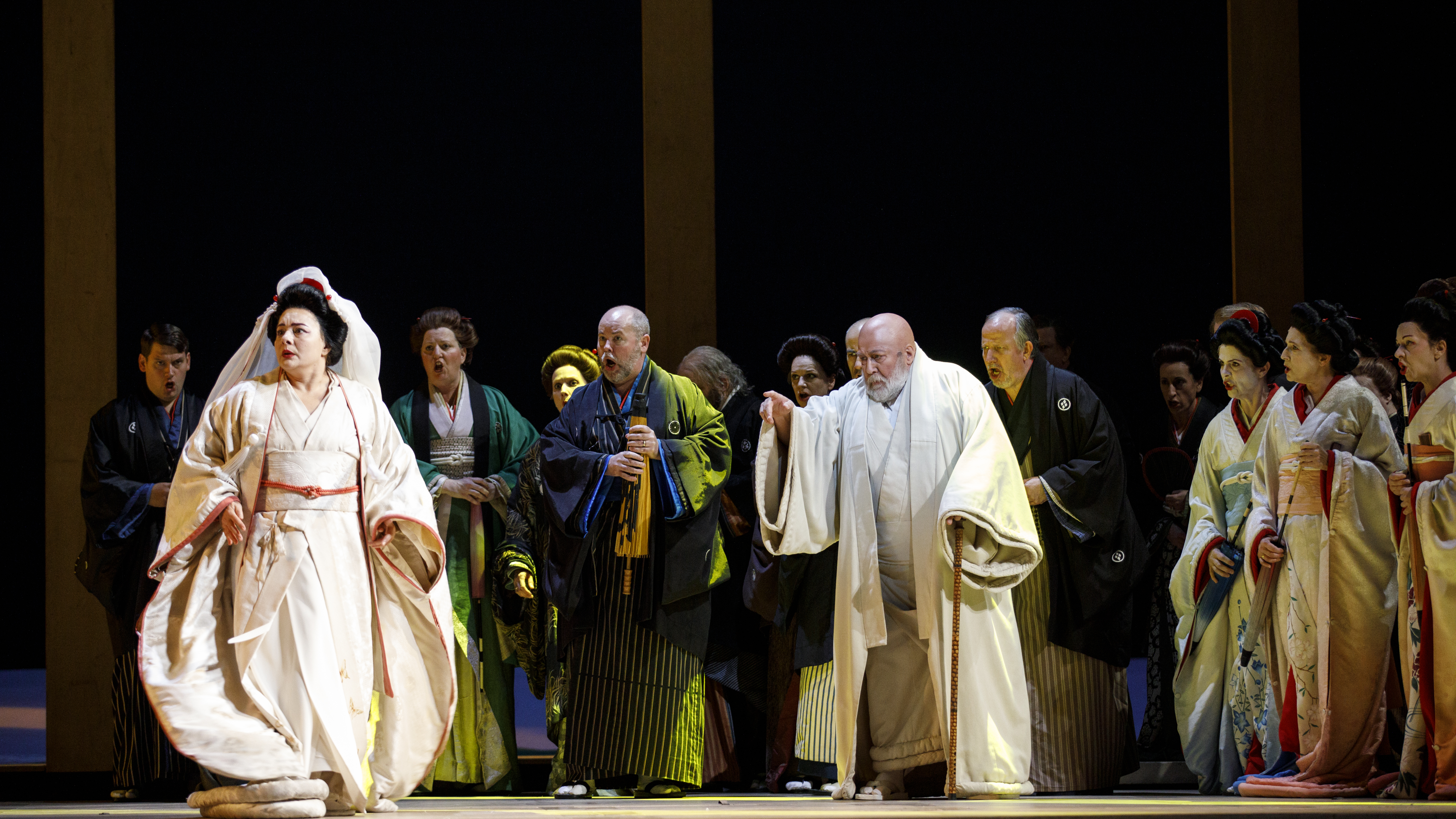


That final rolling around on stage was an extreme conclusion to a performance from Lianna Haroutounian that was throughout more strong than subtle. I am not sure it was especially in keeping with the avowed intentions of this revision, but it did no especial harm. Ultimately, though, it was difficult to take her seriously enough in the role. Freddie De Tommaso’s Pinkerton also tended towards the broad-brush, albeit with greater attention to detail: a perfectly decent, if not especially illuminating, performance. I presume a pronounced lachrymose tendency in the third act to have been an interpretative decision, just in case one did not loath the character enough; the self-pity did the trick, in any case. Patricia Bardon’s Suzuki was constant and compassionate, very much what one expected—and wanted—to hear. For me, Lucas Meachem’s Sharpless was the pick of the bunch, his thoughtful, variegated performance unquestionably founded in the text. The Royal Opera Chorus was not on its best form, comparisons with Covent Garden’s recent Lohengrin again unfortunate.

 Not nearly so unfortunate, though, as the conducting. In the programme, we also read Mears and Pappano write, ‘We are thrilled to welcome back Dan Ettinger to conduct.’ They could hardly say they had been pained to do so, but leaving out Ettinger altogether would have been preferable. It is difficult to imagine anyone having been thrilled with the results, at any rate. Ettinger’s sole advantage, relatively speaking, was that he was not Daniel Oren: another, frankly atrocious conductor Covent Garden engages with bewildering frequency. This was bad, but perhaps not quite so bad. Quite what it is with some such figures I do not know; maybe it is the demands of artist management companies. Whatever it is, houses should stand firm. For Ettinger’s perverse achievement in ridding most of Puccini’s score, especially an interminable first act, of any interest, let alone drama, was not something any house should welcome. The rest was loud, crude, weirdly devoid of harmonic rhythm, and often simply of harmonic, let alone structural, interest. 

If work and production are to be further re-evaluated, then having someone capable of leading such re-evaluation from the pit would help; enlisting someone capable of holding one’s attention would be a bare minimum. Better still, consider a staging that engages more deeply with the racial and sexual violence, as well as the devastating imperialism, that lie at this opera's heart (or lack thereof).


Wednesday, 15 February 2012

Le nozze di Figaro, Royal Opera, 14 February 2012

Royal Opera House, Covent Garden

Images: Royal Opera House/Bill Cooper, 2012
Figaro (Ildebrando d'Arcangelo)

Figaro – Ildebrando d’Arcangelo
Susanna – Aleksandra Kurzak
Bartolo – Carlo Lepore
Marcellina – Ann Murray
Cherubino – Anna Bonitatibus
Count Almaviva – Lucas Meacham
Don Basilio – Bonaventura Bottone
Countess Almaviva – Rachel Willis-Sørensen
Antonio – Jeremy White
Don Curzio – Harry Nicoll
Barbarina – Susanna Gaspar
Bridesmaids – Melissa Alder, Louise Armit

David McVicar (director)
Leah Hausman (movement, revival director)
Tanya McCallin (designs)
Paule Constable (lighting)

Royal Opera Chorus (chorus master: Renato Balsadonna)
Orchestra of the Royal Opera House
Sir Antonio Pappano (conductor)


David McVicar’s production of The Marriage of Figaro, previously staged in 2006 (twice), 2008, and 2010, now returns as part of the Royal Opera House’s ‘Da Ponte cycle’. I cannot help wishing that funds had stretched to commissioning three new productions, preferably from the same director, with a sense of how the works might actually cohere as a ‘cycle’. Nevertheless, and despite a good number of reservations I continue to entertain, McVicar’s production remains preferable to Jonathan Miller’s vulgar Così fan tutte, and, assuming it not to have been overhauled beyond recognition, Francesca Zambello’s vacuous Don Giovanni. Moving the action to the Restoration period does no especial harm, but the motivation remains obscure. If the point be to highlight Talleyrand’s observation concerning the restored Bourbons, that they had learned nothing and forgotten nothing, then it needs to be made, not assumed. The Count’s droit de seigneur is a gross exaggeration in the eighteenth century; in the nineteenth, it merely seems incredible. ‘Absolutism’ was of course a nineteenth-century way of understanding the ancien régime, painting a complex society in the bold, often crude colours of monarchs such as Charles X. A good deal of sophistication would be needed to make the shift coherent, yet here the political seems notable for the most part by its absence. We have neither a society of orders nor an emergent class-based society, merely a house with hyperactive servants in attractive costumes. The result, whatever the intention, seems to be pandering to devotees of mindless ‘costume dramas’. It all nevertheless looks good, and certain moments are very well handled, especially the magical falling of dusk between the third and fourth acts. (Incidentally, when audience members are relentlessly intent upon disrupting the action with mid-act applause, why do they then fall silent at the end of an act? Mystifying!) The servants’ running about during the Overture remains an unnecessary irritant – can anyone really think that Mozart’s music deserves to be drowned out by footsteps? – and Leah Hausman’s revival direction, sadly, tends towards the Carry On school, only encouraging a vocal, puerile section of the audience, about which more anon.

Susanna (Aleksandra Kursak), Figaro, Marcellina (Ann Murray)

The greatest surprise of the evening was perhaps Sir Antonio Pappano’s conducting. There were problems: too often, he seems to view Mozart as aspiring towards Rossini, and the consequent motor rhythms have no place whatsoever in Mozart’s music. Certain aspects of phrasing also suffered in that respect, perhaps most glaringly in the Overture; articulation, where desperately needed, came there none. The use of natural horns was at best questionable; their rasping at the conclusion of Figaro’s fourth act aria was unpleasant in the extreme. That said, and with the notable exception of the end of the second act, Pappano did not harry the score; indeed, there were moments when he clearly communicated his delight in its subtleties. Woodwind might not have ravished in the way they did for Sir Colin Davis in 2010, but they seduced nevertheless. Tempi convinced for the most part, and there was little of the tendency towards mere ‘accompaniment’ that has often held back this conductor’s work previously. I seem to be the only person who regrets the 'traditional' cuts in the fouth act, but regret them I do.

Casting Figaro successfully seems trickier than one would expect. Even in 2010, a simply astounding male team of Erwin Schrott (Figaro) and Marius Kwiecien (the Count) had to endure sub-par contributions from their Susanna and Countess. Here the undoubted star was Aleksandra Kursak’s Susanna, ever musical, ever lively, and above all ever alert to the twists and turns Da Ponte and Mozart lovingly throw her way. One could not, for the duration of the performance, imagine it being done better any other way. Phrasing was telling but unobtrusive, likewise her sideways glances. Ildebrando d’Arcangelo has never lacked stage presence, and his voice at its dark-chocolate best remains as attractive as his handsome visage and figure. There were, however, a good few moments, especially earlier on, when his delivery lacked focus. Lucas Meachem’s Count suffered similarly, though he also lacked his valet’s presence – a serious drawback, alas. Rachel Willis-Sørensen’s Countess was a serious disappointment: I have never heard ‘Porgi, amor’ so ill-tuned, nor so squally. She improved as time went on, but throughout lacked grace and, straightforwardly, character. The Cherubino of Anna Bonatatibus also disappointed: ill-focused and short-breathed. Even the Marcellina of a stalwart such as Ann Murray, an artist I admire greatly, sometimes sounded out of sorts. And would directors please cease their fixation with turning Don Basilio into a camp monstrosity? It is entirely unwarranted in either libretto or score, and has simply become a tedious cliché.

Finally, alas, a character that was all too present on this occasion: the audience, or at least a considerable section thereof. I had been tempted to open with the words, ‘more in sorrow than in anger,’ but that would have misled, for both emotions ran to the surface dealing with so disruptive a crowd. All manner of disruption was present, unremittingly so. Barely a bar went by without a cough or two. Objects were dropped left, right, and centre – and I am not referring to the stage business. A watch alarm made a charming accompaniment to ‘Porgi, amor’, though we had to wait a little longer for telephones to make their first appearance. Worst of all was the incessant, moronic laughter, perhaps to a certain extent elicited by more dubious aspects of the production; but really, if one finds someone walking onstage with a dog intrinsically hilarious, then one may need to seek treatment. The slightest reference – via the surtitles, be it noted – to anything sexual was met with all the maturity of a convention for non-recovering Benny Hill Show addicts. I should say that those people needed to get out more, except I should much rather they stayed at home. Most unforgivable was the laughter that greeted those words: ‘Contessa, perdono’. McVicar’s production brings a true sense of revelation at that point, the show-stopping appearance of the Countess, ravishing and in more than one sense graceful, fully in tune with Mozart’s approaching benediction. What is even remotely hilarious about seeking a forgiveness that goes beyond even the humanity of the Countess to the Almighty Himself, that ‘peace … which passeth all understanding’? Even if somehow one were to find that hysterically amusing – presumably one would then guffaw through King Lear or the Missa Solemnis – one might have some regard for fellow members of the audience, those who might have come to hear Mozart’s score. As the gentleman seated next to me commented during the curtain calls, it made one long to be Ludwig II, alone with one’s art. None of this is, of course, in any sense the fault of the Royal Opera House, but perhaps an announcement requesting silence during performance and the occasional summary execution, pour encourager les autres, might be in order.