Showing posts with label Madama Butterfly. Show all posts

Wednesday, 10 July 2024

Festival d’Aix-en-Provence (1) - Madama Butterfly, 8 July 2024


Théâtre de l’Archeveché

Cio-Cio San – Ermonela Jaho
B.F. Pinkerton – Adam Smith
Suzuki – Mihoko Fujimura
Sharpless – Lionel Lhote
Goro – Carlo Bosi
The Bonze – Inho Jeong
Prince Yamadori – Kristofer Lundin
Kate Pinkerton – Albane Carrère
Imperial Commissioner – Kristján Jóhannnesson

Director – Andrea Breth
Set designs – Raimund Orfeo Voigt
Costumes – Ursula Renzenbrink
Lighting – Alexander Koppelmaan
Dramaturgy – Klaus Bertisch  

Lyon Opera Chorus (chorus master: Benedict Kearns)
Lyon Opera Orchestra
Daniele Rustioni (conductor)


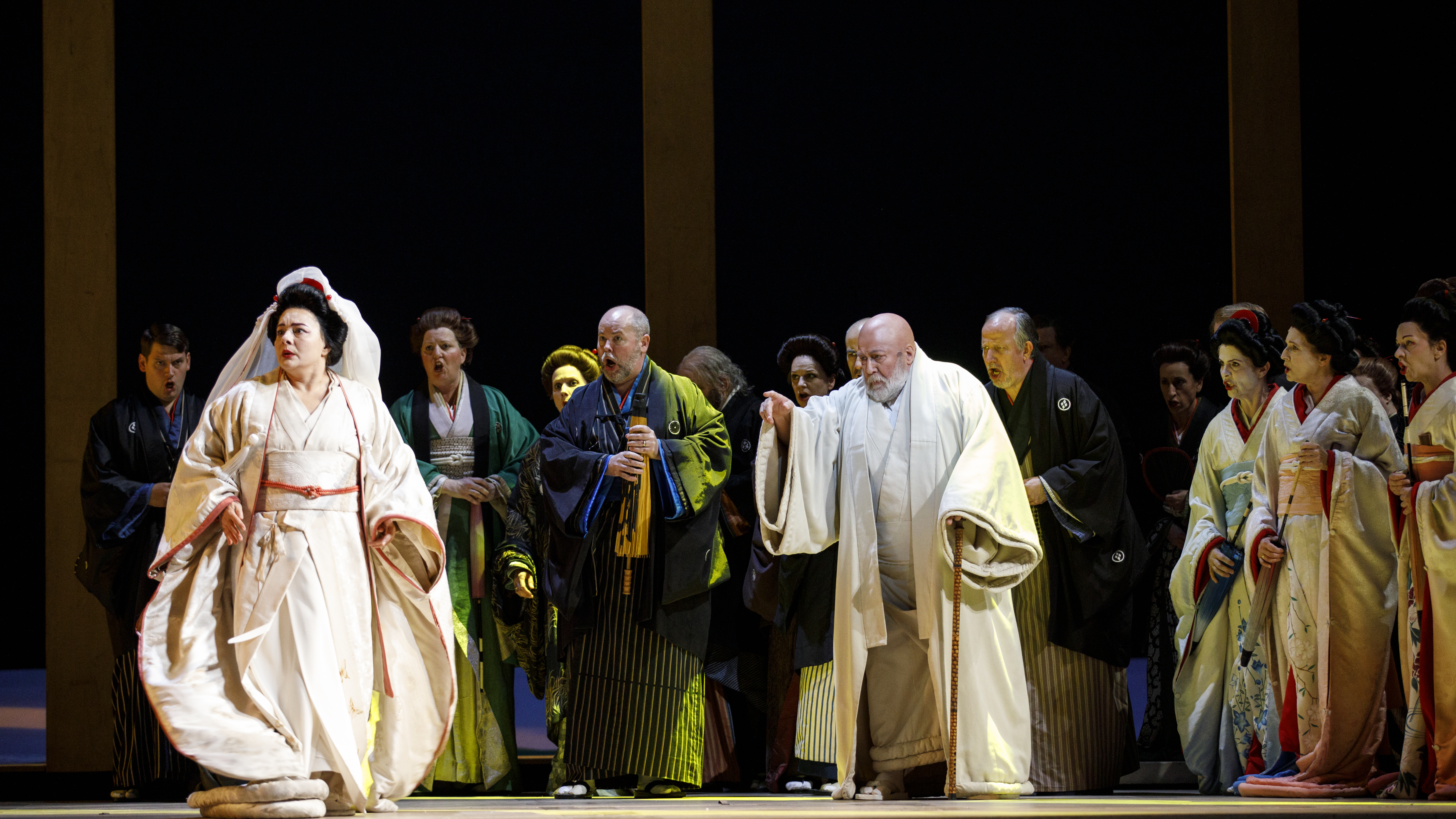
Images: Festival d’Aix-en-Provence 2024 © Ruth Walz

Madama Butterfly has become a difficult opera to stage, largely on account of its deeply problematical subject matter, but also its dramatic straightforwardness. Does one just ignore the former insofar as possible, perhaps toning down what might have been acceptable to some a couple of decades ago yet would no longer be considered to be; or does one address some of its issues head on and, at least for some, risk it buckling under the weight of a critical apparatus it will struggle to support onstage? Its orientalism (or worse) will not go away, so one is going to have to take a view whether one likes it or not; likewise the cruelty inextricably linked with the sympathy it voices and evokes. And assuming one is not going to take the line that there is nothing wrong with Pinkerton’s actions or indeed American imperialism, is there really much to interpret, as opposed to draw out? 

Andrea Breth appears to think not—or at least declines to do so. She does not attempt any grand re-evaluation of the opera, but she does heighten its nastiness and, ultimately, the power of its tragedy. Breth does not impose a concept, good, bad, or indifferent, upon the work, but has clearly thought both about its problems and the drama that lies in its detail, and presents them with clarity and integrity. Where the opening scene can often seem a mere prelude, albeit a necessary one, here we are confronted with the horror of what is there from the start: the racism, imperialism, and misogyny of Pinkerton abundantly clear in his dismissive treatment of Suzuki. She barely registers as a human being as he takes off his shoes. Save for her, it is also, prior to Cio-Cio San arrival, an entirely (heterosexual) male environment—and it feels like it. Whatever it is – ‘love’ hardly seems the word – that Pinkerton feels for his bride, its roots are in this context. Suzuki, moreover, knows precisely what is going on and tells us so, long before she says a word; Breth’s direction and Mihoko Fujimura’s acting are as one. 


Moreover, Breth does not attempt to ‘understand’ Japanese culture. In the programme, she freely admits that she does not and cannot, in contrast with Puccini’s then typical yet, for us, deeply problematical acts of appropriation. It is difficult, perhaps impossible, even to talk about this without orientalising, but perception, both its truths and its lies, stands at the heart of a tale concerned with mutual incomprehension as well as deeply stacked scales. Faded designs suggest something retrospective, a refusal to resort to ‘colourful’ caricature, or both; so does lighting that appears more dialectical than crudely binary in its portrayal of lightness and darkness. Masked actors play Butterfly’s family, whilst their voices come from singers, almost unseen, in the dark surrounding the stage. Moreover, the pace of their ‘action’, if one can call that it at all, is quite different from Puccini’s. To our eyes – and ears – they slow it down, but perhaps therein lies some sort of resistance as well as difference. And of course, in most respects, they are right. Breth makes much, though anything but crudely, of Kate Pinkerton’s arrival and act of child-possession, sealing the cruel tragedy, whilst Butterfly’s suicide is horrible, as it must be, though in no sense gratuitously so. Actors and singers, after all, play characters; they do not (straightforwardly) become them, at least from a Brechtian standpoint. Indeed, the relationship between realism and other possibilities might be said to lie at the heart of the production, as perhaps of the work and how we might now approach it. 

Daniele Rustioni’s conducting of a fine cast and Lyon Opera forces combined interestingly with Breth’s staging. I am sure it would be distorting to say that one determined the other, but one certainly had the impression of interplay. Rustoni’s similar attention to detail contributed to, rather than detracting from, a greater sense of the whole. His tempi, especially in the first act, I was less sure about; that act in particular came to seem increasingly drawn out. Yet, considered as a whole, that seemed very much in keeping with the (masked) disinclination to rush, and paid off handsomely in the second and third acts, where ghosts of Tristan und Isolde in particular enlightened and discomfited. The erotics of this performance could be experienced both immediately and at a sophisticated level of mediation, as with its other qualities. 


That certainly included singing. In the beginning, I felt slightly troubled by an apparent lack of dramatic verisimilitude concerning the two central characters, struggling to achieve necessary suspension of belief given a work aesthetic that seems, though perhaps only seems, to insist on realism. There were times, moreover, when the tessitura of Butterfly’s role seemed to strain Ermonela Jaho. As the opera progressed, and as Jaho’s dramatic commitment, bordering on possession, took over, she moved in a special way that heightened a sense of both problems and opportunities in the work ‘itself’, her final scene as true and necessary a climax as one could hope for. Smith’s thankless role was more ‘straightforwardly’ convincing, as doubtless it should be. He did not flinch from having us loathe him, balancing the tricky imperatives of shallowness in character and thoughtfulness of portrayal. Fujimura’s self-revelation was deeply impressive throughout, whilst Lionel Lhote (doubtless with Breth’s help) presented a compassionate, understanding, subtly memorable Sharpless. With smaller roles all well taken, there was a strong sense of unity in greater dramatic service. Almost in spite of itself, yet also on its own account, this Aix production quietly, powerfully rethought and reimagined Puccini’s opera.


Thursday, 15 February 2024

Madama Butterfly, Staatsoper Unter den Linden, 14 February 2024


Cio-Cio-San – Sonya Yoncheva
Suzuki – Natalia Skrycka
Kate Pinkerton – Rebecka Wallroth
Pinkerton – Stefan Pop
Sharpless – Carles Pachon
Goro – Gonzalo Quinchahual
Prince Yamadori – Taehan Kim
Uncle Bonze – Grigory Shkarupa
Commissioner – Dionysios Avgerinos
Cio-Cio-San’s Mother – Verena Allertz
Aunt – Michèle Cusson
Uncle – Insoo Hwoang
Child – Carl Beyme

Director – Eike Gramss
Revival director – Marcin Łakomicki
Designs – Peter Sykora
Lighting – Irene Selka

Staatsopernchor Berlin (chorus director: Gerhard Polifka)
Staatskapelle Berlin
Domingo Hindoyan (conductor)


Images (from the 1991 premiere): Gianmarco Bresadola

Happy St Valentine’s Day! Ash Wednesday and an opera about sex tourism. Whatever we might think about the latter two, many will agree that the coincidence is well deserved by the pseudo-feast of heart-shaped balloons and ‘special menus’ at three times the price, a third of the culinary quality. In retrospect, or rather more or less as soon as I had arrived, I could not help but think it was perhaps not the wisest of evenings to have chosen to see a Puccini opera; some fellow audience members seemed more concerned to chat, consult their telephones, and more rather than to devote attention to what might reasonably be considered the main attraction in an opera house. More broadly, though, an opera house’s life and health extend beyond the glamour and excitement of premieres. For that reason and for their own sake, I try to sample older stagings I have not seen too and have made that a particular effort to explore these, both in opera and spoken theatre, for this spell in Berlin. 

Here, then is Staatsoper’s Madama Butterfly, in Eike Gramss’s production, first seen at the end of April 1991, when it was conducted by Fabio Luisi, with Miriam Gauci in the title role. Fashions change, of course, often rapidly so—and that certainly applies to opera staging. To see something hailing from less than two years after the fall of the Berlin Wall is to step back some time indeed (not helped by the realisation we reached the point some years hence that the post-Wall era had lasted longer than ever the Wall stood). German reunification and full sovereignty were little more than a month old. One of that process’s sternest and most hapless foes, Margaret Thatcher, had recently been replaced as Prime Minister of the United Kingdom. The first Iraq War had still more recently concluded. And closer to home in newly reunified Berlin, Daniel Barenboim, fresh and doubtless a little sore from his atrocious treatment at Paris’s new opera house in the Place de la Bastille had yet to be appointed music director at the Statsoper Unter den Linden; that would come at the end of the year. 

I wondered initially, then, whether the safety curtain picturing a US sailor and other images, an eagle included, of Yankee imperialism had been initially intended to have more precise reference thirty-three years ago. Perhaps they had, although the theme is, as they say, ongoing, the opera itself bearing witness to that. I think that image may also, or primarily, have borne witness to a more existential conception, which I suspect will have come across more strongly earlier on, before the staging settled into a comfortable, perhaps necessary, repertoire life. There is a sense that Cio-Cio-San is perhaps delusional – obviously, on a very important level, she is – and certainly looking for escape. She does none of the things that would have helped her, in a difficult, disgraced position, owing to her father’s hara-kiri, to lead a better life; indeed, obstinately she rules them out. And this, I think, we can still see here; her movements suggest a refusal to confront her existing society, and an obstinate turn towards a fantasy of someone who will come to rescue her. (Wagnerian precedents in particular came to my mind.) 


In a notably unsympathetic portrayal of Pinkerton, there was perhaps just a chink of light suggesting that he too might have bought into ‘white saviour’ mode, as opposed to acting with pure cynicism. In many ways, that simply rephrases questions, but is probably worth bearing in mind. Otherwise, the action proceeds more or less as one would expect—and still perhaps might see from a smaller company, albeit probably with greater racial awareness. On the latter score, I think – and I know it is easy for me, as a white man to say this – one can be somewhat forgiving. There is nothing especially outrageous here, and doubtless all concerned would take a different approach from the outset today. Moreover, one can always read things more than one way: the dangerously orientalising portrayal of Japanese women fanning in concert can now be taken, if not intended, as a critique of such portrayals or at least a warning. We are free to have our own thoughts and should surely pursue them. 

Sonya Yoncheva gave a commanding performance as Cio-Cio-San. It offered a wealth of dynamic and other contrast, expertly shaded. There is, as ever, the problem as to how convincing, in a highly realist setting, someone can be as a fifteen-year-old Japanese girl. It is not clear to me what we do about that, other than abandon realism (which is clearly a question for another day), and that is not her fault. Natalia Skrycka’s Suzuki offered deep compassion and a high degree of on-stage chemistry. Stefan Pop can certainly has the vocal reserves for Pinkerton, yet I could not help but find his portrayal a little generalised: of thirty-odd years ago in a way that was not entirely beneficial. Maybe that was brought about by the venerable production, but I missed something more variegated. Carles Pachon’s Sharpless, though, had me wishing he had more to sing—and act. This was a creditably – and credibly – detailed performance, asking questions as much as answering them. 

The rest of the cast, chorus included, impressed, as did the Staatskapelle Berlin: the first time, I think, I have heard this orchestra in Puccini. If I am not sure Domingo Hindoyan always had the pacing quite right – the evening did sometimes seem to drag – then this is also in part a matter of taste and is related in complex ways to what one sees, and does not, on stage too. His approach was more Italianate than post-Wagnerian; something at least a little more symphonic might have helped bind the action together more strongly. By the same token, though, there was little doubt the score was unfolding as he envisaged it, and he certainly knew how to whip up a head of steam at climactic moments. It may well be time, so far as some of us are concerned, to replace this production, but audience reaction was enthusiastic in the extreme.


Sunday, 19 June 2022

Madama Butterfly, Royal Opera, 14 June 2022


Royal Opera House

Pinkerton – Freddie De Tommaso
Goro – Alexander Kravets
Suzuki – Patricia Bardon
Sharpless – Lucas Meachem
Cio-Cio-San – Lianna Haroutounian
Imperial Commissioner – Dawid Kimberg
Original Registrar – Nigel Cliffe
Cio-Cio-San’s Mother – Eryl Royle
Uncle Yaukusidé – Andrew O’Connor
Cousin – Amy Catt
Aunt – Kiera Lyness
Bonze – Jeremy White
Dolore – Leo Stokkland-Baker
Prince Yamadori – Alan Pingarrón
Kate Pinkerton – Rachel Lloyd

Moshe Leiser and Patrice Caurier (directors)
Daniel Dooner (revival director)
Christian Fenouillat (set designs)
Agostino Cavalca (costumes)
Christophe Forey (lighting)

Royal Opera Chorus (chorus director: William Spaulding)
Orchestra of the Royal Opera House
Dan Ettinger (conductor)


Images: © Yasuko Kageyama

‘In the 21st century, staging Madama Butterfly poses questions for any opera house. The opera’s essence is a violent collision between two cultures. But how to represent another culture on stage with truth and sensitivity? In reviving Moshe Leiser and Patrice Caurier’s classic production, we have involved Japanese practitioners and academic to work towards a Butterfly both true to the spirit of the original and more authentic in its representation of Japan.’

Not perfect, far from it; one could readily pick holes in that section of the programme’s ‘welcome’ statement from Oliver Mears and Antonio Pappano. For instance, t is at least debatable, to my mind rather more than that, that the work’s ‘essence’ is something else entirely. Moreover, if the Royal Opera were honest about it—this would be true of pretty much every opera company on the planet—staging such a work and production did not really ‘pose questions’ until very recently indeed in the twenty-first century. It is good, though, to see the opera world showing some such development, and we should be gracious about that: we all, after all, have a long, long way to go in working towards a more racially (and otherwise) just society.

I do not recall having seen the production before, so cannot comment on how noticeable the changes are. I suspect some of them would have passed me by, had I not been advised what to look for, though that doubtless says more about my (ignorant) standpoint than anything else. Costumes, we read, have undergone modification to make them more of the period in which the production is set, not least in terms of their signification of social status. Make-up has also been modified, in order to appear less caricatured, more ‘natural’ or at least appropriate. This I can see from looking at pictures from previous outings. Otherwise, Leiser and Caurier’s production seems to me ‘classic’ only in the sense of standing firmly in the middle of the road: a degree of abstraction, more as style than concept, remaining essentially realist; no Zeffirelli horror, but nothing to scare the Daily Mail horses either. Christophe Forey’s lighting guides the action, subtly and more starkly. And revival director Daniel Dooner does a good job guiding his forces on stage, although the heroine’s demise proved unfortunate.


That final rolling around on stage was an extreme conclusion to a performance from Lianna Haroutounian that was throughout more strong than subtle. I am not sure it was especially in keeping with the avowed intentions of this revision, but it did no especial harm. Ultimately, though, it was difficult to take her seriously enough in the role. Freddie De Tommaso’s Pinkerton also tended towards the broad-brush, albeit with greater attention to detail: a perfectly decent, if not especially illuminating, performance. I presume a pronounced lachrymose tendency in the third act to have been an interpretative decision, just in case one did not loath the character enough; the self-pity did the trick, in any case. Patricia Bardon’s Suzuki was constant and compassionate, very much what one expected—and wanted—to hear. For me, Lucas Meachem’s Sharpless was the pick of the bunch, his thoughtful, variegated performance unquestionably founded in the text. The Royal Opera Chorus was not on its best form, comparisons with Covent Garden’s recent Lohengrin again unfortunate.

 Not nearly so unfortunate, though, as the conducting. In the programme, we also read Mears and Pappano write, ‘We are thrilled to welcome back Dan Ettinger to conduct.’ They could hardly say they had been pained to do so, but leaving out Ettinger altogether would have been preferable. It is difficult to imagine anyone having been thrilled with the results, at any rate. Ettinger’s sole advantage, relatively speaking, was that he was not Daniel Oren: another, frankly atrocious conductor Covent Garden engages with bewildering frequency. This was bad, but perhaps not quite so bad. Quite what it is with some such figures I do not know; maybe it is the demands of artist management companies. Whatever it is, houses should stand firm. For Ettinger’s perverse achievement in ridding most of Puccini’s score, especially an interminable first act, of any interest, let alone drama, was not something any house should welcome. The rest was loud, crude, weirdly devoid of harmonic rhythm, and often simply of harmonic, let alone structural, interest. 

If work and production are to be further re-evaluated, then having someone capable of leading such re-evaluation from the pit would help; enlisting someone capable of holding one’s attention would be a bare minimum. Better still, consider a staging that engages more deeply with the racial and sexual violence, as well as the devastating imperialism, that lie at this opera's heart (or lack thereof).


Sunday, 20 May 2018

Madama Butterfly, Glyndebourne, 19 May 2018


Glyndebourne Opera House

Pinkerton – Joshua Guerrero
Goro – Carlo Bosi
Suzuki – Elizabeth DeShong
Sharpless – Michael Sumuel
Cio-Cio-San – Olga Busuioc
Cousin – Jennifer Witton
Cio-Cio-San’s Mother – Eirlys Myfanwy Davies
Yakuside – Adam Marsden
Aunt – Shuna Scott Sendall
Imperial Commissioner – Michael Mofidian
Official Registrar – Jake Muffett
Bonze – Oleg Budurtaskiy
Prince Yamadori – Simon Mechlinski
Sorrow –Rupert Wade
Kate Pinkerto – Ida Ränzlöv

Annilese Miskimmon (director)
Nicky Shaw (set designs)
Mark Jonathan (lighting)
Kally Lloyd Jones (movement)
Ian William Galloway (video)

Glyndebourne Chorus (chorus master: Nicholas Jenkins)
London Philharmonic Orchestra
Omer Weir Wellber (conductor)


‘Picture it,’ as senior Golden Girl, Sophia Petrillo used to say. ‘England, 19 May 2018…’ An audience found itself enthralled by the marriage of an impressive woman to a privileged man, impeccable and dashing in his military uniform, from another nationality and ‘race’. They wished her well in this fairytale, investing their hopes, personal and communal, in the success of their union, even as some of their number risked spoiling the party by exploring a little of the history of this meeting of cultures. All the while, the mediating moneymakers – well, they made money. Would it last? Were some of them/us already gearing up to be thrilled by its potential difficulties, failures, even tragedy? From Windsor Castle, then, to the Sussex Downs did not seem too lengthy a journey – I saw signs at Clapham Junction for the latter, as I found my platform for the latter – especially for a festival opening for which the not-quite-so-great-and-good-as-would-have-resulted-in-an-invitation-to-the-reception were naturally out in force.


Annilese Miskimmon’s production of Madama Butterfly, Glyndebourne’s first, has been seen previously on the 2016 tour, but this was its first appearance at the Festival proper, and my first encounter with it. It would be considered reasonably straightforward for most composers, bar the ‘updating’ – must we continue to use that dated word and idea? – to the 1950s, yet for Puccini, who perhaps suffers more than any other opera composer from a surfeit of reactionary stagings, probably marks quite an important step. It is not Calixto Bieito, nor would one expect it to be. What we see, however, portrays the drama, both a clash of cultures and expectations on anything but a level playing-field and a very personal tragedy, with unfailing intelligence and emotional commitment. I liked it – and the stage performances – very much, and responded pretty much how I ‘should’, whilst being provoked to think rather more than I often have been.


What comes across very strongly from the outset is that, whatever the exalted setting – be it a royal castle or an opera stage – and the undeniable personhood of the sacrificial victim, there is something distressingly typical about the story and the social structures that give rise to it. Cio-Cio-San is placed explicitly in a line of geishas, ‘married’ off to their respective ‘husbands’, educated onsite at the marriage bureau by the slide show, ‘How to be an American wife’, a ready source of income for the grubbily venal Goro. (He returns at the close of the first act to count his money.) A neon-lit HOTEL stands next door, for ease of consummation; or rather, the bureau stands next door to it, for ease of commerce. The overweening arrogance of Pinkerton is his personally and culturally: not just the cigarettes he smokes, but his – in context – shocking act of forcing a horrified Cio-Cio-San to toss her bouquet behind her. She does not understand, nor do the girls behind her, who dart away from it. It is cultural misunderstanding, yes, but from a man and a culture – a gender too – which, holding all the cards, have neither need nor wish to understand. Perhaps he does, a little; he too, after all, is ultimately ordinary, nothing special. (Unlike his ‘bride’, he remains that way, resolutely untransfigured, untransfigurable.) There are a few little signs of such, and, in the duet with which the first act closes, he shows her a degree of kindness, or at least of toxic masculine, Yankee concern. He is, however, a colonial tourist and overlord – and will remain so. So says the score too, of course, as Puccini subjects the Star-Spangled Banner to further exploration than one might innocently expect. In Madam Butterfly, we are all robbed of whatever innocence we may fondly delude ourselves we possessed in the first place.


The second act, tellingly, shows us an American house, set in a Japanese – or, rather stylised, orientalised ‘Japanese’ – landscape. There is no doubting Butterfly’s – sorry, Mme Pinkerton’s – belief and pride in her new situation, whatever the parlous financial situation of which Suzuki informs her. She smokes American cigarettes too now, or claims to; she proudly offers one to Sharpless, and discreetly chokes on hers. Prince Yamadori was surrounded by Americans as well as ‘natives’, when he paid her a visit: he is the compromising member of a colonial elite one would expect. Much is done with light, much is done with designs, costumes included; she is dressed as an American woman too. Until the end, that is, when to die in honour, she dresses, tragically and yet not without her hallmark pride, as the Japanese woman she has, perhaps, always known herself to be. And her son, little Sorrow, plays with a model of an American gunboat, as he waits for his father – and as his mother kills herself. Throughout, the tragedy is intensely personal and intensely imperialist.


In the title role, Olga Busuioc impressed greatly, especially during the second and third acts, when she seemed more at ease in the role. (This was, after all, an opening night.) As Alexandra Wilson writes in her programme note – and this goes for so much Puccini in general: think what we actually see and hear first-hand in La bohème! – ‘one of the particular strokes of brilliance about the opera is the way in which Puccini manages to trace the development of … [her] personality so vividly and perceptively across the span of a comparatively short opera.’ That needs performative brilliance too, which one certainly received later on, the dynamic scale of her vocal contribution not the least of her dramatic tools. Elizabeth DeShong made for a kindly yet – again – proud Suzuki. If I am rehearsing colonialist stereotypes, what else is one to do in such an opera? Perhaps the best we can hope for is to do so with a degree of critical awareness, unless, that is, we are puritanically to consign this and so many other works to the dustbin of history – and then remain with what?


Joshua Guerrero portrayed Pinkerton to a tee: his easy, false charm, his arrogance, and yet, a hint of the ambiguous, albeit quotidian devil to him too. (The pantomime booing he received was, as ever, deeply regrettable. Can we not put a stop to that, right now, please?) Carlo Bosi made us loathe the shallow evil of the aforementioned Foro, whilst Michael Sumuel did an excellent job as the duly compassionate – up to a point: repeat, up to a point – Sharpless. Indeed, every member of the cast impressed, and contributed to a greater whole; I noted, especially, Michael Mofidian’s Imperial Commissioner, Oleg Budartaskiy’s Bonze, and, as much in stage beaing as in voice – for, as one always rediscovers, she has so little to sing – Ida Ränzlöv’s Kate Pinkerton.


The London Philharmonic clearly relished playing Puccini’s score. (Which orchestra would not?) String sheen and more general tonal allure were not purchased at the expense of incisive drama: quite the contrary. I could not help but wish that it had been given its head a little more often by Omer Meir Wellber, but perhaps that was his point. If he did not always communicate the quasi-symphonic form of the musical work as strongly as he might have done, with a consequent lack of dramatic impetus at times. For the most part Wellber showed himself a good accompanist, more often than not alert to the ebb and flow, often a little reticent and sometimes even sluggish. In Puccini, just as in Wagner and Strauss, the relationship between orchestra and singers is not, or should not be, a zero-sum game: attention paid to the one should heighten our attention to the other. More of that will probably come, though, as the run progresses. This remained, by any standards, an impressive opening night for the 2018 Glyndebourne Festival. For those, moreover, who cared to think, it may have had a good deal still to tell us about our own hopes and fears, about our own prejudices and our struggles, however vain, to surmount them. As Carl Dahlhaus once observed, ‘it is precisely in order to radicalise conflicts — so that “resolutions” are ruled out — that dramas are written; if not, they would be treatises.’

Wednesday, 18 May 2016

Madama Butterfly, English National Opera, 16 May 2016


Coliseum

(sung in English, as Madam Butterfly)

Cio-Cio San – Rena Harms
Suzuki – Stephanie Windsor-Lewis
Kate Pinkerton – Samantha Price
Pinkerton – David Butt Philip
Sharpless – George van Bergen
Goro – Alun Rhys-Jenkins
Prince Yamadori – Matthew Durkan
The Bonze – Mark Richardson
Yakuside – Philip Daggett
Imperial Commissioner – Paul Napier-Burrows
Official Registrar – Roger Begley
Mother –Natalie Herman
Cousin – Morag Boyle
Aunt – Judith Douglas
Sorrow – Laura Caldow, Tom Espiner, Irena Stratieva

Anthony Minghella (director)
Carolyn Choa (associate director, choreography, revived by Anita Griffin)
Sarah Tipple (revival director)
Michael Levine (set designs)
Han Feng (costumes)
Peter Mumford (lighting, revived by Ian Jackson-French)
Blind Summit Theatre: Mark Down, Nick Barnes (puppetry)

Chorus of the English National Opera (chorus master: James Henshaw)
Orchestra of the English National Opera
Richard Armstrong (conductor)
 

This was my second viewing of the late Anthony Minghella’s much-revived production of Madam Butterfly. As on the first occasion, Sarah Tipple was the excellent (insofar as I could tell) revival director. I cannot claim knowledge of bunraku (Japanese puppet-theatre) beyond the little I have read, but the contribution of Blind Summit Theatre seemed to me as impressive as before, both in itself and with respect to the intriguing interaction between the realism of the work and the æsthetic artificiality of the puppetry. Arnold Toynbee, quoted in the programme, wrote of an Osaka puppet show in 1929: ‘I duly found, as I had been assured beforehand I should find, it possible to entertain the illusion that the puppets were animated by an autonomous life of their own, although the human artists manipulating them were in full view of the spectators.’ So did I, on this occasion. ‘An artistic effect which, in the West,’ Toynbee went on, ‘would have been produced by the artifice of keeping the manipulators out of sight, was produced in Japan by their artistry in keeping themselves out of mind notwithstanding their visibility.’ Again, such was my experience, likewise with Toynbee’s claim that the puppeteers succeeded ‘in subjectively effacing their objectively visible living human forms’.
 

The greatest problem of all with the work remains, though. Is its Orientalism more or less offensive than that of Turandot? Probably less, but more to the point, it is different.  Minghella’s production – and here, that is even more than usual, a shorthand, for the designs and choreography, as well as the puppetry, are surely just as important – offers, as I wrote last time, ‘a convincing blend of abstraction, stylisation, and moments through which more conventional, if highly disturbing, emotion, may flow like blood – or like the scarlet, silken banners unfurled by actors and dancers’. The brazen, colourful Orientalism of Hang Feng’s costumes might fool some, but surely not many; it accuses us, ensures that we acknowledge our complicity. Its relationship toward the relative abstraction of Michael Levine’s set designs is interesting; both aspects interrogate the other in a far more dialectical production than lazy glancing at production stills – or lazy slouching in the comfort of one’s seat – might suggest.
 

More problematical, I think, is the work’s objectification of its heroine. Clearly we are not supposed to sympathise with Turandot, or Turandot (even if we are cynically manipulated to sympathise with Liù, and then revolted by her treatment – both onstage and by Puccini). Equally clearly, we are supposed to sympathise with Cio-Cio San. Yet her objectification as a young, a very young, Japanese woman (or should we say girl?) is at best problematical. My inclination would be to bring the element of imperialistic sex tourism to the fore, but there are other routes, and that taken by Minghella is fruitful, not least in its apparent disinclination to take sides. Indeed, in that respect one might say he is acting more strongly against Puccini than a simple indictment would. Similarly, nightfall and moonlight – or rather, star light – at the end of the first act perform, or at least may be understood to perform, a similar role: drawing us in to Puccini’s manipulations but, at the same time, so clearly a construction of beauty – puppets an element, but only one such element, of that – that we are enabled, I should say encouraged, to interrogate those manipulations. More Straussian than Strauss? Perhaps; at any rate, the effect was not entirely dissimilar.
 

If one can progress beyond those problems, or at least prevent them from overwhelming everything else, the composer’s magic might work all too well. Here, it did not, but for rather the wrong reason. Rena Harms’s anonymous, small-voiced Cio-Cio San rarely convinced. Diction was a problem – so, of course, was the use of English in the first place, but let us leave that on one side – but there were difficulties too with stage presence and indeed with a convincing assumption on the terms of this particular staging. Too often, the voice sounded stretched, or worse. The orchestra and indeed other characters can supply some of what is missing, but they cannot – and could not – supply it all. Richard Armstrong’s conducting, moreover, whilst admirable in its lack of sentimentality, arguably went too far in the opposite direction. Too often, the orchestra sounded merely cold and brash; what we heard was neither ‘Romantic’ nor modernistic. That said, kinship with Götterdämmerung at the beginning of the third act registered more strongly than I recall. Orchestrally, this was a performance that improved significantly over the evening; maybe it will over the (lengthy) run too.
 

Elsewhere on stage there was much to enjoy. David Butt Philip’s Pinkerton was ambiguous. He seemed trapped by circumstance, by a degree of genuine enthusiasm for his tragic ‘project’. This was a rabbit trapped in the headlights, even if the headlights were of his own – as well as imperialism’s – making. Words and vocal line, moreover, were so clear that one could have taken dictation. George van Bergen’s Sharpless was also a fine musico-dramatic portrayal; again, the conflicts within the character were intelligently, even movingly, represented to us. Stephanie Windsor Lewis’s Suzuki was sympathetic throughout, especially during the third act. Most of the ‘smaller’ roles, not least the wheedling Goro of Alun Rhys-Jenkins, were cast from strength too, which makes it all the more surprising that such an error was made in the casting of so thin-voiced a Butterfly. Not for the first time – and I do not mean this in a nationalistic sense – one was left wondering why an American singer had been miscast by ENO, when there would surely have been many English, or other, singers well capable of taking on the role.

Thursday, 2 April 2015

Madama Butterfly, Deutsche Oper, 29 March 2015


Deutsche Oper, Berlin

Cio-Cio San – Hui He
Suzuki – Jana Kurucová
Kate Pinkerton – Stephanie Lauricella
Pinkerton – Fabio Sartori
Sharpless – Elia Fabbian
Goro – Gideon Poppe
Prince Yamadori – Jörg Schörner
The Bonze – Marko Mimica
Imperial Commissiner – Carlton Ford
Official Registrar – Thomas Lehman
Mother – Martina Metzler
Cousin – Saskia Meusel
Aunt – Keum-Shin Kwon
Child – Birte Weigelt

Pier Luigi Samaritani (director, designs)
Gerlinde Pelkowski (revival director)

Chorus of the Deutsche Oper, Berlin (chorus master: William Spaulding)
Orchestra of the Deutsche Oper
Yves Abel (conductor)


For an evening off from the Staatsoper’s Festtage, I walked a little further up Bismarkstrasse to the Deutsche Oper, to see a revival of Pier Luigi Samritani’s Madama Butterfly. There is obviously no point in comparing the first night of a new Parsifal with such an instalment of the Deutsche Oper’s ‘Puccini weeks’, but by any standards, this very different evening did not do badly at all. There is not a great deal to say about the production; it looks very much like the other two productions I have seen of the work. (How I should love to see something different: say, Calixto Bieito’s staging for the Komische Oper!) But it does its job well in ‘traditional’ terms, and on this occasion, its 137th performance (!) since the premiere, benefits from keen revival direction by Gerlinde Pelkowski. Lovers of what might be called ‘conventionally beautiful’ Puccini stagings will be delighted, and doubtless will have been already. I am less sure about the use of sheets – often a device in such productions – which tends a little towards the bathetic, but it is not difficult to live with, even so.


Attention, then, is focused firmly on the musical performance, and especially on the singers. Yves Abel conducted the orchestra ably, without making any particular points. It was not the most symphonic Puccini I have heard, and certainly not the most modernistic, but by the same token, continuity was achieved. The orchestra could hardly be faulted, and I have no desire to try. When really given their head, the strings sounded gorgeous, the perfect compliment to a decidedly ‘traditional’ starring couple.


By that, I mean that these were big voices, employed to general audience delight. Hui He’s Cio-Cio San offered enormous dynamic range, sensitively deployed, although in the spirit of charity, I shall pass over her diction. Fabio Sartori’s Pinkerton was similarly ‘old school’, perhaps still more so. He will certainly win no prizes for his acting, but he showed that, in such repertoire, he would not be shamed by comparison with the starriest of Italian tenors. The first-act duet was, in musical terms, close to everything one might reasonably have hoped for. Jana Kurucová’s Suzuki was subtler, offering welcoming relief: a credible, indeed sympathetic character portrayal in its own right. Elia Fabbian’s Sharpless presented equivocation through musical strength: not the easiest achievement to bring off. Gideon Poppe’s Goro showed an alert stage as well as musical animal. I suspect we shall hear more from Stephanie Lauricella, the Kate Pinkerton. (I know she has little to sing, yet always find myself surprised by quite how little!) A highly creditable evening, then, for all concerned. I only wish the opera itself were a little less offensive and a little more ambiguous…

Tuesday, 22 October 2013

Madama Butterfly, English National Opera, 21 October 2013


(sung in English)
 
Coliseum

Cio-Cio San – Mary Plazas
Suzuki – Pamela Helen Stephen
Pinkerton – Timothy Richards
Sharpless – George van Bergen
Goro – Alun Rhys-Jenkins
Prince Yamadori – Alexander Robin Baker
The Bonze –Mark Richardson
Yakuside – Philip Daggett
Imperial Commissioner – Paul Napier-Burrows
Official Registrar – Roger Begley
Mother – Natalie Herman
Aunt –Judith Douglas
Cousin – Morag Boyle
Kate Pinkerton – Catherine Young

Anthony Minghella (director)
Sarah Tipple (revival director)
Michael Levine (set designs)
Hang Feng (costumes)
Peter Mumford (lighting)
Blind Summit Theatre (puppetry)

Chorus of the English National Opera (chorus master: Martin Fitzpatrick)
Orchestra of the English National Opera
Gianluca Marciano (conductor)

 
Many readers will doubtless already have seen the late Anthony Minghella’s Madam Butterfly, now revived by Sarah Tipple, whether at the Coliseum, at the Met, or even in Vilnius.  This, however, was my first viewing, and I found it rather impressive. There is any number of ways in which one might in performance respond to Puccini’s deeply problematical orientalism, though simply failing to do so and reproducing or rather vulgarising it is surely no longer an option, if ever it really were. Minghella’s staging, aided immensely by the rest of his collaborative team, offers a convincing blend of abstraction, stylisation, and moments through which more conventional, if highly disturbing, emotion, may flow like blood – or like the scarlet, silken banners unfurled by actors and dancers. The relative abstraction of Michael Levine’s versatile set designs focuses our attention upon the drama rather than irrelevant incidentals. In a relationship that partakes in contrast and complementarity, the ‘beauty’ – I affix inverted commas, since Western eyes will doubtless perceive such things rather differently from Japanese eyes, and in any case, no group sees everything in the same manner – of Hang Feng’s ‘Oriental’ costumes reminds us that there should be a degree of alienation as well as seduction and sympathy to our response. Whatever the sins in which this opera indulges – and in many respects, racist, sexist, etc., it seems to tick almost every box – that is of nothing when compared with a modern opera audience treating it in unquestioning fashion.  Ultimately, that remains our responsibility, but a production can help or hinder; this does the former. Even the fall of darkness and emergence of the stars at the end of the first act, ‘beautifully’ accomplished according to any understanding, both draws one in and holds one slightly distanced, in a sense thus making one all the more dangerously susceptible both to Puccini’s brazenly manipulative genius and to knowledge of that manipulation. If it would be exaggerated to compare him to Strauss in terms of sophistication, the effect and to a certain extent the technique are not entirely dissimilar either.

 
The lack of realism, or perhaps the theatricality that goes beyond realism, of Japanese puppetry makes a great impression in that sense too. On one level, it is a sensible theatrical solution to the problem of what to do with a small child. Yet to have Sorrow as a puppet, visibly manipulated by some of the mysterious, dark shrouded figures who intermittently populate the stage also heightens our sense of the clash between artificiality and a crude, manipulative, yet highly potent emotionalism that would collapse into mere sentimentality if any of us were not careful. To have those figures’ dance of death suggest during Cio-Cio San’s  suicide an outpouring of daemons – perhaps both hers and ours – furthers the ambiguity  we require as a defence to the undeniable, dangerous power of the score’s close.

 
At that point, conductor, Gianluca Marciano and the ENO Orchestra pull out all the stops – as of course does Puccini himself. There were times earlier on when it was difficult not to feel the lack of a more incisive musical mind at work in the pit; sometimes, the music floated along a little too amiably. Yet even when the performance is more that of a Kapellmeister than a great conductor, the niggling difficulties of the score – modernist, Wagnerian, orientalist – have a way of continuing to insinuate themselves.

 
The cast for the most part made the best of an unenviable job of singing Puccini in English. Timothy Richards’s Pinkerton was, alas, something of a blemish, though language was not here the problem. Rather, he lacked vocal or stage allure; one can believe up to an extent in an unprepossessing American officer relying upon the force of an occupying power to have his way, but it cannot be entirely that. (His pantomime encouragement of the audience to boo him at the end was, moreover, quite out of keeping with the sensibility of work and production.) Mary Plazas, despite a few shaky moments – perhaps most notably, her very first line, and then the first line of ‘Un bel di, vedremo’ – offered a sympathetic, highly involving performance in the title role. Pamela Helen Stephen’s Suzuki was warmly sympathetic too; one felt her protectiveness, her love, and indeed her intelligence. George van Bergen made for a tortured – in a good sense! – Sharpless, his humanity contrastingly strongly with Pinkerton’s cowardice. And though her role may be small, Catherine Young made as close to a three-dimensional impression of Kate Pinkerton as one has any right to expect: sensible, concerned, and in a sense as ‘other’ as the other wife she faced. Various of the other smaller roles were well taken, in a performance that benefited from a fine sense of ensemble.   

Friday, 14 June 2013

Madama Butterfly, Opera Holland Park, 12 June 2013


Holland Park

Butterfly – Anne Sophie Duprels
Pinkerton – Joseph Wolverton
Suzuki – Patricia Orr
Sharpless – David Stephenson
Goro – Robert Burt
Kate Pinkerton – Chloe Hinton
Bonze – Barnaby Rea
Prince Yamadori – John Lofthouse
The Imperial Commissioner – Alistair Sutherland
Butterfly’s Mother – Lindsay Bramley
The Aunt – Loretta Hopkins
The Cousin – Maud Millar
Yakuside – Nathan Morrison
Sorrow – Ben Bristow

Paul Higgins (director)
Neil Irish (designs)
Richard Howell (lighting)
Namiko Gahier-Ogawa (movement)

Opera Holland Park Chorus (chorus master: Holly Mathieson)
City of London Sinfonia
Manlio Benzi (conductor)


There is a sense in which it all began in London, Puccini having been seized in 1900 with the idea of an opera on this subject after watching David Belasco’s play here. London, in the guise of Opera Holland Park, certainly repaid the favour on this occasion. Not only, vile weather notwithstanding, did it aid my already rapid thawing towards Puccini; it offered a production and performance which, considered as a whole, were probably the finest I have yet seen at Holland Park.

 
It was certainly a relief to be spared the vulgarity of a Zeffirelli-like production. Paul Higgins’s staging and Neil Irish’s designs were not abstract, but they were (at least by some standards) relatively spare, offering a space in which the action may unfold rather than overwhelming it. The screens at the back of the stage both facilitate comings and goings and offer a welcome impression of Japanese or at least Orientalist stylisation; likewise the costumes are ‘faithful’ to time and place, without becoming an end in themselves. The American flag is as noticeable on stage as it is in Puccini’s score, perhaps a little less, but the effect in both is as much exotic as straightforwardly anti-imperialist. I cannot help but wish that Puccini had been a little more restrained in his use both of the ghastly Star-Spangled Banner and those too-obvious pentatonicisms, but at least he, like the staging, is relatively even-handed. (I suppose we should remind ourselves that what has become wearily commonplace for us was still very much new musical territory not so long after the celebrated Paris exhibitions.) Higgins also reminds us and holds in our mind that Cio-Cio-San is a dancer, Namiko Gahier-Ogawa’s movement working well in context. Nothing peripheral, however, is permitted to obscure the central tragedy: a signal achievement from which many directors could learn.

 
That also depends, of course, on a convincing assumption of the title role. Anne Sophie Duprels offered something rather more than merely convincing; she inhabited the role completely, offering a rounded portrayal in dramatic and vocal terms alike. Not a single false note, in any sense, was struck, and one sympathised to a degree beyond the expectations engendered by what can often seem a silly role. Butterfly’s delusion, then, convinced at least as much as her attraction. There was strength without steel, nobility without hauteur. Joseph Wolverton’s Pinkerton occasionally sounded a little too Italianate in the pejorative sense, and proved somewhat lacking in stage presence; still, with the American flag on his side, perhaps he did not need them.  Chloe Hinton offered hints of something far more in the role of his wife, but given the nature of that role, they could be little more than that. Patricia Orr, however, impressed greatly as a wise Suzuki, beautiful and graceful of voice and movement. David Stephenson’s Sharpless likewise made much, though never too much, of words and music. The suitors' and other smaller roles were all well taken.

 
The chorus sang and acted creditably throughout, clearly well trained. I was surprised by how little I missed the sound of a larger orchestra, the losses proving largely cosmetic rather than fundamental. Indeed, one heard in the City of London Sinfonia’s performance (strings 8.6.4.4.2) a great deal more of the inner workings – more than once I found myself recalling aspects of Die Meistersinger – than one might in a larger-scaled, conventional account. (That is not to claim that I think chamber orchestras should become the norm, but simply to note that, given a high enough level of performance, virtue can arise from necessity.) Manlio Benzi shrewdly marshalled his forces, imparting dramatic tension throughout and steering as clear as might reasonably have been expected from sentimentality.

Monday, 18 October 2010

R.I.P. Joachim Herz, 1924-2010


News just in from Leipzig: the director Joachim Herz has died today (18 October). His 1973-76 Ring for Oper Leipzig, where he served as director of opera from 1959 to 1976, presaged the more celebrated Bayreuth 'Centenary Ring' of Patrice Chéreau. Wagner as a serious, sophisticated critic of modern capitalism was on stage – and would not easily be pushed away again, however much devotees of horns and helmets might wish otherwise. Herz bravely, however, dissociated Wagner from Marxism too, not least in his crucial decision to leave the end of Götterdämmerung open (again, compare the ‘watchers’ in Chéreau); he therefore came in for considerable criticism from more doctrinaire commentators, of whom there were many. Nevertheless, Der Union, a Dresden newspaper, went so far as to declare that Leipzig had overtaken Bayreuth, and that the focus of Wagner interpretation had passed from West Germany to its socialist confrere. (For more on the production and reactions to it, see Patrick Carnegy's excellent history of Wagner production, Wagner and the Art of the Theatre).


In 1976, Herz would succeed Walter Felsenstein at the Komische Oper, Berlin. For a director in the GDR, Brecht could hardly fail to loom large, of course - and he already had in Herz's Ring. Here is a clip from Herz’s Aufstieg und Fall der Stadt Mahagonny:


And here, an example of Herz's work in rather different repertoire: