Showing posts with label Daniel Dooner. Show all posts

Sunday, 19 June 2022

Madama Butterfly, Royal Opera, 14 June 2022


Royal Opera House

Pinkerton – Freddie De Tommaso
Goro – Alexander Kravets
Suzuki – Patricia Bardon
Sharpless – Lucas Meachem
Cio-Cio-San – Lianna Haroutounian
Imperial Commissioner – Dawid Kimberg
Original Registrar – Nigel Cliffe
Cio-Cio-San’s Mother – Eryl Royle
Uncle Yaukusidé – Andrew O’Connor
Cousin – Amy Catt
Aunt – Kiera Lyness
Bonze – Jeremy White
Dolore – Leo Stokkland-Baker
Prince Yamadori – Alan Pingarrón
Kate Pinkerton – Rachel Lloyd

Moshe Leiser and Patrice Caurier (directors)
Daniel Dooner (revival director)
Christian Fenouillat (set designs)
Agostino Cavalca (costumes)
Christophe Forey (lighting)

Royal Opera Chorus (chorus director: William Spaulding)
Orchestra of the Royal Opera House
Dan Ettinger (conductor)


Images: © Yasuko Kageyama

‘In the 21st century, staging Madama Butterfly poses questions for any opera house. The opera’s essence is a violent collision between two cultures. But how to represent another culture on stage with truth and sensitivity? In reviving Moshe Leiser and Patrice Caurier’s classic production, we have involved Japanese practitioners and academic to work towards a Butterfly both true to the spirit of the original and more authentic in its representation of Japan.’

Not perfect, far from it; one could readily pick holes in that section of the programme’s ‘welcome’ statement from Oliver Mears and Antonio Pappano. For instance, t is at least debatable, to my mind rather more than that, that the work’s ‘essence’ is something else entirely. Moreover, if the Royal Opera were honest about it—this would be true of pretty much every opera company on the planet—staging such a work and production did not really ‘pose questions’ until very recently indeed in the twenty-first century. It is good, though, to see the opera world showing some such development, and we should be gracious about that: we all, after all, have a long, long way to go in working towards a more racially (and otherwise) just society.

I do not recall having seen the production before, so cannot comment on how noticeable the changes are. I suspect some of them would have passed me by, had I not been advised what to look for, though that doubtless says more about my (ignorant) standpoint than anything else. Costumes, we read, have undergone modification to make them more of the period in which the production is set, not least in terms of their signification of social status. Make-up has also been modified, in order to appear less caricatured, more ‘natural’ or at least appropriate. This I can see from looking at pictures from previous outings. Otherwise, Leiser and Caurier’s production seems to me ‘classic’ only in the sense of standing firmly in the middle of the road: a degree of abstraction, more as style than concept, remaining essentially realist; no Zeffirelli horror, but nothing to scare the Daily Mail horses either. Christophe Forey’s lighting guides the action, subtly and more starkly. And revival director Daniel Dooner does a good job guiding his forces on stage, although the heroine’s demise proved unfortunate.
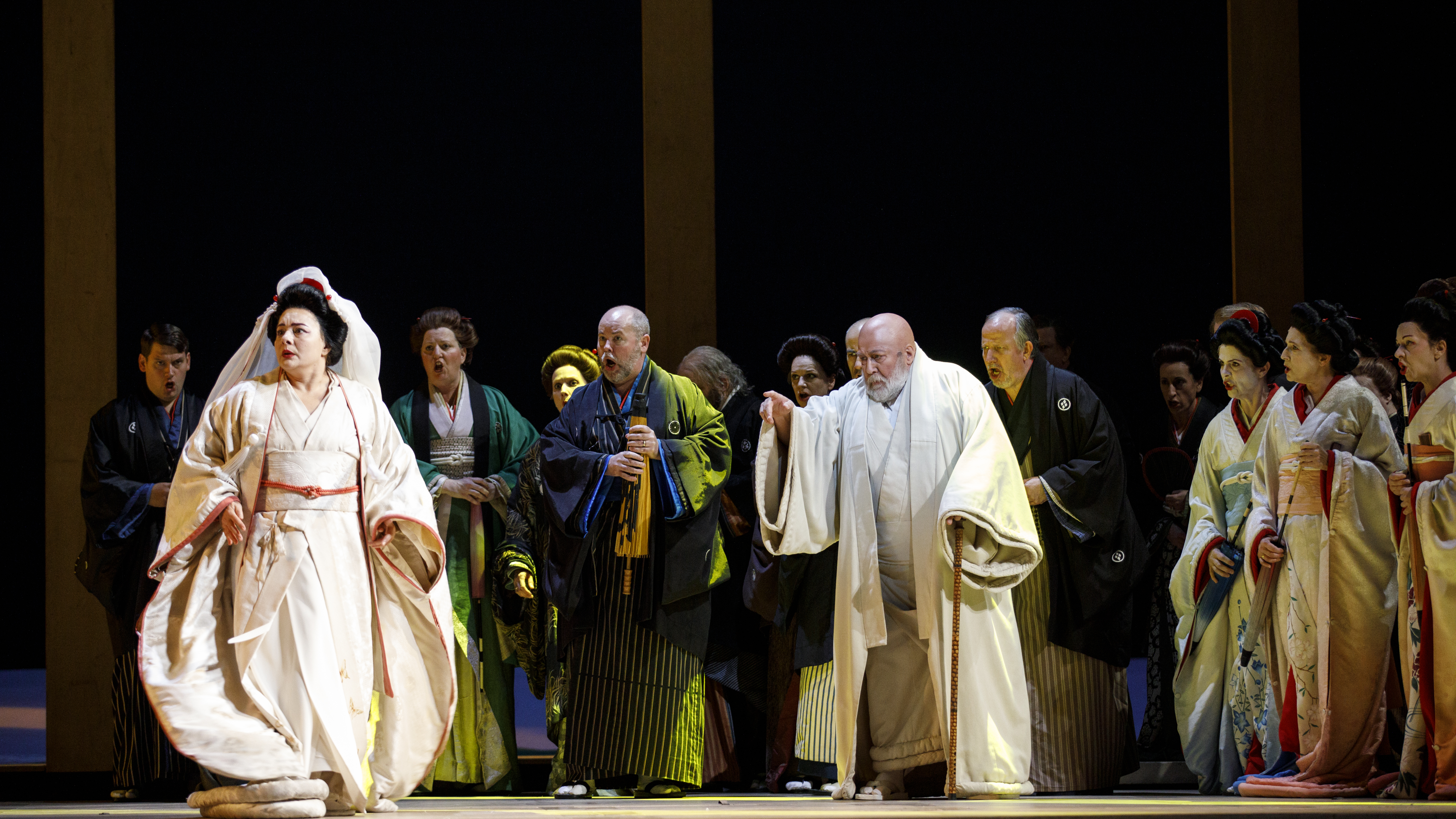


That final rolling around on stage was an extreme conclusion to a performance from Lianna Haroutounian that was throughout more strong than subtle. I am not sure it was especially in keeping with the avowed intentions of this revision, but it did no especial harm. Ultimately, though, it was difficult to take her seriously enough in the role. Freddie De Tommaso’s Pinkerton also tended towards the broad-brush, albeit with greater attention to detail: a perfectly decent, if not especially illuminating, performance. I presume a pronounced lachrymose tendency in the third act to have been an interpretative decision, just in case one did not loath the character enough; the self-pity did the trick, in any case. Patricia Bardon’s Suzuki was constant and compassionate, very much what one expected—and wanted—to hear. For me, Lucas Meachem’s Sharpless was the pick of the bunch, his thoughtful, variegated performance unquestionably founded in the text. The Royal Opera Chorus was not on its best form, comparisons with Covent Garden’s recent Lohengrin again unfortunate.

 Not nearly so unfortunate, though, as the conducting. In the programme, we also read Mears and Pappano write, ‘We are thrilled to welcome back Dan Ettinger to conduct.’ They could hardly say they had been pained to do so, but leaving out Ettinger altogether would have been preferable. It is difficult to imagine anyone having been thrilled with the results, at any rate. Ettinger’s sole advantage, relatively speaking, was that he was not Daniel Oren: another, frankly atrocious conductor Covent Garden engages with bewildering frequency. This was bad, but perhaps not quite so bad. Quite what it is with some such figures I do not know; maybe it is the demands of artist management companies. Whatever it is, houses should stand firm. For Ettinger’s perverse achievement in ridding most of Puccini’s score, especially an interminable first act, of any interest, let alone drama, was not something any house should welcome. The rest was loud, crude, weirdly devoid of harmonic rhythm, and often simply of harmonic, let alone structural, interest. 

If work and production are to be further re-evaluated, then having someone capable of leading such re-evaluation from the pit would help; enlisting someone capable of holding one’s attention would be a bare minimum. Better still, consider a staging that engages more deeply with the racial and sexual violence, as well as the devastating imperialism, that lie at this opera's heart (or lack thereof).


Sunday, 20 November 2016

Les Contes d’Hoffmann, Royal Opera (cinema broadcast), 15 November 2016


Royal Opera House (viewed at Curzon Mayfair)


Hoffmann – Vittorio Grigòlo
Four Villains – Thomas Hampson
Olympia – Sofia Fomina
Giulietta – Christine Rice
Antonia – Sonya Yoncheva
Nicklausse – Kate Lindsey
Spalanzani – Christophe Montagne
Crespel – Eric Halfvarson
Four Servants – Vincent Ordonneau
Spirit of Antonia’s Mother – Catherine Carby
Nathanael – David Junghoon Kim
Hermann – Charles Rice
Schlemil – Yuriy Yurchuk
Luther – Jeremy White
Stella – Olga Sabadoch


John Schlesinger (director)
Daniel Dooner (revival director)
William Dudley (set designs)
David Hersey (lighting)
Maria Björnson (costumes)
Eleanor Fazan (choreography)

Royal Opera Chorus (chorus master: William Spaulding)
Orchestra of the Royal Opera, Evelino Pidò (conductor)


Oh dear! One might travel far before seeing so dramatically inert a production of anything. ‘Revived’ – hardly the mot juste here – by Daniel Dooner, pretty much the only saving grace accompanying this ancient staging by John Schlesinger was the news that it will be its last. In vain did one seek for irony. Offenbach’s taste and wit, it seemed, had been paid off, with a generous settlement. Indeed, one sensed that one Manhattan-based master of ‘settlements’ and theatrical criticism would have approved, together with his chums in the bizarre ‘Against Modern Opera Productions’ group. As for the edition used, the less said the better, but imagine the outcry if Bruckner performances were still being given in the Schalk ‘versions’, perhaps with a few odds and ends thrown in for the hell of it. This, as Mahler would have put it, was tradition as Schlamperei.
 

For the designs – there is nothing more to the production, certainly no hint of a critical stance, let alone a Konzept – speak of vulgar ostentation. Although ostensibly set when it ‘should’ be, earlier in the nineteenth century, this looked more like a Second Empire recreation, albeit one that had seen better days. The Palais Garnier is a thing of wonder; if you are going to do ‘style of Napoleon III’, then go all out for it. This, however, is not; it is merely tedious. If the æsthetic aspired to Donald Trump, it ended up being more minor West End musical. If ‘lavish’, for some unfathomable reason, is the first word that comes to mind when you think of Offenbach, then I suppose you might have liked this, but surely anyone would have baulked at the bizarre, am-dram over-acting of some members of the chorus. Perhaps that was a matter of cinematic close-up, but it was at best an occasion, well-taken (unfortunately) for laughter. At any rate, for an evening that dragged so, I was grateful to be seated in the comfort of the Curzon Mayfair rather than squeezed into the Royal Opera House’s Amphitheatre.
 

That it dragged was also the fault of Evelino Pidò’s leaden conducting. There was no lightness, no air, no direction, just endless plodding through. Offenbach’s musical drama – and I am far from convinced he is at his most successful in this work – is a delicate flower. The score simply sounded suffocated.
 

At least the singing was better. Vittorio Grigòlo’s untiring commitment put me in mind of Roberto Alagna, although vocally, Grigòlo was certainly more secure than his mercurial counterpart can sometimes be. Stylistically, his voice and manner are perhaps not ideal, but there was much to be enjoy. (As you will have guessed, I took what I could.) Kate Lindsey impressed greatly as Nicklausse, in a stylish, equally committed performance. She can act too, and did. Christine Rice’s Giulietta brought a touch of vocal opulence. It was neither unwelcome nor inappropriate, tempered as it was with taste, quite unlike its scenic equivalent (For her act, Schlesinger seemed to have in mind, quite without irony, or indeed without eroticism, the world of ‘vintage’ soft porn. Again, laughter ensued.) Sofia Fomina handled the challenges of Olympia’s coloratura with ease, and portrayed the very particular acting challenges of her doll’s role convincingly. Sonya Yoncheva’s Antonia was sincere enough, but it sounded as if she would have been happier singing Verdi. Catherine Carby’s brief appearance as her mother brought much needed relief. Thomas Hampson’s performances suggested that his voice is now seriously beyond repair. Not only, as one might have suspected, did the lower notes lie awkwardly for him; so did many at the top too. Smaller roles were taken well; David Junghoon Kim’s Nathanael caught my ear.


As theatre, though, this was strictly for those who like to applaud scenery. And even they might have preferred to check into a certain Washington hotel for the real thing.


Sunday, 8 February 2015

Der fliegende Holländer, Royal Opera, 5 February 2015


Images: ROH/Clive Barda
 
 
Royal Opera House

The Dutchman – Bryn Terfel
Senta – Adrianne Pieczonka
Daland – Peter Rose
Erik – Michael König
Mary – Catherine Wyn-Rogers
Steersman – Ed Lyon

Tim Albery (director)
Daniel Dooner (revival director)
Michael Levine (set designs)
Constance Hoffmann (costumes)
David Finn (lighting)

Chorus of the Royal Opera House (chorus master: Renato Balsadonna)
Orchestra of the Royal Opera House
Andris Nelsons (conductor)

 
I wonder whether we need a new way of thinking – and talking – about operatic ‘revivals’. Perhaps the term is more meaningful when it comes to works that have been dead and buried for years, before being rediscovered by subsequent generations. However, when it comes to productions, I cannot help but think that it increasingly obscures rather than aids understanding. Where, after all, has the production been in the mean time? Hades? More to the point, though, I think we tend to underestimate, at least in many cases, the role of the revival director. (The often problematical ‘repertory’ system employed in many German theatres is a different matter; I am thinking here of theatres operating according to what is essentially a stagione principle.) In this particular case, Daniel Dooner seemed to make a better job of ‘reviving’ Tim Albery’s production of The Flying Dutchman than Albery had made of presenting it in the first place. Or was it a matter of a better-adjusted cast? The one does not exclude the other, of course; indeed, the two are not unlikely to have been related.


Steersman (Ed Lyon)


The 2009 ‘premiere’ had greatly disappointed, eschewing Wagner’s interest in myth for a  form of dreary realism, quite out of place and seemingly determined – understandably, I suppose, given its misguided premise – to downplay the figure of the Dutchman as much as possible. It did not make sense and it did not involve. The irritants have not entirely gone away, especially during the third act, in which the drunken antics of the townsfolk – here, it must be admitted, very well portrayed by the chorus and Ed Lyon’s Steersman – still seem to be far too much ‘the point’. But they are counterbalanced and, on occasion, supplanted by a stronger sense of the Dutchman’s plight and its consequences. ‘Revival’ seems something of a misnomer for a hugely beneficial shift of emphasis, unless we mean that the work itself experiences something of a revival – which, I think, it does, at least vis­-à-vis its outing six years ago.

 
The Dutchman (Bryn Terfel)

Bryn Terfel’s performance certainly seems less ‘revived’ than brought to life for the first time. In 2009, he had disappointed perhaps even more than the production. There were still occasional unwelcome tendencies towards crooning, especially towards the end of his first-act monologue. They were occasional, though, and Terfel followed up his excellent Proms Walküre Wotan – almost certainly the best thing I have heard him sing – with a world-weary Dutchman who, moments of tiredness aside, yet had powers of something mysterious in reserve for when the moment called.  This time the words were not only crystal-clear – always a formidable weapon in Terfel’s armoury – but invested with a true sense of dramatic meaning. Adrianne Pieczonka’s Senta was at least his equal in terms of dramatic commitment; arguably, this thrilling, unmistakeably womanly performance went still further. I say ‘womanly’ since this was a reading that seemed thoroughly in keeping with a recent, welcome understanding of Wagner’s earlier heroines to be more than virginal male projections. Peter Rose made the most of Daland’s character: venal, yes, but also looking to the future for his daughter as well as himself. Michael König offered an alert Erik, Catherine Wyn-Rogers a properly maternal Mary. Often threatening to steal the show was Lyon’s Steersman, as fine a portrayal as I can recall: an everyman, perhaps, but one with agency, for which verbal and musical acuity alike should be thanked.


Senta (Adrianne Pieczonka) and Erik
(Michael König)

Andris Nelsons’s conducting for the most part brought out the best from the Orchestra of the Royal Opera House. However, the interpretation as a whole did not seem quite to have settled; I strongly suspect that subsequent performances will impress more. The Flying Dutchman is a difficult work to bring off; despite fashionable claims for overplaying its (alleged) antecedents, it really works best as a whole when viewed, as Wagner would later do so, in the light of his subsequent musico-dramatic theories. Senta’s Ballad may not originally have been its dramatic kernel, but it has become so. Nelsons sometimes seemed unclear which way to tilt, especially during a drawn-out Overture, whose extremes of tempo threatened to negate any sense of unity. There were sluggish passages elsewhere: not hugely drawn out, but enough to make one wonder where the music was heading. The third act emerged tightest, and may well be a pointer to what audiences will hear later in the run. Choral singing was not entirely free of blurred edges, but there was much to admire, and again, I suspect that slight shortcomings will soon be overcome. This remained an impressive ‘revival’, all the more so, given its manifest superiority to the production’s first outing.