Showing posts with label Emma Bell. Show all posts

Wednesday, 1 March 2023

Rusalka, Royal Opera, 27 February 2023


Royal Opera House

Rusalka – Asmik Grigorian
Prince – David Butt Philip
Vodník – Rafał Siwek
Ježibaba – Sarah Connolly
Duchess – Emma Bell
Kuchtík – Hongni Wu
Hajný – Ross Ramgobin
Wood Spirits – Vuvu Mpofu, Gabrielė Kupšytė, Anne Marie Stanley
Lovec – Josef Jeongmeen Ahn

Ann Yee and Natalie Abrahami (directors)
Chloe Lamford (set designs)
Annemarie Woods (costumes)
Paule Constable (lighting)
Ann Yee (choreography)

Royal Opera Chorus (chorus director: William Spaulding)
Orchestra of the Royal Opera House
Semyon Bychkov (conductor)


Images: Camilla Greenwell

A strange evening: I very much enjoyed this new Rusalka, though found myself slightly haunted by the suspicion I did so more than I should have done. Musically magnificent yet theatrically inert: opera should intrinsically be more than that, yet I suppose we should be grateful that it can still partly satisfy, even when one crucial component misfires. 

The production is oddly listed as having been ‘created by Natalie Abrahami and Ann Yee’ but with ‘Ann Yee and Natalie Abrahami’ as directors. Equitable, perhaps, but does such re-listing really merit a line in the programme? (Does it really merit three lines in a review, one might also ask, I suppose.) I mention it only as a minor instance of something more irritating. Equity, sustainability, so much else: these are of course causes toward which we should all be working, a great deal faster and harder than we are now. They do not, however, in themselves make a production; they are certainly no substitute for one either. For here, whilst one could read an interesting programme note, promising much, by Jessica Duchen on ‘A Sustainable Rusalka for the Royal Opera House’, the results were actually neither sustainable – for that, ‘wed have to have started the control systems much earlier’ (Abrahami) – nor, contra what we read, saying anything much about sustainability or wider ecological issues. Instead, there was a strange boast, admittedly fulfilled, of having ‘worked with our creative team to create the illusion of water, using paint effects and lighting, and a set that can hold this without having to turn over actual water’. Fine, if hardly unprecedented. Is that not more often the case than not with water? How many productions will theatregoers already have seen that did just that?

Ultimately, the directors (or ‘creators’) feel the story is ‘not about nature’s conflict with humanity, but rather humanity’s need to connect and meld with nature’. It is a point of view: not one that makes a great deal of sense to me, either intrinsically or in the case of Rusalka, but worth a hearing or viewing. What, then, do we have? A sort of non-directed cartoon with words and music attached. Singers generally have to fend (creditably) for themselves. A mossy fairytale without irony or magic turns mildly trashy in the second act, presumably out of a desire to be ‘contemporary’. It looks as though a few items from Claire’s Accessories have been magnified on stage to frame the ‘party’. Inflatable toy animals are presumably intended to imply distance from Nature’s real animals, yet since no one seems to know what is going on, they just look silly. We return more or less to a slightly broken version of the setting for the first act. Alleged intentions go unrealised, as if our ‘creators’ have failed to appreciate that stating you will do, let alone explore, something is not the same as doing or exploring it. As a framework for the story, it works reasonably. Paule Constable’s lighting pretty much steals the visual show, saying so much more than Yee’s tedious, seemingly tone-deaf choreography.

And save, mercifully, for the musical performances: singers, orchestra, and conductor. My two other big house Rusalki over the past decade or so have been Paris in 2019, not so long before the end of the world, and Covent Garden’s first (!) staged performance in 2012. An excellent Komische Oper staging in Berlin was a slightly different animal, built as it was around a thriving company, as opposed to an ‘international’ cast; it offered by some way the most interesting, penetrating production (Barrie Kosky). Paris had Camilla Nylund, Klaus Florian Vogt, Karita Mattila, Thomas Johannes Mayer, and Michelle DeYoung, Covent Garden 2012 also had Camilla Nylund, working with Bryan Hymel, Petra Lang, Alan Held, and Agnes Zwierko. At this level, comparisons are often more a matter of taste than anything else, but I should unhesitatingly plump for David Butt Philip’s Prince from Covent Garden 2023 and consider its cast every inch the equal of its illustrious predecessors. 


One of my first thoughts was that surely we must be due a Lohengrin from Butt Philip soon; lo and behold, on later reading the programme biographies, one (Deutsche Oper Berlin) is forthcoming. Beautifully, unerringly musically phrased, his Prince conveyed a vulnerability and complexity of character considerably beyond either of the aforementioned performances. This was a considered character development, conveyed through words and music. Asmik Grigorian’s Rusalka likewise had it all: effortlessly scaling the vocal peaks, drawing in through hushed intimacy, and offering almost everything in between. Her stage presence likewise was second to none. Sarah Connolly’s Ježibaba and Emma Bell’s Duchess – I am not sure why the usual ‘Foreign Princess’ was not used here, but no matter – represented luxury casting. The former’s expressive range, controlled in technique yet with dramatic spontaneity (or the impression of such), could hardly have been bettered. The latter’s star quality shone through: both in itself and as something akin to metacommentary on the role. Rafał Siwek’s dark-toned Vodník was just the thing too, in voice and presence. Lively and warmly sympathetic performances from Hongni Wu (Kuchtík) and Ross Ramgobin (Hajný) were also highly worthy of note.

 Excellent conducting from Susanna Mälkki (Paris) and Yannick Nézet-Seguin (Covent Garden, 2012) notwithstanding, Semyon Bychkov was for me in a different league. His was world-class conducting, the Orchestra of the Royal Opera House sounding the equal of its very starriest peers. One might expect operatic symphonism from Bychkov, but the extent to which the entire work sounded as if heard in a single, variegated breath nonetheless astonished. A symphony in three movements emerged, its first two acts strongly contrasted. The first was doubtless ‘objectively’ on the slow side, but emerged as an exquisitely conceived, quasi-Wagnerian tapestry in absolute commanded of our musical attention. The second entered more Italianate waters, enlivened by a welcome dash or two of Tchaikovsky, and the third effected due synthesis, culminating in a climax that can surely have never sounded closer to the pantheistic ecstasy of Janáček. Not, of course, that this was not first and foremost Dvořák, but it was a generous, cultivated and culturally broad performance that denied national, let alone nationalistic, clichés. 

Mention should also go to the language coaches, Lada Valesova and Lucie Spickova. I do not speak or understand Czech, save for odd words and phrases I have picked up. But I could have had a stab at transcribing some of it here, such were the clarity of diction and, insofar as I could tell, evident meaning with which words in their alchemic union with music were treated. All in all, then, a splendid evening—yet despite, rather than on account of, the inconsequential production.

Sunday, 21 November 2021

Die Walküre, English National Opera, 19 November 2021


Coliseum

Siegmund – Nicky Spence
Sieglinde – Emma Bell
Hunding – Brindley Sherratt
Wotan – Matthew Rose
Brünnhilde – Rachel Nicholls
Fricka – Susan Bickley, Claire Barnett-Jones
Gerhilde – Nadine Benjamin
Ortlinde – Mari Wyn Williams
Waltraute – Kamilla Dunstan
Schwertleite – Fleur Barron
Helmwige – Jennifer Davis
Siegrune – Idunna Münch
Rossweisse – Claire Barnett-Jones
Grimgerde – Katie Stevenson

Richard Jones (director)
Stewart Laing (designs)
Adam Silverman (lighting)
Sarah Fahie (movement)
Akhila Krishnan (video)

Orchestra of the English National Opera
Martyn Brabbins (conductor)

Images: (C) Tristram Kenton
Siegmund (Nicky Spence) and Sieglinde (Emma Bell)

I wanted so much to like this more than I did. It is not quite ENO’s return to the Coliseum after you-know-what, but in many ways it felt like it. (A Philip Glass revival and a new production of Gilbert and Sullivan will have had their devotees, but they are not my potion of forgetfulness.) Anneliese Miskimmon, ENO’s Artistic Director, could not have been more welcoming in her brief address from the stage before the performance. And what could be a greater declaration of intent for a new era than a new Ring? Perhaps a Schoenberg or, still more so, a Stockhausen series? But even then, the Ring retains for many the status of non plus ultra. Its all-encompassing nature continues to surpass all competitors; no artwork has more to tell us, so it seems, at any juncture in our dubious human development.

No Ring is therefore going to be perfect; even the most exalted performance, let alone staging, will have imperfections. It would be too easy to judge perfection a lesser thing; it is not, necessarily, but it is a different thing—one which Mozart (often) has covered. Yet if a Ring in performance will always fall short, it should not fall so short as Richard Jones’s half-hearted attempt at a production, which detracted all too much from a mixed musical performance laying claim to not inconsiderable virtues. Perhaps more would have been gleaned had we seen Das Rheingold first. Starting with the second instalment is not without precedent, but I remain unconvinced that it is a good idea. Berlin’s Deutsche Oper has had to present Stefan Herheim’s new Ring as and when it can, but that is a different case, planned performances having to be cancelled, given without an audience, and so on. (How I long to see what Herheim has done!) Yet it is difficult to imagine that much light being shed on a Walküre (sorry, Valkyrie, as ENO obstinately continues to refer it) seemingly without a concept or indeed much of an idea at all. Presumably, money was tight, for what we see is not so much minimalism as people wandering a little lost around a stage that sometimes has scenery and sometimes does not. As in Jones’s recent, wretched La clemenza di Tito for the Royal Opera, there was a vague look: in this case, noir-ish ‘Scandinavia’, though it would be difficult to say anything more precise than that. ENO’s publicity suggests the idea that this is a family saga: well, sort of, I suppose, but only if that is taken to be the crucible for something greater. Use of video to show Alberich (‘Nibelung’ tattooed on his forehead), Grimhilde, and Hagen when referred to in Wotan’s narration—nothing more, just show them—seemed both patronising and pointless, though perhaps in a greater context it contributes to the banal theme of family feud. The appearance of Hunding’s clan on stage might have contributed further, but ultimately undirected (like so much else), they proved little more than a distraction, the lack of much to distract from notwithstanding.


Alberich (Jamie Campbell), Brünnhilde (Rachel Nicholls), Wotan (Matthew Rose)

Maybe the strange claim (Christopher Wintle) that opened one of the programme notes offered a clue to the lack of any exterior, let alone political element: ‘Most of us can agree that The Valkyrie is “about” incest.’ I do not know precisely to whom ‘us’ refers; certainly not to me, anyway. Wagner’s drama is no more ‘“about” incest’ than The Flying Dutchman is ‘about’ sailing. The point of Siegmund and Sieglinde’s love is that it breaks the violent, cruel bonds of marriage, family, and custom (which Wagner specifically identified with Fricka); that it leads Siegmund to reject immortality, and thus to put Brünnhilde on her way to doing likewise, to attaining the superior status of ‘purely human’; and precisely that it does not matter whether the Volsung twins are brother and sister, not that it does. Here, occasional straining towards a familial idea, for instance Hunding’s physical brutality to Sieglinde, seemed little more than striving after effect, given a lack of embedding in anything more than an IKEA catalogue. The production team sported more interesting clothes than those given to the cast; maybe they should have swapped.


Grimgerde (Katie Stevenson), Rossweisse (Claire Barnett-Jones),
and Siegrune (Idunnu Münch)


Or maybe they should have given them to the curious animals that pranced around the stage, Wotan’s ravens (I think) included: more Sesame Street than creatures of the forest. Whether the concept were malevolent or ironic, neither possibility was achieved. For some reason, a lone tap dancer did her stuff during the Ride of the Valkyries, whilst actors in horse costumes struggled around on tip toe. Why on earth Grane, understandably fidgeting, was made to balance in this way through the entirety of the final scene—and not only then—I have no idea; but then I have little idea about anything else either. Inability to set the stage ablaze at the close was attributed to a late intervention from Westminster City Council. Alas, Wotan’s protracted fumbling to attach to Brünnhilde a harness that would awkwardly suspend her above the stage, without the slightest sign of flames that had intermittently flickered earlier, seemed all too apt a metaphor. Quite what the Met, where Jones’s third (!) attempt at the Ring is heading, will make of it is anyone’s guess. It is certainly devoid enough of intellectual content to satisfy Friends of Otto Schenk. But the ‘look’, for that is all it is, and lack of discernible stage action will surely trouble many. 

Martyn Brabbins’s conducting was sane, measured, and doubtless sensitive—perhaps too sensitive—to the needs of his singers. Brabbins clearly appreciates the need to think in the broadest terms about Wagner’s structures, yet often seemed to confuse that with maintaining a slow speed throughout, occasionally changing gear when that could not conceivably be maintained any longer. A few understandable fluffs—every performance has them—notwithstanding, the ENO Orchestra played beautifully, if often in strangely subdued fashion, especially in the first act (!) I do not know how long it lasted in actual minutes, but it felt like the longest I had ever heard. By contrast, the third act often seemed rushed, if hardly short. This was clearly a work in progress, but there may be considerably more hope for improvement here than in the staging.


Brünnhilde

Had it not been for an initial announcement, no one would have known Nicky Spence was suffering from a cold. Siegmund is clearly a role for which he is ready—and for which he has well prepared. There are strength, vulnerability, and many other of the qualities we need, even in so unpromising a setting as this. It was difficult to discern much in the way of chemistry with Emma Bell’s Sieglinde; nor did this seem to be ironic or deconstructive detachment. However, considered on its own terms, her performance also impressed, indicative of a woman bruised yet determined to command her own destiny. Dart-playing Rachel Nicholls, lumbered with a strange skater-girl look, trod a fine, shifting line between Brünnhilde's youthful impetuosity and the glimmers of something more moving, more human—which is to say she understood what was at stake, even if Jones did not. Matthew Rose, lumbered with, well, being a lumberjack-turned-television-detective, offered a typically detailed and thoughtful performance as Wotan, though the third act did not show him at his strongest. These things vary from night to night. Brindley Sherratt's focus as Hunding varied too, though at its best it offered something darkly psychopathic. One of the strongest, most committed and sustained performances came from the team of Susan Bickley (finely observed, on stage) and Claire Barnett-Jones (also finely observed and with gleaming tone, from a box above) as Fricka. This, again, was a performance that truly used words, music, and gesture to suggest drama beyond Jones’s imagination.


So too did John Deathridge’s new singing translation. It was in many respects remarkably faithful not only to what Wagner said but, crucially, to what he did not, employing suggestion and ambiguity in the right places. It had an intriguing line too in something akin to Stabreim. Word order and stress played their part, as did various other considerations one might find—with profit—in reading Wagner’s own Opera and Drama. This did not, like many of ENO’s translations, attempt to draw attention to itself, still less to elicit inappropriate laughter; rather it participated in the dramatic effort in a way the singers and orchestra, if hardly the director, did. The sort of people who drone on about ‘the Coli’ and alleged halcyon days of Reginald Goodall will doubtless bemoan the lack of Andrew Porter, but their parochial concerns need not be ours.


Fricka (Susan Bickley) and Wotan

‘Mark well my poem,’ wrote Wagner to Liszt in 1853, enclosing a copy of the Ring in verse; ‘it contains the beginning of the world and its end.’ One might argue that beginning(s) and end happen elsewhere in the Ring; but were this the generic television ‘show’ from which Jones & Co. appeared to have taken non-inspiration, it seems doubtful, even in the unlikely event of a decision to renew for another ‘season’, that many viewers would have been remaining. To achieve not only an Annunciation of Death, but an entire Walküre, in which nothing whatsoever seemed to be at stake, was a peculiar, perverse and strangely pointless achievement. Either Jones needs to rethink—the prefix ‘re-’ may be too kind—or ENO should act decisively with courage and substitute another production or concert performances. With Wagner, in Wagner, much is or should be at stake.


Thursday, 28 April 2016

Tannhäuser, Royal Opera, 26 April 2016


Tannhäuser (Peter Seiffert) and dancers in the Venusberg ballet
Images: Clive Barda/ROH
 
 
Royal Opera House

Tannhäuser – Peter Seiffert
Elisabeth – Emma Bell
Venus – Sophie Koch
Wolfram von Eschenbach – Christian Gerhaher
Hermann, Landgrave of Thuringia – Stephen Milling
Biterolf – Michael Kraus
Walther von der Vogelweide – Ed Lyon
Heinrich der Schreiber – Samuel Sakker
Reimar von Zweter – Jeremy White
Shepherd Boy – Raphael Janssens
Elisabeth’s Attendants – Kiera Lyness, Deborah Peake-Jones, Louise Armit, Kate McCarney

Tim Albery (director)
Michael Levine (set designs)
Jon Morrell (costumes)
David Finn (lighting)
Jasmin Vardimon (choreography, Venusberg Scene)
Maxine Braham (movement)

Dancers
Royal Opera Chorus and Extra Chorus (chorus master: Renato Balsadonna)
Orchestra of the Royal Opera House
Hartmut Haenchen (conductor)

 
Wolfram (Christian Gerhaher)
 

London remains starved of Wagner. This season, its major companies offer but two works, Tannhäuser from the Royal Opera and Tristan from ENO. True, Opera North will bring its concert Ring to the South Bank, but that is a somewhat different matter. Comparisons with serious houses, let alone serious cities, are not encouraging, especially if one widens the comparison to nineteenth-century Italian composers. Quite why is anyone’s guess; the composer is anything but unpopular. More to the point, Wagner and Mozart should stand at the heart of any opera house’s repertory. They can hardly do so if they are so rarely performed.
 

I mention that not only because it is very important in itself, but because it has serious implications for orchestras. What used to be Bernard Haitink’s orchestra has had a rougher time of things since his departure. Whilst a great conductor – Semyon Bychkov, for instance, in the first run of this production, or more recently, in Die Frau ohne Schatten – can still summon truly great things from the Orchestra of the Royal Opera House, its day-to-day experience of core German repertory is fading. Here, under Hartmut Haenchen, there were no particular upsets, but there were only hints at what the orchestra has been capable of, and still might be. Haenchen’s conducting had its moments, but it was the heavenly lengths, and how they might fit together, that were lacking. A penny-plain opening to the Overture suggested ‘authenticist’ tendencies, as if Haenchen would rather be conducting the Dresden Tannhäuser, albeit conducting it a little like ‘period’ Mendelssohn. When it came to the music written for Paris, he seemed to linger and to rush, somewhat arbitrarily. There is stylistic ‘incongruity’, yes, if we want to call it that, but should we not be making something of that, even making it into a virtue?


I suspect that Haenchen’s tempi were, on balance, considerably quicker than Bychkov’s; that was certainly not how it felt, especially in the Venusberg, whose pleasures seemed at times interminable (in the wrong sense). Indeed, the exchanges between Tannhäuser and Venus often sounded alarmingly perfunctory, robbed not only of orchestral ‘cushioning’, but of the direction that Wagner’s orchestra-as-Greek Chorus, even at this stage in his career, offers. Of Beethoven, at least as Wagner would have understood him, there was little: perhaps there was, however, of fashionable, ‘period’ Beethoven-cut-down-to-size. Compared to the most recent other Tannhäuser I had heard, superlatively conducted by Daniel Barenboim in Berlin, this was disappointing.
 
Venus (Sophie Koch)
 

Disappointing in that very important respect, anyway. There was much more to savour vocally. Peter Seiffert gave a strange performance in the title role: it came and went, seemingly without reason, sometimes, especially in the first act, alarmingly out of tune, at other times spot on, always tireless, even when, understandably, his voice acquired something of an edge in parts of the Rome Narration (movingly despatched). Emma Bell was a wonderful Elisabeth; I do not think I have heard anything finer from her. Sincere but certainly not bland, this Elisabeth’s vocal qualities were subtle yet, where necessary (and it often is!), powerful. Sophie Koch’s Venus was ravishingly sung, words and music in excellent, dramatically productive, balance. Christian Gerhaher’s Wolfram is a known quantity to many of us, of course, but no less welcome was it for that. The startling, almost indecent, yet utterly sincere, beauty of Gerhaher’s delivery was once again something for all to remember. There was no need to force the performance; he could draw us in so as to hear a pin drop. Phrasing was just as exemplary. Ed Lyon’s sweetly-sung, dramatically-committed Walther was another pleasure; if only he had had more to sing. Thank goodness, at least, Walther’s solo, only cut from Paris because the tenor could not sing it, was restored. Stephen Milling's sonorous Landgrave was, quite rightly, especially acclaimed by the audience. Young Raphael Janssens acquitted himself well as the Shepherd Boy. So did the chorus (and extra chorus) of Renato Balsadonna, although I think there was greater precision, and perhaps greater weight, under Bychkov in 2010.
 
The ballet


Tim Albery’s production does not seem to have changed very much. The Venusberg scene is strongest, the ballet well (if more efficiently than probingly) choreographed by Jasmin Vardimon. It might have been raunchier – Wagner’s music here is, after all, the supreme musical manifestation of desperately trying and failing to achieve sexual climax – but it works well enough. Is a point being made about the unsatisfying nature of pornographic voyeurism? That was an assumption, given that our 'hero' only ever watches, but I am not entirely sure. In any case, the sense of the Royal Opera House being on stage is interesting in this opera. In a work whose central event is a song contest, who is performing, and why? Alas, nothing is really followed through, so that one cannot even really tell whether such metatheatrical possibilities are intended. We end up with little more than a mild compendium of clichés. One bizarre exception is the appearance of cowbells – there is, frankly, little to see – when Tannhäuser first returns to ‘normality’. Their lack of coordination would have been irritating in Mahler, but here, in Tannhäuser? If I had been Haenchen, or the house, I should have put a stop to it. This was not some interesting musical recomposition; it was just a bit of a mess.

The war-torn (Balkan?) setting of the second act I presume to have taken its cue from the Landgrave’s ‘Wenn unser Schwert in blutig ernstern Kämpfen stritt für des deutschen Reiches Majestät’. It would be a stretch, however, to say that post-war deprivation was what Tannhäuser might really be ‘about’, at least without some further work on the director’s part. Albery seems content to let Michael Levine’s set designs do the work for him, which of course they cannot. The third act carries on in much the same way. Very much worth hearing for most of the singing, then, but a restricted view would not penalise you unduly.


Tuesday, 3 June 2014

Dialogues des Carmélites, Royal Opera, 2 June 2014


Images: Stephen Cummiskey/Royal Opera House
 
 
Royal Opera House

Chevalier de la Force – Yann Beuron
Marquis de la Force – Sir Thomas Allen
Blanche de la Force – Sally Matthews
Thierry – Neil Gillespie
Mme de Croissy – Deborah Polaski
Sister Constance – Anna Prohaska
Mother Marie – Sophie Koch
M. Javelinot – John Bernays
Mme Lidoine – Emma Bell
Carmelites – Yvonne Barclay, Katy Batho, Tamsin Coombs, Eileen Hamilton, Anne Osborne, Deborah Peake Jones, Louise Armit, Andrea Hazell, Elizabeth Key, Kate McCarney, Deborah Pearce
Sister Mathilde – Catherine Carby
Mother Jeanne – Elizabeth Sikora
Chaplain – Alan Oke
First Commissary – David Butt Philip
Second Commissary – Michel de Souza
Officer – Ashley Riches
Gaoler – Craig Smith

Robert Carsen (director)
Michael Levine (set designs)
Falk Bauer (costumes)
Jean Kalman (lighting)
Philippe Giradeau (movement)

Royal Opera Chorus (chorus master: Stephen Westrop)
Orchestra of the Royal Opera House
Sir Simon Rattle (conductor)

 
This was a performance whose intensity increased almost immeasurably as the evening went on. That seemed to be as much a matter of the production as the conducting, of the singing as the orchestral playing, although there were, of course, exceptions. At any rate, the final scene proved devastating in its combination of abstraction and directness, the amplified (electronic?) guillotine notwithstanding. Robert Carsen’s staging, and in this case especially Philippe Giradeau’s movement, exemplary throughout, frame the action simply and without hysteria, as the equally exemplary ensemble thins out one by one – until the appearance of Blanche, to whom Constance reaches out from afar, and then… Yes, the opera veers dangerously close to sentimentality, and perhaps in some places crosses that boundary, but the frisson experienced near that boundary is part, though only part, of what Poulenc is about. Musically, the scene is not quite reducible to the ghost of Œdipus Rex, haunted by an earlier ghost of Gounod; it is, indeed, its own unforgettable self. And the other influences, Puccini, Mussorgsky, and Debussy amongst them, never overpower the ‘dialogues’ of the title, with their roots in a very French understanding of plainsong and religious life. It was not only in the final scene that music, staging, and performance came together very well indeed, but it was perhaps the finest example and of course the climax.

 
Mme de Croissy (Deborah Polaski) and Blanche (Sally Matthews)

If only Carsen’s understandable interest in the revolutionary crowd did not overpower some of the other scenes, this would be a great staging indeed; as it stands, Carsen’s divided attention seems to run along the lines of much (mis-)understanding of the opera. I do not wish to carp about the role played by the volunteer Community Ensemble, whose direction and performance deeply impressed, and whose achievement, some of its participants having experienced homelessness, prison, and long-term unemployment, can hardly fail to move and to cheer. But Carsen’s presentation tends to suggest that the opera is more ‘about’ the French Revolution than it really is. This is a drama about Divine Grace, a truth at least as often forgotten, or overlooked, as the similar truth about Parsifal, a work with which Poulenc’s opera would otherwise have little or nothing in common. There are moments, nevertheless, when the ensemble works wonders, perhaps above all acting as a human – or inhuman? – dividing line between Blanche and her brother, the Chevalier, when he visits her in the convent. Still, the loss is perhaps a price worth paying for the redemptive involvement and prospects afforded to members of the ensemble, who have also been invited to take part in a careers support programme by the Royal Opera House and its partner organisations (Streetwise Opera, Synergy Theatre Project, the Department for Work and Pensions, and the Royal Central School of Speech and Drama).


Mother Marie (Sophie Koch) at the centre
Sir Simon Rattle’s role in proceedings was impressive too – as one might expect from this conductor in French music. Rattle’s leadership of the Orchestra of the Royal Opera House, generally on very good form itself, refused to sentimentalise, taking the opera faster than some may have wished, but hardly offensively so and quite without the mannerisms that so often disfigure his readings of the ‘central’ Austro-German symphonic repertoire. And the big moments had great punch, the unanimity of orchestral and vocal ensemble alike quite remarkable. Poulenc once remarked that he did not want his music to be analysed but to loved; perhaps a better way to love it, though, is to accord it the dignity of some degree of analytical, as well as dramatic, thought.


Constance (Anna Prohaska) and other Carmelites
 

Sally Matthews’s performance of the central role was one which improved almost out of recognition as the evening went on. The first scene was troubled by thick vibrato and less than convincing French. It would be vain to contend that Matthews’s French diction or style ever truly convinced, but it became possible to leave to one side one’s doubts, as her dramatic sincerity won one over. Anna Prohaska made a wonderful foil as Constance: vivacious, pure and clean of tone, yet full of fun. In short, she simply ‘lived’ the character, convincing us that this was how she must be; it would be a pity if we were not one day to hear her Blanche. Deborah Polaski’s Old Prioress impressed through sheer strength of personality, even if, again, her French was far from beyond reproach. Her Erwartung did not seem so very far away at the end of the first act. Emma Bell was sensational as her replacement, ringing as true and clear as I have ever heard; indeed, this was the finest performance I have heard from her. Equally distinguished was Sophie Koch’s Mother Marie: a tricky, yet crucial role. Her inner demons and ultimate humanity were powerfully portrayed in a reading of vocal distinction too. Yann Beuron’s Chevalier de la Force made a headstrong and imploring mark, whilst Alan Oke captured better than I had previously encountered the ambivalent role of the Chaplain. Indeed, pretty much every one of the smaller roles was well taken, and the choral singing could hardly be faulted either. This was, then, whatever quibbles one might have had concerning aspects of Carsen’s production and the French diction, an excellent company effort, and should be lauded as such.


Thursday, 26 September 2013

Fidelio, English National Opera, 25 September 2013


Coliseum

Florestan – Stuart Skelton
Leonore – Emma Bell
Rocco – James Creswell
Marzelline – Sarah Tynan
Jaquino – Adrian Dwyer
Don Pizarro – Philip Horst
Don Fernando – Roland Wood
First Prisoner – Anton Rich
Second Prisoner – Ronald Nairne

Calixto Bieito (director)
Rebecca Ringst (set designs)
Tim Mitchell (lighting)
Ingo Krügler (costumes)

Chorus and Additional Chorus of the English National Opera (chorus master: Aidan Oliver)
Orchestra of the English National Opera
Edward Gardner (conductor)

 
More than two centuries on, Fidelio may well remain the most misunderstood opera of all. Irrelevant and downright stupid criticisms continue to be made of it, those voicing them apparently blind to what one would have thought the blindingly obvious truth that it not only represents, but instantiates the bourgeois idea of freedom at its most inspiring, apparently deaf to the symphonism of this most symphonic of operas, that idea of freedom explicitly expressed through the structural dialectics of Beethoven’s score. What a relief, then, for ENO’s new Fidelio, a co-production with the Bavarian State Opera, where it has already been seen, to be staged both as an expression and a deconstruction of that idea. Such problem as there were lay with Edward Gardner’s Harnoncourt-lite conducting, but Calixto Bieito’s imaginative, probing production offered one of those rare evenings in which a staging could more or less redeem a disappointing conductor. For that, of course, an often excellent cast should also share the credit.

 
Recent performances of Fidelio have tended to make a point of messing around with the work: re-ordering, new dialogue, and so forth. I have never quite understood why; the libretto is no literary masterpiece, but that is hardly the point, for it serves Beethoven’s purpose. Bieito – I assume this to be his doing – also makes changes; this was probably the first occasion on which I found the choices worth making, not as a blueprint for other performances, but simply as a valid performing choice in this particular context. Alarm bells would normally ring were a performance to open with the third Leonore Overture; even Daniel Barenboim, in a magnificent Proms concert performance, failed to convince that such was a wise move, the overture tending to overshadow, almost to render the opera unnecessary. Yet, following a blinding light and our first reading from Borges, the appearance of the pitiless, intermittently neon-lit labyrinth, a fine piece of design by Rebecca Ringst, not only sets up our expectations – the hopelessness of blind alleys and imprisonment for all concerned – but, in tandem with the overture in which Beethoven essentially presents a symphonic poem, both heightens and deconstructs those expectations. As an audience, also imprisoned in our different ways, we will the prisoners to escape, we begin to ask ourselves how we too might escape, and, perhaps most importantly of all, we already begin to appreciate that this will be a far tougher battle than Beethoven might ever have conceived. That the drama has in a sense been played out before a note has been sung and we have progressed not an inch is, or ought to provoke sober reflection. (The ridiculous booing form small sections of the audience, doubtless fresh, as a Twitter friend suggested, from the UKIP party conference, suggested, sadly if all too predictably, as another Twitter friend commented, that those most in need of the production’s message would never trouble themselves to heed it. At least, however, we can take a small degree of comfort from their discomfort.)

 
As ever, with Bieito, the craft of stage direction is exemplary; what we see is what he intends us to see. (Yes, this ought to be a given, yet all too often it is anything but.) I could not help but wonder whether survival of dialogue, not necessary all of it, might have aided understanding of who the characters were, but of course, as stated previously, the characters, such as they are, are really not the point in this of all operas. Borges and, on one occasion, Cormac McCarthy (as I learned from the programme) do sterling work instead: allowing us to think for ourselves, to make correspondences, rather than necessarily have our vision restricted to Guantánamo Bay, or wherever it might be (perfectly valid though that realistic approach may be). It is a pity that David Pountney’s translation veers all over the place: sometimes offering attention-seeking rhymes, sometimes curiously Victorian formulations, sometimes more present-day demotic. Yet even though it sounds in serious need of editorial attention, or better still rejection in favour of the German Beethoven set, there are phrases that stick with one, phrases that interact with the staging, to have us think. ‘Crimes against humanity’, a sadly everyday phrase in many respects: how could a London audience not think of a war criminal still very much amongst us such as Tony Blair? Bieito’s relative abstraction – unusual for him, and highly telling – permits the space for reflection, whilst listening to the progress of Beethoven’s drama.

 
It is that sureness of musical touch that perhaps permits ‘liberties’, which, when recounted in the abstract, might for some sound too much. Leonore III already used, we hear – this a real coup de théâtre in visual and musical terms – at the once ‘traditional’ juncture, music from, or perhaps beckoning us to, heaven, a Heiliger Dankgesang whose numinous qualities, for which, many thanks to the excellent Heath Quartet, suspended in cages from the ceiling, transcend the drama, question it, and are in turn questioned by it. Bieito undercuts all-too-easy expectations by introducing a sense of distancing already between Leonore and Florestan. And the caged musicians: are they a Stockhausen-like flight of fancy? Are they angels of Beethovenian mercy? Are they too imprisoned, sheltered from ‘reality’, whatever that might be? Are they, as the minority audience reaction would suggest, fated to be ignored, whatever the truth – so Beethovenian a word – of what they might attempt to express? We must think for ourselves, and tragically, an administered world, to borrow Adorno’s formulation, wishes to block them out, as sure as its gaolers wish us to think of opera as nothing more than entertainment.

 
Entirely unprepared as I was for that challenge to the musical work, provocative in the best sense, it made as full as conceivable an impact upon me. Likewise Bieito’s trump card in the final scene. Don Fernando makes his appearance as a stereotypical eighteenth-century ‘operatic’ character in a box above the stage. His increasingly bizarre and unpredictable behaviour, not to mention outrageous feyness, have us realise, both there and when he comes down to the stage, that rescue is not all that it is cracked up to be. Indeed, though we are told that it has happened – many of the prisoners are handed placards, personally signed, to signal their alleged liberation – we wonder whether that is just a trick, perhaps an ‘operatic’ trick. There is no doubting Beethoven’s sincerity, his greatness; that endures. But we also know that the administered world endures. The labyrinth does not retreat; it is simply, as New Labour would have had it, ‘rebranded’. Political action, whether individual or en masse, is both absolutely necessary and quite hopeless. Fate, or rather the forces of late-capitalist production, will find another way to trick us, in the manner of Don Fernando; his apparently ‘arbitrary’ shooting of Florestan, not slain but wounded, a truly shocking moment. And the return of blinding light has us appreciate anew the perils both of the cyclical and of all-too-easy identification of forces such as ‘light’ with progress.

 
The contrast between Beethovenian optimism, the sheer goodness of the score, and its staged deconstruction would of course have been greater still, had it not been for Gardner’s listless conducting. Often simply too fast – the main body of the overture but a single, albeit extreme example – the problem went beyond that; like Harnoncourt, the conductor seemed to have little or no ear for harmonic rhythm. Numbers did not extend beyond themselves; nor did that seem in itself a deconstructive strategy, more a matter of reductive domestification by default. To a certain extent, a grander canvas revealed itself during the second act, but structural concerns still went for very little. There is no one ‘correct’ way to conduct Fidelio: consider the success of such entirely different approaches as those of Furtwängler and Klemperer, or latterly, Barenboim and Colin Davis; but that does not mean that anything goes. We had, as I said, to rely upon the staging to accomplish double the work; almost miraculously, it accomplished something not so very short of that.

 
The singers’ accomplishment was also not to be disregarded. Stuart Skelton offered the finest Florestan I have heard since Jonas Kaufmann: powerful yet vulnerable, clearly committed to the ideas of both Beethoven and Bieito. If only he had not been harried by Gardner’s seeming desire to catch an earlier train home. Emma Bell was an impressive Leonore, her ‘Abscheulicher’ almost beyond reproach, though certain coloratura later on was skated over. More importantly, though, her identification not only with the role but with that all-important idea of freedom, shone through. Sarah Tynan proved an uncommonly excellent Marzelline, cleanly sung, vivacious, and equally committed in dramatic terms. Though Jaquino is a smaller role, Adrian Dwyer offered similar virtues when called upon. James Creswell was a likeable yet properly tortured Rocco. The only vocal disappointment was Philip Horst’s often lightweight Pizarro.  Choral singing was of a high standard throughout: a credit both to the singers and to Aidan Oliver as chorus master.

 
Anyone, then, who cares about opera as drama, who believes that it is something more than expensive entertainment, needs to see – and to hear – Bieito’s Fidelio. Reactions will differ, but those willing to be challenged will find themselves properly inspired and unsettled.   


Friday, 15 June 2012

The Cunning Little Vixen, Glyndebourne Festival Opera, 13 June 2012

Glyndebourne Opera House

The Vixen – Lucy Crowe
Fox – Emma Bell
Forester – Sergei Leiferkus
Forester’s Wife, Owl – Jean Rigby
Parson, Badger – Mischa Schelmoianski
Schoolmaster, Mosquito – Adrian Thompson
Harašta – William Dazeley
Innkeeper – Colin Judson
Innkeeper’s Wife – Sarah Pring

Melly Still (director)
Tom Pye (designs)
Dinah Collin (costumes)
Paule Constable (lighting)

Glyndebourne Chorus
London Philharmonic Orchestra
Vladimir Jurowski (conductor)


A performance of The Cunning Little Vixen can hardly fail to be a joy, and likewise can hardly fail to move. This new production at Glyndebourne – by now, some way into its run – proved no exception. Above all, it would be difficult truly to fault the cast. One may have experienced favoured portrayals in the past, but there was no weak link here, no mean achievement with so multifarious a set of characters. It was good to hear Sergei Leiferkus remain in excellent vocal form as the Forester, even if I found Christopher Maltman at Covent Garden a couple of years ago provided a more individual, deeply moving portrayal. Lucy Crowe was certainly more than a match for her Royal Opera counterpart, Emma Matthews, a little more wayward than often one hears, but none the worse for that. Much the same might be said of Emma Bell, as the Fox. William Dazeley stood out from the rest as Harašta, but, as I said, there were no disappointments at all.

I was less sure about Vladimir Jurowski’s direction of the London Philharmonic. Jurowski’s disinclination to Romanticise the score was perfectly justified, though by the same token, there is nothing wrong with bringing out the echoes of Strauss and early Schoenberg. Similarly, there is much to be said for an approach that brings out the radical disjunctures in Janáček’s writing. Nevertheless, one needs a balance, or perhaps better a dialectic, between those disjunctures and the greater whole. There were occasions, and I do not wish to exaggerate, when the scales seemed unduly weighted towards the former. Unfortunately, this came into greatest relief at the end, when the ecstasy of Janáček’s closing bars seemed to have come almost from nowhere; the temptation to Romanticise seemed to have taken over to a degree that did not tally with the rest of the performance. Work in progress, perhaps, or maybe an indication that other late Janáček works, such as The Makropulos Case or From the House of the Dead might suit Jurowski better. The LPO was on excellent form, though there were times when it might have benefited from a larger body of strings.

Melly Still’s production seemed to have little to say about the work, beyond a slightly puzzling desire to elide the distinction between human and animal worlds. Where other directors, not unreasonably, have seen that as a crucial component of the opera, or have at least problematised the distinction, Still seemed content to present a quasi- and sometimes not-even-quasi-balletic conception of the opera. It was beautiful enough in its æstheticised way, but something more in the way of engagement with the life cycle – I think here especially of André Engel’s Lyon staging, later seen in Paris – would have been welcome. Whether one responded well to the more Carry On-like elements – the translation in the surtitles often veered in that direction too – will have been a matter of taste; I tend to think there is something rather more serious, both delightful and moving, at the core of this wonderful opera. Whether an interval, oddly placed in the middle of the second act, as long as the opera itself is appropriate may also be considered a matter for debate.


Tuesday, 20 December 2011

Die Meistersinger von Nürnberg, Royal Opera, 19 December 2011

Pogner (Sir John Tomlinson)
Images: Clive Barda/Royal Opera

Royal Opera House, Covent Garden

Hans Sachs – Wolfgang Koch
Walther von Stolzing – Simon O’Neill
Eva – Emma Bell
Sixtus Beckmesser – Peter Coleman-Wright
Veit Pogner – Sir John Tomlinson
David – Toby Spence
Magdalene – Heather Shipp
Kunz Vogelsang – Colin Judson
Konrad Nachtigall – Nicholas Folwell
Fritz Kothner – Donald Maxwell
Hermann Ortel – Jihoon Kim
Balthazar Zorn – Martyn Hill
Augustin Moser – Pablo Bemsch
Ulrich Eisslinger – Andrew Rees
Hans Foltz – Jeremy White
Hans Schwarz – Richard Wiegold
Nightwatchman – Robert Lloyd


Graham Vick (director)
Elaine Kidd (revival director)
Richard Hudson (designs)
Wolfgang Göbbel (lighting)
Ron Howell (movement)

Royal Opera Chorus (chorus master: Renato Balsadonna)
Orchestra of the Royal Opera House
Antonio Pappano (conductor)

Hans Sachs would be the first to counsel us of the dangers of extolling past achievements at the expense of the present. It is an apt warning in the case of Wagner, for whom great performances, whether recorded or in the theatre, sear themselves with into the memory with perhaps unusual tenacity, acting as Mastersinger-guardians of the imagination. That said, whilst we should all beware the tendency to act as Beckmesser or worse, not every newcomer proves to be a Stolzing. At a time of year when some midsummer warmth, even magic, could hardly be more welcome, glad tidings were, sadly, thin onstage or in the pit.

Walther (Simon O'Neill), Eva (Emma Bell), congregation
This Marker has fond memories of Graham Vick’s production. It was the first he saw in the theatre, in 2000 and again in 2002; it seemed so full of joy and good humour; above all, it provided a seemingly perfect backdrop for the unforgettable greatness of Bernard Haitink’s conducting. (Mark Wigglesworth was far from put to shame in 2002.) Now, alas, it looks tired: there are few cases of production styles failing to date; in this, as in so much else, Patrice Chéreau’s Ring offers a near-miraculous exception. The evocation of Nuremberg in Richard Hudson’s sets seems as much of its time as John Major’s ‘Back to Basics’ (not that David Cameron seems to have noticed). Where once one saw Breugel, now one registers the lack of darkness in a work every bit as Schopenhauerian as Tristan und Isolde. What once was joyous now seems evasive. The ‘amusing’ antics of the apprentices now merely irritate. Time has passed, yes, but a good part of the problem seems to be the revival direction. Perhaps matters would have been different had Vick himself returned, but there seems to be precious little to Elaine Kidd’s direction beyond having singers don their costumes and sing: it resembles a repertory production in a provincial house rather than a performance on one of the world’s great stages. Oddly, the chorus often seems better directed than the singers. As for the codpieces, it would be an act of charity for all concerned to consign them to the dustbin of history.


Beckmesser (Peter Coleman-Wright) attempting to sing the Prize Song
The contrast becomes all the more glaring, however, when one turns to the Old Master, Haitink. Though Tristan was his final production as Music Director of the Royal Opera, he chose the final scenes of Die Meistersinger as the culmination of his gala farewell to Covent Garden. Indeed, there is perhaps no opera more strongly associated with him. It was a great privilege to receive one’s theatrical baptism from him, though Christian Thielemann at Bayreuth, just a few months later in 2000, also lingers in the memory. Where, under Haitink, the Orchestra of the Royal Opera House sounded every inch a rival to Bayreuth, Vienna, or Dresden, here too much was lacklustre. The horns too often found themselves all over the place; woodwind were untidy; strings and brass lacked bloom. More seriously, Antonio Pappano’s direction failed to probe. Where every line should not only glow but take its place in vital counterpoint with every other, the work emerging almost as if an enormous Bach fugue, this reading remained very much on surface. The Prelude to the first act lacked any distinguishing feature beyond a strangely prominent tuba line: that extraordinary moment of recapitulatory arrival, heralded by adorable triangle, went for nothing. It is not a matter of speed as such, for the act managed both to sound hard-driven and well-nigh interminable. To follow and to guide the Wagnerian melos is no easy task, but when one has heard Haitink, or Thielemann for that matter, Wagner as soft-focus Verdi will not pass muster. There were better passages: the music following ‘Merkwürd’ger Fall!’ was nicely characterised, though it did not arise as it should from what had gone before, nor did it lead where it must. Even the third act, better in a good few respects, suffered from a Prelude that was merely slow: again, speed, or lack thereof, does not equal profundity. The strings now played beautifully, but it was the wrong kind of beauty, the shimmering more akin to the third act of La traviata. The closing bars were not, admittedly, helped by premature applause – surely the music is loud enough to enable one to hear when it has finished – but Pappano harried them so as to sound inconsequential; I have never heard the final chord register in so perfunctory a fashion.

Apprentices, David (Toby Spence), Walther
Save for a generally strong performance from the chorus – as usual, Renato Balsadonna had both learned and conveyed his lessons well – and from Toby Spence as David, there was little vocally to lift the spirits. Even Spence had the occasional moment of crooning, but his was otherwise an alert, carefully shaded reading, which married tone and word as his character outlines. The contrast with Simon O’Neill’s Walther was, to put it mildly, stark, nowhere more so than in the Quintet, where O’Neill stood out like a pneumatic drill. The unpleasant, metallic sound of his voice rendered the Prize Song more of a trial song – and for the first time made me think the naysayers might have it right: do we simply hear that music too often? You do not have to be Sándor Kónya, but it undeniably helps. Where Spence used, indeed relished, Wagner’s language, O’Neill seemed uncertain as to what it meant; maybe the words were not learned by rote, but that was how it sounded. Emma Bell’s intonation was variable as Eva: again, the beginning of the quintet was a glaring casualty. Too often, her delivery was blowsy; the best one could say was that she looked good in a white dress. Peter Coleman-Wright’s Beckmesser sounded and often looked over the hill: a comparison with Sir Thomas Allen for Haitink goes beyond unfortunate. Even Sir John Tomlinson, who sang Sachs in 2000, was out of sorts, loud and yet threadbare as Pogner. This was an instance too far of all-purpose raving and bluster: it was as if Bluebeard, or at a pinch, Wotan, had wandered in from another performance entirely. Wolfgang Koch was a musical, verbally attentive Sachs, but his voice sounded at least one degree too small for the theatre. Midsummer, as so often in this country, was postponed until another year. 


Saturday, 19 June 2010

Idomeneo, English National Opera, 18 June 2010

The Coliseum

(sung in English)

Idomeneo – Paul Nilon
Idamante – Robert Murray
Elettra – Emma Bell
Ilia – Sarah Tynan
Arbace – Adam Green
Voice of Neptune – Pauls Putninš
Choral soloists – Claire Mitcher, Lydia Marchione, Michelle Daly, David Newman, Michael Selby

Katie Mitchell (director)
Vicki Mortimer (set and costume designs)
Alex Eales (set designs)
Paule Constable (lighting)
Fifty Nine Productions (video)
Joseph Alford (movement)

Orchestra of the English National Opera
Chorus of the English National Opera (chorus master: Martin Merry)
Edward Gardner (conductor)

This was only my second Idomeneo in the theatre, the first having been in Mozartjahr 2006, when I resolved that somehow, somewhere, I must hear this great work in the flesh. Frustrated by a substitution of conductor in the Salzburg Festival’s survey of the entire operatic œuvre that summer – there was no way that my first or indeed any Idomeneo was going to come from the baton of a certain, notorious vibrato-hating fanatic – I saw it in Vienna instead, the State Opera decamping to the Theater an der Wien. It was, of course, a joy simply to experience the work, but, despite the incalculable advantage of the Mozart orchestra in the pit, neither Willy Decker’s production nor Bertrand de Billy’s typically anonymous musical direction made the impression for which I had hoped. Moreover, the score was cut in a way that almost recalled the disadvantages of the old days without the musical compensation they might have offered. (Strauss’s reworking is an extraordinary thing, but one can hardly expect its revival to be an everyday occurrence, nor one would one necessarily wish it to be.) It was, therefore, with excitement that I noted a new production from the English National Opera: about time, and another repertoire object lesson to Covent Garden.

If only, then, production and performance had begun to live up to the hopes invested. The orchestra was undoubtedly the best, indeed pretty much the only good, aspect to the evening’s events. There were odd slips here and there, especially from suspiciously ‘natural’-sounding trumpets. (I cannot always tell whether they are just acting under perverse instructions to sound like that, or whether they actually are old instruments.) But the woodwind more than compensated, producing some delectable sounds, elegant in their phrasing. The strings were clearly acting under low- though thankfully not no-vibrato orders, but at least they rarely whined. Phrasing under Edward Gardner could be short-breathed, drawing attention to itself. He also seemed to act according to the widely-held delusion that dramatic urgency equates to fast tempi, but I have heard worse, and he was capable of flexibility. But having heard Sir Colin Davis conduct Figaro so recently, I could not but reflect upon the lack of natural ease and, grossly unfair though the comparison may be, the wisdom born of a lifetime’s experience with Mozart’s music, the most difficult music of all.

What of the singers? Paul Nilon was disappointing in the title role, utterly devoid of charisma – partly the production’s fault, no doubt, but even so – and often struggling with vocal projection and tuning. He struggled, to put it mildly, with the coloratura of the more difficult version of ‘Fuor del mar,’ or whatever it was called in English. This is a role that has been sung with great success by the likes of Pavarotti and Domingo, or, from a quite different tradition, Richard Lewis. (Pavarotti, singing Idamante, learned a great deal from Lewis at Glyndebourne.) A more modest contribution was perhaps more or less inevitable, but one needed more than this. A tenor was favoured as Idamante, in this case Robert Murray. He had some sweet-toned moments but again lacked stage presence. Much the same could be said of Sarah Tynan’s Ilia. Emma Bell certainly did possess stage presence as Elettra, but her intonation was too often awry. It is a treacherous role, of course, and one cannot expect always to hear the likes of Edita Gruberová, but it would be nice to hear more of the notes Mozart wrote. One can do without Arbace’s arias and the concluding ballet, but it is indicative of the standard of his performance that Adam Green, denied his arias, emerged on the basis of skilful handling of recitative as the strongest singer; it would have been good to have heard more from him.

The chorus improved as time went on, pretty rough during the first act but more settled thereafter. However, it never really assumed the Gluckian status that it ought. It did not help that the work was not only sung in English but in a truly dreadful translation, whose banality at times beggared belief. Even the best translation would doubtless sound wrong. However, to take a random example, ‘God of Love, send us your blessing,’ not only fails to translate ‘Scenda Amor, scenda Imeneo’; it ends up sounding like the text for an evangelical guitar-strumming session – many miles and years from Idomeneo’s Crete… It was strange to hear mention of Poseidon rather than Neptune, stranger still to hear in passing of other mythological figures, who could not have stood more distant – and not in a productive, alienating sense – from the airport lounge action on stage. Indeed, updated reference to Unite and volcanic ash might have jarred slightly less.

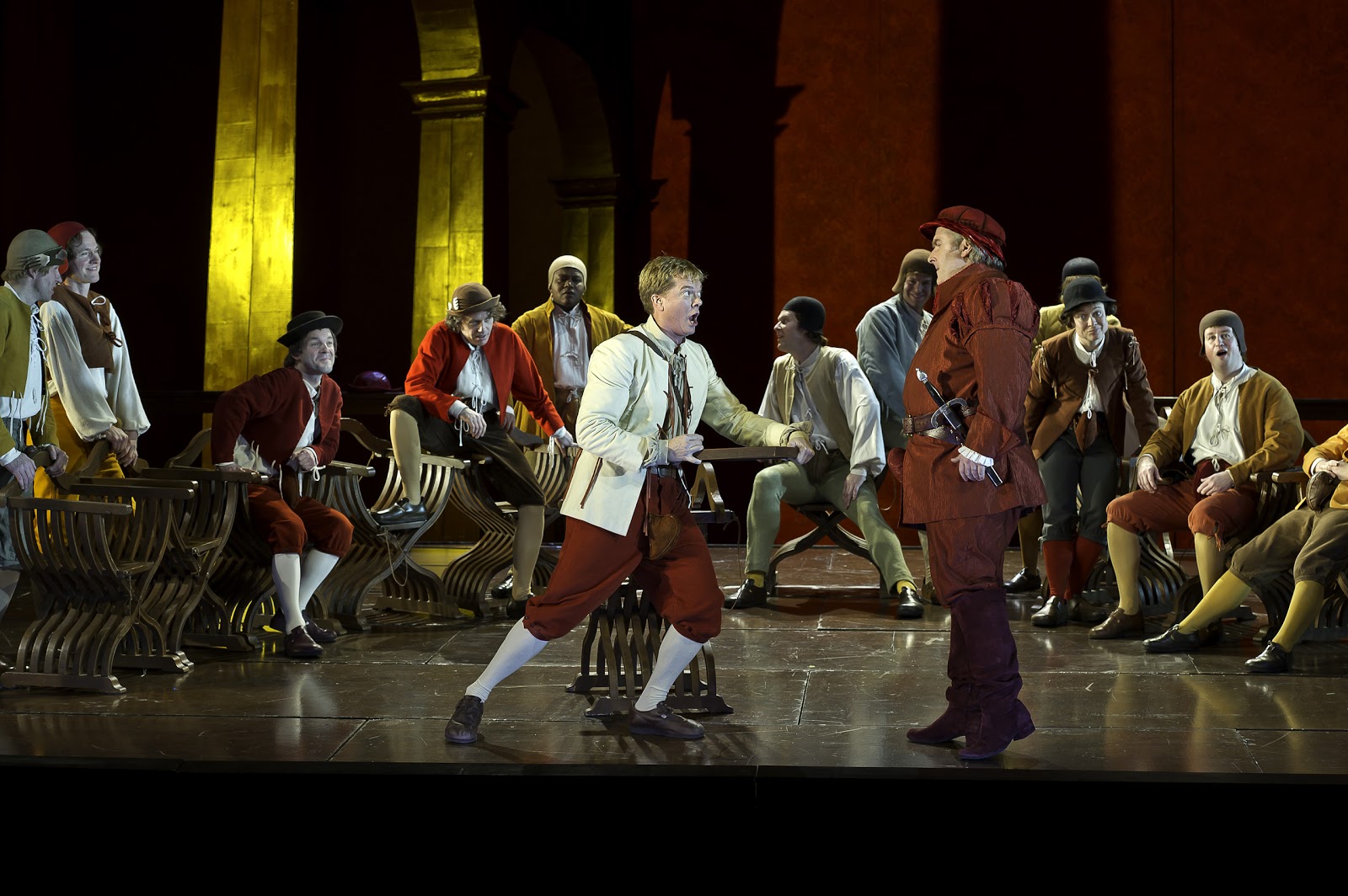
Which brings me more properly to Katie Mitchell’s production. Mitchell seems at her best when indulging her meta-theatrical bent, as recently in ENO’s own After Dido and the Salzburg Festival’s Al gran sole carico d’amore. In what, updating aside, is essentially a conventional presentation, she seems to have no ideas at all about the work, nor even the slightest sympathy with it. Much of the action takes place in what seemed to be a modern hotel, first off with irritating video projection of waves behind. (Video can sometimes add something; far too often it does not.) Clichés of operatic production a good twenty or thirty years out of date abound, not least the constant intervention of ‘extras’ pouring drinks. Supposedly in the corridors of power, this latter facet is taken to such an irritating extreme as to suggest that we are at a convention for non-recovering alcoholics. Perhaps I was being unfair, I thought, but then, lo and behold, the point appears to be made that Elettra’s madness was the product of having had too much to drink. Couples – who on earth were they? – danced and swapped partners whilst Idamante and Ilia sang their second-act duet: distracting and incomprehensible. Baffling from the point of view of the production, let alone the work, was the laugher provoked almost whenever Elettra came onto the stage – and not just when drunk. Carry on Crete: it is a point of view, though I fail to see its merits. Maybe its proponents find Das Lied von der Erde a laugh a minute too.

At least Calixto Bieito might have made something raunchy out of the arbitrary transformation of Elettra’s second act aria into a moment of ever-so-mild foot-fetishistic madness. Here it was merely embarrassing: in keeping with the Luton Airport theme, I suppose. There is, needless to say, no sense whatsoever that she might be a member of the House of Atreus until, clumsily, she is plonked into a first-class departures lounge at the airport, whilst her intended is for the most part banished to the ranks of the unwashed: odd, given that his father is king on the island. Even odder that Elettra too should have to leave her private quarters so that the cleaners can set to work. Utterly lacking is any other sense of hierarchy. The whole point of Idomeneo’s sacrificial dilemma – should he act as king or as father? – goes for naught. He is just some bloke in an ill-tailored suit. For some reason, or more likely none, at the beginning of the third act, Ilia turns biology lecturer, delivering her lines in front of a projector displaying floral photographs. Admittedly, her aria is supposed to take place in the royal gardens, and she sings, or at least should, of gently caressing zephyrs, but the only point here seems to be to give the video production team something more to do.

Idomeneo has never been a lucky work. Perhaps it is simply too rare, too magnificent, too dignified, too fragile for this world. It deserves and could surely receive better than this though. I shall have to hope that, for me, it will be a case of third time lucky.