Showing posts with label Claire Barnett-Jones. Show all posts

Thursday, 12 January 2023

Katya Kabanova, LSO/Rattle, 11 January 2023


Barbican Hall

Katěrina Kabanova – Amanda Majeski
Marfa Ignatěvna Kabanova (Kabanicha) – Katarina Dalayman
Varvara – Magdalena Kožená
Boris Grigorjevič – Simon O’Neill
Váňa Kudrjáš – Ladislav Elgr
Tichon Ivanyč Kabanov – Andrew Staples
Savël Prokofjevič Dikoj – Pavlo Hunka
Kuligin – Lukáš Zeman
Glaša, Fekluša – Claire Barnett-Jones

London Symphony Chorus (chorus master: William Spaulding)
London Symphony Orchestra
Simon Rattle (conductor)


Images: Mark Allan

Perhaps the most perfectly proportioned of Janáček’s operas, certainly one of the most emotionally and dramaturgically correct—which, in Janáček’s case, is saying quite something—Katya Kabanova has not wanted for recent performances in Britain. That is no cause for complaint, quite the contrary. That Janáček’s operas are still not at the heart of every major opera house’s repertory says nothing about the operas and, alas, a great deal about our houses and some of their audiences. Concert performances are less common: these are very much works for the stage. This current project from the London Symphony Orchestra and Simon Rattle to present a number of his operas in concert—I assume it is not all, though should be delighted if it were—is most welcome, not only for introducing new audiences to these fine operas, not only for affording the LSO (and Rattle) the chance to perform them, but also for giving us the opportunity to hear their orchestral writing in all its detail and power, such as might in part be lost when played in the pit.

Rattle certainly seemed to have conceived his reading with this in mind. It is doubtless fruitless to speculate, but I suspect some of the more extreme passages, whether with respect to dynamic contrast or tempo (at the slower end), would have been less so in the theatre. The LSO and an excellentcast responded in kind. Indeed, the glowing, dare I say Central European, tone of the opening bars promised—a promise finely delivered—a performance in which the orchestra was at least as much changed by its encounter with the score as vice versa. Doubtless, Rattle’s work with the Czech Philharmonic contributed to what we heard, but this was a Rattle rethinking at its best, nothing taken for granted, the fury of the later orchestral response again taking one by surprise, yet firmly in the spirit of composer and work. Where later I might have expected the full orchestra to sound a little cramped by the Barbican acoustic, that was not at all to be the case; in the absence of a new London concert hall, killed by Theresa May alongside so many of our hopes, conductor and orchestra have found new ways of living with it.


Climaxes were built and tended, singers included too—no one more so than Amanda Majeski in the title role. Her vocal line and all too clearly Katya’s hopes soared, preparing for a fall, when in the first act she sang to Varvara of her childhood imagination of angels flying heavenwards, continuing prophetically of the sin that threatened her. Likewise in the next act, when she resolved to see Boris and thus fully to set her tragedy in motion. A lack of stage business made such passages more conversational: perhaps neither for good nor ill, but rather just how it was. All the while, Rattle and the orchestra brought out telling detail without having it overwhelm greater line, musical and narrative. What intrigued me—I am not sure I can put my finger on why—was that this Katya seemed less saintly, more intent on pursuing her own happiness, more relatable perhaps, if less of a quasi-religious example. Given her fate, why after all should she present an example?
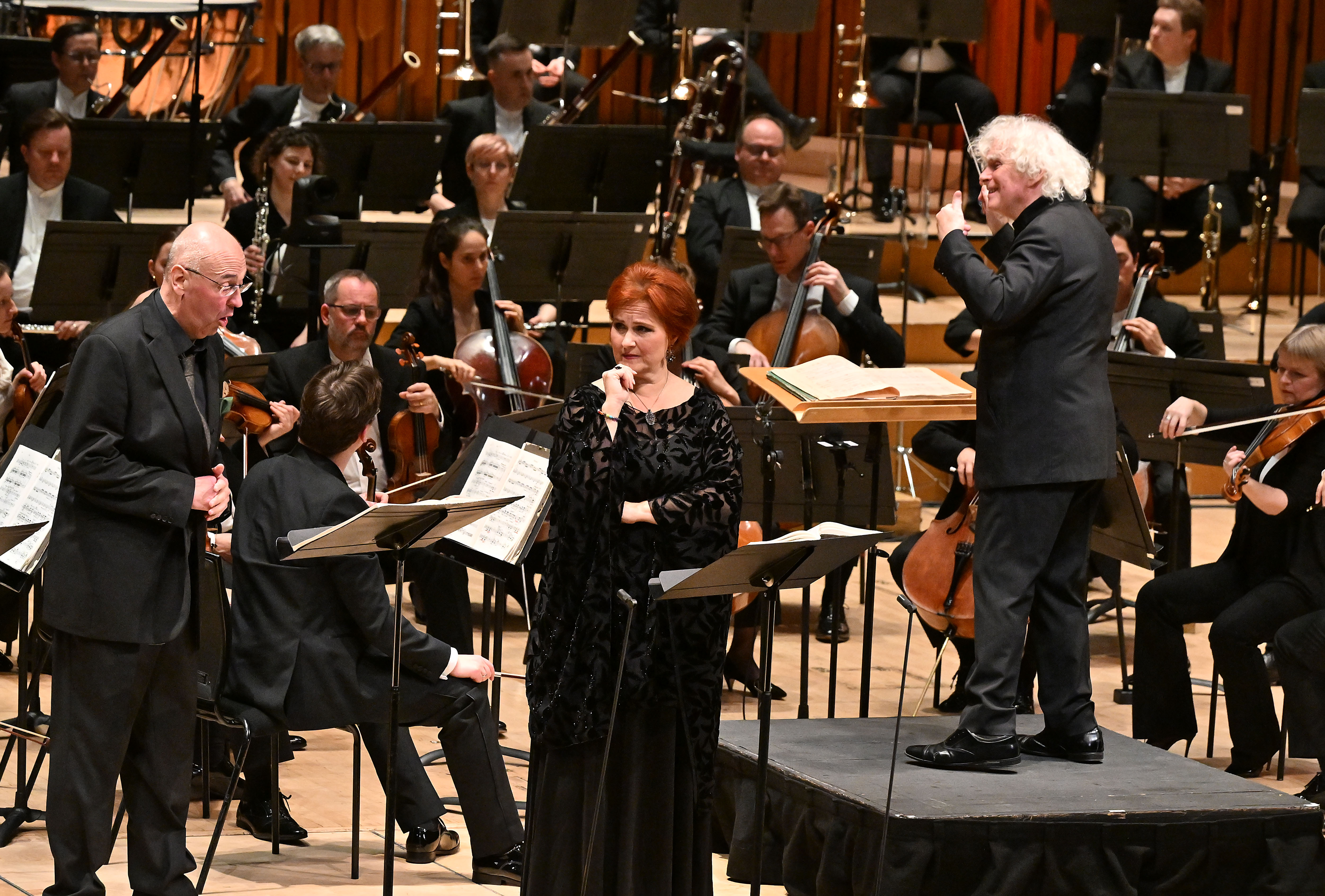


Much could be read from Majeski’s face too; as it could from that of Andrew Staples as her husband Tichon. He felt shame, as did his voice, yet still he did what his mother said. Katarina Dalayman’s Kabanicha was no mere caricature; if hardly sympathetic, perhaps she embodied a more comprehensible than usual desire for order in a community she saw threatened, rightly or wrongly, with breakdown. Her relationship with Pavlo Hunka’s sharply characterised Dikoj was likewise less caricatured than would often be the case, perhaps not merely a case of jaw-dropping hypocrisy. Simon O’Neill’s Boris was intelligently conceived, often ardent. There was likewise plenty of intelligence, and a wonderful animating spark, to Magdalena Kožená’s Varvara. She seemed veritably to brin Ladislav Elgr’s Kudrjáš to life, his second-act song delivered with verve and no little charm, Rattle splendidly highlighting the pizzicato accompaniment to help bring it to life. Claire Barnett-Jones and Lukáš Zeman both impressed in their smaller roles, making much of them in collaboration with their fellow artists. I look forward to hearing more from the latter, a new voice to me.


And yet, this was above all an orchestral drama. The poignancy of the brief, all-too-brief, Puccini-plus afterglow to the second act, eliciting a sadness quite different from anything one might hear in Puccini, offered another splendid, affecting example. Likewise, tellingly, the sheer strangeness of the early storm music of the third, especially from the LSO woodwind. If there were times, slightly to my surprise, when I found myself missing the completion of action that would have been achieved by a staged production—Janáček leaves much to that crucial pillar of operatic experience, knowing not only what to write but also what not to write—this was a compelling evening. If some listeners might have felt Rattle’s more spacious tempi went to far at times, for me they worked well in context. There seemed little doubt they had the assent of orchestra and cast alike.

Saturday, 17 December 2022

Gloriana, English National Opera, 8 December 2022

Coliseum


Queen Elizabeth I – Christine Rice
Robert Devereuz, Earl of Essex – Robert Murray
Frances, Countess of Essex – Paula Murrihy
Charles Blount, Lord Mountjoy – Duncan Rock
Penelope, Lady Rich – Eleanor Dennis
Sir Robert Cecil – Charles Rice
Sir Walter Raleigh – David Soar
Henry Cuffe – Alex Otterburn
A Lady-in-Waiting – Alexandra Oomens
The Recorder of Norwich, A Ballad Singer – Willard White
A Housewife – Claire Barnett-Jones
The Spirit of the Masque – Innocent Masuku

Ruth Knight (director)
Sarah Bowern (costumes)
Corinne Young (wigs, hair, make-up)
Ian Jackson-French (lighting)
Barbora Šenoltová (video)

English National Opera Chorus (chorus director: Mark Biggins)
Orchestra of the English National Opera
Martyn Brabbins (conductor)


Images (c) Nirah Sanghani
Frances, Countess of Essex (Paula Murrihy), Queen Elizabeth I (Christine Rice)

Britten’s Gloriana is a strange work, both in itself and considered as a ‘coronation opera’. It is no Clemenza di Tito, idealising, instructing, and even gently warning a king, at least in Mozart’s version, that affairs of state must always have precedence over those of his own heart. Or is it, even if not by intent? The first Queen Elizabeth, as presented here by Britten and William Plomer, after Lytton Strachey, does not exactly prosper by indulging her favourite, the Earl of Essex. It is not, however, difficult to understand why many thought the presentation of an ageing monarch inappropriate as a way to greet the new reign of Gloriana’s twentieth-century successor. In many ways, The Crown has nothing on this—save for superior dramaturgy. If the strangeness of Gloriana’s (verbal) archaisms can be explained, perhaps even understood, the awkwardness of its first act in particular surely would have merited revision, had opportunity presented itself. Plomer certainly did Britten no favours. 

Similar things may be said, though, of many operas. We have what we have, and ENO did it proud, in just the sort of performance the company and its supporters alike needed to hear. Electrified by the moment of the Arts Council’s latest disgraceful philistinism—scrapping its grant altogether and bundling it off to Manchester, without so much as a word of consultation with venues, existing companies, or local government—this felt like a true coming together, to bless a problematical work more completely than may have been the case upon its first outing and, in my opinion, when revived at Covent Garden in 2013, sixty years after its premiere. Martyn Brabbins and the ENO Orchestra proved at least the equals of Paul Daniel and the Orchestra of the Royal Opera House. If anything, I think they may have been more incisive, still more committed. There was certainly a strong sense of grounding in Britten’s music; one could draw many a comparison with other of the composer’s dramatic music, dating back past Billy Budd and The Rape of Lucretia at least as far as Peter Grimes, yet sometimes also peering into the future. There is not a huge amount that can be done about some of the duller passages, and a masque without dancing is not ideal, but there remained enough at least to intrigue. Ruth Knight’s direction and the ‘concert staging’ in general were obviously limited in what they could achieve, yet as a framework for something considerably more than a concert performance worked well: perhaps something of a model for further revivals, should ENO fare better than Essex in escaping the executioner’s axe. 

There was much to enjoy and admire in the singing. In the title role, Christine Rice offered imperious and internally conflicted as very much two sides to the same Elizabethan coin. Robert Murray’s Essex seemed particularly at home with the particular blend of verbal and musical line required here, not least in the lute songs with which he would seduce his queen. Paula Murrihy proved an affecting Frances, doubtless in part a reflection of the more interesting standpoint of her role, although it remains necessary for an artist to grasp that opportunity—here accomplished in captivating fashion. Duncan Rock, a memorable Don Giovanni, presented a splendidly rutting Mountjoy; if the role fizzles out somewhat, there is very little that can be done about that. Eleanor Dennis’s Penelope complemented him and the other intriguers nicely. 

Earl of Essex (Robert Murray), Countess of Essex,
Charles Blount (Duncan Rock), Lady Rich (Eleanor Dennis)

There was no weak link in the cast, and crucially a strong sense, even in this single performance, of a company coming together as more than the sum of its parts. Two ENO Harewood Artists (Alexandra Oomens and Innocent Masuku) shone, a nice symmetry since Lord Harewood, the second Elizabeth’s cousin, according to some accounts cajoled her into accepting the dedication—and had her and Prince Philip attend a prior dinner-party run-through, at which the royal couple may not have been entirely amused. So too did two former Harewood Artists: Alex Otterburn and the wonderfully spirited Claire Barnett-Jones as a housewife in the penultimate scene. Will someone with power and influence take note? Who knows? Someone certainly should—and fast, before ENO’s death warrant is executed.


Sunday, 21 November 2021

Die Walküre, English National Opera, 19 November 2021


Coliseum

Siegmund – Nicky Spence
Sieglinde – Emma Bell
Hunding – Brindley Sherratt
Wotan – Matthew Rose
Brünnhilde – Rachel Nicholls
Fricka – Susan Bickley, Claire Barnett-Jones
Gerhilde – Nadine Benjamin
Ortlinde – Mari Wyn Williams
Waltraute – Kamilla Dunstan
Schwertleite – Fleur Barron
Helmwige – Jennifer Davis
Siegrune – Idunna Münch
Rossweisse – Claire Barnett-Jones
Grimgerde – Katie Stevenson

Richard Jones (director)
Stewart Laing (designs)
Adam Silverman (lighting)
Sarah Fahie (movement)
Akhila Krishnan (video)

Orchestra of the English National Opera
Martyn Brabbins (conductor)

Images: (C) Tristram Kenton
Siegmund (Nicky Spence) and Sieglinde (Emma Bell)

I wanted so much to like this more than I did. It is not quite ENO’s return to the Coliseum after you-know-what, but in many ways it felt like it. (A Philip Glass revival and a new production of Gilbert and Sullivan will have had their devotees, but they are not my potion of forgetfulness.) Anneliese Miskimmon, ENO’s Artistic Director, could not have been more welcoming in her brief address from the stage before the performance. And what could be a greater declaration of intent for a new era than a new Ring? Perhaps a Schoenberg or, still more so, a Stockhausen series? But even then, the Ring retains for many the status of non plus ultra. Its all-encompassing nature continues to surpass all competitors; no artwork has more to tell us, so it seems, at any juncture in our dubious human development.

No Ring is therefore going to be perfect; even the most exalted performance, let alone staging, will have imperfections. It would be too easy to judge perfection a lesser thing; it is not, necessarily, but it is a different thing—one which Mozart (often) has covered. Yet if a Ring in performance will always fall short, it should not fall so short as Richard Jones’s half-hearted attempt at a production, which detracted all too much from a mixed musical performance laying claim to not inconsiderable virtues. Perhaps more would have been gleaned had we seen Das Rheingold first. Starting with the second instalment is not without precedent, but I remain unconvinced that it is a good idea. Berlin’s Deutsche Oper has had to present Stefan Herheim’s new Ring as and when it can, but that is a different case, planned performances having to be cancelled, given without an audience, and so on. (How I long to see what Herheim has done!) Yet it is difficult to imagine that much light being shed on a Walküre (sorry, Valkyrie, as ENO obstinately continues to refer it) seemingly without a concept or indeed much of an idea at all. Presumably, money was tight, for what we see is not so much minimalism as people wandering a little lost around a stage that sometimes has scenery and sometimes does not. As in Jones’s recent, wretched La clemenza di Tito for the Royal Opera, there was a vague look: in this case, noir-ish ‘Scandinavia’, though it would be difficult to say anything more precise than that. ENO’s publicity suggests the idea that this is a family saga: well, sort of, I suppose, but only if that is taken to be the crucible for something greater. Use of video to show Alberich (‘Nibelung’ tattooed on his forehead), Grimhilde, and Hagen when referred to in Wotan’s narration—nothing more, just show them—seemed both patronising and pointless, though perhaps in a greater context it contributes to the banal theme of family feud. The appearance of Hunding’s clan on stage might have contributed further, but ultimately undirected (like so much else), they proved little more than a distraction, the lack of much to distract from notwithstanding.


Alberich (Jamie Campbell), Brünnhilde (Rachel Nicholls), Wotan (Matthew Rose)

Maybe the strange claim (Christopher Wintle) that opened one of the programme notes offered a clue to the lack of any exterior, let alone political element: ‘Most of us can agree that The Valkyrie is “about” incest.’ I do not know precisely to whom ‘us’ refers; certainly not to me, anyway. Wagner’s drama is no more ‘“about” incest’ than The Flying Dutchman is ‘about’ sailing. The point of Siegmund and Sieglinde’s love is that it breaks the violent, cruel bonds of marriage, family, and custom (which Wagner specifically identified with Fricka); that it leads Siegmund to reject immortality, and thus to put Brünnhilde on her way to doing likewise, to attaining the superior status of ‘purely human’; and precisely that it does not matter whether the Volsung twins are brother and sister, not that it does. Here, occasional straining towards a familial idea, for instance Hunding’s physical brutality to Sieglinde, seemed little more than striving after effect, given a lack of embedding in anything more than an IKEA catalogue. The production team sported more interesting clothes than those given to the cast; maybe they should have swapped.


Grimgerde (Katie Stevenson), Rossweisse (Claire Barnett-Jones),
and Siegrune (Idunnu Münch)


Or maybe they should have given them to the curious animals that pranced around the stage, Wotan’s ravens (I think) included: more Sesame Street than creatures of the forest. Whether the concept were malevolent or ironic, neither possibility was achieved. For some reason, a lone tap dancer did her stuff during the Ride of the Valkyries, whilst actors in horse costumes struggled around on tip toe. Why on earth Grane, understandably fidgeting, was made to balance in this way through the entirety of the final scene—and not only then—I have no idea; but then I have little idea about anything else either. Inability to set the stage ablaze at the close was attributed to a late intervention from Westminster City Council. Alas, Wotan’s protracted fumbling to attach to Brünnhilde a harness that would awkwardly suspend her above the stage, without the slightest sign of flames that had intermittently flickered earlier, seemed all too apt a metaphor. Quite what the Met, where Jones’s third (!) attempt at the Ring is heading, will make of it is anyone’s guess. It is certainly devoid enough of intellectual content to satisfy Friends of Otto Schenk. But the ‘look’, for that is all it is, and lack of discernible stage action will surely trouble many. 

Martyn Brabbins’s conducting was sane, measured, and doubtless sensitive—perhaps too sensitive—to the needs of his singers. Brabbins clearly appreciates the need to think in the broadest terms about Wagner’s structures, yet often seemed to confuse that with maintaining a slow speed throughout, occasionally changing gear when that could not conceivably be maintained any longer. A few understandable fluffs—every performance has them—notwithstanding, the ENO Orchestra played beautifully, if often in strangely subdued fashion, especially in the first act (!) I do not know how long it lasted in actual minutes, but it felt like the longest I had ever heard. By contrast, the third act often seemed rushed, if hardly short. This was clearly a work in progress, but there may be considerably more hope for improvement here than in the staging.


Brünnhilde

Had it not been for an initial announcement, no one would have known Nicky Spence was suffering from a cold. Siegmund is clearly a role for which he is ready—and for which he has well prepared. There are strength, vulnerability, and many other of the qualities we need, even in so unpromising a setting as this. It was difficult to discern much in the way of chemistry with Emma Bell’s Sieglinde; nor did this seem to be ironic or deconstructive detachment. However, considered on its own terms, her performance also impressed, indicative of a woman bruised yet determined to command her own destiny. Dart-playing Rachel Nicholls, lumbered with a strange skater-girl look, trod a fine, shifting line between Brünnhilde's youthful impetuosity and the glimmers of something more moving, more human—which is to say she understood what was at stake, even if Jones did not. Matthew Rose, lumbered with, well, being a lumberjack-turned-television-detective, offered a typically detailed and thoughtful performance as Wotan, though the third act did not show him at his strongest. These things vary from night to night. Brindley Sherratt's focus as Hunding varied too, though at its best it offered something darkly psychopathic. One of the strongest, most committed and sustained performances came from the team of Susan Bickley (finely observed, on stage) and Claire Barnett-Jones (also finely observed and with gleaming tone, from a box above) as Fricka. This, again, was a performance that truly used words, music, and gesture to suggest drama beyond Jones’s imagination.


So too did John Deathridge’s new singing translation. It was in many respects remarkably faithful not only to what Wagner said but, crucially, to what he did not, employing suggestion and ambiguity in the right places. It had an intriguing line too in something akin to Stabreim. Word order and stress played their part, as did various other considerations one might find—with profit—in reading Wagner’s own Opera and Drama. This did not, like many of ENO’s translations, attempt to draw attention to itself, still less to elicit inappropriate laughter; rather it participated in the dramatic effort in a way the singers and orchestra, if hardly the director, did. The sort of people who drone on about ‘the Coli’ and alleged halcyon days of Reginald Goodall will doubtless bemoan the lack of Andrew Porter, but their parochial concerns need not be ours.


Fricka (Susan Bickley) and Wotan

‘Mark well my poem,’ wrote Wagner to Liszt in 1853, enclosing a copy of the Ring in verse; ‘it contains the beginning of the world and its end.’ One might argue that beginning(s) and end happen elsewhere in the Ring; but were this the generic television ‘show’ from which Jones & Co. appeared to have taken non-inspiration, it seems doubtful, even in the unlikely event of a decision to renew for another ‘season’, that many viewers would have been remaining. To achieve not only an Annunciation of Death, but an entire Walküre, in which nothing whatsoever seemed to be at stake, was a peculiar, perverse and strangely pointless achievement. Either Jones needs to rethink—the prefix ‘re-’ may be too kind—or ENO should act decisively with courage and substitute another production or concert performances. With Wagner, in Wagner, much is or should be at stake.


Sunday, 26 September 2021

The Midsummer Marriage, LPO/Gardner, 25 September 2021


Royal Festival Hall


Images: Mark Allan


Mark – Robert Murray
Jenifer – Rachel Nicholls
King Fisher – Ashley Riches
Bella – Jennifer France
Jack – Toby Spence
Sosostris – Claire Barnett-Jones
She-Ancient – Susan Bickley
He-Ancient – Joshua Bloom
Dancing Man – John Findon
Half-Tipsy Man – Trevor Bowes
A Man – Robert Winslade-Anderson
A Girl – Sophie Goldrick

London Philharmonic Choir (artistic director: Neville Creed)
ENO Chorus (chorus director: Mark Biggins)
London Philharmonic Orchestra
Edward Gardner (conductor)

It would have been a work with which to make one’s mark for the opening of any Principal Conductorship. Following the LPO’s Festival Hall silence for the past year-and-a-half, it became, as Edward Gardner acknowledged in a brief spoken welcome, all the more so. Ambition imperfectly realised is in many ways more impressive than passing a lesser challenge—of the estimable qualities one associates with Michael Tippett, perfection is rarely one—but such was not a concern here. Edward Gardner’s gamble in presenting a concert performance of The Midsummer Marriage paid off handsomely, and was gratefully received by a London audience largely starved of sustained Tippett advocacy since the death of Colin Davis.


The orchestral opening was vivid, precise, variegated, as if the orchestra had never been away, likewise when the joint choral forces of the London Philharmonic Choir and ENO Chorus joined. Diction from chorus and soloists alike was excellent, which really helps in an opera whose word-setting does not always privilege verbal understanding. This first act, ‘Morning’, the dawn on Midsummer Day, felt as though it were just that; figuratively, a musical body, it seemed, greater than the sum of its parts, had awoken and was stretching, limbering up. ‘Music? What’s that?’ That and many questions and allusions had acquired new connotations during our recent travails. Tippett’s allusions to Elizabethan music appeared to speak not only of that past but of a nearer past, a ‘new Elizabethan era’ in English music his opera had helped inaugurate, and in which the hall around us, once again open, played so crucial a role (if ever so slightly predating it). Gardner’s—and Tippett’s—presentation of the score in time delineated the work’s dramatic as well as musical form, characters stepping forward as if themes in a giant sonata exposition. In a sense, that is precisely what they are. Against or rather in tandem with that, there was a strong impression, led by Gardner and the orchestra yet certainly including the cast, of revealing a protean imagination, twists and turns never awkward but rather distinctive. They were communicated with conviction, meaning, and what appeared—which cannot always have been the case—of ready familiarity.


Of many highlights, the majestic and, yes, laughing conclusion to the first act, the effervescence of the primal, sometimes dark, yet often touchingly naïve Ritual Dances and their madrigalian choral writing, and a final daybreak as moving as it was atmospheric stand out in my memory. If Tippett would doubtless have pointed to Jung, one did not buy in to that psychology to experience wonder of another sort. Likewise, if King Fisher’s consultation—if that be what it is—with Madame Soristris does not speak to us all in precisely the way intended, there was plenty of alternative in so evocative an exchange as we heard between a dark and dangerous Ashley Riches and a rich-hued Claire Barnett-Jones. For the working through of events or analysis continued to captivate musically throughout the third act, which brought a radiant reunion between Rachel Nicholls’s Jenifer and Robert Murray’s Mark. The versatility of Nicholls’s voice in particular struck me, phrasing always excellent, different colourings and moods always on dramatic point, and the extraordinary coloratura with which Tippett blesses or saddles her despatched without fear. Jennifer France and Toby Spence made for an outstanding ‘second’ couple, in reality no more secondary than their Mozartian model, at least if one imagines a greater role for Papagena than she actually receives. All impressed, but I shall give final mention to the dignity of Susan Bickley’s mysterious yet ineffably human She-Ancient.

From dim recollection of the only other performance I have heard, the 2005 Royal Opera revival under Richard Hickox, I should say this was more incisive, colourful, and generally impressive, though it may simply have been that I was more receptive this time around. My preference for Tippett’s King Priam has not been dislodged, but I think I have come to appreciate the great merits of this ambitious and engaging work as well as its more peculiar singularities. Above all, I felt that something might truly be at stake, and that part of that something was the gift of music.


Monday, 21 October 2019

The Mask of Orpheus, English National Opera, 18 October 2019


Coliseum

Images: (c) Alastair Muir, 2019

Orpheus the Man – Peter Hoare
Orpheus the Myth, Hades – Daniel Norman
Orpheus the Hero – Matthew Smith
Eurydice the Woman – Marta Fontanals-Simmons
Eurydice the Myth, Persephone – Claire Barnett-Jones
Eurydice the Hero – Alfa Marks
Aristaeus the Man – James Cleverton
Aristaeus the Myth, Charon – Simon Bailey
Aristaeus the Hero – Leo Hedman
The Oracle of the Dead, Hecate – Claron McFadden
The Caller – Robert Hayward
First Priest, Judge of the Dead – William Morgan
Second Priest, Judge of the Dead – David Ireland
Third Priest, Judge of the Dead – Simon Wilding
First Woman, Fury 1 – Charlotte Straw
Second Woman, Fury 2 – Katie Coventry
Third Woman, Fury 3 – Katie Stevenson
Dancers – Joan Aguila-Cuevas, Sam Ford, Ripp Greatbatch, Stefano de Luca

Daniel Kramer (director)
Lizzie Clachan (set designs)
Daniel Lismore (costumes)
Peter Mumford (lighting, video)
Barnaby Booth (choreography)

Ian Dearden (sound design)
Chorus of the English National Opera (chorus masters: James Henshaw, Mark Biggins)
Orchestra of the English National Opera
Martyn Brabbins, James Henshaw (conductors)


‘All opera is Orpheus,’ Adorno once declared – although, typically, what he meant by that was rather more complicated than mere quotation would suggest. Perhaps, in some sense, all music in the Western tradition is too – again, so long as we take care, as Harrison Birtwistle always has, never to confuse starkness with over-simplification. In the beginning, then, was Orpheus, his myth repeated, elaborated upon, throughout Western musical tradition, and especially throughout Western operatic tradition. It is surely no coincidence that it was with this monumental work that Birtwistle sought his most radical extension yet of that line. He wanted, he said, ‘to invent [my italics] a formalism which does not rely on tradition in the way that Punch and Judy, my first opera, relied on tradition. There I used forms such as the chorale, toccata and gavotte. I injected them into my work just as Berg injected formal ideas into Wozzeck. In The Mask of Orpheus, I didn’t want to hark back any more; I wanted to create a formal world that was utterly new.’


Expectations could not have been higher. For some, yours truly included, this was a moment for which we had been waiting the whole of our musical lives. From a career strewn with masterpieces, here came at last a second staging of Birtwistle’s Mask of Orpheus: heard only once complete, in concert, since its 1986 premiere, and never since seen in the theatre. I had previously only managed to hear a single act, in concert, at the Proms: an unforgettable experience that only increased my hunger to hear – and to see – more. Present at that first, ENO performance, Alfred Brendel extolled The Mask of Orpheus as the first English musical masterpiece since Purcell. Many will find that view a touch harsh on some music and composers – even assuming Handel’s exclusion – intervening. Be that as it may, no one with any serious interest in music or opera, indeed no one with a passing interest, yet possessed of half an ear and a little curiosity, would deny the work’s stature.


Musical values were high, as they would have to be: there is no more point putting on Birtwistle with musicians unequal to its challenges than there is Stockhausen. That excellence we heard from ENO forces should nevertheless not be taken for granted. The conflict between rational and irrational, between what Orpheus must do to win back Eurydice and what his urge to act as a human being, a conflict as old as that between Apollo and Dionysus and in many respects to be identified therewith, lies at the heart of this work. The climax to the second act, indeed the whole of that extraordinary structure of recollective arches, not only retains its enormous, truly post-Wagnerian power; it seems to increase with every hearing. This proved no exception. One was truly left reeling then – and not only then – at least insofar as one could separate the musical performance from its sadly inadequate scenic realisation, on which more shortly.


Moreover, if that conflict between the demands of reason and those of emotion lies at the work’s dramatic heart, so too does the variety of ways in which its participants, us included, might look at, experience, reflect upon that conflict, not least through time, ours and the characters’ (broadly speaking, as human, myth, and hero, though never in linear fashion, and just as much musically – lyrically and formally – as verbally and scenically). In a sense, this is true of all opera; ‘all opera is Orpheus’. But it is perhaps more so here, more overtly so, more strenuously. Martyn Brabbins and James Henshaw, assisted by Adam Hickox, did a superlative job of enabling the excellent orchestra, chorus, and cast to express what they could of this, Peter Hoare a fascinatingly flawed, multifariously tragic Orpheus the Man, Marta Fontanals-Simmons an alluring, inscrutable, even alluringly inscrutable Eurydice the Woman, ably supported by penetrating, intelligently contrasted performances from Daniel Norman and Claire-Barnett Jones as their mythical counterparts. James Cleverton as Aristaeus and Claron McFadden as the extraordinary Oracle of the Dead also stood out dramatically, but there was nothing approaching a weak link to the cast. Barry Anderson’s electronic realisation, with sound design by Ian Dearden, proved as liminally dramatic in its way as Stockhausen, as pregnant with dramatic purpose as an ‘interlude’ in Wagner.


If only Daniel Kramer’s bizarre, ultimately vacuous production had been remotely equal to its task. Where the work speaks of and with starkness and complexity, Kramer seemingly mistook the latter for a gaudy variety show, validated by inclusion of more and more unconnected – with each other, let alone with the work – acts. This was not the idea of the circus, nor indeed the idea of anything else; it was a hideous and, doubtless, highly expensive mess. Occasionally, the possibility of recollection, of memory, even of dream sequence, asserted itself, more by default than anything else. For the most part, we suffered an absurd – never, alas, absurdist – display of exaggerated, ‘saucy’, latex-clad nurses and medical equipment; of supposedly shocking, yet actually deeply tedious, sexual acts; of people – often entirely unclear who they were, and to what end – emerging and sinking into bathtubs; of highly skilled acrobats (for the opera’s mime action) removing and replacing their clothes, before resuming their distracting activity; of general hyperactivity that not once seemed to enquire what it, let alone of anything else, might be for, let alone of whether its seemingly hapless orientalism might prove a tad problematical to some. It was unclear that the ‘concept’, if one may call it that, was anything more than an ageing rock musician – we see the platinum discs on the wall – Orpheus, holed up in his extravagantly equipped hotel room, having a bad trip. And even that was perhaps to dignify it.


Was this, perhaps, opera for a world with its eyes – and possibly ears – on several screens at once, craving instant diversion rather than satisfaction? Was there even something of the postdramatic to it? I can see that the argument might be made, but frankly, in this particular case, I think not; or if it is, then there really ought to be more to it than this. Constant changing of the emperor’s still newer, still more sparkly, clothes – ‘by artist, campaigner and designer Daniel Lismore, described by Vogue as “England’s most outrageous dresser”’ – was not enough, never nearly enough. Nor was there any sign of irony, of critique, of anything more than camp excess really – which is not to deny the excellent artistry of those on stage, doing what they could. Carry on Birtwistle, then? It just about qualifies as a point of view, I suppose; or, better, as the slender basis for one. I cannot help but think that it would have been better left on the shelf, along with the rest of this wasteful production: a non-ironic cross between Robert Lepage and Liberace.


The absurdity might have worked; all manner of things might have worked; however, in the absence of a connecting pair of ears, let alone anything between them, this was doomed to remain an endless parade – in a decidedly non-Birtwistle sense – of effortful vulgarity on- and offstage, as idiotic as it was wasteful. Wherever one looked, one was assailed with advertisements for a crystal company to which I shall refrain from granting further publicity. Nothing could have lain further from the essence of Birtwistle’s score, nor indeed from Peter Zinovieff’s libretto. Yet such contradiction was not fruitful; nor even, so it seemed, intentional. If anything, it simply suggested a director out of his depth – and not even in the opera’s shallows. The true tragedy, of course, lies in the damage this may do to prospects for a third production, even for a further concert performance. Not for the first time, alas, ENO has snatched defeat from the jaws of victory.


Saturday, 31 October 2015

Le nozze di Figaro, Royal Academy Opera, 30 October 2015


Images: Robert Workman


Hackney Empire Theatre

Susanna – Charlotte Schoeters
Figaro – Božidar Smiljanić
Bartolo – Timothy Murphy
Marcellina – Claire Barnett-Jones
Cherubino – Katherine Aitken
Count Almaviva – Henry Neil
Basilio – John Porter
Countess Almaviva – Emily Garland
Antonio – Alex Otterburn
Barbarina – Lorena Paz Nieto
Don Curzio – Mikhail Shepelenko
Two Girls – Lorena Paz Nieto, Katie Stevenson

Janet Suzman (director)
Fotini Dimou (designs)
Jake Wiltshire (lighting)
Victoria Newlyn (choreography)

Royal Academy Opera Chorus (chorus master: Frederick Brown)
Royal Academy Sinfonia
Jane Glover (conductor)
 

A lazy assumption I used to make was that Don Giovanni was, as the cliché now has it, ‘a director’s graveyard’; it also seemed almost always to lack something in performance, Daniel Barenboim being the Furtwänglerian exception. A parallel, or related, lazy assumption was that The Marriage of Figaro somehow always survived. Directors felt on surer ground, without the overt Catholicism of the later opera, which seemingly either mystified – in pretty much any sense – or repelled them. A good cast would see it through, and surely singers and conductors could hardly fail to respond to its magic, performing ideologies notwithstanding. The former assumption still seems to hold, although I am less inclined to make excuses on behalf of directors who make a mess of it; it really need not be so difficult as they seem to think it. The problem really does not lie with the work, and if opera houses present an unholy composite version from Prague and Vienna, then they only have themselves to blame. However, many recent performances of Figaro seem to have fallen prey to the curse too. I shall not list them, but too many have been dispiriting. And, frankly, one dispiriting Figaro is far too many.

 
Figaro (Božidar Smiljanić)

Such clouds were well and truly dispelled in this quickening evening at the Hackney Empire, the first of Royal Academy Opera’s temporary homes whilst its theatre is renovated. You might react with scepticism if I tell you that, overall – and opera is always a business of ‘overall’, as well as ‘in part’, and so on – this was one of the best Figaros I have seen, certainly one of the best for quite some time. I really did not have a single cause for complaint, which is quite something when it comes to Mozart in general and to this opera in particular, for whom and for which perfection seems, cruelly, to be the only acceptable response.


Janet Suzman’s production plays the work pretty straight: no bad thing, Claus Guth’s Strindbergian conception for Salzburg surely being destined to remain an exception. One might even, if not paying proper attention, think it more or less a ‘period’ production to begin with. However, it soon becomes clear – and indeed always is, so long as one’s eyes are doing a little light work – that we are not in eighteenth-century Spain, although there certainly seems to be a kinship, indeed a strong kinship, with Lorenzo da Ponte’s original setting. We are, in fact, in pre-revolutionary Cuba, as we hear too, as soon as Bartolo’s first aria, Siviglia having become Havana. Havana, Suzman writes, ‘boasted an elegant, bedraggled, inward-looking post-colonial aristocracy, a peasant population desperate for change, and sported perfectly beautiful great houses on the verge of collapse’. The ‘look’, then, is similar, but not the same; abuses are similar, if not quite the same; the droit du seigneur seems eminently credible, perhaps more so than before.


Susanna (Charlotte Schoeters)
 
However, none of that is hammered home. The political is present, yet, as with the librettist’s – let us leave the composer on one side, just for the moment – adaptation of Beaumarchais, it offers the framework for a human drama, rather than the crux of it. (One can say that, I think, without having to take refuge in the chimera of the ‘timeless’, without claiming that a production should not take a more political stance.) For Suzman, ‘an updated Figaro urges us to take another long look at the fate of the female protagonists, rather than resigning ourselves to their classically sanctioned fate.’ And that seems a good defence of updating and relocating in general. It is handsomely done, Fotini Dimou’s designs lending an air of faded grandeur, again without exaggeration, and Jake Wiltshire’s lighting doing what it should, especially for the garden in the fourth act. Above all, Suzman helps make these characters credible. They are busy, without that ‘busy-ness’ becoming an end in itself, as in the irritating Upstairs Downstairs quality to David McVicar’s Royal Opera staging. The difference between Mozart as composer of opera seria and Mozart as composer of opera buffa can be exaggerated, or relied upon as a substitute for engagement, but production and performance truly imparted a sense of what is wondrous and perhaps new here.
 
The Countess (Emily Garland)
 

For it was in the performances themselves that, quite rightly, the magic truly lay. Charlotte Schoeters and Božidar Smiljanić presented a lively, in no sense caricatured – as can sometimes be the danger with buffo characters – Susanna and Figaro. One felt their emotions almost as if they were one’s own, appreciated their knowingness – and their ignorance. Henry Neill, looking like a younger version of Jorge Bolet, at times perhaps seemed a little too young, but if the worst plaint one has is of youth, it is hardly serious. He captured Almaviva’s mood-swings well, and his lechery, without that descending into the unwanted realm of farce. His Countess, Emily Garland, enchanted on an operatic – with or without inverted commas – scale, intimate and grander gestures at one with her character and that character’s predicament. This was a worthy successor performance to her Suor Angelica earlier this year. Cherubinos rarely disappoint; it is such a gift of a mezzo role. That, however, is no reason to overlook a success such as that of Katherine Aitken, every moment of her performance, whether musically or acting, alive to the moment. Every member of the cast shone, and yet was very much part of a larger whole. To mention just two others, Claire Barnett-Jones carried off the burden of age with great success as Marcellina, whilst Lorna Paz Nieto made the most of her small role – a role which yet, so often, imprints itself upon the memory – as Barbarina. Diction was without exception excellent; one could have taken dictation, both verbal and musical.


Last but certainly not least, Jane Glover and the Royal Academy Sinfonia played Mozart’s score to the manoir born. I do not think I have heard such consummate conducting of Figaro since the late Sir Colin Davis. Glover never drew attention to herself, always sounded at Mozart’s service, and brought the music to life with a knowledge and wisdom that can only come with years of acquaintance. Her orchestra was crisp, warm, exciting, beguiling, knowing, innocent: all of those necessary things and more. It commented upon and partook in the action in equal measure, structure and ‘expression’ as one. Despite relatively small forces (8.6.4.4.2), this was a proudly full-sounding ensemble, eminently capable of filling the theatre. So, I think, was this evening as a whole. If you still have chance, do what you can to beg, borrow, or steal a ticket. Otherwise, we shall hear May Night next term and, as Glover’s farewell as Director of Opera, L’incoronazione di Poppea in the summer.

Friday, 20 March 2015

The Rake's Progress, Royal Academy of Music, 16 March 2015


Sir Jack Lyons Theatre, Royal Academy of Music

Tom Rakewell – Bradley Smith
Anne Trulove – Rhiannon Llewellyn
Nick Shadow – Božidar Smiljanić
Baba the Turk – Claire Barnett-Jones
Sellem – Gwilym Bowen
Trulove – Lancelot Nomura
Mother Goose – Katherine Aitken
Keeper of the Madhouse – Ed Ballard 

John Ramster (director)
Adrian Linford (designs)
Victoria Newlyn (choreography)
Jake Wiltshire (lighting)

Royal Academy Opera Chorus
Royal Academy Sinfonia
Jane Glover (conductor)


The apogee of neo-Classicism, an opera surely intended to incite debate upon debate about it and its form, whatever Stravinsky’s typically disingenuous, eye-twinkling denials, The Rake’s Progress is, unless one is Pierre Boulez, very difficult not to admire, almost as difficult not in some sense to disapprove of or at least to suspect, perhaps almost as difficult to love. I think this Royal Academy staging might just have proved me wrong on the final point.


For what struck me about John Ramster’s production and, of course, the performances onstage it inspired, was that they treated this first and foremost as an opera. They  certainly were neither deaf nor blind to the debates – ‘The Rake’s Progress seemed to have been created for journalistic debates concerning: a) the historical validity of the approach; and, b) the question whether I am guilty of imitation and pastiche. If the Rake contains imitations, however – of Mozart, as has been said – I will gladly allow the charge (given the breadth of the Aristotelian word), if I may thereby release people from the argument and bring them to the music.’ (Stravinsky) – but they did not become ensnared by them. Still less did they mistake them for questions of æsthetic quality. Ramster’s production frames the work well, the first scene indicating a mid-twentieth-century filming of an eighteenth-century drama, and there are occasional reminders, not least the appearance in various guises of indications as to how many days Tom Rakewell will have left before his reckoning with Nick Shadow. But for the most part, that framing falls away, and a somewhat yet not excessively stylised set of designs (all handsomely done by Adrian Linford) is not mistaken for human hearts beating beneath the framing and the ‘debates’.


For that, the cast, well prepared by Jane Glover, naturally deserves the lion’s share of the credit. Bradley Smith presented a weak, human, yet impossible-not-to-like Tom: just as he should be. His sappy tenor proved appealing throughout, but moving too, especially towards the end: all very much in character. Rhiannon Llewellyn’s Anne combined grace and beauty to a properly euphonious degree; her first act aria was very fine indeed. Božidar Smiljanić’s Nick stole the show on a number of occasions: protean, dark, and humorous. One could hardly have asked for more. Claire Barnett-Jones revealed a richly expressive voice as well as a finely-judged sense of humour as Baba. As Sellem, Gwilym Bowen offered a very different sense of humour, utterly captivating, never outstaying its welcome, and likewise never at the expense of excellent musical values, line and attention to the words exemplary. Indeed, there was hardly a moment in the entire performance on which one could not readily discern Auden’s libretto. Lancelot Nomura’s deep-voiced Trulove, Katherine Aitken’s haughtily naughty Mother Goose, and Ed Ballard’s Keeper of the Madhouse rounded off, but certainly did not merely round off, an excellent cast.


Choral singing was mightily impressive, as was Ramster’s direction of the chorus. After a slightly, though only slightly, shaky start, in which Glover’s conducting lacked the bite one (not unreasonably) expects, the orchestra passed with flying colours too. Again, a heart was revealed, without any loss to the intellectual, time-travelling revels, in which now more than ever one can understand why Stravinsky would make his next (apparent) about turn. Schoenberg est mort, or rather he may, to a post-war generation, have seemed to be; serialism, however, was already in Stravinsky’s personal way under preparation. Richard Leach's harpsichord playing, not least in that extraordinary graveyard solo, was dazzling.


I am not yet entirely won over by Henze’s typically anti-Boulezian – and not just anti-him – words from an interview in 1967:


Soon the ‘clusters’, the serial recitatives and the ‘happenings’ will have exhausted themselves, and the young composer will look around in vain in this wasteland for something to nourish his hungry soul. I believe, in contrast to Boulez for whom the neo-Classical Stravinsky is 'very weak' (there they go, forty years of musical history, brushed aside in a couple of words!), that in the next few years he will be seen properly for the first time, and understood in all his greatness and significance. The history of music knows plenty of examples where a reorientation has been necessary. This will be the case in the near future too.


In any case, that debate is surely dead and buried; no one thinks about ‘Darmstadt’ like that any more, nr indeed even speaks of ‘Darmstadt’ as such a thing-in-itself; I doubt, moreover, that anyone thinks about Henze and Stravinsky quite in Boulez-of-1960s vein either. For me, neo-Classical Stravinsky’s achievements nevertheless remain very mixed; Orpheus, for instance, I dislike as much as ever, though ‘dislike’ is not to be confused with ‘denigrate’. Perhaps, though, I was edged a little closer to Henze on this occasion. If so, it was by virtue of this fine staging and performance.