Showing posts with label Fflur Wyn. Show all posts

Sunday, 28 June 2026

Turandot, Opera Holland Park, 23 June 2026


Images: Pablo Strong


Princess Turandot – Anne Sophie Duprels
Calaf – José de Eça
Liù – Fflur Wyn
Timur – Jihoon Kim
Ping – Josef Jeongmeen Ahn
Pang – Joseph Buckmaster
Pong – Zwakele Tshabalala
Emperor Altoun – Robert Burt
Mandarin – Wonsick Oh
Prince of Persia – Jamie Formoy
Young Turandot – Lara Ronxin Quattrone

Opera Holland Park Youth Chorus (chorus master: Joe Cummings)
Opera Holland Park Chorus (chorus master: Richard Harker)
City of London Sinfornia
Naomi Woo (conductor)


Celebrating its thirtieth anniversary and the centenary of Puccini’s death, Opera Holland Park completed its set of the composer’s operas with a semi-staging of his final, unfinished work, Turandot. One might wish for a full staging, but one cannot have everything—and relatively little was lost. This made for a fitting crown to a season far from over, or perhaps better an extended encore to its new Fanciulla del West.

Anne-Sophie Duprels and José de Eça (previously Dick Johnson) came together to do something strikingly both similar and different as Turandot and Calaf. Their performances proved to be on a similarly outstanding level too, once again as fine a dramatic soprano and tenor as I can recall hearing at Holland Park—and considerably superior to those one might encounter at many of the opera firmament’s starriest houses. Whatever the dramaturgical depravity of the work – a big ‘whatever’ – both navigated its difficult, some might say impossible, relationship between fantasy and realism with all the fine attention to words, line, and their combination one could hope for. Duprels’s Turandot stood and sang on the threshold of a new life, slowly warming as much as melting. De Eça’s ardour swept all before it, Fflur Wyn and Jihoon Kim’s compassionate Liù and Timur included—which, alas, is as it should be. Wonsick Oh’s Mandarin was a chilling, yet human – indeed, human partly on that account – master of ceremonies, ably assisted by the protean solo-ensemblists of Josef Jeongmeen Ahn, Joseph Buckmaster, and Zwakele Tshabalala’s Ping, Pang, and Pong. Robert Burt’s Emperor Altoun and Jamie Formoy’s Prince of Persia afforded vivid, crucial, ‘smaller’ contributions.  


The role of the chorus is particular important in this opera. Opera Holland Park’s Chorus and Youth Chorus both impressed, both in themselves and in combination with the City of London Sinfonia, which again gave a mighty impression of a much larger band. The CLS now sound like old Puccini hands, which of course they are: warm, incisive, steely by turns, relishing and communicating the ripe post-Wagnerism and still astonishing modernism of the score in equal measure. If there were a few moments when any orchestral reduction would suffer by comparison with the full score, Tony Burke’s resourceful work, strange electronic organ intervention aside, contributed greatly to the success of the performance. A panoply of percussion enhanced the musical theatre of cruelty, as well as looking forward to the later twentieth century.

So too did Naomi Woo’s conducting, screwing up the tension where required and richly expansive where called for. Echoes of Debussy, Stravinsky, Schoenberg and others were relished, as, equally important, were the many cases in which Puccini takes the lead and others follow. It was difficult not to hear sentiments of Dallapiccola’s Il prigioniero, for instance, not least in the arguably still more twisted combination of torture and hope on offer here. As ever, that tantalising early morning conversation between Puccini and Schoenberg, when the ailing elder composer travelled to Florence for the Italian premiere of Pierrot Lunaire, hovered in the musical air. Holland Park’s celebrated peacock chorus contributed vocal embellishments, apparently as engaged with the sadistic dramaturgy as the rest of us. If Franco Alfano’s completion remains unsatisfactory, we cannot always hope for Berio. It has the merits at least of bringing to the surface in its listless wagnerismo parallels – arguably more than that – with Siegfried and Brünnhilde.


Eleanor Burke’s direction was an equal partner in that (as, of course, were our Calaf and Turandot). The semi-staging concentrated, naturally, on character and narrative, and did so very well, whilst nonetheless framing their unfolding with reference to a child, the young princess, first having opened her music box and later handing it to the cruel princess she was to become. The importance both of childhood experience and of the problematical yet fascinating tension between Carlo Gozzi’s commedia dell’arte and Puccini’s realism was brought to our attention, for us to ponder and experience as our minds and mindsets permitted. This was not the place really for an overarching concept, though we were free to contribute one as we wished. Dress, as opposed to full-scale costume, was stylish in red and black. 

This was, then, another distinguished production from Opera Holland Park. A good number of audience members raised their hands at the outset, when asked by CEO and Director of Opera James Clutton if this were their first time. It is difficult to imagine they would have been anything other than greatly impressed, just as the rest of us were. For there was no mistaking the warmth and sincerity of the final applause. What next? Dare we hope for the aforementioned Dallapiccola, perhaps in tandem with Busoni’s Turandot? Someone should, at any rate.


Tuesday, 21 June 2022

The Excursions of Mr Brouček, Grange Park Opera, 18 June 2022


The Theatre in the Woods

Mr Brouček – Peter Hoare
Málinka, Etherea, Kunka – Fflur Wyn
Mazal, Bounzincek, Petrik, Svatopluk – Mark Le Brocq
Würfl, Paycek, Councillor – Andrew Shore
Sacristan, Dudcek, Domšík – Clive Bayley
Kedruta – Anne-Marie Owens
Spotcek, Vojta, Raincek, Mirosla – Adrian Thompson
Postdatedcek – Jonathan Kennedy
Child Prodigy – Pasquale Orchard
Spotcek – Robin Horgan
Farty – Benjie del Rosario
Taborite I – Toki Hamano
Arty, Taborite I – Marcus Swietlicki
Dancers – Lauren Bridle, Bridget Lappin, Arianne Morgan, Luke Murphy, Jay Yule

David Pountney (director)
Leslie Travers (designs)
Marie-Jean Lecca (costumes)
Tim Mitchell (lighting)
Lynne Hockney (choreography)

BBC Concert Orchestra
George Jackson (conductor)
 

Bounzincek (Mark Le Brocq) and an artist on the moon
Images: Marc Brenner

Hats off to Grange Park Opera for unquestionably the best of the four ‘country house’ operas I have seen so far this season. First, and perhaps most important, with respect to the work itself: Janáček’s The Excursions of Mr Brouček. I suppose it might be theoretically possible to reach a state in which Janáček’s music was heard too often, though it might not. (Imagine saying such a thing of Bach or Mozart.) If it is, though, we are nowhere near that yet. Yet the Janáček operas we see staged are mostly, perhaps understandably, restricted to three: Jenůfa, Katya Kabanova, and The Cunning Little Vixen. We must go beyond The Makropulos Case and even From the House of the Dead to reach Mr Brouček. Doubtless some in the Grange Park Opera audience had seen it in the theatre before, but I had not, and was immensely grateful to have the opportunity to do so, let alone for it to be performed so well. 

Mr Brouček will doubtless always be a problematical work, in a way that the aforementioned popular (relatively speaking) trio will not. Its two-part structure will probably always require effort to bring together—if, indeed, such is the dramaturgical aim. But art is certainly not always about perfection, or approaches to it. Sometimes, it is about quite the opposite. The first part’s satire against pretentious avant-gardism, or perhaps better derrière-gardism, hits home more readily for a modern, or at least non-Czech, audience than the second, more preoccupied with Czech national mythology—although a little grounding helps us on our way. Nationalism, after all, remains sadly too universal. But the other part of the satire is against the antihero himself: the philistine who has little idea what he is doing in Prague, let alone on the Moon or in the fifteenth century. To that, we can and should all relate. No one likes a landlord, after all, especially one who boasts of having no mortgage, only a three-storey house. You can begin to see why the opera will never touch as Katya does. That is not its purpose.


Málinka (Fflur Wyn)

David Pountney’s production pulls out all the stops for a frankly zany trip from Prague to the moon, clarified and extended by Marie-Jean Lecca’s imaginative costuming. Leslie Travers’s brilliant set for the former captures an almost childlike delight in city models, as well as the, or at least an, idea of Prague. The empty pretentiousness of the moon artists—Pountney has fun, using his own, free English version of the text, creating names such as Spotcek, Raincek, and Postdatedcek—engenders an intoxication of its own. It is fun to watch, which guards us against too ready identification with Brouček. ‘We must each fight our inner Brouček,’ Janáček insisted. A similar, yet different mix of magical constructivism informs the still more bewildering—for many—and darker trip to the Prague of the Hussite rebellion.


Mr Brouček (Peter Hoare)

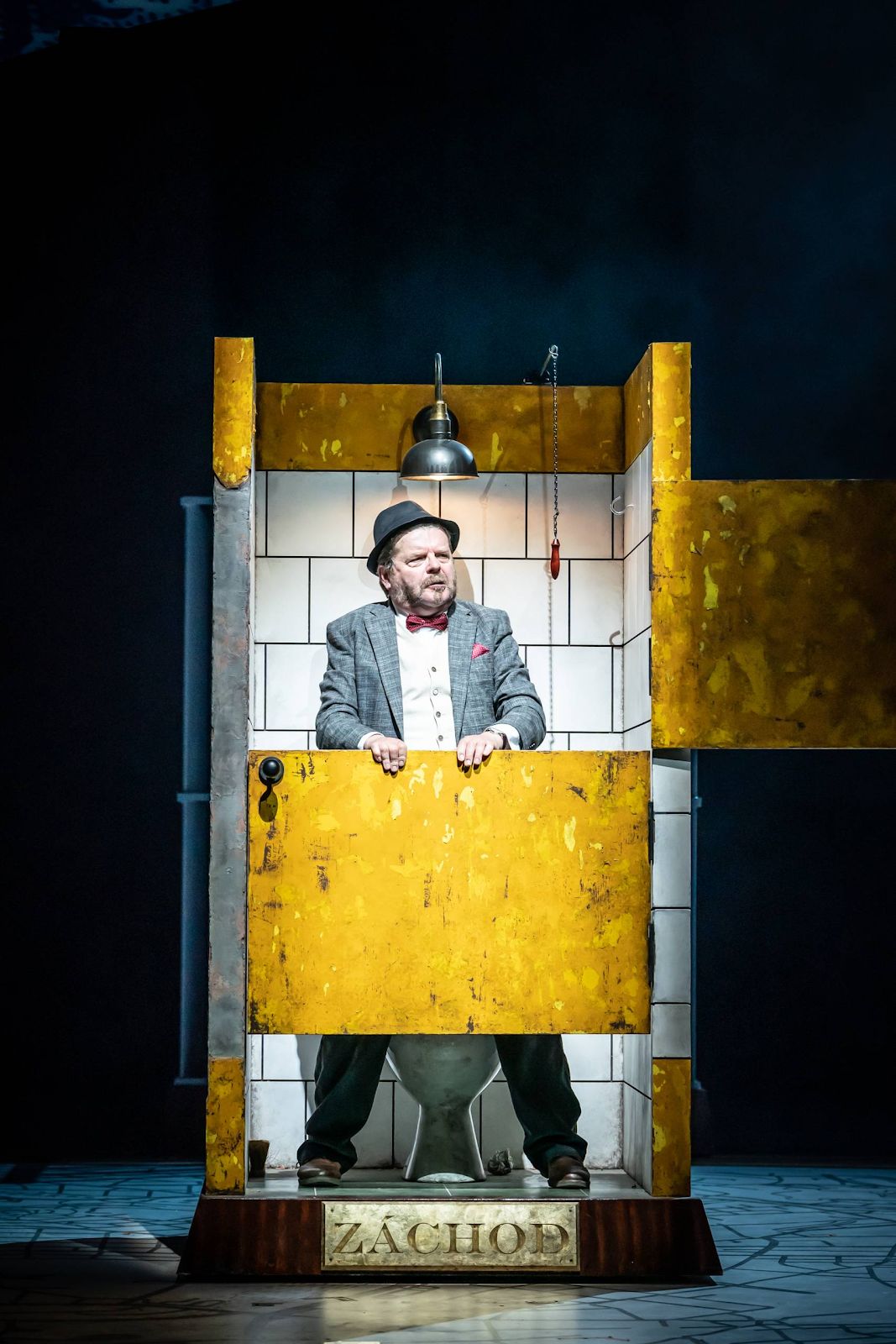
Whether one cares for the (literal) toilet (brush) humour of the interlude between the visits, will be a matter of taste. Monty Python is not my thing, but if it is yours, you will almost certainly love Pountney’s more outrageous excurses. Sometimes, though, I wondered where the heart was, especially during the Moon-trip. Is there not something more positive to say about artistic creation too? The answer, I suppose, would be that it lies in the score (and, indeed, in the artistic endeavour of performance and reception itself. It arguably suggested itself onstage at the end, when the innkeeper Würfl collected his drunken patron, laughed at his tall tales, but also walked him away in camaraderie. Perhaps that was enough. Again, that will probably be as much a matter of taste or inclination as anything else.


Peter Hoare’s Brouček captured well the contradictions not only of the character, but of our response(s) to him. This was a typically intelligent performance, which held the stage, amused, and touched without sentimentality. Fflur Wyn’s Málinka and other roles were lively, characterful, and rooted in, yet far from hidebound by, the text. Such is the magic of theatre, and such might be said of any number of the cast, including Mark Le Brocq’s handful of roles, Andrew Shore’s, and Clive Bayley’s, as well as Anne-Marie Owens's Kedruta. This was very much a company effort, which did Grange Park Opera proud, enthralling an audience that could all too readily have registered mere bemusement at the work’s oddity.


Domsik (Clive Bayley)


George Jackson’s traversal of the score elicited my unqualified admiration, as did the playing of the BBC Concert Orchestra. Incisive and expansive, earthy and soaring, above all attuned to those fabled speech rhythms and their unpredictable, magical combination into form and structure, this was as fine a Janáček performance as I have heard for some time, all the more so for its revelation of relatively unfamiliar territory. Time and time, presentiments of the Vixen’s world shone through, anchoring these ‘excursions’ in a common humanity and inspiring us to go forth and create it. The score emerged possessed of the musical, scherzando brilliance of the more or less contemporary Gianni Schicchi, if perhaps less single-minded, at any rate without the latter work’s dramaturgical precision, considered as a whole. We might say Janáček’s musical dramaturgy is more adventurous, though much depends what one means. Whatever our thoughts on that, this was a musical banquet beautifully and, at the last, movingly served.