Showing posts with label Peter Hoare. Show all posts

Friday, 16 January 2026

The Makropulos Case, LSO/Rattle, 15 January 2026


Barbican Hall

Emilia Marty – Marlis Peterson
Krista – Doubravka Novotná
Albert Gregor – Aleš Briscein
Baron Jaroslav Prus – Svatopluk Sem
Dr Kolenatý, Strojník, Machinist – Jan Martiník
Vítek – Peter Hoare
Count Hauk-Šendorf – Alan Oke
Janek – Vit Nosek
Cleaning lady, chambermaid – Lucie Hilscherová

London Symphony Orchestra
Simon Rattle (conductor)


Images: Mark Allan


Simon Rattle’s twin traversal of the Janáček operas in concert in London and onstage in Berlin has now reached The Makropulos Case in the former, Claus Guth’s staging for the Staatsoper Unter den Linden’s having been its first ever. I suspect this may also have been the LSO’s first performance, though shall happily be corrected. At any rate, from the very outset, both Rattle and the LSO sounded entirely ‘inside’ the work, with all the security of a repertory staple, yet with all the freshness and exhilaration of discovery. It is only two months ago that the Royal Ballet and Opera staged the opera, in what was reported to have been Katie Mitchell’s feminist farewell to the genre. If so, Mitchell certainly went out with a bang in one of those rare productions that will prove not only memorable but also to have transformed our understanding of the work forever, expertly conducted by the RBO’s music director Jakub Hrůsá, and with a fine cast headed by Aušrinė Stundyte. That will have been fresh in the memories of many in the Barbican audience, but that did not prevent the hall from apparently selling out for not one but two concert performances; indeed, I suspect it aided that success.

That first-act Prelude constructed a frame for our listening thereafter, strings, timpani, and the rest, offstage brass included, ‘speaking’ in just the right way for opera: musically generative and full of dramatic content and commentary, almost more Wagnerian than Wagner, without ever sounding especially Wagnerian. Czech speech rhythms met the time-honoured craft of something approaching orchestral accompagnato in Rattle’s conducting, so that the composer’s twin poles of cellular radicalism and lyrical expansion proved not only compatible but mutually dependent and generative. At the beginning of each act, there was an unmistakeable sense of where we were, how we (dramatically) had got there, and of anticipation. For the LSO was on outstanding form. It would be invidious to single out any instrument or section, since all, from trombones to xylophone, contributed so eloquently. What struck was a sense of a myriad of lines, orchestral and vocal, combining in ever transformative fashion to a harmonic, contrapuntal, and dramatic whole.


The essence of opera in concert performance is complex: what it is, what it is not, what it might or might not be. Those of us had recently seen Mitchell’s staging will doubtless have come to the performance with different views of the work from those who had not, and so on. What is incontestably the case for everyone is that the orchestra literally takes centre stage, and we both see and hear its music very differently from when it emerges from a sunken pit. Singers must prove at least as verbally and musically communicative, since there is less room for staged expression; Rattle’s latest Janáček troupe certainly impressed in that and indeed in all other respects. It was almost like reading – or having read to one – a sung novella. In a typically livewire performance, Peter Hoare, one of two singers common to the Barbican and Covent Garden, could not but help but act. That early liberation acted as if to inspire the rest of the cast.

Marlis Petersen as Emilia Marty seemed just ‘right’ in all she did: voice, bearing, and unmistakeable sympathy. Doubravka Novotná’s rich-toned, spirited Krista proved the perfect foil—or better, one of them. From Aleš Briscein’s ardent Albert Gregor to Alan Oke’s magnificently vivid cameo (the other role shared from Covent Garden) as Count Hauk-Šendorf, this performance had a true sense of company even without staging. Jan Martiník’s three characters were sharply drawn as individuals, as was Svatopluk Sem’s Jaroslav Prus. Vit Nosek and Lucie Hilscherová likewise made the most of their roles, created through words and music, yet as human as if we had seen them onstage.  Such vivid characterisation drew back even those of us won over by Mitchell’s alternative vision towards the work ‘itself’. Those new to the opera will surely have been enthralled. A roaring reception suggested so.


For it was in the third act, as it must be, that Janáček’s drama palpably touched all as if for the first time. Here was most clearly redrawn in exultant urgency the twin clarity and abandon of E.M. to the increasing irrelevance of the men (and women) surrounding her, reminding us that ultimately, Mitchell’s staging grew out of the work’s essence rather than being imposed upon it (as uncomprehending criticism claimed). Taking a view does not necessarily mean betrayal; it is often fundamental to fidelity. Petersen and the orchestra’s transfiguration sent shivers down the spine in what came to seem, if you can imagine such a thing, almost a female, even feminist, Gerontius. Now there might lie a challenge to staging.


Tuesday, 11 November 2025

The Makropulos Case, Royal Opera and Ballet, 10 November 2025


Royal Opera House

Emilia Marty – Ausrine Stundyte
Krista – Heather Engebretson
Albert Gregor – Sean Panikkar
Baron Jaroslav Prus – Johan Reuter
Dr Kolenatý – Henry Waddington
Vítek – Peter Hoare
Count Hauk-Šendorf – Alan Oke
Janek – Daniel Matoušek
Stage Door Woman – Susan Bickley
Security Guard – Jeremy White
Hotel Maid – Jingwen Cai

Katie Mitchell (director)
Vicki Mortimer (set designs)
Sussie Juhlin-Wallén (costumes)
James Farncombe (lighting)
Sasha Balmazi-Owen (video)

Royal Opera Chorus (chorus director: William Spaulding)
Orchestra of the Royal Opera House
Jakub Hrůsá (conductor)
 

Image: The Royal Opera / Camilla Greenwell

If the Royal Opera and Ballet’s new Makropulos Case does indeed prove to be Katie Mitchell’s final opera production, we should think of it more as a culmination than a farewell. If the owl of Minerva spreads its wings only at dusk, the outlines of Mitchell’s operatic work – part, to be sure, of her broader theatrical work, but a distinctive part – may now seem clearer to us all. Rightly or wrongly, for I can lay no claim to oracular status on this or any other question, they certainly do to me following this superlative evening, dramatically and musically, in the theatre, a splendid addition to the company’s Janáček series? May we hope for a Mr Brouček, even a Šárka or an Osud? Hope dies last, as the ambiguous, even oracular, saying has it. 

And death lies at the heart of this work, as does life—as does their cyclical relationship both in Janáček’s work as a whole and this production, in turn both in its overt presentation and in its broader, metatheatrical, even symbolic frame. One might say the same of women, their role in society, and their role in opera, Mr Brouček’s Excursions the great exception, for even From the House of the Dead has one feel their absence. The Makropulos Case is centred, of course, around a great female singer, a great survivor, a woman seemingly infinitely blessed, but in reality, if not infinitely, then gravely cursed. She is literally the creation of men, in some ways figuratively too. I say ‘a woman’ and of course she is, but as such and as a human, she deserves to be named: Emilia Marty, Elena Makropulos, and the rest. (We may, if we wish, recall Kundry’s many names and incarnations. Wagner was not a feminist; to claim so would be anachronistic nonsense. But his works are not without feminist themes and, more to the point, opportunities—as well as themes and opportunities that are anything but. The same, of course, may be said of Janáček.) Mitchell takes a further step: this woman is queer, standing in no need of men, whatever the history with which she has been furnished (by them) may claim. She has fond memories; she has produced numerous ‘bastards’ with them, but now does not care for them (men or children). 

Now forty-plus = or so she claims and appears – EM seeks women on ‘dating’ apps. With a technological bent very much of our time, the opera begins, app and text message communications, courtesy of Sasha Balmazi-Owen, running parallel to, interacting with, and sometimes undercutting the work ‘itself’. Krista and Janek intend to rob her, the former (‘they/them’) ensnaring her prey 200 metres distant and securing an invitation to her hotel room. The proceeds, whose net worth Janek instantly checks online as Krista photographs them, include an eighteenth-century medallion and a rare, early twentieth-century playbill. Yet ultimately, Krista falls for EM, mesmerised as her male admirers, yet apparently feeling and sharing something deeper. Rather than absconding to Berlin with her (former) lover, she shoots him: shades of Lulu, perhaps, yet with the crucial distance that this is no blank canvas onto which male fantasies are projected. This is women in love, by women, for women.

Surtitles are contemporary English in tone, without becoming paraphrase. Additional communications fly across the ether: ‘Berlin or bust’, popular abbreviations, emojis, and so on. Like anything else, use of text messages – also here telephone calls, audio and video – can be a cliché, a gimmick, and too often is. Here, unlike in, say, Simon Stone’s tedious, extravagant, and tediously extravagant Cherubini Médée – if ever there were an opera crying out for the Mitchell touch… - or Kirill Serebrennikov’s silly Marriage of Figaro, it serves a useful dramatic purpose, both straightforwardly and more metatheatrically in its extension of live cinema to new realms in successful pursuit of Mitchell’s longstanding and, in this case, unapologetically queer subversion of the male gaze both generally and in specifically operatic guise. For when the diva comes at long last to die, she is not so much a creature of opera, but opera itself. Has the director killed the genre or let it die? More significantly, has it in its death, which may yet permit of rebirth though not artificial prolongation, at last been liberated of the male gaze. On an optimistic reading: yes, at least in part. The elixir is bequeathed to Krista as a gift of what appears to be love, but does it remain a poisoned chalice; can it be cleansed?

Janácek’s score naturally invites some degree of optimism, its increasingly rapt lyricism, orchestral motifs coalescing, combining, and expanding into something greater, brought home in wondrous, golden immediacy by Jakub Hrůsá at the helm of the Orchestra of the Royal Opera House. That Hrůsá is the real thing no one who has heard him will doubt, but this proved a significant achievement even by his standards, as intellectually as it was emotionally involving. The same must be said of Ausrine Stundyte’s all-encompassing assumption of the title role, rightly permitting of various readings whilst ever sure of its direction. No wonder the rest of her world lay in her thrall. All contributed something to the greater whole, showing what the world of opera can and should be. I shall note Sean Panikkar’s typically ardent, lyrical Albert Gregor, Peter Hoare’s sharply characterised Vitek, Heather Engebretson’s sparky Krista, and, in another tribute, conscious or otherwise, to the best of an opera company and its progress of time, Johan Reuter ‘moving up’ from, say, Orest and Birtwistle’s Theseus to Baron Prus, and Susan Bickley from numerous Covent Garden roles (and her ENO Dido with Mitchell) to the cameo of the Stage Door Woman. It was, though, a collaborative effort, as production, conductor, work, and any future for the genre demand.

From that ENO After Dido, Purcell’s jewel forming part of a greater theatre piece, through a Salzburg Al gran sole carico d’amore I imagine I might understand better now than I did in 2009, live cinema again offering a feminist corrective or at least enhancement to Luigi Nono’s project of telling European revolutionary experience from the standpoint of female revolutionaries,  the woman’s revenge of Written on Skin and queer love of Lessons in Love and Violence, the postdramatic feminism of The Blue Woman, and important reassessments such as her Aix Ariadne auf Naxos and Pelléas and Covent Garden Theodora, a path becomes traceable towards this Makropulos Case. Is it the end of the line? That should not really even be the question; it is certainly an important, musicotheatrically riveting contribution, one I am keen to see again, should I be able. 

Cathérine Clément notoriously described opera as the ‘undoing of women’. Perhaps, if one is extremely selective—and one treats it only in terms of libretti. Go back to Monteverdi’s Poppea or forward to Rebecca Saunders’s recent operatic debut and it seems anything but. Nevertheless, that book or at least its title remains, whether we like it or no, part of operatic discourse. Carolyn Abbate’s review said most, perhaps all, of what need be said about it. And here, as it must, that theory is realised in practice, without in any sense jettisoning necessary critique. Actually existing opera houses and their ways are, or can be, another thing. This is not in any sense intended to refer to the Royal Opera House in particular; indeed, its relatively recent, highly publicised appointment of an intimacy coordinator marked an important step forward in one respect. I know no details of the opera-world misogyny Mitchell has endured – her recent interview lies behind a Murdoch paywall – and I do not intend to speculate. What I can say is that operatic works, historical and contemporary, and performances offer greater scope for critique and, dare I say it, redemption than the day-to-day activities of any company will. This year’s greatest musical centenary, that of Pierre Boulez, reminds us of the necessary utopianism of his celebrated 1967 interview with Der Spiegel.

New German opera houses certainly look very modern—from the outside; on the inside, they have remained extremely old-fashioned. To a theatre in which mostly repertory pieces are performed one can only with the greatest difficulty bring a modern opera—it is unthinkable. The most expensive solution would be to blow the opera houses into the air. But do you not think that that might also be the most elegant solution? 

In turn, that echoes a Wagner’s diary entry from 1849.

8 May (Monday) Morning once again by roundabout route via barricades to Town Hall. At S. Anne Barricade guard shouts “Well, Mr Conductor, joy’s beautiful divine spark’s made a blaze.” (3rd perf. 9th Symphony at previous Palm Sunday concert; Opera House now burnt down. Strange feeling of comfort.


This latest death  will not destroy our opera houses and companies, nor even leave them peacefully to die, but should at least ask us whether that would be advisable. Is this, rather than opera as the undoing of women, then, women as the undoing and possible rebirth of opera? It might, considered in utopian fashion, constitute an act of operatic reform or revolution to be compared with the work composers such as Wagner, conductors such as Boulez, directors such as Stefan Herheim, and singers such as Wilhelmine Schröder-Devrient, noting ruefully and purposefully the gender balance of historical examples, whilst recalling Boulez’s own caution that, although Wagner’s Bayreuth project was in almost every respect right and necessary, it has not had the slightest effect on the day-to-day life of our benighted operatic culture. And yet, it has, for our revolutionary-reformers continue to offer a critique of patriarchy, of heteronormativity, and of capitalism many of us continue to heed. To do more than criticise, we must all play our part. The Royal Opera and Ballet has done so too, staging Janáček’s opera (incredibly) for the first time and supporting a new way forward. The Royal Opera and Ballet has done so too, staging Janáček’s opera (incredibly) for the first time and supporting, among many other things in its necessarily mixed economy, some seeds of a new way forward. 

Friday, 9 May 2025

The Excursions of Mr Brouček, LSO/Rattle, 6 May 2025


Barbican Hall

Mr Brouček – Peter Hoare
Mazal/Blankytný – Aleš Briscein
Málinka/Etherea/Kunka – Lucy Crowe
Sacristan/Svatopluk/Lunobor/Domšík – Gyula Orendt
Würfl/Čaraskvouci/Councillor – Lukáš Zeman
Čišničeck/Child prodigy/Student – Doubravka Novotná
Kedruta – Hanna Hipp
Básník/Oblačný/Vacek- Arttu Kataja
Artist/Dohuslav/Vojta – Stephan Rügamer
Skladatel/Harfoboj/Miroslav – Linard Vrielink

Tenebrae (chorus director: Nigel Short)
London Symphony Orchestra
Simon Rattle (conductor)


Images: Mark Allan


Simon Rattle’s survey of the Janáček operas has proved a tale of two cities: Berlin (first the Philharmonic and latterly the Staatsoper) and London (the LSO). The latter has been mostly in concert, although it shared Peter Sellars’s concert staging with the Berlin Philharmonic. Now, on the back of Robert Carsen’s Berlin staging, originally seen at the Janáček Festival Brno, the LSO’s series reaches The Excursions of Mr Brouček to the Moon and to the 15th Century. 

Of those I have attended, this unquestionably marked the highpoint: one of those performances it is difficult immediately to imagine being bettered. At the heart of that was the magnificent playing of the LSO. Janáček had not previously played a large part in its repertoire, though I remember an interesting, also highly criticised Glagolitic Mass from Colin Davis. It hardly could, one might say, for a symphony rather than an opera orchestra, which incidentally reminds us of a long-term consequence of Davis and Clive Gillinson’s tenures, nurtured by their successors: regular performances of opera in concert, supplemented by occasional appearances in festival pits. Intimacy of acquaintance with Janáček’s writing, its melodic, rhythmic, harmonic, and timbral qualities, inextricably bound to the Czech language, told—as, I think, it did with Rattle, who has long championed this music and who no longer has anything to prove. Precision, heft, the way the orchestra ‘spoke’: this and so much more made for an ideal partnership, rendered all the more impressive by a uniformly impressive cast and chorus (the ever versatile Tenebrae choir, trained and sometimes conducted here by Nigel Short). 


From the opening of the first part, dance rhythms and orchestral colours, xylophone immediately recalled from Jenůfa, created a dramatic stage before our ears, so much so that it is difficult to imagine anyone truly regretting the lack of staging. Time of day, temperature (literal and metaphorical), place, and much more were palpable, indeed unavoidable. As dawn approached at the end of the first part, one felt it emotionally, overwhelmingly so, as well as temporally. For a tenderness embedded in the composer’s deep humanity was always apparent, in a reading that saw no reason to exaggerate the bizarre, zany elements, as perhaps did David Pountney in a memorable 2022 staging for Grange Park Opera. There is room for all, but this went deeper, also underscoring the extraordinary, innovative brilliance of the composer as a contemporary of Strauss, Schoenberg, and yes, Puccini. There was absurdity, yes, but in that absurdity lay deepest sincerity, and the second part, darker and more soulful from the off, proved more moving still. Soundworlds related yet distinct offered both contrast and connection between the opera’s two parts. 

Peter Hoare, who had also sung the title at Grange Park, proved if anything a still more captivating Mr Brouček, alive to his provincial, bourgeois absurdity, not without affection, yet quite without what would have been deadly sentimentality. Like his fellow cast, this was a portrayal that sprang from the page, deeply rooted in words, music, and their alchemy, without being bound by them. Lucy Crowe gave as fine a performance as I have ever heard from her, alternating various roles as Málinka, Etherea, and Kunka, bringing something special to each of them, refulgent of tone, yet acerbic where called for, and hinting without didacticism at what might unite them. Much the same might be said in principle of all those taking on multiple roles, world-class casting offered by the likes of Gyula Orendt, Linard Vrielink, and Aleš Briscein. Truth be told, there was not a weak link in the cast; more to the point, the drama lay in connection, collaboration, and of course conflict. We were fortunate, I think, to see and hear a cast that had mostly performed together onstage in Berlin. 


Dare we hope, then, for all of Janáček’s operas to feature in subsequent instalments? However tempting, we should probably retain perspective and simply enjoy them one at a time. Sometimes I worry that, in ever-straitening times, opera with full forces, be it staged or unstaged, might come to seem an ‘unaffordable’ luxury. Smaller versions, cleverly adapted, whether will slightly reduced orchestrations or full-scale reductions, can form a crucial part of our operatic ecology, but that must never be at the expense of the ‘real thing’. One can hardly hope for a better reminder of such ‘reality’ than the magical surreality of these Excursions.


Saturday, 20 May 2023

Wozzeck, Royal Opera, 19 May 2023


Royal Opera House

Wozzeck – Christian Gerhaher
Marie – Anja Kampe
Captain – Peter Hoare
Doctor – Brindley Sherratt
Margret – Rosie Aldridge
Drum Major – Clay Hilley
Andres – Sam Furness
First Apprentice – Barnaby Rea
Second Apprentice – Alex Otterburn
The Fool – John Findon
Soldier – Lee Hickenbottom
Tenor Solo – Andrew Macnair
Marie’s Son – Jonah Elijah McGovern

Deborah Warner (director)
Hyemi Shin (set designs)
Nicky Gillibrand (costumes)
Adam Silverman (lighting)
Kim Brandstrup (choreography)

Royal Opera Chorus (chorus master: William Spaulding)
Orchestra of the Royal Opera House
Antonio Pappano (conductor)


Images: Tristram Kenton
Andres  (Sam Furness), Wozzeck (Christian Gerhaher)


Thirty years ago, in Sheffield, a teenage schoolboy saw his first opera in the theatre. It was Wozzeck, directed by Deborah Warner for Opera North. Quite an opera with which to begin, you might say, and indeed in many ways it was, yet why would you wish to begin with something that was not ‘quite an opera’? He knew a little more, though not much, opera not having been part of his childhood or more general homelife, nor indeed of his schooling. Plus ça change… By that time, he had just begun to explore the operas of Mozart, those you might expect: Figaro, Don Giovanni, and The Magic Flute. He had also, slightly clueless, speculatively bought a reduced, ‘historic’ recording of Tristan und Isolde from WH Smith and had watched a video, kindly lent by his music teacher, of Die Meistersinger. That, however, was it. He had not yet knowingly listened to music of the Second Viennese School, though that also was suddenly about to change. It is no exaggeration to say that those hundred minutes in the Lyceum Theatre changed his life. 

From 1993 to 2023: an avid (if, born perhaps of that initial experience, selective) opera-goer travelled across another English city for the first night of a new production of Wozzeck, also directed by Deborah Warner, now for the Royal Opera. Full circle? Not really; nothing ever is. Our protagonist has, for better or worse, had numerous experiences, music, dramatic, emotional, and intellectual, since; he is certainly no longer a boy. Yet Wozzeck, which for him ever since has had at least as strong a claim as any to be the single greatest opera of the twentieth century, exerts, if anything, a still greater fascination and admiration, certainly a greater love, than it did then, born of three decades of living with it. How, then, would Warner II fare in circumstances both old and new?


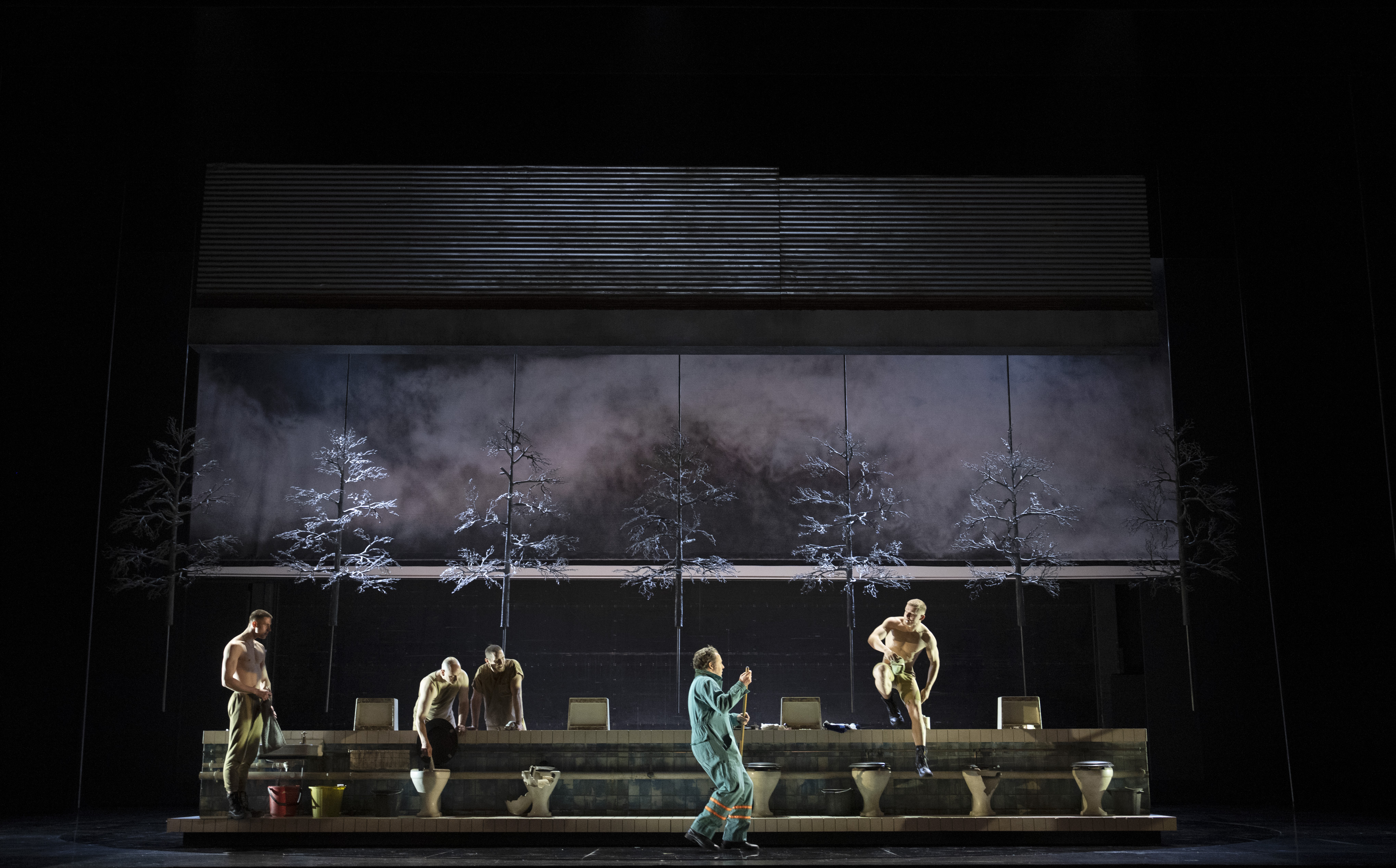
Truth be told, if you spend your time in Wozzeck thinking about a previous production or performance, something has gone wrong (either with you, what is onstage, or both). I did not. In any case, comparisons either with Warner’s first staging or with when I had previously heard Antonio Pappano conduct the work (twenty-one years ago for Keith Warner’s then-new production, in Pappano’s first season at Covent Garden) would largely be meaningless, given the vagaries of memory and my lack of a written record. Deborah Warner in 2023 does not seem to me especially to take a view or standpoint, at least not exclusively. This is not a Wozzeck that (over-)emphasises the brutality of military life and war, or expressionist experimentalism, or any one thing, though many such things are present. The action is already taking place as we take our seats, soldiers (an excellent troupe/troop of actors) relieving themselves in various ways, cleaning up, doing very much what soldiers do in barracks. That establishes an expectation of realism which is not entirely fulfilled, but rather is supplemented, so that as the action develops, as different standpoints are afforded by the work (and probably its creator), we have opportunity to take them too. Everything takes place more or less where one might expect, but there are always refreshing touches of set design, costume, lighting, or detailed Personenregie – let alone the musical performances – to enable us to take a fresh look and listen. The drama unfolds, with great immediacy, yet always it feels that this is ultimately Wozzeck rather than ‘Deborah Warner’s Wozzeck’, whether that feeling, even that possibility, be a fond illusion or otherwise. Different settings for different scenes – no fewer than fifteen of them – present themselves without fussiness or fetishisation: this is a light, enabling, generous realism that can shade almost imperceptibly into other, complementary aesthetics as required. Credit is surely due both to the design team and to the Royal Opera House’s technicians and actors, who accomplished this feat with such apparent ease. Rehearsal surely paid off.


Slightly stylised trees, Cross-like, hint at Wozzeck’s fate, albeit without redemption, but also at a natural world beyond that neither knows nor cares, yet in some sense frames tragedies that lie in stark contrast, being entirely the creation of man. There remains a Romantic desire to escape this miserable world, even if only to Berg’s family estate (Berghof) in Carinthia. Like so much else, though, it is not possible. The blood-red moon and the black, unfathomable lake dominate our vision and consciousness as natural and human boundaries. And finally, in that ultimate, heartbreaking scene of horror: the child turns to the wall in front of which the other children have just been playing, to see painted on it the news they have so cruelly, carelessly delivered. His mother is dead. He turns around and walks off, alone. The drama stops, silence cruelly denied by some idiot’s premature applause—but even that could not quite break the punch to the solar plexus. 

Much of that is, of course, a musical punch. Pappano really seems to be at his best right now. Shortly after thinking his Turandot perhaps the best I had heard from him, I found this Wozzeck at least close to equal, and in ways that surprised me. Without wishing to play that game of illusory comparisons, however tempting, I found this an infinitely more engaging experience than in 2002. Often quite extraordinary orchestral precision, for which one must of course above all credit the orchestra itself, laid bare the framework of closed forms in themselves, their multifarious musical procedures objects of an almost yet not quite Neue Sachlichkeit fascination, but also showed them to be the engines of a dramatic progression that, however Wagnerian it may often sound, is at least as much an alternative to Wagner’s method. There were wrenching, late-Romantic passages, of course, precisely where one would need and expect them, but this was also a musical drama that prefigured Hindemith, Weill, perhaps even Berg’s own teacher, Schoenberg. This was not always a Wozzeck that rose from the bass line, though sometimes it did, but it hinted more than usual at Berg’s later writing, whilst also suggesting an earlier, almost Mendelssohnian Romanticism. Like Warner’s production, it afforded different standpoints, without sounding merely sectional. 

I have been fortunate to see some extremely fine Wozzecks in those years since my first encounter (Andrew Shore on that first encounter included). Christian Gerhaher’s thoughtful, collegial approach, placing himself and his character at the dramatic hub, gaining meaning as much from interaction with colleagues as from his considered yet apparently spontaneous way with the text, has nothing to fear from any of them. His performance, worlds away, as is proper, from the beauties of his celebrated Wolfram, was yet equally well judged. Indeed, I wonder whether it heralds a new chapter in his career. For now, though, it will more than do in and of itself.


Wozzeck, Marie (Anja Kampe)

There was splendid chemistry with his Marie, Anja Kampe. I was about to say ‘we tend…’, but should really only speak for myself: I tend often somewhat to overlook the tragedy of Marie’s death, so overwhelmed am I by that of Wozzeck. Here I felt greater parity, doubtless a matter of Warner’s Personenregie but also of Kampe’s portrayal. (It is more or less impossible for an outsider to distinguish between the two.) This important corrective was brought into further relief by Anna Picard’s excellent programme note on ‘Maria and her World’, whose closing words seem very much to refer to what we saw and heard: ‘She is no Kundry. Neither is she a Judith or the hysterical Woman in Marie Pappenheim and Arnold Schoenberg’s monodrama, Erwartung. Her murder is not dressed up as a form of release for Wozzeck or a point of debate. It is simply a domestic tragedy of a very ordinary, and ever modern, kind.’ Which also brings us back to Gerhaher’s Wozzeck, for his very haplessness – what art lay in that – also contributed to that very non-release, felt (at least by me) more emphatically than I can recall.


Captain (Peter Hoare), Wozzeck

All in the cast contributed to the greater dramatic (and musical) whole, so much as to suggest unusually fruitful close collaboration between all concerned. Sam Furness’s Andres surprised me, not least because I often find myself wondering where the role went, thinking it smaller than I had expected. Not here: this was a character sympathetic to Wozzeck who yet had his own story to tell. Likewise Rosie Aldridge’s spirited Margret, whose spot in the second tavern scene almost had time stand still as the world disintegrated around her. Peter Hoare’s Captain and Brindley Sherratt’s Doctor made a sharply etched pair: guilty, yet not guilty, like all in the world we saw. Well, perhaps not quite all, for it is difficult to find any grounds to absolve the Drum Major, here given an appropriately nasty, bullying, yet finely sung performance by Clay Hilley. William Spaulding's Royal Opera Chorus was on outstanding form too. 

What, then, should a Wozzeck accomplish? There can be no definitive answer, no more than for any artwork in performance. Different productions, different performances, different audiences will all render such categorical statements in vain. If I have learned one thing over the past thirty years, it will be that. That said, if one does not emerge from a performance convinced that it is one of the greatest of all operas – ranking beyond that is a mere parlour game – it will have been in vain. My first experience was not; nor, emphatically was this: a searing and strangely refreshing Wozzeck, which I hope and intend to revisit soon.


Tuesday, 21 June 2022

The Excursions of Mr Brouček, Grange Park Opera, 18 June 2022


The Theatre in the Woods

Mr Brouček – Peter Hoare
Málinka, Etherea, Kunka – Fflur Wyn
Mazal, Bounzincek, Petrik, Svatopluk – Mark Le Brocq
Würfl, Paycek, Councillor – Andrew Shore
Sacristan, Dudcek, Domšík – Clive Bayley
Kedruta – Anne-Marie Owens
Spotcek, Vojta, Raincek, Mirosla – Adrian Thompson
Postdatedcek – Jonathan Kennedy
Child Prodigy – Pasquale Orchard
Spotcek – Robin Horgan
Farty – Benjie del Rosario
Taborite I – Toki Hamano
Arty, Taborite I – Marcus Swietlicki
Dancers – Lauren Bridle, Bridget Lappin, Arianne Morgan, Luke Murphy, Jay Yule

David Pountney (director)
Leslie Travers (designs)
Marie-Jean Lecca (costumes)
Tim Mitchell (lighting)
Lynne Hockney (choreography)

BBC Concert Orchestra
George Jackson (conductor)
 

Bounzincek (Mark Le Brocq) and an artist on the moon
Images: Marc Brenner

Hats off to Grange Park Opera for unquestionably the best of the four ‘country house’ operas I have seen so far this season. First, and perhaps most important, with respect to the work itself: Janáček’s The Excursions of Mr Brouček. I suppose it might be theoretically possible to reach a state in which Janáček’s music was heard too often, though it might not. (Imagine saying such a thing of Bach or Mozart.) If it is, though, we are nowhere near that yet. Yet the Janáček operas we see staged are mostly, perhaps understandably, restricted to three: Jenůfa, Katya Kabanova, and The Cunning Little Vixen. We must go beyond The Makropulos Case and even From the House of the Dead to reach Mr Brouček. Doubtless some in the Grange Park Opera audience had seen it in the theatre before, but I had not, and was immensely grateful to have the opportunity to do so, let alone for it to be performed so well. 

Mr Brouček will doubtless always be a problematical work, in a way that the aforementioned popular (relatively speaking) trio will not. Its two-part structure will probably always require effort to bring together—if, indeed, such is the dramaturgical aim. But art is certainly not always about perfection, or approaches to it. Sometimes, it is about quite the opposite. The first part’s satire against pretentious avant-gardism, or perhaps better derrière-gardism, hits home more readily for a modern, or at least non-Czech, audience than the second, more preoccupied with Czech national mythology—although a little grounding helps us on our way. Nationalism, after all, remains sadly too universal. But the other part of the satire is against the antihero himself: the philistine who has little idea what he is doing in Prague, let alone on the Moon or in the fifteenth century. To that, we can and should all relate. No one likes a landlord, after all, especially one who boasts of having no mortgage, only a three-storey house. You can begin to see why the opera will never touch as Katya does. That is not its purpose.


Málinka (Fflur Wyn)

David Pountney’s production pulls out all the stops for a frankly zany trip from Prague to the moon, clarified and extended by Marie-Jean Lecca’s imaginative costuming. Leslie Travers’s brilliant set for the former captures an almost childlike delight in city models, as well as the, or at least an, idea of Prague. The empty pretentiousness of the moon artists—Pountney has fun, using his own, free English version of the text, creating names such as Spotcek, Raincek, and Postdatedcek—engenders an intoxication of its own. It is fun to watch, which guards us against too ready identification with Brouček. ‘We must each fight our inner Brouček,’ Janáček insisted. A similar, yet different mix of magical constructivism informs the still more bewildering—for many—and darker trip to the Prague of the Hussite rebellion.


Mr Brouček (Peter Hoare)

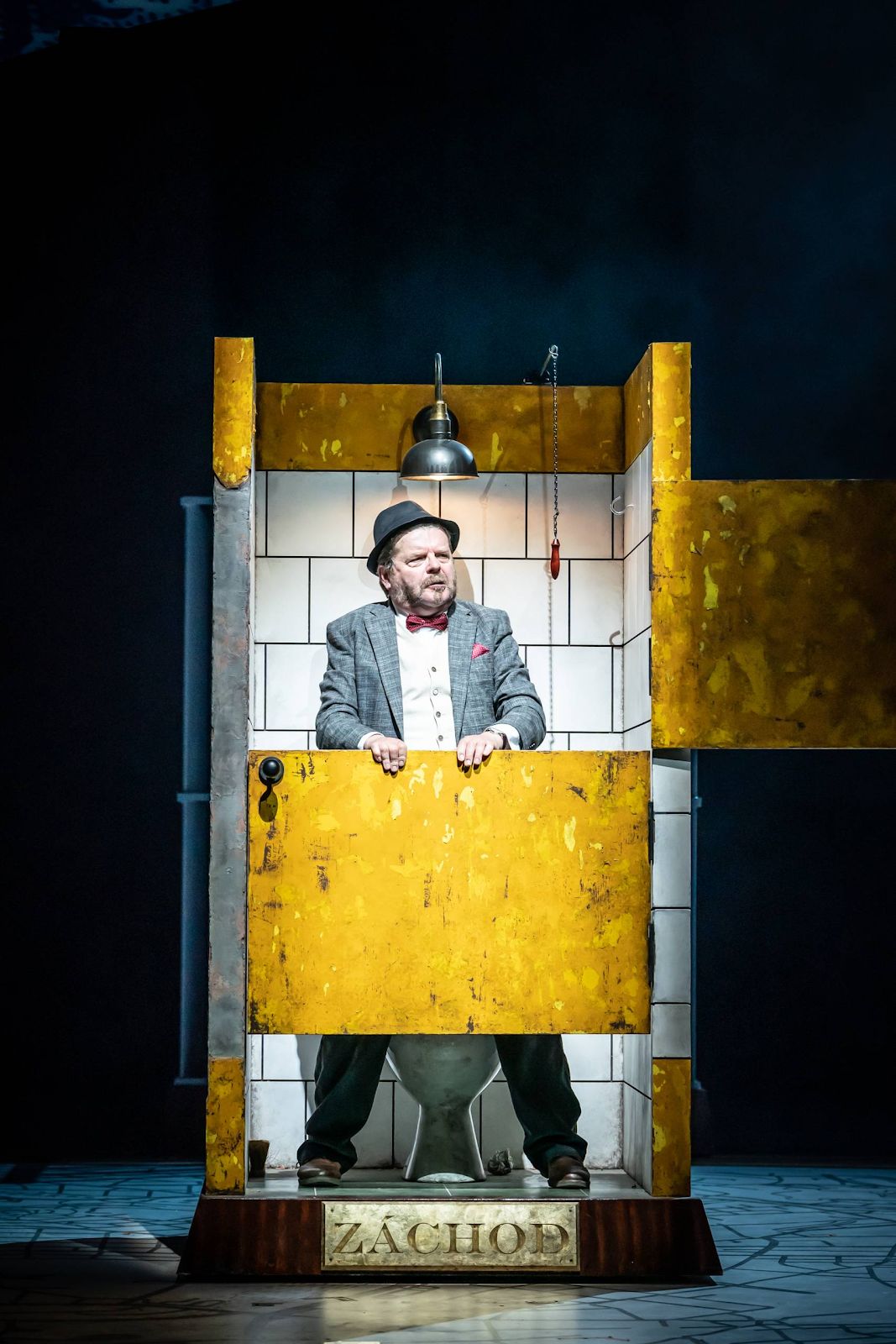
Whether one cares for the (literal) toilet (brush) humour of the interlude between the visits, will be a matter of taste. Monty Python is not my thing, but if it is yours, you will almost certainly love Pountney’s more outrageous excurses. Sometimes, though, I wondered where the heart was, especially during the Moon-trip. Is there not something more positive to say about artistic creation too? The answer, I suppose, would be that it lies in the score (and, indeed, in the artistic endeavour of performance and reception itself. It arguably suggested itself onstage at the end, when the innkeeper Würfl collected his drunken patron, laughed at his tall tales, but also walked him away in camaraderie. Perhaps that was enough. Again, that will probably be as much a matter of taste or inclination as anything else.


Peter Hoare’s Brouček captured well the contradictions not only of the character, but of our response(s) to him. This was a typically intelligent performance, which held the stage, amused, and touched without sentimentality. Fflur Wyn’s Málinka and other roles were lively, characterful, and rooted in, yet far from hidebound by, the text. Such is the magic of theatre, and such might be said of any number of the cast, including Mark Le Brocq’s handful of roles, Andrew Shore’s, and Clive Bayley’s, as well as Anne-Marie Owens's Kedruta. This was very much a company effort, which did Grange Park Opera proud, enthralling an audience that could all too readily have registered mere bemusement at the work’s oddity.


Domsik (Clive Bayley)


George Jackson’s traversal of the score elicited my unqualified admiration, as did the playing of the BBC Concert Orchestra. Incisive and expansive, earthy and soaring, above all attuned to those fabled speech rhythms and their unpredictable, magical combination into form and structure, this was as fine a Janáček performance as I have heard for some time, all the more so for its revelation of relatively unfamiliar territory. Time and time, presentiments of the Vixen’s world shone through, anchoring these ‘excursions’ in a common humanity and inspiring us to go forth and create it. The score emerged possessed of the musical, scherzando brilliance of the more or less contemporary Gianni Schicchi, if perhaps less single-minded, at any rate without the latter work’s dramaturgical precision, considered as a whole. We might say Janáček’s musical dramaturgy is more adventurous, though much depends what one means. Whatever our thoughts on that, this was a musical banquet beautifully and, at the last, movingly served.


Monday, 21 October 2019

The Mask of Orpheus, English National Opera, 18 October 2019


Coliseum

Images: (c) Alastair Muir, 2019

Orpheus the Man – Peter Hoare
Orpheus the Myth, Hades – Daniel Norman
Orpheus the Hero – Matthew Smith
Eurydice the Woman – Marta Fontanals-Simmons
Eurydice the Myth, Persephone – Claire Barnett-Jones
Eurydice the Hero – Alfa Marks
Aristaeus the Man – James Cleverton
Aristaeus the Myth, Charon – Simon Bailey
Aristaeus the Hero – Leo Hedman
The Oracle of the Dead, Hecate – Claron McFadden
The Caller – Robert Hayward
First Priest, Judge of the Dead – William Morgan
Second Priest, Judge of the Dead – David Ireland
Third Priest, Judge of the Dead – Simon Wilding
First Woman, Fury 1 – Charlotte Straw
Second Woman, Fury 2 – Katie Coventry
Third Woman, Fury 3 – Katie Stevenson
Dancers – Joan Aguila-Cuevas, Sam Ford, Ripp Greatbatch, Stefano de Luca

Daniel Kramer (director)
Lizzie Clachan (set designs)
Daniel Lismore (costumes)
Peter Mumford (lighting, video)
Barnaby Booth (choreography)

Ian Dearden (sound design)
Chorus of the English National Opera (chorus masters: James Henshaw, Mark Biggins)
Orchestra of the English National Opera
Martyn Brabbins, James Henshaw (conductors)


‘All opera is Orpheus,’ Adorno once declared – although, typically, what he meant by that was rather more complicated than mere quotation would suggest. Perhaps, in some sense, all music in the Western tradition is too – again, so long as we take care, as Harrison Birtwistle always has, never to confuse starkness with over-simplification. In the beginning, then, was Orpheus, his myth repeated, elaborated upon, throughout Western musical tradition, and especially throughout Western operatic tradition. It is surely no coincidence that it was with this monumental work that Birtwistle sought his most radical extension yet of that line. He wanted, he said, ‘to invent [my italics] a formalism which does not rely on tradition in the way that Punch and Judy, my first opera, relied on tradition. There I used forms such as the chorale, toccata and gavotte. I injected them into my work just as Berg injected formal ideas into Wozzeck. In The Mask of Orpheus, I didn’t want to hark back any more; I wanted to create a formal world that was utterly new.’


Expectations could not have been higher. For some, yours truly included, this was a moment for which we had been waiting the whole of our musical lives. From a career strewn with masterpieces, here came at last a second staging of Birtwistle’s Mask of Orpheus: heard only once complete, in concert, since its 1986 premiere, and never since seen in the theatre. I had previously only managed to hear a single act, in concert, at the Proms: an unforgettable experience that only increased my hunger to hear – and to see – more. Present at that first, ENO performance, Alfred Brendel extolled The Mask of Orpheus as the first English musical masterpiece since Purcell. Many will find that view a touch harsh on some music and composers – even assuming Handel’s exclusion – intervening. Be that as it may, no one with any serious interest in music or opera, indeed no one with a passing interest, yet possessed of half an ear and a little curiosity, would deny the work’s stature.


Musical values were high, as they would have to be: there is no more point putting on Birtwistle with musicians unequal to its challenges than there is Stockhausen. That excellence we heard from ENO forces should nevertheless not be taken for granted. The conflict between rational and irrational, between what Orpheus must do to win back Eurydice and what his urge to act as a human being, a conflict as old as that between Apollo and Dionysus and in many respects to be identified therewith, lies at the heart of this work. The climax to the second act, indeed the whole of that extraordinary structure of recollective arches, not only retains its enormous, truly post-Wagnerian power; it seems to increase with every hearing. This proved no exception. One was truly left reeling then – and not only then – at least insofar as one could separate the musical performance from its sadly inadequate scenic realisation, on which more shortly.


Moreover, if that conflict between the demands of reason and those of emotion lies at the work’s dramatic heart, so too does the variety of ways in which its participants, us included, might look at, experience, reflect upon that conflict, not least through time, ours and the characters’ (broadly speaking, as human, myth, and hero, though never in linear fashion, and just as much musically – lyrically and formally – as verbally and scenically). In a sense, this is true of all opera; ‘all opera is Orpheus’. But it is perhaps more so here, more overtly so, more strenuously. Martyn Brabbins and James Henshaw, assisted by Adam Hickox, did a superlative job of enabling the excellent orchestra, chorus, and cast to express what they could of this, Peter Hoare a fascinatingly flawed, multifariously tragic Orpheus the Man, Marta Fontanals-Simmons an alluring, inscrutable, even alluringly inscrutable Eurydice the Woman, ably supported by penetrating, intelligently contrasted performances from Daniel Norman and Claire-Barnett Jones as their mythical counterparts. James Cleverton as Aristaeus and Claron McFadden as the extraordinary Oracle of the Dead also stood out dramatically, but there was nothing approaching a weak link to the cast. Barry Anderson’s electronic realisation, with sound design by Ian Dearden, proved as liminally dramatic in its way as Stockhausen, as pregnant with dramatic purpose as an ‘interlude’ in Wagner.


If only Daniel Kramer’s bizarre, ultimately vacuous production had been remotely equal to its task. Where the work speaks of and with starkness and complexity, Kramer seemingly mistook the latter for a gaudy variety show, validated by inclusion of more and more unconnected – with each other, let alone with the work – acts. This was not the idea of the circus, nor indeed the idea of anything else; it was a hideous and, doubtless, highly expensive mess. Occasionally, the possibility of recollection, of memory, even of dream sequence, asserted itself, more by default than anything else. For the most part, we suffered an absurd – never, alas, absurdist – display of exaggerated, ‘saucy’, latex-clad nurses and medical equipment; of supposedly shocking, yet actually deeply tedious, sexual acts; of people – often entirely unclear who they were, and to what end – emerging and sinking into bathtubs; of highly skilled acrobats (for the opera’s mime action) removing and replacing their clothes, before resuming their distracting activity; of general hyperactivity that not once seemed to enquire what it, let alone of anything else, might be for, let alone of whether its seemingly hapless orientalism might prove a tad problematical to some. It was unclear that the ‘concept’, if one may call it that, was anything more than an ageing rock musician – we see the platinum discs on the wall – Orpheus, holed up in his extravagantly equipped hotel room, having a bad trip. And even that was perhaps to dignify it.


Was this, perhaps, opera for a world with its eyes – and possibly ears – on several screens at once, craving instant diversion rather than satisfaction? Was there even something of the postdramatic to it? I can see that the argument might be made, but frankly, in this particular case, I think not; or if it is, then there really ought to be more to it than this. Constant changing of the emperor’s still newer, still more sparkly, clothes – ‘by artist, campaigner and designer Daniel Lismore, described by Vogue as “England’s most outrageous dresser”’ – was not enough, never nearly enough. Nor was there any sign of irony, of critique, of anything more than camp excess really – which is not to deny the excellent artistry of those on stage, doing what they could. Carry on Birtwistle, then? It just about qualifies as a point of view, I suppose; or, better, as the slender basis for one. I cannot help but think that it would have been better left on the shelf, along with the rest of this wasteful production: a non-ironic cross between Robert Lepage and Liberace.


The absurdity might have worked; all manner of things might have worked; however, in the absence of a connecting pair of ears, let alone anything between them, this was doomed to remain an endless parade – in a decidedly non-Birtwistle sense – of effortful vulgarity on- and offstage, as idiotic as it was wasteful. Wherever one looked, one was assailed with advertisements for a crystal company to which I shall refrain from granting further publicity. Nothing could have lain further from the essence of Birtwistle’s score, nor indeed from Peter Zinovieff’s libretto. Yet such contradiction was not fruitful; nor even, so it seemed, intentional. If anything, it simply suggested a director out of his depth – and not even in the opera’s shallows. The true tragedy, of course, lies in the damage this may do to prospects for a third production, even for a further concert performance. Not for the first time, alas, ENO has snatched defeat from the jaws of victory.


Wednesday, 16 May 2018

Lessons in Love and Violence, Royal Opera, 15 May 2018


Royal Opera House

King – Stéphane Degout
Gaveston, Stranger – Gyula Orendt
Isabel – Barbara Hannigan
Mortimer – Peter Hoare
Boy, Young King – Samuel Boden
Girl – Ocean Barrington-Cook
Witness 1, Singer 1, Woman 1 – Jennifer France
Witness 2, Singer 2, Woman 2 – Krisztina Szabó
Witness 3, Madman – Andri Björn Róbertsson

Katie Mitchell (director)
Vicki Mortimer (designs)
James Farncombe (lighting)
Joseph Alford (movement, associate director)

Orchestra of the Royal Opera House
George Benjamin (conductor)

Girl (Ocean Barrington-Cook), Isabel (Barbara Hannigan), King (Stéphane Degout), Boy (Samuel Boden)
Images: © ROH 2018/Stephen Cummiskey

 
If Harrison Birtwistle remains acknowledged as England’s greatest musical dramatist since Purcell, then Lessons in Love and Violence may well come to be seen as the work with which George Benjamin mounted his challenge. There is no reason, of course, why such matters should be adversarial, and such is hardly Benjamin’s style, whatever the grisly subject matter of his third opera. He is more someone to knock on the door, enter and delight us with what he brings to the party, without any need to elbow anyone aside. Let us instead rejoice in the creation of another masterpiece, darker and perhaps deeper still than Written on Skin. (Not, of course, that we should forget Benjamin’s first opera either: the wonderful Into the Little Hill.)


As you will doubtless know by now, Benjamin has been reunited with Martin Crimp for this, Crimp’s third libretto, and Katie Mitchell, who directed the excellent first staging of Written on Skin, and who has also worked with Crimp on his other theatrical works, has rejoined the team too. This seems, almost a priori, to have given rise to a degree of ennui in certain quarters. (I have tried to avoid hearing what others have thought about the work, but have not been entirely successful.) One objection seems to have been ‘more of the same’, more or less. I can only presume that the same people would have regretted Mozart’s decision to ‘pursue a collaboration’ with Lorenzo da Ponte after Don Giovanni, perhaps even after Figaro. After all, one often hears the most ridiculous nonsense spoken of Così fan tutte. But there is no reason to be defensive here; I only mention the matter since, for better or worse, it is being spoken of already. Upon leaving the theatre, I hastily typed an ‘instant reaction’ tweet, even, for once, remembering to use the ‘hashtag’: ‘#ROHLessons is a towering masterpiece, its intellectual brilliance and sensual wonders matched, at the very least, by its emotionally overwhelming dramatic path. Drained and satisfied as if by Wozzeck or Katya Kabanova; or, the work that increasingly came to mind, Boris Godunov.’ I have no argument with that almost a day later, and shall try to explain why.


Are such comparisons less odious than ridiculous? Perhaps. Not entirely, though, since I think this is how we often approach new works, not least in so repertory-bound a genre as opera, perhaps especially with a house and company such as the Royal Opera (House). They are far from exact and the tragic trajectory is not the same; here, in the story of Edward II, it is nicely doubled at the end. Essentially we see (and hear) here Edward’s (never, I think named as such) inability to say no to his lover, Gaveston, resulting in the banishment of the clever, unscrupulous politician, Mortimer, who returns, having manipulated the people to his end, to restore himself in something equivalent to a queen’s coup, ridding the court and realm first of Gaveston and then of the king. But the young king, again not named as Edward III, having watched, with his sister, everything unfold, including that violence which is often yet not always subtly hinted at or stylised, turns upon the usurpers and truly becomes king himself.

Boy, Girl, Isabel

Tragedy or restoration? That rightly does not quite seem to be the question, just as that bald outline omits the mess of motivations that characterises this horrible, political world. Much is hinted at, there for one to join the dots, but much is portrayed too. The audience member is, rightly or wrongly, treated as an intelligent human being, a participant, not a consumer of Verdi or other tedious kitsch. It is certainly not so straightforward as portraying a situation in which no one is sympathetic. Rather, as in ‘real life’ – and what, alas, could be more real than our present, not so different high or low ‘political’ life? – motivations are complex, contradictory, and, between characters at least, irreconcilable. Such is surely not the least of the lessons of love and violence that unfold – whether one does not believe in love, as Mortimer, or in violence, as the younger young king does not, yet must. Mortimer, after all, schools him, too, perhaps better than he intended. Likewise, Isabel seems – perhaps is – wronged at the start; we can understand why she, a mother and a wife as well as a queen, acts as she does. Yet she is far from white to start with; in her aestheticism – her love of music and her chilling dissolution of a pearl in acid, a pearl that would have given houses to petitioning subjects – she actually seems a good, or rather deadly, match to her husband, as well as a potential rival to Gaveston. There is horror, too, in her children turning upon her, however deserved that turnaround might be.


But we must return to music, so beloved of these unpleasant people, yet puritanically or sadistically prohibited by the Young King. (Or so he claims: we never quite know the truth of many claims, for who is narrating? We almost seem to know better in the play within a play, that of David and Jonathan, in which Isabel almost literally begins to call the shots, and in the non-musical reprise of such ‘entertainment’ which is threatened, and yet which turns out to be ‘real’, a tortured Mortimer about to be shot dead by the Young King’s sister.) Yes, we must, that too lengthy parenthesis notwithstanding. For it is music that seems – apparently or otherwise – to structure the words and the drama, or perhaps to re-structure them. It is music that creates them, in many ways, regardless of empirical priority. It also creates, and is created by, the situation: its colour, its tensions, its possibilities. ‘It’, whatever it may be, is always, ultimately, about the music; for when the music stops, so does the opera. Perhaps that has always been Isabel’s fear: the fall of the curtain. Mitchell certainly seems to hint at that, but so do Benjamin and Crimp – and, of course, the outstanding cast and orchestra.

Madman (Andri Björn Róbertsson) restrained, Queen, Girl, Boy, Mortimer (Peter Hoare)


Benjamin’s ability to create a sound world has always been one of his hallmarks; in that sense I could not help but think of Janáček and Mussorgsky, both in general and in particular, as mentioned above. Yet, as with those composers, it is certainly not a matter of simply providing atmosphere, a setting, although that certainly is created. Just as Vicki Mortimer’s plush, power-dressing – dressing itself becomes, in true royal fashion, almost a ritual in itself – claustrophobic designs, both for sets and costumes, provide a framework, both to contain and to be broken by the action, so do timbres, often in combination, and harmonies, likewise. There is almost infinite variegation within. The old problem, almost yet not quite Schoenbergian, of reconciling musical antimonies between freedom and determinism, gains new clothes – aural and visual. And the inevitability of the action, at least viewed from the close, of what has happened, takes upon itself an almost Bergian thrust, not least through the characters of and connections between particular scenes. The orchestra follows Benjamin, whether as composer or conductor; or rather, it leads the action with all the confidence and, more to the point, understanding it might once have shown Bernard Haitink in Wagner. And, as with Wagner, still more so with the Debussy of Pelléas, so much action, so much of the truest, wordless action, occurs in the interludes, the transformations between scenes. It is perhaps in those, as in Pelléas, that the stature of Benjamin as a musical dramatist is most immediately manifest.


Or does it? Does the orchestra lead? Do not the singers? Yes, they do too. There is much leadership: too much in the plot, just enough in performance. For song, or at least singing, is crucial to this opera; it is certainly not to be defined as a ravishing, horrifying symphonic poem with voices, although it is perhaps partly that. Benjamin and his co-creators and co-performers refuse the either-or that many of us, seeking for a way in to account for our reactions, would seek to foist upon him. There is drama in melisma: what could be more traditionally operatic than that? There is drama in the entwining and the opposition of melisma? Again, what could take us back more closely to that first zenith of the genre, to Monteverdi? Perhaps the encounter between Isabel and Gaveston, in which she verbally bids him come closer to her, that she might also come closer to the King (who remains distant on stage), is most instructive of all here, for it expresses and creates a musico-dramatic situation more complex than, and still more deadly than, the duet of two baritones so full of sensual delight between the king himself and his lover. Both, and other duets and ensembles, are necessary of course, in the structuring of the drama, just as in the still sorely misunderstood Così. Post-Mozartian Harmoniemusik occasionally seemed to make that point, at least to me; likewise the haunting death rattle avant la lettre emanating from harps and cimbalom, as the Stranger took the King’s life in his cell. The King thought this stranger was Gaveston; so did we, even though he told us he was not, and Gaveston was dead. One could hardly fail to think of the careful, meaningful symmetries of Lulu.

Isabel and Mortimer


And, as with Mozart, although whether through design or through the sheer excellence of these artists on stage, one had the sense that the roles had been written with them in mind. They were, of course, for Mozart, but here, who knows? We are not so much concerned with process, as with each artist having inhabited his or her role. Stéphane Degout’s velvet tones cloaked the impetuous, arbitrary deeds of a weak tyrant, who was also a wronged and wronging man. One made no distinction between role and performance; he simply was the King. So too, and increasingly so, as her role came into focus, was Barbara Hannigan, as his consort. That she played so well in the initial background speaks just as well of her as the display of that extraordinary ability we all know and love – think, for instance, of her Ligeti – to encompass so many modes of vocal delivery within a single line that remains spun from the same silk. Gyula Orendt’s seductive, nasty, manipulative way with Gaveston mirrored and contested the politician’s path of Peter Hoare’s clever, calculating, just as (in)human Mortimer. Not the least of the evening’s performances was the coming of age through politico-emotional stunting of Samuel Boden’s Boy and Young King. Dressed like a boy, he acted unerringly like one too: almost a Prince William, whilst Diana was still around, or shortly after. Ably assisted by his sister, Ocean Barrington-Cook (a mute role), the crown was, again if only in retrospect, his for the taking – once he had learned his deathly lessons. Smaller roles were all very well taken, by Jennifer France, Krisztina Szabó, and Andri Björn Róbertsson: suggestive of a greater number of voices and faces than was actually present, drawn, as it were, as if from an imaginary chorus.

Isabel, King, Gaveston (Gyula Orendt)

For, as in Boris, we observed and felt the people’s grief, feared equally for what we knew to be their largely hopeless future. As the Third Witness had accused the Queen, in a shocking intrusion, orchestrated by Mortimer, into her chamber, the poor had no choice, unlike the decadent rich, to sleep three to a bed. The miracle here was that fury, both external and internal to the drama of princes and nobles, manifested itself through three single voices, an orchestra, and, not least, an endlessly inventive, supportive, and questioning production. Mitchell too did the work the necessary honour of treating it as a mature drama, as she had in Written in Skin; this was not something to be introduced, hesitantly, but to be directed with the critical modernity she would bring to any other work. This may be a quiet operatic manifesto; such, as discussed, is Benjamin’s way. It may even be a manifesto without intention to be a manifesto. Perhaps that makes it all the more convincing, all the more accomplished.