Showing posts with label Puccini. Show all posts

Saturday, 4 July 2026

Munich Opera Festival (3) - Turandot, 30 June 2026


Nationaltheater


Images: Geoffroy Schied


Turandot – Sondra Radvanovsky
Altoum – Kevin Conners
Timur – Christian Van Horn
Calaf – Yonghoon Lee
Liù – Golda Schultz
Ping – Vitor Bispo
Pang – Tansel Akzeybek
Pong, Prince of Persia – Samuel Stopford
Mandarin – Bálint Szabó

Director – Carlus Pedrussa/La Fura dels Baus
Designs – Roland Olbeter
Costumes – Chu Oruz
Video – Franc Aleu
Lighting – Urs Schönebaum
Dramaturgy – Andrea Schönhofer, Rainer Karlitschek
Revival director – Lejila Selfried

Chorus, Children’s Chorus, and Extra Chorus of the Bavarian State Opera (chorus director: Christoph Hell)
Extras, Children Extras, and Opera-Ballet of the Bavarian State Opera
Bavarian State Orchestra
Conductor – Andrea Battistoni


How curious. I learned what this Turandot had been about only upon consulting the programme post-performance. To be honest, I wish I had not done so. A quotation from La Fura dels Baus’s website will do: ‘In 2046 Europe is completely under Chinese rule. More than 30 years, China had rescued Europe from a financial crisis by buying up the debt, the ownership and natural resources. China is now the new world power. Turandot, the princess of ice control, as “Big Brother” every European, in order to pay back every last penny and pay off the debt of their parents’ generation.’ There is, I suppose, nothing like a bit – a lot – of paranoid Western Sinophobia to knock the work’s tamer racism into perspective. How this was depicted onstage I am at a loss to describe, but there you have it. 

For, if that sounds like the sort of thing a US Republican might utter or like to hear, what we saw often suggested something devised to hold the attention of an octogenarian man-baby president. There was certainly something going on all the time: less an evocation of the circus, or on engagement with the idea of one, commedia dell’arte or otherwise, than a circus in itself. If not so vacuous as, say, the Cirque du soleil, Carlus Pedrussa’s production was not so far off as it appeared to think itself. Breakdancers, acrobats, rollerskaters: someone was and often many people were doing something or many things all of the time. Quite why remained obscure, at least to me. I wondered whether some comment was being made about visual overload, and perhaps it was. But its relation to Turandot I could only hazard to tell you, until the final scene when things calmed down and the characters were directed rather well. Titles instructed us when to put on our 90s-style 3-D glasses, red and blue, which promised far more than they delivered. Apart from turning much of what we saw, well, red and blue, they enabled us to see a few objects flying around between us and the stage. Spectacle has always been a dramatic – or, indeed a postdramatic – tool in opera. Here, I am afraid, things tended towards Wagner’s celebrated denunciation of Meyerbeer as effect without cause.


Pedrussa’s decision – again, I quote La Fura dels Baus’s website – to present a Turandot ‘strictly pure and original’ mighty suggest conflict, productive or otherwise, with visual hyperactivity. Did it ‘respect the composer’s music’? Arguably so, in that it presented it as one might expect, save for one exception of ultra-‘respect’, ending ‘when the choir says “Liú poesía”.’ I had not heard it done this way before, so was curious to discover how it might turn out. Not very well, alas. It can plausibly be argued that there is no entirely satisfactory solution to this particular problem, not even Berio’s—and certainly not Franco Alfano’s. But this not only sounded quite at odds with what we had seen; it also presented an oddly muted winding down to an opera for which subtlety may hardly be a priority, but tonal dramaturgic strategy certainly is. Wozzeck stops rather than closes; no one would wish it otherwise. For Turandot more or less to peter out proved an unnecessary disappointment. 

Andrea Battistoni’s conducting of the Munich orchestra offered a proverbial curate’s egg. Tremendous Stravinskian precision early on, hammering home Puccini’s inheritance from Petrushka and The Rite of Spring, met with frustrating listlessness later on. If the reading never lost sight of the gorgeousness of the orchestral tapestry, relative lack of structural command doubtless contributed to the disappointment of the close. Much was loud, very loud, although considerably more varied in tone than Yonghoon Lee’s ear-splitting Calaf. Again, this may not be the world’s most subtle opera; nor is Calaf’s the most of operatic characterisation. There is nonetheless more to it, or should be, than unrelieved shouting. Sondra Radvanovsky was cold and imperious as Turandot, and considerably subtler in, say, ‘In questa reggia’. It was difficult not to feel the loss of additional music in her case. Golda Schultz’s Liù was heart-rending: lovelorn and sincere, a star-turn without trying to be a ‘star’. Christian Can Horn’s verbally and musically attentive Timur impressed similarly for adding much that was absent elsewhere. Indeed, all the singing, bar that of Lee, was of excellent quality or better, massed choral forces included. I could only wish the singers – and we – had benefited from a production that had extended beyond School of Franco Zeffirelli, albeit more by default than design.


Sunday, 28 June 2026

Turandot, Opera Holland Park, 23 June 2026


Images: Pablo Strong


Princess Turandot – Anne Sophie Duprels
Calaf – José de Eça
Liù – Fflur Wyn
Timur – Jihoon Kim
Ping – Josef Jeongmeen Ahn
Pang – Joseph Buckmaster
Pong – Zwakele Tshabalala
Emperor Altoun – Robert Burt
Mandarin – Wonsick Oh
Prince of Persia – Jamie Formoy
Young Turandot – Lara Ronxin Quattrone

Opera Holland Park Youth Chorus (chorus master: Joe Cummings)
Opera Holland Park Chorus (chorus master: Richard Harker)
City of London Sinfornia
Naomi Woo (conductor)


Celebrating its thirtieth anniversary and the centenary of Puccini’s death, Opera Holland Park completed its set of the composer’s operas with a semi-staging of his final, unfinished work, Turandot. One might wish for a full staging, but one cannot have everything—and relatively little was lost. This made for a fitting crown to a season far from over, or perhaps better an extended encore to its new Fanciulla del West.

Anne-Sophie Duprels and José de Eça (previously Dick Johnson) came together to do something strikingly both similar and different as Turandot and Calaf. Their performances proved to be on a similarly outstanding level too, once again as fine a dramatic soprano and tenor as I can recall hearing at Holland Park—and considerably superior to those one might encounter at many of the opera firmament’s starriest houses. Whatever the dramaturgical depravity of the work – a big ‘whatever’ – both navigated its difficult, some might say impossible, relationship between fantasy and realism with all the fine attention to words, line, and their combination one could hope for. Duprels’s Turandot stood and sang on the threshold of a new life, slowly warming as much as melting. De Eça’s ardour swept all before it, Fflur Wyn and Jihoon Kim’s compassionate Liù and Timur included—which, alas, is as it should be. Wonsick Oh’s Mandarin was a chilling, yet human – indeed, human partly on that account – master of ceremonies, ably assisted by the protean solo-ensemblists of Josef Jeongmeen Ahn, Joseph Buckmaster, and Zwakele Tshabalala’s Ping, Pang, and Pong. Robert Burt’s Emperor Altoun and Jamie Formoy’s Prince of Persia afforded vivid, crucial, ‘smaller’ contributions.  


The role of the chorus is particular important in this opera. Opera Holland Park’s Chorus and Youth Chorus both impressed, both in themselves and in combination with the City of London Sinfonia, which again gave a mighty impression of a much larger band. The CLS now sound like old Puccini hands, which of course they are: warm, incisive, steely by turns, relishing and communicating the ripe post-Wagnerism and still astonishing modernism of the score in equal measure. If there were a few moments when any orchestral reduction would suffer by comparison with the full score, Tony Burke’s resourceful work, strange electronic organ intervention aside, contributed greatly to the success of the performance. A panoply of percussion enhanced the musical theatre of cruelty, as well as looking forward to the later twentieth century.

So too did Naomi Woo’s conducting, screwing up the tension where required and richly expansive where called for. Echoes of Debussy, Stravinsky, Schoenberg and others were relished, as, equally important, were the many cases in which Puccini takes the lead and others follow. It was difficult not to hear sentiments of Dallapiccola’s Il prigioniero, for instance, not least in the arguably still more twisted combination of torture and hope on offer here. As ever, that tantalising early morning conversation between Puccini and Schoenberg, when the ailing elder composer travelled to Florence for the Italian premiere of Pierrot Lunaire, hovered in the musical air. Holland Park’s celebrated peacock chorus contributed vocal embellishments, apparently as engaged with the sadistic dramaturgy as the rest of us. If Franco Alfano’s completion remains unsatisfactory, we cannot always hope for Berio. It has the merits at least of bringing to the surface in its listless wagnerismo parallels – arguably more than that – with Siegfried and Brünnhilde.


Eleanor Burke’s direction was an equal partner in that (as, of course, were our Calaf and Turandot). The semi-staging concentrated, naturally, on character and narrative, and did so very well, whilst nonetheless framing their unfolding with reference to a child, the young princess, first having opened her music box and later handing it to the cruel princess she was to become. The importance both of childhood experience and of the problematical yet fascinating tension between Carlo Gozzi’s commedia dell’arte and Puccini’s realism was brought to our attention, for us to ponder and experience as our minds and mindsets permitted. This was not the place really for an overarching concept, though we were free to contribute one as we wished. Dress, as opposed to full-scale costume, was stylish in red and black. 

This was, then, another distinguished production from Opera Holland Park. A good number of audience members raised their hands at the outset, when asked by CEO and Director of Opera James Clutton if this were their first time. It is difficult to imagine they would have been anything other than greatly impressed, just as the rest of us were. For there was no mistaking the warmth and sincerity of the final applause. What next? Dare we hope for the aforementioned Dallapiccola, perhaps in tandem with Busoni’s Turandot? Someone should, at any rate.


Thursday, 28 May 2026

La fanciulla del West, Opera Holland Park, 26 May 2026


Minnie – Amanda Echalaz
Jack Rance – Robert Hayward
Dick Johnson – José de Eça
Nick – Zwakele Tshabalala
Ashby – Alaric Green
Sonora – Aidan Edwards
Trin – Jamie Formoy
Sid – Joe Ashmore
Bello – Michael Temporal Darell
Harry – Dominick Felix
Joe – Hugh Beckwith
Happy – Matthew Duncan
Jim Larkens – Samuel Snowden
Billy Jackrabbit – Freddie Tong
Wowkle – Kezia Bienek
Jake Wallace – Blaise Malaba
José Castro – Ronald Nairne
Pony Express Rider – Robert Jenkins

Director – Martin Lloyd-Evans
Designs – Anna Reid
Lighting – Jamie Platt
Choreography – Róisín Whelan
Fight director – Haruka Kuroda

Opera Holland Park Chorus (chorus master: Dominic Ellis-Peckham)
City of London Sinfonia
Matthew Kofi Waldren (conductor)


Images: Craig Fuller


This year, Opera Holland Park celebrates its thirtieth anniversary. Now a fixture in London’s operatic calendar, it continues to put many allegedly starrier stages to shame, not only through the quality of its productions and a wise stewardship that continues to build on its particular artistic strengths, but also through the genuine warmth of its welcome to newcomers and seasoned operagoers alike, and to its commitment to community and sustainability. Puccini has always stood at the heart of its offerings, so opening the 2026 season with a new production of La fanciulla del West, directed by Martin Lloyd-Evans and conducted by Matthew Kofi Waldren, was fitting and welcome. It turned out to show the company at its best: an interesting, intelligent staging, with excellent musical values, including a City of London Sinfonia one would never have guessed from the sound included only five first violins and a well assembled team of seasoned and newer vocal artists.

When talking about how differently an opera – or any other performing artwork – has struck one on different occasions, it is always difficult to know how much to attribute to the performance, broadly conceived including production, and how much to oneself. It will often be a combination of both; the important thing to remind oneself is that one may be more or less receptive at different times. I suspect, as an astute critic said to me during the interval, that Fanciulla may be a work that speaks more readily to those of a certain age. Its themes become more apparent, as well as more meaningful. (That may also be in part a reflection of coming to know it better.) But I am pretty sure it was only that; much in Lloyd-Evans’s production skilfully drew out the work’s dramatic concerns without overt interventionism, tracing a careful and involving path between its tricky combination of realism and redemption, neither of which it seems desirable, even possible, to underplay, let alone jettison. 


First among these themes is surely loneliness; at least, it felt so here. I do not doubt a more overt, even contemporary thematization could work too, but a hallmark of this production was to draw it out of what we could imagine the work ‘itself’ to be. Related to that and with similar contemporary resonance, period setting notwithstanding, is the theme of migration. For these are people who have come to California from across the world, not only the continent. In that lie their hopes, their fears, their sadness, and their possibilities to build something new—such as love. The dramatic, emotional point of the first scene, of men meeting at the Polka saloon, unsure of how they can and should relate to one another, whether missing their ‘homes’ elsewhere or otherwise, comes across strongly. Minnie and Dick Johnson are not so different, though they step out from that generality. And, as Minnie reminds us, none of them, her included, has clean hands: this could readily tilt into a Brecht-Weill Mahagonny, although ultimately its direction could hardly stand more strongly opposed. 


That is all in the work, one might say, and in many ways that is so, but one is led to understand and feel that with greater clarity and indeed emotional depth than I can previously recall. Dancing with another, faute de mieux, is touching in its heterosexual wariness but also its brief joy, though the ‘real thing’ lies between the central couple—and between them alone. We follow its origins, its rekindling, its blooming, its crisis, and its victory, through detailed, yet never fussy direction that supports every character onstage to trace a plausible path. There are set-piece moments, as there are in the work. They make reference, or at least conform, to our ideas of the Western, brought further to life in Anna Reid's resourceful designs and Jamie Platt's lighting. But they are never mere clichés: they have a function, narrative and emotional, and effect that function well.  

Waldren’s direction of the CLS and its playing were first-class. If you would have me down as a sceptic for chamber orchestra Puccini, even in so skilful a reduction as that by Ettore Panizza, you would be right. Not only, though, was I convinced from the outset; the question never arose in the first place. Here was a sound that was throughout just right, a gorgeous string sheen the icing on a cake of many ingredients, often dissolving in strikingly modernist fashion before our ears, whilst never forgetting its ‘Italian’ – forgive the essentialism – heart. Flexible yet directed, warm yet variegated, here was a Fanciulla that evoked the Puccini of his past and future, whilst reminding us how close much of it stands to Tristan und Isolde, to Debussy, and to the operas and film scores of Korngold and company. If I had a slight doubt, I wondered whether it might move on a little faster at times, but such matters come down to taste more than judgement. Passages of suspended time had their own dramatic motivation, palpably received throughout a packed audience.


Amanda Echalaz’s Minnie was similarly world-class: a far more complex character than I have seen and heard before and all the better for it. There were goodness and wisdom there, to be sure, but also pride and even resentment: as was very much her right. Her alchemy of words and music was shared by the charismatic José de Eça, at least as lovelorn and with all the greater need for a redemptive arc. One could not but root for them, much as one feared (even when one ‘knew’) darker forces would win out. Robert Hayward’s Jack Rance married a Scarpia of the West with something deeper, doubtless drawing on his experience in Wagner up to and including Wotan. No one sentimentalised, crucial in this of all composers, and the drama was all the richer for it. Cast from depth, a community was brought to life by singers such as Zwakele Tshabalala’s Nick, Alaric Green’s Ashby, Aidan Edwards’s Sonora, and many others, not least Kezia Bienek’s loyal Wowkle. This, though, was very much a company effort, with an outstanding chorus trained by Dominic Ellis-Peckham at its beating heart. All contributed to something greater than the sum of its considerable parts.


For the ending not to seem trite, even silly, it needs broader, redemptive resonance: not an easy task for our age. It is arguably here that the work needs a little help, and the question is raised as to what sort of work it really is. Clearly it is not a tragedy, though it has seemed to be leading that way. Nor is it a comedy, save in the sense that it is not a tragedy. It is easier, I think, to take Turandot as a perverted, even repellent version of the latter. It might be easier to take Fanciulla as such, if it had a greater mythological element to it, as Wagner does even in Die Meistersinger. Tristan is a tragedy that, in the older or at least George Steiner sense, turns aside too. Whilst one might draw a comparison here, perhaps the problem is that it does not feel appropriate, for various reasons, of which realism is only one. The point is not, of course, classification, Aristotelian or otherwise, for its own sake. It is perfectly fine for a work simply to be itself; ultimately it must be. But when doubts linger concerning the happy ending, such questions more or less inevitably arise. A potential future carved out for the lovers is hard-won in its way, It is difficult to argue with Minnie’s admonitions and persuasion: she deserves it. But do we believe in it? In Così fan tutte, of course we do not: that is the point. If I am still not entirely clear what the point is here, first the problem may well be mine, and second this came far closer to convincing me than any performance previously, the dress rehearsal I was fortunate enough to attend included. So there was an emotional truth to what we saw and heard in committed performance, as in staging, as in work. The three came together in just the way opera of most kinds should.

Happy thirtieth anniversary, then, Opera Holland Park. It has been a pleasure to share a good few of those years with you, and I hope to share many more of them.

Wednesday, 10 July 2024

Festival d’Aix-en-Provence (1) - Madama Butterfly, 8 July 2024


Théâtre de l’Archeveché

Cio-Cio San – Ermonela Jaho
B.F. Pinkerton – Adam Smith
Suzuki – Mihoko Fujimura
Sharpless – Lionel Lhote
Goro – Carlo Bosi
The Bonze – Inho Jeong
Prince Yamadori – Kristofer Lundin
Kate Pinkerton – Albane Carrère
Imperial Commissioner – Kristján Jóhannnesson

Director – Andrea Breth
Set designs – Raimund Orfeo Voigt
Costumes – Ursula Renzenbrink
Lighting – Alexander Koppelmaan
Dramaturgy – Klaus Bertisch  

Lyon Opera Chorus (chorus master: Benedict Kearns)
Lyon Opera Orchestra
Daniele Rustioni (conductor)


Images: Festival d’Aix-en-Provence 2024 © Ruth Walz

Madama Butterfly has become a difficult opera to stage, largely on account of its deeply problematical subject matter, but also its dramatic straightforwardness. Does one just ignore the former insofar as possible, perhaps toning down what might have been acceptable to some a couple of decades ago yet would no longer be considered to be; or does one address some of its issues head on and, at least for some, risk it buckling under the weight of a critical apparatus it will struggle to support onstage? Its orientalism (or worse) will not go away, so one is going to have to take a view whether one likes it or not; likewise the cruelty inextricably linked with the sympathy it voices and evokes. And assuming one is not going to take the line that there is nothing wrong with Pinkerton’s actions or indeed American imperialism, is there really much to interpret, as opposed to draw out? 

Andrea Breth appears to think not—or at least declines to do so. She does not attempt any grand re-evaluation of the opera, but she does heighten its nastiness and, ultimately, the power of its tragedy. Breth does not impose a concept, good, bad, or indifferent, upon the work, but has clearly thought both about its problems and the drama that lies in its detail, and presents them with clarity and integrity. Where the opening scene can often seem a mere prelude, albeit a necessary one, here we are confronted with the horror of what is there from the start: the racism, imperialism, and misogyny of Pinkerton abundantly clear in his dismissive treatment of Suzuki. She barely registers as a human being as he takes off his shoes. Save for her, it is also, prior to Cio-Cio San arrival, an entirely (heterosexual) male environment—and it feels like it. Whatever it is – ‘love’ hardly seems the word – that Pinkerton feels for his bride, its roots are in this context. Suzuki, moreover, knows precisely what is going on and tells us so, long before she says a word; Breth’s direction and Mihoko Fujimura’s acting are as one. 


Moreover, Breth does not attempt to ‘understand’ Japanese culture. In the programme, she freely admits that she does not and cannot, in contrast with Puccini’s then typical yet, for us, deeply problematical acts of appropriation. It is difficult, perhaps impossible, even to talk about this without orientalising, but perception, both its truths and its lies, stands at the heart of a tale concerned with mutual incomprehension as well as deeply stacked scales. Faded designs suggest something retrospective, a refusal to resort to ‘colourful’ caricature, or both; so does lighting that appears more dialectical than crudely binary in its portrayal of lightness and darkness. Masked actors play Butterfly’s family, whilst their voices come from singers, almost unseen, in the dark surrounding the stage. Moreover, the pace of their ‘action’, if one can call that it at all, is quite different from Puccini’s. To our eyes – and ears – they slow it down, but perhaps therein lies some sort of resistance as well as difference. And of course, in most respects, they are right. Breth makes much, though anything but crudely, of Kate Pinkerton’s arrival and act of child-possession, sealing the cruel tragedy, whilst Butterfly’s suicide is horrible, as it must be, though in no sense gratuitously so. Actors and singers, after all, play characters; they do not (straightforwardly) become them, at least from a Brechtian standpoint. Indeed, the relationship between realism and other possibilities might be said to lie at the heart of the production, as perhaps of the work and how we might now approach it. 

Daniele Rustioni’s conducting of a fine cast and Lyon Opera forces combined interestingly with Breth’s staging. I am sure it would be distorting to say that one determined the other, but one certainly had the impression of interplay. Rustoni’s similar attention to detail contributed to, rather than detracting from, a greater sense of the whole. His tempi, especially in the first act, I was less sure about; that act in particular came to seem increasingly drawn out. Yet, considered as a whole, that seemed very much in keeping with the (masked) disinclination to rush, and paid off handsomely in the second and third acts, where ghosts of Tristan und Isolde in particular enlightened and discomfited. The erotics of this performance could be experienced both immediately and at a sophisticated level of mediation, as with its other qualities. 


That certainly included singing. In the beginning, I felt slightly troubled by an apparent lack of dramatic verisimilitude concerning the two central characters, struggling to achieve necessary suspension of belief given a work aesthetic that seems, though perhaps only seems, to insist on realism. There were times, moreover, when the tessitura of Butterfly’s role seemed to strain Ermonela Jaho. As the opera progressed, and as Jaho’s dramatic commitment, bordering on possession, took over, she moved in a special way that heightened a sense of both problems and opportunities in the work ‘itself’, her final scene as true and necessary a climax as one could hope for. Smith’s thankless role was more ‘straightforwardly’ convincing, as doubtless it should be. He did not flinch from having us loathe him, balancing the tricky imperatives of shallowness in character and thoughtfulness of portrayal. Fujimura’s self-revelation was deeply impressive throughout, whilst Lionel Lhote (doubtless with Breth’s help) presented a compassionate, understanding, subtly memorable Sharpless. With smaller roles all well taken, there was a strong sense of unity in greater dramatic service. Almost in spite of itself, yet also on its own account, this Aix production quietly, powerfully rethought and reimagined Puccini’s opera.


Thursday, 15 February 2024

Madama Butterfly, Staatsoper Unter den Linden, 14 February 2024


Cio-Cio-San – Sonya Yoncheva
Suzuki – Natalia Skrycka
Kate Pinkerton – Rebecka Wallroth
Pinkerton – Stefan Pop
Sharpless – Carles Pachon
Goro – Gonzalo Quinchahual
Prince Yamadori – Taehan Kim
Uncle Bonze – Grigory Shkarupa
Commissioner – Dionysios Avgerinos
Cio-Cio-San’s Mother – Verena Allertz
Aunt – Michèle Cusson
Uncle – Insoo Hwoang
Child – Carl Beyme

Director – Eike Gramss
Revival director – Marcin Łakomicki
Designs – Peter Sykora
Lighting – Irene Selka

Staatsopernchor Berlin (chorus director: Gerhard Polifka)
Staatskapelle Berlin
Domingo Hindoyan (conductor)


Images (from the 1991 premiere): Gianmarco Bresadola

Happy St Valentine’s Day! Ash Wednesday and an opera about sex tourism. Whatever we might think about the latter two, many will agree that the coincidence is well deserved by the pseudo-feast of heart-shaped balloons and ‘special menus’ at three times the price, a third of the culinary quality. In retrospect, or rather more or less as soon as I had arrived, I could not help but think it was perhaps not the wisest of evenings to have chosen to see a Puccini opera; some fellow audience members seemed more concerned to chat, consult their telephones, and more rather than to devote attention to what might reasonably be considered the main attraction in an opera house. More broadly, though, an opera house’s life and health extend beyond the glamour and excitement of premieres. For that reason and for their own sake, I try to sample older stagings I have not seen too and have made that a particular effort to explore these, both in opera and spoken theatre, for this spell in Berlin. 

Here, then is Staatsoper’s Madama Butterfly, in Eike Gramss’s production, first seen at the end of April 1991, when it was conducted by Fabio Luisi, with Miriam Gauci in the title role. Fashions change, of course, often rapidly so—and that certainly applies to opera staging. To see something hailing from less than two years after the fall of the Berlin Wall is to step back some time indeed (not helped by the realisation we reached the point some years hence that the post-Wall era had lasted longer than ever the Wall stood). German reunification and full sovereignty were little more than a month old. One of that process’s sternest and most hapless foes, Margaret Thatcher, had recently been replaced as Prime Minister of the United Kingdom. The first Iraq War had still more recently concluded. And closer to home in newly reunified Berlin, Daniel Barenboim, fresh and doubtless a little sore from his atrocious treatment at Paris’s new opera house in the Place de la Bastille had yet to be appointed music director at the Statsoper Unter den Linden; that would come at the end of the year. 

I wondered initially, then, whether the safety curtain picturing a US sailor and other images, an eagle included, of Yankee imperialism had been initially intended to have more precise reference thirty-three years ago. Perhaps they had, although the theme is, as they say, ongoing, the opera itself bearing witness to that. I think that image may also, or primarily, have borne witness to a more existential conception, which I suspect will have come across more strongly earlier on, before the staging settled into a comfortable, perhaps necessary, repertoire life. There is a sense that Cio-Cio-San is perhaps delusional – obviously, on a very important level, she is – and certainly looking for escape. She does none of the things that would have helped her, in a difficult, disgraced position, owing to her father’s hara-kiri, to lead a better life; indeed, obstinately she rules them out. And this, I think, we can still see here; her movements suggest a refusal to confront her existing society, and an obstinate turn towards a fantasy of someone who will come to rescue her. (Wagnerian precedents in particular came to my mind.) 


In a notably unsympathetic portrayal of Pinkerton, there was perhaps just a chink of light suggesting that he too might have bought into ‘white saviour’ mode, as opposed to acting with pure cynicism. In many ways, that simply rephrases questions, but is probably worth bearing in mind. Otherwise, the action proceeds more or less as one would expect—and still perhaps might see from a smaller company, albeit probably with greater racial awareness. On the latter score, I think – and I know it is easy for me, as a white man to say this – one can be somewhat forgiving. There is nothing especially outrageous here, and doubtless all concerned would take a different approach from the outset today. Moreover, one can always read things more than one way: the dangerously orientalising portrayal of Japanese women fanning in concert can now be taken, if not intended, as a critique of such portrayals or at least a warning. We are free to have our own thoughts and should surely pursue them. 

Sonya Yoncheva gave a commanding performance as Cio-Cio-San. It offered a wealth of dynamic and other contrast, expertly shaded. There is, as ever, the problem as to how convincing, in a highly realist setting, someone can be as a fifteen-year-old Japanese girl. It is not clear to me what we do about that, other than abandon realism (which is clearly a question for another day), and that is not her fault. Natalia Skrycka’s Suzuki offered deep compassion and a high degree of on-stage chemistry. Stefan Pop can certainly has the vocal reserves for Pinkerton, yet I could not help but find his portrayal a little generalised: of thirty-odd years ago in a way that was not entirely beneficial. Maybe that was brought about by the venerable production, but I missed something more variegated. Carles Pachon’s Sharpless, though, had me wishing he had more to sing—and act. This was a creditably – and credibly – detailed performance, asking questions as much as answering them. 

The rest of the cast, chorus included, impressed, as did the Staatskapelle Berlin: the first time, I think, I have heard this orchestra in Puccini. If I am not sure Domingo Hindoyan always had the pacing quite right – the evening did sometimes seem to drag – then this is also in part a matter of taste and is related in complex ways to what one sees, and does not, on stage too. His approach was more Italianate than post-Wagnerian; something at least a little more symphonic might have helped bind the action together more strongly. By the same token, though, there was little doubt the score was unfolding as he envisaged it, and he certainly knew how to whip up a head of steam at climactic moments. It may well be time, so far as some of us are concerned, to replace this production, but audience reaction was enthusiastic in the extreme.


Wednesday, 4 October 2023

Il trittico, Deutsche Oper, 30 September 2023


Michele – Misha Kiria
Giorgetta – Carmen Giannattasio
Luigi – Jonathan Tetelman
Il Tinca – Ya Chung-Huang
Il Talpa – Andrew Harris
La Frugola – Annika Schlicht
Song seller – Andrei Danilov
Two lovers – Lilit Davtyan, Andrei Danilov

Sister Angelica – Mané Galoyan
La Zia Principessa – Violeta Urmana
Abbess – Lauren Decker
Sister Zelatrice – Annika Schlicht
Mistress of the Novices – Davia Bouley
Sister Genovieffa – Lilit Davtyan
Sister Osmina – Stephanie Lloyd
Sister Dolcina – Gyumi Park
Nursing Sister – Arianna Manganello
Alms Sisters – Alyson Rosales, Kristina Griep
Novice – Maria Motolygina
Lay Sisters – Julie Wyma, Margarita Greiner

Gianni Schicchi – Misha Kiria
Lauretta – Mané Galoyan
Zita – Annika Schlicht
Rinuccio – Andrei Danilov
Gherardo – Burkhard Ulrich
Nella – Karola Pavone
Betto di Signa – Michael Bachtadze
Simone – Andrew Harris
Marco – Dean Murphy
La Ciesca – Arianna Manganello
Maestro Spinelloccio – Jörg Schörner
Ser Amantio di Noclao – Markus Brück
Pinellino – Christian Simmons
Guccio – Gerard Farreras
Buoso Donati – Derrick Amantidis

Pinar Karabulut (director)
Michela Flück (designs)
Teresa Vergho (costumes)
Carsten Rüger (lighting)
Dorothea Hartmann (dramaturgy)

Children’s Chorus (director: Christian Lindhorst) of the Deutsche Oper Berlin (director: Christian Lindhorst)
Chorus of the Deutsche Oper Berlin (director: Jeremy Bines)
Orchestra of the Deutsche Oper Berlin
John Fiore (conductor)


IL TRITTICO von Giacomo Puccini, Premiere am 30 September 2023, Deutsche Oper Berlin, copyright: Eike Walkenhorst (Suor Angelica)

Integral performances of Puccini’s Il trittico, first seen and heard at New York’s Metropolitan Opera in 1918, have seemed to gain in popularity of late. In recent years, I have seen two different productions in London (Covent Garden and Holland Park) as well as last year’s Salzburg Festival staging. The problem is largely one of cost, I suspect: to stage three operas, with decidedly different casting requirements, in a single evening does not come cheap, even if one does what one can to share resources, human and scenic. The balance will continue to shift between treating each opera as an individual work and some sense of a greater whole, and that is no bad thing. A signal virtue of Pinar Karabulut’s new Deutsche Oper staging, of which this was the first night, is that that balance and indeed the idea of the altar triptych remain central to her conception: not in a didactic or even overtly representational way, but nonetheless so as to suggest one knows the same artist and purpose are at work. In the middle stands the explicitly (anti-)Marian Suor Angelica, ‘flanked,’ as Karabulut explains in a programme interview, by ‘the dramatic tragedy Il tabarro and the grotesque comedy Gianni Schicchi’. 

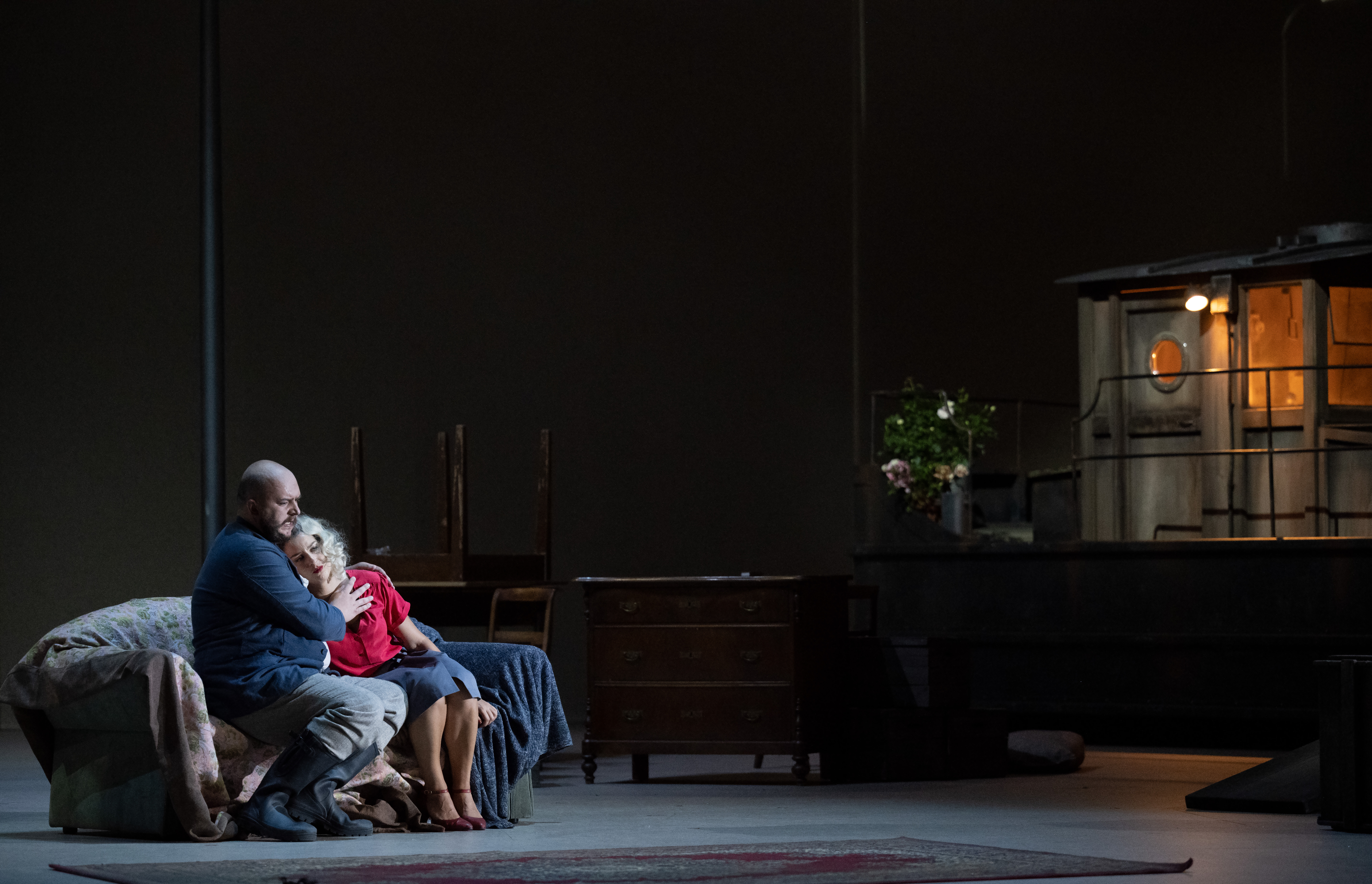
Dante informs proceedings too. Gianni Schicchi has its origins in The Divine Comedy, of course, but Karabulut and her team offer a progression that takes us from the inferno of Il tabarro, explicitly headed with the celebrated inscription, ‘Lasciate ogne speranza voi ch’intrate’. It is far from an unreasonable location for the tragedy of Michele, Giorgetta, and Luigi to unfold; indeed, one might see it as approaching self-evident. What is often given in a naturalistic, or at least highly suggestive, Parisian setting, here becomes a more fantastic, invented world, with at least a hint of science fiction to it, visited at one point by curious visitors who might be from another planet. For this is certainly not an overtly Christian or theological approach, even as we progress through purgatory to paradise; indeed, it becomes if anything less so. Suor Angelica has, quite deliberately, nothing of the Christian convent to it, although its scenic connections with what has preceded and what will follow are cleverly suggested by framing elements retained, as if we were travelling upwards within a (secularised?) theatrical cupola. It is a futuristic society, or seems to be, albeit one with a perhaps unfortunate air of colourised early Dr Who. This, at any rate, is the world from which those visitors have earlier passed through another, as they will do also in the final piece, presented as a satyr play with a vengeance. We see suggested not only an entirely female world, but one in which patriarchy may actually have been superseded, or at least set to one side. If so, its mixings seem decidedly blessed—and perhaps that is the point.


Gianni Schicchi
 

Influence of the commedia dell’arte is seen throughout, in masks, in stylisation of action, and not least in Teresa Vergho’s costumes, connecting in scarlet what she describes as ‘three veritable figures of death: Michele, the Principessa und Gianni Schicchi’. I am not sure I agree when it comes to the third figure, though it is an interesting and far from insupportable thesis. The important thing is not whether one necessarily agrees, though, but that one is led to reflect. Commedia dell’arte functions as a distancing, even alienating (pre-, yet also post-Brecht) strategy, yet proves also in its relative artificiality to provide a way in to emotional directness that avoids the sentimentality to which Puccini stagings can still fall prey. The audience certainly seemed strongly to appreciate the release offered by the final piece’s presentation, living up to Karabulut’s billing of grotesquerie. Doubtless there is a vein of puritanism in my wishing for something a little more restrained, subtle even; such matters are more related to taste than judgement, and this high degree of physicality is more a mainstay of German than English theatre. 

John Fiore stepped in at short notice as conductor, replacing an indisposed Donald Runnicles. There was no doubting, doubly impressive in the circumstances, Fiore’s knowledge of the score and his ability to communicate his reading of it to the excellent Orchestra of the Deutsche Oper. At times, though – and again I think this is mostly a matter of taste – I found the sound a little too pre-packaged: without wishing to essentialise, this seemed a rather transatlantic understanding of Puccini, made, as it were for the Met. (Fair enough, one might say, given that is precisely where the operas were made for.) Surface sheen and extraordinary dynamic range were characteristic, yet so was stereotypical ultra-broadening for vocal climaxes—and, sadly, no attempt to evade or silence the applause within operas this helped provoke. I missed a little more Wagnerism – doubtless I would – though I greatly appreciated the unapologetic refusal to tone down the shock, in context, of Puccini’s bitonal and other explorations. Petrushka may be a little too apparent in Il tabarro, but there are many, many worse models. And if the Seine were less apparent visually – the water we saw was somehow both more elemental and more figurative, Stygian perhaps – we certainly heard it loud and clear as a character of its own in the score.


Il tabarro: Michele (Misha Karia), Luigi (Jonathan Tetelman)
 

Misha Kiria, Salzburg’s Gianni Schicchi, played the (anti?)-hero here too, as well as Michele. His versatility and sensitivity rightly garnered prolonged audience approbation. Likewise Mané Galoyan’s heartfelt, properly differentiated Suor Angelica and Lauretta. Violeta Urmana’s Zia Principessa proved a typical star turn: almost, one might say, an ‘also starring…’ moment. Carmen Giannattasio and Jonathan Tetelman, doubtless assisted by the production, brought undeniable sexual chemistry to their portrayal of Giorgetta and Luigi; it was difficult to take one’s eyes and ears off them, whether apart or together.  Andrei Danilov’s Rinuccio was similarly as ardent as one could wish for, a winning development of his (retrospective) cameo as the Song seller in Il Tabarro. Andrew Harris’s Simone and Annika Schlicht shone as Simone and Zita respectively. But there was little in the way of weak vocal links—and plenty of character to even the smallest performance. That quality was certainly shared by the Chorus and Children’s Chorus, splendidly prepared by Jeremy Bines and Christian Lindhorst. Whatever my doubts concerning a few aspects of detail, doubts that seemed from the audience reaction very much a minority response, this was an evening that spoke of the strength in depth of the Deutsche Oper as well as the enduring appeal and enigma of Puccini’s Trittico.


Sunday, 12 March 2023

Turandot, Royal Opera, 10 March 2023


Royal Opera House

Turandot – Anna Pirozzi
Emperor Altoum – Alexander Kravets
Calaf – Yonghoo Lee
Liù – Masabane Cecilia Rangwanasha
Timur – Vitalij Kowalkow
Ping – Hansung Yoo
Pang – Aled Hall
Pong – Michael Gibson
Mandarin – Blaise Malaba
Two Girls – Marianne Cotterill, Tamsin Coombs

Andrei Serban (director)
Jack Furness (revival director)
Sally Jacobs (designs)
Kate Flatt (choreography)
Tatiana Novaes Coelho (choreology)
E. Mitchell Dana (lighting)

Royal Opera Chorus (chorus master: William Spaulding)
Orchestra of the Royal Opera House
Antonio Pappano (conductor)


Images: Marc Brenner

Andrei Serban’s production of Turandot has certainly offered the Royal Opera its money’s worth. First seen – somewhat oddly, not at Covent Garden, but on tour to Los Angeles – in 1984, it has had no fewer than fifteen revivals on home territory, as well as touring internationally and being adapted for performances at Wembley Arena (1991 and 1992). No wonder, as Serban’s programme biography states, that ‘he is both surprised and delighted that his production … is still revived.’ This, however, is apparently to be its final outing. Assuming that to be the case, it is receiving a good send off: not before time, yet with strong performances and revival direction from Jack Furness considerably more convincing than what I saw in earlier reincarnations (2013 and 2014). 

What we see seems understandably eager to veer towards Carlo Gozzi’s fairytale. Ping, Pang, and Pong (I know…) lose the worst of their racialised appearance, clearly taking their leave instead from commedia dell’arte. Lively performances from Hansung Yoo, Aled Hall, and Michael Gibson certainly helped in that respect, perhaps even going so far as to suggest that these, alongside Puccini, might be the real orchestrators of the action, playful as well as sadistic, intriguingly beyond morality in an almost Nieztschean sense. Where that leaves the story of Turandot, Calaf, and of course Liù remains, shall we say, problematical. The ‘arias’ embedded in the score stood out awkwardly, as if remnants – and in a way they are – of bygone technique, which the composer at the height of his musical powers was unable to banish entirely, on account of theatrical and audience expectations. 


The closer the story moves to realism, the more repellent its final sadism becomes: magnificent in a way, yet also strangely unsatisfactory. The more fantastical the framework and action, the greater the artifice, the better. This seems to be well understood and indeed communicated, not least through a parade of dances that might readily have seemed theatrical for the sake of theatre. In a way they still do, yet in this context, that offers a possibility if not quite for redemption, than for something less (im)morally outrageous. The framing of the set as a theatre of sorts, or at least a public arena suggestive of one – are not the two often coterminous and coexistent? – contributes with unusual success to that desirable distancing of standpoint. Masks serve with similar, indeed still more absolute, necessity.


In the title role, Anna Pirozzi offered a well sung, unusually human performance, warmer than many, though also posing the question as to whether that is what we should want here. Why not, really? In posing that question it is surely performing a dramatic service of its own, difficult conflict being part of the point. Yonghoon Lee’s heroic stab at Calaf should also be commended. Only on rare occasions, when something more inwardly vulnerable was required, did it sound lacking, but that is always a difficult near-circle to square. He can ride an orchestral wave, and did. He also seemed very much at one with Furness’s reimagining of the production. Even reimagined, the production arguably does Liù no favours, but that is much to ask of any staging. Masabane Cecilia Rangwanasha’s heartfelt, sincere performance was very much in the mainstream of expectations here. Timur’s strange appearance – an old man, to be sure, though it is stranger than that – likewise does the role no favours, yet when he sang, Vitalij Kowalkow was able vocally to rise far above visual limitations. 

In the pit, Antonio Pappano offered what for me turned out to be one of his best performances at Covent Garden. I have given up trying to reconcile myself to his Wagner; we clearly hear and understand that and much other music in such different ways that I am unlikely to ‘get’ it any time soon. Here, however, a Puccini darkly haunted by, even founded upon, marriage of darkly Wagnerian chromaticism to a surprisingly Wagnerian way with motivic construction – to my ears, more so than in Pappano’s Wagner – offered just the sort of musico-theatrical experience that was called for. Flexible yet goal-directed, enabling of singers yet also revelling in Puccini’s ‘symphonism’, it told us what we knew yet perhaps still wished we did not. This was a murky, malevolent tale that could not quite be wished away with a welcome does of theatrical fantasy. The oft-remarked affinities with more contemporary (to Puccini) music, not least Stravinsky and Schoenberg, were perhaps less immediately present, but viciousness both of score and broader theatrical purpose were certainly very much with us. With orchestra and chorus on excellent form, Pappano brought something both old and new to the score, greatly to his – and its – credit.


Farewell then, we think, to Serban. Even when revived with such intelligence as seen here, this is not a production directly to address the very difficult, probably insoluble, questions this extraordinary, flawed opera presents. Yet, given space such as was granted here – and was not, to the best of my memory, so apparent when I first saw the production – it can nonetheless permit them to play out. Taking a view seems more of a moral imperative here, on account of the sadism as much as the racism; there are many ways to do that, whether by transforming the work into something more directly political (or something else?) or by confronting its issues head on. We shall see what Serban’s successor does. This however, offers an often intriguing and absorbing last hurrah, as well, I suspect, as a hint to why new steps may prove necessary.


Wednesday, 24 August 2022

Salzburg Festival (2) - Il trittico, 21 August 2022


Grosses Festspielhaus

Gianni Schicchi – Misha Kiria
Lauretta – Asmik Grigorian
Zita – Enkelejda Shkosa
Rinuccio – Alexey Neklyudov
Gherardo – Dean Power
Nella – Lavinia Bini
Gherardino – Daniel Fussek
Betto di Signa – Manel Esteve Madrid
Simone – Scott Wilde
Marco – Iurii Samoilov
La Ciesca – Caterina Piva
Maestro Spinelloccio – Matteo Peirone
Ser Amantio di Noclao – Mikołaj Trąbka
Pinellino – Aleksei Kulagin
Guccio – Liam James Karai
Buoso Donati – Leopold Böhm


Michele – Roman Burdenko
Giorgetta – Asmik Grigorian
Luigi – Joshua Guerrero
Il Tinca – Andrea Giovannini
Il Talpa – Scott Wilde
La Frugola – Enkelejda Shkosa
Song seller – Dean Power
Lovers – Dean Power, Martina Russomanno
Midinettes – Dijana Kos, Irena Krsteska, Wilma Maller, Irina Peroš, Katarína Porubanová, Anna Yasiutina
Dancers – Clara Cozzolino, Mário Jorge Moisés da Silva Branco, Joni Österlund, Anna Possarnig, Guillaume Rabain, Nicolas Franciscus, Giulia Tornarolli

Sister Angelica – Asmik Grigorian
La Zia Principessa – Karita Mattila
Abbess – Hanna Schwarz
Sister Zelatrice – Enkelejda Shkosa
Mistress of the Novices – Vaterina Piva
Sister Genovieffa – Giulia Semenzato
Sister Osmina – Martina Russo manno
Sister Dolcina – Daryl Freedman
Nursing Sister – Juliette Mars
Alms Sisters – Lavinia Bini, Alma Neuhaus
Novice – Amira Elmadfa
Lay Sisters – Svenja Kallweit, Anna Yasiutina
Son – Jonathan Ehrenreich
Choral soloists – Dijana Kos, Mari Nakayama, Irina Peroš

Christof Loy (director)
Étienne Pluss (set designs)
Barbara Drosihn (costumes)
Fabrice Kebour (lighting)
Yvonne Gebauer (dramaturgy)  

Salzburg Festival and Theatre Children’s Choir (chorus director: Wolfgang Götz)
Concert Association of the Vienna State Opera Chorus (chorus director: Jörn Hinnerk Andresen) 
Angelika-Prokopp-Summer Academy of the Vienna Philharmonic (stage music)
Vienna Philharmonic Orchestra
Franz Welser-Möst (conductor)


Images: (C) SF /Monika Rittershaus


In many ways, this new production of Puccini’s triptych of one-act operas marked a triumph for the Salzburg Festival. One serious unforced error detracted, yet could only detract so far; likewise a few other cavils. Singing and orchestral playing were excellent throughout on the evening I attended, the last in the run. If Christof Loy’s production offered nothing particular in the way of insight, let alone re-evaluation, it presented the stories clearly and with élan, aided by good design work. Everything came together well, at an undeniably ‘Salzburg’ level.

Loy’s major miscalculation was to mess around with the ordering, so as to present the operas in the order Gianni Schicchi, Il tabarro, and Suor Angelica. The self-justification given in the programme made things worse, speaking of Suor Angelica having given the ‘impression’ of ‘such an extreme impact … that Gianni Schicchi came across as relatively trivial’. Not in my experience, nor in that of anyone I have spoken to. Nor has Il tabarro suffered from a lack of contemporary relevance, as Loy bizarrely suggests. (Quite why moving it to second place would help here remains unclear too.) Apparently, because this is a Festival, ‘everyone [is] in good spirits to be here,’ it makes better sense to open ‘with the seemingly life-affirming atmosphere of Gianni Schicchi’. Enough! There is good reason for placing the comedy last. Suor Angelica, meanwhile, suffers from being placed third, in that not only does it offer less a climax than a sense of tiring, even tailing away; but, perhaps worse, its own genuine musical as well as dramatic interest pales when heard after Schicchi. If you wanted to lend credence to claims of the saccharine, you could do a lot worse than adopt this reordering. Loy says that Franz Welser-Möst and he were in agreement on the matter; Welser-Möst really should have known better. None of this is fatal; after all, the operas are often (probably more often) played alone with entirely different companion pieces. But there is little gain here, and not inconsiderable loss.

Loy’s reputation in certain quarters remains something of a mystery to me. There is, as there certainly was here, a genuine craftsmanship at work. That I could admire—and did greatly. Movement and placing of objects on stage, the identity of each character (most of them, anyway), and much else had clearly been considered; one was left with little doubt that what one saw was what one was supposed to have seen. This is no more than speculation on my part, but I can imagine singers liking to work with him: certainly no bad thing. But beyond a certain generic stylishness, which is presumably in large part the work of his designers, I struggled to find any particular conceptual thinking at work, whether in each individual opera or as something to connect them. All three were vaguely modernised, I suppose, but unless one considers ‘modern dress’ to be a concept in itself, there was nothing to trouble conservative viewers. On the other hand, there was no banal intervention as in, say, Loy’s Tristan (Covent Garden) or Die Frau ohne Schatten (Salzburg, in which he essentially ignored the work altogether). So horses of no breed would have been scared away; perhaps that in itself was the idea.


The Vienna Philharmonic was on tremendous form, clearly relishing the opportunity to play all three operas in something approaching ideal conditions (certainly by way of comparison to the rehearsal schedule, or lack of it, in Vienna). Welser-Möst’s guiding spirit was heard to best effect in the first two operas, the scintillating scherzo of Gianni Schicchi razor-sharp, yet with plenty of tenderness too, the ominous ostinato of the Seine in Il tabarro duly overwhelming. (It took a few hours to get the latter out of my head, following the performance.) Light and shade were as meticulously planned and projected as any stage lighting, and there could be no doubting Welser-Möst’s knowledge and understanding of the scores. I missed a sense of something darker in Suor Angelica, but that was doubtless in considerable part a matter both of the piece itself and Loy’s decision to move it. There might nonetheless have been greater bite in its often intriguing harmonies and also a greater range of colour. A tendency to greyness such as I have often heard in Welser-Möst’s Strauss was not entirely avoided here.


Asmik Grigorian’s heroic service as heroine (of sorts) in all three proved both heartfelt and flawless. She did not tire, far from it, and gave considered, distinct performances of each of her roles. I do not think appreciation of her Sister Angelica was helped by its placing, giving the impression of everything leading up to a ‘big moment’, but I have probably said enough about that now. Her chemistry with Joshua Guerrero as Luigi and, indeed, negatively with Roman Burdenko as Michele was, to my mind, just as impressive, both of those artists turning in thoughtful as well as viscerally immediate performances. So too, unsurprisingly, did Karita Mattila as La Zia Principessa. From the moment she stepped on stage, one knew this was going to be something special, and it certainly was. Equal attention to words, music, and gesture informed a star turn that collegially collaborated with, in no sense upstaging, Grigorian. Much the same might be said, albeit (properly) with less hauteur, of Hanna Schwarz’s Abbess. Grigorian’s Rinuccio, Alexey Neklyudov, proved youthful, ardent, and similarly intelligent: a fine companion. Every portrayal in Gianni Schicchi was indeed, of similar quality, whether solo or ensemble, from Misha Kiria’s wily lawyer down (should that be the right direction). Enkelejda Shkosa’s turn as Zita here was followed by a splendidly animated La Frugola, hinting at hidden depths of sadness, in Il tabarro. This was a Trittico that almost offered the definition of casting from depth. For fine singing, complemented by excellent stage gifts, Personenregie, and orchestral playing, this will surely prove difficult to beat.


Tuesday, 26 July 2022

Margot la Rouge and Le Villi, Opera Holland Park, 23 July 2022


Margot, Anna – Anne Sophie Duprels
Sergeant Thibault – Samuel Sakker
L’Artiste – Paul Carey Jones
Lili Béguin – Sarah Minns
Nini – Laura Lolita Perešivana
La Patronne – Laura Woods
First Soldier – George von Bergen
La Poigne – Jack Holton
Second Soldier – Alistair Sutherland
Totor – David Woloszko
First Woman – Chloé Pardoe
First Drinker – Sean Webster
Second Drinker – Matthew Duncan
Third Drinker, A Man – Peter Lidbetter
Waiter – Richard Moore
Police Inspector – Dragoş Andrei Ionel
Roberto – Peter Auty
Guglielmo – Stephen Gadd
Dancers – Fern Grimbley, Isabel Le Cras, Gabriella Schmidt

Martin Lloyd-Evans (director)
takis (designs)
Jake Wiltshire (lighting)
Jami Reid-Quarrell (movement)

City of London Sinfonia
Opera Holland Park Chorus (chorus director: Dominic Ellis-Peckham)
Francesco Cilluffo (conductor)

Images: Ali Wright
Chorus, Le Villi

Opera Holland Park’s new double-bill of operatic rarities proves a great success, highly recommended to anyone slightly curious to hear works off the beaten track. Delius’s Margot la Rouge, written from 1901-2 but unperformed until 1983, and Puccini’s first opera, Le Villi, here given in its 1884 two-act revision, were both unsuccessful entrants in the Milan publisher Sonzogno’s competition for new one-act operas. In Martin Lloyd-Evans’s production, both open with a father and his daughter, the unfortunate tales to follow initiated by the latter leaving the former. (Make of that what you will.)

Delius’s 45 minutes or so tell a straightforward story in which the woman Marguerite/Margot, fallen into Parisian prostitution, has a chance meeting with her childhood sweetheart, Thibauld, which rekindles their relationship, only for her pimp-lover, L’Artiste, to explode with anger, stab Thibauld, and in turn be stabbed by Margot, who is arrested. There is little in the way of dramatic conflict or surprise; people act precisely as one might expect them to. There is a frankly absurd number of cast-members for a work so short. But it is musically interesting, Delius not only at his most Wagnerian, but far more directed (or conventionally directed) than many of the composer’s more wandering scores. Lloyd Evans and his team summon up a seedy Paris bar, a storm, and various comings and goings with a gutsy verismo spirit that matches what one hears from orchestra and singers alike. If ultimately Margot la Rouge comes across more as a sketch in search of expansion, it certainly does not outstay its welcome and has much to fascinate audiences of various tastes.


Le Villi is, unsurprisingly, the more accomplished, finished work, the level of craftsmanship from Puccini at so early a stage in his career little short of astonishing. The Gothic tale has more in common with French and, perhaps still more, German Romanticism than one might expect. Here, takis’s shell of a bar transformed into a woodland house, Roberto and Anna, celebrating their betrothal, are separated by Roberto’s journey to Mainz to collect his inheritance. Waylaid by a Mainz ‘siren’, he fails to return, choosing instead a city life of debauchery, and Anna dies, her father calling for supernatural vengeance from the Villi who inhabit the forest. Roberto, having finally resolved to return home, meets these fairies instead of his beloved; they do as the legend foretells, dancing him to death.

Puccini is likewise not without Wagnerian influence here, but his truer predecessors seem to be earlier German (and again French) Romantics, as well as the purveyors of French grand opéra and ballet. For, in this early opera-ballet, what surprises most is just how much Puccini sounds like himself. Melodies, harmonies, scoring, if not so much characterisation: so much of his later mastery is already close—and sometimes more than close. Lloyd-Evans’s resourceful production takes full advantage of the magical descent into darkness an evening at Holland Park offers. Again, it tells the story directly, with a sharp eye for detail, and offers plenty for one to consider after the event, as indeed does the work itself.


Both orchestral reductions, by Andreas Luca Beraldo, seemed to me highly successful, in that I pretty much forgot we were not hearing quite the real thing. That success must also of course be attributed to Francesco Cilluffo and the City of London Sinfonia.  Cilluffo’s conducting, energetic yet long-breathed, was imbued with every inch of the conviction necessary to lift such scores off the page. The CLS sounded fuller of tone than many an opera house orchestra of twice the size. It drove the action as much as supported the singers in a true partnership between pit and stage. The Opera Holland Park Chorus, finely trained by Dominic Ellis-Peckham, proved both polished and enthusiastic in its singing—and game in its dancing too. Jami Reid-Quarrell’s choreography, whether for the chorus or the three Villi dancing, was sharp, illustrative, and dramatically conceived.

At the heart of both operas lay the outstanding singing of Anne Sophie Duprels: heartfelt, incisive, and variegated. She was poignantly partnered by Samuel Sakker as Thibauld in Margot la Rouge, Paul Carey Jones’s Artiste offering a contrasting, commanding, and vicious stage presence. The size of the cast offered a host of young singers opportunities to shine, all of them well taken. As Le Villi’s Roberto, Peter Auty might have graced any operatic stage. His marriage of vocal heft, lyricism, and command of detail fully complemented Duprels. Stephen Gadd’s performance as Anna’s father Guglielmo should also be commended. As so often at Holland Park, this was a fine company achievement.

Indeed, I think it was worth drawing attention to the achievement of the greater team at Holland Park. From Director of Opera James Clutton down (not to forget recently departed colleague Michael Volpe), or perhaps better, from a committed team of volunteers up, this is a friendly, welcoming, high-achieving company, crucial both to this country’s operatic ecology, past, present, and future, and also playing its part in building a more sustainable theatre in the broader, ecological sense. Since the pandemic, OHP has taken still greater care to work in partnership with local suppliers; a wonderful array of upscaled furniture provides audience seating; the auditorium has been constructed from reclaimed wood and recycled shipping containers. Art for art’s sake matters; let no one tell you otherwise. But art is never solely for art’s sake. To survive, it must assume and further social, environmental, and political responsibility. When everything goes right artistically, as it does here, that is even better, but human striving, artistic and social, matters greatly in itself and will only do so more as our world belatedly confronts a host of crises that never should have been permitted to reach this stage. Every theatre company, every orchestra, every artist, every partner organisation will have its/his/her/their own solutions, but they must work together too; that includes us as audiences. What better place to learn from hard work, effort, and example than here in Holland Park?