Showing posts with label Janáček. Show all posts

Tuesday, 3 March 2026

The Cunning Little Vixen, Staatsoper Unter den Linden, 28 February 2026


Vixen – Vera-Lotte Böecker
Forester – Svatopluk Sem
Fox – Magdalena Kožená
Forester’s Wife, Owl – Natalia Skrycka
Schoolmaster, Mosquito – Florian Hoffmann
Priest, Badger – David Oštrek
Harašta – Carles Pachon
Dachsund, Woodpecker – Sandra Laagus
Rooster – Anna Samuil
Innkeeper’s Wife, Hen – Adriane Queiroz
Jay – Sonja Herranen
Innkeeper – Junho Hwang

Frog – Milla Aulibauer
Cricket – Paula Bredt
Grasshopper – Alexander Meieer
Young Vixen – Naz Yilmaz
Frantík – Otto Glass
Pepík – Alia Engel
First fox cub – Paloma Couloumy

Director – Ted Huffman
Assistant director – Sonoko Kamimura
Set designs – Nadja Sofie Eller
Costumes – Astrid Klein
Lighting – Bertrand Couderc
Choreography – Pim Veulings
Dramaturgy – Detlef Giese, Elisabeth Kühne

Children’s Choir of the Staatsoper Unter den Linden (director: Vinzenz Weissenburger)
Staatsopernchor Berlin (director: Dani Juris)
Staatskapelle Berlin
Sir Simon Rattle (conductor)


Images: Monika Rittershaus


Believe it or not, this was the first ever performance at the Staatsoper Unter den Linden of The Cunning Little Vixen, more than a century after its world premiere in Brno. It is not that it has never been performed in Berlin before, of course not. Walter Felsenstein’s 1956 (German-language) Komische Oper production was a landmark in the reception of the work and, more broadly, of Janáček outside the Czech lands. In 1965, Felsenstein’s production was made into a magical film for East German television, conducted by no less than Václav Neumann. Yet the house a few hundred metres away left the opera alone and indeed showed little interest in most of Janáček’s operas, even as they were revived elsewhere, in Europe or beyond. Simon Rattle’s passion for the composer, combined with his now long-term collaboration with the Staatsoper and Daniel Barenboim’s trust in Rattle, has now resulted in a number of Janáček house premieres, of which this must surely be the most surprising. Rattle conducted the opera for the first time almost fifty years ago, at Glyndebourne, in 1977. He has also conducted it with the Royal Opera and the LSO, as well as with the Berlin Philharmonic. So here we had an inviting blend of novelty and experience, mirrored onstage by the combination of adult professionals and child performers (acrobats as well as singers).

How did that work in practice? Rattle certainly conducted it with the knowledge, sympathy, and understanding that would entail. Pacing was such that one did not notice it; it proceeded naturally and, in general, at the rate of a sung play, as Janáček tends to require. The composer’s language had been fully internalised and put to good musicodramatic use, even if the Staatskapelle Berlin – understandably – did not always sound quite so much at home in this music as other opera orchestras (or indeed the LSO, which has taken to it like ducks to water). It was a golden, Straussian Janáček we heard: nothing wrong with that and indeed one might sometimes say the same about the most ‘authentic’ Janáček of all, from Czech orchestras. There is in their Janáček, though, something I did not quite hear in this case: not only ‘tradition’, that slippery, movable, even questionable feast; but also an instinctive feel of how the orchestral music speaks, sings, propels, and even bites, in its own extraordinary language. Playing was on its own terms, though, excellent throughout; I should not exaggerate a relatively minor reservation. 


As has been the case for his Janáček performances in both London and Berlin, Rattle had assembled and/or attracted a fine cast too. Vera-Lotte Böecker’s Vixen was characterful, animated, and sympathetic without being remotely cutesy. This world of Nature should never be sentimentalised. Magdalena Kožená offered a proper, more masculine complement with her Fox; the two matched one another at times as if in a Mozart instrumental serenade. Svatopluk Sem was a distinguished, humane Forester, his final hymn to Nature and its life cycles properly moving. (By now, the Staatskapelle too seemed more fully inside Janáček’s idiom.) Natalia Skrycka, Anna Samuil, David Oštrek, and Carles Pachon particularly stood out to me in their respective roles. Samuil’s Rooster proved a delightful, scene-stealing Rooster. But this was casting in depth too. No one disappointed, right down to the smaller animal roles very well taken by members of the Staatsoper’s International Opera Studio and also of its Children’s Choir. Choral singing in general was of a high standard throughout. 


Unfortunately, Ted Huffman’s production proved a disappointment. It had its moments, a highpoint being the imaginative presentation of the vixen’s running amok in the chicken coup, feathers flying across the stage as hens’ costumes were punctured. At that point, following a slow and disjointed start in stage terms, all seemed to be coming together nicely. It was, alas, difficult to discern much of a line in what followed, ideas briefly floated only to vanish without trace or recur arbitrarily, as in characters’ typing of letters towards Terynka during interludes, which added little other than confusion. All took place ultimately in a white box, Nadja Sofie Eller’s designs offering neither natural wonder nor obvious deracinated contrast. For some reason, great play was made of dressing the chorus in highly individualised human outfits: well designed as such by Astrid Klein, but it was unclear to what end. Lighting seemed to be little more than simple on and off; perhaps a point was being made, but again I am not sure what. There was scope for the children to display their skills, undoubtedly welcome; yet integration into the plot, be it of opera or production, proved elusive.


Insofar as there was an overall idea, it seemed to be to blur the boundaries between animals and humans: fair enough, but the blurring seemed, well, blurred in focus and ultimately arbitrary. This was a different attempt at realism from Felsenstein’s, from that of Peter Sellars too (for Rattle and the BPO in 2017). If preferable to the latter, which was often frankly bizarre, it could surely have learned something from the former, even at this distance, not least in terms of overall coherence and indeed of a sense of what the work, or the production for that matter, might be about. Elsewhere, the accomplishment of that one scene with the chickens threw into relief what came across as a lack of basic, general direction elsewhere. Some scenes more resembled an early stage of rehearsal than a finished staging.
 

This is necessarily impressionistic, but I could not help noticing that younger and more international elements, visiting or resident, appeared distinctly less enthusiastic than the older, local core of the audience. If I were to hazard a potential explanation, I might note that it could hardly have been a matter of theatrical style and values. The production had nothing obviously in common with critical German theatre—unless that were why some approved, which I should not discount entirely. But I do not think it was only that; there seemed to be a genuine excitement at encountering the work, notwithstanding those Rattle performances at the Philharmonie in 2017. Those of us who have seen it in multiple stagings may be, according to taste, more critical or more jaded. Yet it is no bad thing to be reminded of the joy of encountering a Janáček opera for the first time; of that there appeared to be much in evidence.


Friday, 16 January 2026

The Makropulos Case, LSO/Rattle, 15 January 2026


Barbican Hall

Emilia Marty – Marlis Peterson
Krista – Doubravka Novotná
Albert Gregor – Aleš Briscein
Baron Jaroslav Prus – Svatopluk Sem
Dr Kolenatý, Strojník, Machinist – Jan Martiník
Vítek – Peter Hoare
Count Hauk-Šendorf – Alan Oke
Janek – Vit Nosek
Cleaning lady, chambermaid – Lucie Hilscherová

London Symphony Orchestra
Simon Rattle (conductor)


Images: Mark Allan


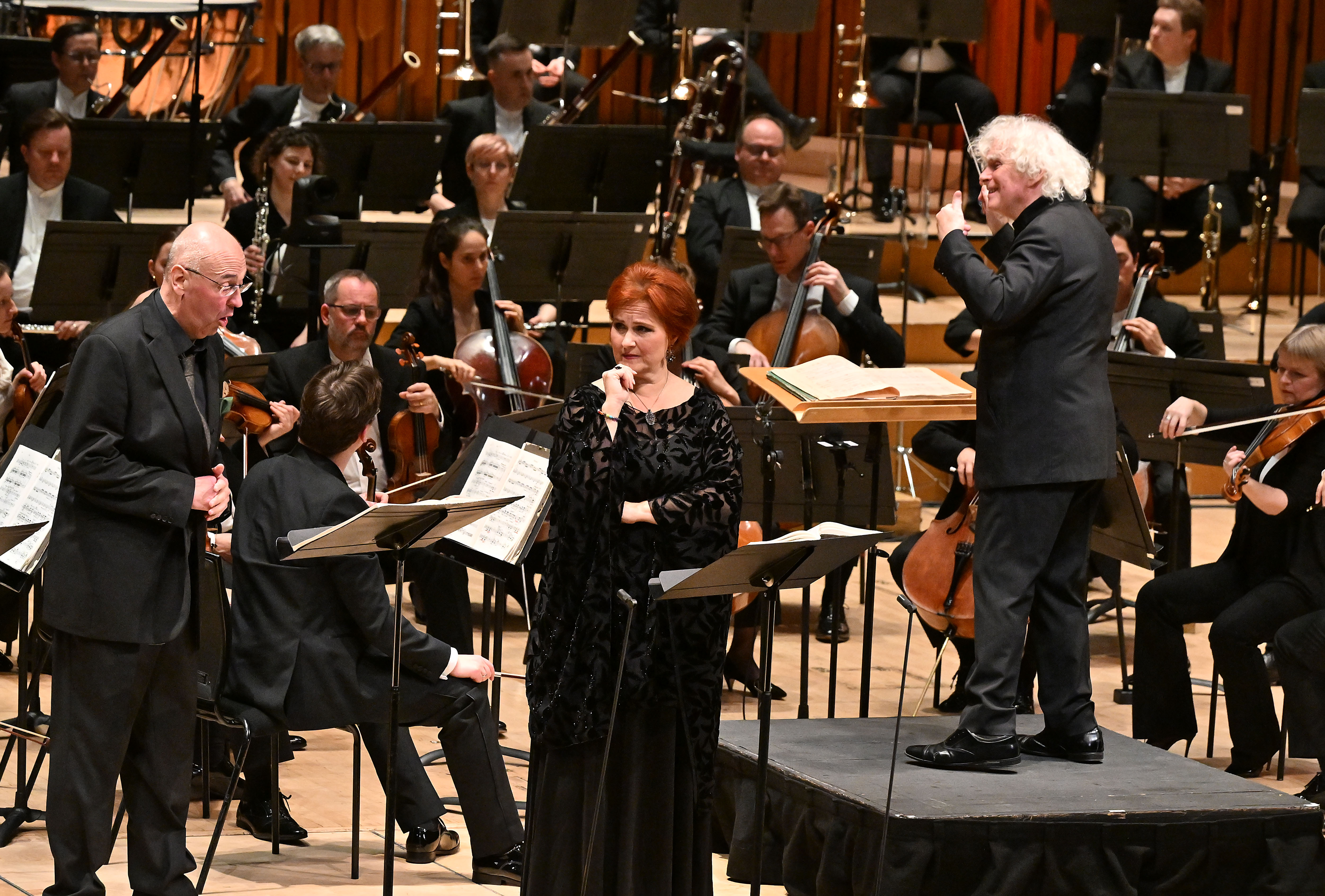
Simon Rattle’s twin traversal of the Janáček operas in concert in London and onstage in Berlin has now reached The Makropulos Case in the former, Claus Guth’s staging for the Staatsoper Unter den Linden’s having been its first ever. I suspect this may also have been the LSO’s first performance, though shall happily be corrected. At any rate, from the very outset, both Rattle and the LSO sounded entirely ‘inside’ the work, with all the security of a repertory staple, yet with all the freshness and exhilaration of discovery. It is only two months ago that the Royal Ballet and Opera staged the opera, in what was reported to have been Katie Mitchell’s feminist farewell to the genre. If so, Mitchell certainly went out with a bang in one of those rare productions that will prove not only memorable but also to have transformed our understanding of the work forever, expertly conducted by the RBO’s music director Jakub Hrůsá, and with a fine cast headed by Aušrinė Stundyte. That will have been fresh in the memories of many in the Barbican audience, but that did not prevent the hall from apparently selling out for not one but two concert performances; indeed, I suspect it aided that success.

That first-act Prelude constructed a frame for our listening thereafter, strings, timpani, and the rest, offstage brass included, ‘speaking’ in just the right way for opera: musically generative and full of dramatic content and commentary, almost more Wagnerian than Wagner, without ever sounding especially Wagnerian. Czech speech rhythms met the time-honoured craft of something approaching orchestral accompagnato in Rattle’s conducting, so that the composer’s twin poles of cellular radicalism and lyrical expansion proved not only compatible but mutually dependent and generative. At the beginning of each act, there was an unmistakeable sense of where we were, how we (dramatically) had got there, and of anticipation. For the LSO was on outstanding form. It would be invidious to single out any instrument or section, since all, from trombones to xylophone, contributed so eloquently. What struck was a sense of a myriad of lines, orchestral and vocal, combining in ever transformative fashion to a harmonic, contrapuntal, and dramatic whole.


The essence of opera in concert performance is complex: what it is, what it is not, what it might or might not be. Those of us had recently seen Mitchell’s staging will doubtless have come to the performance with different views of the work from those who had not, and so on. What is incontestably the case for everyone is that the orchestra literally takes centre stage, and we both see and hear its music very differently from when it emerges from a sunken pit. Singers must prove at least as verbally and musically communicative, since there is less room for staged expression; Rattle’s latest Janáček troupe certainly impressed in that and indeed in all other respects. It was almost like reading – or having read to one – a sung novella. In a typically livewire performance, Peter Hoare, one of two singers common to the Barbican and Covent Garden, could not but help but act. That early liberation acted as if to inspire the rest of the cast.

Marlis Petersen as Emilia Marty seemed just ‘right’ in all she did: voice, bearing, and unmistakeable sympathy. Doubravka Novotná’s rich-toned, spirited Krista proved the perfect foil—or better, one of them. From Aleš Briscein’s ardent Albert Gregor to Alan Oke’s magnificently vivid cameo (the other role shared from Covent Garden) as Count Hauk-Šendorf, this performance had a true sense of company even without staging. Jan Martiník’s three characters were sharply drawn as individuals, as was Svatopluk Sem’s Jaroslav Prus. Vit Nosek and Lucie Hilscherová likewise made the most of their roles, created through words and music, yet as human as if we had seen them onstage.  Such vivid characterisation drew back even those of us won over by Mitchell’s alternative vision towards the work ‘itself’. Those new to the opera will surely have been enthralled. A roaring reception suggested so.


For it was in the third act, as it must be, that Janáček’s drama palpably touched all as if for the first time. Here was most clearly redrawn in exultant urgency the twin clarity and abandon of E.M. to the increasing irrelevance of the men (and women) surrounding her, reminding us that ultimately, Mitchell’s staging grew out of the work’s essence rather than being imposed upon it (as uncomprehending criticism claimed). Taking a view does not necessarily mean betrayal; it is often fundamental to fidelity. Petersen and the orchestra’s transfiguration sent shivers down the spine in what came to seem, if you can imagine such a thing, almost a female, even feminist, Gerontius. Now there might lie a challenge to staging.


Sunday, 28 December 2025

Tally of opera performances attended 2025


Not a vintage year for opera performances, at least in quantity. Returning to Brexit-Insel, even with as many escapes as humanly possible, has had a considerable hand in that. This has nevertheless been the first year in which I have seen more than one Salieri opera. It would be nice to think it will not be the last, but that seems unlikely. As usual, concert performances are included, as are works performed 'as' operas, thus Handel oratorios and even Mahler's Das Lied von der Erde. Concerts and a combined tally will follow.

Wagner 5

Janáček, Mozart, Strauss 3

Handel, Salieri 2

Berg, Bizet, Cavalli. Unsuk Chin, Eötvös, Fauré, Gluck, Kurtág, Mahler, Thea Musgrave, Purcell, Rossini, Rebecca Saunders, Schoenberg, Tchaikovsky, Turnage, Weill 1


Tuesday, 11 November 2025

The Makropulos Case, Royal Opera and Ballet, 10 November 2025


Royal Opera House

Emilia Marty – Ausrine Stundyte
Krista – Heather Engebretson
Albert Gregor – Sean Panikkar
Baron Jaroslav Prus – Johan Reuter
Dr Kolenatý – Henry Waddington
Vítek – Peter Hoare
Count Hauk-Šendorf – Alan Oke
Janek – Daniel Matoušek
Stage Door Woman – Susan Bickley
Security Guard – Jeremy White
Hotel Maid – Jingwen Cai

Katie Mitchell (director)
Vicki Mortimer (set designs)
Sussie Juhlin-Wallén (costumes)
James Farncombe (lighting)
Sasha Balmazi-Owen (video)

Royal Opera Chorus (chorus director: William Spaulding)
Orchestra of the Royal Opera House
Jakub Hrůsá (conductor)
 

Image: The Royal Opera / Camilla Greenwell

If the Royal Opera and Ballet’s new Makropulos Case does indeed prove to be Katie Mitchell’s final opera production, we should think of it more as a culmination than a farewell. If the owl of Minerva spreads its wings only at dusk, the outlines of Mitchell’s operatic work – part, to be sure, of her broader theatrical work, but a distinctive part – may now seem clearer to us all. Rightly or wrongly, for I can lay no claim to oracular status on this or any other question, they certainly do to me following this superlative evening, dramatically and musically, in the theatre, a splendid addition to the company’s Janáček series? May we hope for a Mr Brouček, even a Šárka or an Osud? Hope dies last, as the ambiguous, even oracular, saying has it. 

And death lies at the heart of this work, as does life—as does their cyclical relationship both in Janáček’s work as a whole and this production, in turn both in its overt presentation and in its broader, metatheatrical, even symbolic frame. One might say the same of women, their role in society, and their role in opera, Mr Brouček’s Excursions the great exception, for even From the House of the Dead has one feel their absence. The Makropulos Case is centred, of course, around a great female singer, a great survivor, a woman seemingly infinitely blessed, but in reality, if not infinitely, then gravely cursed. She is literally the creation of men, in some ways figuratively too. I say ‘a woman’ and of course she is, but as such and as a human, she deserves to be named: Emilia Marty, Elena Makropulos, and the rest. (We may, if we wish, recall Kundry’s many names and incarnations. Wagner was not a feminist; to claim so would be anachronistic nonsense. But his works are not without feminist themes and, more to the point, opportunities—as well as themes and opportunities that are anything but. The same, of course, may be said of Janáček.) Mitchell takes a further step: this woman is queer, standing in no need of men, whatever the history with which she has been furnished (by them) may claim. She has fond memories; she has produced numerous ‘bastards’ with them, but now does not care for them (men or children). 

Now forty-plus = or so she claims and appears – EM seeks women on ‘dating’ apps. With a technological bent very much of our time, the opera begins, app and text message communications, courtesy of Sasha Balmazi-Owen, running parallel to, interacting with, and sometimes undercutting the work ‘itself’. Krista and Janek intend to rob her, the former (‘they/them’) ensnaring her prey 200 metres distant and securing an invitation to her hotel room. The proceeds, whose net worth Janek instantly checks online as Krista photographs them, include an eighteenth-century medallion and a rare, early twentieth-century playbill. Yet ultimately, Krista falls for EM, mesmerised as her male admirers, yet apparently feeling and sharing something deeper. Rather than absconding to Berlin with her (former) lover, she shoots him: shades of Lulu, perhaps, yet with the crucial distance that this is no blank canvas onto which male fantasies are projected. This is women in love, by women, for women.

Surtitles are contemporary English in tone, without becoming paraphrase. Additional communications fly across the ether: ‘Berlin or bust’, popular abbreviations, emojis, and so on. Like anything else, use of text messages – also here telephone calls, audio and video – can be a cliché, a gimmick, and too often is. Here, unlike in, say, Simon Stone’s tedious, extravagant, and tediously extravagant Cherubini Médée – if ever there were an opera crying out for the Mitchell touch… - or Kirill Serebrennikov’s silly Marriage of Figaro, it serves a useful dramatic purpose, both straightforwardly and more metatheatrically in its extension of live cinema to new realms in successful pursuit of Mitchell’s longstanding and, in this case, unapologetically queer subversion of the male gaze both generally and in specifically operatic guise. For when the diva comes at long last to die, she is not so much a creature of opera, but opera itself. Has the director killed the genre or let it die? More significantly, has it in its death, which may yet permit of rebirth though not artificial prolongation, at last been liberated of the male gaze. On an optimistic reading: yes, at least in part. The elixir is bequeathed to Krista as a gift of what appears to be love, but does it remain a poisoned chalice; can it be cleansed?

Janácek’s score naturally invites some degree of optimism, its increasingly rapt lyricism, orchestral motifs coalescing, combining, and expanding into something greater, brought home in wondrous, golden immediacy by Jakub Hrůsá at the helm of the Orchestra of the Royal Opera House. That Hrůsá is the real thing no one who has heard him will doubt, but this proved a significant achievement even by his standards, as intellectually as it was emotionally involving. The same must be said of Ausrine Stundyte’s all-encompassing assumption of the title role, rightly permitting of various readings whilst ever sure of its direction. No wonder the rest of her world lay in her thrall. All contributed something to the greater whole, showing what the world of opera can and should be. I shall note Sean Panikkar’s typically ardent, lyrical Albert Gregor, Peter Hoare’s sharply characterised Vitek, Heather Engebretson’s sparky Krista, and, in another tribute, conscious or otherwise, to the best of an opera company and its progress of time, Johan Reuter ‘moving up’ from, say, Orest and Birtwistle’s Theseus to Baron Prus, and Susan Bickley from numerous Covent Garden roles (and her ENO Dido with Mitchell) to the cameo of the Stage Door Woman. It was, though, a collaborative effort, as production, conductor, work, and any future for the genre demand.

From that ENO After Dido, Purcell’s jewel forming part of a greater theatre piece, through a Salzburg Al gran sole carico d’amore I imagine I might understand better now than I did in 2009, live cinema again offering a feminist corrective or at least enhancement to Luigi Nono’s project of telling European revolutionary experience from the standpoint of female revolutionaries,  the woman’s revenge of Written on Skin and queer love of Lessons in Love and Violence, the postdramatic feminism of The Blue Woman, and important reassessments such as her Aix Ariadne auf Naxos and Pelléas and Covent Garden Theodora, a path becomes traceable towards this Makropulos Case. Is it the end of the line? That should not really even be the question; it is certainly an important, musicotheatrically riveting contribution, one I am keen to see again, should I be able. 

Cathérine Clément notoriously described opera as the ‘undoing of women’. Perhaps, if one is extremely selective—and one treats it only in terms of libretti. Go back to Monteverdi’s Poppea or forward to Rebecca Saunders’s recent operatic debut and it seems anything but. Nevertheless, that book or at least its title remains, whether we like it or no, part of operatic discourse. Carolyn Abbate’s review said most, perhaps all, of what need be said about it. And here, as it must, that theory is realised in practice, without in any sense jettisoning necessary critique. Actually existing opera houses and their ways are, or can be, another thing. This is not in any sense intended to refer to the Royal Opera House in particular; indeed, its relatively recent, highly publicised appointment of an intimacy coordinator marked an important step forward in one respect. I know no details of the opera-world misogyny Mitchell has endured – her recent interview lies behind a Murdoch paywall – and I do not intend to speculate. What I can say is that operatic works, historical and contemporary, and performances offer greater scope for critique and, dare I say it, redemption than the day-to-day activities of any company will. This year’s greatest musical centenary, that of Pierre Boulez, reminds us of the necessary utopianism of his celebrated 1967 interview with Der Spiegel.

New German opera houses certainly look very modern—from the outside; on the inside, they have remained extremely old-fashioned. To a theatre in which mostly repertory pieces are performed one can only with the greatest difficulty bring a modern opera—it is unthinkable. The most expensive solution would be to blow the opera houses into the air. But do you not think that that might also be the most elegant solution? 

In turn, that echoes a Wagner’s diary entry from 1849.

8 May (Monday) Morning once again by roundabout route via barricades to Town Hall. At S. Anne Barricade guard shouts “Well, Mr Conductor, joy’s beautiful divine spark’s made a blaze.” (3rd perf. 9th Symphony at previous Palm Sunday concert; Opera House now burnt down. Strange feeling of comfort.


This latest death  will not destroy our opera houses and companies, nor even leave them peacefully to die, but should at least ask us whether that would be advisable. Is this, rather than opera as the undoing of women, then, women as the undoing and possible rebirth of opera? It might, considered in utopian fashion, constitute an act of operatic reform or revolution to be compared with the work composers such as Wagner, conductors such as Boulez, directors such as Stefan Herheim, and singers such as Wilhelmine Schröder-Devrient, noting ruefully and purposefully the gender balance of historical examples, whilst recalling Boulez’s own caution that, although Wagner’s Bayreuth project was in almost every respect right and necessary, it has not had the slightest effect on the day-to-day life of our benighted operatic culture. And yet, it has, for our revolutionary-reformers continue to offer a critique of patriarchy, of heteronormativity, and of capitalism many of us continue to heed. To do more than criticise, we must all play our part. The Royal Opera and Ballet has done so too, staging Janáček’s opera (incredibly) for the first time and supporting a new way forward. The Royal Opera and Ballet has done so too, staging Janáček’s opera (incredibly) for the first time and supporting, among many other things in its necessarily mixed economy, some seeds of a new way forward. 

Friday, 9 May 2025

The Excursions of Mr Brouček, LSO/Rattle, 6 May 2025


Barbican Hall

Mr Brouček – Peter Hoare
Mazal/Blankytný – Aleš Briscein
Málinka/Etherea/Kunka – Lucy Crowe
Sacristan/Svatopluk/Lunobor/Domšík – Gyula Orendt
Würfl/Čaraskvouci/Councillor – Lukáš Zeman
Čišničeck/Child prodigy/Student – Doubravka Novotná
Kedruta – Hanna Hipp
Básník/Oblačný/Vacek- Arttu Kataja
Artist/Dohuslav/Vojta – Stephan Rügamer
Skladatel/Harfoboj/Miroslav – Linard Vrielink

Tenebrae (chorus director: Nigel Short)
London Symphony Orchestra
Simon Rattle (conductor)


Images: Mark Allan


Simon Rattle’s survey of the Janáček operas has proved a tale of two cities: Berlin (first the Philharmonic and latterly the Staatsoper) and London (the LSO). The latter has been mostly in concert, although it shared Peter Sellars’s concert staging with the Berlin Philharmonic. Now, on the back of Robert Carsen’s Berlin staging, originally seen at the Janáček Festival Brno, the LSO’s series reaches The Excursions of Mr Brouček to the Moon and to the 15th Century. 

Of those I have attended, this unquestionably marked the highpoint: one of those performances it is difficult immediately to imagine being bettered. At the heart of that was the magnificent playing of the LSO. Janáček had not previously played a large part in its repertoire, though I remember an interesting, also highly criticised Glagolitic Mass from Colin Davis. It hardly could, one might say, for a symphony rather than an opera orchestra, which incidentally reminds us of a long-term consequence of Davis and Clive Gillinson’s tenures, nurtured by their successors: regular performances of opera in concert, supplemented by occasional appearances in festival pits. Intimacy of acquaintance with Janáček’s writing, its melodic, rhythmic, harmonic, and timbral qualities, inextricably bound to the Czech language, told—as, I think, it did with Rattle, who has long championed this music and who no longer has anything to prove. Precision, heft, the way the orchestra ‘spoke’: this and so much more made for an ideal partnership, rendered all the more impressive by a uniformly impressive cast and chorus (the ever versatile Tenebrae choir, trained and sometimes conducted here by Nigel Short). 


From the opening of the first part, dance rhythms and orchestral colours, xylophone immediately recalled from Jenůfa, created a dramatic stage before our ears, so much so that it is difficult to imagine anyone truly regretting the lack of staging. Time of day, temperature (literal and metaphorical), place, and much more were palpable, indeed unavoidable. As dawn approached at the end of the first part, one felt it emotionally, overwhelmingly so, as well as temporally. For a tenderness embedded in the composer’s deep humanity was always apparent, in a reading that saw no reason to exaggerate the bizarre, zany elements, as perhaps did David Pountney in a memorable 2022 staging for Grange Park Opera. There is room for all, but this went deeper, also underscoring the extraordinary, innovative brilliance of the composer as a contemporary of Strauss, Schoenberg, and yes, Puccini. There was absurdity, yes, but in that absurdity lay deepest sincerity, and the second part, darker and more soulful from the off, proved more moving still. Soundworlds related yet distinct offered both contrast and connection between the opera’s two parts. 

Peter Hoare, who had also sung the title at Grange Park, proved if anything a still more captivating Mr Brouček, alive to his provincial, bourgeois absurdity, not without affection, yet quite without what would have been deadly sentimentality. Like his fellow cast, this was a portrayal that sprang from the page, deeply rooted in words, music, and their alchemy, without being bound by them. Lucy Crowe gave as fine a performance as I have ever heard from her, alternating various roles as Málinka, Etherea, and Kunka, bringing something special to each of them, refulgent of tone, yet acerbic where called for, and hinting without didacticism at what might unite them. Much the same might be said in principle of all those taking on multiple roles, world-class casting offered by the likes of Gyula Orendt, Linard Vrielink, and Aleš Briscein. Truth be told, there was not a weak link in the cast; more to the point, the drama lay in connection, collaboration, and of course conflict. We were fortunate, I think, to see and hear a cast that had mostly performed together onstage in Berlin. 


Dare we hope, then, for all of Janáček’s operas to feature in subsequent instalments? However tempting, we should probably retain perspective and simply enjoy them one at a time. Sometimes I worry that, in ever-straitening times, opera with full forces, be it staged or unstaged, might come to seem an ‘unaffordable’ luxury. Smaller versions, cleverly adapted, whether will slightly reduced orchestrations or full-scale reductions, can form a crucial part of our operatic ecology, but that must never be at the expense of the ‘real thing’. One can hardly hope for a better reminder of such ‘reality’ than the magical surreality of these Excursions.


Tuesday, 4 February 2025

MCO/Uchida - Mozart and Janáček, 1 February 2025


Royal Festival Hall, London, 1.2.2025 (MB)

Mozart: Piano Concerto no.18 in B-flat major, KV 456
Janáček: Mládi for wind sextet
Mozart: Piano Concerto no.21 in C major, KV 467

Mitsuko Uchida (piano, director)
Mahler Chamber Orchestra

Mitsuko Uchida’s series of Mozart piano concertos with the Mahler Chamber Orchestra reaches nos 18 and 21, on this occasion sandwiching an outstanding performance from MCO soloists of Janáček’s Mládi. If KV 456 took a little time to settle – its first movement a little too ‘neutral’ in character – then its later movements and the whole of KV 467 witnessed pianist and orchestra alike on excellent form. 

B-flat major is a funny key. My ears ‘tuned’ by orchestral tuning, I could not help but notice its flatter character. Even beyond that, though, that first movement sounded somewhat subdued. The MCO strings offered more extroverted playing in some tutti passages; there were gains too in the intimacy and the need properly to listen. It was only later on, though, that I really felt the music’s inherent drama, though tempo and balance could not be faulted. A barrage of coughing notwithstanding, the opening of the slow movement suggested the subtle tragedy of a great seria aria, and that sense only increased with its passage. There have doubtless been more overtly Romantic readings, but the MCO’s relative understatement did not undersell; nor did Uchida’s dignified response, voice-leading and harmony already pointing toward Mozart’s later years. Orchestral Furies vied with Orphic pleas, leading to a mesmerising close in which time stood still and once again moved—for it could do no other. In the best sense, that drama hung over a finale that truly smiled – rarest of delights – though sterner moments were equally moving. A slip from Uchida went for little; if anything it enhanced the sense of deeply human music-making. 

It is difficult not to regret a relative lack of concert music from Janáček, though certainly not at the cost of his operas. In any case, Mládi showed us how intimately connected are both ‘sides’ to his output, the music breathing the air of the late operas, instruments assuming the roles of dramatic characters, as if in anticipation of the music theatre of composers such as Birtwistle. As characteristic as it was compelling, a kaleidoscope of emotions was unleashed in the first movement, only to be added to or deepened in its successors. The second emerged as if the composer’s counterpart to that in the preceding piano concerto, its multiplicity of inflections and incitements, moods both shifting and abruptly changing, highly dramatic throughout. As bubbly as they were mysterious, the third and fourth were not only dramatically consequent but blessed by tremendous, unfailingly eloquent wind playing. 

The C major Piano Concerto, KV 467, had the second half to itself. From the off, the orchestra – still on the small side – sounded more energised than at the start of the earlier concerto, as did Uchida’s direction. A larger wind section made its presence felt, as did the commitment of the MCO strings—and of course Mozart’s (natural) trumpets and drums. Phrasing, mood, detail: all came into grater focus. Mozart’s oscillation between major and minor structured an emotionally engaging tonal drama, replete, where called for, with imperious C major ‘public’ grandeur. I assume the cadenza, conceived on a grander scale and inflected with greater modernity than those for the B-flat concerto, was Uchida’s own; at any rate, I did not recognise it. 

In the slow movement, the strings again were at least equal partners, whether in their celebrated pizzicato passages or bowed music with meaningfully varied vibrato. A black and white pearl, one might say, of a movement. The tempo, if a little faster than once might have been the case, felt right. Mozart’s music sang and bewitched, in a performance that seemed to conceive his writing in a single breath. At times, I found the finale just a little hard-driven, at others, it scampered delightfully. Uchida’s collegial music-making – rarely did I think of her as a ‘soloist’ – nonetheless proved throughout a treat.


Thursday, 11 January 2024

Jenůfa, Staatsoper Unter den Linden, 7 January 2024


Grandmother Buryja – Hanna Schwarz
Kostelnička Buryja – Rosie Aldridge
Jenůfa – Vida Miknevičiūtė
Laca Klemeń – Stephan Rügamer
Števa Buryja – Pavol Breslik
Foreman – Grigory Shkarupa
Jano – Victoria Randem
Barena – Adriane Queiroz
Mayor – David Oštrek
Mayor’s Wife – Natalia Sckrycka
Karolka – Maria Kokareva
Herdswoman – Ekaterina Chayka-Rubinstein
Auntie – Rebecka Wallroth
Voices – Olga Vilenskaia, Ben Bloomfield

Director – Damiano Michieletto
Revival director – Marcin Łakomicki
Set designs – Paolo Fantin
Costumes – Carlo Teti
Lighting – Alessandro Carletti
Choreography – Thomas Wilhelm  

Staatsopernchor Berlin (chorus director: Dani Juris)
Staatskapelle Berlin
Axel Kober (conductor)


Images: Bernd Uhlig (from 2021 premiere, with different cast)

Damiano Michieletto’s 2021 production of Jenůfa, now receiving its first revival, offers a relatively straightforward retelling of the story without prettifying or sentimentalising. Paolo Fantin’s set designs are stark: semi-transparent, enabling one to see, as in a small rural community, most of what is going on, whilst still maintaining some degree of secrecy. This is a world of violence and poverty, and so it feels, whilst avoiding undue specificity: the level of abstraction is such that the message need not be restricted to any one milieu. That enables a degree of symbolism, perhaps not entirely unlike Olivier Tambosi’s 2001 Covent Garden production (my first, with Bernard Haitink and Karita Mattila no less).

Ice/water is central to Michieletto’s conception. There is something icy to the walls, but more fundamentally, not unlike Tambosi’s giant boulder, although the other way up, an iceberg descends from the ceiling or sky. It hems in the action to varying extents, according (I assume) to the emotional and broader dramatic temperature. Števa hacks a block of ice to pieces, with violence shocking both in itself and in its childishness, when he has been rejected for conscription. Jenůfa’s child is buried and preserved in the ice too, of course, that discovery provoking the final reckoning and thus enabling the advent of some limited hope and here, literally, sunlight for Jenůfa and Laca. And its melting provides a downpour to punish, symbolically at least, the Kostelnička. The community, arguably the true villain here – Števa is too weak to deserve such billing – is represented by a few actors, whose shifting shape and role say most of what needs to be said. We can fill in the gaps, bring something to the table ourselves, or simply watch things ‘straight’. Whether the chorus’s placing, largely offstage, was at least in part a response to pandemic restrictions, I do not know, but it works, perhaps paradoxically, to enhance the onstage claustrophobia.


Choral singing was good, although coordination with stage and pit sometimes went awry. Indeed, conductor Axel Kober’s coordination of his different forces often left something to be desired, the opening seriously awry, both in that respect and concerning balance of orchestral lines. By and large, Kober gave a good enough impression of the score without penetrating deeper. The Staatskapelle Berlin responded in kind, often more than that. But where the musical action should erupt, forcing itself into our consciousness as a literal matter of life or death, Kober seemed largely content to offer an accompaniment to scenic action: involving enough, but an accompaniment nonetheless. There was little sense, at least from the orchestral direction, of the composer’s speech rhythms determining line and form (surely a crucial argument for preferring Janáček in the original Czech). 

The cast did a better job in that respect and others. Vida Miknevičiūtė seems very much to be a soprano of the moment, unable to put a foot (or note) wrong. Her assumption of the title role proved no exception: no mere victim, but a somewhat headstrong young woman, who made choices of her own as well as suffering those of others. Here was to be heard a definite command of the composer’s writing and its dramatic implications, as well as stage presence and collegiality. The same could be said of her colleagues, Rosie Aldridge a compassionate yet broken Kostelnička, Hanna Schwarz still an estimable force as Grandmother Buryja. Pavol Breslik skilfully trod a tightrope as Števa, keenly alert to the character’s contemptible weakness, whilst maintaining allure and vocal security. Stephan Rügamer’s Laca grew in stature as Števa receded from our – and Jenůfa’s – consciousness. Sterling work was done in the smaller roles, Maria Kokareva’s Karolka, Natalia Sckrycka’s Mayor’s Wife, and Victoria Randem’s Jano shining examples for me. There was fine ensemble work here, in which it was rightly difficult to distinguish between singing and acting.


Thursday, 12 January 2023

Katya Kabanova, LSO/Rattle, 11 January 2023


Barbican Hall

Katěrina Kabanova – Amanda Majeski
Marfa Ignatěvna Kabanova (Kabanicha) – Katarina Dalayman
Varvara – Magdalena Kožená
Boris Grigorjevič – Simon O’Neill
Váňa Kudrjáš – Ladislav Elgr
Tichon Ivanyč Kabanov – Andrew Staples
Savël Prokofjevič Dikoj – Pavlo Hunka
Kuligin – Lukáš Zeman
Glaša, Fekluša – Claire Barnett-Jones

London Symphony Chorus (chorus master: William Spaulding)
London Symphony Orchestra
Simon Rattle (conductor)


Images: Mark Allan

Perhaps the most perfectly proportioned of Janáček’s operas, certainly one of the most emotionally and dramaturgically correct—which, in Janáček’s case, is saying quite something—Katya Kabanova has not wanted for recent performances in Britain. That is no cause for complaint, quite the contrary. That Janáček’s operas are still not at the heart of every major opera house’s repertory says nothing about the operas and, alas, a great deal about our houses and some of their audiences. Concert performances are less common: these are very much works for the stage. This current project from the London Symphony Orchestra and Simon Rattle to present a number of his operas in concert—I assume it is not all, though should be delighted if it were—is most welcome, not only for introducing new audiences to these fine operas, not only for affording the LSO (and Rattle) the chance to perform them, but also for giving us the opportunity to hear their orchestral writing in all its detail and power, such as might in part be lost when played in the pit.

Rattle certainly seemed to have conceived his reading with this in mind. It is doubtless fruitless to speculate, but I suspect some of the more extreme passages, whether with respect to dynamic contrast or tempo (at the slower end), would have been less so in the theatre. The LSO and an excellentcast responded in kind. Indeed, the glowing, dare I say Central European, tone of the opening bars promised—a promise finely delivered—a performance in which the orchestra was at least as much changed by its encounter with the score as vice versa. Doubtless, Rattle’s work with the Czech Philharmonic contributed to what we heard, but this was a Rattle rethinking at its best, nothing taken for granted, the fury of the later orchestral response again taking one by surprise, yet firmly in the spirit of composer and work. Where later I might have expected the full orchestra to sound a little cramped by the Barbican acoustic, that was not at all to be the case; in the absence of a new London concert hall, killed by Theresa May alongside so many of our hopes, conductor and orchestra have found new ways of living with it.


Climaxes were built and tended, singers included too—no one more so than Amanda Majeski in the title role. Her vocal line and all too clearly Katya’s hopes soared, preparing for a fall, when in the first act she sang to Varvara of her childhood imagination of angels flying heavenwards, continuing prophetically of the sin that threatened her. Likewise in the next act, when she resolved to see Boris and thus fully to set her tragedy in motion. A lack of stage business made such passages more conversational: perhaps neither for good nor ill, but rather just how it was. All the while, Rattle and the orchestra brought out telling detail without having it overwhelm greater line, musical and narrative. What intrigued me—I am not sure I can put my finger on why—was that this Katya seemed less saintly, more intent on pursuing her own happiness, more relatable perhaps, if less of a quasi-religious example. Given her fate, why after all should she present an example?


Much could be read from Majeski’s face too; as it could from that of Andrew Staples as her husband Tichon. He felt shame, as did his voice, yet still he did what his mother said. Katarina Dalayman’s Kabanicha was no mere caricature; if hardly sympathetic, perhaps she embodied a more comprehensible than usual desire for order in a community she saw threatened, rightly or wrongly, with breakdown. Her relationship with Pavlo Hunka’s sharply characterised Dikoj was likewise less caricatured than would often be the case, perhaps not merely a case of jaw-dropping hypocrisy. Simon O’Neill’s Boris was intelligently conceived, often ardent. There was likewise plenty of intelligence, and a wonderful animating spark, to Magdalena Kožená’s Varvara. She seemed veritably to brin Ladislav Elgr’s Kudrjáš to life, his second-act song delivered with verve and no little charm, Rattle splendidly highlighting the pizzicato accompaniment to help bring it to life. Claire Barnett-Jones and Lukáš Zeman both impressed in their smaller roles, making much of them in collaboration with their fellow artists. I look forward to hearing more from the latter, a new voice to me.


And yet, this was above all an orchestral drama. The poignancy of the brief, all-too-brief, Puccini-plus afterglow to the second act, eliciting a sadness quite different from anything one might hear in Puccini, offered another splendid, affecting example. Likewise, tellingly, the sheer strangeness of the early storm music of the third, especially from the LSO woodwind. If there were times, slightly to my surprise, when I found myself missing the completion of action that would have been achieved by a staged production—Janáček leaves much to that crucial pillar of operatic experience, knowing not only what to write but also what not to write—this was a compelling evening. If some listeners might have felt Rattle’s more spacious tempi went to far at times, for me they worked well in context. There seemed little doubt they had the assent of orchestra and cast alike.

Thursday, 24 November 2022

Andsnes - Vustin, Janáček, Silvestrov, Beethoven, and Dvořak, 21 November 2022


Wigmore Hall

Aleksandr Vustin: Lamento
Janáček: Piano Sonata 1.X.1905, ‘From the Street’
Valentin Silvestrov: Bagatelle, op.1 no.3
Beethoven: Piano Sonata no.31 in A-flat major, op.110
Dvořák: Poetic Tone Pictures, op.85

Leif Ove Andsnes (piano)

Leif Ove Andsnes’s performances are always very well worth hearing; this programme, mixing the familiar and unfamiliar was no exception. The first half offered short pieces by Russian and Ukrainian composers, either side of Janáček’s tribute to František Pavlík, a worker killed demonstrating for a Czech university in Brno, followed by Beethoven’s penultimate sonata: however one considers it, and however clichéd this may sound, a sublime song from and to the human spirit and what it might yet achieve. 

Aleksandr Vustin, invited by Andsnes in 2019 to his Rosendal Chamber Festival, in what was only Vustin’s second journey outside Russia, died the following year, an early victim of the coronavirus pandemic. His Lamento, itself inspired by the funeral of a friend and its sounds, is tonal, yet moves in often surprising ways. Opening two-part left-hand writing soon has a right-hand melody soar above—a recollection, I learned later, of a bird that began to sing at the funeral and would not stop. It made for an interesting prelude to Janáček’s Sonata 1.X.1905, ‘From the Street’, its first movement in Andsnes’s performance both precise and suggestive: like work and composer, one might say. Proudly turbulent in its post-Romanticism, passages of its music seemed almost to acquire proto-filmic character, perhaps in slow motion, in remembrance. The composer’s profound national pride sang forth still more directly in the second movement, the stubbornness of his writing, not least in sheer persistence of figures, transmuted once more into a declaration of spirit, made with a fine sense of musical drama.

One of Valentin Silvestrov’s Bagatelles offered cool contrast, behaving (at least I fancied) not entirely unlike Vustin’s piece. The quiet dignity of Andsnes’s performance again made for an interesting prelude to a sonata, this time Beethoven’s in A-flat major, op.110. Its first movement sang with a simplicity both fragile and strong. Welcome, one might say, to late Beethoven. Fractures were often only implied; this was not the most modernist of accounts, nor was there any reason it should be. Yet implied they were. The turn to the minor was communicated with ineffable sadness, yet never mawkishness. Again, this was Beethoven. The scherzo’s gruff humour did not attempt to conceal the difficulties of the trio. The overriding impression was of shocking concision. Mournful dignity characterised Beethoven’s ‘Klagender Gesang’ in the finale, the fugue first offering release and intensification, its voicing to die for: beautiful, no doubt, yet above all truthful. Contrast and complement of material registered and developed throughout, the inverted fugue enabling yet in no sense guaranteeing ultimate triumph. There was, rightly, no easy path.

The second half was given to Dvořák’s Poetic Tone Pictures, op.85: new, I confess to me, and quite a discovery. Andsnes had explored them during lockdown, welcoming the discovery of ‘life-affirming music of the greatest invention and imagination’. Dvořák can occasionally pale alongside Janáček, but not here. This work emerged as a Schumannesque collection, played with affection, characterisation, and acute understanding. Indeed, the scene-setting of its first piece, ‘Night journey’ immediately brought Schumann to mind: not that it sounded ‘like’ Schumann, but in terms of the role it played in introduction, and its vein of fantasy. Andsnes’s communication of the charm and Romantic snares of this night was finely judged indeed. A wonderful procession of characters, scenes, sketches in a strong sense ensued: not unlike a good novel, or perhaps better, a collection of short stories. ‘At the old castle’ haunted. A vigorous ‘Furiant’ put Andsnes’s fingers duly through their paces. Dances of all kinds, goblins and all, invited us in—not always without danger. Exuberance and introspection informed one another across more elevated canvases and earthier songs. Andsnes’s cantabile in the ‘Serenade’ was just the thing, as was his Lisztian grandiloquence in ‘At a hero’s grave’. Fascinating—and nourishing.

Monday, 29 August 2022

Salzburg Festival (5) - Katya Kabanova, 26 August 2022


Felsenreitschule

Katěrina Kabanova – Corinne Winters
Marfa Ignatěvna Kabanova (Kabanicha) – Evelyn Herlitzius
Varvara – Jarmila Balážová
Boris Grigorjevič – David Butt Philip
Váňa Kudrjáš – Benjamin Hulett
Tichon Ivanyč Kabanov – Jaroslav Březina
Savël Prokofjevič Dikoj – Jens Larsen
Kuligin – Michael Mofidian
Glaša – Nicole Chirka
Fekluša – Ann-Kathrin Niemczyk


Barrie Kosky (director)
Rufus Didwiszus (set designs)
Victoria Behr (costumes)
Franck Evin (lighting)
Christian Arseni (dramaturgy)

Concert Association of the Vienna State Opera Chorus (chorus director: Huw Rhys James)
Vienna Philharmonic Orchestra,
Jakub Hrůša (conductor)


Images: SF / Monika Rittershaus 


For me, Barrie Kosky has often been at his best when staging more serious operas, which do not lend themselves to his trademark ‘showbiz’ treatment, and for which he has shown a single-mindedness again quite different from what other stagings may have led us to expect. Pelléas, Rusalka, Eugene Onegin, and Iphigénie en Tauride spring immediately to mind. Others differ strongly, I know, so it is probably more a matter of taste as anything else (though not in the case of that breathtakingly dishonest Bayreuth Meistersinger). This new Salzburg production of Katya Kabanova broadly falls, I suppose, into that category. There was certainly nothing to object to, nothing to distract; and yet, I could not help but feel—more feel than think—that something was missing. 

Theatre is not, of course, made in a vacuum. Experience of the pandemic—far from over, of course, whatever our overlords may tell us—is still raw and its consequences are still very much with us (he wrote, typing, FFP2-mask-clad, on a train out of Salzburg). No need to worry: this is not a Katya full of masks, Microsoft Teams, and parties chez Johnson and Simmonds, though surely it will come. (My bet is on a Zoom Tristan by 2025.) But rather, the vast stage of the Felsenreitschule seemed strangely underused, as if to allow for social distancing, save—a crucial exception, I grant—for a vast, immobile (boundaries occasionally altered between scenes) crowd, backs turned to us throughout. Extremely realistic, of all shapes and sizes, this wall of puppets could well have been taken for actual human beings, had one not known—or suspected, given the lack of movement. It was an arresting image, walling in the community, Katya’s horizons, and indeed those of everyone else, although Kosky’s interest, not unreasonably, seemed to lie in the heroine. A large stage with nothing else to detain us: on second thoughts, one could readily have had set designs and kept the characters apart as necessary, so perhaps it was not Covid at all. Words from a programme interview lend credence to that view, Kosky saying that he did not want to ‘do Kátá Kabanova as an Ibsen or Strindberg drama – it’s not just about the family.’ He says he and his production team needed ‘to consider how we could represent this village or small town and Kátá’s feeling of isolation within this place, and at the same time concentrate on Kátá and the immediate family around her, without turning it into a chamber piece with walls, doors, tables, chairs and a samovar – which wouldn’t work anyway in the Felsenreitschule.’

So maybe the pandemic and the horrific loneliness it brought for many of us haunts responses rather than intention; or maybe, just maybe, the one does not exclude the other, especially in the work of so experienced a man of the theatre. For whilst Kosky verbally acknowledged the role of the community, and that puppet-wall was ever-present, the impression—present, I think, in much of the Personenregie too—was of a more existentialist drama than either we are accustomed to or those words imply. True, there were at the beginning of each act other, sonic hints of something, whether natural or social, lying beyond. Birdsong preceded the first act, bells the second, and thunder the storm of the third. Beyond a light bit of sado-masochism, as Kabanicha walked Dikoj around on a leash and poured liquid on him, the abiding feeling for me remained loneliness in a vast space.

In the title role, Corinne Winters proved an estimable contributor to this concept, determined to make her own way in the role, never remotely reliant on post-Hardy (at least for an English speaker) cliché. If I observed and was duly repelled by her treatment, only really at the end was I moved. I say this not as adverse criticism; that seemed to be the dramatic strategy, to emphasise the final breakdown. It seemed to be Jakub Hrůša’s conception too, in the pit. Goal-orientation is not only a musical strategy for Beethoven and his followers. There was never an ounce of sentimentality, never a moment to enjoy the excellent, if not to my ears always entirely idiomatic, playing of the Vienna Philharmonic for itself. Sometimes, I may have wished the music, the drama, would linger just a little, but that was surely the point. And surely they were right.


Where I had a few doubts was with some of the Czech language heard. I cannot really say more than that, speaking not a word of the language myself, but I wonder whether it is a coincidence that, without knowing who they were beforehand, I often felt a greater immediacy from those whose first language it was. First and foremost was Jarmila Balážová: an outstanding Varvara, glowing with an infectious zest for life in such sharp contrast with Katya’s fate and, yes, that of the society around them. Presented with considerable vocal beauty and undeniable sincerity, David Butt Philip’s Boris was another fine portrayal—from an artist who seems never to give anything but. Evelyn Herlitzius gave a duly terrifying star turn as Kabanicha, surely one of the most unremittingly evil characters in all opera. As is her wont, this was a powerfully committed performance throughout. Benjamin Hulett’s idea of Kudrjáš and his communication of that idea seemed almost designed to vindicate the description in Ivana Rentsch’s excellent programme essay of his character’s ‘mellow detachment’, as much expressed through sonority as gesture.All contributed, though, to the sharply delineated drama unfolding; there were no exceptions, nor even weak links. And whether the pandemic coloured conception, response, or both, is perhaps unimportant, given the tragic power of the denouement.


Tuesday, 21 June 2022

The Excursions of Mr Brouček, Grange Park Opera, 18 June 2022


The Theatre in the Woods

Mr Brouček – Peter Hoare
Málinka, Etherea, Kunka – Fflur Wyn
Mazal, Bounzincek, Petrik, Svatopluk – Mark Le Brocq
Würfl, Paycek, Councillor – Andrew Shore
Sacristan, Dudcek, Domšík – Clive Bayley
Kedruta – Anne-Marie Owens
Spotcek, Vojta, Raincek, Mirosla – Adrian Thompson
Postdatedcek – Jonathan Kennedy
Child Prodigy – Pasquale Orchard
Spotcek – Robin Horgan
Farty – Benjie del Rosario
Taborite I – Toki Hamano
Arty, Taborite I – Marcus Swietlicki
Dancers – Lauren Bridle, Bridget Lappin, Arianne Morgan, Luke Murphy, Jay Yule

David Pountney (director)
Leslie Travers (designs)
Marie-Jean Lecca (costumes)
Tim Mitchell (lighting)
Lynne Hockney (choreography)

BBC Concert Orchestra
George Jackson (conductor)
 

Bounzincek (Mark Le Brocq) and an artist on the moon
Images: Marc Brenner

Hats off to Grange Park Opera for unquestionably the best of the four ‘country house’ operas I have seen so far this season. First, and perhaps most important, with respect to the work itself: Janáček’s The Excursions of Mr Brouček. I suppose it might be theoretically possible to reach a state in which Janáček’s music was heard too often, though it might not. (Imagine saying such a thing of Bach or Mozart.) If it is, though, we are nowhere near that yet. Yet the Janáček operas we see staged are mostly, perhaps understandably, restricted to three: Jenůfa, Katya Kabanova, and The Cunning Little Vixen. We must go beyond The Makropulos Case and even From the House of the Dead to reach Mr Brouček. Doubtless some in the Grange Park Opera audience had seen it in the theatre before, but I had not, and was immensely grateful to have the opportunity to do so, let alone for it to be performed so well. 

Mr Brouček will doubtless always be a problematical work, in a way that the aforementioned popular (relatively speaking) trio will not. Its two-part structure will probably always require effort to bring together—if, indeed, such is the dramaturgical aim. But art is certainly not always about perfection, or approaches to it. Sometimes, it is about quite the opposite. The first part’s satire against pretentious avant-gardism, or perhaps better derrière-gardism, hits home more readily for a modern, or at least non-Czech, audience than the second, more preoccupied with Czech national mythology—although a little grounding helps us on our way. Nationalism, after all, remains sadly too universal. But the other part of the satire is against the antihero himself: the philistine who has little idea what he is doing in Prague, let alone on the Moon or in the fifteenth century. To that, we can and should all relate. No one likes a landlord, after all, especially one who boasts of having no mortgage, only a three-storey house. You can begin to see why the opera will never touch as Katya does. That is not its purpose.


Málinka (Fflur Wyn)

David Pountney’s production pulls out all the stops for a frankly zany trip from Prague to the moon, clarified and extended by Marie-Jean Lecca’s imaginative costuming. Leslie Travers’s brilliant set for the former captures an almost childlike delight in city models, as well as the, or at least an, idea of Prague. The empty pretentiousness of the moon artists—Pountney has fun, using his own, free English version of the text, creating names such as Spotcek, Raincek, and Postdatedcek—engenders an intoxication of its own. It is fun to watch, which guards us against too ready identification with Brouček. ‘We must each fight our inner Brouček,’ Janáček insisted. A similar, yet different mix of magical constructivism informs the still more bewildering—for many—and darker trip to the Prague of the Hussite rebellion.


Mr Brouček (Peter Hoare)

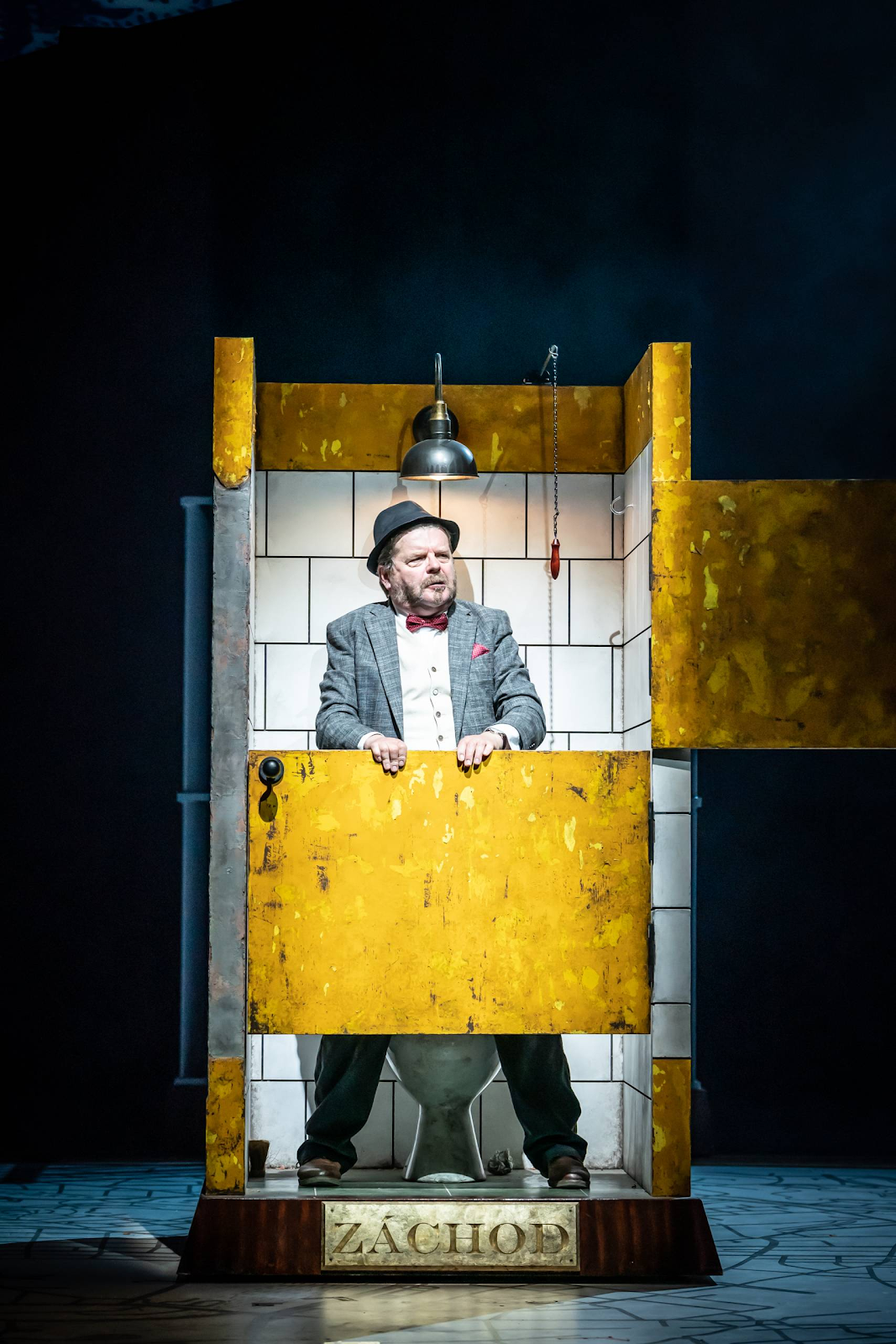
Whether one cares for the (literal) toilet (brush) humour of the interlude between the visits, will be a matter of taste. Monty Python is not my thing, but if it is yours, you will almost certainly love Pountney’s more outrageous excurses. Sometimes, though, I wondered where the heart was, especially during the Moon-trip. Is there not something more positive to say about artistic creation too? The answer, I suppose, would be that it lies in the score (and, indeed, in the artistic endeavour of performance and reception itself. It arguably suggested itself onstage at the end, when the innkeeper Würfl collected his drunken patron, laughed at his tall tales, but also walked him away in camaraderie. Perhaps that was enough. Again, that will probably be as much a matter of taste or inclination as anything else.


Peter Hoare’s Brouček captured well the contradictions not only of the character, but of our response(s) to him. This was a typically intelligent performance, which held the stage, amused, and touched without sentimentality. Fflur Wyn’s Málinka and other roles were lively, characterful, and rooted in, yet far from hidebound by, the text. Such is the magic of theatre, and such might be said of any number of the cast, including Mark Le Brocq’s handful of roles, Andrew Shore’s, and Clive Bayley’s, as well as Anne-Marie Owens's Kedruta. This was very much a company effort, which did Grange Park Opera proud, enthralling an audience that could all too readily have registered mere bemusement at the work’s oddity.


Domsik (Clive Bayley)


George Jackson’s traversal of the score elicited my unqualified admiration, as did the playing of the BBC Concert Orchestra. Incisive and expansive, earthy and soaring, above all attuned to those fabled speech rhythms and their unpredictable, magical combination into form and structure, this was as fine a Janáček performance as I have heard for some time, all the more so for its revelation of relatively unfamiliar territory. Time and time, presentiments of the Vixen’s world shone through, anchoring these ‘excursions’ in a common humanity and inspiring us to go forth and create it. The score emerged possessed of the musical, scherzando brilliance of the more or less contemporary Gianni Schicchi, if perhaps less single-minded, at any rate without the latter work’s dramaturgical precision, considered as a whole. We might say Janáček’s musical dramaturgy is more adventurous, though much depends what one means. Whatever our thoughts on that, this was a musical banquet beautifully and, at the last, movingly served.