Showing posts with label Julia Burbach. Show all posts

Saturday, 21 March 2026

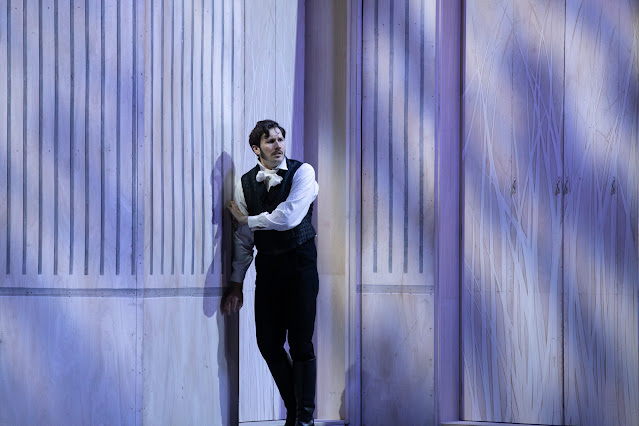
Rinaldo, Royal Academy Opera, 19 March 2026


Susie Sainsbury Theatre, Royal Academy of Music


Almirena (Abigail Sinclair) and Rinaldo (Ella Orehek-Coddington)
Images: Craig Fuller


Goffredo – Owen Lucas
Rinaldo – Ella Orehek-Coddington
Almirena – Abigail Sinclair
Argante – Tom Butler
Armida – Grace Hope-Gill
Eustazio (Cupid) – Theodore McAlindon

Director – Julia Burbach
Designs – Bettina John
Lighting – Robert Price
Choreography – Cameron McMillan

Royal Academy Sinfonia
David Bates (conductor)


Rinaldo, Handel’s first opera for London, received a bright, enjoyable, and – more surprisingly – succinct new production at the Royal Academy of Music, directed by Julia Burbach and conducted by David Bates. As ever, with conservatoire opera, the ultimate point is to afford young singers experience, but that can never, should never be the only point: unless there is positive musical and dramatic reason for an audience to attend, the singers will gain no meaningful experience. The virtues of a small theatre, in which all are close to the action, are many; but again, they will be as nothing without excellence in performance. As so often, that was forthcoming, a fine young case requiring no apology and proffering many grounds for praise. 


Goffredo (Owen Lucas)

Handel’s operas are no stranger to cuts. A standard version in the modern sense is arguably an anachronism in such opera seria, as is a modern conception of the ‘musical work’—in some ways, more so than it might be for Monteverdi (in others, less so). The music we heard was expected, though not all of it was heard. For to compress almost three hours of music into a two-hour span including a twenty-minute interval required radical surgery—much, though far from all, lying in elimination, as opposed to pruning, of recitative. That is not to say there was none at all, but there were a good few cases when aria simply led to aria. There are losses to such a path, of course; one can tell that even when one does not know the work so well. To an extent, the production helped fill in the gaps, but there were narrative elements that came to seem underdeveloped, even arbitrary. Most smaller parts, sung or merely acted, were dispensed with. 

So far as I could tell – I shall happily be corrected by those more deeply acquainted with the opera – the music heard was essentially from the ‘original’ version, including some of that later cut. However, Goffredo was sung by a tenor, as in the major 1731 revision – damned by Anthony Hicks as ‘in effect … a pasticcio’ – a decision I could not help but think marking an improvement. In any case, the 1711 ‘original’ includes so much earlier music from Handel’s Italian period, it is unclear to me how meaningful such a distinction might be, in theory or in practice. There is much I believe we still do not know about what was sung for revivals in between 1711 and 1731; there is ever reason to choose pragmatically, according to singers available and other performing conditions, just as Handel would have been. 

That out of the way, the abridged version had much to offer musically—and more dramatically than one might have expected. Ella Orehek-Coddington gave an impressive account of the title role, truly growing into the part as it progressed, which seemed to be a dramatic strategy rather than simply warming up. Her tone was both bright and warm, her coloratura secure; to an age in which countertenors are more often preferred in this repertoire – the RAM’s double-casting offered both – she reminded us of the distinct virtues her vocal type can offer here (which was, after all, a signature role for Marilyn Horne). Grace Hope-Gill presented a fiery sorceress Armida, one with whom one could not but help sympathise, ably complemented by Tom Butler’s Argante, both singers employing technical command as a spur to greater emotional commitment—on their part and on ours. 


Argante (Tom Butler), Almirena

Owen Lucas offered model Handel singing, clarion-like as Goffredo, leader of the First Crusade, looking the part in Bettina John’s costume too and employing it to suggest compromising vanity. Abigail Sinclair’s Almirena was sweetly sung, blending well almost as if a member of the orchestral wind in that aria, ‘Lascia ch’io panga’, whose ornamentation was relatively lavish from all concerned, yet in no sense excessive. Eustazio, a role which, unless I am mistaken, was written for contralto, was here sung by bass Theodore McAlindon, doubling up (slightly confusingly) as Cupid. Not that doubling of roles is necessarily confusing, but presenting this newly invented role as one and the same was a little. I suspect the reasoning was its relatively thankless nature as it stood; indeed, it was omitted in revivals later than that of 1713. The dual role gave McAlindon more to do, his acting accomplished as well as his vocal artistry.


Eustazio (Theodore McAlindon)

Bates led the Royal Academy Sinfonia and singers alike in a warm and spirited performance that, whilst often swift, only occasionally seemed rushed. This was excellent playing indeed from the orchestra, whose variety in timbre, colour, and much else suggested a larger and more varied ensemble than was actually the case, the composer’s resourcefulness showcased in the pit as well as onstage. Concerning the latter, Burbach trod in the best sense a fine line between straightforward telling and framing of the action – all the more necessary given how much it must fill in or even invent – and creation of a world in which strange fantasies might germinate, take root, and surprise. Cameron McMillan's choreography added considerably to the sum of the parts. If, at times, I might have preferred a production that took more of a ‘view’, not least with respect to the Crusader setting, I can equally see why one might not wish to do so. The work is not ‘about’ that, of course, and we return to the ultimate point of conservatoire opera. In that and in much else, this Rinaldo succeeded very well indeed.


Sunday, 28 September 2025

La Cenerentola, English National Opera, 27 September 2025


Coliseum


Images copyright: Mark Douet


Angelina – Deepa Johnny
Don Ramiro – Aaron Godfrey-Mays
Dandini – Charles Rice
Don Magnifico – Simon Bailey
Alidoro – David Ireland
Clorinda – Isabelle Peters
Tisbe – Grace Durham

Director – Julia Burbach
Set designs – Herbert Murauer
Costumes – Sussie Juhlin-Wallén
Lighting – Malcolm Rippeth
Video – Hayley Egan
Choreography – Cameron McMillan

Dancers
Chorus of the English National Opera (chorus director: Matthew Quinn)
Orchestra of the English National Opera
Yi-Chen Lin (conductor)


Cinderella (Deepa Johnny), Don Ramiro (Aaron Godfrey-Mayes)


For the more Teutonically inclined of us, Rossini is an interesting case. He would doubtless have scoffed at the very idea, itself deeply German, of offering a ‘case’ at all: surely more the province of Wagner and his endless stream of interpreters. Interpreting Rossini might even seem beside the point; as Carl Dahlhaus put it, setting up his guiding twin style and culture contrast between Beethoven and Rossini, for him ‘a far-reaching rift in the concept of music’, there was ‘nothing to “understand” about the magic that emanated from Rossini’s music’. That is far from straightforwardly a pejorative observation, though it is difficult to avoid the implication of lesser, secondary status vis-à-vis Beethoven (and his successors). It might even be made to stand with Nietzsche’s celebrated elevation of Carmen over Wagner, though that even more so is ‘really’ about Wagner, not Bizet. At some level, though, one knows what Dahlhaus means, irrespective of one’s own particular stance or preference. There is something immediate, even unreflective to much of this music; one does not engage in a search for music, or if one does, one is readily confounded, given the way the same music can be made to suffer quite different purposes, brazenly un-textbound, attesting to the truth, if not the whole truth, in Wagner’s oft-misunderstood observation of ‘absolute melody’. 

There needs, though, to be magic (as doubtless there does, in a very different way, in Wagner). It will suspend disbelief, transform the at-times disturbingly formulaic into an intriguing formalism, and among other things, simply delight. That was not absent on the first night of ENO’s new Cenerentola, but nor was it as present as it might have been. Yi-Chen Lin’s stewardship of the score proved surprisingly tentative, highlighting rather than transmuting potential longueurs, too often feeling and sometimes being oddly slow. I suspect that was partly to be attributed to the requirements of singing in English – a very wordy English at that – but it was not only that. The Overture, for instance, came across as a random assemblage of unconnected musical ideas, with little attempt to weld them into something that was more than the sum of its parts. Too often, the music, some splendid playing from the ENO Orchestra notwithstanding, lacked contrast, be it dynamic or of tempo; all was too much of a muchness. There were a few too many cases of discrepancy between pit and stage – one in particular lasting several bars – but such things tend to iron themselves out during a run. 


In that context, the singers could only be expected to shine intermittently, which they did. Deepa Johnny’s Angelina/Cinderella was in general beautifully sung, with an accurate if not necessarily expressive line in coloratura. She did much to fashion an attractive character of sincerity; if there were no hidden depths, that might be said of everyone else and is more a reflection of the work than anything else. Her accent sometimes veered awkwardly between different sides of the Atlantic: one of several reasons why Italian will generally prove the better choice for such repertoire. Aaron Godfrey-Mayers offered a Ramiro, tender and ardent by turn, who again had one long to hear what he might have done in Italian, without in this case feeling unduly shortchanged: a significant achievement. Charles Rice’s Dandini was similarly well sung and acted, alive in the moment in a properly Rossinian sense, and fearless in his trickier vocal moments. David Ireland and Simon Bailey gave the strongest sense of commitment to the translation, the former as Alidoro almost giving one the impression it might have been written that way, the latter as Don Magnifico spinning and relishing a fine, old-school ENO line in patter. As the sisters Clorinda and Tisbe, Isabelle Peters and Grace Durham steered a judicious line between opera and pantomime, though could often have projected and enunciated more strongly in the cavernous Coliseum. Chorus and dancers offered variety, scenic diversion, and a welcome degree of greater framing. 

That might have been developed further had Julia Burbach’s production not felt quite so caught between two (or more) stools. A few doses of more detailed as opposed to surface realism, be it grimy or ‘traditional’, and/or of glitter, magic, and, dare I say, of spectacle might have helped. Herbert Murauer’s set could not have been cheap, yet a central lift that did not go up or down served little purpose; if two levels were desirable, a staircase might have done a better job of linking them. Burbach’s staging also imparted a sense of having failed to establish – in reality, probably having failed to communicate – quite what its guiding principles were and how they played out in the drama, which came across as less than it does on the page, though Christopher Cowell’s relentlessly self-regarding translation – often more a paraphrase – did not help. Many in the audience, though, seemed to find the startlingly novel concept of rhyme hilarious, especially when mixed with increasingly tedious demotic anachronism. 


Cinderella, Dandini (Charles Rice)

If, despite the shortcomings, this made for an enjoyable enough evening, it could readily have offered more. The opera’s general trajectory and Rossini’s musical formalism could and surely should have been conveyed more consistently, with both greater polish and a stronger sense of what ‘it’, be it the opera ‘itself’ or its staging, was actually about. Children dressed as miniature versions of Don Magnifico (in his case, with beard) and his daughters, appeared on stage for a while, eliciting mirth and bewilderment. Alas, I cannot tell you why. A woman who often, though not always, accompanied Simon Bailey turned out, according to the programme, to be Angelina’s mother. It is a reasonable enough idea, but needed greater attention to communication and implication. Mice ran around for a while, without really doing anything beyond that. Even a promising sense of literal framing, members of the chorus stepping out of the prince’s ancestral pictures, led nowhere in particular. That seemed in retrospect, alas, a little too accurate a snapshot of the action as a whole.


Sunday, 19 June 2022

Eugene Onegin, Opera Holland Park, 15 June 2022


Tatiana – Anush Hovhannisyan
Onegin – Samuel Dale Johnson
Lensky – Jack Roberts
Olga – Emma Stannard
Mme Larina – Amanda Roocroft
Filipievna – Kathleen Wilkinson
Prince Gremin – Matthew Stiff
M. Triquet – Joseph Buckmaster
Zaretsky/Captain – Konrad Jaromin
Solo tenor – Phillip Costovski

Julia Burbach (director)
takis (designs)
Robert Price (lighting)
Jo Meredith (movement)

Opera Holland Park Chorus (chorus director: Richard Harker)
City of London Sinfonia
Lada Valešová (conductor)
 

Eugene Onegin (Samuel Dale Johnson).
Images: Ali Wright

Sharing a single set by takis with Carmen—typically resourceful, sustainable practice for Opera Holland Park—Julia Burbach’s Eugene Onegin proved a puzzling affair. The idea, I think, was to move between monochrome and colour, perhaps playing with memory and/or dreaming, but too much remained obscure or arbitrary (at least for me). Burbach seemed unsure whether to opt for realism, something more symbolic, or even a coherent melange of the two. Presumably, the uniform light colours of the first scene were intended to evoke a sort of Chekhovian boredom, but it seemed at odds with Pushkin, let alone Tchaikovsky.  Having everyone dressed in similar finery in that opening scene also suggested a chorus of nobles rather than peasants. For these were clearly the same people we encountered in the ball scene, and I do not think the intention was to suggest some sort of Russian Petit Trianon. Quite why some were playing badminton, I have no idea; it proved distracting in the wrong way, as had ‘peasant’ dancing earlier on. A turn through colour to black largely made emotional and narrative sense, yet details continued to sit oddly with the overall ‘picture’. Nothing ever quite moved convincingly, nor settled down.

It was also unquestionably the most heteronormative Onegin I have seen: a perverse distinction, one might say. Not only is there no sign, no inkling, nor even the slightest twinkling of an eye, of homosexual subtext; the characters are conventional enough in their relationships to be plausibly heterosexual. Perhaps if one were viewing work and creator from a Putinesque standpoint, that might signal cause for celebration. To the rest of us, it may seem strange or evasive.

That said, the cast did a fine job within these confines. Jack Roberts (an OHP Young Artist) and Emma Stannard gave a fine impression of Lensky and Olga as a young couple giddily in love. Their sheer enthusiasm proved infectious, not least given the curiously static production. Roberts’s sappy tenor and Stannard’s deep-toned mezzo proved just the vocal ticket too. Samuel Dale Johnson’s offered a thoughtful, well-sung performance as Onegin, both beguiling and infuriating in his mood swings. If the visual haunting demanded by Burbach in the Letter Scene seemed somewhat contrived, Dale Johnson’s subtler vocal version thereafter, culminating tragically in buyer’s remorse, was far more convincing. Anush Hovhannisyan’s Tatina gained in confidence as the evening went on: character development of course, but also, I think, in strength of performance. By the final scene, this was a formidable portrayal indeed. There were no weak links onstage, Kathleen Wilkinson’s Filipievna and Konrad Jaromin’s appearances as Zaretsky and the Captain especially catching the ear.


Tatiana (Anush Hovhannisyan)

Lada Valešová’s direction of the City of London Sinfonia seemed, laudably, engineered to follow these particular performances and production, rather than being imposed upon them. Was her languorous, intimate way with the first act too much of a muchness? That is probably a question of taste. It is not how I hear the work, but there was a thoughtful approach at work here. I missed a sense of abandon in the big public scenes, though Valešová’s scrupulousness offered alternative rewards.  One should also bear in mind that she was working with—and emphatically with—a chamber orchestra. A larger orchestra, as well as a different production, may well have brought forth a different musical reading.


Sunday, 3 March 2019

Così fan tutte, Royal Opera, 25 February 2019


Royal Opera House

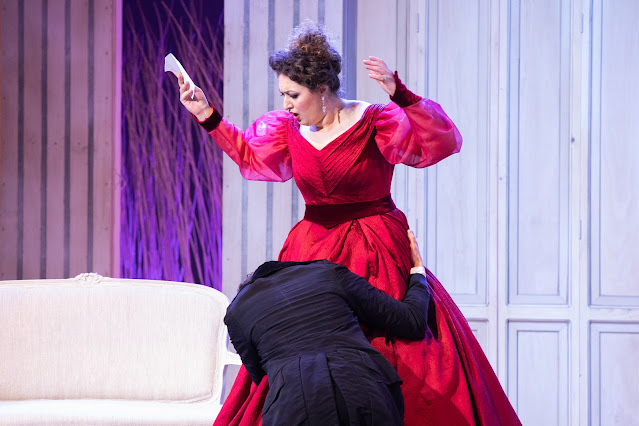
Dorabella (Serena Malfia)
Images: ROH 2019/Stephen Cummiskey

Ferrando – Paolo Fanale
Guglielmo – Gyula Orendt
Don Alfonso – Thomas Allen
Fiordiligi – Salome Jicia
Dorabella – Serena Malfi
Despina – Serena Gamberoni

Jan Philipp Gloger (director)
Julia Burbach (revival director)
Ben Baur (set designs)
Karin Jud (costumes)
Bernd Purkrabek (lighting)
Katharina John (dramaturgy)

Orchestra of the Royal Opera House
Royal Opera Chorus (chorus director: William Spaulding)
Stefano Montanari (conductor)

Ensemble

First the good news. With one partial exception, there was much splendid singing, and stage performance more generally, to enjoy from an entirely new cast for the first revival of Jan Philipp Gloger’s Così fan tutte (reviewed here first time around). Our pairs of male and female lovers were nicely differentiated, whilst blending with equal skill and pleasure – crucial in an opera with so much ensemble writing, endlessly varied, endlessly revised and renewed. (There is dramaturgical genius in that, of course, not that sceptics and outright decriers – believe it or not, there remain a few – bother to think about that before regaling us with their ‘thoughts’ on the work.) Salome Jicia and Serena Malfia made for a sparkling pairing of ladies from Ferrara, linear clarity matched by complementary contrast such as one might enjoy in a fine wind ensemble. Much the same, perhaps still more so, might be said of Paolo Fanale’s Ferrando and Gyula Orendt’s Guglielmo, the former’s arias as sweetly sung, tenderly phrased as anyone might reasonably ask. Serena Gamberoni’s keenly sung Despina was properly knowing without lapsing into the unduly arch. Thomas Allen’s Don Alfonso had its moments, but it was difficult to avoid the conclusion that this, a role he long made his own, is now a vocal challenge too far, whatever his continued enthusiasm on stage. Hand on heart, I cannot say that any of these performances surpassed those at Holland Park last year, but I doubt that anyone would have had serious grounds for disappointment either.
 
Dorabella and Guglielmo (Gyula Orendt)


There were, alas, grounds aplenty for disappointment in both the conducting and the production: concerning the former, rather more than mere disappointment. Described in the programme as ‘charismatic’, Stefano Montanari certainly made his presence felt Charisma, however, entails a gift, not a curse, be it divine or otherwise. It is difficult to think of anyone more deserving of the claim than Mozart. If only we had heard a little more of his work and a little less of Montanari’s extraordinary – extraordinarily ignorant, too – arrogance. Arrogating to himself the fortepiano continuo too, Montanari went on to show us that he has little ability at conducting but considerable ability at obscuring scores with his own, allegedly witty, yet in truth tediously predictable, sonic vandalism. To begin with, his ‘contributions’ remained within the realm of the unnecessary, if still highly irritating. The level of premature ejaculation soon, however, reached the level of medical emergency, at times entirely taking leave of Mozart’s bass line and harmony so as simply to present some ‘songs from the shows’. It was the sort of thing a bumptious first-year organ scholar might have done over late-night drinks, albeit more cleverly; here, the results were quite unforgivable. Occasionally hard-driven, Montanari’s conducting was more often merely flaccid: nothing to do with speed, everything to do with a lack of harmonic and formal understanding; it was as if the performance were led by the lovechild of René Jacobs and Marc Minkowski. For a performance of Così fan tutte drag so much is an achievement of sorts, not one I wish to hear repeated. To hear it in the house that was once Sir Colin Davis’s was little short of scandalous.

Dorabella and Ferrando (Paolo Fanale)


Some changes have been made to Gloger’s production since its first outing, presumably by revival director, Julia Burbach. In the first act in particular, they are to its benefit, tightening and clarifying, although the second act fizzles out much as it had done before (if slightly differently). It is, perhaps, indicative of the state of British opera audiences that anyone would see something remotely adventurous in the hamfisted attempt at metatheatricality on show – ‘show’ being the thing – here. Clichés abound, without apparent awareness that clichés they are, and therefore might be played with. The more promising moment remains the substitution of applauding members of the real cast, initially seated in an audience box, for the cast in eighteenth-century garb on stage. There is nothing wrong with the idea that the characters might learn from a performance of the work; it has much to commend it. There is everything wrong, however, with the confusion – somewhat mitigated now, yet only somewhat – with which that is allegedly accomplished. Identities, acts, characters are not ambiguous; they appear simply not to have been thought through, rather as if this were an early sketch for a production rather than the finished article.


As for Gloger’s preposterous claim, allegedly justifying such confusion, namely that to be ‘realisable in realistic terms’, the female characters must ‘know from the beginning of the second act that the “foreign men” are really their own boyfriends,’ it is difficult to think of a graver admission of incompetence. By all means play with such an idea, should it prove dramatically fruitful. The idea, however, that such banal realism has anything to do with the work, that ‘we decided to explain…’ signifies anything other than a catastrophic misunderstanding of the opera’s artificiality and its dramatic consequences, is both saddening and infuriating. Perhaps there is scope for further revisions; I certainly appreciate the attempt. I cannot, however, claim to be hopeful. Like Montanari's conducting, if less so, the production thinks itself far cleverer than it is. More seriously, neither seems remotely to appreciate not only the intelligence but the profundity of this most ravishing of operas.