Showing posts with label Kathleen Wilkinson. Show all posts

Sunday, 19 June 2022

Eugene Onegin, Opera Holland Park, 15 June 2022


Tatiana – Anush Hovhannisyan
Onegin – Samuel Dale Johnson
Lensky – Jack Roberts
Olga – Emma Stannard
Mme Larina – Amanda Roocroft
Filipievna – Kathleen Wilkinson
Prince Gremin – Matthew Stiff
M. Triquet – Joseph Buckmaster
Zaretsky/Captain – Konrad Jaromin
Solo tenor – Phillip Costovski

Julia Burbach (director)
takis (designs)
Robert Price (lighting)
Jo Meredith (movement)

Opera Holland Park Chorus (chorus director: Richard Harker)
City of London Sinfonia
Lada Valešová (conductor)
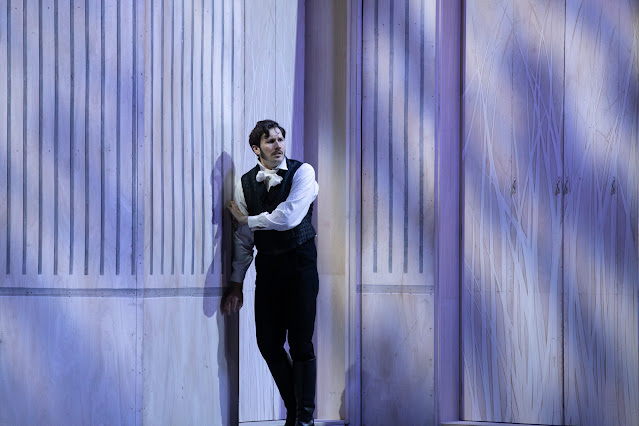
 

Eugene Onegin (Samuel Dale Johnson).
Images: Ali Wright

Sharing a single set by takis with Carmen—typically resourceful, sustainable practice for Opera Holland Park—Julia Burbach’s Eugene Onegin proved a puzzling affair. The idea, I think, was to move between monochrome and colour, perhaps playing with memory and/or dreaming, but too much remained obscure or arbitrary (at least for me). Burbach seemed unsure whether to opt for realism, something more symbolic, or even a coherent melange of the two. Presumably, the uniform light colours of the first scene were intended to evoke a sort of Chekhovian boredom, but it seemed at odds with Pushkin, let alone Tchaikovsky.  Having everyone dressed in similar finery in that opening scene also suggested a chorus of nobles rather than peasants. For these were clearly the same people we encountered in the ball scene, and I do not think the intention was to suggest some sort of Russian Petit Trianon. Quite why some were playing badminton, I have no idea; it proved distracting in the wrong way, as had ‘peasant’ dancing earlier on. A turn through colour to black largely made emotional and narrative sense, yet details continued to sit oddly with the overall ‘picture’. Nothing ever quite moved convincingly, nor settled down.

It was also unquestionably the most heteronormative Onegin I have seen: a perverse distinction, one might say. Not only is there no sign, no inkling, nor even the slightest twinkling of an eye, of homosexual subtext; the characters are conventional enough in their relationships to be plausibly heterosexual. Perhaps if one were viewing work and creator from a Putinesque standpoint, that might signal cause for celebration. To the rest of us, it may seem strange or evasive.

That said, the cast did a fine job within these confines. Jack Roberts (an OHP Young Artist) and Emma Stannard gave a fine impression of Lensky and Olga as a young couple giddily in love. Their sheer enthusiasm proved infectious, not least given the curiously static production. Roberts’s sappy tenor and Stannard’s deep-toned mezzo proved just the vocal ticket too. Samuel Dale Johnson’s offered a thoughtful, well-sung performance as Onegin, both beguiling and infuriating in his mood swings. If the visual haunting demanded by Burbach in the Letter Scene seemed somewhat contrived, Dale Johnson’s subtler vocal version thereafter, culminating tragically in buyer’s remorse, was far more convincing. Anush Hovhannisyan’s Tatina gained in confidence as the evening went on: character development of course, but also, I think, in strength of performance. By the final scene, this was a formidable portrayal indeed. There were no weak links onstage, Kathleen Wilkinson’s Filipievna and Konrad Jaromin’s appearances as Zaretsky and the Captain especially catching the ear.
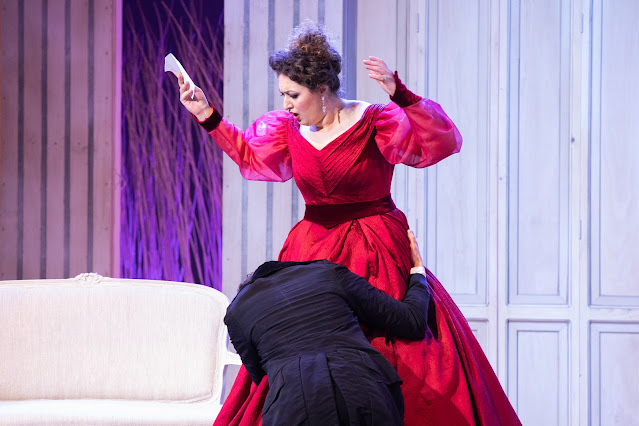

Tatiana (Anush Hovhannisyan)

Lada Valešová’s direction of the City of London Sinfonia seemed, laudably, engineered to follow these particular performances and production, rather than being imposed upon them. Was her languorous, intimate way with the first act too much of a muchness? That is probably a question of taste. It is not how I hear the work, but there was a thoughtful approach at work here. I missed a sense of abandon in the big public scenes, though Valešová’s scrupulousness offered alternative rewards.  One should also bear in mind that she was working with—and emphatically with—a chamber orchestra. A larger orchestra, as well as a different production, may well have brought forth a different musical reading.


Tuesday, 12 February 2013

Eugene Onegin, Royal Opera, 11 February 2013

Eugene Onegin (Simon Keenlyside)
Images: Bill Cooper
Royal Opera House
 
Tatyana – Krassimira Stoyanova
Eugene Onegin – Simon Keenlyside
Young Tatyana – Vigdis Hentze Olsen
Mme Larina – Diana Montague
Filipyevna – Kathleen Wilkinson
Olga – Elena Maximova
Peasant Singer – Elliot Goldie
Young Onegin – Thom Rackett
Lensky – Pavol Breslik
Monsieur Triquet – Christophe Mortagne
Captain – Michel de Souza
Zaletsky – Jihoon Kim
Guillot – Luke Price
Prince Gremin – Peter Rose

Kasper Holten (director)
Mia Stensgaard (set designs)
Katrina Lindsay (costumes)
Wolfgang Göbbel (lighting)
Leo Warner (video)
Lawrence Watson (animation)
Signe Fabricius (choreography)

Royal Opera Chorus (chorus master: Renato Balsadonna)
Orchestra of the Royal Opera House
Robin Ticciati (conductor)


Kasper Holten’s new production of Eugene Onegin, his first staging for the Royal Opera House, was in many ways excellent, an auspicious debut indeed. Unfortunately, it was truly let down by some of the most lacklustre conducting I have heard at Covent Garden. Whilst an interesting, intriguing evening was still to be pieced together from production and singing, it would be idle to pretend that Robin Ticciati’s jejune performance did not detract significantly from the experience. To start with, it seemed as though Ticciati’s reading might prove interestingly different. The balletic side to Tchaikovsky seemed on the verge of shining through, the woodwind section of the Orchestra of the Royal Opera House offering sparkling playing, and what a nice change it made for once to hear the harp! Alas, it soon emerged that those advantages had been achieved largely by default. It became impossible to ignore the thinness of the string sound, despite a sizeable number of strings in the pit. That was not on account of any ineptitude of execution by the players, who remained polished throughout, but because Ticciati seemingly wished to elicit the sound of a middle-ranking chamber orchestra from one of the best opera house bands in the world. Fair enough if you simply have to put up with a small number of strings, or even if you are playing in a small house, but such was not of course the case here. More damagingly still, the performance dragged, at times interminably so. Without any sense of life – not to be confused with alleged ‘airiness’ – and without any sense of Tchaikovsky’s tormented soul, the only signs of anything dramatic being at stake had to be gleaned elsewhere: a great pity. Let me be clear. This was not about ‘intimacy’, about approaching Tchaikovsky’s ‘scenes’ in the manner in which they were first performed at the Moscow Conservatoire – although the perversity did have something in common, albeit significantly magnified, with the attempt by Ticciati’s mentor, Sir Simon  Rattle, to present an ‘intimate’ Carmen upon the vast stage of Salzburg’s Grosses Festspielhaus. Nor was it about actual speed; I genuinely have no idea whether the performance was fast, slow, or middling, by the clock. What I do know is that it dragged, despite sometimes being unduly driven, because Ticciati proved hopelessly incapable of finding a pulse, variable or otherwise. Instead of intimacy and interesting if unusual tempi, we had mere thinness and tedium.

 
Tatyana (Krassimira Stoyanova)
Holten’s production, on the other hand, offered what was often a searching exploration of memory. Inscribed into the score, its visual manifestation was effected by a number of means. Most obvious, but far from the only example, was the use of doubles, a young Tatyana and a young Onegin, to observe, to remind, to haunt. Mirroring the structure – some might say the lopsidedness – of Tchaikovsky’s drama, the young Tatyana is often seen during the first four scenes, whereas her counterpart does not emerge until the older, wiser Onegin appears in St Petersburg. The two young figures meet only in the final scene, offering a glimpse of what might have been, but what is now cruelly denied. Or should that read, 'wisely denied'? For in a fascinating gloss, Prince Gremin appears in that scene too: no longer a mere doddery if noble old fool, he too will have to learn to live with the truth. I can imagine that some might have found the histrionic display of the young Tatyana during the Letter Scene a little much, but by the same token, it seems a valid response to one side at least of the music – and Tchaikovsky’s character. It does not last very long, moreover, and more important seems to be the slippage between the two Tatyanas: who is writing? Who is truly affected? Is this for once an attempt to construct, with all the potential for failure that might entail, a character who is more than Tchaikovsky’s self-projection?

 
Colour is used to great effect: an especially telling moment is the infection through lighting and film of the outside world – or is it again a projection, this time from Tatyana herself? – with Tatyana’s scarlet, following the Letter Scene? Has she been rash, to put it mildly? Is this foreboding? Does her uneasy relationship to the outside world doom her to an unhappy, unsociable life? Is this where it all goes wrong, the moment to which her elder self will perforce return, time and time again? The relationship between books and memory is of course not a new concept in Onegin productions, but it is a good one, and their presence at Mme Larina’s house, not least in Tatyana’s hands, makes its point well. As time went on, above all in St Petersburg, it was as if Tchaikovsky’s and Pushkin’s reminiscences were straining towards Wagnerian leitmotif. They did not and could not reach it; technique and indeed aspiration are quite different. But I could not help but wonder if Holten’s Wagnerian experience played a role here. If only there could have been some counterpart to that in the conducting, which continued signally to fail to join up the dots. Let us hope that the production will be revived with someone else in the pit. A conductor with whom the Royal Opera House has a strong relationship, such as Semyon Bychkov, who has a fine Onegin recording to his name already? That might really be something.

 
Lensky (Pavol Breslik)
The cast was for the most part excellent too. Krassimira Stoyanova’s Tatyana was beautifully sung, no mere cipher, but a strong, flawed character, uncertain of where she was heading and all the more credible for that. I was a little disconcerted by Simon Keenlyside’s Onegin during the first act; it seemed coarser than I recalled from a few years ago. But dramatic truth gained over ‘mere’ beauty, for this Onegin gained in insight as the work progressed, quite in tandem with the production. As ever, Keenlyside’s way with words, just like Stoyanova’s, was pretty much beyond reproach. Beauty there was aplenty in the honeyed tones of Pavol Breslik, every inch the Romantic poet; his verbal acuity was no less impressive. Holten had elected to downplay, even to ignore, the homoeroticism of the relationship between Onegin and Lensky: a pity, since it so permeates the score, but of course the director had other ideas to explore. Instead we witnessed two young, quite immature men as genuine rivals for the affections or at least the attentions of their women. Olga was finely and richly sung by Elena Maximova, whilst Diana Montague and Kathleen Wilkinson almost stole the show with their equally fine portrayals of Mme Larina and Filipyevna. The only disappointments were an unidiomatic Zaretsky from Jihoon Kim and an intonationally-challenged Triquet from Christophe Mortagne. Peter Rose’s Gremin did everything it should – and more. Likewise the Royal Opera Chorus was on splendid form, for which Renato Balsadonna should once again receive considerable credit.