Showing posts with label Lada Valešová. Show all posts

Tuesday, 19 May 2026

The Rape of Lucretia, Royal Academy of Music, 13 May 2025


Susie Sainsbury Theatre


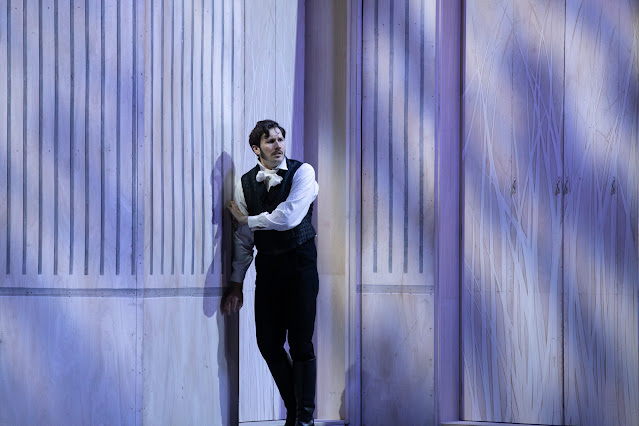
Tarquinius (Oliver Heuzenroeder), Collatinus (Pavel Basov), Junius (Harrison Robb)
Images: Craig Fuller


Director – Paul Carr
Costumes – Michelle Bradbury
Lighting – Jake Wiltshire

Female Chorus – Madeleine Perring
Male Chorus – Yihui Wang
Lucretia – Ella Orehek-Whitford
Tarquinius – Oliver Heuzenroeder
Collatinus – Pavel Basov
Junius – Harrison Robb
Bianca – Viktoria Melkonian
Lucia – Ellie Donald

Royal Academy Sinfonia
Lada Valešová (conductor)


Male Chorus (Yihui Wang)

Hot on the heels of HGO’s Rape of Lucretia has come another excellent young-artist production, this time from Royal Academy Opera. (English Touring Opera also gave performances, here in London and elsewhere, in November.) It is for me one of Britten’s stronger works, the sometimes excessive wordiness of Ronald Duncan’s libretto notwithstanding; this opportunity to see it again so soon, not so much to compare as to experience it from another, related standpoint, was readily taken.

Paul Carr’s production puzzled me at first, probably because I had come with overly realist expectations to something that unfolded with a more abstract aesthetic, indeed aestheticism. What seemed to be a punk-meets-S&M look for the beginning of the first act, soldiers meeting on an edgy, even dangerous street, turned out not to be a setting as such, but rather a look, contrasted with a more Roman sense, achieved more through lighting than costumes, for the domestic sphere of Lucretia’s villa. Not that there was anything much here as a set: this focused on the characters, their deeds, and their interactions, all viewed through a prism of black, white, and red, a long red rope both prophetic and eventually summative. In the masculine sphere, Tarquinius was a ‘panther’ indeed, not only ‘agile’ and ‘virile’ but also in thrall to his pleasures and desires—and not necessarily restricted to women. Mad, bad, and definitely dangerous to know, then, in a memorable stage animal portrayal by Oliver Heuzenroeder.
 

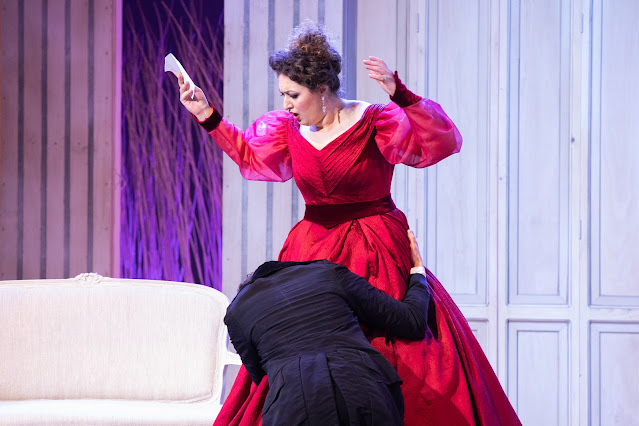
Lucia (Ellie Donald), Lucretia (Ella Orehek-Coddington), Bianca (Viktoria Melkonian)

Ella Orehek-Whitford’s Lucretia contrasted vividly with his Tarquinius: good, honourable, and with undeniable inner strength, though how could that ever be enough? Her way with words, music, and their combination enabled her fully to inhabit her role. Pavel Basov’s Collatinus was multi-dimensional, to begin with barely distinguishable from the other men, thrust by direst fate into his role as Tarquinius’s antagonist. Harrison Robb’s Junius was, more clearly than usual, the real manipulator, through vocal and stage means alike. (Both characters pointed us to the Roman republican future.) Viktoria Melkonian’s Bianca and Ellie Donald’s Lucia were nicely contrasted in voice, more to the point intelligently sung and acted throughout; likewise Madeleine Perring’s Female Chorus, very much part of the action. For me, though, it was Yihui Wang’s Male Chorus who emerged as first among a team of fine equals, his diction and musical line quite superlative, all a means to a properly ambiguous dramatic end. The production asked much of this cast and received all it asked.


Madeleine Perring (Female Chorus)


The musicians of the Royal Academy Sinfonia proved just as impressive in the pit, incisively led by Lada Valešová. An ensemble of steel that could melt before our ears and the morning Roman sun, it drove and structured the action, ensuring that Britten’s opera for the most part overcame the limitations of its libretto and even hinting that there might be some post-Bachian truth in that problematical claim of redemption at the close. For if Duncan’s work has its problems, it also bears genuine dramatic fruit, especially though not solely in combination with the score—all the more so in so compelling a performance as this.


Sunday, 19 June 2022

Eugene Onegin, Opera Holland Park, 15 June 2022


Tatiana – Anush Hovhannisyan
Onegin – Samuel Dale Johnson
Lensky – Jack Roberts
Olga – Emma Stannard
Mme Larina – Amanda Roocroft
Filipievna – Kathleen Wilkinson
Prince Gremin – Matthew Stiff
M. Triquet – Joseph Buckmaster
Zaretsky/Captain – Konrad Jaromin
Solo tenor – Phillip Costovski

Julia Burbach (director)
takis (designs)
Robert Price (lighting)
Jo Meredith (movement)

Opera Holland Park Chorus (chorus director: Richard Harker)
City of London Sinfonia
Lada Valešová (conductor)
 

Eugene Onegin (Samuel Dale Johnson).
Images: Ali Wright

Sharing a single set by takis with Carmen—typically resourceful, sustainable practice for Opera Holland Park—Julia Burbach’s Eugene Onegin proved a puzzling affair. The idea, I think, was to move between monochrome and colour, perhaps playing with memory and/or dreaming, but too much remained obscure or arbitrary (at least for me). Burbach seemed unsure whether to opt for realism, something more symbolic, or even a coherent melange of the two. Presumably, the uniform light colours of the first scene were intended to evoke a sort of Chekhovian boredom, but it seemed at odds with Pushkin, let alone Tchaikovsky.  Having everyone dressed in similar finery in that opening scene also suggested a chorus of nobles rather than peasants. For these were clearly the same people we encountered in the ball scene, and I do not think the intention was to suggest some sort of Russian Petit Trianon. Quite why some were playing badminton, I have no idea; it proved distracting in the wrong way, as had ‘peasant’ dancing earlier on. A turn through colour to black largely made emotional and narrative sense, yet details continued to sit oddly with the overall ‘picture’. Nothing ever quite moved convincingly, nor settled down.

It was also unquestionably the most heteronormative Onegin I have seen: a perverse distinction, one might say. Not only is there no sign, no inkling, nor even the slightest twinkling of an eye, of homosexual subtext; the characters are conventional enough in their relationships to be plausibly heterosexual. Perhaps if one were viewing work and creator from a Putinesque standpoint, that might signal cause for celebration. To the rest of us, it may seem strange or evasive.

That said, the cast did a fine job within these confines. Jack Roberts (an OHP Young Artist) and Emma Stannard gave a fine impression of Lensky and Olga as a young couple giddily in love. Their sheer enthusiasm proved infectious, not least given the curiously static production. Roberts’s sappy tenor and Stannard’s deep-toned mezzo proved just the vocal ticket too. Samuel Dale Johnson’s offered a thoughtful, well-sung performance as Onegin, both beguiling and infuriating in his mood swings. If the visual haunting demanded by Burbach in the Letter Scene seemed somewhat contrived, Dale Johnson’s subtler vocal version thereafter, culminating tragically in buyer’s remorse, was far more convincing. Anush Hovhannisyan’s Tatina gained in confidence as the evening went on: character development of course, but also, I think, in strength of performance. By the final scene, this was a formidable portrayal indeed. There were no weak links onstage, Kathleen Wilkinson’s Filipievna and Konrad Jaromin’s appearances as Zaretsky and the Captain especially catching the ear.


Tatiana (Anush Hovhannisyan)

Lada Valešová’s direction of the City of London Sinfonia seemed, laudably, engineered to follow these particular performances and production, rather than being imposed upon them. Was her languorous, intimate way with the first act too much of a muchness? That is probably a question of taste. It is not how I hear the work, but there was a thoughtful approach at work here. I missed a sense of abandon in the big public scenes, though Valešová’s scrupulousness offered alternative rewards.  One should also bear in mind that she was working with—and emphatically with—a chamber orchestra. A larger orchestra, as well as a different production, may well have brought forth a different musical reading.


Saturday, 8 June 2019

The Diary of One who Disappeared, Muziektheater Transparant, 6 June 2019


Linbury Theatre

Ed Lyon (tenor)
Marie Hamard (mezzo-soprano)
Wim van der Grijn (actor)
Annelies van Gramberen, Naomi Beeldens, Raphaële Green (semi-chorus)
Lada Valešová (piano, music director)

Ivo van Hove (director)
Jan Versweyveld (set designs)
An d’Huys (costumes)
Krystian Lada (dramaturgy)


It is more than a decade since I saw Muziektheater Transparant theatre piece, Wolpe!, at the Edinburgh Festival. Stefan Wolpe had hitherto been little more than a name to me; that ‘staged concert’ immediately made him, his music, and his politics much more than than what I see I went to far as to call an ‘inspiring event’.


Janáček is unlikely to require such an introduction, at least, should such a thing exist, for a core audience, though one can hardly call him and his music over-exposed. His song-cycle, The Diary of One who Disappeared, should be far better known, or at least more frequently performed, than it is. Language is doubtless an issue: if song performances in translation are not unknown, they are decidedly uncommon, and Janáček loses so much in sound and speech rhythm when translated that we should probably be grateful. Not that there was any cause to regret the use of Czech here, at least to my untutored ears. Ed Lyon’s command of the language seemed excellent, as did that of his collaborators in song, Marie Hamard and offstage, female semi-chorus, Annelies van Gramberen, Naomi Beeldens, and Raphaële Green. Lyon, Hamard, and pianist and music director, Lada Valešová certainly proved vividly communicative throughout, Lyon’s anguished, well-nigh televisually detailed stage presence chilling and human indeed. (What a joy, as ever, it was to be in a smaller theatre where such detail could register and be appreciated.)


There is, of course, nothing remotely new about staging the cycle; the practice dates back to 1926, only five years after the Brno premiere, in Laibach/Ljubljana. What matters is how it is done. But this is not straightforwardly a staging of the cycle, although it stands considerably closer to that than some such theatre pieces, seeking less to tell another story than to tell a story that incorporates and, at a remove, contextualises and interprets the work. Ivo van Hove’s production presents a man, played by Wim van der Grijn, remembering his past: what might have been and what was. Or does it? For it starts neither with him, nor with Janáček’s male protagonist, but with a woman (Hamard), soon seated at a piano. She does what she is told via a recording, until she does not, until she takes on life of her own, her role at the piano quickly taken by Valešová. The man takes his lead in the drama, at least partly – such is society, ours and Janáček’s – and is joined by another, who seems to be his younger self. But the lines are not precise: deliberately, I think. Whilst the obvious interpretation is – well, obvious – it is not mandatory. There are alternatives, or at least aspects one might fill in differently. And so, whilst that affair, presumably long past, comes once again to life in his memory and leads the older man to rueful regret or worse, the woman in a sense takes charge again, just as her musical part and that of her semi-chorus are augmented by additional songs composed by Annelies Van Parys (whom some English opera goers will recall from her skilful chamber reduction of Pelléas et Mélisande, performed by English Touring Opera in 2015).


There is no question of the significance of Kamila Stösslová for the cycle and its female character, Zefka, or indeed, for Janáček as creator, vice versa: ‘I do not have words to express my longing for you, to be close to you,’ he wrote. ‘Wherever I am I think to myself: you cannot want anything else in life, if you have this dear, cheerful, black little “gypsy girl”.’ Janáček knew, he continued, ‘that my compositions will be more passionate, more ravishing: you will sit on every little note in them. I shall caress them: every little note will be your dark eye.’ The troubling exoticism of the idea of the ‘dark … little gypsy girl’ is, to an extent, jettisoned or at least addressed, with an element of reclamation. (Or should we consider it cultural appropriation? These things are never straightforward, nor should they be – and it is hardly for me to say.) Zefka, insofar as it is she, sings songs, which move between idioms more and considerably less related to Janáček’s, which look upon her former, gadjo (non-Roma) lover from her, Roma standpoint. Having had her say, though, she cedes the stage to the older man, who reads from the composer’s celebrated letters to Stösslová, burning them as he would – as he did. Is it so straightforward as the man being revealed as Janáček? I do not think so, though someone could reasonably take that line. Memory is a complex thing: how it haunts us, what it includes, excludes, edits. So too is theatre, at least as a similarly active experience. There is clearly, though, something of the composer in the man we see on stage, embittered, and perhaps facing some degree of justice for his actions, albeit in a setting contemporary or at least closer to us. We too must decide what it is we have seen and heard, relate it as we will or must.


It is a far more interesting, far more finished, piece of work than Richard Jones’s recent, lacklustre Katya Kabanova for the main stage (Jones’s production, that is, rather than the excellent musical performances it attracted). At the same time, it remains, like much contemporary theatre in general, and much contemporary operatic theatre in particular, fruitfully open-ended. I continue to think about it; I suspect that, should you see it, you will too.