Showing posts with label Robin Ticciati. Show all posts

Wednesday, 22 July 2026

Ariadne auf Naxos, Glyndebourne, 19 June 2026


Images: © Glyndebourne Productions Ltd. Photo: Tristram Kenton


Music Master – Michael Kraus
Major Domo – William Relton
Lackey – Oliver Williams
Officer – Owen Lucas
Composer – Samantha Hankey
Tenor, Bacchus – David Butt Philip
Wigmaker – Hector Bloggs
Zerbinetta – Alina Wunderlin
Prima Donna, Ariadne – Rachel Willis-Sørensen
Dancing Master – Ru Charlesworth
Naiad – Anna Denisova
Dryad – Ekaterina Chayka-Rubinstein
Echo – Eirin Rognerud
Harlequin – Mikhail Timoshenko
Scaramuccio – Caspar Singh
Truffaldino – Lian James Karai
Brighella – Liam Bonthrone

Director – Laurent Pelly
Set designs – Massimo Troncanetti
Lighting – Marco Giusti

London Philharmonic Orchestra
Robin Ticciati (conductor)


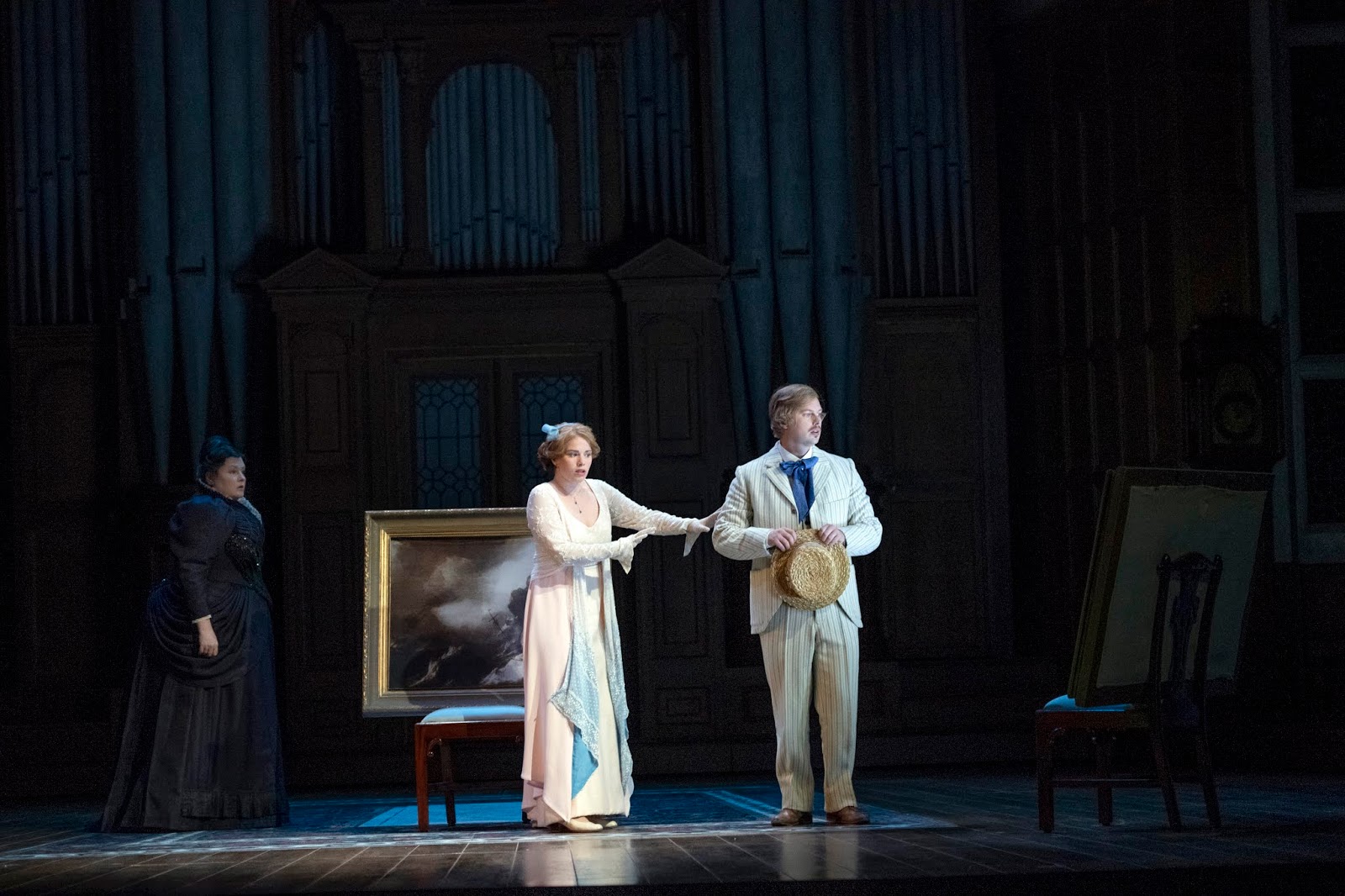
Strauss and Hofmannsthal’s Ariadne auf Naxos should in many ways be the ideal Glyndebourne opera. It is indeed pretty much the ideal opera for any opera house, given its metatheatrical treatment not only of the genre itself, but of almost any aesthetic standpoint anyone in the audience might care to adopt (including none at all). All are fondly mocked and cherished; all can see and hear themselves. The question of art as ‘entertainment’ in a ‘country-house opera’ setting in which the picnic can take almost as long as the performance, itself increasingly prey to what the late Michael Tanner christened the ‘Glyndebourne guffaw’, is especially keen here. So too, for many of us, is the necessity for it to be more than merely entertainment, for the authors’ twin, arguably conflicting ideas and strategies of transformation (Verwandlung) to come into play. It is an opera, then, to be treated with good humour and seriousness, affection and critical distance, these and the opera’s other binaries all informing one another and reminding us why we might have fallen in love with the genre in the first place—even to the extent of catching trains, buses, and more in the madness of decamping to rural Sussex with hampers and the like for an afternoon in the uncharacteristically burning sun. Thinking and writing about opera are part of that joy and madness too, not least since one is almost inevitably setting oneself up to be lampooned in this context (that is, in the unlikely event anyone should really care what one has to say). Without hedging or situating further, I am somewhat saddened to say that it was only in the realm of vocal artistry and individual dramatic performances that this new production shone, staging and conducting leaving much to be desired, even to the extent of coming across in unduly provisional form. 


Let us start with the good news then. Our artists – and artistes – acquitted themselves with excellence ‘as themselves’ in the Prologue and, where relevant and appropriate, as something more in the Opera. Rachel Willis-Sørensen resisted any temptation there may have been to present the Prima Donna as a mere caricature; this was a singer who knew her worth, certainly, but without seeming silly or monstrous. Her seriousness – that word again – in preparing for Ariadne was genuine, as was her achievement in a splendid ‘Es gibt ein Reich…’ and beyond. One might say much the same of David Butt Philip’s Tenor/Bacchus, whose keen attention to words as well as music ensured uncommon depth, not least in furthering our appreciation of where (and whom) he was coming from, in Circe’s guise. Given the enormous technical and other demands placed on Zerbinetta, it is striking how few fail. It is really one of those roles one does not consider attempting unless one can. Alina Wunderlin proved no exception, whether as immensely likeable artist or purveyor of pinpoint coloratura thrills that yet did not mask a necessary sadness behind them. Samantha Hankey’s Composer was a sincere, similarly likeable portrayal, offering an unmistakeably human trouser role in various of its complexities and possibilities. There was much to admire elsewhere, too, the cast assembled in depth with vivid cameos from a world-weary Michael Kraus as Music Master, and Ru Charlesworth as his overtly camp, yet similarly professional opposite number in the world of dance. A haughty Major Domo (William Relton), a fine trio of Rhinemaidens or Naiad, Dryad, and Echo, and a spirited desert island troupe offered other highlights.


Insofar as Laurent Pelly’s production offered a framework, or at least setting, for those performances it functioned well enough. Too often, though, the lack of an evident directoral hand was felt: conceptually, but even in imparting much beyond the sense of bringing the cast together. Was this in some sense the Composer’s dream, suggested by his/her return to view proceedings? If so, that seems a workable, even promising idea, but little was done with it, beyond presenting a Prologue set that combined Rococo and modern, and an Opera wilderness around which characters walked, more or less directed. If Pelly did not get in the way of the work’s dramatic themes, nor did he seem interested in bringing them out either. There is much one could do here to suggest more than the sum of its parts, yet any attempt to do so passed me by. Likewise when it came to Robin Ticciati’s painting-by-numbers conducting, notwithstanding the strengths of the London Philharmonic in itself. We lumbered from section to section, with little to suggest connection between them. A strangely motoric opening intrigued, as if Stravinsky – who openly despised this opera, or claimed to – had been set the task of reinterpreting it, perhaps in the light of Pulcinella. That was soon binned, though, another, arbitrary idea come to replace it for a minute or two, and so on. Again, it gave an impression of what the work might be, but little more than that. A sense of magic beyond the vocal remained stubbornly elusive.


Tuesday, 6 February 2024

Rusalka, Staatsoper Unter den Linden, 4 February 2024


Rusalka – Christiane Karg
Prince – Pavel Černoch
Foreign Princess – Anna Samuil
Vodník – Mika Kares
Ježibaba – Anna Kissjudit
Gamekeeper – Adam Kutny
Kitchen Boy – Clara Nadeshdin
Nymphs – Regina Koncz, Rebecka Wallroth, Ekaterina Chayka-Rubinstein
Huntsman – Taehan Kim

Director – Kornél Mundruczó
Designs – Monika Pormale
Lighting – Felice Ross
Video – Rūdolfs Baltiņš
Choreography - Candaş Baş
Dramaturgy – Kata Wéber, Christoph Lang

Staatsopernchor Berlin (chorus director: Gerhard Polifka)
Staatskapelle Berlin
Robin Ticciati (conductor)


Images:  Gianmarco Bresadola
Rusalka (Christiane Karg)

Director Kornél Mundruczó comes like a breath of fresh air to unsettle our conceptions of Dvořák’s penultimate and, by some way, greatest opera and thus to do precisely what the material demands; or rather, it comes as something bitterly stale, menacing, even poisonous to accomplish what fresh air on its own might not be able. It is certainly refreshing, though it should not be, to have a production that takes class seriously as a form of social distinction, a social barrier, though ultimately it will go beyond that, re-engaging with the opera in all its strange tragedy and tragic strangeness. By grounding itself in the here and now, but also a here and now our society largely wishes to ignore, it challenges, but it challenges further and with brilliant theatricality by the course subsequently taken. 

Rusalka – not strictly her ‘name’, but it is all we have, and ‘the rusalka’ or even ‘the sprite’ would seem unduly pedantic – lives in a shared, ground-floor Berlin apartment, a WG or Wohngemeinschaft, her flatmates the other three nymphs and Vodník (if you prefer, the Watergoblin). She does not fit in with, or has grown distant from, her female flatmates at least; they are so much more laid back, fun-loving, quite happy in their less-than-ideal home of disrepair. Theirs is a working class, it seems, the bourgeoisie simply cannot stomach, however much it might claim to act in its name. But nor, any more, can Rusalka, at least since she has seen signs of the life – above all, the Prince – upstairs. In his modern penthouse with balcony and views across the city including, yet far from restricted to the Fernsehturm and the Rotes Rathaus, he and his appallingly grotesque group of friends, the Foreign Princess (his ex-) included, have ‘made it’. They know each other inside and out, as it were; they probably even vote Green. 

Rusalka, Prince (Pavel Černoch), Gamekeeper (Adam Kutny),
Kitchen Boy (Clara Nadeshdin), and Ensemble

One can see why she would like to escape to that other world, embodied in an attractive, trendily dressed mysterious (to her, though not to us) stranger. For one thing, other than the drugs that may or may not be Ježibaba’s stock-in-trade (what is that fascinatingly beyond-good-and-evil or just-plain-evil neighbour doing?) she is hardly spoilt for choice in alternative paths. Needless to say, an actually existing working-class young woman is the most shocking sight of all to the Prince’s friends and they work immediately to exclude her, the Foreign Princess going all out to rekindle those embers until the culpably weak yet more sympathetic Prince succumbs. No wonder the two sides cannot communicate, at least not until it is too late. For it is important to recognise that Rusalka fits in on neither side of this social divide. She only discovers – and this is entirely faithful to the work – where she might have done far too late. There is, again as in the work, a sort of tragic communion in that the Prince realises too late; he can only do what is right (for him, as much as ethically) by surrendering his life, which, movingly he does. 

In a programme interview, Mundruczó says he kept thinking of Kafka when working on the opera: doubtless a surprising reference for some of us, the Prague connection, albeit intergenerational, notwithstanding. But that may be to fall for outdated ‘national’ histories of music. Why not, after all? It certainly comes into his own in the third act here, where the action transfers less to a house than a cellar of horrors. Having returned to Ježibaba, been scorned and perhaps even poisoned, Rusalka leaves behind the world of social realism in which we imagined we should remain until the end and morphs into an impossible creature, part human, part goodness knows what, although it is perhaps not coincidental that its black suggests the colour of refuse and its disposal. One can and perhaps should read that in social and environmental ways; after all, what could be more of a social issue, what could hit the working class harder, than the destruction of the planet? But the aesthetic is actually quite different; one can read it for ‘meaning’ in that way, but the vision seems to lie beyond that: something spellbinding, from which one wishes to avert one’s eyes in horror at the agony Rusalka is experiencing, yet cannot. It is more filmic than theatrically Gothic, I think, but that choice seems a deliberate decision, again, judging from the interview, to attempt to reach younger audiences with different frames of reference. Whatever one might think of that – I am not sure I am the target audience here – for me it works. It truly unsettles and actually leads us to reconsider clashes between ‘natural’ and ‘human’, or ‘natural’ and ‘supernatural’ worlds very much as the work does—yet which can become lost if the setting is too folk-like. A sort of deformed, already-dead tree-in-plastic has grown, suffocating and perhaps literally trashing all that approach it.


Rusalka, Prince, Third Nymph (Ekaterina Chayka-Rubinstein)

Fairy tales, told properly, are dark, even sick, not through a sort of tired, bourgeois exhibitionism – that might be better left upstairs in the deceased Prince’s apartment – but because they tell of dreams, fantasies, delights, and horrors. They are not of the sanitised, commercial world of Disney, but come from a place of sex, violence, and more. The mirror they hold up is truthful because it is distorted, not despite that distortion. This production recognises such twisted truths and turns them into a drama at least implicit in Dvořák’s –and Jaroslav Kvapil’s – work and world. It may predate Freud and Kafka, but it is not without connections and even presentiments. I have nothing at all against a production presenting a single-minded view of a work, incorporating more current concerns, and so on. The work, whatever it may be, will survive. But a particular point of interest here is that the director does not impose a framework, even a related conceptual framework, on the work, but rather presents such a related framework as a way in to experience or re-experience the very strangeness of the work ‘itself’. 

For Dvořák progresses in this score too; even in so late a work as this, written after (!) Pelléas et Mélisande, he does not rest on his laurels. If those laurels are too folk-like for some early on – their loss, but there is no accounting for taste – then they surely will not be by the third act. For me, conductor Robin Ticciati and the superlative Staatskapelle Berlin came truly into their own in this act, opening up a range of post-Wagnerian language and emotion, not just or even principally emotion, extending beyond what I have heard from Ticciati previously (save, perhaps, at Glyndebourne for the dramaturgically unfortunate Ethel Smyth opera, The Wreckers). Not that there was anything wrong with what he did earlier. I initially found it a bit hard-driven, but came to realise that this was probably as much a reading developed in tandem with the production as a conception ‘in itself’ of the score. Lack of what might be thought of as sentimentality – not necessarily so, but that is arguably another matter – was the point. It was not cold, but nor was it a kitsch (or readable as such) tale of forest life. 


Rusalka, Ježibaba (Anna Kissjudit)


The same might be said of performances from an excellent cast, only more so, for there was some singing of ravishing warmth—but not only of that. Making her role debut, Christiane Karg not only traced the journey(s) proposed by composer, librettist, conductor, director, and more; she was instrumental in creating them. Occasionally during the first act, I wondered whether she might be a little under-powered, and perhaps there were a few first-night nerves there, but this was more, I think, a matter of wise marshalling of resources and dramatic trajectory. In many ways, I liked the way the Song to the Moon did not become a stand-alone aria and indeed related strongly to the music surrounding it, but I can well imagine some not having done so. Whatever one’s position on that – mostly a matter of personal preference – this Rusalka grew in stature through shocking experience, a tragic heroine to remember for the denouement. 

There was tremendous acting on her part too. Pavel Černoch’s Prince was similarly, if differently, involving. Despite it all, and partly on account of twin vocal intelligence and beauty, one could not help but like him, and again shared his ultimate tragedy at the close. Mika Kares’s Vodník also grew as his character – and the truth that character told – increasingly gained our sympathy. Anna Samuil offered glamour and refulgence – just the thing – for the Foreign Princess. Anna Kissjudit’s already horrible Ježibaba became all the more splendidly, horrifyingly so on her return, just as the production demanded, without sacrifice to more ‘traditional’ vocal values. Smaller roles and choral parts were all well taken, all contributing to a greater musicodramatic whole. 

As for the audience member who not only booed the end of the first act, but through his failure to stop – I am trying to be polite – seemed determine to prevent the second from beginning, what part of that whole troubled him so much? And why?

Wednesday, 25 May 2022

The Wreckers, Glyndebourne, 21 May 2022


Tallan – Jeffrey Lloyd-Roberts
Jacquet – Marta Fontanals-Simmons
Harvey – Donovan Singletary
Pasko – Philip Horst
Avis – Lauren Fagan
Laurent – James Rutherford
Thurza – Karis Tucker
Marc – Rodrigo Porras Garulo
Dancers – Rosie Bell, Lucy Bruns, Tash Cru, Sirena Tocco

Melly Still (director)
Ama Inés Jabares-Pita (designs)
Mike Ashcroft (choreography)
Malcolm Rippeth (lighting)
Akhila Krishnan (video)

The Glyndebourne Chorus (chorus director: Aidan Oliver)
London Philharmonic Orchestra
Robin Ticciati (conductor)


© Glyndebourne Productions Ltd. Photo: Richard Hubert Smith


I so much wanted to like this. Ethel Smyth was an interesting, admirable woman. What little of her other music I have heard I have always found at least to be of interest. Her opera The Wreckers is, moreover, an ambitious work, a great statement of intent, matched in many ways by Glyndebourne’s ambition and intent in staging it and by the commitment of those involved on stage and in the pit. None of that, alas, can disguise a signal dramatic failure, whose tedium was surely increased by the frankly bizarre decision to reinstate cuts made for its 1906 premiere. Sometimes cuts can actually make a work seem longer. (Think of Tristan; or rather do not, for the comparison is anything but forgiving.)

Henry Brewster's French libretto is a serious problem: not so much the language as such, though it is no literary masterpiece, as a broken-backed plot, which on paper looks interesting, even suggestive of a Cornish precursor to Peter Grimes. A multitude of incident and apparent conflict notwithstanding, though, it fails to convince. This is partly, I think, on account of so many trees of incident obscuring the dramatic wood. Here lies neither direction nor directness. One loses track—maybe just I did—of who is who, receives little musical help, and finds it difficult to care. Presentation of a host of unpleasant people in the service of a still more unpleasant occupation fails not only to engage, or even to ring true.  There is a message somewhere, but it struggles to emerge.

Smyth’s music is more immediately impressive: at its most structurally convincing when it comes to the choral writing, of which there is much. Even there, beyond being loud and accomplished, it remains anonymous, returning one to the questions of where the drama lies and why one should care. The rest, however, goes beyond mere eclecticism to a banquet of the derivative, all courses served more or less at once, resolving into a strange, indigestible purée of notes. Tchaikovsky, Brahms, Grieg, Wagner, Mendelssohn, Elgar, Bizet, Massenet; and so it goes on, and on, and on… Lack of a definable voice is one thing; so too is a lack of originality; this score, however, seems never to know where to turn, quite to lack harmonic and often even melodic direction. The third of three acts is probably the most interesting, perhaps not coincidentally the least backward-looking of the three. Maybe this was apprentice work, from which Smyth in other circumstances would have emerged more fully equipped; maybe a revision beyond cuts and greater theatrical experience would have produced something more convincing.


© Glyndebourne Productions Ltd. Photo: Richard Hubert Smith


Perhaps some would have held Robin Ticciati’s conducting responsible; it is difficult to say confronted by an entirely unfamiliar work. My sense, though, was of committed musical direction that was determined to mould the score into something more cohesive, failing through not fault of its own. The LPO sounded possessed with belief, rather like the community of which we heard the words tell, yet never felt for ourselves. So too did the Glyndebourne Chorus, outstanding in every respect. I cannot imagine a better case being made for what is probably the oratorio-heart of Smyth’s writing. Heft, precision, and clarity were impeccable, as were these singers’ acting skills. The vocal cast was largely impressive too, Lauren Fagen and Karis Tucker shining throughout, but especially towards the close, in the two principal female roles, Rodrigo Porras Garulo ardent as Marc, a romantic hero in whom one would have liked to believe.


© Glyndebourne Productions Ltd. Photo: Richard Hubert Smith


The conservatism of Melly Still’s production cannot have helped. I wonder what a director such as Katie Mitchell might have made of material that surely needed to be brought more out of itself, framed, interrogated, were it to have any hope of succeeding. As it is, the staging, half-heartedly ‘modern dress’—as people might have said half a century ago—shows little sign even of drawing basic distinctions between different standpoints. For something in one way so straightforward, it is paradoxically obscure and confusing. Female dancers in Edwardian dress, presumably in some sense signifying the composer, come and go; whatever it is their presence is supposed to contribute passed me by entirely. In a way, this mirrors the work, albeit with less octane and conviction: throw everything in, a shopping trolley included, and see what emerges. It is barely an æsthetic, though, let alone an enlightening one. The only respect in which Still really scores—this should certainly be acknowledged—is in detailed direction of the individuals who came together to make the chorus. 

So there you have it. Musical performances made as powerful a case as is likely to be made for the opera. The greater part of the first-night audience loved what it heard, roaring approval in no uncertain terms. A few more sober souls were simply relieved that it was over. I do not begrudge The Wreckers being afforded this opportunity; how else might we reach any sort of informed judgement? By the same token, I cannot imagine ever wanting to hear it again.


Monday, 20 May 2019

La Damnation de Faust, Glyndebourne, 18 May 2019


Glyndebourne Opera House


Images: Richard Hubert Smith

Faust – Allan Clayton

Méphistophélès – Christopher Purves
Brander – Ashley Riches
Marguerite – Julie Boulianne

Richard Jones (director)
Sarah Fahie (assistant director, choreography)
Hyemi Shin (set design)
Nicky Gillibrand (costumes)
Andreas Fuchs (lighting)

Dancers
Glyndebourne Chorus (chorus master: Aidan Oliver)
Glyndebourne Youth Opera
Trinity Boys Choir
London Philharmonic Orchestra
Robin Ticciati (conductor)


There may be a case for staging Berlioz’s ‘dramatic legend’, The Damnation of Faust; it was certainly not made on this occasion. To be fair, here are arguments either way, not least with respect to Berlioz’s own wishes and practice, and there probably always be. This new Glyndebourne production, however, found itself stuck uncertainly, awkwardly, and most of all tediously, between various poles and possibilities. It seemed to lack belief in the work, or at least the wisdom of staging it as it stands, yet at the same time makes changes so half-hearted, arbitrary, and silly that one wishes it had not. Some of Richard Jones’s recent productions – for instance, anon-committal Bohème and a weirdly unfinished Katya Kabanova, both for Covent Garden have suggested running out of steam; this did nothing to dispel the impression.


Much might have been salvaged in the event of a stronger musical performance. Alas, the festival’s music director, Robin Ticciati failed to provide it. I have yet to hear a performance from him that was not at least disappointing. Here, Ticciati offered a masterclass in the perverse art of rendering Berlioz bland and tedious to the point of non-recognition; only the following evening, listening to Colin Davis’s classic Philips LSO recording, did I feel reassured that, yes, I did know the work after all. Such lack of orchestral colour and warmth – the LPO strings sadly wasted through well-nigh absurdist lack of vibrato –married to inability to marry harmony and pulse, on the rare occasion that the latter were discerned, seemed to indicate not so much an æsthetic as mere incompetence. Notes, bars, phrased, paragraphs, even numbers drifted interminably, until suddenly an abrupt, stiff minor – very minor – eruption would occur: quite arbitrary, yet doubtless considered ‘exciting’ by some. Many paths might be taken to ignite the flame of Berlioz’s Romanticism, from Davis to Boulez, from Munch to Markevitch; a prolonged damp squib leading nowhere at all was what we heard here. When it could be heard, the LPO woodwind sounded gorgeous, not least in solo work. Too much, however, was relegated to the status of a dull backing-track to events on stage, such as they were.

 
Singing was better, if often unidiomatic. French is a notoriously difficult language in which to sing, especially for non-Francophone singers, but this was not straightforwardly a matter of nationality. Many of Julie Boulianne’s words were indecipherable, for instance, and she only really came into her own after the interval. Both Christopher Purves and Allan Clayton enunciated far more clearly. If the latter were not ideally cast, straining at the top, there was little doubting his commitment. A few tricky French corners aside, Purves seemed most at home, a sorely needed energising presence. The chorus had a few rocky moments, its female voices in particular; many of the performance’s stronger musical virtues were nevertheless to be found there.


What of Jones’s production? It certainly acknowledged the difficulty in staging the work at all, incorporating additional texts, ‘derived from Goethe’s Faust’, by Agathé Mélinand. Derivation, however, was sometimes oblique – not only because they were, oddly, delivered in French. (Surely English translation would have made more sense in this context.) As with much else, I was left feeling that less or (considerably) more would have been better. Having seen Frank Castorf’s Faust (i.e. Goethe) at the Berlin Volksbühne and heard of his work with Gounod’s version, I could not help but find this both non-committal and unfinished. A half-hearted rearrangement, trying to undercut Marguerite’s assumption by following it with ballet music (the ‘Menuet des feux follets’) in which Faust and his devils rejoiced and bared prosthetic genitalia seemed more to proclaim, ‘let us show our feminist credentials’, than actually to do so. Otherwise, a strange domestication, speaking more by default than of conviction, ruled. Presumably the idea was to show an everyday life that might have been Faust’s and Marguerite’s, but never could have been. By all means question, even negate Faust’s – and Berlioz’s – Romantic questing, but it really needs doing with greater verve and belief. This was often as tired as Ticciati’s conducting.


It is difficult to imagine any Berlioz staging of this memorial year matching, let along surpassing, Dmitri Tcherniakov’s magnificiently uncompromising Paris reassessment of The Trojans. If one does, all the better. However, given the uncomprehending hostility with which that met from many, the world seems likely to continue to receive more of what it most likely deserves.


Monday, 2 July 2018

Pelléas et Mélisande, Glyndebourne, 30 June 2018


Glyndebourne Opera House
  
Mélisande (Christiana Gansch), Pelléas (John Chest), Golaud (Christopher Purves)
Images: Richard Hubert Smith

Golaud – Christopher Purves
Mélisande – Christina Gansch
Geneviève – Karen Cargill
Arkel – Brindley Sherratt/Richard Wiegold
Pelléas – John Chest
Yniold – Chloé Briot
Doctor – Michael Mofidian
Shepherd – Michael Wallace

Stefan Herheim (director, lighting)
Philipp Fürhofer (designs)
Tony Simpson (lighting)
Alexander Meier-Dörzenbach (dramaturgy)

Glyndebourne Chorus (chorus master: Nicholas Jenkins)
London Philharmonic Orchestra
Robin Ticciati (conductor)

Mélisande and Golaud

What might have been? Such was a thought that came to my mind more than once during this, the premiere of Glyndebourne’s new Pelléas et Mélisande. What might have been if Stefan Herheim had not changed his Konzept so late in the day? (I had actually forgotten about that until reminded during the interval, yet had already begun to wonder whether the production had been, especially for him, unusually rushed.) What might have been, had this magnificent statement of intent – one of the greatest opera directors alive – from Sebastian F. Schwarz’s intendancy not been followed by manœuvring to ensure that something more ‘English’ would thereafter prove the order of the day? What might have been, had this Pelléas been conducted by someone with a little more feeling for and understanding of Debussy’s score – it would not have been difficult – than Robin Ticciati? What, ultimately, might have been, were operatic culture in this country not so philistine and class-ridden? The good news – our lives are at present as full of good news as those we see in Pelléas – is that leaving the European Union will only serve to make everything far, far worse. C’est au tour de pauvres petites.

Mélisande and Pelléas

I was thinking, though – which is considerably better than not. Even if I could not help but wonder what Pelléas set on a spaceship would have been like – on the face of it, it sounds a brilliant idea – Glyndebourne’s Organ Room, from time to time a salle modulable yet never escapable, turned the action and responsibility squarely upon us, the audience. (If only the worst-behaved had noticed. Some laughed at the end. Laughed! It was not difficult to think of them as Faragistes.) It is specific, yes, but not exclusivist. Indeed, with its heavy wood-panelling in Philipp Fürhofer’s outstanding set design, it might almost be the Victorianised combination room of an Oxford or Cambridge college or even something from the Hanseatic world of Buddenbrooks. Ancestry and tradition weigh down on it, though, as seen on the severe wall portraits. It is about us, then, but also about how we have become who we are.


Geneviève (Karen Cargill), Mélisande, and Pelléas

‘Us’ in this sense means taking on aestheticism, asking ourselves as well as selfish fellow audience members what we think we are doing and why. These are people engaged in fruitless, fatal pursuits – but in this case they are also aesthetic pursuits. They try to paint new pictures and cannot. Why not? On account of tradition, or account of an aestheticism that has them retreat from lives, even try to turn their lives into art? It need not be either/or; it almost certainly is not. We see through their attempts at art, though: literally, for the paintings, if they exist at all, are beyond the fourth wall. Is not Mélisande, after all, a blank canvas? Men certainly tend to wish her so – as with Lulu. It is just a hobby, though, is it not? Something for rich people to do to while away their time, perhaps like building an opera house so that ‘your’ – the possessive is important – wife might sing in it. Pelléas might seem different; he is, here, an artist, a younger Debussyan dandy rather than the elderly huntsman trying to be something he is not and certainly was not. (Are Golaud and Pelléas to be identified with the composer? Perhaps, perhaps not. If you do not want ambiguity, this is not the opera for you.) But is he? Is he really? Or does he just wear summer clothes in a darkened room? Perhaps his aestheticised life is still more dishonest; perhaps ours are too. Perhaps, peut-être. ‘Je pars peut-être demain.’


We do that to children too, especially those of us who claim to be shocked by the very suggestion. Germaine Greer has fallen off the rails spectacularly in recent years, but her insight that we are all paedophiles still holds; indeed it holds more strongly than ever, if less so for those of us unburdened by ‘family’. And so, when Yniold – yes, I too had been mumbling that I should have preferred to hear a treble – is unmasked as a woman all along, with locks aspiring to those of Mélisande, we are obliged to ask ourselves questions. The violence we see, feel aestheticised and sublimated all around us suddenly becomes, as the interval comes, something we can no longer ignore. Those blows that never quite led anywhere come to seem something more than ‘boring’.


By the same token, however, should they perhaps not have become something a little sooner? When does representing boredom become merely boring? I am not sure that Herheim, usually a master at treading of multiple lines, does not trip, even fall, in this case. An object lesson in that respect was Christiane Pohle’s revelatory post-Beckett staging for the Bavarian State Opera. Meaninglessness was the thing there, not ennui as such; the production was all the better for it. I cannot help but wonder whether the negative reaction it received was laced with misogyny – and/or perhaps a journalistic lack of understanding of ‘modern’ theatre. It was, at any rate, difficult not to ask such a question in a work that focuses on abusive behaviour and yet here, at least, attempts to avoid addressing that behaviour.

Golaud and Mélisande

Later on, when it becomes more explicit, when we see that Pelléas and Mélisande literally stage their own death – is it actually a real death at all, or just an act – everything falls into place. Mélisande has already – in fact she did so straight away – ease(le)d out Geneviève. The family, closing ranks, would clearly avenge itself, so perhaps playing at Tristan and Isolde is all that it is left. It has not been an easy road; nor, surely, should it have been. However, just a little relief from the claustrophobia might actually render it more powerful. As things stand, there remains more than a little suspicion that earlier tedium is a handy, even suggestive excuse, yet perhaps nevertheless an excuse in part. Bloodied clowns certainly make their point; this sick Liebestod from the Theatre of the Absurd has still not left my imagination. Yniold, now herself, visits the Organ Room as a guest, an opera-goer. It makes the point, yes, but might it not be better left unmade?


Tradition is, after all, sometimes necessary, or at least helpful – as the Roman Catholic Church would rightly tell us. It often provides an important counterweight to literalism, to fundamentalism. Collective wisdom enables development; each one of us need not re-invent the wheel. (Aesthetes breathe a collective sigh of relief.) As Pierre Boulez pointed out in challenging – though not, as some have claimed, denying – tradition, ‘a strong personality will inevitably transform it [tradition].’ That still leaves the problem, of course, of what to do about personalities that are not ‘strong’ or do not wish to be. ‘Ne me touchez-pas! Ne me-touchez-pas!’ Is the conclusion here bleak or weak? Is it too easy to say that it is what we want it to be? Doubtless. Is it what we will make of it? By definition it more or less has to be, but is that simply to evade the question? And is that wrong? Debussy, after all, is the unsurpassed master of musical ambiguity.


Tradition, or at least learning, would certainly have benefited the conducting, at best featureless, at worst frankly jejune, we heard from Ticciati. Debussy’s genius shone through, although more the debt to Wagner than what distinguished him from the old Klingsor. That, however, was surely the doing of the London Philharmonic, drawing when it could on its vast reserves of operatic and symphonic experience. Alas, such uninspired musical direction  bleeding titbits of Wagner for people who dislike Wagner  did not help the singers either. Christopher Purves was presented as an older Golaud and sang as such: nothing wrong with it. His anger was wonderfully sublimated until it was not. It would have gained greater musical context, though, as would the rest of the cast’s, had there been – well, greater musico-dramatic context. Christina Gansch and John Chest likewise offered good vocal performances as the doomed lovers, but something seemed to be missing. (Should something be missing? Perhaps. Again, however, it is a fine line.) Richard Wiegold was an undoubted hero of the evening, singing from a box whilst an indisposed Brindley Sherratt acted out the role of Arkel below. Karen Cargill offered rich-toned benevolence – I think – as Geneviève; as so often in this role, one wished there were more to hear.  There was much to admire from Chloé Briot, Michael Mofidian, and Michael Wallace, although it was difficult not to think that all concerned might have benefited from greater certainty and clarity elsewhere.


Was it worth it, then, to have annoyed the right people, bluff English purveyors of ‘common sense’? Of course. They will not like Pelléas anyway; if they think they do, it is because they have not remotely understood it and think of it as vaguely ‘beautiful’. Is it enough to have annoyed them? Of course not. Does this represent Herheim’s best work? No. Does the production stand in need of revision? Very much so. Does it also need a conductor with a little more idea what might be going on and what might be at stake? Still more so. And yet, I have been thinking about it ever since, and show no sign of stopping. In the meantime, hasten to see Barrie Kosky’s Berlin production and, should it ever be revived, Pohle’s Munich staging. There are always, as we æsthetes/æstheticists will tell you, great recordings too. Desormière or Karajan? Boulez or Abbado? Why choose? With Boulez, you can even see Peter Stein before he lost it. ‘What,’ you might ask, ‘is “it”,’? Such is surely part of what Herheim’s production is about – perhaps, peut-être, still more so than he intended.


Tuesday, 12 February 2013

Eugene Onegin, Royal Opera, 11 February 2013

Eugene Onegin (Simon Keenlyside)
Images: Bill Cooper
Royal Opera House
 
Tatyana – Krassimira Stoyanova
Eugene Onegin – Simon Keenlyside
Young Tatyana – Vigdis Hentze Olsen
Mme Larina – Diana Montague
Filipyevna – Kathleen Wilkinson
Olga – Elena Maximova
Peasant Singer – Elliot Goldie
Young Onegin – Thom Rackett
Lensky – Pavol Breslik
Monsieur Triquet – Christophe Mortagne
Captain – Michel de Souza
Zaletsky – Jihoon Kim
Guillot – Luke Price
Prince Gremin – Peter Rose

Kasper Holten (director)
Mia Stensgaard (set designs)
Katrina Lindsay (costumes)
Wolfgang Göbbel (lighting)
Leo Warner (video)
Lawrence Watson (animation)
Signe Fabricius (choreography)

Royal Opera Chorus (chorus master: Renato Balsadonna)
Orchestra of the Royal Opera House
Robin Ticciati (conductor)


Kasper Holten’s new production of Eugene Onegin, his first staging for the Royal Opera House, was in many ways excellent, an auspicious debut indeed. Unfortunately, it was truly let down by some of the most lacklustre conducting I have heard at Covent Garden. Whilst an interesting, intriguing evening was still to be pieced together from production and singing, it would be idle to pretend that Robin Ticciati’s jejune performance did not detract significantly from the experience. To start with, it seemed as though Ticciati’s reading might prove interestingly different. The balletic side to Tchaikovsky seemed on the verge of shining through, the woodwind section of the Orchestra of the Royal Opera House offering sparkling playing, and what a nice change it made for once to hear the harp! Alas, it soon emerged that those advantages had been achieved largely by default. It became impossible to ignore the thinness of the string sound, despite a sizeable number of strings in the pit. That was not on account of any ineptitude of execution by the players, who remained polished throughout, but because Ticciati seemingly wished to elicit the sound of a middle-ranking chamber orchestra from one of the best opera house bands in the world. Fair enough if you simply have to put up with a small number of strings, or even if you are playing in a small house, but such was not of course the case here. More damagingly still, the performance dragged, at times interminably so. Without any sense of life – not to be confused with alleged ‘airiness’ – and without any sense of Tchaikovsky’s tormented soul, the only signs of anything dramatic being at stake had to be gleaned elsewhere: a great pity. Let me be clear. This was not about ‘intimacy’, about approaching Tchaikovsky’s ‘scenes’ in the manner in which they were first performed at the Moscow Conservatoire – although the perversity did have something in common, albeit significantly magnified, with the attempt by Ticciati’s mentor, Sir Simon  Rattle, to present an ‘intimate’ Carmen upon the vast stage of Salzburg’s Grosses Festspielhaus. Nor was it about actual speed; I genuinely have no idea whether the performance was fast, slow, or middling, by the clock. What I do know is that it dragged, despite sometimes being unduly driven, because Ticciati proved hopelessly incapable of finding a pulse, variable or otherwise. Instead of intimacy and interesting if unusual tempi, we had mere thinness and tedium.

 
Tatyana (Krassimira Stoyanova)
Holten’s production, on the other hand, offered what was often a searching exploration of memory. Inscribed into the score, its visual manifestation was effected by a number of means. Most obvious, but far from the only example, was the use of doubles, a young Tatyana and a young Onegin, to observe, to remind, to haunt. Mirroring the structure – some might say the lopsidedness – of Tchaikovsky’s drama, the young Tatyana is often seen during the first four scenes, whereas her counterpart does not emerge until the older, wiser Onegin appears in St Petersburg. The two young figures meet only in the final scene, offering a glimpse of what might have been, but what is now cruelly denied. Or should that read, 'wisely denied'? For in a fascinating gloss, Prince Gremin appears in that scene too: no longer a mere doddery if noble old fool, he too will have to learn to live with the truth. I can imagine that some might have found the histrionic display of the young Tatyana during the Letter Scene a little much, but by the same token, it seems a valid response to one side at least of the music – and Tchaikovsky’s character. It does not last very long, moreover, and more important seems to be the slippage between the two Tatyanas: who is writing? Who is truly affected? Is this for once an attempt to construct, with all the potential for failure that might entail, a character who is more than Tchaikovsky’s self-projection?

 
Colour is used to great effect: an especially telling moment is the infection through lighting and film of the outside world – or is it again a projection, this time from Tatyana herself? – with Tatyana’s scarlet, following the Letter Scene? Has she been rash, to put it mildly? Is this foreboding? Does her uneasy relationship to the outside world doom her to an unhappy, unsociable life? Is this where it all goes wrong, the moment to which her elder self will perforce return, time and time again? The relationship between books and memory is of course not a new concept in Onegin productions, but it is a good one, and their presence at Mme Larina’s house, not least in Tatyana’s hands, makes its point well. As time went on, above all in St Petersburg, it was as if Tchaikovsky’s and Pushkin’s reminiscences were straining towards Wagnerian leitmotif. They did not and could not reach it; technique and indeed aspiration are quite different. But I could not help but wonder if Holten’s Wagnerian experience played a role here. If only there could have been some counterpart to that in the conducting, which continued signally to fail to join up the dots. Let us hope that the production will be revived with someone else in the pit. A conductor with whom the Royal Opera House has a strong relationship, such as Semyon Bychkov, who has a fine Onegin recording to his name already? That might really be something.

 
Lensky (Pavol Breslik)
The cast was for the most part excellent too. Krassimira Stoyanova’s Tatyana was beautifully sung, no mere cipher, but a strong, flawed character, uncertain of where she was heading and all the more credible for that. I was a little disconcerted by Simon Keenlyside’s Onegin during the first act; it seemed coarser than I recalled from a few years ago. But dramatic truth gained over ‘mere’ beauty, for this Onegin gained in insight as the work progressed, quite in tandem with the production. As ever, Keenlyside’s way with words, just like Stoyanova’s, was pretty much beyond reproach. Beauty there was aplenty in the honeyed tones of Pavol Breslik, every inch the Romantic poet; his verbal acuity was no less impressive. Holten had elected to downplay, even to ignore, the homoeroticism of the relationship between Onegin and Lensky: a pity, since it so permeates the score, but of course the director had other ideas to explore. Instead we witnessed two young, quite immature men as genuine rivals for the affections or at least the attentions of their women. Olga was finely and richly sung by Elena Maximova, whilst Diana Montague and Kathleen Wilkinson almost stole the show with their equally fine portrayals of Mme Larina and Filipyevna. The only disappointments were an unidiomatic Zaretsky from Jihoon Kim and an intonationally-challenged Triquet from Christophe Mortagne. Peter Rose’s Gremin did everything it should – and more. Likewise the Royal Opera Chorus was on splendid form, for which Renato Balsadonna should once again receive considerable credit.


Saturday, 5 April 2008

The Rape of Lucretia, Klangforum Wien, 5 April 2008

(concert performance)

Konzerthaus, Vienna

Angelika Kirchschlager – Lucretia
Emma Bell – Female Chorus
Ian Bostridge – Male Chorus
Christopher Maltman – Tarquinius
John Relyea – Collatinus
James Rutherford – Junius
Jean Rigby – Bianca
Malin Christensson – Lucia

Klangforum Wien
Robin Ticciati (conductor)

The idea of Britten in Vienna was appealing. No music benefits from being treated as the property of a particular nation – unless, that is, such particularist ‘tradition’ involves special pleading. Britten anyway seems now to be gaining greater exposure on the Continent than would have been the case until quite recently. Looking at the cast list, however, dispelled the illusion that this might have been a truly international performance. There is, of course, nothing wrong with casting English singers, but it was more of a home from home than one might have initially expected. Angelika Kirchschlager and Malin Christensson were the only exceptions to the Anglophone rule.

That said, there was no uniformity amongst the cast. Ian Bostridge and Emma Bell delivered their roles as Chorus with great skill, although in rather different fashion. With Bostridge, most listeners will know what to expect. The contorted facial expressions were not for the queasy, and there was, needless to say, more than a little vocal mannerism. Britten supplies quite enough of that already for my taste. By the same token, however, Bostridge’s delivery was in general impressively handled, with due attention paid to words, pitch, and modulation. It was only really during the Interlude to Act One, in which the Male Chorus recounts Tarquinius’s furious ride to Rome, that I felt the music and words ran away with him a little. (This may of course not have been by the singer’s own design.) Bell, by contrast, provided a ‘straighter’ reading, for which I stood most grateful. This is not intended to imply dullness or lack of imagination, but it was well focused and free of histrionics, if a little obscure of diction on occasion.

This was not a problem for Christopher Maltman, who to my mind delivered the best performance of the evening. One could sense him itching to be on stage, without this compromising the conditions of concert performance. Every word was made to tell, and the character of Tarquinius – dangerous, powerfully attractive, yet in thrall to his passions and so ultimately weak – was superbly portrayed. I cannot summon up a single caveat regarding this performance. John Relyea was also very fine in the less interesting role of Collatinus. I had most recently heard him in Sir Colin Davis’s LSO concert performance last year of Benvenuto Cellini, and there was no sign of dilution of promise. Relyea has a fine, truly powerful voice, which he knows how to marshal. James Rutherford, by contrast, was a variable Junius. Much of what he sang was respectable, but there was too much imprecision with regard both to pitch – mostly in the lower notes – and to diction.

Perhaps surprisingly, the best female diction came from Malin Christensson, whose silvery soprano was a delight in the role of Lucia. Her interest in Tarquinius, both before and after the deed – unbeknown to her, of course – was genuinely touching. Jean Rigby was in general a characterful Bianca, although not especially alluring. Angelika Kirchschlager varied in the role of Lucretia. Much of her portrayal was impressive: well-acted, within the constraints of a concert performance, and secure of tone. Sometimes, however, the acting got the better of the music, which is more of a problem in a concert performance than on stage. Her words were not always clear either. I have mentioned diction a few times, because it is important in itself, but also since if I, as a native English-speaker could often not discern the words, then I doubt that many of the Viennese could. Printing the words with German translation in the programme doubtless helped, but consulting them should be a last resort.

For the Klangforum Wien I have nothing but praise. The ensemble’s contribution was the clearest example of Britten freed from parochialism; the music clearly benefited. I do not regard all of the score as equally successful; Britten’s musical facility too often led him in the direction of mere note-spinning. However, the passages most obviously ‘constructed’ here gained an almost Schoenbergian instrumental intensity, relating more to inter-war modernism than to Suffolk. The strings were perhaps exceptional in this regard, but that is more a reflection upon the score than upon the performance. Nothing, I am afraid, can repair the dramatic flaw of the Christian ‘interpretation’ – by turns sentimental, incoherent, or both – transplanted onto an inherently powerful plot, but Klangforum Wien reminded us that there was musical interest nevertheless. I was less sure about Robin Ticciati’s direction. There was nothing terribly wrong with it, apart from a few overtly interventionist passages that simply sounded exaggeratedly slow or fast. For the most part, though, it was not clear that he really added anything. Perhaps most of his work had been done during rehearsal, but the ensemble seemed often – very successfully – to be doing its own thing. Eyes were certainly not always upon the conductor, whose beat seemed vague and who certainly did not help by ostentatiously performing the piano part himself. Just because one can does not mean that one should; numerous instances of arising from the piano stool should either have been more unobtrusively handled or, better still, rendered unnecessary by engaging a pianist from the ensemble. Still, the instrumentalists, every one of them, sounded excellent regardless, although even they could not entirely disguise some of Britten’s more threadbare invention.