Showing posts with label La voix humaine. Show all posts

Saturday, 26 February 2022

LSO/Hannigan - Strauss and Poulenc, 24 February 2022


Barbican Hall

Strauss: Metamorphosen
Poulenc: La Voix humaine

Barbara Hannigan, Denis Guégin, Clemens Malinowski (direction, video)
Julien Bourdin (sound engineer)

London Symphony Orchestra
Barbara Hannigan (soprano, conductor)


24 February 2022 was a black day for Europe, for humanity. The prospect of a concert opening with Strauss’s Metamorphosen seemed potentially a little much, directing us all too readily to where war once more threatened to take us. Perhaps it was as well that the LSO, unobtrusively conducted by Barbara Hannigan—she only began to direct at the first violin entry—offered a performance more Apollonian than Dionysian, Goethe more than requiem. In an extended companion piece to Capriccio and its opening sextet, to the Oboe Concerto too, an aristocratic collection of string soloists came together as if a collection of Masters in Munich’s Alte Pinakothek. In principle, I may have missed something darker, something engaging with Beethovenian ghosts of heroism, with destruction and devastation; but such quietly dignified, civilised music-making was probably the right thing at the right time. 

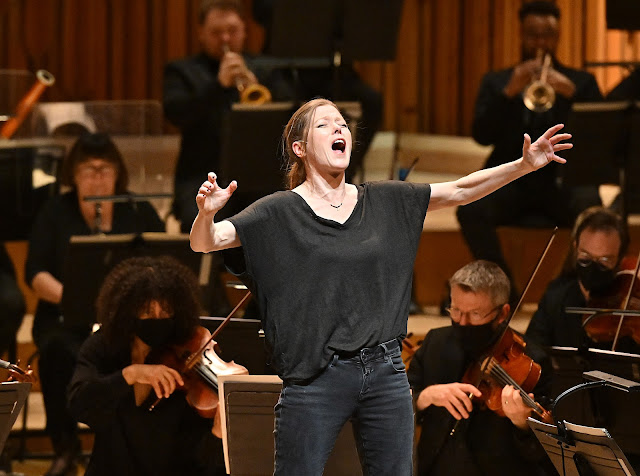
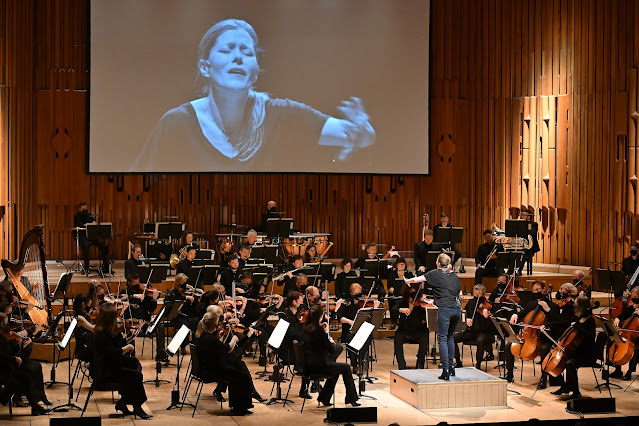
A darker performance might also have called into question the appropriateness of the pairing with Poulenc’s La Voix humaine. Here, to an unusual extent, Hannigan had taken to heart the word ‘humaine’. This was a glorious performance by the human voice, certainly, but equally so in terms of conducting and something approaching live filmed ballet, the two (or three) often fusing to form a greater ‘act’. Three live cameras proved in more than one sense a projection by ‘Elle’. Perhaps the orchestra itself was too, or Elle was imagining herself as conductor (or as Barbara Hannigan). Any initial scepticism concerning Hannigan’s conception of the work as a woman’s fantasy—perhaps this was simply what she might have said to someone from her past; perhaps there was no man at all—vanished, this viewer and listener entirely won over by the immediacy, commitment, and technical excellence of the performance, unsparing close-ups included. The film froze and Hannigan turned to the audience, continuing to act, when Elle told us of her attempts at suicide. Simple, yet startlingly effective.


The LSO, willing partners to Hannigan, Denis Guéguin, and Clemens Malinowski, proved precise, incisive, and affectionate without sentimentality. Where was the authorial voice, one asked? Was there more than one, or was there indeed one at all? Such questions emerged as both necessarily particular and more general, pertaining to what after all is, in some ways, little more (though no less) than recitativo accompagnato and to the heart of opera ‘itself’. The magic of Poulenc’s cadences and indeed of other harmonic progressions duly registered, lifting the everyday and its fantasies momentarily into that new realm we call the transcendental. Poulenc’s grand climax, almost paradoxically repeated yet convincingly so, on those final, tragic words, ‘Je t’aime’, reminded us, should we have needed reminding, that he, like his protagonist, knew how to put on a show. So too, likewise in the very best sense, did our performers this evening.

Monday, 14 September 2015

Antonacci/Sulzen - Poulenc, 14 September 2015


Wigmore Hall


La Dame de Monte Carlo
La Voix humaine


Anna Caterina Antonacci (soprano)
Donald Sulzen (piano)


Quite an opening to my 2015-16 Wigmore Hall season! For this lunchtime concert, Anna Caterina Antonacci and Donald Sulzen performed the piano version of Poulenc’s La Voix humaine, preceded by his final, not dissimilar vocal work, La Dame de Monte Carlo. Both have texts by Cocteau; both are far less conventionally ‘melodic’ than one would expect from this most melodic of composers; both are monologues intended for Denise Duval, portraying women on the verge, at least, of breakdown.


La Dame de Monte Carlo is anything but an easy way in for a soprano. Antonacci was herself, or rather the woman whose persona she assumed, from the very outset, always very well supported – and more than that – by Sulzen. ‘C’est joli de dire: “je joue”. Cela vous met le feu aux joues et cela vous allume l’œil.’ It was a gamble indeed, and it paid off. Moreover, it did have our eyes light up, as she so seductively span out the end of the phrase. Likewise we saw her ‘feathers and veils’ (‘mes plumes et mes voiles’), or rather thought we did, as she raised her arm. There was no doubting the singing actress here. Pauses told as much as words, for instance after ‘Et ils m’accusent d’être sale, de porter malheur dans leurs salles, dans leurs sales salles en stuc.’ There were a sadness and a defiance here that spoke, in Cocteau’s words, of the ‘lamentable story of an old, abandoned, miserable floozy’, and yet went beyond what one fancied words alone might have accomplished. The final ‘Monte Carlo’, upon the woman’s resolution to throw herself into the sea there, was operatic in the very best sense, as was the dryness of the piano response. The French ‘sec’ inevitably sprang to mind.


The main course inevitably encompassed a wider variety of emotions. Initially seated next to a table, on which an orange telephone as stylish as her performance was placed, Antonacci was in character from the moment she sat down. The fascinating tonalities and almost Schoenbergian motivic development of the piano part set the scene, but there was no doubt whose show it was. ‘Tu me connais, je suis incapable de prendre sur moi’ had a splendid sense of irony, whether with respect to the character or the metatheatricality, all the more so since it was delivered with passion rather than irony. Ghosts from Poulenc’s past and present seemed to haunt the performance, although there was little of the carefree. Harmonies from Dialogues des Carmélites assumed new resonance, as did the common notion of fear: ‘Peur? Non, je n’aurai pas peur … c’est pire.’ It almost certainly was worse, since here there was no sign of Divine Grace. Again, the ‘Allô’ when Antonacci feared she had been cut off spoke of real fear, not something assumed. This was great acting as much as anything else. Even the downpour outside and consequent darkening of the light seemed perfectly timed for the ‘production’. And the speech-like writing proved beyond doubt, just as it would have done had she been singing Monteverdi, that recitative can be at least as expressive as aria. Audience reaction was as warm as one would have expected.

Thursday, 5 April 2012

Samantha Brick: The Opera?

Let it never be said that I fail to keep my finger on the pulse of popular culture, if at times a little tardily. Many readers will have heard about the extraordinary, not to say beautiful, Ms Brick some time before I did; indeed, I am still not at all sure who she is, or what she does, aside from having written a now renowned article in the Daily Mail. (This will, I trust be the one and only time I provide a link to that particular website.) Is there not, however, something wonderfully operatic about this woman's delusions, her grasping towards and her sudden attainment of that greatest of modern idols, celebrity? Does she not present a weird, if undeniably down-market, cross between the Woman in Schoenberg's Erwartung and the telephone obsessive in Poulenc's (and Cocteau's) La Voix humaine? So, is it to be a monodrama, or something more along the lines of Powder Her Face (roles at the very least for the stewardess and the pilot), or Anna Nicole even? A chorus of Daily Mail readers would make horrifyingly good musical drama, perhaps thereby offering a nod to Moses und Aron? Samantha in Sprechstimme, a Golden Calf of celebrity around which Mail readers eagerly shed their suburban inhibitions? Perhaps even a male Samantha, underlining the Mosaic precdent further? Bookmakers are presently declining to offer odds against a Linbury Theatre outing in 2013. Suggestions for composer, librettist, and vocalist(s) are most welcome...


O Wort, du Wort, das mir fehlt!

Monday, 29 September 2008

La voix humaine and Pierrot lunaire, Oper Leipzig, 28 September 2008


(Images copyright: Andreas Birkigt)


Leipzig Opera House

La voix humaine
A woman – Angeles Blancas

Christoph Meyer (director)
Ramon Ivars (designs, costumes)
Albert Faura (lighting)

Leipzig Gewandhaus Orchestra
Josep Vicent (conductor)

Pierrot lunaire

A woman who spends too much time on the telephone – Young-Hee Kim

Peter Konwitschny (director)
Michaela Mayer-Michnay (costume collaboration)

Members of the Leipzig Gewandhaus Orchestra (Julius Bekesch – violin, Dorothea Hemken – viola, Daniel Pfister – ’cello, Manfred Ludwig – flute/piccolo, Volker Hemken (clarinet/bass clarinet)
Johannes Harneit (conductor)

Oper Leipzig is certainly giving Schoenberg his due. One ought to be able to say that about every opera company, every orchestra, every concert hall in the world, but sadly not. Last season we were treated – yes, treated – to a triple-bill of Schoenberg’s three one-act operas. Now we have a staged version of Pierrot Lunaire in a double-bill with Poulenc’s one-act opera, La voix humaine. I should readily wager that these two works have rarely if ever been performed together, Poulenc’s admiration for the Second Viennese School and even for the young Boulez notwithstanding. There is, if the truth be told, little to unite the two works, although as staged here, Pierrot might be said, like La voix humaine, to have a female protagonist. Aside from the strange description of the former work’s reciter as ‘a woman who spends too much time on the telephone’ and a brief re-appearance of the telephone from La voix humaine, in which re-appearance its wire acted as a noose, there was little to unite the productions either. This did not matter; we simply experienced the two works – or perhaps better Poulenc’s work and Peter Konwitschny’s take on Schoenberg’s work – on more or less their own terms.

In Christoph Meyer’s production, first seen at Barcelona’s Gran Teatre del Liceu, the setting for La voix humaine was simple and much as originally envisaged. We saw a woman at home in the aftermath of what we learned had been a suicide attempt; home gave an impression of something credibly Parisian; the telephone was there too. And so, rightly, the emphasis was upon Angelas Blancas, whom Meyer directed with impeccable realism. Unless one were utterly to overturn the premise of the work, I cannot imagine a symbolic production working. Blancas’s movements, expressions, actions: all seemed utterly believable. This, though, would have been as nothing without her singing. When I say that Blancas proved herself a fine singing actress, I do not mean to imply, as can sometimes be the case, that her acting compensated for her singing, simply to say that the two aspects were as one. Her portrayal of a woman’s last, increasingly desperate telephone call to the lover who has jilted her was not only moving but credible as half – or rather more than that – of a several-times interrupted dialogue. Her looks and vocal timbre also made one quite ready to believe that this was a Parisienne: more full-blooded than the work’s creator, Denise Duval, but none the worse for that. After all, La voix humaine has attracted artists as different as Felicity Lott, Elisabeth Soderström, and Jessye Norman. Blancas was quite at home in such august company. She was helped by Josep Vicent’s conducting of the Leipzig Gewandhaus Orchestra. That the length of the significant pauses did not bring attention to itself is a considerable tribute, since these are difficult to judge. Occasionally I wondered whether the contrast between Stravinskian rhythm and sensual sweetness might have been greater but to have underlined this might well have been too great a disruption. The orchestra sounded warm and well-blended, at home in Poulenc’s music without sacrificing its unmistakeably German timbre. This was undoubtedly a fine performance.

So was that of Pierrot lunaire. Peter Konwitschny contributed an interesting if enigmatic note, although I was not at all sure how it related to what we saw on stage. He claimed rightly: ‘this production is not about the work itself.’ However, I did not readily comprehend how it lent the work ‘expression by giving it back its context’. Rather it seemed to me to impart a narrative or at least scenes, which ‘worked’, even if it was difficult to explain why, or how they connected with the music. As if Young-Hee Kim did not have enough to worry about, she was called upon to arrive drunkenly on stage, interact with the conductor and players, show us that she was – as Alan Bennett might say – ‘in a bit of a state’, shoot herself, and eventually perhaps – as Bennett might also say – ‘pull herself together’. For instance, at the end of the ‘Valse de Chopin’, she snatched the baton from Johannes Harneit’s hands, ran around conducting (and continuing to recite), then stabbed pianist, Christian Hornef with the baton and shouted of his death. Hornef had to lie dead on the floor for a little time until rising to continue with the re-entry of the piano at the end of the following number, ‘Madonna’. In principle, I have reservations about such a staged approach, since it most likely restricts the workings of one’s imagination, but it turned out rather well and is after all but one attempt to present this irreducible, irrepressible, irresistible work.

Kim’s performance was undoubtedly that of a singing – and speaking and various things-in-between... – actress. She varied the ever-shifting balance according to the needs of the performance, which is as it should be, and showed herself attentive to the bizarre words, producing so many different sounds in a single line – ‘So modern sentimental geworden! – of ‘Heimweh’. Harneit, sometimes called upon to act too, directed members of the Leipzig Gewandhaus Orchestra with great aplomb. He struck a fine balance – there can surely be no one correct balance – between precision and expression, Romanticism and modernism, decadence and construction. Nightmarish dance rhythms really told.

Most important, Harneit allowed the players room to perform, both as soloists and as members of the ensemble – and of course, with Young-Hee Kim. They also had to speak – reciting the final ‘Rote, fürstliche Rubine’ of the tenth number. Manfred Ludwig switched artfully between flute and piccolo, always ensuring that the latter was an instrument of musical expression, never merely shrill. Hornef displayed a commendable grasp of Schoenberg’s piano style, virtuosic and idiomatic throughout. I was greatly impressed by the combination of shrieking hysteria from both Kim and Volker Hemken’s clarinet in ‘Rote Messe. They cleverly mirrored one another, producing chamber music, not simply effect. As Stravinsky once remarked, Pierrot is – amongst so many other things – an instrumental masterpiece. This was equally apparent in the Romanticism we heard from Daniel Pfister’s ’cello in ‘Serenade’, a performance whose equally audible constructivism also pointed the way forward to the Op.24 Serenade. We had a violinist and a violist, which makes sense, since few players have equal command of both instruments. Julius Bekesch showed himself adept at following – and leading – the ever-shifting moods of this nightmare; a particular highlight was his sweetness of tone in ‘Heimfahrt’, married as always to perfect rhythmical precision. Dorothea Hemken’s rich viola contributed with Hornef’s neo-Brahmsian piano part to the impression in the final ‘O alter Duft’ of a perverted, distorted Lied. It then remained for our heroine (?) to bid us farewell, a modern wayfarer of sorts. I doubt that I shall forget this performance.