Showing posts with label Poulenc. Show all posts

Saturday, 21 December 2024

'Morning Star' - The Gesualdo Six, 20 December 2024


Wigmore Hall

Palestrina (arr. Willcocks): Matin Responsory
Lassus: Conditor alme siderum
Praetorius: Nun, komm der Heiden Heiland a 6
Sally Beamish: In the stillness
Jacobus Händl: Mirabile mysterium
Cheryl Frances-Hoad: The Promised Light of Life
Plainchant: Rorate coeli
Byrd: Rorate coeli
Poulenc: O magnum mysterium
Anon (arr. Praetorius): Es ist ein Ros entsprungen
Anon: Angelus ed virginem
Plainchant: Ecce advenit
Cornelius: Weihnachtslieder, op.8: no.3, ‘Die Könige’
Eccard: Maria wallt zum Heiligtum
Clemens non Papa: Magi veniunt
Arvo Pärt: Morning Star
Judith Bingham: In Mary’s love
Plainchant: Vidimus stellam
Lassus: Tribus miraculis
Owain Park: O send out thy light
Bob Chilcott: The Shepherd’s Carol


Alasdair Austin, Guy James (countertenors)
Josh Cooter (tenor)
Joseph Wicks (tenor)
Michael Craddock (baritone)
Owain Park (artistic director, bass)


The eve of the shortest day of 2024 was especially miserable in London: cold, wet, and dark. All the more need, then, for an aural glimpse of the ‘Morning Star’ that gave its name to this Wigmore Hall concert from The Gesualdo Six. Rather than concentrate on Advent, Christmas, or Epiphany, the programme took us from one through another to the third. Indeed, it perhaps tried to do too much in too many pieces, a succession of very different, generally short music in some cases more merging into one than showing affinity and connection, though there were certainly exceptions to that. A packed audience, though, clearly enjoyed its evening, nowhere more so than in an encore performance of Jingle Bells, arranged by Gordon Langford. ‘Style’ might seem an unduly pretentious attribute, but for me it pointed out what had sometimes been missing elsewhere, certain standout pieces offering welcome relief. Perhaps a church acoustic would have imparted a warmer blend, or perhaps I was simply not in the right mood, but there were times – and I realise this is a matter of taste more than anything else – when relief in the guise of female voices might have helped. 

I had reservations, then, but this was also an opportunity to hear a good range of repertoire from chant to Palestrina to the present day, in the guise of artistic director Owain Park’s own O send out thy light, gratefully written for the group, in which instance they were clearly very much at home. Palestrina had appeared at the opening, in the guise of David Willcocks’s well-known arrangement of a Nunc dimittis as a Mattins responsory. Many will surely have recognised it in one guise or another, and it made for a fitting opening, followed by well if slightly anonymously sung Lassus (how I felt about a later example too) and more florid Praetorius, Nun komm der Heiland, which to my ears gave a more arresting impression. Plainchant and ‘Anon.’ often fared best, I think, deceptive simplicity permitting performances and their reception to hone in on melody and words, the mediaeval carol Angelus ad virginem gathering voices in a warm conclusion to the first half. 

Other highlights for me included the extraordinary wandering chromatic lines of Jacobus Händl’s Mirabile mysterium. They are anything but easy to sing, yet intonation never proved a problem. Nor did it in Poulenc’s O magnum mysterium, which emerged a little later as fitting complement in stillness and movement, although this was one of those cases when I felt the loss of women’s (or even children’s) voices. The expressive accomplishment of Byrd’s Rorate coeli was highly welcome, perhaps a first-half counterpart to the second-half highpoint of Clemens non Papa’s euphonious and, no coincidence, more extended Ephipany Magi veniunt. It was preceded by Joannes Eccard’s Maria wallt zum Heiligtum which likewise benefited from a degree more warmth. 

None of the twenty-first-century pieces seemed concerned with straining at the edges of modernity, Sally Beamish’s In the stillness purposefully reticent, almost belying the skill with which verbal and musical cadences coincided. Cheryl Frances-Hoad and Judith Bingham ventured further harmonically, the former a rare if doubtless coincidental instance of seeming to take its leave from its predecessor (Händl), the latter another welcome case of painting on a slightly larger canvas, which if not exactly ‘Romantic’ was not exactly un-Romantic either. Arvo Pärt’s Morning Star, well crafted and performed with sympathy, readily laid bare idea and processes. A somewhat dour Cornelius ‘Three Kings’, sung in English, suggested that the nineteenth century was in generally better avoided; unless, that is, we count Jingle Bells.


Sunday, 2 July 2023

‘Après un rêve’ – Despax: Poulenc, Fauré, Ravel, and Saint-Saëns, 1 July 2023


Wigmore Hall

Poulenc: Les Soirées de Nazelles
Fauré, arr. Despax: Après un rêve, op.7 no.1
Ravel: Gaspard de la nuit
Saint-Saëns-Liszt, arr. Horowitz: Danse macabre, S 555

Emmanuel Despax (piano)

By way of a CD launch, Emmanuel Despax gave a wonderful Saturday lunchtime programme, as deeply committed as it was unfailingly stylish, of French music at the Wigmore Hall. First came Poulenc’s Les Soirées de Nazelles, the composer’s 1930s ‘portraits’ or, as he a little confusingly also called them, ‘variations’, initially improvised for friends assembled by his countryside piano, introduced by a ‘Préambule’ and cadenza. That ‘preamble’, essentially a prelude, opened in Prokofiev-like manner, soon melting slightly to reveal a softer, yet never merely soft, Poulenc centre, all despatched with characteristic élan. Momentum sprang from Despax’s repeated notes – ‘Extrêmement animé et décidé’ – though he always maintained the impression of allowing due time and space; it was never hurried. The darker cadenza, albeit illuminated by shafts of musical light, gave a fine sense of extemporisation. Then came that parade of characteristic ‘variations’, the first delightfully dry, its successor, a full-bodied ‘La cœur sur la main’ turning to the heart. The composer’s indications for each were respected to the letter and, more important, in their spirit, exquisitely voiced, as if fruits of marriage between music of the French clavecinistes and Romantic preludes or character pieces. Scampering certainty and momentary doubt of ‘Le contentement de soi’; mock pomposity of ‘La suite dans les idées’: time in sinuous near-suspension, or at least elongation, in ‘Le goût du malheur’: by way of such delights, we turned to a second cadenza whose open fanfare seemed at first to suggest the Organ Concerto, again more an occasion for metrical, fantasia-like freedom than overt display, and a lightly summative ‘Final’ with a closing touch of something more darkly enigmatic. 

Despax’s own transcription of Fauré’s ‘Après un rêve’, which gave its name to the recital as a whole, sang beautifully in two piano registers, with a proper sense of the original and its words, yet without being unduly limited by them. As ‘itself’, the piano wove its magic around, a little in the line of Liszt. A Lisztian spirit of the transcendental variety is and was present also in Gaspard de la nuit, ‘Ondine’ beginning to shimmer in Fauré’s shadows—or rather, its waters did. A fine balance between the pictorial and something beyond, allure and (rightful) distrust, coolness and heat, is Ravel’s own, but here it was Despax’s too, all painted with the most atmospheric precision. The measured, inexorable tread of ‘Le gibet’ evoked the subjectivity of solitude in the midday sun. Then the flickering malevolence of ‘Scarbo’ burst forth, punctured yet never vanquished by pregnant silences. Virtuosity here is a sine qua non, yet was only the starting point for musical performance. 

Liszt’s transcription of Saint-Saëns’s Danse macabre, further embellished in 1942 by Vladimir Horowitz, emerged in context in duly diabolical fashion, and very much in nineteenth-century voice. Insistent and fantastic, and both as vivid and as virtuosic as Gaspard, it spoke with a freedom that suggested paraphrase yet was not: ideal for such repertoire. Debussy's ‘Clair de lune’ made for a magical encore postlude. This will clearly be a recording to savour.


Saturday, 26 February 2022

LSO/Hannigan - Strauss and Poulenc, 24 February 2022


Barbican Hall

Strauss: Metamorphosen
Poulenc: La Voix humaine

Barbara Hannigan, Denis Guégin, Clemens Malinowski (direction, video)
Julien Bourdin (sound engineer)

London Symphony Orchestra
Barbara Hannigan (soprano, conductor)


24 February 2022 was a black day for Europe, for humanity. The prospect of a concert opening with Strauss’s Metamorphosen seemed potentially a little much, directing us all too readily to where war once more threatened to take us. Perhaps it was as well that the LSO, unobtrusively conducted by Barbara Hannigan—she only began to direct at the first violin entry—offered a performance more Apollonian than Dionysian, Goethe more than requiem. In an extended companion piece to Capriccio and its opening sextet, to the Oboe Concerto too, an aristocratic collection of string soloists came together as if a collection of Masters in Munich’s Alte Pinakothek. In principle, I may have missed something darker, something engaging with Beethovenian ghosts of heroism, with destruction and devastation; but such quietly dignified, civilised music-making was probably the right thing at the right time. 

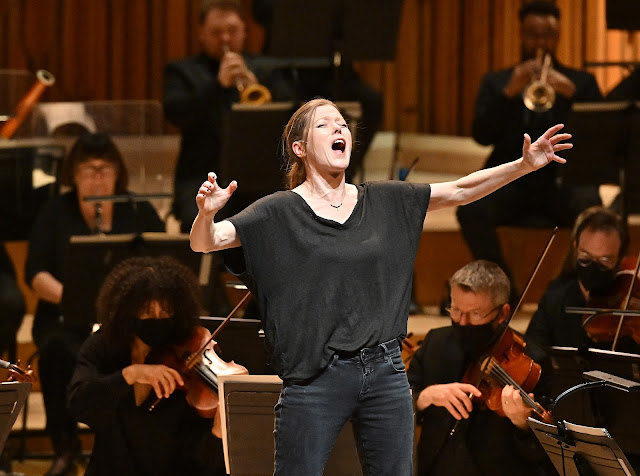
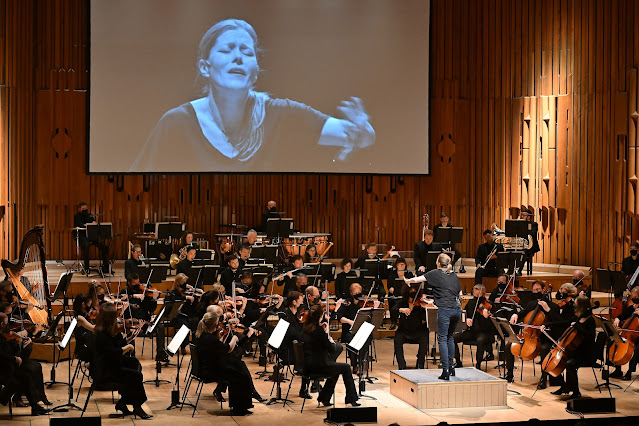
A darker performance might also have called into question the appropriateness of the pairing with Poulenc’s La Voix humaine. Here, to an unusual extent, Hannigan had taken to heart the word ‘humaine’. This was a glorious performance by the human voice, certainly, but equally so in terms of conducting and something approaching live filmed ballet, the two (or three) often fusing to form a greater ‘act’. Three live cameras proved in more than one sense a projection by ‘Elle’. Perhaps the orchestra itself was too, or Elle was imagining herself as conductor (or as Barbara Hannigan). Any initial scepticism concerning Hannigan’s conception of the work as a woman’s fantasy—perhaps this was simply what she might have said to someone from her past; perhaps there was no man at all—vanished, this viewer and listener entirely won over by the immediacy, commitment, and technical excellence of the performance, unsparing close-ups included. The film froze and Hannigan turned to the audience, continuing to act, when Elle told us of her attempts at suicide. Simple, yet startlingly effective.


The LSO, willing partners to Hannigan, Denis Guéguin, and Clemens Malinowski, proved precise, incisive, and affectionate without sentimentality. Where was the authorial voice, one asked? Was there more than one, or was there indeed one at all? Such questions emerged as both necessarily particular and more general, pertaining to what after all is, in some ways, little more (though no less) than recitativo accompagnato and to the heart of opera ‘itself’. The magic of Poulenc’s cadences and indeed of other harmonic progressions duly registered, lifting the everyday and its fantasies momentarily into that new realm we call the transcendental. Poulenc’s grand climax, almost paradoxically repeated yet convincingly so, on those final, tragic words, ‘Je t’aime’, reminded us, should we have needed reminding, that he, like his protagonist, knew how to put on a show. So too, likewise in the very best sense, did our performers this evening.

Sunday, 1 August 2021

First Night of the Proms – Hyde/BBC SO/Stasevska: Vaughan Williams, Poulenc, MacMillan, and Sibelius, 30 July 2021


Royal Albert Hall

Vaughan Williams: Serenade to Music
Poulenc: Organ Concerto in G minor
James MacMillan: When Soft Voices Die (world premiere)
Sibelius: Symphony no.2 in D major, op.43


Elizabeth Llewellyn (soprano)
Jess Dandy (contralto)
Allan Clayton (tenor)
Michael Mofidian (bass-baritone)

BBC Singers (chorus-master: Martin Fitzpatrick)
BBC Symphony Orchestra
Dalia Stasevska (conductor)


Cards on the table. Poulenc aside, I have not previously been a great fan of the music of any of the composers featured in this year’s First Night of the Proms. It does one good, though, to test one’s preferences and prejudices; in any case, this was a moment of return for which I wanted, even needed, to be present, almost irrespective of repertoire. Last year saw a few Proms at the end of the season, albeit with no audience. I was not in London for the summer of 2019, so it was not far off three years since I had lest ventured to the Royal Albert Hall. This was a lovely concert for which to return.


And what piece could be more apt as an opener than Vaughan Williams’s Shakespearean hymn to music? (Whatever my ambivalence toward some of Vaughan Williams’s output, I have loved this piece since first hearing it as a schoolboy.) Its London pedigree—premiered here in 1938 by Sir Henry Wood, for whose diamond jubilee as a conductor it was composed—made the Serenade to Music all the more apt. This was a performance imbued with delight from its opening chords, Vaughan Williams’s orchestration and later vocal writing resounding perfectly through the hall’s challenging acoustic. Dalia Stasevska’s direction, untroubled by drab English tradition, drew from the BBC Symphony Orchestra sonorities and languor it was difficult not to think of as in the line of Ravel, with whom the composer had studied three decades earlier. Stasevska’s shaping of contours and climaxes was spot on, permitting words and above all music to speak and sing for themselves. Especially memorable (for me) were duetting arabesques between Elizabeth Llewellyn and leader Igor Yuzefovich; the deep summons of ‘affections dark as Erebus’ by Michael Mofidian; Jess Dandy’s contralto call, ‘Music! Hark!’; and the final choral echo of Llewellyn’s ‘sweet harmony’, bathed in sweet orchestral warmth. There were no weak links, though, in a magical performance.


Also written in 1938 was Poulenc’s Organ Concerto, here given an excellent performance by Daniel Hyde, the BBC SO and Stasevska. The splendour of its opening is quite different in nature, of course, yet offered another fine Albert Hall moment. Registration was always well chosen for score and instrument alike. Hyde rightly played his part straight, as did strings whose imploring sweetness seemed to prefigure Poulenc’s later sacred music and even the Dialogues des Carmélites. Wagnerian harmonies were soon put to decidedly anti-Wagnerian use, posing questions rather than answers, Poulenc’s mock-Bachian gestures relishing the fairground of barely suppressed desire. For there was serious questing at the heart of this performance, whatever the masks Poulenc cunningly employed, wit and poignancy two sides of the same coin.


Co-commissioned by the BBC and Help Musicians, When Soft Voices Die, 
ames MacMillan’s setting of two poems by Shelley, emerged as a workable companion piece for the Vaughan Williams Serenade, using as it does four soloists and orchestra (no chorus). Performances were as committed and variegated as elsewhere, Llewellyn recalling the virtues of her Puccini roles. As for the piece itself, there was craftsmanship in MacMillan’s setting and no denying his taste in verse. Nevertheless, conservatism aside—Vaughan Williams and Poulenc seemed almost avant-garde by comparison—the overall sense was of anonymous proficiency.


Finally Sibelius, with whose symphonies I have long struggled. I shall not bore you with that now, other than to say this was the first performance both to convince and move me. Perhaps it was simply the right time for this music to come knocking on the door, but surely it was more than that: testament to another fine performance, flexible yet directed. by the BBC SO and Stasevska. It was striking that, even to a long-term sceptic, the opening of the first movement seemed to speak as if an old friend. Balletic lightness of touch recalled Tchaikovsky and, beyond him, perhaps more surprisingly, the orchestral writing of Mendelssohn. Not that that precluded the ardent and majestic where required, quite the contrary. Soon I could only wonder what my problem with this music had been. Pizzicato cellos and double basses in the second movement both picked up from the first and contrasted with it. Mendelssohn again came to mind as a processional forerunner, this time the Italian Symphony, though of course the music developed very much in its own, again not un-Tchaikovskian way. At any rate, rhetoric in performance seemed designed to be understood in terms of such inheritance. I am not sure I quite appreciated the movement’s lengths, but that is doubtless my problem; after all, some others still feel that way about Schubert. A third movement full of nervous energy, woodwind in its trio a necessary contrast in many ways, prepared the way for a finale that combined strong senses both of expectation and culmination. We were nearly there, that is, but there was some way yet to go. Stasevska imparted a wondrous sense of inevitability and ultimately triumph to this final leg of the journey. I may not quite be a Sibelius (or Vaughan Williams) convert yet, but greater curiosity has certainly been piqued. Just please do not ask me to sit through The Lark Ascending…

Tuesday, 19 February 2019

Trifonov/LSO/Rattle - Rameau, Ravel, Poulenc, and Jolas, 17 February 2019


Barbican Hall

Rameau: Les Indes galantes: Suite
Ravel: Piano Concerto in G major
Betsy Jolas: A Little Summer Suite
Poulenc: Les Biches: Suite
Ravel: La Valse

Daniil Trifonov (piano)
London Symphony Orchestra
Simon Rattle (conductor)


An evening of French delights from Simon Rattle and the LSO? Certainly, even if some – not necessarily those one might have expected – delighted more than others. First among not-quite-equals stood the earliest and latest works: a dance suite from Rameau’s Les Indes galantes and a parallel Little Summer Suite, composed in 2015 by Betsy Jolas for Rattle and the Berlin Philharmonic.


One silly, at least borderline offensive, newspaper ‘article’ and a host of tedious imitators notwithstanding, Betsy Jolas and her music have not recently been ‘discovered’. Her music deserves to be better known, more frequently performed; that, however, is a different matter entirely. The best response to such nonsense is to do what Rattle and the LSO did here: perform it – and perform it with such excellence. Seven vividly etched miniatures abound with echoes and correspondences, but does not all music when one is acquainting oneself with it? A few Messiaenesque harmonies, even the odd marriage of rhythm and instrumentation recalling Boulez’s Notations, speak not of overt ‘influence’ but perhaps of kinship – and what kinship. The scoring is much sparer than that for the latter. Although the orchestral forces are relatively large – certainly not so large as Boulez’s – the writing is more often ensemble-like. Four of the movements echo – consciously, I presume – Mussorgsky’s Pictures at an Exhibition. ‘Strolling’ movements – ‘Strolling away’, ‘Strolling about’, ‘Strolling under’, and finally, ‘Strolling home’ – they offer continuity and connection; a dark, menacing, almost nineteenth-century Russian bass suggests that honoured predecessor, before taking in Ligetian ‘Knocks and clocks’, responsorial (to that) ‘Shakes and quakes’ and similarly post-liturgical ‘Chants and cheers’, suspended, it seems, in musical mid-air. Succinct, witty, with a nonchalant sign-off suggestive, as noted in Jeremy Thurlow’s booklet note, of Debussy’s Jeux, one was left wanting more, yet admiring of the taste and judgement that had the music end when it did.


The very opening of Jolas’s suite had, at least in context, intriguingly echoed the chains of Rameau’s opening ‘Air pour les esclaves africains’. If Rameau’s (relative) battery of percussion veered in danger of the wearisome, taken out of dramatic context (for a review of a Munich performance of the entire work, click here), the relief of such enlightened Baroque music-making was eminently worth the slight wait. Each of the five movements danced with colour, grace, and a refreshing lack of doctrinaire ‘authenticity’. String vibrato was withdrawn at the opening of the ‘Air pour l’adoration du soleil’, but with good reason, that anticipation prefiguring sunrises in Haydn (both The Creation and The Seasons). The most celebrated number, the ‘Air pour les sauvages’, proceeded with splendid swing. It may be problematic to our postcolonial minds, yet it is far from unprogressive by Enlightenment standards. The closing Chaconne stood, rightly, worlds away from our one-sided notions of the dance, too influenced by Bach and his Romantic successors. The world of Les Indes Galantes, not unlike the Tiepolo frescoes for the stairwell of Würzburg’s Balthasar Neumann Residenz, present a Eurocentric world, to be sure, but one that attempts to embrace, even in small way to elevate, other cultures as surely as did Montesquieu and Voltaire. Trumpets and drums rejoiced, without effacing a tenderness that spoke both to Rameau’s age and our own. For all Rattle’s evident, longstanding belief in ‘period’ performance practice, this did not sound so very distant from the Rameau of forebears such as Raymond Leppard and Jean-François Paillard – and was all the better for such kinship.


Daniil Trifonov joined the orchestra, post-Rameau, for Ravel’s G major Piano Concerto. He appeared transfixed at the opening. Whose spell? Ravel’s or his own? It was unclear, as was much of the rest of his performance. There were delights aplenty in such pellucid pianism, but much of the first movement was indulgent, lacking line and, on occasion, connection with Rattle’s – and the LSO’s – able accompaniment. Harp-led washes of sound were duly gorgeous, likewise woodwind solos seemingly harking back to the Rameau we had just heard, but Trifonov appeared oblivious, pursuing instead, so it seemed, his own rêveries. The slow movement nevertheless proved bewitching. Here, Trifonov’s exquisite modulation of dynamics, silken touch, and above all, endlessly long-breathed phrasing were quite the match for Ravel’s not entirely un-self-regarding writing. There was here a chamber intimacy, pent up with emotion that never quite dared speak its name that revealed darker undercurrents than I can hitherto recall: a tragic Tombeau de Rameau composed before our ears. If only the first movement and an often oddly-balanced – at least from my seat – finale had matched such extraordinary music-making. Still, Trifonov’s closing exuberance reaped its own rewards – even if he again occasionally parted company from the orchestra. What I believe to have been his own transcription from Rachmaninov’s cantata, The Bells, made for a richly exploratory encore.


Poulenc’s Les biches, here given in suite form, has its admirers. Love much of Poulenc’s music though I do, I cannot help but find much of this ballet music somewhat thin gruel. At any rate, it is very much a period piece. Rattle and the LSO did what they could to point up Stravinskian correspondences, the opening of the ‘Andantino’ very much a case in point, likewise the Pulcinella-like writing of the ‘Final’. (If only the latter benefited from Stravinsky’s – and Pergolesi (attrib.)’s – concision. At its best, for instance in the opening ‘Rondeau’, there was a charming air of an imaginary vieille France: not Rameau’s, but why should it be? Ravel’s La Valse proved a similarly mixed bag: not, of course, as work, but as performance. Rattle certainly captured the dark strangeness of the opening, likewise a later, hallucinogenic nausea to the strings. I was less convinced, though, by the driven, almost vulgar quality to climaxes and other passages. A militaristic subtext? Perhaps; this, however, sounded close to Shostakovich. An odd performance, discontinuities to the fore, was played as well as one would expect; it certainly had me think.


Saturday, 24 March 2018

King's/Parry - Lenten Choral Music, 21 March 2018


Cadogan Hall

Palestrina: Stabat Mater
Tallis: Lamentations of Jeremiah (Part 1)
Poulenc: Quatre motets pour un temps de penitence
Lassus: Stabat Mater
Byrd: Ne irascaris, Domine; Civitas sancti tui
Brahms: Warum ist das Licht gegeben, op.74 no.2; Schaffe in mir, Gott, op.29 no.2

Choir of King’s College, Cambridge
Ben Parry (conductor)


Time was I could hear the Choir of King’s College, Cambridge almost any evening I chose, at least during term time. (If I remember correctly, Mondays were reserved for the mixed voice King’s Voices.) Not that I did, of course: I tended to go to my own chapel services more than others’; I also tended to prefer the services down the road at St John’s, less packed with tourists and thus seemingly less of a ‘concert’. I also preferred, in many ways, the more ‘Continental’ sound of St John’s to the typically ‘English’, whiter sound of King’s. Nevertheless, it was always quite an experience, first to set foot in that masterpiece of late Perpendicular Gothic – pay no heed to its cultured despisers, the same sort who will tell you that St Paul’s is a monstrous hybrid – gowned (and thus in slightly better seating than the non-Cambridge congregants), and to hear that celebrated choir, which, through radio and other recordings, I had known for so long before my time in the city that was essentially my home for fifteen years.


Ben Parry, an old boy from the choir and Assistant Director of Music at King’s, substituted for Stephen Cleobury, who was recovering from a bicycle accident. Parry certainly knew the choir and how to play to its strengths; it is difficult to imagine anyone having been disappointed, even in the almost diametrically opposed (to its echoing Chapel home) acoustic of Cadogan Hall. If some tempo choices, perhaps especially in the closing Brahms motets, seemed chosen more to help the boys than on ‘purely’ musical grounds, there is no great harm in that. The business of a collegiate (or other) choral foundation, after all, is far more than providing concert material; indeed, that is not really its business at all. Perhaps those works by Brahms, Warum ist das Licht gegeben? and Schaffe in mir, Gott, the latter a setting of part of Luther’s translation of the Miserere (Psalm 51), will have flowed more readily, especially in the relationship between different sections, and indeed have benefited from surer intonation, but there was much to enjoy, especially in their respective closing sections.


Two settings of the Stabat Mater, by Palestrina and Lassus, opened the concert’s two halves. Both were nicely shaded, without jarring (to my ears, without any) anachronism. The performance of the former imparted, when called upon, a real sense of ‘dec and can’ (decani and cantoris) antiphony in a different setting. It perhaps sounded closer to Monteverdi than often one hears, less ‘white’ than I had expected. Whatever the Council of Trent’s suspicion of the poem, I was struck by the essential simplicity, however artful, of the music and by the guiding role of words. Lassus’s setting came across as darker, a little more Northern perhaps. (He was, after all, Kapellmeister in Munich.) Within the context of an undoubtedly ‘Anglican’ performance, full of tone yet not too full, the sound seemed – or maybe it was just my ears adjusting – to become a little more Italianate as time progressed.


Poulenc’s Quatre motets pour un temps de penitence offer a challenge, not least intonational, to any choir, and are more often heard with older (female) voices. In these forthright performances, there was – rightly, I think – no great attempt made to ape other performing traditions, but there was nevertheless sometimes a harshness, even perhaps, in the closing ‘Tristis est anima mea’, an anger, we do not necessarily associate with the choir. The shading of ‘Vinea mea electa’ was intelligent, fuller than Anglican reputation would have you believe. If intonation proved far from perfect, especially in the opening ‘Timor et tremor’, nor should one exaggerate; one always knew where the music and indeed the text were heading.


The music of Tallis and Byrd is home territory for King’s – albeit here without the trebles. Naturally, in their absence, countertenors came more strongly to the fore. Parry wisely made no attempt to do too much in terms of word-painting in the Tallis; the words speak for themselves, and did so here especially on the Lenten cries for ‘Ierusalem, Ierusalem’ to return to her God. The two Byrd motets offered, for me, the highlight of the concert. Without a hint of blandness or routine, there was simply – or not so simply – that ineffable sense of ‘rightness’, of ease with the music, the composer’s recusancy notwithstanding. Music and words spoke freely, in greatly satisfying performances. As we heard in both, ‘Sion deserta facta est, Jerusalem desolata est.’ And yet, there was comfort to be had, if not in the wilderness and desolation of Jerusalems heavenly and earthly, then in their artistic representation – which is doubtless as it should be.


Saturday, 10 March 2018

Dialogues des Carmélites, Guildhall, 5 March 2018


Silk Street Theatre

Chevalier de la Force, First Commissary – Eduard Mas Bacardit
Marquis de la Force – Jake Muffett
Blanche de la Force – Lucy Anderson
Thierry, Second Commissary, M. Javelinot, Gaoler – Bertie Watson
Prioress, Mother Jeanne – Georgia Mae Bishop
Sister Constance – Claire Lees
Mother Marie – Emily Kyte
Second Prioress – Michelle Alexander
Carmelites – Eva Gheorghiu, Myramae Meneses, Victoria Li, Alice Girle, Siân Dicker, Ana Marafona, Isabelle Peters, Catherine White, Meriel Cunningham, Natalie Davies, Anne Reilly
Sister Mathilde – Lucy McAuley
Chaplain – Daniel Mullaney

Martin Lloyd-Evans (director)
takis (designs)
Robbie Butler (lighting)

Orchestra and Chorus of the Guildhall School of Music and Drama
Dominic Wheeler (conductor)


The Guildhall’s termly opera offerings have long tended to be more adventurous than those of the Royal Academy or Royal College when it comes to repertoire. In June, we shall have the mouthwatering prospect of a double-bill of Hindemith’s last opera, The Long Christmas Dinner, and Lennox Berkeley’s A Dinner Engagement. Poulenc’s Dialogues des Carmélites is probably as mainstream as I have heard here, with the exception of a fine Marriage of Figaro in 2013. I am not sure that the performance I heard marked the school’s greatest achievement, but there was nevertheless much to admire – and yes, the final scene did what it must when the nuns came before the guillotine, bringing tears to my eyes and a sense of redemption through grace.


The first act in particular seemed somewhat unsettled, the gentle – often deceptively so – flow of Poulenc’s orchestral writing often seeming to elude conductor Dominic Wheeler, and the cast seeming to have been encouraged to perform in a fashion more suited to Italian verismo. French opera more often than not presents a difficulty: not just in the language but in the style too. Perhaps the brashness of the orchestral sound and some decidedly odd balances were as much a matter of the difficult Silk Street acoustic as of anything else. Stravinsky came to mind, quite rightly, but it did not always seem quite the right Stravinsky, and he certainly would have required greater precision too. Fortunately, matters improved considerably in the second and still more the third acts: much better than the other way around! And it was good to have opportunity to see and to hear the opera in its proper three acts, rather than, as often the case, having a break part way through the second.


Martin Lloyd-Evans’s production worked well enough, although the balance or perhaps even opposition between naturalism and something more minimalistic, even symbolic, sometimes seemed arbitrary rather than productive. I have nothing against the opera being set when it ‘should’ be, but the danger then can be that it then comes to seem to be ‘about’ the French Revolution, which it really is not. There were some beautiful costumes from takis to look at. More to the point, his relatively sparse set designs achieved a good deal by suggestion – as well as possessing an aesthetic appeal of their own. A Carmelite convent is surely not in any case intended to be lavish. The true theme of the opera, Divine Grace, shone through just enough, if perhaps less consistently than it might have done.


The young cast had much to recommend it. Perhaps rather oddly, given their distinctly lesser roles, the men foten stood out as much as the women, Daniel Mullaney’s Chaplain and Eduard Mas Bacardi’s Chevalier and First Commissary both offering finely sung, dramatically considered performances. Perhaps the starring role on this occasion was that of Emily Kyte’s Mother Marie. We were reminded more than once, as much through acting as through vocal means, that not only does the opera has its roots in her telling of the story, but of her especially problematical role in the narrative. Lucy Anderson’s Blanche proved a little vocally wayward to start with, but once settled, proved well able to engage our sympathies. A nicely contrasted, yet strangely complementary, pair of prioresses, Old and New, came our way from Georgia Mae Bishop and Michelle Alexander. Choral scenes were well directed, scenically and musically, offering the necessary sense of a threatening and, yes, revolutionary backdrop.

Monday, 14 November 2016

Samling 20th Anniversary Concert, 8 November 2016


Wigmore Hall

Britten – A Charm of Lullabies, op.41: ‘A Cradle Song’; ‘The Nurse’s Song’
Warlock – My Sweet Little Darling
Schubert – Wiegenlied, D 498
Ives – The Children’s Hour
Schumann – Lieder-Album für die Jugend, op.79: ‘Marienwürmchen’
Poulenc – La Courte Paille; nos.4-7
Schubert – Licht und Liebe, D 352
Liszt – Tre sonetti di Petrarca, S 270/1: Sonnets nos 104, 47
Quilter – Five Shakespeare Songs (set 2): ‘It was a lover and his lass’
Britten – The Foggy, Foggy Dew; Soldier, won’t you marry me?
Schubert – Schwanengesang, D 957: ‘Kriegers Ahnung’
Schumann – Der Soldat, op.40 no.3
Wolf – Der Soldat I and II
Fauré – Les Berceaux, op.23 no.1
Poulenc – Bleuet
Barber – I hear an army, op.10 no.3
Liza Lehmann – Nonsense Songs from ‘Alice in Wonderland’: ‘Fury said to a Mouse’
Bolcom – Twelve Cabaret Songs: ‘Amor’
Brahms – O wüsst ich doch den Weg zurück, op.63 no.8; Alte Liebe, op.72 no.1
Barber – The Secrets of the Old, op.13 no.2
Copland – Twelve Poems of Emily Dickinson: ‘Going to Heaven!’
Schubert – Nachstück, D 672; Der Tages Weihe, D 763

 
Kiandra Howarth (soprano)
Kathryn Rudge (mezzo-soprano)
David Butt Philip (tenor)
Benjamin Appl (baritone)
Andrew Foster-Williams (baritone)
James Baillieu (piano)
Ian Tindale (piano)
Malcolm Martineau (piano)
James Garnon (actor)


The Samling Artist Programme has nurtured the careers of many a young artist, both singers and pianists (or, if you will, accompanists), gathering them together (apparently, gathering, collective, even assembly are possible translations of the Norse ‘Samling’) with an array of senior artists. Part of that programme is an annual showcase at the Wigmore Hall. For its twentieth anniversary, Samling Artists from 2000 (Andrew Foster-Williams) to 2016 (Kiandra Howarth) took the stage, joined by Malcolm Martineau (one of those senior artists or ‘Leaders’) and the actor, James Garnon. Thomas Allen, Samling’s Patron was to have joined the assembled company, but flu put paid to that, and thus to an ensemble from Sullivan’s Trial by Jury. I cannot comment on every single song, but hope to give a flavour of what was on offer in this particular showcase.


The programme traced the ‘seven ages of man’, prefaced by Garnon’s engaging reading from As you like it’s ‘strange eventful history’. Two songs from Britten’s A Charm of Lullabies (Kathryn Rudge and James Baillieu) opened ‘Infancy’, Baillieu’s piano making much of the harmonic affinity of the Blake ‘Cradle Song’ with the world of The Rape of Lucretia, Rudge captivating in the a cappella opening of ‘The Nurse’s Song’. Her mezzo-soprano voice here and elsewhere proved both rich and variegated of tone. The post-Mozartian simplicity of Schubert’s Wiegenlied was well captured by Kiandra Howarth and Malcolm Martineau, paving the way for ‘Childhood’. Benjamin Appl seemed not to come truly into his own until later in the recital. Although Ives’s The Children’s Hour was beautifully sung, he missed a certain lightness of touch. Four songs from Poulenc’s La Courte paille were more successful. They were shared between Howarth and Rudge, the former seemingly relishing a more absurdist side, the latter more seductive.
 

When we reached the stage of ‘The Lover’, David Butt Philip joined Howarth and Ian Tindale for Schubert’s Licht und Liebe. Tindale proved equally alert rhythmically and harmonically. The ardent quality of Butt Philip’s singing carried into an unapologetically Italianate rendition of Liszt’s first Petrarch Sonnet. Vocal passion was matched in Baillieu’s piano playing of that and the second, for which Howarth returned, to give a similarly dramatic performance. I cannot claim to care much for the music of Roger Quilter, but Rudge and Appl gave a charming performance.
 

A welcome change of mood – Britten folksongs are really not for me – came after the interval with ‘The Soldier’. Following a reading from Henry IV, Part I, Andrew Foster-Williams was heard for the first time, with Baillieu, in Kriegers Ahnung. A greater depth was immediately announced, carried into an especially commanding performance (now with Tindale) of Schumann’s Der Soldat, sadness and anger in compelling balance. Appl seemed much more at home in two soldier songs from Wolf’s Eichendorff-Lieder, using the words to excellent effect. Another highlight, not just of this section, but of the concert as a whole, came with the Rudge-Martineau performance of Fauré’s Les Berceaux, its sadness deeply felt. Honesty and integrity of feeling were equally apparent in Butt Philip’s Poulenc Bieuet. Stylish, never mawkish, he impressed just as much as he had in the very different music of Liszt. Much the same might be said of Foster-Williams, in Samuel Barber’s Joyce setting, I hear an army.
 

‘The Justice’ was missing the aforementioned Sullivan number, so was confined to a charmingly despatched Liza Lehmann song (Butt Philip/Tindale) and a cabaret song by William Bolcom: not my thing, I am afraid, although Howarth was very much in her element. Lugubrious Teutonophile that I am, I responded more warmly to ‘Old Age’ and Brahms. Foster-Williams and Bailliue gave an unexaggerated, deceptively straightforward performance of O wüßt ich doch den Weg zurück, Rudge and Martineau displaying depth to match that of the Fauré song in Alte Liebe. Rudge’s Barber song, The Secrets of the Old, captured the idiom perfectly: an equally fine performance, again well supported by Martineau. Much the same might be said of Howarth and Tindale’s sincere, aware Going to Heaven!  
 

Our revels now were ended, as the final Shakespeare reading reminded us. ‘Oblivion/Second Infancy’ opened with a fine performance of Schubert’s Nachtstück from Appl and Martineau. With beautiful vocal shading, Appl offered ample consolation for the misery of dotage. A heartfelt consecration of the day (Des Tages Weihes) concluded proceedings, with a well-matched performance form Howarth, Rudge, Butt Philip, Foster-Williams, and Baillieu. It seemed fitting to leave to the echoing strains of a Schubertiade.

Monday, 14 September 2015

Antonacci/Sulzen - Poulenc, 14 September 2015


Wigmore Hall


La Dame de Monte Carlo
La Voix humaine


Anna Caterina Antonacci (soprano)
Donald Sulzen (piano)


Quite an opening to my 2015-16 Wigmore Hall season! For this lunchtime concert, Anna Caterina Antonacci and Donald Sulzen performed the piano version of Poulenc’s La Voix humaine, preceded by his final, not dissimilar vocal work, La Dame de Monte Carlo. Both have texts by Cocteau; both are far less conventionally ‘melodic’ than one would expect from this most melodic of composers; both are monologues intended for Denise Duval, portraying women on the verge, at least, of breakdown.


La Dame de Monte Carlo is anything but an easy way in for a soprano. Antonacci was herself, or rather the woman whose persona she assumed, from the very outset, always very well supported – and more than that – by Sulzen. ‘C’est joli de dire: “je joue”. Cela vous met le feu aux joues et cela vous allume l’œil.’ It was a gamble indeed, and it paid off. Moreover, it did have our eyes light up, as she so seductively span out the end of the phrase. Likewise we saw her ‘feathers and veils’ (‘mes plumes et mes voiles’), or rather thought we did, as she raised her arm. There was no doubting the singing actress here. Pauses told as much as words, for instance after ‘Et ils m’accusent d’être sale, de porter malheur dans leurs salles, dans leurs sales salles en stuc.’ There were a sadness and a defiance here that spoke, in Cocteau’s words, of the ‘lamentable story of an old, abandoned, miserable floozy’, and yet went beyond what one fancied words alone might have accomplished. The final ‘Monte Carlo’, upon the woman’s resolution to throw herself into the sea there, was operatic in the very best sense, as was the dryness of the piano response. The French ‘sec’ inevitably sprang to mind.


The main course inevitably encompassed a wider variety of emotions. Initially seated next to a table, on which an orange telephone as stylish as her performance was placed, Antonacci was in character from the moment she sat down. The fascinating tonalities and almost Schoenbergian motivic development of the piano part set the scene, but there was no doubt whose show it was. ‘Tu me connais, je suis incapable de prendre sur moi’ had a splendid sense of irony, whether with respect to the character or the metatheatricality, all the more so since it was delivered with passion rather than irony. Ghosts from Poulenc’s past and present seemed to haunt the performance, although there was little of the carefree. Harmonies from Dialogues des Carmélites assumed new resonance, as did the common notion of fear: ‘Peur? Non, je n’aurai pas peur … c’est pire.’ It almost certainly was worse, since here there was no sign of Divine Grace. Again, the ‘Allô’ when Antonacci feared she had been cut off spoke of real fear, not something assumed. This was great acting as much as anything else. Even the downpour outside and consequent darkening of the light seemed perfectly timed for the ‘production’. And the speech-like writing proved beyond doubt, just as it would have done had she been singing Monteverdi, that recitative can be at least as expressive as aria. Audience reaction was as warm as one would have expected.

Thursday, 13 August 2015

Salzburg Festival (3): Karg/Martineau - Wolf, Montsalvatge, Duparc, Ravel, Hahn, Koechlin, Poulenc, and Barber, 11 August 2015


Mozarteum

Wolf – Kennst du das Land; Mir ward gesagst, du reisest in die Ferne; Mein Liebster singt am Haus im Mondenscheine; Mein Liebster ist so klein; Ich ließ mir sagen und mir ward erzählt; Ich hab’ in Penna einen Liebsten wohnen; Sagt, seid Ihr es, feiner Herr; In dem Schatten meiner Locken; Klinge, klinge, mein Pandero
Montsalvatge – Cinco canciones negras
Duparc – L’Invitation au voyage
Ravel – Cinq mélodie populaires grecques
Hahn – Lydé; Vile potabis; Tyndaris
Koechlin – Chanson d’Engaddi, op.56 no.1; La Chanson d’Ishak de Mossoul, op.84 no.8; Le Voyage, op.84 no.2
Poulenc – Voyage à Paris; Montparnasse; Hyde Park; Hôtel
Barber – Solitary hotel; Sure on this shining night

Christiane Karg (soprano)
Malcolm Martineau (piano) 
 

One of the most tiresome clichés of contemporary life, and the competition is stiff, is that of the ‘journey’. It perhaps reached its bathetic nadir – I say ‘perhaps’, since I cannot claim to have read the book – in the title of Tony Blair’s autobiography. (Yes, Tony: what really matters most about the invasion of Iraq is how it affected you and your ‘journey’.) How refreshing it was, then, to have an intelligently programmed recital which presented an array of different journeys, actual and anticipated, in excellent performances from Christiane Karg and Malcolm Martineau.


We began with Wolf and specifically with Goethe (not, one suspects, artists with whom our beloved ex-Prime Minister has spent much time). There was nothing of the warm up – how could there be? – to Kennst du das Land? Karg sang as if reaching out – not, I hasten to add, in the sense of a Blairite ‘journey’ – towards the land where lemons blossom, Martineau’s piano part offering Lisztian urgency. On the level of small detail – slightly lingering upon ‘Geliebter’, ‘glänzt’ whispered almost as Schwarzkopf were reborn – and the longer line, with all its increasing dramatic urgency, this seemed to me a model performance. Mir ward gesagt, du reisest in die Ferne, first of the Paul Heyse settings, sounded as continuation and foil in equal measure. The spirit of Chopin’s mazurka pervaded Mein Liebster singt am Haus im Mondenscheine, whilst performative wit, especially to the ending, brought smiles, inward and outward, in Mein Liebster ist so klein. Moving from Italy to Spain, Sagt, seid Ihr es, feiner Herr, sounded imbued with the spirit of the dance. Again, a knowing smile, visible and audible, characterised the final ‘Ach nein!’


Xavier Montsalvatge’s Cinco canciones negras proved a revelation to me: expressing the voice, it seemed, of a Catalan Poulenc. The habanera rhythm of the opening ‘Cuba dentro de un piano’ offers scope, fully realised, for rhythmic play with word endings. Karg and Martineau seemed equally in their element. Rhythmic flexibility and intriguingly ‘different’ harmonies were the order of the day in the ensuing ‘Rhythmus der Habanera’. Karg’s delicious pianissimo singing was the abiding memory of ‘Canción de cuna para dormer a un negrito’. The set reached a wonderfully lively conclusion in ‘Canto Negro’.


Duparc’s L’Invitation au voyage initiated a series of French songs in the second half, the performance striking just the right note of invitingly French post-Wagnerism. The varying moods of Ravel’s Cinq melodies populaires grecques were unfailingly captured, verbal detail impressively present yet unexaggerated. Piano rhythms were flexible where necessary, insistent where necessary. Reynaldo Hahn, I am afraid, is a composer to whom I am yet to respond; the three Etudes latines we heard seemed very well performed, but as music, I found them little more than pleasant. Charles Koechlin offered something far more interesting. Chanson d’Engaddi emerged very much with a personal ‘voice’, its spare quality leading one in, especially with such varied vocal colourings, to the Schoenbergian harmonies of La Chanson d’Ishak de Mossoul.
 

Poulenc is so often at his finest in song, and so he proved again here. Voyage à Paris plunged us immediately into a world of unmistakeably Parisian urbanity, Montparnasse offering a sad foil of solitude, hinting at the world of La Voix humaine: those harmonies, that tristesse… Hyde Park again made me smile: surely the point, whilst the passing time – a Parisian Marschallin, perhaps – of Hôtel cast its own melancholy spell. The programme concluded with two songs by Samuel Barber. Karg’s vocal shading and her understated sadness had Solitary Hotel linger in the memory for some time.

Tuesday, 3 June 2014

Dialogues des Carmélites, Royal Opera, 2 June 2014


Images: Stephen Cummiskey/Royal Opera House
 
 
Royal Opera House

Chevalier de la Force – Yann Beuron
Marquis de la Force – Sir Thomas Allen
Blanche de la Force – Sally Matthews
Thierry – Neil Gillespie
Mme de Croissy – Deborah Polaski
Sister Constance – Anna Prohaska
Mother Marie – Sophie Koch
M. Javelinot – John Bernays
Mme Lidoine – Emma Bell
Carmelites – Yvonne Barclay, Katy Batho, Tamsin Coombs, Eileen Hamilton, Anne Osborne, Deborah Peake Jones, Louise Armit, Andrea Hazell, Elizabeth Key, Kate McCarney, Deborah Pearce
Sister Mathilde – Catherine Carby
Mother Jeanne – Elizabeth Sikora
Chaplain – Alan Oke
First Commissary – David Butt Philip
Second Commissary – Michel de Souza
Officer – Ashley Riches
Gaoler – Craig Smith

Robert Carsen (director)
Michael Levine (set designs)
Falk Bauer (costumes)
Jean Kalman (lighting)
Philippe Giradeau (movement)

Royal Opera Chorus (chorus master: Stephen Westrop)
Orchestra of the Royal Opera House
Sir Simon Rattle (conductor)

 
This was a performance whose intensity increased almost immeasurably as the evening went on. That seemed to be as much a matter of the production as the conducting, of the singing as the orchestral playing, although there were, of course, exceptions. At any rate, the final scene proved devastating in its combination of abstraction and directness, the amplified (electronic?) guillotine notwithstanding. Robert Carsen’s staging, and in this case especially Philippe Giradeau’s movement, exemplary throughout, frame the action simply and without hysteria, as the equally exemplary ensemble thins out one by one – until the appearance of Blanche, to whom Constance reaches out from afar, and then… Yes, the opera veers dangerously close to sentimentality, and perhaps in some places crosses that boundary, but the frisson experienced near that boundary is part, though only part, of what Poulenc is about. Musically, the scene is not quite reducible to the ghost of Œdipus Rex, haunted by an earlier ghost of Gounod; it is, indeed, its own unforgettable self. And the other influences, Puccini, Mussorgsky, and Debussy amongst them, never overpower the ‘dialogues’ of the title, with their roots in a very French understanding of plainsong and religious life. It was not only in the final scene that music, staging, and performance came together very well indeed, but it was perhaps the finest example and of course the climax.

 
Mme de Croissy (Deborah Polaski) and Blanche (Sally Matthews)

If only Carsen’s understandable interest in the revolutionary crowd did not overpower some of the other scenes, this would be a great staging indeed; as it stands, Carsen’s divided attention seems to run along the lines of much (mis-)understanding of the opera. I do not wish to carp about the role played by the volunteer Community Ensemble, whose direction and performance deeply impressed, and whose achievement, some of its participants having experienced homelessness, prison, and long-term unemployment, can hardly fail to move and to cheer. But Carsen’s presentation tends to suggest that the opera is more ‘about’ the French Revolution than it really is. This is a drama about Divine Grace, a truth at least as often forgotten, or overlooked, as the similar truth about Parsifal, a work with which Poulenc’s opera would otherwise have little or nothing in common. There are moments, nevertheless, when the ensemble works wonders, perhaps above all acting as a human – or inhuman? – dividing line between Blanche and her brother, the Chevalier, when he visits her in the convent. Still, the loss is perhaps a price worth paying for the redemptive involvement and prospects afforded to members of the ensemble, who have also been invited to take part in a careers support programme by the Royal Opera House and its partner organisations (Streetwise Opera, Synergy Theatre Project, the Department for Work and Pensions, and the Royal Central School of Speech and Drama).


Mother Marie (Sophie Koch) at the centre
Sir Simon Rattle’s role in proceedings was impressive too – as one might expect from this conductor in French music. Rattle’s leadership of the Orchestra of the Royal Opera House, generally on very good form itself, refused to sentimentalise, taking the opera faster than some may have wished, but hardly offensively so and quite without the mannerisms that so often disfigure his readings of the ‘central’ Austro-German symphonic repertoire. And the big moments had great punch, the unanimity of orchestral and vocal ensemble alike quite remarkable. Poulenc once remarked that he did not want his music to be analysed but to loved; perhaps a better way to love it, though, is to accord it the dignity of some degree of analytical, as well as dramatic, thought.


Constance (Anna Prohaska) and other Carmelites
 

Sally Matthews’s performance of the central role was one which improved almost out of recognition as the evening went on. The first scene was troubled by thick vibrato and less than convincing French. It would be vain to contend that Matthews’s French diction or style ever truly convinced, but it became possible to leave to one side one’s doubts, as her dramatic sincerity won one over. Anna Prohaska made a wonderful foil as Constance: vivacious, pure and clean of tone, yet full of fun. In short, she simply ‘lived’ the character, convincing us that this was how she must be; it would be a pity if we were not one day to hear her Blanche. Deborah Polaski’s Old Prioress impressed through sheer strength of personality, even if, again, her French was far from beyond reproach. Her Erwartung did not seem so very far away at the end of the first act. Emma Bell was sensational as her replacement, ringing as true and clear as I have ever heard; indeed, this was the finest performance I have heard from her. Equally distinguished was Sophie Koch’s Mother Marie: a tricky, yet crucial role. Her inner demons and ultimate humanity were powerfully portrayed in a reading of vocal distinction too. Yann Beuron’s Chevalier de la Force made a headstrong and imploring mark, whilst Alan Oke captured better than I had previously encountered the ambivalent role of the Chaplain. Indeed, pretty much every one of the smaller roles was well taken, and the choral singing could hardly be faulted either. This was, then, whatever quibbles one might have had concerning aspects of Carsen’s production and the French diction, an excellent company effort, and should be lauded as such.